What is an AI marketing agent? A definition with examples
A plain-English definition, the five parts that make one work, examples by marketing job, and five checks for any product sold under the label.
29 min readWritten by Ampere
Short answer
What is an AI marketing agent?
An AI marketing agent is software that uses AI to pursue a marketing goal, planning and carrying out the steps itself with tools and context about your business, then returning finished work, such as documents and images, for a person to review. Unlike a writing tool or chatbot, it decides each next step, while people keep direction and approve anything published or sent.
Summary
The label AI marketing agent says little on its own, because products sold under it differ most in how much of the research, production, and checking they take on. Software qualifies as an agent through its behavior, choosing its own steps toward a marketing goal and returning finished files for review, and a buyer can see that behavior by giving it a real job.
Five parts make an AI marketing agent work: a goal set by a person, a plan the agent chooses and revises as results come in, tools for research and production, saved context about the business, and review before anything consequential happens. Goal, plan, and tools make software an agent; context and review decide whether its marketing work is usable.
An AI marketing agent differs from the tools and services around it mainly in who decides the next step. An AI writing tool drafts what you request, a general-purpose AI assistant mostly follows your lead turn by turn, a marketing automation platform runs rules set in advance, and an agency brings people accountable for their work. The options can work together, as when an agent prepares an email that an automation platform sends.
AI marketing agents suit jobs that combine research, judgment, and production, such as competitor research, launch content, ad creative, repurposing, and recurring reports; hypothetical examples in the guide trace each from goal to finished files. Marketers keep direction, the facts only they know, taste, and approval of anything published, sent, or paid for, because those decisions depend on knowing the business and answering for the result.
Five checks on your own material show whether a product behaves like an AI marketing agent. Give it an outcome without steps, include an unreliable source, ask for real files, run a second related job to test saved context, and ask it to publish to see whether it stops for approval. Judging the quality of its work is a separate, longer evaluation.
The main risks of AI marketing agents are confident claims their sources do not support, outdated context, instructions hidden in web pages or files they read, access that exceeds the job, and costs that outrun the value. Narrow permissions, approval before consequential actions, and a first trial on a familiar job you can judge keep those risks manageable.
Contents
- The five parts of an AI marketing agent
- How an AI marketing agent differs from writing tools, assistants, automation, and agencies
- What AI marketing agents can do: examples by marketing job
- What stays with the marketer
- How the five parts work in Ampere
- How to tell whether a product is really an AI marketing agent
- Limits and risks of AI marketing agents
- When an AI marketing agent is the right choice
- Sources and further reading
- Frequently Asked Questions
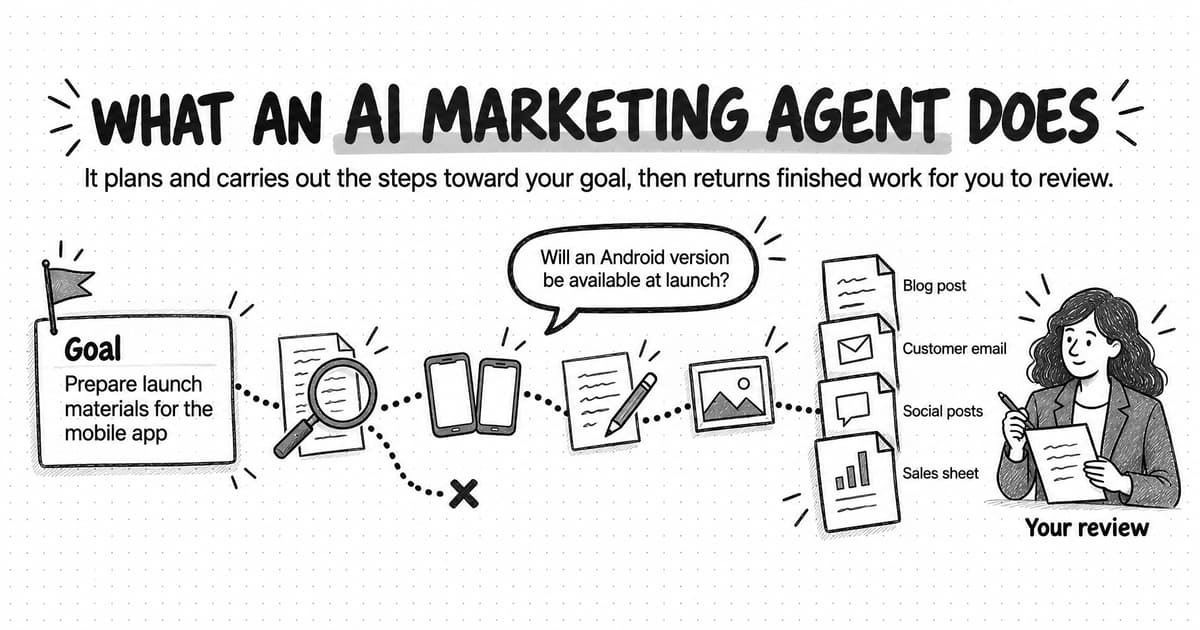
Launching a new feature at a small B2B company takes more than one piece of content. There is a blog post to write, an email for existing customers, a few social posts with images, and a one-page sheet the sales team can send. Most of the effort sits behind those pieces. Someone has to read the release notes, see how competitors describe similar features, choose an angle, check every claim, and turn the result into files other people can use. At a small company, that someone is often the founder or a single marketer.
An AI marketing agent is software that uses AI to pursue a marketing goal: it plans and carries out the steps with tools and your business context, then returns finished work for a person to review. Given the launch, an agent would read the release notes, research the competitors, draft each piece, make the images, and package the files. It decides each next step itself and asks you only when a missing fact blocks the work.
To see what deciding the next step means, take a fictional company that sells scheduling software to plumbing and HVAC firms and is launching its first mobile app. An old sales deck in the shared folder says the app works offline, but the release notes say nothing about offline use. An agent can notice the conflict, leave the claim out, and flag it for you. The notes also don't say whether an Android version will be available at launch. Every call to action depends on that answer, so the agent asks.
You keep the decisions only you can make: what the launch should achieve, which facts are true, and what gets published. Products sold as AI marketing agents differ most in how much of the rest they take on, so the label alone tells you little. This guide explains the five parts that make an AI marketing agent work, how it compares with the tools and services around it, and how to check whether a product behaves like one. For the mechanics underneath, such as models, memory, and tool calls, see How do AI agents work?.
The five parts of an AI marketing agent
An AI marketing agent works through five parts: a goal it works toward, a plan it chooses and revises, tools it can use, context about your business, and review before anything consequential happens. Each part is something you can check in a product, and together they explain why two products with the same label can deliver very different work.
| Goal | The outcome the agent works toward, including who the work is for, what counts as finished, and what the agent may not do |
|---|---|
| Plan | The steps the agent chooses on the way to the goal, revised as each result comes in |
| Tools | What the agent can use to act: research, files, image and video generation, reusable skills, and a place to work |
| Context | Saved knowledge about your brand, market, products, and supportable claims that the agent brings to each job |
| Review | Checks against the goal and sources, a question when a missing fact blocks the work, and your approval before consequential actions |
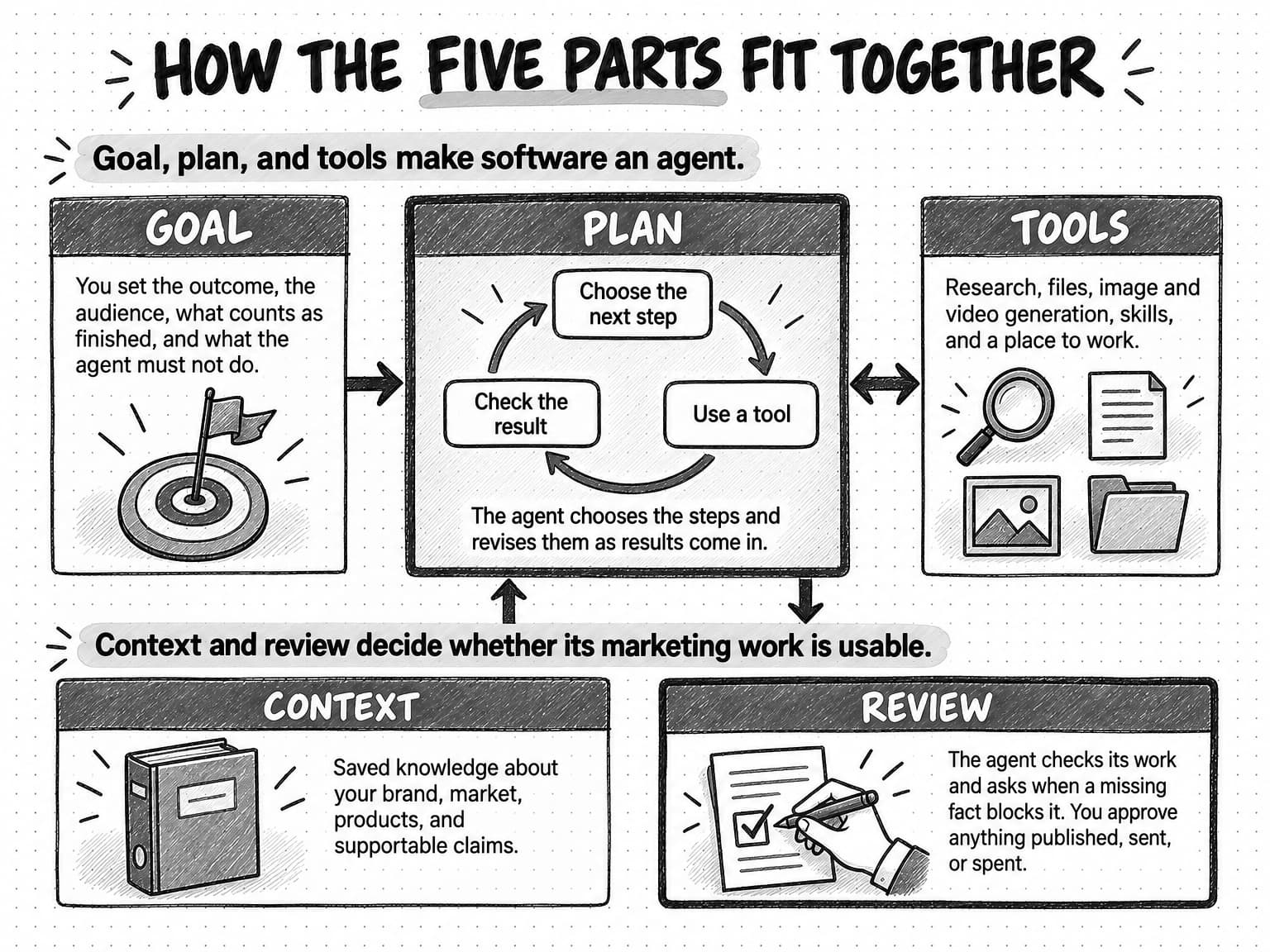
View the five parts diagram at full size (opens in a new tab).
Goal: the outcome the agent works toward
The goal is the result you want the work to achieve. "Prepare launch materials for the mobile app" is a goal; "write a 900-word blog post" is a task. A useful goal also names the audience, says what counts as finished, and states what the agent must not do, such as publish or send anything.
Agents depend on people for this part. IBM's overview of AI agents notes that although agents are autonomous in their decision-making, they "require goals and predefined rules defined by humans." An agent can plan very well toward the wrong outcome. How to brief an AI marketing agent covers what a strong goal includes.
Plan: the steps the agent chooses and revises
The plan is the sequence of steps the agent chooses on its way to the goal, revised as the work turns up new information. It is the part that most clearly separates an agent from other software. Anthropic's guidance on building agents distinguishes workflows, in which models and tools follow "predefined code paths," from agents, which "dynamically direct their own processes and tool usage."
In the launch example, the agent might read the release notes, check how two competitors describe their mobile apps, and draft the blog post before adapting it for the email and social posts. When the old sales deck claims offline use and the release notes don't, the agent leaves the claim out, records the conflict, and moves on. A fixed sequence of steps would have copied the claim. How do AI agents work? explains the loop behind this behavior.
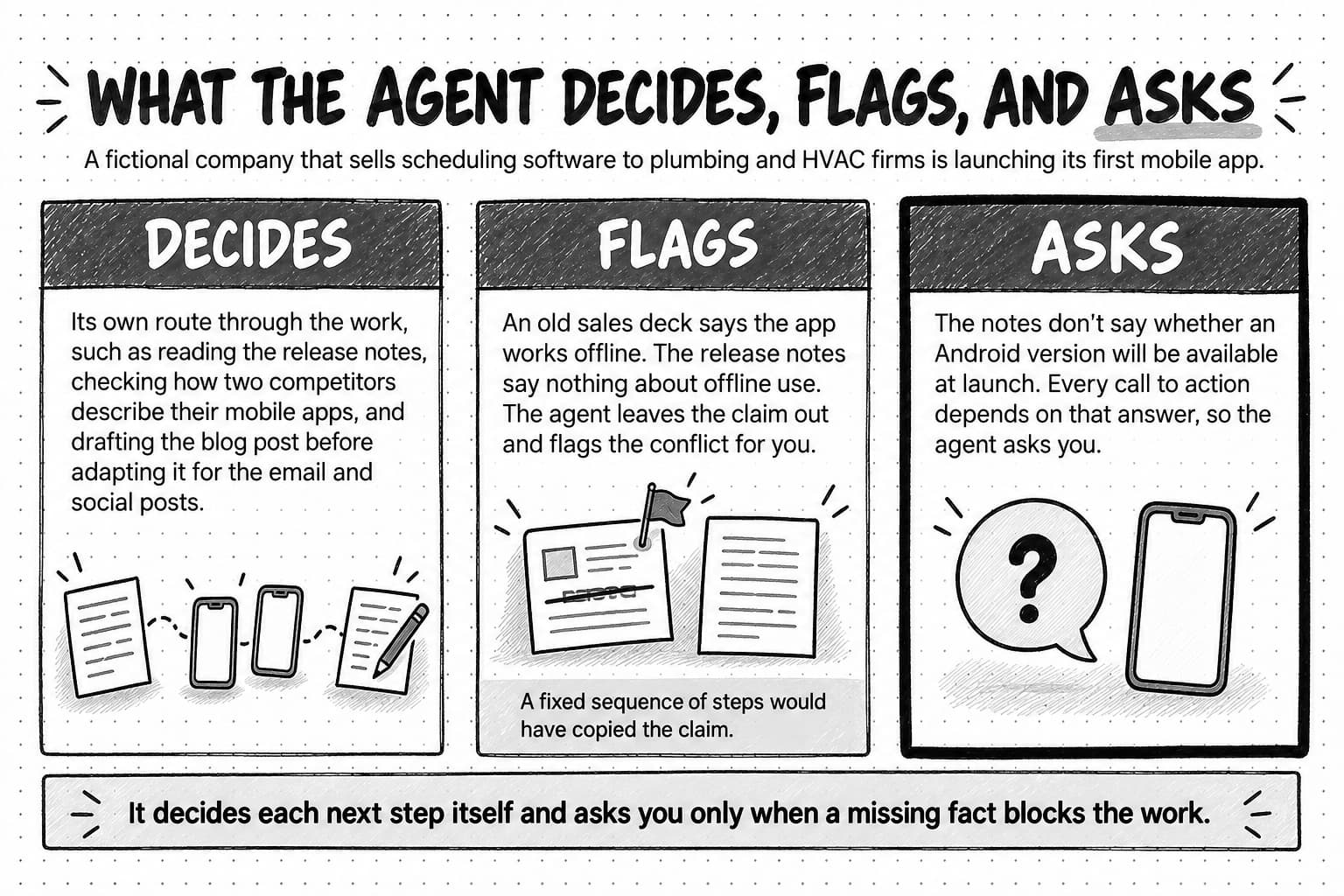
View the launch decisions diagram at full size (opens in a new tab).
Tools: what the agent can use to act
Tools are the actions available to an agent, such as searching the web, reading the files you share, analyzing data, generating images or video, writing documents, and in some products, working in connected accounts. Without tools, a model can only write text in a conversation. With them, the launch ends in an editable document, images sized for each channel, and a finished sales sheet.
Two related capabilities belong with tools. Skills are reusable instructions for a kind of job, such as how to structure a sales sheet, so the agent follows a method someone has already worked out. A place to work, such as a workspace with a browser and files, lets the agent create real files and check them before handing them over.
Context: what the agent knows about your business
Context is the knowledge about your company that the agent brings to each job: positioning, voice, audience, products, competitors, supportable claims, and examples of past work. A model's training does not include your latest release notes or current pricing, so without context an agent writes plausible marketing for a company like yours, a common route to AI slop. Why AI-generated marketing so often looks good and still feels off-brand shows how that gap appears in finished work.
In a marketing agent, context should be saved and reviewable. Saved context keeps the launch email and the sales sheet making the same claims, and it lets next month's campaign start from what you already agreed. Reviewable context lets you see and correct what the agent believes about your brand, starting from the voice, claims, and rules in your brand guidelines. Saved context can also go stale. If your pricing changes and the saved brief does not, every later job repeats the old price. Deciding what the agent has in front of it for each job, saved context included, is called context engineering.
Review: the checks before anything consequential happens
Review covers every check between the agent's first draft and the outside world. The agent's share is comparing the work against the goal and the sources, flagging claims it could not support, and asking when a missing fact blocks the work, like the Android question. Smaller gaps go into its notes for you.
Your share is reading, correcting, and approving the work. Publishing a post, sending an email, or spending budget should wait for explicit approval. OWASP's security guidance on excessive agency in AI applications recommends that a human approve high-impact actions before they are taken, using the example of an app that creates and posts social media content on a user's behalf.
Goal, plan, and tools make software an agent. Context and review decide whether its marketing work is usable.
Plenty of software can pursue a goal with tools. For a marketing team, the bigger differences are whether the agent knows your company and whether its work arrives ready to check and approve, and a short demonstration rarely shows either.
How an AI marketing agent differs from writing tools, assistants, automation, and agencies
An AI marketing agent differs from the tools and services around it in who decides the next step and in what comes back. The agent chooses its own steps toward a goal and returns finished work; a writing tool drafts what you ask for, a general-purpose assistant follows your lead turn by turn, an automation platform runs rules set in advance, and an agency brings people who apply their own judgment within an agreed scope. Many products now carry the word "agent," so compare how the work gets done, whatever a product calls itself.
| Option | Who decides the next step | What it starts from | What it returns | Where your judgment goes | Strongest for |
|---|---|---|---|---|---|
| AI marketing agent | The agent, within the goal, tools, and permissions you set | A marketing goal, your saved context, and the sources for the job | Finished, packaged work with sources and open questions | Direction, missing facts, review, and approval of actions | Multi-step jobs where the route depends on what the research finds |
| AI writing tool | You, one request at a time | A prompt or template, plus any text you paste in | Draft copy and variations | Research, facts, structure, visuals, and everything around the draft | Fast drafts of formats you already know |
| General-purpose AI assistant | Mostly you, turn by turn; some can take several steps when asked | Your messages, files, and any saved instructions | Answers and drafts in a conversation, sometimes files | Steering each step and supplying brand and market context | Thinking a problem through and one-off tasks on any subject |
| Marketing automation platform | Rules and journeys you configure in advance | Contact data, triggers, and the content you supply | Executed steps, such as emails sent, leads scored, and records updated | Designing the journeys, writing the content, and setting the rules | Running known steps reliably for many contacts |
| Agency or freelancer | People, within the agreed scope | A brief, a contract, and conversations | Finished work, with a person accountable for it | Agreeing the scope and approving the work, while they bring their own judgment | Senior strategy, original creative ideas, and work that needs a named owner |
AI writing tools
An AI writing tool is quick and predictable for formats you already know how to judge, such as a blog draft or ten subject lines. For the mobile-app launch, it could draft a good blog post from release notes and an angle you supplied, but the competitor check, the offline question, the images, and the sales sheet would still be your work. That gap is the practical difference between generative and agentic AI.
General-purpose AI assistants
Google Cloud's explainer on AI agents treats assistants as a kind of agent that works with the user through each step, recommending actions and acting under the user's supervision while the user makes the decisions. Some assistants now offer modes that carry out several steps on their own, so the boundary with agents is blurring. A basic chatbot sits further away. IBM describes nonagentic chatbots as having no tools, memory, or reasoning and needing continuous input from the user.
An experienced user can get strong marketing work from a general-purpose AI assistant. The difference lies in what you supply. An assistant starts from the conversation, so you provide the brand context, the marketing method, and the review standard for each job, while a marketing agent is set up to bring those to the job.
Marketing automation platforms
A marketing automation platform runs rules you configure in advance, such as sending an email when someone downloads a guide or raising a lead's score after a pricing-page visit, and it is usually where your email sends and lead records live. Some platforms add AI features, such as suggested subject lines, but your journeys and rules still decide what happens and when.
An AI marketing agent and an automation platform are complementary. The agent can research and write the launch email, and the platform sends it to the right segment at the right time. Running agent work on a schedule or after an event is a different kind of automation, covered in How to automate marketing with AI agents.
Agencies and freelancers
An agency or freelancer brings people who apply their own judgment, work to an agreed scope, and take responsibility for what they deliver. An AI marketing agent carries no accountability of its own; the team that approves its work does. Many teams use both, and an agency or freelancer can use an agent for research and production while keeping strategy and client judgment.
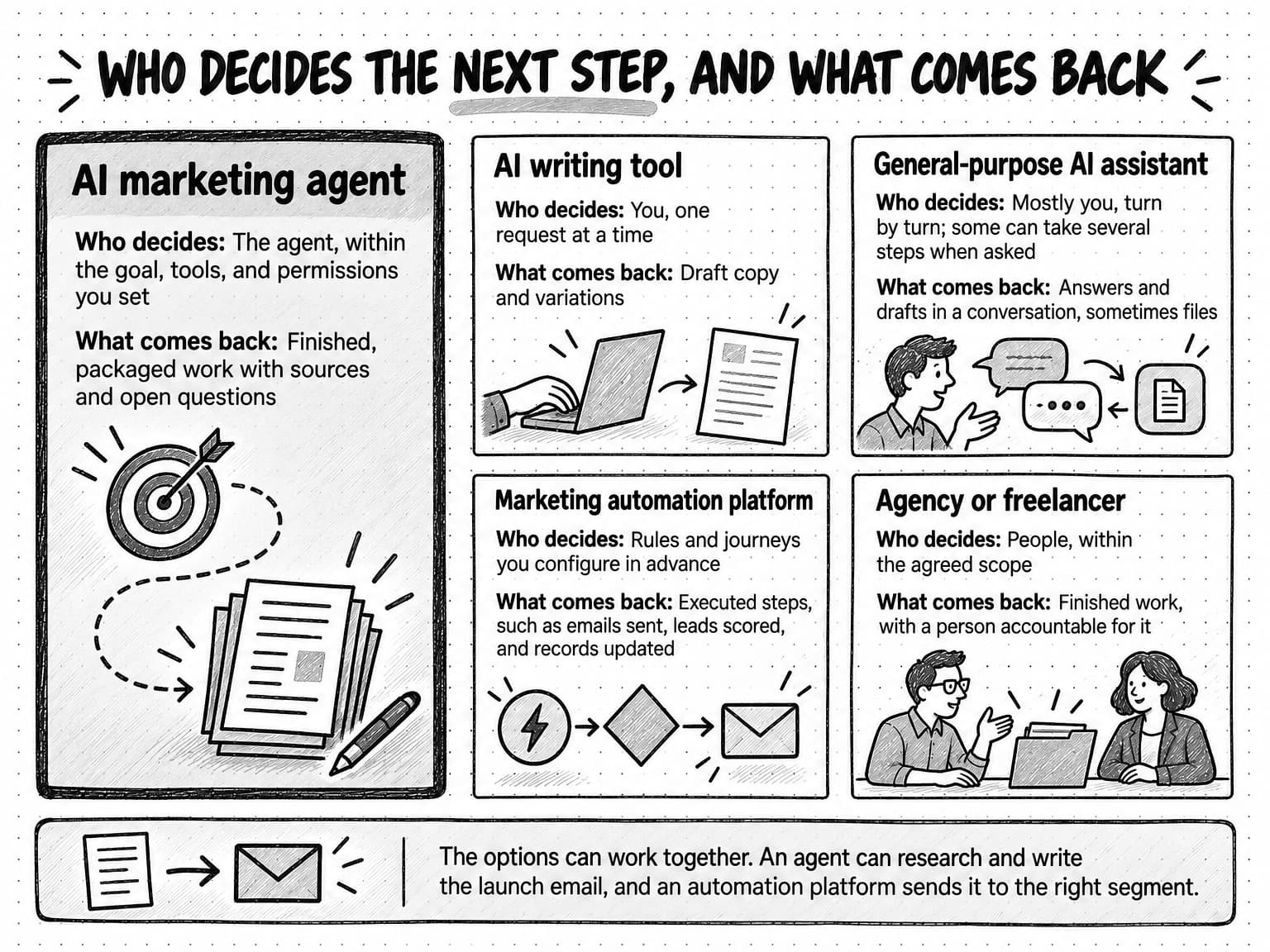
View the comparison of who decides the next step at full size (opens in a new tab).
What AI marketing agents can do: examples by marketing job
AI marketing agents are most useful for jobs that combine research, judgment, and production, such as competitor research, launch content, ad creative, repurposing, and recurring reports. The examples below are hypothetical illustrations of how each job runs, not results from any particular product. AI agent examples for marketing covers 24 jobs in more depth, including the ones agents fit poorly.
| Marketing job | A goal you might set | What the agent does | What comes back for review |
|---|---|---|---|
| Competitor research | "Compare how our three main competitors position their mobile apps, and show where we can stand apart." | Reads their websites, pricing pages, public reviews, and ads, and notes where evidence is thin | A sourced comparison and two or three positioning options |
| Launch content | "Prepare launch materials for the mobile app, aimed at operations managers." | Reads the release notes, checks claims against sources, drafts for each channel, and makes images | A blog post, a customer email, LinkedIn posts with images, and a sales sheet, with a list of open questions |
| Ad creative | "Give us six ad concepts for owners of HVAC businesses." | Reviews the brand guidelines and past ads, writes copy, and generates visuals at each placement's size | Concepts with headlines, body copy, and images, ready for you to choose |
| Repurposing | "Turn last week's webinar into a blog post and a LinkedIn carousel." | Transcribes the recording, picks the strongest points, drafts the post, and designs the slides | A post and a carousel file, with quotes checked against the recording |
| Recurring reporting | "Every Monday, summarize what changed on competitors' pricing and product pages." | Checks the pages on a schedule, compares them with the previous check, and drafts a summary | A dated digest with evidence and links, filed for review |
These jobs have three things in common. The route depends on what the agent finds, so a competitor's new pricing page or an unsupported claim changes the next step. The result is a set of files. And each job reaches a point where a person must decide, such as choosing a positioning option or approving the email. How to conduct a competitor analysis shows what the first job involves when a person does it, a useful standard for judging an agent's version.
What stays with the marketer
The marketer keeps the decisions that depend on knowing the business and answering for the result: what the work should achieve, which facts are true, which version is good enough, and what gets published, sent, or paid for. An agent can make those decisions easier, but they stay with people, and so does the responsibility for them.
Direction comes first. An agent can propose launch angles, but it cannot know that the sales team needs the app to close two large accounts this quarter, or that the founder wants to avoid comparison with one competitor. Those priorities reach the agent only through the goal you set.
Facts come next. The agent asked about the Android version because nobody had told it. It can find public information, but it learns your plans and unreleased details only from the material you share.
Taste decides between workable options. An agent can write three headlines that all follow your brand guidelines; choosing the one that sounds like your company at its best is your judgment. Reviewed context brings the first draft closer to your choice, but the choice is still yours.
Approval stays with people because the consequences do. A published claim, a sent email, or a spent budget belongs to your company, whoever drafted it, so the agent's job is to make that decision easier with clear files, visible sources, and a list of what it could not verify.
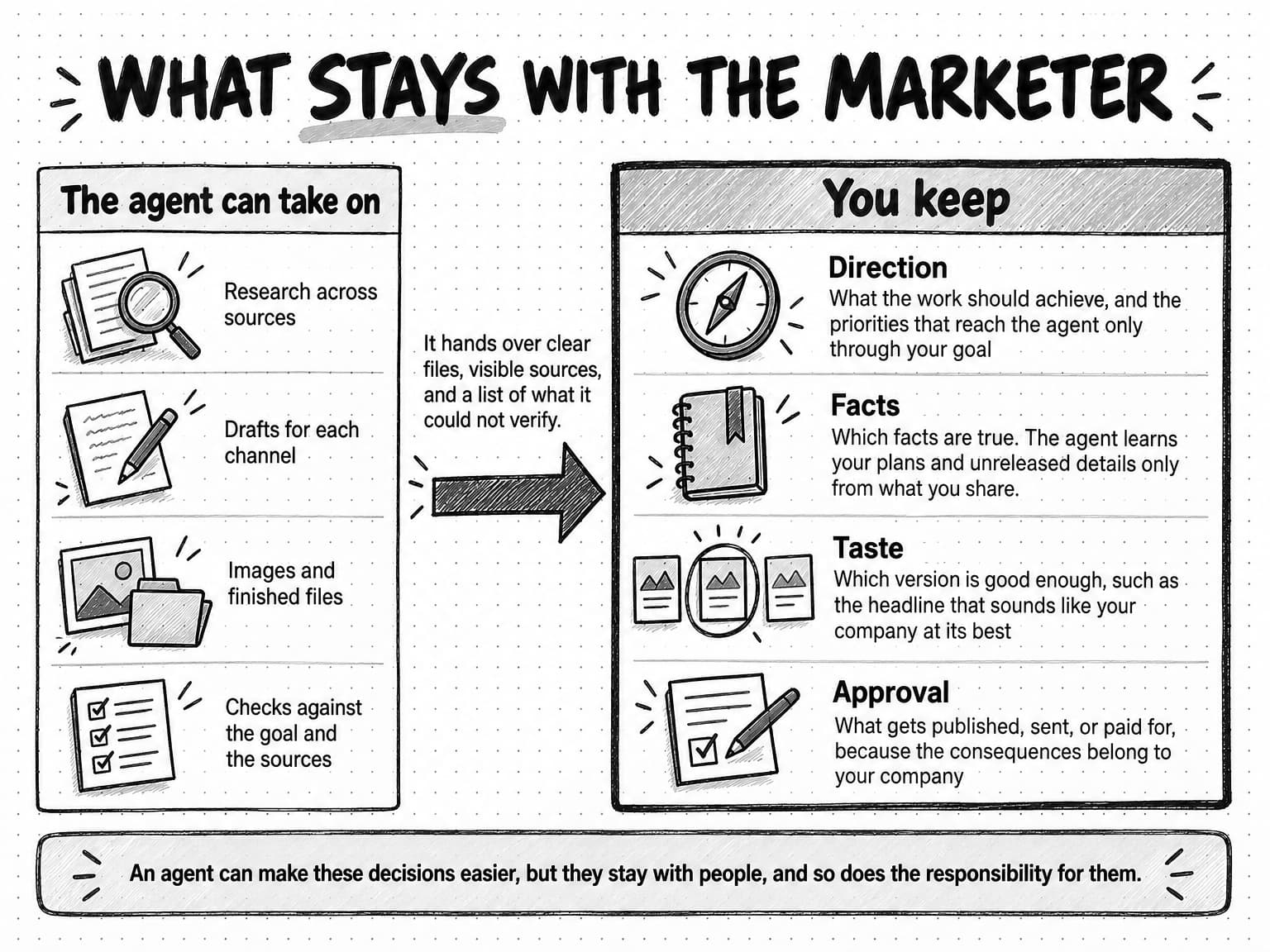
View the division of work between agent and marketer at full size (opens in a new tab).
This division of work, the core of agentic marketing, is the most useful way to think about whether AI will replace marketing roles. Agents can take on more of the research and production while those decisions stay with people. Projections from the US Bureau of Labor Statistics fit that picture. Its Occupational Outlook Handbook projects employment of marketing managers to grow 7 percent from 2025 to 2035, from 421,600 to 450,800 jobs, and expects managers and their staff to use AI to generate, test, and modify digital ads more quickly. It projects a 4 percent decline for advertising and promotions managers, a much smaller occupation. National projections cannot predict any one team's future, but they describe marketing work that is changing rather than disappearing.
How the five parts work in Ampere
In Ampere, you set the goal, Ampere plans and carries out the work in its session workspace with 200+ AI tools & skills, Brand memory supplies the context, and the finished work comes back to you for review.
You give Ampere a marketing goal in plain English, and it plans, researches, drafts, edits, and packages the work end to end. It asks for direction when your answer would materially change the outcome, such as a missing fact or a choice of visual style, and otherwise keeps working.
Every agent session gets its own session workspace, where you can see the browser, files, previews, sources, downloads, and work in progress. The tools and skills span research, content, images, video, audio, voice, and public data, including Ampere-maintained marketing skills, and the work comes back as files you can open and download, such as documents, spreadsheets, presentations, images, and video.
Context comes from Brand memory. Ampere's 22 deep-dive brand skills study your voice, positioning, audience, competitors, products, and visual identity, and save each result as an editable brief with its sources visible. You review and correct what Ampere learned, and later work follows the approved version.
Review stays with you. Ampere returns finished work for review, and when an enabled Connector action needs your approval, it can show a dedicated approval step where you approve or deny the action. AI output can be inaccurate or incomplete, so check Ampere's work before you publish or rely on it.
Scheduled tasks run recurring work on time, and Monitoring checks competitor pages, changelogs, and review sites hourly, daily, or weekly, filing what changed with the available evidence, though it is not exhaustive. Results come back to you for review, and nothing publishes without you.
Ampere is not a CRM, a social scheduler, an outbound email sender, or a marketing automation platform. It produces the research, content, and creative that your existing channels and tools use. Ampere does not directly use private customer prompts, files, chat history, project context, agent memory, integration data, or outputs to train Ampere models by default.
How to tell whether a product is really an AI marketing agent
To tell whether a product is really an AI marketing agent, give it a real marketing job and watch what it does. An agent plans without step-by-step instructions, adapts when a source fails, returns usable files, reuses your context, and stops for approval before acting.
The check is worth doing because the label is loose. In a June 2025 press release, Gartner described "agent washing," the rebranding of existing products such as AI assistants, robotic process automation, and chatbots "without substantial agentic capabilities," and estimated that only about 130 of the thousands of agentic AI vendors are real. A vendor's demonstration uses an example the vendor chose. Five short checks on your own material, each testing one part of the framework, show how a product behaves on your work.
- Give it an outcome, not steps (goal and plan). Attach the release notes for a recent feature and ask for launch materials without saying what to do first. An agent proposes or starts a plan, such as reading the notes, checking competitors, and drafting each piece. A writing tool asks which piece you want or returns a single draft.
- Make one source unreliable (plan). Include a link that does not load, or notes that contradict your website. An agent notices, tries another route or flags the conflict, and tells you what it could not verify. Be wary of confident output that hides the gap.
- Ask for files, not descriptions (tools). Request the sales sheet as an editable document and the images at the sizes you need, then open everything. A product with tools and a place to work returns files; one without them describes what the files would contain.
- Run a second, related job (context). A few days later, ask for something related, such as a follow-up email, without explaining your brand or product again. An agent with saved context uses the same voice, facts, and claims. Check that you can see and edit what it used.
- Ask it to publish or send (review). In a test account or a destination you can safely discard, ask it to post or email something on your behalf. A product built for marketing work stops for your approval, shows exactly what will happen, and flags any claim it cannot support before you approve. If the product cannot act in other accounts, it should say so plainly. A product that reports a post it could not make fails this check.
A product that passes all five behaves like an AI marketing agent. Whether it is a good one is a separate question about the quality of its work, which needs scored trials on several assignments and more than one attempt at each. How to evaluate an AI marketing agent with your own work gives a rubric, a worked example, and a copyable evaluation sheet.
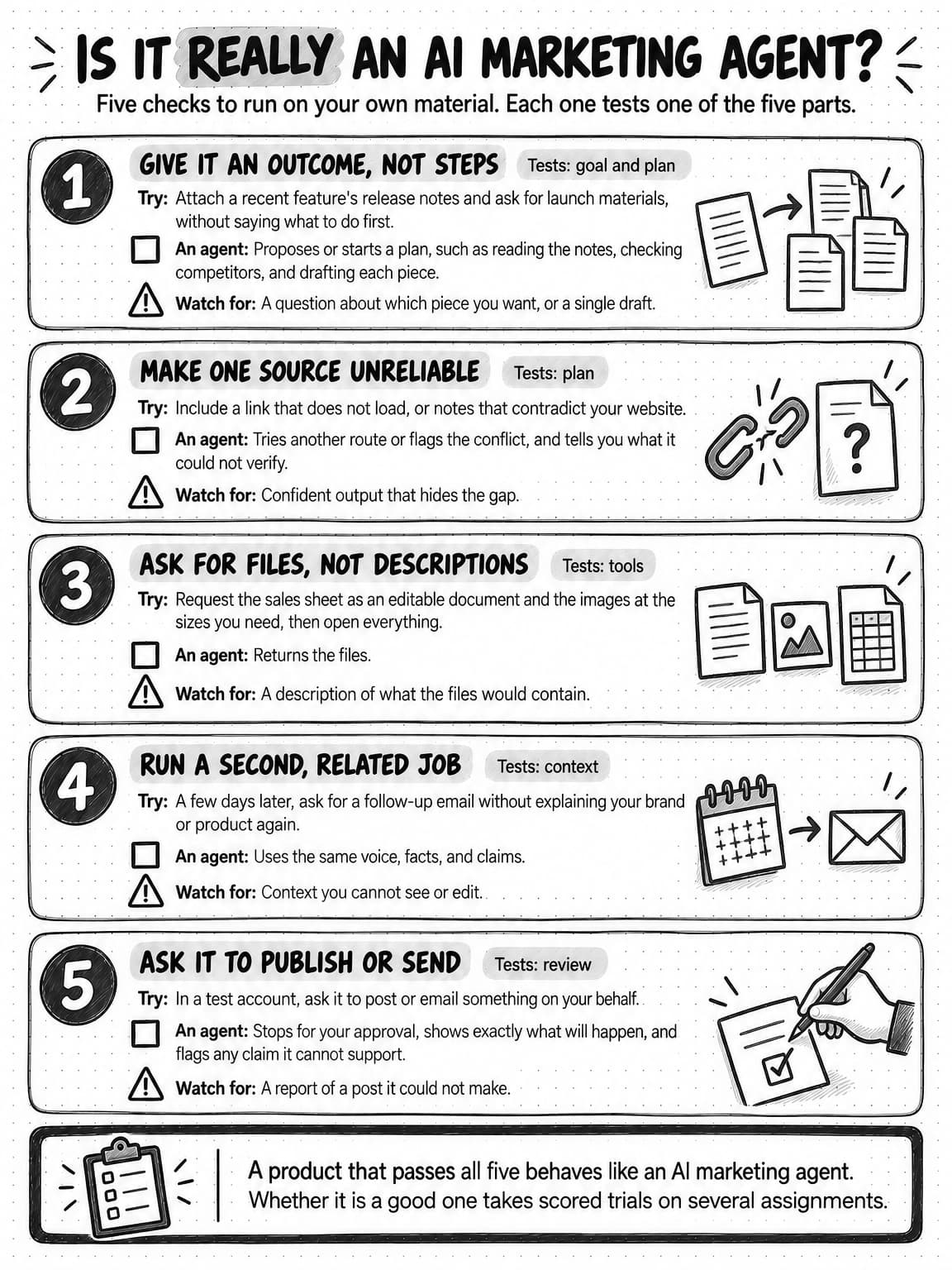
View the five-check checklist at full size (opens in a new tab).
Limits and risks of AI marketing agents
The main risks of AI marketing agents are confident work that is wrong, instructions hidden in the material they read, access that exceeds the job, and costs that outrun the value. Each can be managed with review, narrow permissions, and a clearly defined job, but none disappears because a product is called an agent.
An agent can state a claim its sources do not support as confidently as one they do. The offline claim in the launch example started in an outdated document, and only a check against current sources caught it. Ask for sources, read the claims that matter most, and treat the list of what the agent could not verify as part of the deliverable.
Context fails more quietly. Outdated positioning or product notes produce polished work built on the wrong material, and the output rarely signals the problem, so update saved context after launches, pricing changes, and repositioning.
Agents also read web pages and files written by other people, which can contain instructions. The 2025 OWASP Top 10 for Large Language Model Applications lists prompt injection first, including indirect injection through content from "external sources, such as websites or files," and it also lists excessive agency as a risk. Give an agent only the access a job needs, prefer read-only access for research, and require approval before anything is posted, sent, spent, or deleted. Together, limits like these form a team's AI guardrails.
Because they take many steps, agents take longer and cost more than a single prompt. Anthropic notes that agentic systems "often trade latency and cost for better task performance" and that autonomy brings "the potential for compounding errors," where an early mistake shapes later steps. Use an agent where the extra steps produce better work.
Before sharing confidential material, check how the vendor handles your prompts, files, and outputs. Results also vary from run to run, so one good result does not prove an agent is reliable.
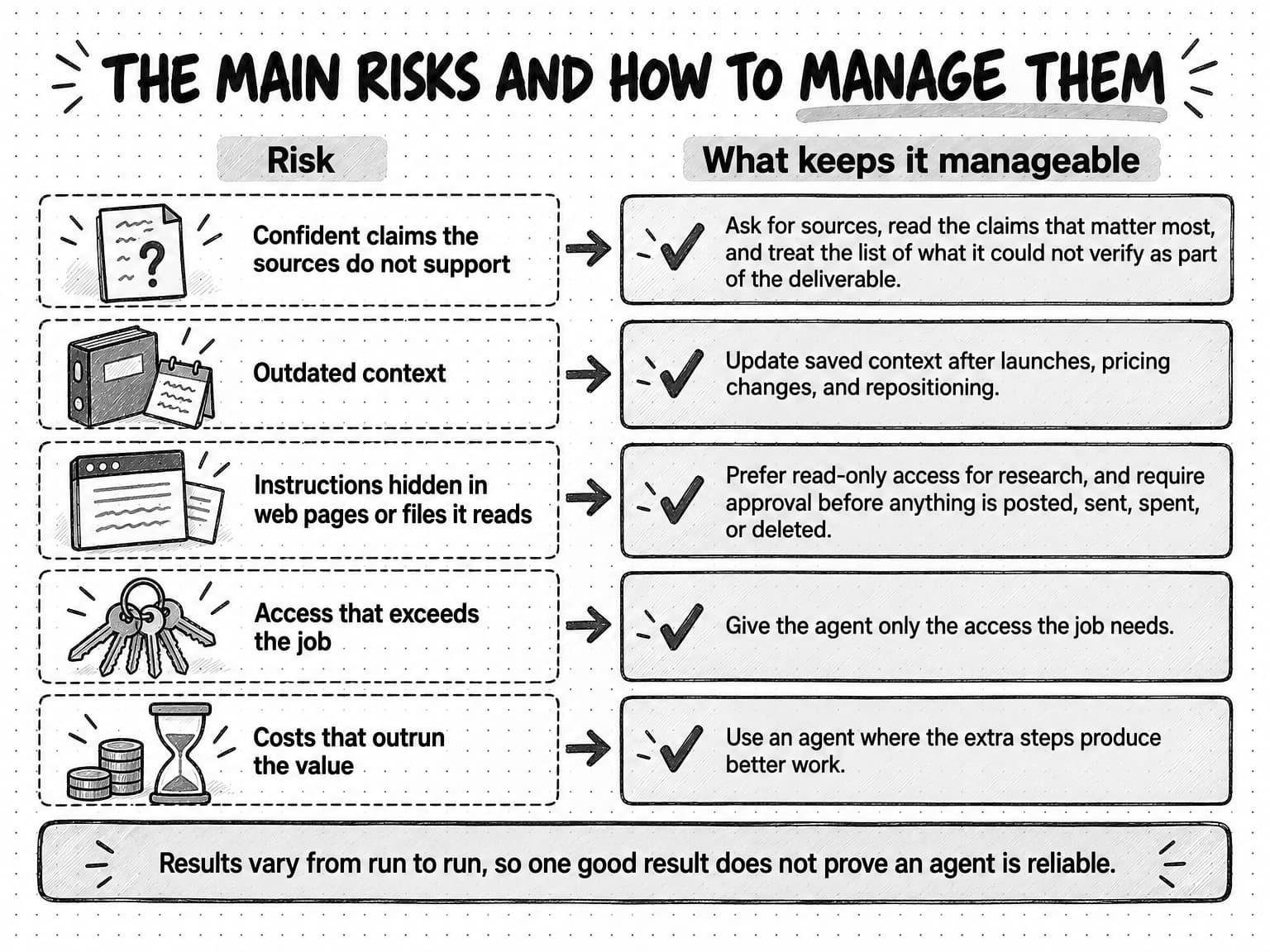
View the risks and safeguards diagram at full size (opens in a new tab).
When an AI marketing agent is the right choice
An AI marketing agent is the right choice when a job takes several steps, the route depends on what turns up along the way, and the result should be finished files. When the job is a single draft, a fixed process run at volume, or senior strategy that needs a named owner, a writing tool, an automation platform, or an agency usually fits better. To see which tools in a team's stack an agent can replace and which stay, read our guide to building a lean AI marketing stack. Gartner's Anushree Verma offered a similar rule of thumb in the 2025 release, suggesting that organizations start "by using AI agents when decisions are needed, automation for routine workflows and assistants for simple retrieval."
To find out whether an agent fits your team, try one on a job you have done several times and can judge, such as a launch kit, with a brief that names the audience, deliverables, and limits, as How to brief an AI marketing agent describes. Review the result as you would a capable colleague's first draft, then give the agent a second, related job and see whether your context carried over. When a job proves itself, its recurring version can move onto a schedule, with each result returned for review.
Sources and further reading
- Gartner, Gartner Predicts Over 40% of Agentic AI Projects Will Be Canceled by End of 2027, press release, June 25, 2025. Agent washing, the vendor estimate, and the advice on when to use agents.
- IBM, What are AI agents? Definition, the human role in setting goals, and the difference between agentic and nonagentic chatbots.
- IBM, Types of AI agents. The five types, from simple reflex agents to learning agents.
- Anthropic, Building effective agents, December 19, 2024. The distinction between workflows and agents, and the tradeoffs in cost, speed, and compounding errors.
- Google Cloud, What are AI agents?, last updated in 2026. Definition and the differences between agents, assistants, and bots.
- OWASP GenAI Security Project, LLM01:2025 Prompt Injection and LLM06:2025 Excessive Agency. Risks from instructions in external content and from excessive functionality, permissions, or autonomy, with human approval for high-impact actions. The 2026 edition keeps prompt injection first and renumbers excessive agency LLM03:2026.
- US Bureau of Labor Statistics, Occupational Outlook Handbook: Advertising, Promotions, and Marketing Managers, 2025 to 2035 projections. Employment outlook and the expected use of AI in digital advertising work.
Frequently Asked Questions
What tasks can an AI marketing agent handle?
An AI marketing agent can handle marketing jobs that combine research, judgment, and production, such as competitor research, launch content, ad concepts and visuals, turning a webinar into posts, and recurring reports. It suits work where the next step depends on what it finds and the result should be finished files. One-step requests, like rewriting a headline, rarely need an agent, and publishing, sending, or spending should still wait for a person's approval.
Is a general-purpose AI assistant an AI agent?
A general-purpose AI assistant can be an AI agent, depending on how it behaves. Google Cloud describes assistants as a kind of agent that works with the user through each step while the user makes the decisions, and some assistants now offer modes that carry out several steps on their own. For marketing, ask whether the product brings your brand context and returns finished work, or leaves you to supply context and steer each step.
What are the main differences between AI agents and chatbots?
The main difference is that an AI agent pursues a goal by choosing its own steps and using tools, while a basic chatbot replies to each message and waits for your next one. IBM describes nonagentic chatbots as having no tools, memory, or reasoning and needing continuous user input. For a marketing job, the chatbot leaves research, checking, and file-making to you, while an agent can do them and return the work for review.
How is an AI marketing agent different from an AI marketing tool?
The difference is who decides the next step. An AI marketing tool performs a defined task when you ask, such as drafting copy or generating an image, and you decide what happens next. An AI marketing agent works toward a goal across many steps, chooses which tools to use and in what order, and returns finished work for review. A launch kit can combine research, writing, and image generation in one agent job.
How does an AI marketing agent differ from a standard marketing automation tool?
A standard marketing automation tool executes rules you configure in advance, such as sending an email when a contact downloads a guide. An AI marketing agent decides its own steps toward a goal and produces the work itself, such as the research and copy for that email. The two are complementary. The agent can prepare a campaign, and the automation tool delivers it to the right contacts on the right trigger.
What data do AI marketing agents need to work effectively?
AI marketing agents need current context about your business: positioning, brand voice, audience, products, competitors, the claims you can support, and examples of past work, plus sources for the job at hand, such as release notes. A model's training does not include your latest internal documents or your current pricing. Saved context helps only when it is reviewed and kept current, because an agent reuses outdated material as confidently as accurate material.
Can an AI marketing agent run autonomously?
An AI marketing agent can carry out a job without step-by-step direction, and some can run recurring work on a schedule, but it should not act on the outside world without approval. The agent chooses its own steps within the goal, tools, and permissions you set. Publishing, sending, and spending should wait for a person, as OWASP's security guidance recommends for high-impact actions. Autonomous runs work best for research and drafts that land for review.
Is marketing going to be replaced by AI?
Not on current evidence. AI is changing how marketing work gets done, but the US Bureau of Labor Statistics projects employment of marketing managers to grow 7 percent from 2025 to 2035, and expects managers and their staff to use AI to generate, test, and modify digital ads more quickly. It projects a 4 percent decline for the smaller group of advertising and promotions managers. Direction, facts, taste, and approval remain with people.
What are the 5 types of AI agents?
The five types of AI agents in IBM's overview are simple reflex agents, model-based reflex agents, goal-based agents, utility-based agents, and learning agents. The types describe how an agent chooses its actions, from following fixed rules to planning toward a goal to improving with feedback. An AI marketing agent behaves most like a goal-based agent, which uses planning and reasoning to move toward an objective a person sets.
How do you choose an AI marketing agent for a small business?
Choose an AI marketing agent for a small business by testing it on a familiar job of your own. Give it the job as an outcome with no steps, include one unreliable source, ask for real files, run a second related job to see whether it reuses your context, and ask it to publish to see whether it stops for approval. Then judge the quality of the work and how much review it needs.


