What is an agentic workflow? Patterns and marketing examples
An agentic workflow lets AI work through a job in steps, checking and revising along the way. Here's how those steps can be arranged, a marketing illustration of each arrangement, and where a person should check the work.
29 min readWritten by Ampere
Short answer
What is an agentic workflow?
An agentic workflow is a process in which AI models complete a job in several connected steps, such as researching, drafting, checking, and revising, instead of answering in one pass. People can design the route in advance, or an AI agent can choose it as it goes. A few common patterns describe how the steps are arranged, and a person should check the work where mistakes get expensive.
Summary
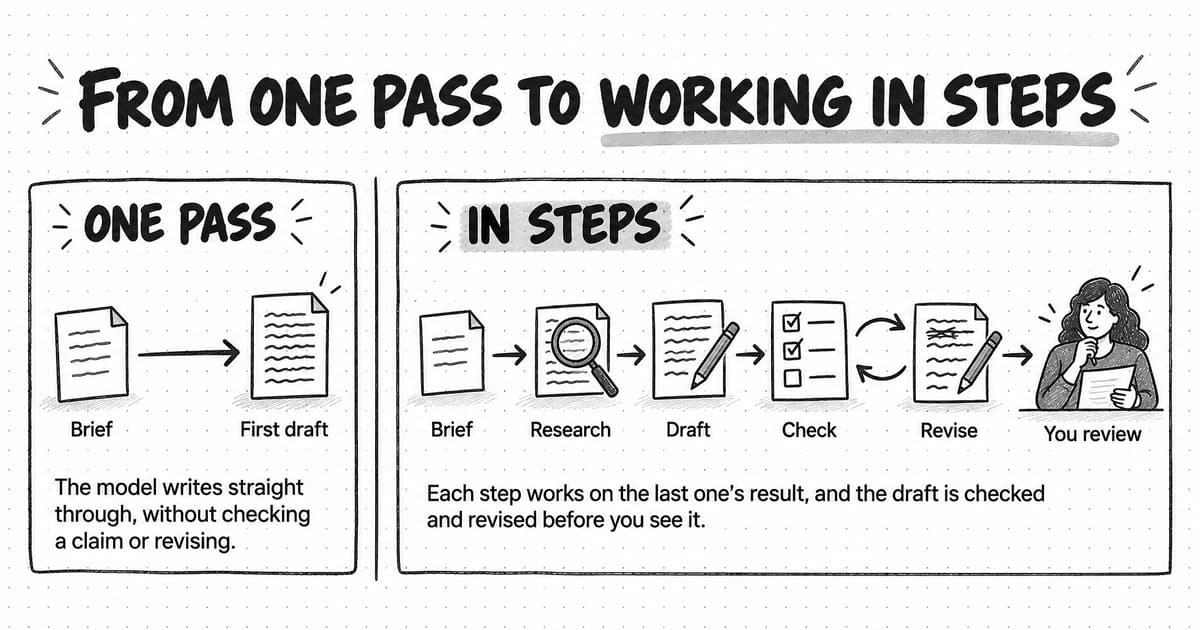
An AI model asked for finished work in one pass writes straight through, without stopping to look up a source, check a claim, or revise. An agentic workflow breaks the job into stages instead. Broadly, the term covers everything from a fixed sequence of model steps to an agent choosing its own route; in Anthropic's narrower usage, a workflow is only the fixed-route side, the opposite of an agent.
Five common patterns describe how an agentic workflow's steps can be arranged: chaining steps in a fixed order, routing each input to the right handling, splitting independent work and merging it, delegating subtasks from a lead model, and critiquing drafts against criteria until they pass. A table pairs each pattern with a marketing illustration, the point where a person checks, such as approving an outline before drafting, and the kind of job it suits.
Andrew Ng's four agentic design patterns from 2024, reflection, tool use, planning, and multi-agent collaboration, describe what a model does rather than how the steps are arranged. In coding-benchmark results Ng's team analyzed, an older model in an iterative loop could score higher than a newer model working in one pass. Ng found reflection and tool use more reliable than planning and multi-agent collaboration.
People should check an agentic workflow where a mistake becomes expensive to undo, often on the plan before production and on the finished work before it ships. Common failures are errors that compound across steps, loops that don't stop, costs that outgrow the job, handoffs that lose the brief, and self-checks without outside evidence; gates, revision caps, and complete briefs limit the damage.
The simplest structure that does a job reliably is usually the right one: a fixed workflow when rules can handle every case, model steps where the work needs reading or writing, and an agent only when the route depends on what the work turns up. Move up a level when real examples fail, and fix an agent's route once it repeats, since a fixed route is cheaper to test and run.
Contents
- The broad and narrow meanings of agentic workflow
- How agentic workflows differ from workflow automation and AI agents
- The five agentic workflow patterns: chain, route, split, delegate, critique
- Agentic design patterns: reflection, tool use, planning, and multi-agent collaboration
- Where people check the work in an agentic workflow
- How agentic workflows work in Ampere
- What goes wrong in agentic workflows
- How to choose between a fixed workflow, AI steps, and an agent
- Sources and further reading
- Frequently Asked Questions
Ask an AI model for a finished landing page in a single request and you usually get a first draft, because that's what a single pass produces. The model writes from the first word to the last without stopping to look up the competitor it mentions, check whether the product can back the claim in the second paragraph, or reread the headline against your positioning. In a March 2024 letter in The Batch newsletter, the AI researcher Andrew Ng compared this to asking someone to compose an essay “typing straight through with no backspacing allowed” and expecting a high-quality result.
People don't write landing pages that way. They outline, gather evidence, draft, reread for weak spots, and revise, often with a colleague's review in between. An agentic workflow gives AI the same chance to work in stages. An agentic workflow is a process in which AI models work through a job in several connected steps, such as researching, drafting, checking, and revising, using tools and the results of each step instead of producing a finished answer in one pass.
A person can fix the steps in advance: research the product, outline, draft, then check the draft against the approved claims. Or an AI agent can choose them as it goes, deciding which source to read next or whether a draft needs another round. Who decides the route is the main design choice in any agentic workflow, and it's why the term means slightly different things to different people.
The broad and narrow meanings of agentic workflow
In the broad sense, an agentic workflow is any process in which AI models plan, use tools, and iterate toward a result; in the narrow sense, used by Anthropic, a workflow is the fixed-route alternative to an AI agent.
Ng's 2024 letters on the subject use the broad sense. Instead of having a model generate its final output directly, he wrote, “an agentic workflow prompts the LLM multiple times, giving it opportunities to build step by step to higher-quality output.” (An LLM, or large language model, is the kind of AI model that reads and writes text.) In a June 2024 letter, he argued against sorting systems into agents and non-agents and suggested thinking of them as “agent-like to different degrees,” from prompting a model once at one end to an agent that plans, uses tools, and carries out many steps at the other. IBM's explainer on agentic workflows also uses the broad sense, though by its definition a workflow without an AI agent isn't agentic.
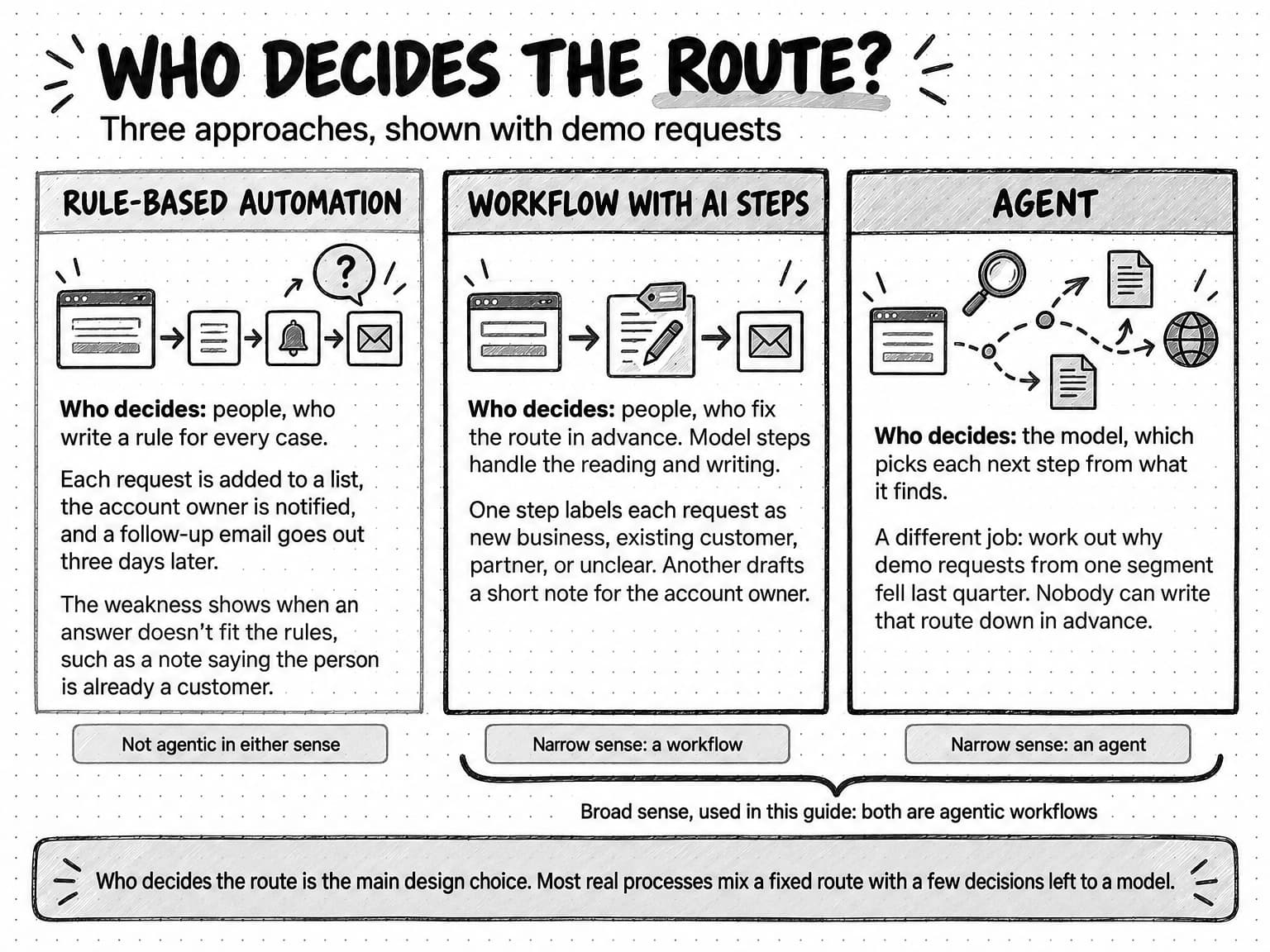
The narrow sense appears in Building effective agents, a December 2024 guide by Anthropic's engineering team. It groups all of these designs as “agentic systems” and then draws a line through them. Workflows are “systems where LLMs and tools are orchestrated through predefined code paths”: a person designed the route, and the model does the work at each step. Agents are systems in which the model directs its own process and its use of tools. In this vocabulary, a workflow sits at the opposite end of the range from an agent.
This guide uses the broad meaning, so an agentic workflow covers the whole range. Where the difference matters, it says fixed workflow for a route people design in advance and agent for a route the model chooses as it goes. Most real processes mix the two, such as a launch process that follows a fixed route for nine steps and lets a model decide whether a draft is ready or needs another revision. A related term, agentic AI, names the broader setup that pursues goals by choosing and carrying out its own steps, often across several tasks or over time; an agentic workflow describes how one job's steps are arranged and checked.
How agentic workflows differ from workflow automation and AI agents
Traditional workflow automation follows rules a person wrote for every case, an agentic workflow adds AI models for the steps that need reading, writing, or judgment, and an AI agent sits at the flexible end of agentic workflows, because the model chooses the steps.
Consider a demo-request form. Rule-based automation can add each request to a list, notify the account owner, and send a follow-up email three days later. Every request takes the same path, and that predictability is the point; IBM's explainer notes that rule-based automation can be enough for repetitive tasks with a standard structure. The weakness shows when an input stops fitting the rules, such as a free-text answer explaining that the person asking for a demo is already a customer.
An agentic workflow can keep the same trigger and add model steps where the rules run out. One step reads the free-text answer and labels the request as new business, an existing customer, a partner, or unclear. Another drafts a short note for the account owner summarizing what the prospect said. The route is still fixed; the model handles the parts that require understanding language.
An agent fits a different job: work out why demo requests from one segment fell last quarter. Nobody can write that route down in advance, because the next step depends on what the agent finds in the data, on the website, and in the market. How do AI agents work? explains the loop an agent runs, and our guide to automating marketing with AI agents covers when to combine agents with fixed workflows and how schedules and event triggers start the work.
The five agentic workflow patterns: chain, route, split, delegate, critique
The five agentic workflow patterns that Anthropic's engineering team described in 2024 are prompt chaining, routing, parallelization, orchestrator and workers, and evaluator and optimizer, which this guide shortens to chain, route, split, delegate, and critique.
Anthropic reported that across the dozens of teams it had worked with, “the most successful implementations use simple, composable patterns rather than complex frameworks.” Anthropic calls them common patterns that can be shaped and combined, and each starts from the same building block: a model with access to retrieval, tools, and memory. Anthropic files all five under workflows, although in the delegate pattern a lead model decides the subtasks, which moves it toward the agent end of the range.
| Pattern | How it works | Marketing illustration | Where a person checks | Use it when |
|---|---|---|---|---|
| Chain (prompt chaining) | Each step works on the last step's output, with checks between steps | An approved brief becomes an outline, a blog post, and LinkedIn and email versions | Approve the outline before drafting | The job splits into steps you can name in advance |
| Route (routing) | A first step classifies the input and sends it to a specialized next step | Survey answers sorted by reason for canceling, each with its own follow-up | Spot-check the sorting and handle the unclear group | Inputs fall into distinct types that need different handling |
| Split (parallelization) | Independent parts run at once, or one check runs several times, and the results are combined | One research step per competitor, merged into a comparison | Review the merged result and any split votes | Parts are independent, or one check isn't trustworthy alone |
| Delegate (orchestrator and workers) | A lead model decides the subtasks, assigns them, and assembles the results | A launch kit planned from release notes, with each asset assigned to a worker | Approve the plan before the work fans out, then check the kit for contradictions | You can't predict the subtasks until you see the input |
| Critique (evaluator and optimizer) | One step drafts, another evaluates against criteria, and the draft is revised until it passes or hits a limit | A landing page checked against approved claims and the voice guide | Set the criteria, cap the rounds, and review the final version | Clear criteria exist, and feedback improves the draft |
Prompt chaining: run the steps in a fixed order
Prompt chaining breaks a job into a fixed sequence in which each step works on the output of the one before. Anthropic's examples include generating marketing copy and then translating it. Between steps, you can add what Anthropic calls a gate: a check written in ordinary code that stops the run when something is off, such as an outline that skips a required section.
For illustration, a software company turns an approved product brief into launch content. Step one pulls out the three claims the brief approves, and step two outlines a blog post around them, with a gate confirming that every section maps to an approved claim. Step three writes the post, and step four adapts it into a LinkedIn post and a customer email, the kind of reshaping covered in our guide to repurposing content.
The person checks the outline: a wrong angle caught there costs minutes, and caught after four finished assets it costs a rewrite. Use chaining when the job splits cleanly into steps you can name in advance. Anthropic describes the trade as a slower run in exchange for higher accuracy, because each model call gets an easier task.
Routing: send each input to the right next step
Routing classifies an input and sends it to a specialized next step. Without it, Anthropic notes, tuning a process for one kind of input can make it worse at the others. Routing can also manage cost: Anthropic's examples include sending easy, common questions to smaller, cost-efficient models and hard or unusual ones to more capable models.
For illustration, a team collects open-text answers from a cancellation survey. A first step labels each one as price, missing feature, onboarding trouble, switched to a competitor, or unclear. Price answers go to a step that summarizes objections for the pricing page, feature answers to a summary for the product team, and competitor answers to the competitive notes, which turns the survey into usable voice-of-customer research.
The person spot-checks a sample of the sorting and handles the unclear group directly, because routing errors are quiet: a misfiled answer gets a well-written response to the wrong problem. Use routing when inputs fall into distinct types and the classification can be done accurately.
Parallelization: split independent work and combine it
Parallelization runs several model calls at once and combines their results. Anthropic describes two versions: sectioning breaks a task into independent subtasks, and voting runs the same task several times to get varied outputs.
To illustrate sectioning, a competitive review runs one research step per competitor, each filling the same fields: headline claim, target audience, proof offered, and whether pricing is public. A final step merges them into one comparison, the core of a competitor analysis. For voting, three independent checks review a draft ad for claims the evidence doesn't support, and a flag from any one of them sends the draft to a person.
The person reviews the merge, where duplicates, gaps, and inconsistent fields show up, and looks at split votes rather than letting them average away. Use splitting when the parts are truly independent or when one check isn't trustworthy alone, though each branch adds a model call.
Orchestrator and workers: delegate subtasks from a lead model
In the orchestrator and workers pattern, a central model breaks the job down, hands the pieces to worker models, and combines what they return. Unlike splitting, Anthropic explains, the subtasks aren't defined in advance; the orchestrator decides them from the input.
For illustration, a lead step reads release notes and decides what the launch needs. A bug fix might need only a changelog entry and an updated help article, while a new integration might need a blog post, an email, a sales one-pager, and three social posts. The lead step assigns each asset to a worker with the brief and the approved claims, then assembles the kit.
The person approves the plan before the work fans out and checks the assembled kit for contradictions, such as an email promising a date that the blog post leaves out. In a June 2025 account of its multi-agent research system, Anthropic wrote that each worker needs an objective, an output format, guidance on tools and sources, and clear task boundaries; without detailed task descriptions, agents duplicate work, leave gaps, or fail to find necessary information.
Evaluator and optimizer: critique the draft and revise it
In the evaluator and optimizer pattern, one step produces a draft and another evaluates it against criteria and returns feedback, in a loop. Anthropic names two signs that the pattern fits: a person's feedback would demonstrably improve the draft, and a model can give that kind of feedback.
For illustration, a landing page draft goes to an evaluator with four criteria: every claim appears on the approved claims list, each claim has its proof point, no phrase from the voice guide's avoid list appears, and the page stays within the agreed length. The evaluator returns specific failures, the drafting step revises, and the loop stops when every criterion passes or after three rounds, when a person takes over.
In the 2023 Self-Refine study, having a model give feedback on its own output and then revise it improved task performance by about 20 percentage points on average across seven tasks, compared with single-pass generation. The loop finds only what its criteria describe, though. It won't notice that the page speaks to the wrong buyer if no criterion asks, so a person still sets the criteria and reviews the final version.
Agents: let the model choose the route
Beyond the five patterns sit agents, which Anthropic describes as “typically just LLMs using tools based on environmental feedback in a loop.” An agent chooses a step, reads the result, and picks the next step from what it found, which suits open-ended problems where the number of steps can't be predicted. A 2022 research paper named one version of this loop ReAct, for the way it interleaves reasoning with actions such as looking something up.
For illustration, an agent asked why trial sign-ups from organic search fell last month might start with the traffic export, notice that the drop is concentrated on three pages, check whether those pages changed, and then compare the search results for their main queries. No one could plan that route in advance. Anthropic notes that agents can pause for human feedback at checkpoints or blockers, and that runs commonly include stopping conditions such as a maximum number of iterations. The person sets the goal and boundaries, reviews the evidence behind the conclusion, and approves anything that would publish, send, or spend.
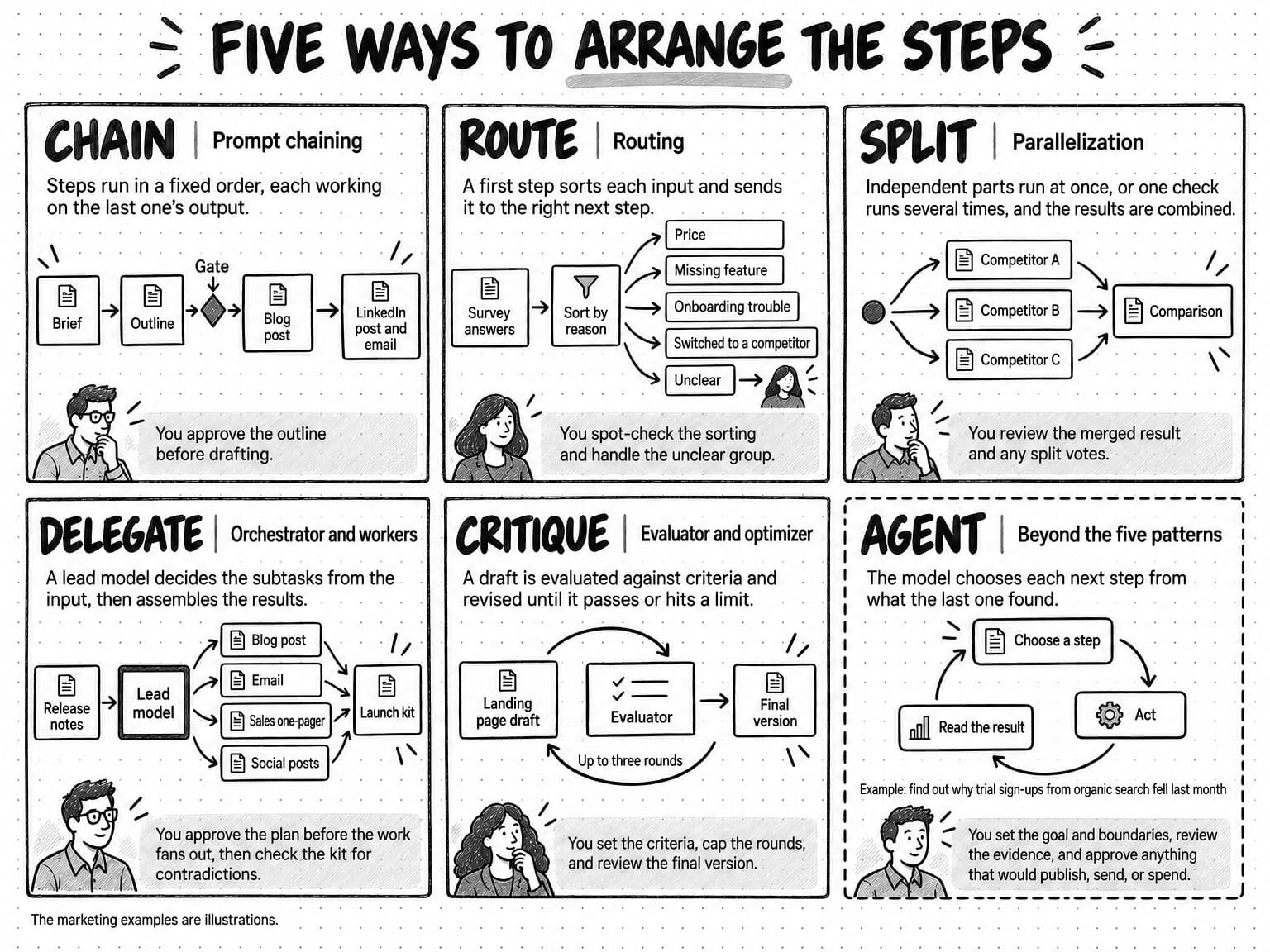
View the five workflow patterns and the agent loop at full size (opens in a new tab).
Agentic design patterns: reflection, tool use, planning, and multi-agent collaboration
A second, shorter list of agentic design patterns comes from Andrew Ng, who described four in March 2024: reflection, tool use, planning, and multi-agent collaboration.
As the first letter of his series defines them, reflection means the model examines its own work to find ways to improve it. Tool use gives the model tools such as web search or code execution to gather information, take action, or process data. Planning has the model come up with and carry out a multistep plan, such as outlining an essay, researching, and then drafting. Multi-agent collaboration has several AI agents split up the tasks and discuss and debate ideas to reach a better result than one agent would.
The same letter gave a reason to care about structure. Ng's team analyzed results that several research groups reported on HumanEval, a widely used coding benchmark. Working in a single pass, an older model answered 48.1% of the problems correctly and a newer one 67.0%, but the older model wrapped in an iterative agent loop reached as high as 95.1%. That's a coding test, not a marketing one, but it shows how much the process around a model can matter.
The two lists answer different questions: Ng's patterns describe what a model does, and Anthropic's describe how the steps are arranged. Reflection corresponds to the critique pattern, and Ng suggested the same two-role setup, with one agent prompted to generate and another to criticize, as well as tools such as web search to double-check the output. Tool use underlies all five arrangements. Planning is what the orchestrator does in the delegate pattern and what an agent does throughout, and multi-agent collaboration covers delegating and splitting when each worker plays a distinct role.
Ng was also candid about reliability. In an April 2024 letter on tool use, he wrote that he could get reflection and tool use to work fairly reliably, while planning and multi-agent collaboration were less mature and less predictable. In his letter on planning, he added that many agentic workflows don't need planning at all: a workflow in which a model reflects on and improves its output a fixed number of times follows a fixed sequence.
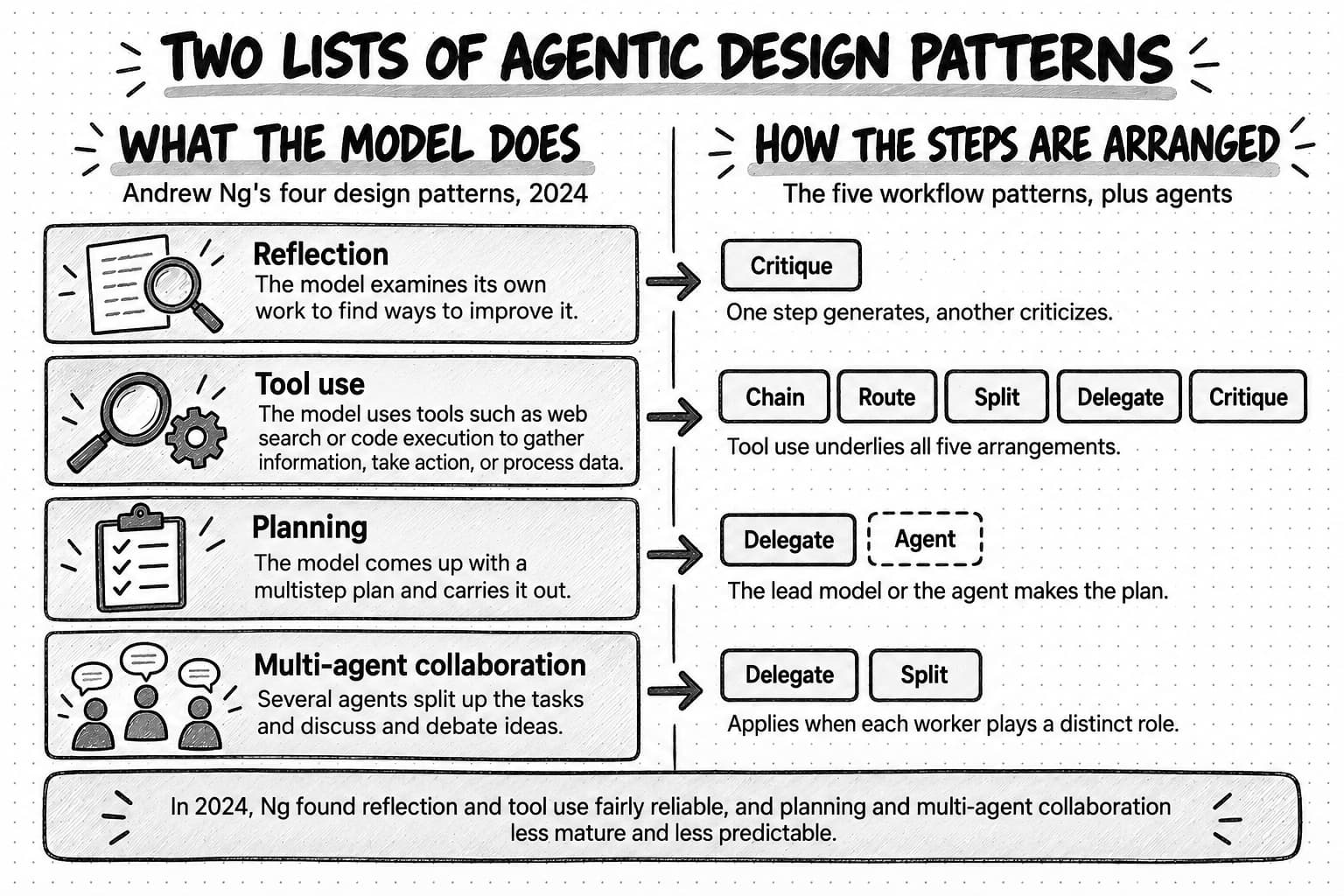
View the two lists of design patterns at full size (opens in a new tab).
Longer catalogs cover both lists and more. Antonio Gullí's 2025 book Agentic Design Patterns gives 21 chapters to individual patterns, from prompt chaining and routing to memory management, exception handling, human-in-the-loop review, and guardrails. Cloud architecture guides rename the same shapes: Microsoft's guide to AI agent orchestration patterns notes that its sequential pattern is also known as prompt chaining and its maker-checker loop as evaluator-optimizer.
Where people check the work in an agentic workflow
People should check an agentic workflow where a mistake becomes expensive to undo: before the work fans out, where separate results are merged, before anything leaves the company, and wherever the workflow flags its own uncertainty.
A workflow can check itself in two ways before a person sees anything. Gates written in ordinary code enforce exact rules: a required field is filled in, every link works, a draft stays within its length. Model evaluators judge against criteria that require reading, such as whether each claim matches the approved list. Neither replaces a person for judgments that depend on strategy, taste, or facts the system can't verify, or for approving actions with consequences outside the work, such as publishing, sending, or spending.
When you add a human checkpoint, decide what kind it is. Microsoft's orchestration guidance distinguishes an approval that moves the workflow forward from feedback that loops back for another round, and notes that approval can be limited to sensitive actions so low-risk steps proceed on their own. Anthropic's advice to show an agent's planning steps explicitly helps at any checkpoint, because a reviewer can catch only the plan they can see.
More checkpoints aren't automatically safer. A workflow that asks for approval at every step turns the reviewer into the bottleneck and leaves less time for the checks that matter. For many marketing jobs, the two checkpoints that matter most are one on the plan or angle before production starts and one on the finished work before it ships. How to evaluate an AI marketing agent shows how to test a system on your own work, including its approval steps.
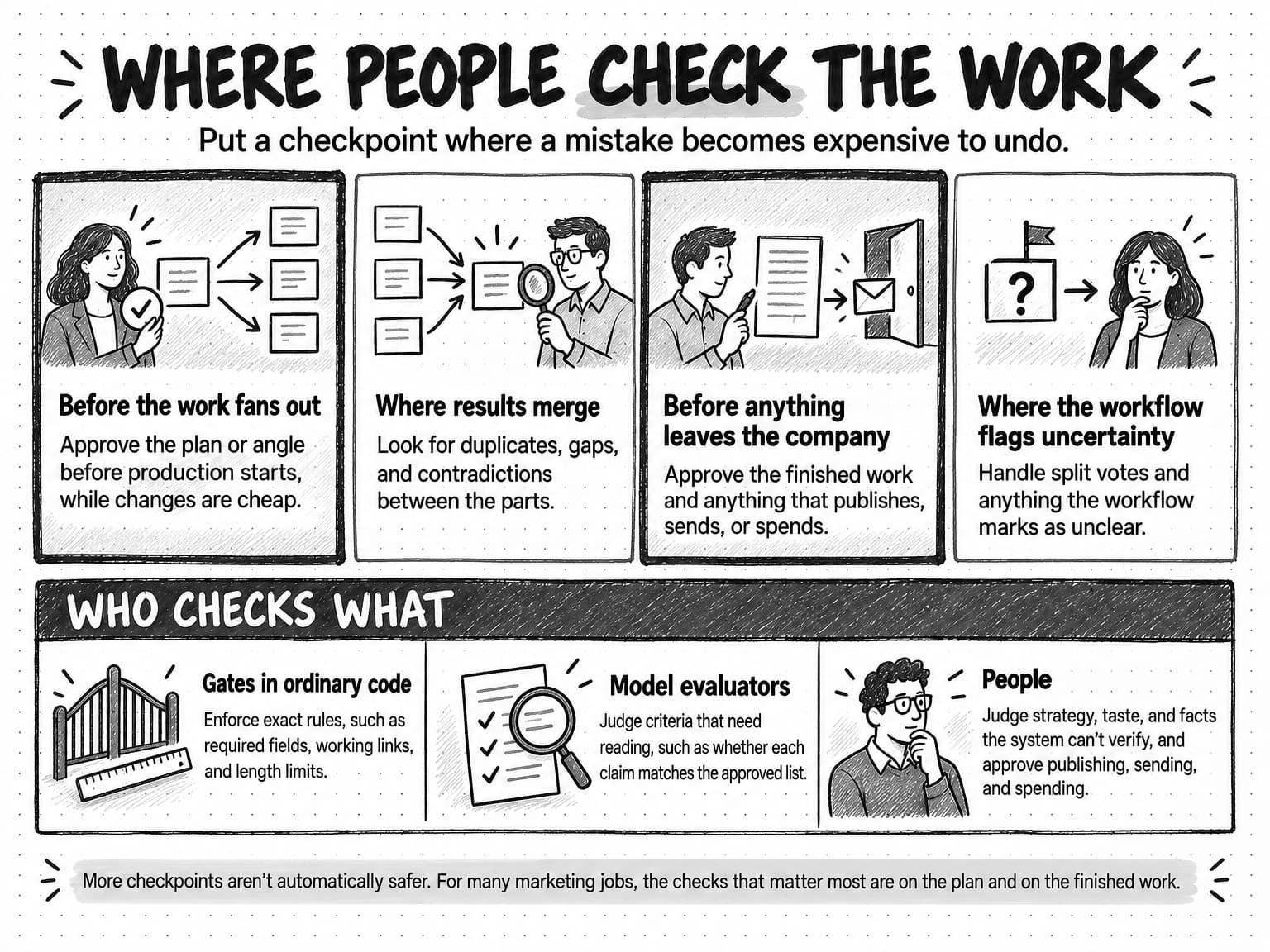
View the checkpoint diagram at full size (opens in a new tab).
How agentic workflows work in Ampere
For a single job, Ampere works at the agent end of the range: you describe the outcome in plain English, and Ampere, the AI marketing agent, plans the multi-step work and carries it out. The work happens in its session workspace, where you can open the files it creates and inspect the browser pages it used. While a turn is running, a compact task-progress view can show how many tasks are done and which one is current, when that tracking is available.
For familiar marketing jobs, the method comes from Ampere-maintained marketing skills, evaluated against defined task, tool, and output expectations, so your team gets repeatable methods for common jobs without writing its own. Individual steps can call AI Tools for image, video, voice, and research runs, part of Ampere's 200+ AI tools & skills.
People stay involved at specific points. Ampere asks for a missing fact only when the work can't continue without it and otherwise keeps working. For a branded LinkedIn carousel, it can show content-style and visual-style pickers with example decks, so you set the direction before the deck is made for your brand and topic. LinkedIn text post, poll, and newsletter packages can include review notes and claim checks alongside the drafts, and you decide what to publish and where. Where Connectors are enabled, Ampere pauses for your approval before Connector actions that require it.
Recurring work adds a fixed structure around the agent. A scheduled task runs a saved prompt, with its Project and attachments, on an hourly, daily, weekly, or monthly cadence. Monitoring checks supported public sources, such as a competitor's pricing page, and files an alert with the available evidence when something changes. It starts follow-up work only if you configured a follow-up action, and because it checks on a cadence, it can miss or delay a change. In both cases, you set the trigger in advance, Ampere does the work inside each run, and the results come back to you for review. Nothing publishes without you.
What goes wrong in agentic workflows
Five common failures in agentic workflows are errors that compound across steps, loops that don't stop, costs that outgrow the job, handoffs between models that lose the brief, and self-checks that miss what they have no evidence to catch.
Errors that compound across steps
Every step builds on the one before, so an early mistake carries forward. In its June 2025 account, Anthropic observed that issues that would be minor in traditional software can derail an agent entirely, and that one failed step can send it down an entirely different path. Short routes, gates between steps, and an early human checkpoint limit how far an error can travel.
Loops that don't stop
Google Cloud's architecture guidance warns that a badly defined exit condition can make a loop run indefinitely, with excessive operating costs and possible system hangs. Anthropic's early research agents made errors such as spawning 50 subagents for simple queries and searching the web endlessly for sources that didn't exist. Set a maximum number of rounds, define what good enough means, and tell the workflow to report the gap and stop when the evidence isn't there.
Costs that outgrow the job
Each model call takes time and money, and agentic designs make many of them. In Anthropic's own data, reported in June 2025, agents typically used about four times as many tokens, the units in which model usage is measured, as chat interactions, and multi-agent systems about fifteen times as many. Anthropic concluded that multi-agent systems make economic sense only for tasks valuable enough to pay for the extra performance. Send simple inputs down simpler paths, and cap how far a run can range.
Handoffs that lose the brief
When several models share a job, information can be lost between them. A 2025 study, Why Do Multi-Agent LLM Systems Fail?, built a dataset of more than 1,600 annotated traces from seven multi-agent frameworks and a taxonomy of 14 failure modes in three groups: system design issues, misalignment between agents, and failures to verify the result. The authors also observed that multi-agent systems' gains on popular benchmarks are often minimal. Give each worker a complete brief, and check the assembled result as well as the parts.
Self-checks without outside evidence
A model asked to review its own reasoning without new information may not improve it. A study presented at ICLR 2024, Large Language Models Cannot Self-Correct Reasoning Yet, found that models struggled to correct their reasoning without external feedback and sometimes did worse after trying. Self-Refine's gains came across a broader mix of tasks, such as dialogue responses, so results depend on the task, but the safer design gives the evaluator something outside the draft to check against: the approved claims list, the source documents, or a tool such as web search.
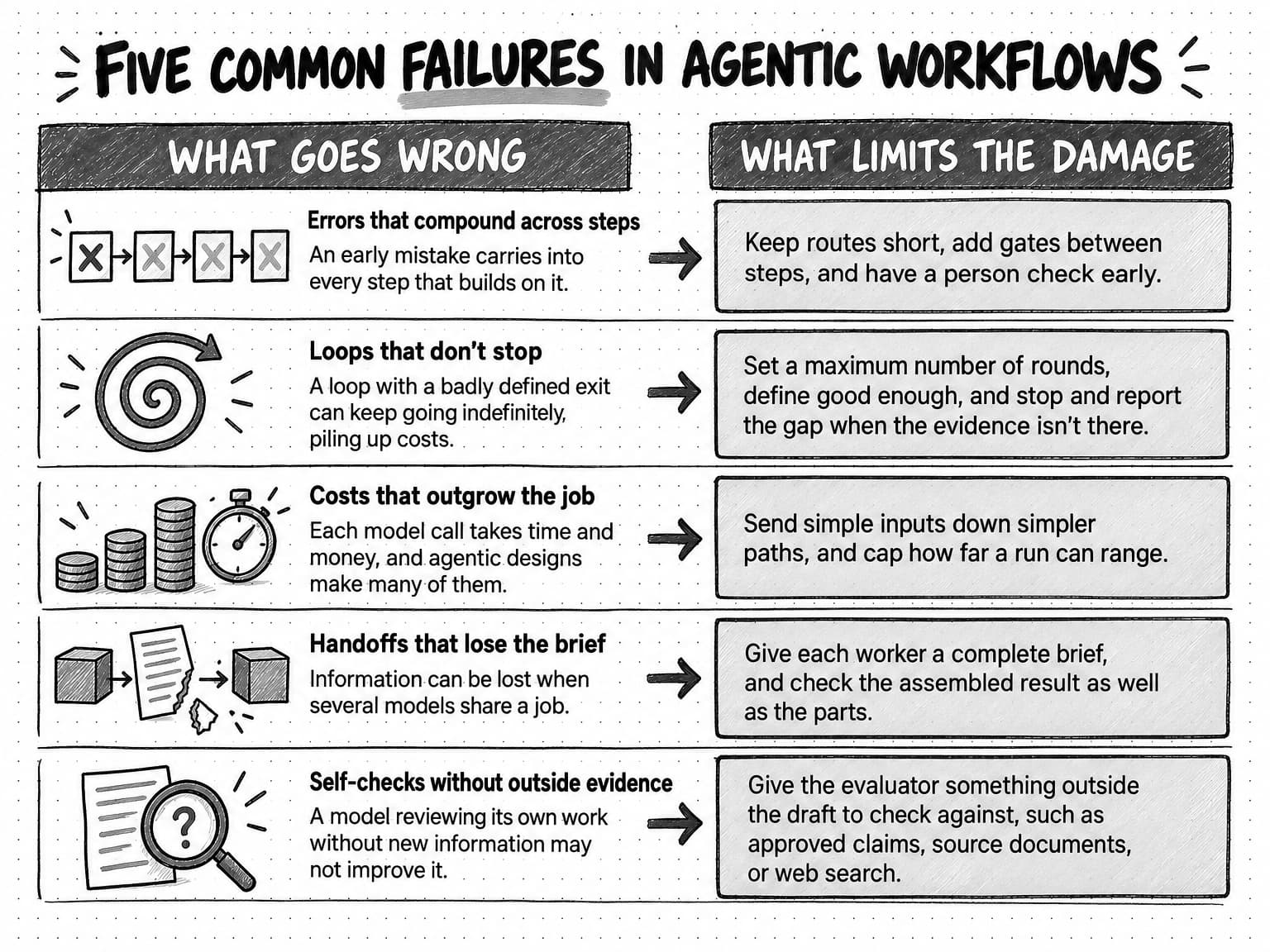
View the five failures and their fixes at full size (opens in a new tab).
How to choose between a fixed workflow, AI steps, and an agent
Choose the simplest structure that does the job reliably: a fixed workflow when rules can handle every case, a workflow with AI steps when some steps need reading or writing but the route is known, and an agent only when the route depends on what the work turns up.
Anthropic's advice is to find “the simplest solution possible” and add complexity only when needed, which may mean not building an agentic system at all, because these systems often trade speed and cost for better results. Microsoft's guidance makes the same point: use the lowest level of complexity that reliably meets your requirements. Four questions help place a marketing job:
- Can you write the steps down before the run? If they're the same for every input, keep the route fixed, even if some steps use a model.
- Which steps need reading, writing, or judgment? Add model steps only there. A model that rewrites a subject line for a new audience earns its cost; one that copies a field from a form doesn't.
- Does the next step depend on what the last one found? If the forks are few and known, route between them. If you can't list them in advance, the job needs an agent.
- What does a wrong step cost, and how would you notice? The more expensive or less visible a mistake, the stronger the case for a fixed route, gates, and a checkpoint before anything ships.
Move between levels on evidence. Start lower than you think you need, and move up when real examples fail in ways a more flexible structure would fix. Move down when an agent takes the same route run after run; that route is now a fixed workflow you can test, schedule, and run more cheaply. If you're still working out how a good marketer handles the job, work through it with an agent first, as our automation guide recommends, and fix the route once you've seen it work.
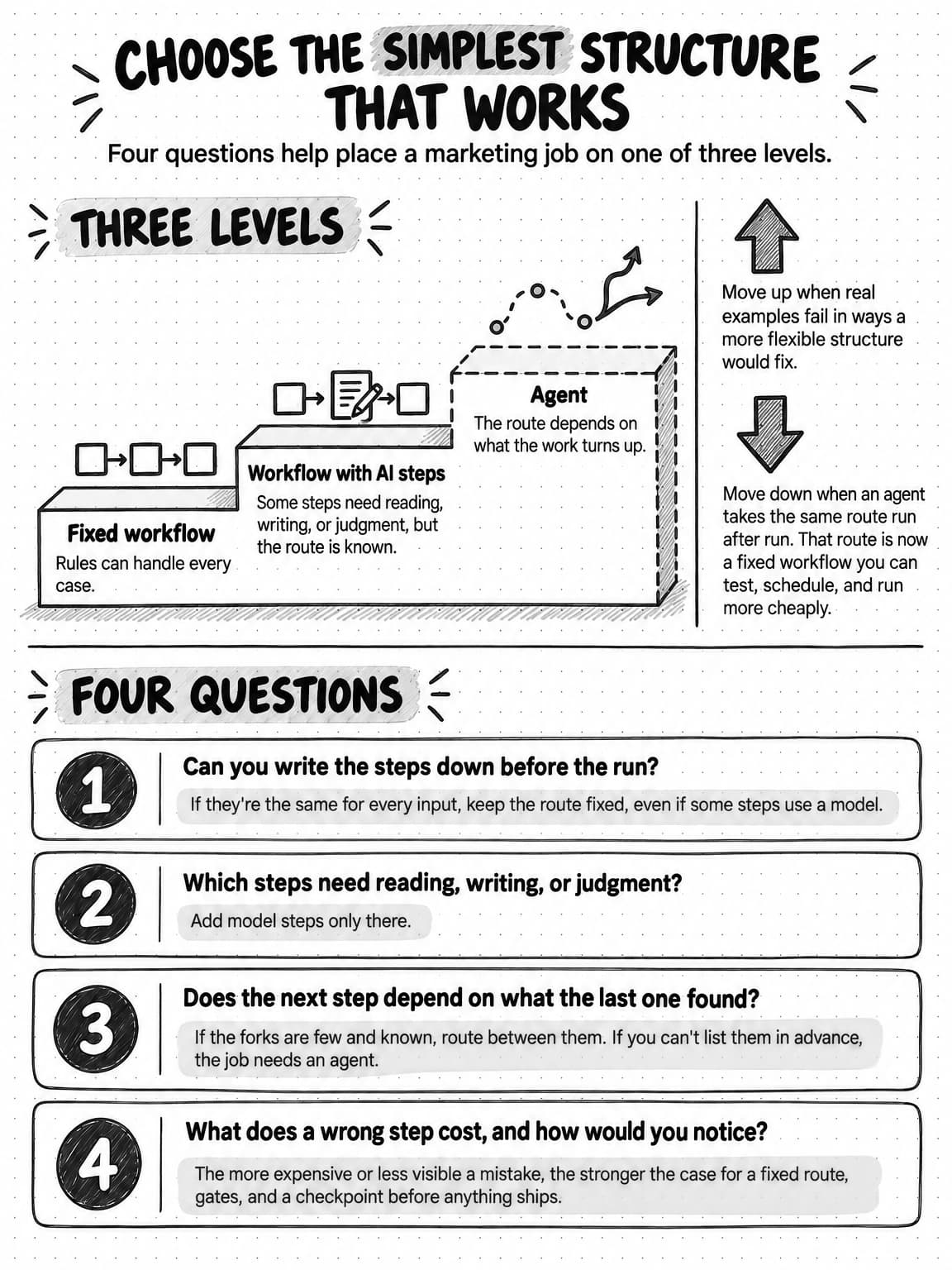
View the structure decision guide at full size (opens in a new tab).
Sources and further reading
- Anthropic, Building effective agents (December 2024): workflows versus agents, the five patterns, and starting simple.
- Anthropic, How we built our multi-agent research system (June 2025): delegation, token use, and compounding errors.
- Andrew Ng, Agentic Design Patterns Part 1, Part 2: Reflection, Part 3: Tool Use, and Part 4: Planning (March and April 2024): the four design patterns.
- Andrew Ng, letter in The Batch, issue 253 (June 2024): agentic as a matter of degree.
- IBM, What are agentic workflows? (2025): an agent-centered definition.
- Aman Madaan and colleagues, Self-Refine: Iterative Refinement with Self-Feedback (2023).
- Jie Huang and colleagues, Large Language Models Cannot Self-Correct Reasoning Yet (ICLR 2024).
- Mert Cemri and colleagues, Why Do Multi-Agent LLM Systems Fail? (2025).
- Shunyu Yao and colleagues, ReAct: Synergizing Reasoning and Acting in Language Models (2022).
- Microsoft Azure Architecture Center, AI agent orchestration patterns (2026).
- Google Cloud Architecture Center, Choose a design pattern for your agentic AI system (2026).
- Antonio Gullí, Agentic Design Patterns: A Hands-On Guide to Building Intelligent Systems (Springer, 2025).
Frequently Asked Questions
What is the difference between an AI agent and an agentic workflow?
An AI agent is software that uses an AI model to pursue a goal by choosing actions, using tools, and adjusting to the results. In the broad sense, a job run by an agent is the most flexible kind of agentic workflow; other agentic workflows follow a route people design in advance and use AI models for individual steps. Anthropic calls only the fixed-route kind a workflow, so check which sense a writer means.
How does an agentic workflow differ from traditional workflow automation?
Traditional workflow automation follows rules a person wrote, such as adding every form submission to a list and sending an email three days later. An agentic workflow adds AI models for steps that need reading, writing, or judgment, such as labeling a free-text answer, and may let an agent choose the route. Rule-based automation is more predictable; an agentic workflow handles varied, unstructured input.
What are agentic design patterns?
Agentic design patterns are reusable ways of structuring the work AI models do on a multi-step job. Anthropic's engineering team describes five: prompt chaining, routing, parallelization, orchestrator and workers, and evaluator and optimizer. Andrew Ng's 2024 list has four: reflection, tool use, planning, and multi-agent collaboration. Ng's patterns describe what a model does, Anthropic's describe how the steps are arranged, and longer catalogs, such as a 2025 book with 21 pattern chapters, extend both.
What are examples of agentic workflows in marketing?
Marketing examples of agentic workflows include turning an approved brief into a blog post and channel versions, sorting survey answers into types that each get their own follow-up, researching each competitor separately and merging the results, planning a launch kit from release notes, and checking a landing page against approved claims until it passes. An agent investigating why sign-ups from one channel fell sits at the flexible end of the range.
How do you build an agentic workflow?
Build an agentic workflow by starting with one job and the simplest structure that could do it. Write down the steps, add model calls only where the work needs reading, writing, or judgment, put gates and a human checkpoint where mistakes get expensive, and cap the number of revision rounds. Test the workflow on real examples, and add routing, splitting, or an agent only when the simpler version fails.
What is the best agentic workflow pattern?
No agentic workflow pattern is best in general; the best one is the simplest that does the job reliably. Prompt chaining suits jobs with fixed steps, routing suits inputs of distinct types, parallelization suits independent parts, orchestrator and workers suits jobs whose subtasks depend on the input, and evaluator and optimizer suits drafts with clear criteria. In 2024, Ng found reflection and tool use more reliable than planning and multi-agent collaboration.
What is the difference between agentic AI and an agentic workflow?
Agentic AI is the broader setup in which AI pursues goals by choosing and carrying out its own steps, often across several tasks or over time. An agentic workflow describes how one job's steps are arranged, who decides them, and where they're checked. One agentic AI system can run many agentic workflows, such as a weekly research workflow and one triggered when a competitor changes its pricing.
What are the risks of agentic workflows?
The main risks of agentic workflows are errors that compound across steps, loops that don't stop, costs that grow faster than the value of the work, information lost in handoffs between models, and self-checks that miss problems they have no evidence to catch. Short routes, gates, revision caps, complete briefs for each step, outside evidence for evaluators, and a person's review before anything is published or sent reduce these risks.


