General-purpose AI assistant or AI marketing agent? How to choose
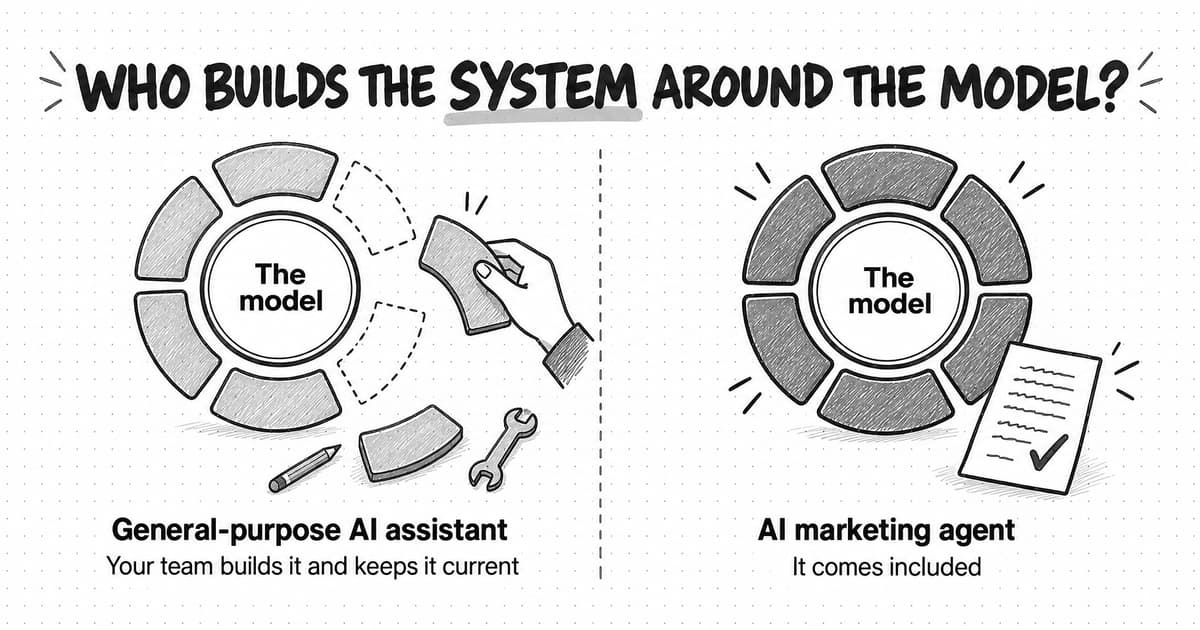
Both can produce capable marketing work. The choice turns on who builds and maintains the brand context, methods, tools, model choices, shared access and recurring work around the model.
29 min readWritten by Ampere
Short answer
Should a marketing team use a general-purpose AI assistant or an AI marketing agent?
Use a general-purpose AI assistant when one person needs occasional help with drafting and ideas, or when your team has the expertise and time to build and maintain its own marketing setup. Choose an AI marketing agent when several people need consistent, brand-aware work across research, writing, design and recurring tasks, and you would rather have the system around the model supplied and maintained than build it yourself.
Summary
General-purpose AI assistants are capable marketing tools, and specialized agents often run on similar models. The useful difference is who supplies and maintains the system around the model: brand knowledge, working methods, production tools, model choices, shared access and recurring work. With a general-purpose assistant, the team builds and maintains that system itself; an AI marketing agent should include it.
Controlled studies show general-purpose AI speeding up self-contained writing and analysis, but the gains are uneven: on a task chosen to sit outside the model's strengths, consultants using AI were less likely to reach the correct answer. Specialization, whether described as vertical or by job, mostly lives in context, methods, tools and checks, so what a product maintains matters more than its label.
The guide's framework names six layers around the model: brand context, marketing skills, a tool stack, a model and cost policy, shared team access, and recurring-work infrastructure. Each one has to be built and then kept current, because positioning changes, channel conventions shift, model prices and capabilities move quickly, and teammates join and leave.
A general-purpose assistant is often enough for one person's occasional drafting and ideation, or for a team with a builder whose role includes maintaining the setup. Signs of outgrowing it include re-explaining the company in new projects, different results for the same request from different teammates, separate media and data subscriptions, and recurring work that slips when one person is busy.
Compare the options by counting hours as well as subscriptions: setup, maintenance, other tools, usage, review and coordination. Then test both on the same two or three real assignments with equivalent material, run a second assignment without re-supplying context, ask a teammate to run a third, and change one fact to see how many places each setup needs updating.
Contents
- What general-purpose AI assistants do well for marketing
- Vertical vs horizontal AI agents: what specialization means
- The six layers your team builds around a general-purpose AI assistant
- Build it yourself or have it included: the six layers compared
- How Ampere supplies the six layers
- When a general-purpose AI assistant is enough
- What to count beyond the subscription price
- How to choose between a general-purpose AI assistant and an AI marketing agent
- How to test both options on the same brief
- Sources and further reading
- Frequently Asked Questions
If your team already pays for a general-purpose AI assistant, you know what it is good for. Someone tightens a LinkedIn post with it, someone else summarizes customer calls, and the founder asks it for campaign angles before a launch. So when an AI marketing agent comes up, the first question is a fair one: why add another AI product when the one you have can already write, research and analyze?
General-purpose assistants are capable. Many now browse the web, work with files and complete multistep tasks, and specialized products often run on similar models. On one well-briefed request, the results may be close. The differences show up around the request: what the work draws on about your brand, the methods and checks behind it, the tools that produce images and data, and whether a teammate gets the same quality next week without rebuilding the setup.
The choice between a general-purpose AI assistant and an AI marketing agent comes down to who supplies and maintains the system around the model: with an assistant, your team builds it; with an AI marketing agent, it comes included. An assistant is often enough for one person's occasional drafting and ideation, or for a team with the expertise and time to run its own setup. An AI marketing agent earns its place when several people need consistent, brand-aware work across research, writing, design and recurring tasks, and maintaining that system should not become someone's second job.
By the end of this guide, you should be able to list what your current setup already provides, count what the rest would cost to build and keep current, and test both options on the same brief, measuring the work around the output as well as the output itself.
What general-purpose AI assistants do well for marketing
General-purpose AI assistants are good at the language and reasoning work that fills much of a marketer's week: brainstorming, first drafts, rewrites, summaries and analysis of material you provide. They are also flexible. The assistant that drafts a product announcement can restructure a webinar outline, explain an unfamiliar pricing model or turn a messy spreadsheet export into a clean table, with no new tool to configure.
Controlled research supports the productivity gain on this kind of work. In a 2023 experiment published in Science, Shakked Noy and Whitney Zhang gave 453 college-educated professionals, including marketers, realistic writing tasks from their own occupations, such as press releases, short reports and delicate emails. Half were randomly given access to a general-purpose AI chatbot. They took 40% less time, and the quality of their work, graded blind by experienced professionals in the same occupations, rose 18%. The tasks were short and self-contained, which is where an assistant is strongest.
The gains are uneven, though. In a 2023 field experiment with 758 consultants at Boston Consulting Group, Fabrizio Dell'Acqua and colleagues found that on 18 realistic tasks inside what they called AI's "jagged technological frontier", consultants using AI completed 12.2% more tasks, finished 25.1% faster and produced work rated more than 40% higher in quality than a control group. On a task chosen to fall outside that frontier, consultants using AI were 19 percentage points less likely to reach a correct answer. Tasks that look equally difficult can fall on either side of the line, so AI output needs review by someone who knows what a correct answer looks like.
Today's assistants also do more than write. Many now work as general-purpose agents that take several steps toward a goal, and depending on the product and plan, an assistant can browse the web, analyze files, generate images, connect to some business apps, and keep reference files and standing instructions in a project that teammates can share. Some can run saved prompts on a schedule; our guide to automating marketing with AI agents compares what leading assistants supported as of September 2026.
What an assistant lacks by default is knowledge of your business and of how your team works. Each project or conversation starts from what someone has put into it: uploaded files, saved instructions and today's request. Saved memory can add details from earlier chats, but it usually belongs to one person and holds what that person shared. A team that wants consistent marketing work from an assistant therefore has to build a system around it, starting with a brand brief, reusable instructions for recurring jobs, a review checklist and an agreed place to keep them.
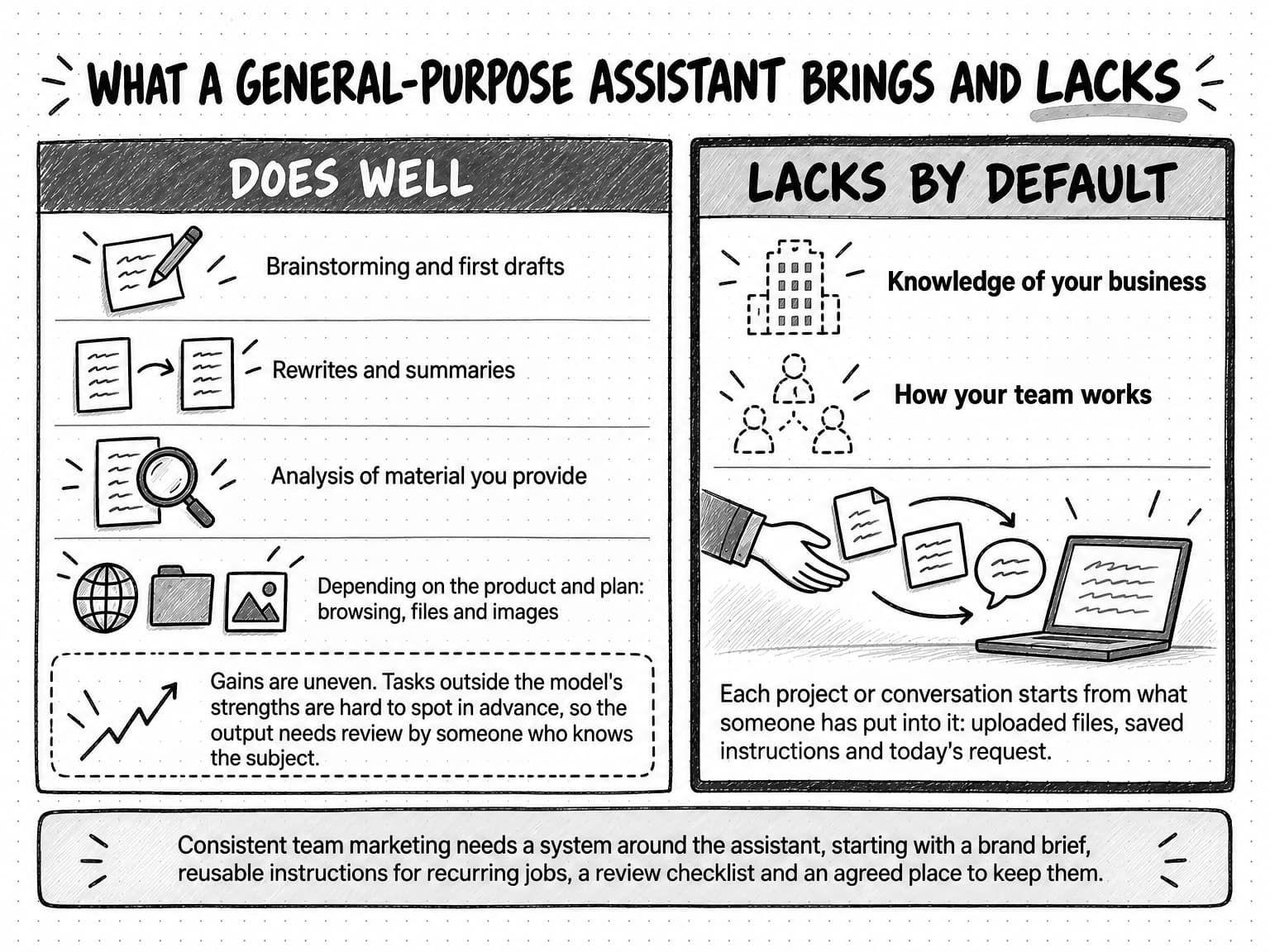
View the assistant strengths and gaps diagram at full size (opens in a new tab).
Vertical vs horizontal AI agents: what specialization means
A horizontal AI agent is built to help with many kinds of work across industries, while a vertical AI agent is built for one specific domain. The terms come from software, where horizontal products such as accounting or customer relationship management software serve one business function in companies of every kind, and vertical products serve a single industry, such as construction or hospitality.
Investors carried the distinction into AI. In September 2024, Bessemer Venture Partners described vertical AI as applications and platforms "purpose-built for specific industries", such as legal, healthcare and finance, and argued that, unlike traditional vertical software, they can automate complex, repetitive language-based tasks. In November 2024, Y Combinator's Lightcone podcast made the case to founders in an episode titled "Vertical AI Agents Could Be 10X Bigger Than SaaS". The phrase has since loosened, and it is also applied to agents built around one business function.
It helps to separate two dimensions: the range of jobs an agent is built for and the range of industries it serves. A general-purpose AI assistant is broad on both. A strictly vertical agent, such as one built for legal contract review, is narrow on industry. An AI marketing agent is narrow on the job and broad on industry: a software company, a consultancy and a consumer brand can all use it for marketing work. Because the label depends on which dimension someone means, ask what a product is specialized for.
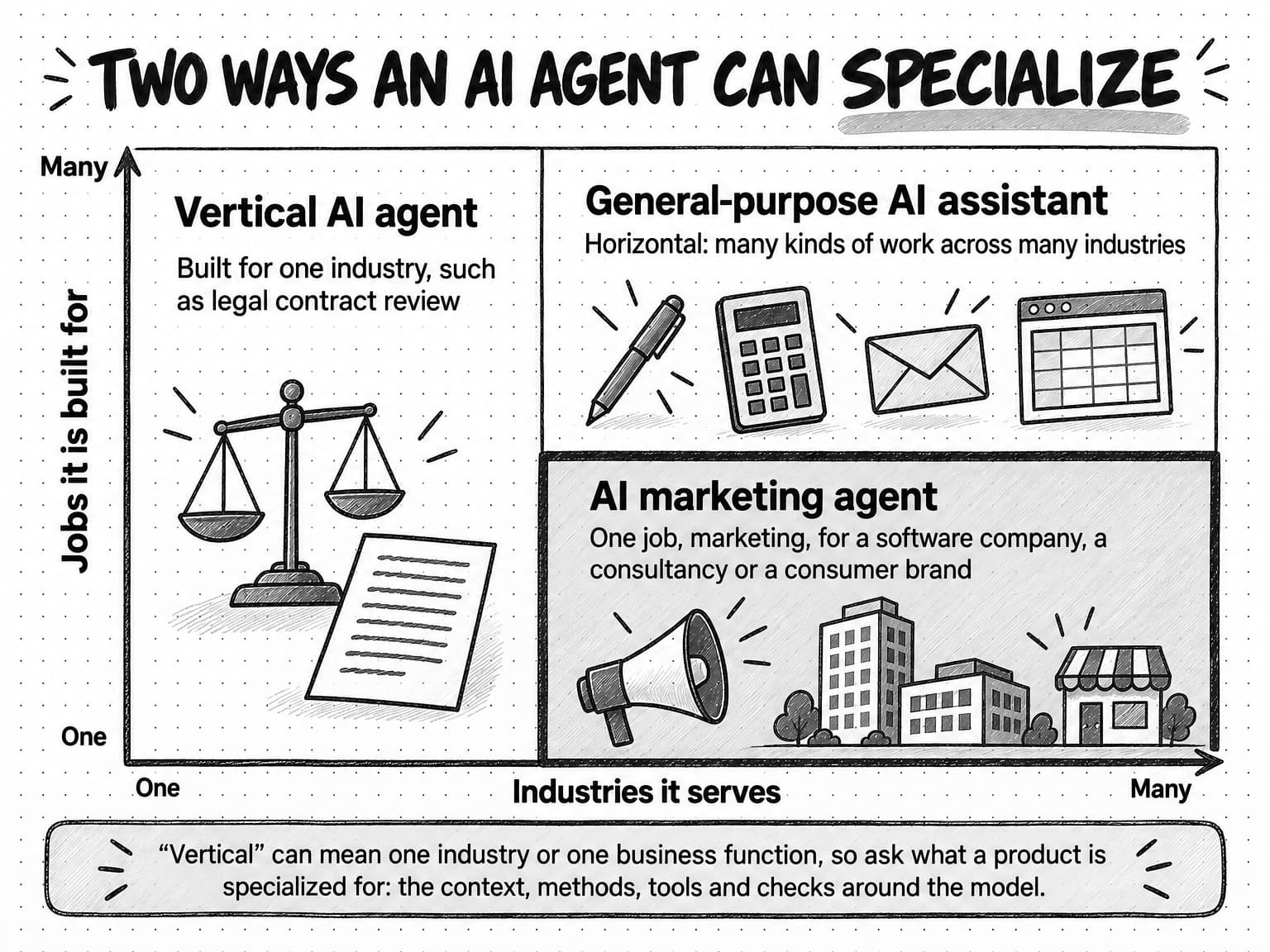
View the two ways to specialize diagram at full size (opens in a new tab).
Specialization rarely means a different kind of intelligence. Many AI applications are built on third-party models, which is why, as Bessemer's analysis acknowledges, critics dismiss some of them as "wrappers". Where a product is genuinely specialized, the specialization usually lives around the model: the context it receives, the methods it follows, the tools it can call and the checks on its work. A 2023 study by Microsoft researchers points the same way. A general-purpose model, steered by a structured prompting method and given no medical fine-tuning, achieved state-of-the-art results on all nine benchmarks in a standard medical question-answering suite and outperformed leading models built for medicine. Exam questions are not marketing deliverables, but the result shows how much of a specialist's edge can come from method and context.
That suggests a practical test for any specialized product, including an AI marketing agent. If it adds little more than prompts over a model, a capable team can rebuild it. If it supplies and keeps current the context, methods, tools and shared infrastructure a team would otherwise build, it takes that work off the team. Ampere, which publishes this guide, is a general-purpose agent enhanced for marketing, so the comparison that follows is about the system around the model rather than the model itself.
The six layers your team builds around a general-purpose AI assistant
Consistent team marketing from any AI model depends on six layers around it: brand context, marketing skills, a tool stack, a model and cost policy, shared team access, and recurring-work infrastructure. This guide calls them the six layers around the model. With a general-purpose assistant, your team decides how much of each layer it needs, builds it and keeps it current, and keeping it current is where the effort accumulates. An AI marketing agent should arrive with all six in place, though you still need to check how well each one fits your work.
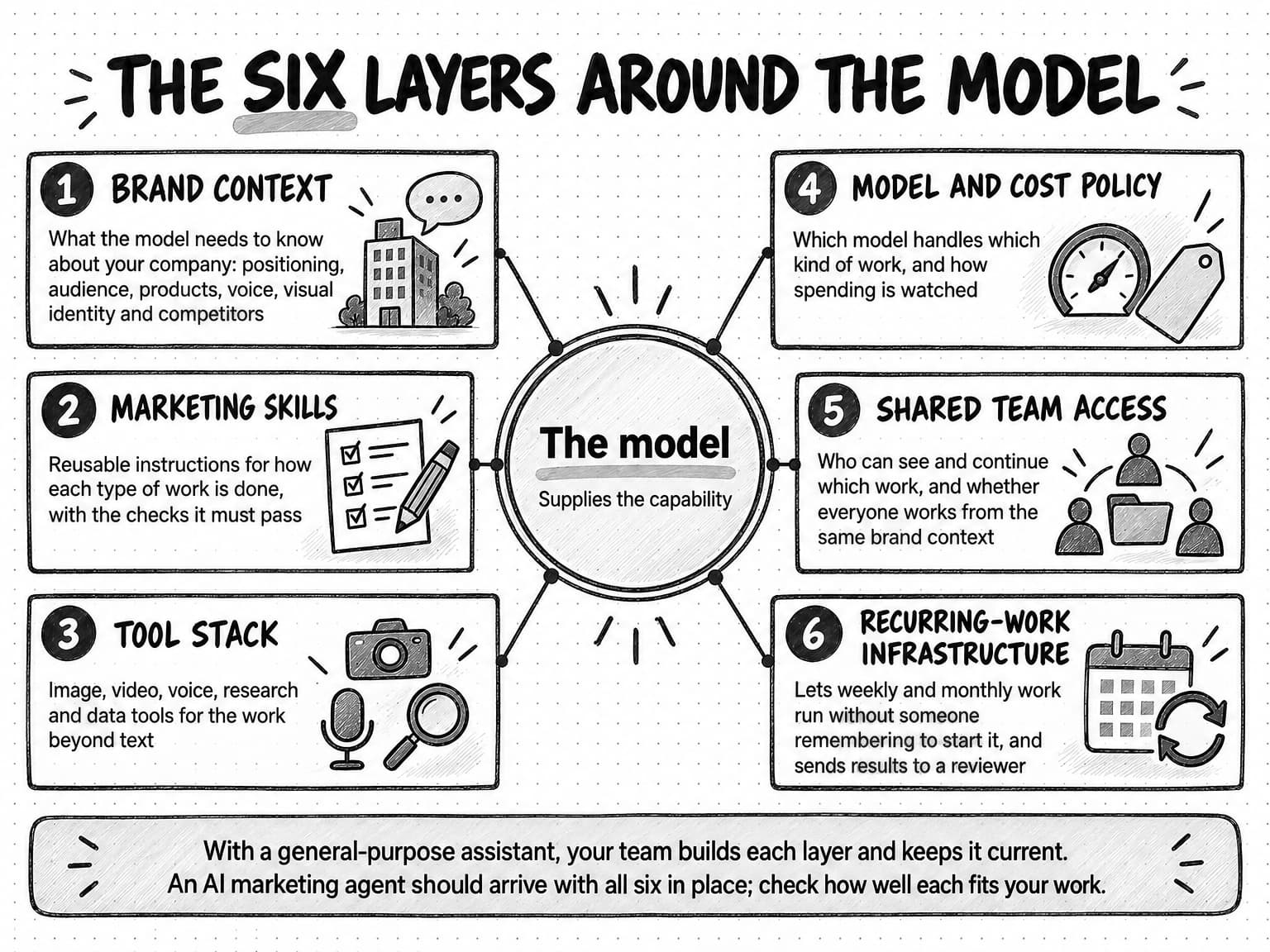
View the six layers diagram at full size (opens in a new tab).
1. Brand context
Brand context is what the model needs to know about your company before it starts: positioning, audience, products and offers, proof points, voice, visual identity, competitors and what is happening in your market now. Without it, an assistant produces competent work that could belong to any company in your category.
Building this layer means collecting or writing the source documents, such as brand guidelines, a positioning statement and a voice guide, deciding which version wins when they disagree, and loading them where the assistant will use them, usually as project files and standing instructions. Visual identity needs extra work, because an image model needs colors, layout conventions and reference examples rather than adjectives.
Keeping it current takes steady effort. Positioning shifts after a launch, a competitor changes its pricing and last quarter's market notes go stale, and each change has to reach every copy of the context, including copies saved in personal accounts. A same-brief comparison on the Ampere Blog shows what is at stake: two agents had the same event details for a webinar graphic, and the difference between the results came from how much brand context each had for interpreting them.
2. Marketing skills: methods and quality checks
Marketing skills are reusable instructions for how a type of work should be done: the steps, the sources to consult, the shape of the deliverable and the checks it must pass. A skill for a LinkedIn carousel, for example, might set the number of slides, the text limit per slide, the brand checks and the export format. How AI agents work explains how an agent loads a skill when a task calls for it.
Building a skill library means researching good practice for each recurring job, writing it down precisely enough for a model to follow, defining what a good output looks like and testing the instructions on real examples until the results hold up. A team with strong playbooks has a head start, because a skill is largely a playbook written for a model.
Maintenance comes from two directions. Channel formats and conventions change, so methods date, and instructions that worked with one model can behave differently with the next, so skills need re-testing after model updates. When skills are missing or out of date, quality depends on which teammate made the request and what they remembered to include.
3. The tool stack: image, video, research and data
Marketing work needs more than text. One campaign can call for images in several formats, a short video, a voiceover, search and keyword data, competitor ads, customer reviews, social data and content pulled from web pages. An assistant covers some of this itself; specialist tools cover the rest.
Assembling this layer means choosing, paying for, connecting and learning a tool for each capability, then moving work between them by hand: a draft from the assistant, an image from a second product, a video from a third. Keeping it current means tracking separate subscriptions and usage limits, replacing tools when better ones appear and repairing connections when a provider changes its product. Any brand context a tool needs has to be supplied to it separately, which makes consistency across formats harder to keep.
4. Model and cost policy
A model and cost policy decides which model handles which kind of work, who can use the most expensive options and how spending is watched. More capable models generally cost more to run, and subscription plans carry usage limits that matter once a team depends on them.
The right policy changes quickly. Stanford HAI's 2025 AI Index reported that the cost of running a model at one fixed level of capability fell more than 280-fold between November 2022 and October 2024. At that pace, a policy written once goes stale, and someone has to test new models on the team's own tasks, decide when a cheaper model is good enough and update the guidance. In a team without a policy, people pick models by habit, and nobody can say whether the team is paying for capability it does not need or saving money on work that needed more.
5. Shared team access and context
Shared team access decides who can see and continue which work, where finished assets live, whether everyone works from the same brand context and who pays for usage. Individual subscriptions make this layer easy to skip.
Personal AI use at work is common. In the 2024 Work Trend Index, Microsoft and LinkedIn surveyed 31,000 knowledge workers in 31 markets and found that 78% of people using AI at work brought their own AI tools, rising to 80% at small and medium-sized companies. When marketing context lives in personal accounts, the brief one person refined and the instructions another saved stay invisible to the rest of the team, and they leave when their owners do.
Setting it up usually takes a team plan, shared projects, agreed homes for context and finished work, and assigned roles. After that come onboarding and offboarding, reconciling the different instructions teammates create and keeping usage visible to whoever owns the budget.
6. Recurring-work infrastructure
Much marketing work recurs: a weekly competitor summary, a monthly report, a batch of social posts, a check on a competitor's pricing page. Recurring-work infrastructure lets that work run without someone remembering to start it, and makes sure the results reach a person who will review them.
Some general-purpose assistants can now run saved prompts on a schedule. The automation guide explains what a dependable automation needs beyond the trigger, including current context, tools and access, a record of earlier runs, a destination for results and an owner. A team has to settle those parts for each recurring job, then notice when a source changes, a run fails quietly or an automation outlives the campaign it served.
None of these layers is exotic, and a capable operator can build all six. The practical questions are whether that is the best use of the operator's time, and whether the setup keeps working through a busy quarter, a vacation or a resignation.
The model supplies the capability. Someone still has to supply the marketing system around it.
Build it yourself or have it included: the six layers compared
The difference between the two options is who builds and maintains each layer. The table sets the work a team takes on around a general-purpose assistant beside what an AI marketing agent should include, with a column for what to verify, because an included layer helps only if it fits your work.
| Layer | Built by your team around a general-purpose assistant | Included in an AI marketing agent | What to verify |
|---|---|---|---|
| Brand context | Write the brand brief, voice guide and visual references, load them into projects or instructions, and update every copy when something changes | Saved, editable brand knowledge that later work reuses | Can you see the sources, correct mistakes and tell how current each part is? |
| Marketing skills | Research methods, write reusable instructions and checks, test them, and re-test after model changes | Maintained methods for recurring marketing jobs, with defined output expectations | Do the methods fit how your team works, and who updates them when channels or models change? |
| Tool stack | Choose, pay for and connect separate image, video, voice, research and data tools, then move files between them | Media, research and data tools the agent can call within one piece of work and one bill | Are the tools you need included, and how is each one charged? |
| Model and cost policy | Test models, write guidance on which to use and watch spending across plans and tools | A choice of models with guidance on task fit and relative cost | Can you pick the model, see what the work cost and keep spending in bounds? |
| Shared team access | Set up a team plan, shared projects, folders and roles, and reconcile personal setups | Company-wide context, shared projects and assets, roles and shared usage | Can a teammate open, continue and review someone else's work with the same context? |
| Recurring work | Configure schedules where the assistant supports them, route results, handle failures and retire stale jobs | Scheduled and change-triggered work that returns results for review | Where do results land, who is told, and what happens when a run fails? |
An included layer is not automatically better. You give up some control over how it works, you depend on the vendor to maintain it well, and its methods may not suit a team with firm views about how work should be done. Building it yourself gives full control and can cost less in cash when someone on the team has the skills and the time. Each layer you build is time someone spends; each layer you buy is a dependency you should be able to inspect.
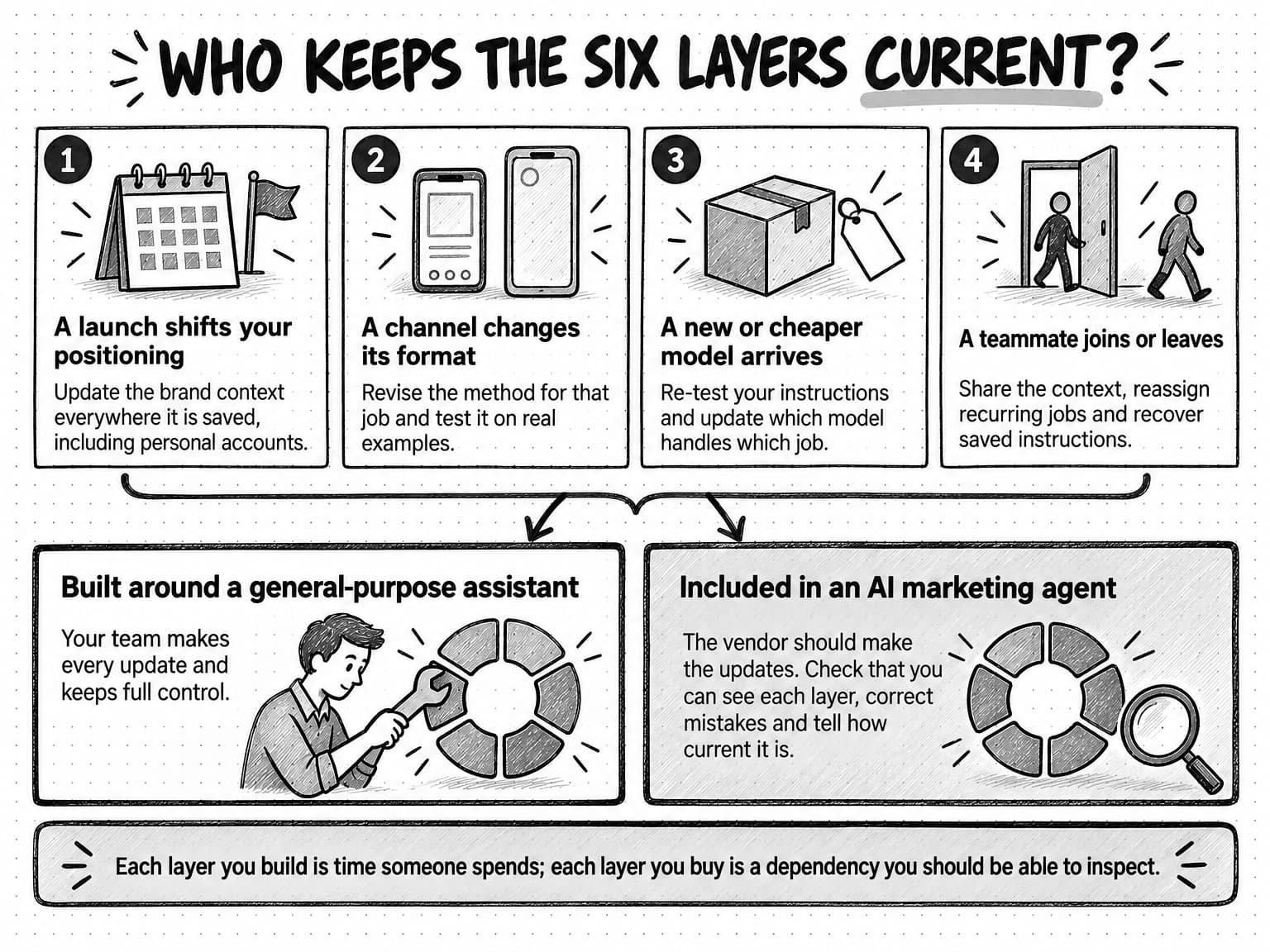
View the layer upkeep diagram at full size (opens in a new tab).
The two options can also coexist. An individual can keep using a general-purpose assistant for quick questions, editing and thinking a problem through, while research, campaign production and recurring work run through an AI marketing agent that holds the shared context. Paying for both makes sense when each has a clear job.
How Ampere supplies the six layers
Ampere Platform supplies all six layers around Ampere, the AI marketing agent, so a team starts with a maintained marketing system already in place.
For brand context, guided Brand Context onboarding sets up a new Organization from its website or a short business brief. Ampere's 22 Brand memory skills save editable, source-visible reports on areas such as positioning, audience, voice, products, competitors and visual identity, and later work reuses them. Each report carries a freshness window, 12 months for most and shorter for fast-moving areas (30 days for trend snapshots, 14 days for recent news), and is refreshed when it expires.
For methods and tools, Ampere works from Ampere-maintained marketing skills across channel content, research, strategy, ads, creative, reports and recurring work, each evaluated against defined task, tool and output expectations. It coordinates 200+ AI tools & skills across research, text, images, video, audio, voice, web extraction and public data, and all usage draws on one credit pool shared across the Organization.
For model choice and teamwork, users select among agent models described by task fit and relative cost, and Ampere offers guidance toward lower-cost options where they are enabled. Projects, assets and credits belong to the Organization, teammates hold owner, admin, member or viewer roles, and sessions can be shared with view, edit or owner access.
For recurring work, Scheduled Tasks run saved prompts or supported AI Tools on a schedule, such as daily, weekly or monthly, and return each result to its Project for review, with optional run-update emails to chosen teammates. Monitoring checks supported public sources hourly, daily or weekly and files what changed, the available evidence behind it and follow-up work Ampere can prepare for review. Checks run on a cadence and provider coverage can be partial, so Monitoring is neither instant nor exhaustive.
Your team keeps direction and approval throughout. Ampere asks when taste or missing context would change the result, keeps its files in a session workspace you can inspect and returns finished work for review. It is not a social scheduler or an outbound email sender. AI output can be inaccurate, so review it before it goes out. Ampere does not directly use private customer prompts, files, chat history, project context, agent memory, integration data, or outputs to train Ampere models by default.
Paid plans run from $100 to $2,000 a month, and every paid plan includes the full product. Eligible accounts in supported regions that have never had a paid plan can start on the Free Plan with no card: Ampere sets up Brand memory, then completes up to four Free tasks for the brand (a LinkedIn content audit, image post, carousel and text post). That shows the brand context layer working on your own company. Your own prompts and follow-up questions, 200+ AI tools & skills, Scheduled Tasks and Monitoring come with paid plans, so a test on your own brief needs one.
When a general-purpose AI assistant is enough
A general-purpose AI assistant is enough when the marketing work is occasional and individual, or when your team already has the expertise and time to build and maintain the six layers itself. In the first case most of the layers are unnecessary; in the second, someone covers them.
The first case fits many early companies. A founder who writes a weekly post, answers a journalist's questions and drafts the occasional launch email can keep the needed context in a saved instruction and a few files, and can judge every output personally. At that volume, inconsistency is cheap because one person sees everything. The same holds for ideation, editing and summarizing, where the assistant acts as a thinking partner rather than a production system.
The second case is a team with a builder: someone who likes writing instructions, testing models and connecting tools, and whose role sets aside time to keep that setup current. If that work is planned, documented and shared, a general-purpose assistant plus a few specialist tools can serve a team well, and the team keeps full control of its methods.
When the work outgrows an assistant on its own, the symptoms usually point to a specific missing layer:
- People re-explain the company at the start of new projects, or old positioning keeps reappearing in drafts (brand context).
- Two teammates get noticeably different results from the same request (marketing skills and shared access).
- Images, video and research come from several subscriptions, with files passed between them by hand (tool stack).
- Nobody knows which model to use for which job, or what the team spent last month (model and cost policy).
- Recurring reports slip whenever the person who runs them is busy (recurring-work infrastructure).
What to count beyond the subscription price
The full cost of either option is its subscription plus everything needed to make the output usable: setup, maintenance, other tools, usage charges, review and rework, and coordination. Subscription prices are the easiest part to compare. Most of the other costs are measured in hours, and they fall on different people. Our guide to the total cost of an AI marketing stack applies the same count to every tool a team pays for.
| Setup | Hours spent writing brand context, building instructions or playbooks, connecting tools and configuring projects, multiplied by the hourly cost of whoever does the work. |
|---|---|
| Maintenance | Hours each month spent updating context, re-testing methods after model changes, repairing connections and retiring stale automations. |
| Other tools | Monthly fees for the image, video, voice, research and data tools the work needs, including any bought for one campaign and never cancelled. |
| Usage | Metered model or credit charges for representative deliverables, plus the cost of reaching a plan limit close to a deadline. |
| Review and rework | Minutes a reviewer spends checking and correcting each deliverable before it can be used. |
| Coordination | Time spent sharing context, finding the latest version, onboarding teammates and recovering work from personal accounts. |
Count the same items for an AI marketing agent. It has setup costs too, such as onboarding your brand context and adapting its methods to your preferences. Usage-based charges also vary with the kind of work, so price a few representative deliverables to see what your own work would cost.
Be wary of comparisons that count only part of the picture. One that leaves out hours favors whichever option has the lower subscription, and one built on projected savings favors whoever made the projection. Record actual hours and charges during a trial instead. The evaluation guide shows how to log setup time, review time and charges for each run, and its worked example explains why agent run time and human review time belong in separate columns.
How to choose between a general-purpose AI assistant and an AI marketing agent
Choose by answering five questions about your team and its work.
- How many people will produce marketing work with AI? One person can hold the context in their head and judge every output. Once several people share the work, they need shared context, shared methods and visibility into each other's work.
- How varied is the work? If most of it is text, an assistant covers a lot. If it regularly includes images, video, research data and reports, the tool stack and the handoffs between tools become the bigger job.
- How much of the work recurs? Weekly and monthly work needs infrastructure that runs, records and reports. Occasional work does not.
- Who would own the setup, and do they have the time? Name the person. If nobody's role includes maintaining the six layers, expect them to decay.
- What does inconsistent work cost you? Where off-brand or unsupported work reaches customers, maintained context and checks are worth more than where drafts stay internal.
If most answers point to one person, mostly text, occasional work and a low cost of inconsistency, start with the assistant you have and add layers as the need appears. If several point the other way, test an AI marketing agent against your current setup on the same assignments.
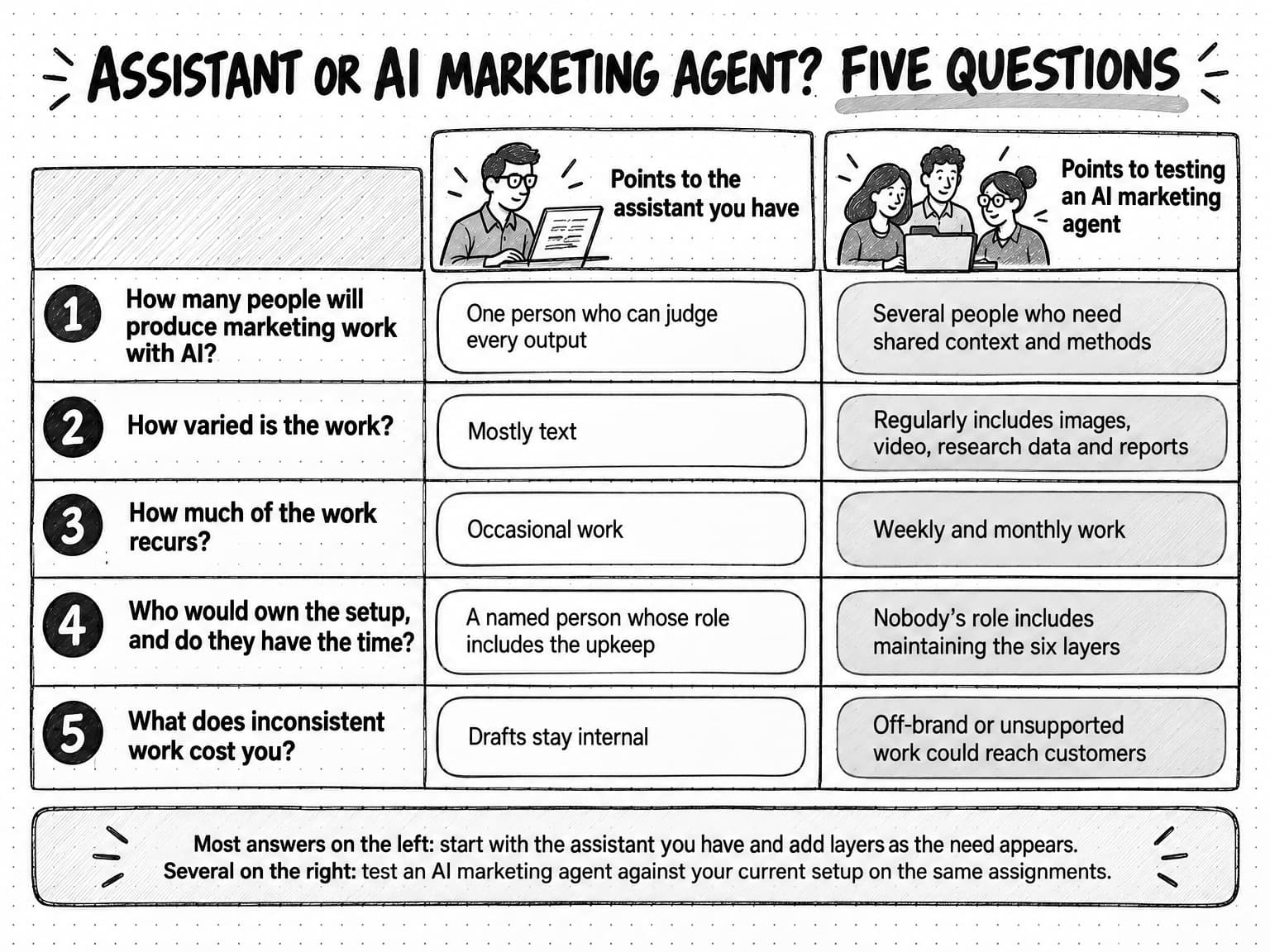
View the five questions table at full size (opens in a new tab).
How to test both options on the same brief
Test both options on two or three real assignments with the same source material and pass/fail requirements, and record the setup each one needed as part of the result. The evaluation guide covers the core method: representative assignments, comparable conditions, critical failures kept apart from graded quality, and scoring. Comparing an assistant with an agent needs a few additions, because the differences sit mostly in the layers, which a single run on a fresh brief hides.
- Choose assignments that exercise several layers. A launch package that needs research, copy and an on-brand image tests more of the system than a single post. Add one recurring job, such as a weekly competitor summary. Write each assignment as one brief that both options receive; the briefing guide includes a template covering the goal, audience, sources, deliverables and definition of done.
- Give each option the setup your team would actually maintain. For the assistant, that means the project files, instructions and extra tools you would keep current. For the agent, it means the vendor's onboarding with your material. Time both setups and record the hours beside the scores, because the difference measures the system you would be signing up to keep current.
- Run a second assignment without re-supplying context. This shows whether the brand context and methods carry over or have to be pasted in again.
- Ask a teammate to run the third. A different person working from the shared setup shows whether quality depends on who makes the request.
- Run the recurring job at least twice. Check where the results land, who is notified and what happens when a run fails.
- Change one fact and count the updates. Change a product name, a price or a positioning line, then count how many places each setup needed updating and whether the next output used the new fact.
Keep the comparison fair in both directions. Do not judge the assistant on a bare prompt while the agent receives a full onboarding, and do not rewrite the assistant's instructions after seeing the agent's result without recording that as a new condition. Use approved or synthetic material for the first runs and keep publishing, sending and account changes off-limits, as the evaluation guide recommends.
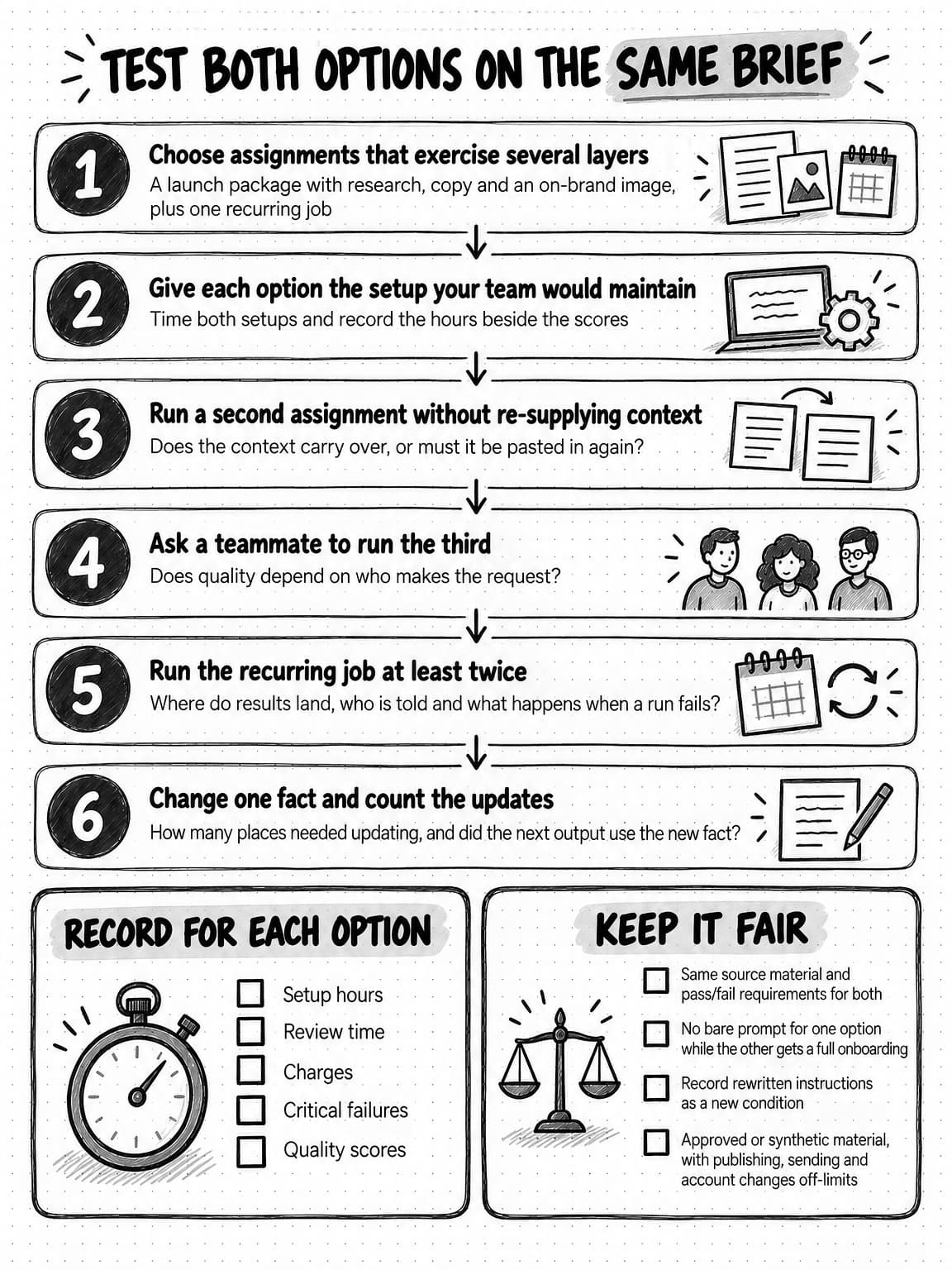
View the same-brief test checklist at full size (opens in a new tab).
Sources and further reading
- Noy and Zhang, "Experimental evidence on the productivity effects of generative artificial intelligence," Science, 2023 — randomized experiment on occupation-specific writing tasks.
- Dell'Acqua et al., "Navigating the Jagged Technological Frontier," Harvard Business School working paper, 2023 — field experiment on tasks inside and outside AI's capabilities.
- Bessemer Venture Partners, "Part I: The future of AI is vertical," September 2024 — an investor's definition of vertical AI.
- Y Combinator Lightcone, "Vertical AI Agents Could Be 10X Bigger Than SaaS," November 2024 — an investor argument, not research.
- Nori et al., "Can Generalist Foundation Models Outcompete Special-Purpose Tuning? Case Study in Medicine," 2023 — preprint on a general-purpose model against specialist models.
- Stanford HAI, 2025 AI Index Report — includes the fall in inference cost at a fixed level of capability.
- Microsoft and LinkedIn, 2024 Work Trend Index — survey of 31,000 knowledge workers on AI use at work.
Frequently Asked Questions
What marketing tasks can a general-purpose AI assistant handle well?
A general-purpose AI assistant handles self-contained language and reasoning tasks well: brainstorming, first drafts, rewrites, summaries and analysis of material you provide. In a 2023 controlled experiment, professionals including marketers completed short writing tasks such as press releases in 40% less time with a general-purpose chatbot, and evaluators rated the work 18% higher. Results are less dependable on tasks outside the model's strengths, so the output still needs review by someone who knows the subject.
What are the limitations of a general-purpose AI assistant for marketing?
The main limitation of a general-purpose AI assistant for marketing is that it works only from the context and tools someone has set up around it. Brand knowledge, reusable methods, media and data tools, model guidance, shared access and recurring automation all have to be built and kept current by the team. The assistant can also be wrong on tasks outside the model's strengths, and those tasks are hard to spot in advance, so its work needs informed review.
What is a vertical AI agent?
A vertical AI agent is an AI agent built for one specific domain, usually an industry such as legal, healthcare or finance. Bessemer Venture Partners describes vertical AI as applications purpose-built for specific industries. The term is also used loosely for agents specialized by business function, such as marketing, so check what a product is actually specialized for: its context, methods, tools and checks.
What is the difference between horizontal and vertical AI agents?
A horizontal AI agent is built to help with many kinds of work across industries, while a vertical AI agent is built for one domain. A general-purpose AI assistant is the clearest horizontal example. An AI marketing agent is specialized by job, so it serves many industries but only marketing work. In each case, much of the specialization lives in the context, methods and tools around the model.
Can a business use a general-purpose AI assistant and an AI marketing agent together?
Yes, a business can use a general-purpose AI assistant and an AI marketing agent together. A practical split keeps the assistant for individual questions, editing and ideation, and runs shared work such as research, campaign production and recurring reports through the AI marketing agent, which holds the team's brand context. Paying for both makes sense only when each has a clear job, so decide which work belongs where.
Which tools should a marketing team use alongside a general-purpose AI assistant?
A marketing team needs specialist tools alongside a general-purpose AI assistant for whatever work the assistant does not cover itself, which can include image and video generation, voice, search and keyword data, ad and review research, social data and web extraction. Each adds a subscription and an interface, any brand context it needs has to be supplied separately, and work often moves between them by hand. Count those tools, and the time spent connecting them, when comparing options.
How do the costs of a general-purpose AI assistant and an AI marketing agent compare?
The costs of a general-purpose AI assistant and an AI marketing agent compare fairly only when both include hours as well as subscriptions. With an assistant, the team pays in time for setup, maintenance, extra tools and coordination. An AI marketing agent includes more of that system in its price but still involves usage charges, onboarding and review time. The most reliable comparison records actual hours and charges during a trial.
Can a general-purpose AI assistant replace a marketer?
A general-purpose AI assistant can take on parts of a marketer's work, such as first drafts, summaries and analysis, but not the role. People still decide what the company should say, which claims it can support and what gets published, and they remain accountable for the result. In a 2023 field experiment, consultants using AI on a task chosen to sit outside the model's strengths were less likely to reach the correct answer, so informed review matters. The same applies to AI marketing agents.
How are vertical AI agents different from vertical SaaS?
Vertical SaaS is industry-specific software that people operate themselves, such as construction project management or restaurant point-of-sale software. A vertical AI agent is built for one domain and carries out parts of the work, returning it for people to review. Bessemer Venture Partners argues that, unlike traditional vertical SaaS, vertical AI can automate complex, repetitive language-based tasks. In November 2024, Y Combinator's Lightcone podcast argued that vertical AI agents could be ten times bigger than SaaS; that is an investor forecast.


