How to prevent AI hallucinations in marketing content
No AI model can promise only true statements. Learn where invented statistics, quotes and citations come from, which ones do the most damage in marketing, and how to keep them out of everything you publish.
29 min readWritten by Ampere
Short answer
How do you prevent AI hallucinations in marketing content?
You can't make an AI model hallucination-free, but you can keep invented facts out of published marketing. Give the AI current, approved sources and permission to say it doesn't know, ask for each claim with its source, and check every factual claim against the original before publishing, starting with numbers, quotes, product facts and citations.
Summary
An AI hallucination is false or unsupported content that an AI model presents as fact, such as an invented statistic or a real source cited for something it doesn't say. No current model is hallucination-free, and a false claim reads as smoothly as a true one, so proofreading a polished draft won't catch hallucinations. Checking each factual claim against its source will.
AI models hallucinate because they predict plausible text, and their training and testing reward a confident guess over an admission of uncertainty. The facts most at risk are rare, recent or specific to one company, such as current pricing, new features and customer results. Those are the details marketing copy depends on, and a model fills them in with something plausible when nobody supplies them.
Six kinds of AI hallucination are worth watching for in marketing content: invented statistics, wrong product features or pricing, fake or misattributed quotes, made-up or broken citations, outdated facts, and invented customers or results. Once published, the error belongs to the publisher. A Canadian tribunal held Air Canada responsible for its website chatbot's wrong answer, and US advertisers need a reasonable basis for claims before they run.
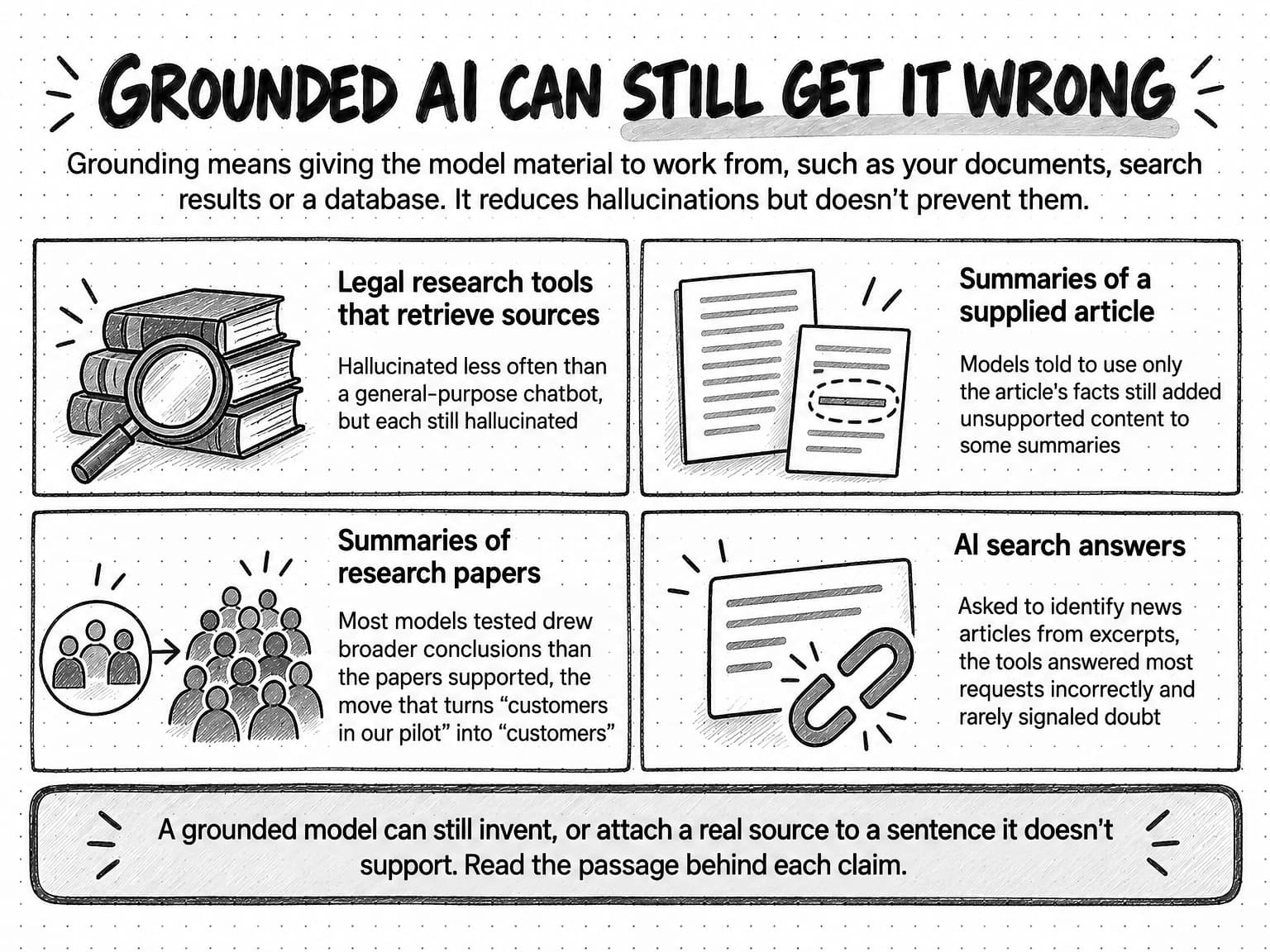
Grounding an AI in your own sources reduces hallucinations but doesn't prevent them. In a 2025 Stanford study, retrieval-based legal research tools still hallucinated 17% to 33% of the time, and in a March 2025 test, AI search tools gave incorrect answers to more than 60% of requests to identify a news article from an excerpt. Grounded models can also cite a real source for a claim the source doesn't support.
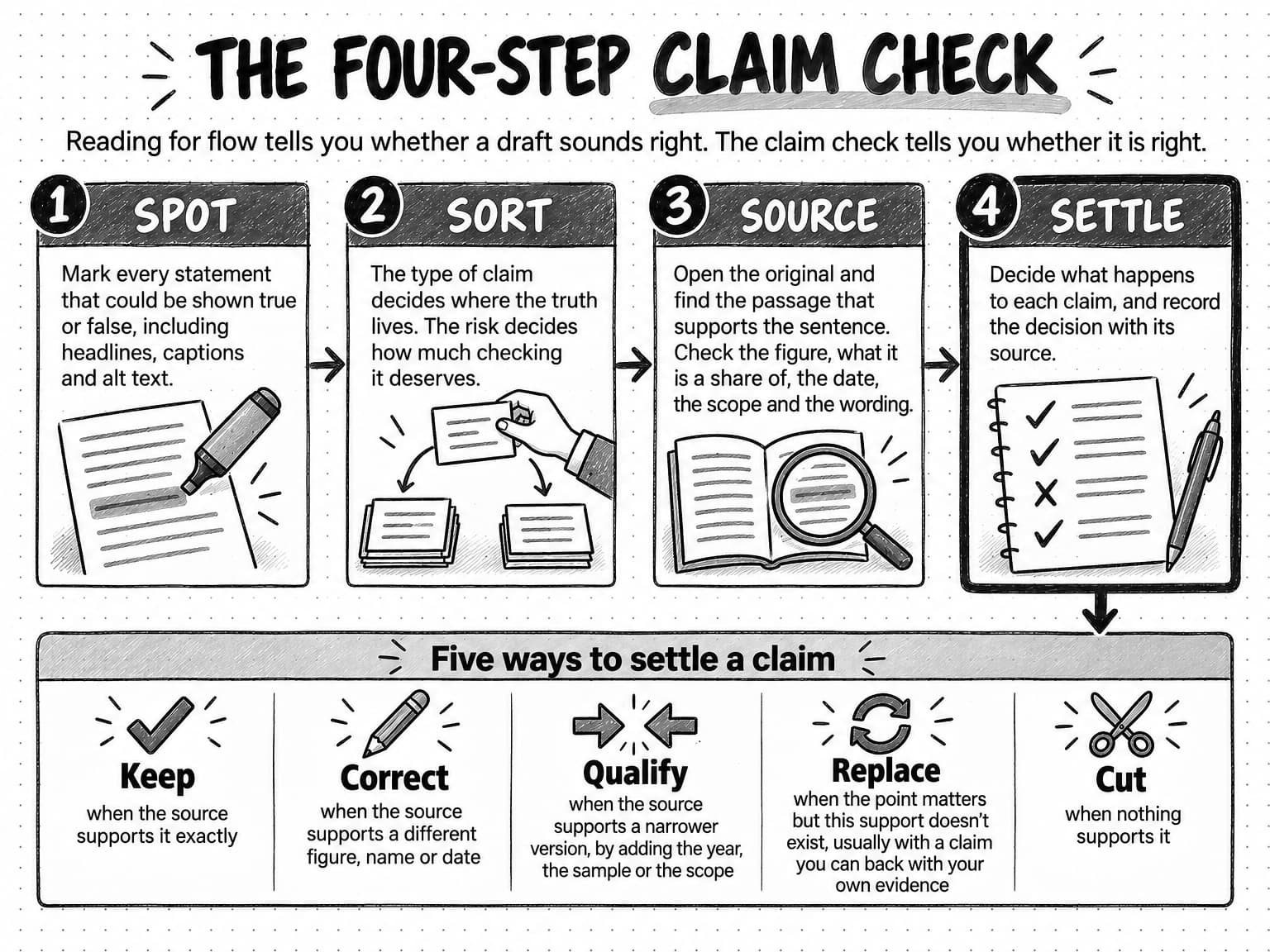
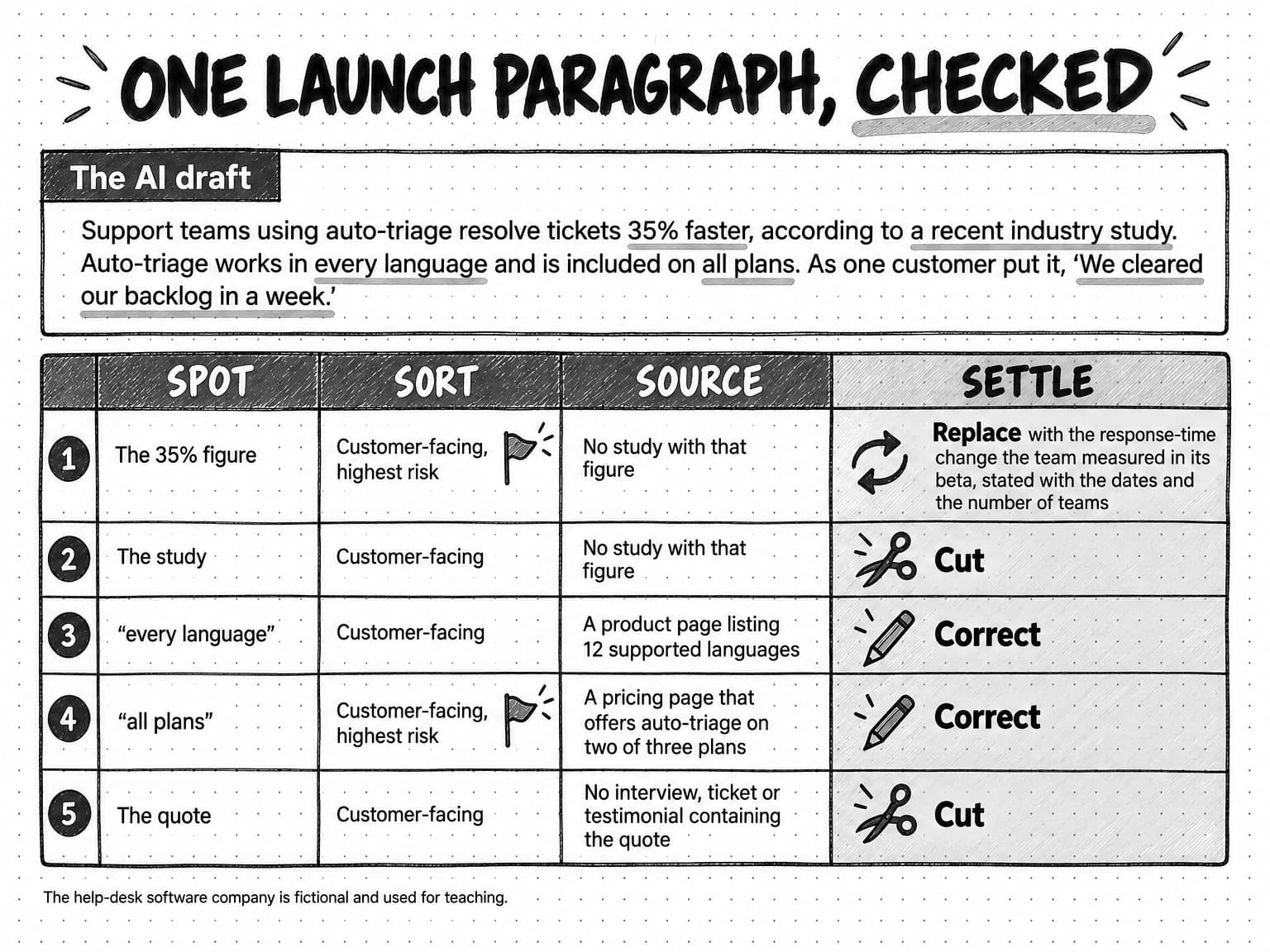
A four-step claim check catches hallucinations before publication: spot every factual claim, sort the claims by type and risk, source each one to the passage that supports it, and settle it by keeping, correcting, qualifying, replacing or cutting the claim. A worked example applies the check to a fictional software company's launch paragraph, and habits before and during drafting, such as supplying approved facts and allowing “not found,” make hallucinations rarer.
Contents
- What is an AI hallucination?
- Why do AI models hallucinate?
- What AI hallucinations look like in marketing content
- What happens when AI hallucinations reach customers
- Does grounding AI in your sources prevent hallucinations?
- How to fact-check AI-generated marketing content
- How to prevent AI hallucinations before, during and after drafting
- How Ampere helps keep hallucinations out of published work
- Sources and further reading
- Frequently Asked Questions
In May 2025, the Chicago Sun-Times and at least one edition of The Philadelphia Inquirer printed a syndicated summer reading list in which only five of the 15 books were real. The rest were made-up books credited to well-known authors, complete with descriptions. The writer who produced the list said it was partly generated with AI, and the Sun-Times said the licensed content had not been created or approved by its newsroom. The list went to print without anyone confirming that the books existed.
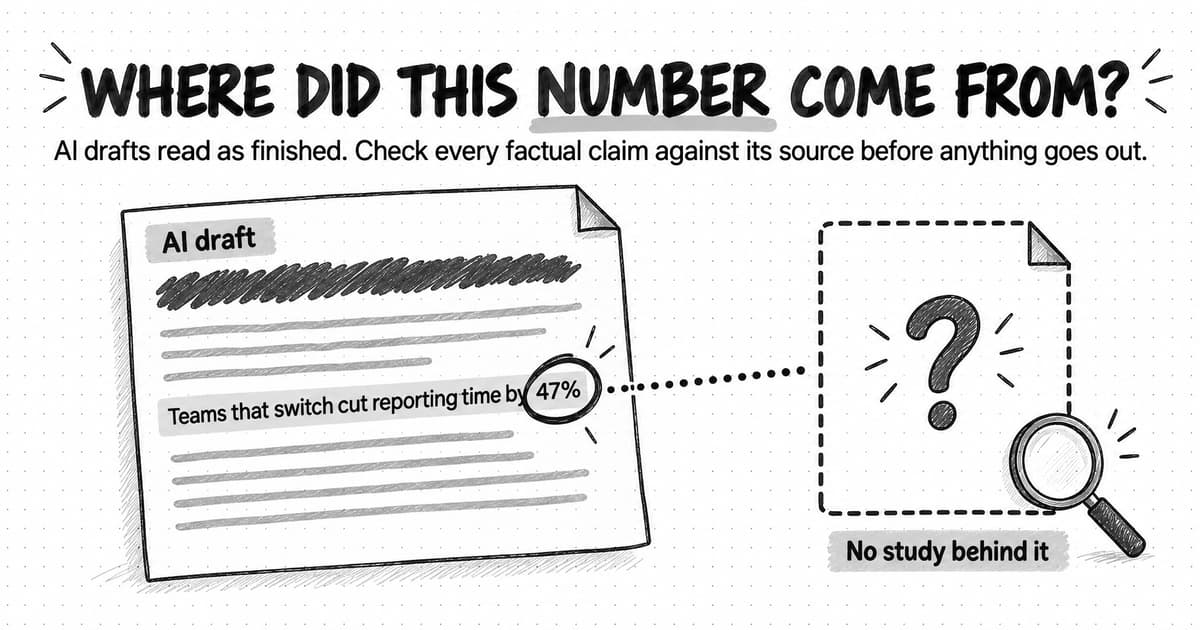
Marketing drafts fail the same way, usually less publicly: a statistic from a study nobody can find, a feature the product doesn't have, a customer quote nobody gave, a link to a report that was never published. You can't make an AI model hallucination-free, but you can keep hallucinations out of what you publish: give the AI the facts and sources the work depends on, let it say when it can't support a claim, and check every factual claim against its source before anything goes out.
The last step is the easiest to skip, because AI drafts read as finished, and a polished paragraph says nothing about whether its facts were checked. This guide explains why models hallucinate, the six kinds of hallucination to watch for in marketing content, what happens when they reach customers, and how far grounding an AI in your own sources helps. It then sets out a four-step claim check (spot, sort, source, settle) and the habits before, during and after drafting that make hallucinations rarer.
What is an AI hallucination?
An AI hallucination is false or unsupported content that an AI model presents as fact. The US National Institute of Standards and Technology calls it confabulation, which its Generative AI Profile defines as “the production of confidently stated but erroneous or false content” that can mislead or deceive the people who read it. Whatever the name, what makes it dangerous is the confidence. A false statement arrives in the same assured tone as the true ones around it.
NIST's definition reaches beyond pure invention. It includes output that departs from the prompt or from the material the model was given, and it warns that a model can produce “confabulated logic or citations” that seem to justify a false answer. For marketing work, that breadth points to two kinds of hallucination worth telling apart.
Invented claims have nothing behind them: a statistic from a study that doesn't exist, a quote nobody gave, a book with a made-up title. Misgrounded claims point to something real that doesn't say what the sentence says: a genuine report cited for a number it doesn't contain, a feature described from an old version of a product page, a finding from one market stretched to cover all of them. The second term comes from a 2025 Stanford study of AI legal research tools, which counted a response as a hallucination if the model “makes a false statement or falsely asserts that a source supports a statement.” The distinction changes the check. For an invented claim, you confirm whether the thing exists. For a misgrounded one, you read the source and compare.
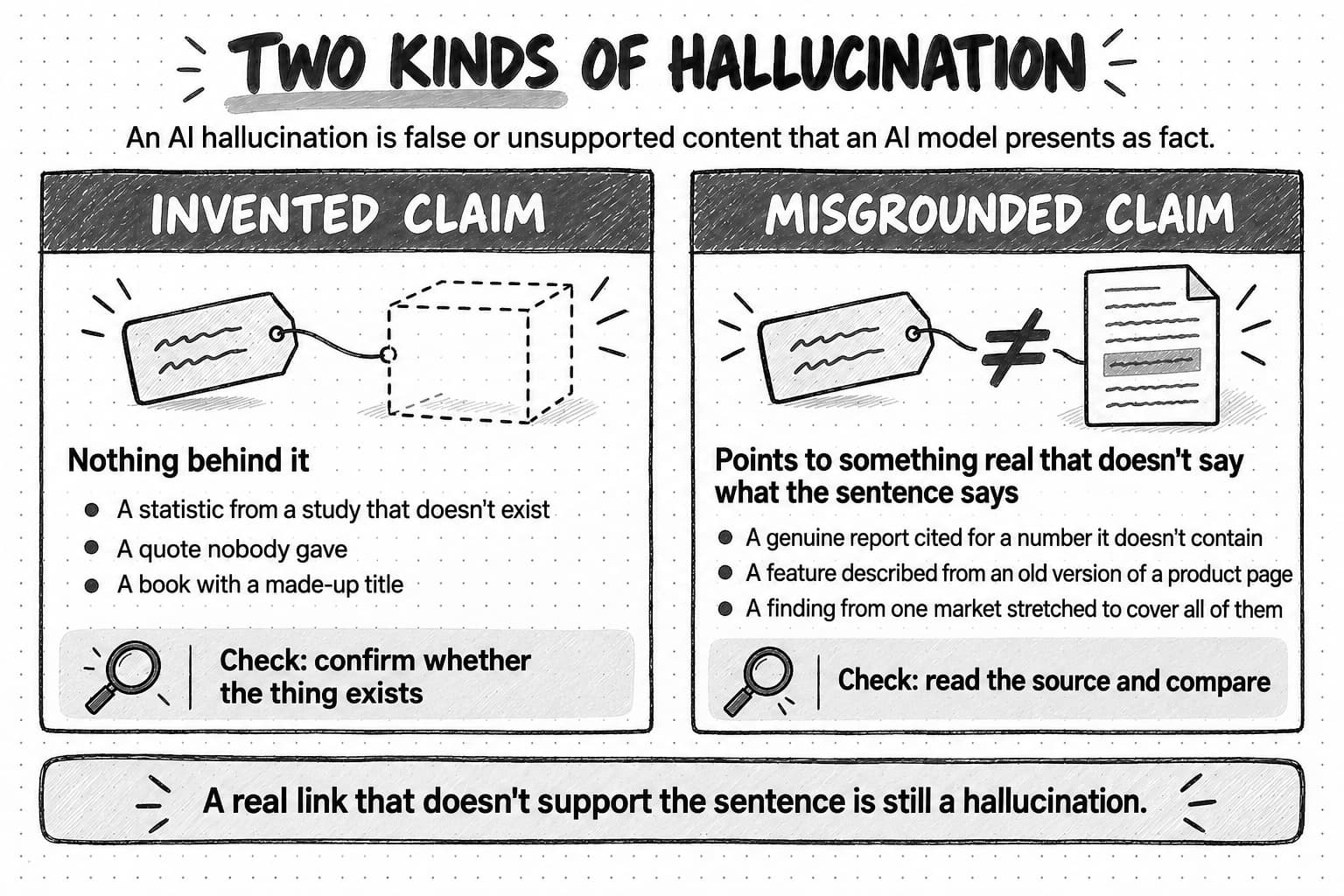
View the two kinds of hallucination diagram at full size (opens in a new tab).
Two related problems need different fixes. An AI can faithfully repeat an error from an outdated or wrong source, and then the fix is the source, which is why the material you give an AI needs dates and owners. Accurate content can also be worthless: generic copy that any company could have published is a quality problem, often called AI slop, while a hallucination is a truth problem. A draft can have both.
Why do AI models hallucinate?
AI models hallucinate because they generate text by predicting what is likely to come next, and the way they are trained and tested rewards a confident guess over an admission of uncertainty. NIST calls confabulation “a natural result of the way generative models are designed”: a model produces output that matches the statistical patterns of its training data, so a sentence can be plausible without being true.
A September 2025 paper by researchers at OpenAI and Georgia Tech explains why the guessing persists. Most tests score a model the way a multiple-choice exam scores a student: a right answer earns a point, while a wrong answer and “I don't know” both earn nothing. Under that scoring, guessing is the winning strategy, so models learn to bluff, and the paper notes that the bluffs tend to be overconfident and specific, such as a precise date where a vague season would be honest.
The researchers also explain which facts are most at risk. Spelling follows consistent patterns, so spelling errors disappear as models grow larger. Arbitrary facts that appear rarely in training data, such as a particular person's birthday, can't be inferred from any pattern. By the paper's reasoning, if 20% of birthday facts appear only once in the training data, a model should be expected to get at least 20% of them wrong after its initial training.
Vendor results published by OpenAI alongside the paper show what guessing costs. On SimpleQA, a set of 4,326 short factual questions, an older OpenAI model abstained on 1% of questions, answered 24% correctly and got 75% wrong. A newer model abstained on 52%, answered 22% correctly and got 26% wrong. Accuracy was almost the same, but the newer model made about a third as many errors, because it declined to answer when it didn't know. The researchers argue that accuracy will never reach 100%, because some real-world questions can't be answered, but that a model could avoid confident errors by abstaining when it's uncertain. Even the more cautious model still got 26% of the questions wrong.
This matters for marketers because the facts a model is least likely to know are the ones marketing copy depends on: this quarter's pricing, the feature that shipped last month, your customer count, the result from your newest case study. Those facts are specific, recent and often missing from the public web, so a model fills them with something plausible when you don't supply them. NIST adds that confabulation is a particular risk in long-form answers to open-ended prompts and in work that needs specialized context, a fair description of most marketing drafts.
The facts an AI model is least likely to know are the ones your marketing depends on most.
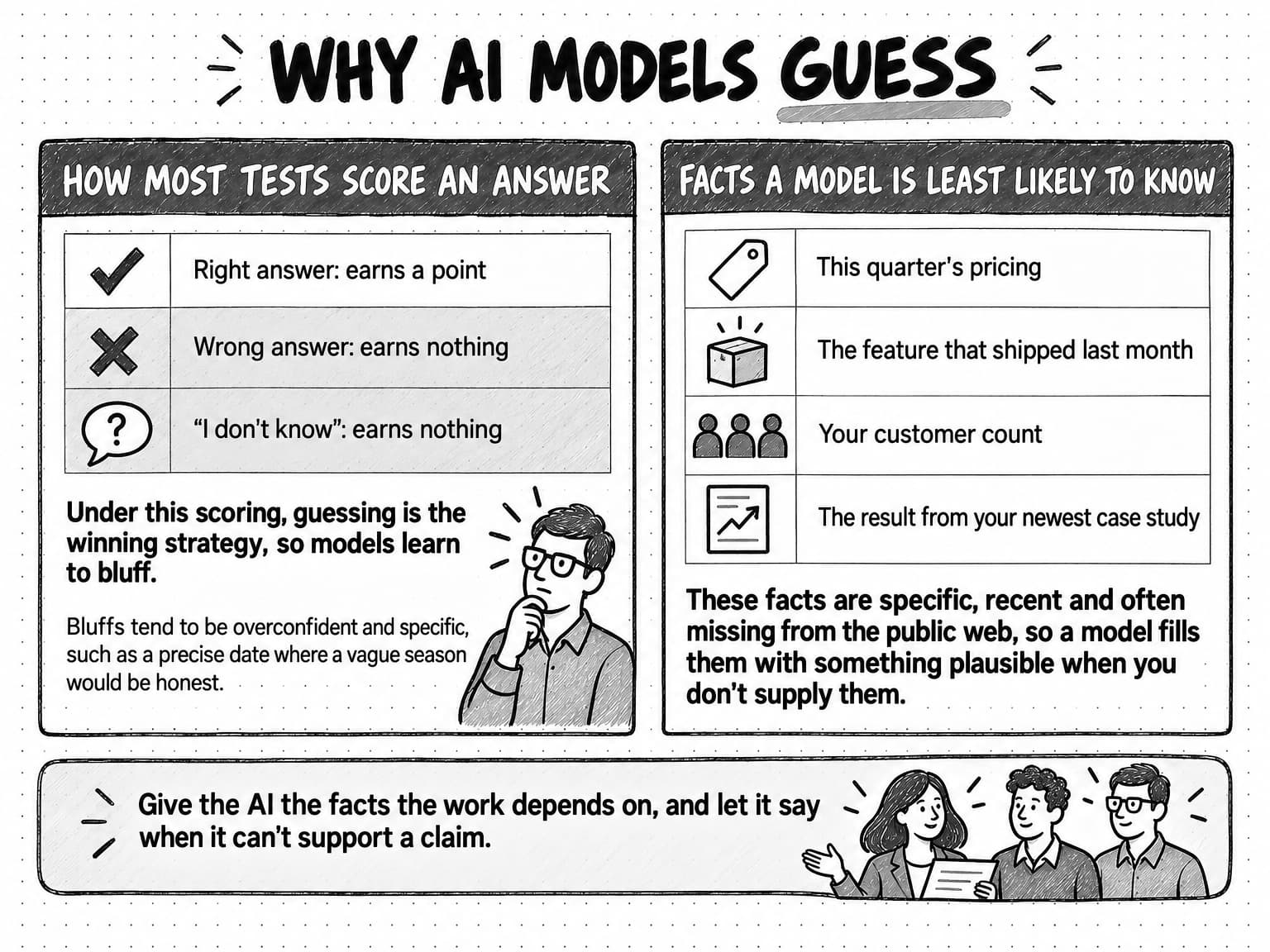
View the diagram of why AI models guess at full size (opens in a new tab).
What AI hallucinations look like in marketing content
In marketing content, AI hallucinations look like the details that make copy persuasive: statistics, product facts, quotes, citations, dates and customer results. The table sets out six types to watch for and the check that catches each. Its examples are illustrations, not real claims.
| Type | Illustrative example | Why it appears | Check that catches it |
|---|---|---|---|
| Invented statistic | “Teams that switch cut reporting time by 47%,” with no study behind it | A precise figure suits persuasive copy, and a model keeps no record of where a number came from | Find the original publication and confirm the figure, sample, date and wording |
| Wrong product feature or pricing | “Included on every plan” for a feature sold only on the top tier | Current product facts are recent and rarely published, so the model fills gaps with what is typical for the category | Compare with the current pricing page, release notes or product owner |
| Fake or misattributed quote | A customer quote nobody gave, or a real line credited to the wrong person | A model can produce speech-like wording with no record of who said it | Match the exact words to a recording, transcript or approved testimonial |
| Made-up or broken citation | A report title that was never published, or a real link that doesn't support the sentence | Citations are generated like any other text, and search tools can link a wrong page or a copy | Open every link and find the passage that supports the claim |
| Outdated fact | Last year's price, a retired product name, or “the latest version” two releases ago | Training data stops at a cutoff date, and retrieved pages can be old or cached | Check the source's date against the current official page |
| Invented customer or result | “Trusted by 500 teams” or a case-study result nobody measured | Social proof is a common pattern in the marketing copy models learn from | Confirm against your own records or an approved case study |
A model can produce any of these details fluently whether or not it knows the answer, and the wording won't tell you which. That is why the guide to evaluating an AI marketing agent fails any run that invents or misstates a material product claim, however polished the rest of the output.
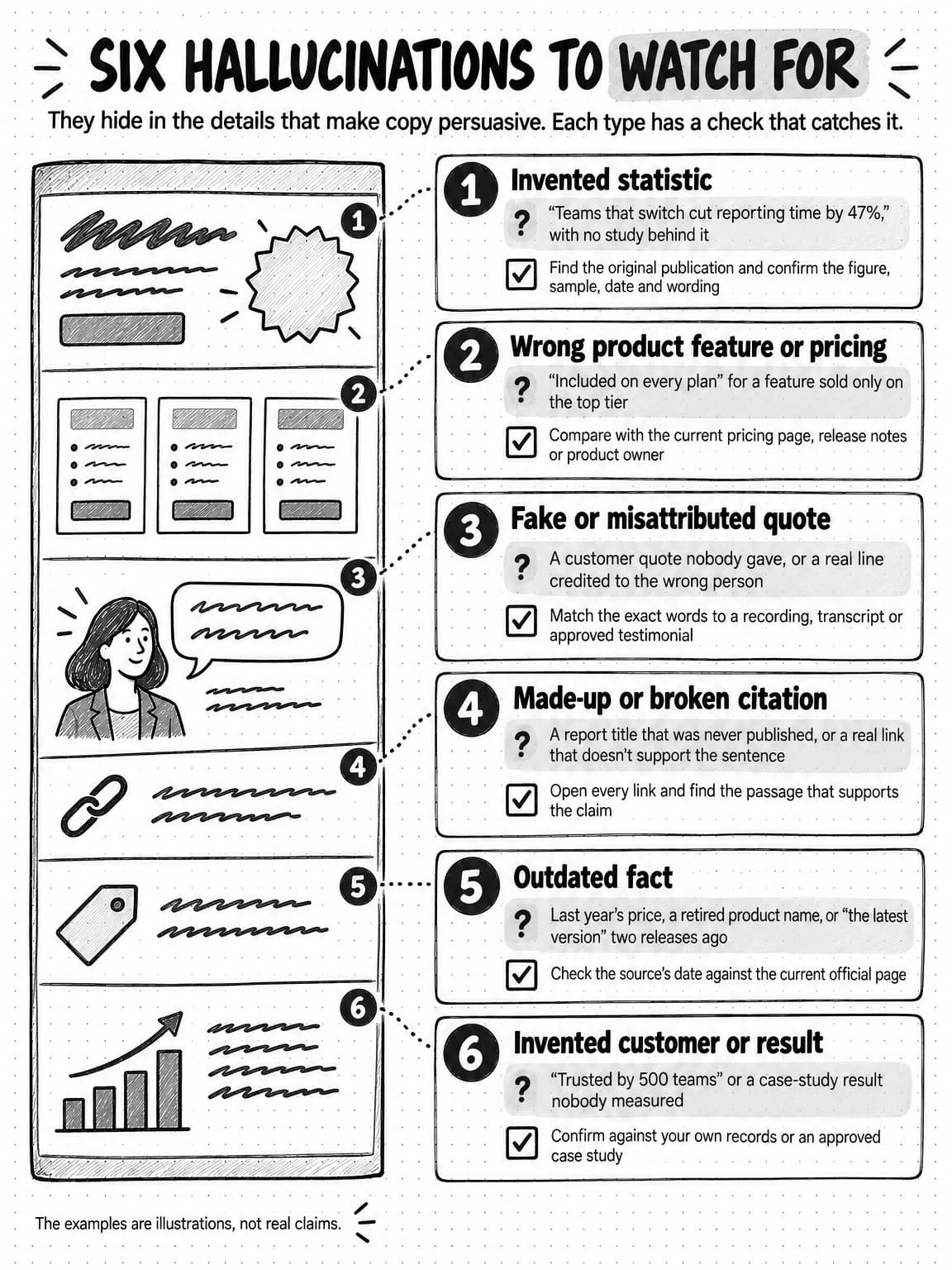
View the six hallucination types at full size (opens in a new tab).
What happens when AI hallucinations reach customers
When an AI hallucination reaches customers, the organization that published it answers for the error, whatever produced the words. Cases from customer service, consulting and the courts all point the same way.
In Moffatt v. Air Canada (February 2024), a customer asked the chatbot on Air Canada's website about bereavement fares and was told they could claim the reduced fare within 90 days of the ticket being issued. The airline's bereavement travel page said the policy didn't apply once travel was complete, and Air Canada argued it couldn't be held liable for information its chatbot provided. British Columbia's Civil Resolution Tribunal called that “a remarkable submission,” found that the airline hadn't taken reasonable care to make its chatbot accurate, and ordered it to pay C$812.02 in damages, interest and fees. The decision doesn't say what technology ran the chatbot, but its reasoning covers any automated answer a company publishes:
It should be obvious to Air Canada that it is responsible for all the information on its website. It makes no difference whether the information comes from a static page or a chatbot.
In October 2025, Deloitte Australia agreed to partially refund the Australian government for a A$440,000 report that, according to the Associated Press, contained a fabricated quote from a federal court judgment and references to academic research that doesn't exist. The researcher who flagged the problems said his colleagues' work had been used as “tokens of legitimacy,” cited without being read. A revised version of the report disclosed that a generative AI system had been used in writing it, and the department later put the refund at more than A$97,000.
In law, the problem has its own running count. A public database maintained by Damien Charlotin listed 2,149 court and tribunal decisions dealing with hallucinated content as of October 5, 2026, typically fake citations. The lesson carries over to marketing: the hallucinations that do the most damage are the ones that look like evidence.
Advertising claims carry an older obligation. In the United States, the Federal Trade Commission's policy statement on advertising substantiation, issued in 1984, expects advertisers to have “a reasonable basis for advertising claims before they are disseminated,” and the support required depends on factors including the type of claim and the consequences of a false one. An AI-invented statistic has no basis at all, and publication is too late to find that out. Rules differ by country and industry, so regulated claims need their own review.
Does grounding AI in your sources prevent hallucinations?
Grounding an AI in your own sources reduces hallucinations but doesn't prevent them. Grounding means giving the model material to work from, such as your documents, search results or a database, instead of relying on what it absorbed in training. One common method is retrieval-augmented generation, or RAG: the system searches a collection of documents and passes the relevant passages to the model along with the request.
Legal research offers a direct test, because some vendors had promoted retrieval as eliminating hallucinations or guaranteeing “hallucination-free” citations. In the Stanford study, the first preregistered evaluation of such tools, retrieval-based research tools from two major legal publishers hallucinated less often than a general-purpose chatbot, but each still did so “between 17% and 33% of the time.” The authors' conclusion holds well beyond law: users “must continue to verify that key propositions are accurately supported by citations.”
Summarizing a document that sits in front of the model doesn't remove the risk either. The AI company Vectara runs a public leaderboard that asks models to summarize more than 7,700 articles using only the facts in each one, then scores every summary with Vectara's own hallucination-detection model. In the version updated on September 22, 2026, the share of summaries containing unsupported content ranged from 1.8% to 24.2% across 108 models, and 50 of the models were at 10% or higher. The ranking is vendor-run and machine-scored, so treat individual positions with caution, but the spread shows that a model can drift from a source it was told to stick to.
AI summaries can also stretch their sources. In a 2025 study in Royal Society Open Science, Uwe Peters and Benjamin Chin-Yee compared 4,900 AI-generated summaries of scientific papers with the originals. Even when explicitly prompted for accuracy, most of the 10 models tested drew broader conclusions than the papers supported, and three of them did so in 26% to 73% of cases. A finding about the people in one study became a statement about whole categories of people, the same move that turns “customers in our pilot” into “customers.”
AI search tools, which ground their answers in live web results, show the gap in their citations. In March 2025, the Tow Center for Digital Journalism at Columbia tested eight AI search tools with excerpts from 200 news articles, 1,600 queries in all, asking each tool for the article's headline, publisher, date and link. Together, the tools answered more than 60% of the queries incorrectly, with error rates from 37% to 94% depending on the tool, and they rarely signaled doubt. The two paid versions in the test answered more queries correctly than their free counterparts but also had higher error rates, because they seldom declined to answer. More than half of the responses from two of the tools cited fabricated or broken links, and one tool's citations led to error pages for 154 of its 200 queries.
Grounding changes what you need to check. A model working from sources can still invent, and it can also misreport a real source by attaching a genuine link, report or page to a sentence it doesn't support. That is why the claim check below asks you to read the passage behind each claim instead of stopping once a source exists. If you track how AI search describes your own brand, the guide to measuring AI search visibility shows how to record answer accuracy alongside mentions and citations.
View the grounding limits diagram at full size (opens in a new tab).
How to fact-check AI-generated marketing content
Fact-check AI-generated marketing content with a four-step claim check: spot every factual claim, sort the claims by type and risk, source each one to its original, and settle what happens to it. The method separates two jobs that ordinary proofreading blends. Reading for flow tells you whether a draft sounds right. The claim check tells you whether it is right, and the effort it takes grows with the number of claims, not the length of the piece.
View the four-step claim check at full size (opens in a new tab).
Spot every factual claim
Start by marking every statement that could be shown true or false, leaving aside opinions and recommendations. In marketing drafts, checkable claims cluster in predictable places: numbers and dates; names of people, companies, products and publications; quotes and attributions; product facts such as features, prices, plans, integrations and availability; comparisons and superlatives such as “fastest” or “the only”; cause-and-effect claims, such as a feature that “reduces churn”; customer results; and every citation and link. Look past the body copy, too. Headlines, subject lines, image text, chart labels, captions, alt text and page descriptions come from the same model and carry the same risk.
You can ask the AI to list the factual claims in its draft with a source for each. The list makes a useful first pass, but don't treat it as complete, because a model that invented a claim can also leave it off its own list. Make your own pass and compare the two.
Sort the claims by type and risk
Sorting tells you where to look and how hard. The type of claim decides where the truth lives. Product facts live in current product documentation, release notes and the pricing page, and customer results in your own records and approved case studies. Quotes live in recordings, transcripts and signed-off testimonials, third-party statistics in the original publication, and competitor facts on the competitor's current pages, noted with the date you checked them.
The risk decides how much checking each claim deserves. Ask who will see it, whether it can be corrected easily once it's out, and what it promises, much as the FTC weighs the type of claim and the consequences of a false one. A widely known fact in an internal brief can get a quick look. Numbers, quotes and product claims in anything customers will read always get a full source check. Prices, performance results, comparisons with named competitors, and anything in a regulated area such as health, finance or employment also need a second check by the person who owns the fact: the product owner for a capability claim, whoever sets prices for a pricing claim, legal review for a regulated one.
Source each claim to its original
Sourcing a claim means opening the original and finding the passage that supports the sentence. Check five things against that passage: the figure itself, what it is a share of, the date, the scope (which market, sample, product tier or period), and the wording, if the draft quotes or closely paraphrases the source. A genuine report cited for a figure it doesn't contain is the misgrounded claim described earlier, and it survives any check that stops at the link.
Go to the original publication instead of a summary of it, because figures shift as they are repeated, and don't treat an AI search answer as a source in its own right. When a source is unfamiliar, read laterally, as professional fact-checkers do. In a 2019 study by Sam Wineburg and Sarah McGrew, fact-checkers judged unfamiliar websites by leaving them after a quick scan and opening new tabs to see what other sources said about them. They reached better-supported conclusions than historians and university students, in a fraction of the time.
Settle each claim
Settling means deciding what happens to each claim, and there are five outcomes. Keep a claim when the source supports it exactly. Correct it when the source supports a different figure, name or date. Qualify it when the source supports a narrower version, by adding the year, the sample or the scope. Replace it when the point matters but this support doesn't exist, usually with a claim you can back with your own evidence. Cut it when nothing supports it. Invented statistics nearly always end in a cut or a replacement, because a number with no source can't be corrected into a real one.
Record each decision with its source, in a column beside the draft or a short claim log, so a reviewer can see what was checked and an editor can later tell which figures need refreshing.
View the checked launch paragraph at full size (opens in a new tab).
How to prevent AI hallucinations before, during and after drafting
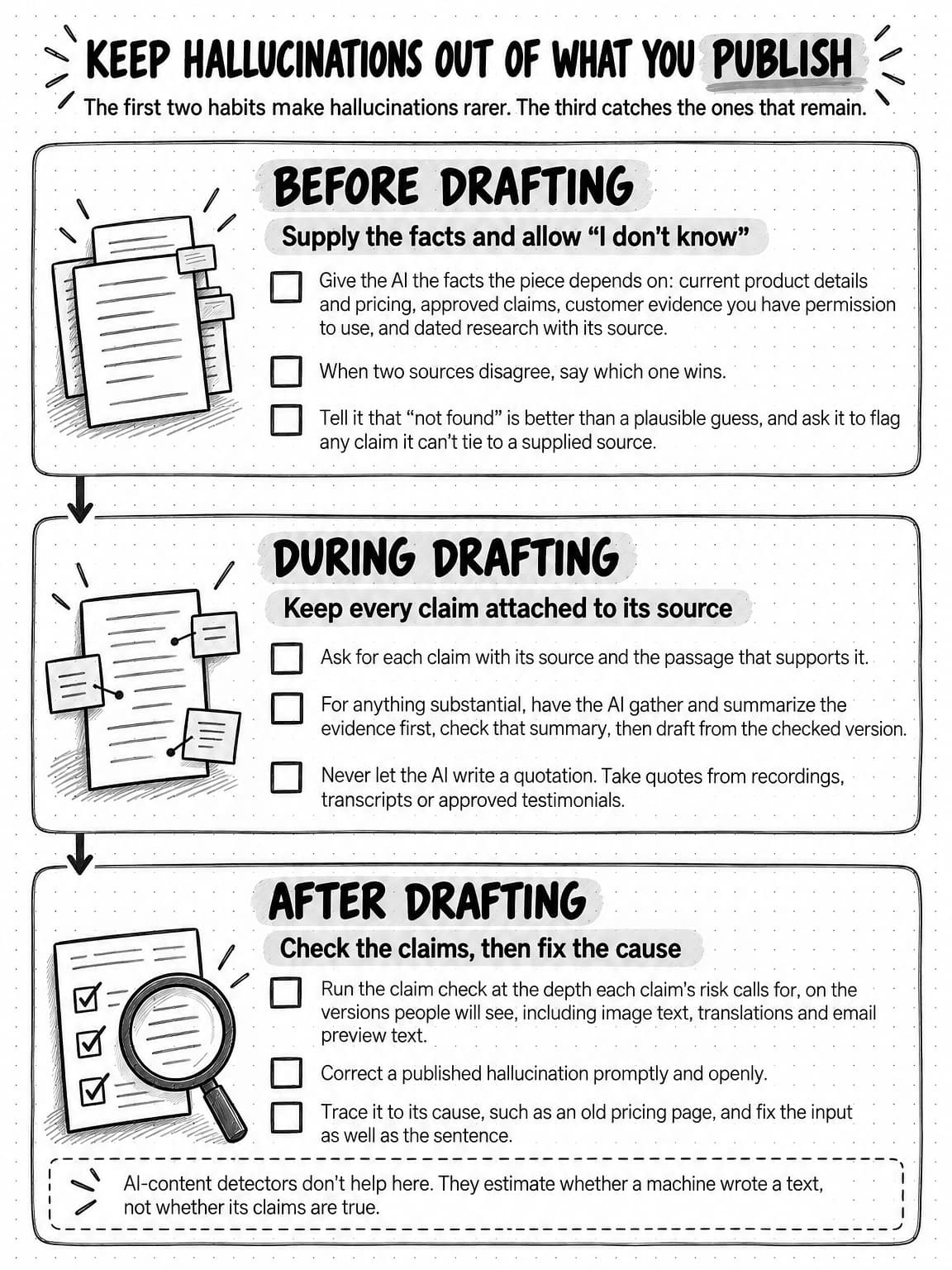
Preventing AI hallucinations takes three habits: supply the facts before drafting, keep claims attached to their sources during drafting, and check and correct after drafting. The first two make hallucinations rarer, and the third catches the ones that remain. For where this check sits in the whole content workflow, see our guide to AI content creation.
Before drafting: supply the facts and allow “I don't know”
A hallucination in a marketing draft often fills a gap the brief left open. Give the AI the facts the piece depends on: current product details and pricing, the claims your team has approved, customer evidence you have permission to use, and dated research with its source. A proof inventory, which checks each claim you might make against the evidence available now, is one of the most useful inputs, and the guide to building a brand messaging framework shows how to make one. When two sources disagree, say which one wins, as the guide to briefing an AI marketing agent explains.
Then make abstaining acceptable. Tell the AI that “not found,” or a visible gap such as “customer count to confirm with sales,” is better than a plausible guess, and ask it to flag any claim it can't tie to a supplied source. The OpenAI researchers propose a similar move for model tests: state in the instructions that a wrong answer costs more than an honest “I don't know.”
Instructions alone won't settle it, though. In the Royal Society study, asking for faithful summaries backfired: compared with a simple summary request, it made broad conclusions twice as likely. Narrow tasks also help. Asking for a summary of three supplied reports leaves less room for invention than asking for an article about a market.
During drafting: keep every claim attached to its source
Ask for claims and evidence together. A practical format is a short source note after each factual sentence, or a table at the end that lists each claim, its source and the passage that supports it. The passage matters more than the source's name, because it lets a reviewer compare the two in seconds and exposes a misgrounded claim at once.
For anything substantial, separate research from writing. Have the AI gather and summarize the evidence first, check that summary, and only then draft from the checked version. Never let the AI write a quotation. Take quotes from recordings, transcripts or approved testimonials, and label them as the guide to voice-of-customer research suggests, so exact words, edited excerpts and paraphrases stay distinct.
After drafting: check the claims, then fix the cause
Run the claim check at the depth each claim's risk calls for, on the versions people will see, including image text, translations and email preview text, because a fix in the document doesn't always reach every format. AI-content detectors don't help here. They estimate whether a machine wrote a text, not whether its claims are true.
When a hallucination reaches a published piece, correct it promptly and openly. Then trace it to its cause, along with any error your claim log shows recurring. A wrong price often traces back to an old pricing page, and an invented quote to a brief that asked for social proof without supplying any. Fixing the input, as well as the sentence, is what improves the next draft. For recurring work, the guide to automating marketing with AI agents recommends showing sources and gaps with every output.
View the before, during and after drafting checklist at full size (opens in a new tab).
How Ampere helps keep hallucinations out of published work
Ampere, the AI marketing agent, supports the habits before, during and after drafting, and it leaves review and approval with you.
Before drafting, Ampere works from Brand memory, the saved, reviewable knowledge it keeps about your brand and market. Its 22 deep-dive brand skills study your positioning, products, pricing, audience, competitors and more, and save each result as an editable brief with its sources visible. You review and correct what Ampere learned, and the approved version is what later work follows. Briefs have shelf lives: when Ampere reuses a saved brief instead of repeating the research, it is designed to refresh one that has passed its shelf life first. When a launch or a price change makes a brief out of date sooner, edit it so later work doesn't repeat the old fact. When a missing fact blocks the work, Ampere asks you for it.
While drafting, Ampere works in a session workspace you can inspect, with its files, previews, the browser pages it opened, and sources where the work has them, so you can see where a claim came from. Several kinds of work are built around evidence. Blog article packages are source-grounded; competitor reports, battlecards and comparisons come with sources attached; and for LinkedIn text posts, polls and newsletters, Ampere can return a package with review notes and claim checks alongside the drafts. Monitoring alerts about supported competitor pages, changelogs and review sites include available evidence and source excerpts.
After drafting, the work comes back to you. AI outputs may be inaccurate or incomplete, and provider data such as public engagement counts can be partial. Answers about a video can be wrong, so check them against the recording before quoting. The claim check in this guide applies to everything Ampere produces, and nothing publishes without you.
Sources and further reading
- National Institute of Standards and Technology, Artificial Intelligence Risk Management Framework: Generative Artificial Intelligence Profile (NIST AI 600-1), July 2024.
- Adam Tauman Kalai and colleagues, Why Language Models Hallucinate, September 4, 2025, and OpenAI, Why language models hallucinate, September 5, 2025. Vendor research.
- Varun Magesh and colleagues, Hallucination-Free? Assessing the Reliability of Leading AI Legal Research Tools, Journal of Empirical Legal Studies, 2025.
- Vectara, Hallucination Leaderboard, updated September 22, 2026. Vendor research.
- Uwe Peters and Benjamin Chin-Yee, Generalization bias in large language model summarization of scientific research, Royal Society Open Science, April 30, 2025.
- Klaudia Jaźwińska and Aisvarya Chandrasekar, AI Search Has a Citation Problem, Columbia Journalism Review, March 6, 2025.
- Civil Resolution Tribunal of British Columbia, Moffatt v. Air Canada, 2024 BCCRT 149, February 14, 2024.
- Rod McGuirk, Deloitte to partially refund Australian government for report with apparent AI-generated errors, Associated Press, October 7, 2025.
- Elizabeth Blair, How an AI-generated summer reading list got published in major newspapers, NPR, May 20, 2025.
- Damien Charlotin, AI Hallucination Cases Database, updated October 5, 2026.
- Federal Trade Commission, Policy Statement Regarding Advertising Substantiation, 1984.
- Sam Wineburg and Sarah McGrew, Lateral Reading and the Nature of Expertise, Teachers College Record, 2019.
Frequently Asked Questions
Can AI hallucinations be fixed?
AI hallucinations can be reduced but not fixed completely, because no current model can be made to produce only true statements. Researchers at OpenAI argue that accuracy will never reach 100%, because some real-world questions can't be answered, but that a model can avoid many confident errors by declining to answer when it's uncertain. In practice, supply the facts and check every claim before publishing.
Why does AI make things up?
AI makes things up because it generates text by predicting likely words, and its training and testing reward a confident guess over “I don't know.” A guess sometimes scores, while an admission of uncertainty never does. Facts that are rare or missing in training data, such as a company's current pricing, can't be predicted from patterns, so a model without them tends to produce something plausible.
How often does AI hallucinate?
How often AI hallucinates depends on the task and the model. On a vendor-run summarization leaderboard updated in September 2026, models added unsupported content to between 1.8% and 24.2% of summaries. On a short factual-question test reported by OpenAI in 2025, one of its models got 26% of answers wrong and an older one 75%. Open-ended writing without supplied sources carries more risk than summarizing supplied material.
What are some real examples of AI hallucinations?
Well-documented AI hallucinations include a syndicated summer reading list, printed by major US newspapers in May 2025, in which only five of 15 books were real, and a government report that Deloitte Australia partly refunded in 2025 over a fabricated court quote and references to research that doesn't exist. A public database lists more than 2,100 court decisions involving hallucinated content, mostly fake legal citations.
How can you tell if an AI-generated claim is a hallucination?
You can't tell whether an AI-generated claim is a hallucination by reading it, because hallucinations sound as confident as true statements. The reliable test is to trace the claim to an original source and confirm that the source says the same thing, with the same number, date and scope. Until you find that source, treat the claim as unsupported, starting with precise numbers, quotes, product details and citations.
How do you verify sources and citations produced by AI?
Verify a citation produced by AI by opening it, confirming that the page or publication exists, and finding the passage that supports the claim. Check that the figure, date, scope and wording match, and prefer the original publication to a summary of it. If the source is unfamiliar, read laterally by checking what other sources say about it. A real link that doesn't support the sentence is still a hallucination.
Does retrieval-augmented generation prevent AI hallucinations?
Retrieval-augmented generation reduces AI hallucinations but doesn't prevent them. Giving a model relevant documents cuts down on invented facts, yet a 2025 Stanford study found that retrieval-based legal research tools still hallucinated between 17% and 33% of the time. Grounded systems can also cite a real source for a claim the source doesn't make, so every key claim still needs checking against the passage it cites.
What prompting techniques help prevent AI hallucinations?
Prompts that help prevent AI hallucinations supply facts and allow uncertainty. Give the AI the sources it should use and say which one wins in a conflict, tell it that a visible gap is better than a guess, and ask for the supporting passage behind each factual claim. Simply demanding accuracy isn't enough: in one 2025 study, it made overbroad summaries more likely. The claim check still applies.
Are there AI fact-checking tools that catch hallucinations?
AI tools can help with fact-checking, for example by listing a draft's factual claims or scoring a summary against its source, but their results need checking too, because a model can miss or misjudge a claim. AI-content detectors are a different kind of tool: they estimate whether a machine wrote a text, not whether its claims are true. Keep a person responsible for what gets published.


