What is AI agent memory? A marketer's guide to brand memory
What an AI agent can keep between jobs, what your brand memory should hold and leave out, and a five-step routine for keeping saved facts current.
28 min readWritten by Ampere
Short answer
What is AI agent memory?
AI agent memory is information an AI agent keeps outside its underlying model, during a task and between tasks, and brings back when the work needs it. Working memory holds the current task; long-term memory keeps past work, facts, and methods. For marketing, the part that matters most is brand memory, which needs regular review to stay accurate.
Summary
Re-explaining your brand in every AI chat happens because a model's training holds general knowledge, not your company, and a conversation's context disappears when the task ends. AI agent memory fills that gap by keeping information outside the model and bringing it back for later work, so it can be corrected without retraining the model.
CoALA, a research framework for language agents, divides memory into short-term working memory and three long-term types: episodic memory of past work, semantic memory of facts, and procedural memory of methods. In a marketing agent, knowledge lives in six places with different lifespans and owners, from the working context of one task to project and brand memory, alongside retrieved sources and the model's training.
Research suggests fine-tuning is a poor way to teach a model facts that change: one study found retrieval outperformed it for adding knowledge, and another found that fine-tuning on new facts made models more prone to hallucinate. Saved memory and retrieved documents both sit outside the model and can be corrected by editing, but a search returns whatever matches, while memory should hold only the current, approved version.
Brand memory should hold positioning, audience, products and pricing, competitors, voice, visual identity, approved claims, and decisions with their reasons, each with a date and a source. It should leave out secrets, unneeded personal data, one-off preferences, unapproved ideas, and instructions from outside content, because models tend to follow what they are given, memory can be poisoned, and stored conversations can leak.
The five Rs of brand memory turn upkeep into a routine: record only what is decided, reusable, and checkable; have someone who knows the business review it; test that later work uses it; refresh each kind of fact at the speed it changes, from days for news to months for positioning; and retire what stops being true. Memory reduces re-explaining and drift, but the work still needs review.

Contents
- The types of memory in AI agents
- Where a marketing agent's knowledge lives: six places compared
- How AI agent memory differs from training, fine-tuning, and retrieval
- What is brand memory in AI marketing?
- What an AI marketing agent should remember, and what it should not
- The risks of AI agent memory
- The five Rs: how to keep brand memory accurate
- How brand memory works in Ampere
- Sources and further reading
- Frequently Asked Questions
If you use AI for marketing, you may know the routine. Before asking for a LinkedIn post or a landing page, you paste in what the company sells, who buys it, and how it should sound, because nothing from the last conversation came with you. Skip that step and the draft comes back competent and generic, the kind of copy that could belong to any company in your category.
Memory is the feature meant to end that routine. AI agent memory is information an AI agent keeps outside its underlying model, during a task and between tasks, and brings back when the work needs it. Training gave the underlying model a general knowledge of language, marketing, and the wider world, but not your positioning, this quarter's pricing, or the claims your team approved last week. Those reach the agent only through what it keeps outside the model and what it retrieves.
For a marketing team, most of the value sits in brand memory: what the agent keeps about your company, your market, and the decisions you've made. Kept well, it lets the tenth brief be shorter than the first and keeps the launch email and the sales page making the same claims. Kept badly, it puts an old price or a retired claim into every draft, and nothing in the polished result signals that the fact has gone stale.
This guide explains the types of memory AI agents use, where each one lives in a marketing agent, and how memory differs from training and retrieval. It then covers what brand memory should hold, the risks of saved knowledge, and a five-step routine for keeping it accurate. It's about memory in AI agents, not the memory chips in AI hardware news; for the mechanics of how an agent handles information mid-task, see How do AI agents work?.
The types of memory in AI agents
AI agents use two broad kinds of memory: short-term working memory, which holds what the current task needs, and long-term memory, which keeps knowledge from one task to the next. A framework called Cognitive Architectures for Language Agents, or CoALA, written by Princeton researchers and published in Transactions on Machine Learning Research in 2024, divides them further. Drawing on cognitive science and earlier AI research, it splits long-term memory into three types: episodic, semantic, and procedural.
Working memory is what the agent has in front of it during a task. CoALA describes it as the “active and readily available information” for the agent's current step, including what the agent has just observed and knowledge it has retrieved from long-term memory. In practice, that means the context window: your brief, the pages and files the agent has read, tool results, and the draft so far. Working memory is temporary. When the task ends, or when a long task summarizes older material to make room, anything that wasn't saved elsewhere is gone.
Episodic memory stores “experience from earlier decision cycles,” in CoALA's phrase: a record of what happened before. For a marketing agent, that means past work, such as the three headlines it proposed last week, the one you chose, and the draft you sent back with notes. A record like this can stop an agent from repeating a rejected approach, but most of what happened in last week's conversation shouldn't shape this week's work, so raw history needs filtering before it's useful.
Semantic memory stores “an agent's knowledge about the world and itself.” This is where knowledge about your company and market belongs: positioning, products and pricing, audience, competitors, and voice. CoALA notes that retrieving passages from a document collection can be viewed as reading from semantic memory. Most of what this guide calls brand memory is semantic memory, plus a few chosen records of past decisions.
Procedural memory is knowledge of how to do things. CoALA describes two forms: “implicit knowledge stored in the LLM weights, and explicit knowledge written in the agent's code.” The implicit part is whatever the model absorbed in training. In a marketing agent, the explicit part includes skills, the reusable instructions for jobs such as a competitor analysis or a LinkedIn carousel. The framework warns that writing to procedural memory “is significantly riskier than writing to episodic or semantic memory,” because it “can easily introduce bugs or allow an agent to subvert its designers' intentions.” For marketers, the consequence is that a saved rule about how to write affects every later job, so it deserves more scrutiny than a saved fact.
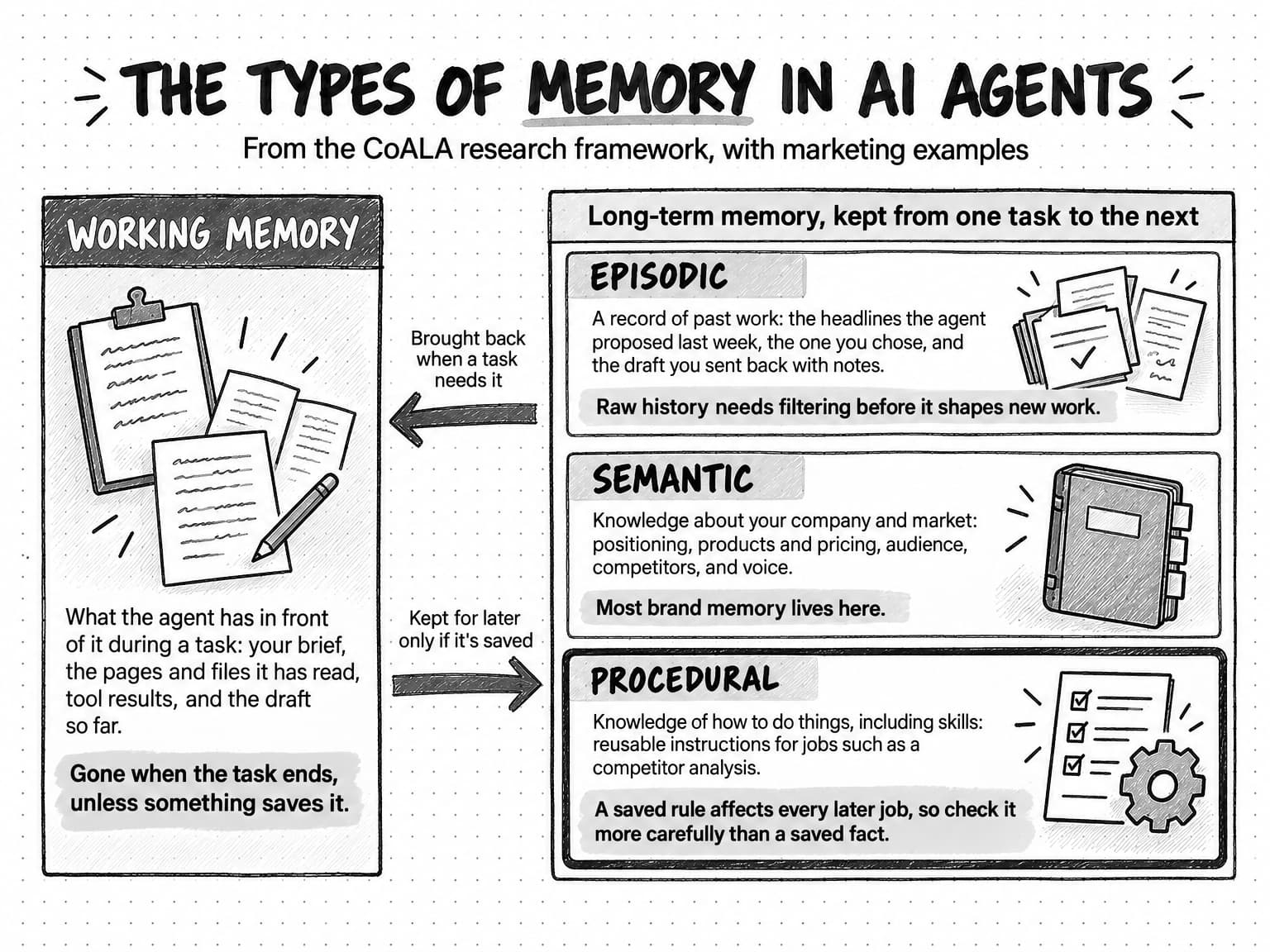
View the types of memory diagram at full size (opens in a new tab).
Where a marketing agent's knowledge lives: six places compared
A marketing agent's knowledge lives in six places that differ in what they hold, how long it lasts, and who can see or change it. Two of them, retrieved sources and model training, aren't memory in the strict sense, but people often confuse them with memory, so they belong in the comparison. Products differ, so treat the table as a set of questions to ask about any agent rather than a description of one.
| Where knowledge lives | What it holds | Marketing example | How long it lasts | Who can see and edit it |
|---|---|---|---|---|
| Working context | The brief, sources, tool results, and drafts for the current task | Competitor pages read for today's comparison | Until the task ends or older material is summarized to make room | The agent while it works; you see it through the files and notes it shows you |
| Session history | The conversation and files from one session | Headline options discussed in Tuesday's session | As long as the product keeps the session, usually without carrying into new ones | People with access to that session |
| Project memory | Briefs, source files, and saved outputs for one body of work | A launch brief and the messaging approved for it | For the life of the project | The project's members, within the product's permissions |
| Brand memory | Lasting knowledge about the company, its market, and its decisions | Current positioning, pricing, approved claims, and words to avoid | Until someone edits or retires it, or it reaches a refresh date | The team, if it's stored at the organization level; one person, if it lives in a personal account |
| Retrieved sources | Documents and web pages searched while a task runs | This morning's release notes or a competitor's pricing page | As current as the source | Whoever controls the source |
| Model training | General knowledge of language and the world, fixed when the model was trained | Knowing what a value proposition or a buyer journey is | Until the provider releases a new model | Only the model's provider; your team can't inspect or correct it |
Two mix-ups are worth avoiding. One is treating model training as knowledge of your company, which the next section takes up. The other is assuming session history carries forward. A decision you reached in Tuesday's conversation lives in Tuesday's conversation, and unless it's saved to the project or to brand memory, Thursday's session may start without it. Some general-purpose AI assistants now offer saved memory that carries details across chats. The ones we checked let you view and delete the details they save, and most let you edit them directly. What some pick up from past chats isn't listed, though, and removing it can mean deleting those chats. Two of them can also keep a separate memory for each project. Even so, saved memory usually belongs to one person's account and holds what that person has shared with it.
Scope matters as much as lifespan. Memory saved in one person's account helps that person; a team that wants consistent work needs memory at the project or organization level, so everyone's requests start from the same version. Choosing which of these to draw on for a particular task is a separate discipline, known as context engineering. This guide stays with what persists between tasks and how to keep it accurate.
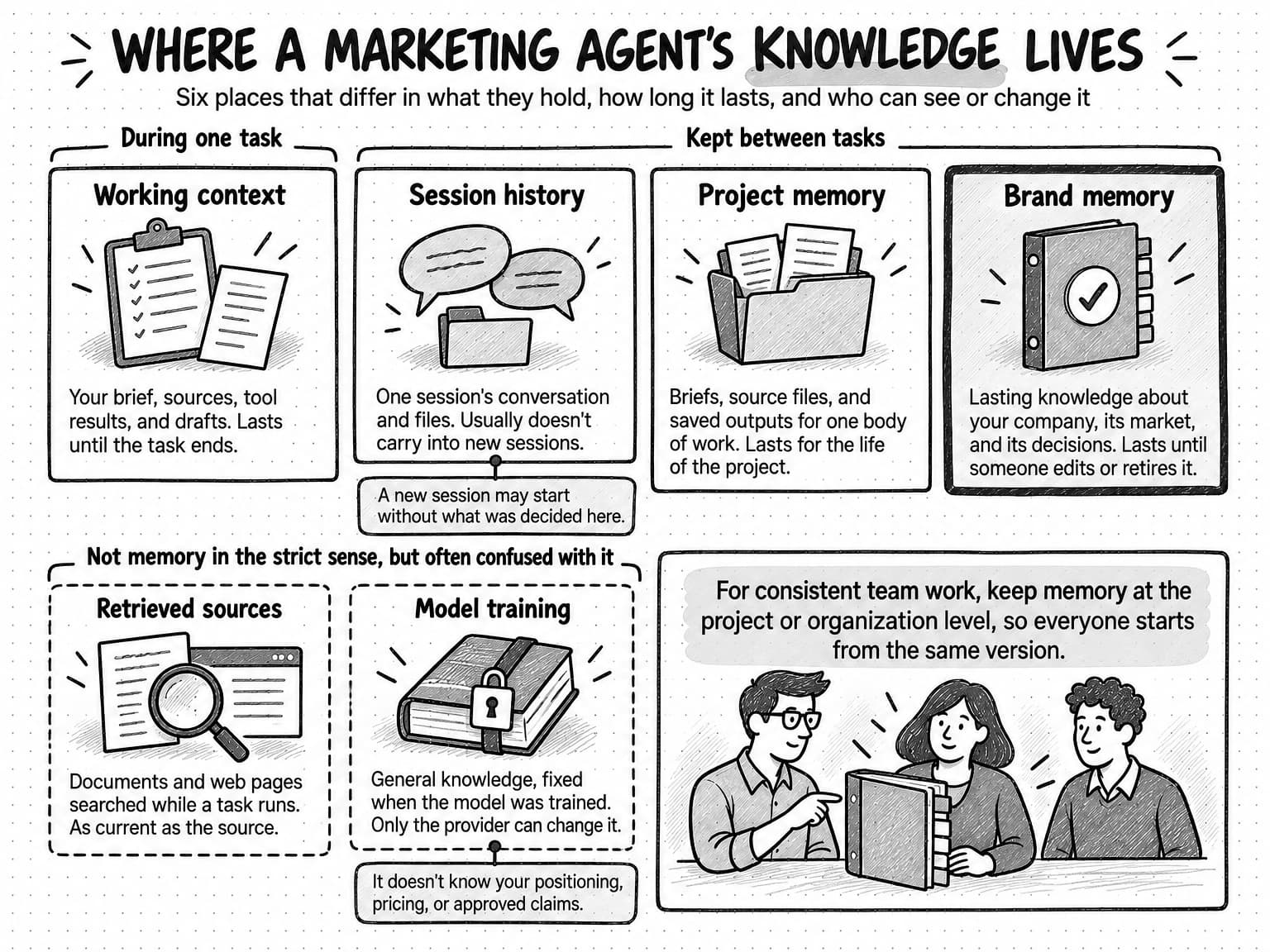
View the diagram of where an agent's knowledge lives at full size (opens in a new tab).
How AI agent memory differs from training, fine-tuning, and retrieval
AI agent memory differs from training and fine-tuning because it lives outside the model, where your team can read and correct it, and it differs from retrieval because it holds knowledge someone chose to keep rather than everything a search can find.
Training is where a model's general knowledge comes from. The 2020 paper that introduced retrieval-augmented generation described pre-trained models as storing “factual knowledge in their parameters” and called the model itself parametric memory. That knowledge stops at a cutoff date, and a 2024 study of knowledge cutoffs found that a model's effective cutoff often differs from the one its makers report. A model's training also didn't include your private documents, and nobody on your team can inspect or edit what the model absorbed.
Fine-tuning trains an existing model further on your own material, which changes the model itself. It can sound like the thorough way to teach a model your brand, but research on teaching facts this way is discouraging. A 2023 comparison of knowledge-injection methods found that unsupervised fine-tuning offered some improvement, but retrieval “consistently outperforms it,” both for knowledge the model had met in training and for entirely new knowledge. A 2024 EMNLP paper found that models learn new facts through fine-tuning slowly and that, once learned, those examples “linearly increase the model's tendency to hallucinate.” A fine-tuned fact also can't be corrected by editing a sentence, and CoALA calls fine-tuning “a costly form of learning.”
Retrieval searches a collection, such as your documents, a knowledge base, or the web, while a task runs and places the relevant passages into working memory. The authors of the retrieval-augmented generation paper wrote that for models relying on their parameters alone, “providing provenance for their decisions and updating their world knowledge remain open research problems.” A searchable collection helps with both: you update it by editing a document, and it can show where a passage came from.
Memory and retrieval overlap, because memory systems typically use search to bring saved knowledge back. In research systems and products alike, saved memories are usually text, such as notes, structured records, or documents kept in a store outside the model. The difference is in what the store holds. A shared drive returns whatever matches, including last year's sales deck and the tagline that never shipped. Memory holds what someone chose to keep for reuse, ideally the current, approved version with a date and a source. Both can be corrected without retraining anything, which is why facts that change, such as prices, product names, and claims, belong in memory or in retrieved sources rather than in a model.
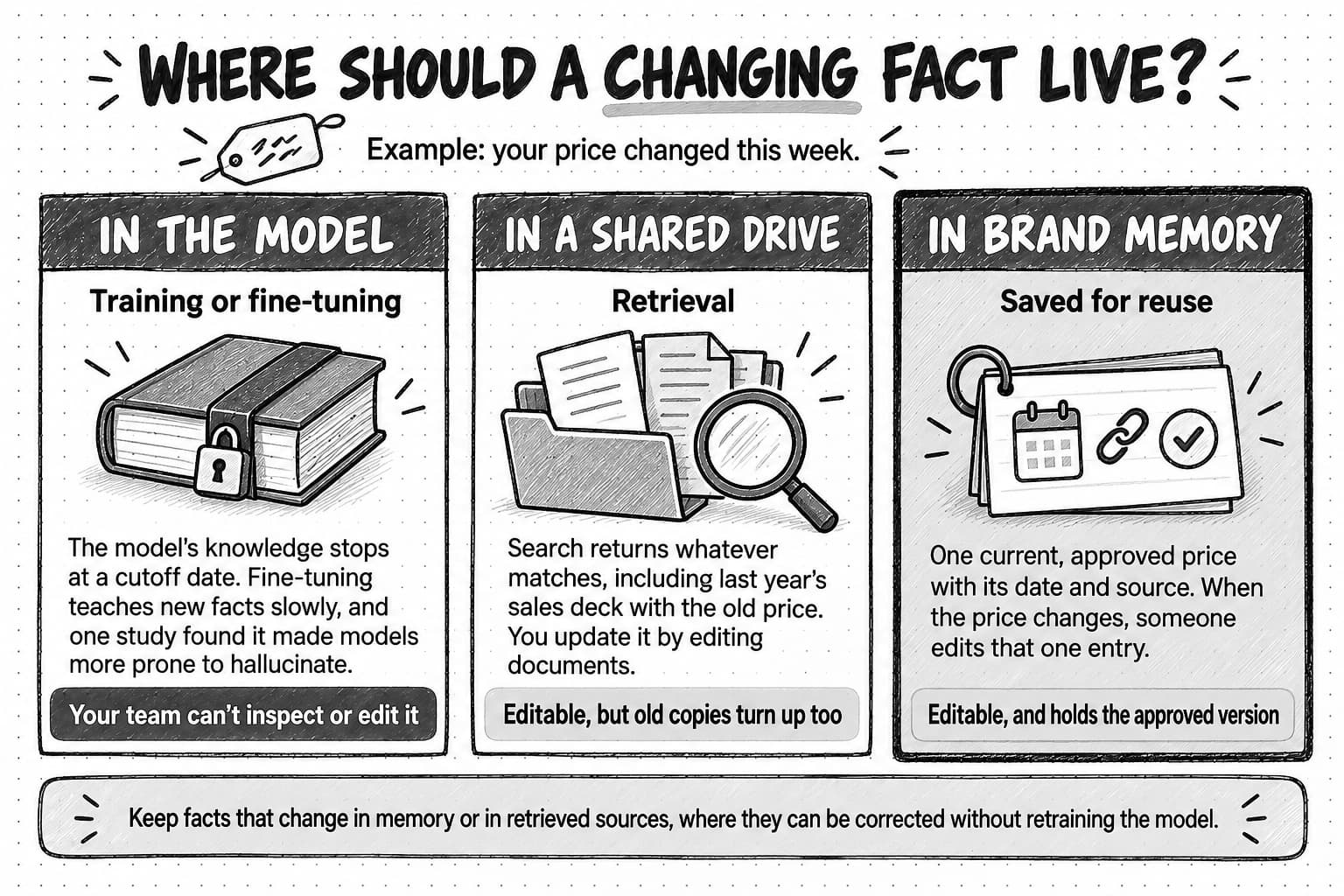
View the changing fact comparison at full size (opens in a new tab).
What is brand memory in AI marketing?
Brand memory is saved, reviewable knowledge about your brand, its audience, market, products, competitors, voice, and visual identity that an AI agent can reuse in later work. In an agent, it's the part of long-term memory that represents your company, mostly semantic memory: facts and decisions, kept outside the model where people can read them. Brand marketers also use “memory” for the associations buyers hold about a brand, the memory structures behind what researchers call mental availability. That's a different subject from what an agent keeps.
Brand memory overlaps with brand guidelines, but it serves a different reader. Guidelines are written for people who already share a lot of context. A designer who reads “confident, never arrogant” has often sat in the meetings where that line was argued over. An agent hasn't, so its memory has to be explicit where guidelines can afford to be brief: which competitors buyers compare you with this quarter, which claims have been approved and on what evidence, which words the team avoids, and examples of copy that sounds right next to copy that doesn't.
Brand memory also has to carry two things guidelines rarely do. The first is time. Each fact needs a date, because a competitor's pricing from last spring and your positioning from last spring age at very different speeds. The second is decisions, with their reasons. If the team decided to stop leading with a feature, a note saying so, and why, keeps the agent from reintroducing it the next time it reads an old page that still does.
Finally, brand memory belongs to the team, not to whoever happened to brief the agent first. When it lives in personal accounts, each teammate ends up with a private version of the brand, and the work drifts apart. The Ampere Blog's look at brand consistency in AI marketing makes the same case: shared context matters as much as persistent context.
What an AI marketing agent should remember, and what it should not
An AI marketing agent should remember the facts and decisions that shape most of your marketing work, and it shouldn't keep secrets, personal data the work doesn't need, one-off preferences, instructions from outside content, or anything unapproved or undated. A useful brand memory covers eight areas:
- Positioning: who you serve, what buyers compare you with, and the value and proof that set you apart. What is brand positioning? explains each part.
- Audience: your target audience segments and buyer roles, their problems and objections, and the words customers use to describe them.
- Products and offers: current names, what each one does, pricing and packaging, and what's released versus planned.
- Competitors: who you're compared with, how they position themselves, and when that was last checked.
- Voice: tone, vocabulary, words to avoid, and examples of copy that does and doesn't sound like you. How to define your brand voice covers how to write it down.
- Visual identity: colors, logos, typefaces, and image style, the visual side of your brand identity.
- Approved claims and proof: statistics, customer results, and quotes you're allowed to use, each with its source and who approved it.
- Decisions and their reasons: what the team decided, when, and why, so the agent doesn't reopen settled questions.
Keep these out of brand memory:
- Secrets: passwords, API keys, unreleased financials, and embargoed news. Memory is read into many tasks and may be visible to everyone with access, so credentials belong in a password manager or the product's connection settings.
- Personal data the work doesn't need: notes about a named prospect from a sales call, for example. They might help one email, but as memory they travel into every later task.
- One-off preferences: “make this one shorter” is an instruction for one post, but saved as a rule, it shortens everything that follows. Save a preference only when it's a decision about all your work.
- Unapproved material: brainstormed taglines, a draft price, or a rumor about a competitor. Saved without a label, a guess becomes a fact the agent repeats.
- Instructions from outside content: a line on a web page or in an inbound email telling the agent what to do. The next section explains why.
- Undated facts: a fact without a date or a source can't be checked or refreshed, so it goes stale without anyone noticing.
Data protection law points the same way for personal data. The UK GDPR, for example, requires personal data to be “adequate, relevant and limited to what is necessary” for its purpose, the principle known as data minimization, and kept in identifiable form “for no longer than is necessary,” known as storage limitation. The UK Information Commissioner's Office sets out both in its guide to the data protection principles.
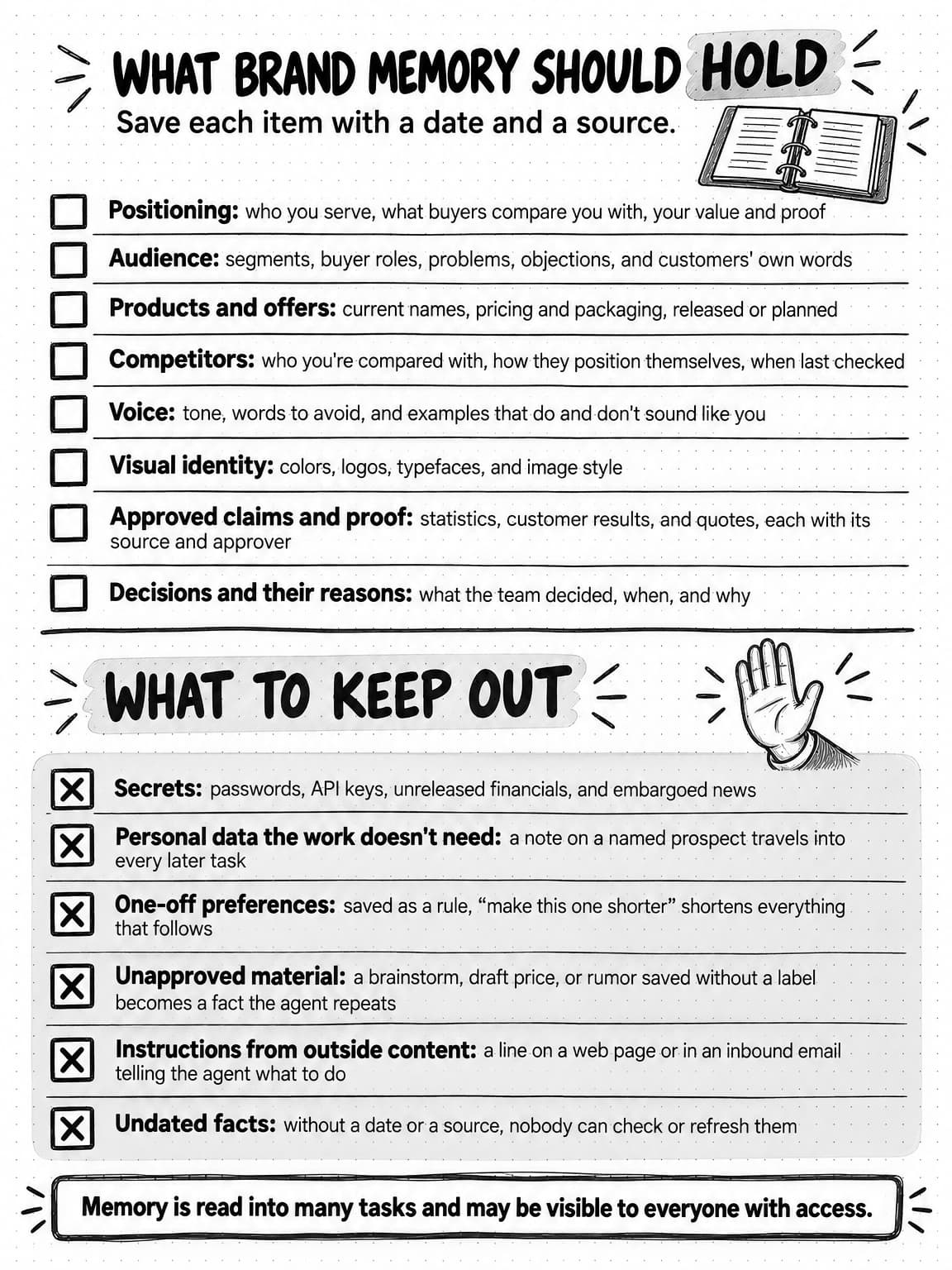
View the brand memory checklist at full size (opens in a new tab).
The risks of AI agent memory
AI agent memory carries three main risks: wrong or outdated facts repeated with confidence, memory poisoned by untrusted content, and private information kept or exposed when it shouldn't be.
The first risk follows from what makes memory useful. Models tend to go along with the information they're given. In a study of knowledge conflicts presented at ICLR 2024, researchers found that language models “can be highly receptive to external evidence even when that conflicts with their parametric memory,” as long as the evidence is coherent and convincing. That's how saved positioning can override a model's generic assumptions about your category. It's also why an outdated price in memory wins: the agent uses it, and nothing in the draft says anything is wrong. Discussing AI systems that state false content confidently, NIST's Generative AI Profile notes that the risk arises when users believe that content, “often due to the confident nature of the response.” A draft built on stale memory reads as confidently as one built on current facts.
The second risk is poisoning. If an agent saves what it reads, whoever controls what it reads can try to plant something. Researchers have shown this in test settings. AgentPoison, a 2024 study, poisoned the long-term memory or knowledge base of AI agents and reported an average attack success rate above 80 percent, while poisoning less than 0.1 percent of the stored records and reducing normal performance by less than 1 percent. MINJA, first published in 2025, showed that an attacker could insert malicious records into an agent's memory by “only interacting with the agent via queries and output observations,” without direct access to the memory itself. For a marketing agent, competitor pages, reviews, forum posts, and inbound emails are all outside content. Facts from them can be saved as observations with a source; instructions in them should never be saved.
The third risk is privacy. Memory that stores past conversations stores whatever was in them. A 2025 paper at ACL described a memory extraction attack that recovered private interactions stored in an agent's memory using only crafted queries, and found it effective on the two agents it tested. NIST's profile lists data privacy among 12 risks that generative AI creates or makes worse, including the “leakage and unauthorized use, disclosure, or de-anonymization” of personal or sensitive information. The practical defenses are to keep personal data out of brand memory, know who can read it, and check how a vendor uses customer data.
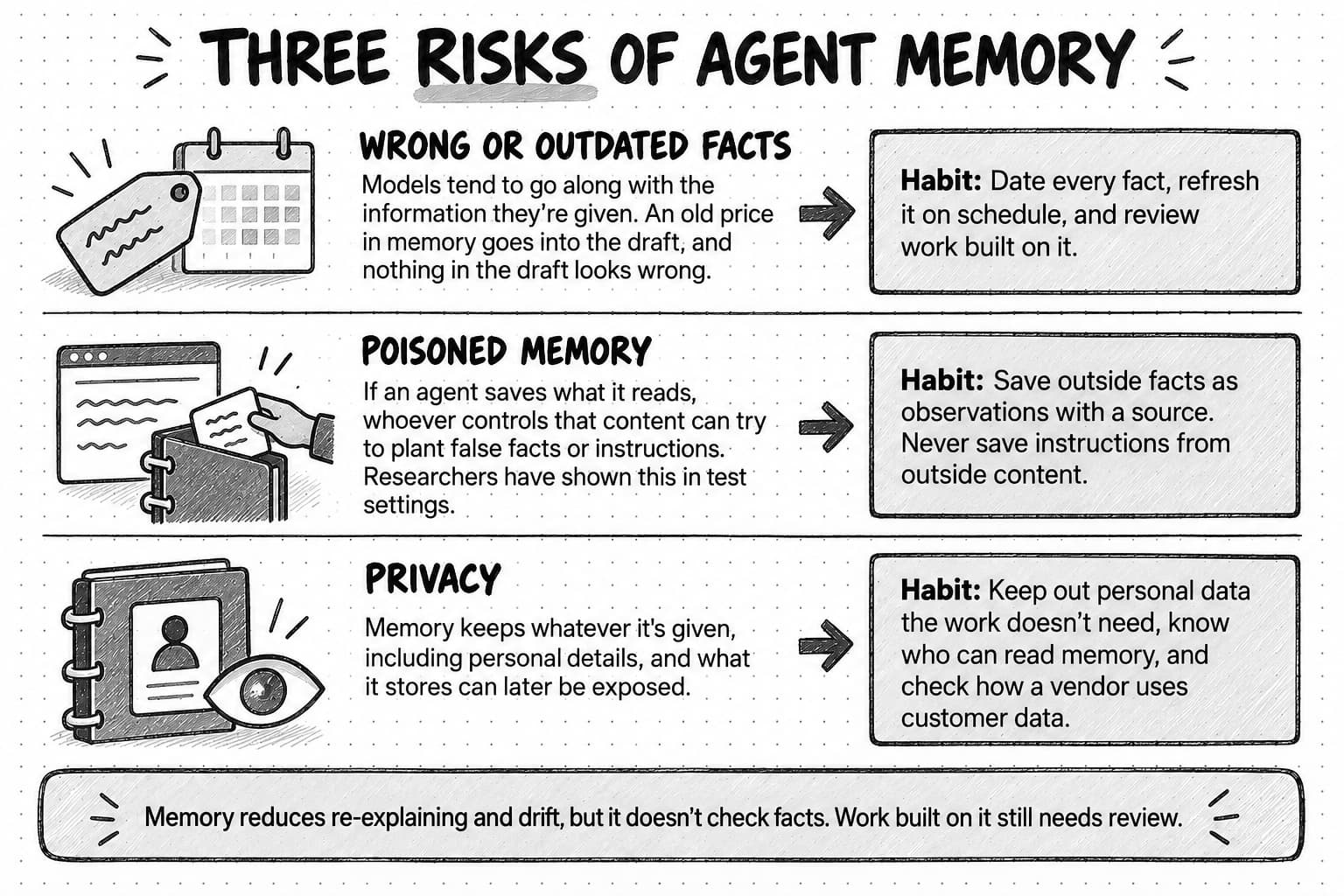
View the memory risks diagram at full size (opens in a new tab).
Memory reduces re-explaining and drift between assets, but it doesn't check facts, so work built on it still needs review. The five Rs below turn these defenses into a routine.
The five Rs: how to keep brand memory accurate
Keeping brand memory accurate takes a routine with five steps, which this guide calls the five Rs of brand memory: record, review, reuse, refresh, and retire. Together, they treat memory as a working document with an owner instead of a setup task done once.
Record decisions, review them before they're trusted, reuse them on purpose, refresh them as fast as they change, and retire them when they stop being true.
Record: save decisions, not drafts
Before saving anything, ask three questions. Is it decided, meaning approved by whoever owns it? Will more than one job need it? Can someone check it, because it has a source or an owner? If any answer is no, leave the material in the project or the session. When it qualifies, save it with its source, the date, and who approved it, which is what makes the later steps possible.
Recording can be done by people, by the agent, or by both. Some research systems let the agent organize its own memories, an approach the authors of A-MEM, presented at NeurIPS 2025, call agentic memory. Their system writes each new memory as a structured note, links it to related earlier notes in the manner of the Zettelkasten note-taking method, and lets new memories update older ones. Whoever does the recording, the next step is the same.
Review: have someone who knows the business read it
Saved knowledge should be read by someone who knows the business before the agent relies on it, especially when automated research produced it. Look for facts that were true once but aren't now, competitors' claims recorded as facts, guesses stated with certainty, and anything without a source. Correct mistakes in memory itself: one fix to the saved positioning carries into every later job, while a fix to one draft repairs only that draft. Review is also when a person decides what counts as approved, a judgment an agent shouldn't make for you.
Reuse: check that later work draws on it
Memory only helps if later work uses it, so test it. Give the agent a second, related job without re-explaining the company, and check whether the draft uses the current product names, the approved claims, and the right voice. If the product shows which saved knowledge a task used, read it. When a brief conflicts with memory, the brief should win for that job, and if the brief reflects a lasting change, update memory too, or the next job will revert. For a fuller test on your own work, see how to evaluate an AI marketing agent.
Refresh: match the schedule to how fast facts change
Different kinds of facts go stale at different speeds, so a single review date for everything is either too slow for news or too frequent for positioning. Treat the schedule below as a starting point to adapt.
| News and announcements | Stale within days. Check before any job that mentions recent events. |
|---|---|
| Trends and social conversation | Stale within weeks. Refresh monthly, or before a campaign that depends on them. |
| Competitor pricing, features, and messaging | Stale within weeks to months. Check quarterly, and whenever a competitor launches or changes its prices. |
| Your products, pricing, and offers | Change on your own release schedule. Update memory on the day of the change. |
| Positioning, audience, and voice | Stable for months or longer. Review on a fixed cadence, such as twice a year, and after a major launch, a new competitor, or an acquisition. |
| Visual identity | Stable for years. Update when the brand is refreshed. |
Events matter more than the calendar. A launch, a price change, a rebrand, or a new competitor should prompt an update that week, whatever the schedule says. The brand positioning guide covers the signs that positioning itself needs revisiting.
Retire: remove what is no longer true
When a product is discontinued, a claim is withdrawn, or a message is dropped, remove it from memory and note that it was retired. Old web pages, decks, and posts don't disappear, and an agent researching your company will find them. A short note such as “we no longer offer the Starter plan” keeps a retired fact from being saved again as current. Don't count on an agent to do this on its own; when CoALA was written, modifying and deleting memories, a form of “unlearning,” were “understudied in recent language agents.” Retiring is a person's job, triggered by the same events as refreshing.
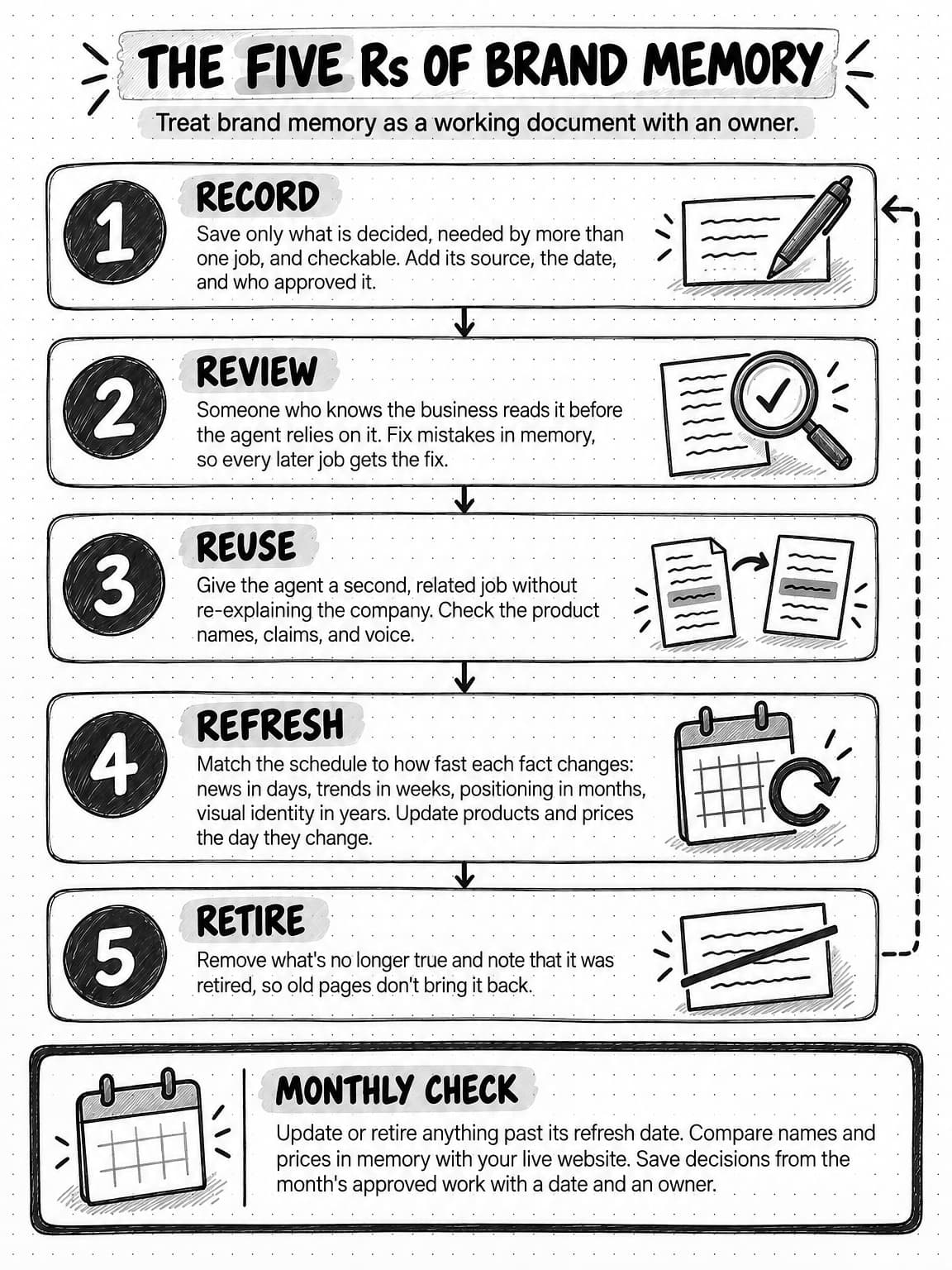
View the five Rs reference at full size (opens in a new tab).
How brand memory works in Ampere
In Ampere, brand memory is a named feature called Brand memory. Here is how it maps to the five Rs.
Recording starts with research rather than a form to fill in. Setup works from your website or a short business brief, with optional notes and up to five context documents, and builds reusable context for your products and offers, competitors, brand colors, logo, and visual identity. Ampere's 22 deep-dive brand skills go further, studying areas such as voice, positioning, audience, competitors, and products, and saving each result as an editable brief with its sources visible.
Review happens in the app: each report opens in its own view, where you can edit it directly or save it as a PDF, and later work follows the approved version.
Reuse and refresh run on shelf lives: 12 months by default, 30 days for trend snapshots, and 14 days for news. Before repeating research that depends on freshness, Ampere can reuse a saved report that's still within its shelf life, and it is designed to refresh and save one that has passed it before presenting it as ready to open. When a launch or a price change makes a brief out of date sooner, you can edit it or run its research again.
Memory also has a scope. Working files for the current job stay in the session workspace. Projects keep a brief, uploaded context files, generated files, and reusable assets together, and Project context files can be summarized for Ampere to use in later sessions. Brand memory and Projects belong to the Organization, so teammates start from the same version, while individual sessions are shared with explicit view, edit, or owner access. Ampere does not directly use private customer prompts, files, chat history, project context, agent memory, integration data, or outputs to train Ampere models by default.
To retire something, edit the report and remove what's no longer true. Saved context doesn't replace review: AI output can be inaccurate, and nothing publishes without you.
Eligible accounts in supported regions that have never had a paid plan can start on the Free Plan with no card: Ampere sets up Brand memory, then completes up to four Free tasks for the brand.
Sources and further reading
- Theodore R. Sumers, Shunyu Yao, Karthik Narasimhan, and Thomas L. Griffiths: Cognitive Architectures for Language Agents, Transactions on Machine Learning Research (2024)
- Patrick Lewis and others: Retrieval-Augmented Generation for Knowledge-Intensive NLP Tasks, NeurIPS (2020)
- Jeffrey Cheng and others: Dated Data, Tracing Knowledge Cutoffs in Large Language Models (2024)
- Oded Ovadia, Menachem Brief, Moshik Mishaeli, and Oren Elisha: Fine-Tuning or Retrieval? Comparing Knowledge Injection in LLMs (2023)
- Zorik Gekhman and others: Does Fine-Tuning LLMs on New Knowledge Encourage Hallucinations?, EMNLP (2024)
- Jian Xie and others: Adaptive Chameleon or Stubborn Sloth, Revealing the Behavior of Large Language Models in Knowledge Conflicts, ICLR (2024)
- Wujiang Xu and others: A-MEM, Agentic Memory for LLM Agents, NeurIPS (2025)
- Zhaorun Chen and others: AgentPoison, Red-teaming LLM Agents via Poisoning Memory or Knowledge Bases (2024)
- Shen Dong and others: Memory Injection Attacks on LLM Agents via Query-Only Interaction (2025)
- Bo Wang and others: Unveiling Privacy Risks in LLM Agent Memory, ACL (2025)
- NIST: Artificial Intelligence Risk Management Framework, Generative Artificial Intelligence Profile, NIST AI 600-1 (2024)
- UK Information Commissioner's Office: A guide to the data protection principles
Frequently Asked Questions
Do AI agents have memory?
Yes, AI agents have memory, though how much depends on the product. Every agent has working memory, the information in front of it during a task, which disappears when the task ends unless something saves it. Many agents also keep long-term memory between tasks, such as past work, project files, or saved knowledge about a brand. Anything specific to your business reaches the agent through memory or retrieval, not through the model's training.
What are the different types of memory in AI agents?
The main types of memory in AI agents are working memory and three kinds of long-term memory, as set out in the CoALA research framework. Working memory holds what the current task needs. Episodic memory records past experience, such as earlier drafts and the feedback on them. Semantic memory holds knowledge about the world and the business, including brand facts. Procedural memory holds knowledge of how to do things, in the model's weights and the agent's skills and code.
How does AI agent memory differ from chat history?
AI agent memory is knowledge kept for reuse across tasks, while chat history is the record of one conversation. A decision reached in a chat often stays in that chat, so unless it's saved to a project or to brand memory, a new session may start without it. Chat history is also unfiltered, mixing approved decisions with abandoned ideas, while useful memory holds the current, approved version with a date and a source.
How is AI agent memory stored?
AI agent memory is stored outside the model, usually as text such as notes, structured records, or documents in a store the agent can search. When a task needs it, the agent retrieves the relevant pieces into its working memory. Because nothing is written into the model itself, saved memory can be read, corrected, or removed, provided the product shows you what it keeps and lets you edit it.
How can brand memory improve AI-generated content consistency?
Brand memory improves the consistency of AI-generated content by giving every task the same facts, claims, and voice, so a launch email and a sales page don't contradict each other and teammates don't each brief the agent differently. Memory makes assets agree with each other, but it doesn't make them correct. If the saved pricing is out of date, every asset repeats it consistently, which is why brand memory needs regular review and refreshing.
How do you build a brand memory system for a business?
Build a brand memory system by deciding what it should hold, recording each item with a source and a date, and giving someone the job of maintaining it. Start with positioning, audience, products and pricing, competitors, voice, visual identity, approved claims, and key decisions with their reasons, and keep out secrets, unneeded personal data, and one-off preferences. Then follow the five Rs: record, review, reuse, refresh, and retire.
What is memory poisoning in AI agents?
Memory poisoning in AI agents is an attack that plants false information or malicious instructions in an agent's long-term memory so that later tasks act on it. Researchers have demonstrated it in test settings: a 2024 study reported attack success above 80 percent while poisoning less than 0.1 percent of stored records, and a 2025 study inserted malicious records just by sending the agent queries. Treat outside content as untrusted, and review what gets saved.
What are the privacy risks of AI agent memory?
The main privacy risk of AI agent memory is that it keeps whatever it is given, including personal or sensitive information, and that stored information can later be exposed. A 2025 study described an attack that extracted private interactions from an agent's memory through crafted queries. Keep personal data the work doesn't need out of memory, know who can read what is saved, and check how a vendor uses customer data.
What is agentic memory?
In research, agentic memory refers to memory that an AI agent manages itself, deciding how to store new information, how to link it to earlier memories, and when to update them. One example is A-MEM, a system presented at NeurIPS 2025, which keeps memories as linked notes, borrowing from the Zettelkasten note-taking method, and lets new memories revise older ones. For marketing, memory the agent manages itself still needs a person to review what it saves.


