AI tokens and credits, explained: how AI agent pricing works
What tokens and credits measure, why agent work uses so many of them, how the four pricing models compare, and how to estimate and cap a month of agent spend.
28 min readWritten by Ampere
Short answer
What are tokens in AI, and how does AI agent pricing work?
Tokens are the small pieces of text, often a word or part of one, that AI models read and write, and model providers charge for them, with output priced above input. AI agents use far more tokens than a chat reply because every step rereads the task so far. Products pass these costs on per seat, per unit of usage, per credit or per outcome.
Summary
Tokens are the meter beneath most AI pricing, and agent work uses far more of them than chat, so the useful way to budget it is by the job: measure what a few real runs cost, then cap spending. As a rule of thumb, one token is about three-quarters of an English word, though counts vary with language and model.
Providers price input, output and reasoning differently. On October 2026 price lists, output tokens commonly cost about five times as much as input tokens, largely because models write one token at a time. Hidden reasoning is typically billed as output, repeated input read from a cache costs a tenth of the standard rate or less on newer models, and the dearest models can cost 100 times as much per token as the cheapest, or more.
An AI agent works in a loop, and each step rereads the instructions, the task and every tool result so far, so reading can dominate the bill and grows faster than the number of steps. In an illustrative ten-step task, the model reads about 233,000 tokens and writes about 4,000. Anthropic reported in June 2025 that, in its data, agents used about four times the tokens of chat interactions.
AI credits are a product's own usage unit, converting model tokens, image and video generation, searches and paid data into one balance drawn from an allowance. Credit values differ between products, so compare the money a finished job costs. The four pricing models, per seat, per unit of usage, per credit and per outcome, place the risk of heavy use differently, and many products combine them.
The JOBS method estimates a month of agent spend: list the jobs and how often they run, observe what each costs on two or three real runs, add a buffer for revisions and failed runs, and set a hard spending cap above the total. A worked example for a fictional two-person marketing team, with invented costs, shows the arithmetic from recurring jobs to a monthly estimate and a cap.
Four choices control agent costs: which model does each job, how much each job reads, how often recurring jobs run, and which limits stop spending when a run goes wrong. Test a lower-cost model on your own work before switching, prefer a hard cap to an alert after the fact, and budget for what the usage bill doesn't show: review time and failed runs.
Contents
- What is a token in AI?
- Why input, output and reasoning tokens are priced differently
- Why an AI agent uses far more tokens than a chat reply
- What AI credits are and why AI products use them
- AI pricing models compared: seat, usage, credit and outcome
- How to estimate a month of AI agent spend: the JOBS method
- How to control AI agent costs
- Costs the usage bill doesn't show
- How credits work in Ampere
- Sources and further reading
- Frequently Asked Questions
Put the pricing pages of four AI products side by side and you may find four different units. One charges per seat, one per million tokens, one sells a monthly allowance of credits, and one bills for each task it completes. The units don't convert into one another, so a simple budgeting question becomes hard to answer: what will a month of AI agent work cost?
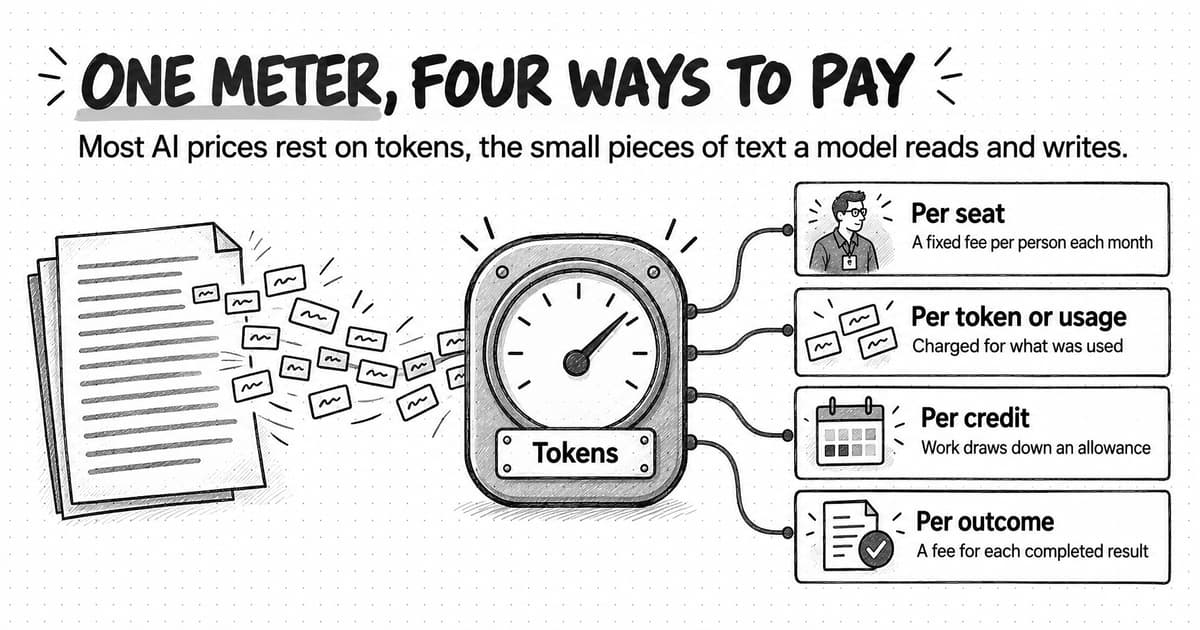
Most of those prices rest on the same meter. A token is a small piece of text, often a whole word or part of one, that an AI model reads or writes, and AI model providers charge for usage by counting tokens. Products pass that cost on in different ways. A seat price folds it into a subscription, usage pricing bills it directly, an outcome price bundles it into a fee for each result, and a credit system converts it into a unit of the product's own. An AI credit is that unit: a product's own measure of usage, which turns the different costs behind a piece of work, such as model tokens, image and video generation and paid data, into one number drawn from an allowance.
The differences matter most for agent work. A chat assistant reads your question and writes one reply. An AI agent works through a task in steps, searching, reading, drafting and checking, and each step is another round of reading and writing. Two requests that look alike can differ several times over in cost, depending on how many sources the agent reads and which model does the work, and a recurring job pays that cost on every run.
This guide explains what each of those units measures and why agent work uses so many tokens, then shows how to estimate a month of agent spend from a few measured runs and set limits that keep spending inside the estimate.
What is a token in AI?
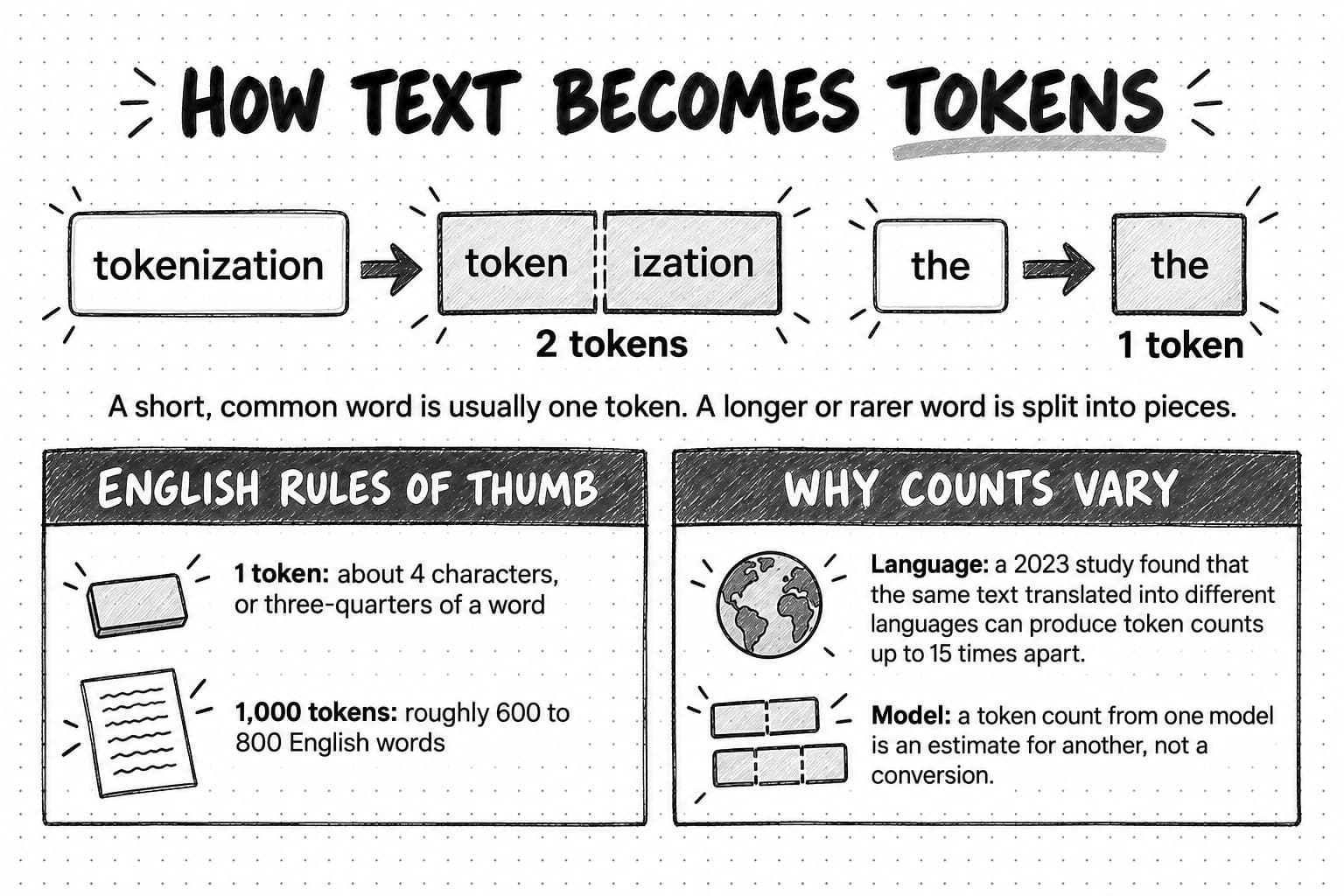
A token is the unit of text an AI language model reads and writes: a short, common word is usually one token, while a longer or rarer word is split into pieces. In OpenAI's documentation, the word “tokenization” becomes two tokens, “token” and “ization,” while a common word such as “the” is a single token. These have nothing to do with crypto tokens; in AI, the word names a unit of text.
Because the split varies, providers publish only rules of thumb. OpenAI and Anthropic both put one token at roughly four characters, or three-quarters of a word, of English text. Google puts 100 tokens at about 60 to 80 English words. By those rules, 1,000 tokens is roughly 600 to 800 English words.
The rules hold for English prose and loosen elsewhere. A study presented at the NeurIPS conference in 2023 found that the same text translated into different languages can produce token counts up to 15 times apart, which changes what a request costs, how long it takes and how much material fits into the model at once. The tokenizer, the component that does the splitting, matters too: Anthropic says the tokenizer in its newer models produces about 30% more tokens for the same text. A token count from one model is an estimate for another, not a conversion.
View the diagram of how text becomes tokens at full size (opens in a new tab).
Images, audio and video are converted into tokens as well, and long recordings add up quickly. At Google's published rate of about 100 tokens per second of video at the default resolution, a one-minute clip counts as about 6,000 tokens, as many as roughly 3,600 to 4,800 English words.
| 1 token | About 4 characters, or three-quarters of a word, of English text (OpenAI, Anthropic) |
|---|---|
| 100 tokens | About 60 to 80 English words (Google) |
| 1,000 tokens | Roughly 600 to 800 English words |
| An average web page (10 kB) | About 2,500 tokens (Anthropic) |
| A research paper PDF (500 kB) | About 125,000 tokens (Anthropic) |
| An image up to 384 pixels per side | 258 tokens (Google) |
| One second of video | About 100 tokens at the default resolution (Google) |
| One second of audio | 32 tokens (Google) |
Tokens also measure how much a model can consider at once. The context window is a model's capacity for a single request, counted in tokens, and OpenAI's documentation notes that the prompt and the generated output together must fit inside it. That limit is one reason long agent tasks have to manage what they keep in view.
Why input, output and reasoning tokens are priced differently
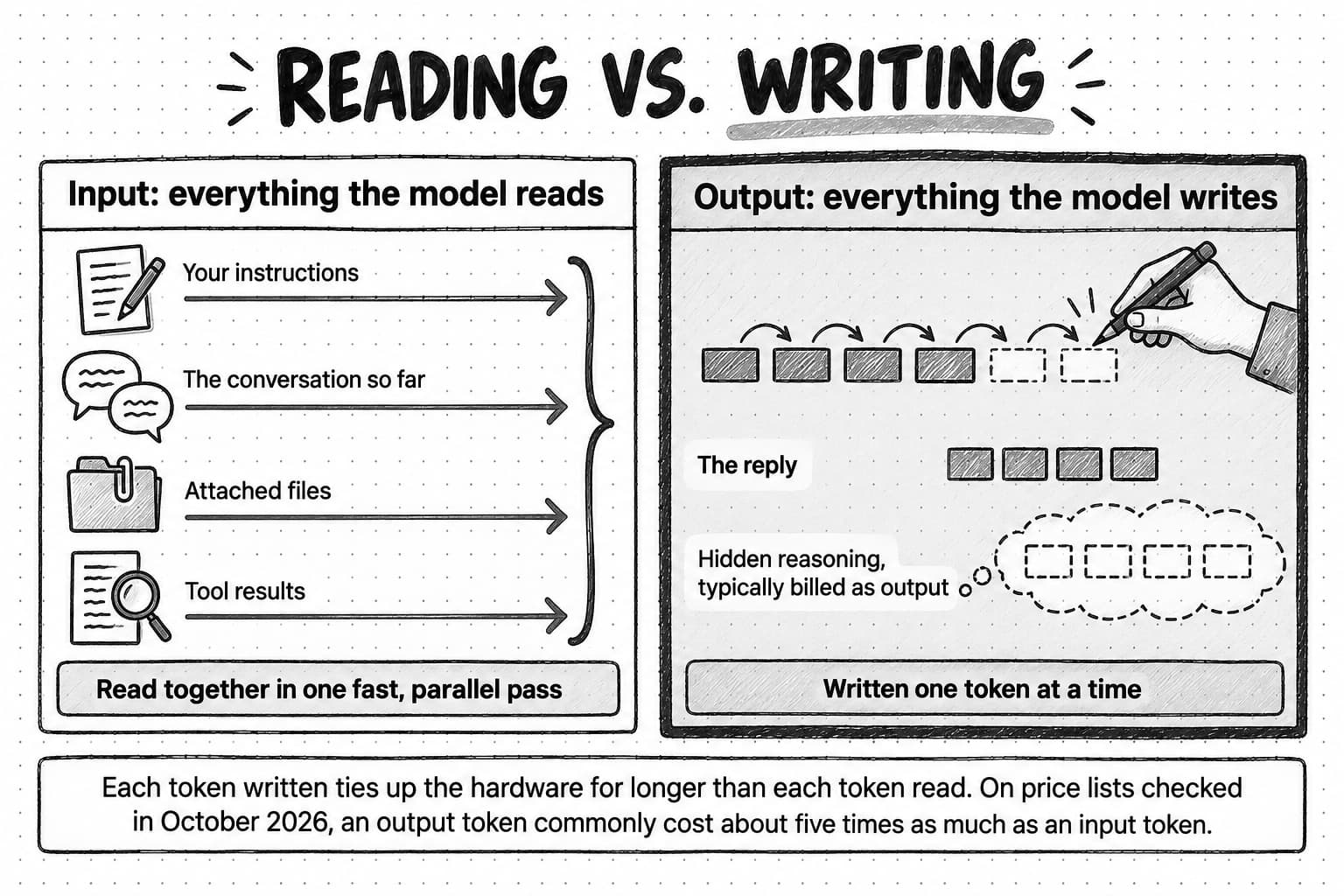
Input, output and reasoning tokens are priced differently largely because a model reads input in one fast, parallel pass but writes output, including any hidden reasoning, one token at a time, so providers charge more for what it writes. On Anthropic's, Google's and OpenAI's price lists, checked on October 8, 2026, an output token commonly cost about five times as much as an input token, and about eight times on some models. Input covers everything the model reads: your instructions, the conversation so far, attached files and the results of any tools it used. Output is everything it writes.
The gap reflects how models run. NVIDIA's engineers describe the two phases. In the first, the model processes all the input tokens together in a highly parallel operation that keeps the processors busy. In the second, it generates output tokens one at a time, a step limited by how fast data moves through memory rather than by computing power. Each token written ties up the hardware for longer than each token read.
Reasoning tokens make the output side of the bill larger than the reply suggests. Many current models work through a problem before answering, and that thinking is written out as tokens you usually don't see. OpenAI's documentation says reasoning tokens are billed as output tokens and take up room in the context window, and that a request can generate anywhere from a few hundred to tens of thousands of them. Google's price list labels its output rate “including thinking tokens.” A short visible answer can therefore carry a large output charge, and asking a model to think harder raises the cost even when the reply looks the same.
View the comparison of reading and writing at full size (opens in a new tab).
Three other factors change the price of the same work. Input that repeats from one request to the next can be read from a cache: Anthropic charges a tenth of the standard input price or less for a cache hit, and OpenAI lists cached input at a tenth of the input price or less for its newer models and at a quarter or half for some older ones. The choice of model moves the price furthest. On Anthropic's and OpenAI's October 2026 lists, the most expensive current text models cost about 100 times as much per token as the cheapest, or more. And tools carry meters of their own: Anthropic charges $10 per 1,000 web searches on top of the tokens the results add, while Google prices video generation per second and search grounding per 1,000 requests.
Put together, the cost of one model request is its fresh input at the input rate, any cached input at the discounted rate, its output and reasoning at the output rate, and any tool or media fees.
Why an AI agent uses far more tokens than a chat reply
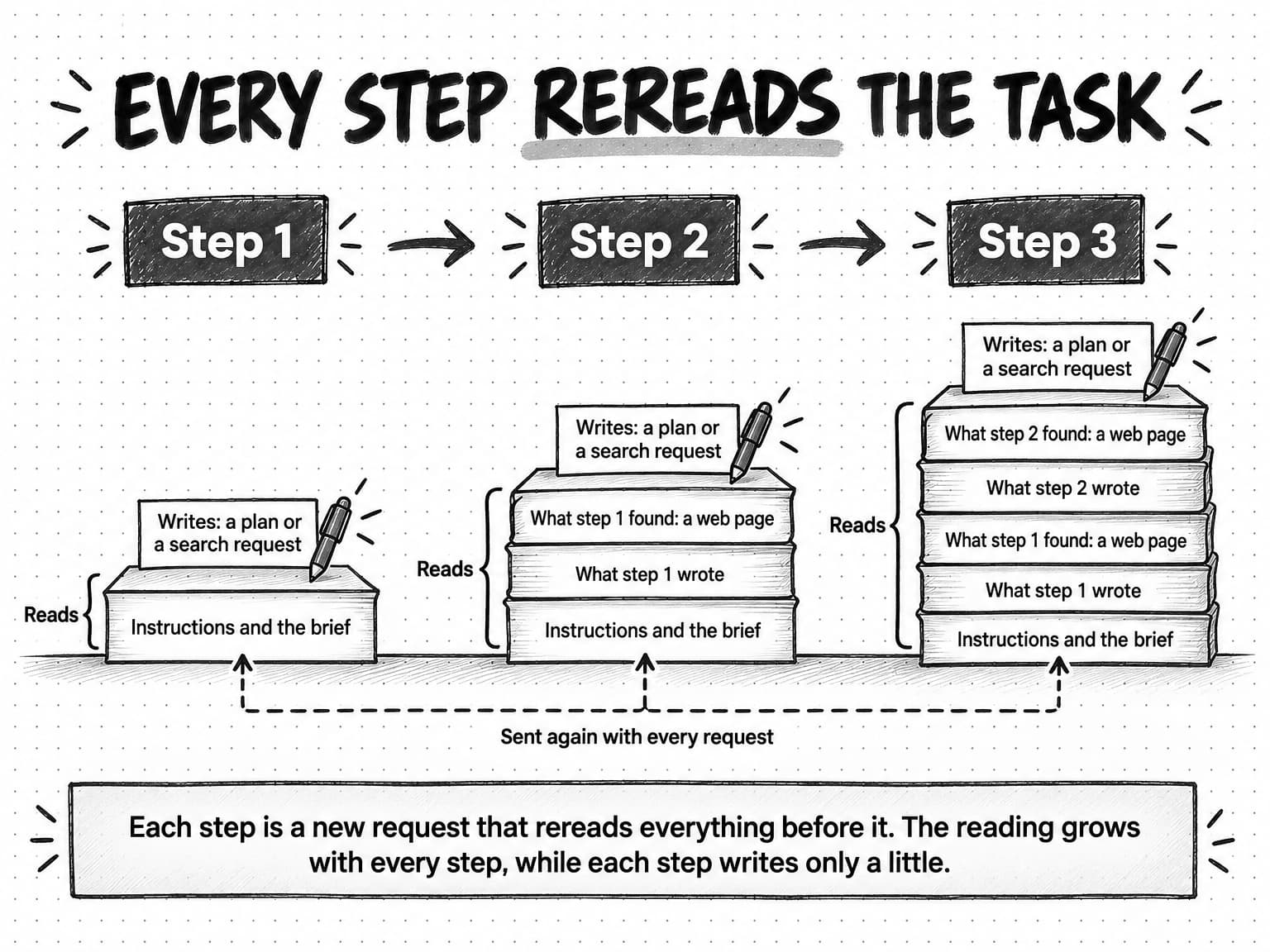
An AI agent uses far more tokens than a chat reply because it works in a loop, and every step is a new model request that rereads the instructions, the task and everything gathered so far. Anthropic's documentation describes its API as stateless, which means the full conversation is sent again with every request. When an agent searches the web or opens a page, the result joins that conversation, and every later step reads it again. So do the descriptions of the tools the agent can use: Anthropic's browser toolset alone adds about 6,600 input tokens to each request. How AI agents work walks through the loop itself.
View the diagram of how every step rereads the task at full size (opens in a new tab).
An illustration shows how quickly that adds up. Picture a ten-step research task that starts with 8,000 tokens of instructions, brand notes and the brief. At each step the agent writes about 400 tokens, such as a plan or a search request, and receives a tool result of about 3,000 tokens, roughly one web page. The first step reads 8,000 tokens. The tenth reads 38,600, because it rereads everything before it. Across the task, the model reads about 233,000 tokens and writes about 4,000.
tokens read
View the data
| Period | tokens read |
|---|---|
| Step 1 | 8000 |
| Step 2 | 11400 |
| Step 3 | 14800 |
| Step 4 | 18200 |
| Step 5 | 21600 |
| Step 6 | 25000 |
| Step 7 | 28400 |
| Step 8 | 31800 |
| Step 9 | 35200 |
| Step 10 | 38600 |
Illustration, not a measurement: an 8,000-token starting context, with each step writing about 400 tokens and adding a 3,000-token tool result.
At illustrative prices of $3 per million input tokens and $15 per million output tokens, the five-to-one ratio common on current price lists, reading costs about $0.70 and writing about $0.06. Output is dearer per token, yet reading is more than nine-tenths of this task's bill. Length compounds the effect: double the task to twenty steps and the tokens read more than triple, to about 806,000, because each added step rereads a longer history.
That repetition is why caching matters for agents, since most of what each step reads, the previous step read too. In a worked example on its pricing page, Anthropic prices a one-hour agent session that reads 50,000 tokens and writes 15,000 at $0.705, including $0.08 of runtime, and at $0.525 when 40,000 of the input tokens come from the cache.
Measured usage points the same way. In June 2025, Anthropic reported that in its own data, agents typically used about four times as many tokens as chat interactions, and multi-agent systems, in which several agents work on parts of a task at once, about fifteen times as many. A December 2025 study of more than 100 trillion tokens handled by OpenRouter, a service that routes requests to many AI models, found that the average prompt had grown about fourfold since early 2024, to more than 6,000 tokens, while the average completion nearly tripled to about 400 tokens, mostly because of reasoning. The authors, from OpenRouter and the investment firm a16z, describe long inputs as a signature of agentic workflows; programming work drove most of the growth.
More tokens can also buy better work. In the same post, Anthropic reported that on a web-browsing evaluation, token usage alone explained 80% of the variance in performance, and it concluded that multi-agent systems suit tasks whose value is “high enough to pay for the increased performance.” In practice, that argues for spending generously on research where depth changes a decision and keeping routine jobs lean.
What AI credits are and why AI products use them
AI credits are a product's own unit of usage: the product prices each kind of work in credits and draws them from an allowance, so one balance can cover costs that are metered in different units underneath. A single agent task might use model tokens, a few web searches, an image generation and a paid data lookup. Google's API price list alone meters text in tokens, video generation in seconds and search grounding in requests, and a product that draws on several suppliers inherits all of their meters.
Credits put those mixed costs into one unit a customer can follow. They let a team buy usage in advance, as a monthly allowance or a top-up, instead of facing a bill worked out from usage after the month ends. And they give the whole team one balance to share across every tool.
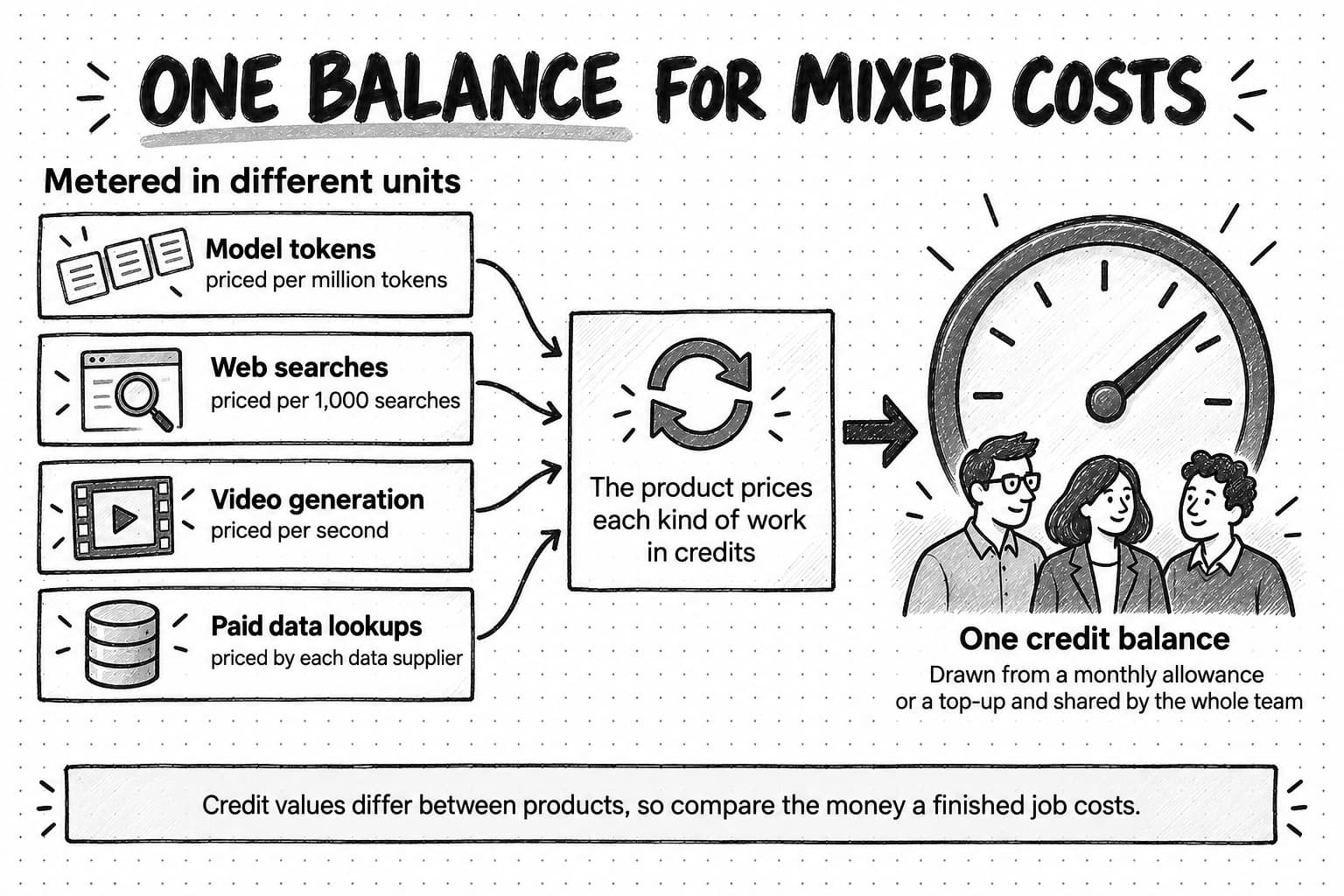
View the diagram of one balance for mixed costs at full size (opens in a new tab).
Credit pricing is spreading. In an April to May 2026 survey of 230 B2B software and AI companies, the Growth Unhinged newsletter found that 29% had adopted AI credits and 33% planned to introduce them within six to twelve months. The survey's author, Kyle Poyar, also warned that credits “can become a nightmare for customers” who juggle different credit systems across vendors.
That warning points to the main limitation: credits are not a standard unit. One product's credit can be worth a different amount of money from another's, and the same task can cost a different number of credits in each. Compare products by what a finished job costs in money, never by credit counts. Before you rely on any credit system, find out:
- what one credit costs in dollars, on each plan and for top-ups;
- which actions spend credits, and which, such as reviewing past work, are free;
- whether you can see the credits each run actually used;
- when included and purchased credits expire, and whether any roll over;
- what happens at zero: whether work pauses or continues at an extra charge;
- whether the balance is shared across the team or split by seat.
AI pricing models compared: seat, usage, credit and outcome
AI products charge in four main ways, often in combination: per seat, per unit of usage, per credit or per outcome. Each places the cost of heavy use somewhere different, which changes what you should check before you buy.
| Pricing model | How it bills | Works well when | What to check | Illustrative example |
|---|---|---|---|---|
| Per seat | A fixed fee per person each month | A few people use the tool steadily for chat-style help | Whether the plan limits how much each person can use; cost grows with headcount, not output | A writing assistant priced per user |
| Per token or usage | A rate per million tokens, per request or per minute, charged for what was used | Usage is easy to forecast, or developers are building on a model | No natural ceiling unless you set one; output and reasoning cost more than input | A model provider's API priced per million input and output tokens |
| Per credit | Work draws down a monthly allowance or a prepaid pack of credits | Mixed work across text, images, video and data runs from one balance | Price per credit, expiry, what happens at zero, and credits that can't be compared across vendors | An agent product with a monthly credit allowance and top-ups |
| Per outcome | A fee for each completed result | A narrow job with a clear, countable result | How the vendor defines and counts a result, and who decides borderline cases | A support agent billed per resolved conversation |
Seat pricing gives you a predictable bill while the vendor absorbs the cost of heavy users. Usage pricing is the most direct: you pay for exactly what you use, and nothing stops an expensive month unless you set a limit. Credit pricing sits between them, with an allowance you can budget that still rises and falls with use. Outcome pricing charges only for results, which works when a result is easy to count, such as a resolved support conversation, and is much harder to apply to a strategy memo or a campaign concept.
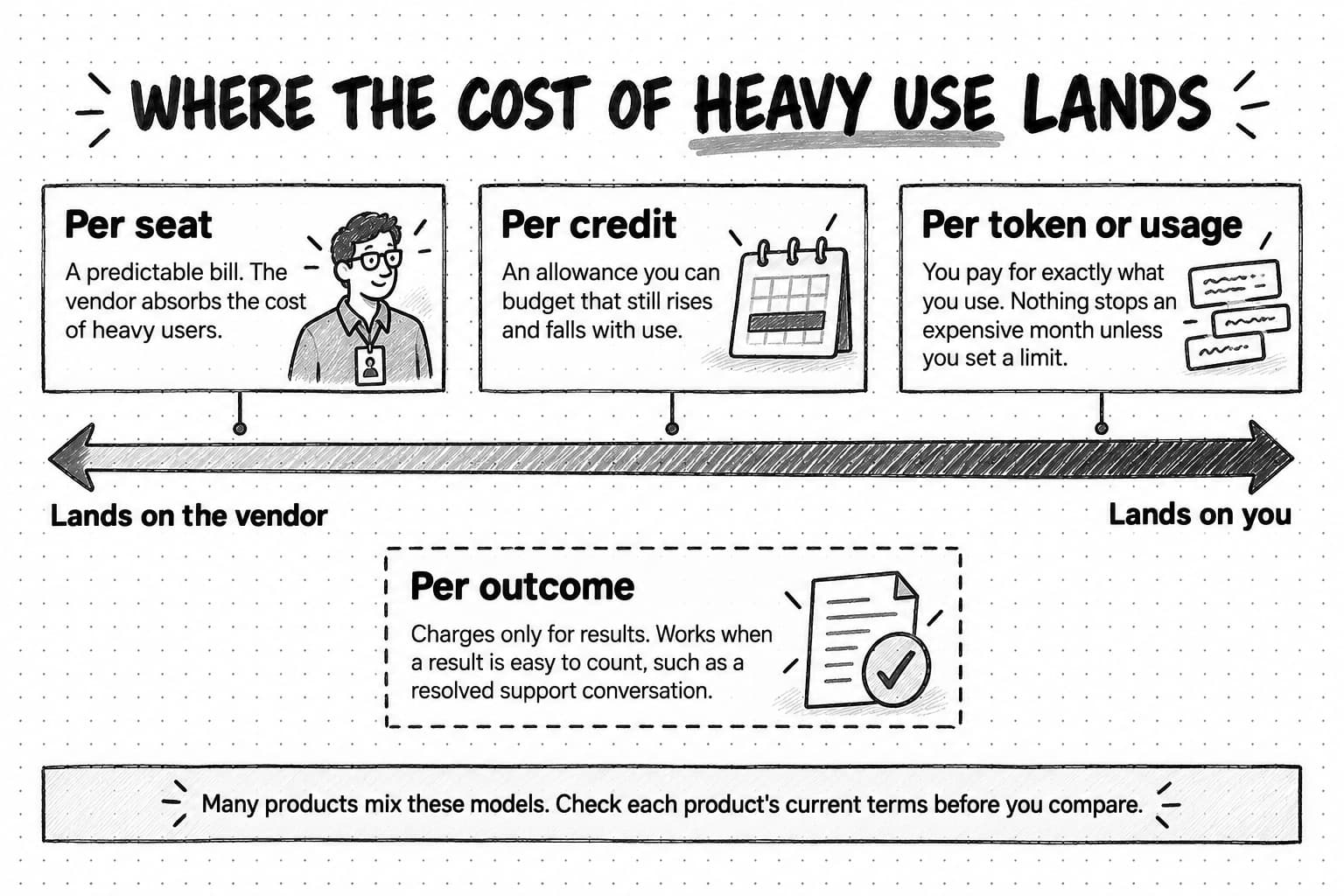
View the diagram of where the cost of heavy use lands at full size (opens in a new tab).
Many products mix these models. The same 2026 Growth Unhinged survey found 37% of companies using hybrid pricing, up from 25% a year earlier. ICONIQ's 2025 State of AI report, based on an April 2025 survey of 300 software executives by the growth investor, found many AI products pairing a base subscription with usage charges, while some companies were experimenting with pricing based entirely on usage or on the results customers achieve. Pricing is changing quickly, so check each product's current terms before you compare.
How to estimate a month of AI agent spend: the JOBS method
A dependable way to estimate a month of AI agent spend is to price the work by the job rather than by the token: list the jobs, observe what each one costs on a few real runs, add a buffer and set a spend cap. This guide calls that the JOBS method, for jobs, observed cost, buffer and spend cap. A price list can't tell you how many tokens a job will use, because that depends on how much the job reads and how many steps it takes. A measured run already includes all of it.
- Jobs. List the work you expect to hand the agent in a typical month and how often each job runs. Describe each job as a deliverable, such as a weekly competitor brief or four blog drafts, and keep recurring jobs separate from one-off projects.
- Observed cost. Run each job two or three times on real material and record what each run cost. If the product bills in credits, convert them to money at the price you pay per credit. Use a typical run, not the cheapest, and note anything unusual, such as a run that read far more sources than the brief needed. How to evaluate an AI marketing agent shows how to record cost alongside quality during a trial.
- Buffer. Add a margin for revisions, retries, failed runs and requests nobody planned. Base it on what the trial showed: if one run in four needed a second pass, a 25% buffer is a reasonable start.
- Spend cap. Choose the plan or allowance that covers the recurring jobs and the buffer, decide how one-off projects will be paid for, and set a hard cap above the estimate, so a busy month can finish but a runaway job can't keep spending. After the first month, compare the estimate with actual usage and adjust it.
Budget agent work by the job, not by the token.
Here is the method applied to a fictional two-person marketing team at a B2B software company. The costs are invented to show the arithmetic. They are not the rates of Ampere or any other product, and real costs depend on the product, the model and how much each job reads.
| Job | Runs a month | Observed cost per run | Monthly cost |
|---|---|---|---|
| Weekly competitor brief | 4 | $2.50 | $10.00 |
| LinkedIn post with one image | 12 | $1.00 | $12.00 |
| Blog article draft from a brief | 4 | $4.00 | $16.00 |
| Monthly market research report | 1 | $14.00 | $14.00 |
| Recurring subtotal | $52.00 | ||
| Buffer: one run in four needed a revision (25%) | $13.00 | ||
| One-off: product launch kit, estimated from similar jobs | 1 | $25.00 | $25.00 |
| Estimated month | $90.00 |
The team's plan or allowance should cover the $65 of recurring work and buffer, with the launch kit paid from a top-up or a one-time increase. A hard cap of $135, half as much again as the estimate, leaves room for a busy month while stopping a job that runs away. If actual usage in the first month lands well above or below $90, find out which job's cost or frequency was off, and use the new figures for the next month.
How to control AI agent costs
You control AI agent costs through four choices: which model does each job, how much each job reads, how often recurring jobs run, and which limits stop spending when a run goes wrong.
Match the model to the job
Model choice is the largest lever, because per-token prices on current lists can differ a hundredfold or more between the cheapest and most expensive models. More capable models cost more per token, while faster, lower-cost models can handle routine steps, such as summarizing sources or reformatting a draft, for a fraction of the price. Anthropic's own cost guidance begins with choosing an appropriate model for each task. Test a lower-cost model on your own work before moving a recurring job to it, because a draft that needs heavy rework can cost more in review time than the model saved.
Limit what each job reads
Most of an agent's tokens go to reading, so the scope of a brief drives its cost. A brief that names its sources and deliverables keeps the work in bounds: say how many competitors or pages to cover, the period to look at and how long the output should be. When a summary of a long document is enough, supply the summary, and reuse finished research instead of asking for it twice.
Set recurring jobs to the pace of change
A scheduled job costs money every time it runs, whether or not anything has changed. Match the cadence to how fast the subject moves: a competitor's pricing page might need a weekly check, while a market overview can be monthly. How to automate marketing with AI agents shows how to filter out non-events with simple rules before an expensive agent run starts.
Put a hard cap on spending
Limits protect you from the runs that go wrong: an agent that keeps searching, a recurring job that fails and retries, or a brief that turned out broader than intended. Prefer a hard monthly cap that pauses work over an alert that only reports overspending after the fact, set a low-balance warning, and check usage weekly during the first month.
Costs the usage bill doesn't show
A usage bill shows what each run consumed but not two costs that belong in a budget: the time people spend reviewing and fixing the output, and the spending that went to runs that failed. Someone has to check each output before it is used. At an illustrative loaded cost of $60 an hour, ten minutes of review costs $10, ten times the illustrative cost of one LinkedIn post in the example above. A draft that misses the brief costs twice: once for the run and again for the revision.
Failed runs can cost money as well. A run that stops partway has still read and written tokens, and OpenAI's documentation notes that a request can run out of room before producing a visible answer, so you could incur costs for input and reasoning tokens with nothing to show for them. Some meters exclude failures: Anthropic doesn't bill a web search that returns an error. Ask each vendor how stopped and failed work is charged, and record review minutes alongside usage during a trial, so the JOBS estimate reflects the full cost of a finished job. The same full cost is the starting point for measuring the ROI of AI in marketing, where cost per approved asset counts everything a finished piece took.
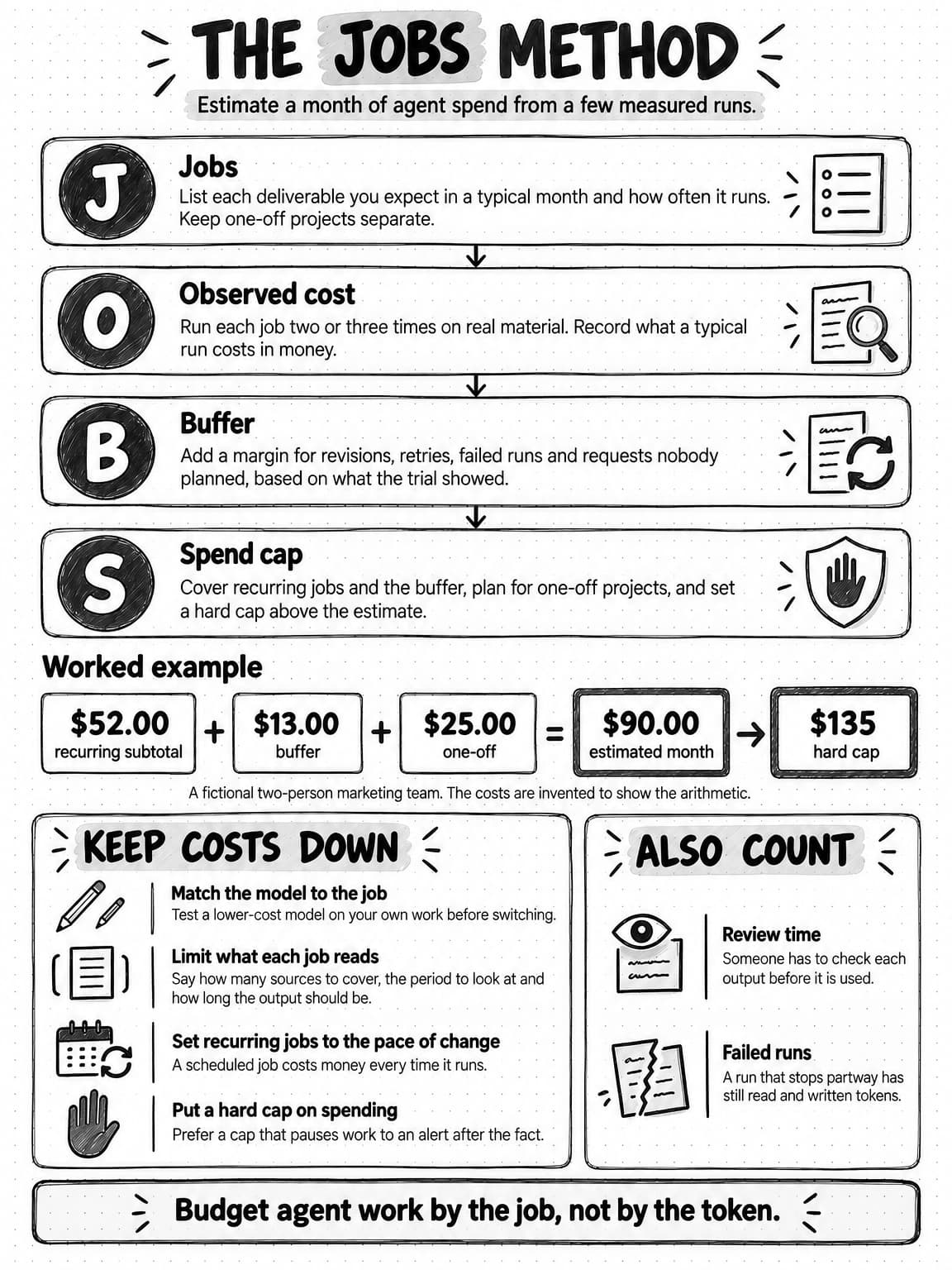
View the JOBS method reference at full size (opens in a new tab).
How credits work in Ampere
Ampere, the AI marketing agent, uses credits as its usage unit, and on paid plans they come from one pool shared across the Organization. Ampere messages, AI Tool runs, browser sessions and select background AI work spend credits, while browsing dashboards, reviewing past runs and managing settings don't. Credits aren't allocated by seat, so the whole team works from the same balance.
Five paid plans run from $100 a month for 20,000 credits to $2,000 a month for 400,000 credits. Each includes the full product, and they differ only in billing cadence and included credit allowance. Monthly plans and top-ups all work out at 200 credits per dollar. Included credits are spent first and expire with their billing period. Top-ups are sold in units of 20,000 credits for $100, and purchased credits roll over while the subscription is active, then expire 12 months after purchase.
When Ampere has a useful estimate for a piece of work, it reserves exactly the estimated credits before the work starts and reconciles the actual cost afterward. The reservation isn't a strict spending ceiling for each turn, so the final cost can differ. Completed sessions can show a settled credit receipt with the exact calculation for supported work, including the agent's own usage and attributed tool usage such as AI Tool runs. The credit control in the top bar shows usable credits, this cycle's usage and usage over the last 24 hours and 7 days.
If the balance reaches zero, new AI runs pause until the allowance resets or more credits are added, while history, settings and saved work stay available. Auto-recharge buys a set amount of credits when the balance falls below a threshold you choose, up to a hard monthly cap, and pauses if the cap is reached or a payment fails. Scheduled tasks reserve credits before each run and can pause automatically when credits run out or runs keep failing. Background helper work is handled separately: it has its own included allowance, and usage above it can appear as one aggregated “Additional background AI usage” line.
The model selector describes each model's task fit and relative cost, and where lower-cost models are enabled, it can suggest one without claiming the results will match. To apply the JOBS method in Ampere, run each job two or three times, read the settled receipts, divide the credits by 200 to convert them to dollars on a monthly plan, and set the auto-recharge cap at the most extra spending you would accept in a month.
Sources and further reading
- OpenAI, Key concepts, Reasoning models and API pricing, checked October 8, 2026. Token rules of thumb, context length, how reasoning tokens are billed, and input, output and cached-input prices.
- Anthropic, Pricing and Using the Messages API, checked October 8, 2026. Input, output and cache prices, tool fees, token sizes of web content, a worked agent-session example, and why each request resends the conversation.
- Google AI for Developers, Understand and count tokens and API pricing, checked October 8, 2026. Token rules of thumb, media token counts, thinking tokens and non-token meters.
- Google AI for Developers, Video understanding, checked October 14, 2026. Tokens per second of video.
- Shashank Verma and Neal Vaidya, NVIDIA, Mastering LLM Techniques: Inference Optimization, November 17, 2023. Why reading input and writing output use hardware differently.
- Aleksandar Petrov and colleagues, Language Model Tokenizers Introduce Unfairness Between Languages, NeurIPS 2023. Token counts for the same text across languages.
- Anthropic, How we built our multi-agent research system, June 13, 2025. Token use by agents and multi-agent systems, and its link to performance.
- Malika Aubakirova and colleagues, State of AI: An Empirical 100 Trillion Token Study with OpenRouter, December 2025. Growth in prompt and completion length per request.
- Kyle Poyar, Growth Unhinged, The state of B2B monetization in 2026, May 13, 2026. Adoption of AI credits and hybrid pricing.
- ICONIQ, 2025 State of AI Report: The Builder's Playbook. Hybrid, usage-based and outcome-based pricing among AI product companies.
Frequently Asked Questions
How many words are 1,000 tokens?
One thousand tokens is roughly 600 to 800 English words. OpenAI and Anthropic estimate one token at about four characters, or three-quarters of a word, of English text, which puts 1,000 tokens near 750 words, and Google puts 100 tokens at about 60 to 80 words. The ratio changes with the language, the model's tokenizer and the kind of text, so treat any conversion as an estimate.
Do AI tokens cost money?
Yes. AI model providers charge for each token a model reads and writes, usually quoted per million tokens, with output priced above input. Who pays depends on how you use the model. A developer calling a model directly pays the provider, while a product built on a model pays the provider and recovers the cost through its own pricing, whether per seat, per unit of usage, per credit or per outcome.
What is the difference between AI tokens and AI credits?
A token is a model's unit of text, and model providers charge for tokens directly. A credit is a product's own usage unit: the product converts tokens and other costs, such as image generation, searches or paid data, into credits drawn from an allowance. Credit values differ between products, so compare the money a finished job costs rather than the number of credits it uses.
What are the main AI agent pricing models?
The main AI agent pricing models are per seat, per unit of usage, per credit and per outcome, and many products combine two of them. Seat pricing charges a fixed fee per person, usage pricing charges for tokens or requests, credit pricing draws work from a monthly or prepaid allowance, and outcome pricing charges for each completed result, such as a resolved support conversation.
How much does an AI agent cost per month?
An AI agent's monthly cost depends on the jobs it does, how often they run, the model it uses and how the product prices usage, so a figure from someone else's setup won't predict yours. Estimate it by the job: list the month's jobs, measure what each costs on two or three real runs, add a buffer for revisions and failures, and set a hard spending cap above the total.
What is the difference between input and output tokens?
Input tokens are everything an AI model reads in a request, including instructions, the conversation so far, attached files and tool results. Output tokens are everything it writes, including any hidden reasoning. Providers price them separately, and on price lists checked in October 2026 an output token commonly cost about five times as much as an input token, largely because models generate output one token at a time.
What is the difference between a context window and tokens in large language models?
Tokens are the units a large language model reads and writes, and the context window is the maximum number of tokens it can consider in one request. The prompt and the generated output together must fit inside the window. In an AI agent, the instructions, conversation history, tool descriptions and tool results all take up room, so a long task can approach the limit.
Why do AI agents use so many tokens?
AI agents use many tokens because they work in a loop, and each step is a new model request that rereads the instructions, the task and everything gathered so far, including long tool results such as web pages. The input grows with every step. In June 2025, Anthropic reported that in its data, agents typically used about four times as many tokens as chat interactions, and multi-agent systems about fifteen times.
How can I reduce AI token usage and costs?
Reduce AI token usage and costs by choosing the lowest-cost model that does each job well, limiting how much each job reads, running recurring jobs only as often as their subject changes, and reusing finished research instead of repeating it. Then set a hard monthly cap, so a job that goes wrong pauses instead of running up the bill.
Can unused AI credits expire or roll over?
Unused AI credits can expire, and the rules depend on the product and the type of credit. Credits included in a subscription may expire at the end of each billing period, while credits bought separately may roll over for a set time. Before buying more than a month needs, check when each type of credit expires and which credits the product spends first.


