What is human-in-the-loop AI? Review points for marketing teams
Five review points for AI marketing work, who should own each one, how deep each check should go, and how to keep approvals from becoming a formality.
27 min readWritten by Ampere
Short answer
What is human-in-the-loop AI?
Human-in-the-loop AI is AI work that stops at set points for a person to review, correct, or approve it before it continues or takes effect. In marketing, those points usually fall at the brief, the plan, the draft, the approval before anything is published or sent, and each recurring run, with the depth of each check matched to how public, permanent, and claim-heavy the work is.
Summary
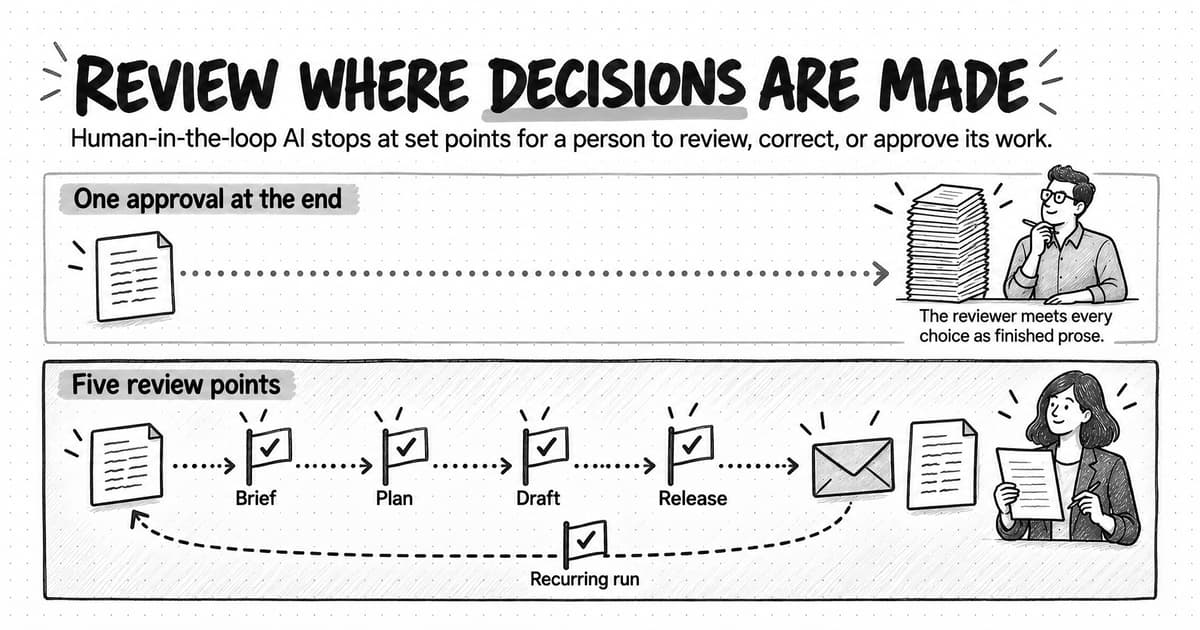
Human-in-the-loop AI keeps people in charge by placing short checks where decisions are made, instead of relying on one approval at the end. A single final approval meets the audience, sources, and claims as finished prose, so the reviewer either rereads everything and becomes the bottleneck or skims and approves without checking. Review spread across the work can be quicker and catches mistakes while they are still cheap to fix.
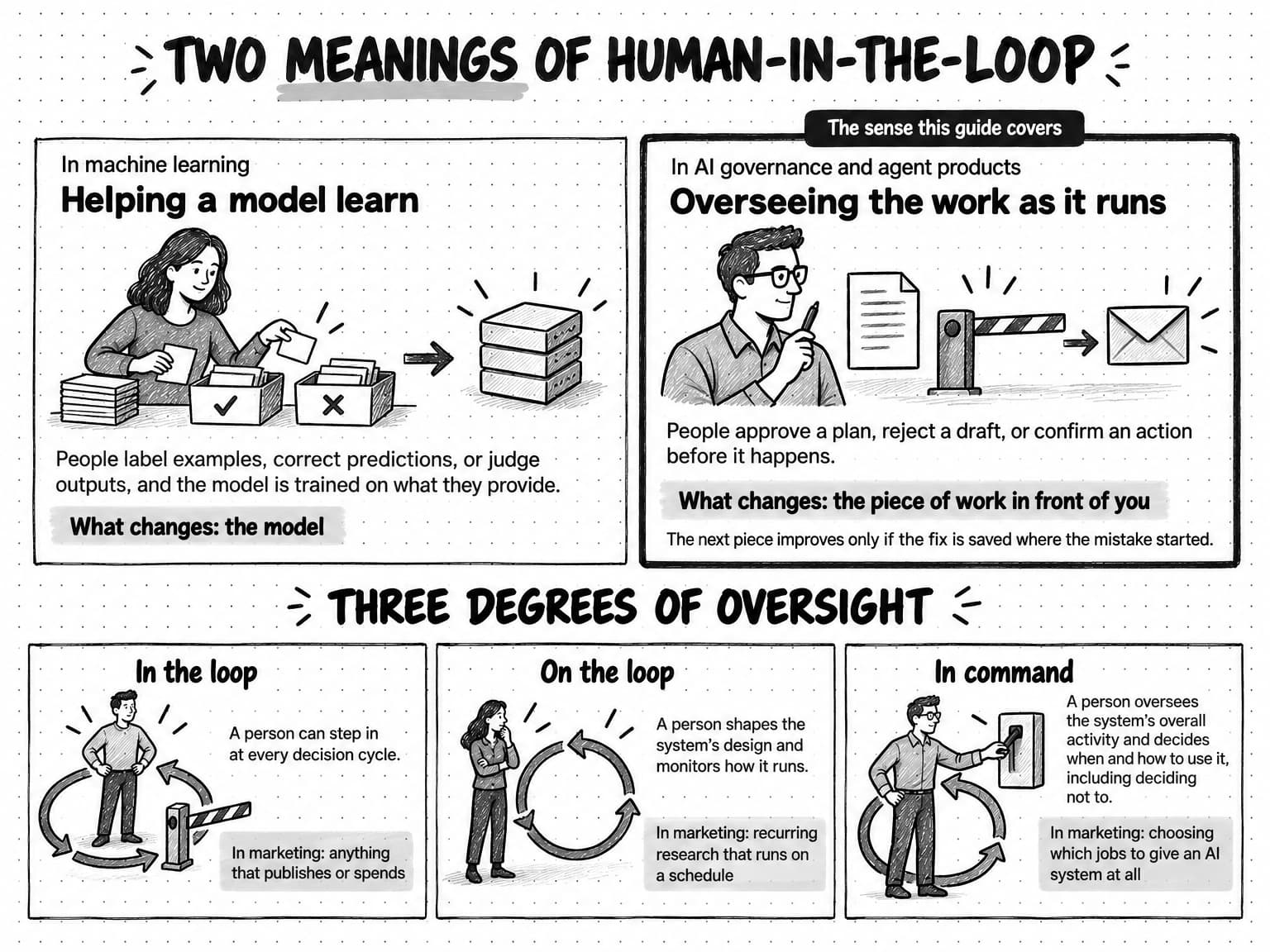
Human-in-the-loop has two senses. In machine learning, it means people labeling, correcting, or judging outputs to train a model. In oversight, the sense that matters for marketing teams, it means people reviewing and approving an AI system's work while it runs. Related terms name other degrees of oversight: human-on-the-loop for shaping and monitoring a system, and human-in-command for deciding whether and how to use one at all.
AI marketing work has five review points: the brief, the plan, the draft, the release, and each recurring run. A worked example follows one fictional software company's monthly newsletter as review catches a wrong audience in the brief, an unapproved quote in the plan, an overstated feature claim in the draft, and a wrong send list at release. A table gives each point an owner and a time budget.
Review depth should follow the stakes: a quick read for internal work that is easy to change, a source check for anything customers will read, and full approval for anything that publishes, sends, spends, or deletes. Research on automation bias finds that experts and teams also over-rely on automated output, so reviewers should decide what must be true before reading, check claims before polish, and keep review queues small.
Corrections improve the next run only when they are saved where the mistake started: the brand or product context the AI reads, the brief, the method, or the sources. A correction made twice belongs upstream. Start with one recurring job, name an owner for each review point, review the first runs closely, and log what reviewers change so review gets lighter as the work improves.
Contents
- What does human-in-the-loop (HITL) mean?
- The five review points for AI marketing work
- Who reviews what at each review point
- How deep each review should go
- How to avoid automation bias and rubber-stamp approvals
- How to turn corrections into better next runs
- How human-in-the-loop review works in Ampere
- How to set up review for your first AI marketing job
- Sources and further reading
- Frequently Asked Questions
For many marketing teams, keeping a person in charge of AI work means one approval step at the end: the AI produces a draft, someone reads it, and it goes out. That step matters, but it comes late. By the time a draft exists, the audience, the sources, the angle, and the claims have all been chosen, and the reviewer meets those choices as finished prose. The reviewer can then reread everything closely and become the reason work waits, or skim and approve, and an approval given that way checks nothing.
Human-in-the-loop (HITL) AI is AI work that stops at set points for a person to review, correct, or approve it before it continues or takes effect. The person takes part throughout the process, at the points where a decision is still cheap to change. An AI agent that asks which customers a newsletter is for before writing it, and waits for approval before anything is sent, has a person in the loop twice.
Spread out this way, review can be quicker as well as more reliable. Each check asks one question of the person best placed to answer it, and close reading is saved for the parts of the work where a mistake would cost something. This guide explains what human-in-the-loop means, sets out five review points for AI marketing work with an owner for each, shows how to match the depth of a check to the stakes, and covers two habits that keep review honest: resisting rubber-stamp approvals and fixing mistakes at their source.
What does human-in-the-loop (HITL) mean?
Human-in-the-loop, shortened to HITL, means that people take part in how an AI system works instead of only receiving what it produces. The phrase has two common senses, and they describe different jobs.
In machine learning, HITL usually means people helping a model learn. They label examples, correct predictions, or judge outputs, and the model is trained on what they provide. A 2022 review of human-in-the-loop machine learning sorts these methods by who controls the learning, from active learning, in which the system stays in control, to machine teaching, in which human experts direct the process. Language models are trained this way too. In a 2022 paper on training language models to follow instructions, people wrote examples of the answers they wanted and ranked the model's outputs, and both were used to train the model further, the second step through a method called reinforcement learning from human feedback.
In AI governance and in agent products, HITL means people overseeing an AI system's work and decisions while it runs: approving a plan, rejecting a draft, confirming an action before it happens. That is the sense this guide covers, and it changes something different from the first. Feedback in the training sense changes the model. A correction in the oversight sense fixes the piece of work in front of you, and whether it improves the next piece depends on where the fix is saved, which a later section explains.
Human in the loop, on the loop, and in command
Oversight comes in degrees, and the European Commission's High-Level Expert Group on AI named them in its 2019 Ethics Guidelines for Trustworthy AI. Human-in-the-loop is the capability to intervene in every decision cycle of a system, which the guidelines note "in many cases is neither possible nor desirable." Human-on-the-loop is the capability to intervene in the system's design and to monitor its operation. Human-in-command is the capability to oversee the system's overall activity and decide when and how to use it, including deciding not to. A system that acts with no person involved is often described as out of the loop. A marketing team can use all three: a person in the loop for anything that publishes or spends, on the loop for recurring research that runs on a schedule, and in command when choosing which jobs to give an AI system at all.
View the two meanings of human-in-the-loop diagram at full size (opens in a new tab).
The five review points for AI marketing work
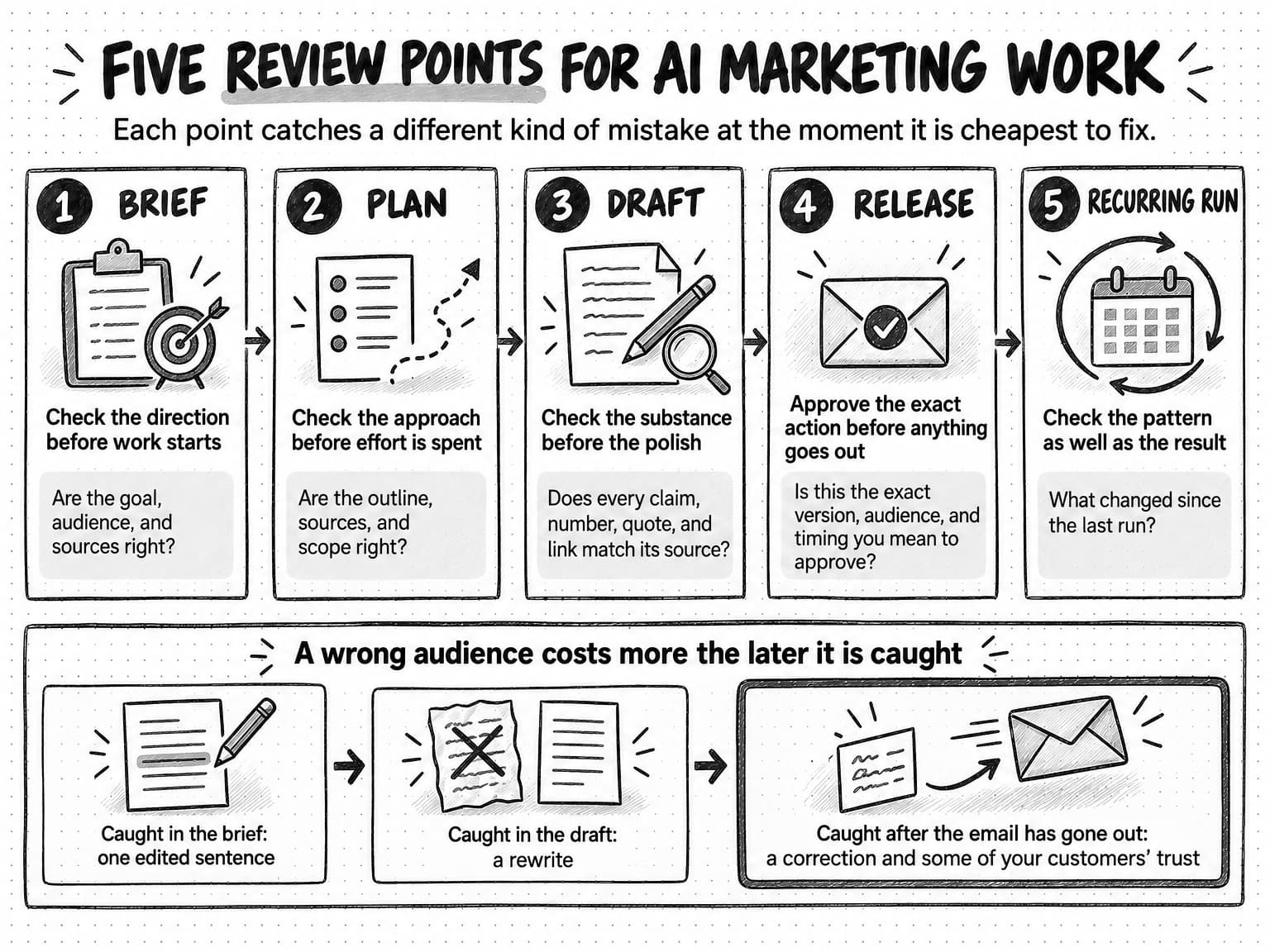
Review in AI marketing work belongs at five points: the brief, the plan, the draft, the release (the moment work is published, sent, or acted on), and each recurring run. Each point catches a different kind of mistake at the moment it is cheapest to fix. A wrong audience caught in the brief costs one edited sentence; caught in the draft, it costs a rewrite; caught after the email has gone out, it costs a correction and some of your customers' trust.
View the five review points diagram at full size (opens in a new tab).
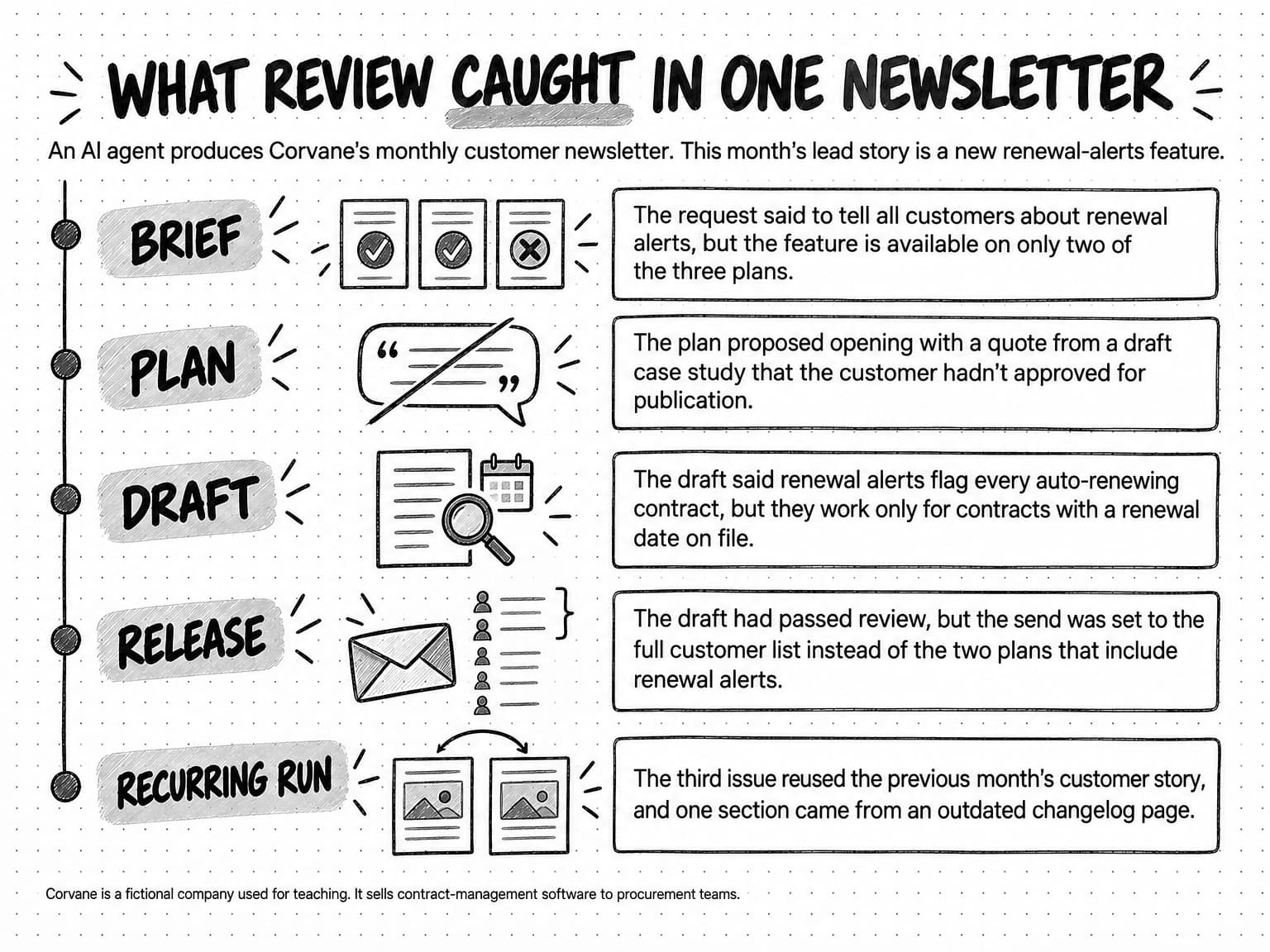
To make the points concrete, this section follows one illustration. Corvane, a fictional company that sells contract-management software to procurement teams, uses an AI agent to produce its monthly customer newsletter. This month's lead story is a new renewal-alerts feature.
Brief: check the direction before work starts
The brief review confirms the goal, the audience, the sources, and anything the work must include or avoid, before the agent spends effort on the wrong thing. Corvane's request said to tell all customers about renewal alerts, but the feature is available on only two of the company's three plans. If the brief doesn't say so, the agent will write a newsletter that promises the feature to everyone, and every later check will be reviewing a mistake built into the assignment. The person asking for the work is best placed to spot that gap, and it usually takes a couple of minutes: read the brief as the agent will and ask what it could get wrong. Our guide to briefing an AI marketing agent covers what a complete brief includes.
Plan: check the approach before effort is spent
The plan review checks how the agent intends to do the job: the outline, the sources it will use, and the scope. If the agent can show a plan or outline before drafting, a few minutes here prevents work that is well made and pointed in the wrong direction. Corvane's plan proposed opening with a quote from a customer case study that was still a draft the customer hadn't approved for publication. Removing one line from a plan is quicker than pulling a quote out of a finished newsletter and rebalancing everything around it. The plan is also the cheapest place to stop scope creep, such as four feature stories when the brief asked for one.
Draft: check the substance before the polish
The draft review checks what the work says before how it sounds: every factual claim, number, quote, link, and product detail against its source, and then fit with the brief and the brand voice. The order matters because fluent writing reads as correct writing. Corvane's draft said renewal alerts flag every auto-renewing contract, but the product brief says alerts work only for contracts with a renewal date on file. That sentence would survive a read for tone. It doesn't survive a source check, and this is where a subject expert earns a place in review: a product manager can settle a capability claim quickly that a marketer would have to research.
Release: approve the exact action before anything goes out
The release review approves the exact thing that will happen, immediately before content is published, sent, paid for, or changed in another system: the final version, the audience or destination, the timing, and any required sign-off. Approving a draft is not the same as approving its release, because details change between the two, and a change after approval needs a new approval. Corvane's newsletter passed its draft review, but in the email platform the send was set to the full customer list instead of the two plans that include renewal alerts.
Security guidance for AI applications puts a person at the same point. The OWASP GenAI Security Project recommends, in its entry on excessive agency, that a person approve high-impact actions before they are taken. One of its examples is an assistant with access to a mailbox, where a malicious incoming email tricks it into forwarding sensitive information. Among the fixes OWASP lists are limiting the assistant to reading mail and requiring the user to review and send every message it drafts.
Recurring run: check the pattern as well as the result
The run review applies to work that repeats on a schedule, and it checks what changed since the last run as well as the result itself: missing or failed sources, repeated content, and drift from the brief. When Corvane's newsletter became a monthly job, its third issue reused the previous month's customer story, and one section came from an outdated changelog page because the current one had moved. Neither error stands out when an issue is read on its own; both show up when you compare runs.
Published recurring work, such as the newsletter, still gets a draft review and a release approval every time. Internal recurring work, such as a weekly competitor digest, may get only the run review, and after a few clean runs that review can move from reading everything to checking each run's sources and changes and reading a sample in full. The less often a person reviews each output, the more testing the setup needs first, a point the EU expert group's guidelines also make. Our guide to automating marketing with AI agents covers setting up recurring work so that a failed run is visible instead of silent.
View the Corvane newsletter example at full size (opens in a new tab).
Put each check where the decision it protects is made, and give it to the person who knows the answer.
Who reviews what at each review point
Each review point should have one named owner, usually the person closest to the decision it protects, and a time budget small enough that review doesn't become the slowest part of the job. The table gives a starting point for a small marketing team.
| Review point | What to check | Who usually owns it | Suggested time |
|---|---|---|---|
| Brief | Goal, audience, sources, and what the work must include or avoid | The person requesting the work | 2 to 5 minutes |
| Plan | Outline, sources the agent will use, and scope | The marketer who will use the result | About 5 minutes |
| Draft | Claims, numbers, quotes, and links against sources, then fit with the brief and voice | The marketer, plus a subject expert for claims in their area | 10 to 30 minutes, depending on the number of claims |
| Release | Exact final version, audience or destination, timing, and required sign-off | The person who answers for the channel | A few minutes, plus any required sign-off |
| Recurring run | Changes since the last run, failed or missing sources, repeated content, and drift | The owner of the recurring task | Close review of the first runs, then a regular check and a sample |
The times are starting points to adjust after a few weeks, not measurements. The right budget depends on the length of the work and how many claims it makes.
Ownership follows knowledge and accountability: each check goes to the person who knows the answer or who answers for the result. Subject experts, such as a product manager, an analyst, or legal counsel when a claim calls for it, check only the claims in their area, which keeps their part short. NIST's AI Risk Management Framework makes the same point for organizations in general: roles and responsibilities for human oversight of AI systems should be defined and kept distinct, so it is clear who does what.
In a small team, one person often holds several of these roles. That works as long as each check still happens as a separate step with its own question. A founder who reviews the brief, the draft, and the release is doing three short checks, each looking for something different.
How deep each review should go
A review should go as deep as the stakes require: a quick read for internal work that is easy to change, a source check for anything customers or the public will read, and a full approval for anything that publishes, sends, spends, or changes a record. Four questions set the stakes: who will see the work, how easily it can be undone, what kind of claims it makes, and whether approving it triggers an action such as publishing, spending budget, or deleting something. An internal document can be edited tomorrow, while a sent email can't be recalled, and facts about your product, prices, customers, competitors, or results carry more risk than structure or opinion.
A quick read takes a few minutes and asks whether the work answers the brief, whether anything is plainly wrong or missing, and whether the agent flagged anything it couldn't verify. It suits internal, reversible work, such as a research digest, a first outline, or notes for a meeting.
A source check opens the source behind each factual claim, number, quote, and comparison and confirms that the source says what the draft says. It suits anything customers or the public will read, and it deserves most of the review time, because it is the check that catches confident errors.
A full approval reviews the exact final version where it will appear, with its audience, timing, and any specialist sign-off, and records who approved it. It suits anything that publishes, sends, spends, or changes a customer record, and above all anything that can't be undone.
Depth can vary within one piece of work. Corvane's newsletter gets a quick read for its tips section, which repeats published help content, a source check for the renewal-alerts story, and a full approval of the send. Matching depth to stakes is what keeps review fast: the time goes to the sentences that could cause harm.
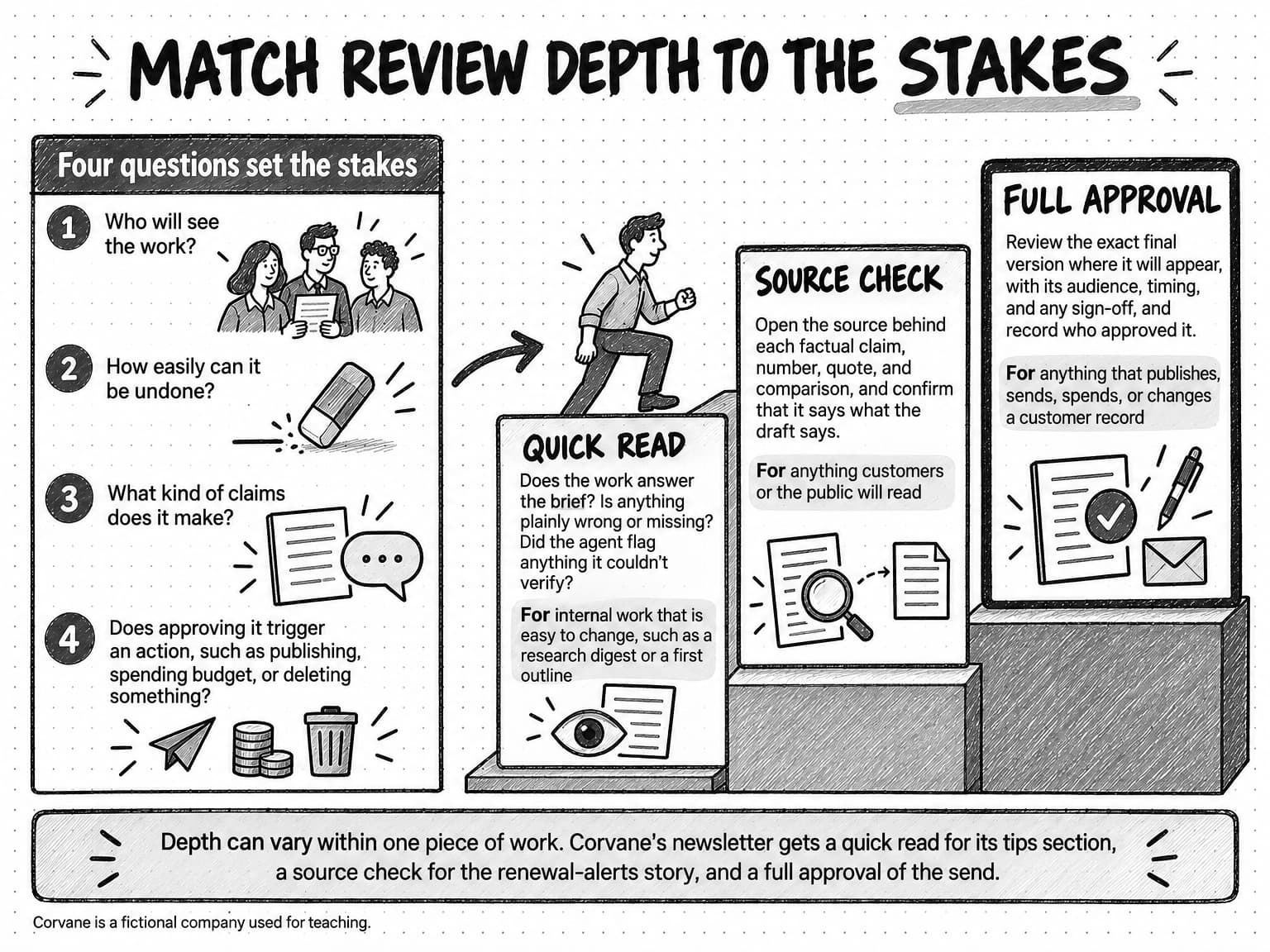
View the review depth diagram at full size (opens in a new tab).
How to avoid automation bias and rubber-stamp approvals
Automation bias is the tendency to over-rely on automated output, letting it stand in for the checking a person would otherwise do, and it explains how a review step can exist on paper and still miss errors. Avoiding it takes specific checks for reviewers to make and a workload light enough that they have time to make them.
Researchers have studied the effect for decades, much of it in aviation and healthcare. A 2012 systematic review in the Journal of the American Medical Informatics Association describes two kinds of error: commission, following incorrect advice, and omission, failing to act because the system didn't prompt it. Workload, task complexity, and time pressure made automation bias more likely, while training and a sense of personal accountability reduced it. In a small pooled analysis of four clinical studies, the review found that when decision-support software gave wrong advice, the risk of an incorrect decision was 26% higher than without the software. A 2010 review in Human Factors found the bias in novices and experts alike, in teams as well as individuals, and concluded that training or instructions cannot prevent it. A review process therefore has to work even for reviewers who know about the bias.
Generative AI shows the same pattern in knowledge work. In a 2023 field experiment with 758 consultants at Boston Consulting Group, those with AI access were more productive and produced higher-quality work on a set of 18 realistic consulting tasks within the AI's capabilities. A separate task was designed so that an AI given the same materials would reach the wrong conclusion: a brand-performance analysis in which the spreadsheet looked complete and the interview notes held the details that changed the answer. Consultants without AI reached the correct recommendation about 84.5% of the time, while the two groups with AI did so 60% and 70% of the time, 19 percentage points less often on average. The authors note that the consultants who did worse with AI tended to adopt its output and question it less.
European law now names the problem. Article 14 of the EU AI Act, on human oversight, requires high-risk AI systems to be provided in a way that lets the people overseeing them stay aware of the tendency to rely or over-rely on the system's output, which the law calls "automation bias," and lets them disregard, override, or reverse that output. The requirement applies to systems the law classes as high-risk, such as those used to screen job candidates or assess creditworthiness. It is cited here for its description of the problem, not as a rule for marketing work, and nothing in this guide is legal advice.
Making reviewers think before they accept helps, though people dislike it. In a 2021 experiment with 199 participants, people who had to engage first, by deciding before they saw an AI's suggestion, asking to see it, or waiting 30 seconds for it, relied less on wrong suggestions than people who were simply shown the suggestion with an explanation. Participants also rated the most effective designs least favorably, so friction is best kept for the checks where the stakes justify it.
Five habits turn that research into practice:
- Decide what must be true before you read. Write down the two or three facts the work has to get right, such as the audience, a capability claim, or an offer's terms, and check those first. It is the review equivalent of making your own call before seeing the AI's suggestion.
- Read the agent's list of what it couldn't verify before reading the work. Ask the agent to list its assumptions and unsupported claims; that list points to the claims most in need of a source check.
- Keep the review queue small. Workload and time pressure make automation bias more likely, so batch similar reviews, set a sensible daily limit, and save full-depth reading for the work that needs it.
- Approve the exact version under your own name. A named approver makes accountability visible, and accountability reduced automation bias in the studies reviewed. Approve again after any material change.
- Track what reviewers change. NIST's framework notes that data on how often and why people overrule AI output may be useful to collect. If weeks of approvals have changed nothing, run a deliberate source check on a sample to confirm the review is still finding what it should.
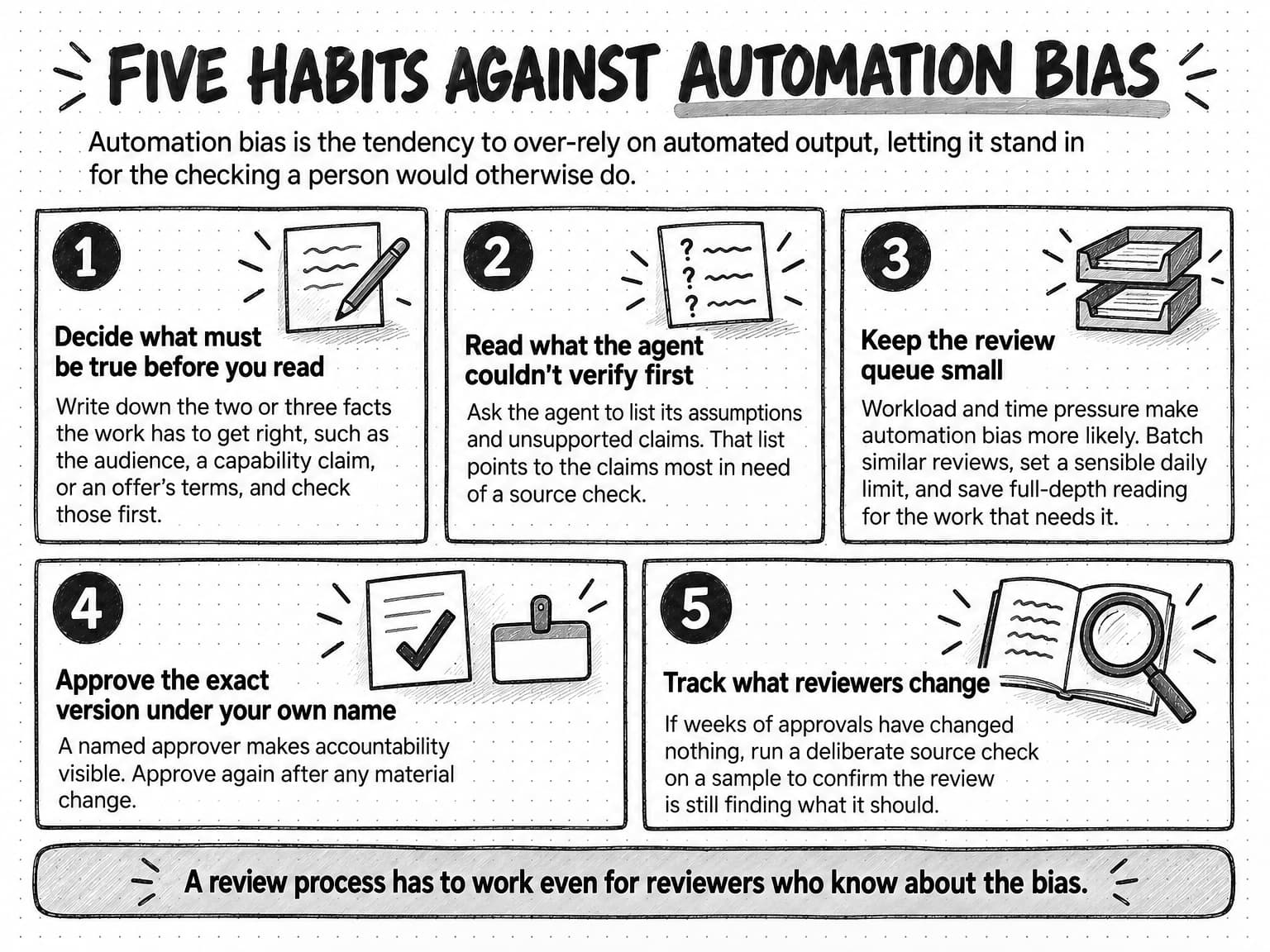
View the five habits against automation bias at full size (opens in a new tab).
How to turn corrections into better next runs
A correction improves the next run only when it is made where the mistake started: in the saved context the agent reads, the brief, the method it used, or the sources it relied on. Editing the output fixes one piece of work. Fixing the source fixes every later piece that would have repeated the error.
Corvane's draft listed the plans under names the company had retired the previous quarter. The reviewer could fix the names in this issue, and the next issue would get them wrong again, along with every product page and sales email the agent drafted from the same material. The mistake started in the saved product brief, which still described the old plans. Updating that brief once corrects every later piece of work that reads it.
| Wrong fact about your company, product, or customers | Update the saved context the agent reads, such as the product brief or brand guidelines. |
|---|---|
| Wrong audience, goal, or scope | Fix the brief or the saved instructions for the recurring task, so the next run starts from the right assignment. |
| Wrong format, structure, or method | Choose a different skill or template, or add an example of the format you want. |
| Weak, outdated, or unapproved sources | Name approved sources in the brief or saved context, and list sources to avoid. |
| An action the agent should not take | Change its permissions or approval settings as well as its instructions. |
| A one-off judgment call | Fix the output. Nothing upstream needs to change. |
A simple rule decides which corrections move upstream: if you make the same correction twice, it belongs in the source. Keep a short log of what reviewers change and why, because patterns in the log show which saved context is stale and which briefs leave something out. Our guides to brand guidelines and brand voice cover what that saved context should contain.
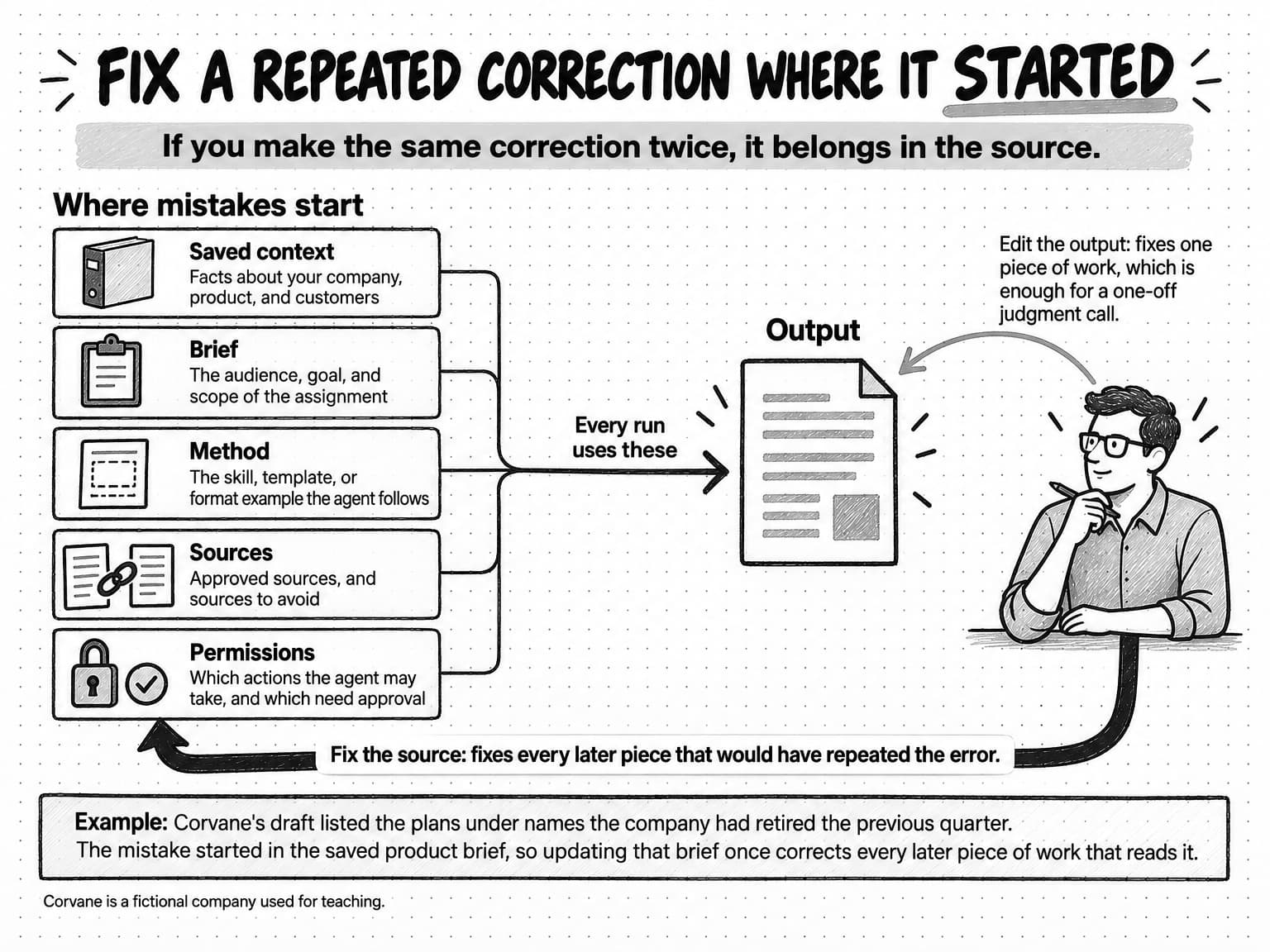
View the fix-at-the-source diagram at full size (opens in a new tab).
Whatever product you use, check where a correction ends up. If it lives only in the edited draft, the next run starts without it.
How human-in-the-loop review works in Ampere
In Ampere, review follows the same points: you set the direction, and finished work comes back to you before anything goes out.
At the brief and plan points, Ampere can ask for clarification, approval, or taste direction when your answer would materially change the outcome, and otherwise keeps working. It is set up to stop for a question only when a missing fact blocks the work. For branded LinkedIn carousels, it offers content-style and visual-style choices with example decks before it makes the deck. While it works, the session workspace shows the browser, files, previews, and sources behind the work, and you can stop a turn that is heading the wrong way.
At the draft point, Ampere's packages for LinkedIn text posts, polls, and newsletters include review notes and claim checks alongside the drafts, so a source check can start from the claims that need it. The owner can get an email when Ampere needs input or has work ready to review, and sessions can be shared with view, edit, or owner access, so a colleague can check the claims in their area.
At the release point, when an enabled Connector action needs approval, Ampere can show a dedicated approval checkpoint. You can deny the action from the compact card, approving opens a full review first, and if the approval can't be matched to the exact action captured for review, the action doesn't go ahead.
For recurring work, scheduled task results land in the Project ready to review, and run-update emails can go to chosen teammates. Scheduled Connector actions can use task-scoped standing consent or one-off approval where the action allows it; material task changes require re-confirmation, destructive scheduled actions always need fresh approval, and without valid consent a run finishes the draft work and waits for your approval. Monitoring files its alerts with evidence and source excerpts.
Corrections carry forward when you make them in Brand memory. Ampere saves what it learns about your brand as editable briefs with their sources visible, and once you correct a brief, later work follows the approved version. Ampere does not directly use private customer prompts, files, chat history, project context, agent memory, integration data, or outputs to train Ampere models by default. AI output can be inaccurate or incomplete, so review still matters, and nothing publishes without you.
How to set up review for your first AI marketing job
Set up human-in-the-loop review one job at a time, starting with recurring work your team already knows how to judge. A job you can judge lets you tell whether review is catching real problems or only slowing the work down. If you are still choosing a product, test it on your own assignments first, as our guide to evaluating an AI marketing agent describes. When several jobs run this way, our guide to the AI-native marketing team sets out who owns context, review, and recurring work across all of them.
- Pick one recurring job, such as a monthly newsletter or a weekly competitor digest.
- List the five review points for that job and name one owner for each.
- Set the depth of each check with the four stakes questions, and give each check a time budget.
- Require approval for anything that publishes, sends, spends, or deletes, in the product's settings as well as in the brief.
- Review the first runs closely and log what reviewers change and why.
- After a month, move every repeated correction into the saved context or brief, and lighten the checks where runs have been clean.
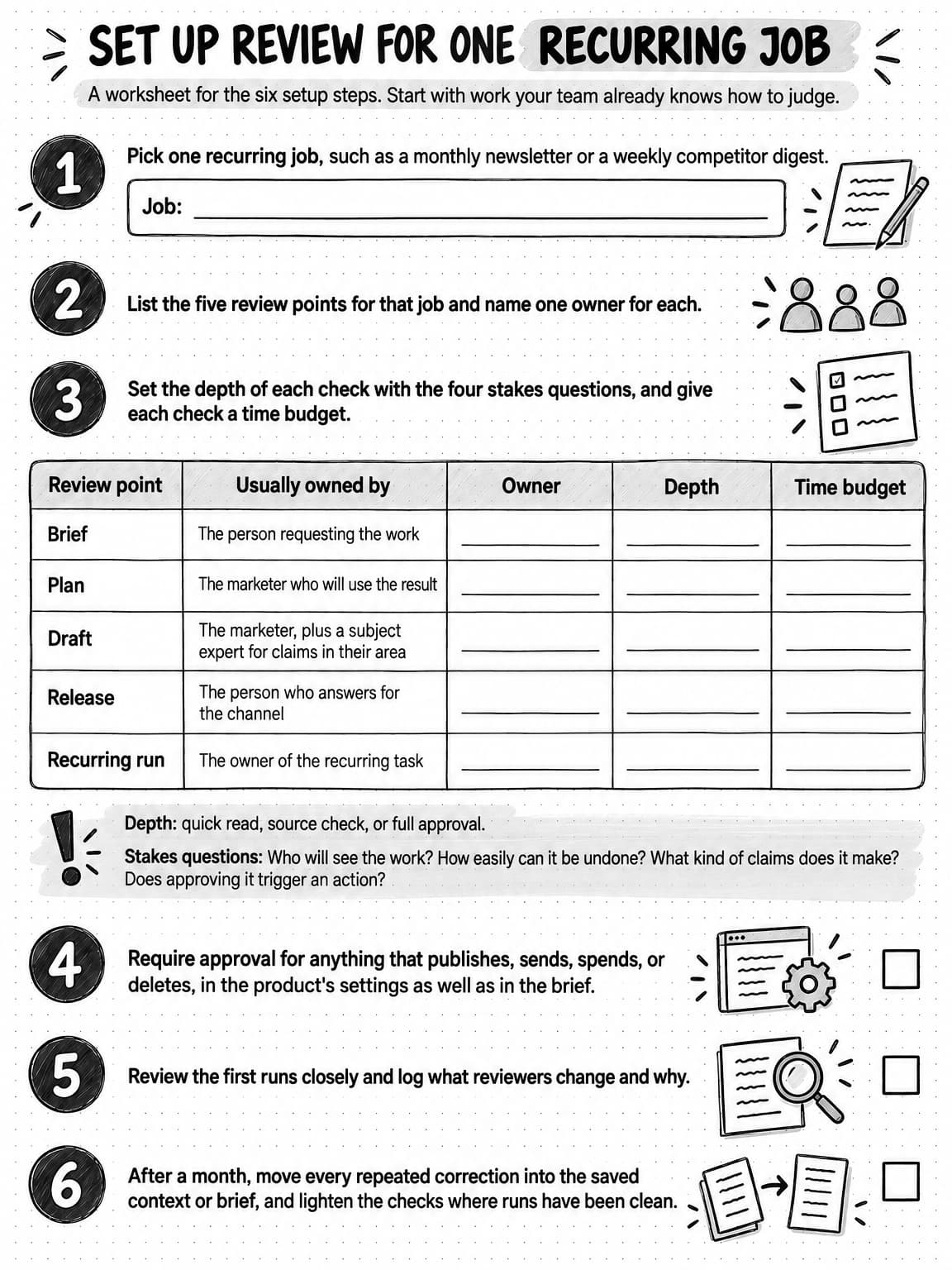
View the review setup worksheet at full size (opens in a new tab).
Sources and further reading
- High-Level Expert Group on Artificial Intelligence, Ethics Guidelines for Trustworthy AI, European Commission, April 8, 2019. Human-in-the-loop, human-on-the-loop, and human-in-command.
- Regulation (EU) 2024/1689 (the AI Act), Article 14: Human oversight, European Commission AI Act Service Desk. Automation bias and the ability to override high-risk AI output.
- OWASP GenAI Security Project, LLM06:2025 Excessive Agency. Excessive functionality, permissions, and autonomy, and human approval of high-impact actions. The 2026 edition renumbers it LLM03:2026 and keeps the recommendation that a person approve high-impact actions.
- Kate Goddard, Abdul Roudsari, and Jeremy Wyatt, Automation bias: a systematic review of frequency, effect mediators, and mitigators, Journal of the American Medical Informatics Association, 2012.
- Raja Parasuraman and Dietrich Manzey, Complacency and bias in human use of automation: an attentional integration, Human Factors, 2010.
- Fabrizio Dell'Acqua and colleagues, Navigating the Jagged Technological Frontier, Harvard Business School Working Paper 24-013, September 2023.
- Zana Buçinca, Maja Malaya, and Krzysztof Gajos, To Trust or to Think: Cognitive Forcing Functions Can Reduce Overreliance on AI in AI-assisted Decision-making, Proceedings of the ACM on Human-Computer Interaction, 2021.
- National Institute of Standards and Technology, Artificial Intelligence Risk Management Framework (AI RMF 1.0), January 2023. Roles and responsibilities for human oversight.
- Eduardo Mosqueira-Rey and colleagues, Human-in-the-loop machine learning: a state of the art, Artificial Intelligence Review, 2022.
- Long Ouyang and colleagues, Training language models to follow instructions with human feedback, 2022.
Frequently Asked Questions
What does HITL stand for?
HITL stands for human-in-the-loop, a setup in which people take part in how an AI system works instead of only receiving its output. The term has two common senses. In machine learning, it means people labeling, correcting, or judging outputs so a model learns from them. In AI oversight, the sense that matters most for marketing teams, it means people reviewing, correcting, or approving the system's work at set points before it continues or takes effect.
What are examples of human-in-the-loop AI?
Examples of human-in-the-loop AI include people ranking a language model's answers so it can be trained further, a marketer approving an agent's outline before it drafts, a product manager confirming a capability claim in a draft, and a channel owner approving the exact audience and version of an email before it is sent. Security guidance from OWASP adds another: an assistant that drafts emails should leave the user to review and send each one.
Why is human-in-the-loop important?
Human-in-the-loop review is important because AI output can read well and still be wrong, and some mistakes, such as a sent email, can't be undone. Review catches wrong facts, unapproved claims, and wrong audiences before they reach customers, and approval keeps high-impact actions such as publishing or spending under a person's control. Research on automation bias explains why review needs a design: people tend to over-rely on automated output, so reviewers need specific things to check before the final click.
How do you implement human-in-the-loop review?
To implement human-in-the-loop review, map a job's review points (the brief, the plan, the draft, the release, and each recurring run), name one owner for each, and set the depth of each check by its stakes. Require approval for publishing, sending, spending, and deleting in the product's permissions as well as in instructions. Then review the first runs closely, log what reviewers change, and move any correction made twice into the saved context or the brief.
Which marketing tasks should require human approval when using AI?
Marketing tasks that publish, send, spend money, delete content, or change customer records should require human approval of the exact action, because they reach people outside the company or are hard to undo. Content with factual claims about products, prices, customers, competitors, or results needs a source check before release. Internal work that is easy to change, such as a research digest or a first outline, can usually get a quick read instead.
How does human-in-the-loop work with AI agents?
Human-in-the-loop works with AI agents by placing checkpoints in a multi-step job instead of reviewing every step. A person sets the brief, can check the plan before the agent drafts, reviews the finished draft, and approves any action that publishes, sends, or spends. For recurring agent runs, a person reviews what changed in each run. Approval for consequential actions should be enforced in the agent's permissions, because an instruction alone can be misread or ignored.
What is human-in-the-loop automation?
Human-in-the-loop automation is automated or recurring work that pauses at set points for a person's review or approval before it continues or takes effect. An agent can draft a monthly newsletter on schedule, but a person still checks its claims and approves the exact send every time. Internal recurring work, such as a weekly competitor digest, may need only a run review, which can move from reading everything to checking each run's sources and changes, plus a sample, once the first runs are clean.
What is human-in-the-loop machine learning?
Human-in-the-loop machine learning is training or improving a model with people's input, such as labeling examples, correcting predictions, or judging outputs. Approaches differ in who controls the learning, from active learning, in which the system stays in control, to machine teaching, in which human experts direct it. Reinforcement learning from human feedback, used to train language models, is one example. It differs from oversight, in which people review an AI system's work as it runs.
What are the drawbacks of human-in-the-loop AI?
The drawbacks of human-in-the-loop AI are slower work, the cost of reviewers' time, and the risk that review turns into a formality. Checking every step can make one person the bottleneck, and tired or rushed reviewers tend to approve what they are shown, a pattern called automation bias. Matching review depth to stakes, giving each check one owner and a short time budget, and fixing repeated mistakes at their source keep review fast without losing the check.


