How to brief an AI marketing agent for better work
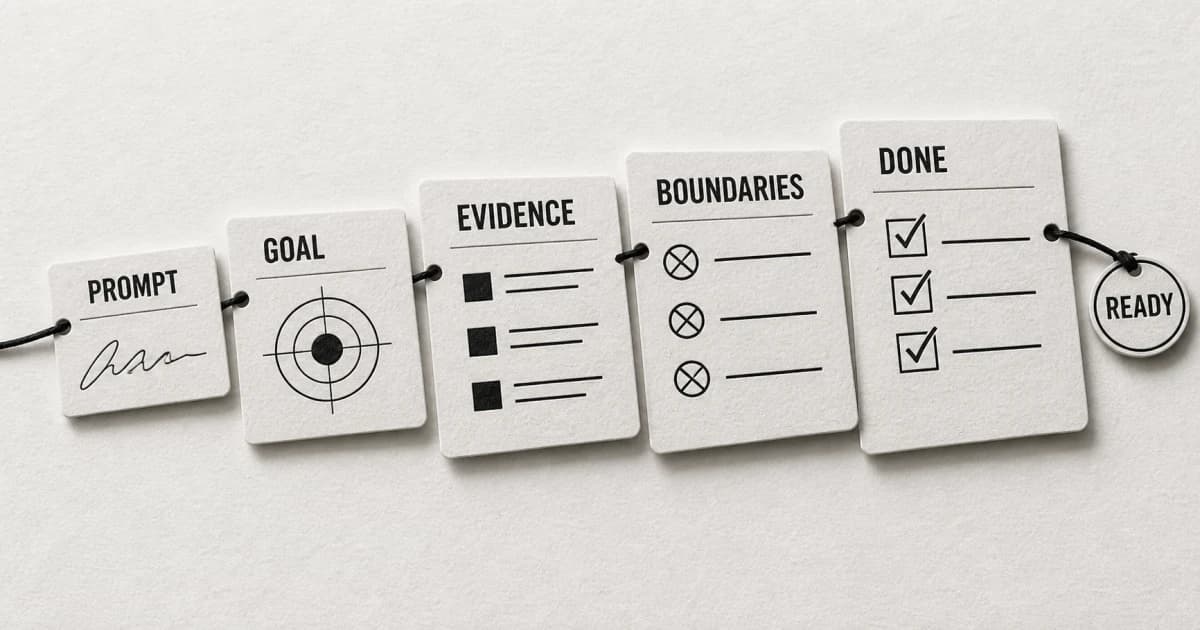
A useful agent prompt is less like a magic phrase and more like a good creative brief: clear about the outcome, grounded in source material, and explicit about what needs your approval.
16 min readWritten by Ampere
Contents
- What makes a prompt effective for an AI marketing agent?
- Start with the outcome, not the asset
- Give the agent an audience it can actually use
- Point to sources and say which ones win
- Describe the deliverables and the boundaries
- Tell an agent what it may do
- Give complex work a process, but leave room for judgment
- Define what good looks like before the first draft
- A reusable prompt template for marketing agents
- How to fix a prompt when the result is weak
- Common prompting mistakes in marketing
- How reusable context changes the prompt
- A final check before you send the prompt
- Sources and further reading
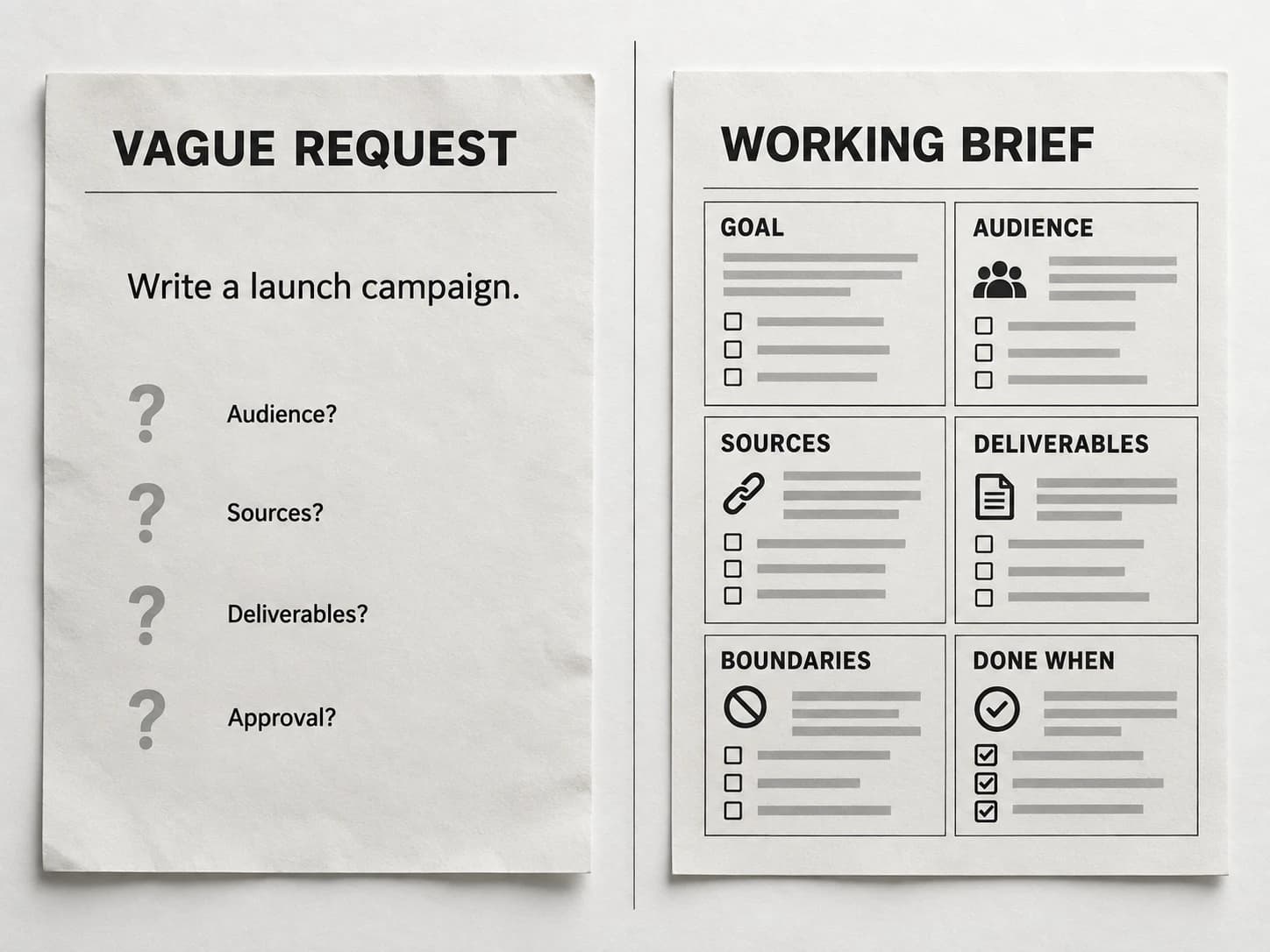
“Create a launch campaign for our new feature” is not a terrible prompt. It names a task, and a capable AI marketing agent can begin from there. But it leaves the agent to guess which audience matters, what counts as a campaign, where the product facts live, which claims are allowed, and whether “create” means draft the assets or publish them.
The most effective prompts for AI marketing agents resolve those decisions before work begins. They state the outcome, point to the right sources, describe the audience and deliverables, set boundaries, and explain what a reviewer will look for. In other words, they read less like a spell and more like a working brief.
That does not mean every request needs a page of instructions. A short, reversible task can have a short prompt. Longer briefs earn their keep when the work spans research, judgment, tools, several formats, or an action that cannot easily be undone.
This guide explains what to include, what to leave out, and how to improve a prompt when the first result misses the mark. It also includes a reusable template you can adapt to content, campaigns, research, creative, and reporting work.
What makes a prompt effective for an AI marketing agent?
An effective prompt gives the agent enough information to make good decisions without making it reconstruct your entire marketing operation from one message.
The exact wording matters less than the decisions the prompt captures. Official guidance from OpenAI, Anthropic, and Google Cloud converges on a few basics: be clear about the objective, supply relevant context, structure complex instructions, show examples when the output is hard to describe, specify the response format, and improve prompts through testing rather than guesswork.
Marketing work adds another layer. An agent may browse the web, inspect files, analyze performance data, generate images, prepare a deck, or work with a connected account. Your prompt therefore needs to cover not only what the answer should say, but also how the work should be carried out and where human approval begins.
| Outcome | The change this work should help create |
|---|---|
| Audience | Who the work is for and what they already know |
| Sources | The facts, files, examples, and data the agent should trust |
| Deliverables | The concrete files or outputs you expect |
| Constraints | Requirements, exclusions, claims, budget, timing, and channel rules |
| Process | Research, analysis, production, and review steps that materially affect the result |
| Authority | What the agent may do and what still requires approval |
| Definition of done | The checks a reviewer will use to accept the work |
You will not need all eight parts every time. “Turn the attached transcript into a clean summary for the sales team, under 500 words” may be enough for a low-risk internal draft. A multi-channel launch with fresh research, customer claims, design assets, and a publishing deadline deserves a fuller brief.
Start with the outcome, not the asset
Marketers often begin by naming a format: write a blog post, make five ads, build a deck. The format tells the agent what to produce, but not what the work is supposed to accomplish.
Compare these two requests:
Write a LinkedIn post about our new reporting feature.
Draft a LinkedIn post that helps hands-on B2B marketers understand why our new reporting feature reduces the time between campaign analysis and a decision. The post should lead interested readers to the launch article. Keep the feature explanation factual and use the approved release notes as the source of truth.
The second prompt gives the asset a job. It identifies the audience, the idea the reader should understand, the next step, and the source behind the claim. The agent still has room to write, but it no longer has to invent the strategy.
For larger work, add the decision the deliverable should support. A competitor report might help the team choose a positioning angle. A campaign analysis might determine which ads to pause. A content brief might help a writer produce an article that answers a specific customer question. Naming that decision helps the agent separate interesting information from useful information.
Give the agent an audience it can actually use
“Write for marketers” is usually too broad. A founder who still owns marketing, a demand-generation lead at a large company, and a freelance social strategist may all be marketers, but they do not share the same problems, vocabulary, or buying authority.
A usable audience description answers three questions:
- Who is this person in relation to the problem?
- What do they already understand?
- What tension, question, or decision brings them to this piece?
You do not need to invent a cinematic persona with a name, age, favorite podcast, and morning routine. Unless those details affect the work, they are decoration. Describe the situation instead: “founders at early-stage B2B software companies who understand their product but do not have a dedicated content team” gives the agent more to work with than “ambitious founders aged 28–45.”
The same rule applies to tone. Words such as professional, engaging, and human are open to interpretation. If voice matters, attach two or three approved examples and say what each demonstrates. One might show the right amount of technical explanation; another might show how direct the brand is willing to be. Examples give the agent observable choices to follow.
Point to sources and say which ones win
Many weak marketing outputs are not writing failures. They are source failures.
If the agent does not have the current product description, customer evidence, campaign data, or brand guidance, it will either stay generic or fill the gaps with plausible language. A more detailed tone instruction cannot repair missing facts.
Name the sources that matter and, when they might disagree, give them an order of authority. For example:
- Use the approved release notes for current product behavior.
- Use the messaging brief for positioning and audience language.
- Use the previous launch page only as a structural reference.
- Treat anything else found on the web as background until verified.
OpenAI's prompting guide recommends including relevant proprietary or external context when the model could not otherwise know it. The practical marketing version is straightforward: attach the real evidence, not a longer description of the evidence.
Freshness matters too. “Use our website” is risky when the site contains old pages, experimental copy, and legacy product names. Name the exact pages or files, include a date range for current research, and tell the agent how to handle conflicts. A useful instruction might be: “If a product claim appears in the website copy but not in the current release notes, flag it instead of using it.”
Do not paste every document you own into every request. Too much irrelevant context can hide the few facts that should govern the work. Supply the smallest set of current sources that allows the agent to complete the job, or place reusable material in the system where the agent can retrieve it when relevant.
Describe the deliverables and the boundaries
“Create a campaign” could mean a strategy, a calendar, finished copy, visual concepts, production-ready images, or all of them. List the concrete outputs you expect.
For example:
- One campaign brief in Markdown
- Three LinkedIn post drafts with distinct angles
- One 1200×627 image concept for the selected angle
- A source note linking each factual claim to the supplied material
Then add the constraints that would cause a reviewer to reject the work. These may include channel limits, required phrases, banned claims, image dimensions, reading level, budget, deadline, regions, legal language, or accessibility requirements.
State positive requirements where possible. “Lead with the customer problem and support the product claim with the release notes” is more useful than a long list of vague prohibitions. Keep negative constraints for real boundaries: do not use customer names without approval; do not invent performance figures; do not publish; do not spend more than the approved amount.
If the output has a fixed shape, show it. OpenAI, Anthropic, and Google all recommend examples for tasks where format or style is difficult to specify. A model can learn more from one approved email and one rejected email—with a note explaining the difference—than from six adjectives about the desired voice.
Tell an agent what it may do
This is the most important difference between prompting a text generator and briefing an agent.
A text generator returns content. An agent may be able to search, create files, run tools, or take action through connected services. The brief should distinguish research and drafting from consequential external actions.
For a campaign task, that boundary could be:
You may research public sources, analyze the attached data, and create draft assets. Do not publish posts, launch ads, email customers, change budgets, or edit live pages. Prepare everything for review and stop before any external action.
If an action is authorized, name its exact scope. “Schedule the approved post in the company account for Tuesday at 9:00 a.m. Pacific” is safer than “handle publishing.” For high-impact actions, approval should attach to the exact action and payload, not to a vague earlier instruction. OpenAI's human-in-the-loop guidance describes this pattern technically: an agent pauses at a tool call, a person approves or rejects that specific call, and the run resumes.
Authority also covers judgment. Tell the agent which decisions it can make and which it should surface. It may be reasonable for the agent to select the clearest chart type. Choosing the campaign promise, accepting a weak source, or deciding that a legal qualification can be removed may require a person.
Give complex work a process, but leave room for judgment
Large marketing requests often contain several jobs: research the market, form a point of view, write the article, generate the images, and package the final files. Asking for everything in one undifferentiated paragraph makes it harder to see where the work went wrong.
Break the task into meaningful stages:
- Inspect the supplied sources and identify missing information.
- Research only the gaps that affect the recommendation.
- Propose the argument and deliverables.
- Produce the approved direction.
- Check facts, brand consistency, channel requirements, and file specifications.
This follows the agent-instruction guidance in OpenAI's practical guide to building agents, which recommends turning dense procedures into smaller steps, defining clear actions, and accounting for common edge cases.
Do not prescribe hidden reasoning or add ceremony for its own sake. “Think step by step and make it amazing” gives the agent no marketing standard to meet. Ask for visible evidence instead: cite the sources used, list material assumptions, show the comparison behind the recommendation, and run the stated checks before delivery.
For work with real ambiguity, explain when the agent should ask. A good default is: proceed with low-impact assumptions and state them; pause when a missing choice would change the audience, claim, budget, channel, or external action.
Define what good looks like before the first draft
A prompt is easier to improve when success is observable.
“Make it stronger” is difficult to evaluate. “The opening should name the audience's problem within the first 80 words, every product claim should trace to the release notes, and each ad variation should test a different promise” gives both the agent and the reviewer something to check.
Your definition of done can cover four kinds of quality:
- Accuracy: Facts, quotations, numbers, dates, and product behavior match the named sources.
- Usefulness: The reader can answer the question or take the intended next step without searching for a better explanation.
- Brand fit: The work follows the approved message, voice examples, visual system, and claim boundaries.
- Completion: Every requested file exists in the right format and has passed the relevant checks.
Google Cloud describes prompt improvement as a test-driven, iterative process: define the objective and expected outcome, test, inspect the result, and adjust. That idea transfers well to marketing. Keep the brief stable enough to learn from repeated work, but change it when the same failure keeps returning.
The best prompt is not the longest one. It is the shortest brief that prevents the expensive misunderstandings.
A reusable prompt template for marketing agents
Use this template as a menu, not a form that must be completed line by line. Delete sections that do not affect the task.
## Goal

What should change because this work exists?
What decision or next step should it support?

## Audience

Who is the work for?
What do they already know, need, or believe?

## Source material

Use these files, pages, datasets, and examples:
- [source]
- [source]

Source priority:
1. [authoritative source]
2. [supporting source]

If sources conflict or a required fact is missing, [state how to proceed].

## Deliverables

Create:
- [file or output, format, size]
- [file or output, format, size]

## Requirements and constraints

- Include [required material]
- Follow [brand, channel, legal, or accessibility rule]
- Do not [real boundary]
- Work within [budget, geography, date range, deadline]

## Process

1. [research or inspection step]
2. [analysis or decision step]
3. [production step]
4. [quality check]

## Authority and approval

You may [read, research, analyze, draft, create files].
Do not [publish, send, spend, delete, or change live systems] without approval.
Pause and ask if [a missing decision would materially change the work].

## Definition of done

The work is ready for review when:
- [fact or source check]
- [audience or message check]
- [format or file check]
- [delivery or packaging check]
Here is the difference when the template is applied to a real kind of marketing task.
Thin request:
Research our competitors and create a content strategy.
Working brief:
Identify three content opportunities for our B2B expense-management product. The decision is which topic cluster our two-person marketing team should own next quarter.
Start with the attached positioning brief, customer interview summary, and list of six competitors. Review each competitor's currently published guides from the last 12 months. Use first-party pages as evidence and link every example. Do not estimate traffic or search volume unless a named source provides it.
Deliver a short research memo, a comparison table, and a recommendation for one topic cluster with five article ideas. Explain why the recommended cluster fits our audience, product evidence, and production capacity. Flag any product claim that is not supported by the supplied material.
You may research and create files. Do not contact competitors, publish content, or change our website. The work is ready when every competitor observation has a source, the recommendation follows from the comparison, and the five ideas answer distinct customer questions.
The stronger version is not better because it is longer. It is better because it removes consequential ambiguity while preserving room for research and judgment.
How to fix a prompt when the result is weak
When an output misses, resist the urge to replace the entire brief with “try again.” Identify which part failed.
| What went wrong | Likely prompt problem | Better correction |
|---|---|---|
| The work is generic | Missing audience, evidence, or examples | Add current customer language, source material, and one approved example |
| The facts are wrong | No source boundary or unclear authority | Name the source of truth and require unsupported claims to be flagged |
| The format is unusable | Deliverable left implicit | Specify the file type, dimensions, sections, and intended destination |
| The agent did too much | Authority was vague | Separate drafting from publishing, spending, sending, or live edits |
| The agent stopped too early | Completion was vague | List every output and the checks required before handoff |
| The work is polished but off-brand | Tone adjectives replaced brand context | Supply reviewed examples, messaging boundaries, and current Brand memory |
| The process is slow or bloated | Too many irrelevant steps or sources | Remove instructions that do not affect the outcome |
Make one or two targeted changes, then run the task again. If you rewrite every section after every result, you will not know which change helped.
Save prompts that support recurring work, but save the context behind them too. A six-month-old prompt may still describe the correct process while pointing to stale product facts or an outdated audience. The reusable unit is the brief plus its maintained sources, not the wording alone.
Common prompting mistakes in marketing
Assigning an impressive role instead of supplying expertise
“Act as a world-class CMO with 20 years of experience” may influence tone, but it does not give the agent your customer research, campaign history, offer, or budget. Define a role when it clarifies scope. Do not use a grand title as a substitute for evidence.
Asking for “viral,” “high-converting,” or “SEO-optimized” work
These labels imply results that no prompt can guarantee. Replace them with observable requirements. For example: use the target query naturally in the title and opening, answer the question early, support claims with sources, and write a description that accurately explains what the reader will learn.
Google's guidance for people-first content is useful here. It asks whether a reader will leave having learned enough to achieve their goal, and warns against producing summaries that add little value or writing to an arbitrary word count. SEO works best when applied to a genuinely useful answer, not when it becomes the subject of every sentence.
Using adjectives where examples would be clearer
“Conversational, authoritative, fresh, bold, warm, concise, and premium” can pull a draft in several directions at once. Use fewer labels, define the ones that matter, and attach examples that show the intended choice.
Trying to complete a campaign in one blind pass
Complex work benefits from checkpoints. Review the research question before production, the argument before design, and the exact assets before an external action. This is not micromanagement. It keeps an early misunderstanding from spreading into ten finished files.
Treating the first prompt as a contract that cannot change
Good prompting is iterative. Follow-up instructions are useful when they add missing context, correct a decision, or sharpen a review criterion. Keep the conversation grounded by explaining what should change and what should remain untouched.
How reusable context changes the prompt
The first brief for a company is usually the hardest because it has to carry so much background. Later requests should become shorter when the agent can draw from maintained, reviewable context.
Meet Ampere—your AI marketing agent. Brand memory can hold saved knowledge about the brand, audience, market, products, competitors, voice, and visual identity. Projects keep briefs, files, reusable assets, and related sessions together. That means a prompt can focus on what is new about the current job instead of pasting the same company introduction into every request.
Persistent context does not remove the need for direction. It changes where the direction lives. Stable brand knowledge belongs in Brand memory. Project-specific material belongs with the Project. The current prompt should state the outcome, the new evidence, the deliverables, and any boundaries particular to this run.
You should still inspect the context periodically. A perfectly written prompt cannot rescue an outdated product fact or a weak brand assumption that the system keeps reusing.
A final check before you send the prompt
Read the prompt once as if you were the person accepting the work.
- Is the outcome clear beyond “make the asset”?
- Does the agent know who the work is for?
- Are the current sources attached or named, with conflicts handled?
- Are the deliverables concrete?
- Are the real constraints visible without a wall of defensive instructions?
- Is the boundary between drafting and external action explicit?
- Could a reviewer tell when the work is done?
If the answer is yes, send it. If the agent encounters an ordinary, low-impact detail, let it make a reasonable choice and state the assumption. If it reaches a decision that changes the claim, audience, spend, channel, or publishing action, that is the moment to bring you back in.
The goal is not to control every sentence the agent writes. It is to give the work a clear direction, reliable material, and a finish line.
Sources and further reading
- OpenAI, Prompt engineering.
- OpenAI, A practical guide to building agents.
- OpenAI Agents SDK, Human-in-the-loop.
- Anthropic, Prompting best practices.
- Google Cloud, Overview of prompting strategies.
- Google Search Central, Creating helpful, reliable, people-first content.
- Google Search Central, Guidance on using generative AI content on your website.
- Microsoft, Write effective prompts for agents.