What is agentic marketing? How AI agents change marketing work
A plain-English definition, a simple model for the three ways agent work starts, and what changes for a marketing team while people keep direction, taste, and approval.
29 min readWritten by Ampere
Short answer
What is agentic marketing?
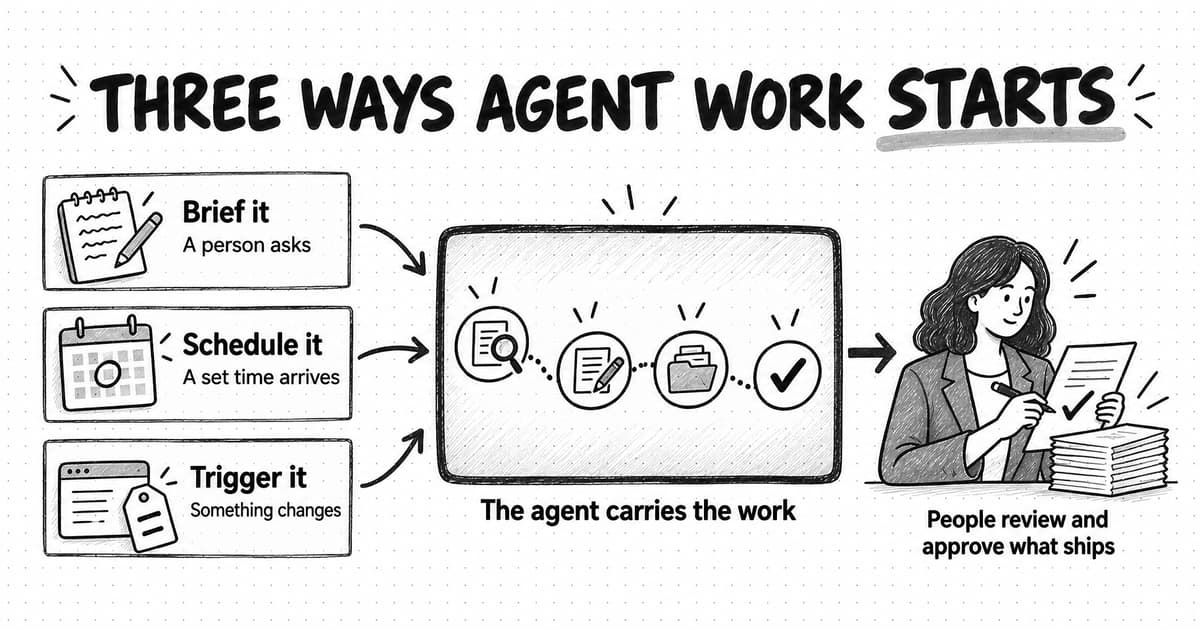
Agentic marketing is the use of AI agents to carry multi-step marketing work, such as research, content production, and reporting, from a goal to a finished result. The agent chooses its own steps within the context, tools, and permissions a team provides. Work can start from a brief, a schedule, or a detected change, while people set the direction, review the results, and approve what ships.
Summary
Agentic marketing means giving an AI agent a goal rather than a single instruction and letting it choose the steps toward a finished result, within the context, tools, and permissions a team provides. The agent takes on the gathering, drafting, packaging, and checking between decisions, while people keep the decisions themselves: what the work is for, what is good enough, and what ships.
Agentic marketing differs from marketing automation in who decides the steps, and from prompt-by-prompt use of generative AI in who carries the work between them. Rules suit routine sequences, a single prompt suits a quick output, and an agent suits a job that needs research and judgment between steps. A June 2025 Gartner release made a similar point about matching each approach to the work.
Agent work starts in one of three ways, summed up as brief it, schedule it, trigger it. A brief suits work whose value lies in one specific request, a schedule suits work whose value comes from regularity, and a trigger suits work whose value depends on speed after a change. A practical path is to brief first, schedule what you brief repeatedly, and trigger what you check by hand.
Before agents take on more work, a team needs shared brand context, approval rules enforced by the product rather than by a prompt, review habits that check sources and claims, and a way to judge results against its own work. These matter because an agent acts on whatever it is given, so an outdated product fact spreads into every output that uses it until someone corrects the source.
An agentic marketing platform combines AI agents with the system they need for marketing work: reusable brand and market context, research and production tools, ways to start work from a brief, a schedule, or a change, and review and approval controls. A general-purpose agent leaves the team to assemble and maintain that system, and a trial with one of your own jobs shows whether a product supplies it.
The main risks are confident errors, mistakes repeated at volume, excessive access, instructions hidden in the pages and files an agent reads, and costs that outgrow the value. Gartner predicted in June 2025 that over 40% of agentic AI projects will be canceled by the end of 2027 because of escalating costs, unclear business value, or inadequate risk controls. Start with one job you can judge.
Contents
- What makes marketing work agentic
- How agentic marketing differs from marketing automation and generative AI
- Brief it, schedule it, trigger it: how agentic marketing work starts
- What changes for a marketing team, and what stays with people
- What a marketing team needs in place first
- What is an agentic marketing platform?
- How agentic marketing works in Ampere
- Risks of agentic marketing, and how to start small
- Sources and further reading
- Frequently Asked Questions
Picture a competitor changing its pricing page on a Tuesday. Someone on your team has to notice, compare the new page with the old one, decide whether the change matters, update the sales battlecard, and perhaps draft a response for your own site or social channels. In a small team, that chain of work often waits until someone happens to look.
Now picture software that carries the chain for you. It checks the page on a schedule you chose, notices the change, reads both versions, compares them with your positioning notes, and returns an updated battlecard and a short draft response for review.
Agentic marketing is the use of AI agents to carry multi-step marketing work from a goal to a finished result, with the agent choosing its own steps within the context, tools, and permissions a team provides. People still decide what the work is for, judge what comes back, and approve what ships. In the pricing example, someone chose which pages were worth watching, what counts as a meaningful change, and what kind of response to prepare. Only the steps between those decisions moved to the agent.
The term turns up in vendor pitches and analyst reports with different meanings attached. This guide separates agentic marketing from marketing automation and from prompt-by-prompt use of generative AI tools, then describes the three ways agent work starts: you brief it, you schedule it, or a change triggers it. Those distinctions make it easier to choose which of your own marketing jobs to hand to an agent and which decisions to keep with your team.
What makes marketing work agentic
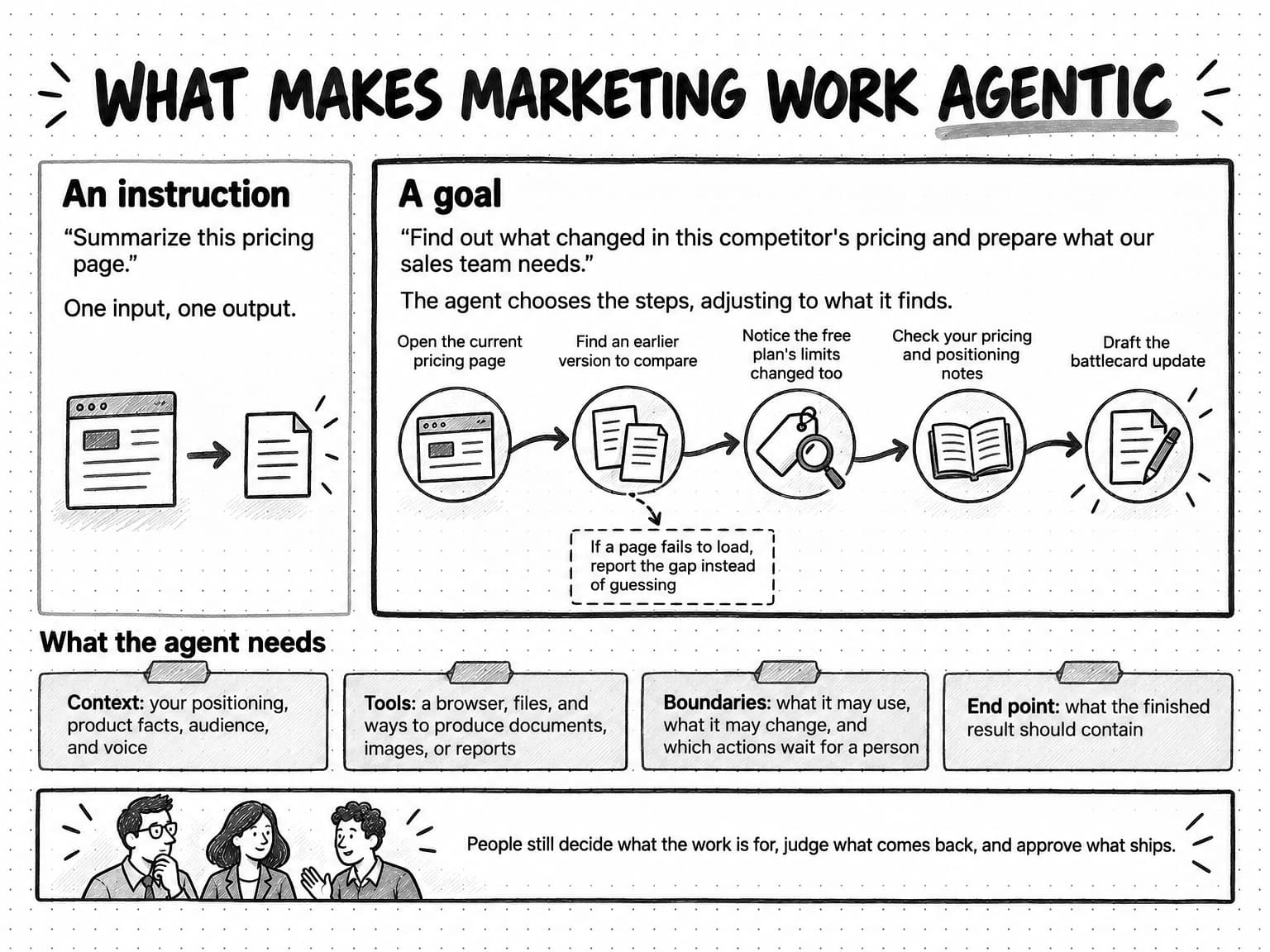
Marketing work becomes agentic when an AI system receives a goal rather than a single instruction and decides the steps toward it, adjusting as it goes. “Summarize this pricing page” is an instruction: one input, one output. “Find out what changed in this competitor's pricing and prepare what our sales team needs” is a goal, and reaching it takes steps nobody has listed in advance.
An agent working toward that goal might open the current pricing page, find an earlier version to compare it with, notice that the free plan's limits changed along with the prices, check your own pricing and positioning notes, and draft an update to the battlecard. If a page fails to load, a well-designed agent reports the gap instead of filling it with a guess. The order of those steps depends on what the agent finds along the way, and that is the practical difference between an agent and a fixed sequence.
How well that goes depends on four things. The agent needs context, such as your positioning, product facts, audience, and voice, so its work fits your company instead of marketing in general. It needs tools, such as a browser to read pages, access to files, and ways to produce documents, images, or reports. It needs boundaries: which sources it may use, what it may change, and which actions must wait for a person. And it needs a clear end point, so it knows what the finished result should contain. For the mechanics behind these parts, including how the model chooses its next action, read our guide to how AI agents work.
View the diagram of what makes marketing work agentic at full size (opens in a new tab).
Agentic marketing can also describe agents that deal with customers directly, such as a website agent that answers prospects' questions or proposes meeting times. The same principles apply there with higher stakes, because a customer-facing agent acts in public every time it runs. This guide concentrates on agents that do the marketing team's own work: the research, planning, production, and reporting that happen before anything reaches a customer.
The practice is also young. In Salesforce's State of Marketing report, a vendor survey of 4,450 marketers conducted in October and November 2025, 75% of marketing organizations used at least one form of AI, while 13% of marketers said they currently used agentic AI.
How agentic marketing differs from marketing automation and generative AI
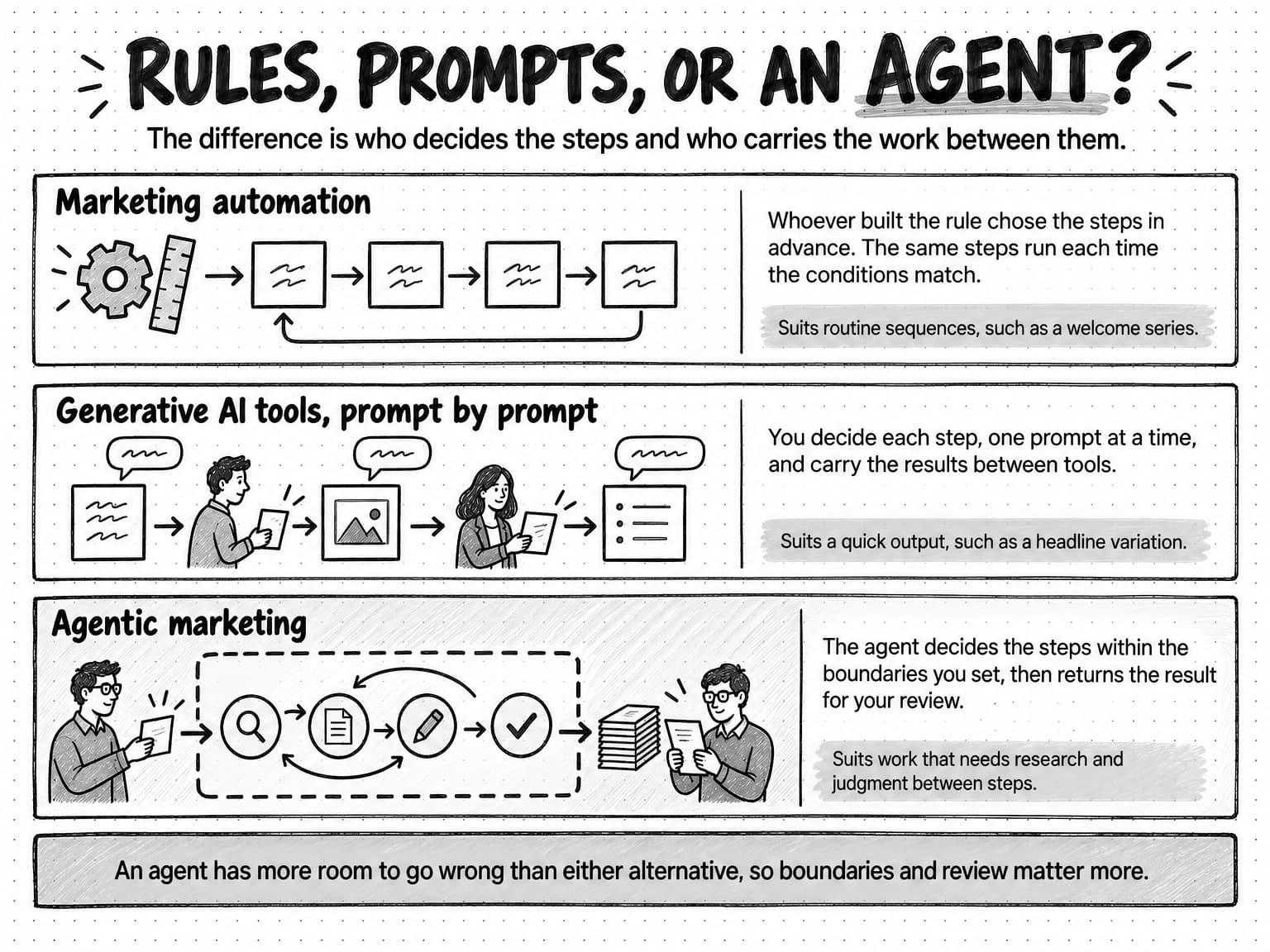
Agentic marketing differs from marketing automation in who decides the steps, and from prompt-by-prompt use of generative AI in who carries the work between steps. Marketing automation here means the rule-based systems behind email sequences, lead scoring, and lead routing, which follow steps someone designed in advance. Agent work can be automated too, since a schedule or a detected change can start it. The difference lies in what happens after the work starts.
| Question | Marketing automation | Generative AI tools, prompt by prompt | Agentic marketing |
|---|---|---|---|
| What starts the work? | A rule, such as a form fill, a list change, or a date | A person's request | A brief, a schedule, or a detected change |
| Who decides the steps? | Whoever built the rule, in advance | The person, one prompt at a time | The agent, within the boundaries it has been given |
| What comes back? | The same action each time the conditions match | One output per request, such as a draft, an image, or a summary | A finished, multi-part result, such as a researched brief with sources or a launch package |
| What do people do? | Design the rules and keep them current | Plan the work, write each prompt, and move results between tools | Set the goal and boundaries, keep the context current, and review what comes back |
| Where does it struggle? | Situations the rules did not anticipate | Jobs with many steps, sources, or files | Missing or stale context, loose permissions, and output nobody reviews |
Marketing automation is predictable by design, and that is its strength. A welcome sequence should send every new subscriber the same emails in the same order. The weakness appears when circumstances change in a way the rules never anticipated: a sequence keeps promoting a webinar after the date has moved, because nothing in the rule asks whether the message still makes sense.
Generative AI tools are flexible, but a person drives every step. You can ask for a headline, then a summary of a competitor's page, then a draft post, and each answer may be good. Between those requests, you decide what to do next, find the sources, carry results from one tool to another, and check that the pieces fit together. For a single output, that works well. For a job with a dozen steps, you end up doing most of the coordination yourself.
Agentic marketing moves that coordination to the agent. An agent usually runs on the same kind of generative model that powers those tools, but it plans the steps, gathers what it needs, produces the deliverables, and can check them against the brief before handing them back. That flexibility helps most where rules break down and step-by-step prompting becomes tedious. It also gives the agent more room to go wrong, which is why boundaries and review matter more here than in either alternative.
None of this makes an agent the right choice for every job. In a June 2025 Gartner press release, senior director analyst Anushree Verma suggested starting with agents where a decision has to be made, automation for routine workflows, and assistants for simple lookups. She also cautioned: “Many use cases positioned as agentic today don't require agentic implementations.” For a marketing team, that might mean keeping the nurture sequence in the automation platform, asking a generative AI tool for a quick headline variation, and giving an agent the jobs that need research, judgment between steps, and several connected deliverables.
View the comparison of rules, prompts, and agents at full size (opens in a new tab).
Brief it, schedule it, trigger it: how agentic marketing work starts
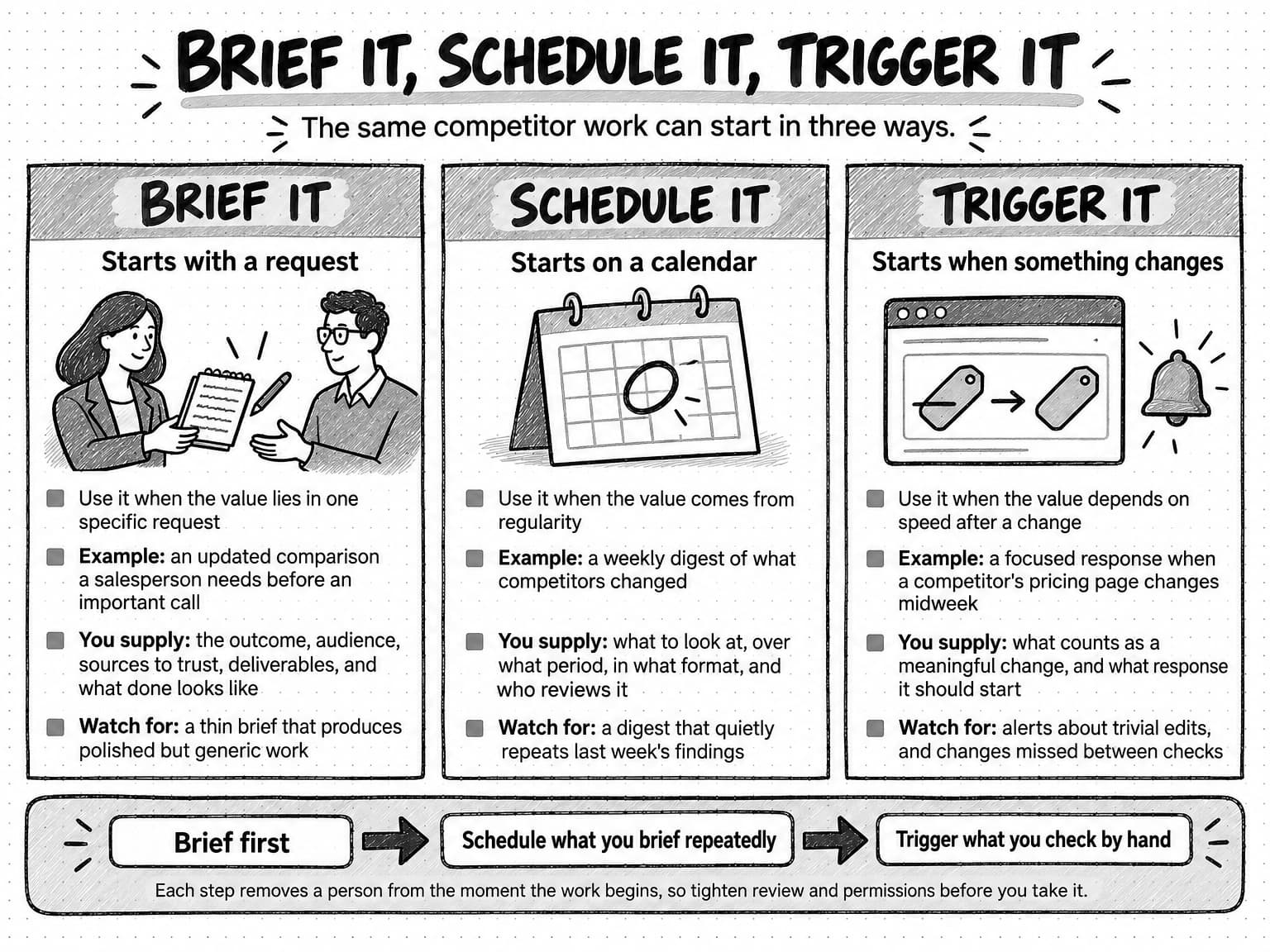
Agentic marketing work starts in one of three ways: a person briefs the agent, a schedule starts saved work, or a detected change triggers it. Each start suits different jobs and asks different things of the team, so naming them helps you see which parts of your own work could move to an agent.
The competitor work from the introduction can start in all three ways. When a salesperson asks for an updated comparison before an important call, you brief an agent to prepare it. When the team wants a standing view of the market, a weekly schedule produces a digest of what competitors changed. When a pricing page changes midweek, the change itself starts a focused response. The work is similar each time. What differs is when it starts, what the agent must know in advance, and how it can go wrong.
Brief it: work that starts with a request
Briefing is the most familiar start. A person hands the agent a goal, the context that goes with it, and a description of the finished result. It suits work whose value lies in one specific request: for example, a launch package built from this week's release notes, a teardown of a new competitor before a planning meeting, or a webinar recording turned into a blog post and a set of social posts.
What the team supplies is direction: the outcome the work should serve, the audience, the sources to trust, the deliverables, and what done looks like. A thin brief tends to produce work that is polished but generic, because the agent fills the gaps with assumptions about marketing in general. A capable agent asks when a missing fact would block the work, but it cannot ask about a preference it has no reason to suspect. Our guide to briefing an AI marketing agent covers what a strong brief includes.
Schedule it: work that starts on a calendar
A schedule starts saved work at a set time, such as every Monday morning or the first day of each month. Scheduling suits work whose value comes from regularity: a weekly digest of competitor changes, a monthly performance summary, or a weekly batch of draft social posts for review. Much of this is work a lean team means to do and drops when the week gets busy. On a schedule, it happens whether or not anyone remembers to start it.
Here the team supplies a stable definition of a useful result: what the agent should look at, over what period, in what format, and who reviews the output. Scheduled work tends to fail quietly. A digest can repeat last week's findings, rely on a source that stopped updating, or land in a folder nobody opens. Give each schedule an owner, and retire it when nobody uses the result. The guide to automating marketing with AI agents covers the settings a scheduled run needs, such as a named timezone and a bounded lookback window.
Trigger it: work that starts when something changes
A trigger starts work when something changes: a competitor edits its pricing page, a new review repeats a complaint that earlier reviews raised, or your own product release goes live. Triggers suit work whose value depends on speed after the change. A response drafted the day a competitor moves gives you more options than the same response drafted two weeks later.
The team supplies two definitions: what counts as a meaningful change, and what response it should start. Some changes deserve only an alert, while others justify a drafted response for review. Triggers fail in their own ways. Conditions that are too broad produce a stream of alerts about trivial edits. A check that runs every few hours or days sees a change only at the next check, and it can miss one that appears and disappears in between. A source that becomes unavailable can look like a quiet week. The same automation guide explains how to narrow conditions and avoid responding twice to one event.
Choosing the right start for each job
To choose a start, ask where the value of the work comes from: one specific request, regularity, or speed after a change. The answer often changes as a job matures, so a practical path runs through the three in order. Start by briefing an agent on work you already do and know how to judge. When you notice you are writing the same brief every week, turn it into scheduled work. When you catch yourself checking a page or a dashboard by hand to see whether anything moved, make that change the trigger. Each step removes a person from the moment the work begins, so tighten review and permissions before you take it, not after.
View the brief it, schedule it, trigger it framework at full size (opens in a new tab).
What changes for a marketing team, and what stays with people
Agents can take on much of the gathering, drafting, packaging, and checking that sits between marketing decisions. The decisions themselves stay with people: the goals and priorities, the judgment about what is good, the approval of what ships, and the accountability for results. The table shows how that division looks across five areas of marketing work.
| Area of work | What agents can take on | What stays with people |
|---|---|---|
| Planning | Draft plans, calendars, and briefs from goals and past results, with options and the reasoning behind them | Setting goals and priorities, choosing between options, and deciding what not to do |
| Research | Gather and summarize sources, compare competitors, collect public reviews and ads, and keep a record of what changed | Deciding which sources count, interpreting what the evidence means, and noticing when it is too thin to act on |
| Production | Draft copy, images, video, decks, and reports, adapt them for each channel, and check them against brand rules | Taste, the final word on claims, and the judgment that a piece is good enough to represent the company |
| Distribution | Package finished assets for each channel and, where a connected account and an approval allow it, carry out the approved action | Deciding what ships, where, and when, and approving any action that publishes, sends, spends, or deletes |
| Measurement | Pull results together, summarize performance against goals, flag unusual changes, and suggest tests | Defining success, deciding what the results mean, and choosing what to change |
In practice, that division changes a marketer's week in three ways.
The pieces of work you delegate get larger. Instead of asking for a headline, you hand over the launch package and review the whole set. The request matters more as a result, because a misunderstanding at the start carries through every deliverable that follows.
Review takes up more of the job. Someone has to read the sources, check the claims, and judge whether the work fits the brand, and that takes real time. When an agent produces more drafts than the team can publish, the bottleneck moves from making things to deciding which of them to use. Count review time as part of the cost of the work.
Context becomes something to maintain. An agent draws on your positioning, product facts, and voice in every run, so an outdated claim in that material spreads into every output that relies on it. Keeping it current becomes a standing job, much like maintaining a style guide.
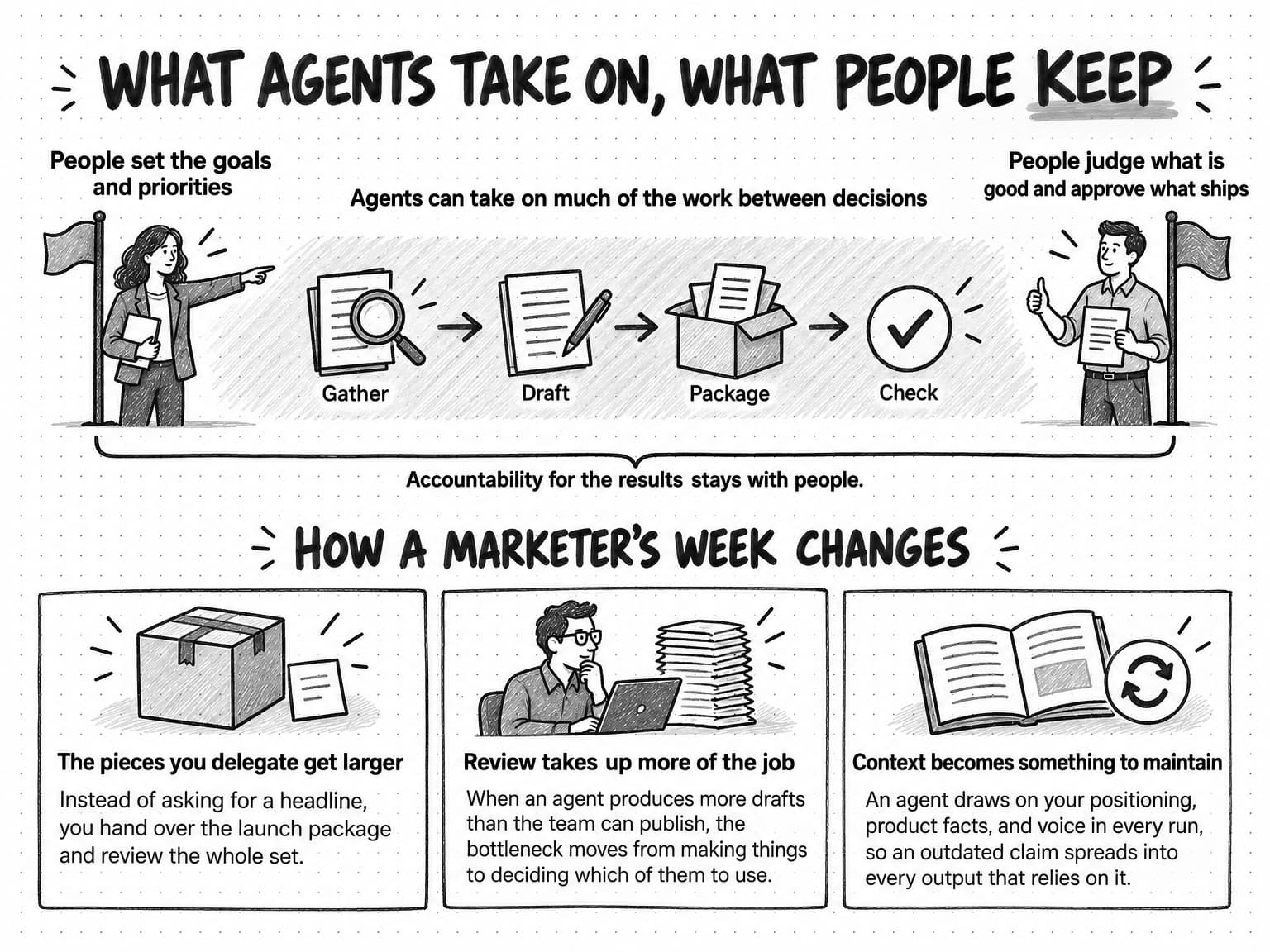
View the diagram of what agents take on and what people keep at full size (opens in a new tab).
What a marketing team needs in place first
Before agents take on more of the work, a team needs four things in place: shared brand context, approval rules, review habits, and a way to judge results. None of them is specific to AI. They are the conditions that let any delegated work come back usable, and agents expose gaps in them quickly because they act on whatever they are given. Our guide to becoming an AI-native marketing team turns them into a five-stage model with a readiness self-assessment.
Shared brand context
An agent can only follow brand guidance it can see. Write down the positioning, audience, voice, product facts, approved claims, and visual rules, and keep them in one place so the agent and every teammate work from the same version. If that material lives in one person's head or in a slide deck from two years ago, each run starts from guesswork. Our guide to brand guidelines covers what to include and how to write rules that people and AI tools can both apply.
Approval rules
Decide in advance which actions an agent may take on its own and which wait for a person. A reasonable starting rule is that research and drafts need review, while anything that publishes, sends, spends, deletes, or changes customer records needs explicit approval of the exact action. Enforce those rules through the product's permissions and approval controls, because an agent can misread or ignore an instruction in a prompt. The OWASP GenAI Security Project's guidance on excessive agency recommends requiring a person's approval before high-impact actions and checking authorization in the system that performs the action, instead of letting the model decide whether an action is allowed. Its own example is an application that creates and posts social media content for a user, which should place the approval step inside the posting function itself.
Review habits
Agree who reviews which outputs, how quickly, and what they check. A useful review opens the sources behind important claims, confirms that every promised file exists and opens, and checks the work against the brief as well as for polish. Match the effort to the stakes: an internal weekly digest can get a quick read, while a claim that will appear in front of customers deserves a source check every time. Without that habit, approval turns into a formality, and the volume agents produce makes a formality risky.
A way to judge results
Define what a good result looks like before the first run, so you can tell whether the agent is helping. Compare its work with what your team already produces for the same job, and track review time, corrections, and how much of the output you actually use, not only how much it produces. Survey figures mostly describe expectations. In the same Salesforce survey, for example, 82% of marketers who used or planned to use agents expected major or moderate improvements to marketing ROI. Your own measurements are the evidence that matters for your team, and our guide to evaluating an AI marketing agent gives a rubric and a way to run repeat trials.
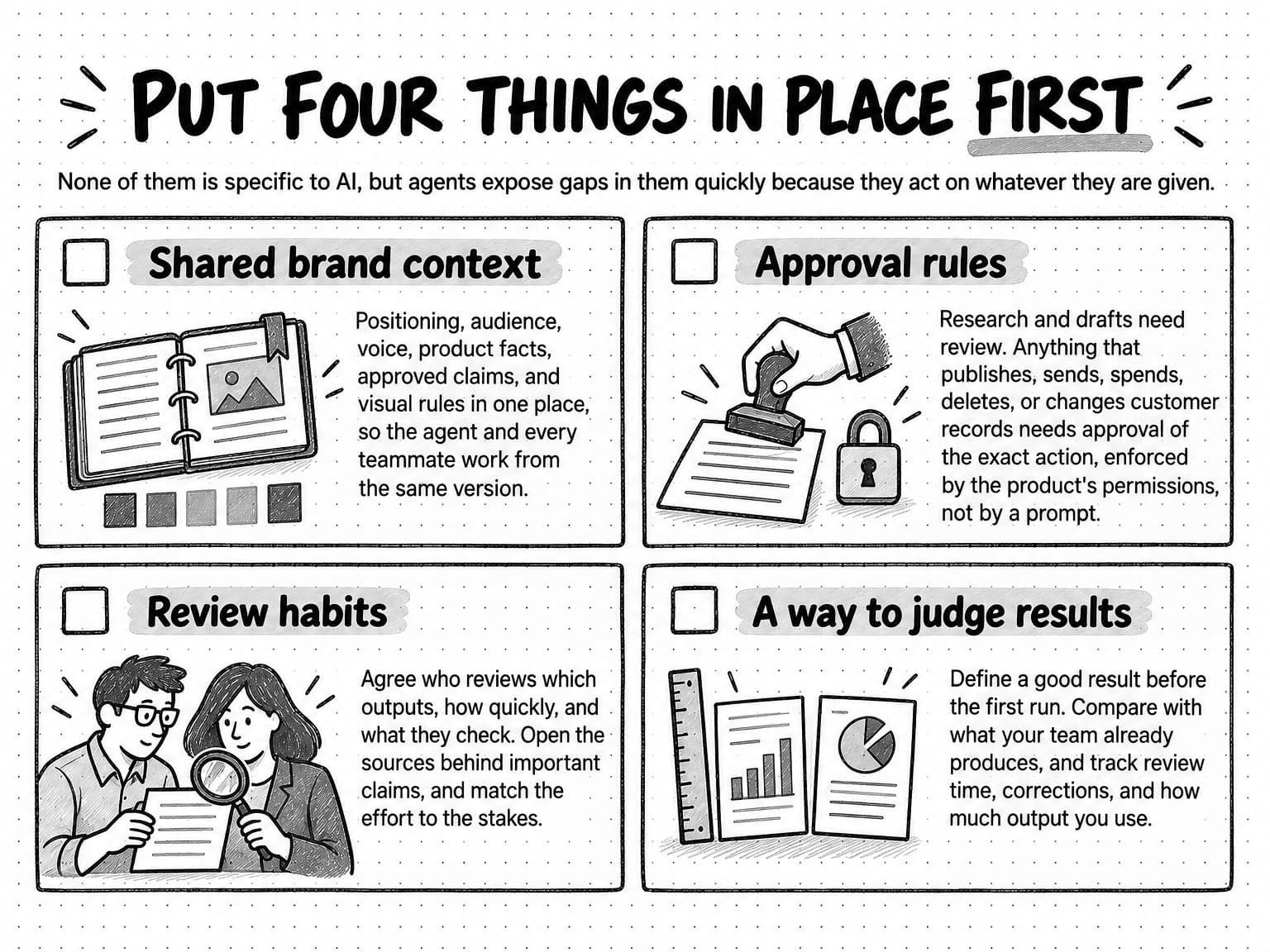
View the checklist of four things to put in place first at full size (opens in a new tab).
What is an agentic marketing platform?
An agentic marketing platform is software that gives a marketing team AI agents together with the system those agents need for marketing work: reusable brand and market context, tools for research and production, ways to start work from a brief, a schedule, or a change, and controls for review and approval. An agent on its own can complete marketing tasks; the system around it is what lets that agent do consistent work for one company over time.
Two kinds of products sit nearby. Some marketing automation platforms now include agents, built around the platform's own channels, sequences, and customer data. General-purpose AI agents are capable of real marketing work, but a team that uses one for consistent marketing has to supply and maintain the system around it: the brand context, the marketing methods, access to research and media tools, the approval rules, and shared access for teammates. An agentic marketing platform's job is to provide that system, so the team's effort goes into direction and review.
To judge a product sold as an agentic marketing platform, give it a real job from your own work and see whether it finishes the job without you directing each step, shows the sources behind the result, and reuses your saved context on the next job. Our guide to evaluating an AI marketing agent turns those checks into a repeatable trial.
How agentic marketing works in Ampere
Ampere is your AI marketing agent. It works from your saved context, uses its session workspace and 200+ AI tools & skills, and returns finished marketing work while you keep direction and approval. Work in Ampere starts in the same three ways this guide describes.
Brief it. In a session, you brief Ampere in plain English. Ampere plans the work, researches, drafts, and packages the deliverables in its session workspace, where you can open the files, sources, and previews it produced. It draws on Brand memory, the saved and reviewable knowledge about your brand, audience, market, and competitors that Ampere can reuse in later work. Ampere asks for clarification or taste direction when the answer would materially change the result, and otherwise keeps working.
Schedule it. Scheduled tasks put recurring work on a cadence, such as hourly, daily, weekly, or monthly. A scheduled task can run a saved prompt with its Project context and attachments, or an eligible AI Tool run. Each result lands back in the Project for review, run-update emails can go to the teammates you choose, and a task pauses itself after repeated failures or when credits run out. Ampere can also propose a scheduled task during a session, and nothing is saved until you accept the proposal.
Trigger it. Monitoring checks supported public sources, such as a competitor's pricing page, changelog, or review site, hourly, daily, or weekly. When a monitor finds a change, it files an alert with the available evidence and source excerpts. If you configured a follow-up action, Ampere then prepares follow-up work for your review; an alert-only monitor files the alert without starting any work. Because checks run on a cadence and depend on each source being available, Monitoring can miss or delay a change.
For the competitor example in this guide, you could point a monitor at the pricing page with a follow-up action that prepares an updated battlecard and a draft response, and run the broader weekly digest as a scheduled task. Both can start from a library of suggested scheduled tasks and monitor templates, and choosing a suggestion creates nothing until you save it.
Across all three starts, people keep direction, taste, and approval. Where Connectors are enabled, Ampere needs your approval before it acts in a connected account. Ampere produces and packages marketing work for the channels and tools you already use. It is not a social scheduler, an outbound email sender, or a general marketing automation platform, and nothing it prepares is published without you.
Risks of agentic marketing, and how to start small
The main risks of agentic marketing are confident errors, mistakes repeated at volume, agents with more access than the job needs, instructions hidden in the material an agent reads, and costs that grow faster than the value.
Confident errors come first. An agent can write fluently about a claim it never checked, and a polished draft is easy to approve without opening the source. In the Salesforce survey, AI accuracy ranked second among marketers' concerns about implementing AI, behind privacy and data security. Keep the evidence attached to every output, and check the claims that matter before anything ships.
Volume multiplies mistakes. An agent that misreads a recurring brief makes the same mistake in every run, and on a schedule it can repeat that mistake every week until someone notices. Read the first few runs of any new recurring job closely, because that is when a misunderstanding is cheapest to catch.
Access determines how much damage a mistake can do. The OWASP GenAI Security Project calls this risk excessive agency: a system built on a language model takes a damaging action after an unexpected, ambiguous, or manipulated output, because it has more functionality, permissions, or autonomy than its job requires. An agent preparing a competitor digest needs to read public pages, not post to your company's social accounts. Grant each job the minimum access it needs, and keep approval in front of anything that acts outside the product.
Hidden instructions are a newer risk. A web page or document can contain text written to redirect an agent that reads it, which OWASP's 2025 list of risks for language-model applications describes as indirect prompt injection. That list said it was unclear whether prompt injection could be fully prevented, and OWASP's 2026 edition says no reliable prevention mechanism exists today, so the mitigations focus on limiting the damage, including least-privilege access, separating untrusted content, and human approval for high-risk actions. For a marketing team, that means treating research sources as evidence, never as instructions.
Cost and unclear value can end the effort altogether. Gartner predicted in its June 2025 release that over 40% of agentic AI projects will be canceled by the end of 2027 because of escalating costs, unclear business value, or inadequate risk controls. An agent that runs often and returns little that anyone uses costs more than it returns, so weigh each recurring job's value against its usage cost and the time it takes to review.
A five-step way to start
Starting small keeps each of those risks contained while your team learns what the agent does well.
- Choose one job you already know how to judge, such as a recurring competitor summary or a monthly report, so you can compare the agent's result with what your team would have produced.
- Run it as a brief a few times and review the work closely. When something is wrong, fix the context and the brief rather than only correcting the output.
- Keep the first version to research and drafts, and leave publishing, sending, and spending out of scope until the results earn trust.
- Move the job to a schedule once its results are consistently usable, and add a trigger only for changes that deserve a response.
- Track review time and corrections alongside output, and widen the scope only when that evidence supports it.
When a job is ready to run without someone starting it, the ten-step production checklist in the automation guide covers what remains, including duplicate protection and cost limits.
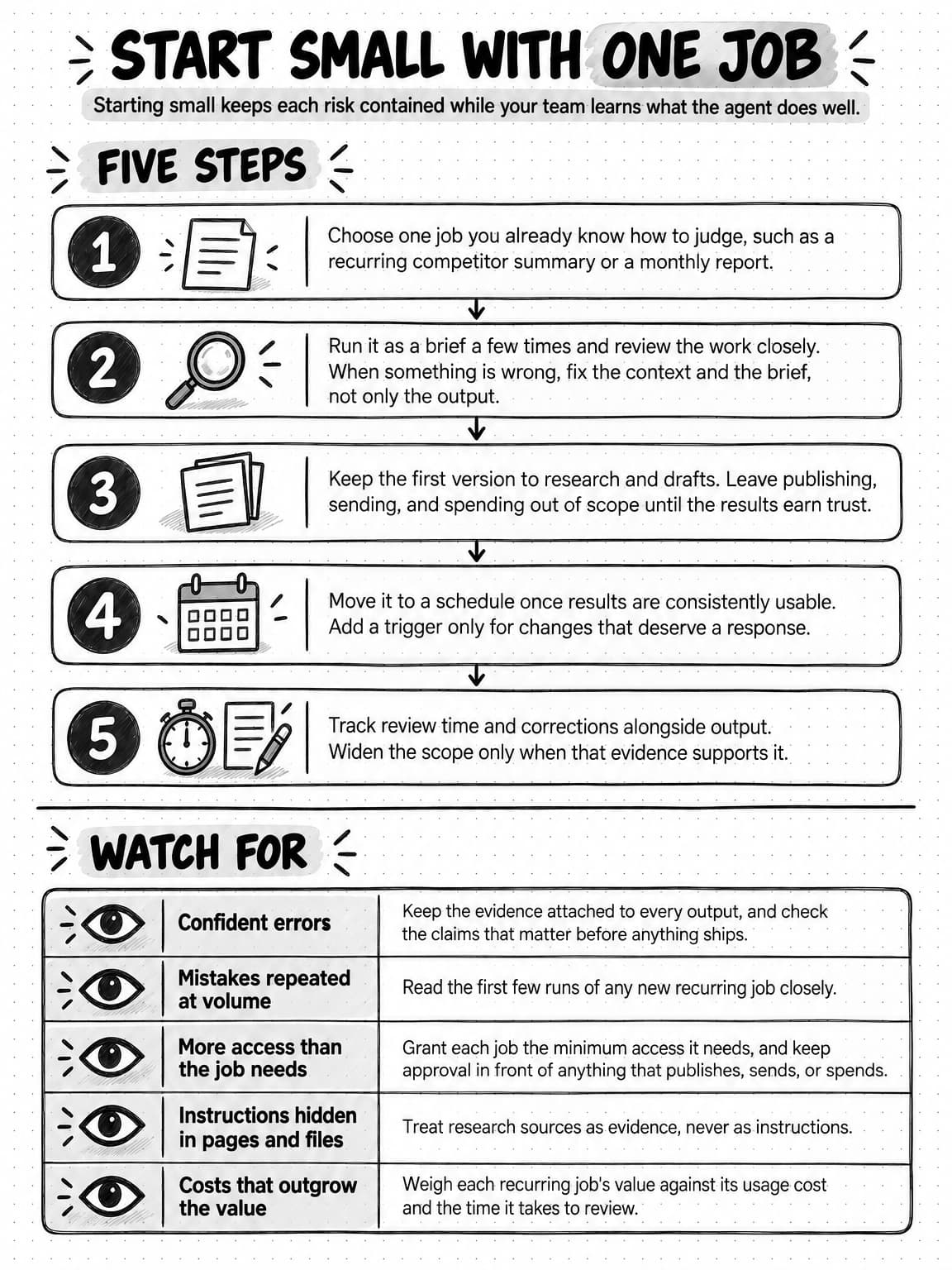
View the reference for starting small with one job at full size (opens in a new tab).
Sources and further reading
- Gartner, “Gartner Predicts Over 40% of Agentic AI Projects Will Be Canceled by End of 2027”, press release, June 25, 2025.
- Salesforce, State of Marketing, Tenth Edition, a vendor survey of 4,450 marketing professionals conducted October 8 to November 17, 2025.
- OWASP GenAI Security Project, LLM06:2025 Excessive Agency, part of the Top 10 for LLM Applications 2025. The 2026 edition renumbers it LLM03:2026.
- OWASP GenAI Security Project, LLM01:2025 Prompt Injection, part of the Top 10 for LLM Applications 2025. It stays LLM01 in the 2026 edition, which says no reliable prevention mechanism exists today.
- Steve Muylle, “What is agentic marketing?”, Vlerick Business School, April 18, 2025.
Frequently Asked Questions
What is the difference between agentic marketing and marketing automation?
Agentic marketing and marketing automation differ in who decides the steps. Marketing automation follows rules and sequences someone designed in advance, such as sending the second email in a welcome series three days after the first. Agentic marketing gives an AI agent a goal and lets it choose the steps toward that goal within set boundaries. Both can start on a schedule or after an event; the difference lies in what happens once the work starts.
What is agentic AI in simple terms?
Agentic AI is AI that pursues a goal through a series of actions it chooses itself, adjusting each step to what it finds, instead of producing one answer to one instruction. In marketing, that might mean reading a competitor's new pricing, comparing it with your positioning, and drafting a battlecard update. How much it may do without a person depends on the tools, permissions, and approval rules it has been given.
What technologies power agentic marketing systems?
Agentic marketing systems usually combine a generative AI model that chooses each next step with tools such as a browser, file access, and ways to produce documents, images, and reports. The system around them adds saved context about the brand, audience, and market; ways to start work from a brief, a schedule, or a detected change; and permission and approval controls that decide what the agent may do without a person.
What are examples of agentic marketing?
Examples of agentic marketing include an agent that turns release notes into a launch package of a blog post, social posts, and an email for review; a scheduled weekly digest of what competitors changed; and a drafted response that starts when a competitor's pricing page changes. Each starts in a different way: from a brief, on a schedule, or after a detected change. People still review each result and decide what ships.
What is an agentic marketing platform?
An agentic marketing platform is software that combines AI agents with the system they need for marketing work: reusable brand and market context, tools for research and production, ways to start work from a brief, a schedule, or a change, and controls for review and approval. It differs from a marketing automation platform built around rules, and from a general-purpose agent whose marketing context, tools, and approvals a team must assemble and maintain itself.
Which marketing tasks are best suited for agentic AI?
The marketing tasks best suited for agentic AI need several steps, some judgment between them, and a result a person can review, such as competitor research, launch packages, recurring reports, and responses to market changes. Routine sequences that should run the same way every time belong in marketing automation, and a quick one-off output such as a headline variation is often easier with a single prompt. Begin with work your team already knows how to judge.
How does agentic marketing affect human oversight and brand control?
Agentic marketing moves human oversight from directing each step to setting goals and boundaries and reviewing results. People keep the goals, the judgment about quality, approval of anything that publishes, sends, spends, or deletes, and accountability for outcomes. Brand control depends on shared, current brand context that every run uses, approval rules enforced by the product rather than by a prompt, and review that checks sources and claims, not only polish.
What are the benefits and risks of using agentic marketing?
The main benefit of agentic marketing is that agents take on the gathering, drafting, and packaging between decisions, so recurring work happens without someone remembering it and responses to market changes can start sooner. The main risks are confident errors, mistakes repeated at volume, agents with more access than a job needs, instructions hidden in pages or files an agent reads, and costs that outgrow the value. Starting small, limiting access, and reading early runs closely keep those risks contained.
How can a business start implementing agentic marketing?
A business can start implementing agentic marketing with one job it already knows how to judge, such as a recurring competitor summary or a monthly report. Run it as a brief a few times, fix the context and the brief rather than only the output, and keep the first version to research and drafts. Move it to a schedule once the results are consistently usable, add triggers only for changes worth a response, and track review time and corrections.
What ROI can businesses expect from agentic AI in marketing?
The return from agentic AI in marketing depends on the job and the team, so measure it on your own work. Published figures point in different directions: in a late-2025 Salesforce survey, 82% of marketers who used or planned to use agents expected major or moderate ROI improvements, while Gartner predicted in June 2025 that over 40% of agentic AI projects will be canceled by the end of 2027, partly over unclear business value. Track review time, corrections, and output actually used.


