How to conduct a competitor analysis: A practical guide and worked example
A decision-led method for choosing the right competitors, comparing credible evidence, and turning what you find into positioning, messaging, content, and campaign actions.
21 min readWritten by Ampere
Contents
- What a marketing competitor analysis should do
- 1. Define the question and boundaries before opening tabs
- 2. Choose competitors from the customer's point of view
- 3. Choose criteria that can change the decision
- 4. Gather and label the evidence
- 5. Build the comparison using the same standard for everyone
- 6. Move from observations to interpretations, then challenge them
- 7. Turn the analysis into decisions and validation work
- A concise one-page competitor analysis
- Use AI to speed up research while keeping verification manual
- Update the analysis when the decision could change
A competitor spreadsheet can be full and still be useless. You may know that one company has six pricing tiers, another publishes three times a week, and a third puts “easy to use” in its headline. None of that tells you whether to change your positioning, rewrite a campaign, enter a segment, or leave your plan alone.
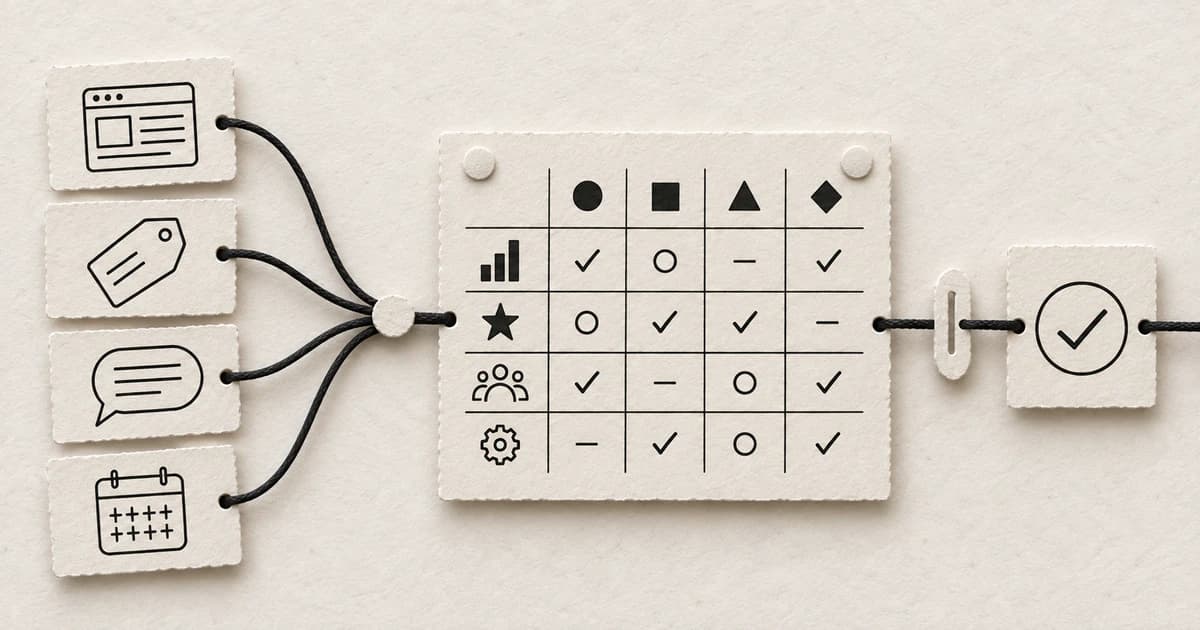
A practical competitor analysis begins with the decision it needs to inform. That decision determines which alternatives belong in the analysis, what evidence to collect, and how deep the research needs to go. The finished work should distill that research into a small number of defensible recommendations.
This guide follows a fictional business through the process. You will see how it frames its question, chooses a comparison set, records evidence, builds a compact matrix, handles uncertainty, and turns one observation into a testable marketing decision. You can use the same method for positioning, messaging, content, campaigns, or a focused go-to-market question.
What a marketing competitor analysis should do
A competitor analysis is a structured comparison of the alternatives a customer could choose, made for a particular business decision. In a marketing analysis, the useful questions usually concern who each alternative is for, what it promises, how it earns trust, how the offer is packaged, what experience it creates, and where it reaches people.
That scope is narrower than an investor's market model, a product team's technical benchmark, or a finance team's unit-economics review. Use the marketing analysis to spot questions for those deeper investigations. Decisions involving an acquisition, a regulated claim, a large capital commitment, technical architecture, or market-share estimates need the relevant financial, legal, product, or technical expertise.
This guide teaches the repeatable decision process. For an example of a much deeper, channel-by-channel public marketing study, read our Clay marketing teardown. If the analysis is feeding a brand decision, our guide to keeping AI-generated marketing consistent with the brand explains why competitor conventions are only one part of the context.
The distinction from competitive intelligence is mainly cadence. A competitor analysis is a bounded project made to answer a question now. Competitive intelligence is the ongoing practice of noticing material changes, preserving evidence, and updating the team's view over time. For a small team, a sound one-off analysis and a short watchlist usually provide enough coverage.
The U.S. Small Business Administration's market-research guidance makes a useful pairing: market research helps a business understand customers, while competitive analysis helps it understand the alternatives serving those customers. Neither can establish the other on its own.
Meet the worked example
Juniper Follow-Up is a fictional software business for independent nutritionists. It helps practitioners send visit summaries, assign next steps, and remember when to check in with clients. The two-person team is preparing a new homepage and a small paid campaign.
The founders disagree about the lead message. One wants “save hours on client follow-up.” The other wants “help more clients follow through between visits.” They could collect every feature and headline in the category, but their actual decision is smaller:
For independent nutritionists with 20–80 active clients, should Juniper lead with saving follow-up time or improving client follow-through, and what proof should the homepage use?
This question names the audience, the two candidate promises, the surface being changed, and the decision the research must support. It also exposes a likely evidence gap. Competitor pages reveal how companies market the problem; customer research and Juniper's own product evidence are needed to learn which promise is credible and motivating for this audience.
1. Define the question and boundaries before opening tabs
Begin by writing one sentence in this form:
We are deciding [decision] for [audience and market], so we need to understand [specific competitive question] within [time, geography, offer, or channel boundaries].
For Juniper, that becomes:
We are deciding the lead promise for a US homepage and paid-social test aimed at independent nutritionists with 20–80 active clients, so we need to understand how credible alternatives describe follow-up work, what they charge comparable customers, and what proof they use, as observed during September 2026.
That sentence prevents three common forms of drift:
- Audience drift: comparing enterprise clinic software with a solo-practitioner tool as though both buyers have the same needs.
- market drift: mixing US self-serve prices with negotiated international contracts.
- decision drift: collecting product details that cannot change the homepage or campaign choice.
Write down what is outside scope too. Juniper excludes clinical outcomes, privacy compliance, enterprise procurement, and the quality of each product's recommendation logic because each requires different evidence and expertise.
You can now define “done.” Juniper will stop when it has a sourced comparison of three credible commercial alternatives, the main customer workaround, its own offer, and enough customer evidence to choose a message test. The standard is traceable evidence that can support that test.
2. Choose competitors from the customer's point of view
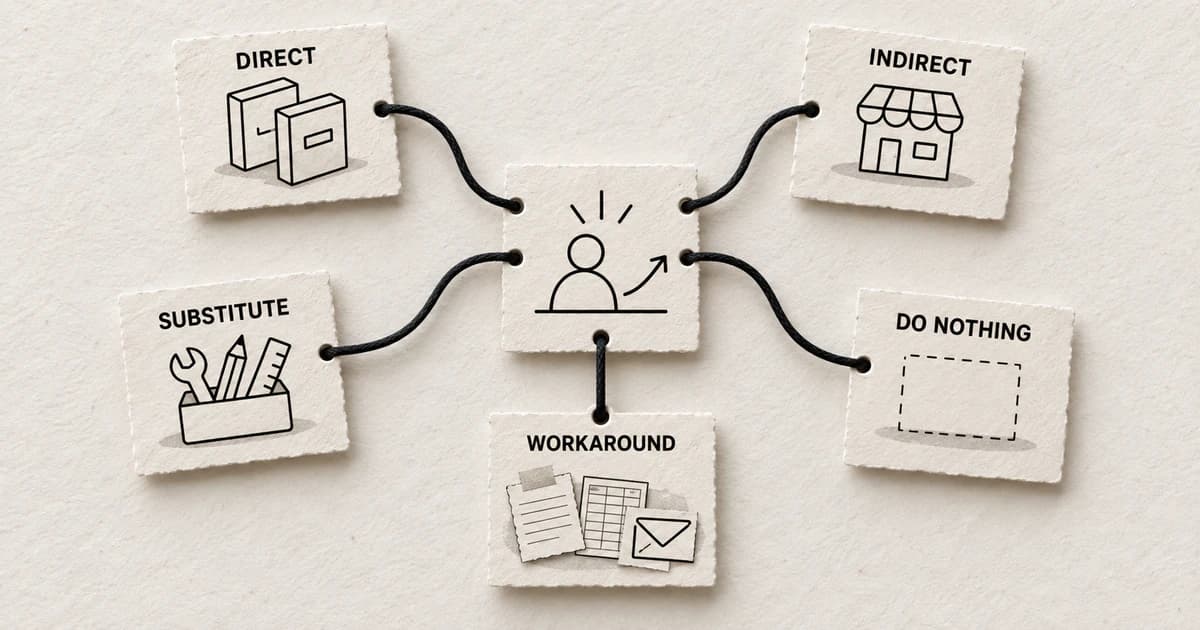
The businesses that look most like yours may miss several alternatives customers seriously consider. Start with the progress the customer is trying to make, then map the ways they can pursue it.
- Direct competitors serve a similar customer with a similar type of offer.
- Indirect competitors address the same broader problem with a different offer or operating model.
- Substitutes let the customer make similar progress without buying the same category of product.
- The current workaround is what the customer assembles today: a spreadsheet, shared inbox, agency, calendar reminder, or manual process.
- Doing nothing is a real alternative when the cost, risk, or effort of change feels greater than the problem.
Juniper's initial longlist contains nine products. The team cuts it to a comparison set that represents distinct customer choices:
| Alternative | Type | Why it belongs |
|---|---|---|
| PracticePilot | Direct | Fictional all-in-one practice software sold to the same independent nutritionists |
| NudgeNote | Direct | Fictional lightweight follow-up tool with a similar self-serve buying motion |
| ClinicFlow | Indirect | Fictional clinic platform that could attract growing practices, but is built for multi-practitioner operations |
| Forms + spreadsheet + email | Substitute and current workaround | The process customers repeatedly described in Juniper's fictional discovery notes |
| Do nothing / rely on memory | Inaction | Costs nothing to adopt and may feel adequate when the follow-up problem is not urgent |
Five rows are enough because each earns its place. Adding four more nearly identical practice suites would increase collection work without adding a new customer choice.
Business competitors and search competitors are different lists
A business competitor can win the same customer or budget. A search competitor ranks for a query you want to reach, and an attention competitor occupies time in the same feed, newsletter, event, or community. The lists can overlap, but each answers a different research question.
For example, a publisher's article about “client follow-up email templates” might outrank Juniper. It competes for search attention, while a nutritionist is unlikely to buy the publisher instead of Juniper. Use the article in a search-content analysis; reserve the pricing or product-positioning matrix for alternatives a customer might buy.
This separation also prevents a common SEO error: treating high search visibility as market share. Search results reveal who is visible for a query in a particular location and moment. Revenue, renewals, and customer preference require separate evidence. Google's guidance for search and generative AI emphasizes useful, original, people-first content. Treat the current results as research inputs and use them to produce a better answer. See Google's people-first content guidance and guidance for AI features in Search.
Where to find candidates
Use several routes because each carries a different bias:
- Ask recent buyers what else they considered and what they used before buying.
- Review lost-deal notes, sales calls, support conversations, and community discussions.
- Search category, problem, use-case, and “alternative to” queries.
- Inspect review-site category neighbors, directories, app marketplaces, and integration pages.
- Include companies customers recommend, even when their search visibility is weak.
Record why every selected competitor belongs. “They are well known” says little about relevance; “three of our last eight qualified prospects evaluated them for the same use case” ties the choice to customer behavior.
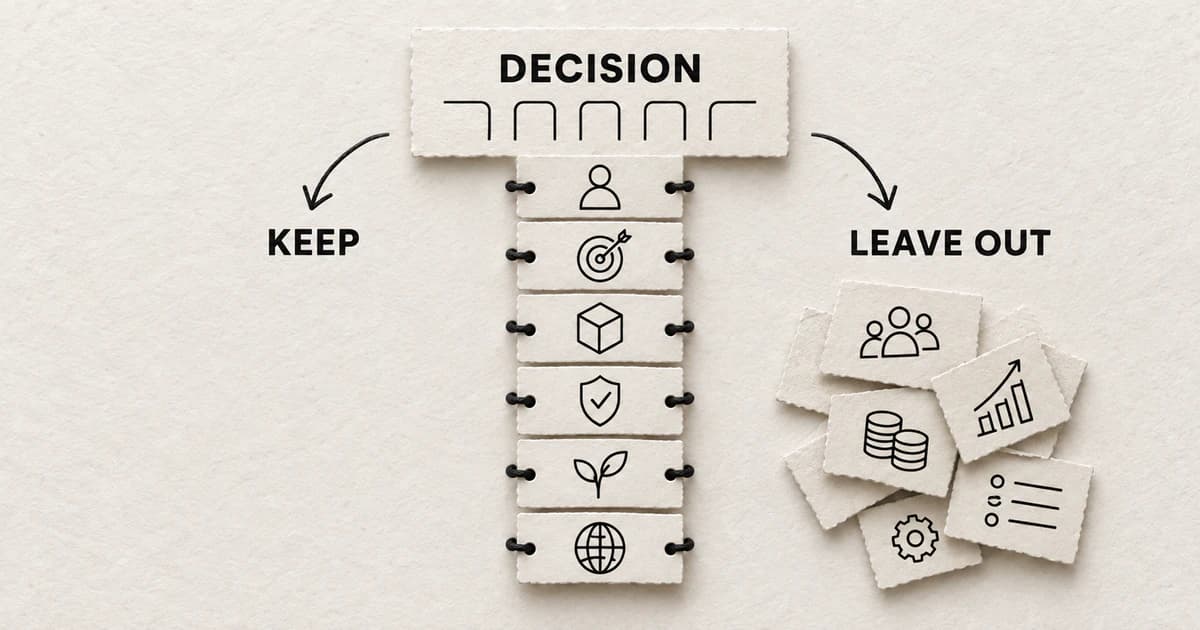
3. Choose criteria that can change the decision
The question should determine the columns. A positioning decision needs a different comparison from a pricing redesign or content plan.
For Juniper's homepage decision, the team chooses six criteria:
- Primary customer and use case. A promise only matters if it is made to the same person in a comparable situation.
- Lead promise. The homepage message shows how the company frames the customer's problem.
- Comparable entry offer. Price and packaging reveal the commitment expected from the target buyer.
- Proof. Case studies, demonstrations, quantified claims, named customers, and customer reports affect how believable the promise is.
- First-use experience. A free trial, required demo, template, or migration step changes how the marketing claim is experienced.
- Content and distribution. Search pages, newsletters, webinars, ads, communities, and partnerships show where the company is trying to earn attention. This criterion belongs because Juniper is also choosing a launch channel.
The team leaves out integrations, staff count, funding, mobile features, and social follower totals. Juniper's homepage decision does not depend on them.
Avoid arbitrary scores such as “messaging: 8.4/10.” A decimal suggests agreement and measurement that do not exist. Record the observation and the tradeoff instead. If a criterion needs a threshold, define it in advance: for example, “self-serve signup available without speaking to sales.”
4. Gather and label the evidence
Use public, legitimately accessible information. Product pages, pricing pages, documentation, public demos, announcements, company-published case studies, ad libraries, customer reviews, and transparent third-party research can all contribute. Their evidentiary weight varies.
| Evidence type | What it can support | What it cannot establish by itself |
|---|---|---|
| Observable first-party fact | A price displayed, plan name, page flow, published feature, or exact wording on a date | Adoption, customer satisfaction, performance, or an unmentioned capability's absence |
| Company claim | How the company positions a benefit or reports a result | Independent proof that the benefit or result is typical |
| Customer report | One person's described experience and language | The experience of the whole customer base |
| Third-party estimate | A modeled direction or benchmark under the provider's method | The competitor's internal traffic, spend, revenue, or conversion result |
| Analyst interpretation | A reasoned explanation connecting several observations | A fact that can be cited as though the company or customers said it |
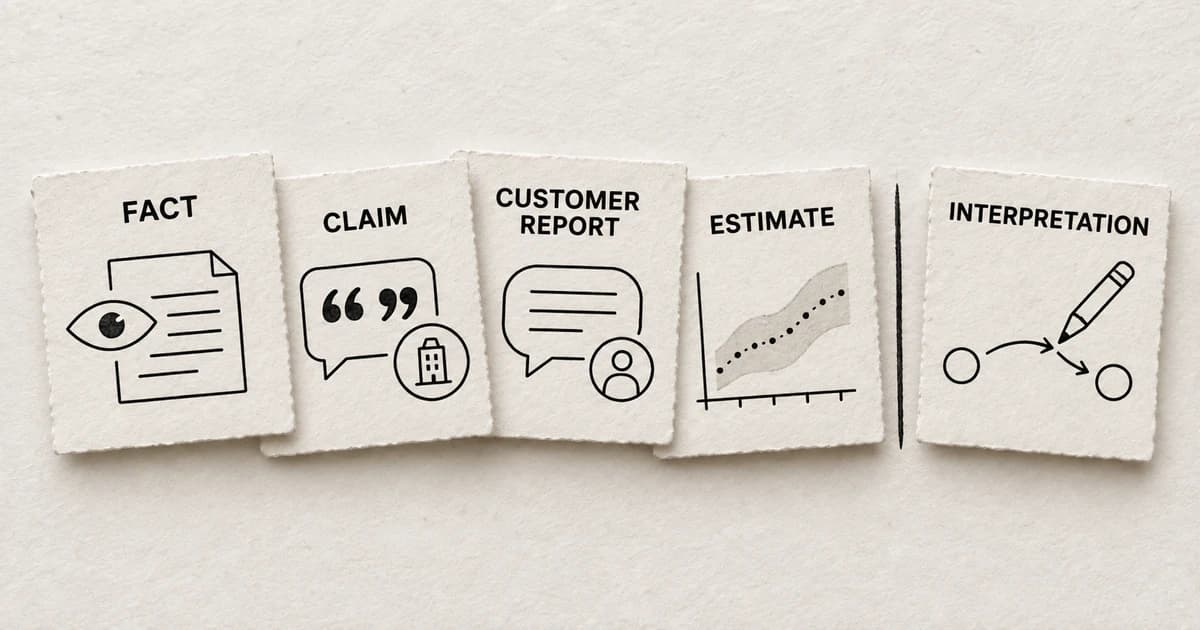
Keep these labels in your notes. “PracticePilot says it saves five hours per week” and “PracticePilot saves five hours per week” are different statements. The first is an observable claim. The second adopts the claim as fact.
Customer reviews need similar care. Reviews may be old, selective, solicited, incentivized, written by an unrepresentative segment, or shaped by the review platform itself. The US Federal Trade Commission's guidance on reviews and endorsements explains why material connections and manipulated review practices matter. Use recurring review language to develop questions for further research. A few memorable comments cannot represent the whole customer base.
Treat estimated traffic, keyword, and ad-spend figures as estimates. Similarweb says it estimates keyword traffic from its contributory network using machine learning; Semrush says its Traffic Analytics numbers are estimates derived from clickstream and other sources rather than a site's internal analytics. Read the provider's method before using the number, keep comparisons within compatible markets and periods, and avoid converting a modeled visit count into a business result. See Similarweb's methodology FAQ and Semrush's explanation of traffic estimates.
Ad libraries show which creative was available to run. Meta's library lets researchers find ads by status, while Google's Ads Transparency Center lets people search advertisers and ads shown over a period. The advertiser's objective, audience economics, conversion rate, profitability, and reason for keeping an ad active remain unknown. See Meta's public Ad Library and Google's ad-transparency description.
Compare prices on compatible terms
Pricing is especially easy to misstate. Capture the plan, billing period, included users or usage, currency, taxes if shown, introductory discounts, required contract, and date checked. Base the comparison on the plan a similar customer would reasonably buy and preserve its actual scope.
In the fictional example, NudgeNote's $24 monthly plan and PracticePilot's $59 monthly plan cover different scopes. Juniper records what each target customer would need and keeps the extra functions visible alongside the two prices.
Preserve an evidence log, then write a readable summary
Keep sources, dates, and uncertainty in the evidence log. Use the final matrix and one-page readout for the decisions. This separation keeps the conclusion readable and the supporting research traceable.
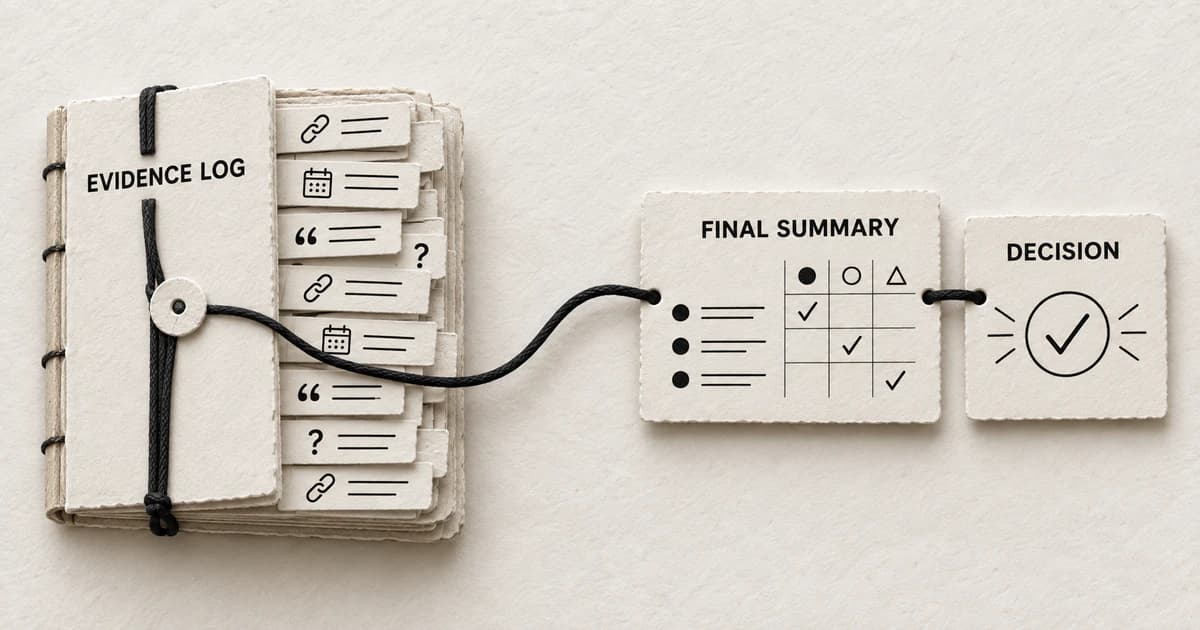
Copy this template into a spreadsheet, document, or database. Give each meaningful observation its own row; one competitor will usually occupy several rows.
| Competitor | Comparison criterion | Observation | Source | Date checked | Interpretation | Remaining uncertainty |
|---|---|---|---|---|---|---|
| [Name or alternative] | [Criterion tied to the decision] | [Exact fact, claim, report, or estimate] | [Page title and URL, interview note, or dataset] | [YYYY-MM-DD] | [What it may mean] | [What this evidence cannot answer] |
| [Example: NudgeNote — fictional] | Lead promise | Homepage says “Stay consistent between visits” | Fictional homepage capture | 2026-09-17 | Frames the value around continuity rather than administrative speed | We do not know which message converts or whether customers repeat this language |
Save page titles and direct URLs. For changeable pages, keep a dated capture when permitted. Quote only the words you need, and preserve the context around them. Do not impersonate a buyer, seek confidential material, bypass access controls, misrepresent your identity, or copy a competitor's creative work.
5. Build the comparison using the same standard for everyone
Juniper now summarizes the evidence relevant to its decision. Every commercial alternative, the workaround, and Juniper itself gets the same questions. Unavailable fields remain marked as unknown.
| Alternative | Customer and use case | Lead promise | Comparable offer | Proof observed | First-use and reach |
|---|---|---|---|---|---|
| Juniper Follow-Up | Independent nutritionists; summaries, next steps, check-ins | Save time and help clients follow through; no clear priority | $29/month, self-serve | Two founder testimonials; no quantified outcome evidence | Guided trial; founder newsletter and small paid-social test planned |
| PracticePilot | Independent practitioners wanting an all-in-one practice system | “Run your practice in one place” | $59/month for the comparable fictional plan | Named case studies and a company-reported time-saving claim | Demo plus assisted setup; webinars and partner referrals |
| NudgeNote | Solo practitioners wanting lightweight between-visit follow-up | “Stay consistent between visits” | $24/month, self-serve | Public demo and six recent fictional reviews mentioning reminders; no independent outcome study | Template-led trial; search guides and creator partnerships |
| ClinicFlow | Multi-practitioner clinics managing operations | “Standardize every client handoff” | $129/month minimum, annual billing | Clinic logos and company-published case studies | Sales-led onboarding; industry events and associations |
| Forms + spreadsheet + email | Practitioners assembling their own process | No marketed promise; familiar and flexible | Existing tools, plus manual time | The process is directly observable in fictional interviews | No migration; templates found through peers and search |
| Do nothing / rely on memory | Practitioners who do not view follow-up as urgent | Avoid a new system and new habit | No new software cost | No claim; choice inferred from fictional interview behavior | Immediate, but fragile as client volume grows |
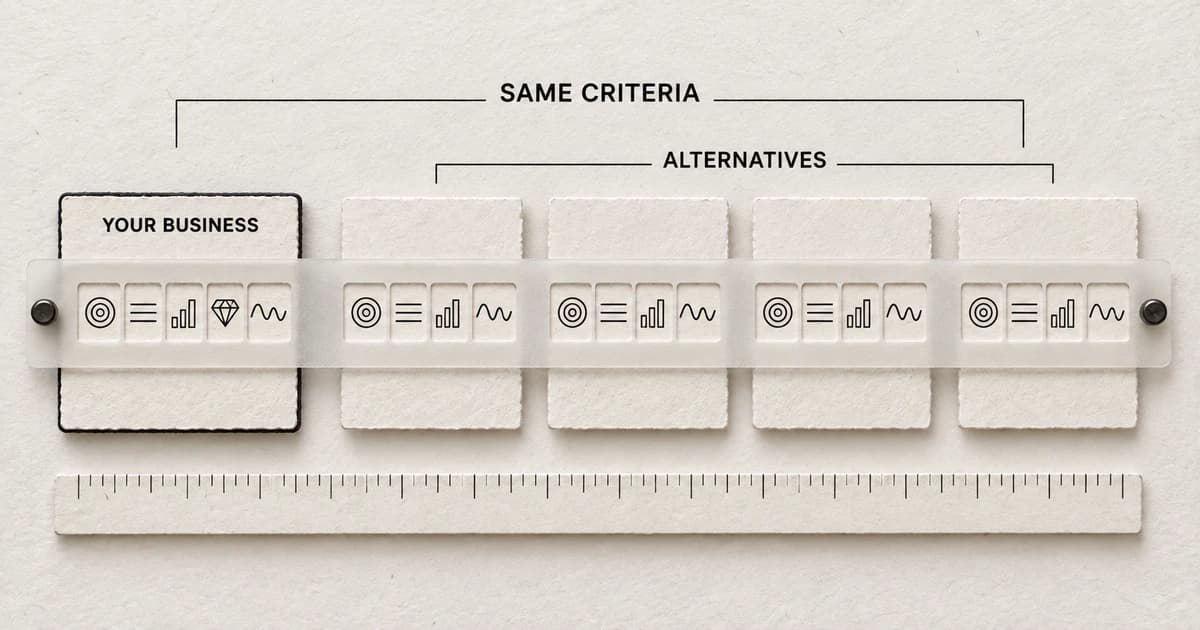
The table is compact because the evidence log holds the detail. The criteria also make the tradeoffs visible:
- Broad suites can show more proof and operational breadth, but ask for more money and change.
- The lightweight direct competitor owns a clearer continuity message, but public evidence does not establish better client outcomes.
- The workaround is flexible and already understood. Juniper must beat its switching cost as well as another product's feature list.
- Juniper's own message is the least disciplined row. Applying the same standard to itself reveals the problem the analysis needs to solve.
A fair comparison needs the same level of detail for Juniper and every alternative.
6. Move from observations to interpretations, then challenge them
Read the matrix across rows as well as down competitors. Look for patterns, meaningful differences, tradeoffs, and unanswered questions.
For Juniper, three patterns emerge:
- Every commercial alternative promises some form of easier administration, even when it is not the headline.
- NudgeNote is the only direct alternative in the fictional set leading with continuity between visits.
- The workaround remains credible because it uses familiar tools and appears cheap, although the manual effort is not measured.
Together, those patterns focus the next round of research on message relevance and proof. A missing public claim leaves several explanations open: the competitor may describe the capability elsewhere, reserve it for sales conversations, or simply choose another message for the homepage.
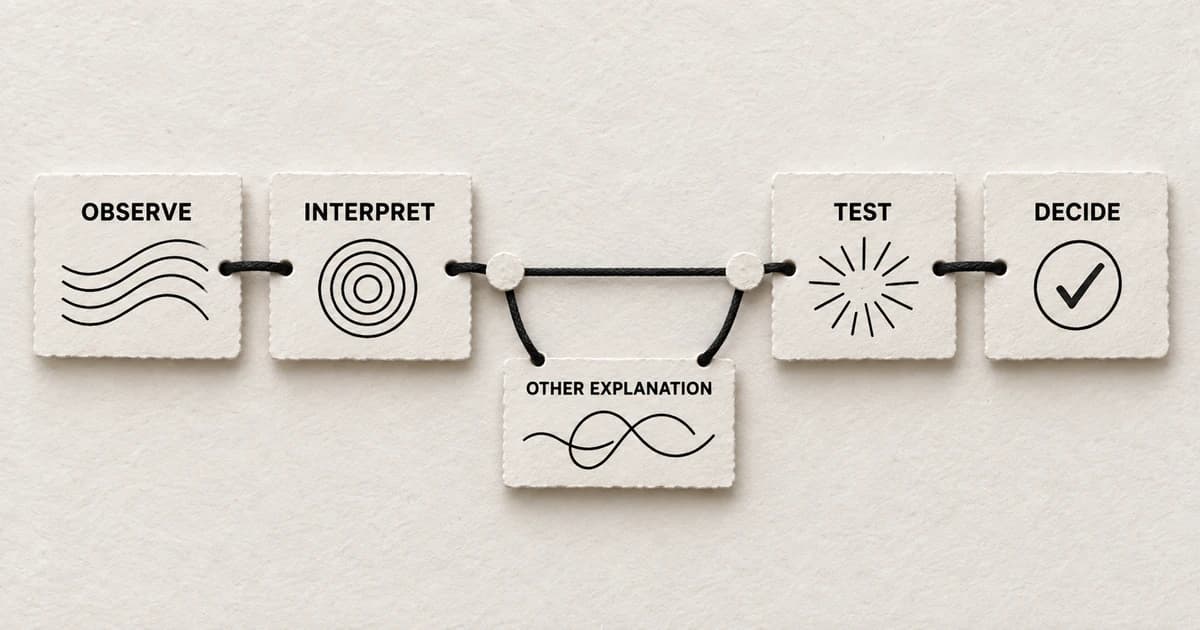
An evidence-to-decision walkthrough
Here is one complete chain from Juniper's fictional analysis.
What was observed: PracticePilot leads with an all-in-one promise. NudgeNote leads with consistency between visits. Neither fictional homepage leads with client follow-through as an outcome. Four of eight fictional interview notes describe chasing clients or losing track of agreed actions, while only two spontaneously complain about time spent writing follow-ups.
What it might mean: Independent nutritionists may find the client-behavior problem more urgent or distinctive than generic time savings. Juniper may have room to lead with follow-through while supporting the promise with a simpler workflow.
What else could explain it: The interview sample may overrepresent practitioners already worried about engagement. Competitors may have tested the outcome message and rejected it. They may avoid it because clinical-outcome language creates a proof or compliance burden. Customers may say follow-through matters but buy primarily to save time.
What Juniper should do or test: Treat the unmet need as a hypothesis. Start with message interviews using two otherwise identical homepage concepts: one centered on faster follow-up, the other on making next steps easier to act on. Ask qualified practitioners to explain what they think each promise means, which feels more relevant, and what proof they would require. Then run a bounded landing-page campaign using the clearer concepts and measure qualified trial starts rather than clicks alone.
What would support or challenge the decision: Support would include the follow-through concept being understood without explanation, repeated customer language that matches it, stronger qualified-trial intent, and product evidence showing practitioners can actually create and track next steps. A challenge would be confusion about responsibility for client behavior, demand for clinical proof Juniper cannot supply, or a time-saving concept producing better qualified response.
The proposed action is proportionate to the evidence. Juniper will treat follow-through as a message hypothesis until the interviews and campaign provide stronger support.
7. Turn the analysis into decisions and validation work
A useful recommendation contains an action, an owner, a reason, a test, and a condition that would change course. Replace a vague direction such as “differentiate on customer experience” with a specific next step: “Test a follow-through homepage concept with eight target practitioners before producing the paid campaign.”
Juniper sorts its next steps into three groups.
Act now on low-regret findings
- Rewrite the homepage draft around one lead promise and move the other into supporting copy.
- Add a clear “replace your spreadsheet and reminder chain” section because the workaround is a real competitor.
- Remove an unsupported line claiming “better client outcomes.” Juniper does not have evidence for it.
- Match the trial to the promise by helping a new user send one summary and schedule one check-in during setup.
Validate before making a larger bet
- Test the follow-through and time-saving concepts in customer interviews and a bounded campaign.
- Ask recent prospects what they use today, what triggered them to look, and which alternatives they considered.
- Review trial behavior to see whether users reach the promised first outcome.
- Gather permissioned, specific proof before turning an anecdote into a homepage claim.
Escalate questions that need another discipline
- Ask product and legal reviewers how far Juniper can describe follow-through without implying a clinical result.
- Use a technical assessment to evaluate integration reliability if it becomes a buying requirement.
- Use financial analysis if the team considers changing price, packaging, or channel economics.
These boundaries keep a marketing analysis focused and show where customer research, product validation, or due diligence must take over.
A concise one-page competitor analysis
The final readout should be short enough to use in a planning meeting. Links connect each finding to the evidence log while the readout stays concise.
Decision
Choose the lead promise and proof plan for Juniper Follow-Up's homepage and first paid-social test for independent nutritionists with 20–80 active clients.
Key findings
- Administrative ease is common across every fictional commercial alternative, so “save time” is credible but not distinctive by itself.
- Continuity between visits appears in one direct competitor's message and in Juniper's fictional customer notes. No evidence yet shows that “client follow-through” is understood, ownable, or more persuasive.
- The most important competitor is often the existing forms-spreadsheet-email process. It is familiar, flexible, and carries no visible new software cost.
- Juniper has less public proof than the broader suites and needs better evidence before making a stronger claim.
Implications
- Position against the cost and fragility of the current workaround alongside the software alternatives.
- Treat follow-through as a message hypothesis that requires careful wording and proof.
- Make first use demonstrate the promise. A homepage about follow-through paired with a generic empty dashboard would break the argument.
Recommended actions
- Prepare two message concepts with the same offer and design.
- Run comprehension and relevance interviews with qualified practitioners.
- Launch a bounded campaign only after the wording is understood and supportable.
- Measure qualified trial starts and completion of the first summary-and-check-in workflow.
- Revisit the lead promise after the test; keep time savings as supporting copy unless the evidence favors it as the lead.
Open questions
- What event makes a practitioner seek a follow-up system now?
- Which part of the manual process feels costly enough to change?
- What proof would make a follow-through promise credible without implying a clinical outcome?
- Do multi-practitioner practices belong in Juniper's near-term market, or should ClinicFlow remain outside the active set?
The team uses this one-page readout in the planning meeting, with the matrix and evidence log behind it for detail and verification.
Use AI to speed up research while keeping verification manual
AI can reduce the mechanical work in a competitor analysis. It can help collect specified public pages, extract comparable fields, group repeated messages, normalize dates and billing terms, flag contradictions, and draft a first comparison. It can also help identify which cells are unsupported or stale.
Give it a bounded assignment. Name the decision, audience, competitor set, criteria, approved sources, date range, and output fields. Require a direct source for every observation and a separate label for interpretation. Our guide to briefing an AI marketing agent includes a reusable structure for that handoff.
Then verify the work. Open the cited page. Check that the quotation exists, the date is current, the price uses the correct billing term, and the summary has preserved company claims as claims. Treat the AI-generated synthesis as provisional until those checks pass.
AI is particularly weak when the task quietly depends on absence: “find which competitors do not offer X.” A tool may fail to retrieve a documentation page, overlook a sales-only feature, or mistake missing copy for missing capability. Record “not found in the sources checked on this date,” then decide whether the question deserves direct validation.
Update the analysis when the decision could change
Add a “checked on” date to the final readout. Then define the events that would make the decision materially stale:
- a selected competitor changes its lead positioning, target segment, price, or package;
- a competitor launches or removes a capability central to your comparison;
- a new alternative repeatedly appears in customer conversations or lost deals;
- your own audience, offer, positioning, or evidence changes;
- a distribution channel important to the decision changes substantially.
Review the analysis when one of those events occurs or before the next decision that depends on it. A quarterly calendar may suit a fast-moving category; a slower category can wait for a meaningful change. Let the consequence set the cadence.
If monitoring becomes recurring work, preserve each observation with its source and date, compare it with the prior state, and report the changes that affect a named decision. At that point, the one-off analysis has become competitive intelligence with a clear filter for what the team needs to see.
The work is done when the team knows what to do next, why, and what evidence would change its mind.