Which AI model is best for marketing? How to choose by task, not leaderboard
A marketing team's jobs need different things from an AI model, and no leaderboard tests your own briefs. Learn which differences matter, how to match a model to each job and how to test candidates on your work in about an hour.
44 min readWritten by Ampere
Short answer
What is the best AI model for writing marketing copy?
No single AI model is best for all marketing copy. The best model for a job is the one whose drafts pass your own review with the least editing, at a cost and speed that job can bear. Test two or three candidates on real briefs and judge their drafts blind against your voice guide and facts. Choose separately for each kind of copy.
Summary
The best AI model for marketing depends on the job, because vendors sell model tiers built for different work and a team's jobs pull in different directions. Short weekly posts need speed, low cost and the right voice. A long interview synthesis needs careful use of a long input, and high-volume tagging needs consistency. Choosing by task fit means judging a model and its effort setting on one job, against your own review standard.
Leaderboards and benchmarks are useful for building a shortlist of two or three current models, but not for the final choice. Researchers have found that answer length and formatting sway crowdsourced votes, that private testing can favor some providers and that benchmarks saturate quickly, and every rank averages other people's prompts instead of your briefs and your reviewer's standard.
Seven differences between models matter most in marketing work: reasoning depth, voice, speed, cost, context length, image and video input, and reliability with tools. Higher reasoning effort is most likely to help multi-step work such as reconciling sources or planning against a budget, while voice usually depends more on the voice guide, examples and brief the model receives than on the effort setting.
A task-fit matrix maps eight common marketing jobs to the model tier worth testing first and the check to run before moving a job to a cheaper option. Comparing options by cost per accepted deliverable, which adds review and rework time to usage, can change the answer: in an illustrative example, the setting with a tenth of the usage cost about twice as much per accepted post.
A one-hour test on three of your own briefs, run twice per candidate and reviewed blind against pass/fail requirements written beforehand, gives each recurring job a default, a fallback and a retest trigger. The guide includes a copyable test sheet and a worked example for a fictional software company. Retest when a model is retired, a version moves, prices change or results drift.

Contents
- Why no single AI model is best for every marketing job
- What AI leaderboards and benchmarks can tell you
- The AI model families available in October 2026
- Seven differences between AI models that matter in marketing
- When a reasoning model or higher effort is worth it
- How much the model changes your brand's voice
- How AI models handle long documents, images and video
- How reliably an AI model uses tools in agent work
- Where small and open-weight models fit
- A task-fit matrix for common marketing jobs
- How to compare AI models by cost per accepted deliverable
- How to test AI models on your own work in an hour
- A worked example: choosing models for three recurring jobs
- When to switch AI models, and how to check nothing broke
- How model choice works in Ampere
- Sources and further reading
- Frequently Asked Questions
In many AI products, a model menu sits next to the message box. It lists four or five names, each with a few words such as fastest, most capable or best for everyday work. This week you have five LinkedIn posts to adapt from one approved message, a competitor brief due Friday and 40 customer interview transcripts that nobody has had time to read. The menu doesn't say which name suits which job.
Ask which AI is best for marketing and you usually get a ranked list of tools or models that rarely says which job was tested or what counted as a good result. A list can't know that your posts must stay under 150 words, that your competitor brief needs a source for every price or that your reviewer rejects anything that sounds like every other software company.
Choosing an AI model by task fit means judging a model on one specific job, against your own review standard, and counting everything it takes to get that job finished: the usage charge, the wait, the review and the rework. The model that fits your weekly posts may not fit your interview synthesis, so you will probably end up with a default for routine work and different choices for the few jobs where depth, speed or cost matters more.
This guide explains what leaderboards can and can't tell you, the differences between models that matter in marketing and how to match a model to each common job. It then shows how to compare options by what an accepted piece of work costs and how to test them on your own briefs in about an hour, with a worked example and a copyable test sheet. Model details are as of October 13, 2026, because vendors release and retire models often. If you're choosing between marketing products rather than models, start with what an AI marketing agent is.
Why no single AI model is best for every marketing job
The companies that make AI models sell tiers built for different work. As of October 13, 2026, Anthropic and OpenAI each offer a top model for demanding, multi-step work, a small, efficient one for high-volume tasks and options in between. Anthropic's guide to choosing a model frames the decision as a balance of capability, speed and cost, and in the lineup on its models page each step up in capability is slower and more expensive.
A marketing team's own jobs pull in different directions. Five LinkedIn variants a week are short, run often and usually have someone waiting for them, so speed, cost and voice matter more than depth. A quarterly synthesis of customer interviews runs on a very long input and nobody minds waiting for it, but a missed detail can mislead a positioning decision. Tagging a thousand survey comments by theme is repetitive work where consistency and cost decide the choice. No one model at one setting is the best choice for all three.
The choice is also rarely about the model alone. All four vendors in this guide offer a setting, variously called effort, reasoning effort, a thinking level or a thinking mode, that changes how much work the model does before it answers, and the same model at a lower setting is usually faster and cheaper. OpenAI's model selection guide recommends running the same inputs through each option and keeping the lightest setting that meets your quality bar, advice that works for marketing as long as the bar is yours and written down before you see the results.
The useful question, then, is which model, at which setting, gets a particular job through your review at a cost and speed the job can bear. Answering it for each recurring job and writing the answers down gives a team what our comparison of general-purpose AI assistants and AI marketing agents calls a model and cost policy: which model handles which kind of work, and how spending is watched.
What AI leaderboards and benchmarks can tell you
Public comparisons of AI models come in two main kinds. A benchmark is a fixed set of tasks with known answers, such as math word problems or exam questions, scored automatically. A crowdsourced leaderboard asks people to compare two anonymous answers to the same prompt and vote for the better one. One such leaderboard, Chatbot Arena, was described in a March 2024 paper by Wei-Lin Chiang and colleagues that reported more than 240,000 votes. The models' names are revealed only after each vote, so voters judge the answers without knowing which model wrote them.
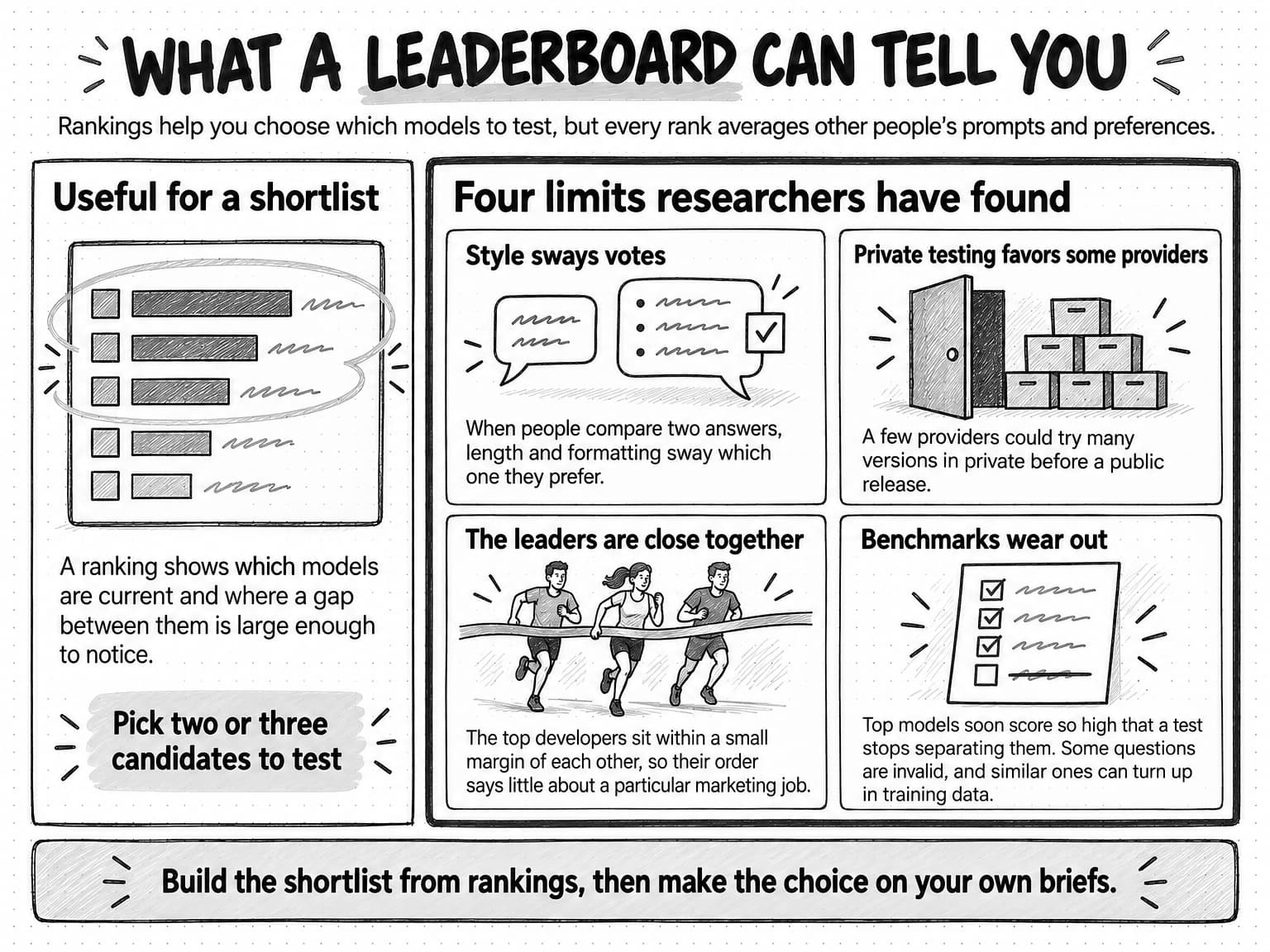
Both are useful for a first pass, because they show which models are current and where a gap is large enough to notice. Researchers have also documented limits that matter for marketing work.
Style sways votes. In an August 2024 analysis of Chatbot Arena, Tianle Li, Anastasios Angelopoulos and Wei-Lin Chiang found that answer length had by far the largest effect on which answer people preferred, with much smaller effects from Markdown formatting such as lists, headers and bold text, and that adjusting for those features changed the order of the leaderboard. A preference for longer, well-formatted answers to general questions says little about which model writes a tighter 150-word post in your voice.
Testing advantages can shape rankings too. In The Leaderboard Illusion, posted in April 2025, Shivalika Singh and colleagues reported that undisclosed private testing benefited a handful of providers, who could try many model versions before a public release; Meta, for example, tested 27 private variants before releasing Llama 4. Stanford HAI's 2026 AI Index notes separate research suggesting that a model's Arena standing may partly reflect adaptation to the platform instead of general capability.
The same AI Index reports that, as of March 2026, the top four developers (Anthropic, Google, OpenAI and xAI, listed here alphabetically) were within 25 points of each other on Arena's rating scale. With a margin that small, the order among them says little about which will do better on a particular marketing job.
Benchmarks also wear out and contain errors. The AI Index reports that evaluations meant to stay challenging for years are now saturated within months, meaning top models score so high that the test no longer separates them, and it cites a review that found invalid-question rates in widely used benchmarks ranging from 2% on MMLU Math to 42% on GSM8K. A high score can also come from similar questions in a model's training data. Hugh Zhang and colleagues wrote fresh grade-school math problems matched to GSM8K and, in a study first posted in May 2024 and revised that November, reported accuracy drops of up to 8%, with signs of systematic overfitting in several model families, though many models, especially the frontier models of the time, showed little sign of it.
View what a leaderboard can tell you at full size (opens in a new tab).
None of these comparisons tests your work. A rank averages a model's results over other people's prompts, judged by other people's preferences, so it can't tell you how the model handles your briefs or your reviewer's standard. Use leaderboards and benchmarks to build a shortlist of two or three current candidates, then test that shortlist on your own briefs.
A leaderboard can tell you which models deserve a test. Your own briefs tell you which one passes your review.
The AI model families available in October 2026
The table lists some of the models four vendors offer, with each vendor's own description, as of October 13, 2026. It is a sample of the field, in no order of merit.
| Vendor | Models | How the vendor describes them |
|---|---|---|
| Anthropic | Claude Fable 5.1, Claude Opus 5.5, Claude Sonnet 5.5, Claude Haiku 5.5 | Fable 5.1 for demanding reasoning and long-horizon agentic work; Opus 5.5 for long-running agentic coding and knowledge work; Sonnet 5.5 as the best combination of speed and intelligence; Haiku 5.5 for high-volume, latency-sensitive tasks such as classification, extraction and routing |
| OpenAI | GPT-6 Astra, GPT-6.1 Sol, GPT-6 Luna | Astra as its most capable model, for the most demanding work; Sol for complex work, at a lower price than Astra; Luna as its most efficient model, for focused, high-volume tasks |
| Gemini 4 Argon, Gemini 3.8 Flash, Gemini 3.5 Flash-Lite | Argon as its flagship reasoning model; 3.8 Flash as its most intelligent Flash model; 3.5 Flash-Lite as the fastest and most cost-effective 3.5 model | |
| DeepSeek | DeepSeek V4.1 Flash, DeepSeek V4 Pro | No one-line descriptions on its models page; both are listed with a thinking mode, on by default, and a non-thinking mode |
Sources: the models pages of Anthropic, OpenAI, Google and DeepSeek, checked on October 13, 2026.
The vendors' advice on where to start differs. Anthropic's models page suggests starting with Opus 5.5 for most workloads and moving to Fable 5.1 when your evaluations of Opus 5.5 at higher effort still fall short, while OpenAI's suggests GPT-6 Astra if you're not sure where to start. Both companies' selection guides then recommend testing on your own inputs.
The model menu in a marketing product often shows a smaller set, the models its maker supports, and the method in this guide works the same way on whatever options your menu offers. Check the vendor's models page before relying on any detail in this section, because lineups change often.
Seven differences between AI models that matter in marketing
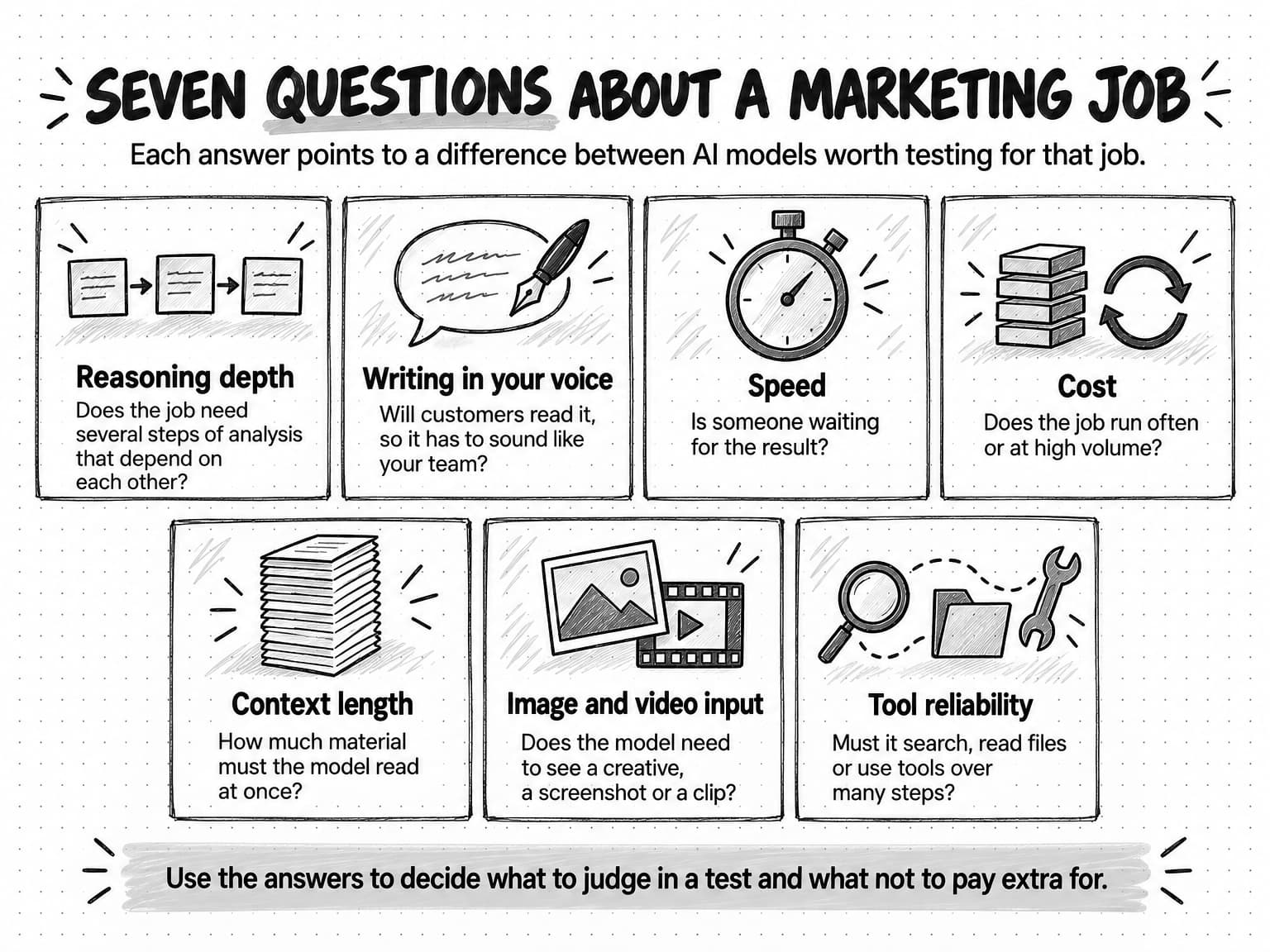
Seven differences between models affect most marketing work: reasoning depth, writing in your voice, speed, cost, context length, image and video input, and reliability with tools. The table says when each matters most and how to check it on your own work.
| Difference | What it means | When it matters most | How to check it |
|---|---|---|---|
| Reasoning depth | How much work the model does before it answers, often set by an effort or thinking level | Multi-step analysis, such as reconciling sources or planning against a budget | Use a brief whose right answer you know, and run it at two effort levels |
| Writing in your voice | How close its default length, structure and word choice come to your approved examples | Posts, emails, ads, landing pages and anything else customers read | Compare drafts blind against approved past pieces and count the edits |
| Speed | How long you wait for a finished answer, including any research steps | Work someone is waiting for; much less for overnight scheduled runs | Time the same brief from start to finish |
| Cost | What a finished, accepted piece costs in usage, review and rework | Jobs that run often or at volume | Price a few real runs, then add review and rework time |
| Context length | How much it can read at once, and how reliably it uses details deep inside a long input | Long transcripts, research reports and document reviews | Ask about a detail from the middle of your longest real document |
| Image and video input | Whether it can read images, video or audio directly | Ad reviews, screenshot critiques, chart reading and video analysis | Ask about a detail you know is in a real creative |
| Tool reliability | How dependably it searches, reads files and uses tools over many steps | Agent work such as research briefs and competitor checks | Run the same multi-step job twice and inspect the steps it took |
Factual accuracy isn't a row of its own, because the defenses are the same for every model: give it the facts and sources the work depends on, and check its claims before anything is published. Models do differ in how often they state something unsupported, which a test on your own briefs can show. Whichever model you choose, the claim check in our guide to preventing AI hallucinations still applies.
Speed and cost are covered together in the section on cost per accepted deliverable, because a fast, cheap draft that needs heavy rework can end up slow and expensive.
View the seven questions about a marketing job at full size (opens in a new tab).
When a reasoning model or higher effort is worth it
A reasoning model works through a problem in intermediate steps before it answers. OpenAI's reasoning guide calls those steps reasoning tokens, which you usually don't see but which are billed as output. Most current models let you set how much of this work to allow. Anthropic calls the setting effort, with levels from low to max, and describes it as a trade between thoroughness and token efficiency. Defaults differ even within one lineup: as of October 13, 2026, Anthropic sets Opus 5.5 to medium effort by default and Sonnet 5.5 to high.
Research finds the gains from step-by-step reasoning concentrated in a few kinds of task. A meta-analysis by Zayne Sprague and colleagues, published at ICLR 2025, covered more than 100 papers plus the authors' own tests of 14 models on 20 datasets, and found strong gains mainly on math and symbolic logic, with much smaller gains elsewhere. Reasoning can also hurt. In a study first posted in October 2024 and revised in June 2025, Ryan Liu and colleagues found tasks where step-by-step reasoning lowered accuracy, including learning hidden patterns from examples and classifying data that contains exceptions; on the hidden-pattern task, OpenAI's o1-preview reasoning model scored up to 36.3 percentage points lower than GPT-4o answering directly.
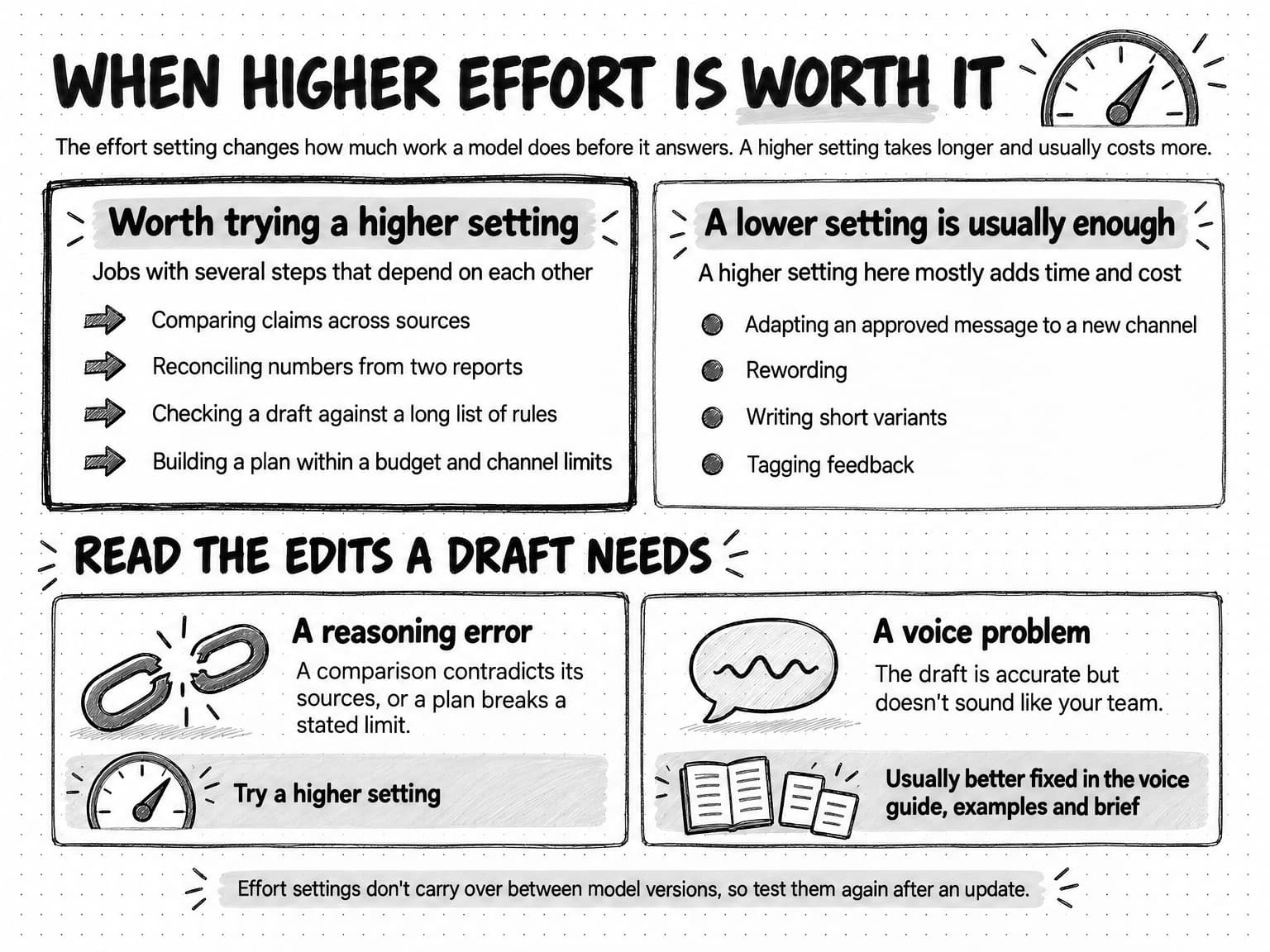
Neither study tested marketing tasks, but together they suggest spending reasoning where a job has several steps that depend on each other: comparing claims across sources, reconciling numbers from two reports, checking a draft against a long list of rules or building a plan that has to respect a budget and channel limits. Adapting an approved message to a new channel, rewording, writing short variants and tagging feedback usually need less, and a higher setting there mostly adds time and cost.
Anthropic's guide to choosing a model says that tuning effort is often a better lever than switching models, and its guide to cost and intelligence recommends sweeping effort, trying each level on your current model, before building anything more elaborate. In Anthropic's tests of Claude Fable 5 on four research and knowledge-work benchmarks, reported in that guide as of October 2026, low effort gave up 1 to 3 points of accuracy for a third to a half off the cost per task, and medium matched the default's accuracy at about 70% to 87% of its cost. Anthropic calls these results internal and directional, not guarantees, so treat them as a reason to test effort levels on your own work.
Each end of the dial has a cost. Anthropic's effort guide notes that lower effort means fewer and terser tool calls, and its October 2026 guidance for Haiku 5.5 says that in long agent prompts the model is more likely to skip a search, stop early or skip a check at low effort, which for a research brief can mean thinner sourcing. At the other end, it says max on Opus 4.7 adds significant cost for relatively small quality gains on most workloads. Settings don't carry over between model versions either: the same guide notes that a level can produce a different amount of thinking on a new version, and it advises a fresh effort sweep on your own evaluations instead of reusing a setting from an earlier model.
The edits a draft needs show which way to turn the dial. A reasoning error, such as a comparison that contradicts its sources or a plan that breaks a stated constraint, is a reason to try a higher setting. A voice problem usually isn't. Anthropic's prompting guide notes that changing effort doesn't reliably change how long Opus 5's visible responses are, and it calls examples one of the most reliable ways to steer Claude's tone, format and structure.
View when higher effort is worth it at full size (opens in a new tab).
How much the model changes your brand's voice
Models differ in default length, structure, formatting and word choice. As of October 2026, Anthropic's prompting guide keeps notes on what is different about each model, including response length, and says that Opus 5's default responses run longer than earlier models'. If one candidate's drafts are consistently too long or too heavily formatted for your channels, a test will show it quickly.
Much of what makes copy sound like your company comes from what the model is given. A voice guide that lists observable choices, such as preferred words, sentence patterns, boundaries and approved passages, leaves any model less room to supply its own idea of warm or professional. Our guide to defining your brand voice shows how to write one, and a brief that states the facts, audience and purpose supplies what the message can truthfully say.
Switching models is also a weak cure for copy that sounds like everyone else's. In a 2024 study in Science Advances, Anil Doshi and Oliver Hauser found that giving writers AI-generated story ideas raised the creativity ratings of individual stories, most of all for the less creative writers, but made the AI-assisted stories more similar to one another. A January 2025 preprint by Emily Wenger and Yoed Kenett found that responses from different language models were more alike than responses from different people, even after controlling for the structure of the responses. If drafts from several models read alike, the fix more likely lies in specific material, such as customer language, proof and a point of view, than in another model. Our guide to AI slop covers how marketing teams spot and avoid generic AI copy.
To test voice, compare drafts from each candidate with two or three approved pieces your team already likes, with the model names hidden. Ask the reviewer which drafts could pass as your team's work and how many edits each would need before publishing. Test each kind of copy separately, because the model that writes the best 2,000-word article from your research may not write the best ten ad headlines or the best renewal email.
How AI models handle long documents, images and video
A model's context window is the amount of material it can consider at once, measured in tokens. Every model in the family table lists a context window of about one million tokens, so most marketing documents fit, but whether a model uses all of that material well is a separate question. In NoLiMa, a test published at ICML 2025, Ali Modarressi and colleagues found that 11 of 13 models that claimed at least 128,000 tokens of context fell below half of their short-input performance at 32,000 tokens; GPT-4o, one of the strongest performers, fell from 99.3% to 69.7%. In RULER, published at COLM 2024, Cheng-Ping Hsieh and colleagues found that only about half of the 17 long-context models they tested, all claiming 32,000 tokens or more, held satisfactory performance at that length.
Both studies tested models from 2024 and early 2025, and newer models may do better, so treat the findings as a reason to test at the length of your real documents and to ask about details from the middle as well as the start and end. When details go missing, splitting the material into smaller batches is a practical fix. Choosing what goes in matters as much as how much fits, as our guide to context engineering explains.
Image and video input varies more. As of October 13, 2026, every Anthropic and OpenAI model in the family table accepts text and image input, and Google lists text, image, video, audio and PDF input for all three of its models in the table. Video has its own limit. Google's video documentation, checked the same day, says Gemini samples video at one frame per second by default, so fast action can lose detail, while the audio track is processed too. A 15-second ad that cuts every half second, for example, would be read from about 15 frames, so ask about a specific shot when you test.
Products also differ in how they pass media to a model, and some send an image to a separate image step instead of giving it to the model directly. Ampere, the AI marketing agent, is one example: turns on its DeepSeek options don't receive uploaded images directly, and Ampere can use a private image inspection step where appropriate, for tasks such as screenshot critique, chart reading or creative review. When a product offers several models, ask which read images directly and which go through a separate step, and before you choose one for creative review, ask it about a detail you know is in the image or clip. Our guide to multimodal AI covers what image, video and audio input make possible in marketing.
How reliably an AI model uses tools in agent work
In agent work, the model chooses a series of actions: search, open a page, read a file, use a tool, check the result and decide what to do next. Our guide to how AI agents work explains that loop. Because each step builds on the last, a skipped search or a misread page early on can weaken everything after it, and the final draft may read just as fluently as one built on complete research.
Doing a multi-step job every time is harder than doing it once. In τ-bench, a June 2024 benchmark in which agents serve simulated customers using tools and company policies, Shunyu Yao and colleagues found that even gpt-4o, a leading model at the time, completed fewer than half of the tasks. In the retail tasks, the chance that it would complete the same task in all eight of eight attempts was under 25%. For your own test, the question is whether a candidate finishes your multi-step job each time you run it.
The setting matters here too, since a lower effort setting can mean fewer searches and checks. So does the product, because it decides which tools exist, how results come back to the model and what happens when a tool fails, which is why two agents running the same model can produce very different work.
To check, run the same multi-step job at least twice on each candidate and look at what it did as well as what it wrote: which sources it opened, which tools it used and which files it produced. Count the runs that stopped early, skipped a required source or reported work it didn't finish. Some variation between runs is normal, and our guide to why AI gives different answers to the same question explains where it comes from.
Where small and open-weight models fit
The smallest tier in each family is meant for high-volume, repetitive work, as the vendor descriptions in the family table show. Marketing has plenty of it: tagging survey comments or reviews by theme, pulling fields such as company size or job title out of form responses, sorting inbound requests and checking drafts against a fixed list of banned phrases. For jobs like these, a small model at a low setting can be fast and cheap, and the test is whether its output agrees with a person's judgment on a sample.
Models can also be combined, for example by having a lower-cost model consult a more capable one on hard decisions, or a capable model split a task among lower-cost workers. Anthropic's cost guide reports that splitting a task this way saved money in only two of the situations it measured, and that on work a single model could handle alone, running that model at lower effort was cheaper every time.
Open-weight models are models whose trained weights, the numbers that make up the model, are published so that anyone can download and run them. As of October 2026, examples include OpenAI's gpt-oss models, released in August 2025 under the Apache 2.0 license, the smaller of which runs within 16 GB of memory; DeepSeek-V4-Pro, a much larger model whose weights are published under the MIT License; and Meta's Llama 4 models.
Open weights still come with license terms. Meta's Llama 4 Community License, effective April 5, 2025, requires a company whose products had more than 700 million monthly active users to request a separate license, and requires products built with the models to display "Built with Llama" prominently. Open weights also aren't the same as open source. The Open Source Initiative's Open Source AI Definition 1.0, released October 28, 2024, requires the freedom to use, study, modify and share a system, along with information about its training data, the code and the parameters, so publishing weights alone doesn't meet it. Read the license before any commercial use.
Running an open-weight model yourself can make sense when data can't leave your own systems, when volume is high enough that hosting costs less than paying per use or when you need to adapt the model, but it takes engineering to set up and maintain. A marketing team without engineers is more likely to meet open-weight models as options inside the products it uses. On quality, the 2026 AI Index found that, as of March 2026, the top closed model led the top open model by 3.3% on Arena scores, up from 0.5% in August 2024, though a gap measured on general prompts won't tell you how either model handles your briefs.
A task-fit matrix for common marketing jobs
The matrix maps eight common marketing jobs to what matters most for each, the tier worth testing first and the check to run before moving the job to a cheaper option. It uses three generic tiers, because the names on your model menu will change: the fast tier (a family's smallest, quickest model), the balanced tier (a mid-sized model) and the most capable tier (a family's largest model). Each row is a starting point for your own test.
| Job | What matters most | What matters less | Tier to test first | Check before moving to a cheaper option |
|---|---|---|---|---|
| Social post variants from an approved message | Voice, length limits, no new claims | Deep reasoning, long context | Balanced at low effort, with the fast tier as a challenger | Do the drafts still pass voice review with light edits? |
| Long-form article from a brief and sources | Accuracy to sources, structure, voice | Speed | Balanced or most capable at moderate effort | Can every claim still be traced to a source? |
| Competitor or market research brief | Tool reliability, source coverage, reasoning | Voice, speed | Balanced or most capable at higher effort | Does every run still open each required source and flag gaps? |
| Synthesis of long interview transcripts | Use of long inputs, exact quotes | Speed, voice | Most capable at higher effort | Are details from the middle still found, and are quotes exact? |
| Review of ad creative or screenshots | Image or video input, attention to detail | Long context | Balanced, on a model that reads images directly | Does it still catch a detail you know is there? |
| Campaign plan under budget and channel limits | Reasoning across constraints | Speed | Most capable, or balanced at high effort | Do the numbers add up, and does every constraint hold? |
| Tagging customer feedback at volume | Consistency, cost, speed | Voice, deep reasoning | Fast, at low effort | Do its tags still agree with a person's on a sample? |
| Repurposing a finished piece for another channel | Format rules, voice, fidelity to the original | Deep reasoning | Fast or balanced | Does it keep the facts and add nothing new? |
The second and third columns tell you what to judge in a test and what not to pay extra for. The last column says what has to stay true if you move the job down a tier or a setting to save time or money.
Where to begin also depends on how often a job runs. Anthropic's model selection guide describes two approaches. Efficiency-first starts with the smallest model that might work and moves up only if tests show it falls short. Capability-first starts with the strongest model and steps down, by lowering effort or choosing a smaller model, for as long as the results still pass. For marketing work, efficiency-first fits jobs that run weekly or at volume, where a saving repeats every time, and capability-first fits rare or high-stakes jobs, such as a positioning synthesis or a launch plan, where a weak result costs more than the usage saved.
Adjust the rows to your situation. A stricter review standard, such as claims in a regulated area, pushes a job up a tier. A product that offers only some models or settings narrows the choice.
Some jobs have parts that belong in different rows. A research brief followed by a draft combines the research row with the long-form row, and if your product lets you choose settings for each step, you can run the research at a higher setting and the drafting at a lower one.
How to compare AI models by cost per accepted deliverable
Model price lists quote a rate per million tokens, and the rates vary widely. As of October 13, 2026, Anthropic's Claude Fable 5.1 lists at about 100 times the per-token price of Claude Haiku 5.5, and OpenAI's GPT-6 Astra at 100 times the price of GPT-6 Luna. Our explainer on AI tokens and credits covers how those prices work, including why reasoning is billed as output, and the costs a usage bill doesn't show.
A per-token price is a poor guide to what a finished piece of marketing costs. Token counts vary by model and setting, because a higher setting writes more hidden reasoning and an agent that searches and reads uses far more tokens than a single reply. Some runs are paid for and thrown away. People's time to review and fix each draft can easily cost more than the usage. A fairer comparison counts all of it.
Cost per accepted deliverable = (usage for all runs + review time × hourly cost + rework time × hourly cost) ÷ accepted deliverables
Usage covers every run, including discarded ones. Review time is the time a person spends checking each draft and making light edits, and rework time is the time spent fixing drafts that need more. Accepted deliverables are the pieces that pass review and get used.
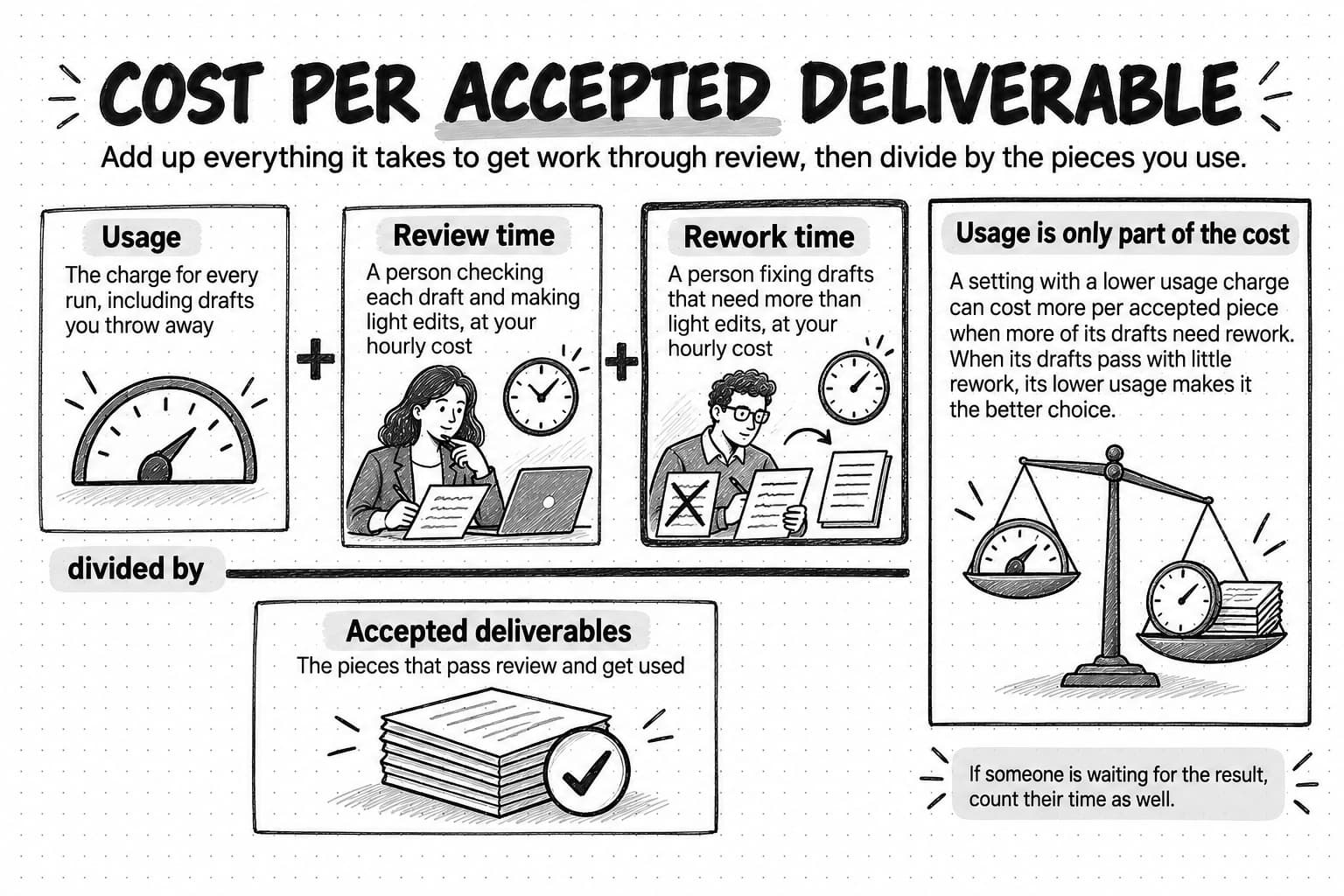
View the cost per accepted deliverable formula at full size (opens in a new tab).
The table works through an illustrative month of 20 LinkedIn post variants at two settings. Every number in it is invented for teaching, including the $60 hourly cost.
| Illustrative measure | Lower-cost setting | Balanced setting |
|---|---|---|
| Usage for 20 drafts | $0.30 | $3.00 |
| Drafts accepted with light edits | 12 | 18 |
| Drafts needing rework | 8 | 2 |
| Review and light edits, at 3 minutes a draft | 60 minutes | 60 minutes |
| Rework, at 15 minutes a draft | 120 minutes | 30 minutes |
| People's time, at $60 an hour | $180.00 | $90.00 |
| Total cost | $180.30 | $93.00 |
| Accepted deliverables after rework | 20 | 20 |
| Cost per accepted deliverable | $9.02 | $4.65 |
In this illustration, the lower-cost setting saves $2.70 in usage but adds $90 of people's time, so each accepted post costs about twice as much. The arithmetic can run the other way. If your test shows a lower-cost setting's work passing your review on a particular job with little rework, as can happen with tagging or simple reformatting, its lower usage makes it the better choice for that job, and the formula lets you show that with your own numbers.
Speed belongs in the same comparison when someone is waiting, because a slow setting costs the waiting person's time as well as the usage. A report that runs overnight on a schedule can take as long as it needs.
Cost per accepted deliverable measures what a job costs to finish. Whether the finished work pays off is a separate question, which our guide to measuring the ROI of AI in marketing takes up.
How to test AI models on your own work in an hour
A one-hour test can screen two or three candidates, whether they are different models or different effort settings of one model, on three of your own recent briefs. It borrows the blind comparison that crowdsourced leaderboards use and applies it to your work and your standard.
- Set up the test (10 minutes). Pick one recurring job and three real briefs from the last few weeks, including one hard case, such as a brief with a tricky claim or a very long source. Choose two or three candidates and record the exact model and effort setting for each, since default settings differ between models. Give every candidate the same brief, sources and examples. Before you see any output, write down two or three pass/fail requirements, such as no claim that isn't in the fact sheet, or a length limit.
- Run each brief twice (20 minutes). Three briefs, two runs and two candidates make 12 outputs, and the second run shows whether a good first result repeats. Note how long each run took and, if your product shows it, what it cost.
- Review blind (25 minutes). Have a colleague remove the model names and shuffle the outputs. The reviewer checks the pass/fail requirements first, because an output that fails one is out however well it reads. Then they score the rest on two or three criteria that matter for the job, such as voice, usefulness and accuracy to sources, and note the edits each would need.
- Decide (5 minutes). Reveal the names. Choose a default for the job, a fallback and a trigger for retesting. If the candidates come out level on your review, choose the faster or cheaper one.
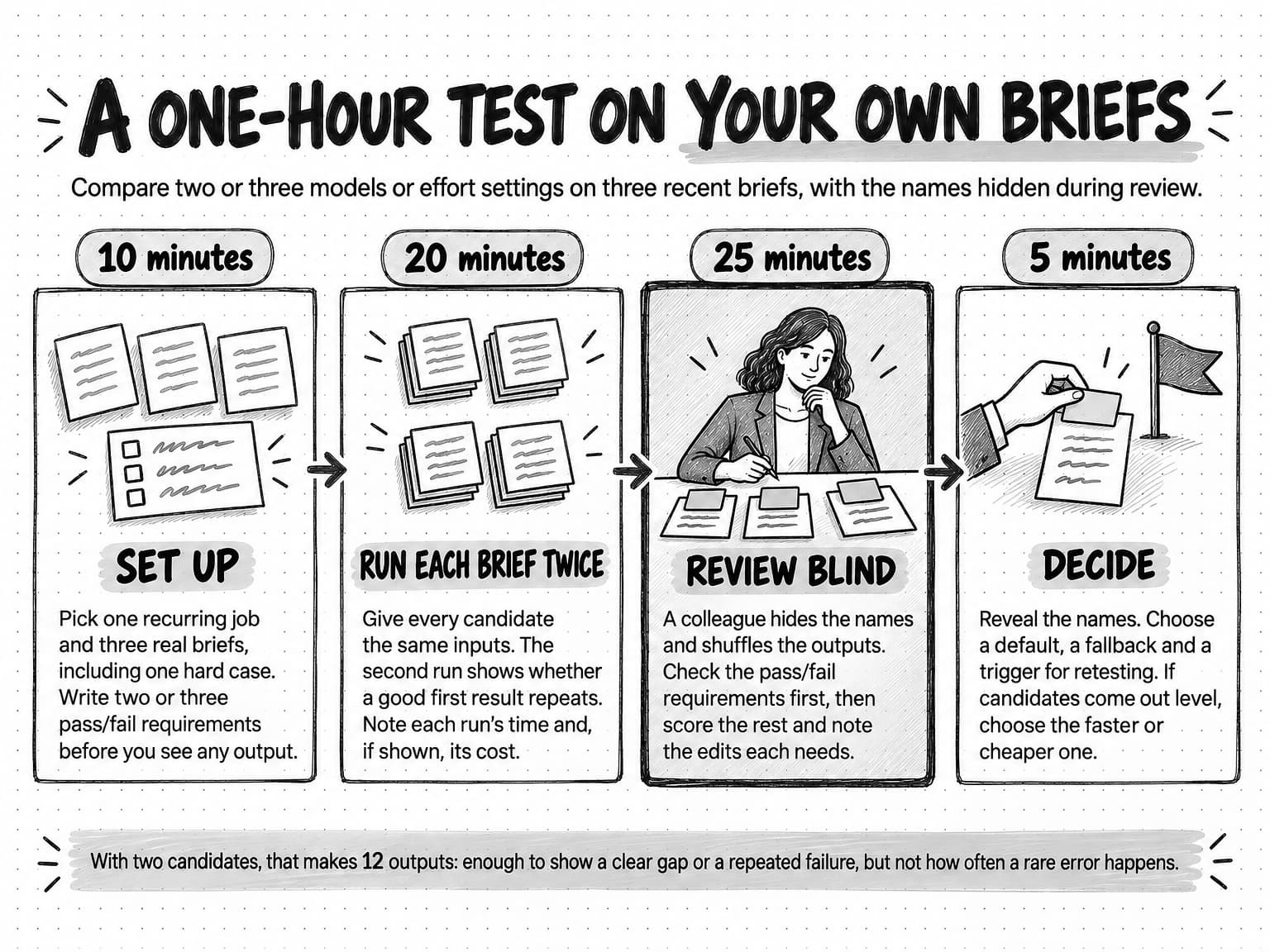
View the one-hour test at full size (opens in a new tab).
Keep the brief identical across candidates, but don't read too much into one wording. In an ICLR 2024 study, Melanie Sclar and colleagues found that formatting changes alone, such as different separators or spacing, moved accuracy by up to 76 points on LLaMA-2-13B, and that a format that worked well for one model didn't reliably work for another. If a candidate fails on something a small rewording might fix, try one reasonable rewrite and record it as a separate condition, as our guide to evaluating an AI marketing agent recommends whenever a brief is rewritten after a weak result. That guide also sets out a fuller scoring method, with hard gates and a 0 to 4 scale, for bigger decisions.
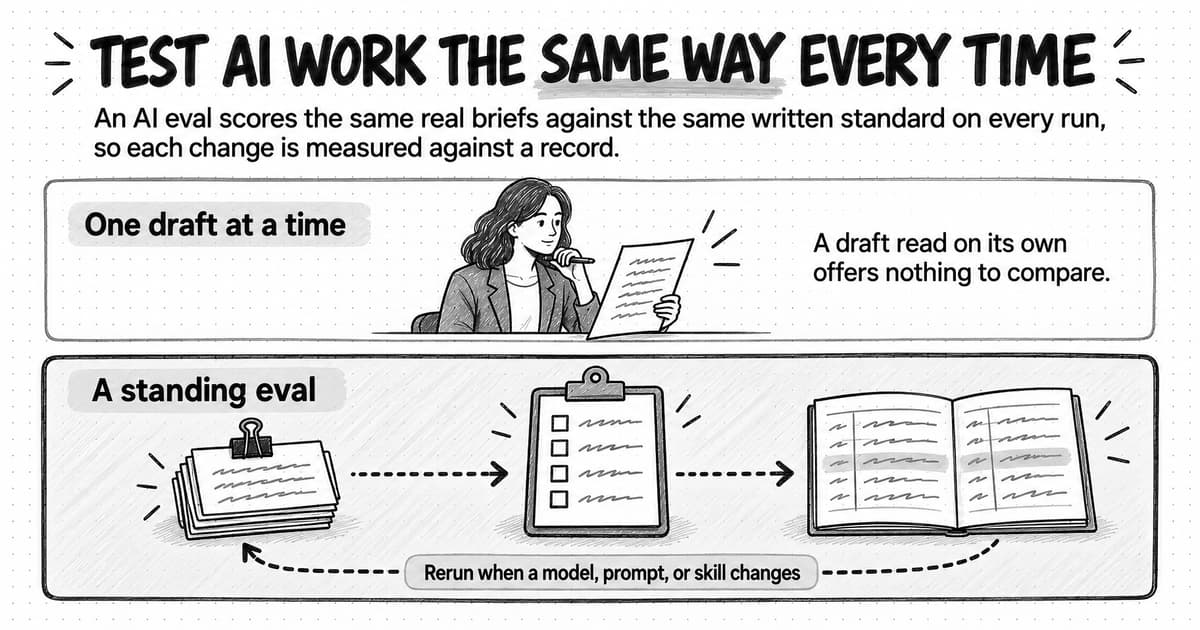
An hour gives you a quick screen. Twelve outputs can show a clear gap or a repeated failure, but they can't tell you how often a rare error happens. For a choice with more at stake, such as moving a high-volume or customer-facing job to a cheaper setting, extend the test with more briefs and more runs. Keep the briefs either way, because they are the start of a standing test set, and our guide to AI evals explains how to build that set into a test you rerun whenever something changes.
Job:
How often it runs, and who waits for it:
Briefs used (three, including one hard case):
Inputs given to every candidate (brief, sources, examples):
Pass/fail requirements (written before any output):
Review criteria (two or three):
Candidate A (model and effort setting):
Candidate B (model and effort setting):
Candidate C (optional):
Results for each brief and run (pass/fail, scores, edits needed, time, cost):
  Brief 1, run 1:
  Brief 1, run 2:
  Brief 2, run 1:
  Brief 2, run 2:
  Brief 3, run 1:
  Brief 3, run 2:
Reviewer and date:
Decision (default, fallback, retest when):
A worked example: choosing models for three recurring jobs
Brindlepath is a fictional company that sells scheduling software to field-service businesses, and its marketing team has two people: a marketing lead and a content marketer. The AI product the team uses offers models in the three tiers from the matrix, each with an effort setting. The team ran the test from the previous section on three recurring jobs, allowing more time for the interview synthesis, and every result and number below is illustrative.
Weekly LinkedIn variants
Each week the content marketer turns one approved message into five LinkedIn post variants. The pass/fail requirements were that a post uses only claims from the approved message and stays under 150 words, and the review criteria were voice and the strength of the opening line. On the fast tier at low effort, all six test drafts met the requirements, but the reviewer marked four of them as needing a rewrite to sound like Brindlepath. On the balanced tier at low effort, five of six needed only light edits, so the team made it the default. The fast tier kept one narrower job, drafting a list of possible opening lines, which the content marketer rewrites anyway.
Monthly competitor brief
Once a month, the marketing lead asks for a brief on what four competitors changed on their pricing pages, in their release notes and in new campaigns. The requirements were that every run cover each competitor's pricing page and release notes, give a source link for every claim and flag anything it couldn't check. On the balanced tier at low effort, three of six runs failed: two skipped a competitor's release notes, and one stated a price without opening the pricing page. At high effort on the same tier, all six runs opened every required source, and each run took about three times as long. The brief runs monthly and nobody waits for it, so the team chose the balanced tier at high effort. The most capable tier at medium effort also passed every requirement, at a higher cost, so it became the fallback.
Quarterly interview synthesis
Every quarter the team turns about 40 customer interview transcripts into themes, with quotes, for a positioning review. The requirements were that every quote match a transcript word for word and that each theme name the interviews behind it. To test how candidates used a long input, the marketing lead also asked about details she knew sat in transcripts from the middle of the batch. The balanced tier missed several of those details and presented two paraphrases as exact quotes. The most capable tier at high effort found the details and quoted exactly in five of six runs; the sixth attributed one quote to the wrong interview. The team chose the most capable tier at high effort and, to reduce what any one run has to hold, split the transcripts into four batches of ten with a final pass that combines the batch summaries. It also kept a rule that a person checks every quote against its transcript before the synthesis is shared.
| Job | Default | Fallback | Retest when |
|---|---|---|---|
| Weekly LinkedIn variants | Balanced tier, low effort | Most capable tier, low effort, tested before use | The voice guide changes, a new model version arrives or two weeks of drafts need heavy edits |
| Monthly competitor brief | Balanced tier, high effort | Most capable tier, medium effort | A run skips a required source, or a new model version arrives |
| Quarterly interview synthesis | Most capable tier, high effort, in four batches | Balanced tier, high effort, in smaller batches, tested before use | Before each quarter's run, and when a retirement notice arrives |
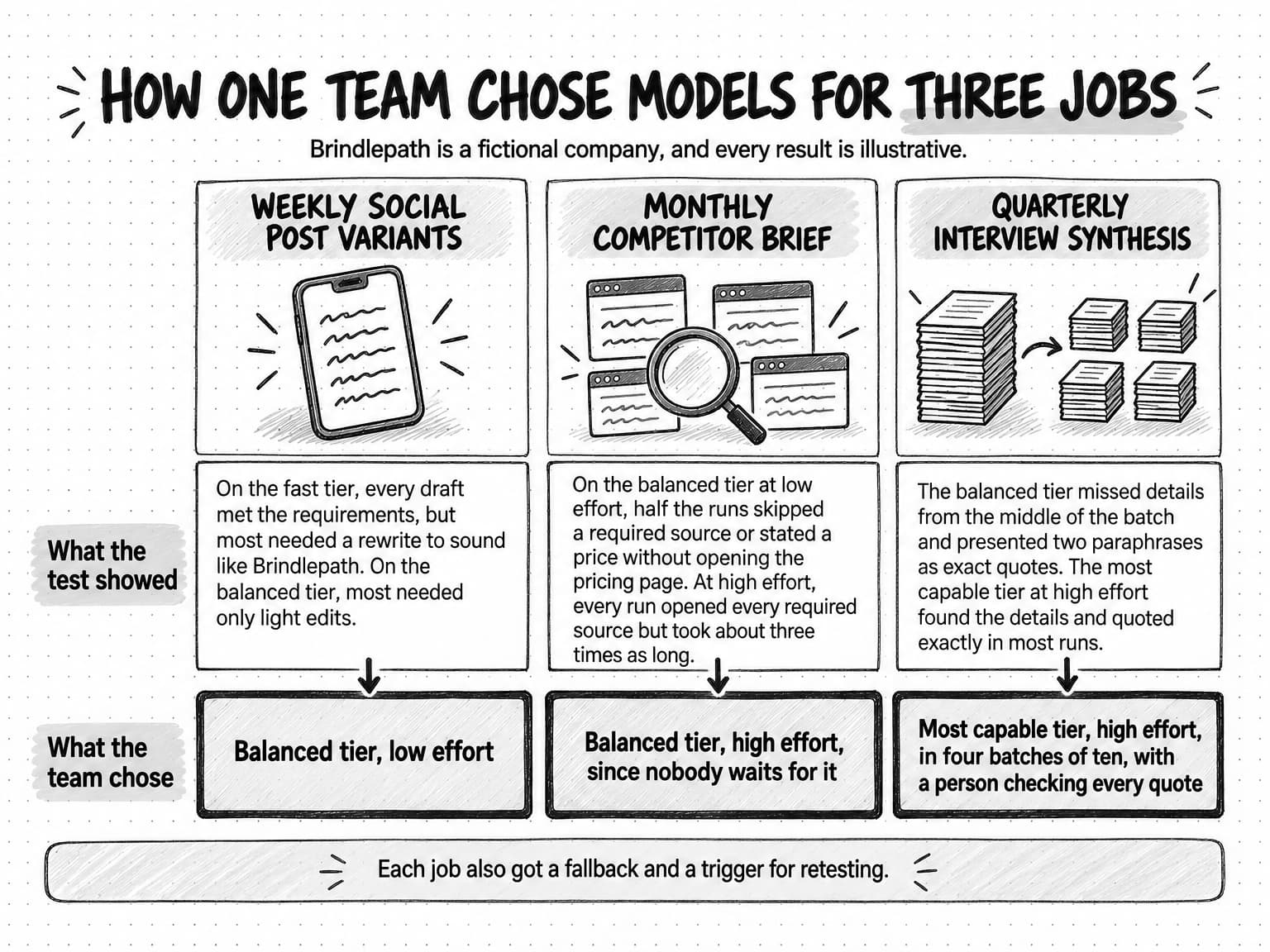
View how Brindlepath chose models at full size (opens in a new tab).
When to switch AI models, and how to check nothing broke
Four kinds of event should send you back to your test:
- A retirement notice. Anthropic's deprecation policy gives at least 60 days' notice before a publicly released model retires. On September 30, 2026, for example, it notified developers that Claude Sonnet 4.5 will retire on November 30, 2026. It also says deprecated models are likely to be less reliable than active ones and advises testing the replacement well before the retirement date.
- A version that moves. As of October 2026, Google says its preview models can be deprecated with at least two weeks' notice, and that a "latest" alias can move to a new model version after two weeks' email notice for breaking changes. A product built on a moving alias can change its behavior without anyone on your team changing a setting.
- A new model or a price change. A new release or a cheaper price can make a different choice worth testing for a job you settled months ago.
- Drift. A model sold under the same name can behave differently over time. In a study first posted in July 2023 and revised that October, Lingjiao Chen, Matei Zaharia and James Zou found that GPT-4's accuracy at telling prime from composite numbers fell from 84% in March 2023 to 51% in June 2023, and they called for continuous monitoring. Pinned versions, which stay fixed to one release, reduce the risk; every Claude model ID, for example, is a pinned snapshot. Inside a product you may not see version numbers, so ask the vendor how model changes are announced.
When one of these happens, rerun a small regression set: the briefs from your one-hour test plus any brief that once produced a bad result, run with the same inputs on the new model to catch anything that got worse. Compare the new results with your earlier ones on length, format and tone against your approved examples. Check facts and quotes against the sources, and look at the tool steps the model took. Because defaults and effort levels can change between versions, test effort levels again too.
Re-test your prompts and skills as well. Anthropic advises treating any prompting technique that names a specific model as measured on that model, and checking it against your own evaluations before using it on another. Our guide to AI agent skills explains why a model update is a reason to re-test a skill even when nothing in it has changed. Keep the old model as your fallback until the new one passes, then switch the default and record the date and the result.
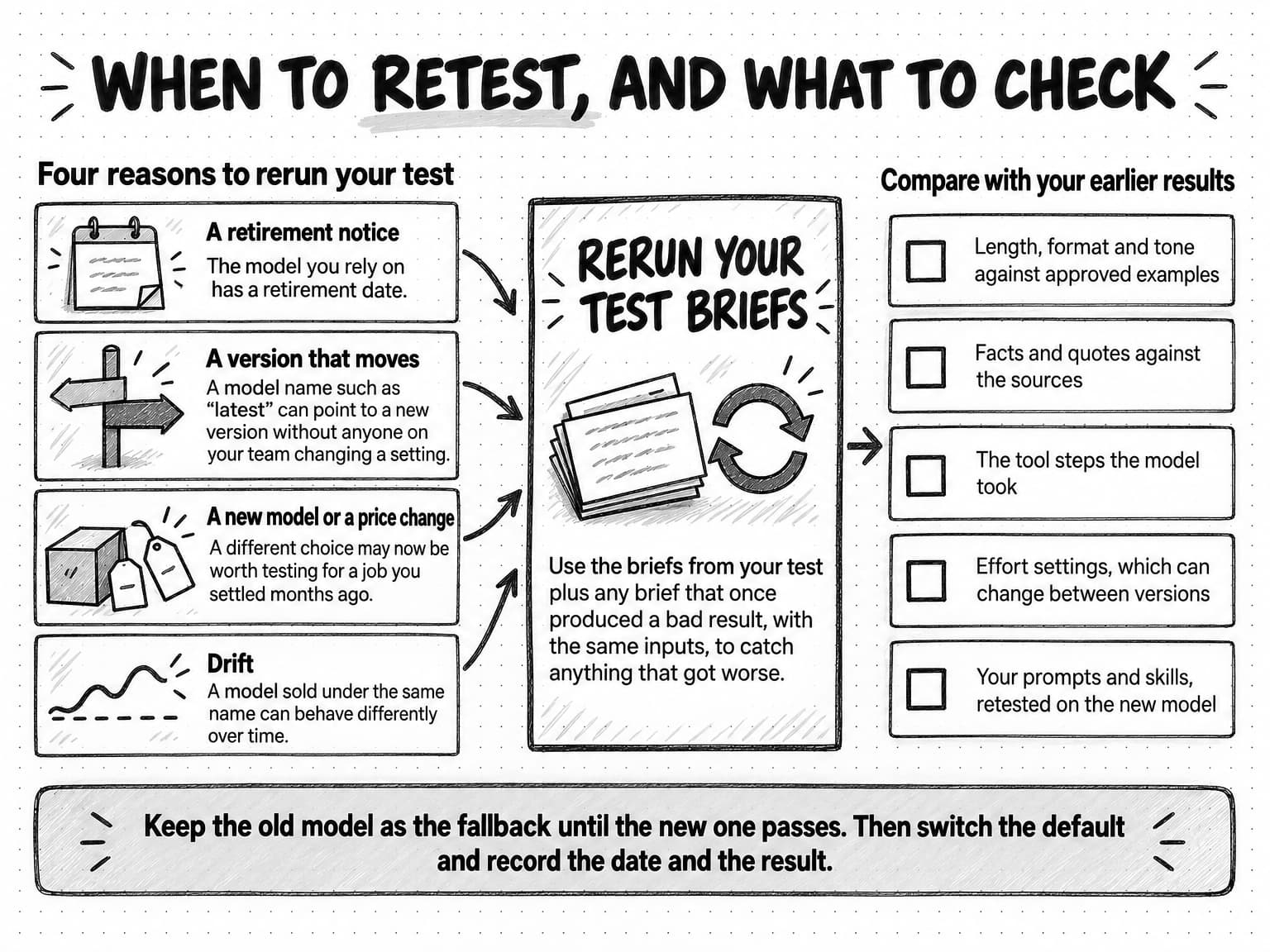
View when to retest and what to check at full size (opens in a new tab).
How model choice works in Ampere
Ampere lets you choose the model and effort for your work, so a team isn't tied to one premium model for every job. Ampere's model preference options include Anthropic Claude Sonnet 5, Ampere's standard model, and Claude Opus 4.8. When enabled for the Organization, DeepSeek V4.1 Flash and DeepSeek V4 Pro are also available as lower-cost options. The model selector describes each option by task fit and relative cost, and the launcher includes effort selection alongside the model preference.
When the DeepSeek options are enabled, selecting Sonnet shows dismissible guidance toward the lower-cost DeepSeek V4.1 Flash, and selecting Opus shows guidance toward DeepSeek V4 Pro. The guidance suggests a lower-cost option without claiming the results will be the same, so a test on your own briefs is still how to decide whether that option's work passes your review. After a session starts, you can switch among models from the same provider. Switching from an Anthropic model to the suggested DeepSeek model starts a new session prefilled with your text, and attachments stay in the original session.
To compare settings on cost, completed turns can show a turn-credit summary, and completed sessions can load settled credit receipts with exact calculations, including agent usage and attributed tool usage. If you ask for it, a scheduled task proposed in chat can include model and effort settings, so a recurring job can use the setting your test chose.
Changing models doesn't mean rebuilding your setup. The supported Anthropic and DeepSeek options work inside the same Ampere marketing system, so your tools, skills and Project context stay in place, and the set of models can grow as more models clear Ampere's product and evaluation requirements. Whichever model you choose, AI outputs may be inaccurate or incomplete, so review the work before it goes out. Ampere drafts and prepares the work, and you decide what gets published.
Sources and further reading
- Anthropic, Claude documentation: Models overview, Choosing the right model, Optimizing for cost and intelligence, Effort, Prompting best practices and Model deprecations, checked October 13, 2026. The cost results are Anthropic-internal and directional.
- OpenAI, API documentation: Models, Model selection and Reasoning models, checked October 13, 2026.
- Google, Gemini API documentation: Gemini models and Video understanding, checked October 13, 2026.
- DeepSeek, Models and pricing, and the DeepSeek-V4-Pro model card on Hugging Face, checked October 13, 2026.
- OpenAI, gpt-oss-20b model card, Hugging Face, August 2025.
- Meta, Llama 4 Community License Agreement, effective April 5, 2025.
- Open Source Initiative, The Open Source AI Definition 1.0, October 28, 2024.
- Wei-Lin Chiang and colleagues, Chatbot Arena: An Open Platform for Evaluating LLMs by Human Preference, arXiv, March 7, 2024.
- Tianle Li, Anastasios Angelopoulos and Wei-Lin Chiang, Does style matter? Disentangling style and substance in Chatbot Arena, LMSYS, August 29, 2024.
- Shivalika Singh and colleagues, The Leaderboard Illusion, arXiv, April 29, 2025.
- Stanford HAI, The 2026 AI Index Report: Technical Performance, April 2026.
- Hugh Zhang and colleagues, A Careful Examination of Large Language Model Performance on Grade School Arithmetic, arXiv, May 1, 2024, revised November 22, 2024. The figures cited are from the revised version.
- Zayne Sprague and colleagues, To CoT or not to CoT? Chain-of-thought helps mainly on math and symbolic reasoning, ICLR 2025.
- Ryan Liu and colleagues, Mind Your Step (by Step): Chain-of-Thought can Reduce Performance on Tasks where Thinking Makes Humans Worse, arXiv, October 2024, revised June 2025.
- Anil R. Doshi and Oliver P. Hauser, Generative AI enhances individual creativity but reduces the collective diversity of novel content, Science Advances, July 12, 2024.
- Emily Wenger and Yoed Kenett, We're Different, We're the Same: Creative Homogeneity Across LLMs, arXiv preprint, January 31, 2025.
- Ali Modarressi and colleagues, NoLiMa: Long-Context Evaluation Beyond Literal Matching, ICML 2025.
- Cheng-Ping Hsieh and colleagues, RULER: What's the Real Context Size of Your Long-Context Language Models?, COLM 2024.
- Shunyu Yao and colleagues, τ-bench: A Benchmark for Tool-Agent-User Interaction in Real-World Domains, arXiv, June 17, 2024.
- Melanie Sclar and colleagues, Quantifying Language Models' Sensitivity to Spurious Features in Prompt Design, ICLR 2024.
- Lingjiao Chen, Matei Zaharia and James Zou, How is ChatGPT's behavior changing over time?, arXiv, July 18, 2023, revised October 31, 2023. The figures cited are from the revised version.
Frequently Asked Questions
Which is the best AI model at present?
No single AI model is best at everything as of October 2026. Vendors sell tiers for different work, from small, fast models for high-volume tagging to large models for long, multi-step reasoning, and Stanford's 2026 AI Index found the top four developers within 25 points of each other on the Arena leaderboard in March 2026. The best model for a marketing job is the one whose output passes your own review at a cost and speed that job can bear.
Is Claude or ChatGPT better for writing?
Neither Claude nor ChatGPT is better for every kind of writing. Each comes from a vendor that offers several models and effort settings, and the drafts that suit a 2,000-word article may not suit ten ad headlines or a renewal email. Run the same few briefs through each option with identical inputs, have a colleague hide the names and choose the one whose drafts pass your review with the fewest edits.
How do you choose the right AI model for a task?
Choose an AI model for a task by testing a short list on your own work. Pick two or three candidates, run three real briefs through each twice with identical inputs and have someone review the outputs blind against pass/fail requirements written beforehand. Then compare the cost per accepted deliverable, including review and rework time, and record a default, a fallback and a trigger for retesting.
How reliable are AI model leaderboards and benchmarks?
AI model leaderboards and benchmarks are reliable enough to build a shortlist but not to make the final choice. Researchers have found that answer length and formatting sway crowdsourced votes, that private testing can favor some providers and that benchmarks saturate quickly and contain invalid questions. A rank also averages other people's prompts and preferences, so it can't show how a model handles your briefs and your reviewer's standard.
What is a reasoning model in AI?
A reasoning model is an AI model that works through a problem in intermediate steps before it answers, and most current models let you set how much of that work to allow. Research finds the largest gains on math and logic, and some tasks get worse with more reasoning. In marketing, extra reasoning is most likely to help multi-step work such as reconciling sources or planning against a budget, and adds little to short variants or rewording.
What is the best AI model for marketing research?
The best AI model for marketing research is the one that opens every required source and flags what it couldn't check each time you run it. Research briefs depend on reliable tool use and careful reasoning more than on voice, so start by testing a balanced or most capable model at a higher effort setting. Run the same brief at least twice and inspect which sources each run opened before you trust the result.
Are open-source AI models as good as closed models?
On the Arena leaderboard, the best open AI models still trail the best closed ones. Stanford's 2026 AI Index found that, as of March 2026, the top closed model led the top open model there by 3.3%, up from 0.5% in August 2024. That general gap doesn't show how either model handles your briefs, and running an open model yourself takes engineering to set up and maintain.
What is the difference between open-source and open-weight AI models?
An open-weight AI model has its trained weights published so anyone can download and run it, usually under license terms that can restrict some uses. An open-source AI model, under the Open Source Initiative's 2024 definition, must also grant the freedom to use, study, modify and share the system and come with information about its training data, code and parameters. Publishing weights alone doesn't meet that definition.