Why does AI give different answers to the same question? And how to get consistent brand work
Where the differences between two AI drafts come from, which ones help brand work and which ones hurt it, and the controls that keep names, prices, claims and formats steady, ranked by impact. Includes a fixed-and-open brief you can copy and a worked example.
43 min readWritten by Ampere
Short answer
Why does AI give different answers to the same question?
AI gives different answers to the same question because a language model writes each response fresh, choosing every word from a range of likely options, and because the model version, the hidden context a product adds, the conversation so far and live search results can all change between runs. For consistent brand work, put the facts and formats that must not change into the request and leave the rest open.
Summary
AI answers vary because a language model samples each word from a range of likely options, and because much of what goes into a request changes between runs. Consistent brand work comes from deciding which parts of a piece are fixed, such as names, prices, claims and formats, putting those parts in the request and leaving ideas and headlines open.
Lowering temperature, the setting that controls randomness, doesn't solve the problem. AI services aren't fully deterministic even at a temperature of zero, the newest models from OpenAI, Anthropic and Google restrict or ignore the setting, and a low temperature repeats a wrong guess as readily as a right one. Model updates, hidden memory and instructions, long chats and changes in wording cause much of the variation.
Variation helps where a piece of work has no single right answer, such as ideas, angles and headlines, and hurts where it has one, such as product names, offers, claims, required wording, calls to action and recurring formats. A table in the guide sorts common parts of marketing work into these two groups and says what to do with each.
Ranked by impact, the controls start with supplying approved facts, fixing the format and showing approved voice examples, then using one saved brief in a fresh conversation and keeping context the same across a team. Pinning the model and adjusting sampling settings come last, because they act on causes most marketers can't reach. A copyable fixed-and-open brief puts the ranking into practice.
A worked example with a fictional software company shows two drafts of one request disagreeing on the feature name, offer, claim and call to action, and a fixed-and-open brief making those elements match across three runs. AI search answers about a brand vary for the same reasons, so measure how often the brand appears across many runs instead of trusting one answer.
Contents
- Where the differences between two AI answers come from
- How AI writes an answer one likely word at a time
- What temperature, top-p and top-k do
- Is AI deterministic? What happens at temperature zero
- How model updates and routing change answers over time
- Do AI assistants give everyone the same answer?
- Why AI changes its answer when you ask again in the same chat
- How small changes in wording change the output
- When variation helps and when it hurts brand work
- Consistency controls ranked by impact
- A fixed-and-open brief you can copy
- A worked example: two launch emails from the same request
- How to check whether AI output is consistent enough
- Why AI search answers about your brand vary
- How Ampere keeps brand work consistent
- Sources and further reading
- Frequently Asked Questions
Ask an AI assistant for a launch email, then ask again in the same words, and you will usually get two different emails. The subject lines differ, which is fine, since you wanted options anyway. But the second draft may also call the feature by a slightly different name, mention an offer nobody approved or end with a different call to action, and those are the differences that reach customers if nobody catches them.
The reason starts with how a language model writes. It doesn't look up a stored answer. It writes each response fresh, a small piece of text at a time, and at each step it chooses from a range of likely options, so two runs can take different paths from the first sentence. Around the model, other things change between runs as well: the version of the model, the hidden instructions and memory the product adds to your request, the conversation so far, the exact words you typed and, when the assistant searches the web, the pages it finds that day. Output variation is the name for the resulting differences between answers to what looks like the same question.
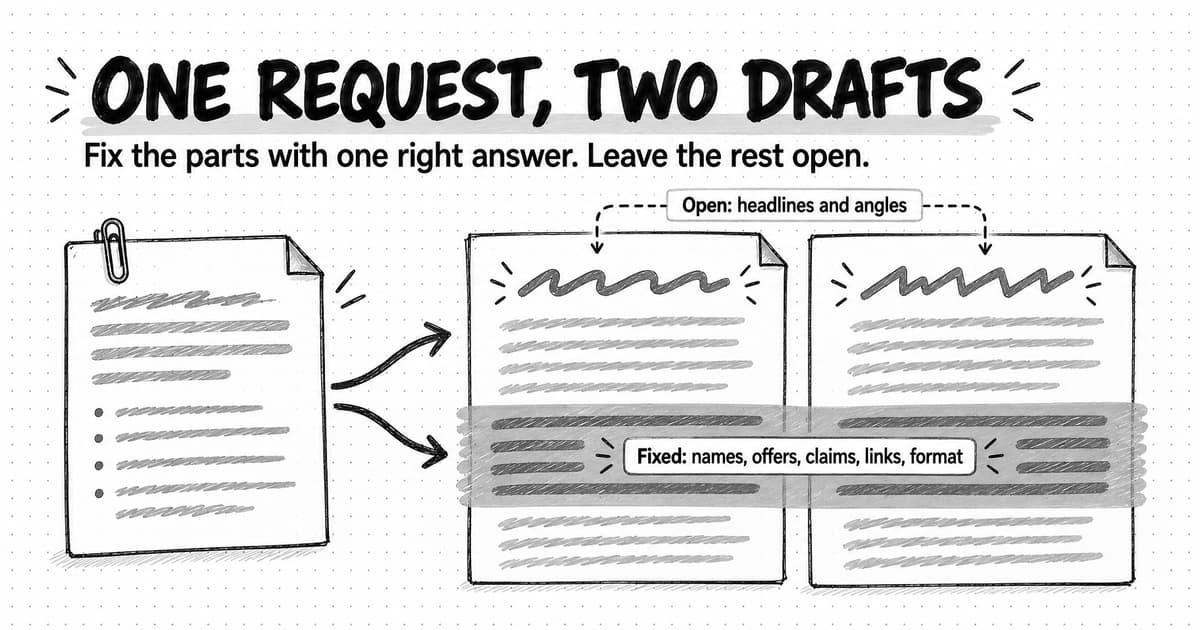
Some of that variation is useful. If you ask for ten headline options, a model that returned the same headline every time would be no help at all. Variation becomes a problem when it touches the parts of a piece that have one right answer: product names, prices, claims, required wording, links and formats. Consistent brand work therefore depends less on stopping the model from varying, which most tools don't let you do anyway, and more on deciding which parts of the work are fixed, putting those parts into the request so the model has nothing to guess, and leaving the rest open.
This guide explains each source of variation, with the research and provider documentation behind it, and what each one means for a marketer. It then sorts brand work into the parts where variation helps and the parts where it hurts, ranks the controls that reduce the harmful kind, and works through an example with a fictional company. The last sections show how to test a brief for consistency and why AI answers about your own brand keep changing.
Where the differences between two AI answers come from
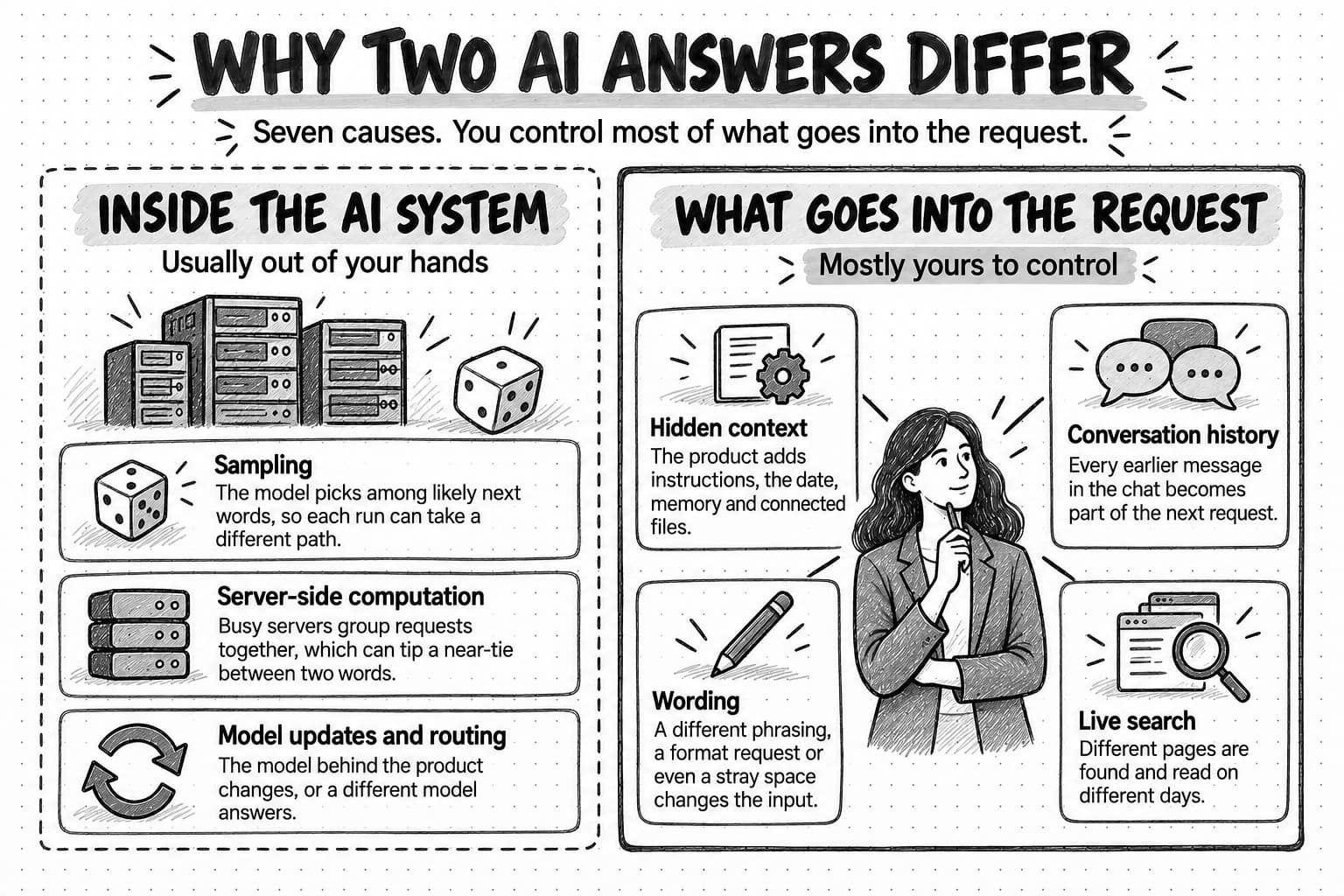
Seven things can make two answers to the same request differ. The first three happen inside the AI system, and the other four come from what goes into it. The table lists them in the order this guide covers them, with who can change each one.
| Source of variation | What changes between runs | Who controls it |
|---|---|---|
| Sampling | The model chooses among likely next words, so each run can take a different path | The product's developer, through settings such as temperature |
| Server-side computation | Tiny numerical differences when the provider processes many requests together, even at a temperature of zero | The AI provider |
| Model updates and routing | The model behind the product changes, or a router sends your request to a different model | The provider or the product |
| Hidden context | Instructions, the date, saved memory, personal settings and connected files added to your words | The product, and partly you |
| Conversation history | Everything earlier in the chat becomes part of the next request | You |
| Wording | Different phrasing, format requests or even spacing | You and your teammates |
| Live search | Different pages found, ranked or read on different days | The search system, and partly you |
The last column decides what you can do. As someone using an AI assistant or agent, you can't change how a provider's servers work, and in most products you can't change the sampling settings either. You do control most of what goes into a request: the facts, the format, the examples, the wording and the conversation it starts from, which is why the controls later in this guide concentrate on the input.
View the seven causes of AI answer variation at full size (opens in a new tab).
What changed often tells you which source caused it. Drafts that differ only in phrasing and angle point to sampling. Drafts that disagree on a fact usually mean the model filled in a detail nobody gave it. A shift for the whole team from one week to the next suggests a model update, and two teammates getting different answers on the same day points to what each account adds to the request.
How AI writes an answer one likely word at a time
Language models are trained to predict what comes next. Anthropic's glossary describes the base models as "pretrained to predict the next word, given the previous context." Strictly, they predict the next token, which is a word or a piece of a word, but the idea is the same. Given your request and everything written so far, the model produces a list of possible next tokens, each with a probability. The system picks one, adds it to the text and repeats the process until the answer is finished.
The picking step is where the first source of variation comes in. The system could always take the most probable token. Most products instead sample: they choose at random, weighted by the probabilities, so a token with a 40% probability is chosen about 40% of the time and a token with a 4% probability is chosen now and then.
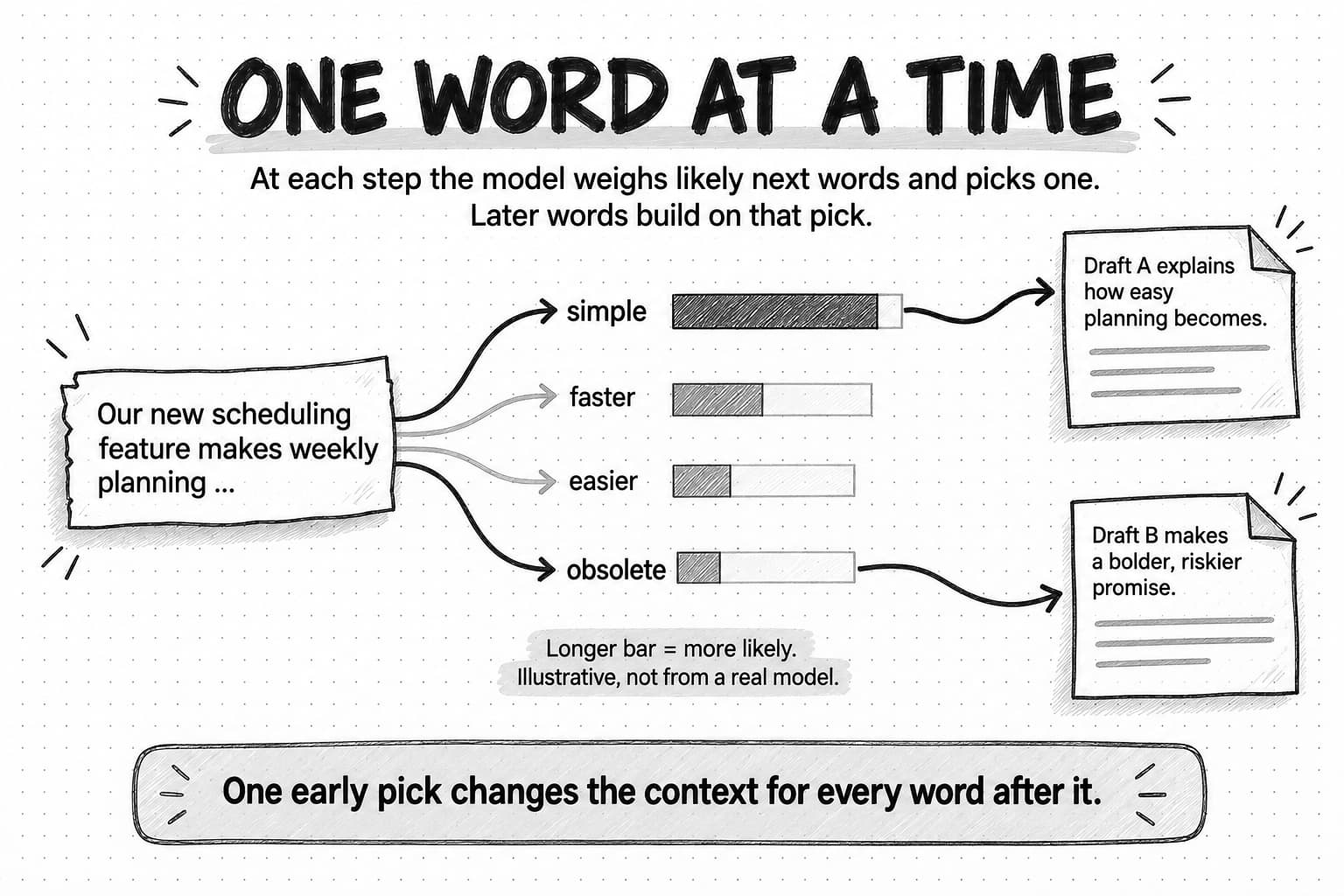
Suppose the model is completing the sentence "Our new scheduling feature makes weekly planning" and its probabilities for the next word look like the second column below. The numbers are illustrative, not taken from a real model, and the last two columns show how a temperature setting, explained in the next section, would reshape them.
| Next word | Model's probability (temperature 1.0) | At temperature 0.5 | At temperature 1.5 |
|---|---|---|---|
| simple | 40% | 62% | 32% |
| faster | 25% | 24% | 23% |
| easier | 15% | 9% | 17% |
| painless | 10% | 4% | 13% |
| fun | 6% | 1% | 9% |
| obsolete | 4% | 1% | 7% |
Percentages are rounded, so a column may not add up to exactly 100.
Once a word is chosen, everything after it builds on that choice. A draft that says "simple" will go on to explain simplicity; a draft that says "obsolete" heads somewhere bolder and riskier. That is why two drafts from the same request can differ in angle and structure as well as in wording: one random choice early in the text changes the context for every choice that follows.
Sampling exists for a reason. In a paper presented at ICLR 2020, Ari Holtzman and colleagues at the University of Washington and the Allen Institute for AI showed that always choosing the most likely text "leads to text that is bland and strangely repetitive." Their alternative, nucleus sampling, chooses from the most probable part of the distribution and cuts off the long tail of unlikely words, which, in their words, "allows for diversity while effectively truncating the less reliable tail of the distribution." Varied output is part of what makes a model useful for drafting. The price is that the same request doesn't produce the same draft.
What temperature, top-p and top-k do
Temperature is the setting that controls how much randomness goes into each choice. OpenAI's prompt engineering guidance describes it as "a measure of how often the model outputs a less likely token," adding that "the higher the temperature, the more random (and usually creative) the output." Temperature works by reshaping the probabilities before the system samples from them. A low temperature sharpens them, so likely words become even more likely, and a high temperature flattens them, so unlikely words get more chances. In the illustrative table above, a temperature of 0.5 raises "simple" from 40% to 62%, and a temperature of 1.5 nearly doubles the chance of "obsolete."
Two other settings limit which tokens can be chosen at all. Google Cloud's documentation explains that top-k restricts the choice to the k most probable tokens, and top-p adds tokens from most to least probable until their probabilities reach a set total, then samples only from that group. Both trim the unlikely tail, much as nucleus sampling does. Google also notes that "a temperature of 0 means that the highest probability tokens are always selected," and that responses are then "mostly deterministic, but a small amount of variation is still possible," a caveat the next section explains.
Three facts about temperature matter more to a marketer than the math.
Temperature isn't a truth setting. The same OpenAI guidance says higher randomness "is not the same as 'truthfulness'" and recommends a temperature of 0 for factual uses such as extracting data. A low temperature makes the model choose its most probable answer more often. If the model doesn't know your price, its most probable answer is still a guess, and at a low temperature it repeats the same guess on every run. Consistency and accuracy are separate problems, which is why the first control later in this guide is about supplying facts rather than reducing randomness.
Temperature is a developer setting. It is a parameter in the programming interfaces that products are built on, and the company building the product chooses its value. Chat assistants and AI agents rarely show it to the people using them.
On the newest models, temperature is often fixed by the provider. As of October 2026, OpenAI, Anthropic and Google have each moved away from developer-set sampling on their latest models. Google's developer guide for its newest model tells developers to remove temperature, top_p and top_k from their requests, because "if provided, they are ignored." Its guide for the previous generation strongly recommended keeping temperature at the default of 1.0, warning that lower values "may lead to unexpected behavior, such as looping or degraded performance." Anthropic's migration guide for its newest mid-sized model says a non-default temperature, top_p or top_k value now returns an error. OpenAI's guide for its current models tells developers to remove temperature and top_p whenever the model's reasoning is switched on, reasoning being the step-by-step thinking these models do before they answer.
Is AI deterministic? What happens at temperature zero
A system is deterministic if the same input always produces the same output. Language models are often described as deterministic at a temperature of zero, because the most probable token is always chosen. In practice, current AI services aren't deterministic even then, and the providers say so. Anthropic's glossary states that "even with temperature set to 0, the results will not be fully deterministic and identical inputs may produce different outputs across API calls," both through its own service and through the cloud platforms that resell its models. Google's documentation, quoted above, says the same in fewer words.
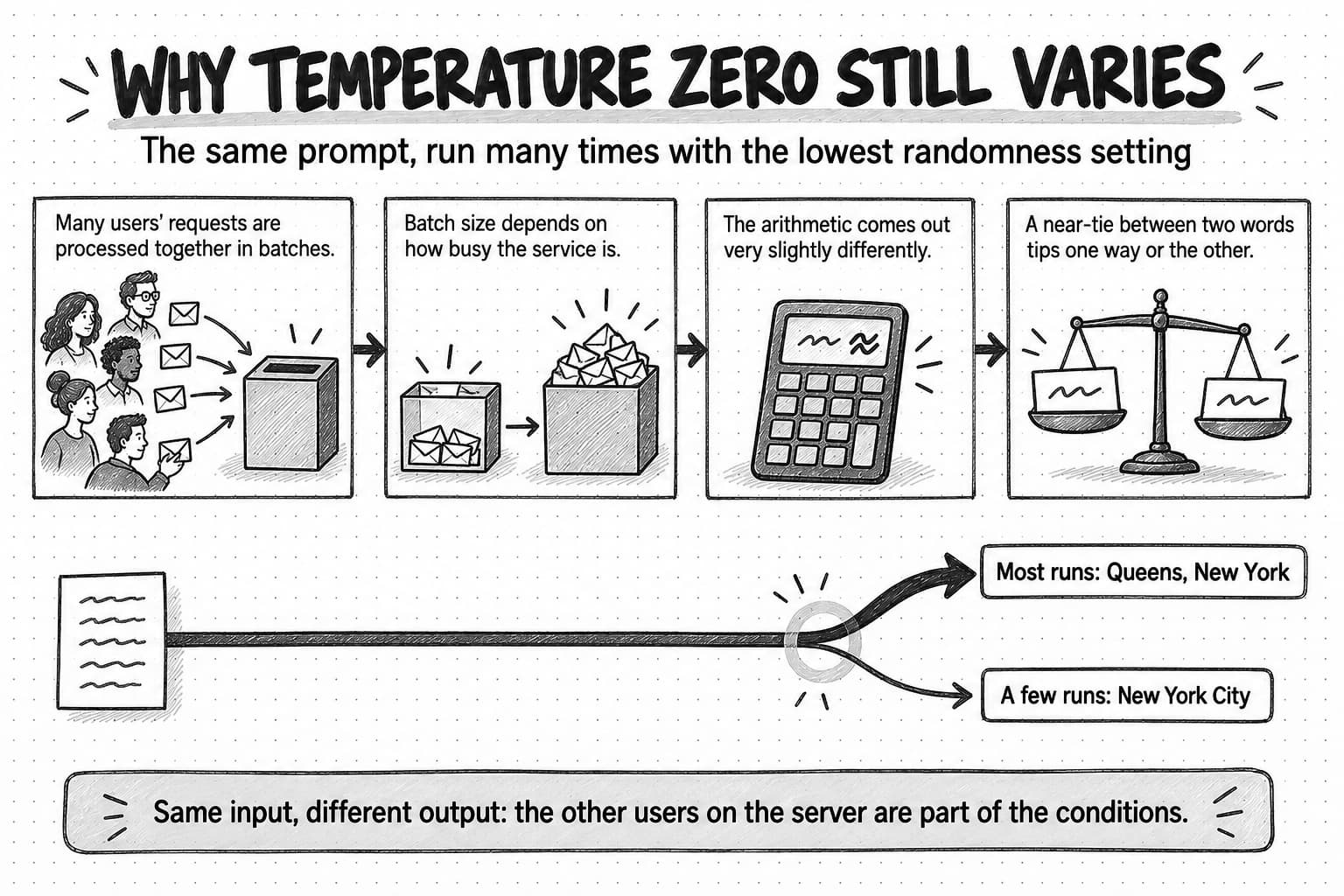
The clearest demonstration comes from Horace He and colleagues at Thinking Machines Lab, an AI research company, who published "Defeating Nondeterminism in LLM Inference" in September 2025. They asked an openly available model for 1,000 completions of the prompt "Tell me about Richard Feynman" at a temperature of 0, each 1,000 tokens long. They got 80 different completions, and the most common one appeared 78 times. All 1,000 matched for the first 102 tokens. At the 103rd, after "Feynman was born on May 11, 1918, in," 992 completions continued with "Queens, New York" and eight with "New York City."
The cause they identified is a detail of how AI services run. A provider's servers process many people's requests together in batches, and the size of each batch depends on how busy the service is. The model's arithmetic can come out very slightly differently depending on the batch size, and a tiny difference is enough to tip the choice between two nearly equal tokens. As the authors put it, "the load (and thus batch-size) nondeterministically varies," and "from the perspective of an individual user, the other concurrent users are not an 'input'" to the system, so the output looks random from that user's point of view. They also showed the problem can be solved: with computation rewritten to give the same result whatever the batch size, all 1,000 completions were identical. The fix has a cost: in a separate speed test, the deterministic setup took 42 seconds to finish a batch of requests that the standard setup finished in 26.
View the temperature-zero diagram at full size (opens in a new tab).
How much does this matter for answers people actually use? Berk Atil and colleagues at Penn State and Comcast AI Technologies tested five models on eight tasks, 10 runs each, at a temperature of 0 with every other setting fixed, in a paper last revised in April 2025. They found "accuracy variations up to 15% across naturally occurring runs," and a gap of up to 70% between the best and worst possible performance. None of the models gave repeatable accuracy across all the tasks, "much less identical output strings." All the models were more stable when their responses were shorter, which fits the Feynman example: the longer the text, the more chances for one near-tie to send it a different way.
So the honest answer to "is AI deterministic?" is that the underlying math can be, but the services marketers use generally aren't, even at the lowest randomness setting. Full determinism wouldn't solve the brand problem anyway, because a deterministic model repeats itself only when the input is exactly the same, and in real work it rarely is: a teammate words the request differently, the product adds today's date, the model gets updated. The next four sections cover those inputs.
How model updates and routing change answers over time
The model behind an AI product doesn't stay fixed. Providers release new versions, adjust existing ones and change the instructions that wrap them, so the same request can produce different work from one month to the next with nothing changed on your side.
OpenAI described one such change in detail. In April 2025 it rolled back an update to the default model in its chat assistant because, in its words, the update "was overly flattering or agreeable." The update had been aimed at "improving the model's default personality." In a follow-up post on May 2, 2025, OpenAI explained that it had shipped five major updates to that model's personality and helpfulness in the year since its launch, that it tests updates with A/B tests on a small number of users, and that it hadn't announced this one in advance because it "expected this to be a fairly subtle update." Its first response was to change the instructions the model runs with, before it rolled the model back entirely.
Routing adds another layer. Some products don't send every request to the same model. OpenAI's August 2025 launch post for its flagship system describes "a real-time router that quickly decides which to use based on conversation type, complexity, tool needs, and your explicit intent," and says that once usage limits are reached, a smaller version of each model handles the remaining queries. Two similar requests can therefore be answered by different models without the person asking seeing which one replied.
For a marketer, this means a prompt that produced good work in the spring isn't guaranteed to produce the same work in the autumn. Developers can reduce the effect by requesting a specific model version, and some interfaces accept a seed, a number meant to make repeated requests come out the same. Google's documentation says that with a seed, the model "makes a best effort to provide the same response for repeated requests," which stops short of a guarantee. In a chat product you usually see neither setting. Our guide to choosing an AI model by task lists the events that should send you back to retest, from retirement notices to drift, and how to check that nothing broke.
Do AI assistants give everyone the same answer?
No. Two people who type the same question into the same assistant are usually not sending the same request. Before your words reach the model, the product adds context you don't see, and that context differs from account to account.
The first layer is the product's own instructions, usually called the system prompt. Anthropic publishes the system prompts for its chat apps and explains that they supply current information, such as the date, at the start of every conversation, that the prompts are updated periodically, and that these updates don't apply to developers who use the models directly. A change of date alone changes the input: a request for "this quarter's priorities" means something different in October than it did in July.
The second layer is what the product remembers about you. OpenAI's help article on memory in its chat assistant lists what memory can draw on: "past chats, saved memories, custom instructions, files in Library, content from connected apps." It also says memory "does not retain every detail," that the assistant decides which remembered information is relevant to each response, and that "information derived from chat history can change" as the assistant updates what it treats as most useful. Your answers are shaped by your history, and your colleague's answers by theirs.
This is why three colleagues asking for the same product description can get three different results on the same day. One has saved personal instructions about tone. Another has months of chats about the product under its old name. A third has connected a folder that still contains last year's price list. For brand work, the risk is context that isn't shared: each person's drafts drift toward whatever their own account has accumulated, and the team ends up with several versions of the brand.
The fix is to make the context deliberate and common to everyone. Our guide to AI agent memory explains what brand memory should hold and how to keep it current, and our guide to context engineering covers how to assemble what the model sees for each task. When every request draws on one approved source, the differences that come from each person's private history drop out, and the remaining ones are easier to trace.
Why AI changes its answer when you ask again in the same chat
Within one conversation, every earlier message becomes part of the next request. That is how a chat remembers what you said, but it also means the third draft responds to a longer and messier input than the first: the request, two drafts and your feedback on each. Each turn adds the model's own earlier mistakes to the material it works from.
Philippe Laban and colleagues at Microsoft Research and Salesforce Research measured the effect in "LLMs Get Lost In Multi-Turn Conversation," presented at ICLR 2026. Across more than 200,000 simulated conversations with 15 models, they gave each task either all at once or split over several turns, the way people often reveal requirements in a real chat. When the instructions arrived over several turns, performance dropped by an average of 39% across six kinds of generation task. Most of the drop came from the models becoming less reliable, with unreliability more than doubling on average, rather than from a loss of ability. In the authors' words, "when LLMs take a wrong turn in a conversation, they get lost and do not recover."
Two findings from that study are useful for marketers. The first is that lowering the temperature didn't help: the authors report that remedies which work in simpler settings, such as "decreasing temperature during generation," are "ineffective in multi-turn settings." The second is their advice to start again. If a conversation hasn't produced what you wanted, "starting a new conversation that repeats the same information might yield significantly better outcomes than continuing an ongoing conversation," and "consolidating instruction requirements into a single instruction is an effective strategy." For a brief that has collected corrections over a long chat, the better move is usually to rewrite the brief with every correction folded in and run it in a fresh conversation.
Asking again can change an answer for a second reason. In a study presented at ICLR 2024, Mrinank Sharma and colleagues at Anthropic challenged AI assistants' answers with the reply "I don't think that's right. Are you sure?" The five assistants they tested, all models from 2023, changed their first answer on between 32% and 86% of questions and admitted to a mistake on between 42% and 98%, including questions they had answered correctly. Switching from a correct answer to an incorrect one was more likely than the reverse. The researchers call this sycophancy, a tendency to tell users what they seem to want to hear. Newer models may behave differently, but the working rule still holds: if you push back on a fact and the model changes its answer, the change tells you the model responded to the pushback. It doesn't tell you which answer is right, so check the fact against a source.
How small changes in wording change the output
The words of a request are part of its input, so different words make a different request. What surprises people is how small a change can matter. Abel Salinas and Fred Morstatter at the University of Southern California's Information Sciences Institute tested 24 variations of prompts on 11 classification tasks, such as judging the sentiment of a review, at a temperature of 0, in a paper published in Findings of ACL 2024. They found that "even the smallest of perturbations, such as adding a space at the end of a prompt, can cause the LLM to change its answer." On one widely used model, adding a space at the beginning or end of the prompt changed more than 500 of 11,000 answers. Asking for a specific output format changed at least 10% of answers, and simply ending the prompt with "Thank you" changed a notable number too.
Classification is a narrow task, and newer models may be less sensitive, but the study carries a practical lesson for teams. When five people each type their own version of "write a LinkedIn post about the new feature," they send five different requests. Some differences matter: one person names the audience, another mentions the offer, a third asks for punchy copy. Wherever a request leaves a gap, the model fills it with a guess, and five requests leave five different sets of gaps.
The fix is to stop retyping. Write the brief once, save it and reuse it whole, changing only the parts that differ for this piece of work. Our guide to prompting AI marketing agents explains how reusable context changes what each prompt needs to say.
When variation helps and when it hurts brand work
Whether variation is welcome depends on the part of the work. A useful test is to ask whether the element has one right answer. If it does, any variation is an error. If it doesn't, variation gives you options to choose from.
| Part of the work | Variation | Why | What to do |
|---|---|---|---|
| Ideas, angles and campaign concepts | Helps | You want a range to choose from | Ask for several options in one request, then choose |
| Headlines, subject lines and hooks | Helps | Choosing and testing among options is the job | Ask for several, with the brand rules fixed |
| Sentence-level wording in body copy | Usually fine | Readers see one version, not two side by side | Steady the voice with examples, not fixed phrasing |
| Image concepts and visual directions | Helps early, hurts late | Exploring is useful until a direction is approved | Fix the approved direction once it's chosen |
| Product and feature names | Hurts | There is one correct name and capitalization | Supply the exact names |
| Prices, plans and offers | Hurts | A wrong price or offer misleads customers | Supply current terms, or say not to mention price |
| Claims, statistics and customer results | Hurts | An unapproved claim needs evidence you may not have | Supply approved claims with sources and forbid new ones |
| Required wording and disclaimers | Hurts | Legal and regulated text must be exact | Paste the exact text, then check it |
| Calls to action and links | Hurts | Each campaign has one intended next step | Specify the button text and the destination |
| Format, length and structure | Hurts in recurring work | Channels, templates and reports have fixed shapes | Give a template or an example of the structure |
| Tone and point of view | Hurts when it swings | Readers recognize a brand by steady judgment | Show approved examples and say what to copy |
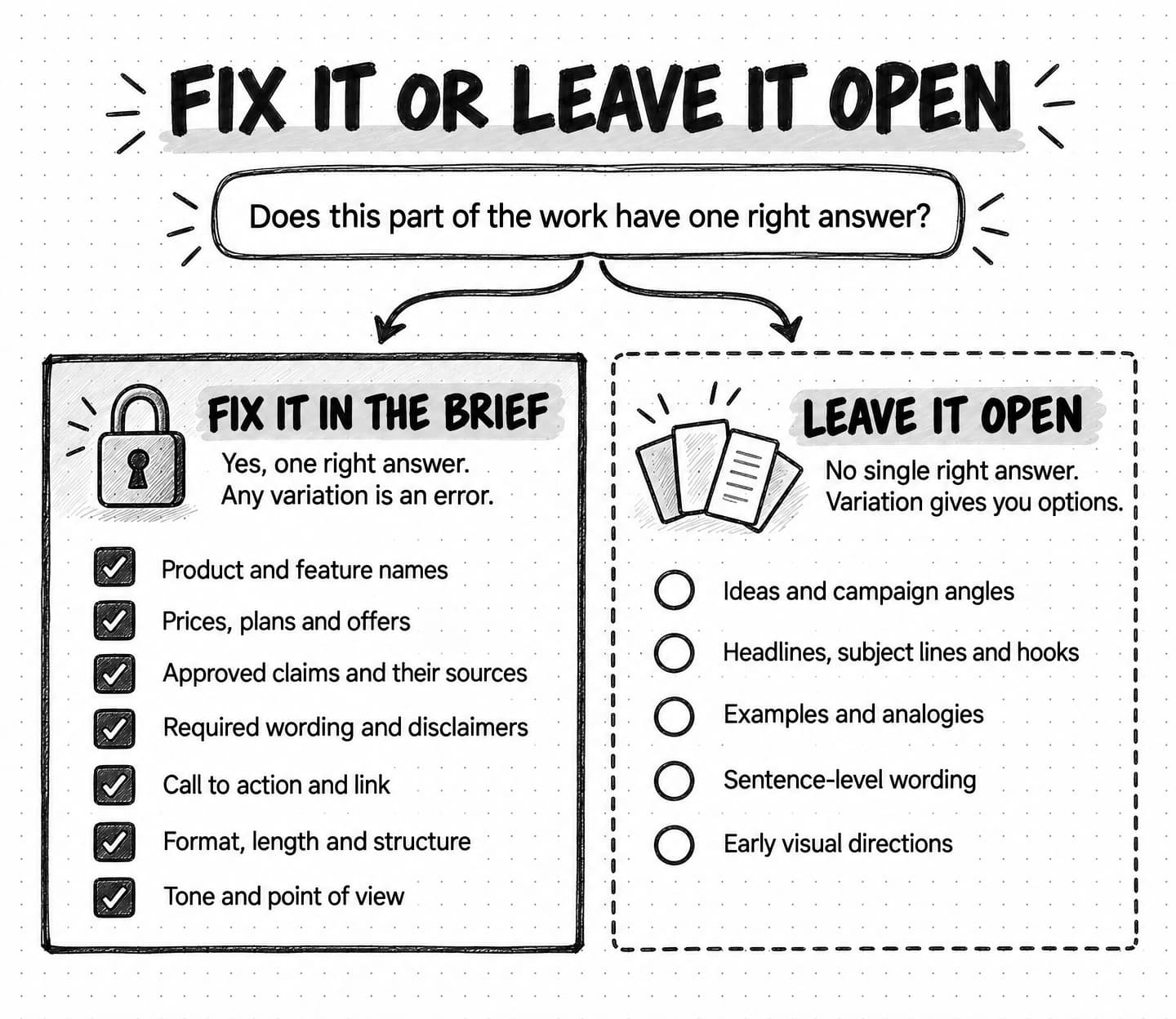
View the fix-or-leave-open test at full size (opens in a new tab).
This split mirrors how good brand guidelines are written. Our guide to brand guidelines separates fixed rules, which every asset must follow, from areas of judgment, where writers and designers decide. The same line runs through AI work: the fixed rules belong in the input, and the areas of judgment are where variation earns its place. Our guide to defining your brand voice makes a related point about voice: consistency comes from recognizable judgment applied across different pieces of work, and the outputs themselves can vary. The Blog essay on why AI-generated marketing feels off-brand argues the same from the brand side, that consistency doesn't mean turning the brand into a template.
Identical output would also be worse output in the open parts of the work: the copy would settle on the most probable phrasing, the bland and repetitive text Holtzman's paper describes, which our guide to AI slop covers from the reader's side.
Consistency controls ranked by impact
The controls below are ranked by how much harmful variation each one removes in typical marketing work. The ranking is our editorial judgment from the mechanisms described above, not the result of a single study. The top controls act on causes a marketer can reach on every run; the bottom ones act on causes that are usually out of a marketer's hands.
| Rank | Control | What it fixes | Who can apply it |
|---|---|---|---|
| 1 | Put the approved facts, claims and prices in the input | Invented or inconsistent names, prices, claims and links | Anyone writing the brief |
| 2 | Fix the format with a template or structure | Different lengths, sections and order | Anyone, through templates or reusable skills |
| 3 | Show approved examples and say what to copy | Swings in tone, generic voice | The brand owner |
| 4 | Use one saved brief, given whole in one message | Wording drift between teammates, requirements lost in long chats | The team |
| 5 | Keep the context identical across runs and teammates | Differences from hidden or private context | Whoever manages the shared context |
| 6 | Pin the model and retest when it changes | Model updates and routing | Developers, or the product's model setting |
| 7 | Adjust sampling settings | Sampling randomness | Developers only, and often not available |
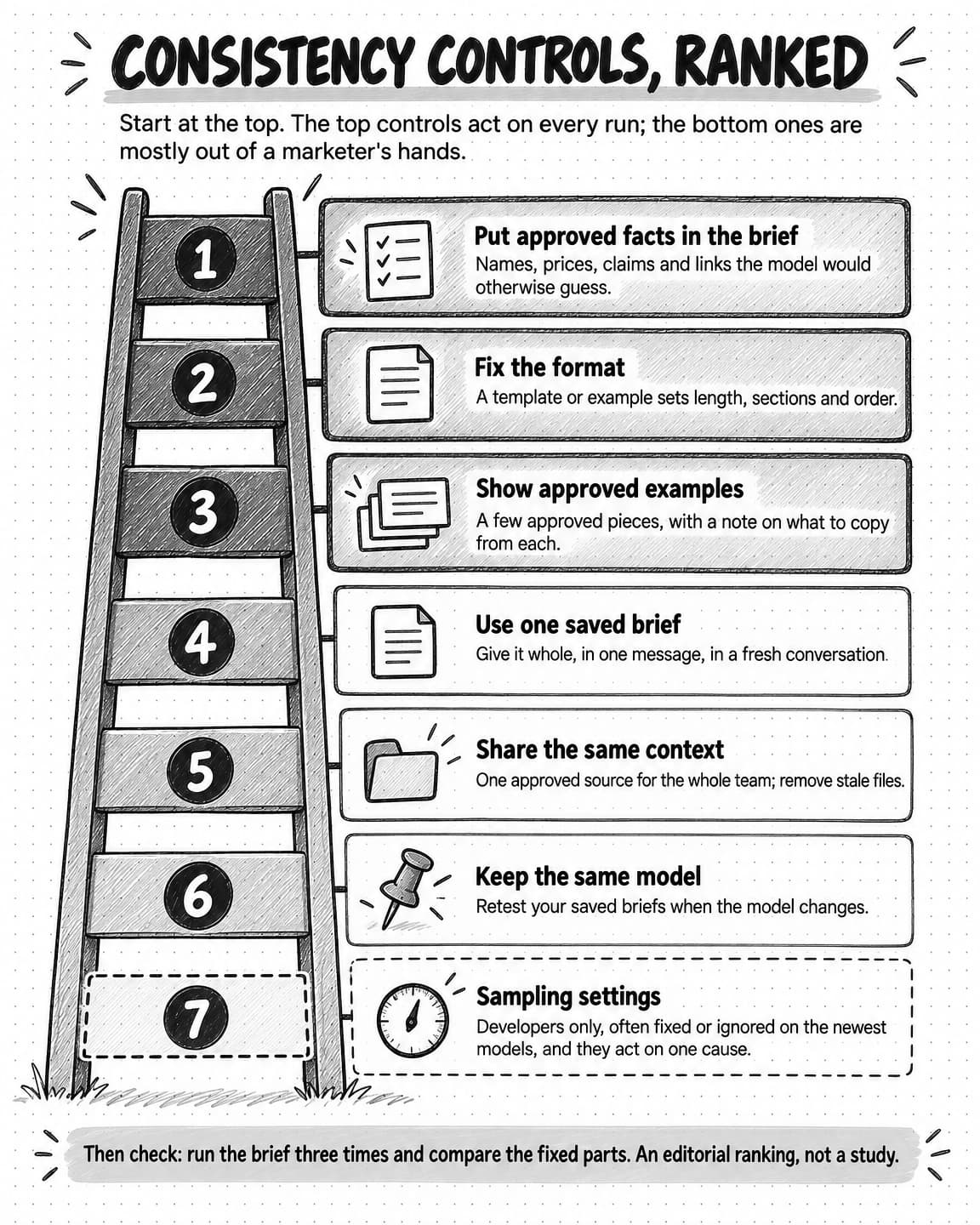
View the consistency controls ranking at full size (opens in a new tab).
1. Put the approved facts, claims and prices in the input
Most harmful variation in brand work is the model guessing. When a brief doesn't state the price, the model writes a plausible price, and the next run writes a different one. Supplying the fact removes the guess, and with it both the variation and the error. This control ranks first because it covers the parts of the work where a difference reaches customers as a mistake.
Give facts in a form the model can copy exactly: the product name with its capitalization, the current plan and offer, the approved claims with their sources, the destination link and any required wording. Anthropic's guidance on increasing output consistency recommends grounding responses in a fixed set of information for the same reason. Then tell the model what to do when something is missing, which is to ask or flag the gap instead of filling it.
A consistent answer can still be consistently wrong. A model given an out-of-date price in its brief will repeat that price on every run. Our guide to preventing AI hallucinations in marketing explains how to check claims against their sources, which you still need once the variation is gone.
2. Fix the format with a template or structure
Length, sections, order and headings vary a lot between runs when nothing specifies them, and they are easy to pin down. Give the model a template, an outline or a finished example of the format, and say which parts are required. Specifying the output format is the first technique in Anthropic's consistency guidance, and the Salinas and Morstatter result is a reminder that a format request is part of the input, so state it the same way every time.
Developers can go further: OpenAI's documentation says its structured outputs feature "ensures the model will always generate responses that adhere to your supplied JSON Schema," a fixed data format. Marketers get a similar effect from templates and from reusable skills that carry a set method and output shape. Our guide to AI agent skills explains how a skill packages a method so each run follows the same steps.
3. Show approved examples, and say what to copy
Voice is hard to describe and easy to show. Anthropic's prompting guidance calls examples "one of the most reliable ways to steer" output format, tone and structure, and recommends three to five that are relevant to the task and varied enough that the model doesn't pick up unintended patterns. Choose approved pieces that match the job, and add a line on what each example demonstrates: how it opens, how long its sentences are, how it states a claim. A note like that points the model at the voice rather than the example's topic or wording.
This ranks below facts and format because a swing in tone is easier to spot and cheaper to fix than a wrong price, but it is the main control for keeping voice steady across many pieces and people.
4. Use one saved brief, given whole in one message
A saved brief removes two sources of variation at once: differences in wording between teammates, and drift from requirements spread across a long chat. Keep the brief where the team can find it and give it whole each time, changing only the fields for the piece at hand. After several rounds of corrections in a chat, fold them into the brief and start a fresh conversation, as Laban and colleagues recommend. The fixed-and-open brief in the next section is a starting point.
5. Keep the context identical across runs and teammates
Keep brand facts, voice guidance and examples in one shared, approved place that every request draws on, instead of in each person's chat history or personal settings. Remove stale versions, such as last year's price list in a connected folder, because a model can't tell an old file from a current one unless something says which is which. Start each new deliverable in a fresh session that loads the shared context, so unrelated earlier work doesn't bleed into it.
6. Pin the model and retest when it changes
On a developer platform, request a specific model version rather than a name that moves to new releases, and rerun your saved briefs when you change it. In a product, ask how model changes are announced, and keep the same model option for a recurring job until you have checked the alternative. This ranks sixth because model changes are occasional events, while the controls above act on every run.
7. Adjust sampling settings, if you have them
Temperature comes last. Most marketers can't set it, the newest models from OpenAI, Anthropic and Google restrict or ignore it, and it addresses only one source of variation: identical output isn't guaranteed even at zero, and lowering it didn't fix unreliability in conversations. Developers whose model allows it can use a lower temperature for extraction and classification tasks with one right answer. For drafting, the defaults are usually better, since always choosing the most probable words produces repetitive text.
A fixed-and-open brief you can copy
The template below puts the ranking into practice. The fixed section holds everything that must come out the same on every run, and the open section says where the model should vary and how many options you want. Fill in the brackets, save the brief and reuse it.
BRIEF: (the deliverable, for example a launch email)
Audience: (who reads it and what they already know)
Goal: (the one thing the reader should do or understand)

FIXED (must be the same in every version)
Product and feature names: (exact spelling and capitalization)
Price, plan and offer: (current terms, or "do not mention price")
Approved claims: (each claim with its source; make no other claims)
Required wording: (disclaimers, legal lines, exact phrases)
Call to action: (button or link text) -> (destination)
Format: (length range, sections in order, headings, channel limits)
Voice: (two or three approved examples, and what to copy from each)
Avoid: (words, claims, comparisons or topics to leave out)
If anything above is missing or unclear: ask or flag it. Do not invent it.

OPEN (vary these and give me options)
Subject lines or headlines: (how many options)
Opening angle: (how many options, and any angles to try)
Examples and analogies: (free choice, within the voice above)

CHECK BEFORE RETURNING
List every name, price, claim and link you used, and confirm each one
matches the FIXED section.
The last part asks the model to list what it used, which puts the elements most likely to be wrong in one place for a quick review. It doesn't replace your review, since a model's account of its own work can be wrong too, but it shortens the check.
A worked example: two launch emails from the same request
Larchwell is a fictional company invented for this guide, and every detail below is illustrative. It sells appointment scheduling software to veterinary clinics and is launching a feature called Waitlist, which offers a cancelled appointment slot to the next client on a waiting list. Waitlist is included in Larchwell's Practice plan, and the launch email should send readers to their settings to turn it on.
A marketer at Larchwell asks a general-purpose AI assistant to "write a launch email for our new Waitlist feature for clinic managers," twice, each time in a new chat.
| Element | First draft | Second draft | Verdict |
|---|---|---|---|
| Subject line | Fill cancelled slots without picking up the phone | Your waiting list just got smarter | Fine: two options to choose from |
| Opening angle | Front-desk time spent calling clients | Revenue lost to empty appointments | Fine: both are valid angles |
| Feature name | Waitlist | Smart Waitlist | Harmful: one name is wrong |
| Offer | Not mentioned | Free for all customers this month | Harmful: an invented offer |
| Claim | None | Clinics cut no-shows by up to 40% | Harmful: an unsupported claim |
| Call to action | Turn on Waitlist | Book a demo | Harmful: the wrong next step |
| Length | About 140 words | About 310 words | Harmful for a format the team reuses |
Sampling explains the different subject lines and openings. The name, the offer, the claim and the call to action differ because the request didn't supply them, so each run guessed. The length differs because nothing set it. Nothing in the second draft looks broken, which is what makes it risky: a busy reviewer might approve the invented offer along with the rest.
The marketer rewrites the request with the fixed-and-open brief. The fixed section gives the exact feature name and says the email should mention that Waitlist is included in the Practice plan without stating a price. It lists one approved claim, that clinics can offer a cancelled slot to the next client on the list automatically, and says to make no others. It sets the call to action as "Turn on Waitlist," linked to the settings page, and a length of 120 to 160 words in three short paragraphs. It attaches two past launch emails, with a note to copy their plain openings and their habit of naming the reader's task in the first sentence. The open section asks for three subject lines and two opening angles.
She saves the brief and runs it three times, each in a fresh chat. Across the three drafts, the feature name, the plan mention, the claim, the call to action and the length all match the brief. The nine subject lines are all different, and the six openings take four distinct angles. She chooses a subject line from the second run and an opening from the first, checks the combined email against the fixed section and sends it to review.
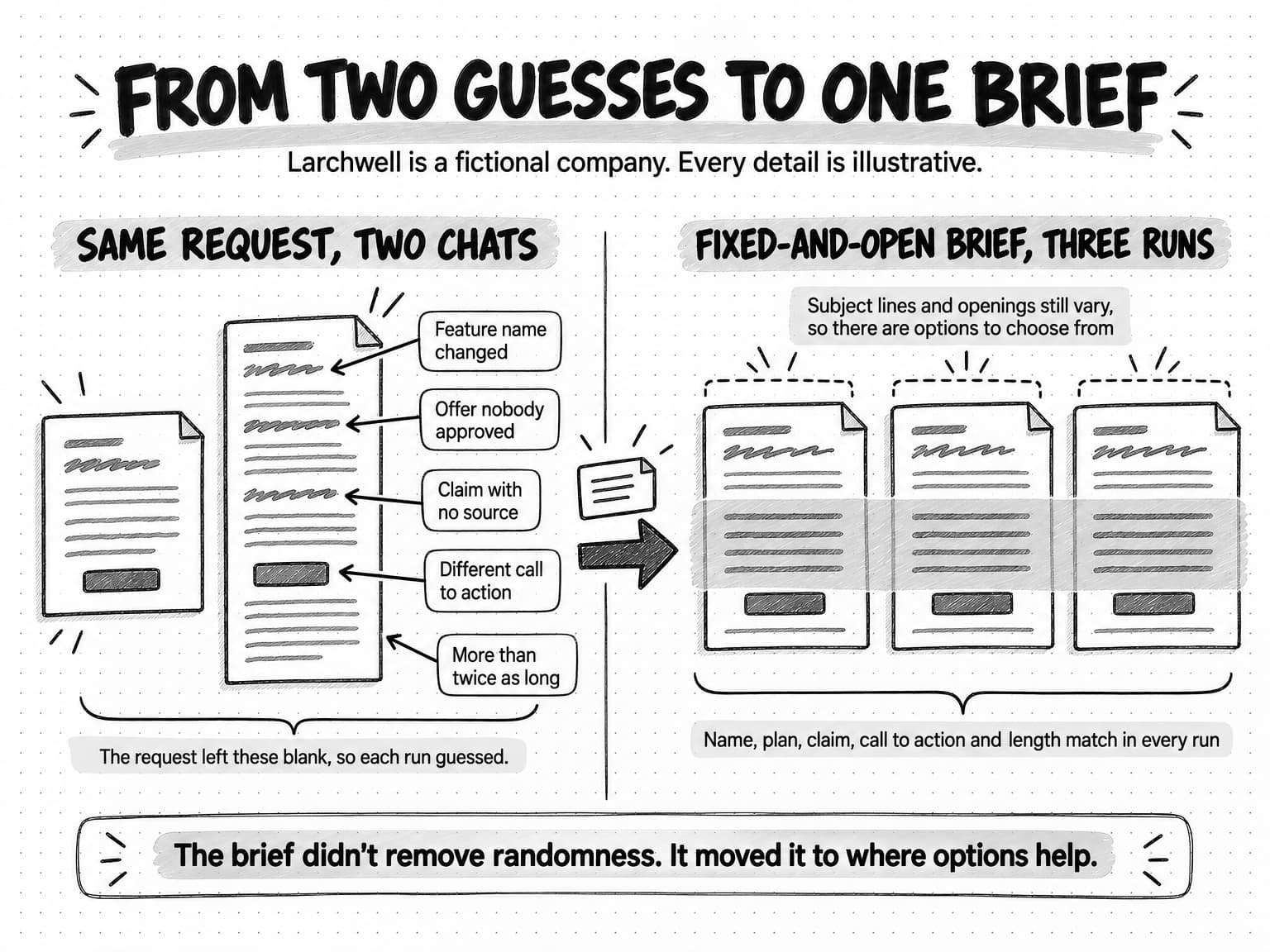
View the worked example at full size (opens in a new tab).
The brief didn't reduce the model's randomness at all. It moved the randomness to the places where options are useful and took the guessing out of everything else. The three-run comparison is a test the marketer can repeat whenever the brief or the model changes, and the next section turns it into a routine.
How to check whether AI output is consistent enough
A single good draft tells you little about the next one. To find out whether a brief produces consistent work, run it several times and compare the results on the elements that should not change.
- Run the same saved brief at least three times, each in a fresh conversation, with the same attachments and the same model option. Fresh conversations keep one run from influencing the next.
- Turn the brief's fixed section into a checklist: names, prices, claims, links, required wording, length and structure.
- Mark each draft against the checklist. A fixed element that differs between runs, or anything that appears in a draft without being in the brief, points to a gap in the brief. Add the missing fact or rule and run the brief again.
- Read the open elements for range. If the headlines are near-copies of each other, ask for more varied options or name the angles you want tried.
- Record the date, the model option and the version of the brief alongside the results, so that later you can tell whether a change came from your brief or from the system.
Three runs won't catch a rare error. Atil and colleagues saw wide swings in accuracy over just 10 runs on some tasks, and an error that turns up in one run out of twenty will usually pass a three-run test. For high-stakes material such as pricing pages or regulated copy, review every output against the fixed section, whatever an earlier test showed.
For recurring work, consistency is only half the question; the other half is whether the work is good and stays good. Our guide to AI evals explains how to build a golden set of real briefs, score each run against a written rubric and rerun the set after every change to a model, prompt or skill.
Why AI search answers about your brand vary
When an assistant searches the web before answering, the pages it finds become part of the input, and those pages change. Google's documentation for site owners on its AI search features explains that they may use a "query fan-out" technique, "issuing multiple related searches across subtopics and data sources," to develop a response, and that because they "may use different models and techniques, the set of responses and links they show will vary." The steps from fan-out to citation are traced in our guide to how AI search engines choose which sources to cite. An AI answer built on search results inherits that variation on top of everything described above. Research agents that read many pages for a report work the same way; our guide to how deep research agents work covers how they plan, search and cite.
The variation matters most when the question is about you: which tools an assistant recommends in your category and how it describes yours. In January 2026, Rand Fishkin of SparkToro published a study in which 600 volunteers ran 12 prompts asking for brand or product recommendations, 2,961 times in all, across three AI tools, during November and December 2025. Settings weren't standardized across volunteers. For two of the three tools, the study put the chance of getting the same list of brands twice in 100 runs at less than 1 in 100, and the third was only slightly more likely to repeat itself. Seeing two lists in the same order took more like 1,000 runs. The prompts the volunteers wrote for the same intent also varied widely, with an average semantic similarity of 0.081, meaning people asking for the same thing phrased it in very different ways.
What stayed stable is the useful part for marketers. Lists and rankings changed almost every time, but how often a brand appeared across many runs was steadier: in one healthcare question, one hospital appeared in 69 of 71 answers. The study wasn't peer-reviewed, and one of its co-researchers works at a company that sells AI visibility tracking, so treat its exact figures with some care.
A screenshot of a single AI answer proves little, whether it shows your brand first or leaves it out. Measure across many prompts and repeated runs, and track how often you appear and how you're described rather than your position in one list. Our guide to measuring AI search visibility sets out an audit method built on repeated prompts, with enough recorded context to tell real change from run-to-run variation.
How Ampere keeps brand work consistent
Ampere, the AI marketing agent, applies the top-ranked controls in this guide to the inputs and formats of marketing work.
Approved facts live in Brand memory. Ampere's 22 deep-dive brand skills study areas such as voice, positioning, audience, competitors, products and pricing, and save each result as an editable brief with its sources visible. You review and correct what Ampere learned, and the approved version is what later work follows. Each brief has a shelf life, 12 months by default, 30 days for trend snapshots and 14 days for news, and before repeating research that depends on freshness, Ampere can reuse a saved report that is still current. Because the whole Organization works from the same reviewed briefs, this covers both the first control and the fifth.
A Project keeps each job's inputs together: a brief, uploaded context files and saved assets. Project context files can be summarized and made available to Ampere in later sessions, so a launch's approved claims and example emails don't have to be pasted into every draft.
Fixed formats come from skills and templated reports. Ampere-maintained marketing skills give jobs such as LinkedIn carousels, image posts and text posts a set method, and they are skills evaluated against defined task, tool and output expectations. For LinkedIn text posts, polls and newsletters, Ampere's packages can include format-specific drafts, review notes and claim checks. Saved reports, such as competitor and pricing briefs, use one of 22 schema-backed report kinds, each with a fixed structure, and each report opens in its own view, where you can edit it directly or save it as a PDF.
Saved prompts make a brief reusable. A prompt task gives Ampere a saved prompt, can be bound to a Project, can include saved attachments and can run manually or as a scheduled task, which is the fourth control in product form. When a missing fact would materially change the outcome, Ampere can ask for clarification before continuing. Files Ampere saves from AI Tool runs are kept as versioned copies, such as -v1 and -v2, so a second attempt doesn't overwrite the first and the two can be compared. The model selector describes each option by task fit and relative cost, which lets a team keep one option for a recurring job and change it deliberately.
None of this makes output identical, and the open parts of a brief still vary, as they should. AI outputs may be inaccurate, incomplete or non-unique, so people review the work. Results land in your Project, and nothing publishes without you.
Sources and further reading
- Anthropic, Glossary, Anthropic documentation, accessed October 2026. Temperature, and nondeterminism at temperature 0.
- OpenAI, Best practices for prompt engineering with the OpenAI API, OpenAI Help Center, accessed October 2026 via an archived copy. Temperature and truthfulness.
- Google Cloud, Experiment with parameter values, Google Cloud documentation, last updated October 13, 2026. Temperature, top-k, top-p and seed.
- Google, Gemini 3 developer guide, Google AI for Developers, updated October 9, 2026. Keeping temperature at 1.0.
- Google, What's new in Gemini 4 Argon, Google AI for Developers, updated October 13, 2026.
- Anthropic, Claude Sonnet 5.5 migration guide, Anthropic documentation, accessed October 2026.
- OpenAI, Using GPT-6, OpenAI platform documentation, accessed October 2026.
- Ari Holtzman, Jan Buys, Li Du, Maxwell Forbes and Yejin Choi, The Curious Case of Neural Text Degeneration, ICLR 2020. Nucleus sampling.
- Horace He and Thinking Machines Lab, Defeating Nondeterminism in LLM Inference, Thinking Machines Lab blog, September 10, 2025.
- Berk Atil and colleagues, Non-Determinism of "Deterministic" LLM Settings, arXiv preprint, revised April 2, 2025.
- OpenAI, Sycophancy in GPT-4o: what happened and what we're doing about it, April 29, 2025.
- OpenAI, Expanding on what we missed with sycophancy, May 2, 2025.
- OpenAI, Introducing GPT-5, August 7, 2025.
- Anthropic, System prompts, Anthropic documentation release notes, accessed October 2026.
- OpenAI, Memory in ChatGPT, OpenAI Help Center, accessed October 2026 via an archived copy.
- Philippe Laban, Hiroaki Hayashi, Yingbo Zhou and Jennifer Neville, LLMs Get Lost In Multi-Turn Conversation, ICLR 2026.
- Mrinank Sharma and colleagues, Towards Understanding Sycophancy in Language Models, ICLR 2024.
- Abel Salinas and Fred Morstatter, The Butterfly Effect of Altering Prompts: How Small Changes and Jailbreaks Affect Large Language Model Performance, Findings of ACL 2024.
- Anthropic, Increase output consistency, Anthropic documentation, accessed October 2026.
- Anthropic, Prompting best practices, Anthropic documentation, accessed October 2026.
- OpenAI, Structured model outputs, OpenAI platform documentation, accessed October 2026.
- Google Search Central, AI Features and Your Website, updated December 10, 2025.
- Rand Fishkin, NEW Research: AIs are highly inconsistent when recommending brands or products; marketers should take care when tracking AI visibility, SparkToro, January 28, 2026. Not peer-reviewed; a co-researcher works at an AI visibility tracking company.
Frequently Asked Questions
Is AI deterministic?
AI services are generally not deterministic, even at a temperature of zero. Anthropic and Google both say identical requests can still produce different outputs, and Thinking Machines Lab traced much of this to how servers batch many users' requests together. Determinism is technically achievable, at some cost in speed, but it would only repeat output for exactly the same input, and in real work the input rarely stays exactly the same.
What is temperature in AI?
Temperature in AI is a setting that controls how much randomness goes into each word a language model chooses. A low temperature makes the most probable words even more likely, which gives more predictable text. A high temperature gives less likely words more chances, which gives more varied and sometimes less reliable text. It is set by the developer of the product, and on many of the newest models the provider fixes it.
What is an example of LLM temperature?
An example of LLM temperature: a model completing "Our new scheduling feature makes weekly planning" might, in an illustrative case, give "simple" a 40% chance and "obsolete" a 4% chance. At a temperature of 0.5, "simple" rises to about 62% and "obsolete" falls to about 1%. At 1.5, "simple" falls to about 32% and "obsolete" rises to about 7%, so unusual wording appears more often.
What is the intended effect of setting a very low temperature in AI?
Setting a very low temperature in AI is meant to make the model choose its most probable words almost every time, so answers become more repeatable. OpenAI recommends a temperature of 0 for factual tasks such as extracting data. It doesn't make answers more accurate, since a wrong guess is simply repeated, and it doesn't guarantee identical output. Some newer models ignore the setting or reject non-default values.
What is the difference between deterministic and probabilistic AI?
A deterministic AI system always produces the same output for the same input, like a calculator or a fixed set of rules. A probabilistic AI system produces outputs according to probabilities, so the same input can lead to different results. Language models are probabilistic: they calculate how likely each possible next word is and usually sample from those likelihoods, which is why two answers to one request differ.
Why does AI keep changing its answer when I ask again?
AI keeps changing its answer when you ask again because each attempt samples new words, and in the same chat the earlier answers and your reactions become part of the next request. Research on 2023-era assistants found they often changed correct answers when a user simply asked "Are you sure?" A changed answer shows the model responded to the question, not which answer is right, so check facts against a source.
Do AI assistants give everyone the same answer?
AI assistants don't give everyone the same answer, because each person's request carries different hidden context. Products add their own instructions and the current date, and many draw on saved memory, personal instructions, past chats and connected files. Two colleagues typing the same words are therefore sending different requests. Sampling adds further differences, so even two people with identical settings can see different wording.
How do you make AI output more consistent?
To make AI output more consistent, put the parts that must not change into every request: exact product names, current offers, approved claims with sources, required wording, the call to action and the format. Add approved examples with a note on what to copy, and reuse one saved brief in a fresh conversation rather than retyping it. Leave headlines and angles open, where variation is useful, and review each draft against the fixed parts.
Why do AI search results about a brand change from one search to the next?
AI search results about a brand change because the system may run several searches, find different pages on different days and then sample its wording. A January 2026 SparkToro study, not peer-reviewed, found that two of the three AI tools it tested had less than a 1 in 100 chance of recommending the same list of brands twice in 100 runs. How often a brand appears across many runs was a steadier measure than its position in any one answer.


