What is AI slop? How marketing teams spot and avoid it
Why polished AI content can still waste a reader's time, how to recognize it in your own marketing, and an editing process that keeps AI-assisted work specific to your brand.
28 min readWritten by Ampere
Short answer
What is AI slop?
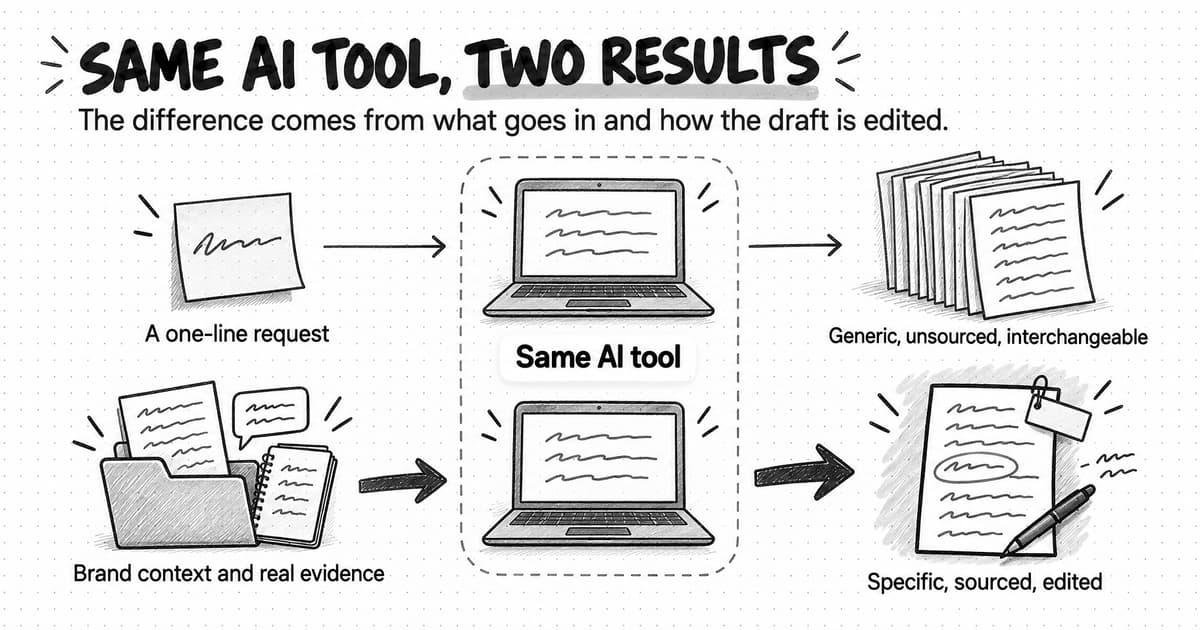
AI slop is low-quality content made with generative AI, usually quickly and in volume, that gives its audience little or nothing of value. The term names a quality problem rather than a tool: AI-assisted work built from real context and evidence, then edited, is not slop, while generic, unsourced, interchangeable content is, however smoothly it reads.
Summary
The term AI slop spread in 2024 by analogy with spam, and in 2025 Merriam-Webster chose slop and Australia's Macquarie Dictionary chose AI slop as word of the year. Their definitions describe low-quality, often mass-produced content that nobody asked for. Because low value is the defining trait, a team can use AI on every draft without publishing slop.
Five signals show that marketing content is slop: generic substance, unsupported specifics, an interchangeable voice, template structure, and visual sameness. Each comes with a question to ask of any draft, such as whether a regular customer would recognize the voice with the logo removed. Several signals together mean the inputs need work, not the sentences.
Slop costs attention first and trust second, because it shifts effort from the publisher to the reader. Vendor research from 2025 found that people rated content they believed was AI-generated as less trustworthy whether or not it was, and a 2024 experiment found that stories written with AI ideas were rated better individually but were more alike as a group.
Workslop is the workplace form of slop: AI-generated work that looks finished but doesn't move the task forward, so a colleague has to fix or redo it. In a 2025 survey of 1,150 full-time U.S. employees, 40% had received some in the previous month. In marketing, it hides in briefs, research summaries, and drafts for review.
AI-generated content is not bad for SEO in itself. Google says its systems reward helpful, original content however it is produced, and its scaled content abuse policy targets pages generated in bulk mainly to manipulate rankings. Google also calls it critical to fact-check AI output, including page titles, meta descriptions, and image alt text, before publishing.
Avoiding slop starts before the draft and ends after it. Decide what the piece adds, give the AI brand context and real evidence, brief for specific claims, edit for substance before voice, and review against the five signals. AI detectors are no substitute, because a detector score says nothing about whether content is useful.
Contents
- What AI slop means and where the term came from
- How AI slop differs from hallucinations, spam, plagiarism, and weak writing
- What AI slop looks like in marketing content
- Five signals that marketing content is AI slop
- Why AI slop costs attention and trust
- What workslop is and why it matters to marketing teams
- Is AI-generated content bad for SEO?
- How to avoid AI slop when you use AI for marketing
- How Ampere keeps AI drafts specific to your brand
- Sources and further reading
- Frequently Asked Questions
In December 2025, Merriam-Webster named slop its word of the year and defined it as “digital content of low quality that is produced usually in quantity by means of artificial intelligence.” A few weeks earlier, Australia's Macquarie Dictionary had chosen “AI slop” for the same honor. For a marketer who uses AI to draft blog posts, ads, and social images every week, the choice raises an awkward question: does that work count?
Not necessarily. AI slop is low-quality content made with generative AI, usually quickly and in volume, that gives its audience little or nothing of value. The tool is part of the name, but the problem is the work itself: a post any company in the category could have published, a statistic nobody can source, an image that looks like every other AI image in the feed. A team can use AI on every draft without publishing slop, as long as the drafts start from the team's own knowledge and someone edits them for substance.
That distinction matters for the two worries that usually bring people to the term. Marketers fear that AI will make their brand sound like everyone else's, and founders wonder whether AI-written pages will hurt them in search. Both come down to whether a piece tells the reader something they couldn't get elsewhere. The sections below give you five signals to check in your own content, explain what Google's guidance says about AI-generated pages, and set out an editing process for using AI without producing slop.
What AI slop means and where the term came from
AI slop means unwanted, low-value content produced with AI, and the term spread in 2024 by analogy with spam. The word itself is old. Merriam-Webster traces it to the 1700s, when slop meant “soft mud.” In the 1800s it came to mean food waste, and later “rubbish” or “a product of little or no value.” The AI sense inherits that disgust.
In May 2024, the software developer Simon Willison wrote that slop was becoming the name for unwanted AI-generated content, crediting a social media post that compared it to the way spam became the word for unwanted email. His distinction is a useful one for marketers: “Not all promotional content is spam, and not all AI-generated content is slop. But if it's mindlessly generated and thrust upon someone who didn't ask for it, slop is the perfect term for it.”
By late 2025, dictionaries had caught up. The Macquarie Dictionary chose “AI slop” as both its committee's and the public's word of the year for 2025, defining it as “low-quality content created by generative AI, often containing errors, and not requested by the user.” Merriam-Webster followed in December, and its examples of the year's slop include “off-kilter advertising images” and “workslop” reports that waste coworkers' time.
Across these definitions, three elements recur: the content is low in quality or value, it is made with little care and often in quantity, and it reaches people who didn't ask for it. AI appears in every definition, but low value is what makes content slop, and value is the part a marketing team controls. The rest of this guide treats slop as a quality problem, which is also how Google's search guidance treats AI-generated content.
How AI slop differs from hallucinations, spam, plagiarism, and weak writing
AI slop is defined by low value, which separates it from four problems it often travels with: a hallucination is defined by falsehood, spam by manipulation, plagiarism by copying, and weak writing by poor craft. Each calls for a different first check.
| Problem | What goes wrong | A marketing example | First check |
|---|---|---|---|
| AI slop | AI-made content gives the reader little or nothing of value | A blog post that restates the top search results in stock phrases | Run the five slop signals in this guide |
| Hallucination | A model presents false or unsupported information as fact | An invented statistic, quote, or product feature | Trace every factual claim to a source |
| Spam | Content made mainly to manipulate people or search rankings, often at scale | Hundreds of near-identical pages built to catch search traffic | Ask whether the page would exist if search engines didn't |
| Plagiarism | Someone else's words or ideas presented as your own | A competitor's case study paraphrased without credit | Compare with the sources, then credit or cut |
| Weak writing | Unclear or careless writing, whoever produced it | A product update that buries the change in its fourth paragraph | Edit for clarity and structure |
| Useful AI-assisted content | AI speeds up work that is accurate, specific, and edited | A post drafted from your own customer interviews, then fact-checked and edited | Review it as you would any draft |
The categories overlap in practice. A sloppy post can contain a hallucinated statistic, slop published in bulk to attract search traffic becomes spam under Google's policies, and a draft that follows one competitor's article too closely drifts toward plagiarism. Naming the main defect tells you which fix to apply first.
The last row is there because the tool alone doesn't decide the category. AI-assisted content that starts from your own evidence and survives a careful edit is ordinary good marketing. The quality problems behind slop are also older than the tools. In its 2023 guidance on AI content, Google recalled concerns from “about 10 years ago” over “a rise in mass-produced yet human-generated content,” which it answered by improving its systems to reward quality content. Generative AI made that kind of content far cheaper to produce, and the new word arrived with it.
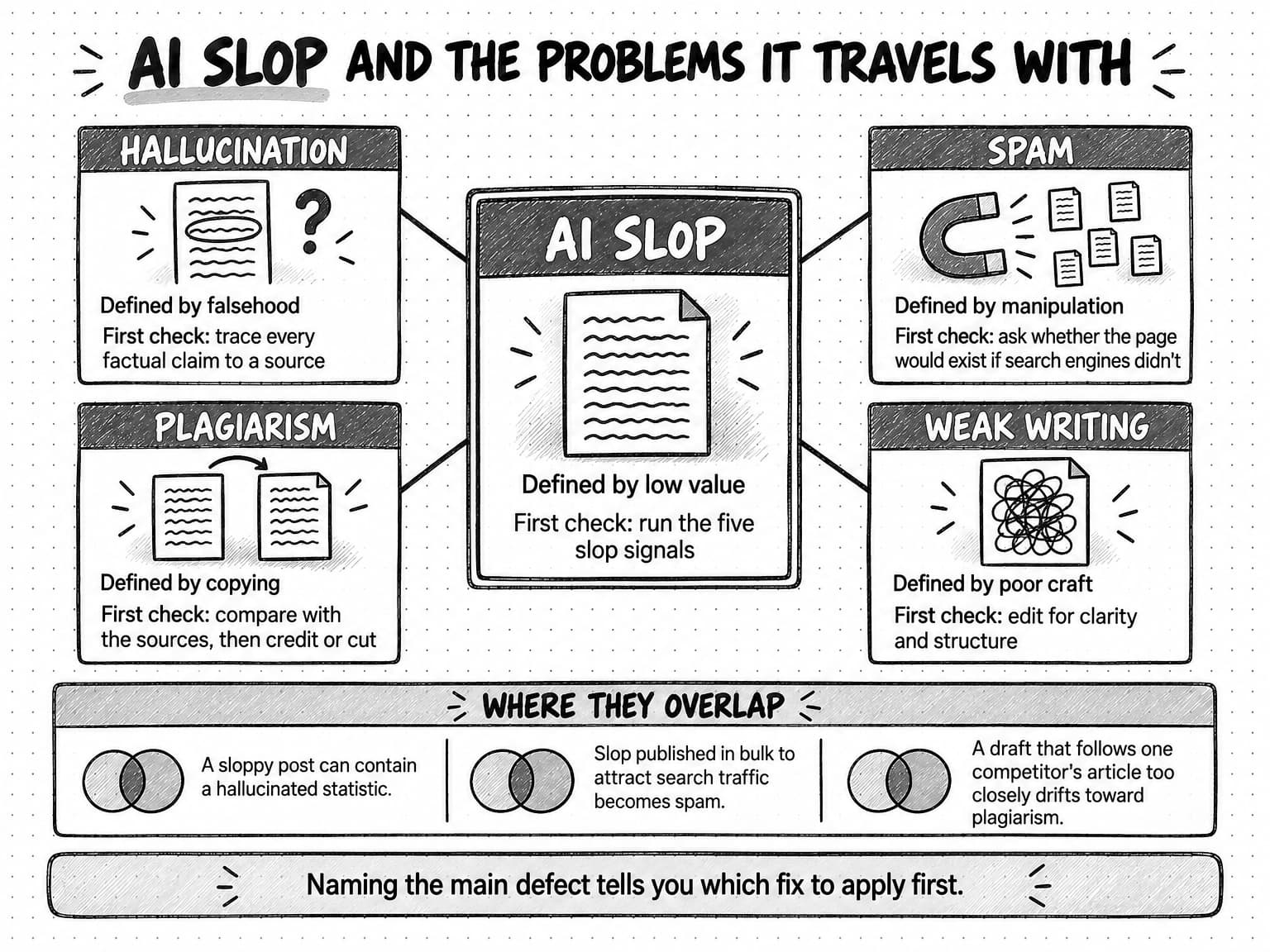
View the diagram of AI slop and related problems at full size (opens in a new tab).
What AI slop looks like in marketing content
In marketing, AI slop rarely looks broken. It usually looks finished: grammatical, well formatted, and on topic, yet interchangeable with what every competitor publishes. A few forms recur across channels.
On blogs and search pages, the common version is an article that summarizes what already ranks for a query, adds no example or data of its own, and pads the result with a long preamble. At scale, it becomes dozens of near-identical pages, one per city, industry, or job title, that differ only in the swapped noun. Bylines can be slop too, such as an invented expert with an AI-generated headshot.
In ads and social images, the familiar tells are faces that are too smooth, hands with the wrong number of fingers, lettering that dissolves into nonsense, and the glossy lighting of a default output. The ad copy beside them often fits any product in the category.
On social networks, slop often follows a formula of a hook line, a ladder of one-sentence paragraphs, a numbered list of lessons, and a closing question written to collect comments. Each element can work in a post that has something to say. Stacked around nothing in particular, they produce posts that read like each other.
In email and outreach, “personalized” messages that insert a first name, a company name, and a compliment that would fit any company are slop at the scale of a sequence. The same pattern shows up inside teams as briefs, competitor summaries, and reports that look complete but leave the reader to do the thinking. Researchers have named that version workslop, covered later in this guide.
Five signals that marketing content is AI slop
Five signals show that a piece of marketing content is slop: generic substance, unsupported specifics, an interchangeable voice, template structure, and visual sameness. Each comes with a question you can ask of any draft, whoever or whatever wrote it. One signal on its own is a reason to edit. When three or four appear together, the piece usually needs better inputs, because polishing sentences can't add what the draft never had.
The examples below follow a fictional invoicing app for freelancers. They are illustrations written for this guide, not real company copy.
Generic substance
Generic content says what anyone could say about the topic. It states that customer feedback matters or that consistency builds trust, then stops before the part only your company knows. Google's own guidance notes that generative models “predict a likely sequence of words based on their training data,” so without your context a draft tends to drift toward what has most often been written about the subject. The question to ask is what the reader knows or can do after reading that they couldn't before. “Getting paid on time is essential for every freelancer” teaches nothing. “If a client hasn't paid by the due date, the app sends a reminder that morning with a pay-now link, then a second one three days later” tells the reader exactly what happens.
Unsupported specifics
Slop often borrows the look of evidence, such as a precise percentage, a quote, or a named study, without the source behind it. Precision makes a claim sound checked, which is why an unsourced number can do more damage than a vague sentence. Whether the number is also false is a separate question; the slop problem is that nobody can tell. Ask whether you can point to the source of every number, quote, and named claim, with its date and scope. “Late payments cost freelancers 20% of their income” has no origin. “Of the 1,200 invoices our customers sent in March, 31% were paid after the due date” says where the figure comes from and how far it reaches.
An interchangeable voice
An interchangeable voice could belong to any brand. It leans on inflated words such as unlock, elevate, and seamless, announces significance instead of showing it, and avoids the words customers actually use. Research has started to document the habits behind this sameness. A 2025 study in PNAS found that instruction-tuned language models write in a noun-heavy, “informationally dense” style, using present participial clauses at two to five times the human rate, even when prompted to match informal speech. Another 2025 study, of more than 15 million biomedical abstracts, found words such as “delves,” “underscores,” and “showcasing” far more common in 2024 than earlier trends predicted.
None of these habits proves that a model wrote a sentence, because people use every one of them. They become a problem when they cluster and crowd out your own way of speaking. Ask whether a regular customer would recognize the piece as yours with the logo removed. “Unlock seamless invoicing and take your business to the next level” could come from any company. “Send the invoice from your phone before you leave the client's office” sounds like a company that knows its customers' day.
Template structure
Template structure applies the same shape to every subject, with an introduction about why the topic matters in today's world, sections of identical length under headings that announce rather than inform, a list of exactly five tips, and a conclusion that repeats the introduction. The shape becomes a problem when it replaces the reader's question as the organizing principle. Ask whether the order follows what the reader needs to know first. A slop version of the invoicing post gives five tips of equal weight and ends, “In conclusion, getting paid on time is crucial.” A rebuilt version opens with the answer (send the first reminder on the due date), explains why, shows the reminder text, and says when a phone call works better.
Visual sameness
Visual sameness is the image version of an interchangeable voice. It shows up as the stock AI aesthetic, colors that ignore your brand, and pictures that illustrate the category rather than the message. It also covers errors a careful review would catch, such as garbled lettering in a product mockup. Ask whether each image shows something specific to this message, in your visual style. A glossy illustration of a robot handing a coin to a smiling freelancer could sit on top of any finance article. A cropped screenshot of the actual reminder email, with the pay-now link circled, belongs to this one.
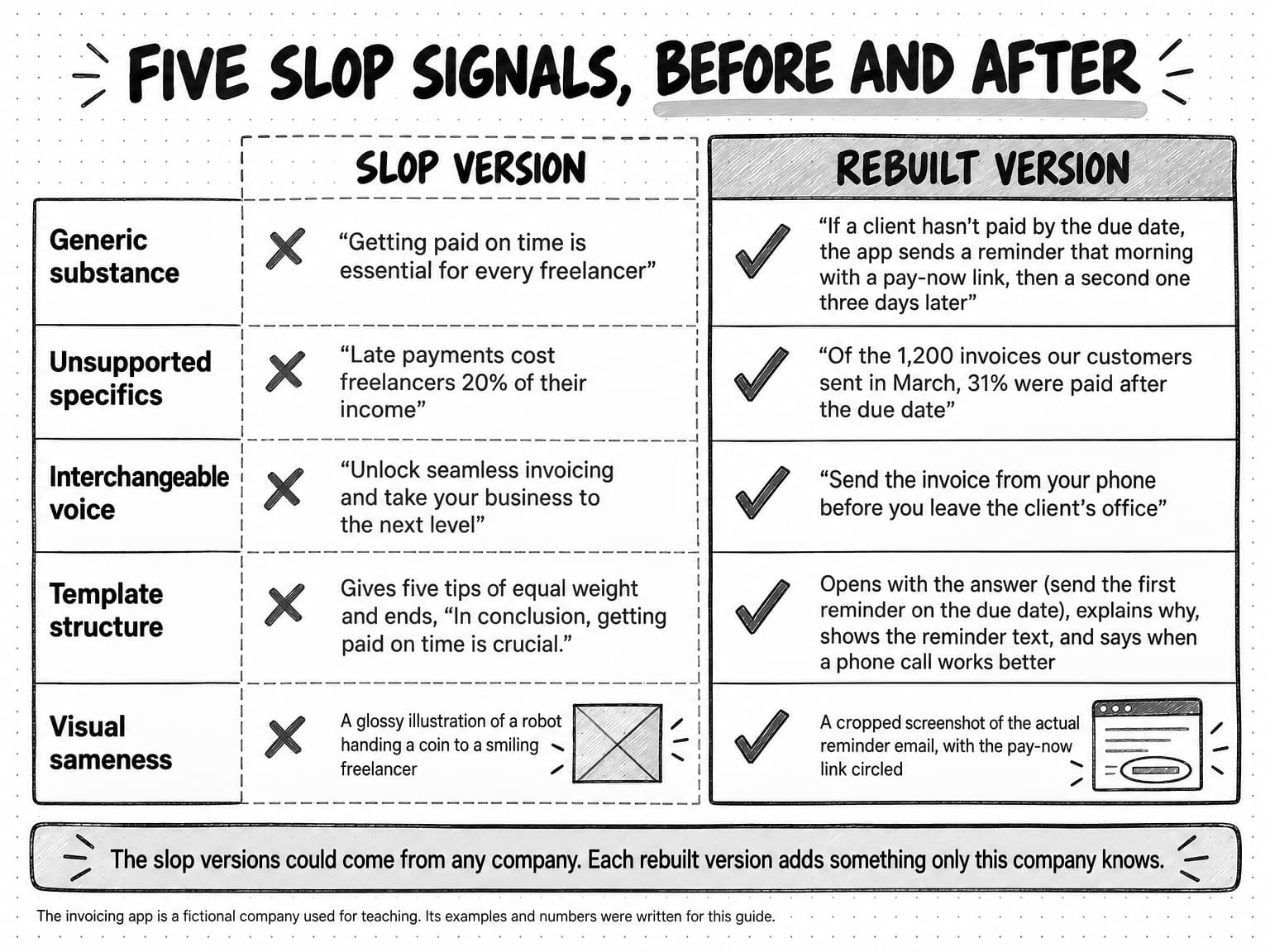
View the before-and-after table of the five slop signals at full size (opens in a new tab).
| Generic substance | After reading this, what does the reader know or have that they did not before? |
|---|---|
| Unsupported specifics | Can you point to the source of every number, quote, and named claim, with its date and scope? |
| Interchangeable voice | With the logo removed, would a regular customer recognize this as yours? |
| Template structure | Does the order follow what the reader needs to know first, or a template? |
| Visual sameness | Does each image show something specific to this message, in your visual style? |
Why AI slop costs attention and trust
AI slop costs a brand its readers' attention first and their trust second, because every piece asks for time and gives little back. The costs fall unevenly. A model can produce a passable post in seconds, but reading it still takes the reader minutes, so each piece of slop moves the effort from the publisher to the audience. When a channel rewards volume, such as more pages for search or more posts for reach, cheap generation pushes toward more of it, which helps explain how quickly slop spread.
Readers also discount content they suspect is AI-generated, whether or not it is. Raptive, which helps creators and publishers make money from advertising, commissioned a study in which 3,000 nationally representative U.S. adults reviewed similar pieces of content, some written by people and some generated by AI. Raptive reported in August 2025 that when people thought something was AI-generated, they rated it much worse on trust and authenticity, “regardless of whether it was really AI-generated or not,” and that the damage extended to the ads shown alongside it. This is vendor research, and it suggests that a human-written post readers mistake for AI work can pay the same price.
The longer-term cost is sameness. In an experiment published in Science Advances in July 2024, 293 writers wrote short stories, some with story ideas from a language model, and 600 evaluators rated the results. Stories written with AI ideas were rated more creative, better written, and more enjoyable, especially among less creative writers, yet they were more similar to one another. The authors compared the result to a social dilemma, in which each writer was better off while the group produced a narrower range of work. For a marketing team using the same tools as its competitors without its own context, the parallel risk is that each asset improves while the brand blends in. Our Blog looks at that drift in why AI-generated marketing so often looks good and still feels off-brand.
What workslop is and why it matters to marketing teams
Workslop is AI-generated work that looks finished but doesn't move the task forward, so a colleague has to interpret, fix, or redo it. Researchers at BetterUp Labs, part of the coaching company BetterUp, and the Stanford Social Media Lab named it in a September 2025 Harvard Business Review article, defining it as “AI generated work content that masquerades as good work, but lacks the substance to meaningfully advance a given task.” In their words, workslop “transfers the effort from creator to receiver.”
Their ongoing survey of 1,150 full-time U.S. employees found that 40% had received workslop in the previous month, and those who had estimated that an average of 15.4% of the content they received at work qualified. Recipients said each instance took an average of one hour and 56 minutes to deal with. The cost was also social. About half viewed the sender as less creative, capable, and reliable, and 42% saw them as less trustworthy. The figures are self-reported, so they indicate scale without measuring it precisely. The authors trace part of the problem to leaders who push AI everywhere without discernment about where it helps, summed up in one of their principles: “Indiscriminate imperatives yield indiscriminate usage.”
Marketing teams hand off exactly the documents where workslop hides, such as campaign briefs, research summaries, competitor reports, content plans, and drafts for review. A brief that names no audience, offer, or evidence forces the designer or writer who receives it to reconstruct all three. Preventing workslop takes the same habits as preventing public slop: give the AI your context before it drafts, check the output against the task before you share it, and tell the recipient what you verified.
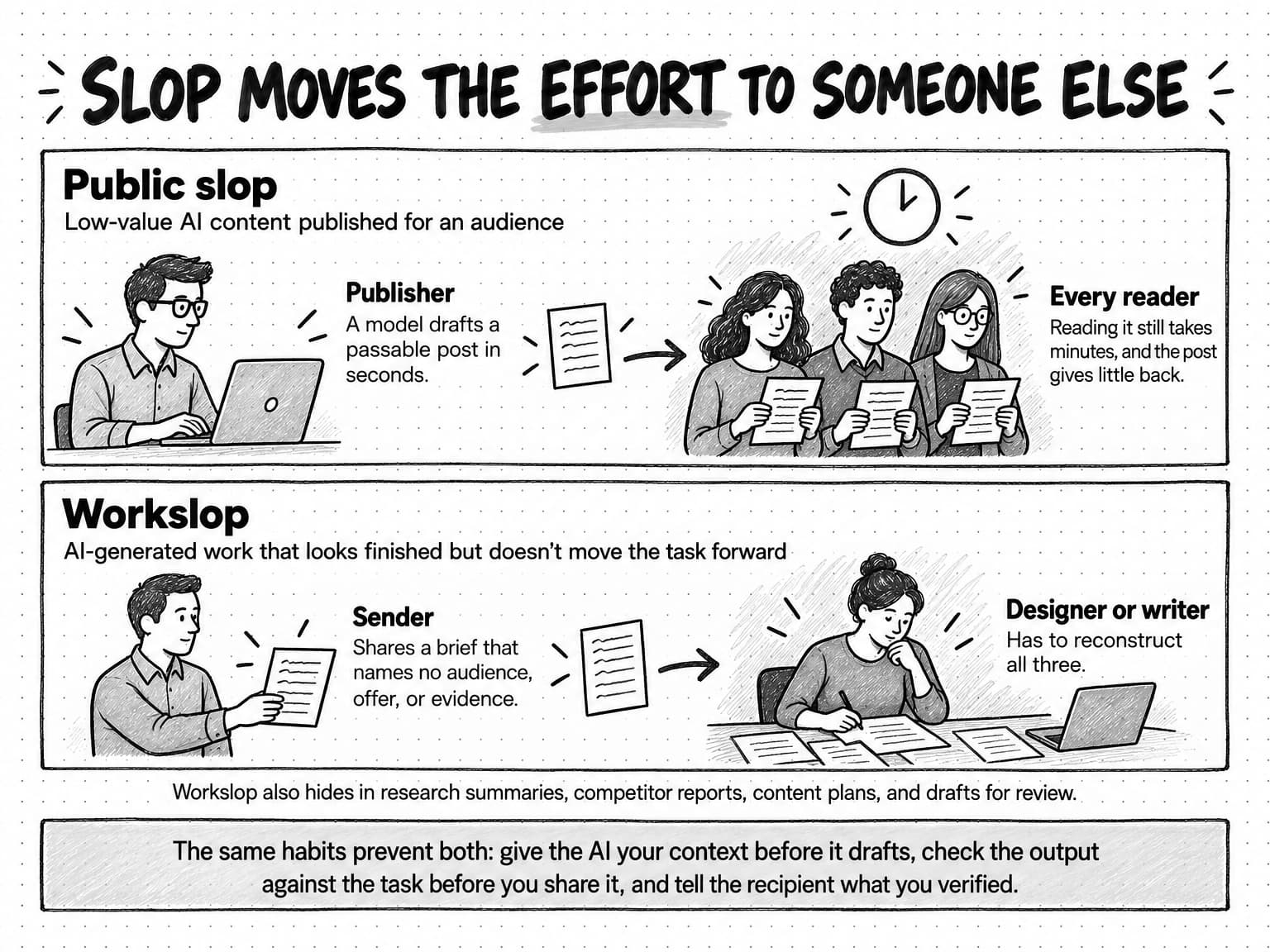
View the diagram of how slop moves effort at full size (opens in a new tab).
Is AI-generated content bad for SEO?
AI-generated content is not bad for SEO in itself. Google says its ranking systems reward helpful, original content however it is produced, and it treats content made mainly to manipulate rankings as spam whether a person or a model wrote it. Slop struggles in search because it adds little that a searcher couldn't find elsewhere, which is also why it loses readers.
Google set out this position in a February 2023 Search Central post that described its focus as “the quality of content, rather than how content is produced.” The post's answers are direct: “Appropriate use of AI or automation is not against our guidelines,” but using automation, including AI, “with the primary purpose of manipulating ranking in search results is a violation of our spam policies.” On whether AI content ranks well, Google wrote that using AI “doesn't give content any special gains.”
In March 2024, Google introduced a spam policy on scaled content abuse, which covers many pages “generated for the primary purpose of manipulating search rankings and not helping users,” typically unoriginal content that provides “little to no value to users, no matter how it's created.” The first example on the list is “using generative AI tools or other similar tools to generate many pages without adding value for users.” Google explained that the policy applies whether content comes from automation, people, or a combination, and that sites violating its spam policies may rank lower or not appear at all. After the core update released alongside the policy finished rolling out, Google reported 45% less low-quality, unoriginal content in search results, against the 40% it had expected.
Google's guidance on generative AI content says generative AI “can be particularly useful when researching a topic, and to add structure to original content.” The page also says it is “critical to manually factcheck and review all AI-generated content for accuracy and trustworthiness before publishing,” and applies that review to page titles, meta descriptions, structured data, and image alt text. Where it would help readers, the page suggests explaining how automated content was made.
Google's page on people-first content explains how its human quality raters judge effort: “using generative AI to produce large amounts of text without manual oversight or curation represents little to no effort.” Raters don't set rankings; Google uses their assessments to check whether its systems work. The guidelines they follow are built around E-E-A-T: experience, expertise, authoritativeness and trust. The same page calls fabricated author profiles, including AI-generated headshots and false credentials, a form of deception, and suggests AI disclosures where readers might reasonably ask, “How was this created?”
For a marketing team, the guidance comes down to a few habits. Publish pages that add something only you can say, check every fact and every piece of metadata, keep bylines real, disclose AI use where readers would expect it, and never generate pages in bulk to catch queries you can't answer well.
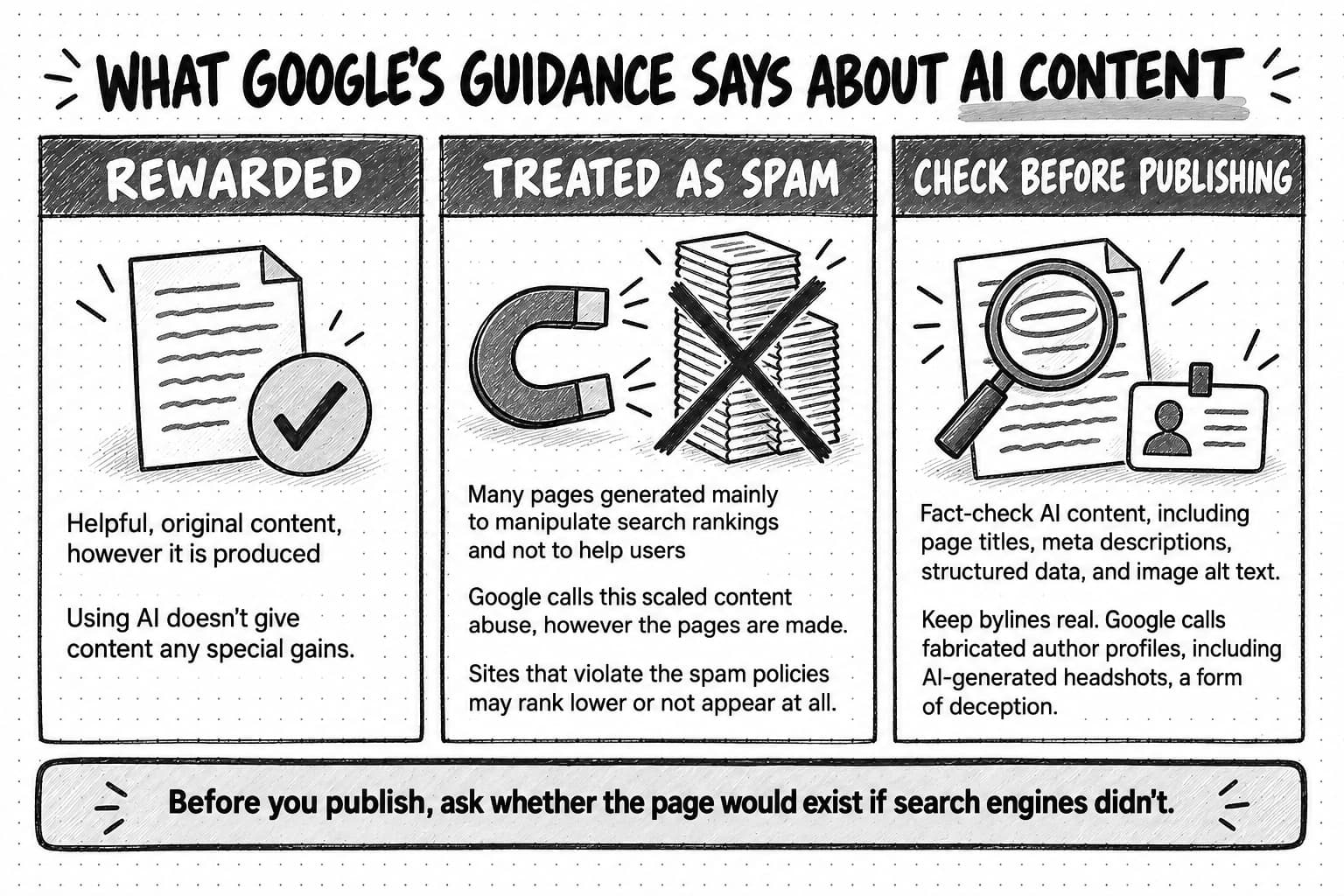
View the summary of Google's guidance on AI content at full size (opens in a new tab).
How to avoid AI slop when you use AI for marketing
To avoid AI slop, put what only your team knows into the work before the AI drafts, and edit for substance before style after it does. AI can supply speed, structure, and a first pass. The specific claims, the evidence, and the judgment about what is worth publishing have to come from you.
Decide what the piece is for
Before drafting, name the reader, the situation they are in, and what they should know or do afterward. If you can't say what a piece adds that the reader couldn't find elsewhere, the AI won't supply it. Sometimes the right outcome is a shorter piece, a different format, or nothing at all. The baseline Willison set for himself in 2024, “don't publish slop,” works for a brand too.
Start from brand context and real evidence
The most reliable cure for generic output is material the model couldn't have found on its own. Give it your positioning, brand guidelines with approved examples, current product facts, and evidence such as customer interviews, support tickets, sales-call notes, your own data, and screenshots. Customer language is especially useful because it is specific by nature, and our guide to voice-of-customer research explains how to collect it and keep each excerpt tied to its source.
Brief for the specifics
A brief turns that material into instructions for one job: which evidence to use, which claims you can and can't make, what a finished piece looks like, and what to leave out. A request to “write a blog post about late payments” leaves every gap for the model to fill with the most predictable content. A brief with the reader, the angle, three customer quotes, and one approved example leaves far less room to drift. Our guides to writing a content brief and briefing an AI marketing agent cover the details.
Edit for substance first, then for voice
Edit an AI draft in two passes. In the first, ignore the sentences and read for substance: note what each paragraph adds, cut the ones that add nothing, and replace general claims with the example, number, or quote that supports them. A simple test helps here. Delete a sentence, and if neither information nor voice disappears, leave it deleted.
In the second pass, edit for voice. Replace stock phrases with your own vocabulary, restore the plain verbs your customers use, vary sentences that all have the same shape, and read the result aloud. Then compare it with an approved example of your writing, using a review that separates facts, voice, and tone, such as the one in our brand voice guide. The goal is writing that sounds like your brand and says something worth reading. Whether a detector would flag it is beside the point.
Review against the five signals before you publish
Run the checklist on the finished piece, including the parts readers and search engines see first: the title, the meta description, image alt text, and every image. Check each number and quote against its source, and cut what you can't verify. If a piece fails several signals, go back to the inputs, because more polishing won't rescue a draft that had nothing specific to work from.
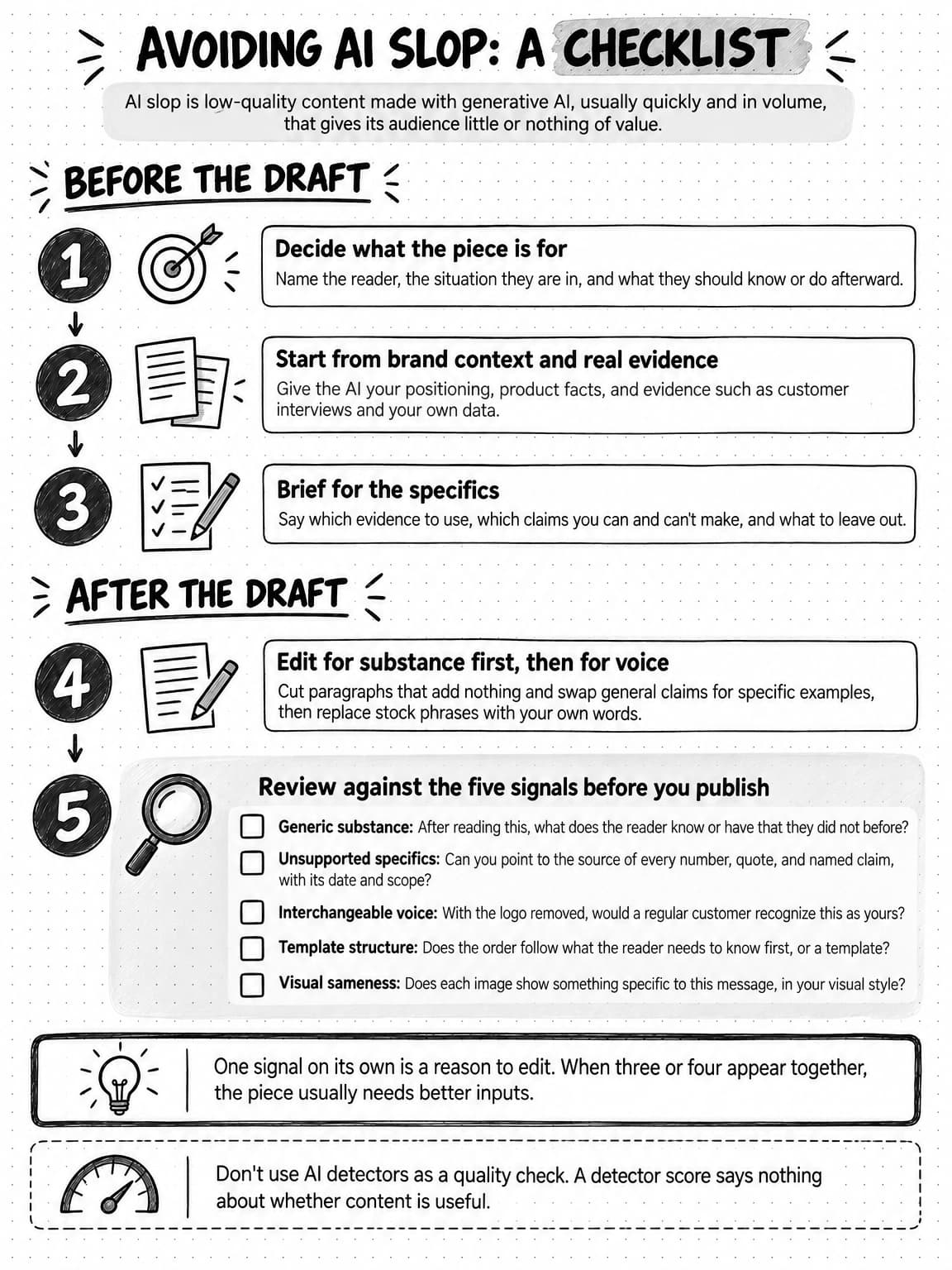
View the AI slop checklist at full size (opens in a new tab).
How Ampere keeps AI drafts specific to your brand
Ampere is an AI marketing agent built around the inputs this guide recommends: brand context, evidence, and a review step before anything goes out.
Brand memory gives every draft a starting point other than the average of what has been written about your category. Ampere runs 22 deep-dive brand skills on your website and files, covering voice, positioning, audience, competitors, products, visual identity, and more, and saves each result as an editable brief with its sources visible. You review and correct what it learned, and the approved version is what later work follows. Saved brand colors, logos, and visual identity reports give image work the same starting point, which helps against visual sameness.
For writing, Ampere can draft source-grounded blog article packages. For LinkedIn text posts, polls, and newsletters, it produces packages with format-specific drafts, review notes, and claim checks, so you can catch unsupported specifics during review instead of after publishing. Ampere-maintained marketing skills turn researched best practices for each format into repeatable instructions, and they are evaluated against defined task, tool, and output expectations.
When you already have a draft, the focused AI-writing cleanup skill audits or edits existing writing for observable AI-writing patterns while preserving the writer's meaning and voice. It is an editing aid: it doesn't judge who wrote the text, chase a detector score, or rewrite the piece into something new.
AI output can still be inaccurate or incomplete, so the last step stays with you. Ampere returns finished work for your review, you decide what to publish and where, and nothing publishes without you.
Sources and further reading
- Merriam-Webster, 2025 Word of the Year: Slop (December 14, 2025) and the dictionary entry for slop.
- Macquarie Dictionary, Word of the Year 2025 (November 2025).
- Simon Willison, Slop is the new name for unwanted AI-generated content (May 8, 2024).
- Google Search Central, Google Search's guidance about AI-generated content (February 8, 2023), spam policies for Google web search, What web creators should know about our March 2024 core update and new spam policies (March 5, 2024), guidance on using generative AI content on your website, and Creating helpful, reliable, people-first content.
- Google, New ways we're tackling spammy, low-quality content on Search (March 5, 2024, updated April 26, 2024).
- Kate Niederhoffer and colleagues, AI-Generated “Workslop” Is Destroying Productivity, Harvard Business Review (September 22, 2025).
- Raptive, The “AI stink” is real, and it's costing brands (August 22, 2025), vendor-commissioned research.
- Anil R. Doshi and Oliver P. Hauser, Generative AI enhances individual creativity but reduces the collective diversity of novel content, Science Advances (2024).
- Alex Reinhart and colleagues, Do LLMs write like humans? Variation in grammatical and rhetorical styles, PNAS (2025).
- Dmitry Kobak and colleagues, Delving into LLM-assisted writing in biomedical publications through excess vocabulary, Science Advances (2025).
- Weixin Liang and colleagues, GPT detectors are biased against non-native English writers, Patterns (2023).
Frequently Asked Questions
What are common examples of AI slop?
Common examples of AI slop in marketing include blog posts that restate what already ranks without adding anything, near-identical pages generated for every city or job title, ad images with garbled lettering or the glossy default AI look, formula social posts built from a hook and a list of generic lessons, and outreach emails whose only personalization is a name. Inside companies, the equivalent is workslop: briefs and reports that look complete but leave colleagues to do the thinking.
What are the clearest signs that content is AI slop?
The clearest signs that content is AI slop are generic substance, unsupported specifics, an interchangeable voice, template structure, and visual sameness. Ask whether the reader learns anything new, whether every number and quote has a source, whether a regular customer would recognize the voice without the logo, whether the structure follows the reader's question, and whether each image is specific to the message. One sign calls for editing; several together usually mean the piece needs better inputs.
Why is there so much AI slop now?
There is so much AI slop because generative AI made a passable draft fast and cheap to produce, while reading it still costs the audience time. When a channel rewards volume, such as more pages for search traffic or more posts for reach, cheap generation pushes publishers toward quantity. Inside companies, researchers studying workslop, AI-generated work that colleagues must fix or redo, trace part of its spread to leaders who push AI everywhere without discernment about where it helps.
Why is AI slop considered harmful?
AI slop is considered harmful because it spends the reader's attention without giving anything back: the publisher saves effort, and the audience pays for it in time. For brands, it also erodes trust. In vendor research published in 2025, people rated content they believed was AI-generated as less trustworthy and authentic, whether or not it was. Over time, generic content also makes a brand harder to tell apart from competitors using the same tools.
Does Google penalize AI-generated content?
No, Google does not penalize content simply for being AI-generated. It says it rewards helpful, original content however it is produced, and that appropriate use of AI is not against its guidelines. What violates its spam policies is generating many pages mainly to manipulate rankings without adding value for users, which Google calls scaled content abuse whether automation, people, or both produced the pages. Sites that violate those policies may rank lower or not appear at all.
How is AI slop different from high-quality AI-generated content?
AI slop differs from high-quality AI-generated content in its inputs and review, not in the tool that produced it. High-quality AI-assisted work starts from the publisher's own context and evidence, makes claims it can source, sounds like the brand, follows the reader's question, and passes a careful human edit. Slop skips those steps, so it ends up generic, unsourced, and interchangeable, even when every sentence is grammatical.
How do you avoid AI slop?
You avoid AI slop by deciding what a piece adds before drafting, giving the AI your brand context and real evidence, briefing for specific claims and examples, and editing for substance before voice. Then review the finished piece, including its title, metadata, and images, against the five slop signals. If a draft fails several signals, go back and improve the inputs.
What editing process makes AI-generated writing feel human?
The editing process that makes AI-generated writing feel human is mostly one that makes it specific. First edit for substance: cut paragraphs that add nothing and replace general claims with examples, numbers, and quotes you can source. Then edit for voice: swap stock phrases for your own vocabulary, vary sentence shapes, read the draft aloud, and compare it with an approved example of your writing. Aim for your brand's voice, not a detector score.
Can an AI detector tell whether content is AI slop?
No, an AI detector cannot tell whether content is AI slop, because slop is a judgment about value, not authorship. Detectors estimate whether a model wrote a text, and they can be wrong. A 2023 Stanford study found that seven widely used detectors labeled more than half of a set of essays by non-native English writers as AI-generated. A checklist of quality signals, applied by an editor, is the better test.


