Why AI-generated marketing so often looks good—and still feels off-brand
AI makes polished work easy to produce. Brand consistency depends on what the system knows about your company before it starts.
19 min readWritten by Ampere
Contents
- Brand consistency is accumulated recognition
- A brand cannot be reduced to a logo and six hex codes
- Why “make it on-brand” rarely solves the problem
- The most dangerous output is “good enough”
- What happened when we gave Ampere and Claude Cowork the same brief
- Brand memory should be part of the working system
- Shared context matters as much as persistent context
- Consistency does not mean turning the brand into a template
- What to look for when evaluating an AI marketing agent
- Faster production is only valuable when the work belongs together
Most marketers who have used AI for creative work know this moment.
You give the tool a sensible brief. You share the company website, describe the audience and explain what the asset needs to achieve. A few minutes later, it returns something polished. The typography is competent. The layout is balanced. The copy makes sense. There is nothing obviously wrong with it.
Yet it does not feel like your company.
Remove the logo and the asset could belong to almost any software business, consultancy or consumer brand in the same broad category. The work is attractive enough to use, but not distinctive enough to strengthen the brand.
This is becoming one of the more important problems in AI-assisted marketing because generic work no longer looks obviously bad. It can look professional, finished and superficially credible. That makes the problem easy to miss.
A visibly poor design is rejected immediately. A polished but generic design often survives review, especially when the team is busy and the deadline is close. It gets published, followed by another asset based on a slightly different prompt, followed by an email written in a slightly different voice. Each piece is acceptable on its own. Taken together, they have very little in common.
The company is producing more marketing, but the additional output is not building a more recognizable brand.
Brand consistency is accumulated recognition
Every piece of marketing teaches people how to recognize a company.
The lesson may be visual: a recurring approach to typography, illustration, photography, composition or color. It may be verbal: the way the company explains its product, the amount of detail it gives, the claims it avoids, the evidence it values or the phrases it returns to. It may be strategic: the audience it addresses, the problems it chooses to discuss and the position it takes in its market.
A single asset rarely creates that recognition. It develops through repeated exposure.
Someone sees a post in their LinkedIn feed, visits a landing page a week later, opens an email after that and eventually looks at a sales deck. Those encounters may happen across several months and several channels. A consistent brand gives the person small signals that these pieces belong to the same company and the same point of view.
When the signals keep changing, every asset has to introduce the company again.
This matters for companies of every size. Buying more reach does not repair an inconsistent brand; it puts the inconsistency in front of more people. When a company spends more to distribute work that sends conflicting signals, it amplifies the confusion instead of strengthening recognition.
That is why brand consistency should not be dismissed as a design preference or a request to make everything “look the same.” It affects whether the market remembers the company, understands what it stands for and trusts that there is a coherent business behind the individual campaign.
AI increases the stakes because it removes much of the friction from producing another asset. A team that previously published a few considered pieces each month can now generate posts, emails, ads, images and presentations every week. That additional capacity is valuable, but it also gives inconsistency many more opportunities to spread.
AI makes it easier to produce more. It does not automatically make that work add up to something.
A brand cannot be reduced to a logo and six hex codes
When teams try to make AI output more consistent, they usually begin with their brand guidelines. That is a reasonable place to start. The problem is that most brand guidelines contain only the portion of the brand that was easy to document.
They may specify the logo, typefaces, color palette and a few tone-of-voice principles. They may include instructions such as “sound confident but approachable” or “use bold, optimistic language.” The visual section might show acceptable logo spacing and several example layouts.
Those rules are helpful. They still leave a large number of decisions unresolved.
Should the writing assume that the reader already understands the category, or explain it from first principles? Does the company make aggressive claims, or prefer precise and qualified language? Does it use humor? How much visual density feels appropriate? Are bright colors used across an entire composition or reserved for accents? Should illustrations feel technical, editorial, playful or literal? Which competitor conventions should the brand deliberately avoid?
A marketer who has worked with the company for a while can often answer these questions without consulting a document. They have seen which drafts were approved, which campaigns performed well, which phrases the founder rewrote and which visual directions the design team rejected. Their judgment reflects hundreds of small decisions that have accumulated over time.
That tacit knowledge is part of the brand too.
The brand also includes facts and context that may not look like brand information at first. Positioning affects which benefit leads the page. Audience knowledge affects how much explanation the copy needs. Product strategy affects which capabilities deserve attention. If the company’s closest competitors all use blue gradients and abstract shapes, repeating those choices can make its ads hard to distinguish from theirs. Knowing that gives the team a reason to choose a visual direction that is recognizably its own.
A brand is therefore much closer to a working body of knowledge than a static design file. It includes what the company believes, whom it serves, how it communicates, what it sells, what it refuses to claim and what good work has looked like in the past.
Giving an AI tool a logo and a color palette is useful. Expecting those inputs to reproduce all of that judgment is asking far too much of them.
Why “make it on-brand” rarely solves the problem
The usual AI workflow places an unreasonable amount of pressure on the prompt.
The tool begins with little persistent knowledge of the company, so the marketer tries to assemble enough context for the current task. They paste several paragraphs from the brand guide, attach an example, add a link to the website and finish with an instruction such as “make sure the result is on-brand.”
Sometimes it works. More often, the prompt contains enough information to prevent obvious mistakes but not enough to guide the hundreds of smaller choices that shape the final result.
The problem becomes even clearer when several people use the tool.
One teammate has the latest brand deck. Another uses a prompt they saved six months ago. Someone else links to the homepage and assumes the AI will infer the rest. A freelancer receives a folder of examples without knowing which ones the internal team still considers representative.
Each person is working with a different version of the company. The resulting outputs reflect those differences.
Even a conscientious marketer cannot paste the full history of the brand into every request. The context may be scattered across strategy documents, campaign folders, product pages, customer research, design files and the memories of individual teammates. Much of it changes over time. Products evolve. Audiences become better understood. Competitors reposition themselves. A once-successful visual treatment becomes tired through repetition.
Then there is the question of relevance. An image for a social campaign needs different parts of the brand than a technical white paper. A landing page may depend heavily on positioning, customer language and product detail. A webinar graphic may rely more on visual identity, audience expectations and the conventions of the channel.
Dumping every available document into every session is not a good solution. The tool needs enough context to make informed decisions without becoming distracted by material that has little to do with the current job.
This is why prompt libraries alone tend to disappoint. They can standardize the wording of a request, but they do not create a maintained understanding of the company behind it.
The most dangerous output is “good enough”
There is another reason teams struggle with this problem: AI-generated brand drift rarely arrives as a dramatic failure.
The tool does not usually return a completely inappropriate asset. It returns a familiar approximation of what successful marketing looks like in that category.
For a software company, that may mean clean sans-serif typography, generous white space, blue or purple accents, soft gradients and concise copy about saving time. For a professional-services business, it may mean a tasteful photograph, a sober palette and broad language about expertise. For a consumer brand, it may mean energetic colors, short headlines and polished lifestyle imagery.
These defaults exist because they often work reasonably well. They are also shared by thousands of companies.
If the team is reviewing one asset, the result may seem perfectly acceptable. The limitation becomes visible only when the asset is placed next to the company’s website, previous campaigns, sales material and other recent posts. The individual piece looks polished; the collection looks as if it came from several different companies.
Human reviewers often repair the immediate output without repairing the system that produced it. They change the colors, rewrite the headline, swap the image and publish the corrected version. The next AI session begins with the same incomplete context, so the same problems return.
This creates a hidden tax on AI adoption. Production becomes faster, but experienced marketers spend more time acting as brand translators and quality-control editors. The work has moved downstream rather than disappearing.
What happened when we gave Ampere and Claude Cowork the same brief
We recently explored this problem with a simple creative assignment:
Create a LinkedIn image promoting Notion’s next “Custom Agents 101” webinar, using Notion’s website as the source.
The factual part of the task was straightforward. Notion’s webinar page described a short workshop about building Custom Agents, creating recurring automations and identifying useful applications for them.
We gave the same brief and source to Ampere and Claude Cowork.
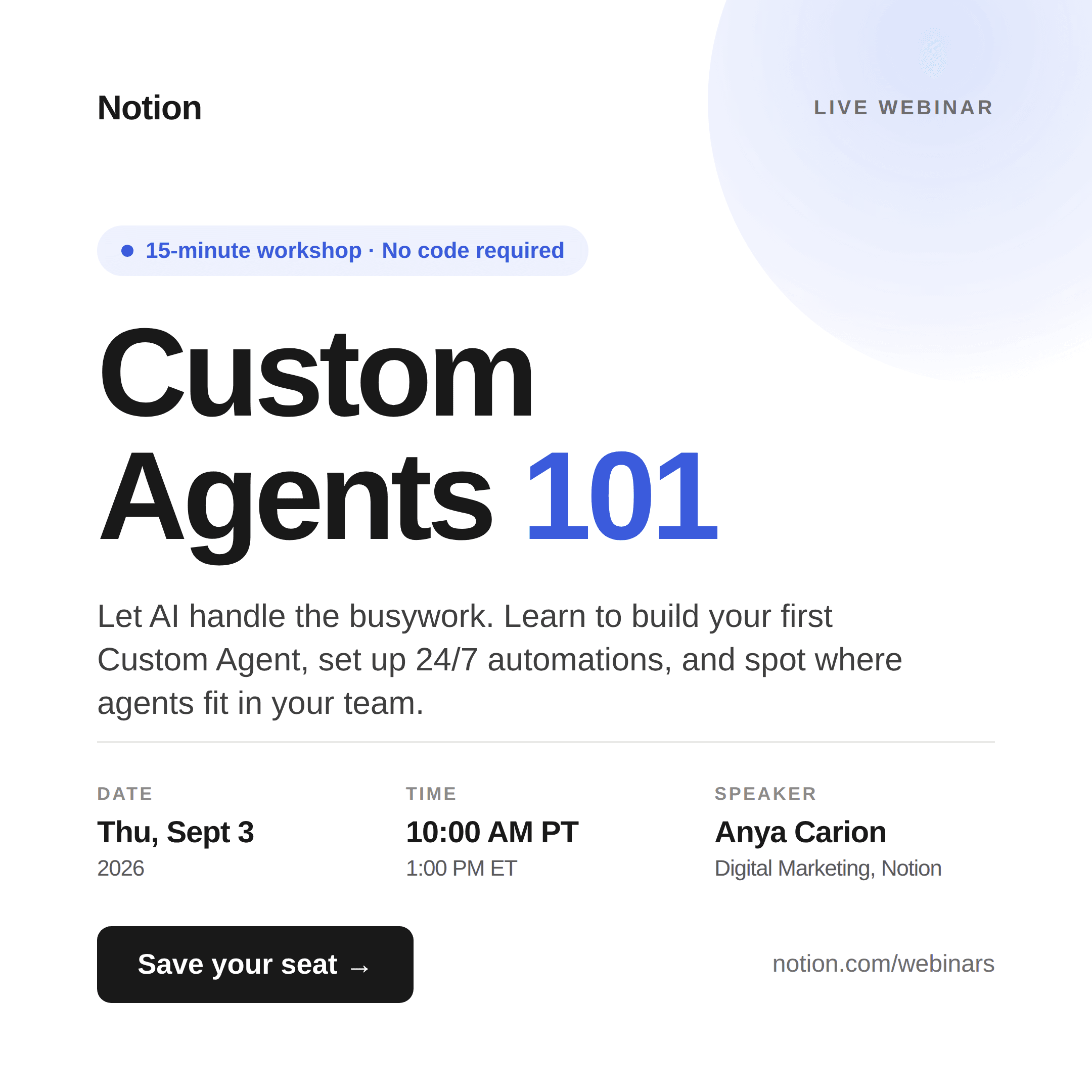
Claude Cowork did several things well. It found the relevant event information, created a clear hierarchy and produced a clean, usable graphic. The event title was prominent. The date, time and speaker information were easy to find. Nothing about the result suggested that the system had misunderstood the assignment.
Claude Cowork’s design used a restrained white layout, a pale blue shape and a bright blue accent on “101.” It looked like a credible webinar graphic for a modern software company.
That was also its weakness. The image relied on a visual language common to a large number of SaaS brands. If the Notion name were removed, there would be few clues pointing back to Notion.
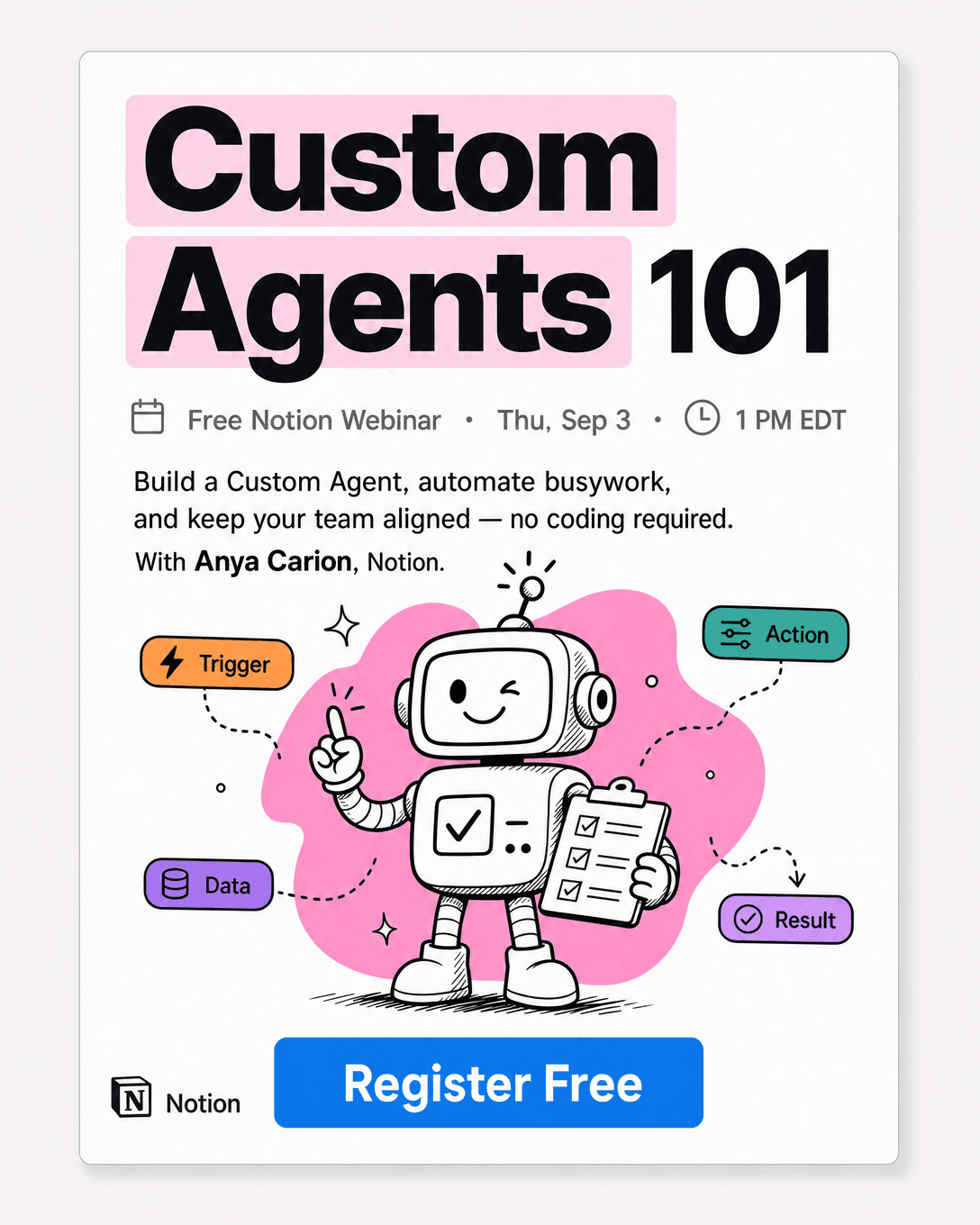
Ampere approached the same source through a broader picture of the brand. Its output used oversized black type, modular blocks, a hand-drawn central illustration and pink, orange, teal, blue and purple accents. The composition was less like a generic webinar template and more closely related to the playful, document-inspired visual language visible in Notion’s marketing.
Ampere and Claude Cowork both had the event information. The difference was how much context they had for interpreting it.
For this Notion brief, Ampere produced the stronger marketing creative. Its oversized typography, hand-drawn illustration, modular composition and varied accent colors give it a much closer relationship to Notion’s visual identity than Claude Cowork’s blue-and-white event graphic. That is a concrete advantage in brand consistency: Ampere delivered an asset that promotes the webinar while reinforcing the brand behind it, whereas Claude Cowork delivered an event graphic whose styling could serve many unrelated software companies.
Ampere session screenshot (opens in a new tab) · Claude Cowork session screenshot (opens in a new tab) · Download the comparison PDF
Brand memory should be part of the working system
This is the problem we built Brand memory in Ampere to address.
Ampere is an AI marketing agent designed to work with reusable knowledge about the company, rather than treating every session as an introduction.
Brand memory is not a single text field containing a condensed brand guide. Ampere uses 22 dedicated Brand memory skills to study different parts of a brand: its positioning, audience, products, competitors, voice, visual identity, colors, content, social presence, customer language, market context and recent activity.
The resulting knowledge is saved in editable reports. A marketer can inspect what Ampere has learned, correct an inaccurate conclusion and update information that has changed. This matters because an uneditable memory would simply turn hidden assumptions into recurring mistakes.
Once that context exists, later work can begin further ahead.
If the task is a social graphic, Ampere can draw on the visual identity, brand colors, relevant products and channel context. If the task is a white paper, positioning, audience knowledge, voice and market evidence become more important. If the task is a competitor comparison, the competitive landscape and approved positioning boundaries matter.
The whole brand does not need to be pasted into every brief. The relevant context can travel with the work.
Freshness matters as well. Some parts of a brand remain stable for a long time; others do not. A company profile or core positioning brief will usually age more slowly than a recent-news report or trend snapshot. Ampere gives Brand memory reports refresh cadences so time-sensitive information is not quietly treated as permanent truth.
This does not mean Ampere should make every brand decision without human input. Some decisions are matters of taste. Some campaigns deliberately depart from previous work. Sometimes the brand itself is changing, and the new direction has not yet been documented.
The purpose of Brand memory is not to remove marketers from the process. It is to stop making them reconstruct the company from scratch before the useful part of the work can begin.
Shared context matters as much as persistent context
Brand consistency is usually discussed as a relationship between one user and one tool. In practice, it is a team problem.
A company may have a founder, a marketer, a designer, a product lead and several external collaborators creating material at the same time. If each person has an isolated AI account with different prompts and uploaded files, the company now has several unofficial versions of its brand.
The risk is not only that the outputs look different. People may also describe the product differently, prioritize different audiences or use claims that other teammates have already rejected.
A useful AI marketing system needs to make brand context persistent across sessions and available across the team. People should be able to inspect the same underlying reports, correct them and use them as the starting point for new work.
That changes brand consistency from an act of individual vigilance into a shared operating practice.
It also reduces dependence on the one person who knows where everything is. Many small companies have someone who has become the human repository of brand context. Every important draft passes through them because they remember the positioning discussion, know which customer language is current and can sense when something feels wrong.
That person’s judgment remains valuable. The problem is that the company cannot scale if every asset requires them to reload the same context into the process.
Capturing that knowledge gives them a better role: setting direction and making high-value judgments instead of repeatedly correcting avoidable drift.
Consistency does not mean turning the brand into a template
There is a legitimate concern hiding underneath this discussion. If an AI system remembers previous work and applies the same brand rules repeatedly, will everything begin to look identical?
It can, if the system mistakes repetition for consistency.
A brand should be recognizable across different types of work without forcing every piece into the same composition or tone. A product launch, an educational article, a research report and a playful social post do not need to behave in the same way. They need to feel as though the same company made a deliberate choice for each situation.
Good brand context establishes boundaries without prescribing every decision.
It helps the system understand which visual and verbal choices are plausible, which ones require caution and which ones clearly belong to another company. Within those boundaries, there should still be room for surprise, experimentation and campaign-specific ideas.
This is another reason examples alone are insufficient. If an AI tool receives three previous social graphics, it may imitate their surface patterns too literally. A richer understanding of the brand can explain why those choices worked, making it possible to create something new without losing the underlying identity.
The goal is not to reproduce the last asset. It is to produce the next asset from the same informed point of view.
What to look for when evaluating an AI marketing agent
Most AI product demonstrations are designed around the first task.
You see a prompt entered, watch the system work and receive an impressive result. That tells you something about its generation capabilities. It tells you much less about what using the product will feel like after ten projects, several teammates and a year of accumulated context.
For marketing work, the second task is often more revealing than the first.
When evaluating an AI marketing agent, look beyond whether it can produce the requested format. Almost every serious tool can draft a post, generate an image or outline a landing page. The more useful questions concern what surrounds that generation.
Where does the brand context live?
Can the system retain meaningful brand information between sessions, or does every new task depend on another long prompt and another round of attachments?
A saved prompt is not the same as saved brand knowledge. Look for persistent context that can be reused across different kinds of work.
How complete is its understanding of the brand?
A logo, color palette and short voice description are not enough for serious marketing work.
The system should be able to account for positioning, audiences, products, competitors, customer language, visual identity, previous content and current market context. It does not need all of this for every task, but it should have somewhere reliable to draw from when the information becomes relevant.
Can you inspect and correct what it knows?
Brand memory should never be a mysterious profile hidden inside the model.
Marketers need to see the saved context, identify weak conclusions and change information that is incomplete or outdated. If the system repeatedly uses an incorrect assumption, there should be an obvious place to repair the assumption rather than correcting every output it touches.
Does it know which context matters for the current job?
More context is not always better. An effective system should use the parts of the brand that help with the deliverable in front of it.
Ask how the product handles relevance. A social image, customer research report and landing page should not all receive an indiscriminate dump of the same documents.
Can the team work from the same understanding?
Find out whether brand context belongs to one person’s account or to the wider organization.
If every teammate maintains a separate set of prompts and attachments, inconsistency is built into the workflow. Shared context, shared assets and reviewable work make it much easier for a team to develop one coherent brand rather than several personal interpretations of it.
What happens when the brand changes?
A useful memory system needs a way to handle time.
Products are renamed. Positioning evolves. New competitors appear. Visual identities are refreshed. Ask whether saved information can be updated, whether time-sensitive research expires and whether older assumptions remain visible after they have stopped being reliable.
Does the product improve the workflow after generation?
A finished marketing job often involves research, source review, drafting, asset creation, iteration and packaging the final files. A tool that returns an isolated answer may still leave the marketer to assemble the actual deliverable.
Look at the complete path from brief to finished work. Can you inspect the sources? Review intermediate decisions? Correct the direction? Reuse the resulting files and context later? Share the work with teammates?
Brand consistency depends partly on generation quality, but it also depends on the system around the generation.
What does the fiftieth asset look like?
This may be the most useful question of all.
A strong AI marketing agent should become easier to work with as the company’s context becomes clearer. The team should spend less time repeating background information. Corrections should improve future work. New teammates should begin with more knowledge than the first teammate had.
If the fiftieth asset still requires the same brand explanation as the first, the tool has memory in the conversational sense, not in the operational sense marketers need.
Faster production is only valuable when the work belongs together
AI has already made the production of competent marketing assets much faster. That part of the change is real.
The harder question is what companies will do with the added capacity.
One possibility is that teams produce far more disconnected work: more posts, more images, more campaigns and more variations, each polished enough to publish but carrying a slightly different version of the company.
The better possibility is that faster production strengthens the brand because every new asset begins with a deeper, shared understanding of what the company is trying to build.
That outcome will not come from adding “make it on-brand” to the end of a prompt. It requires treating brand knowledge as part of the marketing system: captured deliberately, maintained over time, available to the team and applied according to the task.
This is the standard we think an AI marketing agent should meet.
The first asset can show you that the tool is capable. The second begins to show whether it remembers. The fiftieth tells you whether it has helped build a brand.