Agentic AI vs. generative AI: what's the difference for marketing?
Generative AI drafts what you ask for. Agentic AI takes a goal and works through the steps to reach it. A plain-language comparison for marketers, with one product launch handled three ways.
28 min readWritten by Ampere
Short answer
What is the difference between agentic AI and generative AI?
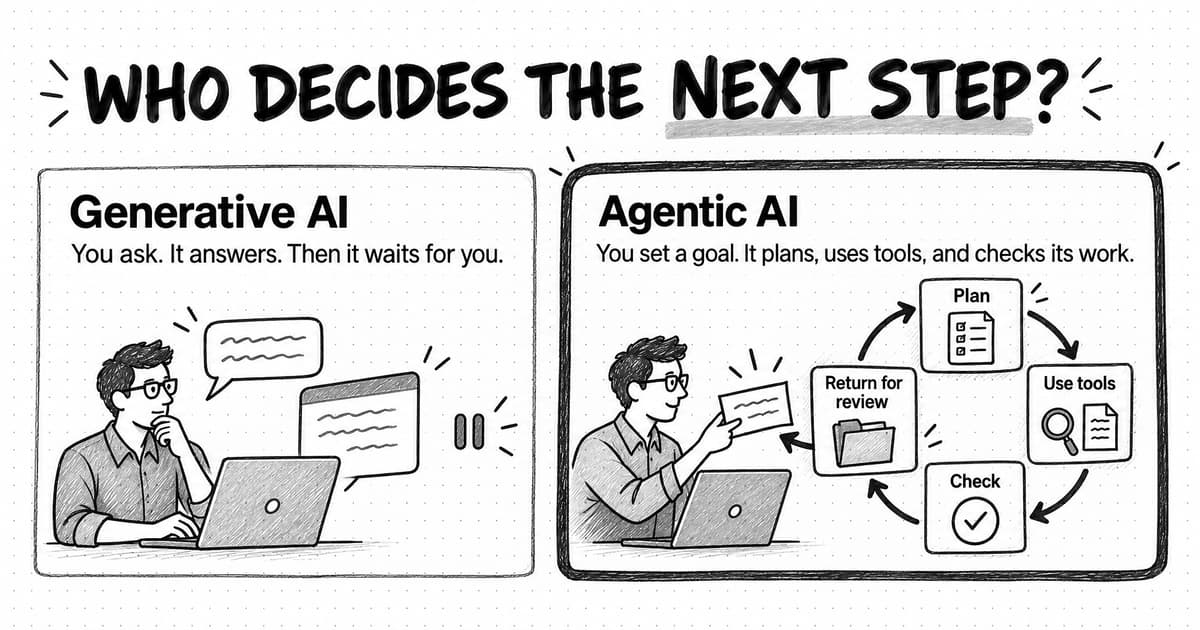
Generative AI creates content, such as text, images, or video, in response to a prompt, then waits for your next instruction. Agentic AI pursues a goal: it plans the steps, uses tools, checks the results, and keeps working until the job is done or needs you. Most agentic systems use generative models to read, plan, and write, so the two work together rather than compete.
Summary
Generative AI and agentic AI differ in who decides the next step. A generative tool produces the response you ask for and stops, while an agentic system chooses and carries out its own steps toward a goal, usually with generative models doing the reading and writing. The difference lies in the software around the model and how much of the job it may carry.
An AI agent is a system that pursues a goal by choosing actions, and agentic describes how much a system decides on its own. Sources draw the boundary differently: IBM treats agents as components of agentic AI, and a 2025 review reserves agentic AI for coordinated multi-agent systems. Because vendors also relabel older chatbots and automation as agentic, ask what a product actually does.
A worked example follows one fictional software company's product launch through all three approaches. A generative tool drafts each asset on request and leaves coordination and fact-checking to the marketer. An AI agent turns a brief into a checked launch kit with its open questions listed. An agentic setup keeps follow-up work running on a schedule and responds when a competitor changes something.
The unit-of-work test matches the approach to the job. Generative AI suits a response you will judge yourself, an AI agent suits a task whose steps depend on what it finds, and an agentic setup suits an operation that continues over time. Choosing the smallest unit that does the job matters, because agentic systems often trade extra time and cost for better task performance.
Agentic AI keeps generative AI's risks, such as confident errors, generic copy, and borrowed material, and adds risks that come from acting: compounding mistakes, consequential actions, outside content that redirects the agent, rising costs, and over-reliance on polished work. Check sources and claims, keep publishing and spending behind an approval step, and start with a task you know how to judge.
Contents
- What is generative AI?
- What is agentic AI?
- AI agents vs. agentic AI: how the terms differ
- Generative AI vs. AI agents vs. agentic AI compared
- How agentic AI uses generative AI
- One product launch brief, handled three ways
- How to choose between generative AI and agentic AI: the unit-of-work test
- How Ampere uses generative models inside an AI marketing agent
- Risks of generative AI and agentic AI
- Is agentic AI the next stage of generative AI?
- Sources and further reading
- Frequently Asked Questions
If you've used generative AI for marketing, the pattern is familiar: you describe a LinkedIn post, a product image, or five subject lines, and a model produces it in seconds. The newer pitch sounds different: tools described as agentic, or built around AI agents, that promise to carry out marketing work instead of handing you a draft. Before choosing what to try next, it helps to know whether those words describe a different way of working or a new label on familiar technology.
The difference is who decides the next step: generative AI produces the content you ask for, while agentic AI pursues a goal by choosing and carrying out its own steps, usually with generative models doing the reading and writing. A generative tool stops after each response and waits for your next instruction. An agentic system can read your sources, decide what to do first, use tools such as web search or an image generator, check what it found, and continue until the work is done or it needs your input.
A product launch shows the difference: a generative tool writes the announcement email you request, an AI agent can research, draft, check, and package the whole launch kit, and a broader agentic setup running on a schedule can keep the launch work going for weeks afterward.
This guide explains each term, including where sources disagree about AI agents and agentic AI, then follows one launch brief through all three approaches and offers a simple test for matching the approach to a marketing job.
What is generative AI?
Generative AI is artificial intelligence that creates new content, such as text, images, audio, video, or code, in response to a prompt. IBM's comparison of agentic and generative AI contrasts it with traditional AI, which was built mainly to recognize patterns and make predictions. The US National Institute of Standards and Technology (NIST) uses a similar definition in its 2024 Generative AI Profile: models that imitate the structure and characteristics of their input data to produce new, synthetic content.
In practice, you give a model an instruction and whatever material you paste in or attach, and it returns a response. It writes from patterns learned in training and from what's in the request, so it doesn't know your latest release notes, pricing, or brand voice unless you supply them. Then it waits for your next instruction, and deciding what happens next is your job.
What generative AI does well in marketing
Generative AI is most useful when the output itself is the job and you can judge it quickly. Drafting subject lines, rewriting a paragraph for another channel, summarizing an interview transcript you supply, sketching image concepts for a campaign, and turning an approved script into a voiceover all fit that description. Because each response takes seconds, you can ask for several options, compare them, and keep the one that works, and nothing happens until you ask for it.
Where generative AI falls short
The same design creates the limits. A model responds to what's in front of it, so a draft is only as good as the context you supply. Without your positioning, audience, and voice, output drifts toward the generic, a problem we examined in why AI-generated marketing so often feels off-brand.
Models can also state wrong details fluently. NIST calls this confabulation, “the production of confidently stated but erroneous or false content,” which most people know as hallucination. In marketing, that might be an invented statistic, a feature your product doesn't have, or a claim a competitor never made.
And a response is all you get. When a job needs research, checks across several sources, or a set of related files, you carry the work between requests: deciding what comes next, pasting the context in again, and making sure the pieces agree. For a launch with many deliverables, that coordination can take longer than the drafting.
What is agentic AI?
Agentic AI is AI that works toward a goal with limited supervision: it plans the steps, makes decisions along the way, uses tools, and carries out multi-step work instead of producing a single response. That is close to how IBM defines agentic AI. Where a generative model usually responds and waits for direction, IBM notes, an agentic system can pursue its goal proactively through other tools and systems.
Agentic is an adjective, and it describes a matter of degree. A system is more agentic when it decides more of the work itself: which source to read first, whether a claim needs checking, which tool to use next, and when to stop. Anthropic's guide to building effective agents groups a range of designs under “agentic systems,” from workflows, in which software follows predefined steps and calls a model along the way, to agents, in which the model directs its own process and its use of tools.
For a marketer, more agentic means you can hand over a goal instead of a sequence of instructions. Ask a generative tool to compare three competitors' pricing and it can work only with the text you paste in. Give the same goal to an agent with web access and it can open the pricing pages, notice that one competitor shows prices only after a sales call, look for pricing mentioned in public reviews, and tell you what it couldn't confirm. The route adapts to what the agent finds. How do AI agents work? explains the loop behind this: choosing an action, running a tool, and reading the result before deciding the next step.
Agentic doesn't mean unsupervised. People still set the goal, the sources, the tools the system may use, and the points where it must stop for approval. A well-built agent asks when a missing fact would change the result and leaves publishing, sending, and spending to a person.
AI agents vs. agentic AI: how the terms differ
An AI agent is a system that pursues a goal by choosing and carrying out actions, while agentic AI is the broader term for AI that works this way, including larger arrangements of agents. Sources draw the boundary in different places, so it helps to know the main versions before reading a vendor's claims.
IBM treats AI agents as one component of agentic AI. In its explainer, an agentic system may contain several agents, each handling part of the job, with their work coordinated toward a single goal. A 2025 review paper by Ranjan Sapkota, Konstantinos Roumeliotis, and Manoj Karkee draws a firmer line. It describes AI agents as modular, model-driven systems built for specific tasks, and reserves agentic AI for systems in which several agents collaborate, divide the work as it unfolds, use persistent memory, and act with coordinated autonomy. Anthropic's umbrella of agentic systems, described above, also includes predefined workflows, and our guide to how AI agents work treats agentic as the capability and agents as the software that has it.
In vendors' own marketing, the words are looser still. In June 2025, Gartner warned about “agent washing”: rebranding existing AI assistants, robotic process automation, and chatbots as agentic without adding substantial agentic capabilities. It estimated that only about 130 of the thousands of vendors claiming agentic AI were offering the real thing.
This guide uses a convention that fits most of these sources:
- AI agent: software that uses an AI model to pursue a goal by choosing actions, using tools, and adjusting to the results.
- Agentic: a property describing how much of the work a system decides and carries out without step-by-step direction.
- Agentic AI, when compared with a single agent: the broader setup that carries work across several tasks or over time, such as several agents dividing a job, or an agent working with schedules, triggers, and saved context.
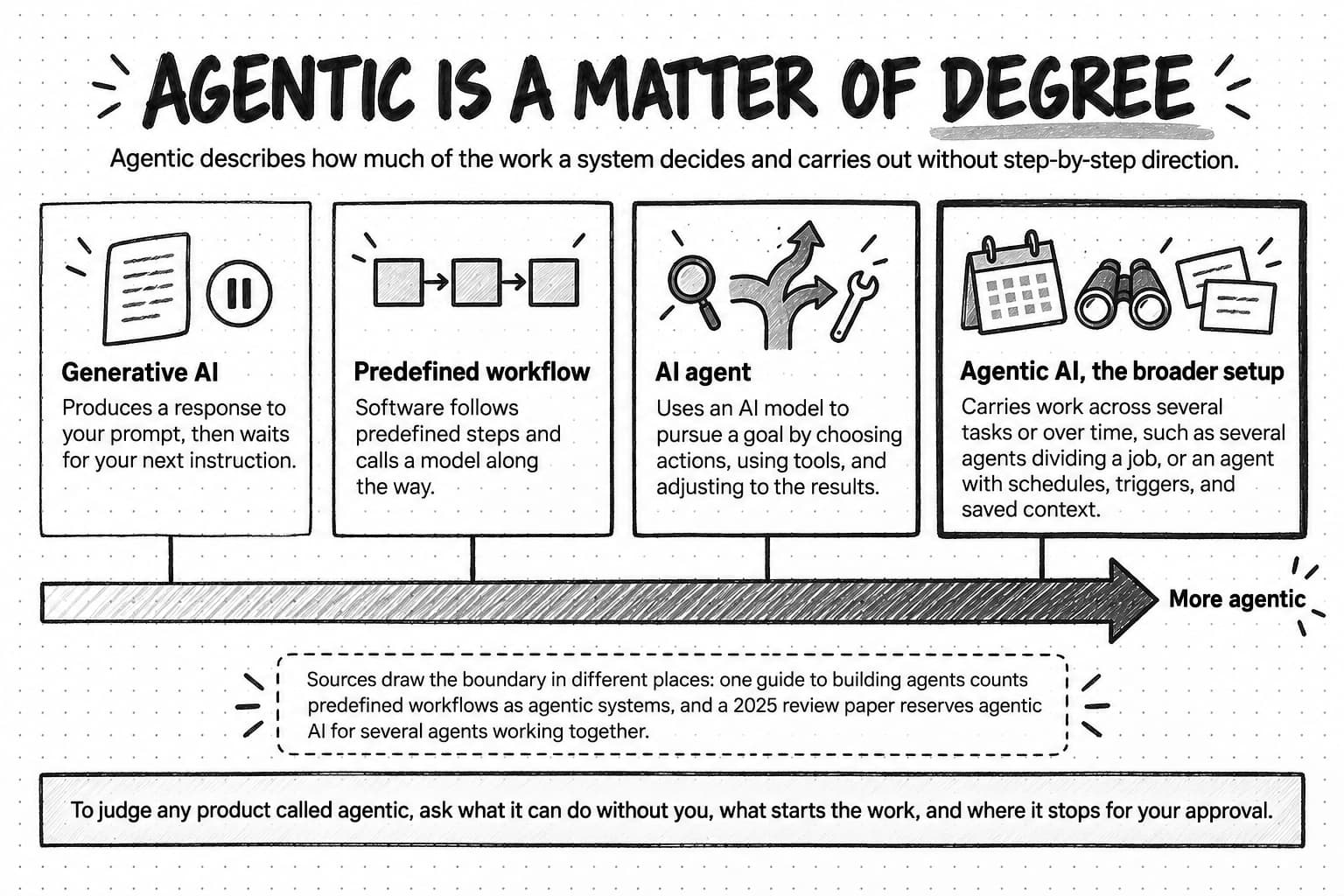
View the scale of agentic terms at full size (opens in a new tab).
Generative AI vs. AI agents vs. agentic AI compared
Generative AI produces responses, AI agents complete tasks, and agentic setups keep work going across tasks and time, so the main differences are the size of the job each can take on and who decides what happens next.
| Question | Generative AI | AI agent | Agentic AI (the broader setup) |
|---|---|---|---|
| What is it? | A model that creates new content from a prompt | A system that uses a model to pursue a goal by choosing actions, using tools, and reading the results | One or more agents, plus schedules, triggers, or coordination, carrying work across tasks and time |
| What does it produce? | A response: a draft, image, clip, or answer | A completed task: a set of deliverables, with sources and a note of anything unresolved | An ongoing operation: a series of results, each delivered for review |
| Who decides the next step? | You, after every response | The agent, within the goal, tools, and permissions you set | Schedules and triggers decide when work starts, agents decide their own steps, and people set direction and approve |
| What's a marketing example? | Five subject lines for a launch email | Research three competitors' pricing pages and write a sourced comparison | A weekly competitor digest, plus a drafted response when a rival changes its pricing |
| What should you check? | Every claim, the voice, and the fit with your brief | The sources used, anything flagged, and whether every file exists and opens | Whether each run used current sources, repeated earlier findings, or drifted, and whether it still earns its cost |
Where predictive AI fits
Predictive AI, close to what IBM calls traditional AI, finds patterns in data to forecast future outcomes; it doesn't create content or carry out tasks. IBM describes predictive AI as combining statistical analysis with machine learning, for uses such as projecting sales, estimating demand, and personalizing customer experiences. The three can work together: an agent might use a predictive model's demand forecast as one input to a campaign plan, then a generative model to write the plan.
How agentic AI uses generative AI
Agentic AI uses generative AI instead of replacing it: in most current systems, a generative language model interprets the goal, plans the work, writes the content, and chooses the next action, while the software around it supplies tools, permissions, memory, and a way to keep going. IBM's comparison makes the same point: a typical agentic system uses a generative model to interpret requests, produce content, and report results.
A large language model, or LLM, is generative on its own: it reads text and writes a response. It becomes part of an agentic system when software lets it take actions and feeds the results back to it, which is why the same model can behave very differently in two products. In a chat window, it drafts what you ask for and stops. Inside an agent, it can also run a search, open a spreadsheet, or request an image, then read the result and decide what to do next. A general-purpose AI assistant can work either way: answering inside the conversation, it's generative AI, and working through a multi-step task with tools, it's acting as an agent.
Generative models also appear inside agents as tools. An agent preparing launch material might write a prompt for an image-generation model, check the image against the brief, and ask for another version if the product is shown incorrectly. The marketer sees one task, while underneath, an agent is directing several generative models.
For anyone comparing products, this cuts both ways. A product built on a strong model isn't agentic unless the system around it lets the model act, and an agentic product is only as good as its model, its tools, and the context it receives. How to evaluate an AI marketing agent shows how to test that on your own assignments.
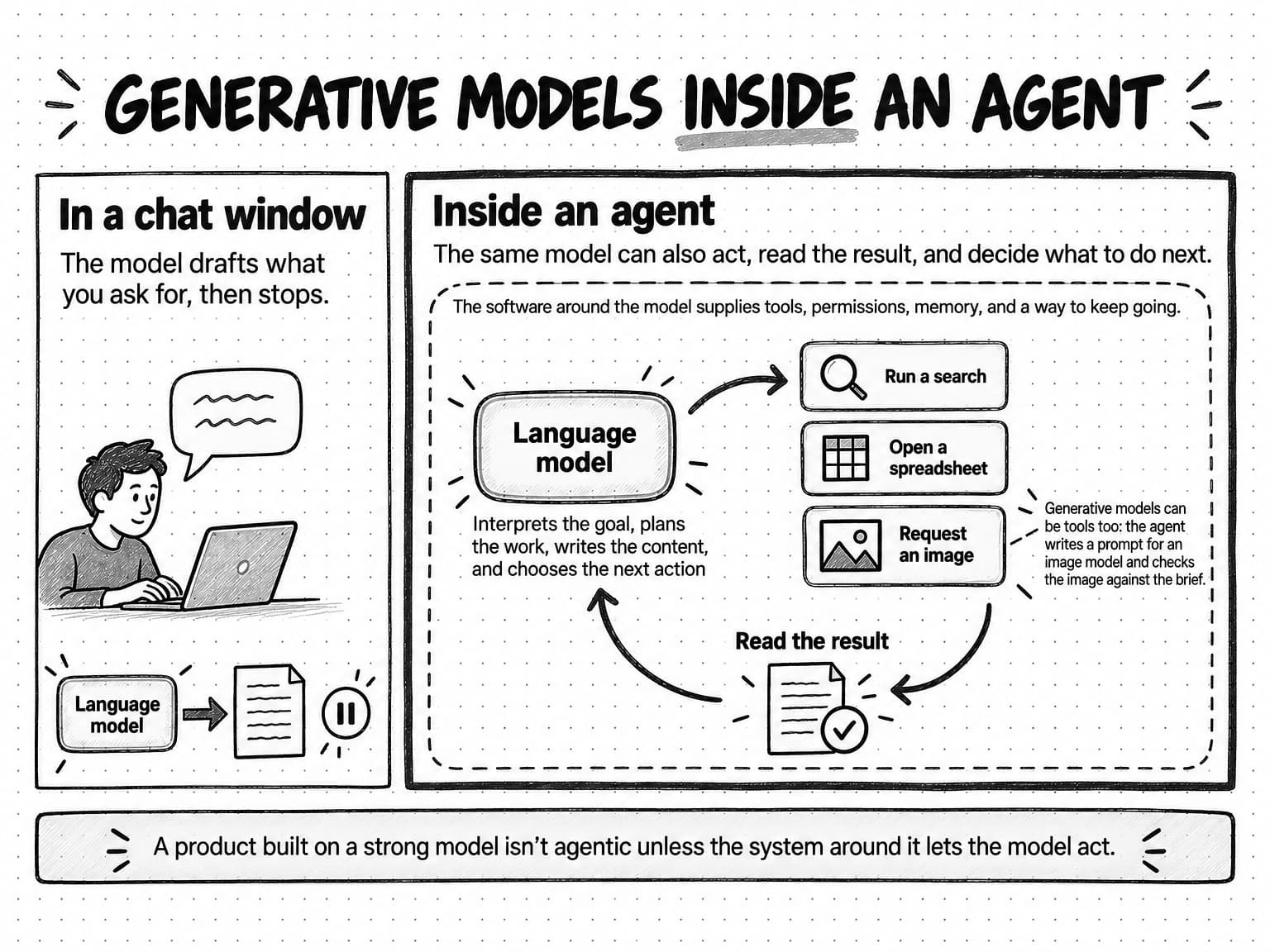
View the generative models diagram at full size (opens in a new tab).
One product launch brief, handled three ways
Giving the same launch brief to a generative AI tool, an AI agent, and an agentic setup shows how each approach changes what gets done and what the marketer still does. The company and its details are invented for illustration.
Tidewell, a fictional invoicing software company for small finance teams, is launching automatic payment reminders in three weeks. Its marketer has the release notes, a one-page positioning statement, and notes from five customer interviews. The launch strategy is settled, so the job is the material: an announcement email, a blog post, three LinkedIn posts, a short note for the sales team, and a product image. Setting that strategy is part of product marketing.
With generative AI: one response at a time
The marketer pastes the release notes into a generative AI tool and asks for the announcement email. A solid draft arrives in seconds, but one sentence says reminders work in any currency, while the release notes say US dollars and euros at launch. The model filled a gap with a plausible detail. The marketer corrects it, asks for a version closer to the company's voice, then makes separate requests for the blog post, LinkedIn posts, and sales note, pasting the release notes in each time, and asks an image tool for the product visual.
Every output is quick, and every decision stays with the marketer: what to make next, what the model sees, and whether the claims are true. So does the work of carrying context between requests and checking that the pieces agree.
With an AI agent: one task with a finish line
Next, the marketer gives an AI agent the same material as a brief. The brief lists the deliverables, audience, and launch date, names the release notes as the authority on product facts and the positioning statement as the authority on messaging, and asks for everything to be prepared for review without publishing or sending anything.
The agent reads the interview notes before drafting and finds that four of the five customers describe the problem as chasing late payments without straining client relationships, while the positioning statement leads with time saved. Following the brief, it drafts around time saved and records the interview pattern as a question for the marketer. It checks each claim against the release notes, finds that no source says which pricing plan includes the feature, and lists that as open. Then it returns the email, blog post, LinkedIn posts, sales note, and product image together, with a short list of what it couldn't verify.
The marketer's job shifts from producing each asset to reviewing a set and deciding the open questions. The agent needed more direction up front and took longer than a single prompt. In exchange, the context traveled with the work, and some checking happened before the drafts reached a person. How to brief an AI marketing agent covers writing that kind of brief.
With an agentic setup: an operation that keeps going
Launch day doesn't end the work. For the next six weeks, the team wants to keep up with customer questions and to notice if a competitor responds. That work continues while no one is in a conversation, so it calls for an agentic setup: an agent working with schedules, triggers, and saved context.
Every Monday, a scheduled run reads the customer questions the support team added to a shared file that week, drafts updates to the help article, and proposes a follow-up post. A watch on two competitors' changelog pages starts a separate task when either announces a similar feature, and the agent drafts a comparison note for the sales team. Some setups split work like this among several agents, one researching, one drafting, and one checking, with another coordinating them.
The marketer sets the cadence, sources, and limits once, then reviews each result as it lands. The checks change again: whether each run used current information, whether it repeated last week's findings, and whether the setup is still worth what it costs.
What the three versions show
Across the three versions, decisions moved from the marketer to the system one step at a time: first only the wording, then the order of the steps and the checks, then when the work starts. The marketer's role moved the other way, from making each piece to setting direction and reviewing results. That shift is the practical difference between the terms, and it's also the basis for choosing between them.
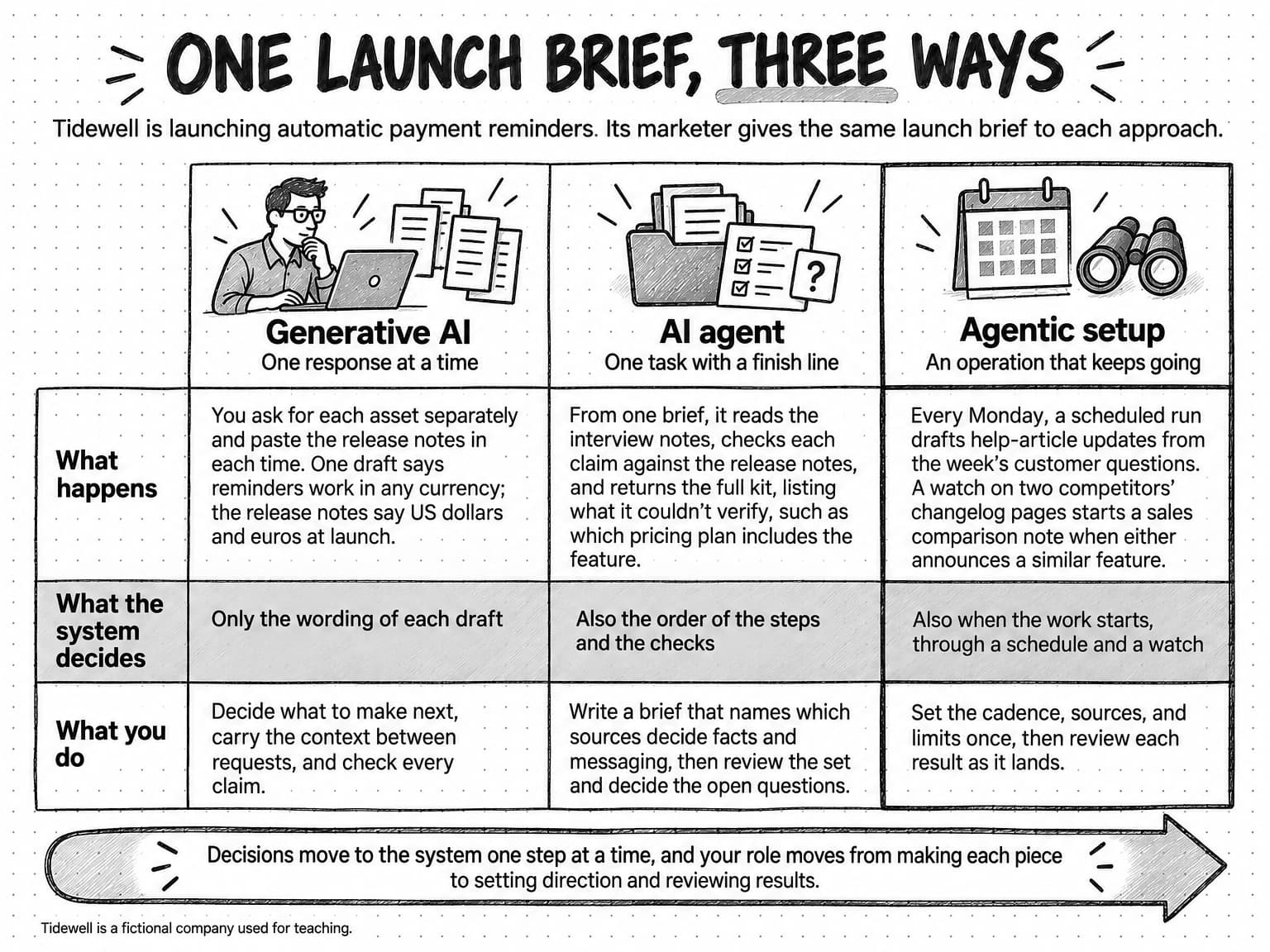
View the launch brief comparison at full size (opens in a new tab).
How to choose between generative AI and agentic AI: the unit-of-work test
To choose between generative AI and agentic AI for a marketing job, name the unit of work you're handing over: a response, a task, or an operation. We call this the unit-of-work test. A response is one output you'll judge and use yourself, such as five headline options or an image concept. A task is a job with a defined finish line whose steps depend on what's found along the way, such as a sourced competitor comparison or a launch kit. An operation is work that spans several tasks or continues over time, such as a weekly competitor digest or a watch on review sites.
Generative AI gives you a response. An AI agent completes a task. An agentic setup keeps an operation running.
Four questions place most marketing jobs:
- Is the output the end of the job? If you'll take the draft and handle the rest yourself, you need a response. Generative AI is usually the fastest and cheapest choice, and you remain the check on every claim.
- Can you list the steps in advance? If the route depends on what's found, such as which sources exist and which claims hold up, you need a task completed, and an AI agent fits. If the steps are fixed and repeat, a predefined workflow may do the job more predictably; How to automate marketing with AI agents explains that choice.
- Does the work need to continue when nobody is in the conversation? Then it's an operation. It needs a schedule or a trigger, saved instructions and sources, a record of what earlier runs found, and a place where results land for review.
- What would a mistake cost, and where must a person approve? This sets the review points for any unit. A weak subject line costs minutes; a wrong price in a sales note, or a post from the wrong account, costs more. The more a system decides, the more deliberately approval points need to be placed.
When in doubt, choose the smallest unit that gets the job done. Anthropic's guidance makes the same recommendation to teams building agents: start with the simplest solution and add complexity only when it's needed, because agentic systems often trade speed and cost for better task performance.
| Subject lines or headline variants | A response. You choose and edit the result yourself, so generative AI is enough. |
|---|---|
| A LinkedIn post from a webinar transcript | A response when you supply the transcript and judge the post. A task when the job includes finding the strongest moments and producing several formats. |
| A competitor messaging comparison with sources | A task. The work means finding and reading pages, checking claims, and adjusting when a source is missing. |
| A launch kit from release notes and interview notes | A task. Several deliverables share one set of sources, and the checks depend on what those sources say. |
| A weekly competitor digest | An operation. It needs a schedule, saved instructions, current sources, and a record of what earlier runs reported. |
| A watch on review sites for complaints about a new feature | An operation started by a change, with each alert and any drafted response landing for review. |
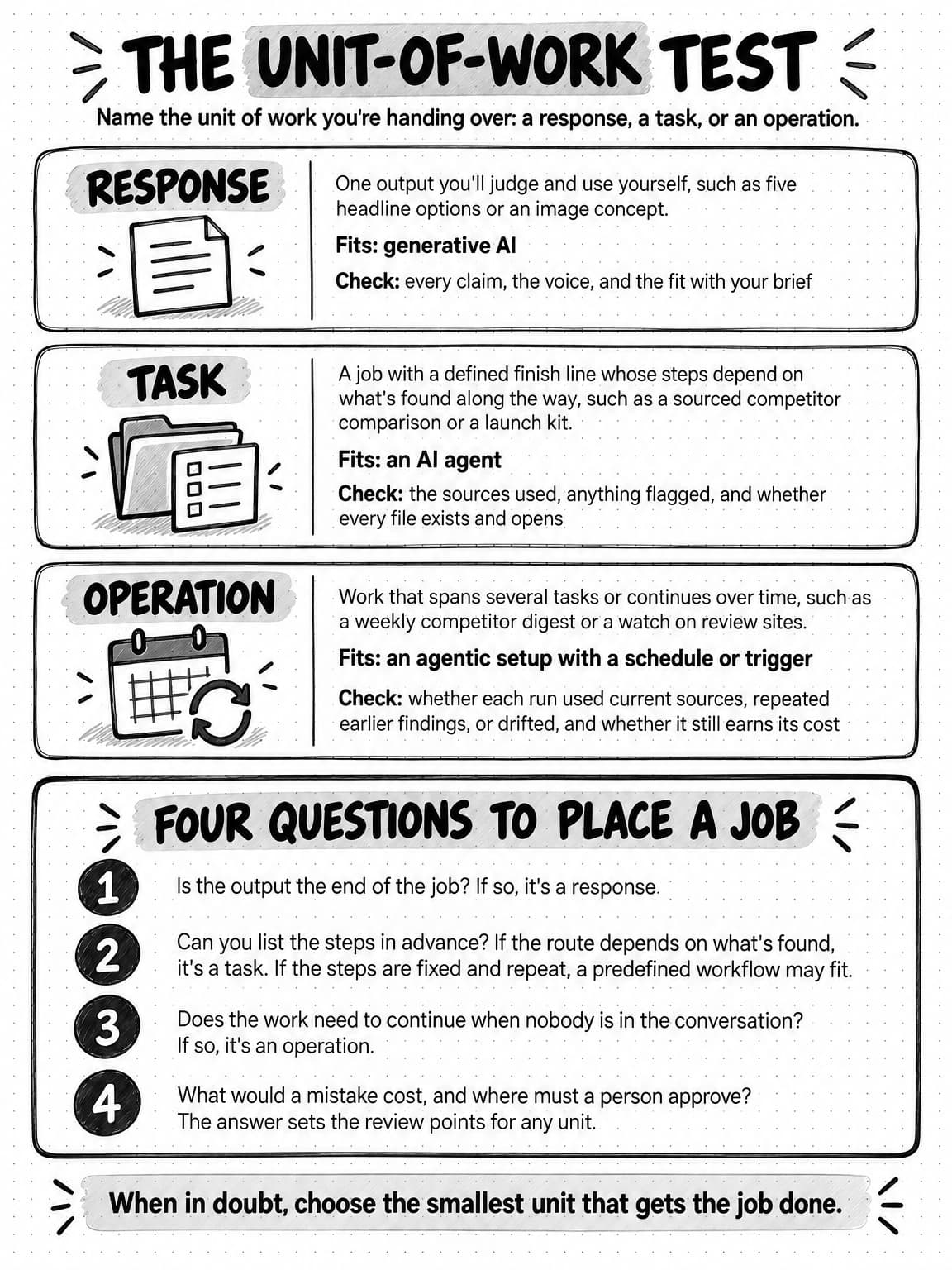
View the unit-of-work test reference at full size (opens in a new tab).
How Ampere uses generative models inside an AI marketing agent
Ampere is an AI marketing agent: it uses generative models to read your brief, plan the work, and write, and it carries marketing tasks from the brief to finished deliverables for your review. In the terms of this guide, generative models sit inside the agent, and the agent decides when and how to use them.
You choose the agent model for a session, guided by descriptions of task fit and relative cost, and that model does the interpreting, planning, and writing. When a deliverable needs an image, a video, a voiceover, or an avatar, Ampere uses generative AI Tools for that format. They are part of its 200+ AI tools & skills, alongside research tools for web search, page extraction, and public ad, review, and social data.
Each session has its own session workspace, with a browser and files, where you can follow the work and open the finished files. Brand memory holds saved, reviewable knowledge about your company, products, audience, voice, and competitors, so each brief doesn't have to restate it. Ampere asks for a missing fact only when the work can't continue without it, and it returns finished work for review. It doesn't publish posts or send marketing emails by itself, and actions in connected accounts, where available, need your approval.
Operations run through scheduled tasks and Monitoring. A scheduled task saves a prompt for Ampere, with any attachments and a Project, and runs it on a cadence such as weekly, with each run's results landing in the Project for review. A monitor checks supported public sources, such as a competitor's pricing page, a changelog, or a review site, hourly, daily, or weekly, and records what changed with the evidence it found, plus any follow-up work you've set up. Monitoring depends on the sources it can reach, so treat an alert as a reason to look closer, not proof that nothing else changed.
In the Tidewell illustration, the launch kit would be one Ampere session, the Monday follow-up a scheduled task, and the competitor watch a monitor, while your team still decides what to send and when.
Risks of generative AI and agentic AI
Generative AI's risks lie mainly in what it produces. Agentic AI keeps those risks and adds new ones that come from what it does.
Risks of generative AI
With generative AI, a person sees every output before it goes anywhere, so the risks concern the content. Confabulation is the best known. NIST's Generative AI Profile also lists intellectual property risks, such as content that replicates copyrighted or trademarked material without authorization, and data privacy risks, such as sensitive information being leaked or misused. The defenses are familiar editorial habits: check claims against sources, keep customer data out of tools your company hasn't approved, and review generated images for borrowed logos or recognizable copyrighted material.
Risks agentic AI adds
An agentic system acts across many steps before anyone reviews the result. An early error, such as a misread source or a wrong assumption about the audience, can shape the research, the recommendation, and every asset built on them. Anthropic's guide notes that the autonomy that makes agents useful also brings higher costs and the potential for compounding errors.
Agents can also act outside the conversation. One that can publish, send, delete, or spend can do the wrong thing in a real account, so approval for those actions belongs in the product's controls, tied to the exact action, not only in the prompt. Outside content adds another risk: NIST's profile describes indirect prompt injection, in which attackers plant instructions in data an AI system is likely to retrieve, such as a web page. An agent doing research should treat what it reads as evidence, never as new instructions.
Cost and attention change too. Long tasks use more model calls and tools, and an operation keeps spending until someone pauses it. Polished, complete-looking work is also easy to approve without reading. NIST lists automation bias and over-reliance among the risks in how people work with generative AI, and a tidy delivery can invite exactly that.
The defenses scale with the unit of work. For a response, read it. For a task, check the sources and the files, and decide the open questions. For an operation, review each run, watch for drift, and decide when it should stop.
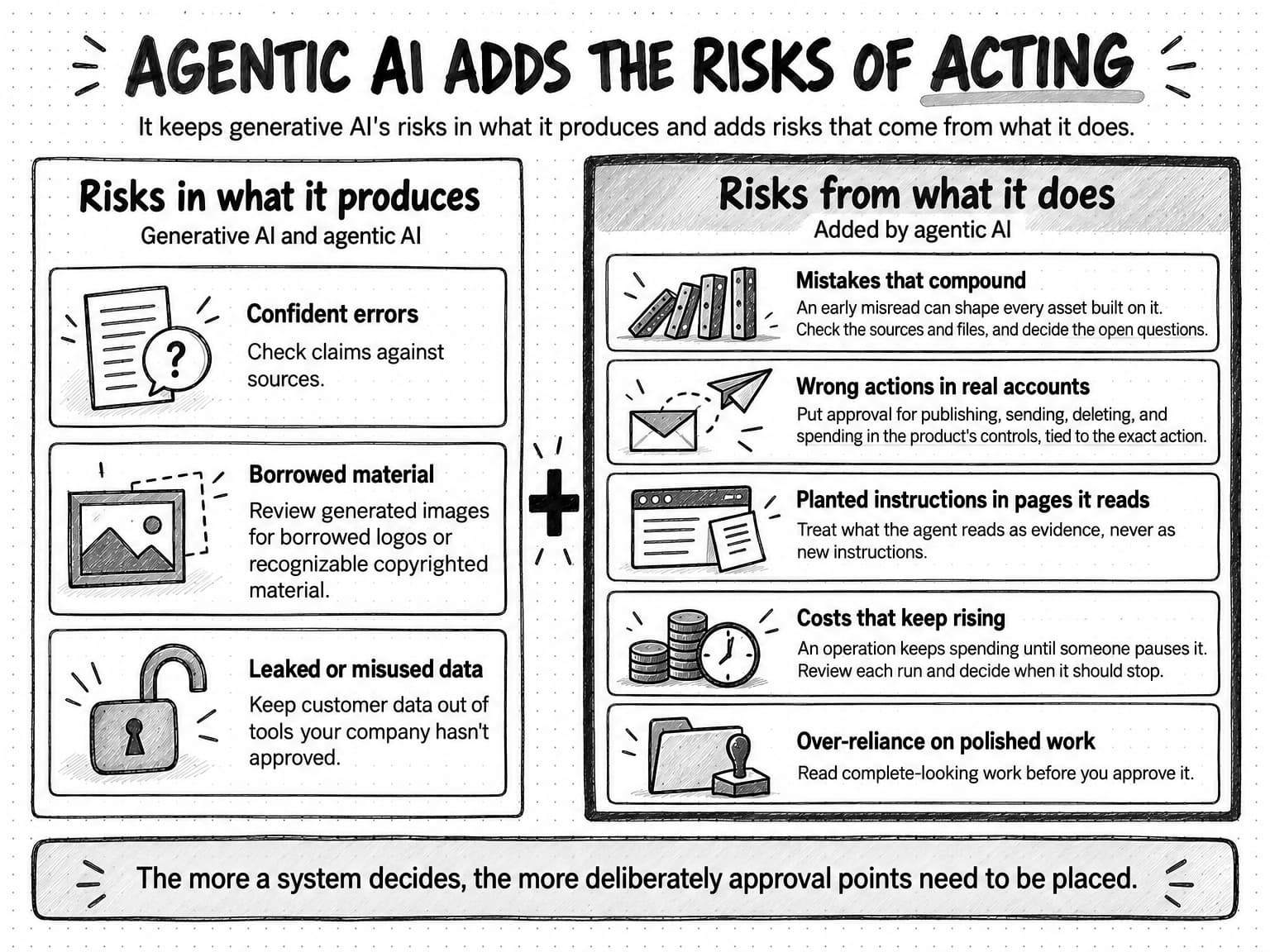
View the risks of acting diagram at full size (opens in a new tab).
Is agentic AI the next stage of generative AI?
Agentic AI is the next stage of generative AI in one sense: it builds on generative models and extends them from producing content to carrying out work. It doesn't replace generative AI, though, and it isn't the right choice for every job. IBM describes agentic AI as building on generative AI techniques and applying generative outputs toward specific goals. The language abilities that make a model good at drafting also let it plan, choose tools, and judge results.
Plenty of marketing work is still a response, such as a rewrite or a set of options, and running it through an agent can add time and cost without improving the result. The more useful picture is a range of options, from a single prompt to a long-running operation, chosen by the unit of work.
Expect the label to run ahead of the substance for a while. Alongside its agent-washing warning, Gartner predicted in June 2025 that more than 40% of agentic AI projects would be canceled by the end of 2027 because of escalating costs, unclear business value, or inadequate risk controls. A forecast isn't an outcome, but it's a sensible caution for buyers. Start with one task you know how to judge, count review time as part of the cost, and give a system more of the work only when its results hold up.
Sources and further reading
- IBM, Agentic AI vs. generative AI: definitions, differences, and how agentic systems use generative models.
- IBM, What is agentic AI?: agentic AI defined, with AI agents as its components.
- IBM, Generative AI vs. predictive AI: What's the difference? (2024): predictive AI's methods and business uses.
- Anthropic, Building effective agents (2024): workflows and agents, starting simple, and the trade-offs of autonomy.
- Ranjan Sapkota, Konstantinos I. Roumeliotis, and Manoj Karkee, AI Agents vs. Agentic AI: A Conceptual Taxonomy, Applications and Challenges (2025): a stricter academic boundary between the two terms.
- NIST, Artificial Intelligence Risk Management Framework: Generative Artificial Intelligence Profile (NIST AI 600-1) (2024): generative AI risks, including confabulation and over-reliance.
- Gartner, Gartner Predicts Over 40% of Agentic AI Projects Will Be Canceled by End of 2027 (June 25, 2025): the agent-washing warning and the cancellation forecast.
Frequently Asked Questions
Is agentic AI part of generative AI?
Agentic AI usually contains generative AI, but the two aren't the same thing. In most current agentic systems, a generative language model interprets the goal, plans the steps, writes the content, and chooses the next action. Agentic describes the system around that model: the tools, permissions, and loop that let it act on a goal and keep going. A plain generative tool that can't take actions isn't agentic.
Is agentic AI the same as AI agents?
Agentic AI and AI agents are related but not identical. An AI agent is a system that pursues a goal by choosing and carrying out actions. Agentic is the property of working that way, and agentic AI is the broader term, often used for arrangements in which several agents, or an agent with schedules and triggers, carry work across tasks and time. Sources draw the boundary differently, and vendors use both terms loosely.
What are examples of agentic AI and generative AI in marketing?
Generative AI examples in marketing include drafting subject lines, rewriting a post for another channel, sketching image concepts, and turning an approved script into a voiceover. Agentic examples carry more of the work: an AI agent researching competitors' pricing pages and writing a sourced comparison, or preparing a launch kit from release notes. An agentic setup can produce a weekly competitor digest or watch review sites for changes, with a person reviewing each result.
What is the difference between agentic AI, generative AI, and predictive AI?
Predictive AI analyzes historical data to forecast outcomes, such as projecting sales or estimating demand. Generative AI creates new content, such as text or images, in response to a prompt. Agentic AI pursues a goal by planning steps and taking actions, usually with generative models doing the reading and writing. The three can work together: an agent might use a predictive model's forecast as one input to a campaign plan and a generative model to write it.
Is an AI chatbot generative AI or agentic AI?
An AI chatbot is generative AI when it answers or drafts inside the conversation and then waits for your next message. If the product also lets it browse the web, run code, or create files across several steps toward a goal, it is working as an agent, so the same general-purpose AI assistant can be either. Ask what it can do between your request and its answer.
What is the difference between agentic AI and an LLM?
A large language model, or LLM, is a generative model that reads and writes text, while agentic AI is a way of building systems around models like it so they can pursue goals. On its own, an LLM drafts a response and stops. Inside an agentic system, software lets it call tools, feeds the results back to it, and keeps the work going until it's done or needs a person.
Which is better for marketing, generative AI or agentic AI?
Neither generative AI nor agentic AI is better for marketing in general, because each fits a different unit of work. Use generative AI for a response you'll judge and use yourself, such as headline options. Use an AI agent for a task whose steps depend on what it finds, and an agentic setup for work that must continue over time. Choose the smallest unit that does the job, because agentic systems add time and cost.
What are the risks of agentic AI compared with generative AI?
Agentic AI keeps the risks of generative AI, such as confident errors and generic or borrowed content, and adds risks that come from acting. Mistakes can compound across steps before a person sees them, actions in connected accounts have real consequences, outside content can try to redirect the agent, and costs grow with every step. Polished, complete-looking work also invites over-reliance, so check sources and claims, and keep consequential actions behind an approval step.
Is agentic AI fully autonomous?
No, agentic AI doesn't mean fully autonomous AI. Agentic describes a degree: how much of the work a system decides and carries out without step-by-step direction. People still set the goal, the sources, the tools the system may use, and the points where it must stop for approval. For marketing work, keep publishing, sending, and spending behind an approval step, and have recurring work land for review before anything goes out.
Is agentic AI just hype?
Agentic AI isn't just hype, but the label often runs ahead of the products. Agents that use tools to carry out multi-step work are real and useful for tasks whose steps depend on what they find. Gartner, however, warned in June 2025 about agent washing, the rebranding of existing chatbots and automation tools as agentic, and predicted that more than 40% of agentic AI projects would be canceled by the end of 2027.


