B2B SaaS SEO strategy: how to win search and AI answers with a small team
A sequenced SEO plan for founders and small marketing teams at B2B SaaS and AI companies: what to build first, how AI answers change the work, how to measure it across a long sales cycle, and a 90-day plan you can adapt.
44 min readWritten by Ampere
Short answer
What is a B2B SaaS SEO strategy?
A B2B SaaS SEO strategy is a plan for which pages a software company builds, and in what order, so the buyers it wants find it in search results and AI answers and move toward a purchase. For a small team it starts from positioning and the buyer, builds comparison, use-case, and integration pages first, and measures influence on pipeline, not traffic alone.
Summary
A B2B SaaS SEO strategy should be built in order, starting from positioning and the buyer rather than a keyword list. Search volumes are small, Forrester reports that 13 people take part in a buying decision on average, and buyers form shortlists before contacting vendors, so the goal is credible answers at the moments that shape a shortlist, in search results and AI answers alike.
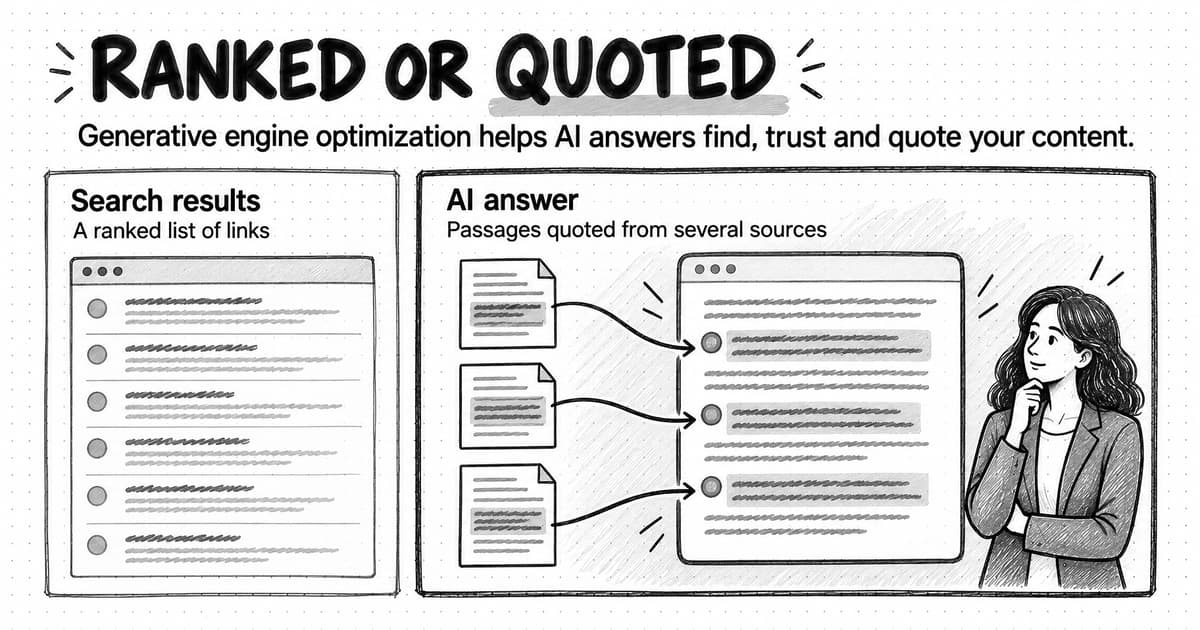
AI answers change where the payoff is, not the fundamentals. Pew found people clicked a result on 8% of Google visits with an AI summary, against 15% without one, so simple definitions bring fewer visits. Google says AI Overviews and AI Mode need no special optimization, so the adjustment is to favor pages with evidence and decisions and to track whether your company is named.
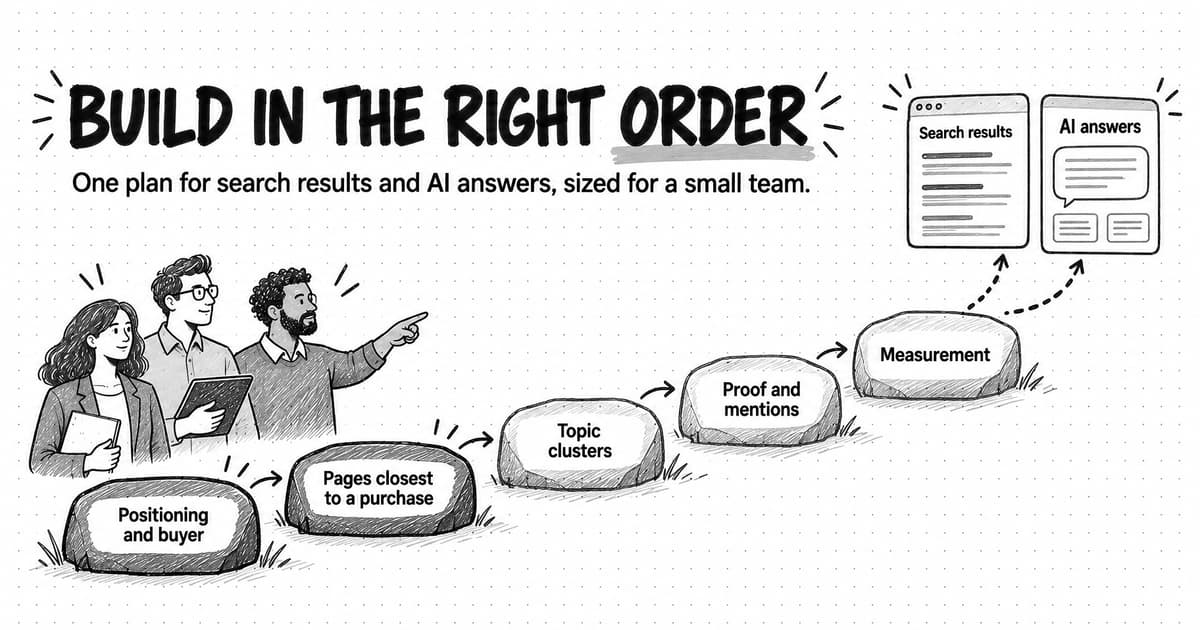
Build the pages closest to a purchase first: honest comparison and alternative pages, use-case pages, integration pages, pricing, and public documentation. Then add pain-point and product-led articles, one finished topic cluster at a time, and original data or expert content that others can cite. Programmatic pages work only when every page has distinct substance, because Google's spam policies cover many pages generated without adding value for users.
Keep technical work to the basics a few-hundred-page site needs, and decide on purpose which AI crawlers to allow, since each company runs separate crawlers for search and for training. Earn mentions on the review sites, partner directories, and communities that AI answers already cite, then measure at three levels: leading signals, conversions by page type, and influence through self-reported attribution and CRM records.
An illustrative 90-day plan for a team of one to five runs foundations in weeks one and two, pages closest to a purchase in weeks three to six, a first cluster in weeks seven to ten, and proof and reach in weeks eleven to thirteen. A fictional four-person team following it shows why order matters more than volume, and why every plan should match the hours the team really has.
Contents
- What makes SEO different for B2B SaaS
- What changes when AI answers come first
- Start from positioning and the buyer, not keywords
- The page types that matter in B2B SaaS
- Bottom-of-funnel pages: comparison, alternative, and use-case pages
- Pain-point and product-led content
- Topic clusters for the problem you solve
- Original data and expert content
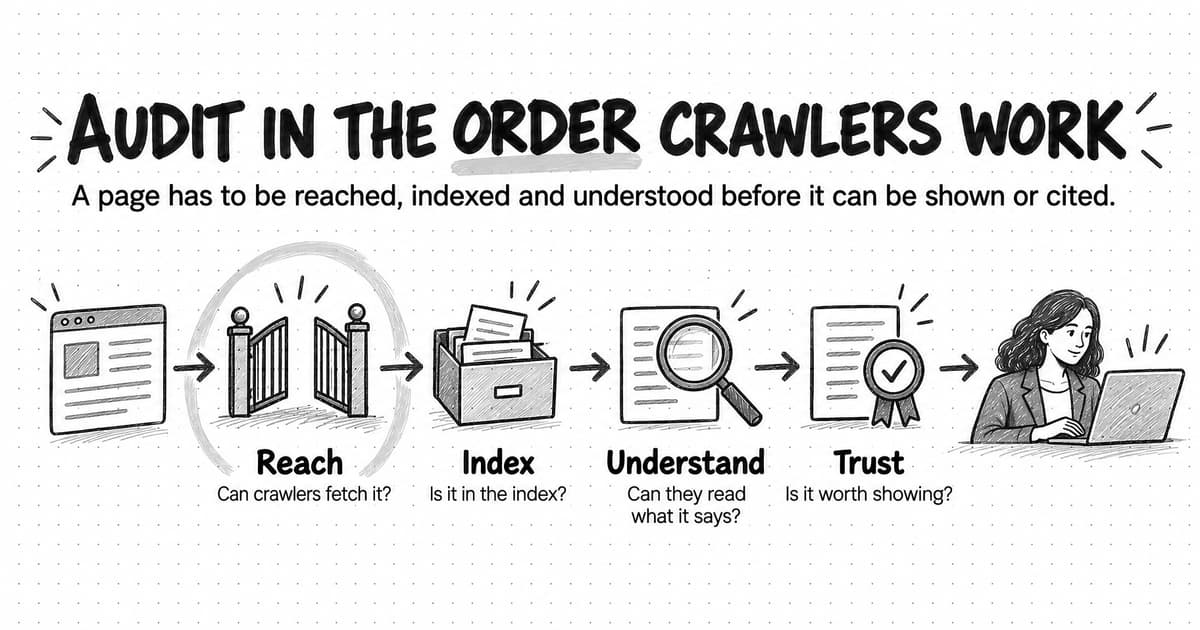
- Technical foundations a small team must get right
- Earning mentions and links beyond your own site
- How to measure SEO in a long sales cycle
- A 90-day SEO plan for a team of one to five
- Worked example: a four-person team plans its first quarter (fictional)
- Common B2B SaaS SEO mistakes
- Running SEO work with Ampere
- Sources and further reading
- Frequently Asked Questions
Most B2B SaaS teams start SEO the same way. Someone opens a keyword tool, types in the product category, and sorts by search volume. The list that comes back is full of broad terms with big numbers, a few hundred people a month searching for the exact thing the product does, and a long tail of questions nobody on the team has time to answer. The team writes a handful of articles for the big terms, waits six months, and finds that the traffic, when it arrives, comes from people who will never buy.
The problem is the order, not effort. A keyword list tells you what people type. It does not tell you which of those people could become customers, what they need to see before they would book a demo or start a trial, or which pages your company is in a position to write better than anyone else. Those answers come from positioning, from the buyer, and from an honest look at what your team can produce in a quarter.
A B2B SaaS SEO strategy is a plan for which pages a software company builds, in what order, so that the buyers it wants find it in search results and AI answers, trust what they read, and take the next step toward a purchase. It covers more than blog posts: comparison and alternative pages, use-case and integration pages, documentation, original data, and the mentions your company earns on other sites. And because buyers now often meet an AI-written answer before they see a list of links, the strategy also has to cover how your pages get read, cited, and recommended by AI search products.
This guide is written for a founder or a marketing team of one to five people. It explains what makes SEO different for B2B software and what changes when AI answers come first, then sequences the work: positioning and the buyer, the pages closest to a buying decision, topic clusters, original data, technical basics, mentions beyond your site, and measurement for a long sales cycle. It ends with an illustrative 90-day plan and a fictional worked example.
What makes SEO different for B2B SaaS
SEO advice is usually written for sites that live on traffic: publishers, online shops, and consumer apps, where more visitors fairly reliably means more revenue. B2B software works differently, and four differences change what a sensible plan looks like.
The first is that the numbers are small. The phrase that describes your product exactly might be searched a few hundred times a month, or a few dozen. A consumer brand would ignore a term that small. For a company that sells annual contracts worth thousands or tens of thousands of dollars, a handful of qualified visitors a month to the right page can be worth more than a viral article. Search volume is a weak guide to value when one customer is worth a year of a writer's salary.
The second is that many people decide. Forrester's State of Business Buying 2024, published in December 2024 from its 2024 buyers' journey survey, reports that on average 13 people within an organization are involved in a buying decision, and that 89% of purchases involve two or more departments. Each of those people searches for different things. The operations lead wants to know whether the product fixes a specific workflow. The finance approver wants pricing and contract terms. The IT reviewer wants security, single sign-on, and integration details. One article per keyword cannot serve all of them, which is why page types matter more in B2B than in most other categories. Our guide to B2B SaaS marketing explains how these buying groups and subscription economics shape the rest of the marketing plan.
The third is that buyers decide early and quietly. In the 2025 Buyer Experience Report from 6sense, a survey of nearly 4,000 B2B buyers across North America, EMEA, and APAC, buyers made first contact with a vendor on average 61% of the way through their buying process, down from 69% in earlier editions. They filled about four spots on their shortlist on the first day of the journey and chose from that day-one shortlist 95% of the time. These are self-reported survey figures, not observed behavior, but they point in a clear direction: much of the evaluation happens before anyone fills in a form, and search, review sites, peers, and AI assistants are where it happens. If your company is absent from the pages buyers read during that quiet stretch, it may never reach the shortlist.
The fourth is that the sales cycle hides cause and effect. A buyer might read your comparison page in March, ask a colleague about you in April, see your founder's post in May, and request a demo in June by typing your company name into a search box. Analytics will credit the branded search. SEO did real work in that story, but the standard reports will not show it. Any plan for B2B SaaS SEO needs a way to measure influence, not only last clicks, and a later section covers how.
Put together, these differences shift the goal. A B2B SaaS team should judge SEO by whether the right buyers find credible answers from the company at the moments that shape a shortlist. Traffic is an input to that, but it is not the goal.
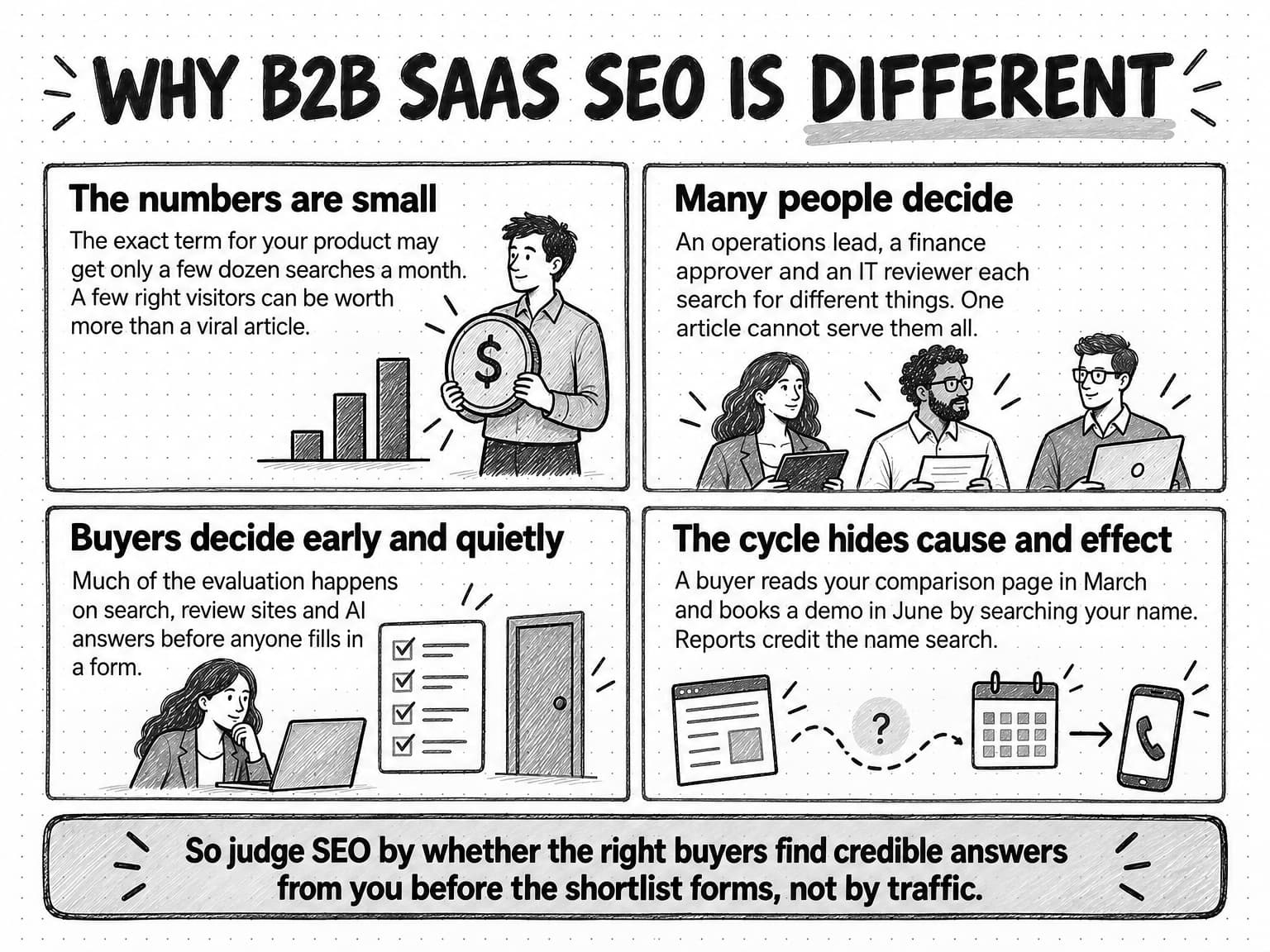
View why B2B SaaS SEO is different at full size (opens in a new tab).
What changes when AI answers come first
Search results now often open with a written answer instead of a list of links. Google shows AI Overviews on many queries and offers AI Mode as a conversational search experience. ChatGPT search, Perplexity, Gemini, Copilot, and Claude can all search the web and answer with cited sources. Our guide to Google AI Overviews and AI Mode explains how Google's versions work, and our explainer on generative engine optimization sets out how optimizing for these answers relates to classic SEO.
Two consequences matter most for a small B2B team.
Fewer people click through on informational questions. Pew Research Center tracked the Google searches of 900 U.S. adults in March 2025 who had agreed to share their browsing. In that study, 18% of searches produced an AI summary. When a summary appeared, people clicked a traditional result link on 8% of visits, against 15% when no summary appeared, and they clicked a link inside the summary on just 1% of visits. That is one study across all kinds of searches, not B2B software queries, but the pressure is clear: an article answering a simple definition question may now be read by Google's systems more than by people. Our guide to zero-click content distribution compares several studies of this shift and covers how to reach buyers who never click.
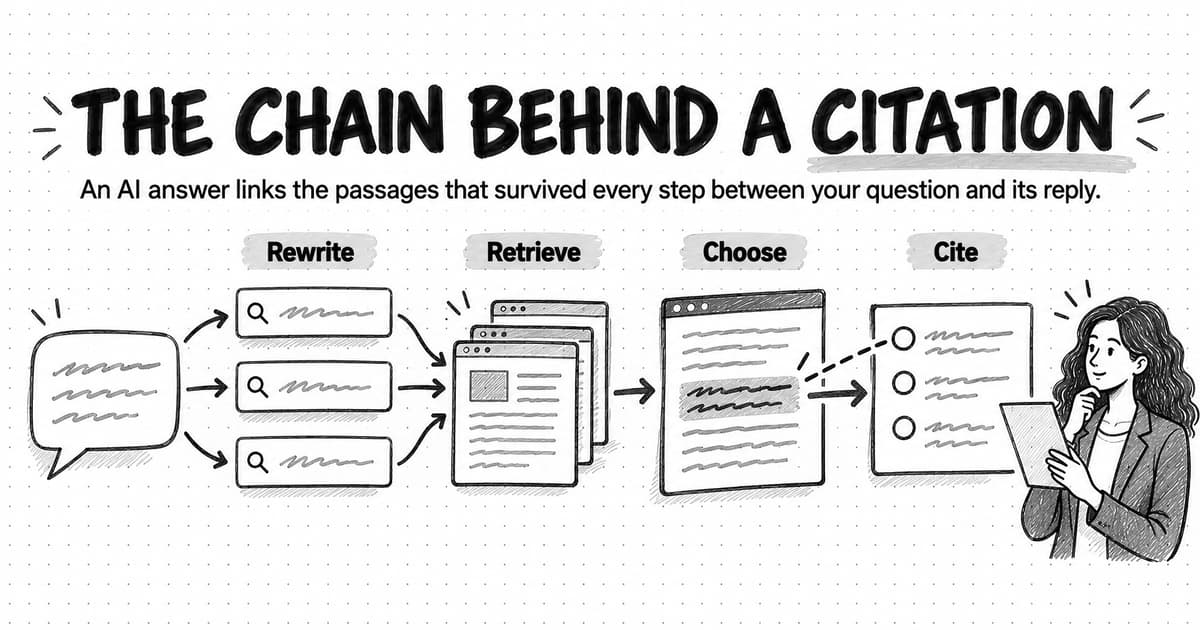
Being named in the answer becomes its own goal. When a buyer asks an AI assistant which tools handle a problem, the answer usually names a few companies and cites a few pages. Being one of them is a new kind of visibility, and it does not always come with a visit. The sources an AI answer draws on are not always the pages that rank first, either. Our guide to how AI search engines choose sources covers what is known about that selection.
What does not change is more reassuring. Google's documentation on AI features and your website, last updated in December 2025, says there are no additional requirements to appear in AI Overviews or AI Mode, and no special optimizations necessary: a page must be indexed and eligible to show a snippet, and "all existing SEO fundamentals continue to be worthwhile." The same page explains that these features may run several related searches across subtopics to build a response, a technique Google calls query fan-out. For a B2B company, fan-out is an argument for covering a problem thoroughly, across the questions a buyer asks around it, instead of chasing one head term.
Research on AI answers points the same way. The paper that named generative engine optimization, by Pranjal Aggarwal and colleagues and accepted at KDD 2024, tested ways of editing source pages and reported that the best methods could raise a source's visibility in generative engine responses by up to 40%, with results that varied by domain. The methods that helped most added substance a reader could check, such as cited sources, quotations, and statistics. That was a controlled experiment on a research benchmark, not a guarantee for any live product, but it fits what Google says: AI answers favor pages that give them something specific and credible to use.
So the strategy below does not split into an SEO plan and an AI plan. It is one plan, with two adjustments for AI answers: weight the work toward pages that carry evidence and decisions rather than generic definitions, and measure whether your company is named, not only whether it is visited.
Start from positioning and the buyer, not keywords
Keyword research is useful, but it is the third step, not the first. Before you look at search data, write down two things on one page.
The first is your positioning: who the product is for, what they use today instead of it, what is different about your approach, and what evidence you have for that difference. Positioning tells you which searches you deserve to win. A company that helps mid-sized finance teams approve purchases faster has earned the right to write about approval bottlenecks, spend policies, and purchase-order workflows. It has not earned the right to write a generic guide to "what is accounting," however large that term's volume. Our guide to brand positioning walks through the parts of a position and how to test one.
The second is the buyer, described as buying situations rather than demographics. What triggers the search? A failed audit, a new hire who inherits a broken process, a price increase from the current vendor, a board asking for an AI plan? Who in the buying group searches at each point, and what do they need to decide? An ideal customer profile and buyer personas give you the company and the people; the buying situation tells you when and why they search.
With those two pages written, look at real language before you open a keyword tool. Sales call notes, support tickets, onboarding questions, review-site comments about you and your competitors, and community threads show the words buyers use for their problem, which are often not the words your team uses for your product. Our guide to voice-of-customer research covers how to collect and code this material. Support tickets often hold the best topics: questions buyers ask repeatedly that no competitor has answered well in public.
Only then turn to search data, to check demand, phrasing, and what currently ranks and gets cited. Our guide to keyword research when AI answers come first covers the method, and our guide to search intent explains how to read what a query is really asking for. For a B2B team, the useful question about a keyword is rarely "how big is it?" It is "if the right buyer typed this, what would they need to see from us, and can we show it better than the pages that rank today?"
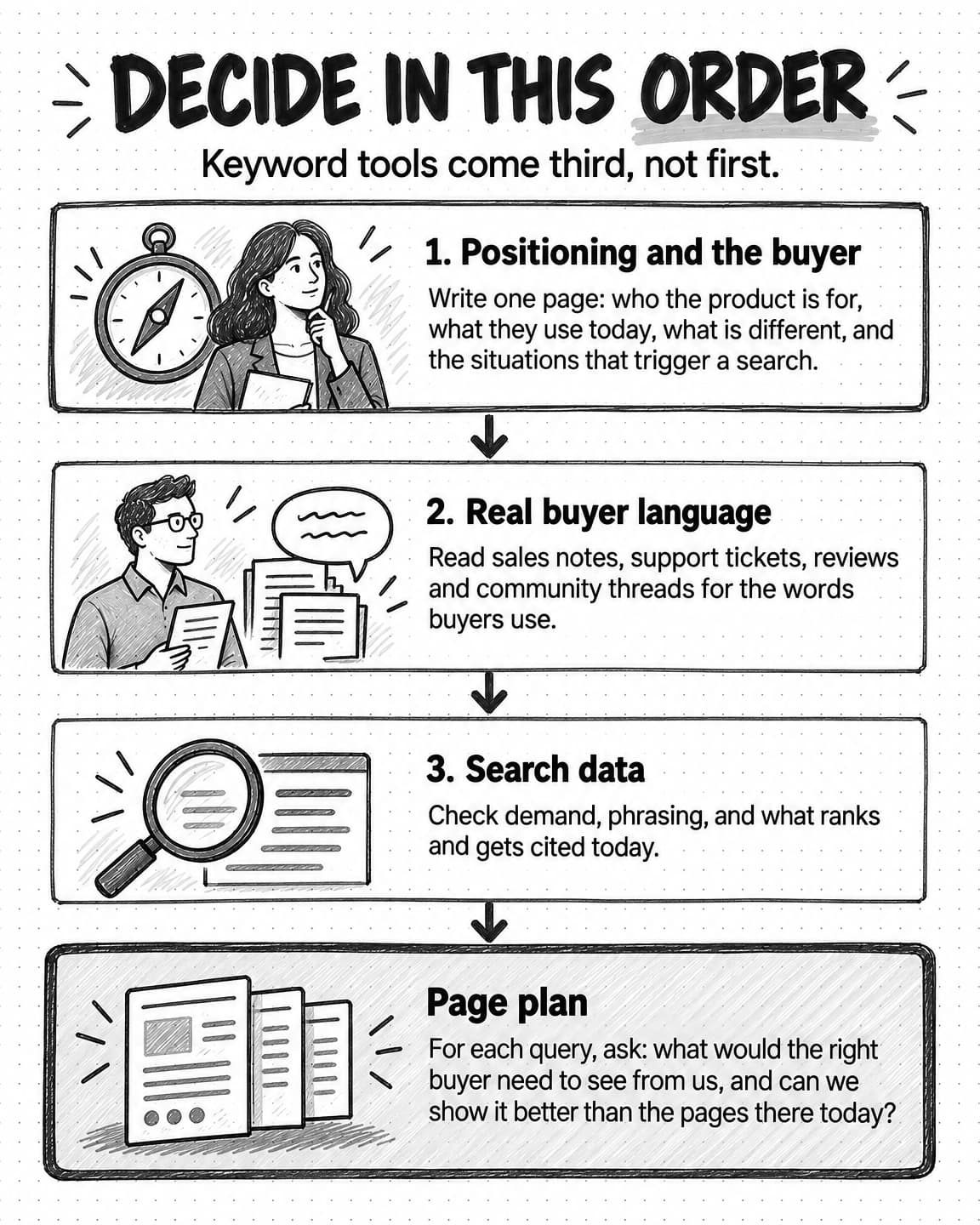
View the order of decisions at full size (opens in a new tab).
The page types that matter in B2B SaaS
A content calendar of blog posts is the most common B2B SEO plan and often the least effective, because a blog post is only one page type and usually the one furthest from a purchase. A stronger plan starts from the page types a buyer needs at each stage and builds the scarce, high-intent ones first.
The table maps the main types to the stage of the buying journey where they help most. The stages are a simplification, since real buyers loop back and skip steps, as our guide to the B2B buyer journey explains, but they are useful for deciding what to build first.
| Page type | Buyer's question | Stage | Example search |
|---|---|---|---|
| Comparison page | "How does this product differ from the one I'm already considering?" | Choosing a vendor | "[your product] vs [competitor]" |
| Alternative page | "What else could I use instead of the tool I have or the one I've heard of?" | Choosing a vendor | "[competitor] alternatives" |
| Use-case or solution page | "Does this product handle my specific job, team, or industry?" | Exploring solutions | "purchase approval software for manufacturing" |
| Integration page | "Will it work with the tools we already use?" | Choosing and validating | "[your product] [CRM] integration" |
| Pricing page | "What will this cost, and how is it priced?" | Validating | "[your product] pricing" |
| Pain-point article | "How do I fix this problem I have right now?" | Identifying the problem | "how to stop purchase approvals getting stuck" |
| Product-led tutorial | "How do I do this task, step by step?" | Exploring solutions | "how to set up a three-step approval workflow" |
| Template or tool page | "Is there something I can use right now?" | Exploring solutions | "purchase approval policy template" |
| Documentation and help content | "How exactly does this feature work?" | Validating and using | "[your product] single sign-on setup" |
| Original research | "What is normal or true for teams like mine?" | Identifying the problem | "average purchase approval time benchmark" |
| Definition or explainer | "What does this term mean?" | Identifying the problem | "what is a three-way match" |
Two things stand out in that table. The pages closest to a purchase (comparison, alternative, use-case, integration, pricing) are usually the fewest in number and the ones a small team can build fastest, because they draw on what the team already knows about its own product and market. And the pages furthest from a purchase, the definitions and explainers, are the ones most exposed to AI answers, because a short factual answer is exactly what an AI summary can supply without a click.
Explainers still build understanding and give AI answers a source to cite, but for a small team they come after the pages that help a buyer choose.
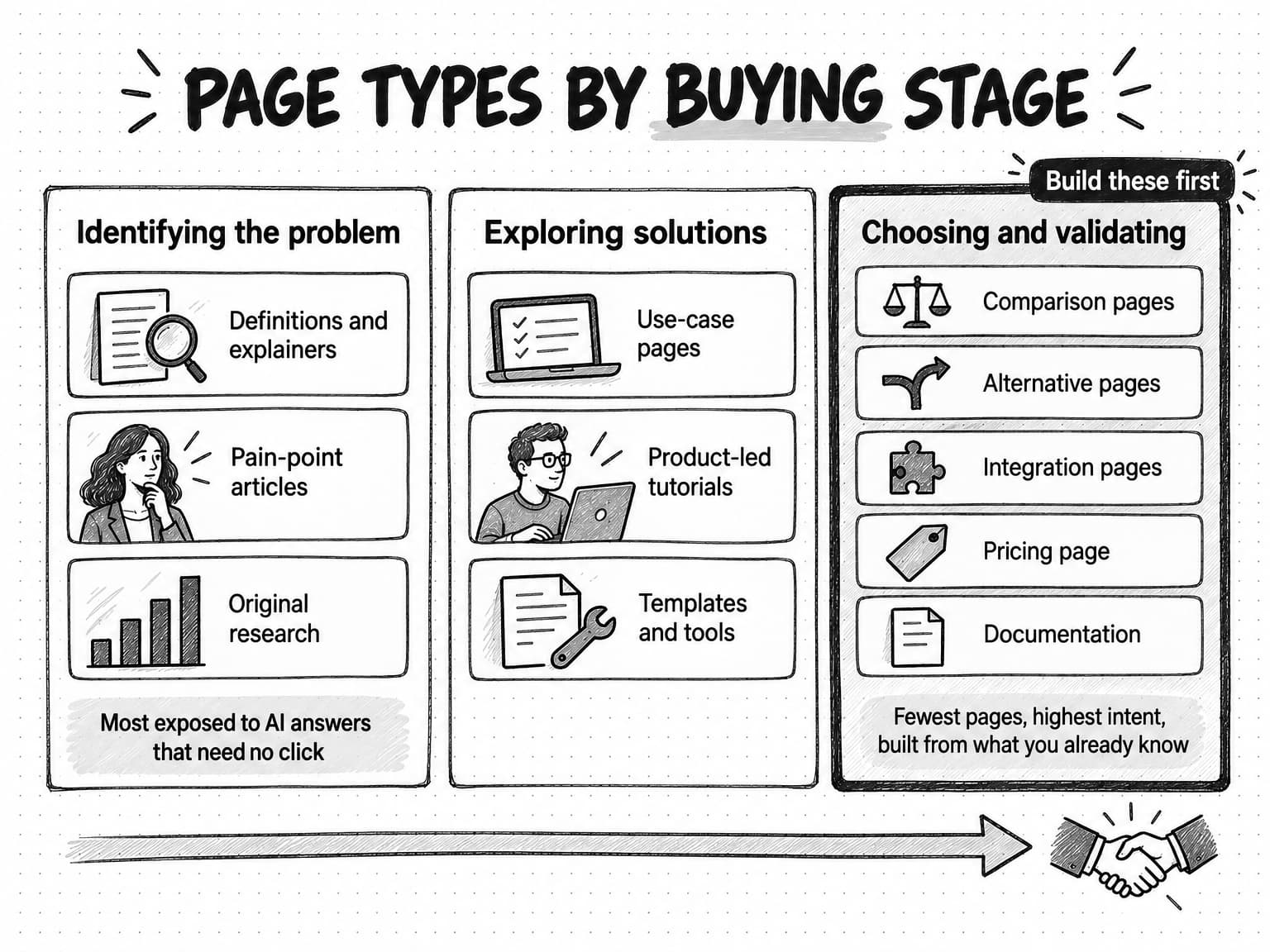
View the page types by buying stage diagram at full size (opens in a new tab).
Bottom-of-funnel pages: comparison, alternative, and use-case pages
Bottom-of-funnel pages answer the questions a buyer asks while choosing between vendors. They tend to have small search volumes and high value, and they are where many small B2B teams should start.
Comparison pages
A comparison page answers "how does your product differ from this other product?" Buyers search for these comparisons whether or not you publish one, and if you do not, the answer they find will be written by a competitor, a review site, or an AI summary of both.
A comparison page earns trust when it reads like a fair briefing rather than an attack. Google's guidance on writing high-quality reviews is written for review sites, but its standards describe a credible comparison well. It asks writers to "explain what sets something apart from its competitors," to "discuss the benefits and drawbacks of something, based on your own original research," and to "cover comparable things to consider, or explain which might be best for certain uses or circumstances." A vendor's comparison page will never be neutral, and readers know it. What it can be is accurate, specific, and honest about who should choose the other product.
A useful comparison page usually contains:
- A short answer at the top: who each product suits best, in one or two sentences.
- The real differences that affect a decision, such as approach, setup effort, pricing model, integrations, and the type of team each fits, rather than a long checklist where every row favors you.
- Evidence for each claim, such as screenshots, documentation links, published pricing, or what customers said in reviews, with dates, because competitors change.
- An honest section on when the other product is the better choice.
- The next step for a buyer who thinks your product fits, such as a trial, a demo, or a migration guide.
Date every claim about a competitor's product and review the page on a schedule, because a comparison that was true last year and is wrong today damages trust more than having no page at all. Check claims against the competitor's own public pages, not memory; our guide to competitor analysis covers how to gather and label that evidence. Ask legal or leadership whether naming competitors fits your company's norms before you publish.
Alternative pages
An alternative page targets searches like "[competitor] alternatives." The searcher is often unhappy with a tool they use or has heard of a market leader and wants options. These pages work best when they genuinely help that searcher: they explain the common reasons people look for an alternative, list several options with a fair description of each, and say plainly which kind of team each one suits, including your own product. A page that lists your product first and dismisses the rest in a sentence each is easy for a reader, and for an AI system summarizing several sources, to recognize as an advertisement.
Use-case and solution pages
A use-case page shows how your product handles one job, team, or industry: "purchase approvals for manufacturing," "onboarding emails for product-led SaaS," "contract review for in-house legal teams." Each page should describe the situation in the buyer's terms, show the workflow with real screenshots or examples, name the specific outcomes it supports, and link to proof such as a case study or documentation. A use-case page that swaps the industry name into the same template is thin content, and buyers notice. Build use-case pages only for situations your product handles well and your team can describe in specific detail.
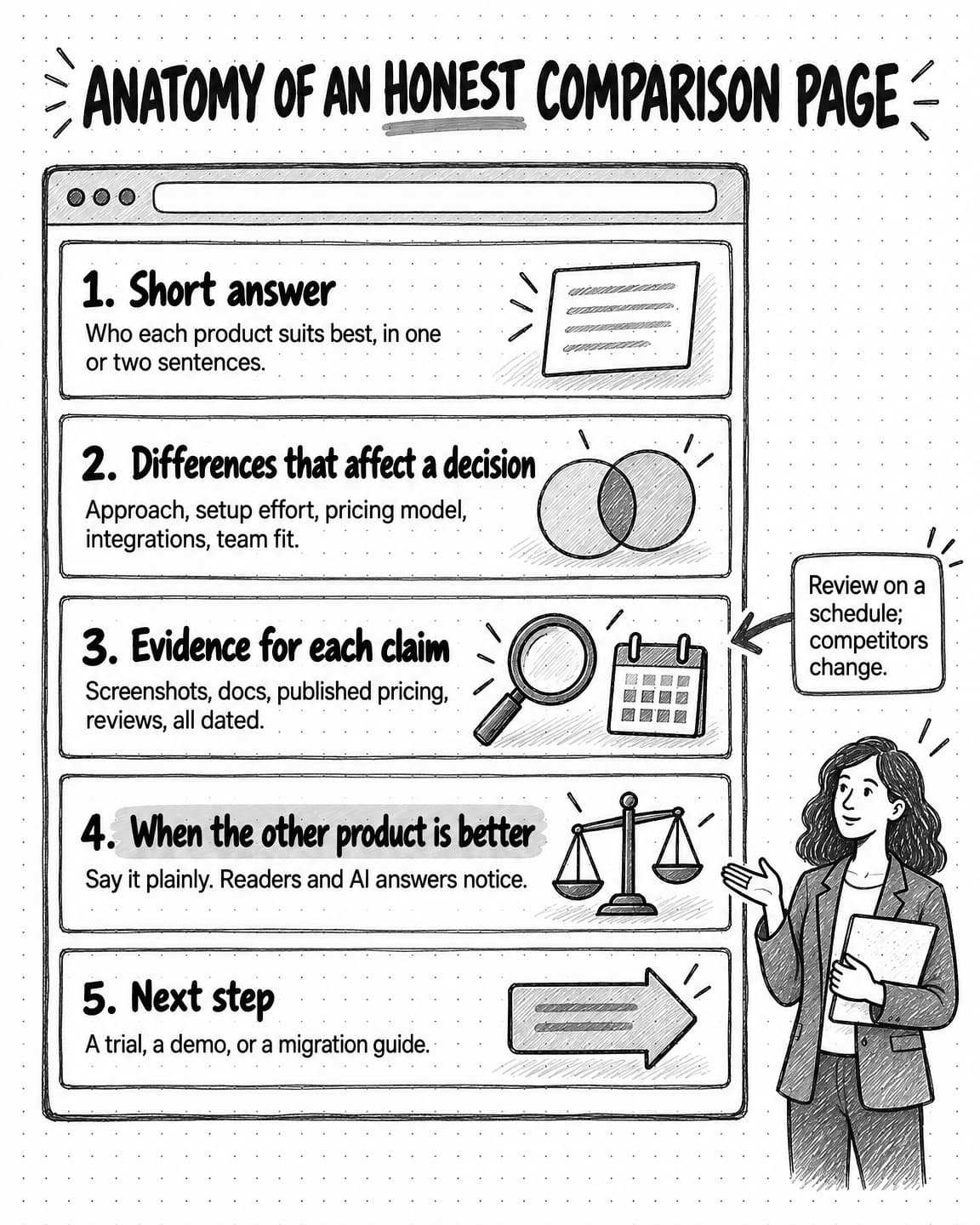
View the honest comparison page template at full size (opens in a new tab).
Pain-point and product-led content
Between the bottom-of-funnel pages and broad explainers sits the most productive kind of B2B content for many teams: articles that help a buyer fix a specific problem, written so the product appears naturally as part of the answer.
Pain-point SEO starts from problems buyers search for when they feel them, such as "approvals stuck in email," "month-end close taking too long," or "sales and marketing disagree on lead counts." These searches often have modest volume, but the searcher has a live problem and is open to a new way of solving it. A good pain-point article explains why the problem happens, gives a method the reader can use with or without your product, and then shows how your product handles the same method with less effort. The order matters: a reader who gets a useful answer first is more willing to read about the product second.
Product-led SEO is a related idea: pages where the product itself is part of the answer, such as a tutorial that walks through a task in your product, a free tool or calculator, a template that matches your product's structure, or a library of examples. These pages are hard for competitors to copy, because they depend on your product, and they are hard for an AI summary to replace, because the reader needs to use the thing, not only read about it.
Both approaches share a test. Google's guidance on creating helpful, reliable, people-first content, updated in October 2026, asks whether content provides "original information, reporting, research, or analysis" and whether it demonstrates "first-hand expertise and a depth of knowledge." A software company has first-hand expertise in its own problem space that a content farm cannot fake: the edge cases support handles, the workflows customers build, the mistakes onboarding teams see weekly. Pain-point and product-led content is where that expertise shows. Our guide to E-E-A-T explains how Google's quality raters think about experience and trust.
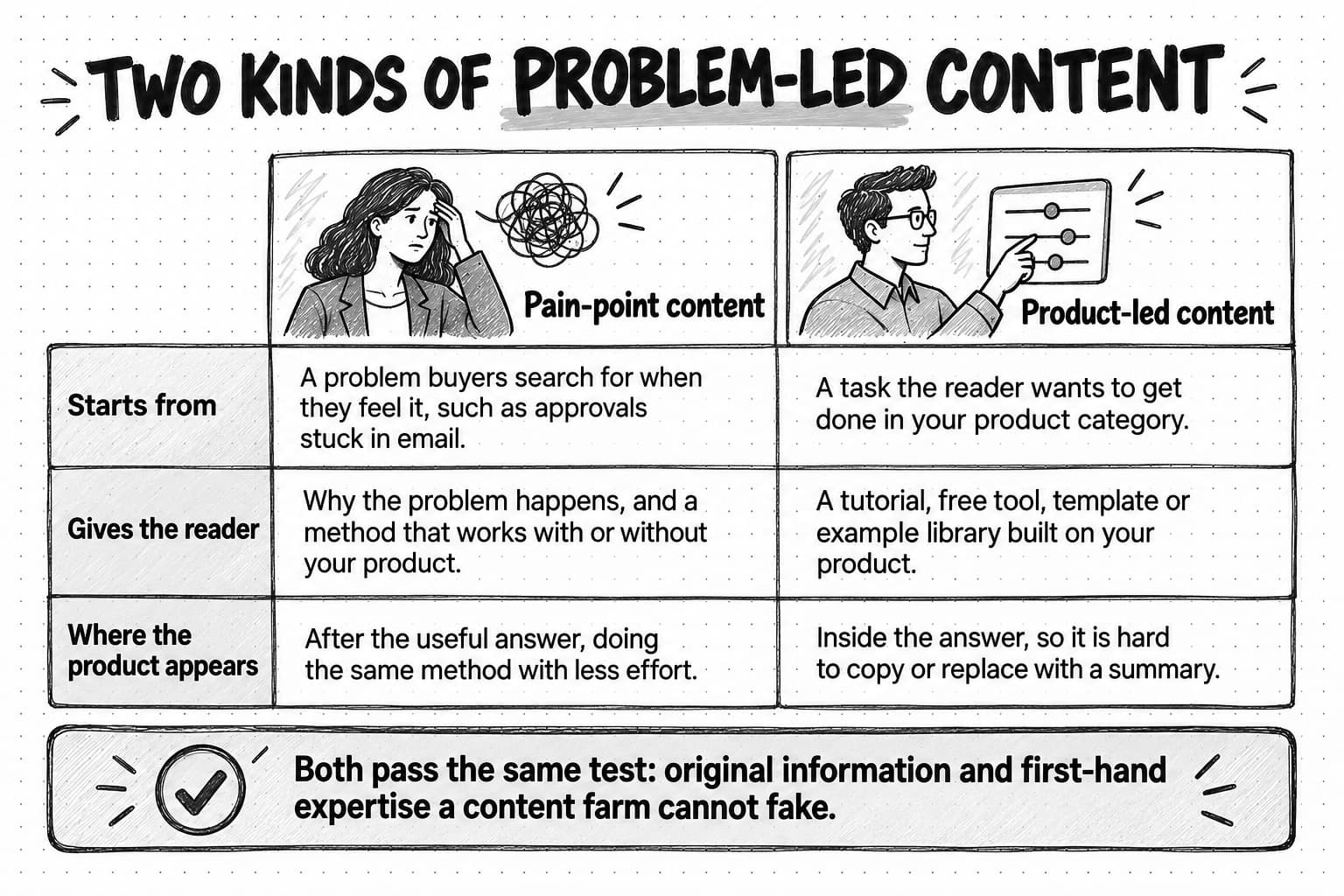
View the pain-point and product-led comparison at full size (opens in a new tab).
Integration pages and documentation
Integration pages answer a question every B2B buying group asks: will this work with what we already use? A page for each important integration should say what data moves in which direction, what a user can do with the connection, how setup works, and any limits. These pages often attract small but highly qualified searches, and they help the IT and operations members of a buying group, who rarely read a blog.
Documentation deserves the same care. Buyers read docs during evaluation to check whether a product does what the marketing pages say, and AI assistants can draw on public docs for detailed product questions. Keep docs public and crawlable where you can, and link from marketing pages to the docs that prove their claims.
Programmatic pages, with care
Programmatic SEO means generating many pages from a template and a dataset, such as one page per integration, per city, per job title, or per pair of competitors. It can work when each page has real, distinct substance: an integration page backed by actual integration details, a benchmark page backed by actual data for that segment. It fails when the pages are the same text with a keyword swapped.
Google's spam policies, updated in August 2026, define scaled content abuse as generating many pages "for the primary purpose of manipulating search rankings and not helping users," and list examples including "using generative AI tools or other similar tools to generate many pages without adding value for users" and "creating many pages where the content makes little or no sense to a reader but contains search keywords." Google's separate guidance on using generative AI content, updated in October 2026, says AI can be useful for research and for adding structure to original content, and asks publishers to fact-check and review AI-generated content for accuracy before publishing. The practical rule for a small team: build a template only when you have the data or product knowledge to make every page worth reading on its own, and review a sample of pages as a skeptical buyer before publishing the set.
Topic clusters for the problem you solve
Once the pages closest to a purchase exist, the next layer is depth on the core problem your product solves. A topic cluster is a group of pages that together cover one subject: a central pillar page that gives the broad answer, and supporting pages that each answer one narrower question, all linked to each other. Our guide to topical authority explains why search engines and AI answers tend to favor sites that cover a subject in depth, and how pillar pages and clusters build that depth.
For a B2B SaaS company, the cluster should be built around the buyer's problem rather than the product's feature list. A purchase-approval product might build its first cluster around "purchase approval process," with supporting pages on approval policies, approval limits by role, approval workflows for remote teams, common bottlenecks, audit requirements, and a template. The product appears where it helps, mainly on the pillar and the most practical supporting pages, and the use-case and comparison pages built earlier become natural link targets from inside the cluster.
Build one cluster at a time, and finish it before starting the next. A small team that spreads twenty articles across ten topics has ten thin clusters. The same twenty articles spent on two problems produce two clusters a buyer, a search engine, or an AI system can recognize as thorough. To find what your cluster is missing compared with competitors and AI answers, run a content gap analysis once the first pages are live. Our pillar guide to building a content marketing strategy for B2B SaaS and AI companies covers how to choose the subjects a company has earned the right to own, which is the same decision seen from the content side.
Internal links hold a cluster together. Link each supporting page to the pillar and to the closest use-case page, and the pillar to each supporting page, with anchor text that names the target's topic.
Original data and expert content
The scarcest thing on the web for most B2B topics is a fact nobody else has. A benchmark of how long purchase approvals take in mid-sized companies, an analysis of anonymized usage patterns, a survey of a hundred finance leaders, or a careful teardown of public data gives other writers, journalists, and AI answers something to cite that they cannot get anywhere else.
Original research does two jobs for SEO. It earns links and mentions from other sites, which remain one of the ways search engines judge a page's importance, and it gives AI answers a specific, checkable source, which fits what the GEO research found about statistics and citations. It also gives your sales team and your founder something worth talking about. Our guide to original research content covers five ways to create data on a small budget, how many survey responses you need, and how to report limits honestly.
Expert content is the other material competitors cannot copy. Interview your product managers, support leads, implementation consultants, and customers, and write down the specific advice they give in calls. A founder's point of view, backed by examples, gives an article a real author with real experience. For early-stage companies, the founder's voice also carries beyond the website; our guide to founder-led marketing covers how founder posts and company pages can support each other.
Technical foundations a small team must get right
Technical SEO can consume unlimited time, and most of it does not matter for a typical B2B SaaS site with a few hundred pages. Google's guidance on managing crawl budget, for example, is written for sites with a million or more pages, or ten thousand or more that change daily; for sites whose pages are crawled the day they are published, it says keeping the sitemap current and checking the Page Indexing report is enough. A small team should get a short list of basics right and then return to content.
The basics:
- Pages are crawlable and indexable. Important pages return a normal response, are not blocked in robots.txt, carry no accidental noindex tag, and appear in an XML sitemap submitted in Google Search Console and Bing Webmaster Tools.
- Content is in the page as text. Key claims, pricing, and feature details should appear in the HTML as text, not only inside images, videos, or scripts that load after the page. Google's AI features documentation lists keeping important content available in text form among the fundamentals.
- Each page has one clear purpose. A descriptive title, a meta description that says what the reader will learn, one main heading, and a clean URL. Two pages that compete for the same query should be merged.
- Internal links connect the cluster. No important page should be reachable only through site search or a menu buried three levels deep.
- Pages load quickly on a phone. Many B2B buyers do their first research on mobile, between meetings.
- The marketing site, docs, and blog live where search engines can see them as one company. Subfolders on the main domain keep this simple; subdomains and separate tools need deliberate linking.
- AI crawlers are allowed or blocked on purpose. Decide which AI search products you want to appear in and check that your robots.txt and any bot protection on your host match that decision.
The last point is new for many teams. AI companies run several crawlers with different jobs, and blocking the wrong one can remove you from AI search answers while leaving model training untouched, or the reverse. The table summarizes what each company's own documentation said as of October 2026. Check the documentation again before you change robots.txt, because these names and policies change.
| Company | Crawler or agent | What its documentation says it does |
|---|---|---|
| Googlebot | Crawls for Google Search, including AI Overviews and AI Mode, which have no separate requirements beyond being indexed and eligible for a snippet. | |
| Google-Extended | A control token for whether crawled content may be used to train future Gemini models and for grounding in Gemini Apps; Google says it does not affect inclusion or ranking in Google Search. | |
| OpenAI | OAI-SearchBot | Surfaces websites in ChatGPT's search features; sites that block it are excluded from ChatGPT search answers, though they may still appear as navigational links. |
| OpenAI | GPTBot | Crawls content that may be used to train OpenAI's foundation models. |
| OpenAI | ChatGPT-User | Fetches pages when a user asks ChatGPT a question; not used for automatic crawling. |
| Perplexity | PerplexityBot | Surfaces and links websites in Perplexity search results; Perplexity says it is not used to crawl content for AI foundation models. |
| Perplexity | Perplexity-User | Visits pages to answer a user's question within Perplexity. |
| Anthropic | Claude-SearchBot | Crawls to improve search result quality; blocking it prevents indexing for search and may reduce visibility in Claude's search results. |
| Anthropic | Claude-User | Retrieves pages when a Claude user asks a question; blocking it prevents retrieval for user queries. |
| Anthropic | ClaudeBot | Collects web content that may contribute to model training. |
Many B2B companies decide to allow the search crawlers, because being cited in AI answers is valuable, and make a separate, deliberate choice about training crawlers. That is a business and legal decision, not an SEO default. Our SEO audit checklist for search and AI crawlers covers how to check these settings along with the rest of the technical basics.
Structured data can make a page eligible for some rich results, but Google's AI features documentation says no special schema is needed for AI Overviews or AI Mode, so treat markup as a helpful extra.
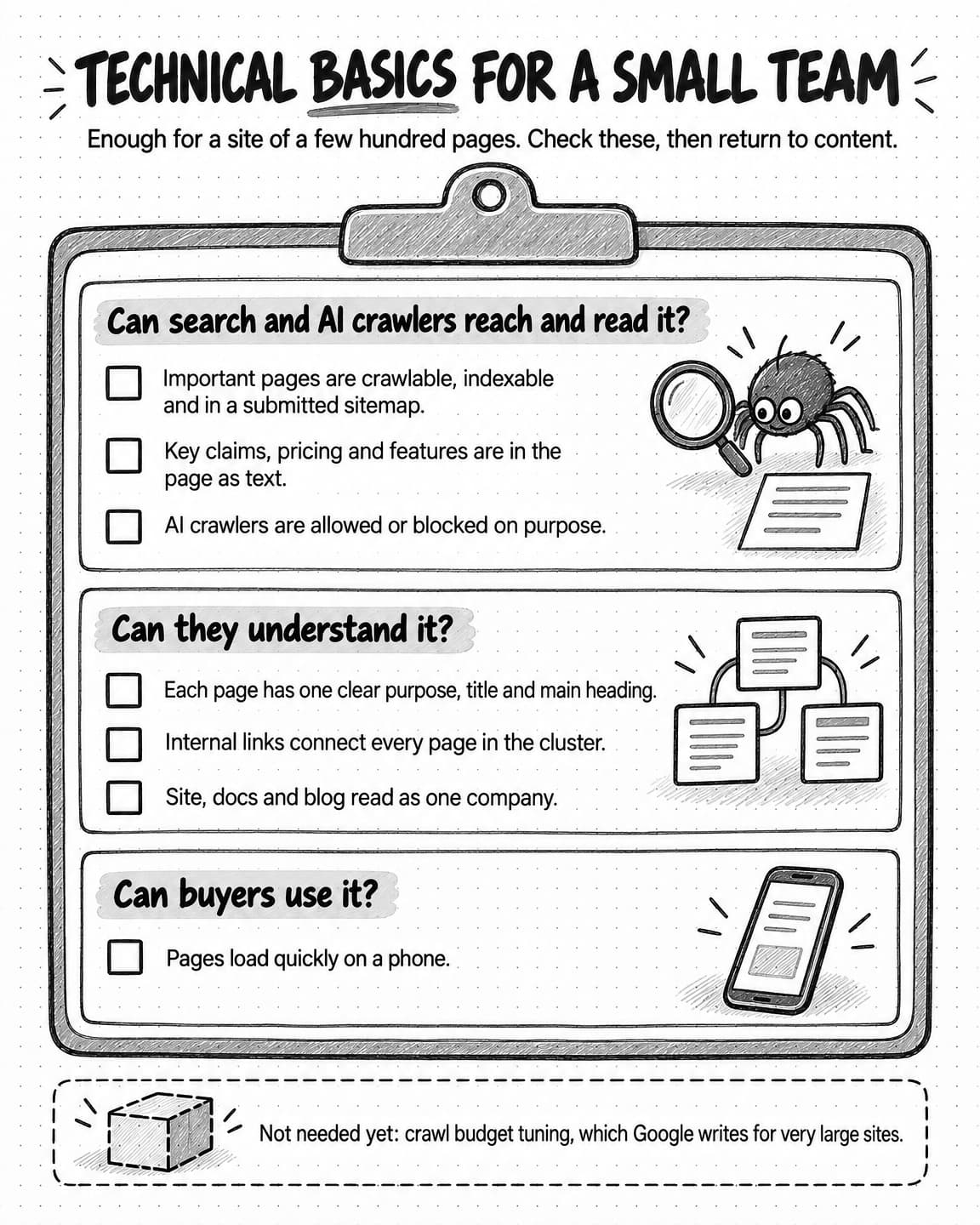
View the technical basics checklist at full size (opens in a new tab).
Earning mentions and links beyond your own site
A company's own pages are only part of what search engines and AI answers read about it. When a buyer asks an AI assistant for the best tools for a problem, the answer draws on review sites, comparison articles, community threads, analyst notes, partner directories, podcasts, and news coverage, as well as vendor pages. Links from respected sites still help pages rank, and mentions on the sites buyers trust shape what AI answers say about you.
For a small team, a few sources of mentions are worth more than a broad link-building campaign:
- Review sites in your category. Keep your profiles complete and current, ask happy customers for reviews at natural moments such as after onboarding or a renewal, and respond to criticism plainly. Buyers read these pages during evaluation, and they are frequently cited sources.
- Partners and integrations. Integration partners usually maintain directories and marketplace listings. A complete listing with a link to your integration page helps buyers who start from the partner's side.
- Original research. A benchmark or survey gives journalists, newsletter writers, and other companies a reason to cite you. This is the most reliable way a small team earns links without asking for them.
- Expert contributions. Guest articles, podcast interviews, conference talks, and quotes in industry publications put your experts' names next to your topic on sites you do not own.
- Communities where buyers ask for advice. Answer questions honestly in the forums, Slack groups, and subreddits your buyers use, under your own name and with your affiliation clear.
None of these is quick. Each produces a page somewhere else that describes your company accurately, in the context of the problem you solve. When you check how AI answers describe your category, note which third-party pages they cite, and ask whether your company appears on those pages and is described correctly. That list is often the most practical outreach plan a small team can have. Our guide to measuring AI search visibility shows how to build a repeatable question set and record which sources AI answers cite.
How to measure SEO in a long sales cycle
SEO in B2B is hard to measure because the effect is spread across months and people. The way through is to measure at three levels and to accept that each level answers a different question.
Leading signals show whether the work is being found. These include impressions and clicks in Google Search Console and Bing Webmaster Tools, ranking positions for the pages you built, the number of pages indexed, and whether your company is named and cited in AI answers to a fixed set of buyer questions. Google's AI features documentation says traffic from AI Overviews and AI Mode is included in the Search Console Performance report under the Web search type, so you will not see it as a separate line; watch impressions and clicks for the pages and queries you care about instead. Leading signals move first, often within weeks, but they say nothing about revenue on their own.
Conversion signals show whether the right people take a next step. Track trial sign-ups, demo requests, template downloads, and newsletter subscriptions from organic visits, and look at which pages those visitors read first. Segment by page type: a comparison page that brings twenty visits and two demo requests a month is doing more than an explainer with two thousand visits and none.
Business signals show whether SEO influences revenue. Two methods help a small team:
- Self-reported attribution. Add an open text field to your demo or sign-up form that asks "How did you hear about us?" and read the answers every month. Buyers will write things like "found your comparison page," "ChatGPT recommended you," or "a colleague sent me your benchmark," which no analytics tool can see. Open text is messier than a dropdown, and that is the point: it captures channels you did not think to list.
- Pipeline influence. In your CRM, record whether the contacts on an opportunity visited organic pages before or during the deal, and which ones. This shows SEO's part in deals it did not originate, which in B2B is most of them.
AI visibility needs its own small routine, because it often produces influence without visits. Pick 20 to 50 questions your buyers really ask, run them in the AI search products your buyers use on a regular schedule, and record whether your company is mentioned, whether it is described accurately, and which sources are cited. AI answers vary from run to run, so look at the trend across several checks rather than any single answer.
| Is our work being found? | Search Console and Bing Webmaster Tools impressions, clicks, and rankings for the pages we built; indexed page count; mentions and citations in AI answers to a fixed question set. |
|---|---|
| Are the right people taking a next step? | Trials, demo requests, and downloads from organic visits, by landing page and page type. |
| Is SEO influencing revenue? | Self-reported attribution answers; organic touches on opportunities in the CRM; pipeline and closed revenue where organic pages were part of the journey. |
| Are AI answers describing us correctly? | Accuracy of how AI answers describe our product, pricing, and fit, and which third-party sources they cite. |
Report the three levels together, and set expectations with leadership early. Pages closest to a purchase can produce demo requests within a few months, but clusters, original research, and mentions usually take longer to reach pipeline. A plan judged only on first-quarter organic traffic can look like a failure while it is working.
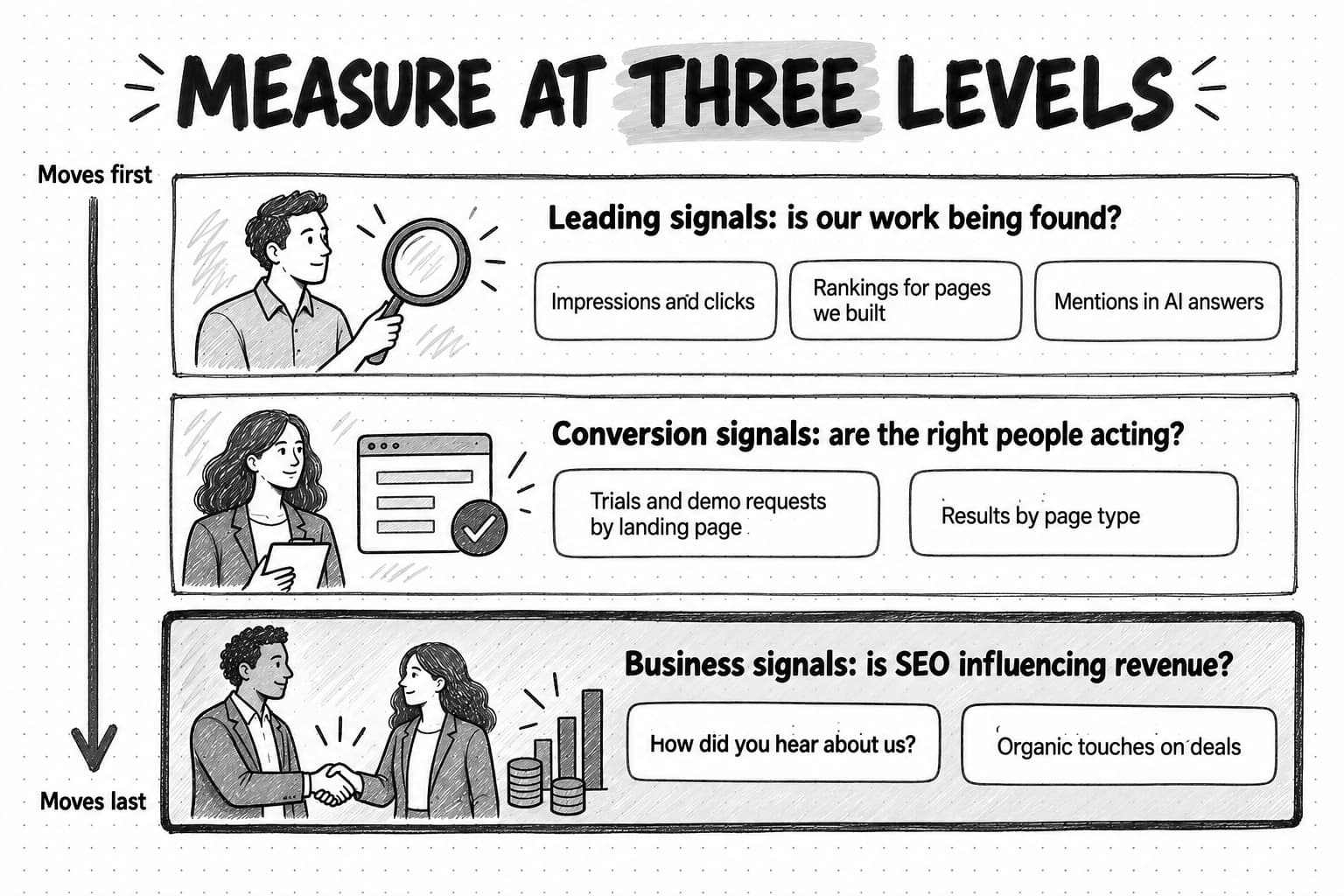
View the three measurement levels diagram at full size (opens in a new tab).
A 90-day SEO plan for a team of one to five
The plan below is illustrative. It assumes a team with roughly the equivalent of one person's half-time effort on SEO, a product with a clear audience, and a site that is already indexed. Adjust the pace to your capacity: a team with more hours can overlap the phases, and a founder working alone can stretch each phase to twice its length. What matters is the order.
| Weeks | Focus | Outputs | Decision at the end |
|---|---|---|---|
| 1–2 | Foundations | One-page positioning and buyer summary; list of real buyer questions from sales, support, and reviews; technical basics checked; AI crawler settings decided; baseline of Search Console data and 20–50 AI answer checks | Which three to five buying situations matter most |
| 3–6 | Pages closest to a purchase | Two or three comparison or alternative pages; three to five use-case pages; integration pages for the most-used integrations; pricing page reviewed | Which bottom-of-funnel pages need more evidence or clearer next steps |
| 7–10 | First topic cluster | One pillar page and four to six supporting pain-point or product-led articles, all linked to each other and to the use-case pages | Whether the cluster topic is drawing the right impressions |
| 11–13 | Proof and reach | One small piece of original data or an expert-led guide; review-site profiles updated; two or three outreach or partner actions; first measurement review across all three levels | What to double down on, fix, or stop in the next quarter |
A rough capacity guide helps a small team plan honestly. These estimates are illustrative, not benchmarks, and vary widely with the product and the writer.
| Page type | Illustrative effort for a first version | Why it takes that long |
|---|---|---|
| Comparison or alternative page | 6–10 hours | Gathering and dating competitor evidence, legal or leadership review |
| Use-case page | 4–8 hours | Screenshots, examples, and a subject-matter review |
| Integration page | 2–4 hours | Mostly product facts; needs a check from the engineer who owns the integration |
| Pain-point or product-led article | 6–12 hours | Research, an expert interview, a worked method, and editing |
| Pillar page | 12–20 hours | Breadth, structure, and linking to the whole cluster |
| Small original research piece | 20–40 hours | Data collection, analysis, honest reporting of limits, and charts |
Run the numbers before committing. At about 20 hours a week, the plan above is achievable but full. At five hours a week, cut it to the comparison pages, a few use-case pages, and the baseline, and save the cluster for next quarter.
After 90 days, the cycle repeats: review the measurements, refresh pages whose facts changed, and extend the cluster that is working. Our guide to content audits covers how to decide which existing pages to keep, update, merge, or cut as the library grows.
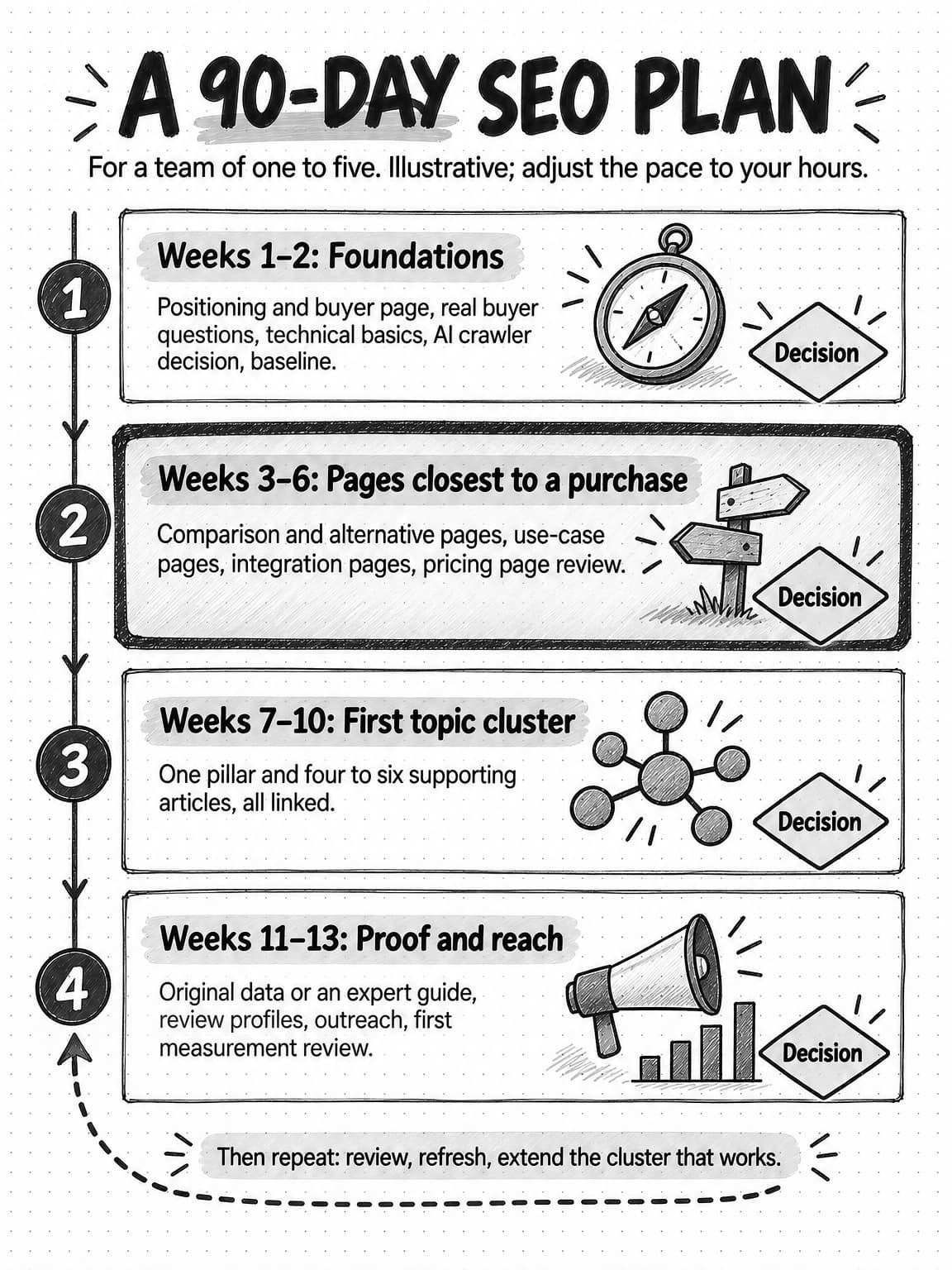
View the 90-day SEO plan at full size (opens in a new tab).
Worked example: a four-person team plans its first quarter (fictional)
Tallyvane is a fictional company invented for this example. It sells purchase-approval software to finance teams at companies with 200 to 2,000 employees. Its marketing team is four people: a head of marketing, a content marketer, a product marketer who also handles the website, and a designer shared with the product team. SEO gets about a day a week from the content marketer and a few hours from the product marketer.
Weeks 1–2: foundations. The team writes a one-page positioning summary: Tallyvane is for finance teams who approve purchases in email and spreadsheets, and its difference is approval rules that follow the company's spend policy automatically. The product marketer pulls 60 questions from sales call notes and support tickets. Three buying situations stand out: a finance controller after a failed audit, an operations lead whose team waits days for approvals, and a CFO comparing Tallyvane with the approval module in the company's existing finance software. A technical check finds the pricing page renders its plan details in a script that loads late, so the details are moved into the page as text. The team decides to allow AI search crawlers and records that decision. A baseline of 30 AI answer checks shows that when asked about purchase approval software, AI assistants name three larger competitors and never mention Tallyvane; the sources cited are two review sites and one comparison article on an industry blog.
Weeks 3–6: pages closest to a purchase. The team builds a comparison page against the finance-software approval module, because that is the alternative the CFO situation describes. It includes an honest section saying the built-in module is the better choice for companies with simple, single-step approvals. It builds use-case pages for audit readiness and for multi-entity companies, and integration pages for the two accounting systems most customers use. The product marketer completes Tallyvane's profiles on the two review sites the AI answers cited and asks ten recent customers for reviews.
Weeks 7–10: first cluster. The content marketer writes a pillar guide to the purchase approval process and five supporting articles, each from a real support question: approval limits by role, what auditors check, why approvals get stuck, approval workflows for remote teams, and a downloadable approval policy template. Each supporting article links to the pillar and to the most relevant use-case page.
Weeks 11–13: proof and measurement. The team analyzes anonymized timing data from customers who agreed to it and publishes a short benchmark of how long approvals take by company size, with the sample and limits stated. The head of marketing pitches it to two finance newsletters. At the 90-day review, the comparison page has brought a handful of demo requests, three of which mention it in the "How did you hear about us?" field; the cluster is drawing impressions but few clicks yet; and in the repeat AI checks, Tallyvane is now named in a few answers, citing one review site. Every number in this paragraph is illustrative. The team's decision for the next quarter is to add a second comparison page, extend the cluster with three articles, and repeat the benchmark in six months.
The example is about order, not results. The team spent six weeks on pages buyers read while choosing, and on the third-party pages AI answers already cited, before writing a broad article. When the cluster went live it had pages to link to, and the baseline made the 90-day review a decision rather than a guess.
Common B2B SaaS SEO mistakes
Most failed B2B SEO programs fail in a few recognizable ways, each of which looks like progress at the time.
Choosing topics by search volume. High-volume terms in B2B are usually broad, crowded, and far from a purchase, and increasingly answered by AI summaries. A team that starts there spends its first quarter competing with publishers for readers who will not buy.
Writing only blog posts. A content calendar of articles leaves out the comparison, use-case, integration, and pricing pages buyers read while choosing. Those pages are often the highest-value SEO work a small team can do.
Publishing pages nobody on the team could defend. Generic articles drafted quickly from other articles add nothing a search engine or AI answer cannot already find, and Google's helpful-content guidance specifically asks whether content mainly summarizes what others have said without adding much value. Every page should contain something your company knows that others do not.
Ignoring the pages other people write about you. Review sites, partner directories, and comparison articles on other sites shape what buyers and AI answers say about your company. Neglecting them leaves that description to chance.
Letting facts go stale. Comparison pages, pricing, integration details, and statistics change. A page with last year's facts misleads buyers and can be repeated by AI answers. Put a review date on every page that makes a factual claim about a product, price, or market.
Running SEO work with Ampere
Ampere is an AI marketing agent that can take on much of the research and drafting in a plan like this, so a small team can spend its own time on the decisions, the expertise, and the review. You describe the work in plain English, and Ampere does it in its own session workspace, with a browser, files, and internet access, and brings the results back for you to review.
For research, Ampere can identify competitors and positioning angles, search and crawl the web, and pull public review, social, and company data into evidence-backed competitive analysis and one-axis competitor comparisons. It can also look for AI-search visibility gaps, and it can save a search landscape report, a competitor report, and other evidence-backed brand reports to Brand memory, so later work starts from the same picture of your market. Public data coverage is never complete, so treat these reports as a strong starting point to check, not a full census.
For the pages themselves, Ampere can run SEO and CRO audits and draft landing-page and pricing-page copy, source-grounded blog article packages, research reports, and interactive tool page briefs. Because Brand memory carries your positioning, products, competitors, audience, and voice, a comparison page, a use-case page, and a cluster article can start from the same understanding of who you are for and what makes you different.
For the recurring parts of the plan, scheduled tasks can rerun research on a cadence and return the results to your Project, and monitoring watches can surface in-app alerts with evidence when something you track changes, such as a competitor's pages or search results you care about. That suits the review dates every comparison and pricing page needs.
Ampere researches, audits, and drafts; it does not publish pages or change your website. Your team reviews every draft, checks every claim, adds the first-hand expertise only you have, and decides what goes live. AI output can be inaccurate or incomplete, which is one more reason the review step matters.
Sources and further reading
- Google Search Central, AI features and your website, last updated December 10, 2025. No extra requirements for AI Overviews and AI Mode, query fan-out, and Search Console reporting.
- Google Search Central, Creating helpful, reliable, people-first content, last updated October 5, 2026. Self-assessment questions on originality, expertise, and search-engine-first content.
- Google Search Central, Spam policies for Google web search, last updated August 28, 2026. Scaled content abuse.
- Google Search Central, Google Search's guidance on using generative AI content on your website, last updated October 1, 2026.
- Google Search Central, Write high quality reviews, last updated December 10, 2025. Standards that also describe a credible comparison page.
- Google Search Central, Large site owner's guide to managing your crawl budget. Which sites need crawl budget work.
- Google Search Central, Google's common crawlers. Googlebot and the Google-Extended token.
- OpenAI, Overview of OpenAI crawlers. OAI-SearchBot, GPTBot, and ChatGPT-User.
- Perplexity, Perplexity crawlers. PerplexityBot and Perplexity-User.
- Anthropic, Does Anthropic crawl data from the web, and how can site owners block the crawler?, Claude Help Center. ClaudeBot, Claude-User, and Claude-SearchBot.
- Athena Chapekis and Anna Lieb, Google users are less likely to click on links when an AI summary appears in the results, Pew Research Center, July 22, 2025. Browsing data from 900 U.S. adults, March 2025.
- Pranjal Aggarwal and colleagues, GEO: Generative Engine Optimization, arXiv, revised June 2024; accepted at KDD 2024.
- Forrester, The State of Business Buying, 2024, press release, December 4, 2024. Buying-group size and departments involved.
- 6sense, 2025 Buyer Experience Report. Survey of nearly 4,000 B2B buyers on first contact and day-one shortlists.
Frequently Asked Questions
How is B2B SEO different from B2C SEO?
B2B SEO serves fewer, higher-value searches made by several people in a buying group over a long decision, while B2C SEO usually serves many individual shoppers who decide quickly. That shifts B2B work toward comparison, use-case, integration, and pricing pages for each member of the buying group, and toward measuring influence on pipeline rather than traffic alone.
What are the key parts of a B2B SaaS SEO strategy?
The key parts of a B2B SaaS SEO strategy are positioning and a clear buyer, pages for each buying stage with the pages closest to a purchase built first, topic clusters on the core problem, original data and expert content, sound technical basics, mentions on sites buyers trust, and measurement at the levels of discovery, conversion, and revenue influence.
Is SEO still worth it for B2B SaaS now that AI answers come first?
SEO is still worth it for B2B SaaS, but the payoff has moved. AI summaries reduce clicks on simple informational questions, so definition articles bring fewer visits. Pages that help buyers choose, such as comparisons, use cases, and integrations, still draw qualified visits, and the same work makes a company more likely to be named and cited in AI answers.
What is the 80/20 rule in SaaS SEO?
The 80/20 rule in SaaS SEO is an informal heuristic that a small share of pages produce most of the results. For a B2B software company, those pages are often the comparison, use-case, integration, and pricing pages buyers read while choosing a vendor. A small team gets more from building and maintaining those well than from publishing many broad articles.
What belongs on a SaaS SEO checklist?
A SaaS SEO checklist should confirm that important pages are crawlable, indexed, and listed in a sitemap; that key content is in the page as text; that each page has a clear title and purpose; that clusters are linked; that pages load quickly on mobile; that AI crawler settings match a deliberate decision; and that factual pages carry a review date.
How does SaaS SEO work over a long sales cycle?
SaaS SEO works over a long sales cycle by shaping the shortlist before buyers contact a vendor. A buyer may read a comparison page months before requesting a demo through a branded search, so analytics credits the last click. Self-reported attribution on forms and organic touches recorded on CRM opportunities show the influence that last-click reports miss.
What is an example of a B2B SaaS SEO strategy?
An example of a B2B SaaS SEO strategy is a small team that spends its first two weeks on positioning, buyer questions, and a measurement baseline, then builds comparison, use-case, and integration pages, then one topic cluster on the core problem, and finally a small piece of original data with outreach, reviewing results at 90 days.
How does SaaS content marketing relate to SEO?
SaaS content marketing and SEO overlap but are not the same. Content marketing decides which subjects a company has earned the right to own and how content reaches buyers through every channel. SEO focuses on making the pages buyers search for findable, credible, and citable in search results and AI answers. A good plan uses one set of subjects for both.