Founder-led marketing: why the founder is the first channel, and when to share it
A content ladder for what to post, a weekly routine that fits a founder's calendar, a share-or-keep test for building in public, and the signs that it is time to bring other voices in.
43 min readWritten by Ampere
Short answer
What is founder-led marketing?
Founder-led marketing is marketing in which the founder's own knowledge, opinions, and experience, published under their name, are the company's main way of reaching buyers. For an early B2B company, it usually means regular LinkedIn posts, a newsletter, and guest appearances. It works because buyers can learn to trust a person who knows their problem before they know the brand, and it needs a steady weekly routine to keep going.
Summary
The founder is usually the best first marketing channel for an early B2B company, because the founder holds the first-hand knowledge buyers need and a young company has no reputation of its own. Most business buyers are not in the market at any given time, so regular founder posts build familiarity before the buying moment arrives. The approach costs founder time and depends on one person, so it needs a routine and, later, other voices.
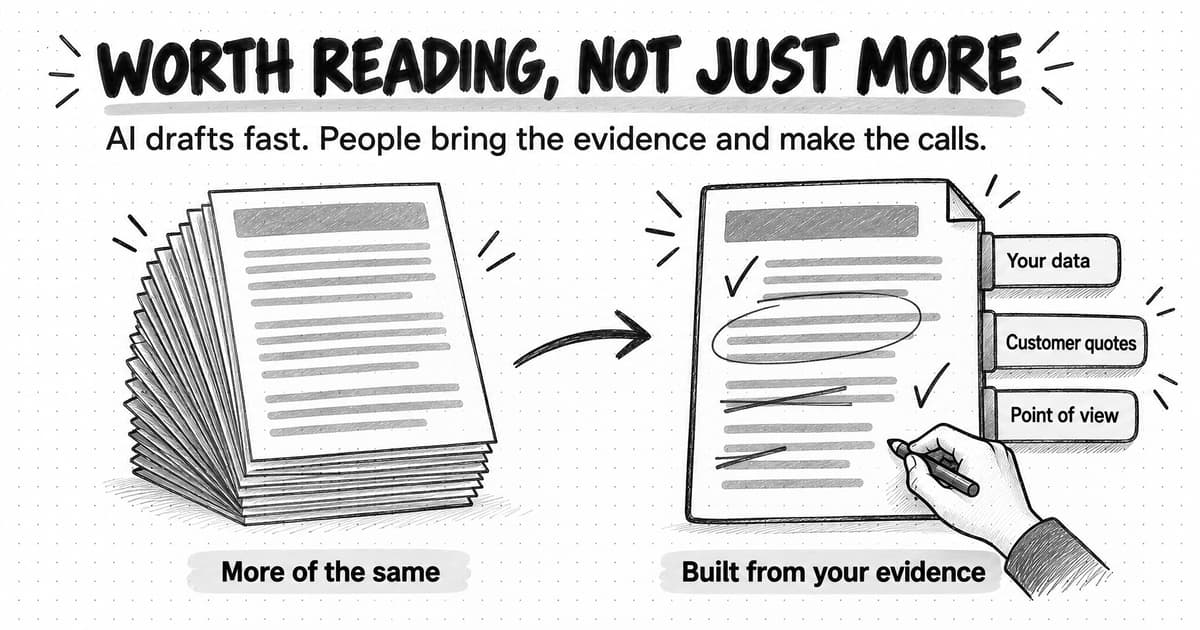
A five-rung content ladder decides what a founder should post: lessons from the work, opinions on how the buyer's problem should be approached, proof used with permission, behind-the-scenes decisions and mistakes, and product news. Lessons should come most often because they give readers something useful without asking for anything. Product news lands better once the posts beneath it have earned the reader's trust.
Building in public means sharing decisions, experiments, mistakes, and sometimes numbers while the company is being built. A five-question share-or-keep test and a written policy protect customers, employees, and confidential details, because every post is permanent and competitors read it too. A routine of about three hours a week, with a daily capture note, two writing slots, daily replies, and a Friday log, keeps posting steady through busy weeks.
Founder posts and founder-led sales work as one loop: posts warm up sales conversations and become follow-up material, and the questions prospects ask on calls become the next posts. Measure who engages, which conversations start, and what buyers say about how they found the company, rather than follower counts, since no routine guarantees growth. A fictional worked example follows one founder through eight weeks and her first added voice.
Share the channel when the founder becomes the bottleneck, buyers ask questions others can answer better, or a first marketer arrives to run the system. Add one voice at a time, starting with people who already talk to customers, and keep every post grounded in its author's real experience. Employees should disclose that they work for the company when they promote it, and personal profiles belong to the people who run them.
Contents
- What founder-led marketing is
- Why the founder is the first channel for an early B2B company
- Founder-led marketing, founder-led sales, and personal brand
- What founders should post: the content ladder
- How to find material without inventing a persona
- Building in public: what to share, what to keep
- A weekly routine that fits a founder's calendar
- How founder posts feed founder-led sales
- Turn founder posts into company assets
- How to measure founder-led marketing
- When to share the channel
- Worked example: one founder's first eight weeks
- Common founder-led marketing mistakes
- Founder content with Ampere
- Start your founder-led marketing this week
- Sources and further reading
- Frequently Asked Questions
Most B2B founders already do marketing, whether or not they call it that. They explain the product on every sales call, answer the same three objections each week, decide which customer problems matter, and argue with investors about where the market is going. What they usually lack is a habit of putting that thinking where buyers can find it before the first call. When a founder starts writing it down in public, several things can change together: prospects arrive knowing what the company believes, sales conversations can start further along, and the company gains a voice before it can afford a marketing team.
Founder-led marketing is marketing in which the founder's own knowledge, opinions, and experience, published under their name, are the company's main way of reaching buyers. In B2B, that usually means the founder posting regularly on LinkedIn, writing a newsletter, appearing on other people's podcasts and panels, and answering questions in the communities where customers spend time. The company page and the website still matter, but early on, people pay attention to a person who knows the problem more readily than to a logo they have never heard of.
The approach has a cost and a limit. It takes a few hours a week from the busiest person in the company, and it ties the company's reputation to one person's calendar, health, and judgment. This guide explains why the founder is usually the right first channel for an early B2B company, then gives a method: a content ladder for deciding what to post, a test for what to share when building in public, a weekly routine, a way to connect posts to sales and measure them, and the signs that it is time to bring in other voices. A fictional worked example follows one founder through eight weeks.
What founder-led marketing is
Founder-led marketing describes who carries the message, not a particular tactic. The founder is the source of the material and the person whose name is on it. The tactics are familiar: posts, a newsletter, guest appearances, talks, comments on other people's posts, replies in communities, and the occasional long article. What makes it founder-led is that buyers meet the company through the founder first.
That differs from a founder who approves the marketing a contractor produces. In founder-led marketing, the ideas, examples, and positions come from the founder's own work. Other people can help shape and edit them, which later sections cover, but the experience behind each post has to be real and the founder has to stand behind every word.
Where founder-led marketing usually happens
For most B2B founders, LinkedIn is the main stage, because it is where buyers, future hires, investors, and partners already read about work. A personal profile also reaches people that a new company page does not: the founder's existing connections, former colleagues, and the people those contacts interact with. Our guide to LinkedIn content strategy for B2B explains how the founder's profile, the company page, and employee accounts work together, and which LinkedIn formats suit which jobs, so this guide does not repeat it.
Around LinkedIn, founders usually add one or two of these:
- A newsletter, for readers who want the longer version of the founder's thinking on a regular schedule
- Guest appearances on podcasts, webinars, and panels run by people who already have the audience
- Talks at industry events and customer meetups
- Answers in the communities where practitioners ask each other for help
- Occasional long articles on the company blog, when an idea needs room to be argued properly
A founder does not need all of them. One main channel, done every week, does more than five channels done when there is time.
Why the founder is the first channel for an early B2B company
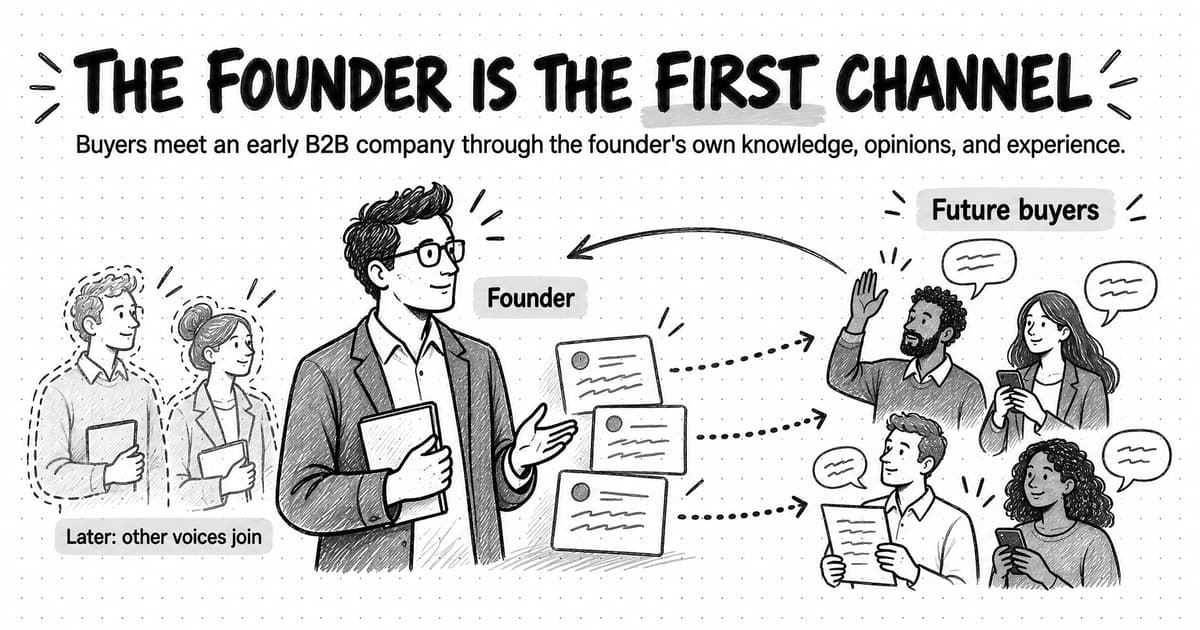
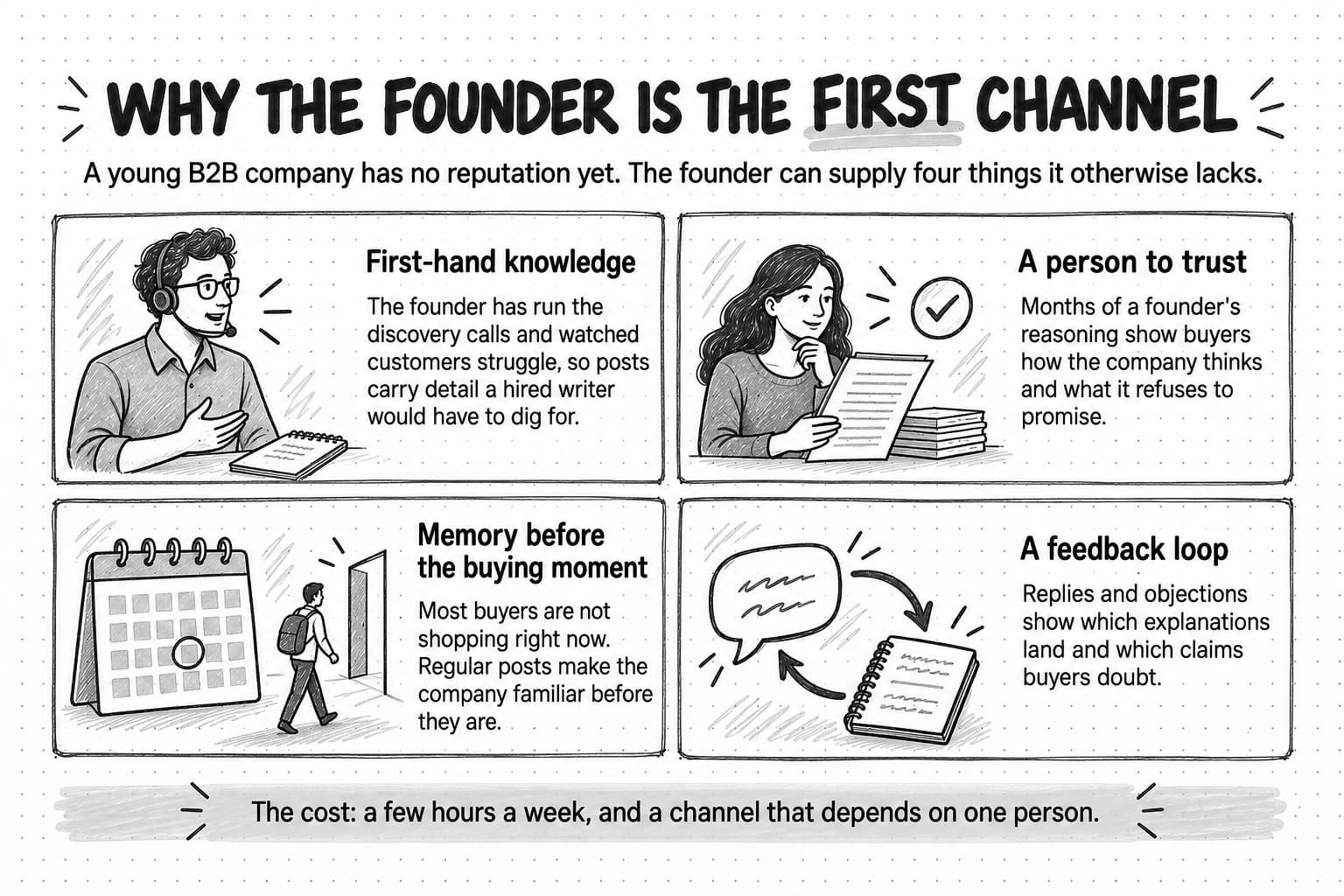
Early B2B companies face a specific problem. Their buyers are careful, their product is unfamiliar, and the company has no reputation yet. A new company page has few followers and no history. Advertising can buy reach, but it cannot buy belief, and a buyer weighing a six-month commitment to an unknown vendor needs something to believe. The founder can supply four things a young company otherwise lacks.
First-hand knowledge. The founder usually knows the customer's problem better than anyone else at the company. They have run the discovery calls, watched customers struggle with the alternatives, and made the product decisions. A post that explains why customers keep failing at a task, written by someone who has watched it happen dozens of times, carries detail that a hired writer would have to dig for.
A person to trust. A buyer considering a small, unfamiliar vendor has little to judge it by except the people behind it. When a buyer can read a founder's reasoning over several months, they learn how the company thinks, what it refuses to promise, and how it handles a problem. That is useful evidence for someone deciding whether to trust a small vendor with their work.
Memory before the buying moment. Most potential buyers are not looking for a product at any given time. John Dawes of the Ehrenberg-Bass Institute illustrated this in a 2021 paper for LinkedIn's B2B Institute: corporations change providers such as their main bank or law firm about once every five years on average, so only about 20% of business buyers are in the market over a year and something like 5% in a quarter. Dawes describes the 95% figure as a heuristic rather than a precise rule, and the share depends on how often a category is bought. His conclusion is that marketing mostly works by building memories that come back when a buyer does enter the market. A founder who posts useful material every week is building those memories with people who are not ready to buy yet, at almost no media cost.
A feedback loop. Posts produce replies, objections, and questions. A founder who reads them learns which explanations land, which claims buyers doubt, and which problems people care about enough to comment on. That feeds back into the product, the website, and the sales pitch.
View why the founder is the first channel at full size (opens in a new tab).
When the founder is not the right first channel
Founder-led marketing is a strong default, not a rule. It fits poorly when the founder cannot commit to a steady routine, when the buyers are on channels the founder cannot reach credibly, when another person at the company knows the customer's work far better (a cofounder who spent ten years in the buyer's job, for example), or when the founder's public visibility carries a real risk, such as a regulated role in which public comments are restricted. In those cases, start with the person who has the knowledge and the time, and use the same method.
Founder-led marketing, founder-led sales, and personal brand
Three terms get used interchangeably, and separating them makes each easier to plan.
| Term | What it means | What it produces | Who it serves first |
|---|---|---|---|
| Founder-led marketing | The founder's knowledge, opinions, and experience, published under their name, as the company's main way of reaching buyers | Attention, trust, and memory among people who may buy later | The company's future buyers |
| Founder-led sales | The founder personally finds prospects, runs sales conversations, and closes the first customers | Customers, revenue, and a first-hand understanding of why people buy | The current pipeline |
| Personal brand | What people associate with someone's name across their whole career | A reputation the person carries from job to job | The person |
The three overlap. A founder's posts help sales, sales calls supply material for posts, and both build a personal reputation. The difference is the goal. Founder-led marketing is judged by whether the right buyers know and trust the company; founder-led sales by whether deals close; a personal brand by whether the person has options. Keeping the goal clear stops a founder from drifting into posts that grow their personal following but say nothing to buyers, a common failure covered later.
The link to sales deserves its own section, after the method for deciding what to post. If you are new to how buyers move from first contact to purchase, our introduction to B2B SaaS marketing explains buying groups, self-serve and sales-led buying, and how much research buyers do before they speak to anyone.
What founders should post: the content ladder
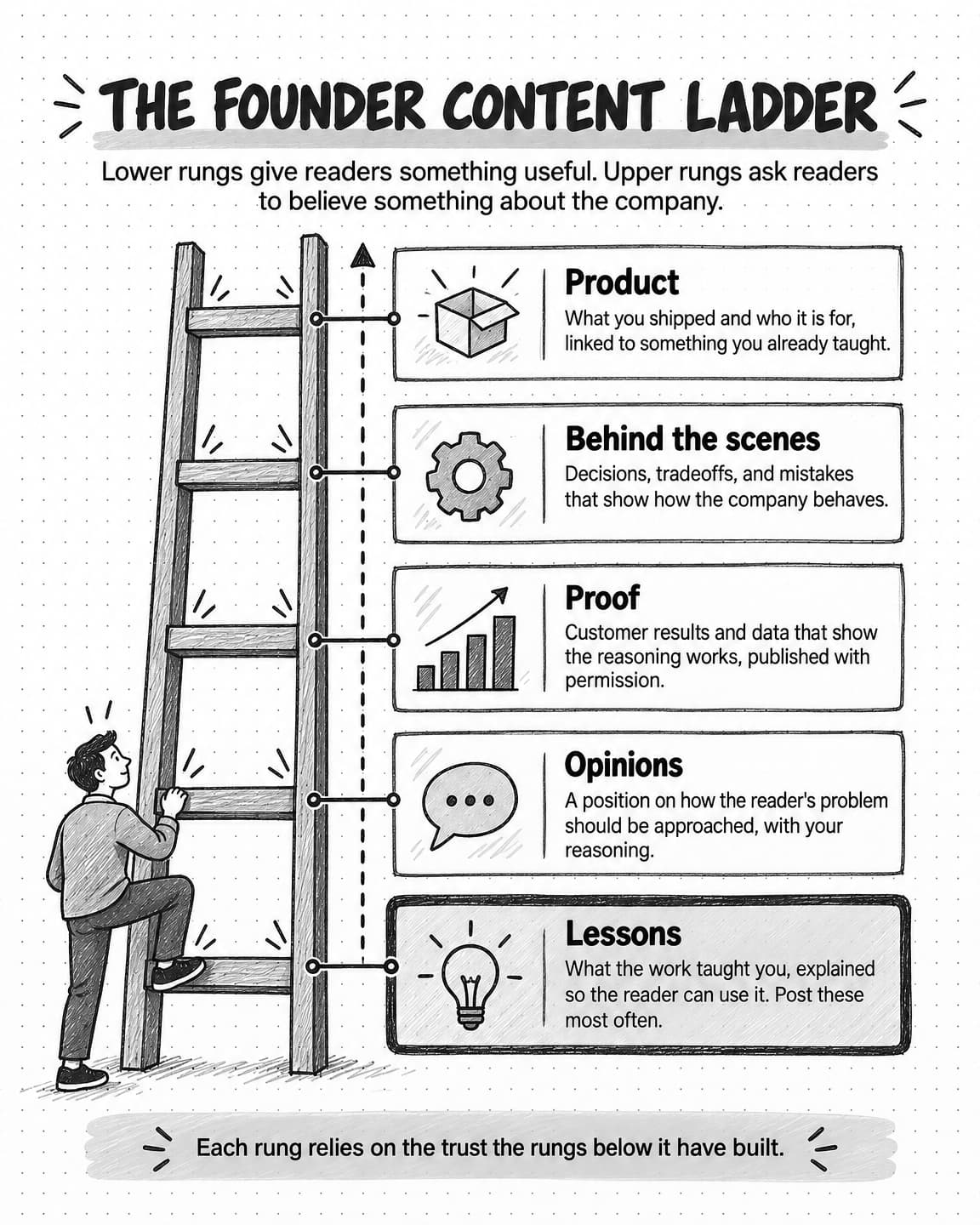
Founders who decide to post more often stall on the same question: what to say this week. A useful answer is a content ladder with five rungs. The lower rungs give readers something useful without asking for anything. The upper rungs ask readers to believe something about the company. Each rung depends on the trust built by the ones beneath it, which is why product news posted to an audience that has never learned anything from the founder tends to land flat.
| Rung | What it is | What it does for the reader | Example subject |
|---|---|---|---|
| 1. Lessons | Something the founder learned from the work, explained so the reader can use it | Saves the reader time or a mistake | What we learned from 40 onboarding calls about why teams abandon setup in week two |
| 2. Opinions | A position on how the reader's problem should be approached, with the reasoning | Gives the reader a way to think about a decision | Why we think most teams should stop measuring this metric weekly |
| 3. Proof | Evidence that the approach works: a customer result, a before and after, data the company can show | Shows the reader that the reasoning holds up in practice | How one customer cut its review time, with the numbers they approved for publication |
| 4. Behind the scenes | Decisions, tradeoffs, mistakes, and how the company works | Shows how the company thinks and behaves when something goes wrong | Why we delayed a launch by three weeks, and what we would do differently |
| 5. Product | What the company shipped, why, and who it is for | Tells interested readers what they can now do | The feature we built because customers kept asking us for the same workaround |
View the founder content ladder at full size (opens in a new tab).
How to use each rung
Lessons are the base, and most founders should post them most often. A good lesson is specific enough that only someone who did the work could write it. "Onboarding matters" is not a lesson. "Teams that invite a second person in the first week are far more likely to finish setup, so we now ask for a teammate's email before we ask for anything else" is a lesson, if the company's data supports it. Lessons come from sales calls, support conversations, product analytics, hiring, and the founder's previous jobs.
Opinions are where a founder becomes distinct. An opinion takes a side on a question the reader faces, explains the reasoning, and accepts that some readers will disagree. It is the start of thought leadership, which our guide to what thought leadership is covers in depth: how a point of view is earned, and why most content labeled thought leadership does not qualify. For the ladder, the test is simple. An opinion should be one the founder would defend in a sales call, and one that follows from the company's positioning. A founder whose opinions contradict what the product does will confuse the buyers they attract.
Proof turns opinions into evidence. It includes customer results, comparisons of before and after, original data, and demonstrations. Proof needs permission. A customer's name, logo, numbers, and quotes belong to the customer, so get written approval for exactly what will be published. When the evidence is the company's own data, describe the sample and the period, and do not let one good result stand in for a general claim. A longer customer story can become a case study; our guide to writing a B2B case study covers how to build one that sales will use.
Behind the scenes is the rung that building in public lives on. It shows how the company makes decisions: why it chose one market over another, what it learned from a failed experiment, how it handled an outage. Readers use it to judge character. It needs the most judgment about what to share, which the building-in-public section below covers.
Product posts tell people what they can now do. They work best when they connect to something the founder has already taught or argued: "Last month I wrote about why teams abandon setup in week two. Here is the change we made because of it." Without that connection, a product post reads like an advertisement in a feed full of advertisements.
A starting mix
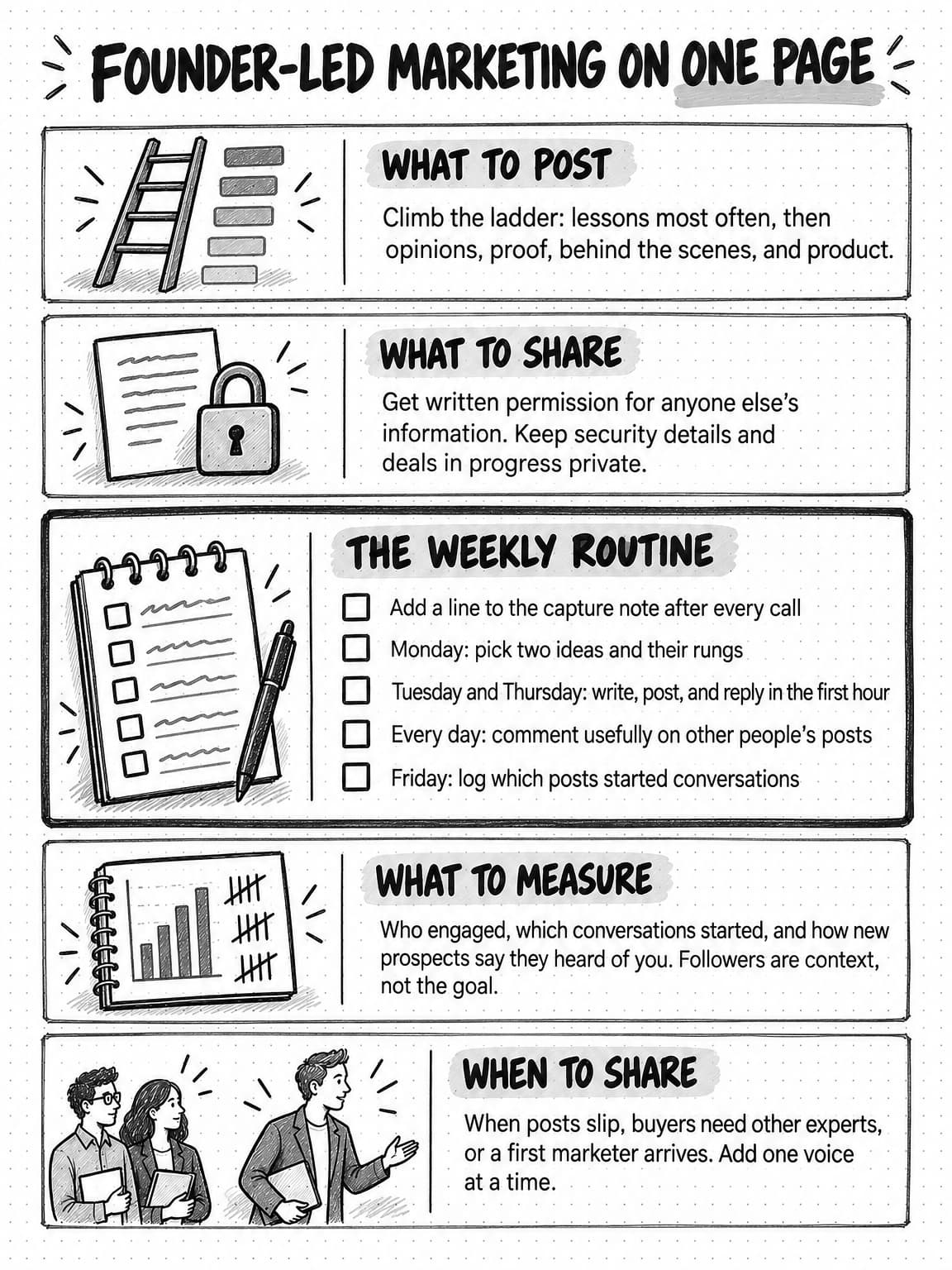
There is no proven ratio, and the right mix depends on the audience and the stage of the company. As an illustrative starting point for a founder posting twice a week, eight posts a month might include three lessons, two opinions, one proof post, one behind-the-scenes post, and one product post. Review the mix after two months against what actually started conversations, and shift toward the rungs that did.
How to find material without inventing a persona
Founders who struggle to post often think they need new ideas. They usually need a way to notice the ideas they already have. Material for every rung of the ladder turns up in ordinary work:
- Sales and discovery calls. The questions prospects ask, the objections they raise, the alternatives they describe, and the words they use for their problem. Recorded calls and their transcripts are a good source, used with the participants' consent and with names removed.
- Support and onboarding conversations. Where customers get stuck, what they misunderstand, and the workarounds they invent.
- Product decisions. What the team decided not to build and why, which tradeoffs it argued about, what the data said.
- Investor and board updates. The metrics and lessons the founder already writes up each month. Not all of it can be public, but the reasoning often can.
- The founder's previous career. Most B2B founders started the company because they saw a problem in a previous job. Those stories are lessons other people in that job still need.
- Disagreements. A post someone else wrote that the founder disagrees with is often the start of an opinion post.
The simplest capture habit is a running note, on the phone or in a document, where the founder adds one line whenever something worth saying happens: a question from a call, a surprising number, a sentence a customer used. A voice memo recorded after a sales call works too. Ten seconds per entry is enough. The weekly routine below turns those lines into posts.
Keep the founder's voice and drop the speech habits
A founder's posts should sound like the founder at their clearest, not like a generic LinkedIn voice. The distinctions they insist on, the examples they reach for, the claims they refuse to make, and their level of formality are what make the posts recognizable. Our guide to defining a brand voice has a section on separating a founder's perspective from their speech habits. The same principle applies here: a transcript of the founder talking is source material, and the post keeps the thinking while removing the repetition and filler that speech is full of.
The risk runs the other way too. Posts written to sound like a successful creator, with one-line paragraphs, a cliffhanger in the first line, and a lesson tacked on at the end, make a founder sound like everyone else in the feed. Write the way the founder would explain the point to a customer they respect.
Building in public: what to share, what to keep
Building in public means sharing how the company is being built while it happens: the decisions, the numbers, the experiments, the mistakes, and what the founder is learning. It is the behind-the-scenes rung of the content ladder, done regularly and with more candor than most companies allow themselves. Some founders share revenue, customer counts, and churn; others share only their reasoning and leave the numbers out. Both count.
What building in public builds
Building in public gives readers a reason to follow along over time, because each post is part of a continuing story. It shows character in a way polished marketing cannot: a founder who explains a mistake and what changed afterwards gives readers evidence about how the company will behave when something goes wrong for them. It also attracts people who care about the problem, including future hires and early customers who want to influence what gets built. And it keeps the founder honest about progress, because writing a monthly update forces them to look at the numbers.
What it risks
Everything published is permanent, whatever the platform allows you to delete, because anyone can screenshot it. Competitors read it. Customers read it, including the customer whose difficult renewal the founder is tempted to write about. Investors in the next round read it and compare it with the deck. Candidates read it before they join, and employees read it about themselves. A post that shares a bad month can help readers trust the founder; it can also give a competitor's salesperson a talking point.
A share-or-keep test
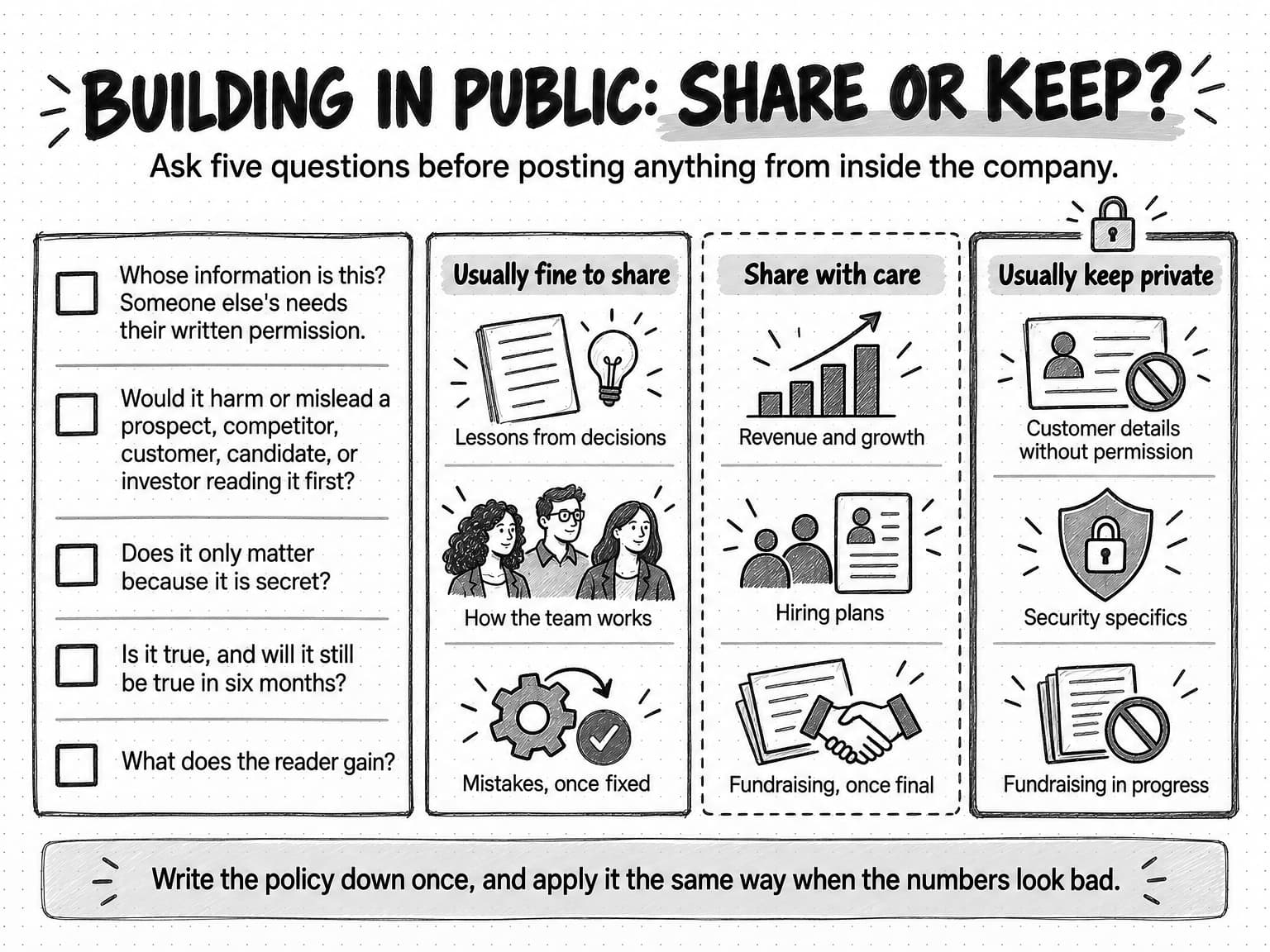
Before posting something from inside the company, a founder can ask five questions:
- Whose information is this? If it belongs to a customer, an employee, an investor, or a partner, it needs their permission, in writing, for exactly what will be published.
- Would I be comfortable if this were the first thing a prospect, a competitor, a customer, a candidate, and an investor read about us? If any of the five would be harmed or misled, change it or keep it.
- Does it reveal something that only matters because it is secret? Security details, unreleased deals, pricing negotiations, and fundraising in progress usually do.
- Is it true, and will it still be true in six months? A number that will look different by next quarter needs its date and context.
- What does the reader gain? A post that is candid but teaches nothing is a diary entry.
| Usually fine to share | Share with care | Usually keep private |
|---|---|---|
| Lessons from decisions, including ones that went wrong | Revenue, customer counts, and growth rates | Customer names, data, or results without written permission |
| How the team works, its process, and its tools in general terms | Hiring plans and team changes | Security details and incident specifics beyond what customers were told |
| Problems the company has decided to solve, and why | Pricing changes before they are announced | Fundraising terms or conversations in progress |
| Mistakes, once the fix is in place and anyone affected has been told | Fundraising news once it is final | Anything about a named employee's performance, pay, or departure |
| Experiments and what they showed | Roadmap direction, described as problems, not dates | Information covered by a confidentiality agreement |
The middle column is a judgment call that depends on the company's stage and its buyers. A founder selling to large companies may decide that sharing monthly revenue makes buyers worry about the company's size. A founder selling to other founders may find that the same numbers build trust. Decide the company's policy once, write it down, and apply it the same way each month, so readers do not see the numbers vanish the first time they look bad.
View the share-or-keep test at full size (opens in a new tab).
A weekly routine that fits a founder's calendar
In practice, founder-led marketing stalls from inconsistency more often than from bad posts. A founder posts five times in a burst of enthusiasm, then disappears for six weeks when a fundraise or a launch takes over. Readers who were starting to recognize the name forget it. A routine prevents that by making the work small, scheduled, and tied to things the founder already does.
The routine below takes about three hours a week, most of it in blocks of ten to thirty minutes, and produces two posts, regular replies, and a short log. The times are illustrative; adjust them to the founder's real calendar.
| When | Time | What the founder does |
|---|---|---|
| Every day, after calls | 1–2 minutes | Add one line to the capture note: a question, an objection, a number, a phrase a customer used |
| Monday | 20 minutes | Read the week's capture note, pick two ideas, and assign each a rung on the ladder |
| Tuesday | 45 minutes | Write and post the first piece (about 30 minutes), then reply to comments during the first hour (about 15) |
| Thursday | 45 minutes | Write and post the second piece, often the one that responds to Tuesday's replies, and reply again |
| Daily, any time | 10 minutes | Comment usefully on posts by customers, prospects, and peers |
| Friday | 10 minutes | Log which posts started conversations, who joined them, and any sales follow-up |
| Last Friday of the month | 45 minutes | Review the log, adjust the ladder mix, and decide one newsletter or long piece from the month's best material |
How often a founder should post
There is no number that works for everyone. Consistency matters more than frequency, because the aim is for buyers to keep meeting the founder's thinking over months. Two posts a week is a pace many founders can keep; one post a week, every week, is better than four posts in some weeks and none in others. If the founder can only manage the minimum, the minimum is one post a week and ten minutes a day of useful comments on other people's posts. Our LinkedIn strategy guide reviews what the evidence says about how often to post on LinkedIn for each kind of account.
Protect the routine from the founder's calendar
The routine works only if it survives busy weeks. Three habits help. Batch when you can: on a quiet week, draft three posts and keep one in reserve for the week that falls apart. Use help for the parts that do not need the founder, such as turning a transcript into a first draft, formatting, and checking facts, while keeping the founder's own review of every post. And put the two writing slots on the calendar as recurring meetings, so they are moved deliberately rather than overwritten by default.
Replies count as much as posts
Comments on the founder's posts are where the conversation happens, and comments on other people's posts are where the founder meets new readers. A useful comment adds an example, a counterpoint, or a question; a comment that says "Great post!" adds nothing. When a founder replies thoughtfully to the people who engage, the replies often start the conversations that lead to sales calls, more than the original post does.
How founder posts feed founder-led sales
In an early B2B company, the founder is usually the salesperson too. Paul Graham's 2013 essay "Do Things That Don't Scale" argues that at least one founder, usually the CEO, has to spend a lot of time on sales and marketing early on, and adds in a footnote: "You have to do sales yourself initially." Founder-led marketing and founder-led sales work best as one loop, in which each makes the other easier.
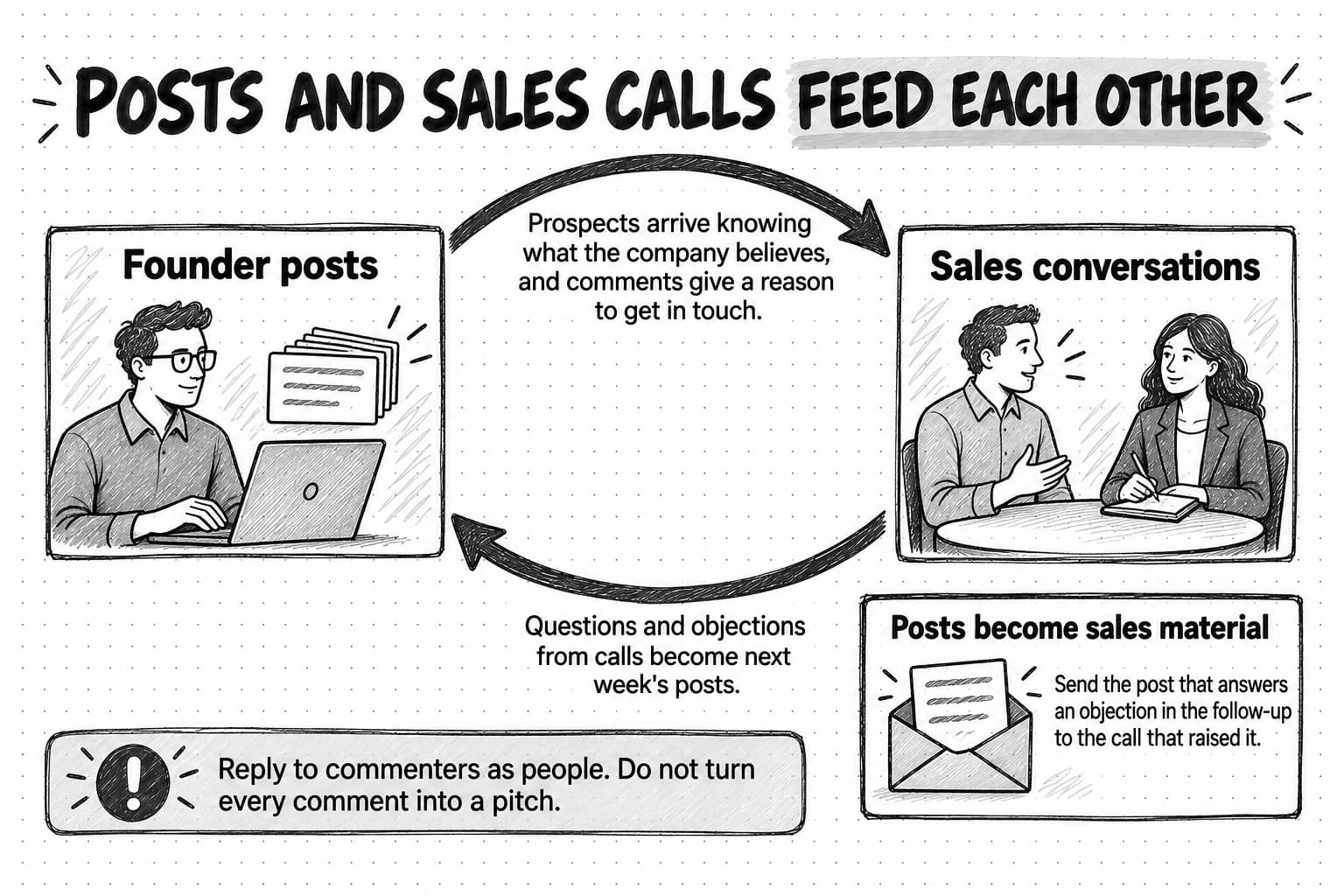
Posts make sales conversations warmer
A prospect who has read the founder's posts for two months arrives at a first call already knowing what the company believes and how the founder thinks. The founder can skip the explanation of the problem and talk about the prospect's situation. Posts also give sales a reason to get in touch that is not a pitch: "You commented on my post about onboarding drop-off. I would be curious how your team handles week two" is a better opening than a cold message, as long as the founder is genuinely curious and does not follow every comment with a sales sequence. People who feel that a comment earns them a pitch stop commenting.
Sales conversations make posts better
The questions prospects ask on calls are the questions other prospects have not asked yet. When three prospects in a month raise the same objection, that objection deserves a post that answers it in public. The founder's capture note is the bridge: write down the objection after the call, and Monday's planning turns it into material.
Posts become sales material
A post that answers a common objection can go into a follow-up email after the call that raised it. A post that explains the founder's reasoning about the category can go to a stakeholder the founder has not met. Keep a short list of the posts that have helped in sales, with the objection or question each answers, so they are easy to find when the moment comes.
View the posts and sales loop at full size (opens in a new tab).
Know who engaged
The value for sales depends on who reads, not how many. A post that draws thirty comments from other founders and no buyers may be enjoyable, but it does little for the pipeline. A post that draws three comments from people in the company's target roles may matter more. A clear picture of who buys, which our guide to ideal customer profiles and buyer personas explains, makes that judgment possible.
Turn founder posts into company assets
Founder posts are usually read for a day or two and then disappear into the feed. The thinking behind them can last much longer if the company keeps it. Treat the founder's best posts as raw material for assets the company owns.
- The newsletter. Once a month, combine the month's strongest posts into a longer edition with the context a post lacked. On LinkedIn, following someone and subscribing to their newsletter are separate: LinkedIn's newsletter help says subscribers are notified about each new article, while followers only receive some notifications about a person's content. A newsletter is a way to reach the readers who want every installment.
- Company page posts and carousels. A lesson the founder posted can become a company-page carousel that walks through the method step by step, credited to the founder. Our guide to repurposing content across channels explains how to adapt a source for a new format without losing its point or overstating it.
- Website and sales material. Opinions that keep earning agreement belong on the website, in the sales deck, and in the onboarding emails, written in the company's voice.
- Long articles and guides. A post that started a long comment thread is a sign that readers want the full argument. Write it on the company blog, where it can be found in search and linked from future posts. Our guide to B2B SaaS SEO strategy explains how a small team plans that kind of search content.
- The company's point of view. Over a year, the founder's opinions add up to a stated position on the market. Write it down and use it to brief anyone who creates content for the company. Our guide to building a content marketing strategy explains how a point of view connects to the subjects, formats, and distribution a company invests in.
Many readers never click a link in a post, so a post should deliver its value in the feed and treat a link to the full piece as optional. Our guide to zero-click content distribution explains how to plan content for readers who stay on the platform.
How to measure founder-led marketing
Founder-led marketing builds slowly, and its effect on revenue is hard to isolate, so measurement needs patience and honesty. No routine guarantees a number of followers or a size of pipeline. What a founder can track is whether the work is reaching the right people and starting the right conversations.
Three kinds of signals are worth recording.
Who engages. For each post, note whether the people who commented, reacted, or messaged are in the company's target roles and companies. A short log works: post date, rung, subject, and the names or roles of buyers who engaged. Totals of reactions and impressions are context, not the goal.
Conversations started. Count the direct messages, replies, and calls that began with a post, and what happened next. This is the signal most directly connected to sales.
What buyers say. Ask every new prospect and customer how they first heard of the company, and record the answer in their own words. "I have been reading Dana's posts for a while" in a discovery call is evidence that platform analytics cannot provide. People often misremember where they first came across a company, so this self-reported answer is imperfect, but over months it shows a pattern.
| Post | Date, rung on the ladder, and subject |
|---|---|
| Right people | Names or roles of target buyers who commented, reacted, or messaged |
| Conversations | Messages or calls that started from the post, and what happened next |
| Sales use | Whether the post was sent in a follow-up, and to whom |
| Heard of us | Prospects who mentioned the founder's posts when asked how they found the company |
| Next | What the founder will write or change because of this post |
Review the log monthly. If posts on one rung keep starting conversations with buyers, write more of them. If a subject draws attention from the wrong audience, decide whether that audience matters. After six months, the log should show whether founder-led marketing is reaching buyers, even if it cannot prove how many deals it caused.
When to share the channel
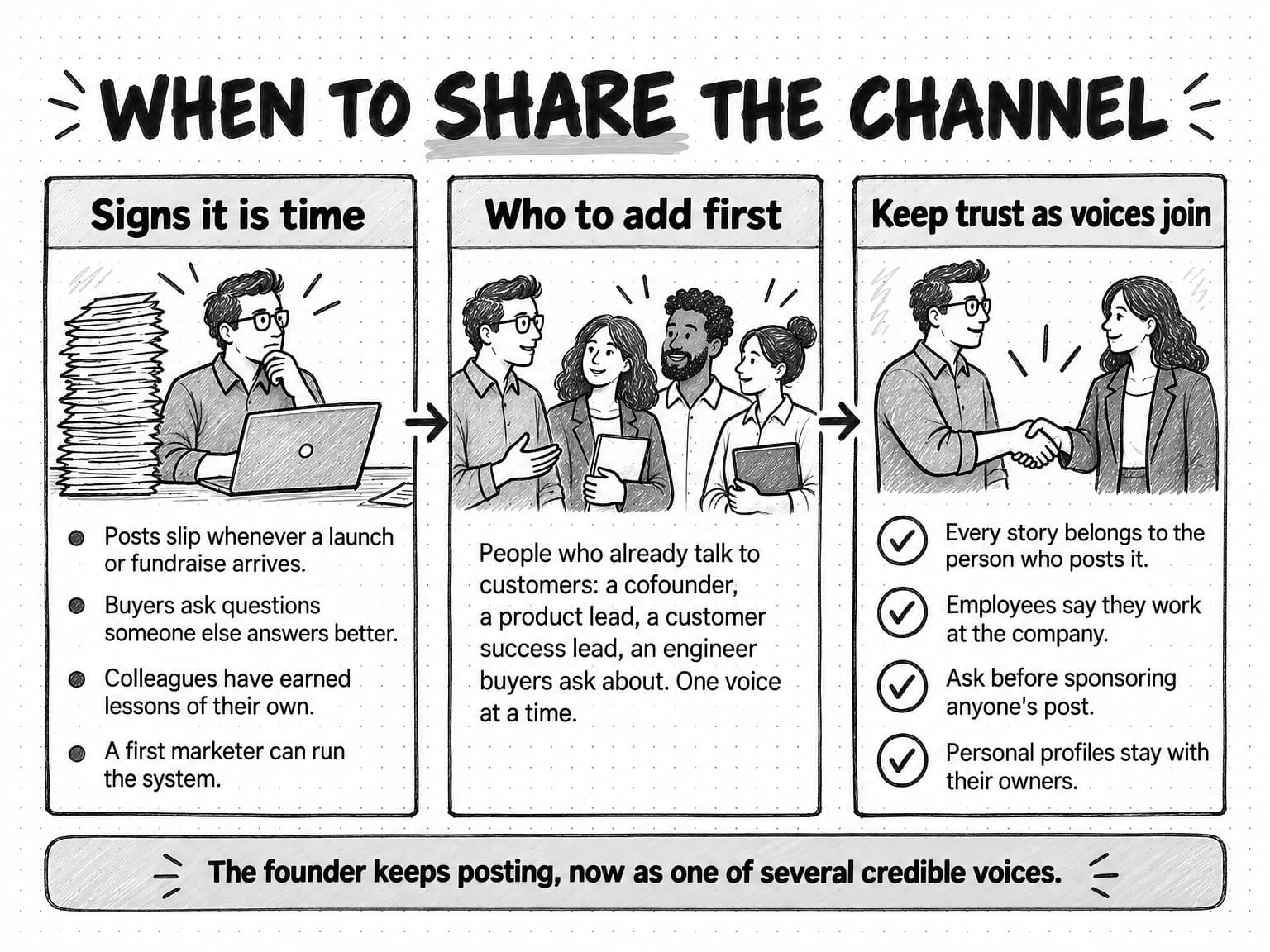
For most early B2B companies, founder-led marketing is the right start and a poor finish. As the company grows, a channel that depends on one person becomes a risk: the founder's time is needed elsewhere, the company's knowledge spreads across more people, and buyers want to hear from the people they will work with. Sharing the channel does not mean the founder stops posting. It means the founder becomes one of several credible voices, often still the most visible one.
Signs it is time
- The founder is the bottleneck. Posts slip whenever a launch, a fundraise, or a hiring push arrives, and the routine has failed for several months in a row.
- Buyers ask questions the founder is not best placed to answer. Technical evaluators want to hear from engineers; customers in implementation want to hear from the people who will support them.
- Other people at the company have earned a view. A head of customer success who has run two hundred onboardings has lessons the founder has only heard about secondhand.
- The company has hired its first marketer. The marketer can run the system, edit, and plan, which frees the founder to supply material and review.
- Buying groups have grown. When deals involve several people, each person in the buying group benefits from meeting a specialist they trust.
Who to add, and in what order
Start with the people who already talk to customers: a cofounder, a product lead, a head of customer success, a senior engineer whose work buyers ask about. Add one voice at a time, give each person the rungs of the ladder they can honestly own (a customer success lead owns lessons and proof; an engineer owns behind-the-scenes and product), and give them the same weekly routine at a smaller size. Customers can be voices too, through interviews and approved stories, which is where proof becomes most convincing.
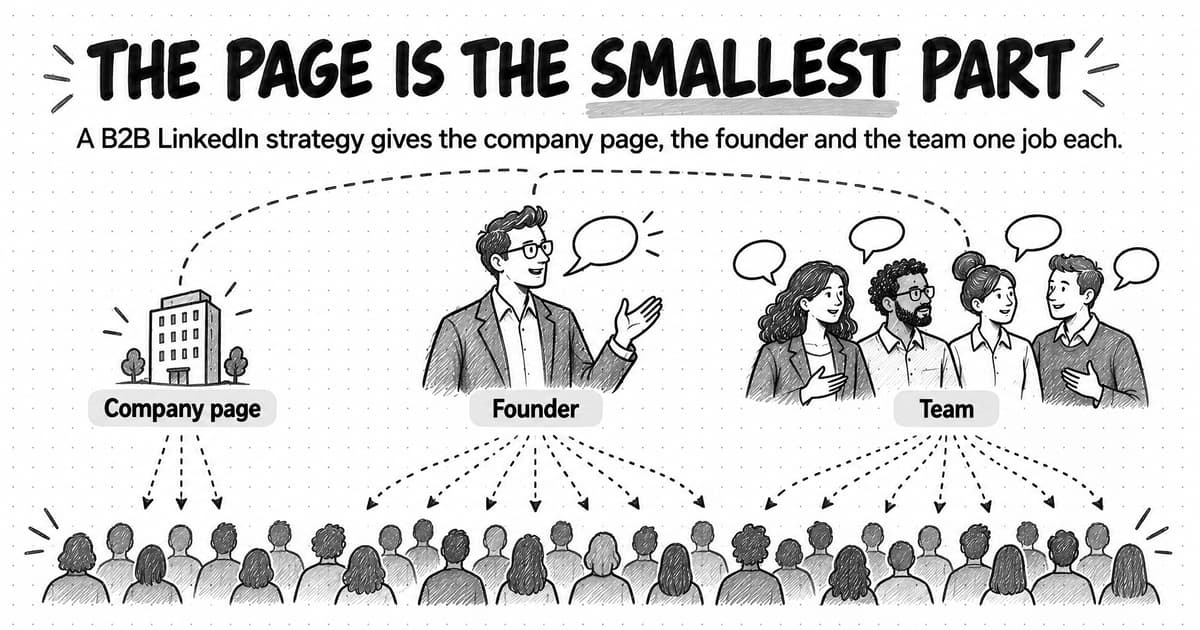
The company page has a role as well. It works as the home of company news, product announcements, and the reposting of team members' best posts. The LinkedIn strategy guide linked earlier explains how the founder, the team, and the page each get a job, and how to get employees posting without making it awkward.
How to add voices without losing trust
Keep the experience real. Anyone can help a founder or an employee write, but the stories, opinions, and examples must belong to the person whose name is on the post, and they approve every post before it goes out. A ghostwritten post that invents an experience the author did not have is a lie readers may eventually discover.
Disclose the relationship. The US Federal Trade Commission's guidance on endorsements says employees who promote their employer's products on social media should disclose the employment relationship, and that listing the employer on a profile page is not enough, because people who read a post may never see the profile. A founder's connection to the company is usually obvious, but an employee's post praising the product needs a clear mention that they work there.
Make amplification consensual. As of October 2026, LinkedIn's Thought Leader Ads let a company sponsor posts written by individual members, such as employees, customers, and industry experts. The company requests permission through LinkedIn's ad tools, and the author can approve or deny each request. Ask each person directly before sending the request, and never make posting a condition of anyone's job.
Agree on ownership early. A founder's or an employee's personal profile, connections, and followers are theirs, and they leave with the person. The company owns its page, its website, its newsletter list if it runs one, and the assets it builds from posts. Write down how posts written with company help can be reused, and what happens if a voice leaves, before it becomes an awkward conversation.
View when to share the channel at full size (opens in a new tab).
The founder's role after the handoff
When other voices are in place, the founder's job shifts from writing most of the posts to setting the company's point of view, supplying the hardest-won lessons, and reviewing what goes out under the company's name. Many founders keep posting once a week indefinitely, because their voice is still the one buyers know best. The difference is that the company no longer depends on it.
Worked example: one founder's first eight weeks
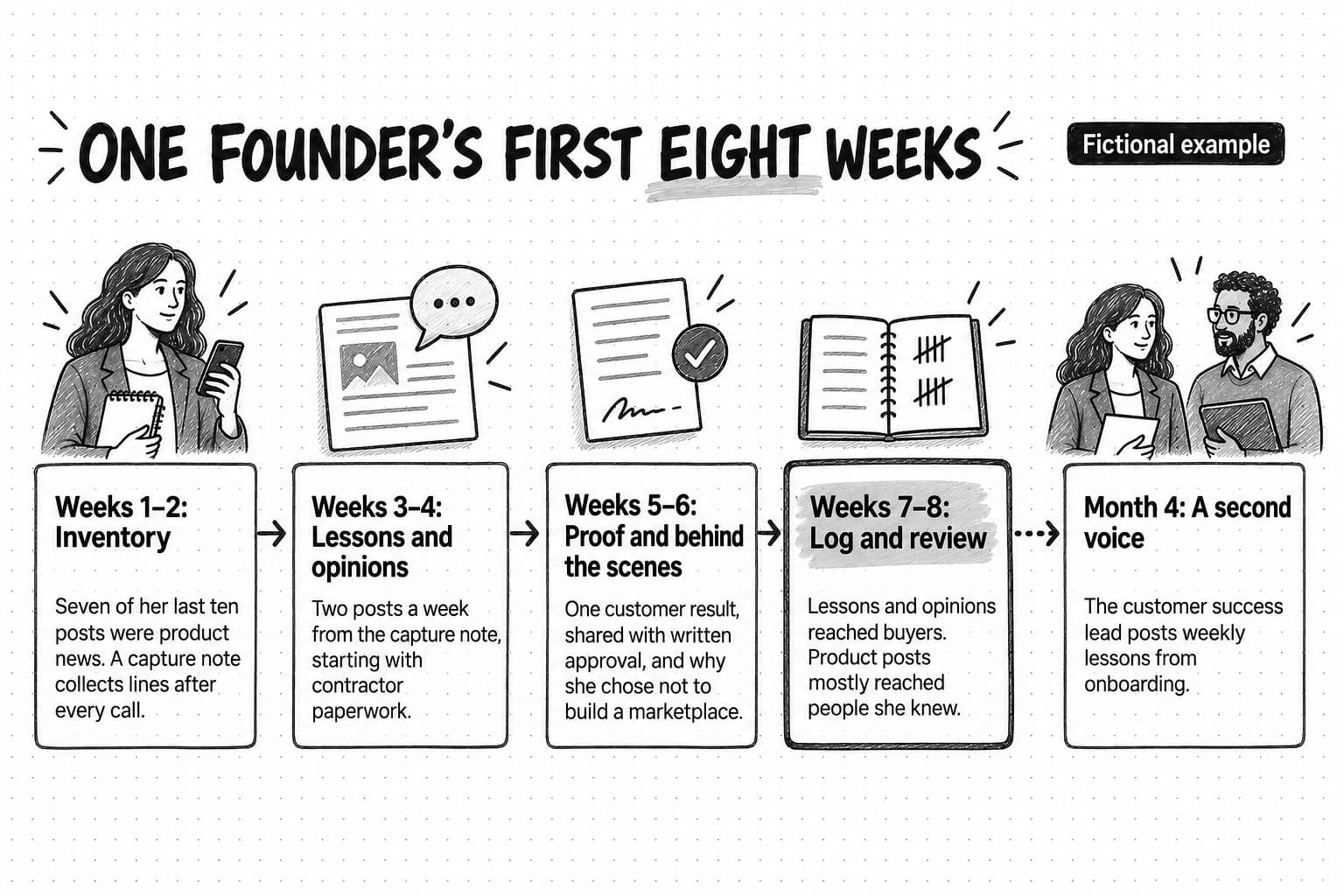
The following example is fictional. Quarrystone, its founder, its customers, and every number below are invented to show the method in use; they are not a benchmark or a forecast.
Quarrystone sells scheduling software for building inspections to commercial property managers. Its founder, Dana Reyes, spent eight years running inspection programs for a property management firm before starting the company. Quarrystone has eleven customers, no marketing hire, and a company page with a few hundred followers. Dana runs every sales call herself. She posts on LinkedIn every few weeks, usually when Quarrystone ships something.
Weeks 1 and 2: inventory and the capture note
Dana starts by reading her last ten LinkedIn posts. Seven are product announcements. Two are reposts of industry news. One, a short story about the inspection that failed because a contractor's insurance certificate had expired, drew more comments than the other nine combined, most of them from property managers.
She starts a capture note on her phone and adds a line after each sales call. By the end of week two, it holds fourteen entries, including three versions of the same objection: property managers worry that scheduling software will make them responsible for contractors' paperwork.
Weeks 3 and 4: the ladder and the first posts
Dana plans two posts a week using the ladder. Her first lesson post builds on the story that worked:
Most failed inspections I saw in eight years of running inspection programs had nothing to do with the building. They failed on paperwork: an expired insurance certificate, a missing license, a contractor who changed their crew. Now I ask every property manager one question before we talk about software: who checks contractor documents, and when? If the answer is "the inspector, on the day," the schedule is already at risk.
Her first opinion post takes a side on the objection from her capture note: property managers should not try to verify every contractor document themselves, and should require contractors to upload documents before an inspection is confirmed. She explains her reasoning and acknowledges that some readers' contracts make that hard.
She replies to every comment in the first hour. Two property managers disagree in the comments, and the discussion becomes the subject of Thursday's post.
Weeks 5 and 6: proof and behind the scenes
One customer agrees, in writing, to let Dana share that rescheduled inspections at its four buildings fell from about one in six to about one in twenty over a quarter, after the company began requiring contractor documents before confirmation. Dana posts it with the customer's approved wording and the period, and says plainly that the result is from one customer.
She also writes a behind-the-scenes post about why Quarrystone decided not to build a contractor marketplace, a feature several investors suggested. She applies the share-or-keep test and leaves out which investors made the suggestion.
Weeks 7 and 8: the log and the first review
Dana's Friday log after eight weeks shows the pattern she needs. Her lesson and opinion posts drew comments from property managers and facilities directors; her two product posts drew reactions mostly from people she already knew. Four property managers sent direct messages after the contractor-documents posts. Two of those became sales calls, and one prospect said on a call that she had been reading Dana's posts for a month.
In her monthly review, Dana shifts the mix toward lessons and opinions about contractor management, combines the contractor-documents posts into a newsletter edition, and turns the lesson post into a company-page carousel that walks through the document check step by step.
Month 4: adding a voice
By the fourth month, Quarrystone has hired a head of customer success, Sam, who runs onboarding for every new customer. Dana notices that prospects in later stages ask about implementation, which Sam knows better than she does. Sam agrees to post once a week on lessons from onboarding, with Dana reviewing the first few posts and the company page reposting the best ones. Sam's posts mention that he works at Quarrystone. Dana keeps posting twice a week, now with more time for opinions and fewer product posts.
View the eight-week worked example at full size (opens in a new tab).
Common founder-led marketing mistakes
Posting only product news. A feed of launches and feature updates gives readers nothing to learn and no reason to follow. Product belongs at the top of the ladder, not across it.
Writing for other founders instead of buyers. Startup advice, fundraising stories, and productivity tips can attract a large audience that will never buy. Some of that is fine, but most posts should be about the buyer's problem.
Borrowing a voice. Posts that copy the formatting and hooks of popular creators make the founder sound like everyone else. The founder's own examples and opinions are the point of the channel. When AI helps with drafts, the same risk applies: a polished post with no first-hand detail reads as generic, which our guide to AI slop describes.
Pitching every commenter. People who engage with a post are not leads to be worked through a sequence. Reply to them as a person, and get in touch privately only when there is a genuine reason.
Founder content with Ampere
Ampere is an AI marketing agent, and it can take on the production work around founder-led marketing while the founder keeps the material and the final say. The founder supplies what only they have: the experience, the opinions, and the judgment about what to share.
Ampere starts from Brand memory, the saved, reviewable knowledge about a company that Ampere reuses in later work. Brand memory can include reports on the company's key people and its voice, alongside its positioning, audience, products, and competitors, so drafts start from what the company is and how it speaks. You can review and edit each report, and later work follows the version you approve.
For LinkedIn text posts, native polls, and newsletters, Ampere can produce a package with a format-specific draft, review notes, claim checks, and follow-up ideas, saved as a Markdown file. A founder can brief Ampere in plain English with the week's capture note, a call summary, or a rough draft, and review the result before deciding what to post and where. For carousels, Ampere can make a 3-to-20-slide PDF and caption from a named topic or from material the founder shares, such as an article, a document, a deck, or a readable video or audio file, which suits turning a strong lesson post into a step-by-step company-page carousel. On paid plans, a saved prompt task can run on a schedule, for example monthly to draft a first version of the newsletter from the posts and notes saved in the Project, and return it for review. Projects keep the briefs, files, and earlier drafts together so new work starts with context.
Ampere doesn't post for you. It drafts and packages the work, and you decide what to publish. AI drafts can be inaccurate or incomplete, and a founder's post should contain no experience or opinion the founder did not supply, so the founder reviews every draft before it goes out.
Eligible accounts in supported regions that have never had a paid plan can start free with no card. Ampere sets up the company's Brand memory, then completes up to four Free tasks for the brand: a LinkedIn content audit, a LinkedIn image post, a LinkedIn carousel, and a LinkedIn text post. Unused Free tasks don't expire, and results stay saved after an upgrade. Your own prompts and follow-up questions, 200+ AI tools & skills, Scheduled Tasks, and Monitoring come with paid plans, so drafting a founder's posts from their own notes, as described above, is paid-plan work.
Start your founder-led marketing this week
The method fits in a week's calendar. Start small and keep it going.
- Read your last ten posts and note which rung of the ladder each one sits on, and which drew comments from buyers.
- Start a capture note and add one line after every customer conversation for a week.
- Write down the company's share-or-keep policy for numbers, customers, and fundraising, so you do not have to decide again each time.
- Put two 30-minute writing slots and a 10-minute Friday log on your calendar as recurring meetings.
- Write one lesson post from your capture note, post it, and reply to every comment in the first hour.
- Ask every new prospect how they first heard of the company, and record the answer in their words.
- After two months, review the log, adjust the mix, and decide whether anyone else at the company has lessons buyers need to hear.
View and save the founder-led marketing one-page reference at full size (opens in a new tab).
Sources and further reading
- John Dawes, Advertising effectiveness and the 95-5 rule: most B2B buyers are not in the market right now, The B2B Institute at LinkedIn and the Ehrenberg-Bass Institute for Marketing Science, 2021. The five-year switching example and the 95-5 heuristic; the author's own summary is on johndawes.info.
- Paul Graham, Do Things That Don't Scale, July 2013. Founders recruiting early users by hand and doing sales themselves.
- US Federal Trade Commission, FTC's Endorsement Guides: What People Are Asking. Employees promoting their employer's products on social media should disclose the relationship; a profile listing is not enough.
- LinkedIn, Thought Leader Ads, LinkedIn Marketing Solutions, accessed October 13, 2026. Sponsoring individual members' posts with the author's approval.
- LinkedIn Help, Newsletters on LinkedIn FAQ, accessed October 13, 2026. The difference between following a member and subscribing to their newsletter.
Frequently Asked Questions
What does building in public mean?
Building in public means sharing how a company is being built while it happens: the decisions, experiments, mistakes, and lessons, and sometimes numbers such as revenue or customer counts. Founders usually do it in regular posts or a newsletter. It gives readers a continuing story to follow and evidence of how the founder thinks and how the company behaves when something goes wrong, which matters to buyers judging a small vendor.
What are examples of founder-led marketing?
Examples of founder-led marketing include a founder posting lessons from sales calls on LinkedIn twice a week, writing a monthly newsletter that expands the best posts, appearing as a guest on industry podcasts, speaking at customer meetups, and answering questions in practitioner communities. In each case, buyers meet the company through the founder's own knowledge first. This guide's worked example follows one fictional founder who shifts from product announcements to lessons and opinions about her customers' problem.
What is the difference between founder-led marketing and founder-led sales?
Founder-led marketing uses the founder's knowledge and opinions, published under their name, to build attention and trust among people who may buy later. Founder-led sales is the founder personally finding prospects, running sales conversations, and closing the first customers. The two work best as a loop: posts make sales conversations warmer and give the founder reasons to get in touch, and the questions prospects ask on calls become material for the next posts.
Should B2B founders post on LinkedIn?
Most B2B founders should post on LinkedIn, because it is where buyers, future hires, investors, and partners already read about work, and a founder's personal profile reaches people a new company page does not. It suits founders who can keep a steady routine and have first-hand knowledge of the customer's problem. If another person at the company knows the buyers better, or the founder cannot keep a routine, start with that person instead and use the same method.
What should a founder post about on LinkedIn?
A founder should post mostly about the buyer's problem, drawing on five kinds of material: lessons learned from the work, opinions on how the problem should be approached, proof that the approach works, behind-the-scenes decisions and mistakes, and product news. Lessons should come most often, because they give readers something useful without asking for anything. Product news works best when it connects to something the founder has already taught or argued.
How often should a founder post on LinkedIn?
A founder should post as often as they can keep up every week, which for many founders is twice a week. No frequency suits every audience, and consistency matters more than volume, because the goal is for buyers to keep meeting the founder's thinking over months. If time is short, one post a week plus ten minutes a day of useful comments on other people's posts is a workable minimum that still keeps the founder visible.
What are the risks of building in public?
The risks of building in public are that posts are permanent and everyone reads them: competitors can use a bad month as a talking point, customers may recognize themselves, investors compare posts with the deck, and employees read what is said about the team. The biggest mistake is sharing information that belongs to someone else, such as a customer's results, without written permission. Deciding in advance which numbers and details the company will share reduces most of these risks.
What are the drawbacks of founder-led marketing?
The drawbacks of founder-led marketing are its cost in the founder's time and its dependence on one person. It takes a few hours a week from the busiest person in the company, it stalls when a launch or fundraise takes over, and the company's reputation rests on one person's judgment and availability. It also builds slowly, and its effect on revenue is hard to measure. Adding other credible voices as the company grows reduces the dependence.
Who owns a founder's personal brand?
A founder's personal brand belongs to the founder: their personal profile, connections, followers, and reputation stay with them if they leave the company. The company owns its own page, website, newsletter list, and the assets it builds from the founder's posts. Because the line can blur when company staff help write posts, founders and companies should agree in writing how that content can be reused and what happens if the founder steps away.
When should a startup move beyond founder-led marketing?
A startup should add other voices when the founder becomes the bottleneck, when buyers ask questions others answer better, when colleagues have earned their own lessons, or when the first marketer arrives to run the system. The founder usually keeps posting, often weekly, but becomes one of several credible voices. Add one person at a time, starting with people who already talk to customers, and keep each post grounded in the author's real experience.