What is brand positioning? A guide with B2B examples
See how a position shapes what buyers compare you with, why the real alternative is often a spreadsheet or doing nothing, and how one product can support two different positions.
45 min readWritten by Ampere
Short answer
What is brand positioning?
Brand positioning is a company's decision about how a chosen group of buyers should understand its offer compared with the alternatives they could use instead. It sets the audience and buying situation, the alternative, what the offer does better, the evidence behind that claim, and the category that gives the offer meaning. Copy, voice, and design then express that decision.
Summary
A position is relative: a difference only counts against a specific alternative, for a specific audience, in a situation that makes the problem pressing. That is why the parts of a position, namely audience, alternatives, differentiated value, evidence, and market context, depend on one another, and why a weak position rarely improves by rewording its weakest part.
The position a team writes down is a hypothesis, and the position buyers hold, assembled from colleagues, review sites, sales calls, search results, and AI assistants, is the evidence that tests it. In a one-product B2B company, brand and product positioning are nearly the same decision; they diverge when a company sells several products or serves segments with different needs.
Buyers often weigh a product against a spreadsheet, a colleague, an agency, or doing nothing rather than a rival vendor, and each alternative changes the question a position must answer. A unique feature becomes a meaningful difference only when it gives that audience a better result than its alternative, which is why a label like AI-powered rarely sets one product apart.
Public B2B examples show positioning choices but not their reasoning: Retool's alternative changed, Gong kept revising its category label, and Intercom renamed itself Fin to shed an older position. A fictional worked example then shows one product supporting two positions with the same facts, where the choice changes the headline, proof, demo, and content but never the claims.
A positioning statement summarizes decisions for briefing and reviewing work, but it cannot replace customer understanding or a missing capability. Test a position against best-fit customers, win and loss interviews, and product usage, revisit it when customers, alternatives, or the category change, and use the guide's five-line check to mark each part supported, assumed, or decided.
Contents
- What brand positioning means
- Brand positioning and product positioning in a B2B company
- How audience, alternatives, value, evidence, and market context fit together
- Why the real alternative is often a spreadsheet, a process, an agency, or nothing
- When a unique feature becomes a meaningful difference
- Choosing a market category buyers already understand
- Three B2B examples of different positioning choices
- Worked example: tracing Fernbridge's position from audience to evidence
- Two plausible positions for the same product
- Positioning compared with value proposition, messaging, slogan, voice, and visual identity
- What a positioning statement helps a team do
- Evidence that supports or challenges a position
- When positioning needs to change
- Try it: write down your product's current position
- Sources and further reading
- Frequently Asked Questions
A buyer who opens a software company's homepage makes several judgments before reading much past the headline. What kind of product is this? Is it meant for a company like mine? What would it replace? Is it likely to be expensive, risky, or worth a closer look? The buyer answers those questions with whatever the page, a colleague, or a search result provides, and fills the gaps with what they already know about products that seem similar.
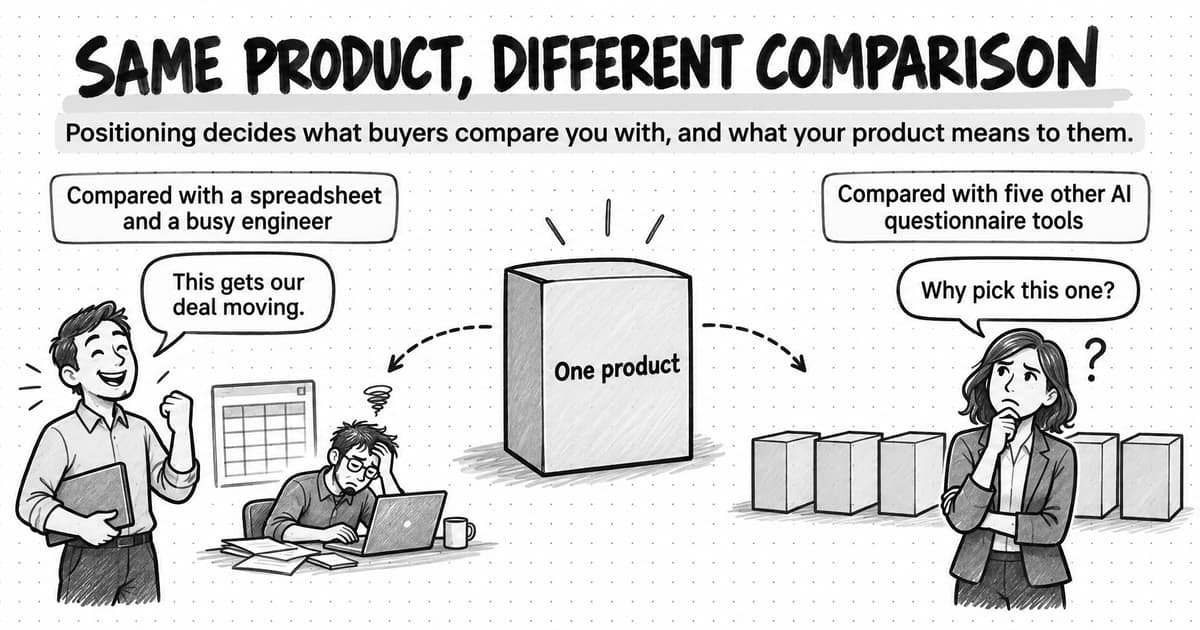
Brand positioning is the company's deliberate choice about how those questions should be answered. It decides which buyers the offer is for, what those buyers would otherwise use, what the offer does better for them, and what kind of thing they should understand it to be. The choice matters because the same product facts can be read in very different ways. A tool that drafts answers to customer security questionnaires looks like a modest convenience to a security team that already keeps a careful library of approved answers. To a founder whose largest deal has been waiting two weeks for those answers, the same tool looks like a way to get the deal moving again.
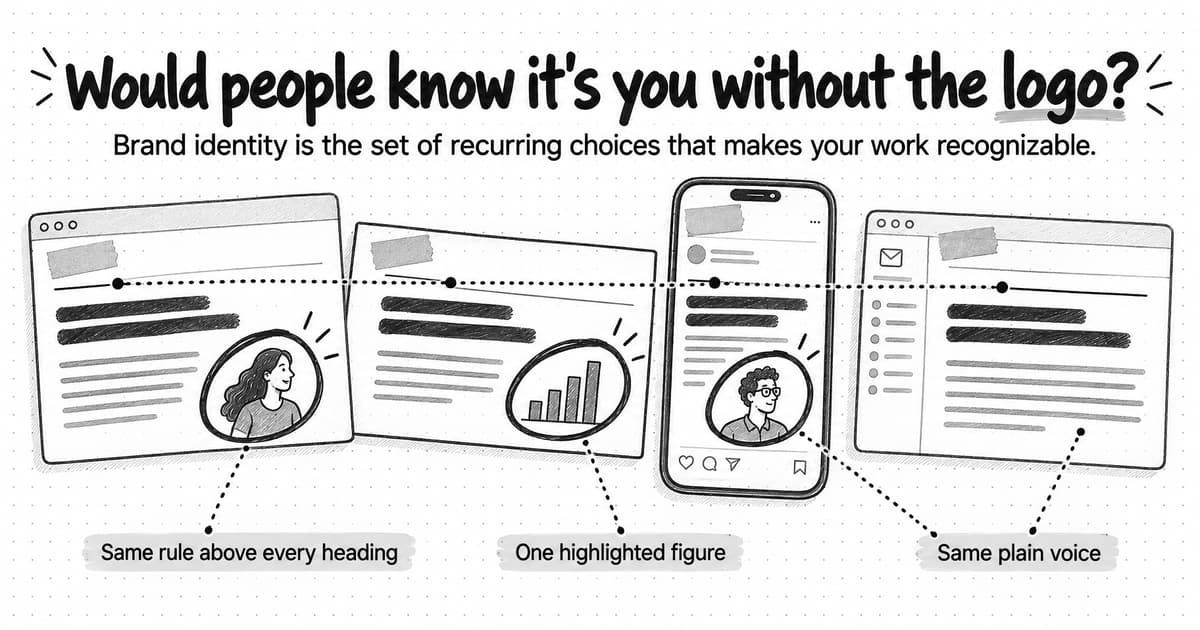
Positioning is easy to confuse with the things that express it: a homepage headline, a tagline, a value proposition, a brand voice, a visual identity. Those come afterward. Positioning is the decision they express, and good expression cannot rescue a weak decision. If a company has chosen an audience that does not care about its difference, or a difference no buyer can verify, better copy only makes the mismatch easier to see.
This guide explains what brand positioning is, how it relates to product positioning and to what buyers actually believe, and how five parts of a position depend on one another: audience, alternatives, differentiated value, evidence, and market context. It looks at three public B2B examples, then follows Fernbridge, a fictional company that drafts answers to security questionnaires, through two plausible positions for the same product. Fernbridge, its customers, and its numbers are invented for teaching. The guide ends with a short exercise for writing down your own product's current position.
What brand positioning means
Brand positioning is the decision about how a company wants a particular group of buyers to understand what it offers, compared with the other ways those buyers could deal with the same problem. A position is always relative: to a buyer, to an alternative, and to the situation in which the choice comes up. “Fast” means little until you know faster than what, for whom, and when speed matters.
The word took on this meaning in a 1969 Industrial Marketing article by Jack Trout. He argued that buyers ignore messages that do not fit what they already believe, so a company has to find a place relative to what buyers already know, and his main example was a B2B one: General Electric trying to compete with IBM in computers. Al Ries and Jack Trout developed the idea in a 1972 Advertising Age series and their 1981 book Positioning: The Battle for Your Mind. Marketing textbooks such as Philip Kotler and Kevin Lane Keller's Marketing Management describe positioning as designing a company's offering and image so that it holds a distinctive place in the minds of its target market. April Dunford, who works mainly with B2B technology companies, puts it more operationally: positioning explains how a product leads at delivering something that a well-defined group of customers cares a lot about.
The definitions differ in emphasis but agree on two points. A position exists in the buyer's understanding, and a company influences it by choosing a context deliberately rather than leaving buyers to supply one. For a B2B software or AI company, that context usually comes down to five decisions: who the best-fit buyers are and in what situation, what they would use instead, what the company does better for them, why buyers should believe it, and which market category or wider change gives the offer its meaning.
The position you intend and the position buyers hold
A positioning document records an intention. The position that affects sales is the one buyers actually hold, and buyers assemble it from far more than the company's own words: how a colleague described the product, which vendors appeared beside it in a search or on a review site, what a salesperson emphasized, what a free trial made easy or confusing, what an analyst or AI assistant called the category, and how competitors describe the market.
The two can drift apart. A team may intend to be the careful choice for security reviews while prospects keep calling it “another AI questionnaire tool” and comparing it on price with three similar products. Louder copy rarely closes that gap, because the gap is evidence about the position itself. Perhaps the intended position is not visible where buyers form their impressions. Perhaps buyers do not find it relevant or believable. Or perhaps the product does not yet behave the way the position promises.
The intended position is a hypothesis about how buyers could best understand the offer, and the position buyers hold is the evidence that tests it. You can observe the second in how prospects describe the product on a first call, in the alternatives they mention when they choose or reject it, in how review sites and analysts categorize it, and in how search results and AI assistants summarize it. The section on evidence later in this guide covers these sources in more detail.
Brand positioning and product positioning in a B2B company
Product positioning applies the same decision to one product or offer: which buyers it is for, what it replaces, what it does better, and which category it belongs to. Brand positioning applies it to the company as a whole: what the company should be known for across its products, audiences, and interactions, and what a buyer should expect from anything carrying its name.
In an early-stage B2B company with one product and one main buyer, the two are nearly the same decision. The company is known for its product, so writing two separate positioning documents usually adds work without adding clarity. They diverge when the company sells several products, serves segments with different needs, or wants its reputation to carry into products it has not built yet. A company that offers both a free developer tool and an enterprise security product needs each product positioned against its own alternatives, and it needs a brand position broad enough to make both credible without blurring either.
The relationship runs in both directions. The brand position should make each product position easier to believe: a company known for careful security work starts with an advantage when it launches a compliance product. Each product position, in turn, should reinforce the brand or extend it deliberately. When a new product asks buyers to believe something the brand has taught them not to expect, the company faces a repositioning decision, not just a launch.
This guide uses “brand positioning” for the general concept and “product positioning” when a decision concerns one offer. Most of the examples are product-level, because that is where B2B companies usually start and where the parts of a position are easiest to see.
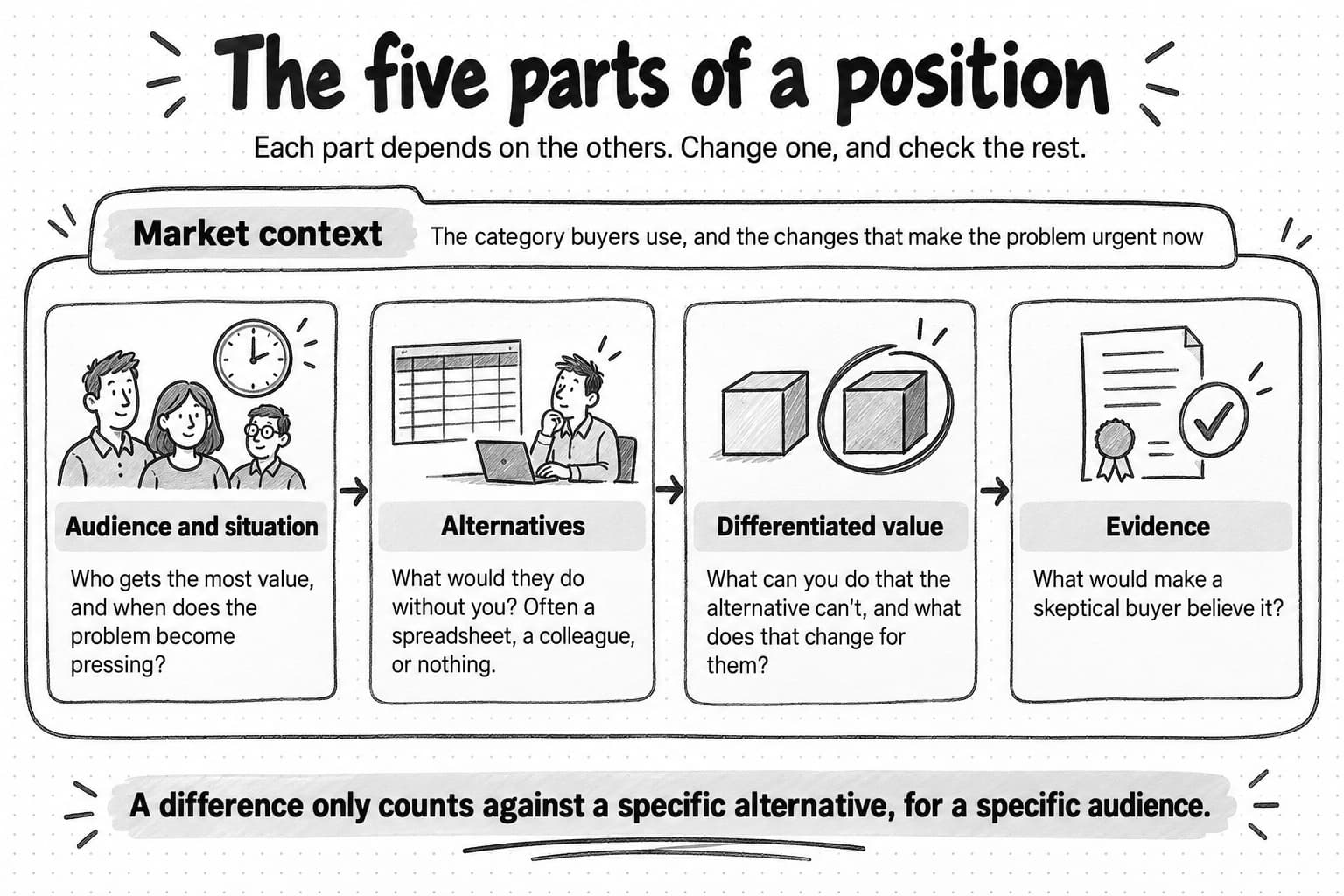
How audience, alternatives, value, evidence, and market context fit together
It helps to treat a position as a small set of connected decisions rather than a sentence. Change one, and the others usually need to change too.
- Audience and buying situation: the buyers who get the most value, described by the problem they have and the circumstance that makes it pressing, not only by industry and job title.
- Alternatives: what those buyers would do if your product did not exist. That might be a competing vendor, but it is often a spreadsheet, an internal process, an agency, a new hire, or nothing.
- Differentiated value: the capabilities you have that the alternatives lack, and what those capabilities make possible for this audience.
- Evidence: the facts that make the difference and its value believable, such as product behavior a buyer can see, customer results, demonstrations, reviews, and independent assessments.
- Market context: the category buyers use to make sense of the offer, plus any wider change that makes the problem newly urgent or the old alternatives newly inadequate.
The dependencies matter more than the order. The audience determines which alternatives are relevant: a startup without a security team and an enterprise with a full compliance department compare a security-questionnaire tool with entirely different options. The alternative determines what counts as different, because a capability is only different relative to something. The audience then decides whether that difference is valuable. Evidence decides whether anyone believes it. And the category sets the expectations a buyer brings: which features should be there, which vendors are comparable, and roughly what the product should cost.
These parts adapt April Dunford's framework, which names five components of positioning: competitive alternatives, differentiated capabilities, value, target customers, and market category. Kevin Lane Keller, Brian Sternthal, and Alice Tybout described a related structure in a 2002 Harvard Business Review article: a frame of reference that tells buyers what the brand should be compared with, points of parity the brand must match to be taken seriously in that frame, and points of difference that set it apart. Both treat a difference as meaningful only within a chosen comparison. This guide also treats evidence as a separate part, because B2B buyers usually need proof before they act on a claimed difference.
Open the five parts of a position diagram at full size (opens in a new tab)
One consequence is that a weak position rarely improves by rewording its weakest part. If a team realizes its difference does not matter to its current audience, the remedy may be a different audience for whom the same difference matters, a different alternative against which it stands out, or a change to the product. A more persuasive sentence about the same difference usually changes nothing.
Why the real alternative is often a spreadsheet, a process, an agency, or nothing
Many positioning documents list competitors and stop there. A B2B buying decision, however, is rarely a straight choice between two vendors. More often it is a choice between changing and carrying on as before.
April Dunford makes this the starting point of positioning work: ask what customers would do if your product did not exist. The answer, she notes, is often to do nothing, to use a spreadsheet or a manual process, or to hire someone junior to handle it. She argues that the status quo is the first alternative a product has to beat, and she warns against listing “phantom competitors” that could in theory compete with you but never actually appear in your deals.
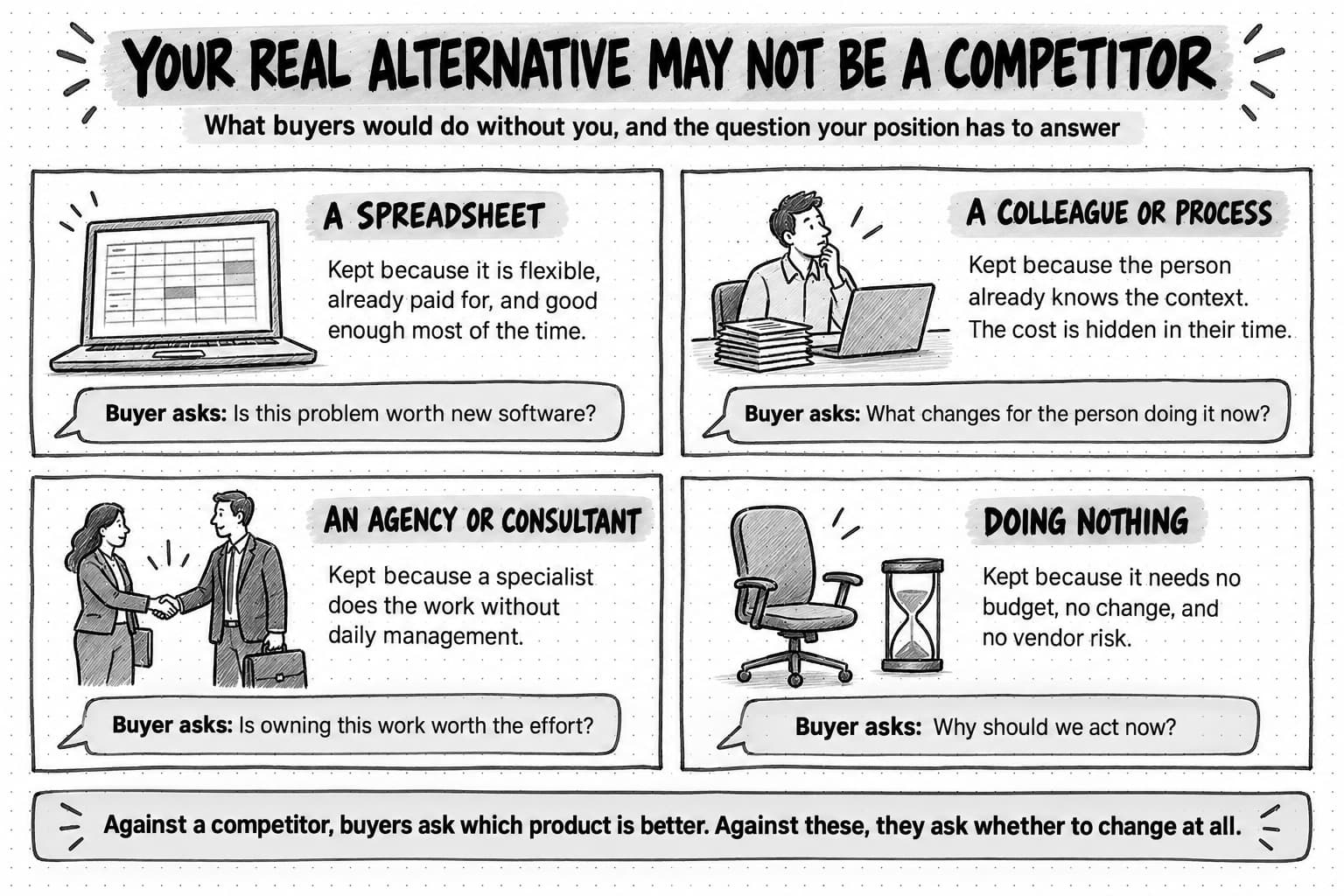
Four alternatives come up again and again.
A spreadsheet or general-purpose tool. Spreadsheets, shared documents, and general software persist because they are flexible, already paid for, and understood by everyone. A team that answers security questionnaires from a spreadsheet of past answers has a system that works most of the time. The positioning question is what the spreadsheet cannot do in the situations that matter, such as telling a reviewer whether an old answer still matches current policy.
An internal process or person. Often the alternative is a capable colleague: the engineer who answers security questions, the analyst who builds the monthly report, the founder who writes every launch announcement. Buyers keep this alternative because the person already knows the context, and the cost is hidden in their salary and in the other work they set aside. Positioning against it means explaining what changes for that person, not implying that they are unnecessary.
An agency, consultant, or contractor. Some buyers hand the work to a specialist. They get expertise and capacity without managing the work daily, and they pay by the project or the hour. A product competing with this alternative has to address control, speed, cost per job, and whether the buyer's own team can do the work well with the product.
Doing nothing. Often the strongest alternative is to tolerate the problem. Deals move slowly, a report is never written, a risk stays unmanaged. Doing nothing is attractive because it needs no budget, no change, and no risk of choosing the wrong vendor. Positioning against it means showing why the problem is worth solving now, often by connecting it to an event the buyer already recognizes, such as an audit, a large deal, or a new regulation.
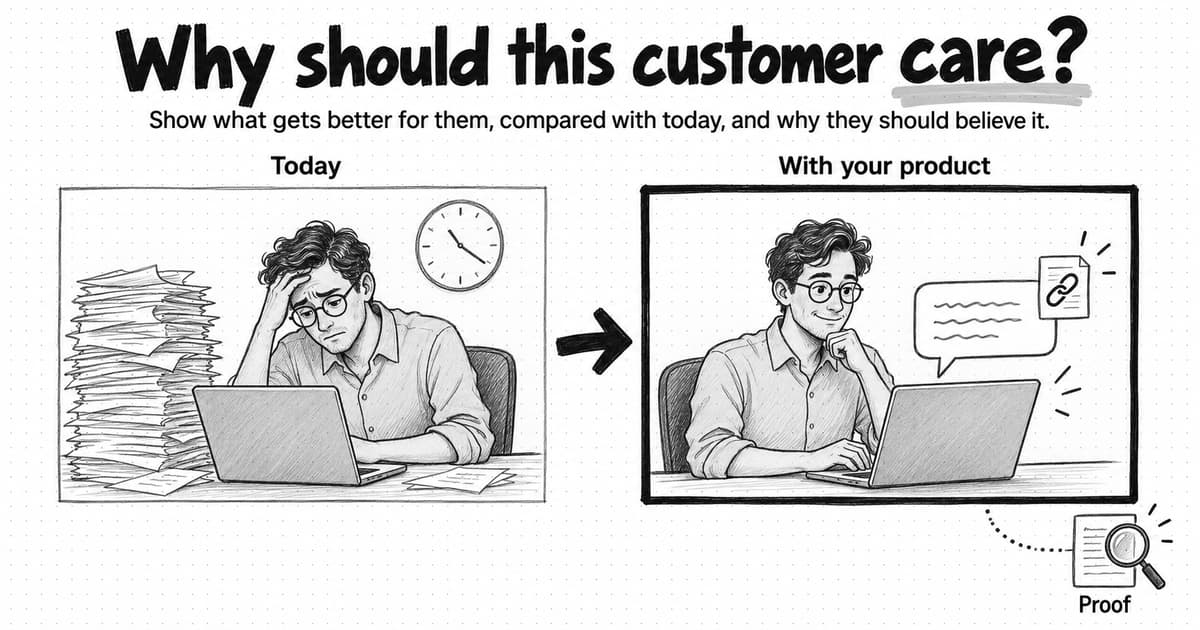
The alternative changes the buyer's question, and the position has to answer the question the buyer is actually asking. Against a competing vendor, the buyer asks which product is better. Against a spreadsheet, the buyer asks whether the problem justifies new software at all. Against an agency, the buyer asks whether owning the work is worth the effort. Against doing nothing, the buyer asks why now. A homepage built to beat a competitor's feature list can fail completely with a buyer who was never going to buy that competitor and is instead deciding whether to keep the spreadsheet.
To find the real alternatives, ask recent buyers what they did before, what else they considered, and what would have happened if they had bought nothing. Ask lost prospects what they chose instead; “we decided not to do anything yet” is a common and useful answer. The competitor analysis guide explains how to choose a comparison set from the customer's point of view, and voice-of-customer research shows how to gather and analyze these conversations.
Open the real alternatives diagram at full size (opens in a new tab)
When a unique feature becomes a meaningful difference
A difference matters to buyers when it gives a particular audience a better result than its real alternative, and buyers can see or believe that it does. Being unique is neither necessary nor sufficient. A product can have a feature no competitor offers that no customer would pay for. It can also win with a capability several vendors share if, for its chosen audience, that capability does something the buyer's current approach cannot.
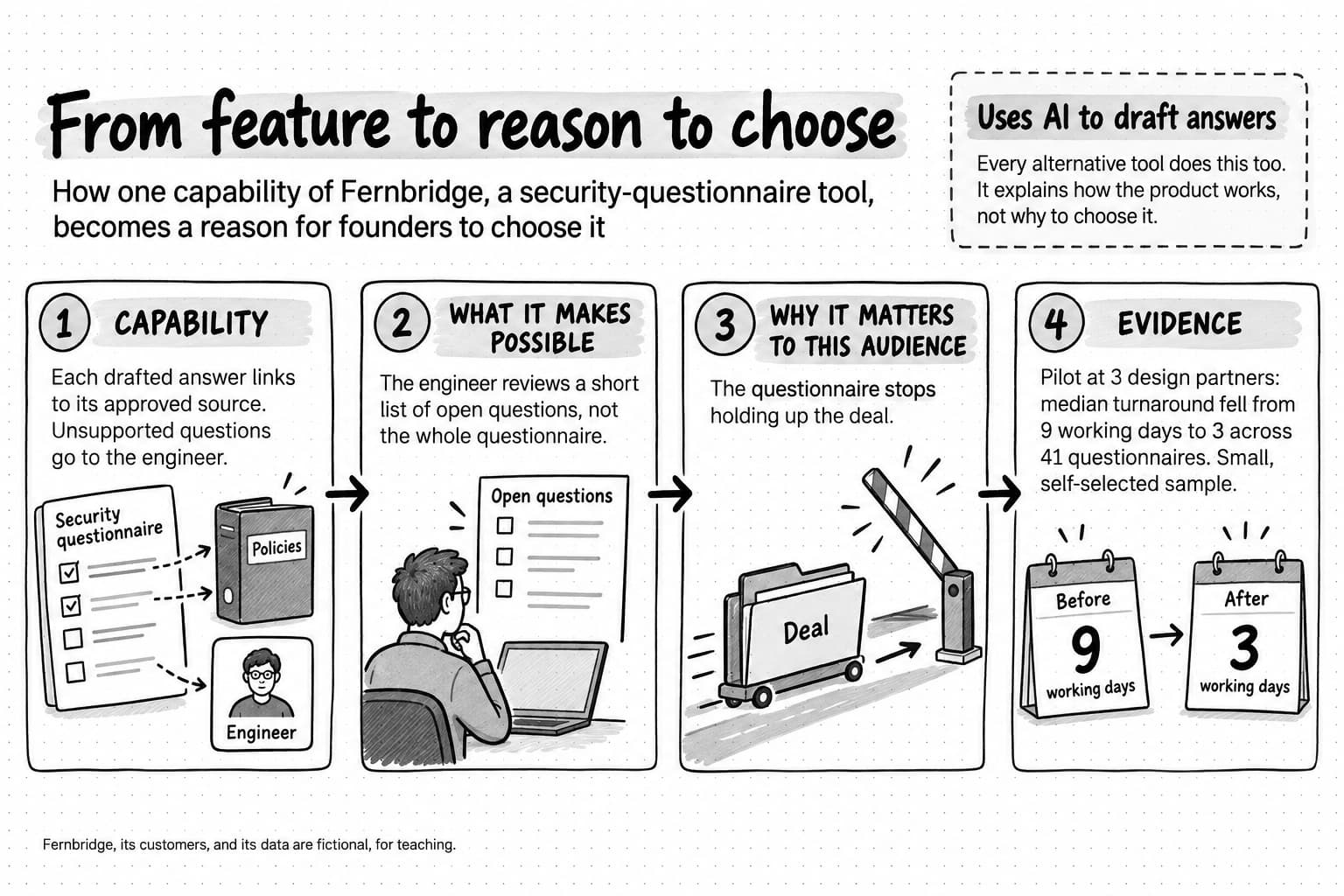
A practical test follows a capability through three questions:
- What does the product have or do that the alternative does not? Describe the capability concretely: “every drafted answer links to the approved policy passage it relies on,” not “accuracy.”
- What does that make possible for this audience in this situation? “The engineer who reviews the questionnaire checks a short list of open questions instead of rereading every answer.”
- Why does that matter to them? “The questionnaire no longer holds up the deal, and the company can show a customer where each answer came from.”
If the chain breaks at the second or third question, the capability may still be worth building, but it is not yet a reason to choose the product.
Keller, Sternthal, and Tybout add a caution: points of difference alone cannot sustain a brand. Buyers first have to accept that the product belongs among the options they are considering, which means matching the points of parity they expect. In B2B software these are often basics such as single sign-on, standard integrations, a completed security review, and dependable support. A strong difference rarely wins a buyer who suspects the product fails one of those basics.
Some researchers go further. Jenni Romaniuk, Byron Sharp, and Andrew Ehrenberg found low perceived differentiation between competing brands across many categories in two countries, yet customers kept buying those brands. They argued that distinctiveness, meaning how easily buyers recognize and recall a brand, deserves more attention than differentiation. For B2B positioning, the practical lesson is that a difference buyers do not notice or remember has no effect, so a position needs consistent, recognizable expression as well as substance.
Why “AI-powered” rarely answers the buyer's question
“AI-powered” describes how a product is built. It does not tell a buyer what the product does better than their current approach. When most products in a category use similar models, the label stops separating them. In a 2026 First Round Review article on positioning AI products, Arielle Jackson, First Round's head of brand and product marketing, argues that once several credible companies make the same “AI-powered” claim, they become interchangeable to buyers.
AI can still be part of a meaningful difference. The useful questions are what the AI makes possible that the buyer's alternative cannot do, and whether the buyer can trust the result. In the fictional market used in this guide, every security-questionnaire tool drafts answers with a language model, so Fernbridge cannot differentiate on drafting alone. Its difference is that each drafted answer shows the approved source behind it, and that questions without a current source are sent to a person instead of being answered anyway. For an engineer who has to vouch for every answer, that is the part that changes the work.
Choosing a market category buyers already understand
A market category tells buyers what kind of thing they are looking at. April Dunford compares it to the opening scene of a film, which orients the audience so they can make sense of the details. Tell a buyer that a product is a “CRM,” and that one word suggests who the main competitor probably is, who usually buys, which features should be there, and roughly what it should cost. Keller and his co-authors call the same idea the frame of reference.
A useful category reference has three qualities. Buyers already recognize it, or can recognize it after one short explanation. It places the product beside alternatives against which its difference looks strong. And it connects to a problem, owner, or budget that already exists. “Security questionnaire software” passes all three for Fernbridge: buyers search for it, security and sales teams know what it is, and some companies already pay for it.
An invented label fails when buyers cannot connect it to any of those things. Suppose Fernbridge called itself a “trust velocity platform.” The phrase may sound distinctive to the team that coined it, but a buyer cannot tell what it replaces, who should own it, or what it should cost. The company then has to explain the familiar category anyway, usually in the second sentence, and the new label has only added a step.
Companies do sometimes create or rename categories, usually when the existing category would force an unfavorable comparison and the company can afford to teach the market a new frame over several years. Dunford estimates that about one in ten of the companies she has worked with were best positioned in a newly created category, because no existing category explained their value well. One of the examples below shows a company introducing its own label. For most early-stage B2B companies, a narrower version of a familiar category gives buyers a reference point while still separating the offer from the general field. “Security questionnaire software for companies without a security team” tells a buyer what the product is and whom it is built for.
Market context also includes changes outside the category. A new regulation, a shift in how companies buy, or a technology that makes an old alternative cheaper or worse can make a position newly relevant. For AI companies, general-purpose AI assistants are part of that context. A buyer can reasonably ask whether pasting their documents into a chatbot would do the job, which makes the assistant itself one of the alternatives a position must answer.
Three B2B examples of different positioning choices
Public examples are useful because they show positioning choices in wording anyone can check. They also have a limit. A homepage or press release shows what a company communicates, not the reasoning behind it or whether the choice worked. Each example below separates the two. The wording comes from the companies' own pages and from archived copies of their homepages, checked on October 4, 2026. Homepage copy changes often, so treat these as dated snapshots, not current descriptions.
Retool: when the alternative is building it yourself
What Retool communicates. Retool sells software for building internal tools, such as the admin panels and dashboards employees use to work with company data. Archived copies of its homepage from 2019 and 2023 compared the product with writing those tools by hand. The December 2019 page promised “Build custom internal tools, fast” and told engineers they would no longer need to worry about routine front-end code. The June 2023 page invited them to stop “wrestling with UI libraries.” In June 2026, chief executive David Hsu introduced a new app builder with a different argument: AI tools now let almost anyone generate a working app on their own computer, but, in his words, “localhost isn't production.” Retool's homepage on October 4, 2026 led with “Secure your vibe-coded apps” and offered to deploy apps built with other AI tools inside Retool's governed environment.
A reasonable reading. For years, Retool's main alternative was not another vendor but the buyer's own engineers building the tool from scratch, so the copy addressed the cost of that alternative. Once AI coding tools made building an app cheap, that alternative changed, and Retool's public argument moved from building quickly to deploying safely, with sign-in, data permissions, and audit trails for apps that are now easy to generate.
What it does not show. Why Retool made the change, how buyers responded, or whether the newer emphasis will last. The 2026 headline may belong to a launch campaign.
Gong: choosing, and then changing, a category label
What Gong communicates. Gong records and analyzes sales calls, emails, and meetings. In December 2018, its homepage title described “Conversation Intelligence Technology for Sales Teams.” In October 2019, Gong announced “Revenue Intelligence” at its first Revenue Success Summit, presenting it as a move from decisions based on opinions and gut feelings to decisions based on data, while the same press release still described Gong as a sales-enablement platform. By June 2020 the homepage title read “Revenue Intelligence for Sales Teams,” and a Gong blog post first published in 2022 is titled “Why Gong Pioneered The Category in 2019.” By January 2026 the homepage title had become “Revenue AI OS for Revenue teams.”
A reasonable reading. Each label changes the frame of reference. “Conversation intelligence” invites comparison with other tools that record calls and suggests a buyer who manages sales calls. “Revenue intelligence” asks a revenue leader to compare Gong with the CRM data and opinions they use to manage deals and forecasts, which is a larger problem with a larger budget. Introducing the new label while still using a familiar one gave buyers a reference point. “Revenue AI” places the product among current AI products. The sequence also shows that a category label is a choice a company keeps revisiting.
What it does not show. That the labels caused Gong's growth. Words such as “#1,” “leader,” and “pioneered” are Gong's own claims, and analysts use their own labels for the same market.
Intercom and Fin: when an old position becomes baggage
What the company communicates. Intercom's homepage title read “Customer Messaging Platform” in 2019, “The Engagement OS” in 2022, and “The complete AI-first customer service solution” in September 2024. In 2023 Intercom introduced an AI customer service bot called Fin. In May 2026, chief executive Eoghan McCabe announced that the company would rename itself Fin and keep Intercom as the name of its helpdesk product. He argued that people update their mental map of companies rarely, and that newer competitors in AI customer service had no baggage: they never had to move anyone from an old position. Salesforce completed its acquisition of Fin, which its announcement described as formerly Intercom, on September 10, 2026.
A reasonable reading. This is a public example of the gap between an intended position and the one buyers already hold. The company had changed its product and its stated category, but, by its chief executive's account, its name still carried the older position. Renaming the company after the AI agent was one way to make the intended position easier for buyers to accept.
What it does not show. Whether the repositioning or the rename drove the company's results or the acquisition. Resolution rates and customer counts in the announcements are the companies' own figures.
Taken together, the three examples show different parts of a position under pressure: the alternative at Retool, the category reference at Gong, and the position buyers already hold at Fin. None of them is a template to copy, because each choice depended on that company's buyers, alternatives, and evidence.
Worked example: tracing Fernbridge's position from audience to evidence
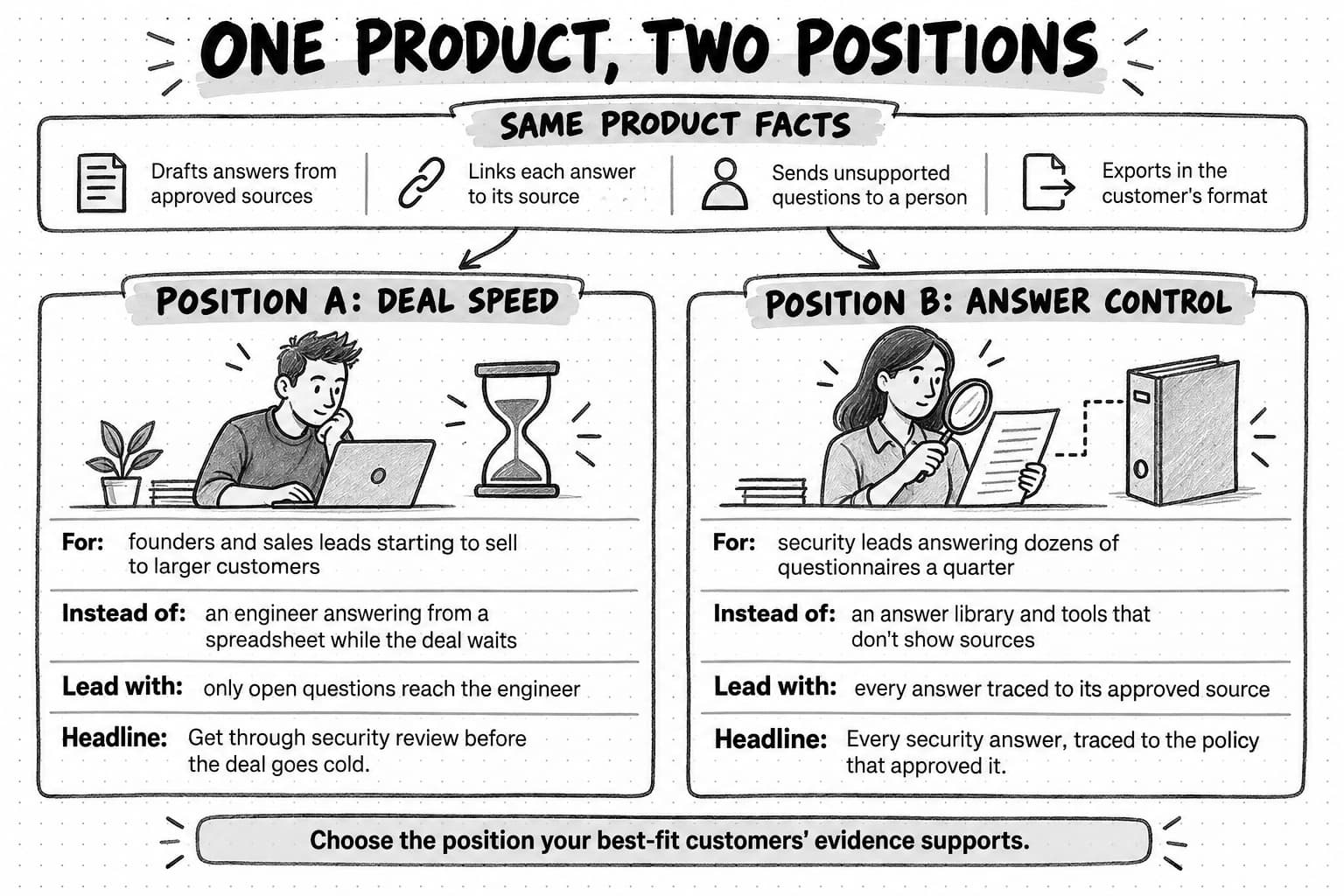
Fernbridge's software drafts answers to the security questionnaires that larger customers send before they buy software: long spreadsheets or online forms asking how a vendor stores data, controls access, handles incidents, and trains staff. These facts about the product stay fixed for the rest of this guide:
- It drafts answers from documents the customer's team has approved: security policies, audit reports, and previously approved answers.
- Every drafted answer links to the passage it relies on and shows when that source was last approved.
- Questions with no approved source, or whose source is older than a review period the team sets, go to a named reviewer instead of being answered.
- Completed questionnaires export back into the format the customer sent.
- Drafting uses a large language model, as do the drafting features of the competing products in its fictional market.
Fernbridge has eight design-partner customers. During a pilot, three of them logged 41 questionnaires. The median time from receiving a questionnaire to returning it fell from nine working days, measured on the same partners' questionnaires in the previous quarter, to three. The sample is small, the partners volunteered, and questionnaires varied in length, so the result supports a carefully worded claim about these pilots, not a general promise.
Here is the position Fernbridge's founders chose first.
| Audience and situation | Founders and sales leads at software companies of roughly 30 to 200 people that have started selling to larger customers. There is no security team, so one engineer or the founder answers each questionnaire while the deal waits. |
|---|---|
| Alternatives | A spreadsheet of past answers kept by that engineer; answering each questionnaire from scratch; paying a consultant for the largest deals; letting the deal wait. |
| Differentiated capability | Drafts complete answers from approved sources, shows the source and approval date behind each answer, and sends only the unsupported questions to the engineer. |
| Value for this audience | Questionnaires stop holding up late-stage deals, and the engineer reviews a short list of open questions instead of the whole document. |
| Evidence | The source links and routing, shown in a demo; median pilot turnaround from nine working days to three across 41 questionnaires at three design partners; interviews in which engineers describe questionnaires as an interruption to product work. |
| Market context | An existing category, security questionnaire software. In the founders' own deals, buyers asked for security reviews earlier when a purchase involved AI features. |
| Claims to avoid | Instant answers, accuracy percentages, faster deal closing, and being the only tool with source links. None has been measured or researched. |
Read the table from top to bottom, and each row turns out to depend on the ones above it. The alternatives are a spreadsheet, an engineer, a consultant, and waiting, because the audience is a small company without a security team. A larger company would add an established questionnaire tool. The capability counts as different because the spreadsheet cannot draft answers and the engineer cannot draft them quickly. It becomes valuable because, for this audience, the engineer's time and the waiting deal are the problem. The evidence is matched to that value: it measures turnaround, which is what this audience cares about, and it stops short of claiming faster deal closing, which Fernbridge has not measured.
Notice what is missing from the difference row. Fernbridge's use of a language model appears in the product facts but not in the position, because it is true of the alternatives too. It explains how the product works, not why a founder should choose it.
Open the feature-to-reason worked example at full size (opens in a new tab)
Two plausible positions for the same product
A few months into the pilots, Fernbridge's founders notice that some of their most enthusiastic users are not founders or salespeople. At two design partners, the security lead championed the product. Those companies had grown large enough to have a security team, and the team's concern was not speed. Salespeople had sometimes sent customers answers copied from an old spreadsheet that no longer matched the company's policies, and the security lead had to correct them after the fact.
That suggests a second position built on the same product facts.
| Position A: deal speed | Position B: answer control | |
|---|---|---|
| Primary audience | Founders and sales leads at companies that have started selling to larger customers | Security and compliance leads at companies answering dozens of questionnaires a quarter |
| Situation that makes it urgent | A large deal is waiting on a questionnaire | An audit, a customer who spots an inconsistent answer, or rising questionnaire volume |
| Main alternative | An engineer answering from a spreadsheet, or letting the deal wait | An answer library maintained by the security team, or questionnaire tools that draft answers without showing sources |
| Difference to lead with | Drafts complete answers and sends only open questions to the engineer | Every answer is traced to its approved source, and answers from outdated sources are held back |
| Value | Security review stops being the slow step in a deal | The security team can approve answers quickly and defend each one |
| Category reference | Security questionnaire software for companies without a security team | Security questionnaire software, compared on review and approval controls |
| Evidence buyers will want | Turnaround time; setup without a security specialist | How answers are sourced, approved, and recorded; how stale content is caught |
| Evidence Fernbridge has now | Pilot turnaround data and a demo | A demo of the source trail and routing; two security leads' accounts |
| Risk | Small companies may not feel the pain often enough to pay | Head-to-head comparison with established tools whose buyers already have a preferred vendor |
Neither position is better in every case. Each fits a different set of customers.
Position A is the stronger choice if Fernbridge's best-fit customers turn out to be smaller companies: the deal pain is acute, the founder controls the budget, the evidence Fernbridge already has measures the thing these buyers care about, and the main alternative is a spreadsheet the product clearly improves on. The risk is frequency. A company that receives four questionnaires a year may not keep paying for software to answer them.
Position B is the stronger choice if the companies that adopt fastest, use the product most, and renew are the larger ones with security teams. Those buyers have recurring volume and a budget for the problem, and the source trail answers a worry they already have. The cost is a tougher comparison. Fernbridge would be competing against established questionnaire tools, and it would need much stronger evidence about control and accuracy than two enthusiastic accounts.
The choice should come from evidence about best-fit customers: who gets value fastest, who keeps using the product, who renews, and who recommends it. It should not come from which story sounds bigger in a fundraising deck. A company can also serve both audiences at the product level, with separate pages and sales conversations for each, but its brand still needs one primary answer to “What is Fernbridge for?” A homepage that tries to lead with both usually helps neither reader.
Open the two-positions comparison at full size (opens in a new tab)
How the chosen position changes the copy
The two positions use identical product facts. What changes is the emphasis. Here is the opening of a homepage written for each.
| Position A: deal speed | Position B: answer control | |
|---|---|---|
| Headline | Get through security review before the deal goes cold. | Every security answer, traced to the policy that approved it. |
| Supporting line | Fernbridge drafts answers to customer security questionnaires from your approved policies and past answers. Your engineer gets only the questions it couldn't answer, so the rest of the questionnaire is ready for review instead of waiting in a queue. | Fernbridge drafts questionnaire responses from your approved policies and audit reports, links each answer to its source and approval date, and holds back any answer whose source is out of date. Your team reviews and approves before anything reaches a customer. |
| Proof shown next | Pilot turnaround times and a short demo of an incoming questionnaire | A demo that opens one answer's source and approval history |
| Call to action | See a questionnaire drafted | See the source trail |
Several things change between the two. The opening problem moves from a waiting deal to an answer nobody can trace. The implied alternative moves from a busy engineer to an answer library and less careful tools. The proof moves from turnaround times to the source trail and approval controls, and the call to action follows the proof.
Several things stay fixed. Both versions describe the same capabilities. Neither promises instant answers, a percentage of accuracy, or faster closing, because Fernbridge has measured none of them. Both make clear that a person reviews the work. If a sentence in either version described a capability Fernbridge does not have, no positioning choice would make it acceptable.
The same decision reaches beyond the homepage:
- Product explanation. A demo for Position A starts with an incoming questionnaire and ends with the engineer's short list. A demo for Position B starts with a drafted answer and opens its source and approval history.
- Content. Position A suggests articles about selling to larger customers for the first time and preparing for a first security review. Position B suggests articles about keeping answers consistent, reviewing stale policies, and handling customer audits. Our guide to content strategy for B2B SaaS and AI companies explains how to choose subjects the company has earned the right to teach.
- Campaigns. Position A suits timing around the end of a sales quarter or a company's first enterprise deal. Position B suits timing around audits and policy reviews.
Positioning compared with value proposition, messaging, slogan, voice, and visual identity
These terms are often stored in the same document, so they blur together. Each has a different job, and only the first is the positioning decision itself.
| Term | Its job | Fernbridge, Position A |
|---|---|---|
| Positioning | Decides the context in which the offer is the best choice: audience, alternative, difference, value, evidence, and category | Questionnaire software for small companies without a security team, chosen over an engineer and a spreadsheet |
| Value proposition | States the useful value the offer creates for that audience and how it creates it | Security questionnaires come back drafted from your approved sources, so only open questions reach your engineer |
| Messaging framework | Records the claims, proof, and emphasis the company repeats across audiences and channels | Drafted from approved sources; only open questions reach the engineer; exports in the customer's format |
| Positioning statement | Summarizes the positioning decision for internal alignment | See the next section |
| Slogan or tagline | Gives the brand or a campaign a short, memorable line | “Security review, off the critical path” |
| Brand voice | Governs how the company sounds | Calm, specific, and careful never to overstate security |
| Visual identity | Governs how the company looks | Type, color, imagery, layout, and logo use |
The value proposition overlaps most with positioning, and the difference is worth stating plainly. Positioning establishes the context in which the offer makes sense and differs from the alternatives. The value proposition states, within that context, the useful value the offer creates. Fernbridge's two positions would produce two different value propositions from the same product, because each position puts a different value in front.
Everything below positioning in the table expresses the decision. A brand messaging framework turns the position into claims and proof the whole team can use. A brand voice guide shapes how those claims sound. Visual identity makes them recognizable. All of them can be excellent while the position underneath them is wrong.
A quick way to tell whether a disagreement is about positioning or expression: imagine buyers reading each version. If both versions would lead buyers to compare the product with the same alternatives and expect the same value, the disagreement is about expression, and taste or testing can settle it. If one version would lead buyers to a different alternative, a different buyer, or a different category, the disagreement is about positioning. Settle it with evidence about customers before anyone polishes the copy.
What a positioning statement helps a team do
A positioning statement condenses the decision into a few sentences so everyone who explains the product starts from the same place. Geoffrey Moore's Crossing the Chasm popularized a fill-in-the-blanks format for technology companies: for a target customer with a particular need, the product is a member of a category that provides a key benefit, and unlike the primary alternative, it offers a particular difference. April Dunford warns against starting with this template, because filling in the blanks can make a team feel the positioning work is finished before it has studied customers and alternatives. It works better as a summary written after the decisions are made.
Here is Fernbridge's statement for Position A:
The statement is an internal tool, and it is rarely good public copy. It is too long for a headline and written in the team's vocabulary rather than the buyer's. Its job is different. A team can use it to:
- Brief work. A writer, designer, agency, or AI agent starting a landing page or campaign knows which buyer, alternative, and difference the work must serve.
- Review work. A reviewer can ask whether a draft leads buyers toward the chosen alternative and value, or quietly drifts toward a different position.
- Make disagreements visible. When a salesperson's pitch and the homepage tell different stories, the statement shows which one departs from the agreed position.
- Notice when the decision needs revisiting. If the statement no longer describes the customers who buy, or the alternative they mention, the position needs work.
A positioning statement has limits, too. It cannot substitute for understanding customers: a statement written from the founders' assumptions is a hypothesis, however confident the wording. And it cannot make up for a missing capability. If Fernbridge's source links were unreliable, no wording would make Position B credible. The statement records a decision; customers, product, and evidence determine whether the decision is sound.
Evidence that supports or challenges a position
A position is a set of claims about buyers: that a particular audience has this problem in this situation, compares the product with these alternatives, values this difference, and will believe this proof. Each claim can be checked, and the strongest evidence comes from people who have actually bought, used, kept, or rejected the product or an alternative.
| Source | What it can show | What it cannot show on its own |
|---|---|---|
| Your best-fit customers | Which customers got value fastest, use the product most, renew, and refer others | Why buyers who never tried the product stayed away |
| Win/loss and lost-deal interviews | The alternatives buyers really weighed and why they chose or rejected you | How common each reason is across the market |
| First-call notes and sales recordings | How buyers describe the problem and the product before learning your vocabulary | Whether the people who reach sales are the best fit |
| Your reviews and competitors' reviews | Differences buyers mention unprompted, and the category labels they use | The views of quieter or less satisfied customers |
| Product usage | Whether buyers use the capability you call your difference | Whether that use creates the value you claim |
| Message tests | Whether people understand, value, and believe the position as written | Whether the position is right for the market |
| Search results and AI assistant answers | How the market currently summarizes and categorizes you | What buyers think when they evaluate you seriously |
Customer evidence carries the most weight. April Dunford suggests starting with your best customers, the ones who got value quickly and stayed, and asking what they have in common, because their view of the alternatives and the value is the one a position should reflect. The target audience guide describes how the email app Superhuman narrowed its market by studying the users who said they would be very disappointed to lose the product, a method that also answers a positioning question: which audience values the difference most.
Some signals challenge a position directly:
- Prospects keep asking how you differ from a product or approach you never considered your competition.
- Deals are lost to “no decision” more often than to any vendor.
- Customers praise a capability you barely mention, while the capability you lead with goes unused.
- Sales calls need a long explanation before the category makes sense to the buyer.
- Price objections come from buyers comparing you with a cheaper kind of product than the one you intended.
Any of these can mean that the audience, alternative, difference, or category is wrong, or that the position is right but not yet visible. Look at several sources before deciding which. The market research guide explains how to match a decision to the evidence it needs.
Use a positioning map only when the axes come from buyers
A positioning map plots offers on two axes to show where each one sits. It helps when the axes are criteria buyers actually use to choose, drawn from interviews and lost-deal reasons, and when every placement rests on evidence anyone can check, such as pricing pages, documentation, or hands-on product tests.
It misleads when the axes are chosen to put your product alone in the most attractive corner, or when placements record the team's opinion of competitors. For Fernbridge, a defensible map might compare products on whether each drafted answer shows its source and on who must review an answer before it is sent, with every placement linked to public documentation. A map of “innovation” against “ease of use” would record only the team's self-image. If you cannot explain why buyers care about each axis and where each placement came from, leave the map out.
When positioning needs to change
Positioning should be stable enough for marketing, sales, and product to build on, but it is not permanent. Revisit it when the evidence or the market changes in ways that affect one of its parts:
- Best-fit customers change. The customers who get the most value, use the product most, or renew are no longer the ones the position describes.
- Alternatives change. A new kind of product, a general-purpose AI assistant, or a cheaper approach becomes the thing buyers compare you with.
- The product changes. A new capability creates value for a different audience, or a capability you led with becomes standard across the category.
- The category changes. Buyers start using a new name for the problem, or the category you joined becomes associated with something you do not want to be compared with.
- Evidence contradicts the position. Win/loss interviews, reviews, or message tests keep pointing to a different audience, alternative, or difference.
Writing about B2B technology companies, Dunford treats positioning shifts as normal and suggests checking positioning about every six months, and sooner after an event such as a new competitor, an acquisition, or a major release. She also cautions that new AI capabilities do not automatically require new positioning. If a new feature strengthens value the company already delivers, the position may stay the same. The examples earlier in this guide show two kinds of change. Retool's alternative shifted when AI coding tools made apps cheap to generate. Fin changed its company name because, in its chief executive's account, buyers kept applying the old position after the product had moved on.
Some things are not reasons to reposition: boredom with your own homepage, a competitor's new tagline, one lost deal, or the need for a fresh campaign. A campaign can find a new angle within the same position. Repositioning changes the foundation everything else rests on, so it should follow evidence.
When the position does change, its effects travel. The messaging framework, website, sales materials, demo, onboarding, content plan, and any briefs given to agencies or AI agents all need checking, because each was written to express the earlier decision. A repositioning that changes the homepage and nothing else creates exactly the kind of gap between intended and perceived position described at the start of this guide.
Try it: write down your product's current position
Use five lines to describe the position your product holds today, or the one you intend it to hold. Keep each line specific enough that someone outside the team could disagree with it.
# Five-line position check

1. Audience: Who gets the most value, and in what situation does the problem become pressing?
   [Write one audience and one situation]
   Status: supported / assumed / decided

2. Current alternative: What do they do today: a spreadsheet, a colleague, an agency, or nothing?
   [Write the alternative most buyers actually use]
   Status: supported / assumed / decided

3. Meaningful difference: What can your product do that this alternative cannot?
   [Write the capability concretely, not as an adjective]
   Status: supported / assumed / decided

4. Resulting value: What does that difference change for this audience?
   [Write the outcome in the buyer's terms]
   Status: supported / assumed / decided

5. Proof: What would convince a skeptical buyer that lines 3 and 4 are true?
   [Write the evidence you have now, or the gap]
   Status: supported / assumed / decided

Category reference: What would a buyer call this kind of product?
Riskiest assumption: Which line, if wrong, would change the others?
Next check: Whom will you ask, or what will you look at, to test it?
Mark a line supported when evidence from customers, prospects, or product use backs it, assumed when it rests on the team's belief, and decided when it is a deliberate choice, such as choosing to focus on one segment. Then show the five lines to someone who talks to customers every week, such as a salesperson, a support lead, or a customer you trust, and ask which line they would change. Their answer usually points to the riskiest assumption.
Keep the finished lines with the documents people use to brief work: the messaging framework, content briefs, creative briefs, and the instructions you give agencies or AI agents. Positioning only shapes what buyers believe when it reaches the research, content, creative, and product explanations they actually see.
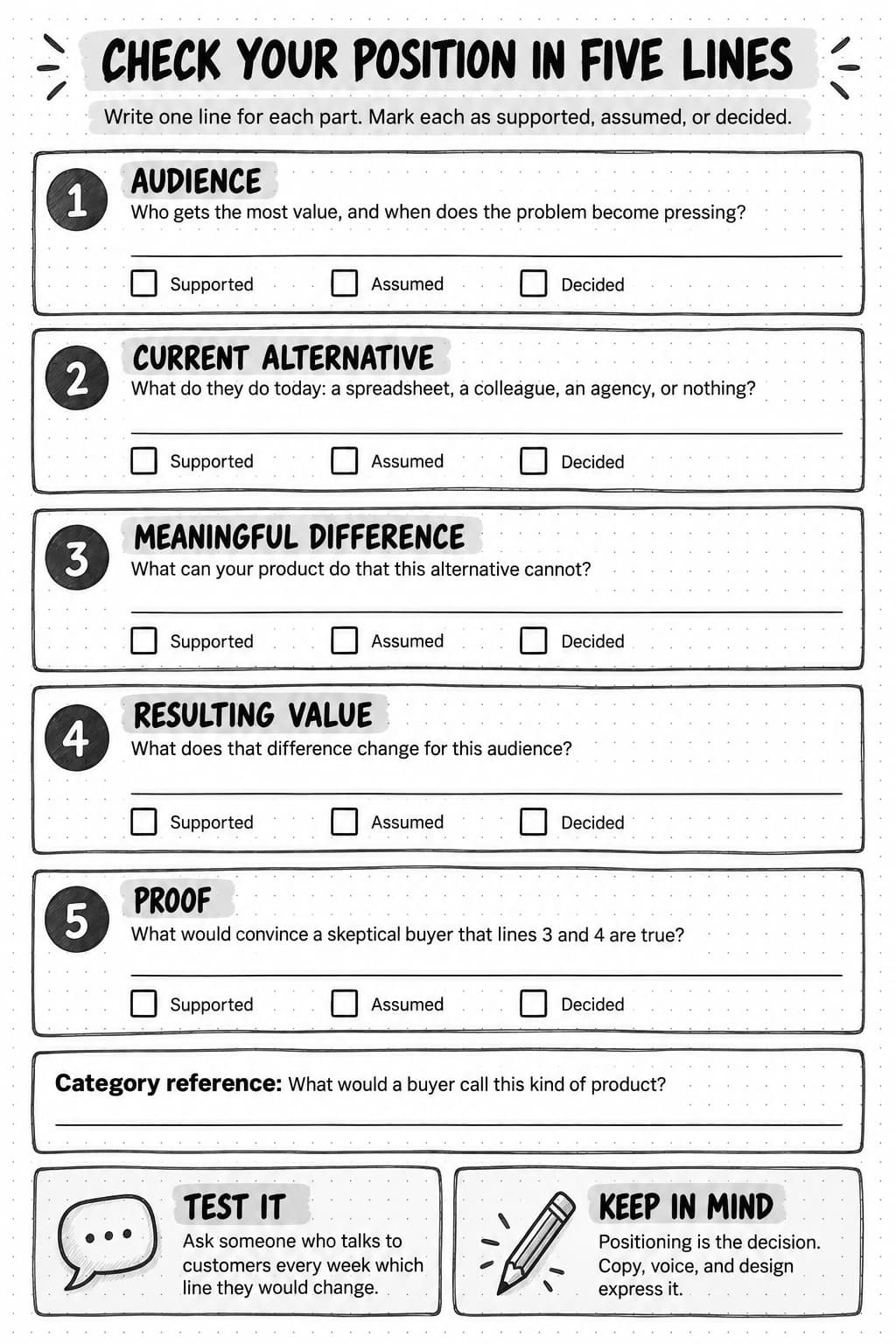
Open the five-line position check worksheet at full size (opens in a new tab)
Sources and further reading
- Jack Trout: “Positioning” is a game people play in today’s me-too market place, Industrial Marketing (1969), reproduced by Innis Maggiore
- Ries: The history of positioning
- Kevin Lane Keller, Brian Sternthal, and Alice M. Tybout: Three questions you need to ask about your brand, Harvard Business Review (2002)
- Jenni Romaniuk, Byron Sharp, and Andrew Ehrenberg: Evidence concerning the importance of perceived brand differentiation, Australasian Marketing Journal (2007)
- April Dunford: A quickstart guide to positioning
- April Dunford: Positioning and competition
- April Dunford: Understanding the job of a market category
- April Dunford: Shifting positioning, why B2B tech is different
- April Dunford: Shifting positioning when AI capabilities are rapidly changing
- First Round Review: “AI-powered” isn’t a position
- Product Marketing Alliance: What is positioning? Market, product, and brand positioning explained
- Retool homepage, December 2019 (Internet Archive) and June 2023 (Internet Archive)
- Retool: Ship vibe-coded apps to production, by David Hsu and the Retool homepage, checked October 4, 2026
- Gong homepage, December 2018 (Internet Archive), June 2020 (Internet Archive), and January 2026 (Internet Archive)
- Gong: Gong charts new future for sales leaders, launches Revenue Intelligence (2019)
- Gong: What is revenue intelligence? Why Gong pioneered the category in 2019
- Intercom homepage, June 2019 (Internet Archive), June 2022 (Internet Archive), and September 2024 (Internet Archive)
- Eoghan McCabe: Today Intercom becomes Fin
- Salesforce: Salesforce completes acquisition of Fin
Frequently Asked Questions
What are the key elements of brand positioning?
Brand positioning has five connected elements: the audience and the situation that makes their problem pressing, the alternatives they would otherwise use, the differentiated value the offer creates compared with those alternatives, the evidence that makes that value believable, and the market context, including the category buyers use to understand the offer. A difference only counts relative to an alternative for a particular audience, so changing one element usually means changing the others.
How does product positioning differ from brand positioning?
Product positioning decides how one product or offer should be understood: which buyers it is for, what it replaces, what it does better, and which category it belongs to. Brand positioning makes the same decision for the whole company and what buyers should expect from anything carrying its name. In an early-stage B2B company with one product, the two are nearly the same decision. They diverge when a company sells several products or serves segments with different needs.
What is the difference between brand positioning and brand perception?
Brand positioning is the position a company intends buyers to hold. Brand perception is what buyers actually believe, assembled from colleagues, search results, review sites, sales conversations, trials, and AI assistants as well as the company's own copy. A gap between the two is evidence: the intended position may not be visible where buyers form impressions, may not seem relevant or believable, or may promise something the product does not yet do.
What is the difference between brand positioning and a value proposition?
Brand positioning sets the context in which an offer is the best choice: the audience, the alternative, the difference, and the category. A value proposition states, within that context, the useful value the offer creates for that audience and how. Because the position decides which value comes first, one product can support different value propositions under different positions, as the guide's fictional security-questionnaire example shows.
How does brand positioning differ from a brand's identity and messaging?
Brand positioning is the decision about which buyers an offer is for, what it competes with, and why it is the better choice. Messaging, brand voice, and visual identity express that decision: messaging records the claims and proof a company repeats, voice governs how it sounds, and visual identity governs how it looks. All three can be excellent while the position beneath them is wrong, so settle the positioning decision first.
What are some examples of brand positioning strategies?
Three B2B companies show different positioning choices. Retool's homepage long compared it with engineers building internal tools by hand, then shifted toward deploying AI-generated apps safely once that alternative changed. Gong moved its category label from conversation intelligence to revenue intelligence to Revenue AI. Intercom renamed the company Fin, arguing that its old name kept an outdated position in buyers' minds. These show what the companies communicated, not why they chose it or whether it worked.
How do I create a strong brand positioning statement?
Write a brand positioning statement after making the positioning decisions, as a summary of them. A common format, popularized by Geoffrey Moore, names the target customer and their need, the product's category and key benefit, the primary alternative, and the main difference. Starting with the template can make a team feel finished before it has studied customers and alternatives. Use the statement to brief and review work, not as public copy.
How can I differentiate my brand in a crowded market?
To differentiate a brand in a crowded market, start with the alternative buyers actually use, which is often a spreadsheet, a colleague, an agency, or doing nothing, rather than a rival's feature list. Find a capability that alternative lacks, explain what it makes possible for a specific audience, and support it with evidence buyers can check. A claim every competitor can make, such as being AI-powered, describes how a product is built, not why to choose it.
What is a brand positioning map?
A brand positioning map plots offers on two axes to show where each sits relative to the others. It is useful only when the axes are criteria buyers use to choose, drawn from interviews and lost-deal reasons, and every placement rests on evidence anyone can check, such as pricing pages, documentation, or product tests. A map whose axes put your product alone in the best corner records the team's self-image, not the market.
How do I measure whether my brand positioning is working?
Measure brand positioning by comparing the intended position with evidence from buyers. Look at which customers get value fastest, stay, and renew; which alternatives prospects mention when they choose or reject you; how buyers describe the product on first calls; and how review sites, search results, and AI assistants categorize it. Warning signs include frequent losses to no decision, unexpected comparisons, and customers praising a capability you barely mention.