How to build a content marketing strategy for B2B SaaS and AI companies
Turn scattered articles, campaigns, product news, and search ideas into a focused system for earning attention, helping buyers, supporting adoption, and learning what to improve.
30 min readWritten by Ampere
Contents
- Start with the business change content should help create
- Define the audience through buying situations and roles
- Build an evidence base before choosing themes
- Choose a point of view and subjects the company has earned
- Build a portfolio that helps buyers make decisions
- Prioritize opportunities with explicit judgment
- Plan distribution and the next useful action together
- Give contributors clear ownership and review responsibilities
- Write the strategy on one page
- Use the first 90 days to build and test the system
- Measure discovery, buyer progress, and business outcomes
- Review the strategy and maintain the library
- Make the next content decision explainable
- Sources and further reading
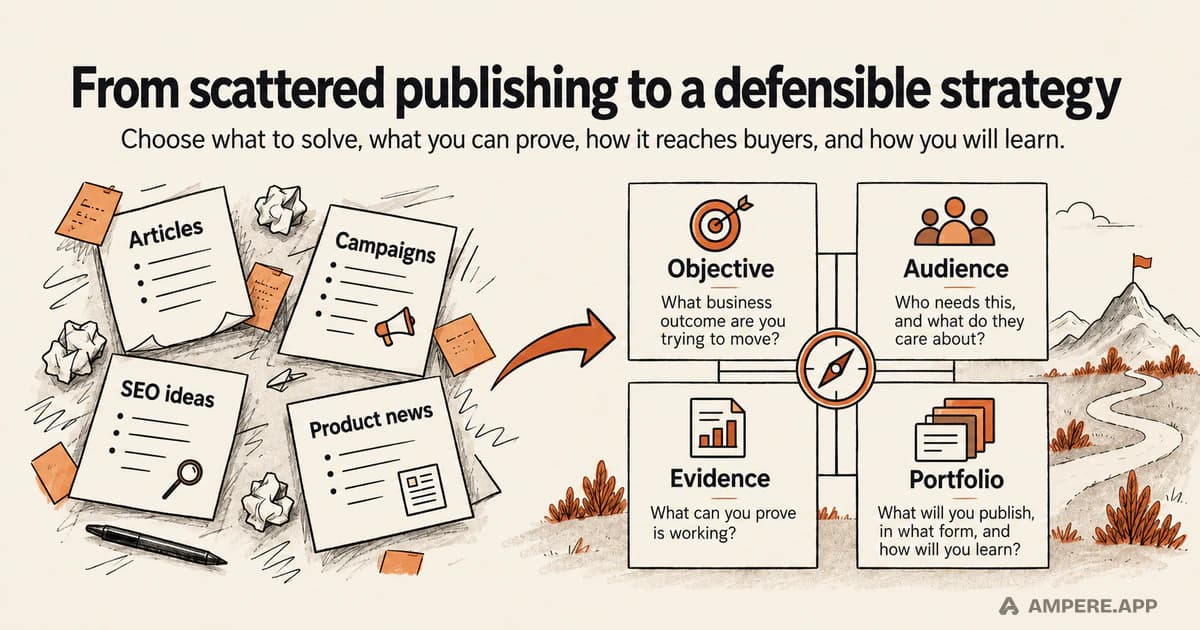
A content program often begins with sensible work: a founder has an argument to make, sales needs a comparison page, product has a launch coming, and search research reveals questions the company could answer. Each request may be worthwhile. Deciding which ones deserve time and budget requires agreement on the audience and business objective they should serve.
A content marketing strategy is the set of decisions that connects a business objective to a defined audience, a useful point of view, a portfolio of subjects and formats, a distribution system, appropriate next actions, and a way to learn. It explains what the company will concentrate on, why those choices are credible, and what it will leave out for now.
An editorial calendar is where that strategy becomes scheduled work. An SEO strategy governs organic-search opportunity and technical discoverability. A campaign plan coordinates a time-bound push. A content plan may list assets, owners, and deadlines. All can support the strategy; none replaces the decisions underneath it.
This guide follows SignalDesk, a fictional B2B AI company, as it makes those decisions: from reviewing a scattered content inventory to choosing its first subject, writing a one-page strategy, and evaluating the first 90 days. SignalDesk and all of its numbers are invented for teaching. Adapt the method to your company’s buying process and resources; the example’s pace and results are not benchmarks.
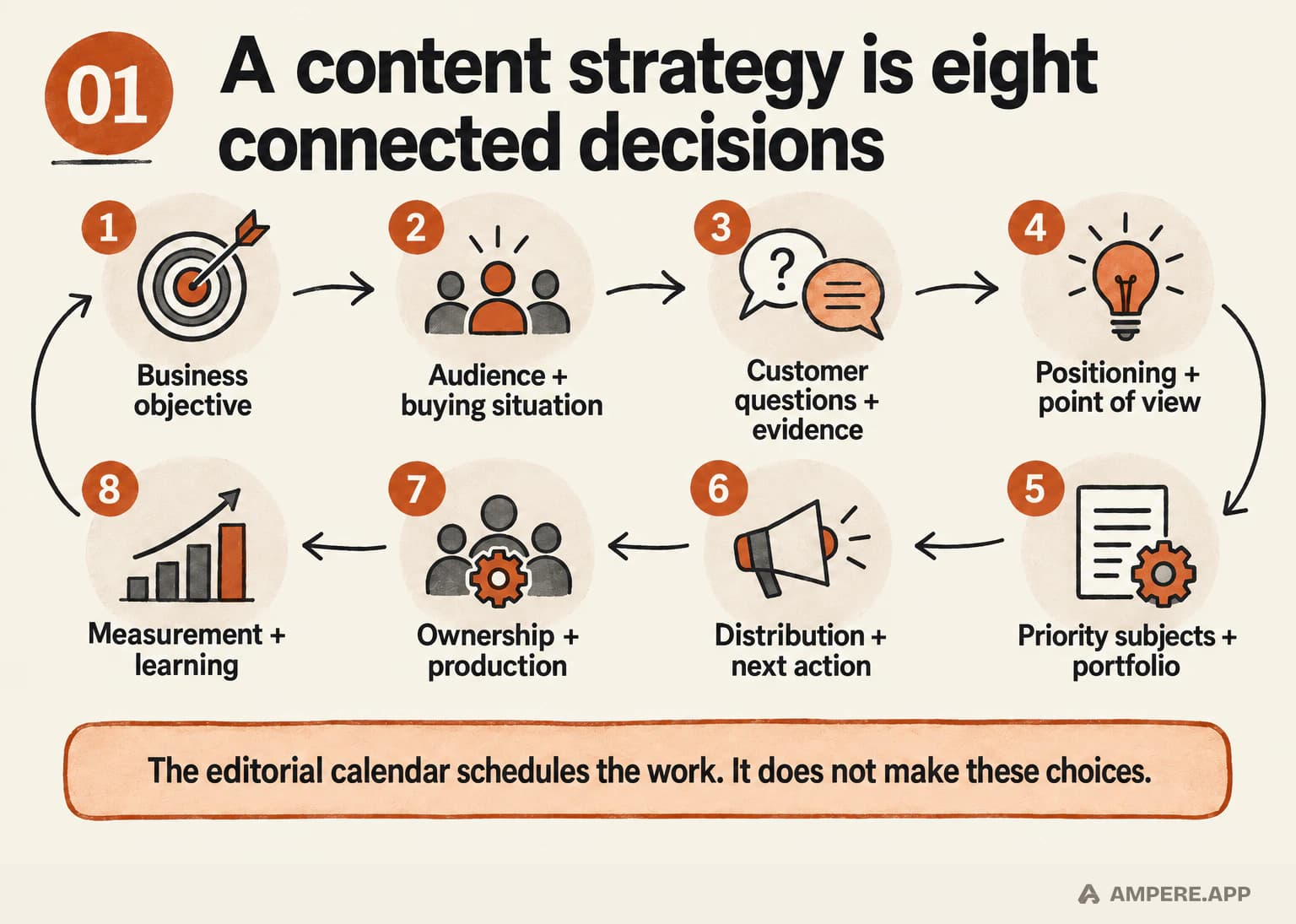
View the eight strategy decisions at full size (opens in a new tab).
Start with the business change content should help create
“Grow awareness” is too broad to guide a portfolio. “Generate pipeline” skips the work content can realistically do before an opportunity exists. A useful objective names the business change, the audience or situation involved, the period in which the team expects to learn, and content’s plausible contribution.
Content can help a B2B SaaS or AI company:
- Teach a category that buyers do not yet understand
- Create qualified discovery among a defined market
- Help a buying group evaluate options and reduce uncertainty
- Make a complex product or use case easier to understand
- Help new users reach value or existing customers adopt more of the product
- Give sales, customer success, partners, and executives credible material for conversations
- Build a distinct, defensible view of an important problem
Choose one primary objective for the strategy period. Other benefits may follow, but they should not all become equal goals. A company trying to establish a new category will make different investments from one whose immediate constraint is security review late in the sales process.
Why B2B SaaS changes the content problem
Recurring revenue means the job continues after acquisition. Content may help a prospect discover the problem, a user learn the product, a champion build internal support, and a customer adopt another use case. Product changes can also make an otherwise strong article stale.
The buying motion matters just as much. A self-serve product may let a user test the promise before speaking with anyone. A sales-led product may require weeks of technical, commercial, security, privacy, legal, and implementation review. Many companies combine the two: individual users begin in the product, while a broader buying group becomes involved when the account expands.
Current buyer research supports planning for this mixed behavior, though no survey describes every market. Gartner’s 2025 release reports that 61% of 632 B2B buyers surveyed in August and September 2024 preferred an overall rep-free experience, while the same respondents preferred seller input for contextual questions such as whether an offering fits their company. For content planning, this suggests making general learning self-directed while giving buyers access to a salesperson when they need help applying that information to their own circumstances.
AI companies carry an additional proof burden
An AI company may need to explain a capability the buyer has no stable category for, while the underlying product and model behavior continue to change. A fluent product description is therefore weak evidence. Buyers may need to see the task performed, understand the test conditions, inspect limitations, and evaluate security, privacy, reliability, governance, and operational fit.
OpenAI and Anthropic publish system cards that describe capabilities, evaluations, risks, and deployment decisions. A company selling an AI support product might cover those questions in an evaluation guide, a demonstration, and a security brief. The format should suit the buyer, with enough detail to understand how performance was assessed and where the findings apply.
Keep four kinds of statement separate:
| Statement type | What it needs |
|---|---|
| Demonstrated capability | A current product demonstration or reproducible test with conditions |
| Measured performance | A defined dataset, method, comparator, date, and limitations |
| Planned feature | Clear roadmap language, never present-tense availability |
| Category belief or aspiration | Attribution to the company’s point of view, not presentation as an observed fact |
SignalDesk chooses one objective
SignalDesk is a fictional B2B AI platform that helps customer-support organizations evaluate AI-generated answers before and after deployment. It imports approved knowledge, runs test conversations, groups failure patterns, and lets reviewers trace an evaluation result back to the source and test case.
Its product has a self-serve sandbox, but larger purchases are sales-led. A support operations lead usually champions the evaluation. An AI or automation lead tests the workflow. Security and privacy reviewers examine data handling. A VP of Support or COO owns the economic decision. Implementation requires knowledge owners and support managers.
The company has 34 articles, six launch posts, three webinars, two customer stories, and a useful help center. Most marketing articles are product announcements or broad explanations of AI customer service. Organic visits are growing, but sales still sends one-off documents to answer evaluation questions.
SignalDesk’s primary six-month content objective is:
Help support leaders at mid-market software companies move from general interest in AI support to a credible evaluation plan, increasing qualified evaluation starts and giving champions material they can share with technical, security, and executive reviewers.
For someone beginning their research, useful content might help them draft an evaluation plan. During a live pilot, it might help a champion answer a security reviewer’s questions. Both contribute to this objective, even when the reader’s next step happens without contacting sales.
Define the audience through buying situations and roles
An ideal customer profile, buyer role, buying situation, customer problem, search intent, and journey stage describe different things:
| Lens | The question it answers | SignalDesk example |
|---|---|---|
| Ideal customer profile | Which organizations are most likely to benefit and succeed? | B2B software companies with a substantial support volume, maintained knowledge, and an active AI-support initiative |
| Buyer role | Who participates, and what responsibility do they carry? | Support leader, AI evaluator, security reviewer, economic buyer, knowledge owner |
| Buying situation | What has changed enough to create attention or action? | The team is preparing a pilot after a leadership mandate to improve support efficiency |
| Customer problem | What progress is difficult today? | The team cannot tell whether plausible AI answers are accurate, safe, and grounded at scale |
| Search intent | What is a person trying to learn or do through a search? | Learn how to evaluate an AI support agent; compare evaluation approaches; find a checklist |
| Journey stage | What broad decision state are they in? | Learning, evaluating, implementing, or expanding |
The lenses can overlap without forming a neat funnel. A security lead may discover SignalDesk during a live deal, then read an introductory explanation. A support leader may use an evaluation template before the organization has approved a project. One practical guide can help a champion plan the evaluation, give a technical reviewer a method to inspect, and give an executive a clearer picture of risk. Do not create three near-identical pages simply because three roles may read them.
Define the audience at two levels. First, describe the organizations and situations the strategy will favor. Then map the people who influence progress in those situations: what each person needs to decide, what evidence they trust, and what could stop them.
SignalDesk focuses on companies preparing to evaluate AI-generated support answers and needing agreement on what good, safe performance means. The support leader needs a plan they can bring to colleagues, while the evaluator needs test design and traceability. Security reviewers will ask about data handling; the executive needs a credible case for value and risk. These responsibilities give the content team specific questions to answer across the buying group.
Treat generated personas and AI-written audience summaries as hypotheses. They can organize known information or expose missing fields, but they do not become customer evidence until supported by interviews, observed behavior, market data, or other direct sources.
Build an evidence base before choosing themes
Record the evidence behind each strategic choice so colleagues can inspect the reasoning and challenge it. Keep the source types distinct: an interview can explain why a buyer hesitated, while product usage can show where users stopped.
Listen for decisions, questions, and language
Customer interviews are strongest when they reconstruct a recent situation: what changed, which alternatives appeared, what caused uncertainty, and how the group reached a decision. Sales conversations show live objections and the material champions request. Support and customer-success conversations reveal implementation friction, recurring misunderstandings, and adoption gaps. Win/loss work can show how criteria and internal agreement affected an outcome, provided the sample and collection method are recorded.
Product usage shows behavior inside the product. Search Console shows how pages from your site appeared and received clicks in Google Search. Third-party keyword tools estimate search behavior under their own datasets and methods. Autocomplete and related questions reveal phrases a search system associates with a query. Community discussions reveal how some participants describe problems in that community. These sources can reinforce or challenge one another, but they should not be collapsed into a fictional measure of demand.
Use competitor research to understand category conventions, claim patterns, evidence gaps, and questions already answered poorly. Assess whether your audience needs a better answer and whether you can provide one. Publication alone tells you nothing about the competitor’s qualified readership or sales results. Our competitor analysis guide shows how to keep observation, interpretation, and decision separate.
Audit the material you already own
Review current articles, reports, webinars, product pages, customer proof, sales documents, help content, and in-product education. For each item, record:
- The audience question and business job it serves
- Its current accuracy and evidence
- Discovery, engagement, conversion, sales-use, and product-use signals where available
- Overlap with other assets
- Whether it should be kept, refreshed, consolidated, redirected, repurposed, or retired
Traffic alone should not decide. A high-traffic article may attract students or consumers who will never use the product. A low-traffic security explainer may repeatedly unblock valuable evaluations. Conversely, “sales likes it” is not enough unless the team can identify who used the material, in what situation, and what happened next.
SignalDesk’s evidence pack
For the fictional example, SignalDesk assembles:
- Eight interviews with recent champions, including two lost evaluations
- Themes from 120 tagged sales-call moments, with links back to recordings
- Questions from security reviews and implementation handoffs
- Aggregated, privacy-safe product usage showing where evaluators abandon test setup
- Search Console query and page data for existing content
- Directional keyword estimates from one named tool, recorded with market and capture date
- Community discussions about AI-support evaluation, preserved as qualitative examples
- A competitor inventory that records what is published without claiming performance
- Product and legal review of what SignalDesk can demonstrate and claim now
Across these sources, evaluation planning comes up repeatedly. Teams need a credible way to design tests, agree on failure categories, involve reviewers, and judge results. SignalDesk can investigate that subject further using the questions and examples in its evidence pack.
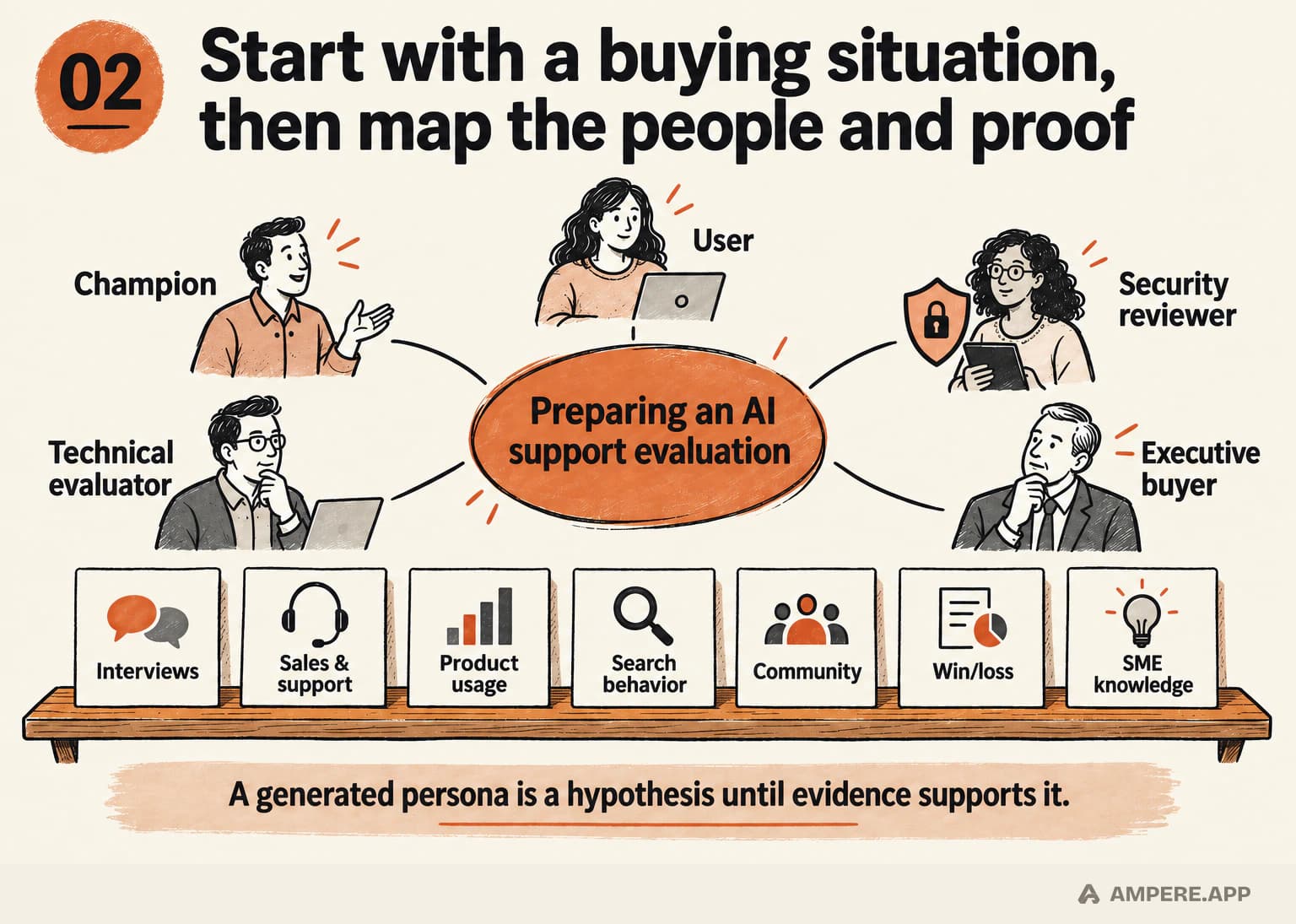
View the buying-group and evidence infographic at full size (opens in a new tab).
Choose a point of view and subjects the company has earned
A subject belongs in the strategy when four things meet: the audience has an important question; the answer matters to the business; the company has useful evidence or expertise; and the company can add something more useful than a summary of existing pages.
That “right to discuss” can come from product data, repeated customer work, a distinctive method, technical expertise, original research, implementation experience, or a well-supported interpretation of public evidence.
A point of view is the company’s reasoned stance on how the audience should understand or approach that problem. It should affect choices. SignalDesk’s point of view is:
A useful AI-support evaluation tests representative work, traces every judgment to evidence, and sets review thresholds before the pilot. A polished demo or one aggregate accuracy score cannot show operational fit.
That view gives the company something coherent to teach. It also sets claim boundaries: SignalDesk can demonstrate its evaluation workflow and discuss what its own product records. It cannot claim that its method guarantees a safe deployment, that one score captures support quality, or that every company needs the same thresholds.
Positioning, messaging, voice, evidence, and content strategy have separate jobs
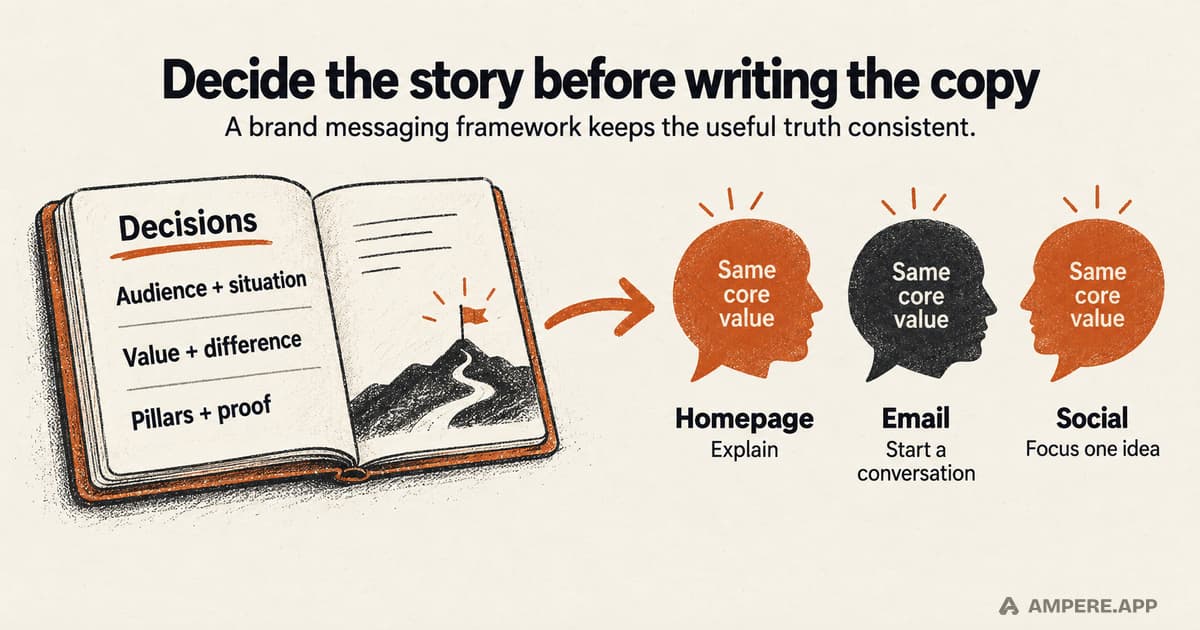
Positioning decides the market context in which the product has its strongest value. A brand messaging framework turns that position into messages and proof. A brand voice guide governs how the company sounds. Product evidence supports specific claims. Content strategy chooses which audience questions and subjects deserve sustained investment, how they will be distributed, and how the company will learn.
Use these documents together when briefing and reviewing content. Repeated buyer confusion about a central claim may call for a messaging review. A product change may require new evidence and revisions to affected articles. Keeping those responsibilities clear lets the content strategy stay focused on investment choices without duplicating the messaging or voice guide.
Build a portfolio that helps buyers make decisions
The right portfolio depends on the objective and buying motion. A useful mix may include:
- Education: clear explanations, methods, guides, and templates that help someone understand or perform the work
- Original evidence: research, benchmarks, experiments, and field observations with transparent methods
- Product and use-case education: demonstrations, workflows, release explanations, and implementation guidance
- Thought leadership: a substantiated view that changes how an audience understands a consequential problem
- Evaluation: comparisons, buyer guides, security and privacy explanations, technical documentation, and decision tools
- Customer proof: cases, examples, quotations, and artifacts with permission and enough context to judge relevance
- Action assets: templates, calculators, checklists, diagnostic tools, workshops, or product experiences that help someone do the next piece of work
- Timely product-led material: launches and commentary tied to a durable customer question rather than news for its own sake
The portfolio should not assign every format an equal quota. If buyers understand the category but repeatedly stall at implementation, another broad explainer may be less useful than a migration guide, technical workshop, or proof-rich customer story. A company introducing an unfamiliar AI capability may need more demonstration and evaluation material than a familiar SaaS category does.
When a topic cluster helps
A topic cluster is useful when several distinct questions belong to the same customer problem and the company can answer each one substantially. It becomes artificial when a keyword list is split into near-duplicate pages for every role, funnel label, or wording variation.
SignalDesk builds one cluster around evaluating an AI support agent before rollout:
| Asset | Reader’s job | Distinct contribution | Appropriate next action |
|---|---|---|---|
| Practical guide | Understand the complete evaluation method | Defines representative tests, failure categories, reviewers, thresholds, and decision rules | Copy the evaluation brief |
| Failure-mode field guide | Recognize what can go wrong | Shows groundedness, policy, tone, escalation, and source-quality failures with examples | Use the review rubric |
| Security and privacy brief | Complete internal risk review | Answers data-flow, retention, access, and review questions within approved claim boundaries | Share with security or contact the team |
| Interactive evaluation template | Plan a real pilot | Turns the method into test cases, owners, thresholds, and evidence fields | Save the template or start in the sandbox |
| Product demonstration | See the method in practice | Runs a representative test and traces the result to its source | Try the sandbox or request a tailored evaluation |
| Customer story | Judge relevance and operational fit | Shows one customer’s context, evaluation process, limits, and observed outcome | Read the implementation notes |
| Live clinic and recap | Apply the method to edge cases | Lets practitioners bring difficult examples; the recap preserves useful answers | Join a future clinic or use the template |
Each asset answers a different need within the same evaluation. The main guide explains the method, and readers who need help classifying failures can continue to the field guide. A champion can share the security brief with a specialist reviewer, use the template to plan the pilot, and consult the demonstration and customer story to judge how the approach works in practice.
Prioritize opportunities with explicit judgment
Compare ideas using a small set of criteria, with the reasoning written beside each rating. The ratings reflect the team’s judgment, so discuss where reviewers disagree before selecting an opportunity. SignalDesk compares four plausible opportunities on a three-level scale: strong, mixed, or weak.
| Opportunity | Audience relevance | Product and commercial relevance | Evidence and differentiation | Distribution and durability | Cost | Judgment |
|---|---|---|---|---|---|---|
| Complete AI-support evaluation guide and template | Strong: repeated across interviews and sales | Strong: directly precedes a qualified evaluation | Strong: product workflow, expert method, and real questions available | Strong: search, sales, community, webinar, and partner uses; likely durable | High | Select as the anchor because it addresses the central decision and can support several follow-on assets |
| “50 AI customer-service statistics” roundup | Mixed: broad interest, little evidence of evaluator need | Weak: distant from the product’s strongest value | Weak: depends on third-party surveys and offers little proprietary insight | Mixed: potentially searchable, but expensive to keep current | Medium | Reject; likely traffic without a clear audience or proof advantage |
| Security FAQ for AI-support evaluation | Strong for active evaluations | Strong: repeated late-stage blocker | Strong: approved product and policy evidence exists | Mixed: valuable in sales and search, narrower discovery | Medium | Build early, but after the anchor establishes the evaluation context |
| Commentary on a major model release | Mixed: timely interest among evaluators | Mixed: relevant only if SignalDesk can show a material workflow effect | Mixed: a reproducible test is possible, but release details may change | Strong short-term distribution, weak durability | High and urgent | Hold until the company has a test worth publishing; do not manufacture a take to meet the news cycle |
SignalDesk selects the evaluation guide and template because buyers repeatedly ask for help planning an evaluation, and the company already has a workflow and expert method it can show. Sales, communities, and partners also offer ways to put the guide in front of those buyers. The team accepts the higher production cost on that basis. The security FAQ follows early because it resolves a narrower question within the evaluation the guide helps readers plan.
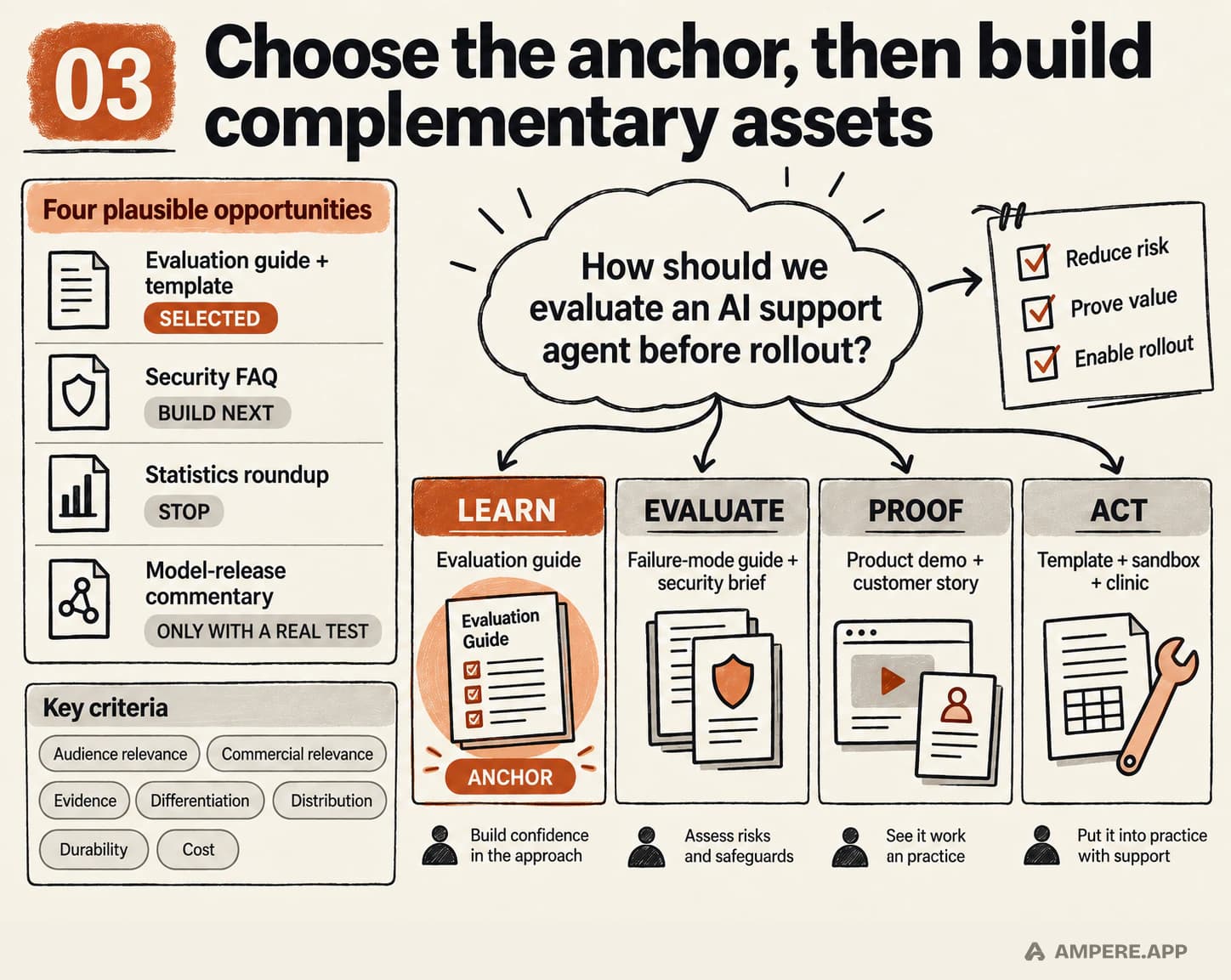
View the worked prioritization and portfolio example at full size (opens in a new tab).
Search volume estimates can inform the distribution case, but they do not establish buyer quality, business value, or ranking feasibility. Record the provider, query, market, date, and metric definition. A high-volume subject can still be a poor choice when it attracts the wrong audience or sits far from any problem the product can credibly help solve.
Plan distribution and the next useful action together
Distribution is part of the strategy because it changes what is worth making. If the audience learns through practitioner communities and sales conversations, the work should be easy to discuss and share there. If the product has a natural education surface, a guide or template may belong inside onboarding. If search is important, the answer should be clear, crawlable, internally connected, and supported by original value.
Google’s current guidance for both traditional and generative search emphasizes useful, reliable, people-first material and warns against producing separate pages for every possible query variation. Clear authorship, first-hand expertise, original analysis, accurate metadata, and satisfying answers are sound publishing practice. They do not guarantee rankings or inclusion in an AI-generated answer.
For every major asset, write a distribution brief before production:
- Where can the intended audience reasonably encounter it?
- Who can carry it: subject-matter experts, executives, customers, partners, sales, or community members?
- Which smaller expressions preserve the argument for newsletters, social posts, events, and sales follow-up?
- Can a product or customer-success surface place it at the moment of need?
- What deserves paid amplification, if anything?
- What is the next useful action for this reader now?
Choose the next action according to what the reader is trying to do. Someone learning the method might copy a template, subscribe to a research series, read a technical explanation, watch a demonstration, or try a self-serve workflow. Someone coordinating an active evaluation may want a security brief or a conversation. An existing customer may need an implementation guide. Offer a demo where a product conversation would help the reader make progress.
SignalDesk gives the anchor guide four paths: copy the evaluation template; inspect the failure-mode guide; run a sample in the sandbox; or request a tailored evaluation when a buying group is ready. Sales uses the same guide in follow-up. A support-operations community discussion leads with the method rather than a product pitch. The newsletter carries one practical section and a link to the full tool. A product checklist links to the guide when an evaluator is defining thresholds.
Give contributors clear ownership and review responsibilities
Name the person or group responsible for the objective, audience choices, themes, portfolio, and review cycle. For individual assets, assign an editor who can resolve tradeoffs and move the work forward, drawing on contributors’ expertise where needed.
Subject-matter experts supply experience, evidence, technical interpretation, and review of material claims. Marketers turn that expertise into an audience-relevant argument and distribution plan. Editors protect coherence and standards. Designers make explanations easier to grasp. Product and legal specialists review only the claims and boundaries that require them. Sales contributes questions, field use, and feedback. Executives help set the point of view and distribute ideas where their authority is useful.
A simple review path is usually enough:
- Approve the brief: audience, question, argument, evidence, boundaries, distribution, and next action.
- Review specialist claims in the draft with named reviewers and a deadline.
- Give one editor final authority over structure and prose.
- Verify links, evidence, product accuracy, accessibility, and conversion paths before release.
Limit each reviewer’s approval to the decisions they own. A security reviewer should be able to hold an unsupported data-handling claim for correction; the editor should resolve a disagreement about paragraph order. Define those boundaries in the brief so contributors know when their input is required and who settles a disagreement.
Where AI marketing agents help
An AI marketing agent can help with research and production: gather public sources, organize interview notes, compare existing assets, propose briefs, draft from approved evidence, create channel adaptations, and flag pages whose claims or links may be stale. It can also help maintain a source log or repurpose a reviewed argument.
The accountable person still decides which audience matters, whether a pattern is meaningful, which claim the evidence supports, and whether the work is ready. AI-generated topic lists, personas, summaries, and drafts are not customer evidence. Give the agent the sources, authority, and definition of done; our guide to briefing an AI marketing agent provides a practical structure. If the work becomes repeatable, the AI marketing automation guide explains where scheduled execution helps and where judgment should remain explicit.
Write the strategy on one page
SignalDesk’s completed one-page strategy keeps durable decisions separate from the editorial calendar.
SignalDesk content marketing strategy
| Decision | Choice |
|---|---|
| Business objective | Help mid-market software support teams move from broad AI interest to a credible evaluation plan; increase qualified evaluation starts and help champions align technical, security, and executive reviewers over six months |
| Strategic constraints | Category language is unstable; product changes quickly; no universal accuracy benchmark; security claims require review; self-serve and sales-led paths coexist |
| Priority organizations and situations | B2B software companies with meaningful support volume, maintained knowledge, and an active plan to evaluate AI-generated support answers |
| Priority people and decisions | Support leader designs the pilot; AI/automation lead tests quality; security and privacy review data handling; executive judges value and risk; knowledge owners prepare implementation |
| Central customer questions | How should we test representative work? What failure types matter? What evidence should we retain? Who reviews what? How do we set thresholds? How do we judge operational fit? |
| Point of view | Evaluate representative work, trace judgments to evidence, and agree on thresholds before the pilot; a polished demo or one aggregate score is insufficient |
| Claim boundaries | Demonstrate current SignalDesk workflows and documented behavior; do not promise safe deployment, universal thresholds, or business outcomes the company has not measured |
| Strategic themes | Evaluation design; evidence and traceability; operational trust; implementation and knowledge quality |
| Portfolio | Anchor evaluation guide and template; failure-mode field guide; security brief; product demonstration; proof-rich customer story; live clinic and recap; relevant product updates |
| Distribution | Organic search; expert and company LinkedIn; email; support-operations communities; partners; sales follow-up; product evaluation checklist; live clinic |
| Conversion paths | Copy template; read specialist guidance; subscribe; try sample evaluation; share security brief; request tailored evaluation when ready |
| Ownership | Head of Content owns strategy and editorial decision; Head of Support AI supplies subject expertise; Product and Security review their claim areas; Demand Gen owns distribution; Sales Enablement records field use |
| Measurement | Discovery and engagement by intended problem; returning qualified audience; template use and evaluation starts; sales use and opportunity progression; pilot completion and activation where relevant; qualified pipeline as a lagging, non-exclusive outcome |
| Review rhythm | Monthly evidence check for execution; quarterly strategy review; immediate review after material product, policy, market, or search change |
Copyable content marketing strategy template
Copy this into a working document to record the strategic decisions. Use the editorial calendar for dates, individual asset titles, production status, and weekly channel tasks.
BUSINESS OBJECTIVE
What business change should content help create, for whom, and over what learning period?

STRATEGIC CONSTRAINTS
Which product, market, evidence, regulatory, budget, or operating realities limit the choices?

PRIORITY ORGANIZATIONS AND BUYING SITUATIONS
Which organizations are a strong fit? What has changed when the content becomes relevant?

BUYER ROLES AND DECISIONS
Who uses, champions, evaluates, approves, reviews risk, implements, or expands the product? What must each person decide?

CUSTOMER QUESTIONS AND EVIDENCE
Which important questions recur? Which interviews, conversations, behavior, search signals, community discussions, market sources, and expertise support them? Keep the source types separate.

POSITIONING, POINT OF VIEW, AND CLAIM BOUNDARIES
Which positioning and messages must the content express? What does the company believe about the problem? What can it demonstrate now? What must it not imply?

PRIORITY SUBJECTS AND PORTFOLIO
Which three to five subjects deserve sustained investment? Which complementary educational, evaluation, proof, product, and action assets will serve them?

DISTRIBUTION AND CONVERSION PATHS
Where will the intended audience encounter the work? Who can carry it? What next actions fit different levels of readiness?

OWNERSHIP AND PRODUCTION
Who owns the strategy? Who owns each asset? Which experts and reviewers are required, and what decision does each control?

MEASUREMENT AND LEARNING
Which leading, quality, hand-raising, sales-use, customer, product, and lagging business signals will answer the objective? What is the attribution rule? When will the strategy be reviewed?
An editorial calendar can now record the first guide, security brief, webinar, newsletter adaptations, owners, review dates, and distribution tasks. Those entries may change weekly while the strategic choices remain stable enough to coordinate the program.
Use the first 90 days to build and test the system
This plan is illustrative, not a universal publishing benchmark. A company with deeper research requirements, a regulated market, or several business units may need more time. A company with strong existing evidence may move faster.
| Period | Research and decisions | Creation | Distribution and reuse | Measurement and maintenance |
|---|---|---|---|---|
| Days 1–15 | Confirm objective and constraints; interview customers and field teams; map buying situations and roles; audit current content; inventory claims and proof | Write the one-page strategy; brief the anchor asset and template | Interview sales, customer success, partners, community owners, and product-surface owners about real distribution opportunities | Define metric meanings, baselines, CRM association rules, and review ownership |
| Days 16–30 | Validate the anchor question with source evidence; resolve claim gaps; decide what existing material to consolidate | Draft the anchor guide and usable template; outline the security brief | Prepare expert posts, newsletter treatment, sales note, partner pitch, and event concept from the same argument | Instrument template use and evaluation starts; label the pre-launch baseline |
| Days 31–45 | Test the guide with several intended readers and internal users; record confusion rather than soliciting general approval | Revise and publish the anchor; refresh or redirect overlapping pages; produce the first demonstration | Distribute through search-ready publishing, email, expert voices, sales, and selected communities with channel-native framing | Check discoverability, engagement, next-action behavior, qualitative feedback, and broken or misleading paths |
| Days 46–60 | Gather questions from real use; choose the next asset from evidence | Publish the security brief and failure-mode guide; turn webinar questions into an editorial brief | Run the live clinic; equip sales and partners; add contextual product and help-center links where appropriate | Record sales use, stakeholder roles, repeat visits, template use, evaluation starts, and content gaps |
| Days 61–75 | Review which audience and situation is actually appearing; investigate unexpected traffic or objections | Produce a customer proof asset only if evidence and permission are ready; otherwise deepen the demonstration | Repurpose the clinic into a recap, newsletter section, sales snippets, and expert posts without changing the central claim | Refresh changed product details; consolidate weak duplicate pages; compare cohorts rather than only totals |
| Days 76–90 | Conduct the first strategy review using quantitative and qualitative evidence | Improve the anchor and portfolio; commission the next subject only if it survives prioritization | Reallocate distribution effort toward channels producing qualified attention and useful conversations | Decide what to keep, change, investigate, or stop; document attribution limits and the next test |
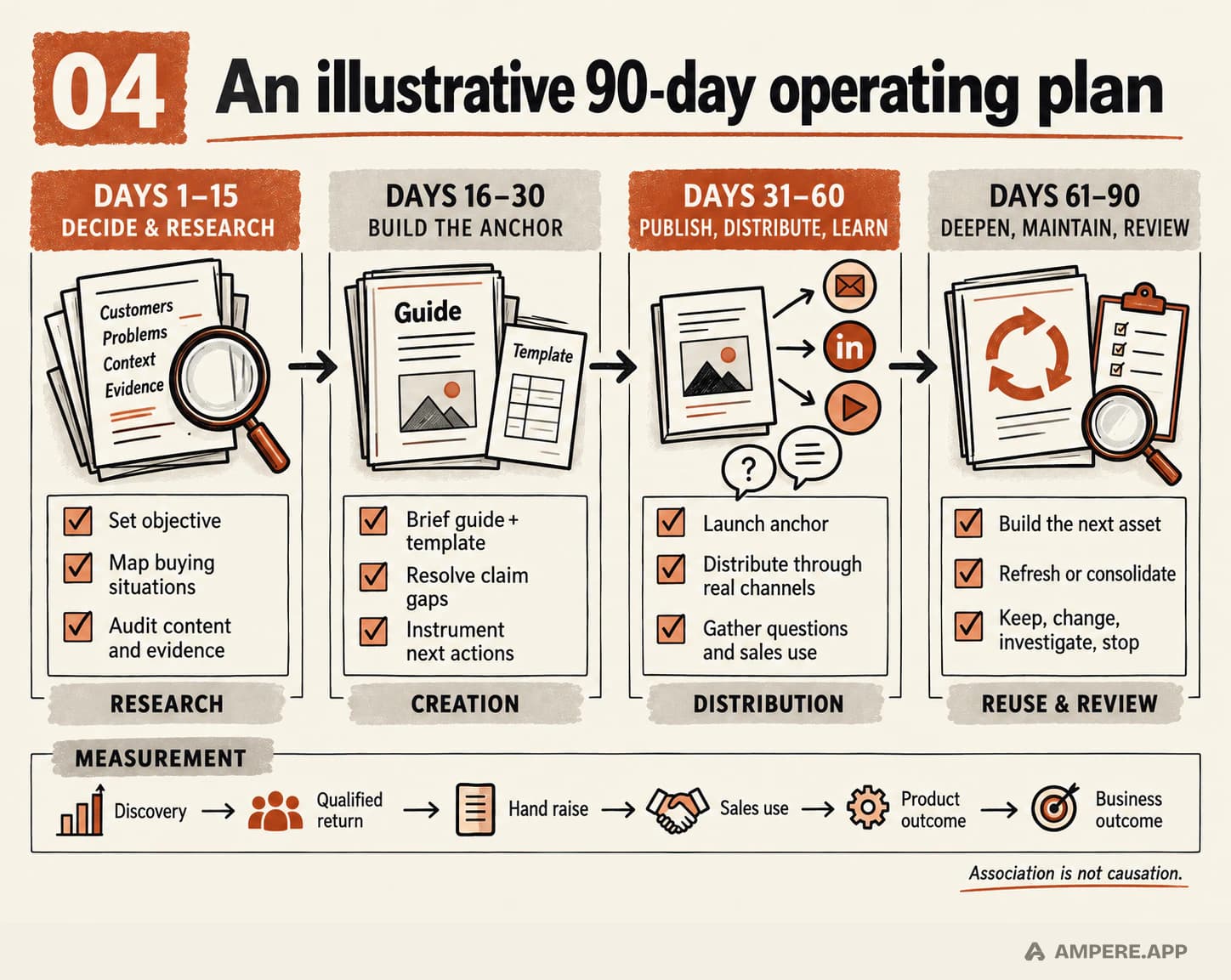
View the illustrative 90-day plan at full size (opens in a new tab).
Set the publishing pace around the time needed to gather evidence, produce useful work, and review it. Reserve capacity for distribution and maintenance after publication; those tasks compete for the same people’s time as the next draft.
Measure discovery, buyer progress, and business outcomes
Long and nonlinear buying makes direct attribution incomplete. Measurement is still possible when each metric is assigned a question it can answer.
| Layer | Examples | What it can support | What it cannot prove |
|---|---|---|---|
| Discovery and engagement | Search impressions and clicks, referral visits, newsletter reach, engaged sessions, completion or interaction where measured | Whether the work is being encountered and used in observable ways | Buyer quality, commercial value, or causation |
| Audience quality and return | Intended job functions or accounts where lawfully known, returning readers, repeat subscribers, related-asset paths, qualitative replies | Whether relevant people or organizations appear to return and deepen attention | That anonymous or inferred identity is correct; that return caused a purchase |
| Hand-raising and conversion | Template copies, event registrations, sandbox starts, newsletter subscriptions, contact requests, demo requests | Which next actions readers take and how readiness differs | That every action is a sales-qualified lead or was caused by one page |
| Sales use and progression | Assets shared by sales, buying-group roles reached, security reviews supported, stage movement after content use, salesperson feedback | Whether content is useful in live evaluations and associated with progression | That content alone caused the opportunity or stage change |
| Customer and product outcomes | Evaluation completion, activation, feature adoption, support deflection, expansion education where relevant | Whether content helps users complete product or customer work | That the content deserves all credit for the outcome |
| Lagging business outcomes | Qualified opportunities, pipeline, wins, expansion, revenue, retention | Whether business outcomes appear alongside the program over a suitable period | A simple causal relationship, especially in a multi-touch buying process |
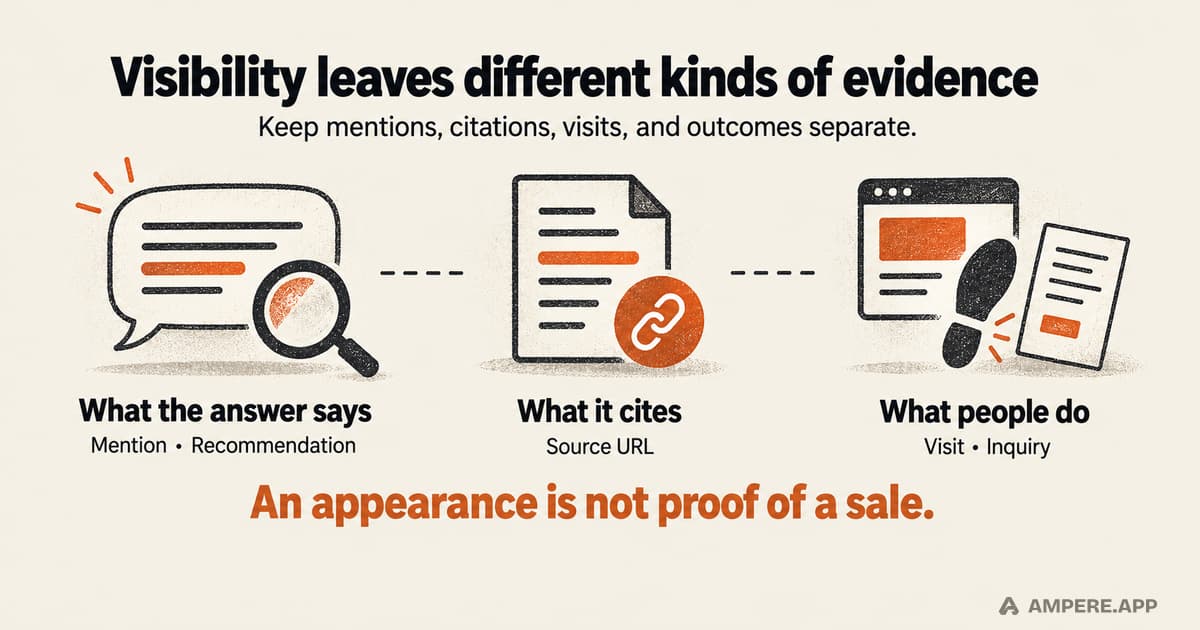
Google Search Console defines impressions, clicks, click-through rate, and average position within Google Search; these are discovery measures, not revenue measures. Google Analytics 4 defines an engaged session as one lasting longer than 10 seconds, containing a key event, or containing at least two page or screen views. That threshold is a product definition, not proof that someone found an article valuable. Configure key events around actions that matter to the business, and document any attribution model and lookback window used.
SignalDesk adopts this content-assisted opportunity rule: an opportunity is “content-assisted” when a known buying-group member engages with a tracked strategic asset during the 90 days before opportunity creation or while the opportunity is open, or when a salesperson records sharing that asset in the opportunity record. The report separates tracked engagement from salesperson-recorded sharing and deduplicates opportunities.
Content-assisted opportunities show an association with content use, without establishing whether the content caused the sale. Direct visits, branded search, forwarded documents, private community exposure, sales conversations, and later conversions can carry influence that analytics cannot connect to one page. Review assisted progression alongside direct conversions, sales feedback, and audience quality to understand what each source of evidence adds or leaves unexplained.
The 2026 Content Marketing Institute study is useful context rather than a universal benchmark. Its report covers 1,015 B2B marketers, mostly in North America, from a global survey fielded June 24–August 14, 2025 and sponsored by Storyblok. Among that respondent group, measurement and creating content that prompts action remained common challenges. The finding supports taking measurement design seriously; it does not supply a target conversion rate or content cadence for SignalDesk.
Review the strategy and maintain the library
Use the strategy review to decide which investments to continue, adjust, investigate, or end. Bring the one-page strategy, new customer and field evidence, portfolio performance, content inventory, product changes, and distribution learning into the same conversation.
At the end of its fictional first 90 days, SignalDesk has the following illustrative evidence:
- The anchor guide earned 4,800 search impressions and 310 clicks. Search Console shows most discovery around evaluation methods rather than generic AI-support terms.
- 94 readers copied the template; 28 started a sample evaluation within 14 days. These are tracked actions, not automatically qualified opportunities.
- Eleven opportunities were content-assisted under SignalDesk’s stated rule. Sales recorded the guide as useful in seven and the security brief in six; several opportunities used both.
- The broad model-release commentary drew the highest social reach of the period but produced few return visits and no observable evaluation actions.
- The live clinic drew 42 registrants from 31 companies. Questions repeatedly concerned knowledge quality and reviewer disagreement, creating evidence for a deeper implementation subject.
- Product analytics shows more evaluators completing test setup after the product checklist began linking to the guide. The team has not run an experiment, so it treats the relationship as a reason to investigate, not proof of causation.
SignalDesk’s first strategy review
| Decision | SignalDesk’s judgment |
|---|---|
| Keep | The evaluation anchor, template, security brief, clinic, sales enablement path, and point of view; together they attract relevant questions and support live evaluations |
| Change | Improve the template’s reviewer-agreement section; give the security brief a clearer path back to the evaluation; shift newsletter space from generic AI news to evaluation practice |
| Investigate | Whether the product checklist improves setup completion; why some template users do not begin an evaluation; whether knowledge-quality content helps implementation as well as acquisition |
| Stop | Routine commentary on model releases unless SignalDesk has a reproducible test or a material customer implication; production cost and short-lived reach did not advance the strategy |
The library changes with the strategy. Refresh pages when product behavior, evidence, terminology, or search context changes. Consolidate pages that answer the same question, keeping the strongest explanation and redirecting retired URLs when appropriate. Repurpose durable arguments into channel-native forms while preserving their evidence. Retire material that is inaccurate, unhelpful, or no longer aligned, even if it once received traffic.
Google explicitly advises against adding or removing large amounts of content merely to make a site seem fresh. Maintenance should improve accuracy, usefulness, and coherence. For AI products, set a tighter review trigger for capability claims, model references, security statements, and technical instructions because those facts can change quickly.
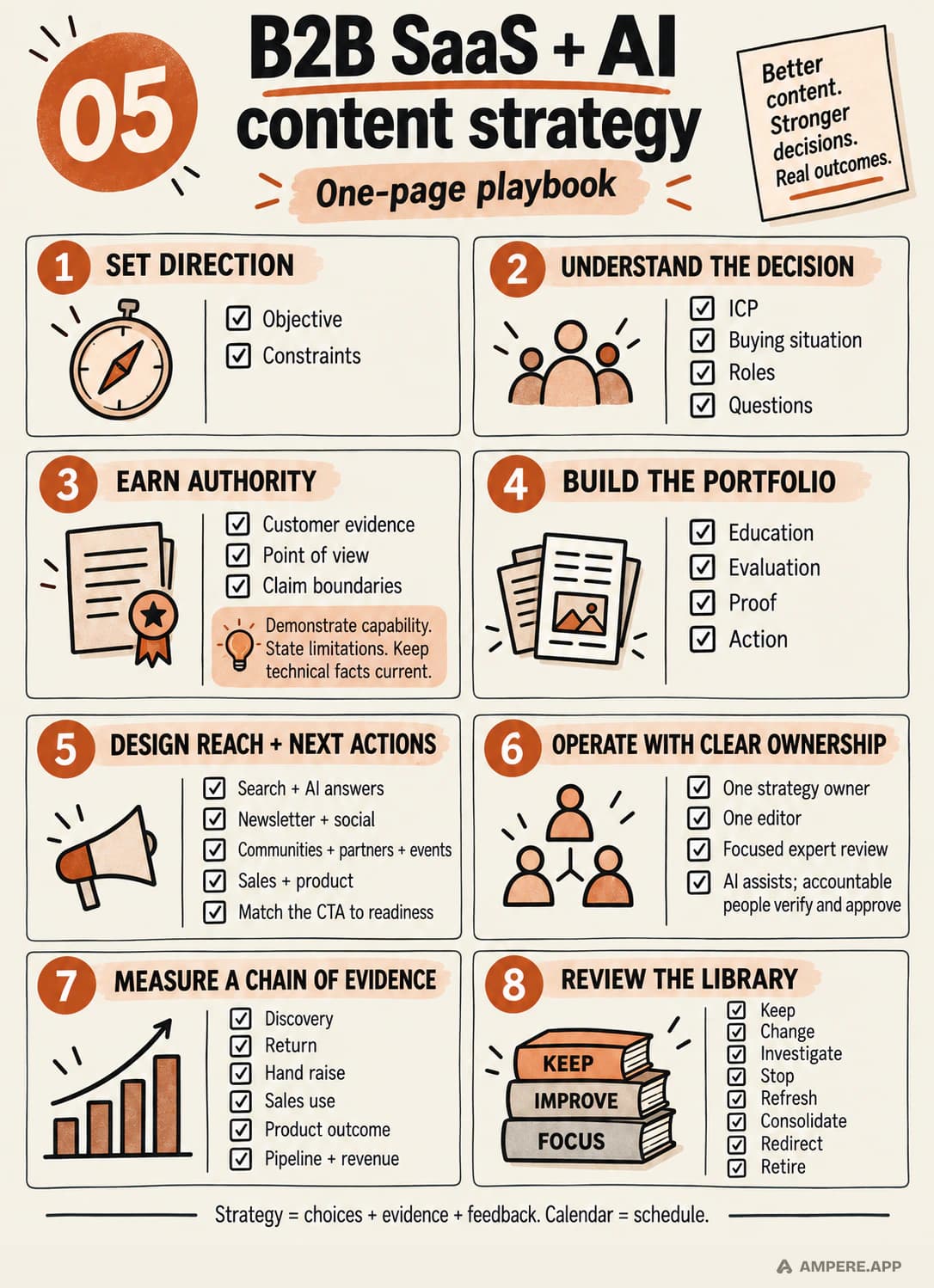
Open the full-size strategy playbook to save a copy (opens in a new tab).
Make the next content decision explainable
Start by using the one-page template to connect one business objective to an important customer problem. Before commissioning the first asset, check that you have evidence for the problem, something useful to contribute, and a way to reach the people facing it. That gives colleagues a basis for discussing the investment and deciding what to leave out. Put the agreed work into the calendar, then use the review cycle to test whether those choices are helping the intended audience and business.
Meet Ampere—your AI marketing agent. Ampere can help research public sources, synthesize supplied evidence, prepare a strategy brief, draft and repurpose approved material, and check a content library for changes. Your team remains responsible for customer evidence, factual verification, strategic judgment, and approval.
Sources and further reading
- Google Search Central: Creating helpful, reliable, people-first content
- Google Search Central: Guidance for generative AI features in Search
- Google Search Console: Performance report and metric definitions
- Google Analytics: Engagement rate and bounce rate
- Google Analytics: Key events
- Google Analytics: Attribution overview
- Content Marketing Institute and MarketingProfs: B2B Content and Marketing Trends—Insights for 2026
- Edelman and LinkedIn: 2025 B2B Thought Leadership Impact Report
- Gartner: 61% of surveyed B2B buyers prefer an overall rep-free buying experience
- OpenAI: Deployment safety and current system cards
- Anthropic: Model system cards
- Intercom: Great help content starts with great questions