What is generative engine optimization (GEO)? How it differs from SEO and AEO
A plain-language definition of GEO, what the original study actually tested, where GEO overlaps with SEO and AEO, the tactics with evidence behind them, the myths to skip, and a 30-day starting plan for a small team.
44 min readWritten by Ampere
Short answer
What is generative engine optimization?
Generative engine optimization (GEO) is the practice of making your content easy for AI systems that write answers, such as Google's AI Overviews, ChatGPT search and Perplexity, to find, understand, trust and quote. It builds on SEO: pages still need to be crawlable and indexed, but GEO adds self-contained passages backed by evidence and consistent descriptions of your brand across other sources.
Summary
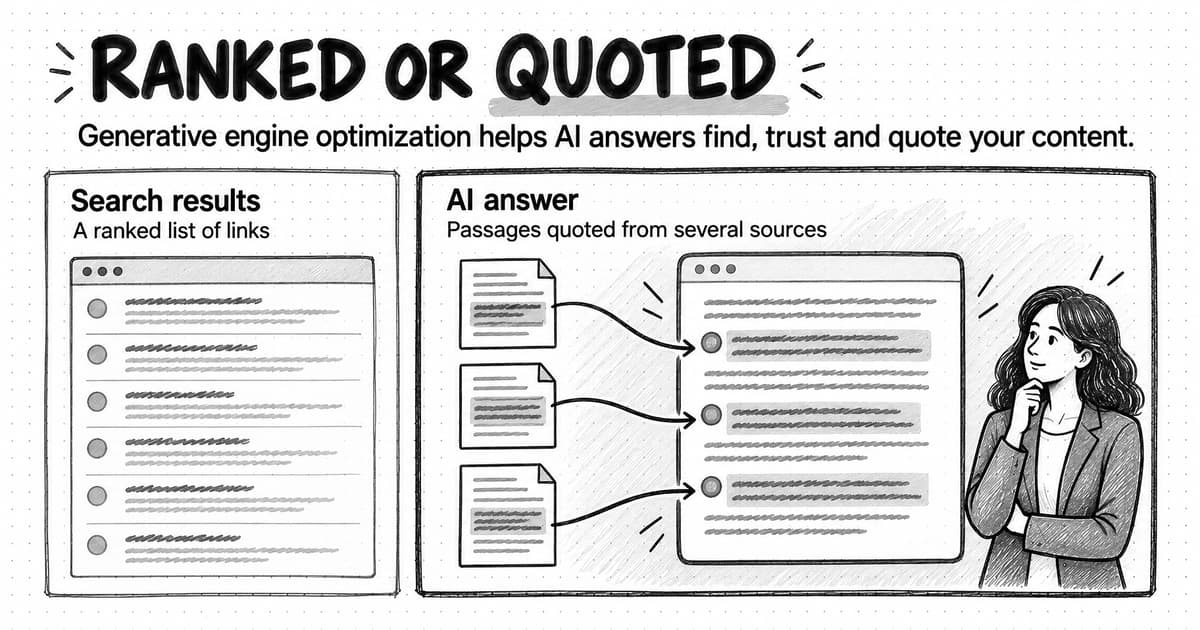
Generative engine optimization changes the goal from being ranked to being quoted. A results page lists links and leaves the reading to people, while an AI answer reads several sources and names only some of them. GEO aims at five separate outcomes: a mention, an accurate description, a recommendation, a citation and a visit, with accuracy first.
The term comes from a 2023 study that rewrote one source per query and measured its share of AI answers. Adding statistics, quotations and citations raised visibility by roughly 30 to 40 percent, and helped lower-ranked pages most, while keyword stuffing made things worse. The engines were simple and the effect was relative, so the result is a direction, not a forecast.
GEO, AEO, LLMO and AI SEO are one family of terms with different emphases. All of them touch three layers of work: access, so systems can crawl and index pages; answerability, so pages answer real questions with evidence; and corroboration, so other credible sources describe the brand the same way. Google says no special files or markup are needed.
The tactics with evidence behind them are editorial: direct answers under each heading, passages that make sense when lifted out, verified evidence with named sources, coverage of follow-up questions, and consistent company facts everywhere. The myths to skip include llms.txt as a ranking lever, keyword stuffing, bought AI rankings and mass-produced pages. A fictional worked example and a copyable page checklist show the method.
GEO measurement relies on a fixed set of buyer questions rerun on a schedule, logging mentions, accuracy, recommendations, citations and the sources cited, alongside Search Console and analytics. A 30-day plan for one marketer builds that baseline, fixes wrong facts at their source, makes three pages answer-ready, then starts earning accurate mentions on the sites answers cite.
Contents
- What generative engine optimization means
- Where the term came from: the GEO study and what it measured
- GEO, AEO, LLMO and AI SEO: one family of terms
- What stays the same from SEO
- What changes when an AI answer is the reader
- How generative engines choose what to quote
- GEO tactics with evidence behind them
- GEO myths and tactics to skip
- Worked example: one product page and one guide made answer-ready
- A GEO checklist you can copy for any page
- How to measure GEO
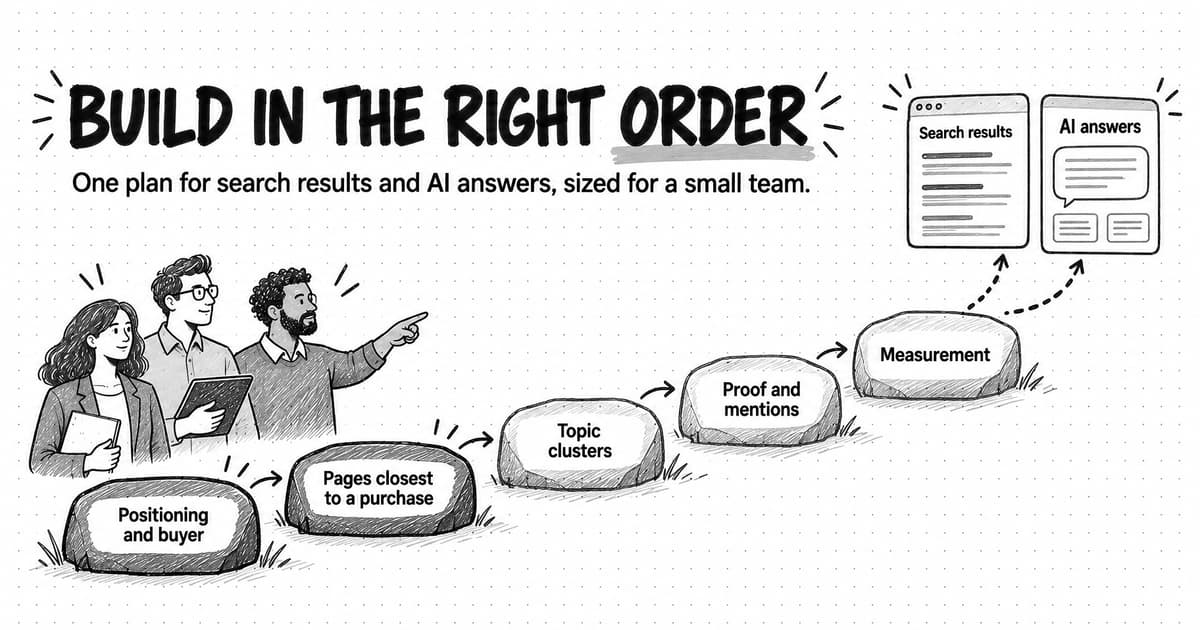
- A 30-day GEO starting plan for a lean team
- When GEO should wait
- How GEO works in Ampere
- Sources and further reading
- Frequently Asked Questions
Ask a vendor what your company should do about AI search and you will probably hear a new acronym. One agency sells generative engine optimization, another sells answer engine optimization, a tool promises LLM optimization, and a conference talk calls all of it AI SEO. If you run marketing at a small software company, the practical question underneath the vocabulary is simpler: when a buyer asks ChatGPT, Perplexity, Gemini, Copilot or Google's AI Mode about the problem your product solves, does the answer mention you, describe you accurately, and point to your pages? And if it does not, what should you change?
Generative engine optimization (GEO) is the practice of making your content easy for AI systems that write answers to find, understand, trust and quote, so that your brand and your pages appear accurately in those answers. A search results page ranks a list of links and leaves the reading to the person. A generative engine reads the sources itself, writes a single answer, and decides which sources to name. GEO is about that second step: being the source whose facts, definitions and recommendations end up inside the answer.
Most of what makes a page usable to a generative engine is what has always made it usable to a search engine. The engine has to be able to crawl and index the page, the page has to answer the question better than the alternatives, and the source has to look trustworthy. What changes is the unit of competition. You are no longer competing only for a position in a list of ten links. You are competing for a sentence, a citation or a mention in an answer the reader may never click past.
This guide defines GEO precisely, explains what the research that named it actually measured and where its limits are, separates GEO from SEO, AEO and the other labels, and sorts the tactics into those with evidence behind them and those you can skip. It ends with a worked example, a page checklist, a way to measure progress, and a 30-day plan a team of one or two people can run.
What generative engine optimization means
A generative engine is a system that combines search with a language model. It takes a question, retrieves documents that might answer it, and generates a written response grounded in those documents, usually with links or references to the sources it drew on. Google's AI Overviews and AI Mode, ChatGPT search, Perplexity, Microsoft Copilot and Gemini all work this way in broad outline, although each product retrieves, ranks and cites differently, and none of them publishes the full method.
Generative engine optimization is the work a content owner does to improve how their content shows up in those generated answers. "Shows up" has several meanings, and keeping them apart makes the rest of this guide easier to follow:
- Mention: the answer names your company or product.
- Accurate description: the answer describes what you do, who you serve and what you cost correctly.
- Recommendation: the answer presents you as a suitable option for the need in the question.
- Citation: the answer links to or lists one of your pages as a source.
- Visit: a reader follows that citation to your site.
A brand can be mentioned without being cited, because the engine learned the name from someone else's page. A page can be cited while the answer recommends a competitor. A citation can produce no visit at all. Our guide to measuring AI search visibility treats these as separate signals for exactly that reason, and GEO aims at all of them, with accuracy first. Being named wrongly is worse than not being named.
GEO is not a single technique or a piece of markup. It is a way of reviewing content and the wider footprint of a brand from the point of view of a reader that is a machine assembling an answer: can it find the passage it needs, can it lift that passage without losing the meaning, does it have reasons to believe it, and do other sources on the web say the same thing?
Where the term came from: the GEO study and what it measured
The term was coined in a research paper, "GEO: Generative Engine Optimization," by Pranjal Aggarwal, Vishvak Murahari, Tanmay Rajpurohit, Ashwin Kalyan, Karthik Narasimhan and Ameet Deshpande, with authors at Princeton University and the Indian Institute of Technology Delhi. It was first posted to arXiv in November 2023, revised in 2024, and accepted to KDD 2024, a major data mining conference. The paper describes GEO as a framework that helps content creators improve the visibility of their content in generative engine responses, and it treats the engine as a black box: the creator cannot see or change how the engine works, only what is on their own page.
Understanding the study's design matters, because its headline number travels far more widely than its method.
How the researchers tested it
The researchers built a benchmark called GEO-bench of 10,000 queries drawn from nine sources, including search query logs, question-answering datasets, discussion questions and Perplexity's own Discover feed. For each query, their test engine fetched the top five Google results and gave the full text of those pages to a language model (GPT-3.5 Turbo), which wrote an answer with citations. They then picked one of the five sources at random, rewrote it using one of nine optimization methods, and measured whether that source's share of the answer went up or down.
The rewriting itself was done by a language model prompted to make specific stylistic and content changes. The nine methods were:
| Method | What the rewrite did |
|---|---|
| Authoritative | Made the text more persuasive and authoritative in tone |
| Statistics Addition | Replaced qualitative statements with quantitative statistics where possible |
| Keyword Stuffing | Added more of the query's keywords, as in old-style SEO |
| Cite Sources | Added citations to credible sources |
| Quotation Addition | Added relevant quotations from credible sources |
| Easy-to-Understand | Simplified the language |
| Fluency Optimization | Improved the fluency of the text |
| Unique Words | Added unusual words |
| Technical Terms | Added technical terms |
Visibility was measured two ways. The first, position-adjusted word count, counted the words in the answer's sentences that cited the source and gave more weight to sentences near the top of the answer. The second, subjective impression, used a language model as a judge to score qualities such as how relevant and influential the cited material was, how likely a reader would be to click it, and how prominent it appeared.
What it found
The three methods that added evidence did best. Cite Sources, Quotation Addition and Statistics Addition each improved position-adjusted word count by roughly 30 to 40 percent relative to the unchanged page, which is where the paper's "up to 40%" headline comes from. Keyword Stuffing did slightly worse than doing nothing. Combining methods helped further: the best pair, Fluency Optimization with Statistics Addition, beat any single method by more than 5.5 percent on that measure.
The researchers repeated a smaller test on Perplexity, a live commercial engine. There, Quotation Addition improved position-adjusted word count by about 22 percent, Statistics Addition improved subjective impression by up to 37 percent, and Keyword Stuffing performed about 10 percent worse than the baseline.
One result is especially relevant for smaller companies. The methods helped lower-ranked sources most. A source in fifth position that added citations gained 115.1 percent in visibility on average, while sources already in first position lost 30.3 percent on average when they applied the same method. The authors read this as a sign that GEO could help smaller content creators compete with dominant ones, because the engine weighs the content of the passage and not only the rank of the page.
What the study does not show
The paper is useful evidence, and it is also narrower than the way it is often quoted. Keep these limits in mind before treating "up to 40 percent" as a forecast for your site:
- The engines were simple. The main engine read only five sources per query and gave them all to one model. Commercial products retrieve many more sources, run several searches per question, and rank sources with signals the study could not see.
- Only one page changed at a time. The gain was measured against four unchanged competitors. If every competing page adds statistics and quotations, the relative advantage shrinks.
- The measure was share of the answer, not business results. The study did not measure clicks, sign-ups or revenue, and it did not test whether rewrites changed search rankings.
- The models and engines have changed since. The authors note that generative engines evolve and that methods will need to adapt, as they have for SEO.
- The rewrites were generated. A language model added the statistics and quotations. The study measured whether the engine quoted the rewritten source more, not whether the added facts were true. On a real site, an invented statistic is a liability, not a tactic.
The durable lesson is the direction of the effect: engines that write answers favor passages that contain specific, attributable evidence, and they do not reward keyword repetition. That is a good basis for editorial practice. It is not a guarantee of any particular gain.
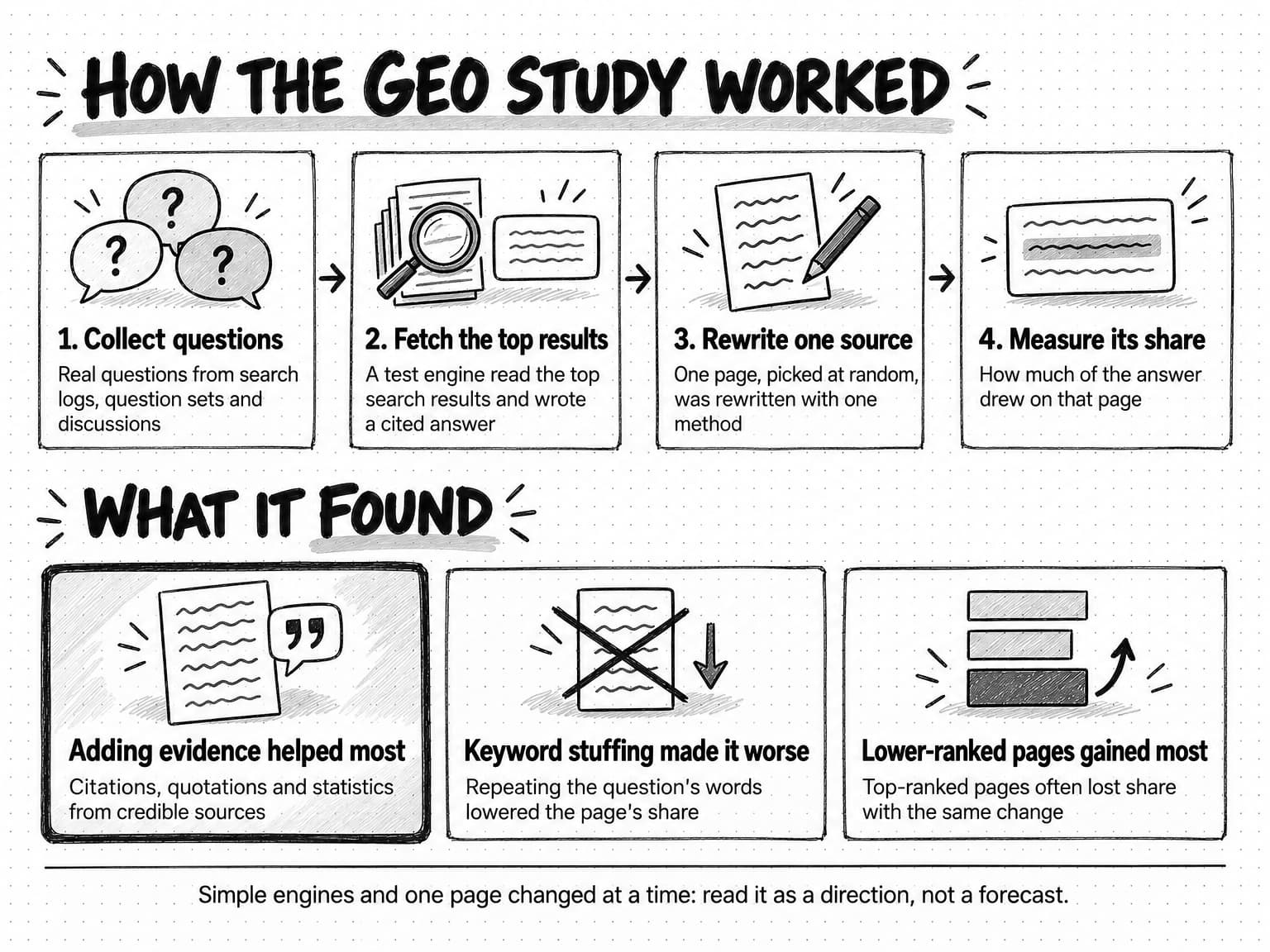
View how the GEO study worked at full size (opens in a new tab).
GEO, AEO, LLMO and AI SEO: one family of terms
The vocabulary arrived faster than any agreement about it. None of these terms has a standards body or an official definition, and vendors often use them interchangeably. It helps to treat them as one family that shares the same foundation and differs in emphasis.
| Term | Usually means | Emphasis |
|---|---|---|
| SEO (search engine optimization) | Improving how a site is crawled, indexed, ranked and clicked in search results | Rankings and organic traffic from a list of links |
| AEO (answer engine optimization) | Structuring content so a system can lift a direct answer to a question | Question-shaped content, concise answers, featured snippets, voice assistants and AI answers |
| GEO (generative engine optimization) | Improving how content is used and cited in answers written by a language model | Being quoted, cited and described accurately in synthesized answers |
| LLMO (large language model optimization) | Influencing what language models say about a brand | Brand and entity representation across sources a model learns from or retrieves |
| AI SEO, AI search optimization | An umbrella label for any of the above, or for using AI tools to do SEO | Varies; check which meaning the speaker intends |
Answer engine optimization is the oldest of the newer terms. It grew up around featured snippets and voice assistants, which read one short answer aloud, so it emphasizes question-and-answer formatting and concise definitions. Generative engine optimization comes from the 2023 research and is concerned with answers that synthesize several sources, so it emphasizes evidence, citations and how passages are combined. LLM optimization is used most often for brand representation: what a model says about your company when asked, including from what it learned during training, which you cannot edit directly. AI SEO is ambiguous. Some people mean optimizing for AI search; others mean using AI to produce SEO content, which is a different activity with different risks.
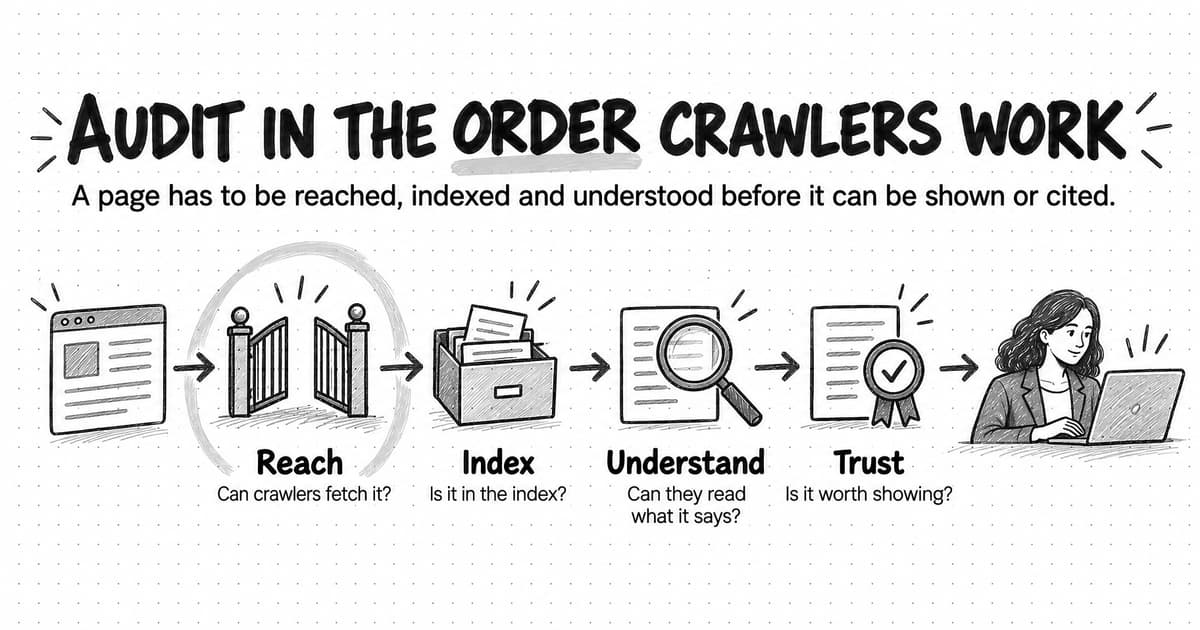
In practice, the overlap is large enough that a small team should not run separate programs. The useful distinction is between three layers of work that every term touches:
- Access: can the systems crawl, index and retrieve your pages?
- Answerability: does each page contain clear, self-contained passages that answer real questions with evidence?
- Corroboration: do other credible sources on the web describe your company and claims the same way?
SEO has always covered the first layer and much of the second. AEO pushed harder on the second. GEO and LLMO add weight to the third, because an engine composing an answer from many sources will repeat what the sources agree on. When a vendor pitches one of these acronyms, ask which of the three layers the work changes, and how they will show you whether it did.
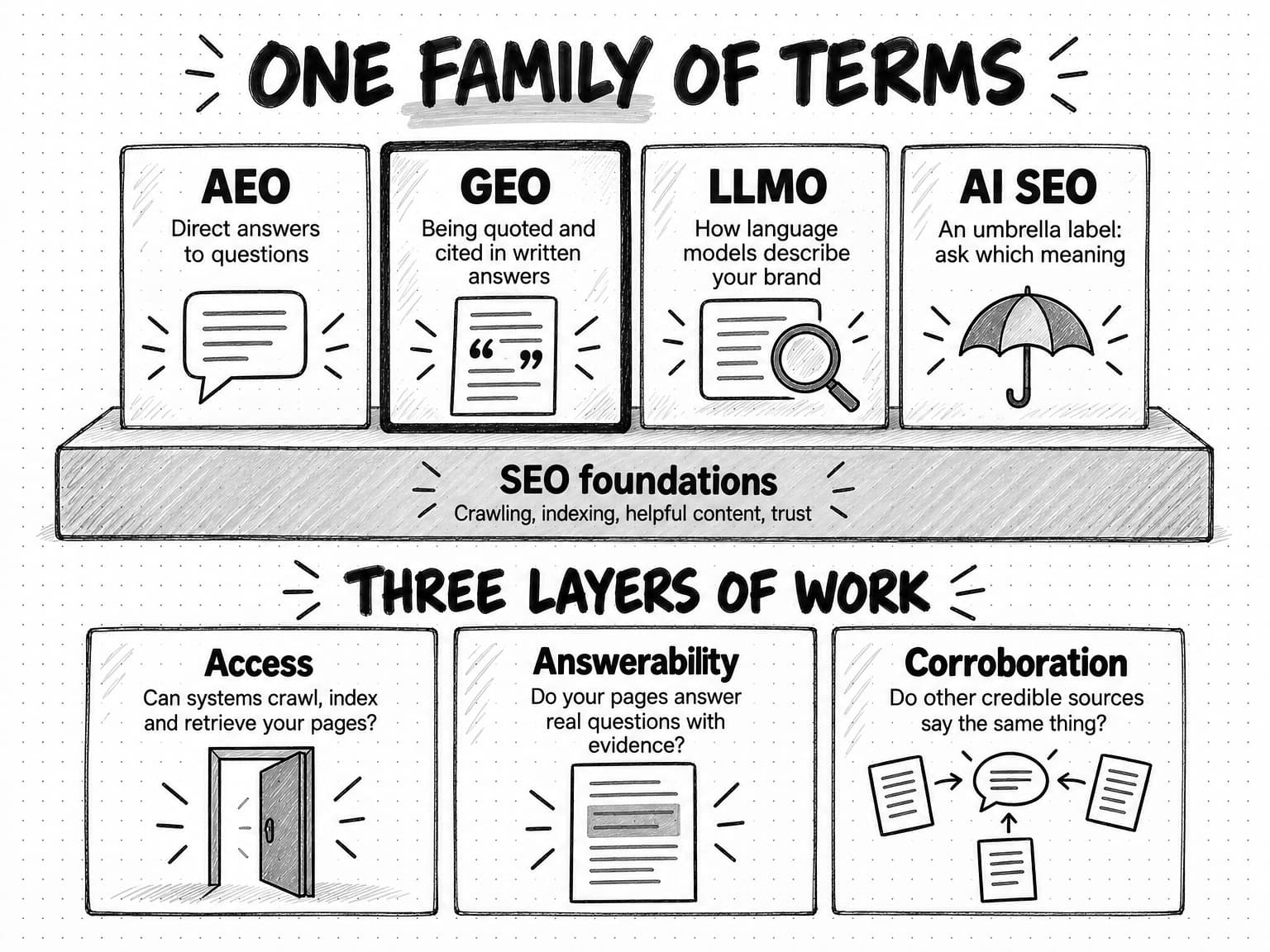
View the GEO term family diagram at full size (opens in a new tab).
What stays the same from SEO
Google's position is direct. Its Search Central documentation on AI features and your website, last updated in December 2025, says there are no additional requirements to appear in AI Overviews or AI Mode, and no other special optimizations necessary. To be eligible as a supporting link, a page must be indexed and eligible to be shown in Google Search with a snippet. In a May 2025 Search Central post on performing well in Google's AI experiences, John Mueller of Google wrote that the underpinnings of what Google has long advised carry across to these new experiences.
Microsoft says much the same about Bing and Copilot. In an October 2025 post on optimizing content for inclusion in AI search answers, Krishna Madhavan of Microsoft Bing describes crawlability, metadata and internal linking as the baseline that AI answers build on, and then adds guidance about structure.
So the SEO fundamentals carry over, and for many sites they are still where the biggest gains are:
Crawling and indexing. If a search engine cannot crawl a page, render its main content and index it, the generative features built on that engine cannot use it. This includes the basics an SEO audit checks: robots.txt rules, noindex tags, canonical tags, server errors, slow or script-dependent rendering, and orphan pages with no internal links.
Helpful, people-first content. Google's guidance on creating helpful, reliable, people-first content defines it as content made primarily for people, not to manipulate rankings. Generative features draw on the same ranking systems, so content that fails this test in classic results has no special route into AI answers.
Trust and expertise. The same Google guidance says that, among the qualities its systems look for, trust is the most important. Clear authorship, accurate claims, cited sources and a visible track record help a page in a results list and in an answer. Our guide to E-E-A-T and how search and AI answers judge trust covers this in depth.
Relevance to intent. A page has to answer the question the searcher is really asking. AI answers make this stricter, not looser, because the engine is looking for the passage that answers one sub-question precisely.
Structured data that matches the page. Mueller's post asks site owners to make sure the content in their markup is also visible on the page. Structured data helps systems interpret a page; it does not substitute for the content.
Authority built by others. Links and mentions from credible sites have always signaled that a source is worth trusting. In AI answers, mentions matter even without a link, as the next section explains.
If your site has indexing problems, thin pages or no clear expertise behind its claims, fix those first. GEO work built on a weak SEO foundation has very little to work with.
What changes when an AI answer is the reader
The fundamentals carry over, but the shape of the competition changes in five ways that affect what you write and what you track.
You compete to be quoted, not only ranked
On a results page, a ranking is the outcome. In a generated answer, ranking is an input: the engine retrieves a set of candidate pages and then decides which passages to use. A page can rank well and contribute nothing to the answer because its useful sentence is buried, vague or dependent on context the engine does not carry over. A page further down can contribute the key definition because it states it cleanly. The GEO study's finding that lower-ranked sources gained most from adding evidence is one sign of this.
One question becomes many searches
Google's documentation says that AI Overviews and AI Mode may use a "query fan-out" technique, issuing multiple related searches across subtopics and data sources to develop a response. A question such as "what is the best scheduling software for a 20-person HVAC company" might be answered with separate searches about pricing, dispatch features, integrations, reviews and alternatives. Each sub-search is a chance for a different page to be retrieved. This rewards sites that cover the follow-up questions around a topic, not only the head term, which is part of why topical authority built through topic clusters matters more in AI search.
Mentions on other sites carry weight
An engine composing an answer about a category draws on many sources at once: review sites, comparison articles, forums, documentation, news and your own pages. If those sources agree about what your company does and who it is for, the answer is likely to repeat it. If your own site says one thing and the rest of the web says another, or says nothing, the answer reflects the rest of the web. A May 2025 study by Ahrefs of about 75,000 brands found that the number of branded web mentions had the strongest correlation with how often a brand appeared in Google AI Overviews (a Spearman correlation of 0.664), stronger than referring domains (0.295) or total backlinks (0.218). The author was explicit that correlation is not causation, and the study covered one product, but it supports a practical point: your footprint beyond your own site is part of GEO.
The click is optional
A generated answer can satisfy the reader without a visit. In a July 2025 Pew Research Center study of 900 U.S. adults' Google searches during March 2025, users clicked a traditional result in 8 percent of visits to results pages with an AI summary, against 15 percent of visits without one, and clicked a link inside the summary in about 1 percent of visits. That makes the content of the answer itself, what it says about you, a marketing outcome in its own right. Our guide to zero-click content distribution covers how to reach buyers who never click.
Each product behaves differently
Google's AI features use Google's index and Googlebot. ChatGPT search relies on OpenAI's search crawler: OpenAI's crawler documentation says that sites which block OAI-SearchBot will not be shown in ChatGPT search answers, and that GPTBot, a separate crawler, collects content that may be used to train its models. Perplexity's crawler documentation describes PerplexityBot as the crawler that surfaces and links websites in Perplexity's results and says it is not used to crawl content for AI foundation models. Blocking a training crawler and blocking a search crawler are different decisions with different consequences.
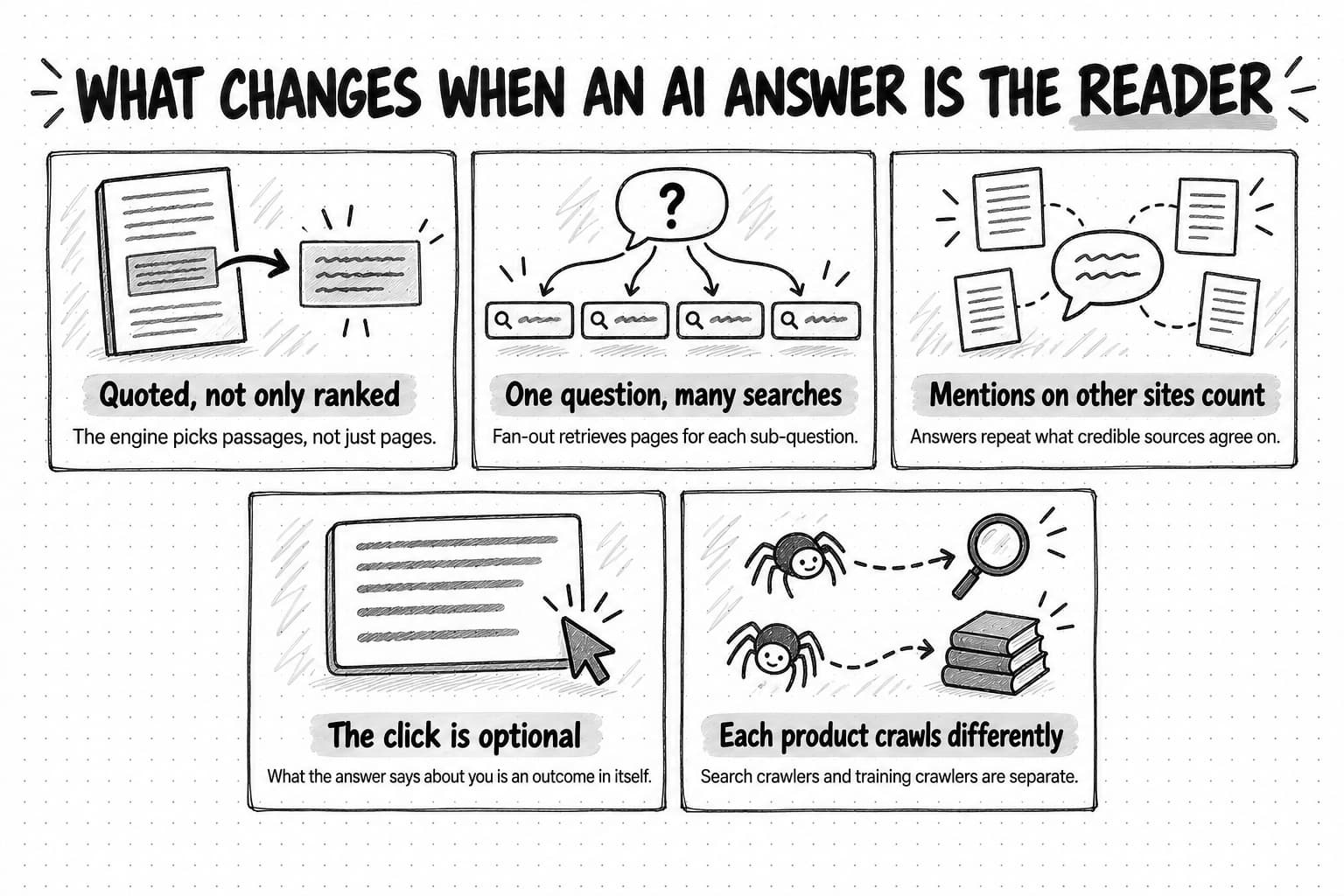
View the five changes diagram at full size (opens in a new tab).
How generative engines choose what to quote
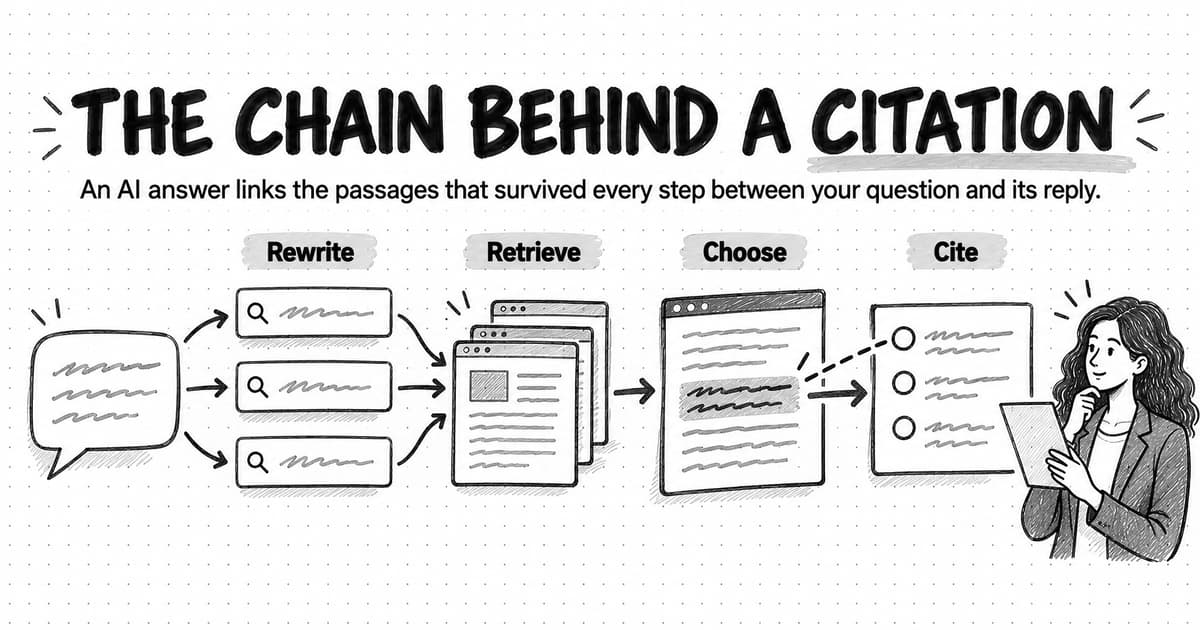
No AI search product publishes its full selection method, and the methods change often. What can be said from documentation and research is the general sequence, which is enough to guide your content decisions. Our guide to how AI search engines choose which sources to cite goes further into each product.
- Interpret the question. The engine works out what is being asked, including implied needs such as company size, location or budget.
- Fan out. It may run several searches for sub-questions and related topics.
- Retrieve candidates. It pulls pages from its search index or a partner's, and sometimes fetches pages live. Pages that cannot be crawled or indexed drop out here.
- Select passages. From the candidates, it picks the passages that answer each part of the question. Clear, specific, self-contained passages are easier to use than vague ones or ones that depend on the surrounding page.
- Compose and attribute. It writes the answer, combining what several sources say, and attaches citations to some of the claims. Where sources agree, the answer states the claim with confidence; where they conflict, it may hedge, pick one, or leave the point out.
Each stage suggests a matching question for your content. Can the page be retrieved at all? Does it cover the sub-questions a buyer asks beyond the head term? Is the answer to each sub-question stated in a passage that still makes sense when lifted out? Is there a fact, figure or source in that passage the engine can attribute? And do other sources say the same thing? Microsoft's guidance makes the passage point directly, recommending self-contained sentences that still make sense when pulled out of context, specific headings that mark clear topic boundaries, and key information kept out of tabs and expandable sections that AI systems may not render.
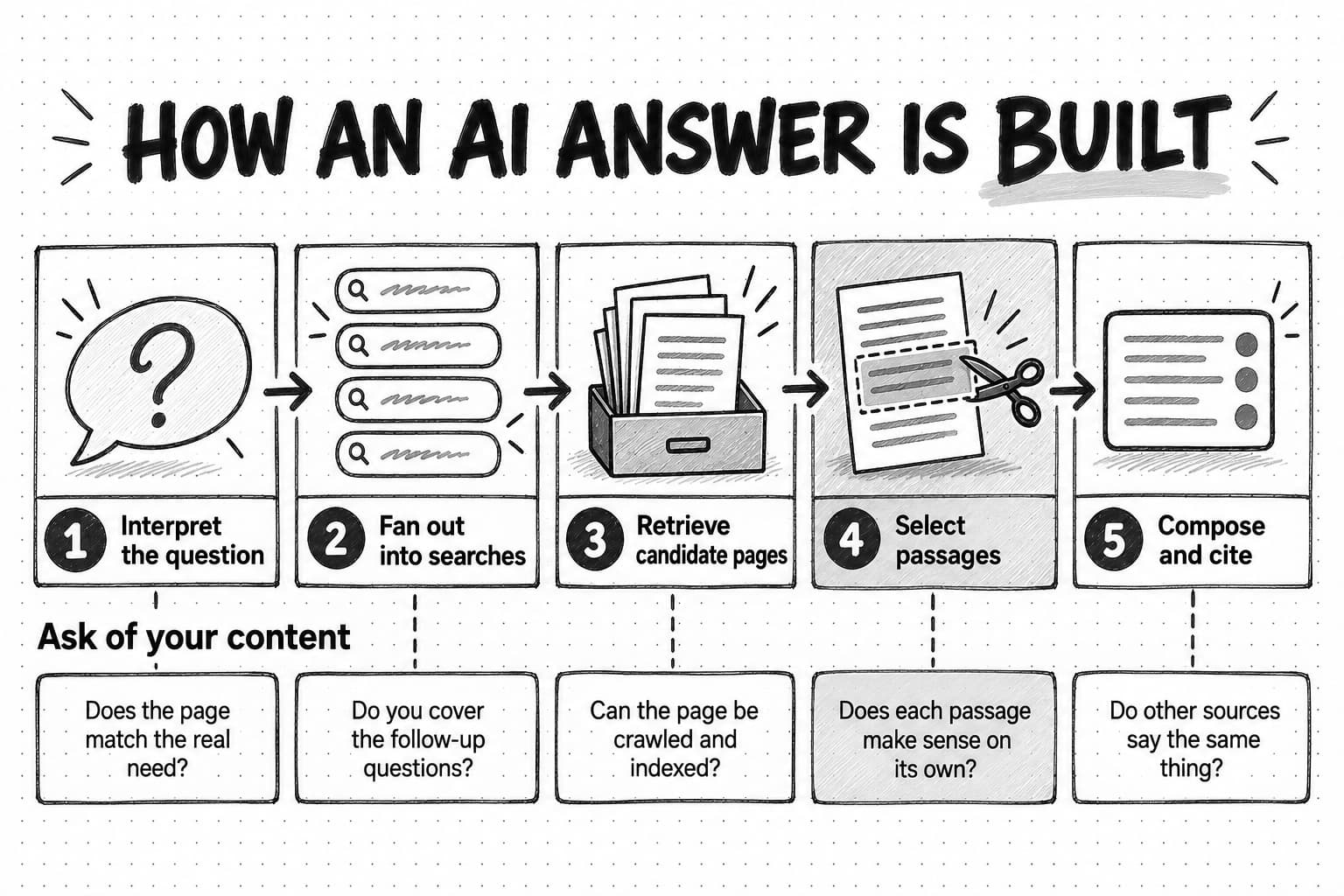
View the AI answer process diagram at full size (opens in a new tab).
GEO tactics with evidence behind them
The tactics below are supported by the GEO study, by the search engines' own guidance, or by both. They are editorial practices, and most of them also make the page better for a human reader. That overlap is the safest test of any GEO tactic: if a change helps a person understand and trust the page, it is unlikely to be wasted, and if it only makes sense as a trick for a machine, it is unlikely to last.
Put specific, sourced evidence where the claim is
The study's strongest single finding was that adding statistics, quotations and citations to credible sources increased how much of the answer drew on a page. On a real site, this means replacing a vague claim with a measured one and naming where it came from. "Most teams spend too long on invoicing" gives an engine nothing to quote. "In our 2026 survey of 312 finance teams, the median team spent 6.5 hours a week on invoice approvals" (an illustrative sentence, not a real survey) gives it a specific, attributable fact, provided the survey exists and the number is right. The evidence has to be real. Original data you collected yourself is the strongest version, because you become the source that everyone else must cite; our guide to original research content explains how to produce it on a small budget.
Answer the question in the first sentences of the section
Write each section so that its opening sentence answers the question its heading asks, then develop the answer. A definition should define. A comparison should state the difference before explaining it. This does not mean writing in fragments or stripping out explanation; it means the engine, and the skimming reader, find the answer without hunting for it.
Write passages that survive being lifted out
A passage the engine can use stands alone. It names its subject instead of saying "it" or "this tool," it defines terms it relies on, and it keeps qualifications next to the claim they qualify. "It integrates with both" is unusable out of context; a sentence that names the product and the two accounting tools it connects with is usable. This is the same discipline good reference writing has always required.
Use headings, lists and tables for what they are good at
Descriptive headings tell an engine where one topic ends and another begins, which helps it match a passage to a sub-question. Numbered lists suit steps. Tables suit comparisons with several attributes, such as plans, features or alternatives. Microsoft's guidance recommends all three, and they help readers as well. Use them where the content has that shape, not everywhere.
Cover the follow-up questions buyers ask
Because engines fan a question out into sub-questions, a page or cluster that answers the obvious follow-ups (price, setup time, integrations, who it is not for, how it compares with doing it by hand) has more chances to be retrieved. Find those questions from People Also Ask boxes, sales calls, support tickets and the follow-up suggestions AI assistants offer. Our guides to search intent and keyword research when AI answers come first cover how to build that question set.
Keep facts about your company consistent everywhere
Your positioning, pricing model, customer type, integrations and founding facts should match across your site, documentation, review profiles, directory listings, social profiles and press coverage. Engines that see one consistent description repeat it. Engines that see conflicting descriptions repeat whichever appears most, which may be an outdated review or a competitor's comparison page.
Earn mentions on the sources answers draw from
Look at which sites the AI answers in your category cite: review platforms, comparison articles, industry publications, community discussions, podcasts. Being accurately present on those sources, through genuine reviews, contributed expertise, partner pages and coverage, is the GEO equivalent of link building, and the Ahrefs correlation suggests it matters. Thought leadership with a real point of view is one of the more reliable ways to get quoted by others.
Show who is behind the content and keep it current
Name authors and their relevant experience, show when a page was last reviewed, and update facts that change. Google's people-first guidance asks content owners to make it clear who created content, how and why. For fast-moving topics, an answer engine that finds a 2023 price on your page and a 2026 price elsewhere has a reason to distrust you.
Make the important content visible as text
Put key answers in the HTML text of the page, not only in images, PDFs, tabs, accordions or scripts that may not render. Give images descriptive alt text. If a chart carries a finding, state the finding in a sentence too.
GEO myths and tactics to skip
A new acronym attracts tactics that promise shortcuts. Each of the following is either contradicted by the platforms' own documentation or unsupported by evidence.
Myth: llms.txt is a ranking lever
llms.txt is a proposal by Jeremy Howard, published in September 2024, for a Markdown file at a site's root that gives language models a curated summary and a list of links, mainly for use when an agent needs information about a topic while helping a user. It is a reasonable convenience for documentation-heavy sites and for agents that choose to read it. It is not a standard that AI search engines have committed to using for selecting or citing sources. Google's AI features documentation says plainly that you don't need to create new machine-readable files, AI text files or markup to appear in AI Overviews or AI Mode. Publishing one is cheap and harmless; expecting it to change your visibility is not supported by any platform documentation reviewed for this guide.
Myth: keyword stuffing works for language models
Repeating the target phrase was the one method in the GEO study that made things worse, both on the test engine and on Perplexity. Google's spam policies still define keyword stuffing as filling a page with keywords in an attempt to manipulate rankings. A language model reads for meaning; repetition adds no meaning.
Myth: you can buy AI rankings
No vendor can guarantee that an AI answer will mention or recommend you, because no vendor controls how the engines retrieve, select and cite sources, and the answers change from run to run. Treat any promise of guaranteed citations or "ranking number one in ChatGPT" as a sales claim to test, not a deliverable.
Myth: mass-produced AI pages will flood the answers
Generating hundreds of near-identical pages to cover every query variation is what Google's spam policies call scaled content abuse: many pages generated primarily to manipulate rankings and not to help users, explicitly including pages made with generative AI tools without adding value. Pages that fail people-first tests in classic search do not become useful sources for AI answers. Our guide to AI content creation covers how to use AI in content work without producing this.
Myth: you need special AI markup or a separate AI site
No major engine requires special schema for AI answers. Structured data that accurately describes visible content still helps machines interpret it, as it always has. Showing crawlers different content from what readers see is what Google's spam policies call cloaking, and "AI-only" pages that people never reach add maintenance without any documented benefit.
Myth: blocking AI crawlers protects you with no trade-off
Blocking a training crawler such as GPTBot limits use of your content for model training. Google describes its Google-Extended control as limiting AI training and grounding in some of Google's other systems, separate from the Googlebot rules that govern Search, including its AI features. Blocking a search crawler such as OAI-SearchBot or PerplexityBot removes you from that product's answers. Decide each case on purpose.
Myth: GEO replaces SEO
Every major engine's documentation ties its AI answers to its search index or crawler. If anything, AI features raise the cost of SEO weaknesses, because a page that is not indexed is invisible to both the results page and the answer.
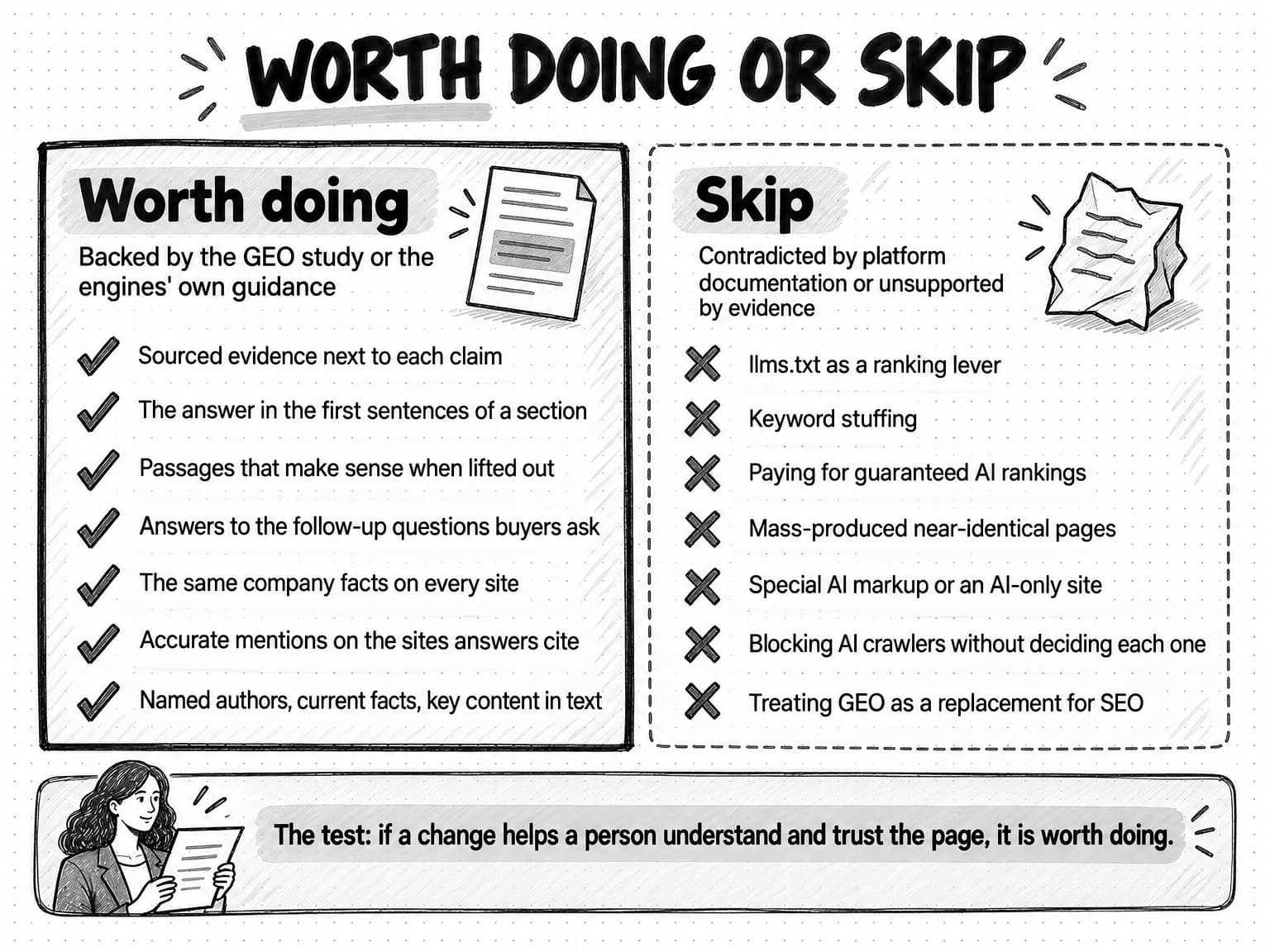
View the worth doing or skip sort at full size (opens in a new tab).
Worked example: one product page and one guide made answer-ready
The company in this example is fictional. Fernhollow is an imaginary scheduling and dispatch product for small field-service businesses such as HVAC and plumbing companies with 5 to 50 technicians. Every name and number below is illustrative.
The starting point
Fernhollow's marketing lead, working alone, runs a small set of questions through Google's AI Mode, ChatGPT search and Perplexity on one afternoon: "best scheduling software for a small HVAC company," "how to reduce no-show appointments for plumbers," "Fernhollow pricing," and "Fernhollow vs spreadsheets for dispatch." She records what each answer says.
The results are uneven. For the category question, the answers list four competitors and mention Fernhollow once, describing it as "an enterprise field-service suite," which is wrong; the description matches an old directory listing from before the company repositioned. For the pricing question, two engines quote a per-technician price that Fernhollow dropped a year ago. For the no-show question, the answers cite a trade association article and a competitor's blog post, though Fernhollow has a long guide on the topic.
She picks two pages to fix first: the product page, because it is where the wrong description and price should be corrected at the source, and the no-show guide, because it targets a question buyers ask early and already ranks on the second page of classic results.
The product page: before and after
| Element | Before | After |
|---|---|---|
| Opening line | "The smarter way to run your field business." | "Fernhollow is scheduling and dispatch software for field-service companies with 5 to 50 technicians, such as HVAC, plumbing and electrical contractors." |
| Pricing | "Plans for every team. Contact us." | A short pricing section in text: the current flat monthly price per company, what each plan includes, and the date the page was last reviewed |
| Who it is for | Implied by stock photos | A section titled "Who Fernhollow is for, and who it isn't for," naming the company sizes and trades it fits and the large-enterprise needs it does not cover |
| Integrations | Logo strip image with no text | A text list of the accounting and payment tools it connects with, each linked to its setup documentation |
| Evidence | "Customers love us" | Two named, approved customer results with figures and dates, and a link to the public review profile |
| Key details | Inside tabs that load on click | The same content as visible text sections with descriptive headings |
| Structured data | None | Organization and Product markup matching the visible facts |
None of these changes is exotic. The opening line now defines the product in a sentence an engine can lift. The pricing is in text with a review date. The audience boundary gives an engine a reason not to recommend Fernhollow for the wrong buyer, which also protects sales from bad-fit leads. The facts the engines got wrong are now stated plainly on the page they would most expect to be authoritative.
The page alone does not fix the wrong description elsewhere. The marketing lead also updates the outdated directory listing and the company's review-site profile, and asks two integration partners to correct the description on their partner pages. That corroboration work is the part of GEO that SEO checklists often leave out.
The no-show guide: before and after
The existing guide, "10 tips to reduce no-shows," opens with three paragraphs about how frustrating no-shows are, gives ten tips as one-line bullet points, and cites no sources.
The revision does four things. First, the opening answers the question directly: what most reduces no-shows for home-service appointments, in two sentences. Second, each tip becomes a short section with a descriptive heading ("Send a reminder the day before and a second one when the technician is on the way") whose first sentence states the advice and whose following sentences explain why it works and how to set it up. Third, the guide adds evidence: Fernhollow's own anonymized data on reminder timing across its customers, described with the sample, the date range and the method, plus citations to the two most credible external sources the marketing lead can find and verify. Fourth, it adds a short section answering the follow-up questions buyers ask (what a reasonable no-show rate is, whether to charge a cancellation fee, what to say in the reminder), drawn from support tickets and the People Also Ask results for the topic.
What she checks a month later
She reruns the same questions in the same three products and logs the answers. The illustrative outcome: two of the three engines now describe Fernhollow correctly as a product for small field-service companies, one still repeats the old enterprise description, and the no-show guide is cited in one engine's answer to the reminder-timing sub-question. She cannot attribute the changes to her edits with certainty, because the engines change too and answers vary between runs. What she can say is that the wrong description is gone from two of three answers after its sources were corrected, and that she has a baseline to compare against next month.
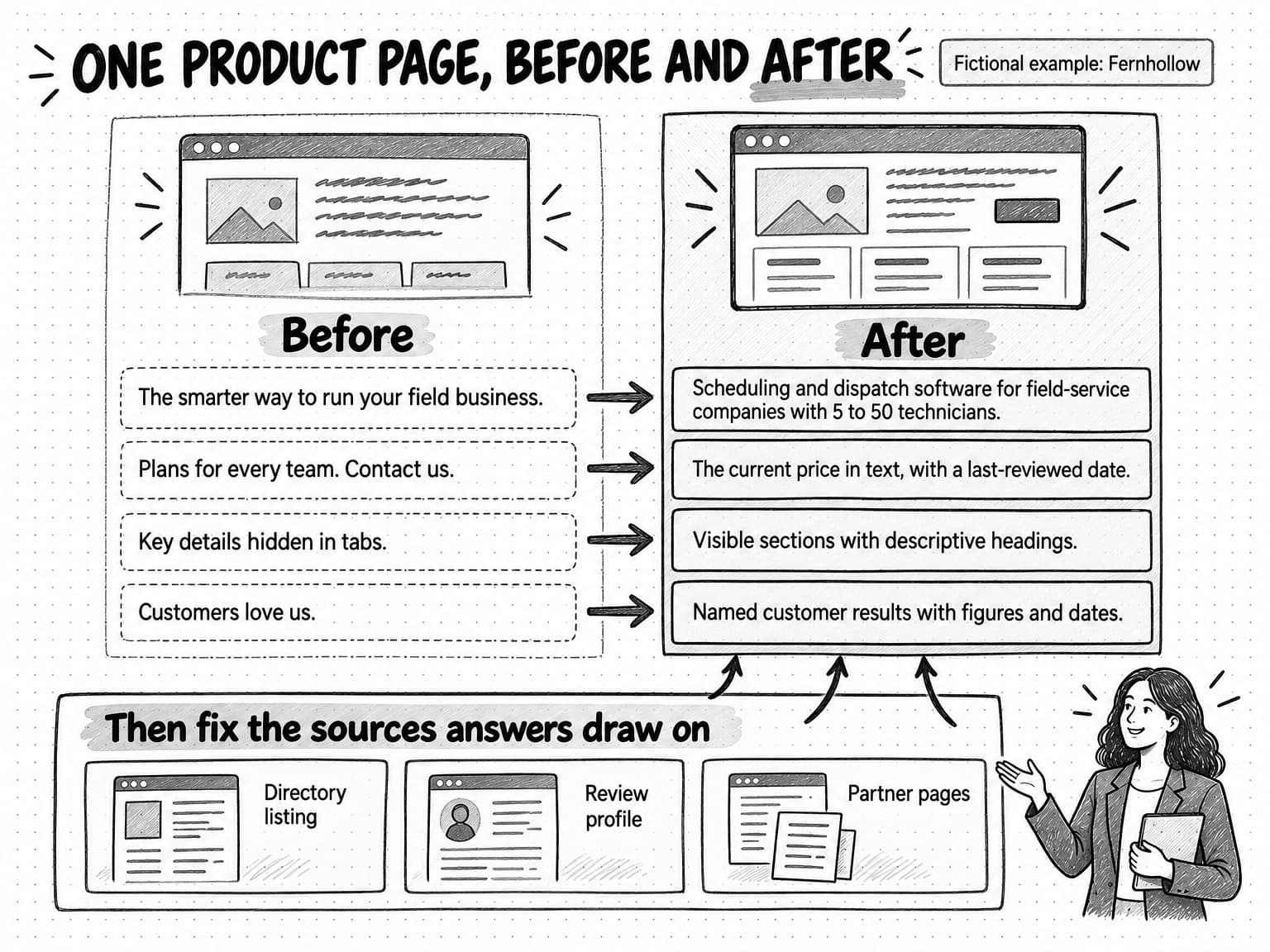
View the product page before and after at full size (opens in a new tab).
A GEO checklist you can copy for any page
Use this checklist when you write or revise a page that buyers might ask an AI assistant about. It is grouped by the three layers from earlier, so you can see whether a weakness is about access, answerability or corroboration.
Access
- The page returns a 200 status, is not blocked in robots.txt, and has no noindex tag.
- The main content renders as HTML text without requiring a click, a login or a script that crawlers may not run.
- The page is linked from at least one relevant page on your own site.
- You have decided, on purpose, which AI search and training crawlers to allow.
- The page appears in the search engine's index when you check it.
Answerability
- The first sentence under the title, and under each heading, answers the question that heading asks.
- The page defines its subject in one sentence that names it in full.
- Each section stands alone: it names its subject and keeps qualifications next to claims.
- Claims carry specific, verified evidence with the source and date named.
- Steps are numbered lists, multi-attribute comparisons are tables, and headings describe their sections.
- The page answers the main follow-up questions buyers ask about the topic.
- Important facts are in text, not only in images, PDFs, tabs or accordions.
- The author and last review date are visible, and time-sensitive facts are current.
- Structured data, if used, matches what is visible on the page.
Corroboration
- Your company description, pricing model, audience and integrations match across your site, documentation, review profiles, directories and social profiles.
- You know which external sources AI answers in your category cite, and you are accurately represented on the ones that fit.
- Any outdated or wrong description of your company on a third-party page has a request for correction logged.
A page does not need every box ticked to be useful, and some items will not apply. The checklist is a way to find the weakest layer on the pages that matter most.
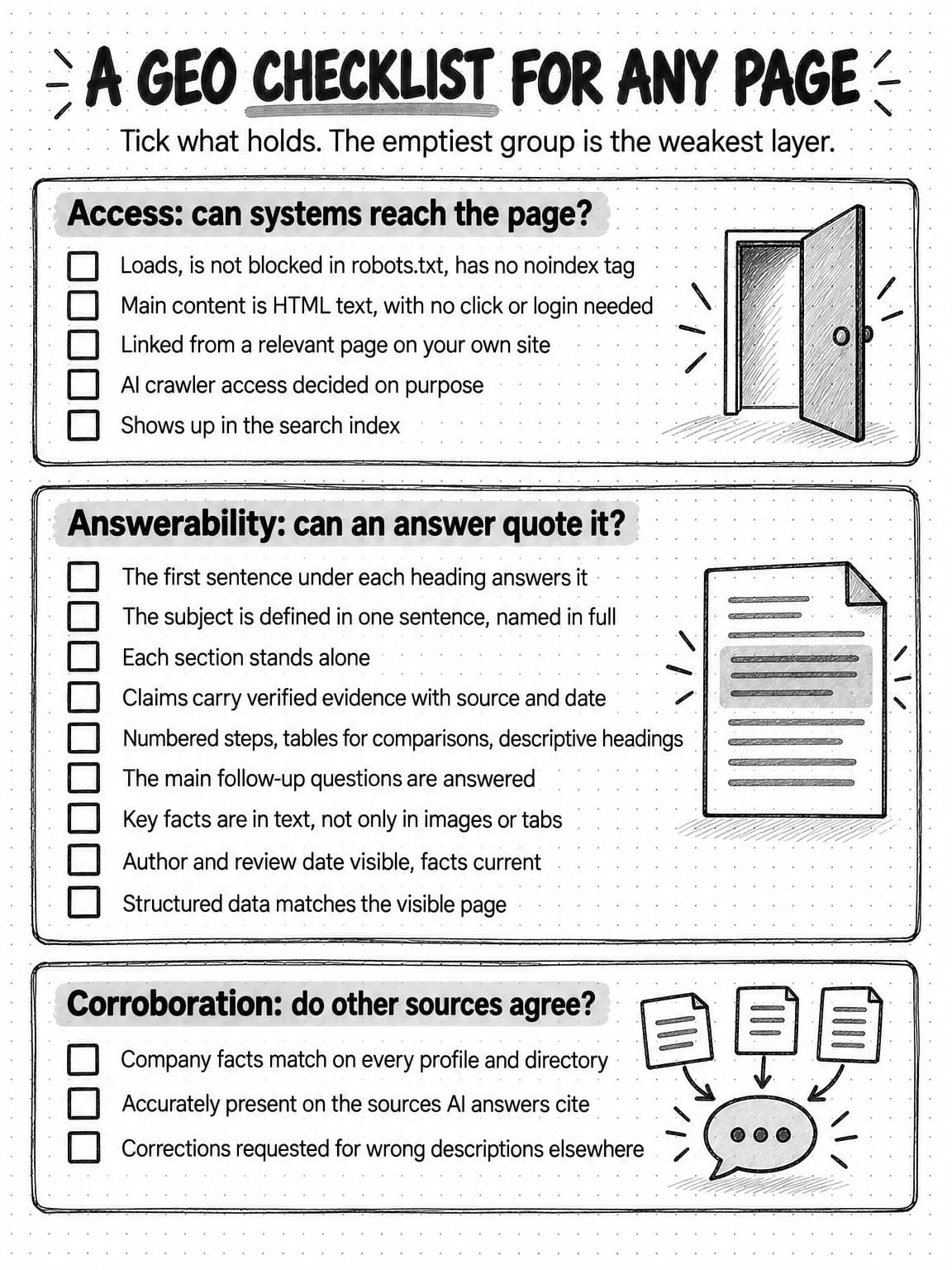
View the GEO page checklist at full size (opens in a new tab).
How to measure GEO
GEO measurement is less precise than SEO measurement, and it helps to accept that early. Generated answers vary between runs, between users, by location and over time, and no AI search product gives site owners a full report of when they were mentioned or cited. What you can build is a repeatable sample that shows direction, combined with the traffic and conversion data you already have.
Start with a fixed set of 20 to 50 questions your buyers actually ask, grouped by stage: category questions ("best tool for..."), problem questions ("how to..."), comparison questions and branded questions ("[your company] pricing"). Run them on a schedule in the products your buyers use, record the full answer and the cited sources, and log five things for each answer: whether you were mentioned, whether the description was accurate, whether you were recommended, whether one of your pages was cited, and which other sources were cited. Our guide to measuring AI search visibility gives a full baseline audit method and a copyable tracking template, and it explains why these signals should be reported separately rather than combined into one score.
Then add the data the platforms do provide. Google's documentation says traffic from AI features is included in Search Console's Performance report under the "Web" search type, combined with other search traffic rather than reported separately. In your analytics, referral visits from AI products that pass a referrer can be grouped into their own channel. Watch branded search volume and direct traffic as well, because a reader who meets your name in an answer may search for it later.
Mueller's May 2025 post makes a point worth repeating: focus on the overall value of visits from search, such as sign-ups and sales, rather than on the number of clicks alone. A smaller number of visitors who arrive already understanding what you do can be worth more than the larger number you used to get.
What to expect: no platform publishes timelines, so treat these as working assumptions. Corrections to how you are described can show up within weeks once the sources an engine draws on are fixed, especially for branded questions, because there are fewer competing sources to outweigh. Citation and recommendation gains for competitive category questions usually take longer and depend on the same slow work as SEO: better content, more coverage of the topic, and more mentions from credible sources.
A 30-day GEO starting plan for a lean team
This plan assumes one marketer, or a founder, with a few hours a week. It favors the work with the clearest payoff: fixing what is wrong, then making the most important pages answerable, then starting the slower corroboration work.
Week 1: build the baseline
- Write 20 to 30 questions buyers ask, using sales calls, support tickets, People Also Ask results and the follow-up questions AI assistants suggest. Include at least five branded questions.
- Run each question in the two or three AI products your buyers use most, and log mentions, accuracy, recommendations, citations and the sources cited.
- List every inaccurate statement about your company you found, with the source the engine appears to have drawn it from.
- Check that your most important pages are indexed and crawlable, and review which AI crawlers your robots.txt allows.
Week 2: fix the facts at the source
- Update your homepage, product page and pricing page so each states what you do, who it is for, and the current facts in plain text near the top.
- Correct outdated descriptions on the third-party profiles you control: review sites, directories, marketplaces and social profiles.
- Request corrections from partners or publications that describe you wrongly.
- Add or fix Organization and Product structured data so it matches the visible facts.
Week 3: make three pages answer-ready
- Choose three pages that target questions from your baseline where you are absent or weak, ideally pages that already rank in classic search.
- Revise each with the checklist above: direct answers under each heading, self-contained passages, verified evidence with sources, tables and lists where they fit, follow-up questions answered, author and review date shown.
- Link the revised pages to each other and from relevant pages on your site.
Week 4: start corroboration and rerun the baseline
- From your baseline log, list the external sources AI answers in your category cite most often.
- Choose two where you could be legitimately present: a review platform where customers could leave honest reviews, a publication that accepts expert contributions, a podcast, a partner page or a community where your team can answer questions genuinely.
- Rerun the full question set, compare it with week 1, and write down what changed, what did not, and what you will work on next month.
After the first month, the work becomes a cycle: rerun the questions monthly, fix new inaccuracies, revise a few more pages, and keep building the external footprint. For how this fits into a wider search program, see our guide to B2B SaaS SEO strategy for a small team, and for how it fits your content plan, our guide to building a B2B content marketing strategy.
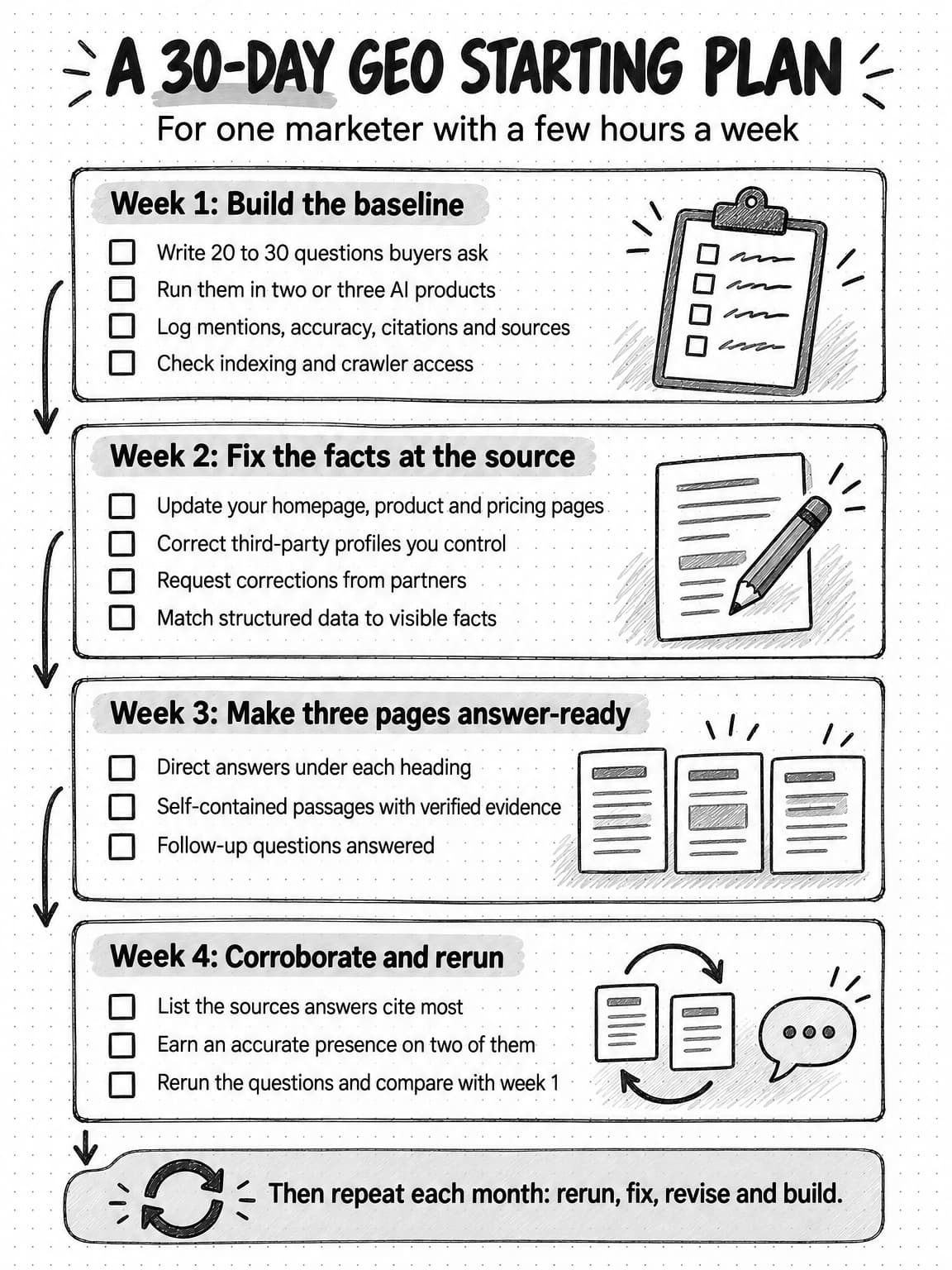
View the 30-day GEO starting plan at full size (opens in a new tab).
When GEO should wait
GEO is not the first priority for every company. If your site has serious indexing problems, the fix is technical SEO, and GEO tactics will not reach pages that engines cannot see. If you have not yet decided who your product is for or how to describe it, polishing passages for AI answers will spread a description you may change next quarter; settle the positioning first. And if your buyers do not use AI assistants to research your category, which is worth checking with a few customer conversations rather than assuming, then content and channels they do use deserve the time first.
There is also a question of what you can influence. Branded questions ("what does Fernhollow do") and narrow problem questions are where a small company can most quickly change what answers say. Broad category questions dominated by large review sites and well-known competitors take longer, and progress there comes mostly from corroboration over months. Set expectations with that difference in mind.
How GEO works in Ampere
Ampere, the AI marketing agent, can take on much of the research and drafting that GEO requires, while your team decides what to change and publishes it.
For the baseline, Ampere can research AI-search visibility gaps for your brand: which questions in your category its research finds you missing from, and which competitors and sources appear instead. It can produce a search landscape report and save it to Brand memory as an editable, evidence-backed brief, so later work starts from the same picture of where you stand.
For the pages, Ampere can run SEO audits and draft source-grounded blog article packages for your own site. Brand memory carries your products, positioning and voice into those drafts, so the facts you corrected in week 2 are the ones the drafts use. Ampere works in a session workspace with its own browser and files, so you can inspect the sources behind a draft before you accept it.
For the ongoing cycle, scheduled tasks can rerun recurring research and return results to a Project for review, and monitoring watches can check public sources, including search and AI answers, on an hourly, daily or weekly schedule and surface alerts with evidence for your team to review.
Ampere researches, audits and drafts; it does not change your website or publish pages. Public-data coverage is never complete, and AI output can be inaccurate or incomplete, so people review the findings and drafts before anything goes live.
Sources and further reading
- Pranjal Aggarwal, Vishvak Murahari, Tanmay Rajpurohit, Ashwin Kalyan, Karthik Narasimhan and Ameet Deshpande, GEO: Generative Engine Optimization, arXiv 2311.09735, first posted November 2023, version 3 June 2024; accepted to KDD 2024. The study that named GEO, with the GEO-bench method and results.
- Google Search Central, AI features and your website, last updated December 10, 2025. Eligibility for AI Overviews and AI Mode, query fan-out, Search Console reporting and preview controls.
- John Mueller, Top ways to ensure your content performs well in Google's AI experiences on Search, Google Search Central Blog, May 21, 2025.
- Google Search Central, Creating helpful, reliable, people-first content, last updated October 5, 2026.
- Google Search Central, Spam policies for Google web search, last updated August 28, 2026. Keyword stuffing and scaled content abuse.
- Krishna Madhavan, Optimizing your content for inclusion in AI search answers, Microsoft Advertising Blog, October 8, 2025.
- OpenAI, Overview of OpenAI crawlers, OpenAI developer documentation, accessed October 14, 2026. OAI-SearchBot, GPTBot and ChatGPT-User.
- Perplexity, Perplexity crawlers, Perplexity documentation, accessed October 14, 2026. PerplexityBot and Perplexity-User.
- Jeremy Howard, The /llms.txt file, llmstxt.org, September 3, 2024. The llms.txt proposal.
- Athena Chapekis and Anna Lieb, Google users are less likely to click on links when an AI summary appears in the results, Pew Research Center, July 22, 2025. Browsing data from 900 U.S. adults in March 2025.
- Louise Linehan, An analysis of AI Overview brand visibility factors (75K brands studied), Ahrefs, May 26, 2025. Correlations, not causal effects, for Google AI Overviews only.
Frequently Asked Questions
What is the difference between SEO and GEO?
SEO improves how a site is crawled, indexed, ranked and clicked in a list of search results. GEO improves how a site's content is used, quoted and cited inside answers that AI systems write from several sources. GEO builds on SEO rather than replacing it, because AI answers retrieve from search indexes. What GEO adds is more weight on self-contained, evidence-backed passages and on consistent mentions of the brand across other credible sites.
What is the difference between GEO and AEO?
Answer engine optimization, or AEO, grew up around featured snippets and voice assistants, so it focuses on question-shaped content and concise direct answers. Generative engine optimization, or GEO, comes from 2023 research on AI systems that combine several sources into one written answer, so it puts more emphasis on evidence, citations and corroboration across the web. The two overlap heavily, and a small team can treat them as one program.
Is generative engine optimization replacing SEO?
No. Generative engine optimization depends on SEO. Google says a page must be indexed and eligible to appear in Search with a snippet to be used in AI Overviews or AI Mode, and ChatGPT search and Perplexity rely on their own search crawlers. A page that search systems cannot crawl or index is invisible to both the results page and the AI answer, so SEO fundamentals remain the first layer of GEO work.
What is the difference between LLM optimization and generative engine optimization?
LLM optimization, or LLMO, usually refers to influencing how language models describe a brand, including what a model learned during training, which no company can edit directly. Generative engine optimization focuses on answers that AI search products write from sources they retrieve at the time of the question. In practice, both come down to accurate, consistent information about the brand on your own site and on the third-party sources these systems read.
How does generative engine optimization work?
Generative engine optimization works by improving the inputs AI search systems draw on. The engine interprets a question, may run several related searches, retrieves candidate pages, selects the passages that answer each part, and writes an answer with citations. GEO makes sure your pages can be retrieved, that each passage answers a real question clearly with verifiable evidence, and that other credible sources describe your company the same way.
What are generative engine optimization best practices?
The best-supported generative engine optimization practices are to keep pages crawlable and indexed, answer each heading's question in its first sentences, write passages that make sense when lifted out, and add specific evidence with named sources. The original GEO study found that adding statistics, quotations and citations helped most, while keyword stuffing hurt. Keeping company facts consistent across your site and third-party profiles also matters.
How do you measure generative engine optimization?
Measure generative engine optimization with a fixed set of 20 to 50 buyer questions run on a schedule in the AI products your buyers use. For each answer, record whether you were mentioned, described accurately, recommended or cited, and which other sources appeared. Add Search Console data, where Google includes AI feature traffic within the Web search type, plus AI referral visits, branded search and conversions from your analytics.
Does an llms.txt file help generative engine optimization?
There is no evidence that an llms.txt file improves generative engine optimization results. llms.txt is a 2024 proposal for a Markdown file that gives AI agents a curated summary of a site, and some agents may read it. Google states that no new machine-readable files or AI text files are needed to appear in AI Overviews or AI Mode. Publishing one is harmless, but it is not a substitute for crawlable, useful pages.
What is an example of generative engine optimization?
An example of generative engine optimization is a software company that finds AI answers describing it with an outdated price and the wrong audience. The team rewrites its product page so the first sentence defines the product and who it serves, puts the current price in text with a review date, and moves key details out of tabs. It then corrects the old directory listing and review profile the answers were drawing on.