What is B2B SaaS marketing? A beginner's guide
An introduction for founders and marketers new to software: how organizations discover, buy, adopt, and renew SaaS products, and what marketing contributes at each point.
36 min readWritten by Ampere
Short answer
What is B2B SaaS marketing?
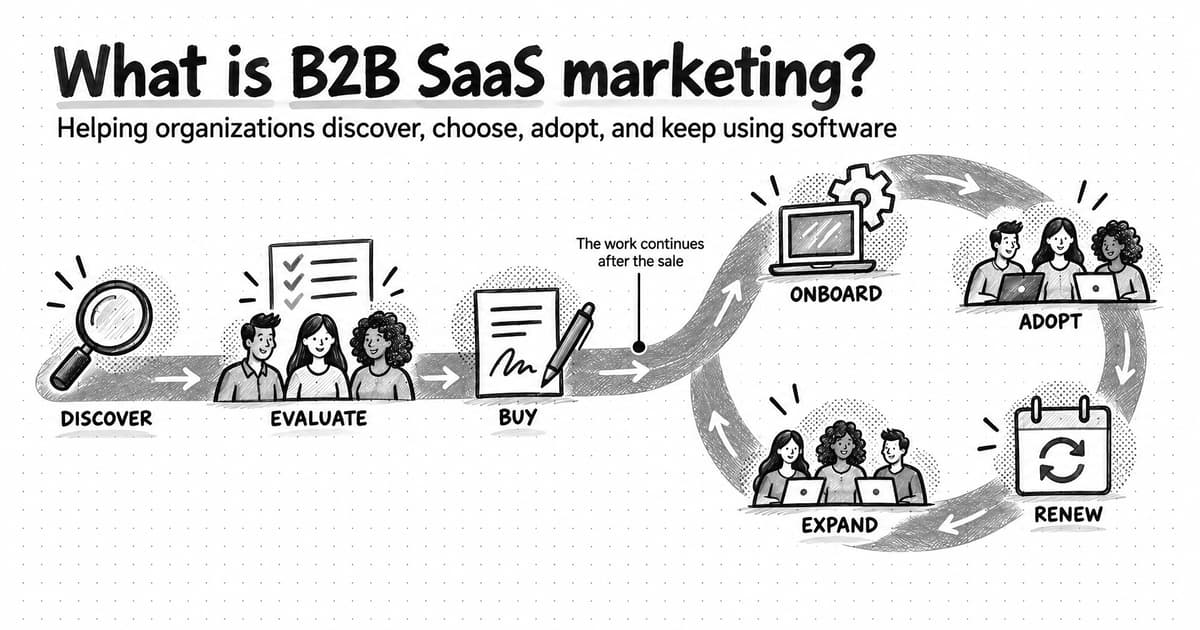
B2B SaaS marketing helps organizations discover, evaluate, adopt, and continue using subscription software. It connects the right buying groups with useful education, credible evidence, and a next step suited to the product's buying motion. Because value and revenue develop over time, the work extends beyond acquisition to activation, retention, and expansion.
Summary
Four conditions shape B2B SaaS marketing: an organization buys, the buyer may not be the user, the customer decides again at each renewal, and the product keeps changing. Renewal gives marketing a stake after the sale, because it can attract customers the product suits, describe it accurately, and teach people to use it.
Several people take part in a business software purchase, and each judges it differently. Users ask whether it eases their work, a budget owner weighs cost and return, and IT and security reviewers check integration and data handling. The internal champion translates between them, so material a champion can pass along is among the most useful.
How customers usually buy shifts marketing's emphasis. In self-serve buying, marketing helps the right users reach a first useful result; in sales-assisted buying, it also equips the colleague arguing for the purchase; in sales-led buying, it prepares evidence for each reviewer. Many companies combine these approaches.
The worked example follows a fictional AI call-notes tool from first search to a second team's evaluation. Most of its questions come from people who never saw an ad, such as security and finance reviewers. Each question needs one consistent answer and a team that maintains it, and AI quality claims should say what was tested, how, and where results apply.
Basic measures such as trial conversion and retention show whether marketing helps the right people move forward, once teams agree how each is defined. The guide closes with a printable six-step exercise that maps buying approach, people, and questions to material, owning teams, and measures. Start with the two or three questions that most often slow or stop purchases.
Contents
- How B2B SaaS marketing differs from other kinds of marketing
- How subscriptions, pricing, and product changes shape the work
- Who takes part in buying business software
- Self-serve, sales-assisted, and sales-led buying
- What happens from discovery to renewal and expansion
- Where the main marketing activities fit
- How marketing, sales, product, and customer success work together
- Worked example: one AI purchase from first search to expansion
- What buyers need to know when the product uses AI
- Basic measures that show whether marketing is working
- Apply it to your product
- Sources and further reading
- Frequently Asked Questions
Suppose you have just moved into software marketing from consumer brands, an agency, or a sales role, or you are a founder preparing to market your first product. The familiar list of marketing work still applies: a website, content, search, social media, email, and paid campaigns. What changes is the buying situation those activities serve. A sales manager might find a call-notes tool, try it with a few colleagues, and then wait weeks while IT, security, and finance review it. Once the company buys it, the tool has to keep earning its place, because the company decides at each renewal whether to go on paying.
B2B SaaS marketing is the work of helping organizations discover, evaluate, buy, adopt, and keep using software they pay for over time. B2B, short for business-to-business, means the customer is an organization rather than an individual consumer. SaaS, short for software as a service, means the product runs online, where the vendor can keep updating it, and is paid for as a subscription or by usage rather than installed after a one-time purchase.
Those two facts explain most of what makes the work distinctive. Because an organization buys, several people usually take part in the decision, and the person who approves the budget may never use the product. Because revenue continues only while the customer stays, marketing's contribution does not end with the signed contract. It extends into onboarding, product education, and the reasons a customer renews or adds more people, where marketing works alongside sales, product, and customer success rather than owning the result alone.
This guide explains those ideas for readers who are new to software marketing. It compares B2B SaaS with other kinds of marketing, shows how pricing and buying approaches change the work, follows the customer relationship from discovery to expansion, and works through a fictional AI purchase to show which questions buyers ask and which material answers them. It ends with a short exercise to apply to your own product. When you are ready for a detailed planning method, continue with how to build a content marketing strategy for B2B SaaS and AI companies.
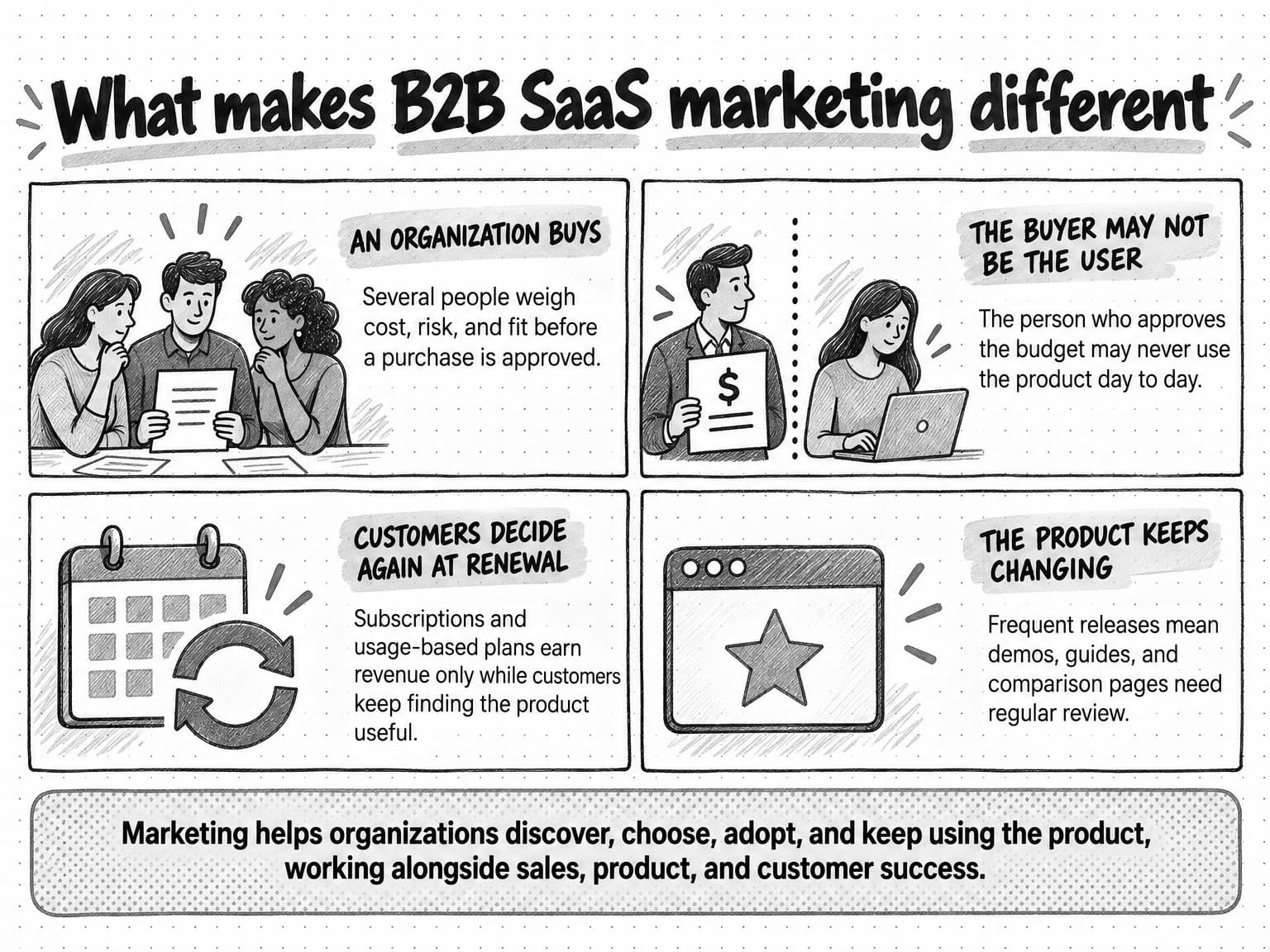
View the four conditions at full size (opens in a new tab).
How B2B SaaS marketing differs from other kinds of marketing
Much of what marketers learn elsewhere transfers directly: understanding an audience, making a clear offer, writing well, testing creative, and choosing channels. The differences come from three places: who makes the decision, when the revenue arrives, and what a buyer needs to see before committing.
| Type of business | Who usually decides | When revenue arrives | What buyers need to see |
|---|---|---|---|
| Consumer products and apps | An individual or household, often quickly | At purchase, or monthly for a personal subscription | That the product is appealing, affordable, and easy to buy |
| One-time business sales, such as equipment or a perpetual software license | A group, for larger purchases | Mostly at the sale, sometimes with maintenance fees | That the product meets the requirements and the vendor will support it |
| Professional services, such as an agency or consultancy | A client sponsor, often with procurement | Per project or retainer, as people deliver the work | That the team has the expertise, capacity, and record to solve this client's problem |
| B2B SaaS | A group that can include users, a budget owner, and technical reviewers | Each month or year while the customer keeps the subscription, or as usage accrues | That the product fits the organization, that people will use it, and that it will keep delivering value |
Compared with consumer marketing
A person subscribing to a music app decides alone, often in minutes, so the marketing can concentrate on appeal, price, and ease of buying. A company choosing a customer-support platform involves the agents who will answer tickets in it, a support leader who wants faster responses, someone who controls the budget, and reviewers who check how customer data will be handled. One message rarely satisfies all of them, and the decision can take weeks or months. Consumer skills such as clear messaging and creative testing still matter; the audience is a set of roles inside an organization rather than one person.
Compared with one-time software sales
When business software was mostly sold as a perpetual license, the customer paid a large amount up front and the vendor earned most of its revenue at the sale, with optional maintenance fees afterward. Under a subscription, the first contract may be modest, and the vendor's return builds over the months or years the customer stays. A company that signs and then struggles to use the product is likely to leave at renewal. That gives marketing a stake in the customer's experience after the contract. Marketing sets expectations before the sale, and it supplies onboarding material, education, and product news afterward.
Compared with professional services
An agency or consultancy sells the expertise of its people, so buyers judge the team: its experience, its thinking, and whether it has capacity for their project. A SaaS company sells a product that many customers use in broadly the same way, so buyers can judge the product itself, often by trying it. Proof comes from demonstrations, trials, documentation, and evidence from similar customers. Many software companies also offer services such as implementation or training, but the product carries the ongoing relationship.
How subscriptions, pricing, and product changes shape the work
Three features of software businesses change marketing's job: the renewal decision, the pricing model, and the pace of product change.
Renewal turns each customer into a continuing decision
With a subscription, the customer pays monthly or annually and decides at each renewal whether to continue. Software companies describe this with a few terms you will hear often. Churn is the customers, or the revenue, lost when customers cancel or do not renew. Retention is the share of customers or revenue that stays. Expansion is additional revenue from existing customers, for example when they add users, move to a higher plan, or use more of a product priced by usage.
Retention depends on much that marketing does not control: product quality, support, the customer success team, pricing, and changes in the customer's own business. Marketing contributes in specific ways. It can attract customers whose needs the product actually meets, describe the product accurately so expectations match what customers experience, and help people learn to use it well. An exaggerated promise that wins a deal can produce a customer who leaves at the first renewal.
Pricing models change the questions buyers ask
SaaS companies charge in several ways, and each one raises different questions for a buyer. A pricing page, and the explanations around it, are marketing material, so the model affects what marketing needs to explain.
| Pricing model | How the customer pays | Public example | What buyers need to understand |
|---|---|---|---|
| Per user, often called per seat | A fee for each person with access | Jira's Standard and Premium plans are priced per user per month | Who counts as a user, and whether everyone needs access |
| Usage-based | Charges that rise and fall with consumption | Twilio lists $0.0083 for each SMS segment sent or received in the US, plus carrier fees | How much they are likely to use, and how to control spending |
| Hybrid | A subscription that includes some usage, with more available at extra cost | GitHub Copilot Business costs $19 per user per month and includes 1,900 AI credits per user, pooled across the organization | What is included, what triggers extra charges, and who can approve them |
| Outcome-based | A fee for each completed result | Intercom lists its Fin AI agent at $0.99 per outcome, with a minimum of 50 outcomes a month | Exactly what counts as an outcome, and how to check the count |
Each model moves the buyer's attention somewhere different. With per-user pricing, a finance reviewer wants to know what happens as the team grows. With usage-based and hybrid pricing, the reviewer wants an estimate and a way to cap spending; GitHub's documentation, for instance, explains that administrators decide whether paid usage beyond the included credits is allowed. With outcome-based pricing, the definition of an outcome becomes part of the product explanation, and Intercom publishes what counts as one. When a buyer is weighing cost, worked examples, calculators, and plain definitions help more than another feature description.
A changing product needs changing material
A SaaS product keeps changing while customers use it. New features arrive, interfaces move, integrations are added, and prices change. Screenshots, demos, comparison pages, and help articles that were accurate at launch can become misleading within months. Marketing needs a routine for reviewing material when the product changes, and a way to tell existing customers what changed and why it matters to them.
Frequent change also creates recurring reasons to communicate. A new feature can give an existing customer a reason to use the product more and give a prospect a reason to look again. Pricing changes need particular care because they affect customers' budgets: when GitHub moved Copilot to usage measured in AI credits, it announced the change on its blog in late April 2026, ahead of the June 1 start.
Who takes part in buying business software
A business software purchase usually involves a buying group: the people who influence, evaluate, or approve the decision. Its size varies widely. A team buying a small tool may involve two people. Forrester's 2026 State of Business Buying research, based on a survey of nearly 18,000 business buyers worldwide, reports that on average 13 internal stakeholders and nine external participants influence a buying decision, and that the number rises for more expensive or complex purchases. In G2's 2026 survey of more than 1,000 software buyers, finance involvement in software decisions rose from 31% to 46% in a single year, and IT security review was the most commonly cited source of delay after buyers had chosen a vendor, at 39%.
The roles you will meet most often are:
- Users, who will work in the product every day and judge whether it makes their work easier.
- A champion, the person who wants the product and argues for it internally. The champion is often a user or team lead.
- A budget owner, sometimes called the economic buyer, who approves the spending and compares it with other priorities.
- Technical evaluators, such as IT staff and system administrators, who check integration, setup, and ongoing administration.
- Security, privacy, legal, and procurement reviewers, who assess data handling, contract terms, and vendor risk. They may send a security questionnaire or ask for an independent report such as SOC 2, an examination of a service provider's controls for security, availability, processing integrity, confidentiality, or privacy.
- An executive sponsor, for larger purchases, who connects the decision to the company's priorities.
- Outside influences, such as peers at other companies, consultants, review sites, and online communities.
Why the buyer may not be the user
The person who approves the budget may never log in, and the people who use the product every day may have no authority to buy it. Consider a company choosing an expense-management tool. The finance director approves the purchase and cares about control, accuracy, and cost. Employees submit receipts from their phones and care about speed. Managers approve claims and care about not being interrupted. IT cares about sign-in and connections to the accounting system.
Marketing has to speak to both sides of that divide. Users need to see that the product makes their day easier, often by trying it. Budget owners need to understand cost, risk, and return. The champion usually translates between them, so some of the most useful marketing material is written for the champion to pass along: a one-page summary for leadership, a security overview for IT, or a business-case template that turns a trial into an argument for purchase.
Buyers do much of their research alone
Buyers often form a view before they speak to anyone at the vendor. In a Gartner survey of 645 B2B buyers conducted in August and September 2025, 67% said they preferred a buying experience without a sales representative, 45% had used generative AI during a recent purchase, and respondents used an average of seven information sources. The same survey found that 69% preferred to check AI-generated insights with a sales representative. Many buyers, in other words, want to do their own research and still value a person who can confirm what they found.
A company's website, documentation, pricing pages, reviews, and published answers are read by buyers, and summarized by AI assistants, often before anyone at the company knows the buyer exists. If the public material is vague or out of date, the buyer's first impression is vague or out of date too. Our guide on how to measure AI search visibility explains how to check what AI assistants say about a product.
Self-serve, sales-assisted, and sales-led buying
The way customers usually buy a product is sometimes called its go-to-market motion. Three broad approaches are common, and each one shifts where marketing concentrates its effort.
Self-serve
In a self-serve approach, customers can sign up, try the product, and pay without speaking to anyone. The term product-led growth describes companies that rely on the product experience itself to attract, convert, and expand customers. Jira's pricing page shows this approach: anyone can start on a free plan for up to 10 users or a free trial of the Standard or Premium plan, and the Enterprise plan directs buyers to contact sales. Atlassian states that when a Free plan exceeds its user limit, it is upgraded automatically to a seven-day free trial of the Standard plan, so the move toward a paid plan starts inside the product rather than with a sales call.
Marketing's job here is to bring in the right users, set accurate expectations, and help people reach a useful result quickly. That moment is often called activation: the first meaningful use that shows the product can do its job, such as creating and sharing a first project plan. The material that helps includes a clear website and pricing page, templates, onboarding emails, short tutorials, in-product guidance, and pages that show how particular teams use the product.
Sales-assisted
In a sales-assisted approach, people start with the product on their own, and a salesperson becomes involved as the purchase grows: more users, a higher plan, or a company-wide rollout that needs security review. Sales teams often look for accounts whose product usage suggests they are ready for that conversation. Such an account is sometimes called a product-qualified lead, meaning an account whose behavior in the product, rather than a form it filled in, indicates interest in buying or expanding.
Marketing supports both halves of this approach. It helps users succeed with the product, and it equips the internal champion to win approval with business-case material, security documentation, administration guides, and stories from similar customers. It also helps sales understand what an account has already seen, so the conversation starts from the buyer's actual questions.
Sales-led
In a sales-led approach, the purchase begins with a sales conversation, a demo request, or outreach from the vendor, and it proceeds through demonstrations, evaluation, sometimes a pilot, and negotiation. This is common when a purchase is expensive, complex, or risky, such as replacing a finance system or choosing a security platform. Marketing's job is to reach the right organizations, build familiarity across the buying group before sales gets involved, and create material for each reviewer. Account-based marketing is one method for this: marketing and sales agree on a list of target organizations and coordinate campaigns, content, and outreach for the people in each one.
Many companies combine approaches
These approaches are not a ladder that every company climbs, and one product can use several. Slack, Notion, and Figma all let customers buy their lower tiers online and route their enterprise plans through sales, and those enterprise plans list controls that IT and security teams look for, such as single sign-on, automated user provisioning, and audit logs. The right mix depends on customer size, price, and how much risk the purchase carries for the buyer.
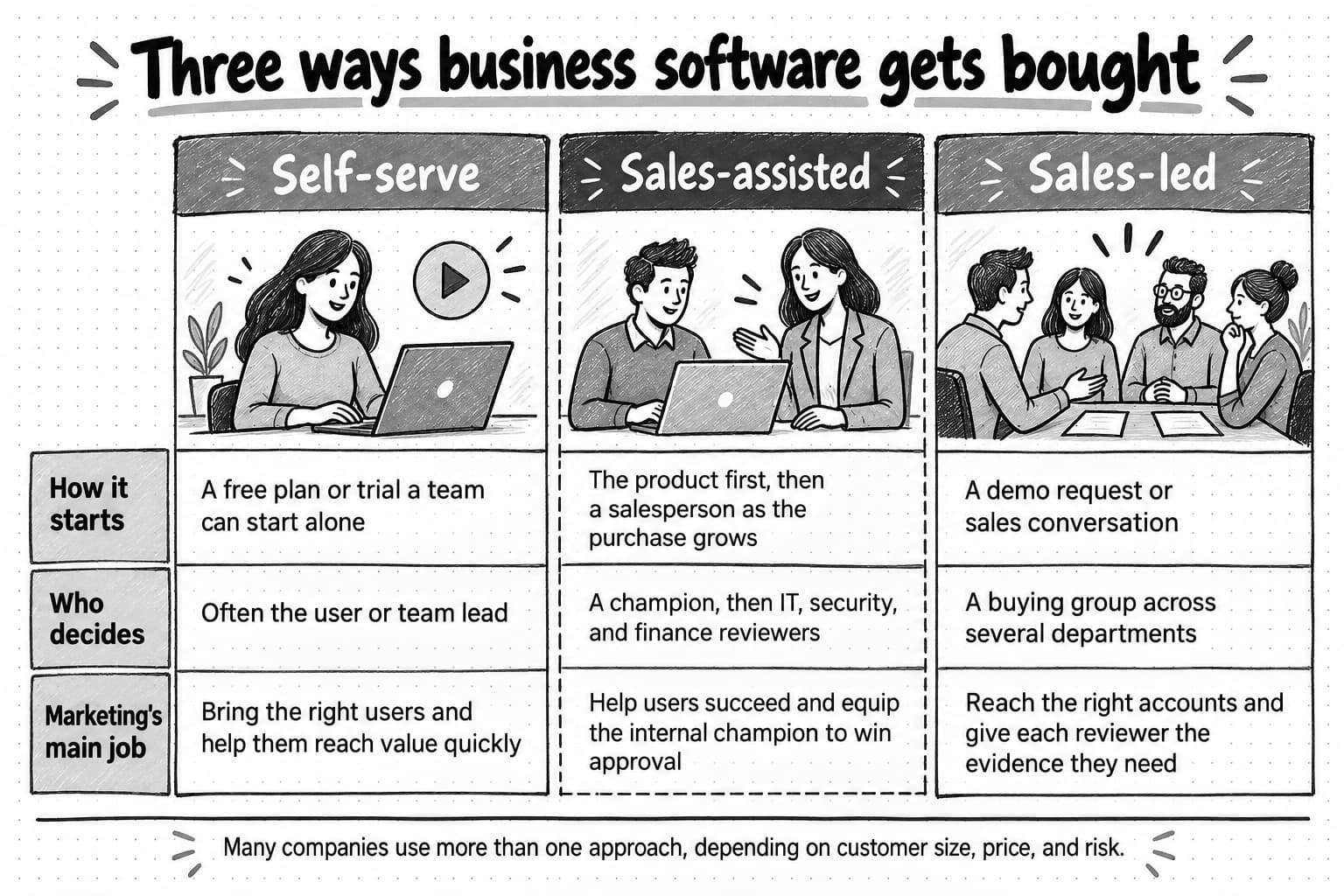
View the three buying approaches at full size (opens in a new tab).
What happens from discovery to renewal and expansion
It helps to think of the customer relationship as a set of stages, as long as you remember that real purchases rarely move in a straight line. Each stage has a different customer goal, a different team in the lead, and a different kind of useful marketing material.
| Stage | What the customer is trying to do | Who usually leads | How marketing helps |
|---|---|---|---|
| Discovery | Recognize a problem and learn the options | Marketing | Educational content, search, social media, events, communities, and reviews |
| Evaluation | Compare options, test them, and involve colleagues | Marketing and sales, with product for trials | Comparison pages, demos, trials, pricing examples, customer stories, and security documentation |
| Purchase | Approve the budget, the terms, and the risk | Sales, finance, and legal | Business-case templates, clear pricing, and procurement documentation |
| Onboarding | Set up the product and reach a first useful result | Customer success, product, and support | Setup guides, welcome emails, templates, and training |
| Adoption | Make the product part of regular work | Product and customer success | Tips, webinars, feature education, and community programs |
| Retention | Decide whether to renew | Customer success or account management | Value summaries, product updates, and customer communications |
| Expansion | Add users, upgrade, or bring in new teams | Customer success and sales | Use-case pages for other teams, champion material, and launch campaigns |
In practice, purchases loop and stall. A new reviewer can send an evaluation back to research, a trial can go quiet for weeks, and a second department can begin its own evaluation of a product that another team already uses. Because the relationship continues after the sale, some teams draw it as a bow tie rather than a funnel: one side narrows toward the purchase and the other widens again through onboarding, adoption, retention, and expansion. Winning by Design's Bowtie model is one published version of that picture.
Marketing aimed at existing customers is often called customer marketing. It includes onboarding and education campaigns, product announcements, community programs, and work with customers who agree to share their stories.
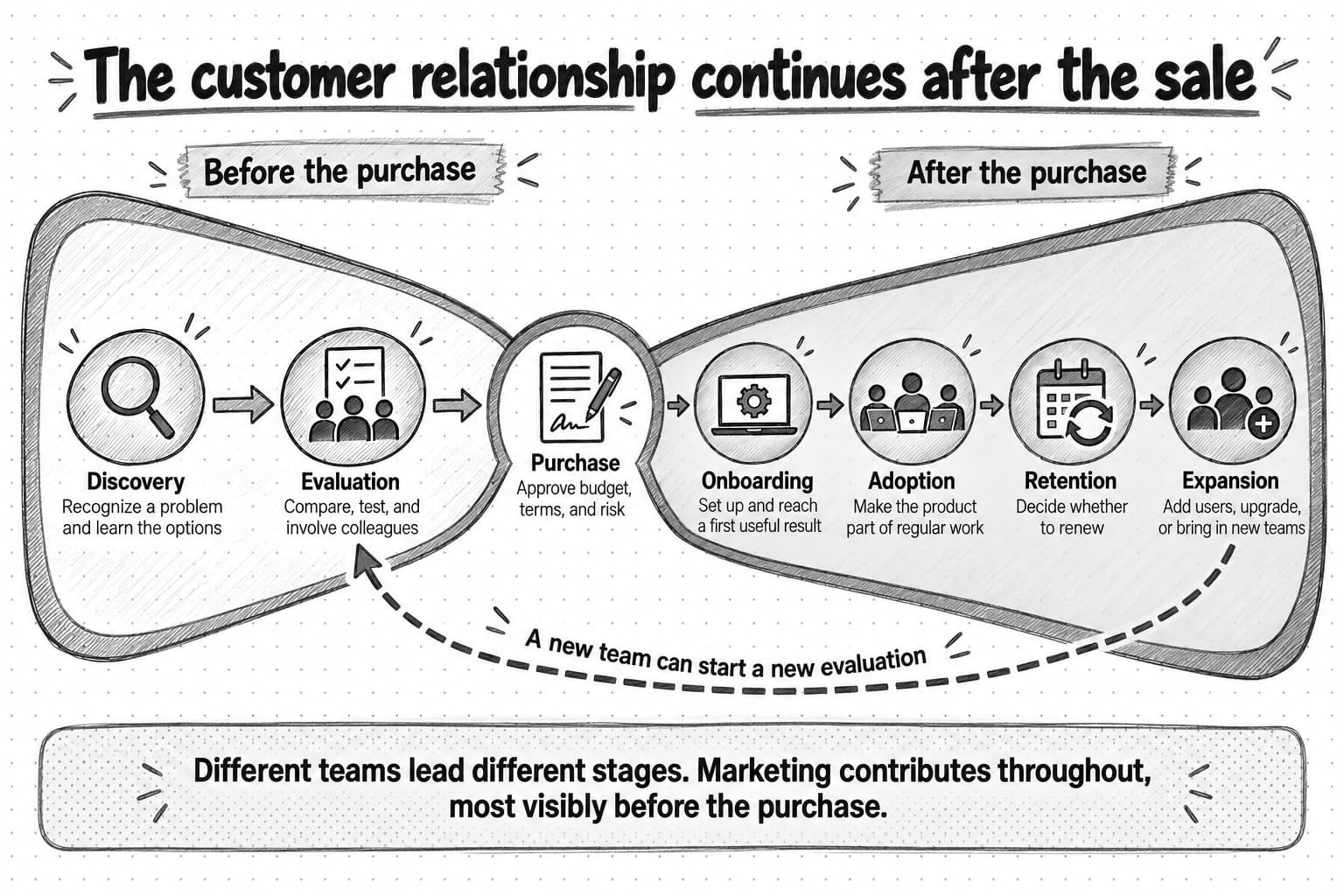
View the customer journey at full size (opens in a new tab).
Where the main marketing activities fit
The activities in B2B SaaS marketing are the ones you may already know. What distinguishes the work is choosing which questions each activity should answer and at which stage.
| Activity | What it involves | Where it helps most |
|---|---|---|
| Customer and market research | Interviews, sales call reviews, support tickets, product reviews, and competitor analysis | Every stage; it tells you which questions matter |
| Positioning and messaging | Deciding who the product is for, which problem it solves, what it replaces, and why it is different | Discovery and evaluation, then every later message |
| Product education | Tutorials, templates, courses, documentation, and webinars | Evaluation through expansion |
| Content | Articles, guides, reports, videos, and newsletters | Discovery and evaluation |
| Search | Pages that answer the questions buyers type into search engines and ask AI assistants | Discovery and evaluation |
| Social media | Company, founder, and employee posts, and participation in communities | Discovery |
| Newsletters, onboarding sequences, and product updates | From discovery through retention | |
| Paid campaigns | Search ads, social ads, and sponsorships aimed at defined audiences | Discovery and evaluation |
| Customer evidence | Case studies, reviews, references, and approved quotes | Evaluation and purchase |
| Launches | Announcements of new products, features, and pricing changes | Every stage, especially adoption and expansion |
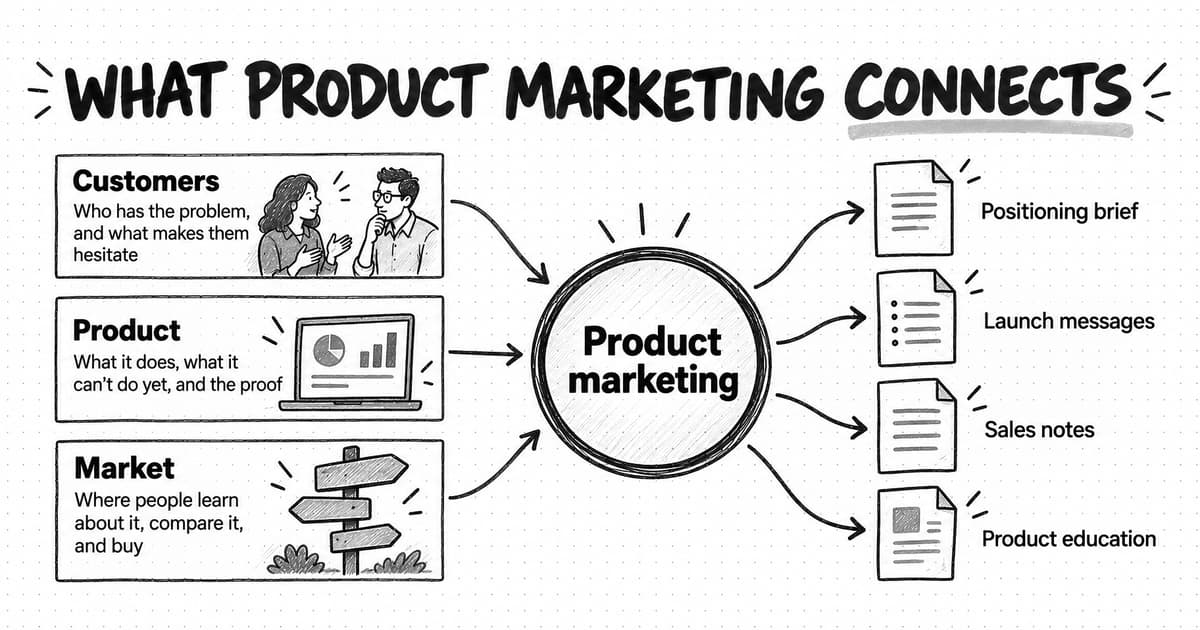
Two specialties organize much of this work at larger companies. Product marketing connects the product to the market: it owns positioning and messaging, plans launches, prepares material for the sales team, and tracks competitors. Demand generation runs the programs that create interest and bring potential customers into evaluation, such as campaigns, events, and paid media. At a small company, one person or the founder often does all of it.
Search and product education have both grown beyond their familiar forms. Search now includes AI-generated answers as well as lists of links. Google's current guidance for its AI features says that SEO best practices still apply, and it encourages distinctive content rather than material that repeats what is widely available. For a software company, the distinctive material is usually specific: answers drawn from its own product knowledge and customer experience. Our guide to B2B SaaS SEO strategy covers how a small team plans for both search results and AI answers. Product education can also become a program of its own. HubSpot Academy and Salesforce's Trailhead, for example, offer free online courses on their products and on related work skills, which gives people a reason to learn with the company before and after they buy.
Several of these activities have more detailed guides:
- Voice-of-customer research for messaging explains how to collect and analyze customer language.
- How to conduct competitor analysis covers researching alternatives buyers compare you with.
- What is brand positioning? explains how audience, alternatives, differentiated value, and evidence fit together in a position.
- How to create a brand messaging framework turns research into positioning and proof.
- How to write a creative brief for a marketing campaign prepares a campaign's audience, message, and deliverables.
- How to write a content brief prepares a single article or asset.
- How to automate marketing with AI agents explains which recurring tasks can be delegated and how to review them.
How marketing, sales, product, and customer success work together
Because the customer relationship spans many stages, no single team owns it. Each team leads part of the relationship and depends on information from the others.
| Team | Main responsibility | What marketing needs from them | What they need from marketing |
|---|---|---|---|
| Sales | Guides evaluations and closes purchases | The questions and objections heard on calls, and the reasons deals are lost | Interested prospects who fit, material for each reviewer, and current competitive information |
| Product | Builds the product and sets its direction | Release plans, accurate descriptions of what the product does, and usage patterns | Customer and market insight, positioning, and launch plans |
| Customer success | Helps customers reach their goals, renew, and expand | Adoption patterns, reasons customers leave, and customers willing to share their stories | Education material, customer communications, and expansion campaigns |
| Support | Answers customers' questions and problems | The most common questions and points of confusion | Help content that matches the product, and accurate expectations set before the sale |
The teams also need a few shared agreements: what counts as a qualified prospect, how a prospect moves from marketing to sales and from sales to customer success, and who produces which material. Because retention is a shared outcome, the agreements should also cover how customer feedback reaches the team that can act on it. A reason for churn heard by customer success may call for a product fix, a change in how marketing describes the product, or both.
Worked example: one AI purchase from first search to expansion
To see how these pieces fit, follow one purchase. Recapwell is a fictional AI call-notes tool invented for this guide. It joins sales calls, writes summaries, and suggests updates to the customer relationship management (CRM) system, where the sales team records its accounts and deals. Individual sales representatives can start a free trial on their own, team plans are priced per user, and a company-wide rollout requires administrator controls and a security review, so Recapwell uses a sales-assisted approach.
The purchase begins with a problem rather than a product. A sales manager at a mid-sized software company notices that the team spends evenings typing call notes into the CRM. The manager searches for ways to reduce that work and asks an AI assistant for options. At this point, useful material explains the problem itself: a guide to cutting CRM admin that covers several approaches, with Recapwell as one of them, and sample summaries that show what the output looks like.
The manager then invites five sales representatives to a trial. Their question is practical: are the summaries accurate, and how long does checking them take? A trial guide that suggests what to test, example outputs that include imperfect ones, and instructions for correcting a summary help the representatives form a fair judgment rather than an impression from one good call.
When the trial goes well, the manager wants to buy for the whole team, and the evaluation widens. IT asks whether Recapwell works with the company's CRM and sign-in system. Security asks where recordings are stored, how long they are kept, and whether customer conversations are used to train models. Legal reviews recording consent and contract terms. None of these reviewers took part in the trial, and a demo video does little to answer their questions. They need an administration guide, a security overview, and specific data-handling documentation.
The budget owner and finance then ask what a full rollout will cost and whether it is worth the money. Clear pricing, a business-case template that the manager can complete with trial results, and a story from a similar customer help. For a real product, that story must come from a real customer who agreed to share it.
After the purchase, the questions change. The administrator and sales manager need a setup guide, a rollout email they can send to the team, and a short training video. As the team settles in, representatives want tips for getting more from the tool, and the manager wants guidance on using summaries in coaching.
At renewal, finance and the customer success manager want to know whether the company is getting value for what it pays, so a summary of usage and outcomes, along with an update on improvements since the purchase, becomes important. Finally, a customer success leader at the same company hears about Recapwell and asks whether it would work for customer calls too, which begins a new evaluation in a different team.
| Moment | Who is asking | Their question | Material that helps |
|---|---|---|---|
| Discovery | Sales manager | Is there a better way to capture what happens on calls? | A guide to reducing CRM admin; sample summaries |
| Trial | Five sales representatives | Are the summaries accurate, and how long does checking take? | A trial guide; example outputs, including imperfect ones |
| Wider review | IT, security, and legal | Will it fit our systems, and is our data safe? | An administration guide; a security overview; data-handling details |
| Purchase | Budget owner and finance | What will full rollout cost, and is it worth it? | Clear pricing; a business-case template; a customer story |
| Onboarding | Administrator and sales manager | How do we set it up and get the team using it? | A setup guide; a rollout email; a training video |
| Adoption | Manager and representatives | How do we get more from it? | Tips by email; a coaching guide; release notes |
| Renewal | Finance and customer success | Are we getting value for what we pay? | A usage and value summary; an update on improvements |
| Expansion | Customer success leader | Will it work for our calls too? | A use-case page for customer success teams |
In this example, most of the questions come from people who never saw an ad. The security reviewer, the finance team, and the administrator shape the outcome as much as the sales manager who found the product. Marketing does not have to produce every item on the list. The security overview may be owned by the security team, the setup guide by support, and the value summary by customer success. What matters is that each question has an answer, that the answers agree with each other, and that everyone knows which team maintains which material.
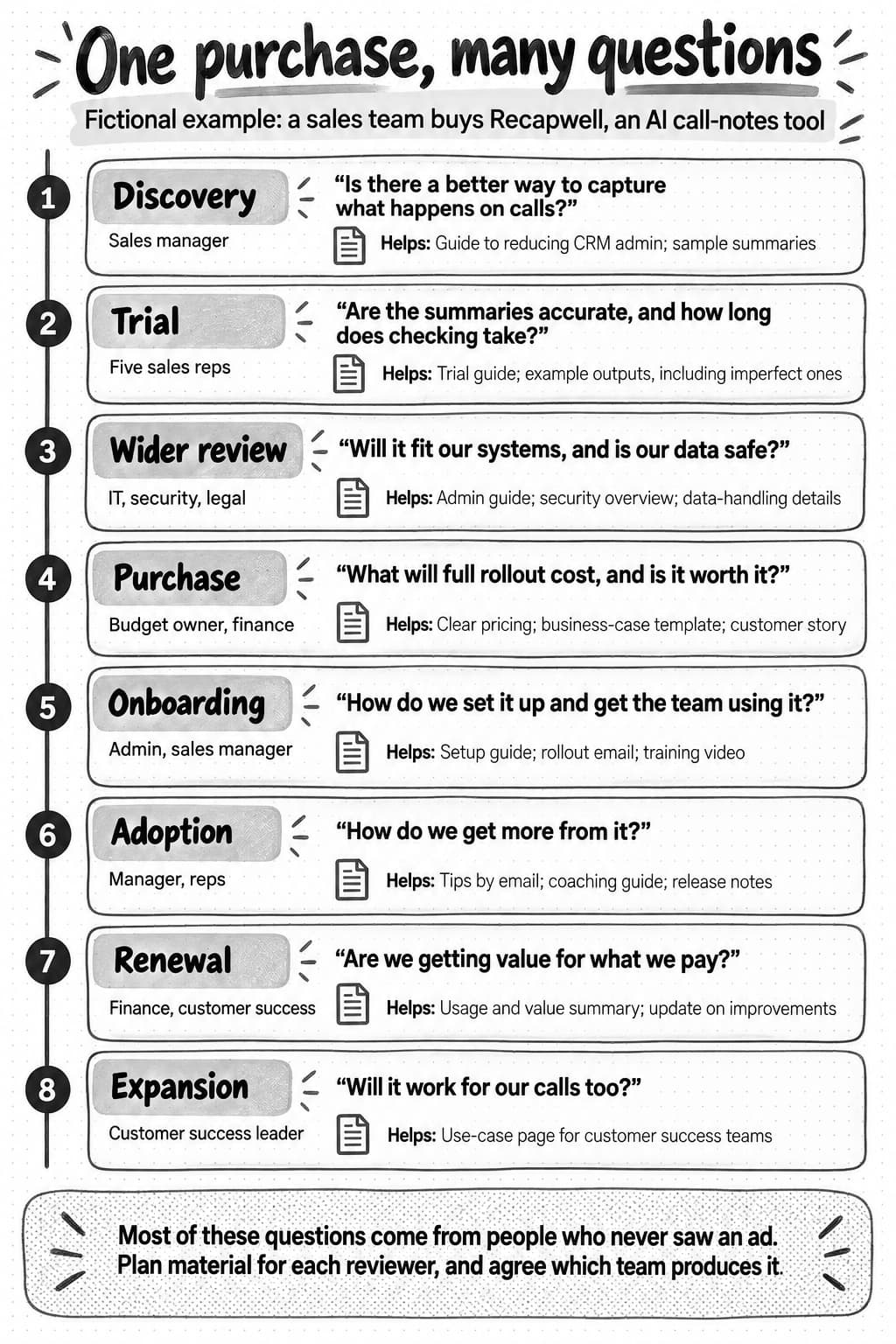
Open the Recapwell example at full size (opens in a new tab).
What buyers need to know when the product uses AI
An AI product raises questions that software without AI features may not. Its output can vary from one use to the next, it may process sensitive information, its cost may rise with use, and its behavior can change when the underlying model is updated. More people also tend to get involved. Forrester's 2026 research reports that buying groups for purchases that include generative AI features are twice the size of groups for purchases without them.
| Buyer question | Material that helps | For example |
|---|---|---|
| What does it do, and what is left to people? | A plain description of the task, its limits, and where people review the output | A product page that states which steps need human approval |
| How good is the output? | Real examples, including imperfect ones, and a description of how quality was tested | Intercom lets Fin customers run simulations, batch tests, and previews before the agent reaches real customers |
| Will it fit how we work? | Integration, administration, and rollout guidance | Setup documentation for the systems the product connects to |
| What happens to our data? | Clear documentation on storage, retention, and whether data trains models | Microsoft states that prompts and responses in its enterprise Copilot service are not used to train foundation models |
| What will it cost as use grows? | Worked pricing examples and spending controls | GitHub documents how administrators set budgets for Copilot usage beyond the included credits |
| What changes when the AI is updated? | Release notes and advance notice of changes that affect output | GitHub announced its move to AI credits more than a month before it took effect |
Claims about output quality need particular care. "Accurate summaries" tells a buyer little. A useful claim says what was tested, how, and where the results apply: for example, which kinds of calls were reviewed, who judged the summaries, and what counted as an error. If the evidence is one demonstration, describe the demonstration rather than implying a general rate. Our content strategy guide separates the kinds of statements an AI company can make and the evidence each requires, and how to evaluate an AI marketing agent shows the buyer's side of the same testing.
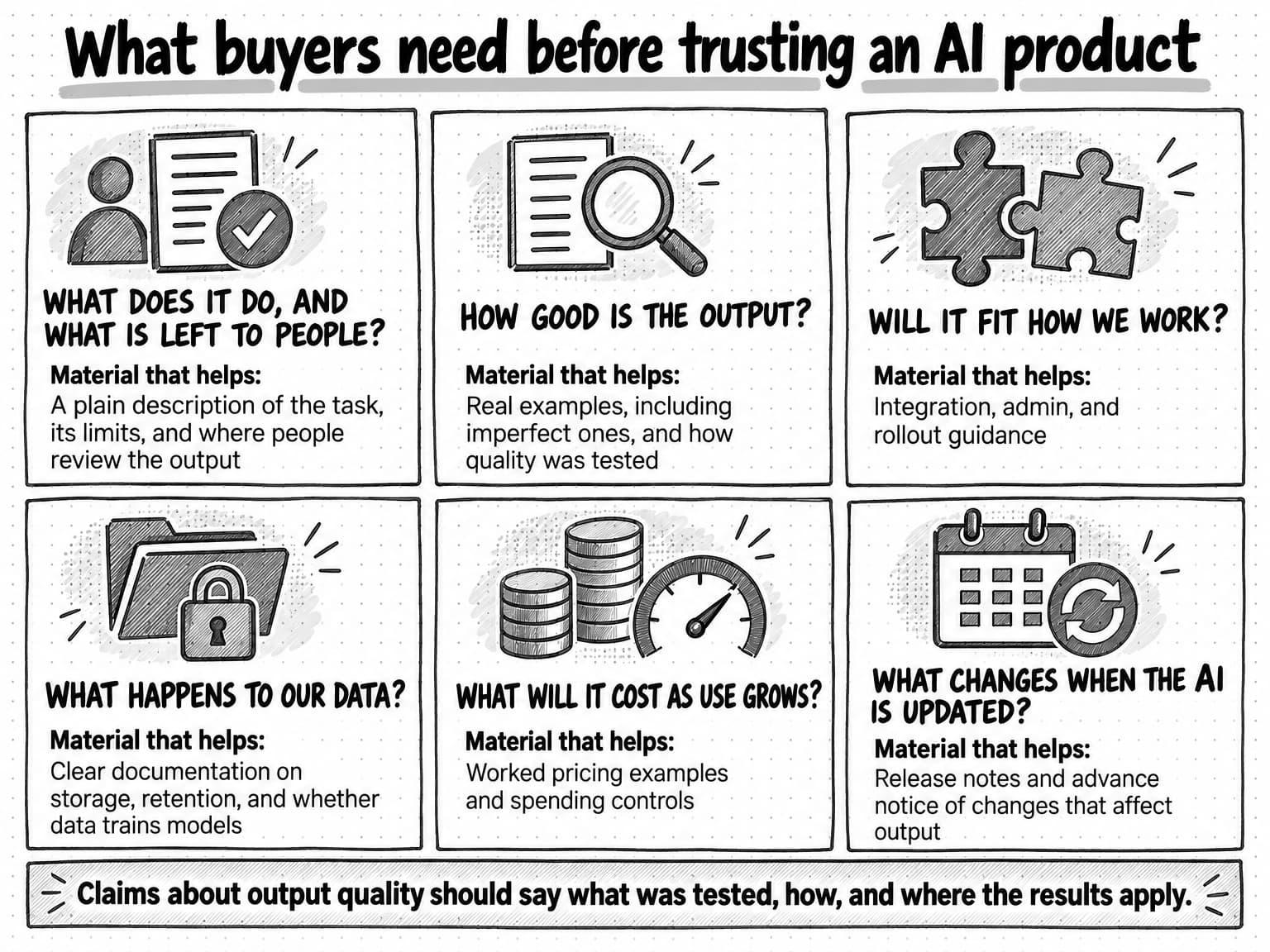
View the AI buyer questions at full size (opens in a new tab).
Basic measures that show whether marketing is working
You do not need a financial model to start. A few measures show whether the work is helping the right people move forward, and they give you a shared vocabulary with sales, product, and finance.
| Measure | What it tells you | What to watch for |
|---|---|---|
| Reach and discovery, such as search visibility, site visits, and audience growth | Whether the right people can find you | Growth from audiences who will never buy |
| Interest, such as sign-ups, demo requests, and newsletter subscriptions | Whether people want to learn more | Counting every form fill as a buyer |
| Activation rate: the share of new accounts that reach a first meaningful result | Whether trials and onboarding show the product's value | A definition of activation that does not predict continued use |
| Conversion and win rate: the share of trials that become paid, or of sales opportunities that close | Where evaluations stall | Comparing rates across very different customer types |
| Retention and churn | Whether customers keep paying | Treating retention as marketing's result alone |
| Net revenue retention: this year's revenue from a group of existing customers compared with the same group's revenue a year earlier | Whether existing customers grow after they buy; above 100% means expansion outweighed losses | Definitions that differ between companies |
| Customer acquisition cost and payback period: what it costs to win a customer, and how long their revenue takes to recover that cost | Whether growth is affordable | Leaving out costs such as salaries or tools |
Even a common measure can be calculated in different ways. Snowflake's annual report calculates net revenue retention from product revenue over a two-year period, while Datadog's uses annual recurring revenue and averages the result over the trailing 12 months. Both leave out new customers, but their figures cannot be compared directly, so agree on your own definitions before you track progress.
Two cautions apply to all of these measures. First, a business software purchase involves many people and many touchpoints over weeks or months, so reports that assign credit for a sale to a single campaign show only part of the picture. Combine them with what customers and sales teams tell you about what influenced a decision. Second, published benchmarks vary by market, price, and buying approach, so your own trend over time is usually a better guide than another company's number.
Apply it to your product
You can use this guide's ideas without a full marketing plan. Take one product, or one customer segment, and work through six steps.
- Name the buying approach. Can someone reach value alone? Who pays, and who must approve? Choose self-serve, sales-assisted, sales-led, or a mix.
- List who takes part. Include users, the internal champion, the budget owner, and any IT, security, legal, or procurement reviewers.
- Write each person's main question in their own words. "Will this work with our CRM?" is more useful than "integration concerns."
- Check the questions against evidence. Look at sales calls, support tickets, trial behavior, lost deals, and reviews, and mark anything you are guessing.
- Choose a few activities. For each question, name the material, the team that produces it, and where the person will find it.
- Pick one measure for each activity. Look for a sign that the person moved forward, such as a trial reaching first value or a security review finishing sooner.
Here is how the first rows might look for a hypothetical self-serve planning tool used by small teams:
| Person | Main question | Activity | Measure |
|---|---|---|---|
| Team lead trying the product | Can we plan our next project here without a long setup? | A project-planning template and a two-minute setup video | Share of new teams that create and share a plan in their first week |
| Workspace administrator at a growing account | Can we control who sees what as more people join? | An administration and permissions guide, and a plan comparison that shows which controls each plan includes | Upgrades among teams that pass the free plan's user limit |
| Finance approver | What will this cost if the whole department joins? | Pricing examples for several team sizes | Time from an upgrade request to a completed purchase |
Start with the two or three questions that most often slow or stop purchases. Good answers to those questions give every channel something useful to say.
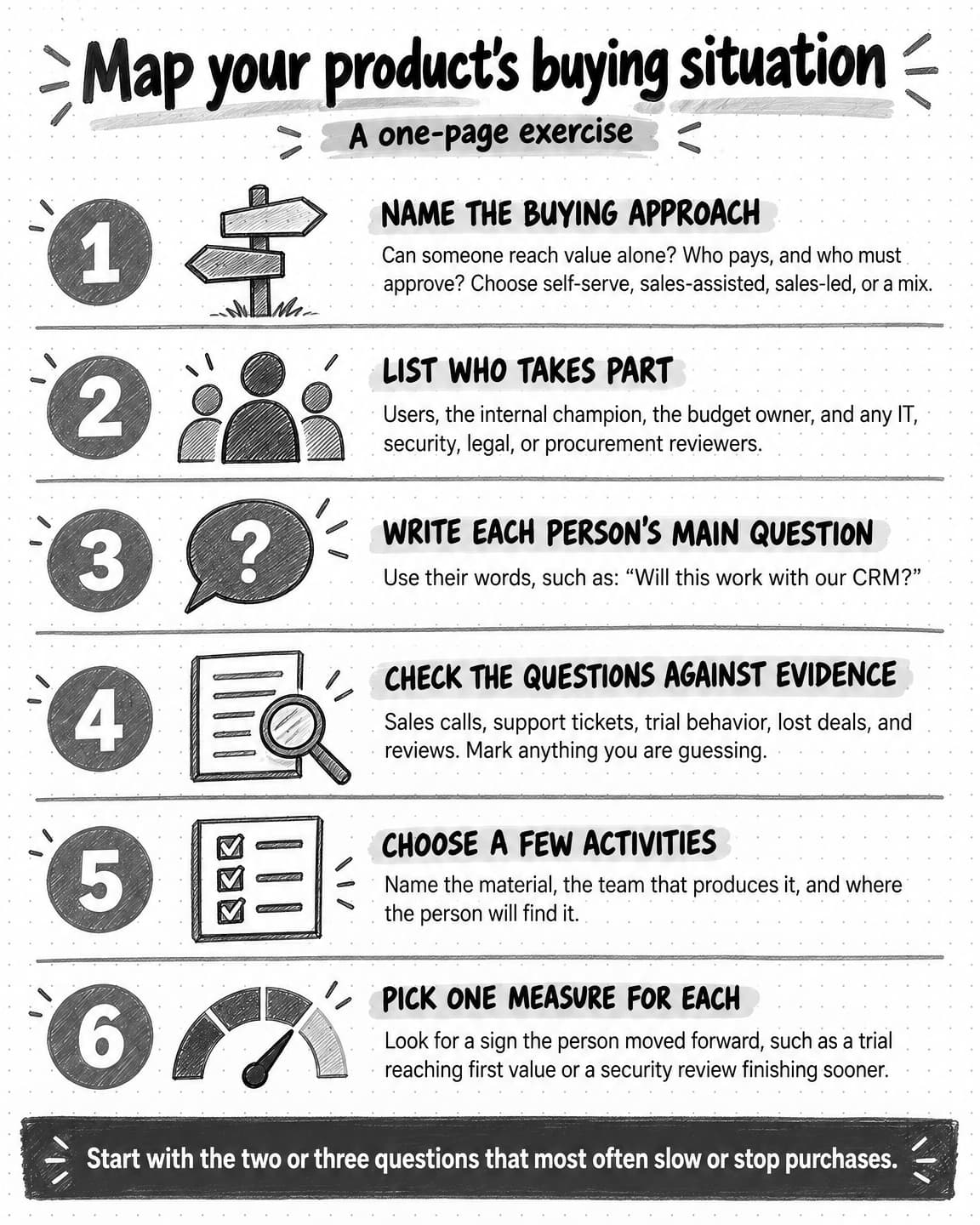
Open the exercise at full size to save a copy (opens in a new tab).
Once you know which questions matter, the next step is to decide what to say and how to say it. The brand messaging framework guide and the creative brief guide turn those answers into positioning and campaign material.
Meet Ampere—your AI marketing agent. Ampere can research competitors, public reviews, and community discussions, help turn the evidence you supply into positioning and messaging, and draft the articles, landing pages, emails, and campaign assets that answer buyers' questions. Your team provides the customer knowledge, checks the facts, and approves what goes out.
Sources and further reading
- Google Search Central: Creating helpful, reliable, people-first content
- Google Search Central: Guidance for generative AI features in Search
- Forrester: The State of Business Buying, 2026
- Gartner: 69% of B2B buyers turn to sales reps to validate AI-generated insights
- G2: 2026 Buyer Behavior Report
- Winning by Design: The Bowtie model
- AICPA: SOC 2 examinations
- Atlassian: Jira pricing
- Slack: Pricing
- Notion: Pricing
- Figma: Pricing
- Twilio: SMS pricing in the United States
- GitHub: Copilot plans
- GitHub Docs: Copilot billing for organizations and enterprises
- GitHub Blog: GitHub Copilot is moving to usage-based billing
- Intercom: Fin pricing
- Intercom: How Fin outcomes are defined and billed
- Intercom: Simulations, batch tests, and previews for Fin
- Microsoft Learn: Enterprise data protection in Microsoft Copilot
- HubSpot Academy
- Salesforce Trailhead
- Snowflake: Annual report on Form 10-K for fiscal 2026
- Datadog: Annual report on Form 10-K for 2025
Frequently Asked Questions
What is B2B SaaS in simple terms?
B2B SaaS is software that organizations use online and pay for over time. B2B, short for business-to-business, means the customer is an organization, not an individual consumer. SaaS, short for software as a service, means the product runs online, where the vendor can keep updating it, and is paid for by subscription or by usage instead of being installed after a one-time purchase. Jira, Slack, and GitHub Copilot are examples.
How does B2B SaaS marketing differ from traditional B2B marketing?
B2B SaaS marketing differs mainly in when revenue arrives and how long marketing's work continues. In a one-time business sale, such as equipment or a perpetual software license, the vendor earns most of its revenue at the sale. Under a subscription, the first contract may be modest, the return builds while the customer stays, and a customer who struggles with the product is likely to leave at renewal. Marketing therefore sets accurate expectations before the sale and supplies onboarding material, education, and product news afterward.
What are some effective marketing strategies for B2B SaaS businesses?
Effective B2B SaaS marketing strategies match how customers buy. In self-serve buying, where customers sign up and pay without talking to sales, marketing brings in the right users and helps them reach a first useful result quickly. Sales-assisted buying adds a salesperson as the purchase grows, so marketing also equips the colleague arguing for it with business-case material and security documentation. For sales-led purchases, account-based marketing coordinates campaigns and outreach for each target organization. Slack, Notion, and Figma combine approaches, selling lower tiers online and enterprise plans through sales.
How do you create a B2B SaaS marketing strategy?
A B2B SaaS marketing strategy starts by mapping how customers buy and what each person in the purchase needs to know. Name the buying approach, list everyone who takes part, and write each person's main question in their own words. Check the questions against sales calls, support tickets, trial behavior, lost deals, and reviews. For each question, choose the material, the team that produces it, and a measure that shows the person moved forward. Begin with the two or three questions that most often slow or stop purchases.
What are some examples of B2B SaaS marketing?
Examples of B2B SaaS marketing include HubSpot Academy and Salesforce's Trailhead, free courses that give people a reason to learn with the company before and after they buy. Jira's free plan is upgraded automatically to a seven-day trial of the Standard plan when a team passes its user limit, and GitHub announced its move to usage-based Copilot billing more than a month before the change. The guide's fictional worked example follows one AI call-notes tool from a first search to a second team's evaluation.
What are the main B2B SaaS marketing channels?
The main B2B SaaS marketing channels are the familiar ones: content, search, social media, email, and paid campaigns. Search now includes AI-generated answers as well as lists of links. The wider work also includes customer research, product education, customer evidence such as case studies and reviews, and launches. What distinguishes B2B SaaS marketing is deciding which buyer question each channel should answer, and at which stage of the purchase or the customer relationship.
What is B2B SaaS content marketing?
B2B SaaS content marketing means publishing articles, guides, reports, videos, and newsletters that help buyers recognize a problem and learn their options. Content does most of its work during discovery and evaluation, and AI assistants may summarize it for a buyer before anyone at the company knows that buyer exists. Distinctive content draws on the company's own product knowledge and customer experience. Some of the most useful material is written for the colleague who champions the purchase to share internally, such as a one-page summary for leadership.
What metrics should you track in B2B SaaS marketing?
Track a few measures that show whether the right people are moving forward: reach, interest such as sign-ups and demo requests, activation rate, trial conversion or win rate, retention and churn, net revenue retention, and customer acquisition cost with its payback period. Agree on each definition first, because companies calculate even net revenue retention differently. Your own trend over time is usually a better guide than another company's number, and a report that credits a sale to one campaign shows only part of a purchase involving many people.
What does the B2B SaaS marketing funnel look like?
The B2B SaaS marketing funnel runs from discovery and evaluation to the purchase, then through onboarding, adoption, retention, and expansion. Because the relationship continues after the sale, some teams draw it as a bow tie: one side narrows toward the purchase and the other widens again after it. Winning by Design's Bowtie model is one published version. Real purchases loop and stall, and a satisfied team can lead to a new evaluation elsewhere in the same company.
How can B2B SaaS teams align marketing and sales?
B2B SaaS teams align marketing and sales through shared agreements on what counts as a qualified prospect, how a prospect moves from marketing to sales and then to customer success, and who produces which material. Sales passes back the questions and objections heard on calls and the reasons deals are lost. Marketing supplies prospects who fit, material for each reviewer, and current competitive information. Customer feedback should also reach the team that can act on it, since retention is a shared outcome.