What is topical authority? How topic clusters and pillar pages build it
What topical authority means and what Google has actually documented about it, plus a method for choosing a topic, mapping it into a pillar page and cluster pages, linking them, pruning what doesn't fit, and checking whether it's working.
44 min readWritten by Ampere
Short answer
What is topical authority?
Topical authority is the degree to which a website is recognized as a thorough, reliable source on one subject, built by answering that subject's questions in depth and linking the pages together. It is an SEO-industry concept rather than a named Google score for web results, but it matches what Google's guidance rewards: a clear focus, depth, original evidence, and descriptive internal links.
Summary
Topical authority describes a site that covers one subject thoroughly, answers its questions in depth, and connects those pages so the coverage reads as a whole. Google has documented a topic authority system only for news queries, and its helpful content guidance asks whether a site has a primary focus. A site-wide topical authority score and third-party domain authority numbers are not Google metrics, so the concept works best as a planning model.
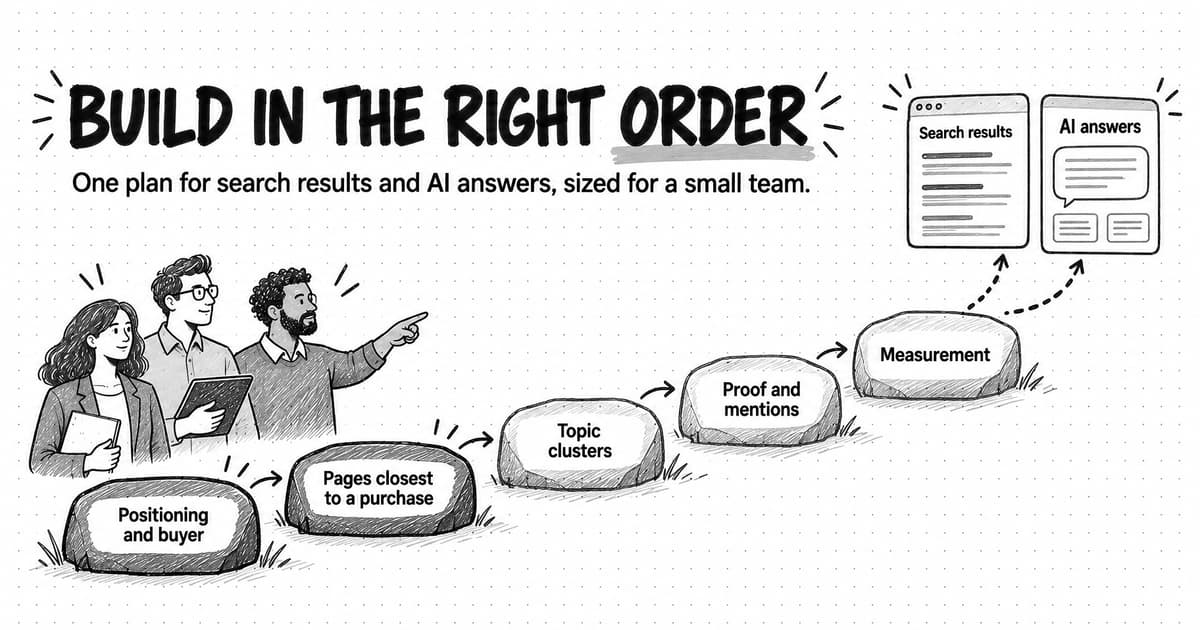
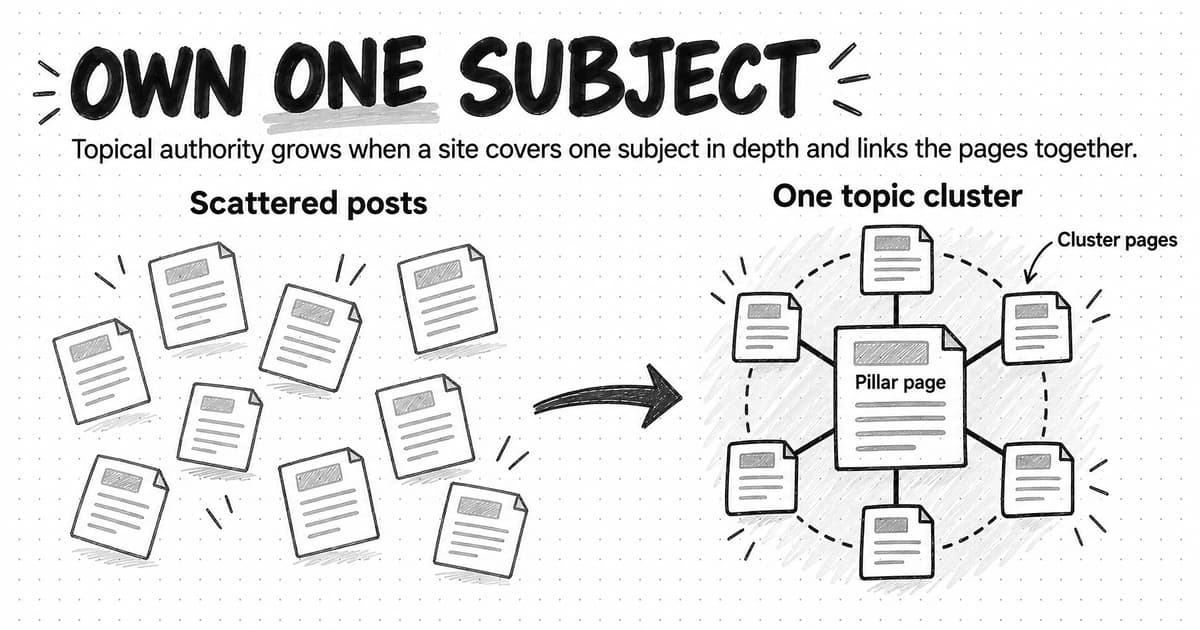
Topic clusters put the idea into practice. A pillar page answers the broad question and links to cluster pages that each answer one specific question in depth; each cluster page links back, and related cluster pages link to each other with descriptive anchor text. Content pillars are different: they are editorial themes across every channel, and one content pillar may have one pillar page, several, or none.
Building a cluster starts with a subject narrow enough to win, where the product's job, the company's expertise, reader demand, and a beatable field overlap. A topic map then lists the buyer's questions, groups them by reader and job, gives each question one page marked existing, update, merge, or new, and plans the links. A copyable template and a fictional worked example with one pillar and twelve cluster pages show the result.
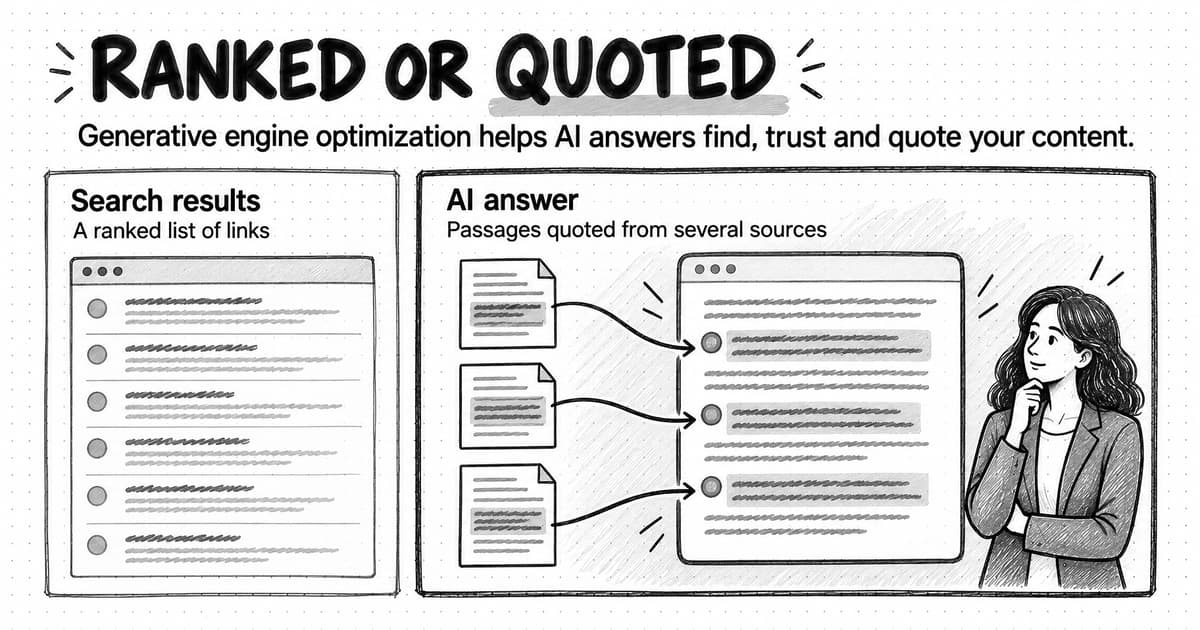
Depth and evidence decide whether a cluster is worth citing. Google says length alone does not matter for ranking; a deep page lets a practitioner do the work without opening another tab, and original data gives readers something the top results lack. Google's AI Overviews and AI Mode may run related searches across subtopics, so a cluster plausibly gives AI answers more pages to draw on, though no AI search provider documents rewarding topical coverage.
Existing posts need a decision too, made carefully: keep and link posts on the topic map, merge duplicates, keep useful off-topic posts outside the cluster, rewrite what can fit, and remove only what nothing uses. Then judge the cluster as a unit after one quarter and again at six months, by the queries its pages appear for, positions on core questions, AI answer citations, links, and reader paths.
Contents
- What topical authority means
- What Google has said, and what is SEO theory
- Topical authority vs domain authority
- Topic clusters and pillar pages explained
- Content pillars vs SEO pillar pages
- How to choose a topic you can own
- How to map a topic into subtopics and pages
- Internal linking that shows the structure
- Depth, evidence and original data
- When to prune, merge or move off-topic content
- Topical authority in AI answers
- A topic map template you can copy
- Worked example: one fictional company's topic map
- How to tell whether topical authority is building
- Building topic maps with Ampere
- Sources and further reading
- Frequently Asked Questions
Open the blog of a B2B software company that has been publishing for three or four years and you will often find the same thing. There are 80 posts, written by different people for different reasons: a launch announcement, a guest post a partner asked for, a piece on remote work culture that someone wanted to write, a few strong guides on the problem the product actually solves, and two or three posts that answer the same question in slightly different words. Each post was a reasonable decision on the day it was published. Together they do not tell a reader, a search engine, or an AI answer what the company knows best.
That missing signal is what SEO practitioners mean by topical authority. Topical authority is the degree to which a website is recognized as a thorough, reliable source on one subject, earned by covering that subject's questions in depth and connecting the pages so the coverage reads as a whole. It is a property of a body of work rather than of any single page. A site with topical authority on usage-based billing has pages that answer the beginner's question, the operator's question, and the edge case, and those pages point to each other.
The phrase needs care, because it is used in two ways. As a planning model for a content library, it is helpful. As a score Google supposedly keeps for every site, it goes beyond what Google has documented, and the difference changes how you should spend your time. This guide separates the two, then sets out a method a small team can run: choose a topic you can own, map it into a pillar page and cluster pages, link them, add the evidence that makes depth worth citing, deal with the posts that do not fit, and check whether the work is paying off. A worked example follows one fictional software company from 80 scattered posts to a map of one pillar and twelve cluster pages, and a template lets you build your own.
What topical authority means
The idea behind topical authority is familiar from everyday life. If you want advice on a tax question, you trust a source that has clearly spent years on tax questions over a general magazine that ran one piece on the subject. You infer expertise from breadth and consistency within a subject: the source has answered the obvious questions, the hard ones, and the follow-ups, and it is still answering them.
Applied to a website, topical authority describes three things that tend to appear together.
The first is coverage. The site answers most of the questions a reader in that subject is likely to have, not just the ones with the highest search volume. A site about onboarding software that has a guide to the first day but nothing on paperwork, training schedules, or measuring retention has gaps a reader will notice.
The second is depth. Each page answers its question properly, with the steps, examples, caveats, and evidence a practitioner needs. Twenty thin pages on twenty subtopics show less expertise than ten pages that a reader could act on.
The third is structure. The pages are connected in a way that shows how the subject fits together: a broad overview page links to the detailed pages, the detailed pages link back to it and to each other, and the anchor text of those links says what each page covers. Structure is what turns a pile of related posts into something a reader can navigate and a crawler can interpret.
Topical authority is also relative. A site does not have authority on "marketing"; it has authority on a narrower subject compared with the other sites that cover the same questions. That is why the method later in this guide starts by choosing a subject narrow enough that a small team can cover it better than the sites currently answering its questions.
What Google has said, and what is SEO theory
Most confusion about topical authority comes from treating an industry model as if it were a documented Google system. It is worth being precise about what Google has published.
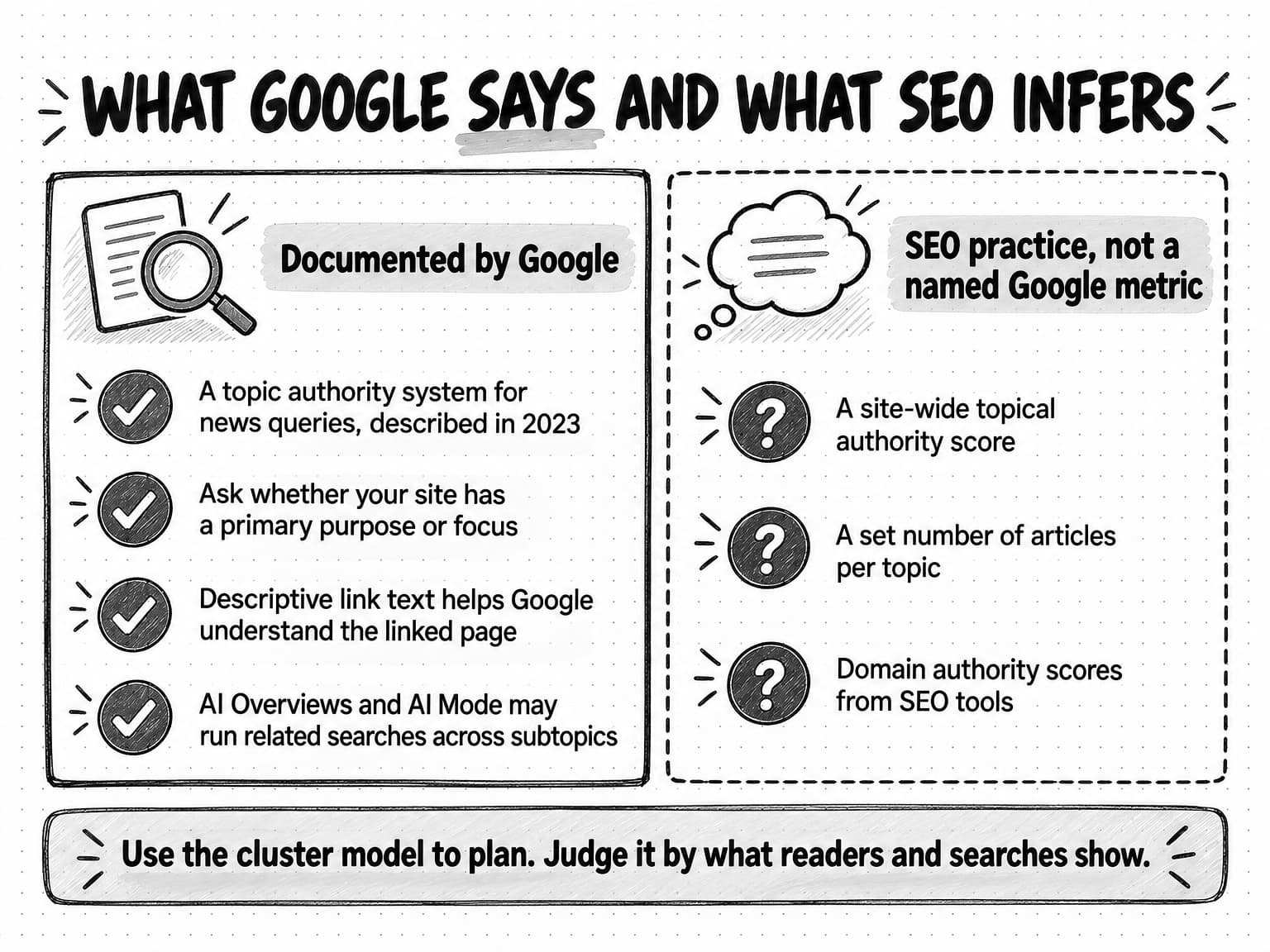
Google has described one system with almost this name. In a May 2023 post on the Google Search Central blog, Jen Granito, a Group Product Manager for Search, wrote that Google developed "a system called topic authority" to help determine which expert sources are helpful for "someone's newsy query in certain specialized topic areas, such as health, politics, or finance." The post names three prominent signals: how notable a source is for a topic or location, influence and original reporting (measured partly by how other publishers cite a publication's original reporting), and source reputation, such as a history of high-quality reporting or recommendations from expert sources. Its examples are about local and specialist news, such as a regional paper covering a flood in its own area. Its advice to publishers is plain: "provide great coverage about the areas and topics they know well."
That post is evidence that Google thinks about expertise at the level of a publication and a topic. It is not evidence that the same system scores a B2B software blog, and Google has not said that it does. The post is explicitly about news queries and news features.
Google's general guidance points in the same direction without naming a metric. Its documentation on creating helpful, reliable, people-first content asks site owners a series of self-assessment questions, including "Does your site have a primary purpose or focus?" and "Are you producing lots of content on many different topics in hopes that some of it might perform well in search results?" The second question is listed as a warning sign of search-engine-first content. The same page asks whether a reader would come away with the impression that a site is "well-trusted or widely-recognized as an authority on its topic." These questions describe the qualities topical authority is meant to capture: focus, depth, and a reputation tied to a subject.
Google's guide to its ranking systems, last updated in December 2025, does not list a topical authority system for web results. It does record that the helpful content system, which was designed to reward "original, helpful content written by people, for people," became part of Google's core ranking systems in March 2024. And its link best practices say that anchor text "tells people and Google something about the page you're linking to," and that attention to the anchor text of internal links can help people and Google make sense of a site.
View the Google documentation and SEO theory comparison at full size (opens in a new tab).
Everything else is SEO theory: reasoned inferences from how search engines work, from patents, from tests, and from experience. Some of it is well supported by practice. None of it is a published Google metric. The table sorts the common claims.
| Claim | Status | How to use it |
|---|---|---|
| Google has a "topic authority" system | Documented, for news queries in specialized topic areas | Do not assume it applies to a company blog |
| A focused site with a clear purpose is a good sign | Documented as a self-assessment question in Google's helpful content guidance | Treat focus as a goal for your library |
| Descriptive internal links help Google understand pages | Documented in Google's link best practices | Plan links and anchor text deliberately |
| Google keeps a site-wide "topical authority score" | Not documented | Ignore tools that claim to show it as a Google number |
| A topic needs a set number of articles before it ranks | Not documented; Google says content length alone does not matter for ranking | Cover the questions readers have, however many that is |
| Pillar pages and clusters cause rankings | Not documented as a ranking mechanism | Use the model to plan coverage and links, then measure |
The practical conclusion is that you do not need Google to confirm a topical authority score to act on the idea. Covering one subject thoroughly, focusing the site, and linking related pages clearly are all consistent with what Google has published, and they make the site better for readers whether or not any system measures them as a unit. What you should avoid is optimizing for a third-party "authority" number as if it were Google's.
Topical authority vs domain authority
Domain authority is the term most often confused with topical authority, and the two measure different things.
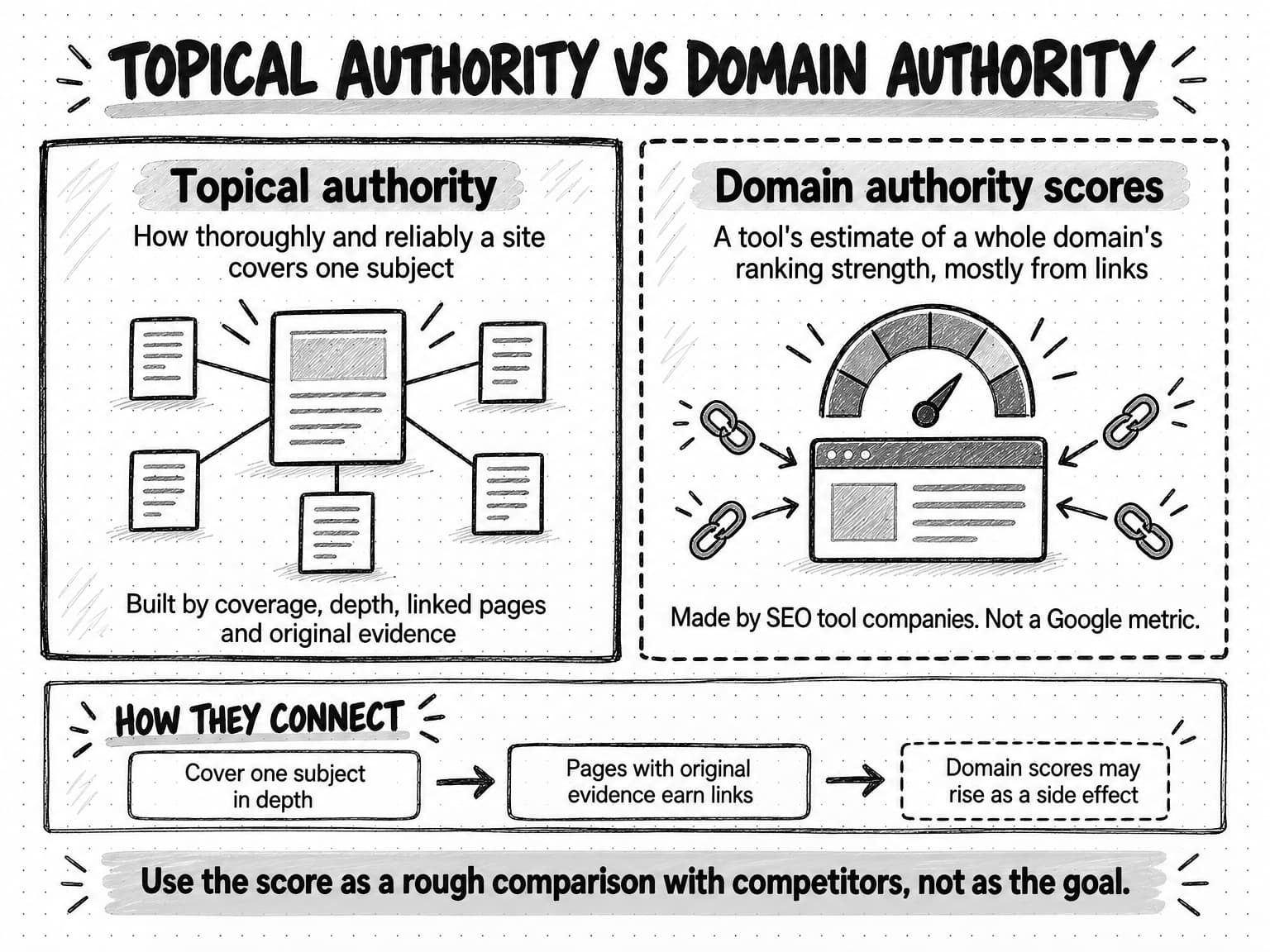
Domain Authority, with capital letters, is a score created by Moz, an SEO software company. Moz describes it as a score from 1 to 100 that predicts how likely a site is to rank compared with competitors, built largely from the site's link profile. Moz's own explanation of Domain Authority says plainly that "Domain Authority is not a Google ranking factor and has no effect on the SERPs." Other SEO tools publish similar scores under their own names. All of them are estimates made by a third party from the data that party can collect, mostly links from other sites.
Topical authority is about subject matter, not links in general. A site can have a high domain score because a few popular pages attracted many links, and still cover its core subject thinly. A small specialist site can have a modest domain score and still be the best source on a narrow subject, because it answers every question in that subject well.
| Topical authority | Domain authority scores | |
|---|---|---|
| What it describes | How thoroughly and reliably a site covers one subject | A tool's estimate of a whole domain's ranking strength, mostly from links |
| Who defines it | An SEO-industry concept with no single official measure | Each SEO tool company defines its own score |
| Scope | One subject at a time | The whole domain at once |
| What builds it | Coverage, depth, structure, evidence, and reputation within the subject | Links from other sites, as each tool counts them |
| Is it a Google metric? | Not as a named score; Google describes related qualities | No; Moz says its score is not a Google ranking factor |
The two are related in one way. Pages that cover a subject thoroughly and include original evidence tend to attract links from other sites, and those links raise domain scores. So the work that builds topical authority can move a domain score as a side effect. Treat the score as a rough comparison with competitors, not as the goal.
View the topical authority and domain authority comparison at full size (opens in a new tab).
Topic clusters and pillar pages explained
The topic cluster model is the most common way to put topical authority into practice. It organizes content about one subject into a hub page and a set of detailed pages that link to each other.
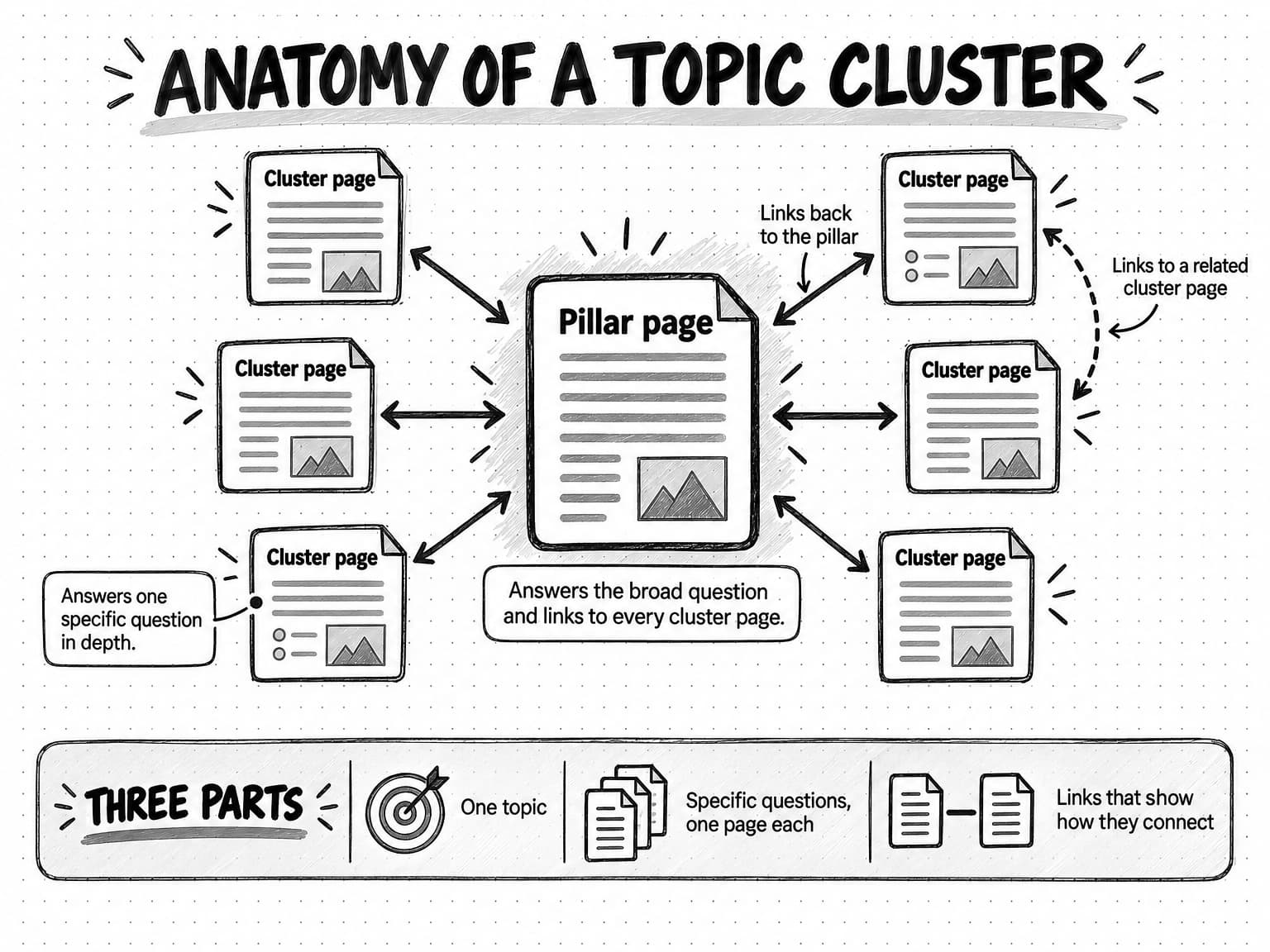
A pillar page is a broad page that answers the main question about a subject and gives an overview of its parts. HubSpot, which popularized the model, describes a pillar page in its knowledge base as "a comprehensive resource page that covers a topic in depth." In practice, a good pillar page defines the subject, explains how its parts fit together, answers the most common questions briefly, and sends readers to a detailed page for each part.
A cluster page answers one specific question within the subject in full. HubSpot describes the subtopics behind these pages as addressing "a specific question about your pillar page topic." A cluster page about "how to run a preboarding checklist for shift workers" goes into the steps, the template, the mistakes, and the example; the pillar page gives that question a paragraph and a link.
A topic cluster is the pillar page plus its cluster pages and the links between them. The links run in three directions. The pillar page links out to every cluster page. Each cluster page links back to the pillar page. And cluster pages that relate closely link to each other where a reader would need the other page next.
View the topic cluster diagram at full size (opens in a new tab).
The model works for readers first. Someone who lands on a detailed page from search can step up to the overview to see the whole subject. Someone who starts at the overview can go straight to the question they have. For a search engine, the same links and their anchor text describe which pages belong together and what each covers, which is the use Google's link guidance describes.
It is worth knowing what the model does not do. HubSpot's own knowledge base notes that creating topic clusters in its software "doesn't affect your website's SEO directly." The structure has value because it changes what you publish and how you link it, not because a cluster label is read by Google. A cluster made of thin pages linked to each other is still thin.
A pillar page is also different from a landing page. A pillar page teaches: it is written for readers who are learning about a subject and gives them a route into the detail. A landing page is built to get a visitor to take one action, such as starting a trial or booking a demo, and usually serves visitors arriving from a campaign. A pillar page can link to a landing page where a reader is ready for that step, but a page that tries to do both jobs tends to do neither well.
A topical map is the planning document behind one or more clusters: a list of the subject's questions, grouped into subtopics, with a page assigned to each. Some practitioners use "topical map" for a larger plan covering several related clusters. The template later in this guide is a topical map for one cluster.
Content pillars vs SEO pillar pages
A team building its first cluster often already has "content pillars" from a content strategy, and the shared word causes trouble.
Content pillars are the recurring subjects a company publishes about across every channel: blog, newsletter, LinkedIn, webinars, sales material. They are editorial themes. Our guide to choosing content pillars for a content calendar covers how to pick them from evidence and run a calendar on them, and it includes a table that separates content pillars, messaging pillars, topics, and pillar pages.
A pillar page is a single page on a website, an SEO structure for one subject. A content pillar might have one pillar page as its anchor on the website, several pillar pages for different sub-subjects, or none at all if the theme lives mostly on LinkedIn and in a newsletter.
The two connect in a useful way. A content pillar tells you which subjects your company has chosen to be known for. The topic cluster is how you build depth in one of those subjects on your website, where search engines and AI answers can find it. If your content strategy has three pillars, you might build a cluster for the one with the clearest search demand first and leave the others as editorial themes until you have capacity. Our guide to building a content marketing strategy for B2B SaaS and AI companies explains how those choices fit into a wider plan.
How to choose a topic you can own
The most consequential decision in building topical authority is the subject. Choose too broadly and a small team cannot cover it better than the large publishers already answering its questions. Choose too narrowly and there is not enough reader demand to justify the work. Choose a subject unrelated to what you sell and you may build an audience that never needs your product.
A topic you can own sits where four things overlap.
Your product's job. The subject should be the problem your product helps solve, described in the buyer's words rather than yours. An onboarding software company's subject is how to onboard employees, not "our onboarding platform." Readers who learn from that subject are the people who might eventually buy.
Your earned expertise. You should have something to say that others cannot easily say: data from your product, patterns your support team sees every week, customers you can learn from, or practitioners on staff. Our guide to what thought leadership is explains how to find a point of view the company has earned. Expertise matters because the later sections on depth and evidence depend on having original material to add.
Reader demand. People should be asking questions about the subject in search, in AI assistants, in communities, and in sales calls. You do not need the subject to have huge volume. A subject with many specific questions that each draw modest interest is often better for a small team than one head term everyone is fighting for. Our sibling guide on keyword research when AI answers come first explains how to gather that evidence.
A winnable field. Look at who currently answers the subject's main questions. If every result is a large publisher or a government agency, and the AI answers cite the same handful of sources, a narrower slice may be the better starting point. If the results are thin, dated, or written by vendors who clearly have not done the work, there is room.
The usual adjustment is to narrow by audience or situation rather than by keyword. "Employee onboarding" is a crowded subject. "Onboarding hourly and frontline employees" is narrower, has its own distinct questions (shift schedules, multi-location training, paperwork before a first shift), and matches a specific buyer. A company that serves that buyer can realistically become the best source on it.
| Test | Question to answer | Warning sign |
|---|---|---|
| Product fit | Would a reader who learns this subject be more likely to need what we sell? | The subject attracts readers who will never buy |
| Expertise | What can we add that the current top results cannot? | Every page would summarize other people's pages |
| Demand | Can we list at least 15 distinct questions people ask about it? | Only one or two queries, or questions nobody asks |
| Field | Who answers these questions now, and can we do better? | Every answer comes from sources far larger than us |
| Capacity | Can we publish and maintain the core pages within six months? | The map needs more pages than we can write or update |
Write the chosen topic as one sentence that names the reader and the subject: "How to onboard hourly and frontline employees, for HR and operations leads at multi-location employers." That sentence becomes the scope test for every page you consider adding.
How to map a topic into subtopics and pages
A topic map turns the chosen subject into a list of pages before anyone writes. It prevents two common failures: gaps, where an obvious question has no page, and overlap, where two pages compete to answer the same question.
View the five-step topic mapping diagram at full size (opens in a new tab).
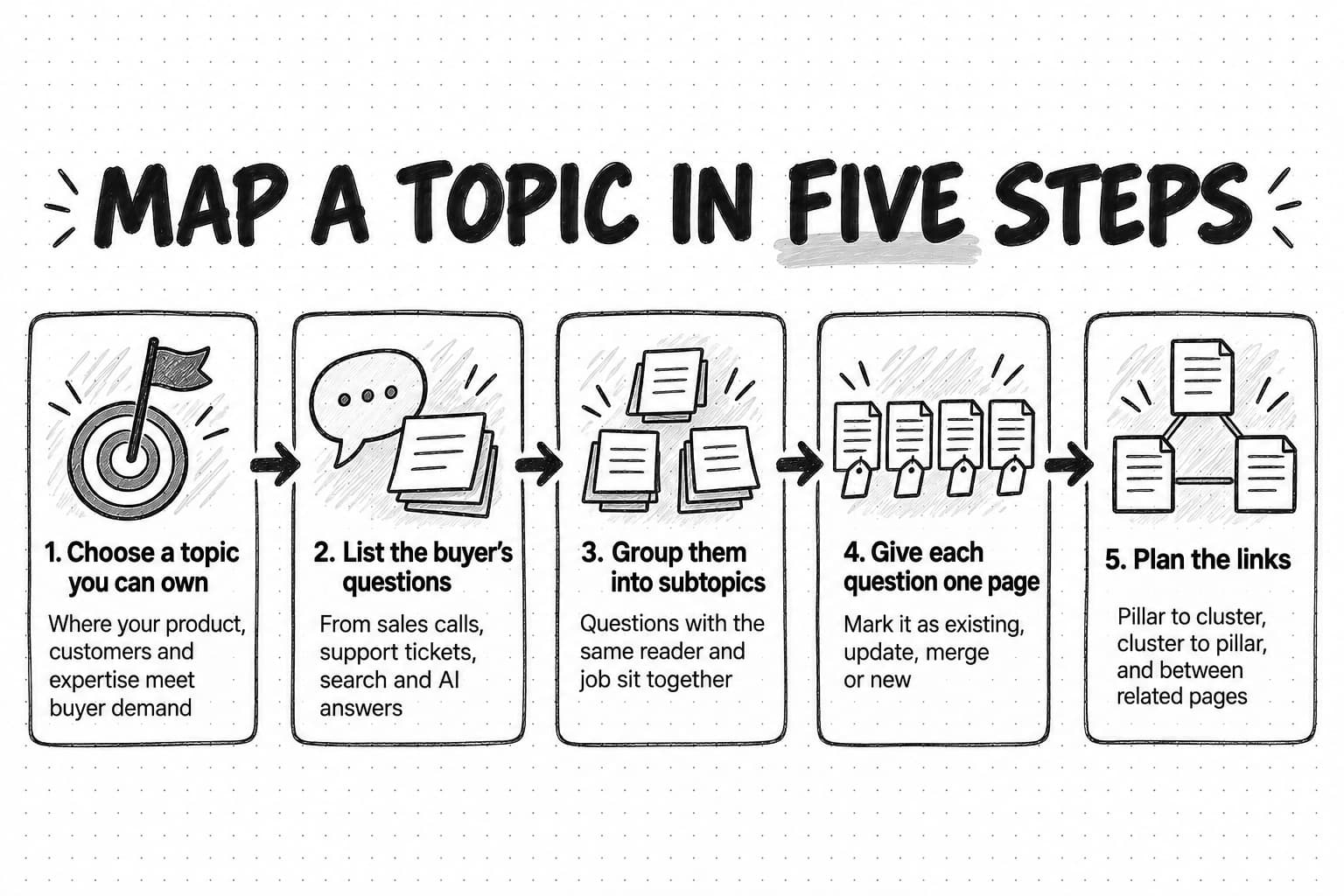
1. Start from the topic sentence. Every question that follows has to serve the reader named in it.
2. List the buyer's questions. Collect questions from several places, because each one shows a different part of demand. Sales and customer-success call notes show the questions buyers ask when they are close to a decision. Support tickets show what goes wrong after purchase. Google's People Also Ask boxes, related searches, and autocomplete show how searchers phrase questions. AI assistants show how people ask conversationally, and the follow-up questions they suggest show what people want next. Communities and forums show the questions practitioners ask each other. Competitor pages show which questions others have chosen to answer, though not whether they answered them well. Our sibling guide on content gap analysis covers how to compare your coverage with competitors' and with AI answers in detail. Aim for a long list at this stage, often 40 to 100 questions for a focused subject.
3. Group the questions into subtopics. Put questions together when they share a reader and a job: the same person asking at the same stage of the work. Questions that differ only in phrasing ("how to onboard seasonal staff" and "seasonal employee onboarding checklist") belong to one page. Questions with different jobs belong to different pages even when they share words. Our sibling guide on search intent explains how to tell whether two queries want the same answer; a quick test is to search both and see whether the same pages come up. A focused subject usually settles into three to six subtopic groups. Across those groups, a focused subject often needs a pillar page and something like eight to fifteen cluster pages, though the right number is whatever it takes to answer the distinct questions on your list.
4. Give each question one page. For every group, decide which questions get their own cluster page and which become sections of a larger page. A question deserves its own page when it needs a full answer with steps, examples, or a template, and when enough people ask it on its own. Smaller questions become sections or FAQ entries. Then mark each planned page with its status: an existing page that already answers it, an existing page to update, two or more existing pages to merge, or a new page to write.
5. Plan the links. Record the pillar-to-cluster and cluster-to-pillar links, plus the two or three cluster-to-cluster links each page needs, with draft anchor text. The next section covers this step in detail.
The output is a table, not a mind map. A table can be sorted by status and owner, which is what you need when the map turns into a publishing plan. A visual map is useful for explaining the plan to colleagues, and the worked example later shows both.
Internal linking that shows the structure
Internal links are how a cluster becomes visible as a cluster. Without them, a pillar page and twelve detailed pages are just thirteen pages on similar subjects.
Google's link best practices set the mechanics. Google can generally only crawl a link if it is an HTML anchor element with an href attribute, so links created only by scripts or click handlers may not be followed. The anchor text, the visible words of the link, should be "descriptive, reasonably concise, and relevant" to both the page it is on and the page it points to. Generic anchors such as "click here" or "read more" tell neither readers nor Google anything about the target.
Within those mechanics, a cluster's link plan has three layers.
Pillar to cluster. The pillar page links to every cluster page, usually from the section that summarizes that subtopic. The anchor names the cluster page's subject in natural words: "our guide to [preboarding checklists for shift workers]" rather than "learn more." Some pillar pages also include a short contents list of cluster pages near the top; that is useful for navigation but does not replace links in context, where the surrounding sentence explains why a reader would go there.
Cluster to pillar. Each cluster page links back to the pillar page, normally early, where the page introduces the wider subject. One clear link is enough. A site-wide sidebar or breadcrumb that points to the pillar also helps, but a link in the body text carries the context.
Cluster to cluster. Related cluster pages link to each other where a reader would naturally need the other page next: the paperwork page links to the first-shift schedule page, the retention page links to the feedback survey page. These links are the ones teams most often skip, and they are what make the cluster read as connected coverage rather than a hub with spokes. Two or three per page is typical. Link only where the connection is real.
Vary anchor text naturally. If every link to the pillar uses the identical phrase, it reads as mechanical to people and adds nothing. Describe the target in the words that fit each sentence.
Once the links are in place, confirm that every cluster page is one click from the pillar and that no page is an orphan that nothing else links to. Our sibling guide on running an SEO audit covers these crawlability checks.
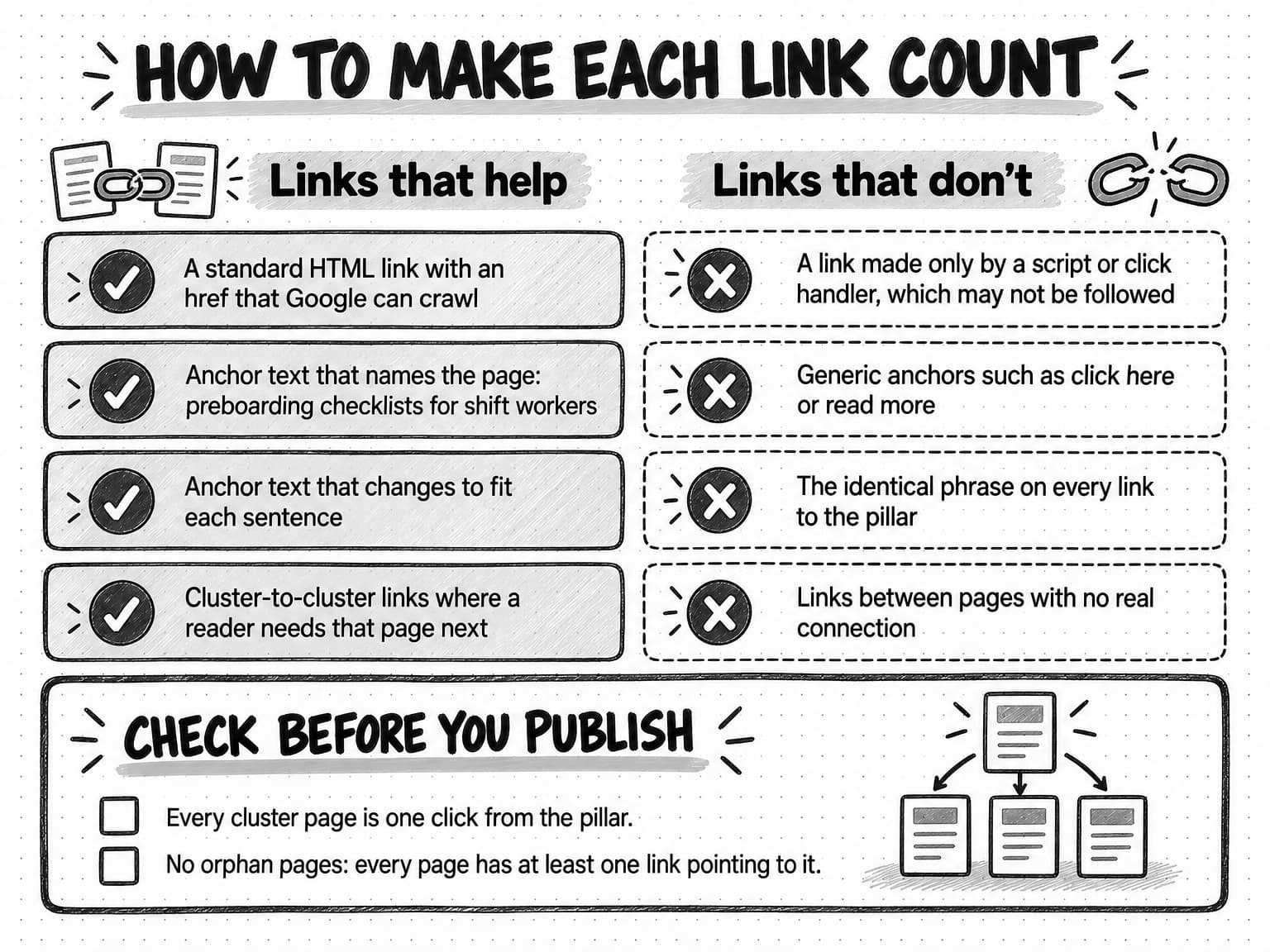
View the internal link checklist at full size (opens in a new tab).
Depth, evidence and original data
Coverage and links make a cluster complete. Depth and evidence make it worth trusting, and they are where most clusters fall short.
Depth does not mean length. Google's SEO Starter Guide says directly that "the length of the content alone doesn't matter for ranking purposes," and that there is no magical word count target. Depth means the page answers the reader's question completely for the job they are doing. For a how-to question, that includes the steps, the decisions along the way, a worked example, the common mistakes, and what to do when the usual approach does not fit. For a definition question, it includes the distinctions from related terms and an example of the concept in use.
A useful test is to read a page and ask whether a practitioner could do the work from it without opening another tab. If they would need to look elsewhere for the template, the example, or the caveat, the page is not yet deep.
Evidence is what separates a page that repeats the consensus from one that adds to it. The strongest evidence is material only your company has: aggregated data from your product, results from a survey of your customers, patterns from support tickets, a test you ran, or an expert on staff explaining what they have seen. This is the "influence and original reporting" idea from Google's news topic authority post applied to a company site. Pages with original evidence are also the ones other sites cite and link to, which builds reputation outside your own domain. Our guide to creating original research content covers five ways to create data on a small budget and how to write findings people quote.
Not every cluster page needs original data. One flagship page built on a customer survey, a few with product-derived benchmarks, and the rest built on careful synthesis with clear citations can be enough, as long as the cluster as a whole contains something a reader cannot get from the first page of results.
Evidence also matters for AI answers, which the section after next covers. One study is relevant here. Researchers from Princeton University and the Indian Institute of Technology Delhi, with two independent researchers, tested how content changes affected a source's visibility in the answers of generative engines, in a paper presented at KDD 2024, GEO: Generative Engine Optimization. On their benchmark of queries, the best-performing changes were adding citations to credible sources, adding relevant quotations, and adding statistics, which raised visibility by 30 to 40 percent relative to unchanged pages on one of their two measures, and by 15 to 30 percent on the other. Keyword stuffing, a traditional SEO tactic, offered little to no improvement. The study measured changes to individual pages in a controlled setting, not topical authority, so treat it as support for adding evidence to pages rather than as proof that clusters earn citations.
When to prune, merge or move off-topic content
Most teams starting a cluster already have a library like the one in this guide's opening: some posts belong in the cluster, some duplicate each other, and some have nothing to do with the chosen subject. Deciding what to do with them is part of building topical authority, because Google's helpful content guidance asks whether a site has a primary focus.
The decision should be careful, because removing pages is hard to undo. Google's documentation on core updates says that "deleting content is a last resort, and only to be considered if you think the content can't be salvaged," and suggests that rewriting or restructuring content to make it easier to read and navigate is often the better improvement. An off-topic post that brings in readers, earns links, or gets used by sales is doing a job even if it sits outside the cluster.
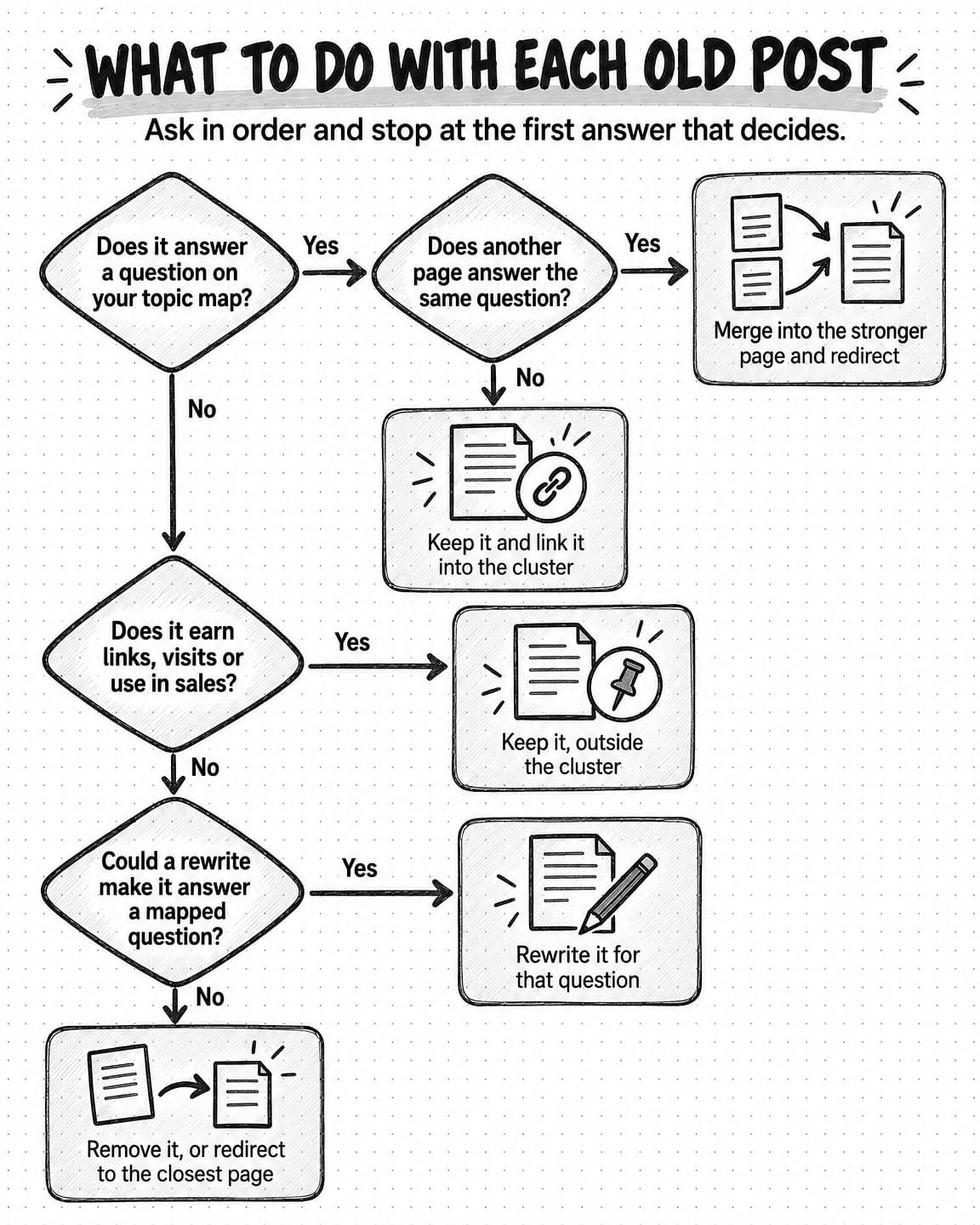
View the old post decision flowchart at full size (opens in a new tab).
Work through each existing post with four questions, in order, and stop at the first answer that decides it.
- Does it answer a question on your topic map? If yes, it belongs in the cluster. Go to the next question to check for duplicates.
- Does another page answer the same question? If yes, merge them: keep the page with the stronger links, search performance, and address, move the useful material from the others into it, and redirect the others to it. If no, keep it, update it if it is weak, and add it to the cluster's link plan.
- For a post not on the map: does it earn links, visits, or use in sales? If yes, keep it, but leave it out of the cluster's links. It can stay live without pretending to be part of the subject.
- Could a rewrite make it answer a mapped question? If yes, rewrite it for that question and add it to the cluster. If no, remove it, or redirect it to the closest relevant page if it has any links or traffic.
This is a narrower version of a full content audit, applied only to topical fit. Our guide to running a content audit covers the full keep, update, merge, or cut method, including how to score quality and performance, and what Google's documentation says about redirects and removals.
Two cautions apply. First, do not remove product documentation, legal pages, recruiting pages, or pages linked from your product because they are "off-topic" for the blog; they exist for other reasons. Second, do not mass-produce pages to fill a map. Google's spam policies define scaled content abuse as generating many pages "for the primary purpose of manipulating search rankings and not helping users," regardless of how the pages are created, and name using generative AI tools to produce many pages without adding value as one example. A map with twelve useful pages beats one with sixty thin ones.
Topical authority in AI answers
AI answer engines add a second reason to build depth on one subject. They do not just rank pages; they assemble answers from several sources and cite some of them. The detail is covered in our sibling guide on how AI search engines choose which sources to cite. Here, the relevant question is why a cluster might help.
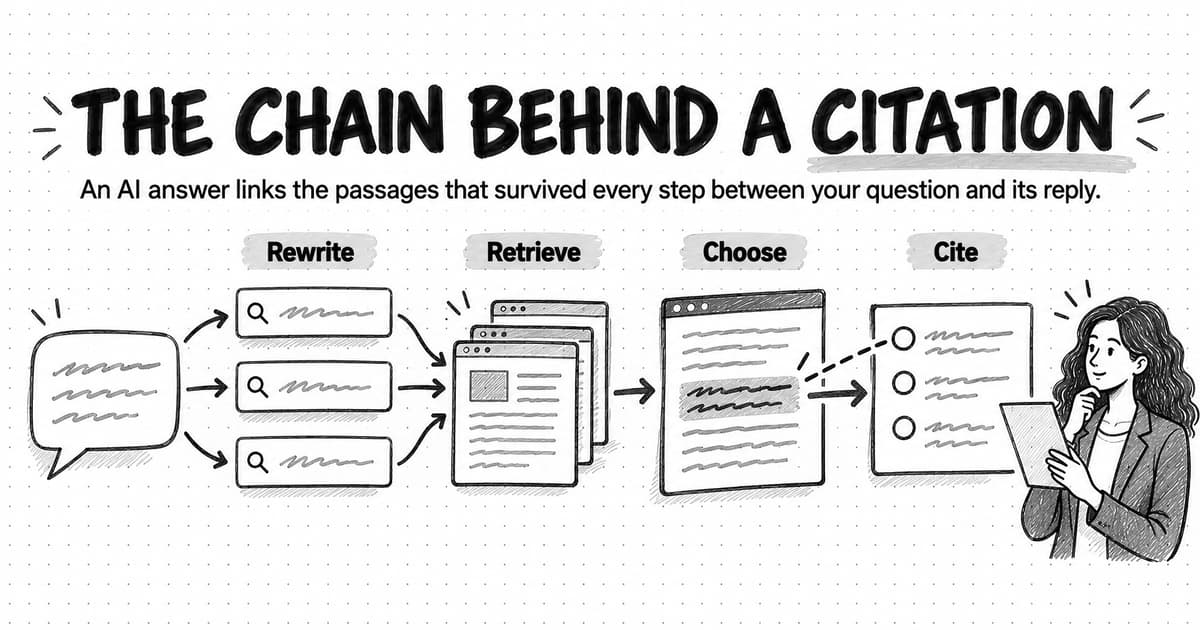
Start with what is documented. Google's page on AI features and your website, last updated in December 2025, says that AI Overviews and AI Mode "may use a 'query fan-out' technique — issuing multiple related searches across subtopics and data sources — to develop a response." The same page says there are no additional requirements to appear in these features beyond being indexed and eligible to show with a snippet, and that SEO best practices remain relevant. Our sibling guide on Google AI Overviews and AI Mode explains these features further. Other AI search products work from their own indexes and crawlers; OpenAI, for example, documents that its OAI-SearchBot crawler is used to surface websites in ChatGPT's search features, and that sites that opt out of it are not shown in ChatGPT search answers.
What follows is reasoning, not a measured result. If an AI answer to a broad question is built from several related searches across its subtopics, a site that has a strong page for each of those subtopics has more chances to be retrieved for one of them, and possibly more than one. A site with one general page on the subject has fewer. A cluster is, in effect, a set of pages that already matches the way fan-out breaks a question into parts. Clear headings, direct answers near the top of each section, and evidence that can be quoted make each page easier to use as a source.
The limits matter as much as the reasoning. No AI search provider has published that it rewards topical coverage as such, citations vary by person, date, and phrasing, and third-party studies of AI citations use different samples and methods that are hard to compare. Our guide to measuring AI search visibility explains how to sample the questions that matter to you and record whether your pages are cited, without overstating what a small sample shows. If AI answers are where many of your buyers get information, our guide to zero-click content distribution covers reaching readers who never click through.
In practice, the work does not change. A cluster built for readers, with depth and evidence on each page, is also a reasonable bet for AI answers.
A topic map template you can copy
Use this template to plan one cluster. Copy it into a spreadsheet, fill in the topic sentence, and add one row per planned page. The pillar page is the first row.
Topic sentence: [Subject], for [reader] who [situation].
Scope test: a page belongs in this cluster only if the reader in the topic sentence would need it to do the work the subject covers.
| Page | Type | Question it answers | Subtopic group | Status | Existing URL | Links to | Evidence to add | Owner | Due |
|---|---|---|---|---|---|---|---|---|---|
| [Pillar title] | Pillar | [The broad question] | All | New / update | [URL or blank] | Every cluster page | [Overview data, definitions] | [Name] | [Date] |
| [Cluster title] | Cluster | [One specific question] | [Group] | Existing / update / merge / new | [URL or blank] | Pillar + [2–3 related pages] | [Data, example, expert] | [Name] | [Date] |
| [Cluster title] | Cluster | [One specific question] | [Group] | Existing / update / merge / new | [URL or blank] | Pillar + [2–3 related pages] | [Data, example, expert] | [Name] | [Date] |
Fill it in with these rules.
| Page | A working title that names the question, not a clever headline |
|---|---|
| Type | Pillar for the one overview page, Cluster for every detailed page |
| Question it answers | One question in the reader's words; if you need two, it may be two pages |
| Subtopic group | Three to six groups for a focused subject, each a shared reader and job |
| Status | Existing, update, merge (list every URL being merged), or new |
| Links to | The pillar plus the two or three cluster pages a reader would need next |
| Evidence to add | What this page will have that the current top results do not |
| Owner and due date | One named person per page, with a date the team can keep |
Before you start writing, check the finished map against four questions. Does every subtopic group have at least two pages? Does any question appear twice? Does every page have at least one cluster-to-cluster link? Can the team finish the pillar and the first group of cluster pages within a quarter? If the answer to the last question is no, cut the map down rather than stretching the schedule.
Each new page then needs a brief before drafting. Our guide to writing a content brief shows how to turn a map row into a brief a writer can work from.
Worked example: one fictional company's topic map
This example is fictional. Tidewell is an invented company, and every count in it is illustrative.
Tidewell sells scheduling and onboarding software to multi-location employers with large hourly workforces: restaurant groups, retailers, and warehouse operators. Its blog has 80 posts written over four years. The new content lead's first job is to make the site a credible source on one subject.
Choosing the topic. Tidewell's product helps managers get new hourly staff from offer to a full schedule. The team has two things competitors do not: aggregated, anonymized data on how long new hires take to reach a full schedule across its customers, and a customer-success team that runs onboarding reviews with operations leads every week. General "employee onboarding" content is crowded with large HR publishers. Questions about onboarding shift workers, such as paperwork before a first shift, safety training, and onboarding across many sites, are answered less thoroughly. The topic sentence becomes: "How to onboard hourly and frontline employees, for HR and operations leads at multi-location employers."
Gathering questions. The content lead collects about 70 questions in two weeks: 25 from customer-success call notes, 15 from support tickets, 20 from People Also Ask boxes, related searches, and follow-up questions in AI assistants, and 10 from frontline management communities. After merging duplicates, 41 distinct questions remain.
Sorting the old posts. The four-question decision flow sorts the 80 existing posts.
| Outcome | Posts | Examples |
|---|---|---|
| On the map, keep and link | 9 | A guide to safety training in the first week; a shift buddy program post |
| On the map, merge | 8, merged into 3 | Three posts on seasonal hiring become one; three on orientation become one; two on new-hire paperwork become one |
| On the map, rewrite | 6 | A general remote-onboarding post rewritten for multi-location onboarding |
| Off the map, keep outside the cluster | 21 | Product announcements, customer stories, a popular post on manager scheduling tips |
| Off the map, remove or redirect | 36 | Workplace culture listicles, an old conference recap, thin posts with no visits in a year |
Removal is the largest group, which is common for a library built without a plan, and it is also the step to take most carefully. The team removes only posts with no meaningful visits, links, or sales use in the past year, redirects the few that have any links to the closest relevant page, and keeps the rest.
Building the map. The 41 questions fall into four subtopic groups. The team gives twelve questions their own cluster pages and folds the rest into sections and FAQ entries. One pillar page ties them together.
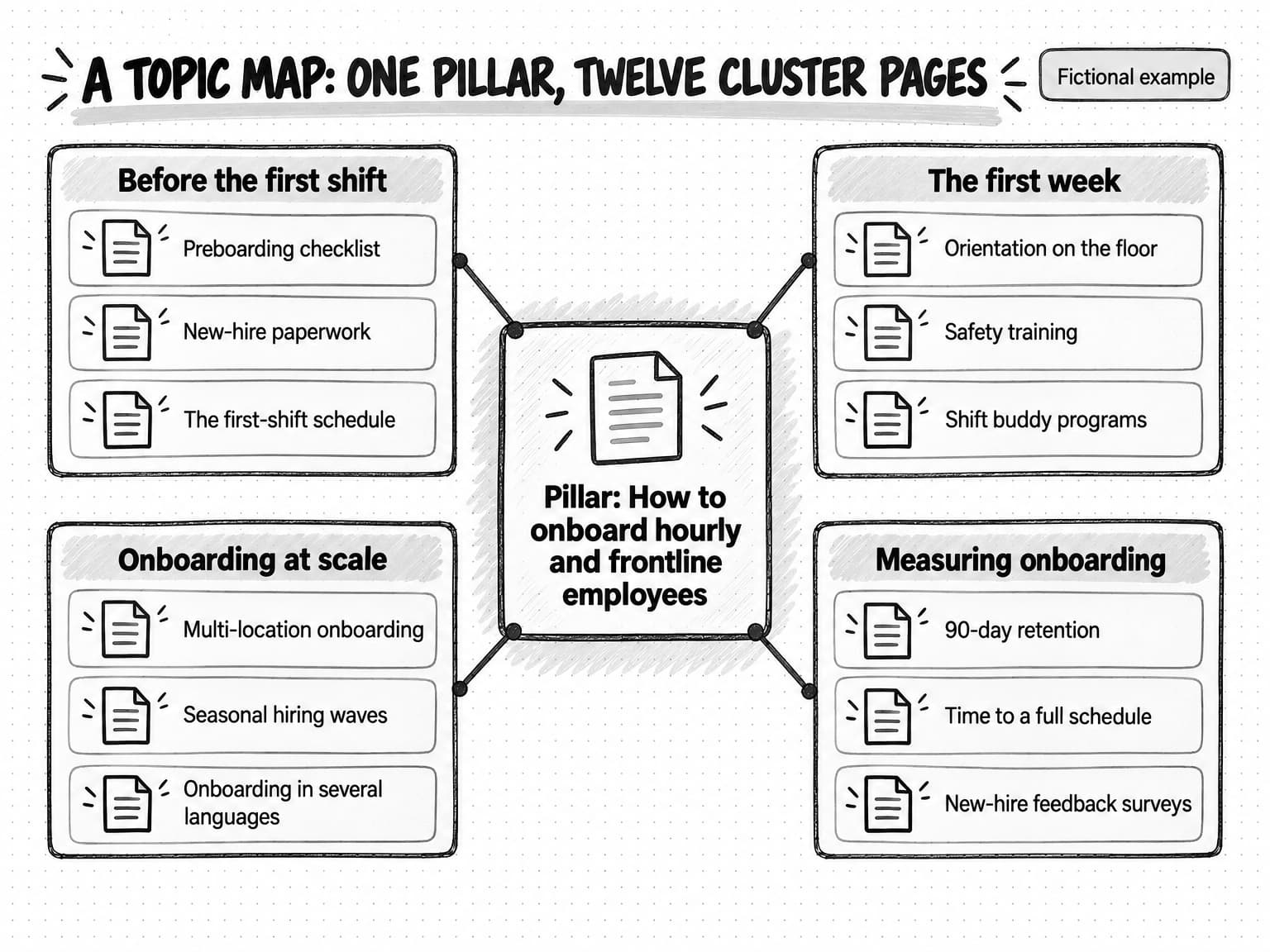
View Tidewell's topic map at full size (opens in a new tab).
| Page | Group | Status | Evidence to add |
|---|---|---|---|
| Pillar: How to onboard hourly and frontline employees | All | New | Summary of Tidewell's time-to-full-schedule data |
| Preboarding checklist for shift workers | Before the first shift | Update | Checklist template |
| New-hire paperwork before the first shift | Before the first shift | Merge (2 posts) | Customer-success notes on common delays |
| Building the first-shift schedule | Before the first shift | New | Product data on first-week hours |
| Orientation on the floor | The first week | Merge (3 posts) | Example agenda |
| Safety training in the first week | The first week | Keep and link | Expert review by a customer's safety lead |
| Shift buddy programs | The first week | Keep and link | Short interviews with two operations managers |
| Onboarding across multiple locations | Onboarding at scale | Rewrite | Template for a standard site-by-site plan |
| Onboarding seasonal hiring waves | Onboarding at scale | Merge (3 posts) | Seasonal timing pattern from product data |
| Onboarding in several languages | Onboarding at scale | New | Examples from customer-success reviews |
| Measuring 90-day retention of hourly hires | Measuring onboarding | New | How to calculate it, with a worked example |
| Time to a full schedule | Measuring onboarding | New | Tidewell benchmark from aggregated data |
| New-hire feedback surveys | Measuring onboarding | New | Survey template |
Planning the links. The pillar page has a section for each of the four groups, and each section links to its three cluster pages with descriptive anchors. Every cluster page links back to the pillar in its introduction. The cluster-to-cluster links follow the reader's work: the paperwork page links to the first-shift schedule page; the multi-location page links to the languages page; the retention page links to the time-to-full-schedule page and the feedback survey page; the seasonal hiring page links to the preboarding checklist.
Sequencing the work. The team cannot write thirteen pages at once. It publishes the pillar first with short sections on all four groups, then completes the "Before the first shift" and "Measuring onboarding" groups in the first quarter, because those are where its data is strongest. The time-to-full-schedule benchmark becomes the flagship page and is promoted separately, since it is the page most likely to be cited by other sites. The remaining groups follow in the second quarter.
Most of the work in the example is decisions: which subject, which questions, which old posts to merge or retire, and which pages carry the original evidence. Once those are made, each page has one job.
How to tell whether topical authority is building
There is no single topical authority number to watch, so measure the cluster as a unit with several signals, and give it time. Google notes in its core updates documentation that after improvements, "it may take time to see an effect in Search results." For a new cluster, a quarter is a sensible first review point, and six months is a fairer test.
Search coverage across the cluster. In Google Search Console's Performance report, filter the pages to the cluster's URLs and track the number of distinct queries those pages appear for, their impressions, and their clicks over time. A cluster that is gaining ground typically appears for more queries, including long questions you never targeted directly, before clicks rise much. Google's documentation says that traffic from AI Overviews and AI Mode is included in the Performance report under the Web search type, so this view covers those features too, though it does not separate them.
Positions for the cluster's core questions. Pick 10 to 20 questions from the topic map and check where the cluster's pages rank for them each month. Watch the group, not single queries, which move for many reasons.
AI answer citations. Sample a fixed set of questions from the map in the AI assistants your buyers use, on a regular schedule, and record whether your pages are cited. The AI search visibility guide linked above gives a repeatable method and a tracking template.
Links and mentions. Count new links from other sites to the cluster's pages, especially the evidence pages, and note where your data is quoted.
Reader behavior. In your analytics, check whether readers who land on a cluster page go on to another cluster page or the pillar, and whether the cluster sends visitors to product pages, trials, or demo requests. This is the signal that the cluster is reaching the buyer in the topic sentence.
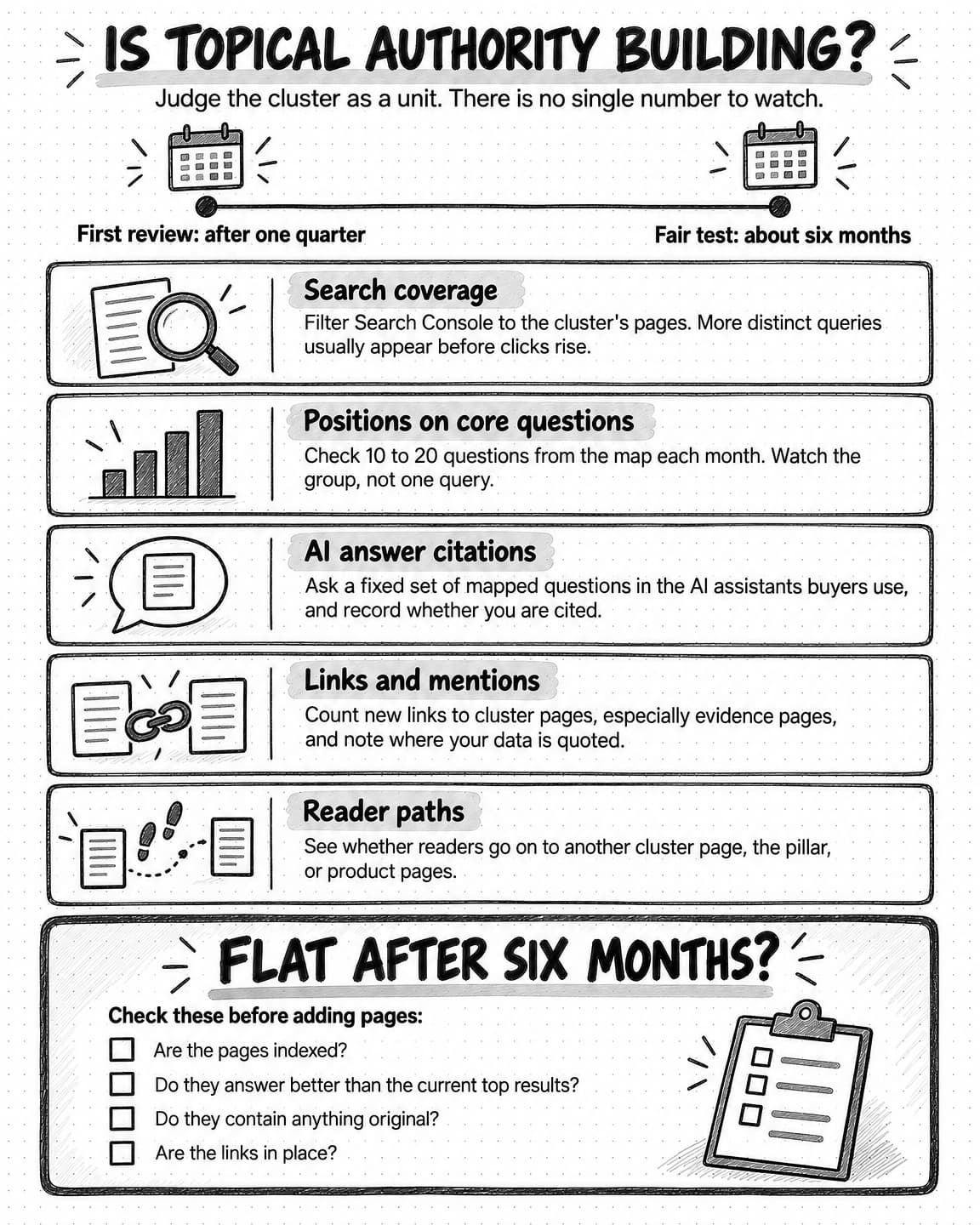
View the topical authority progress signals at full size (opens in a new tab).
If the signals are flat after six months, check the basics before adding pages: whether the pages are indexed, whether they answer the question better than the current top results, whether they contain anything original, and whether the links are in place. Adding more thin pages to a cluster that is not working rarely fixes it. And once the cluster is working, keep it current: put a review date on every page in the map, because a cluster with three-year-old statistics and broken links loses the trust it was built to earn.
Building topic maps with Ampere
Ampere, the AI marketing agent, can do much of the research and drafting in this method, so a small team spends its time on the decisions: which subject to own, which posts to retire, and what the company's own evidence says.
Ampere can search the web, extract page content, crawl a website, and map its structure, and it has search tools including Google SERP Results, Google AI Mode Search, and Bing Copilot Search. You can ask it to gather the questions people ask about a subject, see what ranks and what AI answers say for them, and identify competitors' coverage and AI-search visibility gaps. The work happens in a session workspace where you can see the browser, files, and sources behind the findings.
For the existing library, Ampere can save a content inventory report to Brand memory, alongside reports such as a search landscape report and a competitors report, and it can draft SEO audits. Those give the decision flow in this guide a starting point: a list of what you have, grouped by subject, that your team reviews before deciding what to keep, merge, or remove. Ampere does not change your website; it prepares the analysis and the plan for you to act on.
For new pages, Ampere can draft source-grounded blog article packages from a brief, and Brand memory keeps your positioning, audience, and voice so each cluster page stays on message without restating the context in every request. A scheduled task can repeat a check you rely on, such as sampling the cluster's core questions in AI answers each month, with results that land in the Project for review.
Ampere's outputs can be inaccurate or incomplete, and public search data never covers everything, so people review every map, audit, and draft before anything is published. Your team publishes the pages.
Sources and further reading
- Jen Granito, Understanding news topic authority, Google Search Central Blog, May 23, 2023. Google's topic authority system for news queries and its signals.
- Google Search Central, Creating helpful, reliable, people-first content, last updated October 2026. Self-assessment questions on focus, scale, and authority on a topic.
- Google Search Central, A guide to Google Search ranking systems, last updated December 2025. The helpful content system's move into core ranking in March 2024.
- Google Search Central, Google Search's core updates, last updated December 2025. Deleting content as a last resort, and the time improvements take.
- Google Search Central, AI features and your website, last updated December 2025. Query fan-out, eligibility for AI Overviews and AI Mode, and Search Console reporting.
- Google Search Central, Link best practices for Google. Crawlable links and descriptive anchor text, including internal links.
- Google Search Central, SEO Starter Guide. Content length, duplicate content, and grouping topically similar pages.
- Google Search Central, Spam policies for Google web search, last updated August 2026. Scaled content abuse.
- Moz, What is Domain Authority?. How Moz's score is built, and that it is not a Google ranking factor.
- HubSpot Knowledge Base, Understand pillar pages, topic clusters, and subtopics, last updated November 2025. Definitions of pillar pages and subtopics in the topic cluster model.
- Pranjal Aggarwal, Vishvak Murahari, Tanmay Rajpurohit, Ashwin Kalyan, Karthik Narasimhan, and Ameet Deshpande, GEO: Generative Engine Optimization, KDD 2024. Which content changes raised a source's visibility in generative engine answers on a benchmark.
- OpenAI, Overview of OpenAI crawlers. OAI-SearchBot and ChatGPT search.
Frequently Asked Questions
How do you build topical authority?
You build topical authority by choosing one subject your company can cover better than the current sources, mapping the questions readers ask about it, and publishing a pillar page plus detailed cluster pages that answer those questions in depth. Link the pages so the structure is clear, add original evidence such as product data or customer research, sort out old posts that duplicate or dilute the subject, and keep the pages up to date.
Is topical authority a Google ranking factor?
Topical authority is not a documented Google ranking factor for web results. Google has described a topic authority system for news queries in specialized areas such as health and finance, and its helpful content guidance asks whether a site has a primary purpose or focus. Beyond that, topical authority is an SEO-industry model. It is still a useful way to plan content, because focus, depth, and clear internal links are consistent with Google's published guidance.
What is the difference between topical authority and domain authority?
Topical authority describes how thoroughly and reliably a site covers one subject, while domain authority is a third-party score that estimates a whole domain's ranking strength, mostly from links. Domain Authority is Moz's score, and Moz says it is not a Google ranking factor. A small specialist site can have strong topical authority on a narrow subject with a modest domain score, and a large site can have a high domain score while covering its core subject thinly.
What is a topic cluster in SEO?
A topic cluster in SEO is a group of pages about one subject: a broad pillar page and several cluster pages that each answer one specific question in depth. The pillar links to every cluster page, each cluster page links back to the pillar, and closely related cluster pages link to each other. The structure helps readers navigate the subject and helps search engines see which pages belong together.
What is a pillar page?
A pillar page is a broad page that answers the main question about a subject, explains how its parts fit together, and links to a detailed cluster page for each part. For example, a pillar page on onboarding hourly employees would give paperwork, safety training, and retention a short section each and link to the full guide on each one. It is a website structure, unlike a content pillar, which is an editorial theme across channels.
What is a topical map?
A topical map is a planning document that lists the questions readers ask about a subject, groups them into subtopics, and assigns each question to a page, marked as existing, to update, to merge, or new. It also records the internal links each page needs. A topical map prevents gaps and overlapping pages before writing starts, and it turns into the publishing plan for a topic cluster.
How many articles do you need for topical authority?
There is no set number of articles needed for topical authority, and Google has said that content length alone does not matter for ranking. The right number is however many pages it takes to answer the distinct questions readers have about your subject. For a focused subject, that is often a pillar page and somewhere around eight to fifteen cluster pages, with smaller questions handled as sections. Twelve deep pages are worth more than forty thin ones.
How long does it take to build topical authority?
Building topical authority usually takes months rather than weeks, because the pages have to be written, crawled, and judged against other sources, and links from other sites take time to arrive. Google says improvements can take time to show an effect in search results. A sensible plan is to review the cluster's signals after one quarter and judge it fairly after about six months.
What is the difference between a pillar page and a landing page?
A pillar page is an educational page that gives a broad overview of a subject and links to detailed pages, written for readers who are learning. A landing page is built to get a visitor to take one action, such as starting a trial or booking a demo, usually for visitors arriving from a campaign. A pillar page can link to a landing page, but combining the two jobs on one page tends to weaken both.