What is the B2B buyer journey? Stages, touchpoints, and examples
How a company's buyers move from noticing a need to a decision, and how marketing can answer the questions they raise along the way.
52 min readWritten by Ampere
Short answer
What is the B2B buyer journey?
The B2B buyer journey is the process people in an organization go through to recognize a need, explore ways to address it, evaluate options, reach agreement, and then buy or decide not to. It is described from the buyer's side and usually involves several people asking different questions, often where the seller cannot see them. Stages help with planning, but buyers often loop back.
Summary
For planning content, the most useful unit of the B2B buyer journey is the question a particular person is trying to answer, not a stage label. The journey describes a purchase from the buyer's side, between noticing a problem and making a choice, while a marketing funnel and a sales pipeline record only what the seller observes, and the customer journey also covers the relationship after the sale.
Stage models, from awareness, consideration, and decision to the 1967 buygrid and Gartner's six buying jobs, are planning aids rather than a fixed order. The guide describes six overlapping parts: problem recognition, requirements, exploration, evaluation, internal agreement, and purchase. Groups loop back when someone new joins, evaluation reveals a gap, or priorities move, and many purchases end with no decision at all.
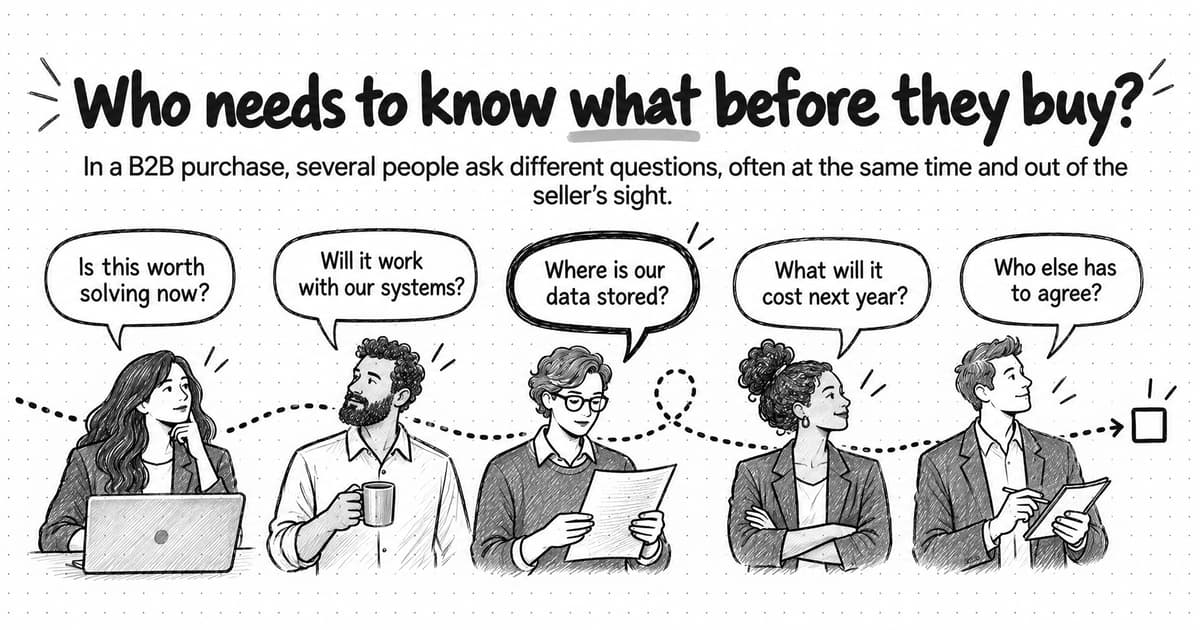
In an organizational purchase, several people ask different questions at the same time, and much of their discussion happens in meetings and documents the seller never sees. Buyers find answers at touchpoints the vendor owns, such as its site, trial, and sales team, and at many it does not, including partners, peers, reviews, search, and AI assistants. Estimates of buyers' AI use vary with who is asked, so AI assistants are one source among several.
Purchases range from an employee buying a tool on a company card, as PostHog's handbook allows, to GitLab's procurement, security, privacy, and legal reviews, which can take weeks and wait on vendor documents. In the guide's fictional worked example, six people at a payroll company evaluate an analytics tool and a seventh approves; a late data-hosting requirement reopens the shortlist, and a competing priority defers the decision to the next quarter.
Choose content from the buyer's current question: who asks it, what evidence would convince that person, where they will look, and what next step helps. Downloads and page visits are reasons to learn more, not proof of readiness, and one contact's activity is not the account's progress. Interviews, sales calls, and questionnaires show what analytics cannot, and some of the journey always stays hidden.
Buyers' questions continue after the sale. The evidence that persuaded the buying group sets its expectations for onboarding, value reviews, and renewal, and another team's interest is often the start of a new journey. The closing exercise maps one buying situation to find the questions your content does not yet answer.
Contents
- What the B2B buyer journey describes
- How the buyer journey differs from the funnel, pipeline, lifecycle, and customer journey
- What stage models explain and what they leave out
- Six parts of a buying decision
- Why buyers loop back, pause, or decide not to buy
- Several people, several questions at once
- Touchpoints: where buyers find answers
- A simple self-serve purchase and an involved organizational one
- Worked example: six evaluators, one approver, different questions
- When the journey loops back or stops
- How to choose content for the buyer's current question
- What research and analytics can reveal, and what stays hidden
- How the buyer journey connects to onboarding, renewal, and expansion
- Exercise: map one buying situation and find the gaps
- Answer more of your buyers' questions before they ask
- Sources and further reading
- Frequently Asked Questions
A demonstration request arrives from a company your team has never spoken to. On the call, the director of product already knows your pricing. They have asked an AI assistant which tools suit a company like theirs, read two comparison articles, and seen a warning in a community thread about how event-based pricing like yours grows. Their first question was passed on by their privacy lead: where is customer data stored? Your analytics recorded a free-plan signup and a few visits to the pricing page. The AI conversation, the community thread, the privacy lead's concern, and the meeting where the purchase was first discussed left no trace in any of your systems.
Long before the call, people at that company noticed a problem, wondered whether it was worth solving, looked into ways to solve it, and started forming requirements. Different people asked different questions, some at the same time, and most of them never spoke to you. The B2B buyer journey is the name for that process: how people in an organization recognize a need, work out how they might address it, evaluate the options, reach agreement, and buy, or decide not to.
The journey is described from the buyer's side, which makes it different from the views a company keeps of its own sales and marketing. A funnel counts how many people move toward a purchase, and a sales pipeline tracks the deals a sales team is working. The buyer journey is about what the buyers are trying to find out and decide. In the example, the director wants to know whether the product will answer questions faster. The privacy lead wants to know where data goes. Someone in finance will soon want to know what the product costs as usage grows. Each of those questions needs a different answer, and an unanswered one can stall the purchase.
Stage names such as awareness and evaluation are useful for planning, but the work happens at the level of questions: who is asking what, what evidence would answer it, and where that person is likely to look. This guide explains the B2B buyer journey on those terms, and later returns to the opening scene to follow the same evaluation from the buyer's side.
What the B2B buyer journey describes
A B2B buyer journey covers everything a buying organization does between noticing a problem and making a decision about it. Four of its features matter most for planning.
It is described from the buyer's point of view. The journey includes research the buyer does alone, conversations with colleagues and peers, requirements written in internal documents, and approvals the vendor never attends. A vendor sees only part of it.
It usually involves several people. In an organizational purchase, the person who finds a product, the people who will use it, the people who review its security and contract, and the person who approves the budget are often different. Each joins at a different time, with a different question. Some decisions involve one or two people; others involve a large group inside the company and advisers outside it.
It can end without a purchase. The buyers may decide that the problem is not worth solving now, that they can solve it with tools they already have, or that they cannot agree. From the buyer's side, those are legitimate outcomes.
It does not follow a fixed sequence. Buyers return to earlier questions when new information arrives, new people join, or priorities change.
How the buyer journey differs from the funnel, pipeline, lifecycle, and customer journey
Five ideas describe the same purchase from different positions. They are easy to blur, and the differences matter because each one answers a different question.
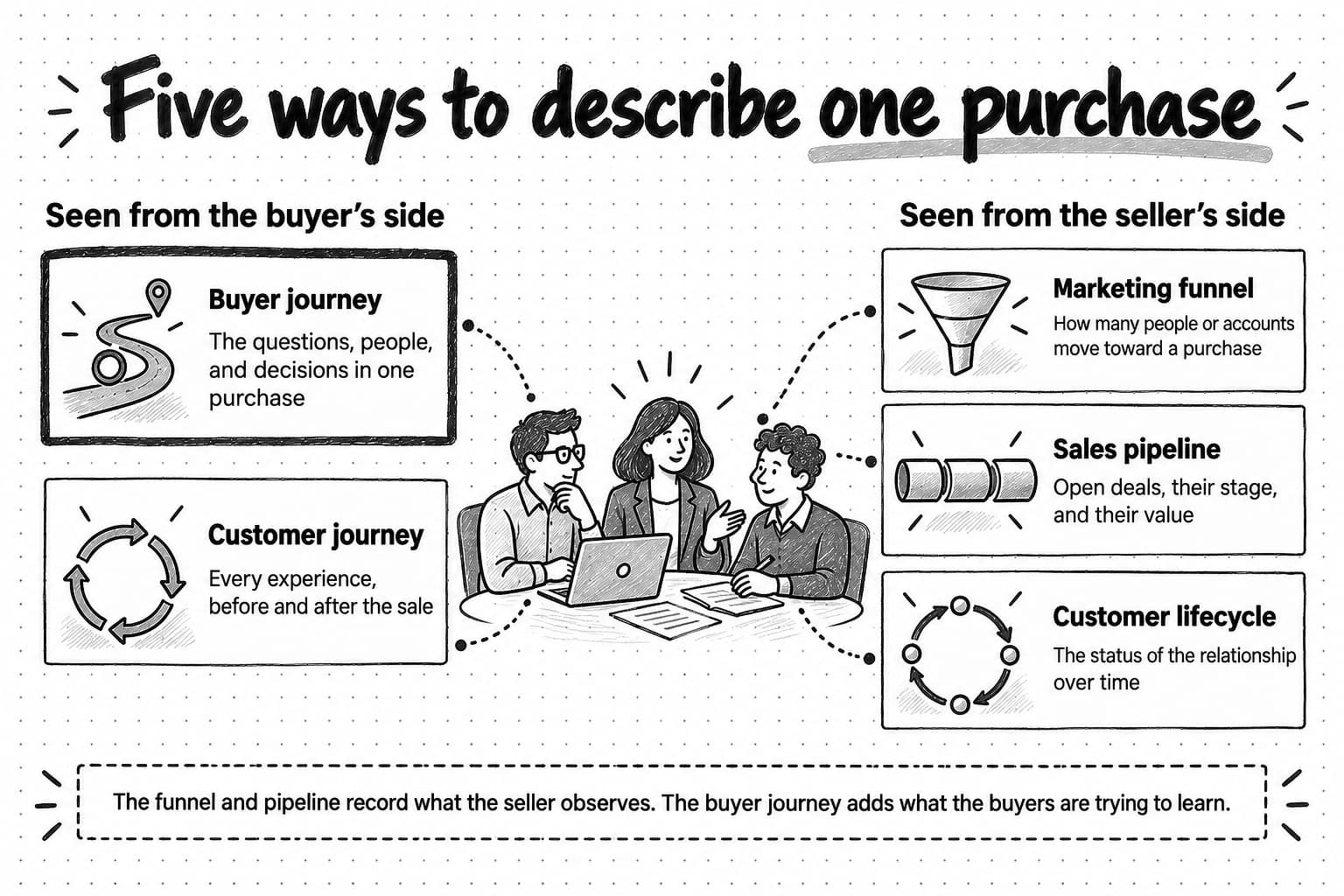
View the five ways to describe a purchase at full size (opens in a new tab).
| Idea | Whose view | What it tracks | Where it starts and ends | What it helps with |
|---|---|---|---|---|
| Buyer journey | The buying organization's | The questions, people, and decisions involved in one purchase | From noticing a problem to buying, or deciding not to | Choosing what to explain and what evidence to provide |
| Marketing funnel | The seller's marketing team | How many people or accounts move from first awareness toward purchase | From first contact with the company to becoming a customer | Seeing where volume drops and planning reach |
| Sales pipeline | The seller's sales team | Open deals, their stage, value, and likelihood of closing | From a qualified opportunity to a deal won or lost | Forecasting revenue and managing active deals |
| Customer lifecycle | The seller's company | The status of the relationship: prospect, customer, renewal, expansion, or lost | From first contact through renewal or churn | Assigning ownership and measuring each phase |
| Customer journey | The customer's | Every experience a customer has with a company, before, during, and after a purchase | Across the whole relationship, often repeatedly | Improving the experience at each point |
The differences show up quickly in practice. The funnel and the pipeline record what the seller observes, so a buying group that has spent a month researching without filling in a form appears in neither. A deal can sit in the pipeline at "proposal sent" while the buyers have gone back to arguing about requirements. And a funnel that reports one new lead may be describing a person who downloaded a guide for a project their company has not started.
The buyer journey and the customer journey overlap the most, and usage varies. Many writers use "customer journey" for the whole relationship, including what happens after the purchase, and "buyer journey" for the part that leads to a decision. HubSpot draws a sharper line: the buyer's journey runs from first realizing there is a problem to making a purchase, and the customer's journey begins after the purchase, with onboarding, adoption, success, and advocacy. In B2B, the distinction carries a second difference. A customer journey is often drawn for one person, while a B2B buyer journey usually involves a group whose members want different things.
None of the five is the correct one. A company needs its funnel and pipeline to run the business. The buyer journey adds the view those measures leave out: what the people deciding are trying to learn, and what would help them decide.
What stage models explain and what they leave out
Stage models give the journey a shape that teams can plan around. Four are worth knowing, because each was built to answer a different question.
| Model | How it describes buying | What it explains well | What it leaves out |
|---|---|---|---|
| Awareness, consideration, decision | Three stages, from understanding a problem to comparing approaches to choosing a vendor | How a buyer's questions move from the problem to solutions to specific products | Several people, loops, and decisions not to buy |
| Buygrid and buy classes (Robinson, Faris, and Wind, 1967) | Eight buying phases, which vary with how new the purchase is: a new task, a modified rebuy, or a straight rebuy | That a first-time purchase needs far more investigation than a repeat one, and that buying continues into a review of how the supplier performed | It was built for formal industrial purchasing and reads as a sequence |
| Buying jobs (Gartner, 2018) | Six jobs: problem identification, solution exploration, requirements building, supplier selection, validation, and consensus creation | That buyers work on several jobs at once and return to earlier ones | How the jobs play out in any one company's purchase |
| Prepurchase, purchase, and postpurchase (Lemon and Verhoef, 2016) | Three broad stages of a customer's experience, with touchpoints the company does not own | That the journey continues after the sale, and that much of it happens outside the seller's channels | The detail of an organizational purchase |
The three-stage model is the most common in content marketing, and HubSpot did much to popularize it. Its strength is simplicity: it reminds a writer that someone who has just noticed a problem needs different help from someone comparing two vendors. Its weakness is that it reads like one person moving in one direction, and a B2B purchase rarely works like that.
The oldest of the four is still useful for two reasons. First, Patrick Robinson, Charles Faris, and Yoram Wind classified purchases by how new the problem is to the buyer. A new task is a problem the organization has not faced before, so the people involved have to work out what they need and who could supply it. A straight rebuy repeats a routine purchase without considering new options. A modified rebuy falls between the two, such as replacing a familiar tool with a different one. Most marketing content is written for new tasks, but a team switching from one analytics tool to another is making a modified rebuy and already knows the category and its vocabulary. Second, the authors described a "creeping commitment": as buyers work through the phases, their choices narrow, and a supplier that was not considered early becomes less likely to get in. A recent survey points the same way. 6sense, which sells buyer-intent data to B2B companies, surveyed about 4,000 buyers of purchases worth $25,000 or more for its 2025 report: 94% said they had ranked their shortlist by preference before contacting a seller, and 77% said the first vendor they spoke with was the one they eventually chose. Both figures rest on buyers' recollection, and 6sense reads the second as a sign that the early favorite usually wins.
Gartner's model describes the same work as jobs rather than steps. Its 2018 announcement said that validation and consensus creation are "always on" throughout a purchase, that most B2B buyers "will revisit nearly every 'buying job' at least once before they make a purchase," and that the resulting journey "resembles more of a maze than a linear path."
Every model leaves out the same thing, because no general model can supply it: which questions your buyers ask, in what order, and what answers they accept. Stage models help a team organize what it learns. They do not replace learning it. This guide uses stages for planning and treats a buyer's questions as the working unit.
Six parts of a buying decision
Most stage models describe some version of the same work. This guide uses six parts, each defined by the questions buyers are trying to answer.
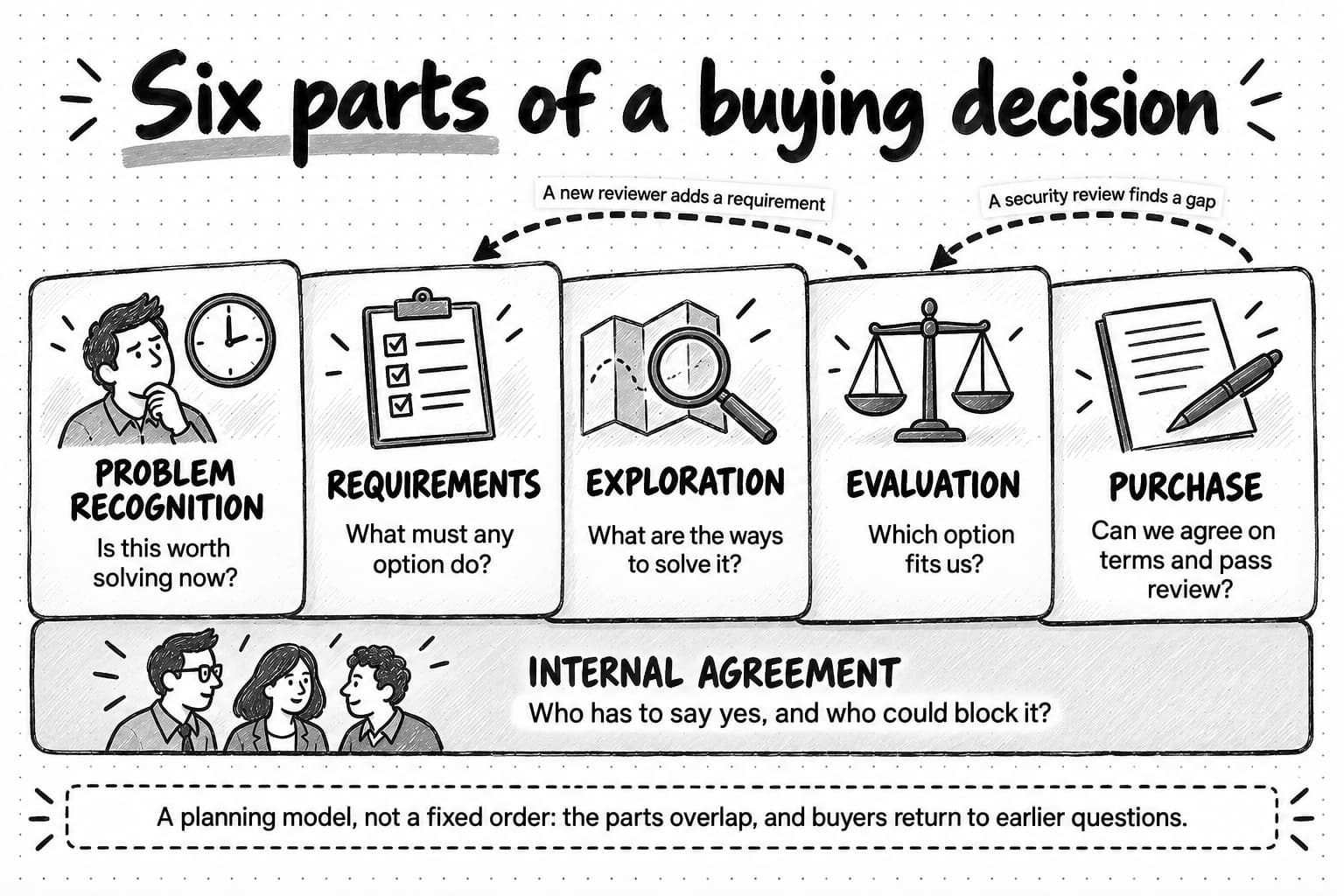
View the six parts of a buying decision at full size (opens in a new tab).
Problem recognition
A purchase begins when someone decides that a situation is a problem worth attention. It may be a recurring pain, such as reports that take two weeks; an event, such as a new regulation, a failed audit, or a new executive; or a goal that the current way of working cannot reach. The questions are about the problem, not about products: Is this a real problem or an annoyance? What is it costing us? Why now? Is it ours to solve?
Many problems are noticed and then lived with. A problem becomes a purchase only when someone with enough influence decides it deserves time and money, so this part often decides whether there is a journey at all.
Requirements
Requirements are the conditions any solution must meet: what it has to do, what it has to work with, what it may cost, and what risks are unacceptable. Early requirements are usually rough, such as "something that lets product managers answer their own questions." They become specific as people learn what is possible and as reviewers add conditions, such as single sign-on, data stored in a particular region, or a limit on implementation effort.
Exploration
Exploration is the search for ways to address the problem: buying a product, building something, hiring a person or an agency, changing a process, or using a tool the company already pays for. Questions here sound like "How do other companies handle this?", "What kinds of solutions exist?", and "What do people who have tried them say?"
Requirements and exploration shape each other. A rough requirement tells buyers where to look, and what they find changes the requirement. Learning that some analytics tools run inside a company's own data warehouse, for example, can turn "store our data securely" into "keep our data in our warehouse," which changes which options qualify.
Evaluation
Evaluation tests specific options against the requirements. Buyers compare features and prices, read reviews, attend demonstrations, run trials or pilots, ask for references, and send questionnaires. The questions become concrete and specific to each reviewer: Will it work with our systems? Is our data safe? What will it cost in two years? Will my team actually use it? Evaluation often reveals requirements nobody wrote down, which sends the group back a step.
Internal agreement
Agreement is the work of getting the people involved to support the same decision. It runs throughout the purchase, not just at the end: the champion has to persuade an executive that the problem matters, the evaluation team has to agree on requirements, and reviewers have to accept the risks. The questions are often political as well as practical: Who has to say yes? Who could block this? What will I have to defend if it goes wrong?
Purchase
The purchase itself includes negotiating price and terms, legal and procurement review, security approval, and signature. In a self-serve purchase, it can be a card payment. In an organizational one, it can take weeks and can still change the outcome: a contract term legal will not accept, or a security review that finds a gap, can reopen evaluation.
How the parts relate
The six parts overlap more than they follow each other. A champion may be evaluating one product while the data team is still exploring other approaches and finance has not yet agreed that the problem is worth the money. Requirements change throughout. Agreement is built, lost, and rebuilt. When marketers say a buyer is "in evaluation," it is usually more accurate to say that some people in the buying group are evaluating while others are working on different questions.
Why buyers loop back, pause, or decide not to buy
Buying groups often move backward. Several things commonly send them back:
- Someone new joins. A security reviewer, a new executive, or a finance lead arrives with requirements nobody had written down, and earlier conclusions have to be checked again.
- Evaluation reveals a gap. A trial or a questionnaire shows that an option cannot meet a condition, such as where data is stored, and the shortlist changes.
- What the buyers learn changes the question. Reading about a different approach, such as building a solution with tools the company already owns, can turn a vendor comparison back into a question about whether to buy at all.
- Priorities move. A regulation, a reorganization, a budget review, or an urgent project takes the people or the money the purchase needed.
- The group cannot agree. The champion cannot persuade an approver, two teams want different things, or the person who started the purchase leaves.
Shortlists change often. In Gartner Digital Markets' survey of 3,500 people involved in software purchases, conducted in August 2024, 83% said they change their initial list of vendors after doing research, and 27% make significant or complete changes. Gartner Digital Markets also runs software review sites, which gives it an interest in how buyers research.
Some loops end in a purchase. Many end in no decision. Matthew Dixon and Ted McKenna studied more than 2.5 million recorded sales conversations for their book The JOLT Effect and reported that 40% to 60% of deals were lost to customers who said they intended to buy but never acted. In their study, 56% of those losses came from indecision, which they link to buyers' fear of making a mistake, and 44% from a preference for the current situation. The data came from recorded sales calls, so it describes purchases that reached a salesperson more than self-serve ones.
Two conclusions follow for marketing. First, the competitor to plan against is often doing nothing, so content has to address the cost of the current situation and the risk of changing, not only why one product is better than another. Second, a pause is not always a loss. A group that stops because a priority moved may return in a quarter, with some of the same people and some new ones. What it finds when it returns, including what the company has published since, affects whether it picks up where it left off.
Several people, several questions at once
In an organizational purchase, the people involved rarely share one view of it. Gartner reported in 2025 that buying groups range "from five to 16 people across as many as four functions." Forrester's 2026 report on business buying, based on a survey of nearly 18,000 business buyers, said the typical buying decision now includes 13 internal stakeholders and nine external influencers. Both studies cover business purchases of many kinds and sizes, so a small software purchase will often involve fewer people. Most of the people involved take part in only some of the decisions, and they join at different times.
Each person brings different questions to the same product:
- The person who found the product wants to know whether it solves the problem they care about.
- The people who will use it want to know whether it fits their work and is easy to learn.
- A technical evaluator wants to know whether it works with existing systems and what it will take to set up.
- Security, privacy, and legal reviewers want to know what risks it adds and how they are managed.
- The person who approves the budget wants to know what it will cost, what return to expect, and why it matters now.
Researchers have described these roles since Frederick Webster and Yoram Wind's work on the "buying center" in 1972. Our guide to ideal customer profiles and buyer personas describes them for software purchases.
These questions are worked on at the same time, not in turn. While a user is trying the product, the security reviewer may be reading the vendor's documentation, and the budget owner may be asking whether the problem is worth solving at all.
Why internal discussion is invisible to the seller
Much of the deciding happens where the seller cannot see it. Requirements are written in internal documents. Concerns are raised in meetings and private messages. A champion summarizes a demonstration for colleagues who were not on the call, in their own words, and the vendor never hears the summary. Buyers also have good reasons to keep this work private: they may not want to signal how much they need a product before negotiating, and they may be weighing an option the vendor would not like, including doing nothing.
A seller can learn some of this by asking, and a good salesperson will. But most of it reaches the vendor secondhand, if at all. The practical response is to equip the person carrying the case inside: material that explains the product in plain language, answers the questions other reviewers will ask, and can be forwarded without the vendor in the room. A white paper that helps the group decide is one long-form version of that material. A Gartner survey of 632 B2B buyers, conducted in 2024 and published in 2025, suggests why material for the whole group matters. Groups that reached consensus were 2.5 times more likely to report a high-quality deal, and content tailored to individual members tended to work against consensus, while content relevant to the group as a whole supported it. That does not mean ignoring each reviewer's question. It means answering it in material the whole group can see, consistent with everything else the group reads, rather than in a separate pitch for each person.
Consistency matters too. In that survey, 69% of buyers reported inconsistencies between the information on a supplier's website and what its salespeople said. When a champion forwards a page that disagrees with what a salesperson told the group, the group has one more reason to doubt both.
Touchpoints: where buyers find answers
A touchpoint is any point at which a buyer encounters information about a company, its product, or the problem it solves. A pricing page is a touchpoint. So are a colleague's comment in a meeting, a review on a software review site, an answer from an AI assistant, and a salesperson's follow-up email.
Katherine Lemon and Peter Verhoef, in a widely cited 2016 review of customer journey research, grouped touchpoints by who designs or controls them: the brand, its partners, the customer, or other people and independent sources. Their paper is mostly about consumer purchases, but the four groups translate well to B2B software:
| Touchpoint group | B2B software examples | Can the seller usually see it? |
|---|---|---|
| Brand-owned | Website, pricing page, documentation, blog, webinars, emails, ads, the product trial, sales conversations | Partly: visits and clicks are recorded, but often not who made them or why |
| Partner-owned | Integration marketplaces, resellers, consultants and agencies, implementation partners | Rarely, unless the partner shares it |
| Customer-owned | The buyer's own meetings, internal messages, shared documents, requirements lists, and the tools they already use | Almost never |
| Social or external | Peers, online communities, review sites, analyst reports, search results, AI assistants, news | Rarely; the seller can see what is published, not who read it |
The table explains much of what sellers find puzzling. Only the first group is under the company's control, and even there visibility is partial. Much of what shapes a decision happens in the other three, where a company can influence what buyers find but cannot watch them finding it. Buyers also use many of these at once: in Gartner's 2026 announcement, based on a survey of 645 B2B buyers, respondents reported using an average of seven information sources during a recent purchase.
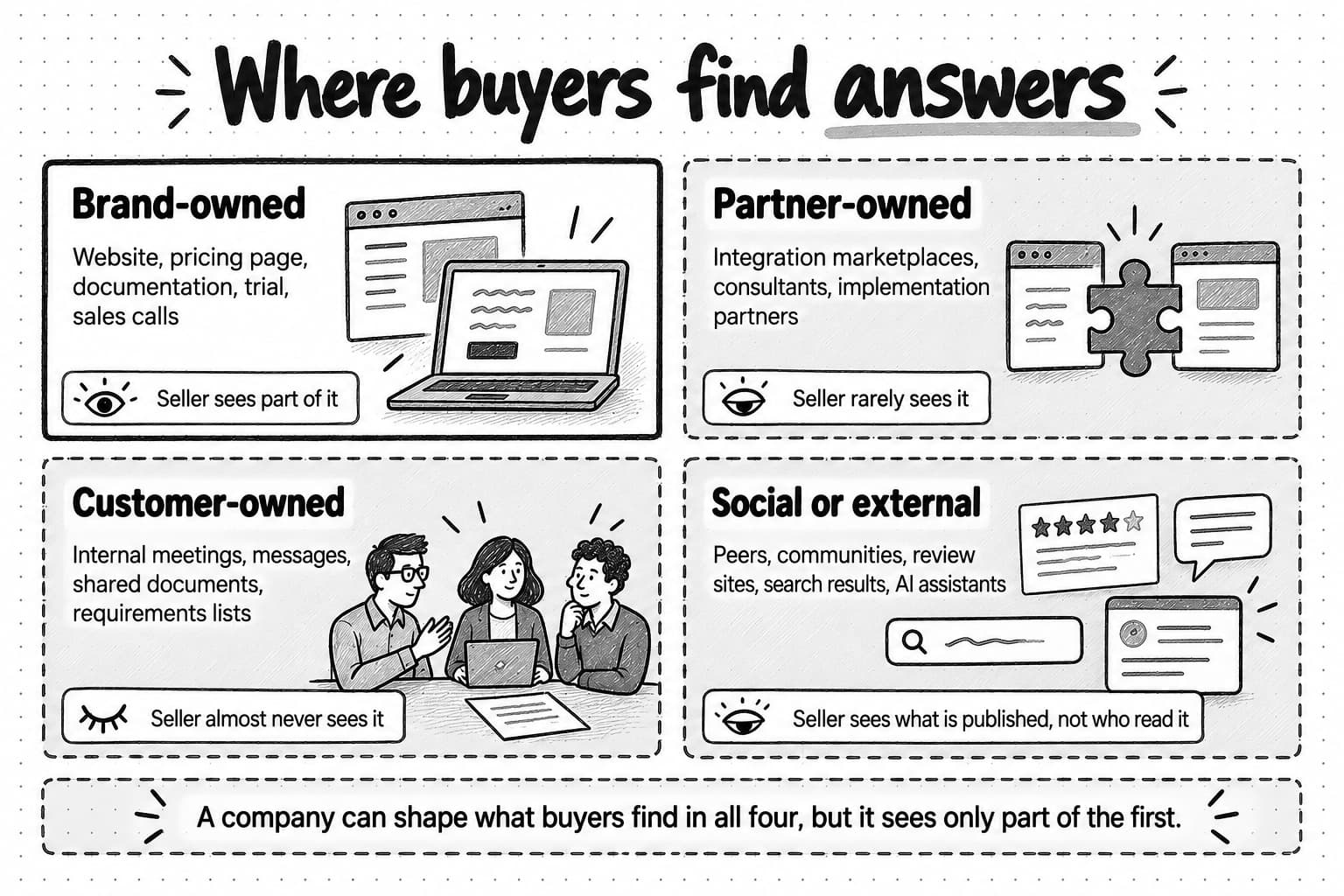
View where buyers find answers at full size (opens in a new tab).
Self-directed research and search
Many buyers prefer to learn on their own before involving a vendor. In Gartner's 2026 survey, 67% said they prefer a buying experience without a sales representative. Self-directed research usually starts with a search engine, the vendor's website, and its documentation. What buyers look for changes as they go: early searches describe a problem ("how to measure feature adoption"), and later ones name categories and vendors ("product analytics for B2B SaaS", "Tallyroot pricing").
AI answers
AI assistants are now one of the places where some buyers ask questions. An assistant can explain a category, suggest options, summarize reviews, and draft comparison tables, which can shorten early exploration. How common this is depends on who is asked and how the question is put: 45% of the buyers in Gartner's 2026 announcement said they had used generative AI during a recent purchase, while Forrester reported that 94% of the business buyers it surveyed used AI somewhere in their buying process. A survey by G2, which runs a software review site, found that 51% of the 1,076 software buyers it asked in March 2026 start research with an AI chatbot more often than with Google.
AI answers draw on material that is publicly available, including vendors' own pages, documentation, reviews, and community discussions, and they can be incomplete, outdated, or wrong. Many buyers check: in Gartner's 2026 survey, 69% said they prefer to validate AI-generated insights with a sales representative. The surveys ask different buyers and define AI use differently, and none of them describes a pattern that holds for every category, company size, or role. The practical response is modest: publish accurate, specific information about the product where people and assistants can read it, and check from time to time what assistants say about the company and its category. Our guide to measuring AI search visibility explains how to make that check repeatable.
Peers, communities, and reviews
Many buyers give extra weight to people who have no stake in the sale. A peer at another company, a thread in a professional community, or a set of reviews can confirm or undermine what a vendor says, and Forrester's research describes buyers turning to colleagues and external influencers to justify and reduce the risk of a purchase. Vendors cannot control these touchpoints, but they can earn and support them: by serving customers well, asking satisfied customers to write reviews, answering questions honestly in communities where that is welcome, and responding to critical reviews.
Product trials and demonstrations
For many software purchases, trying the product is the most direct evidence. Forrester's 2026 report said more than 60% of business buyers now make use of a trial, rising to 78% for purchases of $10 million or more. A trial lets users judge whether the product fits their work, and a demonstration lets a group see it applied to their situation and ask questions. Both answer some questions better than any document and others not at all: a trial will not tell a security reviewer how data is stored.
Sales conversations
A salesperson can answer an unusual requirement, explain trade-offs, adapt a proposal, and connect the vendor's specialists with the buyer's reviewers. In Gartner's 2026 survey, buyers still regarded sales representatives as their most important source when researching a business problem, identifying a preferred supplier and securing internal support, and finalizing a purchase. Sales conversations are also where vendors learn most about a specific purchase: who is involved, what they need, and what might stop it. Many buyers want to research independently and still value a person who can confirm what they found.
A simple self-serve purchase and an involved organizational one
How much of this applies depends on the purchase. Two companies that publish their internal buying rules show the range. Each describes one company's policy, so treat them as illustrations, not as typical of every buyer.
A tool one person can buy on a card
PostHog, which makes product analytics software, publishes its company handbook. Its spending policy gives each employee a monthly limit of $5,000 on a company card and says that individual software "is down to your personal preference." When unsure, employees are told to ask their team lead "for context, not permission," and to give their team lead a heads-up before a one-off expense over $1,000.
For a tool bought this way, the buyer journey can take an afternoon. Someone notices a problem, searches for options, tries one, and pays. Most of the questions belong to one person: does this solve my problem, is it worth the price, and can I start now? The evidence that matters is the product itself, the pricing page, and perhaps a review or a colleague's recommendation.
Vendors that sell this way design for it. Notion's help center says customers can pay with a debit or credit card, that organizations and teams may be eligible to try its Business plan for 30 days, and that when a member requests an upgrade, the workspace owner is notified to approve or deny it. Even here, a second person appears: the owner who approves. Notion also draws a line by company size: organizations with fewer than 100 employees can upgrade to its Enterprise plan from their settings, while larger ones are invited to contact sales.
PostHog draws a line too, and the line is about reach and data, not price. The same handbook says the company is "strongly opposed to introducing new software that is designed for collaboration by default." A tool that the whole company would use goes through a separate process. The proposer tries it first "in a context where it is easily replaced and does not involve sensitive data," then writes a proposal that considers the impact on the whole company, the data involved, the vendor's security credentials, such as SOC 2 and GDPR compliance, and the alternatives. If the vendor will process PostHog's customers' data, those customers must receive 14 days' notice before the vendor can be used in production. The handbook adds: "Many proposals will not make it past this stage – that's good."
A purchase that passes through procurement, security, and legal
GitLab's public handbook describes a more formal path. A purchase request goes through a procurement system and several reviews, each with a target duration: two days for a finance budget check, two days for IT when the purchase is new software, 3 to 21 days for legal review, 12 days for negotiation, and 4 to 14 days each for security, compliance, and privacy reviews. When several reviews are needed, they run in parallel with each other and with legal review. The handbook says requests "can take 5 days to 3+ weeks" to process. Purchases over $250,000 go through a request for proposals led by procurement, typically with five or more vendors bidding.
Several details show where the vendor's own material decides the pace. The security review "cannot begin until after the supplier completes the security questionnaire and supplies their security documentation," and the handbook notes that suppliers often take one to two weeks to respond. GitLab's security team requires that software can integrate with Okta, its single sign-on provider, and reviews an annual independent audit. Even demonstrations and trials that cost nothing go through a contract review. And a vendor's deadline does not speed anything up: the handbook says "Supplier wants it signed today" does not qualify as a reason to escalate a request.
Most of this journey happens in reviews the vendor's marketing never sees. What moves it is material that reviewers can use without a meeting: a completed security questionnaire, an audit report, clear documentation of single sign-on, and contract terms that legal can assess quickly. Some vendors publish this material for everyone. Atlassian offers pre-completed responses to common security questionnaires and says it cannot complete individual security questionnaires for each customer, an approach it describes as keeping its purchasing process "simple and fair for all customers."
What changes between the two
| A simple self-serve purchase | An involved organizational purchase | |
|---|---|---|
| Who takes part | One person, sometimes a second who approves | A buying group, including reviewers who never use the product |
| What starts it | One person's problem | A problem, a project, or a mandate that affects several teams |
| How people learn | Search, a colleague, a review, the product itself | All of those, plus peers, analysts, internal discussion, and sales conversations |
| How they try it | A free plan or trial with real work | A demonstration or pilot, often with test data until security approves |
| What decides it | Whether the product works and the price seems fair | Fit, risk, cost over time, implementation effort, and agreement among the group |
| How it is approved | A card payment, or one approver | Budget, security, privacy, legal, and procurement reviews, then signature |
| What can stop it | The product disappointing the person trying it | Any reviewer's unanswered question, a change in priorities, or a decision to keep the current approach |
| What marketing provides | A clear site, an honest pricing page, a fast route to a first result | Answers to each reviewer's questions, in material the whole group can find or forward without a meeting |
Many software companies sell both ways. A product can be bought on a card by a small team and later reviewed by procurement when the company wants it for everyone. That second purchase is a new journey with new people, even though the product is already in use. Our beginner's guide to B2B SaaS marketing describes self-serve, sales-assisted, and sales-led approaches in more detail.
Worked example: six evaluators, one approver, different questions
This is the purchase from the start of this guide, told from the buyer's side. Tallyroot is a fictional product analytics tool invented for this guide. It records how people use a software product, such as which features they open and where they give up, and lets a team ask questions about that usage in plain English through an AI feature. Small teams can start on a free plan. Paid plans are priced by the number of tracked events, and an enterprise plan with single sign-on and a negotiated contract is sold through a sales team.
The buyer is a payroll software company with about 300 employees. Its customers are small businesses, and its product holds their employees' pay records, so the company is careful about personal data.
How the purchase starts
At a quarterly review, the chief executive asks which of the features launched that year customers actually use. The director of product cannot say. Each adoption question goes to the data team, which takes about two weeks to answer it. The director recognizes a problem worth solving: product decisions are waiting on reports.
Over the next fortnight, the director explores. They ask an AI assistant how B2B software companies measure feature adoption and which tools suit a company that already keeps its data in a warehouse. They read two comparison articles and ask in a product managers' community whether anyone regrets their choice. One reply warns that event-based pricing grew faster than expected. Tallyroot appears in the AI answer and in one of the articles. The director signs up for the free plan with a work email address and, with one engineer, tracks five events in a test environment.
Who else joins, and what each person asks
The director mentions the trial at a planning meeting, and the evaluation stops being one person's project. Over the next few weeks, five more people take part, most of them at the same time and without speaking to Tallyroot.
| Participant | Their question | Evidence that would answer it | Where it might come from |
|---|---|---|---|
| Director of product (champion) | Can my team answer an adoption question in a day instead of two weeks? | A real adoption question answered during the trial, with the time it took | A trial guide with a setup checklist; a demonstration using the company's own test events |
| Data lead | Will these numbers agree with our warehouse, and how do we check an AI-generated answer? | How Tallyroot syncs with a warehouse, where metrics are defined, and whether an AI answer shows the query behind it | Technical documentation; an explanation of how AI answers are produced and checked |
| Engineering manager | How much engineering time will setup take, and who keeps the tracking accurate? | A realistic implementation plan, with effort reported by customers of a similar size | An implementation guide; a tracking-plan template; a customer story that includes the timeline |
| Privacy and security lead | What personal data leaves our systems, where is it stored, and can we block fields? | A description of the data flow, hosting regions, the data processing agreement, and an independent security report | A security overview; the data processing agreement; a security questionnaire |
| Vice president of finance | What will this cost next year if usage doubles? | A clear definition of what counts as an event, with worked cost examples | A pricing page with examples; a cost estimate from a sales conversation |
| Customer success lead | Could we see which customer accounts use the product before their renewals? | An example of an account-level usage view | A use-case page; part of a demonstration |
Six people evaluate the product; a seventh, the chief technology officer, will approve the purchase and owns the engineering time it needs. Their question comes last and sums up the others: is this worth the effort this half, compared with building reports ourselves?
What Tallyroot could see
From Tallyroot's side, the evaluation looked like this: a free-plan signup from the payroll company's domain, five tracked test events, a few anonymous visits to the documentation and the pricing page, and, in week six, a demonstration request from the director. The pricing page had three visits in one week.
A common reading of that pattern is that the account is close to buying. In fact, the visits to the pricing page came from the finance vice president, who was worried about how costs would grow, so they were closer to an objection than to a sign of readiness. Before the demonstration, Tallyroot did not see the chief executive's question, the AI conversation, the community thread, the data lead's interest in building reports in the company's existing business intelligence tool, or the privacy lead's concern about where data would be stored. Almost every question in the table was asked somewhere Tallyroot had no view of.
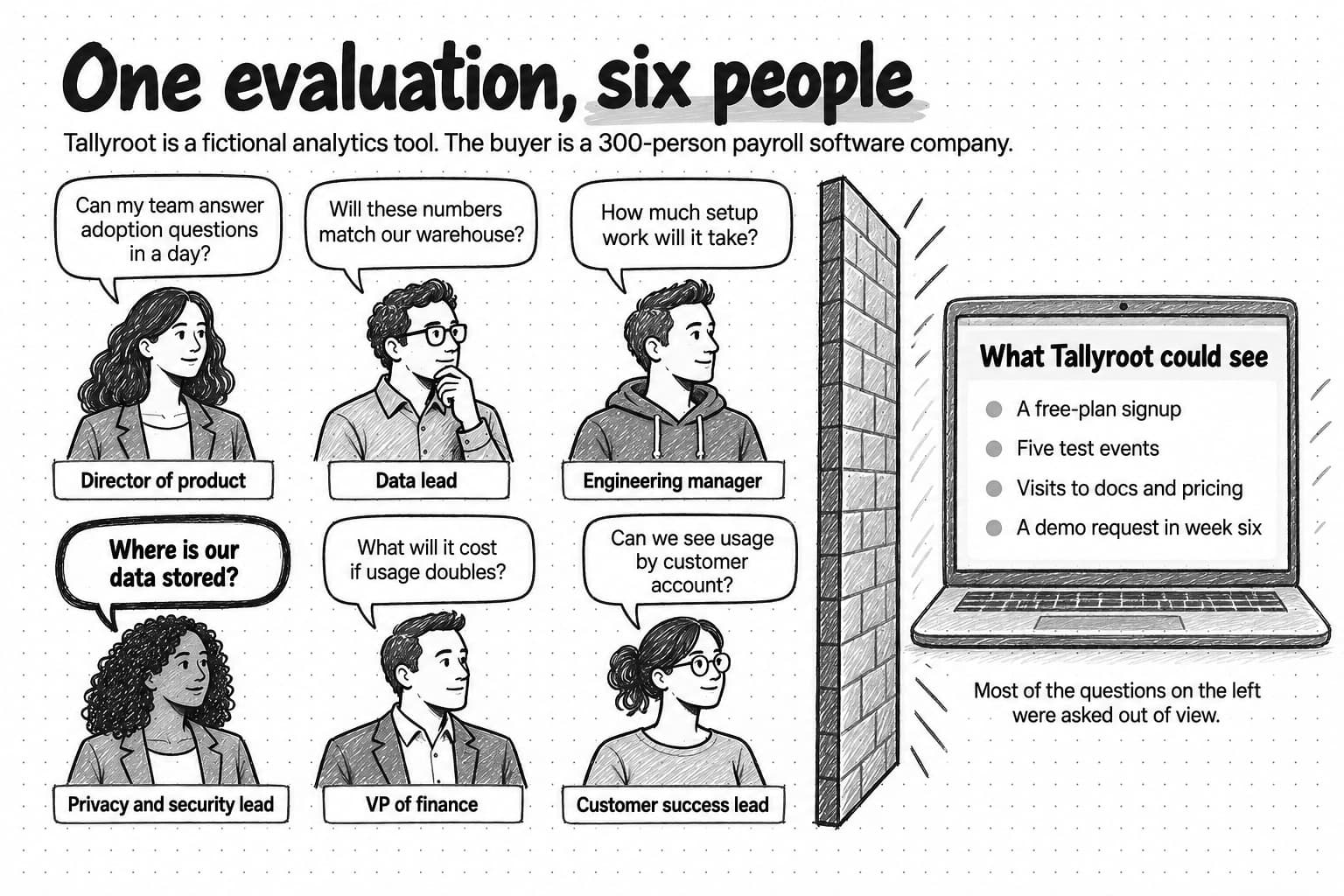
View the six participants and what the vendor saw at full size (opens in a new tab).
When the journey loops back or stops
The demonstration went well. The data lead asked to see the query behind an AI answer, and Tallyroot showed it. The director passed on the privacy lead's question about where data was stored, and Tallyroot's salesperson promised to send details. The director left the call expecting to buy within a month.
In week seven, the details arrived: Tallyroot stored data only in the United States. The payroll company had promised its European customers that their data would stay in Europe, so the privacy lead added a requirement and the evaluation went back a step. The shortlist changed. An analytics tool that runs inside the company's own data warehouse moved up, because the data would never leave the company's systems. Building reports in the existing business intelligence tool, which the data lead had suggested earlier, returned as a serious option. Tallyroot's salesperson had sent the answer, but the sales team learned that it had ruled Tallyroot out only a week later, when the privacy lead's questionnaire asked about European hosting.
In week ten, a change to payroll tax rules required engineering work before the end of the year. The chief technology officer moved the engineers onto it and deferred the analytics decision to the next quarter. No one chose a competitor. The company decided not to decide yet, and the director's free account went quiet.
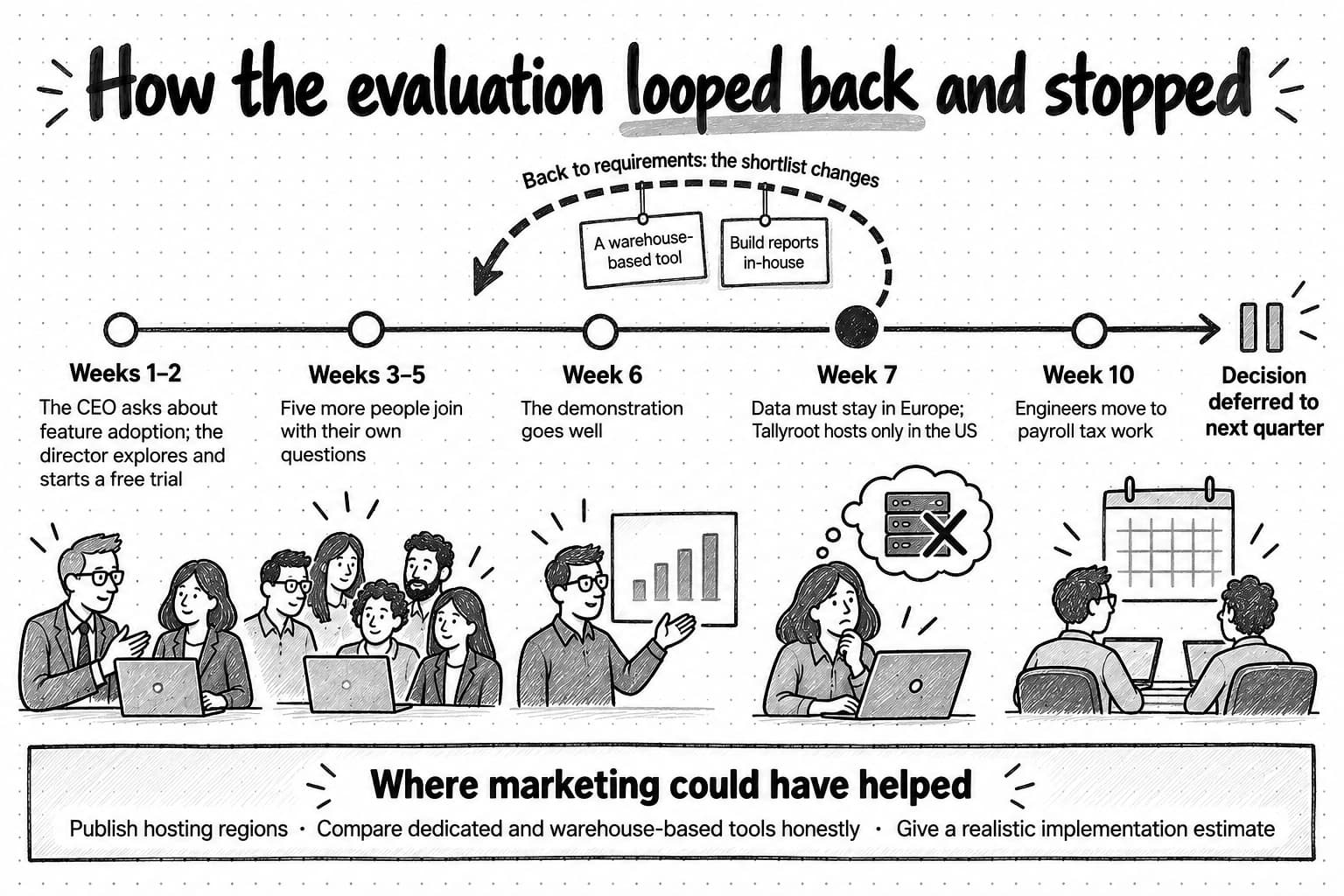
View the evaluation timeline at full size (opens in a new tab).
Several things in this example are ordinary. A requirement appeared late because the person who held it joined late. The shortlist changed to include an option the vendor does not sell, building the reports in-house. And the evaluation stopped for a reason that had nothing to do with any vendor: the engineers were needed elsewhere.
Marketing could not have prevented the tax change, but it could have shortened the loop. If Tallyroot had published its hosting regions where buyers look, such as its security page and pricing page, the privacy lead could have found the gap in week three and the group could have weighed it then. An honest comparison of dedicated analytics tools with warehouse-based ones would have helped the data lead, even though it would not have favored Tallyroot in every case. And a realistic implementation guide would have given the chief technology officer an estimate of engineering effort before the tax change made the question urgent.
After a stall like this, the useful response is to learn what happened and keep the right material ready, not to keep emailing the director to ask whether they are ready to buy. A conversation with the director about why the decision was deferred would reveal the hosting requirement and the engineering constraint. If Tallyroot later offers European hosting, that is news worth sending to the account, because it answers the question that stopped the evaluation.
How to choose content for the buyer's current question
A stage label tells you roughly where a purchase stands. It does not tell you what to make. "Consideration-stage content" could mean a comparison page, a customer story, a webinar, or a pricing calculator, and each of those helps a different person with a different question. Planning from the question is more precise.
Start with a question in the buyer's own words. The best sources are the places where buyers already ask: sales call recordings, demonstration notes, support tickets from trial users, security questionnaires, community threads, review sites, and the questions people type into search engines and AI assistants. For search queries, the search intent behind the words tells you what kind of answer the person expects. Then work through four more decisions.
- Who asks it, and what decision does it affect? "What happens to our data?" from a privacy lead can stop a purchase. The same words from a curious user may only need a short answer.
- What evidence would answer it for that person? A data lead is likely to trust documentation and a test on their own data more than a customer quote. A budget owner may need a worked cost example more than a feature list. Note what the person is likely to distrust as well.
- Where will that person look? A security reviewer may go straight to your security page or send a questionnaire. A champion may ask a peer or an AI assistant before visiting your site. Some answers need to exist in places you do not own, such as review sites, partner directories, or public documentation that AI assistants can read.
- What is a sensible next step? Not every question ends with "book a demo." A useful next step might be a template the buyer can copy, a document they can forward, a test they can run in the trial, or a conversation with someone who can answer an unusual requirement.
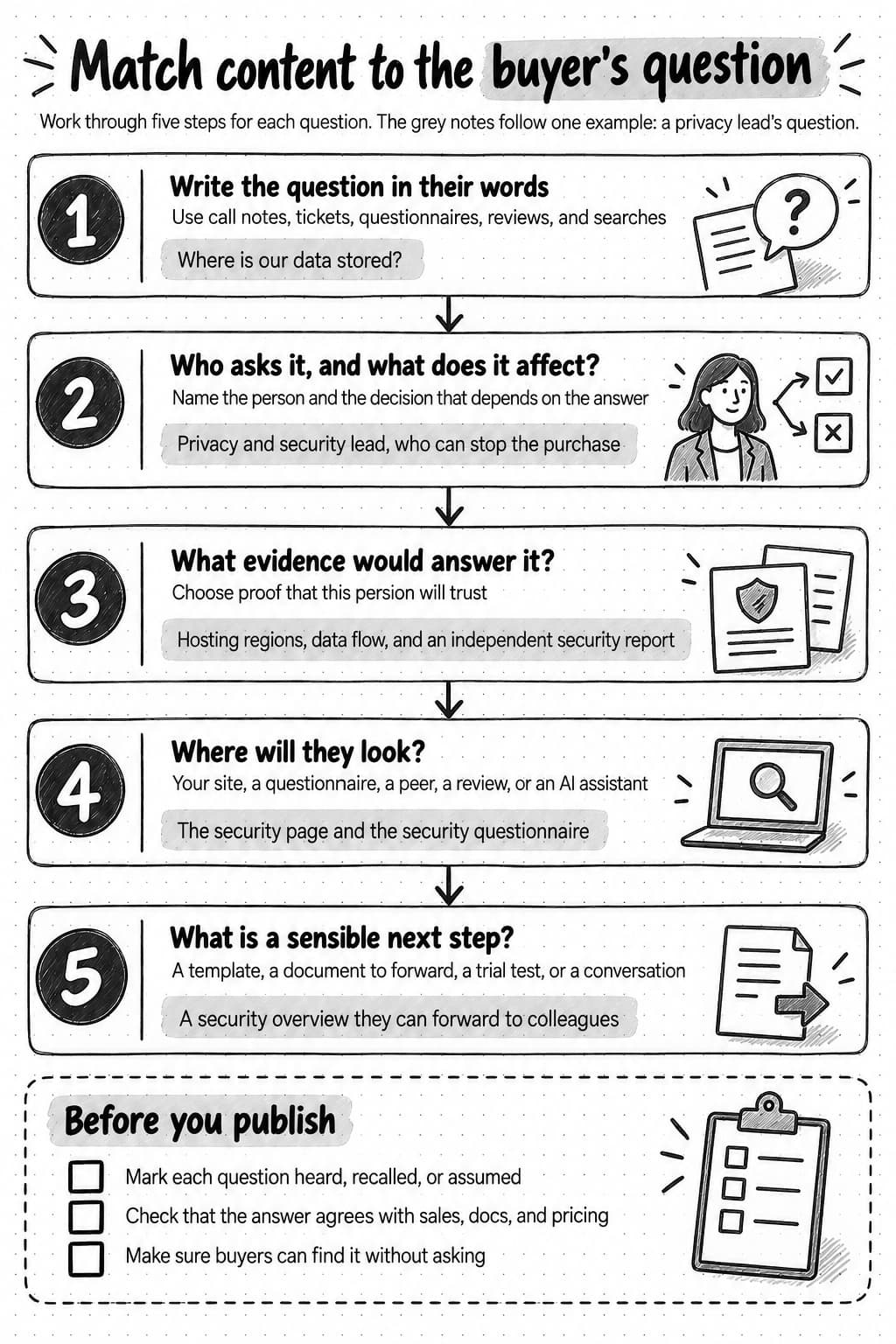
View the question-to-content worksheet at full size (opens in a new tab).
The same asset can answer different questions for different people. A customer story can help a champion believe the problem is solvable, help a technical evaluator judge implementation effort, and help a budget owner justify the spending, if it contains the details each of them needs: the customer's situation, how long setup took, and what changed afterward. Treat formats as tools for particular questions, not as fixtures of particular stages.
| Buyer's question | Who often asks it | Content or interaction that can help |
|---|---|---|
| Is this problem worth solving now? | The person who noticed it, or a skeptical executive | An explanation of the problem and its consequences, with a way to estimate its cost in the reader's own situation |
| What are the ways to solve it, including doing nothing or building it ourselves? | The champion, a technical lead | A guide comparing approaches honestly, including when your product is not the right fit |
| What should we require? | The champion, the evaluation team | A requirements checklist or evaluation template the team can adapt |
| Which options fit our situation? | The evaluation team | A comparison page that states its criteria; reviews; accurate public information for AI assistants to draw on |
| Will it work with our systems and data? | Technical evaluators | Documentation, integration guides, a trial with test data, a technical demonstration |
| Is it safe and compliant? | Security, privacy, and legal reviewers | A security overview, the data processing agreement, independent reports, prompt answers to questionnaires |
| What will it cost, now and as we grow? | The budget owner, finance | A pricing page with worked examples, or a cost estimate built with the buyer |
| Has it worked for a company like ours? | The approver, the champion | Customer stories with context, reference conversations, reviews |
| How do I convince my colleagues? | The champion | A one-page summary, a business-case template, material written to be forwarded |
| How hard will the change be? | The approver, the people who will roll it out | An implementation plan, a migration guide, an onboarding timeline |
Two cautions apply to any mapping like this. First, it is a starting list for your own research, not a substitute for it; your buyers may have questions this table does not include. Second, the answers have to agree with each other. Buyers compare your website with what a salesperson, the documentation, a peer, or an AI assistant tells them, and a pricing page that contradicts a sales quote raises a new question instead of answering one. Our content strategy guide explains how to turn questions like these into a portfolio, and our messaging framework guide helps keep the answers consistent.
What research and analytics can reveal, and what stays hidden
Everything a marketer knows about a buyer journey comes from three kinds of evidence, and they answer different questions.
Observed behavior is what your systems record: page visits, form submissions, downloads, email clicks, product signups, usage during a trial, and meetings booked. It is accurate about what happened in the places you can see. It says little about why, and nothing about what happened elsewhere.
Recollection is what people tell you afterward, in interviews, sales conversations, surveys, and the "How did you hear about us?" field on a form. It can explain reasons, priorities, and the people involved, which behavior data cannot. It is also incomplete. People remember recent and memorable moments better than early ones, may not know what their colleagues did, and sometimes give the answer that sounds most reasonable.
Inferred intent is a conclusion drawn from behavior: a lead score, an account marked as "in market," or a guess that someone who visited the pricing page three times is close to buying. Inference is useful for deciding where to look first. It is still a guess, and it is easy to forget that.
Why a download or a visit does not show readiness to buy
A person who downloads a guide might be researching a problem for next year, studying a competitor, writing a report, collecting material for a colleague, or simply curious. The same action can come from any of them, and repeated visits can even signal an objection, as Tallyroot's pricing-page visits showed. Treat an action as a reason to learn more about the account, not as a statement about where its purchase stands.
Why one contact's activity is not the account's progress
Most measurement tracks individuals, because individuals click and fill in forms. A purchase is decided by a group, and most of the group's work leaves no trace in your analytics. A champion who reads everything you publish may be losing an internal argument. An account where no one has visited your site in a month may be completing a security review with a questionnaire you answered weeks ago. Sales notes, questions from new people at the account, and direct conversation with the champion usually say more about the account's progress than any one person's clicks.
Sources that fill in the picture
No single source shows the whole journey, so combine them and note what each one can support.
| Source | What it can show | What to keep in mind |
|---|---|---|
| Interviews with recent buyers, including those who chose a competitor or did not buy | The trigger, who was involved, the questions that mattered, and why they decided | Based on recollection; talk to people soon after the decision and ask about specific events |
| Sales call recordings and notes | The questions buyers ask in their own words, and objections as they arise | Shows only the part of the journey that reached sales |
| Questionnaires, requests for proposals, and procurement documents | The formal requirements the buying group agreed on | Shows the requirements, not how the group arrived at them |
| Support tickets and trial usage | Where people get stuck when they try the product | Shows the people who tried it, not the reviewers who decided |
| Self-reported attribution ("How did you hear about us?") | Sources people remember, including ones analytics cannot see, such as a podcast or a peer | Recollection again: useful for patterns, unreliable for single cases |
| Website and product analytics | What happened in your own channels | Observed behavior: says what, not why, and only for what you can see |
| Reviews, communities, and AI answers | What buyers can find about you elsewhere | Shows what is available to buyers, not what any particular buyer read |
Our guides to market research and voice-of-customer research explain how to plan interviews and analyze what people say.
Some of the journey will always remain unobserved, and that is normal. The aim is to understand it well enough to make useful decisions about what to publish and say. Complete tracking is not available, and any model that claims it deserves suspicion.
How the buyer journey connects to onboarding, renewal, and expansion
The buyer journey ends with a decision, but the buyers' questions do not. Once the contract is signed, the same people start asking whether they made the right choice, and the answers decide what happens at renewal.
The evidence that persuaded the buying group also set its expectations. If a demonstration showed a first useful report within a day, the team will judge onboarding against that promise. If a customer story described a three-week rollout, a three-month one will feel like a failure, even if three months is normal. Marketing that overstates ease or speed during evaluation creates a problem for onboarding and customer success later.
After the purchase, the questions change:
- Onboarding: How do we set it up, and who does what? The people asking may be new to the purchase, such as an administrator or users who were not part of the evaluation.
- Value realization: Is it doing what we bought it for? The champion needs evidence they can show the approver, often the same kind of evidence that justified the purchase.
- Renewal: Should we keep paying for it? For a subscription, renewal is a new decision, sometimes made by people who were not involved the first time, such as a new finance lead.
- Expansion: Would it help another team? A second department's evaluation is often a new buying journey, with its own trigger, questions, and reviewers, even though the company is already a customer.
Teams that keep a record of the questions each buyer asked, and the evidence that answered them, can use it after the sale: to plan onboarding around what the customer expected, to prepare a value review that addresses the original reasons for buying, and to recognize when a new team's interest is the start of another journey. Our beginner's guide to B2B SaaS marketing follows one purchase from discovery through renewal and expansion.
Exercise: map one buying situation and find the gaps
This exercise takes about an hour with a colleague from sales or customer success. It works best on a real purchase from the last few months, won, lost, or stalled, because you can check your answers against what actually happened.
- Choose one buying situation. Name the kind of company, the problem that started the purchase, and how the product is usually bought: self-serve, with help from sales, or through a full sales process. Pick something specific, such as "a 200-person software company replacing spreadsheets for customer onboarding," not "mid-market."
- List the people involved. Include those who joined late or never spoke to you, such as security, finance, or the people who will use the product every day. Our guide to describing a target audience can help you describe the wider group, and the ICP guide linked above can help with each role.
- Write each person's main questions in their own words. Use call recordings, emails, questionnaires, and support tickets where you have them. Mark each question as heard (someone asked it), recalled (someone described it later), or assumed (your team believes it). These match the observed, recalled, and inferred evidence described earlier.
- Find your current answer to each question. Note the asset or interaction, where it lives, and whether a buyer could find it without asking you. If the answer exists only in a salesperson's head, write that down.
- Mark the gaps. For each question, decide whether the answer is missing, hard to find, out of date, or unconvincing to the person asking. Note where buyers might look instead, such as reviews, communities, or AI assistants, and check what they would find there. A fuller content gap analysis applies the same check to competitors' pages and AI answers across a whole topic.
- Choose one or two gaps to close first. Prefer questions that stopped or delayed real purchases, and questions that only one team can answer accurately.
A short worksheet keeps the results usable:
Buying situation:
How it is usually bought:

Person or role:
Question, in their words:
Heard, recalled, or assumed:
Current answer (asset or interaction, and where it lives):
Could they find it without asking us? (yes / no / partly):
Gap (missing / hard to find / out of date / unconvincing):
Where else they might look, and what they would find:
Priority (high / medium / low), and why:
The result is a short list of specific pieces of work, such as publishing hosting regions on the security page or adding worked cost examples to the pricing page, each tied to a question that real buyers asked. If a competitor's material answers a question better than yours, our guide to competitor analysis shows how to study it.
Answer more of your buyers' questions before they ask
Meet Ampere—your AI marketing agent. Ampere can research the public places buyers look, such as reviews, communities, competitors' pages, and the gaps in how AI search describes your category, and save audience, voice-of-customer, social proof, communities, and search landscape reports to Brand memory so later work starts from saved evidence. From there, Ampere can draft the material this guide describes, including one-axis competitor comparisons, landing and pricing page copy, blog articles, research reports, and email sequences. Public sources can be incomplete, and your team still decides which questions matter, checks the claims, and approves what ships.
Sources and further reading
- Patrick J. Robinson, Charles W. Faris, and Yoram Wind: Industrial Buying and Creative Marketing (Allyn and Bacon, 1967)
- Frederick E. Webster Jr. and Yoram Wind: A general model for understanding organizational buying behavior, Journal of Marketing (1972)
- Katherine N. Lemon and Peter C. Verhoef: Understanding customer experience throughout the customer journey, Journal of Marketing (2016)
- Gartner: Gartner says the marketing-to-sales handoff should no longer exist (October 9, 2018)
- Gartner: Gartner sales survey finds 74% of B2B buyer teams demonstrate "unhealthy conflict" during the decision process (May 7, 2025)
- Gartner: Gartner sales survey finds 61% of B2B buyers prefer a rep-free buying experience (June 25, 2025)
- Gartner: Gartner survey finds 69% of B2B buyers turn to sales reps to validate AI-generated insights (May 20, 2026)
- Gartner Digital Markets: Making the list, how software buyers build their shortlists (2025, PDF)
- Forrester: Forrester's 2026 buyer insights, genAI is upending B2B buying (January 21, 2026)
- 6sense: 2025 buyer experience report
- G2: The answer economy, how AI search is rewiring B2B software buying (April 15, 2026)
- Matthew Dixon and Ted McKenna: The JOLT Effect (Portfolio, 2022), and Stop losing sales to customer indecision, Harvard Business Review (2022)
- HubSpot: Buyer's journey vs. customer's journey (updated July 18, 2025)
- PostHog handbook: Spending money and Adding tools
- Notion: Upgrade or downgrade your plan
- GitLab handbook: Procurement and Third-party risk management
- Atlassian: Vendor security risk response and cloud security questions
- Handbooks and help pages read on October 6, 2026
Frequently Asked Questions
What are the stages of the B2B buyer journey?
The most common version of the B2B buyer journey has three stages: awareness, consideration, and decision. More detailed models describe the work as problem recognition, requirements, exploration, evaluation, internal agreement, and purchase, or as Gartner's six buying jobs. Older academic models list eight phases. All of these are planning aids rather than a fixed sequence, because buyers work on several stages at once and often return to earlier ones when people, requirements, or priorities change.
What is the difference between the buyer journey and the customer journey?
The buyer journey covers how an organization moves from noticing a problem to deciding whether to buy. The customer journey usually covers the whole relationship with a company, including onboarding, use, renewal, and expansion after the purchase. In B2B, the buyer journey also tends to describe a group of people with different questions, while a customer journey is often drawn for one person. The two connect directly, because the evidence used to win a purchase sets the expectations the customer later judges.
How is the B2B buyer journey different from a marketing funnel or sales pipeline?
The B2B buyer journey describes a purchase from the buyer's side: the questions, people, and decisions involved. A marketing funnel counts how many people or accounts move toward a purchase, and a sales pipeline tracks the deals a sales team is working, with their stage and value. Both are the seller's view and record only what the seller observes, so a buying group can be well into its research before it appears in either one.
Who is involved in a B2B buying decision?
A B2B buying decision usually involves the person who found the product, the people who will use it, technical evaluators, security, privacy, and legal reviewers, and the person who approves the budget. Gartner reports buying groups of 5 to 16 people across up to four functions, and Forrester reports that the typical decision includes 13 internal stakeholders and nine external influencers, across business purchases of many kinds and sizes. Small self-serve purchases may involve one person and an approver.
What are the three types of B2B buying situations?
The classic answer comes from Robinson, Faris, and Wind's 1967 buygrid. A new task is a problem the organization has not faced before, so buyers must work out what they need and who could supply it. A straight rebuy repeats a routine purchase without considering new options. A modified rebuy falls between them, such as replacing a familiar tool with a different one. New tasks usually need the most investigation.
What are touchpoints in the B2B buyer journey?
Touchpoints in the B2B buyer journey are the points where buyers encounter information about a company, its product, or the problem it solves. They include the vendor's own website, documentation, trial, and sales conversations, as well as partners, the buyer's internal meetings and documents, peers, communities, review sites, search results, and AI assistants. The seller controls only its own touchpoints and sees only part of what happens there.
Which content works best at each stage of the B2B buyer journey?
No format belongs to one stage of the B2B buyer journey. Choose content from the question a buyer is trying to answer: who is asking, what evidence would convince them, where they will look, and what a sensible next step is. A customer story, for example, can help a champion early, a technical evaluator later, and a budget owner at approval, if it includes the details each of them needs.
What signals show that a B2B buyer is ready to purchase?
No single action shows that a B2B buyer is ready to purchase. A download, a webinar visit, or repeated pricing-page views can come from early research, a competitor, or a finance lead raising an objection. One person's activity also does not show the account's progress, because much of the group's work happens in meetings and documents the seller cannot see. Conversations with the champion, questions from new reviewers, and formal requirements usually say more.
How do you create a B2B buyer journey map?
To create a B2B buyer journey map, start from one specific buying situation, preferably a recent purchase you won, lost, or saw stall. List everyone involved, write down each person's questions in their own words, and mark whether each question was heard, recalled, or assumed. Then record where each question is currently answered, mark answers that are missing, hard to find, outdated, or unconvincing, and close the gaps that delayed real purchases first.