How do AI search engines choose which sources to cite?
A plain-language walk through the four steps between a question and a cited answer, what ChatGPT, Perplexity, Copilot and Google document about each, what the citation studies found, and what you can change on your own pages and beyond them.
43 min readWritten by Ampere
Short answer
How do AI search engines choose which sources to cite?
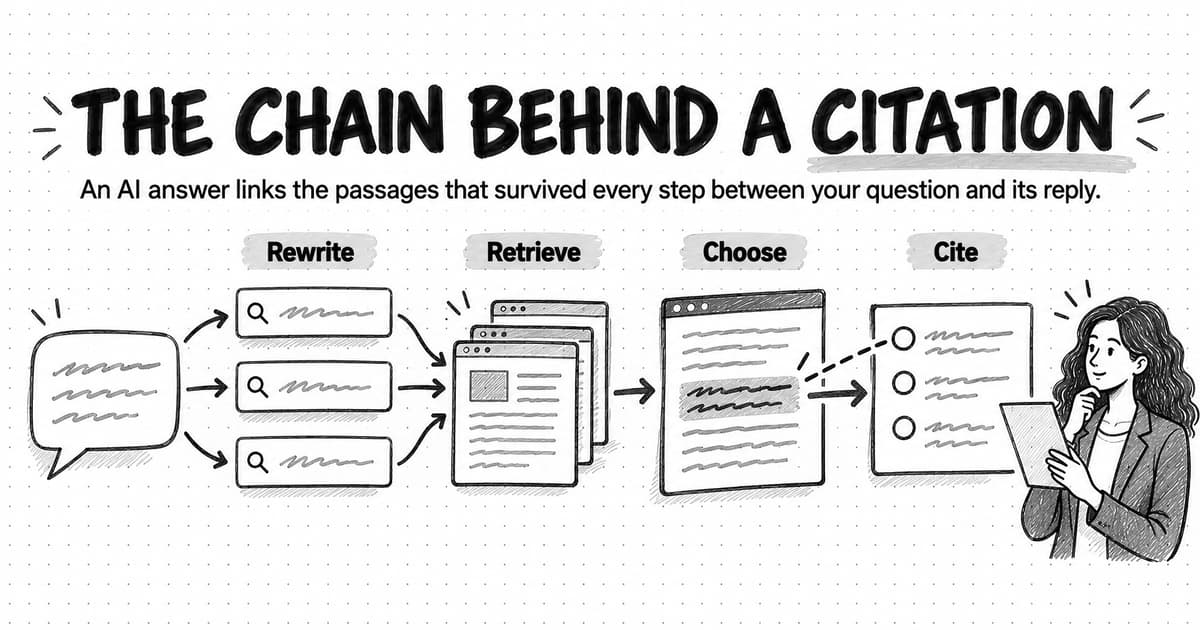
AI search engines cite the pages that survive four steps. The system rewrites your question into several narrower searches, retrieves ranked pages for each search from an index, keeps the passages that answer each search most directly, then writes the answer and links claims to passages it used. A page can drop out at any step, and each step has a different fix.
Summary
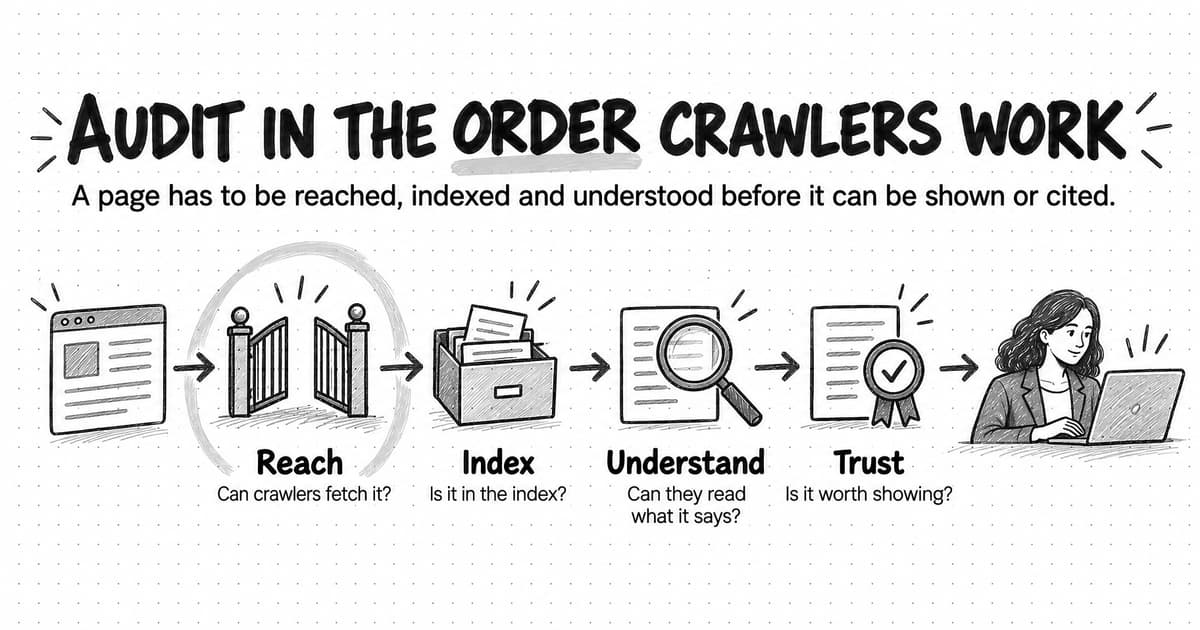
An AI citation is the end of a chain of decisions, not a single ranking. A page is cited only if it is crawlable and indexed, ranks for one of the searches the system ran, contains a passage that answers that search directly, and is chosen when the answer is written. Knowing where a page dropped out tells you which fix will help.
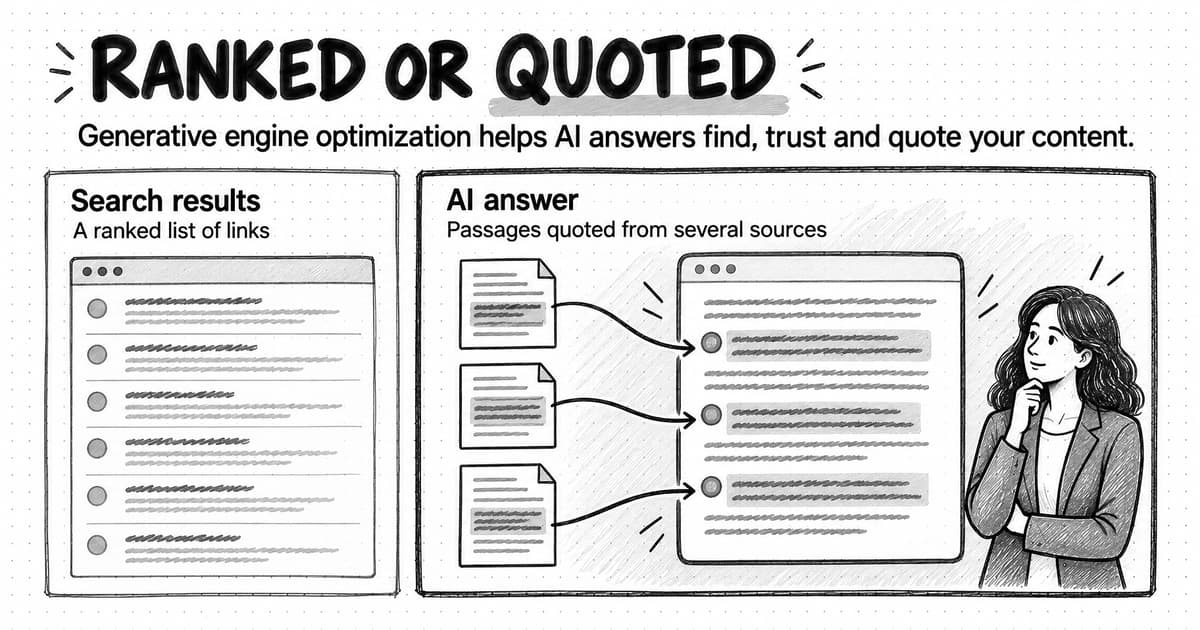
Citations come only from live retrieval. A model answering from training has no page addresses to link, so it cites nothing. When it searches, it first rewrites the question into narrower queries, which Google calls query fan-out, so pages compete for those sub-queries rather than for the question a person typed.
Vendors document eligibility, not selection. Google requires a page to be indexed and eligible for a snippet with no special optimization; OpenAI and Perplexity ask sites to allow their search crawlers; Bing shows sampled grounding queries. Citation studies disagree mainly on method: Ahrefs found 76% of AI Overview citations in Google's top 10 in 2025 and about 38% in 2026.
Third-party pages often win comparison questions because fan-out produces comparison searches that lists, review sites, forums and comparison pages match better than a single vendor page. One 2025 study found AI search strongly favored earned media over brand-owned content. Earning those citations is partly a distribution job, not only a writing job.
Pages are easier to cite when they are eligible, answer one question per section early, keep facts in text, give specific sourced numbers, stand alone when extracted, show they are current, and offer something original. None guarantees a citation. Check repeatedly which sources answer your buyers' questions, locate the step where you lost, and fix that step.
Contents
- What a citation in an AI answer is, and what it is not
- Two ways a model knows things: training data and live retrieval
- Step 1: the question is rewritten and fanned out
- Step 2: retrieval from a search index
- Step 3: choosing passages that answer each sub-question
- Step 4: writing the answer and attaching citations
- How ChatGPT, Perplexity, Copilot, Gemini and Google document source selection
- What the citation studies show, and why they disagree
- Why third-party pages get cited instead of yours
- What makes a page easy to cite
- Worked example: one buyer question traced from fan-out to citations
- What you can and cannot control
- Common mistakes when trying to earn AI citations
- How to check which sources AI answers cite for your questions
- How Ampere helps you see and earn AI citations
- Sources and further reading
- Frequently Asked Questions
You ask ChatGPT, Perplexity or Google's AI Mode the question your buyers ask, something like "what's the best expense software for a small agency?", and read the answer. Your product may be named or it may not, but the small numbered links under the answer tell a story of their own. They point to a listicle on a site you have never pitched, a review-site category page, a three-year-old Reddit thread and a competitor's comparison page. Your own pricing page, which answers the question better than any of them, is not there.
The natural reaction is to rewrite that pricing page. Before you do, it helps to know how the answer was put together, because the page an AI search engine cites is the end of a chain of decisions, and most of those decisions happen before the model writes a word. An AI search engine is a system that answers a question in prose by searching the web, reading some of what it finds, and linking the sources it relied on. A citation is one of those links: the system's record of which retrieved page supported which part of the answer.
This guide follows that chain step by step. It explains the difference between what a model learned in training and what it looks up live, then the four steps that turn a question into a cited answer: rewriting the question into several searches, retrieving pages from an index, choosing the passages that answer each search, and writing the answer with citations attached. It sets out what each major product documents about those steps, as of October 2026, separately from what is only inferred, then covers what the citation studies found, why third-party pages so often win, what makes a page easy to cite, and a fictional worked example traced from question to citations.
What a citation in an AI answer is, and what it is not
A citation in an AI answer is a link the system attaches to a sentence, a paragraph or the answer as a whole, pointing to a page it retrieved while writing. In Perplexity it is a numbered marker that opens the source. In ChatGPT, a response that used web search "may include citations," and a Sources button lists the cited pages and other relevant links, according to OpenAI's help article on searching the web with ChatGPT. In Google's AI Overviews and AI Mode the links appear beside or below the generated text.
A citation is evidence that a page was retrieved and judged useful for part of the answer. It is not a ranking in the old sense, and it is not an endorsement. Three distinctions matter for anyone trying to earn one.
First, a citation is different from a mention. An answer can name your company without linking you, because the name came from another page it cited or from what the model learned in training. It can also link your page while naming a competitor in the text. When you track AI visibility, record the two separately, as our guide to measuring AI search visibility recommends.
Second, a citation does not prove that the cited page says what the sentence beside it says. Researchers have measured the gap. In a 2023 study, Nelson Liu, Tianyi Zhang and Percy Liang at Stanford audited four generative search engines of the time (Bing Chat, NeevaAI, Perplexity and YouChat) and found that on average "a mere 51.5% of generated sentences are fully supported by citations" and "only 74.5% of citations support their associated sentence." Those systems have since been replaced or rebuilt, so treat the figures as evidence that the gap exists, not as today's error rate. The practical point holds: a citation shows that the system used your page, not that it represented it accurately.
Third, a citation is not the same as a visit. In a July 2025 study of the browsing data of 900 US adults, Pew Research Center found that people clicked a link inside Google's AI summary in about 1% of the visits where one appeared. A citation is still worth having, because the page shapes what the answer says and lends it credibility, but its value is mostly in the answer itself. Our guide to zero-click content distribution covers how to plan for buyers who read the answer and never click.
Two ways a model knows things: training data and live retrieval
A language model can answer from two kinds of knowledge, and only one of them produces citations.
The first is what the model absorbed in training. A model is trained on a very large body of text, and what it learns is stored in its parameters, the billions of numbers that make up the model. Researchers call this parametric memory. It has no addresses. When a model answers from training alone, it cannot point to the page a fact came from, because it does not store pages; it stores patterns learned from them. That is why a chat answer without web search has no citations, and why such an answer can be out of date: the model knows only what was in its training data, up to the date that data was collected.
The second is live retrieval. The system searches an index while answering, passes the most relevant text to the model, and asks the model to write from that text. The technique has a name, retrieval-augmented generation (RAG), from a 2020 paper by Patrick Lewis and colleagues at Facebook AI Research and University College London, which described models that "combine pre-trained parametric and non-parametric memory for language generation." In that paper, the non-parametric memory was "a dense vector index of Wikipedia." In an AI search engine it is a web index. Because the retrieved text arrives with its address, the system can attach a link to it. Every citation you see comes from this second kind of knowledge.
The two kinds of knowledge still mix inside one answer. The model uses training to understand the question, decide what to search for, interpret the pages it reads and phrase the result. It uses retrieval for the facts it is asked to ground. Google described this division for AI Overviews in May 2024. Elizabeth Reid, Google's vice president of Search, wrote that AI Overviews are "integrated with our core web ranking systems" and that "they're not simply generating an output based on training data." In practice, a brand that is discussed widely across the web can appear in an answer's text through the model's training even when none of its pages are cited, and a brand that is barely known can be cited because one of its pages answered a retrieved sub-question precisely.
Not every question triggers a search. ChatGPT "may search the web automatically when your question would benefit from current information," OpenAI's help article says, and people can also choose search manually. Google's developer documentation for grounding Gemini with Google Search says the model "analyzes the prompt and determines if a Google Search can improve the answer." A question about a stable definition may be answered from training with no links; a question about current prices, recent releases or "the best tools for" a job usually prompts a search. If your buyers' questions are the kind that trigger a search, the rest of this guide applies to them.
Once a search is triggered, four steps follow. They overlap in practice, and each product runs them differently, but they are a useful way to locate where your page drops out.
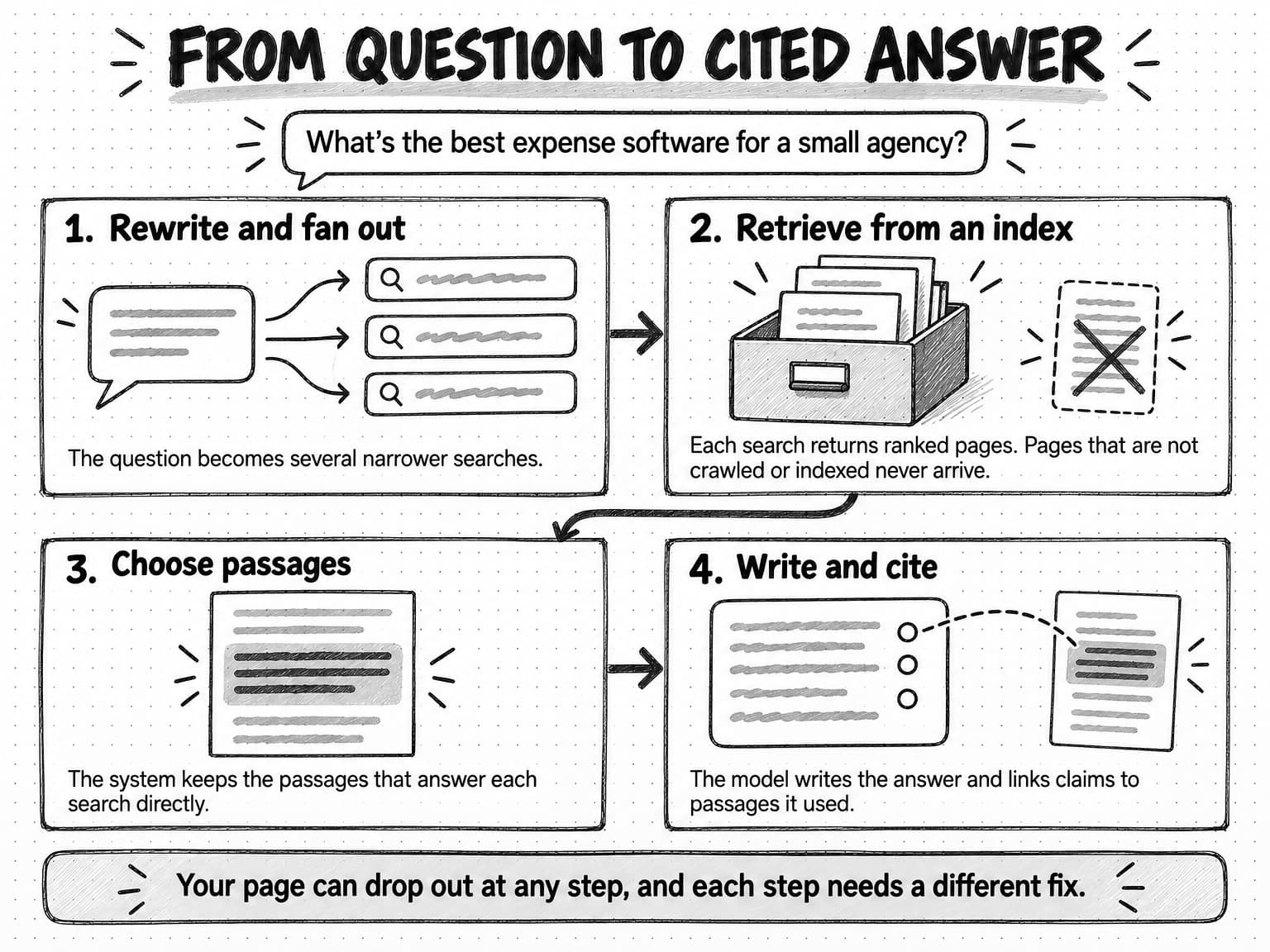
View the question-to-citation diagram at full size (opens in a new tab).
Step 1: the question is rewritten and fanned out
The words a person types are rarely the words the system searches for. Before it retrieves anything, an AI search engine rewrites the question into one or more search queries, often several at once and sometimes in rounds.
OpenAI's help article gives a specific example. When ChatGPT uses outside search providers, it "typically rewrites your query into one or more targeted queries" that it sends to them. A researcher who asks about drugs that target CCR8 for cancer might trigger an initial query of "CCR8 immunotherapy drug development 2025," and "after reviewing the initial results, ChatGPT search may send additional, more specific queries," such as "CHS-114 conference 2025." The rewrite can also add context: ChatGPT may add an approximate location based on the person's IP address, and, if memory is turned on, relevant saved details, so that a request for nearby restaurants becomes "good vegan restaurants San Francisco."
Google calls the same idea query fan-out. Its Search Central page on AI features and your website says AI Overviews and AI Mode "may use a 'query fan-out' technique — issuing multiple related searches across subtopics and data sources — to develop a response." When Google announced the wider rollout of AI Mode in May 2025, it described the technique as "breaking down your question into subtopics and issuing a multitude of queries simultaneously," and said its Deep Search feature can "issue hundreds of searches" for a single research report. Microsoft exposes the result of this step directly. Its AI Performance report in Bing Webmaster Tools, launched in public preview in February 2026, lists grounding queries, which Bing defines as "the key phrases the AI used when retrieving content that was referenced in AI-generated answers."
Fan-out matters to a marketer for one reason above all: your page competes for the sub-queries, not for the question. A buyer types one long question. The system may search for the category's best-known tools, pricing, a comparison of two names it already associates with the category, reviews, and an integration the buyer mentioned. A page can be cited because it answers one of those sub-queries well, even if it would never rank for the original question. A page can also be excluded because none of the sub-queries matches what it covers.
Two consequences follow. The first is that the long question you test in an assistant is a poor guide to what the system actually searched. Where a product shows its searches, such as Bing's grounding queries or the search steps some assistants display while they work, read them. Where it does not, infer the likely sub-questions from the answer's structure: each paragraph or list item usually answers one.
The second is that fan-out adds a layer of variation. The same question asked twice can produce different sub-queries, and different sub-queries retrieve different pages. Google's documentation says that because AI Overviews and AI Mode "may use different models and techniques, the set of responses and links they show will vary." Our guide to why AI gives different answers to the same question explains the sampling side of that variation; fan-out is the retrieval side.
Step 2: retrieval from a search index
Each sub-query goes to a search index, and the index returns a ranked list of candidate pages. This is the step where conventional search engine optimization still decides a great deal, because a page that is not in the index, or that ranks too low for the sub-query, never reaches the model.
Which index depends on the product, and the documentation is uneven.
- Google AI Overviews and AI Mode retrieve from Google's own index. Google's AI features page says that to be eligible as a supporting link, "a page must be indexed and eligible to be shown in Google Search with a snippet," and that "there are no additional requirements to appear in AI Overviews or AI Mode, nor other special optimizations necessary."
- ChatGPT search uses OpenAI's own crawler and outside search providers. OpenAI's crawler documentation says OAI-SearchBot "is used to surface websites in search results in ChatGPT's search features," and that sites that opt out of it "will not be shown in ChatGPT search answers, though can still appear as navigational links." OpenAI's help article says ChatGPT search "sometimes partners with other search providers," and lists Microsoft's and Shopify's privacy statements as the places to read how those providers handle queries.
- Perplexity runs its own crawler. Its crawler documentation says PerplexityBot "is designed to surface and link websites in search results on Perplexity" and "is not used to crawl content for AI foundation models," and recommends allowing it in robots.txt "to ensure your site appears in search results." Perplexity's help center says it searches "the internet in real-time" when you ask a question.
- Microsoft Copilot and the AI summaries in Bing are covered by Bing Webmaster Tools, whose AI Performance report counts citations across Copilot, AI-generated summaries in Bing and "select partner integrations."
Training crawlers are a separate question. OpenAI's GPTBot "is used to crawl content that may be used in training our generative AI foundation models," and blocking it signals that a site's content should not be used for training; it is a different robots.txt entry from OAI-SearchBot. A site can block training and still allow search, or the reverse. Before you change robots.txt, check which crawler controls which use, in each vendor's own documentation, because blocking a search crawler removes you from that product's cited answers. Our sibling guide to running an SEO audit for search and AI crawlers covers the checks in detail.
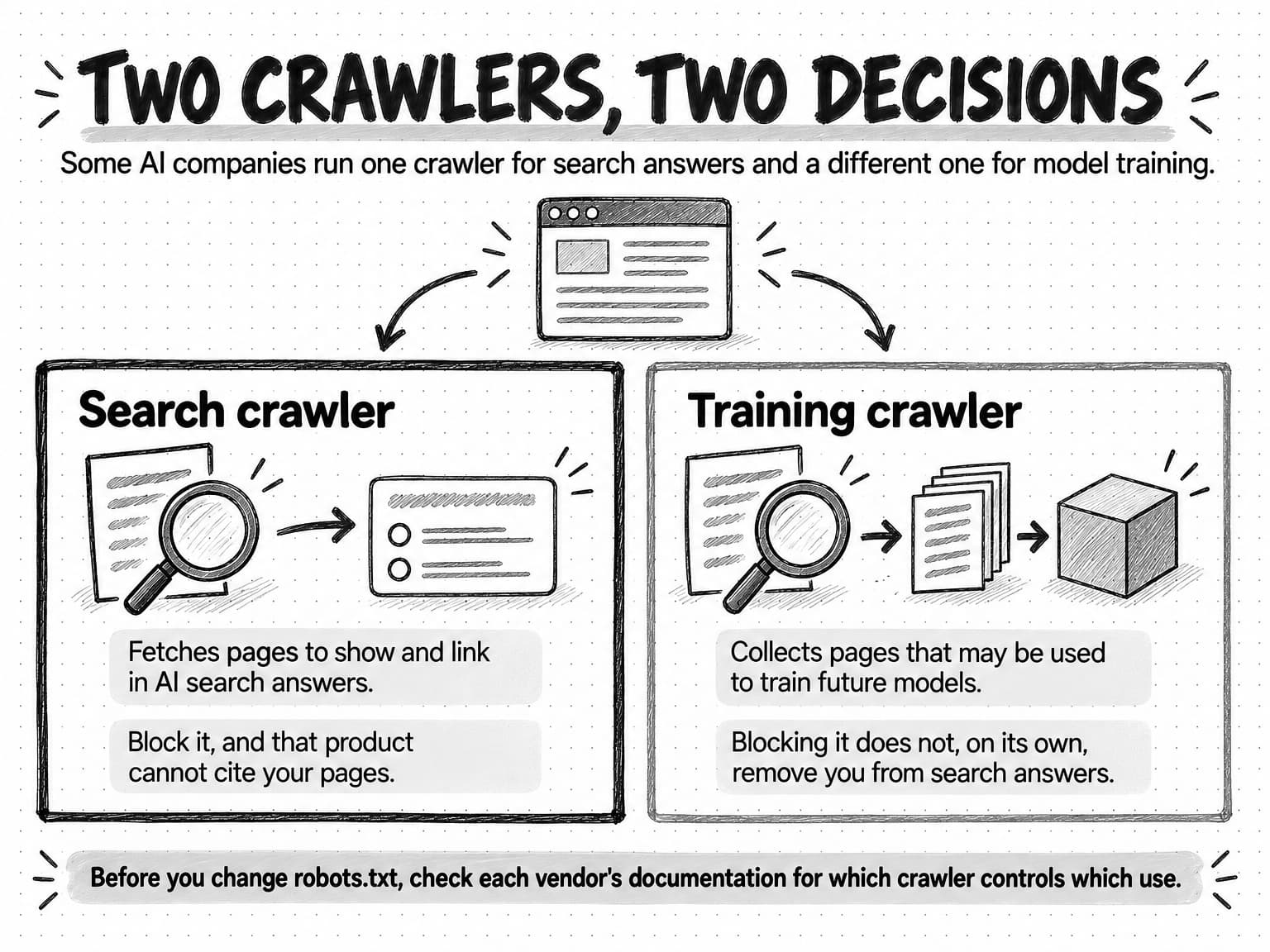
View the search and training crawler diagram at full size (opens in a new tab).
Retrieval also explains why the cited page is sometimes a copy of yours. In a March 2025 test by the Tow Center for Digital Journalism, published in the Columbia Journalism Review, ChatGPT cited a Yahoo News republication of a USA Today article even though USA Today blocks ChatGPT's crawler, and Perplexity Pro cited syndicated versions of Texas Tribune articles in three of ten queries. If your research or press release is republished on sites the crawler can reach, the copy can be retrieved and cited in place of the original.
What does ranking at this step depend on? The vendors say little in detail. OpenAI's help article says "ChatGPT ranks search results using multiple factors intended to help users find relevant, reliable information. Placement is not guaranteed." Google says AI Overviews use its core ranking systems, which means the usual signals of relevance and quality apply. No vendor publishes a separate ranking formula for AI answers, and claims that one exists should be treated as guesses.
Step 3: choosing passages that answer each sub-question
A ranked list of pages is still too much text to hand a model, so the system narrows it down to passages. Retrieval systems typically split pages into chunks, score each chunk against the sub-query, and pass the best-scoring chunks to the model with the question. The vendors do not document the chunk sizes, scoring or limits their consumer products use, so this part of the description comes from how retrieval-augmented systems are generally built rather than from any one product's documentation.
What the documentation and the research do show is that the passage, not the page, is the unit that wins. A page can rank well for a sub-query and still go uncited if no passage in it answers that sub-query in a form the model can use. A long page that answers ten questions in passing may lose to a short page that answers one question directly, because the short page's best passage is a better match.
Three properties of a passage make it easier to select.
It answers the sub-question in its own words. A passage that says "Plan B costs $24 per user per month, billed annually, and includes receipt scanning" is a direct match for a pricing sub-query. A passage that says "contact us for a quote" is not, even on a pricing page.
It stands on its own. Retrieval pulls a chunk out of its page. If the chunk depends on a heading three screens up ("As mentioned above, this tier...") or on a chart with no text equivalent, the extracted text loses its meaning. Pages whose sections name their subject and state their facts in text survive extraction better.
It carries something specific. In a 2023 study that coined the term generative engine optimization, Pranjal Aggarwal and colleagues tested how rewriting source pages changed how much of them a generative engine used. Adding quotations, adding statistics and citing sources produced the largest gains, up to about 40% on one of their visibility measures, while keyword stuffing offered "little to no improvement." Their main tests used a research engine they built on GPT-3.5 and the top five Google results for 10,000 queries, with a smaller test of 200 queries on Perplexity; the authors also found that what worked varied by subject. It is one study on systems that have since changed, so read it as evidence that specific, sourced passages are easier to use, not as a recipe with fixed returns. Bing gives similar advice to site owners: its February 2026 announcement says "clear headings, tables, and FAQ sections help surface key information" and that "examples, data, and cited sources help build trust when content is reused in AI-generated answers."
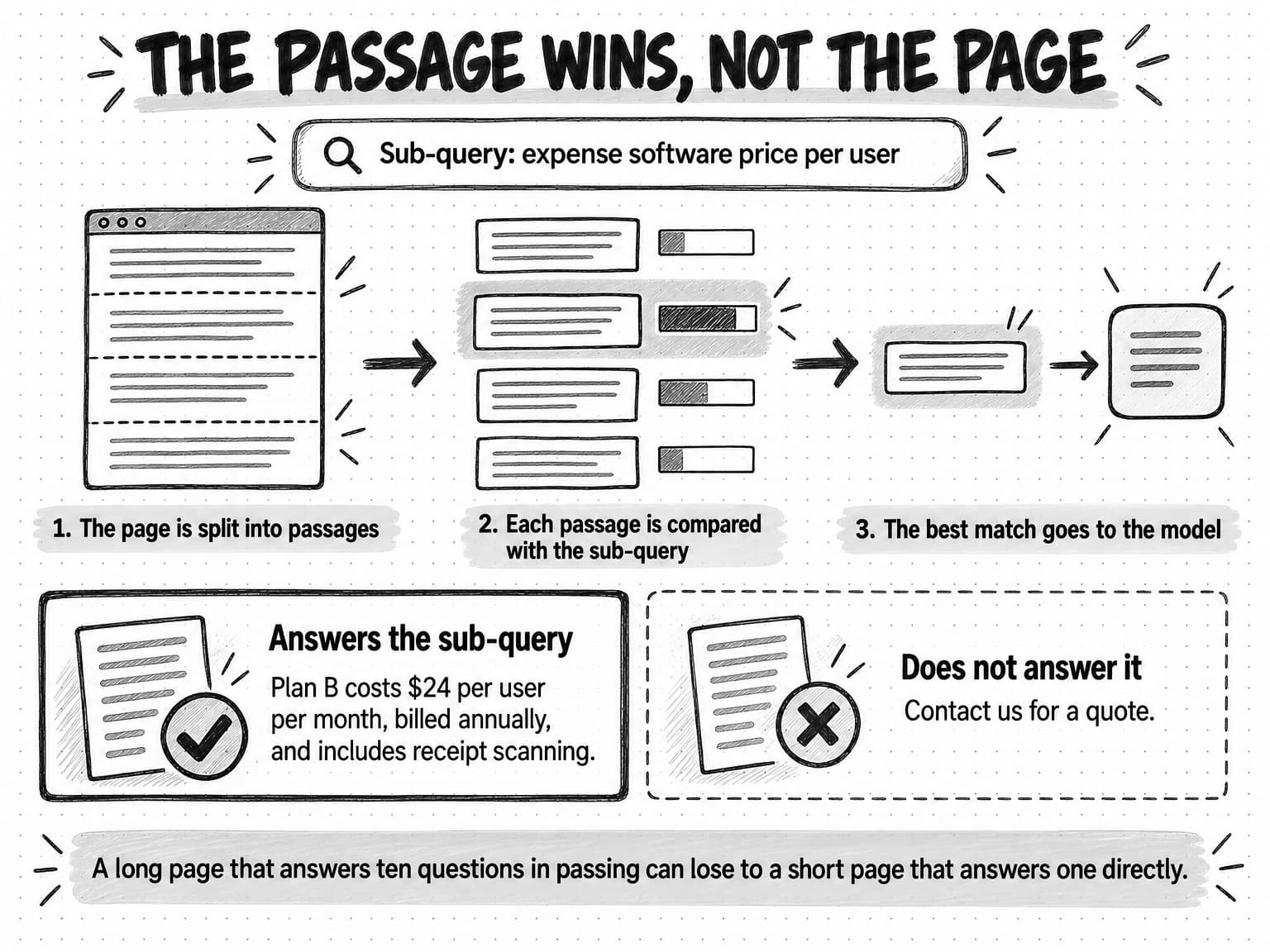
View the passage selection diagram at full size (opens in a new tab).
Freshness can also matter at this step. Bing's announcement says "regular updates help ensure AI systems reference the most current version of your content," and recommends IndexNow, a protocol for telling participating search engines when pages change. For questions that include a year or the word "latest," the rewritten sub-queries often carry a date, as in OpenAI's "CCR8 immunotherapy drug development 2025" example, which favors pages that show when they were updated.
Step 4: writing the answer and attaching citations
The model now has the question, the sub-queries and a set of passages, and it writes the answer. Citations are attached in this step, and how they are attached explains some of the oddities people notice.
Google's documentation for developers who ground Gemini in Google Search describes one way it works. The response comes back with annotations: each citation records a start and end position in the answer text and the source URL that supports that span, which the documentation calls "the key to building inline citations." In other words, the system tracks which sentence came from which retrieved passage, and the interface turns that record into the numbered markers or link cards you see. That documentation covers the developer product, not the Gemini app or Google Search, but it shows the general shape: the citation is a link between a span of generated text and a retrieved source.
Several things follow from this.
The model chooses which retrieved passages to use. Not every page that was retrieved ends up cited. The model writes from the passages it finds most useful for the sentence it is writing and leaves the rest out. Many products also show additional links that were retrieved but not cited; ChatGPT's Sources panel lists "cited sources and other relevant links."
A page can shape the answer without being cited. If two retrieved pages say the same thing, the model may cite only one. If a fact also appears in the model's training, the model may state it without a link.
Citations can be wrong. Beyond the Stanford verifiability findings, the Tow Center test found that more than half of the responses from Gemini and from Grok 3 cited fabricated or broken URLs, and that the eight tools tested gave incorrect answers to more than 60% of 1,600 queries asking them to identify a news article's headline, publisher, date and URL. That test was designed to be hard (the tools had to locate a specific article from an excerpt), and the products have changed since, so the rates are not a general accuracy score. They do mean that when an AI answer misstates your product and cites your page, the problem may sit in this step rather than in your page. OpenAI's own help article tells users that "search results and citations can be incomplete, outdated, or incorrect."
The interface decides what is visible. Some products show every cited source inline, some put most of them behind a Sources button, and some show only a few link cards. Studies that count only the first few visible links, as Ahrefs' July 2025 study did, see a different set from studies that count every link the answer exposes.
The four steps are where your page can drop out: not crawled or not indexed (step 2), not ranked highly enough for any sub-query (steps 1 and 2), no passage that answers a sub-query directly (step 3), or retrieved but not chosen (step 4). Each failure has a different fix, which is why it helps to know where the page fell out before you change it.
How ChatGPT, Perplexity, Copilot, Gemini and Google document source selection
The products share the four steps but document them to very different depths. The table summarizes what each vendor's own documentation says as of October 2026. Anything not in the table is undocumented, and descriptions elsewhere, including in this guide's explanation of passage selection, are inferences from how retrieval systems work.
| Product | What its documentation says about searching | Index and crawler | What site owners can see |
|---|---|---|---|
| Google AI Overviews and AI Mode | May use query fan-out, "issuing multiple related searches across subtopics and data sources" | Google's index; a page must be indexed and eligible for a snippet, with "no additional requirements" | Counted in Search Console's Performance report under the Web search type, with other search traffic |
| ChatGPT search | Rewrites a query into "one or more targeted queries," may send follow-up queries, ranks results using "multiple factors" | OAI-SearchBot plus outside search providers; GPTBot is the separate training crawler | Placement "is not guaranteed"; no first-party citation report is described in the help article |
| Perplexity | Interprets the question, searches "the internet in real-time," and answers with numbered citations; its Research mode "performs dozens of searches" | PerplexityBot for search results; Perplexity-User for fetches a person requests | No first-party citation report is described |
| Microsoft Copilot and Bing AI summaries | Uses grounding queries, "the key phrases the AI used when retrieving content" | Microsoft's Bing; citations reported in Bing Webmaster Tools | AI Performance in Bing Webmaster Tools (public preview since February 2026) shows citations, cited pages and sampled grounding queries |
| Gemini, through Google's developer grounding feature | The model decides whether search will help, "generates one or multiple search queries," and links answer spans to sources | Google Search | Developers receive the executed queries and citation annotations; this does not describe the Gemini app |
Two patterns stand out. The first is that only Microsoft and Google offer site owners first-party data, and neither offers much: Google folds AI feature traffic into its normal Search Console totals, and Bing's report is sampled and does not show which grounding query produced which citation. Most of what marketers know about other products' citations comes from running questions and recording the answers. The second is that every vendor describes eligibility (be crawlable, be indexed, be eligible for a snippet) and none describes a guaranteed path to selection. Google is explicit that there is no special optimization for its AI features. That leaves ordinary search quality and the properties of the passages themselves as the levers. For Google's products in more depth, see our sibling guide to Google AI Overviews and AI Mode.
What the citation studies show, and why they disagree
Because vendors publish so little, most of what is known about AI citations comes from studies by SEO software companies, researchers and journalists who run large numbers of queries and count the links. Their headline numbers often contradict each other. The disagreements are mostly about method, and understanding them is more useful than any single figure.
The clearest example is the overlap between Google's AI Overview citations and the pages ranking in Google's top 10 for the same query. Ahrefs, an SEO software company, has measured it twice.
| Study | Sample and method | Share of AI Overview citations also in the top 10 |
|---|---|---|
| Ahrefs, July 2025 | 1.9 million citations from 1 million AI Overviews; the top three citations in each answer | 76.1% (9.5% ranked 11–100; 14.4% outside the top 100) |
| Ahrefs, March 2026 update | 863,000 keyword results pages and about 4 million AI Overview URLs; all cited URLs its parser could see | 37.9% counting every results-page element, 37.1% counting only standard organic links (36.7% of those were outside the top 100) |
The same company, measuring the same product eight months apart, got roughly half the overlap. Ahrefs offered three reasons. It changed its parsing so that it now sees more of the citations in each answer, not just the top three. Google moved AI Overviews to its Gemini 3 model in January 2026, according to the Ahrefs report. And the author suggested, as a possibility rather than a finding, that AI Overviews now draw more on pages retrieved for fan-out sub-queries than on the results page for the original query. That last explanation fits the mechanism described earlier: a page that ranks for a sub-query is invisible to a study that only checks rankings for the original query.
Most disagreements between studies come from a short list of choices.
- Which citations are counted. The first three visible links, or every link behind the Sources button.
- Which query is compared. Rankings for the typed question miss pages retrieved for sub-queries.
- Which product, model and date. Products change models and retrieval often, and a study from six months ago describes a different system.
- Which questions. Commercial questions, news questions and how-to questions draw on different kinds of sources. A sample drawn from one keyword tool reflects that tool's keyword mix.
- Which country, language, account state and location. ChatGPT adds approximate location to its searches, and saved memories can change the rewritten query.
Other studies point the same way on one central question: how much AI answers favor third-party pages over a brand's own. In September 2025, Mahe Chen, Xiaoxuan Wang, Kaiwen Chen and Nick Koudas compared AI search services with Google and reported that AI search showed "a systematic and overwhelming bias towards Earned media" (independent, third-party coverage) "over Brand-owned and Social content, a stark contrast to Google's more balanced mix." They also found that the AI services differed significantly from each other in how many distinct domains they cited. Pew's 2025 study, which looked at Google's AI summaries, found that Wikipedia, YouTube and Reddit were the most frequently linked sites in both AI summaries and standard results, making up 15% of the links in summaries, and that government sites made up 6% of summary links compared with 2% of standard results.
How should a marketer use studies like these? Read the method before the headline, prefer studies that publish their sample and date, and treat each figure as true of that sample, that product and that month. Use the studies for direction (rankings still matter but predict citations less well than they did; third-party coverage matters a great deal; specific passages help) and use your own repeated checks for anything you plan to act on. Our guide to how deep research agents work summarizes the separate evidence on whether AI research tools cite accurately.
Why third-party pages get cited instead of yours
The marketer in this guide's opening saw a listicle, a review site, a Reddit thread and a competitor's comparison page cited for a question their own pricing page answered. The four steps explain most of that pattern without assuming any bias against brands.
The sub-queries ask for comparisons. A question that contains "best," "top," "alternatives" or "vs" is a request to compare. Fan-out turns it into sub-queries such as "best expense software small agencies" and "[tool A] vs [tool B]." A page that compares several options matches those sub-queries; a single vendor's page, which describes one option, does not. Your pricing page may be the best answer to "how much does [your product] cost," but that may not be one of the sub-queries the system ran.
Independent sources answer the question the system is implicitly asking. When someone asks which product is best, a useful answer weighs claims from more than one party. A review site with hundreds of user reviews, an analyst's list or a forum thread where practitioners argue is the kind of source a careful human researcher would also check. The 2025 earned-media study's finding of a strong preference for earned media is consistent with that, although the study measured the preference and did not establish the reasons for it.
Forums carry the specific detail sub-queries look for. A sub-query about a narrow situation ("expense software for agencies that bill clients for receipts") often has no vendor page that matches, but a forum thread where someone asked exactly that does. Google has also licensed Reddit's content: in February 2024 it announced an expanded partnership giving it access to Reddit's Data API, which supplies current, structured Reddit content, while saying the deal "does not change Google's use of publicly available, crawlable content." The licensing and the retrieval are separate questions, and neither guarantees that a forum page wins; Google said in May 2024 that it had "updated our systems to limit the use of user-generated content in responses that could offer misleading advice."
Third-party pages are often more extractable. A listicle states each product's name, price, best use and drawbacks in one short block per product. A vendor's page may spread the same facts across a hero, a pricing table rendered as an image, and a features page. At the passage step, the listicle's blocks match better.
Your page may never have been retrieved. Before assuming the model preferred someone else, check the basics: whether the relevant crawlers can reach the page, whether it is indexed, and whether it ranks for any of the likely sub-queries. A crawler blocked by a firewall rule is a common and fixable reason a page never enters the candidate set; Perplexity's documentation, for example, gives instructions for allowing its crawlers through common web application firewalls.
The implication is not that your own pages are pointless. It is that the pages an AI answer cites for a comparison question are mostly pages you do not control, and earning a place in them is a distribution job as much as a writing job. Our sibling guide to generative engine optimization covers that discipline as a whole, and our guide to original research content covers one of the more reliable ways to earn third-party citations: publish a finding other people need to quote.
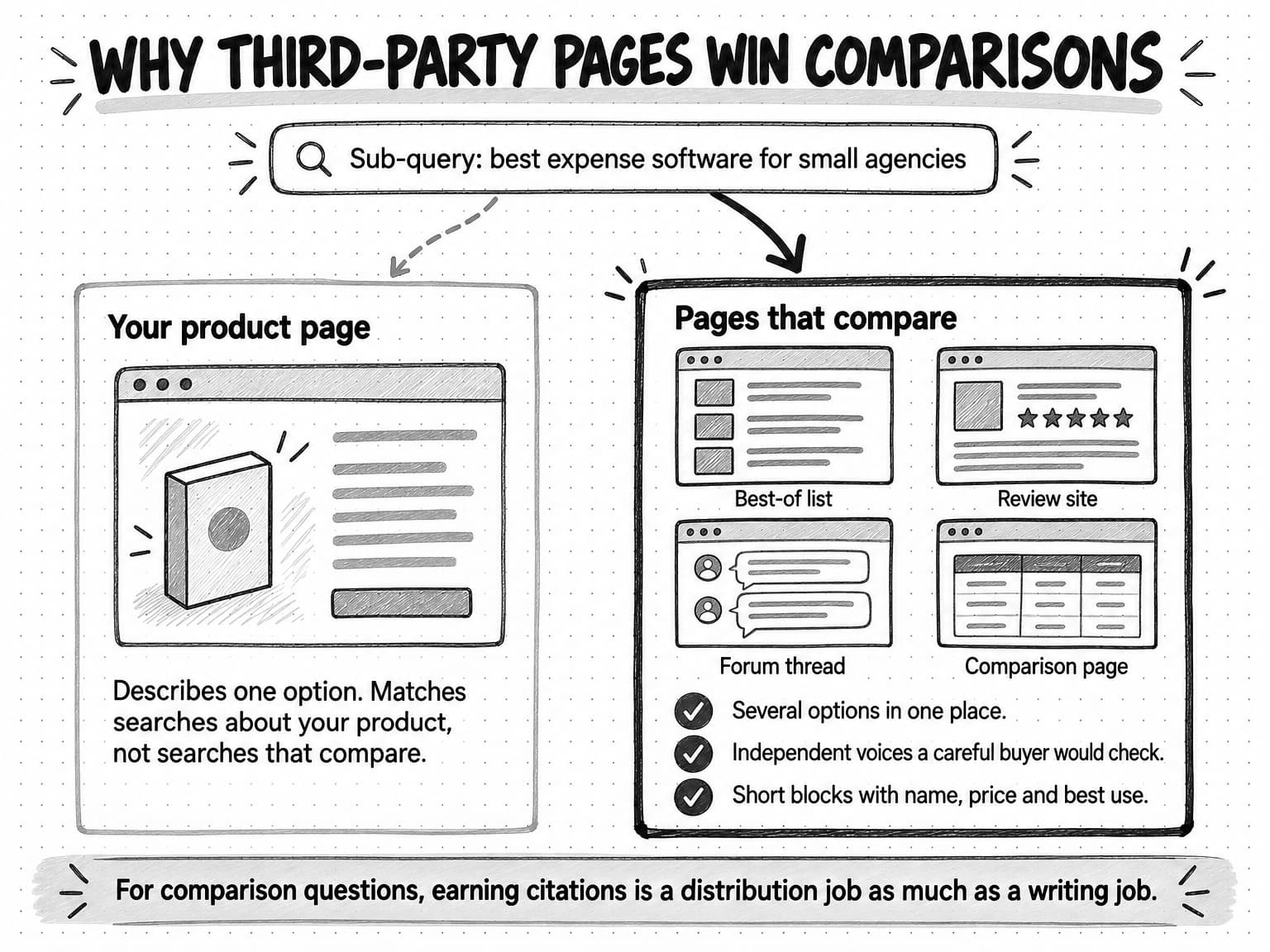
View the third-party citations diagram at full size (opens in a new tab).
What makes a page easy to cite
None of the vendors publishes a checklist for being cited, and Google says there is no special optimization. What follows is drawn from the documented mechanism, the research above and the guidance Google and Bing give site owners. It describes what makes a page easier to retrieve, extract and use, not a guarantee of selection.
Be eligible. The page is crawlable by the search crawlers of the products you care about, indexed, and allowed to show a snippet. Google's preview controls (nosnippet, data-nosnippet, max-snippet and noindex) limit what its AI features can show, so check that none is applied by accident to the passages you want used.
Answer one question per section, and say the answer early. A section headed with the question it answers, whose first sentences state the answer, gives the passage step a clean match. The heading "How much does Northfold cost?" followed by "Northfold costs $24 per user per month on the Team plan" is easier to use than a heading that says "Simple, transparent pricing" followed by a paragraph about values.
Put facts in text. Prices, limits, supported integrations, dates and definitions belong in HTML text, not only in images, PDFs or interactive widgets that a crawler may not read. If you use a table, make it a real table.
Be specific and say where the facts come from. The generative engine optimization study found that adding statistics, quotations and cited sources increased how much of a page the engine used. Bing tells site owners that "examples, data, and cited sources help build trust." A specific number with its source, date and sample is easier to cite than a general claim.
Make each passage stand alone. Name the subject in the passage rather than relying on "it" or "this." Avoid sentences that only make sense after the previous section.
Show that it is current. State when a page was last reviewed, update facts that change, and use IndexNow for engines that support it if you update often.
Have something no one else has. Google's May 2025 advice to site owners on its AI experiences begins with "focus on making unique, non-commodity content." If ten pages say the same thing, the system needs only one of them, and it may as well be the one with more authority. A page with original data, a worked method or first-hand detail answers sub-queries the others cannot. Our sibling guide to E-E-A-T covers how Google judges experience and trustworthiness.
Keep structured data honest. Google's guidance says that if you use structured data, "all the content in your markup is also visible on your web page." Markup does not substitute for visible content.
Several popular tactics have no support in the vendors' documentation. A special file for AI crawlers does not appear in Google's AI features requirements. Rewriting every page into question-and-answer format is not required either; the useful idea underneath it is that each section should answer a clear question. In the generative engine optimization study's tests on Perplexity, keyword stuffing did worse than leaving the pages unchanged.
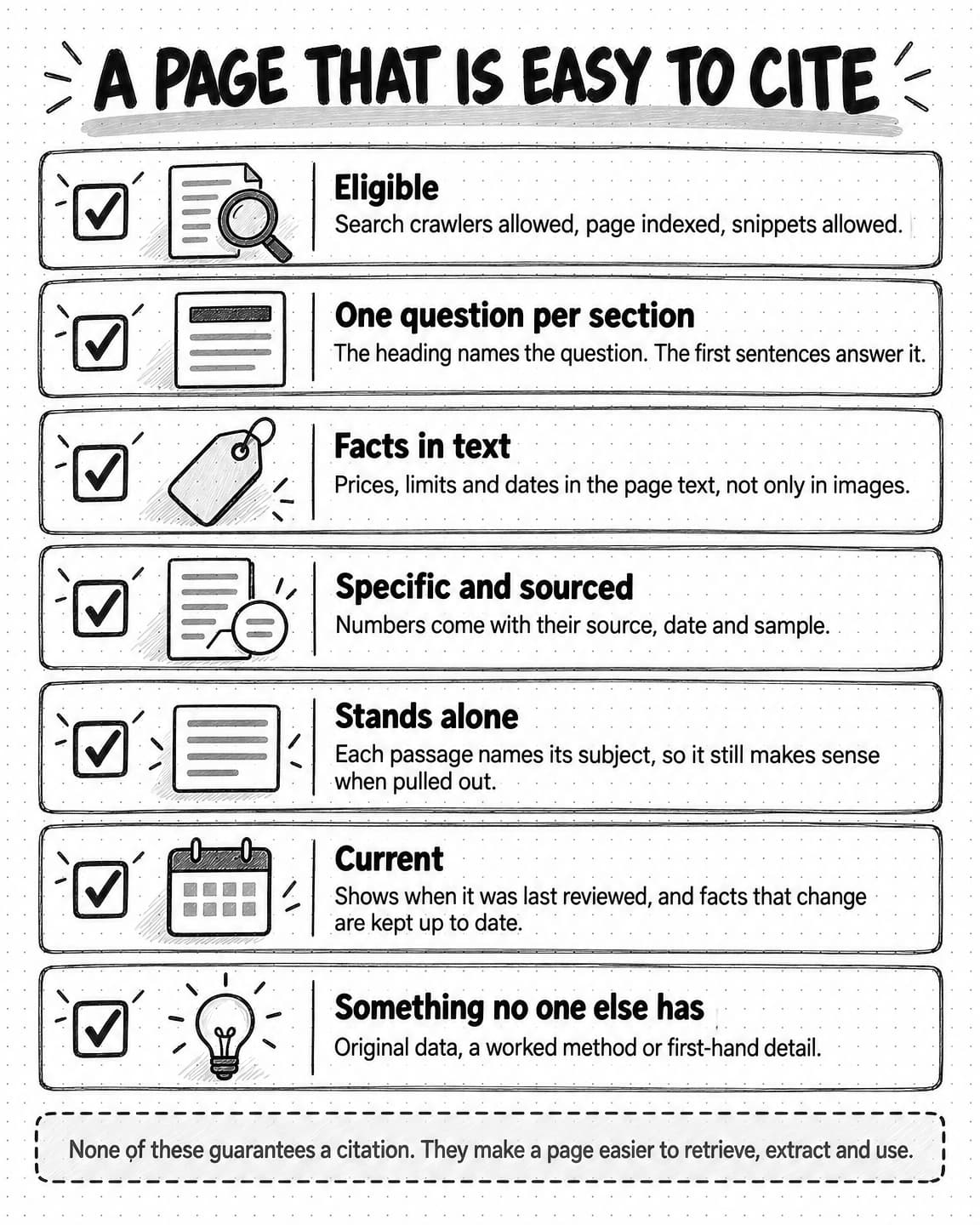
View the easy-to-cite checklist at full size (opens in a new tab).
Worked example: one buyer question traced from fan-out to citations
This example is fictional. Northfold is an invented expense-management product for agencies of 10 to 50 people, and the sub-queries, pages and outcomes below are illustrative, constructed to show the mechanism. They are not observed results from any real AI search product.
A finance lead at a 20-person design agency asks an AI search engine: "What's the best expense management software for a small creative agency that bills receipts back to clients?"
Step 1: fan-out. The system rewrites the question into several searches. Illustratively, they might be:
- best expense management software small business 2026
- expense software rebill client expenses agency
- expense management software reviews small teams
- [two category leaders the model already associates with expense software] vs comparison
- expense software pricing per user
Step 2: retrieval. Each search returns a ranked list. Northfold's homepage ranks for none of them. Its "Rebill expenses to clients" feature page ranks fifth for sub-query 2. Its pricing page ranks well for "Northfold pricing" but that search was never run; it ranks on the second page for sub-query 5, below several comparison pages that list prices for many tools.
Step 3: passage selection. For sub-query 1, the best passages come from a well-known business publication's "best expense software" list, which gives each product a short block with price, best use and drawbacks. For sub-query 2, Northfold's feature page competes with a forum thread in which an agency operations manager asks how to rebill receipts, and three people reply with tool names. Northfold's page opens with "Spend less time on admin" and describes rebilling in the third section under a heading that says "Built for the way agencies work." The forum thread's best passage names the problem in the first line. For sub-query 3, a review site's category page has the passage that matches. For sub-query 4, a competitor's comparison page wins.
Step 4: the answer. The answer recommends three products. It cites the business publication for the overview, the review site for user sentiment, the forum thread for the rebilling point, and the competitor's comparison page for the head-to-head. Northfold is mentioned once, in a sentence drawn from the forum thread ("several agency users mention Northfold for client rebilling"), with the forum thread cited, not Northfold's page.
What would change the outcome? Working back through the steps:
| Step where Northfold lost | What happened | A change that addresses it |
|---|---|---|
| Sub-query 1 (best-of lists) | Northfold is not in the publication's list | Earn inclusion: brief the publication's editors, offer a trial and a clear one-paragraph description with price and best use |
| Sub-query 2 (rebilling) | The feature page buries the answer under a slogan | Rewrite the section heading as "How to rebill expenses to clients" and state in the first two sentences how it works and what it costs |
| Sub-query 3 (reviews) | Few reviews on the main review site | Ask satisfied customers to review there; nothing on Northfold's site fixes this |
| Sub-query 4 (comparison) | The model compares the two category leaders | Publish an honest comparison page covering the leaders and Northfold, with a table of facts in text |
| Sub-query 5 (pricing) | Comparison pages outrank the pricing page | Put plan prices in text on the pricing page and keep them current, so comparison writers and retrieval both find them |
Two of the five fixes happen on other people's sites. That is typical of comparison questions. The example also shows why rewriting the pricing page, the reaction at the start of this guide, would have changed little: the pricing page lost at step 1, because no sub-query asked for it, and no rewrite of its content can fix that.
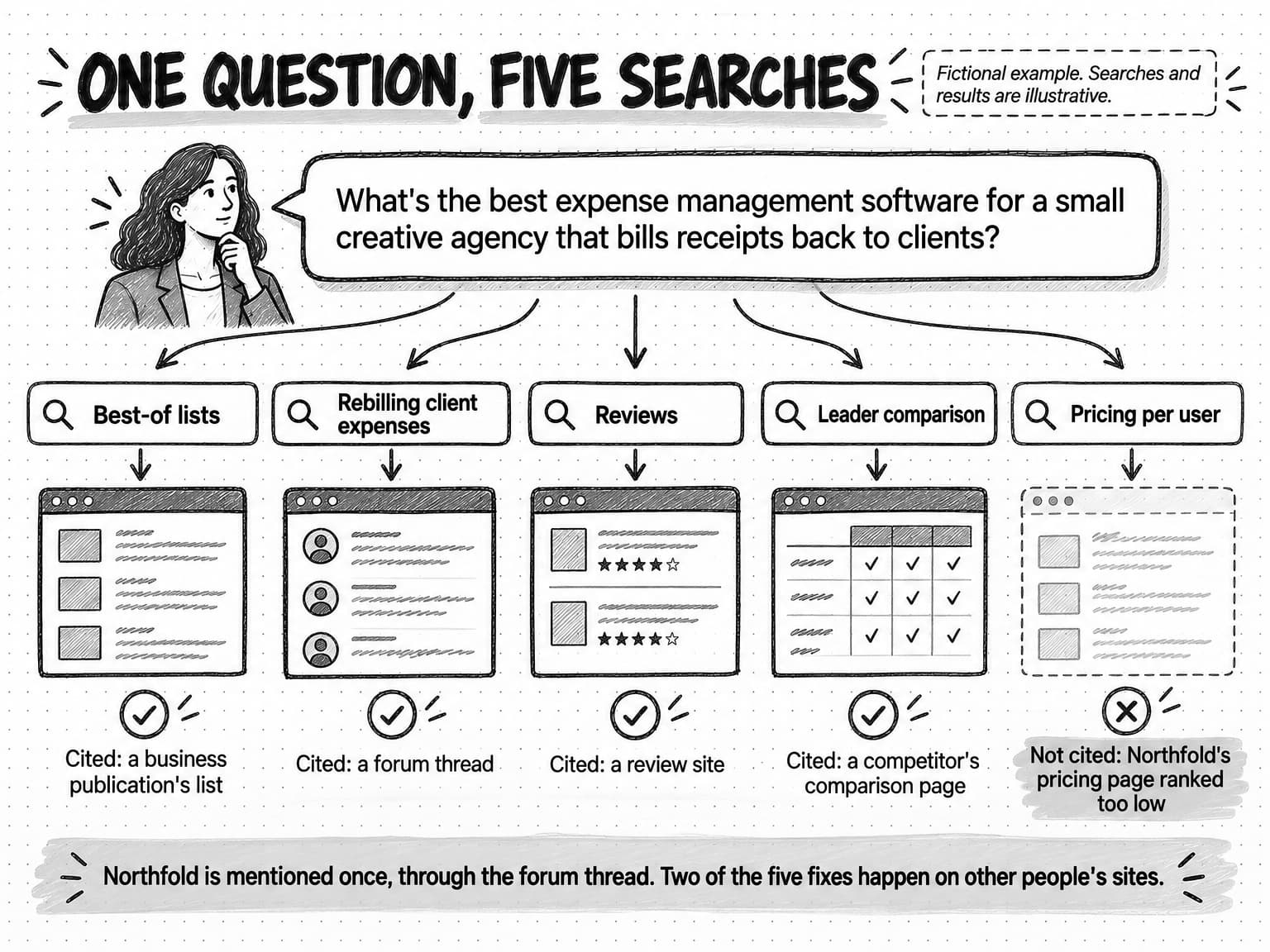
View the worked example at full size (opens in a new tab).
What you can and cannot control
The four steps divide cleanly into parts a marketer can influence and parts they cannot.
You control whether your pages are eligible. Crawler access, indexing, snippet controls, page speed and rendering, and whether facts are in text are all in your hands. They are also the most common reasons a page never enters the candidate set, which makes them the first place to look.
You control how well your pages answer specific sub-questions. You can write sections that answer one question each, state facts with sources and dates, publish comparison and pricing information in text, and create content that has original data or method.
You can influence, but not control, third-party coverage. You can pitch publications, earn inclusion in lists, ask customers for reviews, take part in communities as a named, disclosed representative, and publish research that others cite. You cannot decide what they write.
You cannot control the system's choices. You cannot choose which sub-queries a system runs, how it scores passages, which model it uses this month, or which retrieved passages it cites. You cannot buy a citation: none of the vendors' documentation reviewed for this guide describes a paid path to one, and OpenAI's help article says placement "is not guaranteed." You cannot make an answer stable; the same question will produce different sources on different days.
Separating these makes planning more honest. Eligibility and passage quality have a clear cause and effect and are worth fixing on every important page. Third-party coverage is slower and less certain but matters most for comparison questions. Trying to control the system's final choice, such as phrasing a page to match one test answer, tends to chase noise.
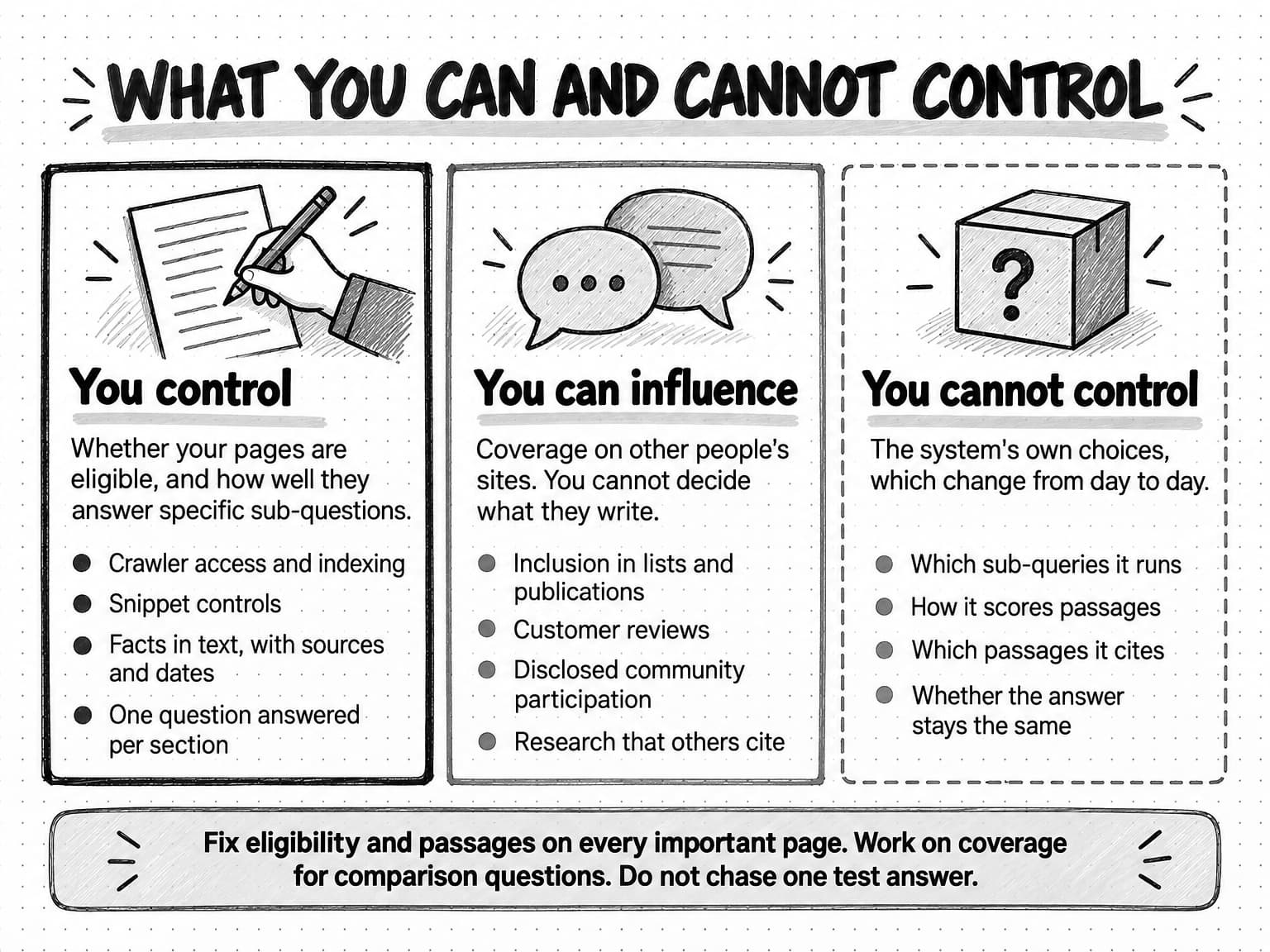
View the control diagram at full size (opens in a new tab).
Common mistakes when trying to earn AI citations
Optimizing for one test answer. Running a question once, seeing who was cited and rewriting a page to match treats one sample as a fact. Run each question several times, on more than one day, and record the pattern before you act.
Blocking the wrong crawler. Blocking a training crawler and a search crawler are different decisions with different consequences. Check each vendor's documentation for which user agent controls which use.
Treating a citation as a recommendation. A page can be cited in an answer that recommends a competitor. Record what the answer says about you, not only whether you were linked.
Ignoring the pages you do not own. For comparison questions, the cited pages are mostly third-party. A plan that changes only your own site addresses only part of the problem.
Forgetting that answers can be wrong about you. If an answer misstates your pricing and cites your page, check whether the page is clear and current, then whether a third-party page it also cites is out of date. Our guide to preventing AI hallucinations in marketing explains why grounded answers still make mistakes.
How to check which sources AI answers cite for your questions
Knowing the mechanism is most useful when you can see it at work in your own category. A small, repeatable check is enough to start.
- Choose 15 to 30 questions your buyers ask, drawn from sales calls, support tickets, Search Console queries and community threads rather than invented. Include definition, comparison, pricing and problem questions. Our guide to measuring AI search visibility explains how to build the question set and keep it stable.
- Pick the products that matter to your buyers and fix the conditions: signed in or out, country, and whether web search is turned on.
- Run each question at least twice on different days, and record the answer, every cited URL, the type of each cited source, and whether you were mentioned, cited, both or neither.
- Classify each cited source as your own page, a competitor's page, a list or publication, a review site, a forum or community, documentation, or original research.
- Locate the step where you lost. For each question where you were not cited, check eligibility (crawlable, indexed), then whether you rank for the likely sub-queries, then whether your best page has a passage that directly answers them.
- Choose one fix per question, on your site or beyond it, and recheck after the fix is live and indexed.
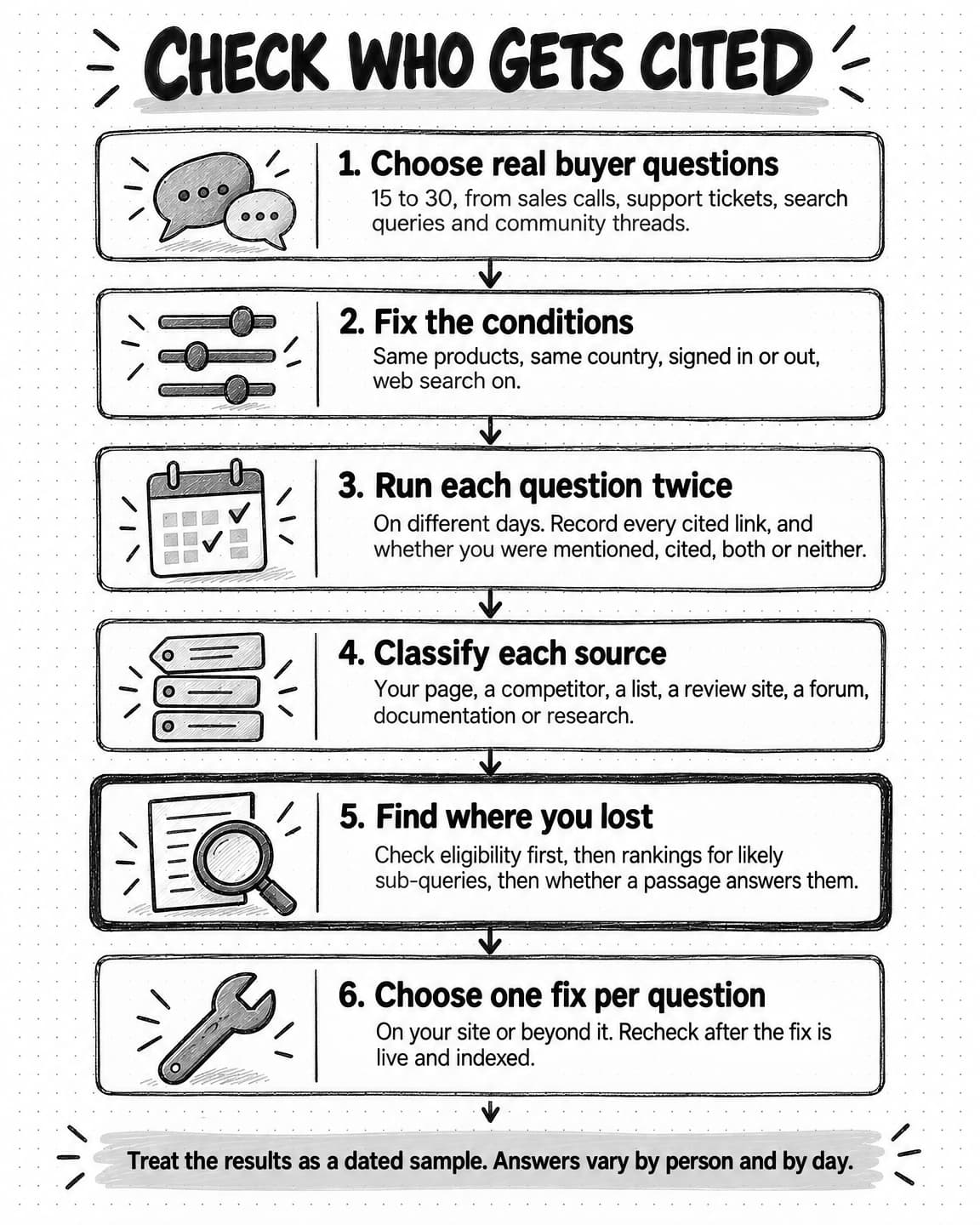
View the citation check process at full size (opens in a new tab).
A simple tracking sheet with one row per question and run might use these columns:
| Question | Product and date | Mentioned? | Cited? | Cited sources and their types | Likely sub-questions | Where we lost | Next fix |
|---|---|---|---|---|---|---|---|
| What's the best expense software for small agencies? | (product), (date) | Yes, once | No | Publication list; review site; forum; competitor comparison | Best-of; rebilling; reviews; leader comparison; pricing | Not in the list; feature page buries the answer | Pitch the list; rewrite the rebilling section |
The sheet will not tell you the system's internal reasons, and public answers vary by person and day, so treat the results as a dated sample. Its value is that it turns "we are never cited" into specific, located problems. Our sibling guide to content gap analysis shows how to turn the questions where competitors and third parties are cited and you are not into a content plan.
How Ampere helps you see and earn AI citations
Ampere, the AI marketing agent, can run this kind of check as a working session rather than a spreadsheet exercise. In a session workspace with its own browser, Ampere can search the web and AI answer surfaces, including Google AI Mode, Perplexity and Bing Copilot search, for the questions you give it, and record which sources appear and what the answers say about you and your competitors. Its AI visibility analysis and search visibility research help identify AI-search visibility gaps, and the findings can be saved as a search landscape report in Brand memory, so later work starts from the same evidence.
From there, Ampere can draft the source-backed pages and sections that fill a gap, such as an honest comparison page, a pricing section with facts in text or an article built around original data, and run SEO audits of existing pages. It drafts and prepares; your team reviews and publishes. To see how the answers change over time, Monitoring can run watches on a schedule of hourly, daily or weekly checks and file alerts with evidence and source links for review, and Scheduled Tasks can rerun a question set on a regular cadence.
Public data coverage is never complete, AI answers vary by person, place and day, and any analysis can be inaccurate or incomplete, so treat the results as a dated sample and review the drafts before anything goes out.
Sources and further reading
- Google Search Central, AI features and your website, last updated December 10, 2025. Query fan-out, eligibility for AI Overviews and AI Mode, preview controls, Search Console reporting.
- Google, AI Mode in Google Search: Updates from Google I/O 2025, May 20, 2025. Query fan-out in AI Mode and Deep Search.
- Elizabeth Reid, AI Overviews: About last week, Google, May 30, 2024. AI Overviews and core ranking systems; limits on user-generated content.
- John Mueller, Top ways to ensure your content performs well in Google's AI experiences on Search, Google Search Central Blog, May 21, 2025.
- Google, Grounding with Google Search, Google AI for Developers. How the developer grounding feature generates queries and attaches citations.
- OpenAI, Searching the web with ChatGPT, OpenAI Help Center, accessed October 14, 2026. Query rewriting, search providers, citations, eligibility.
- OpenAI, Overview of OpenAI crawlers, accessed October 14, 2026. OAI-SearchBot, GPTBot and ChatGPT-User.
- Perplexity, How does Perplexity work?, Perplexity Help Center, last modified August 28, 2026.
- Perplexity, Perplexity Crawlers, accessed October 14, 2026. PerplexityBot and Perplexity-User.
- Microsoft Bing, Introducing AI Performance in Bing Webmaster Tools (public preview), February 10, 2026. Grounding queries and guidance for site owners.
- Patrick Lewis and colleagues, Retrieval-Augmented Generation for Knowledge-Intensive NLP Tasks, NeurIPS 2020.
- Nelson F. Liu, Tianyi Zhang and Percy Liang, Evaluating Verifiability in Generative Search Engines, Findings of EMNLP 2023.
- Pranjal Aggarwal and colleagues, GEO: Generative Engine Optimization, KDD 2024.
- Mahe Chen, Xiaoxuan Wang, Kaiwen Chen and Nick Koudas, Generative Engine Optimization: How to Dominate AI Search, arXiv, September 2025. Earned media versus brand-owned content in AI search.
- Klaudia Jaźwińska and Aisvarya Chandrasekar, AI Search Has a Citation Problem, Columbia Journalism Review, March 6, 2025.
- Pew Research Center, Google users are less likely to click on links when an AI summary appears in the results, July 22, 2025.
- Louise Linehan, 76% of AI Overview Citations Pull From the Top 10, Ahrefs, July 21, 2025, and Update: 38% of AI Overview Citations Pull From The Top 10, Ahrefs, March 2, 2026.
- Google, Google expands partnership with Reddit, February 22, 2024.
Frequently Asked Questions
What sources does ChatGPT pull from?
When ChatGPT searches the web, it pulls from pages found by OpenAI's own search crawler, OAI-SearchBot, and from outside search providers it sometimes partners with. It rewrites your question into one or more targeted searches, ranks the results using several factors, and cites pages it used. When it answers without searching, it draws on its training data and cites nothing.
How does Perplexity work?
Perplexity interprets your question, searches the web in real time, and writes a conversational answer with numbered citations linking to the pages it used. Its own crawler, PerplexityBot, gathers pages for its search results and is not used to train foundation models. Its Research mode runs dozens of searches and reads hundreds of sources for a longer report.
What is query fan-out?
Query fan-out is the technique of turning one question into many related searches, run across subtopics and data sources, before writing an answer. Google documents it for AI Overviews and AI Mode. It matters because pages compete for those narrower sub-queries, so a page can be cited for one part of an answer even if it would never rank for the full question.
Do Google AI Overviews cite top-ranking pages?
Often, but less than they used to. Ahrefs found that 76% of AI Overview citations ranked in Google's top 10 for the same query in July 2025, and about 38% in its March 2026 update, partly because its method changed. Pages retrieved for fan-out sub-queries can be cited without ranking for the original query, so ranking helps but does not decide.
Does ChatGPT use Reddit as a source?
Yes, Reddit threads can be retrieved and cited like any other crawlable page when they answer one of the searches ChatGPT runs. Forum threads often win narrow questions because someone asked exactly that question and practitioners answered it. Pew Research Center's 2025 study of Google's AI summaries also found Reddit among the most frequently linked sites, alongside Wikipedia and YouTube.
How accurate are AI search engine citations?
Less accurate than the links suggest. A 2023 Stanford audit of four generative search engines found only about 74.5% of citations supported the sentence beside them. A 2025 Tow Center test found eight AI search tools gave incorrect answers to more than 60% of queries asking them to identify a news article. The products have changed since, but citations still need checking.
Why does ChatGPT make up citations?
A model answering from training alone does not store the pages it learned from, so it has no real addresses to give. Asked for references, it can produce titles and links that look plausible but do not exist. With web search on, citations point to retrieved pages, yet a cited page still may not support the sentence it is attached to.
How do you get your content cited by AI search engines?
Make sure the search crawlers of the products you care about can reach and index your pages, then write sections that each answer one clear question early, with specific, sourced facts in text. Offer something original, keep pages current, and earn coverage on the lists, review sites and communities that comparison answers cite. No method guarantees a citation.