Voice-of-customer research: turn feedback into better messaging
Learn how to make sense of customer feedback, explain the reasoning behind your findings, and use what you learn to write messages you can test.
30 min readWritten by Ampere
Short answer
How do you turn voice-of-customer research into better messaging?
Voice-of-customer research turns customer accounts into evidence for a messaging decision. Define the audience and question, inventory relevant sources, and keep each excerpt tied to its original context. Develop and challenge themes before translating them into messages to test; a repeated phrase is not proof of market prevalence or product performance.
Summary
Customer feedback is easier to turn into messaging once the decision is named and each comment keeps its context. The same complaint can mean different things from a buyer, a daily user, or a former customer, so write down the decision, audience, deadline, and what would change your mind before choosing sources.
Every feedback source has its own limitation, so record how each was collected and whose perspective it misses. Give each excerpt a source ID, a location someone can reopen, the speaker's role and journey stage, and a verbatim, edited, or paraphrase label, and settle permission questions before sharing material with analysts or tools.
Keep each step from a customer's words to a proposed message separate, so reviewers can see where interpretation begins: observation, code, theme, then messaging implication. In the worked example, four of a fictional company's 10 invented records support a theme about following responsibility through customer handoffs, though that count cannot show how common the need is.
Explain the records that complicate a theme before prioritizing it. Frequency suggests what to investigate, but a buyer may mention a requirement once and refuse to buy without it. AI can organize material, yet it can drop a negation or turn a request into a result, so reopen cited passages and keep generated quotations out of the evidence.
Research can justify testing a message; a public claim also needs proof that the product delivers. The worked example sorts three candidate lines: one is supported for testing, one needs a defined metric and validation, and one is rejected as an unsupported absolute. A first test asks intended readers to restate what a line promises, and the guide includes a copyable evidence log.
Contents
- Define the decision and research question
- Build a source inventory before coding feedback
- Keep each excerpt linked to its original context
- Move from an excerpt to a defensible theme
- Explain contradictory feedback before prioritizing themes
- Use AI to organize material, then audit it against originals
- Turn findings into messages you can test
- Copy this evidence log and analysis template
- A short illustrative research report
- Sources and further reading
- Frequently Asked Questions
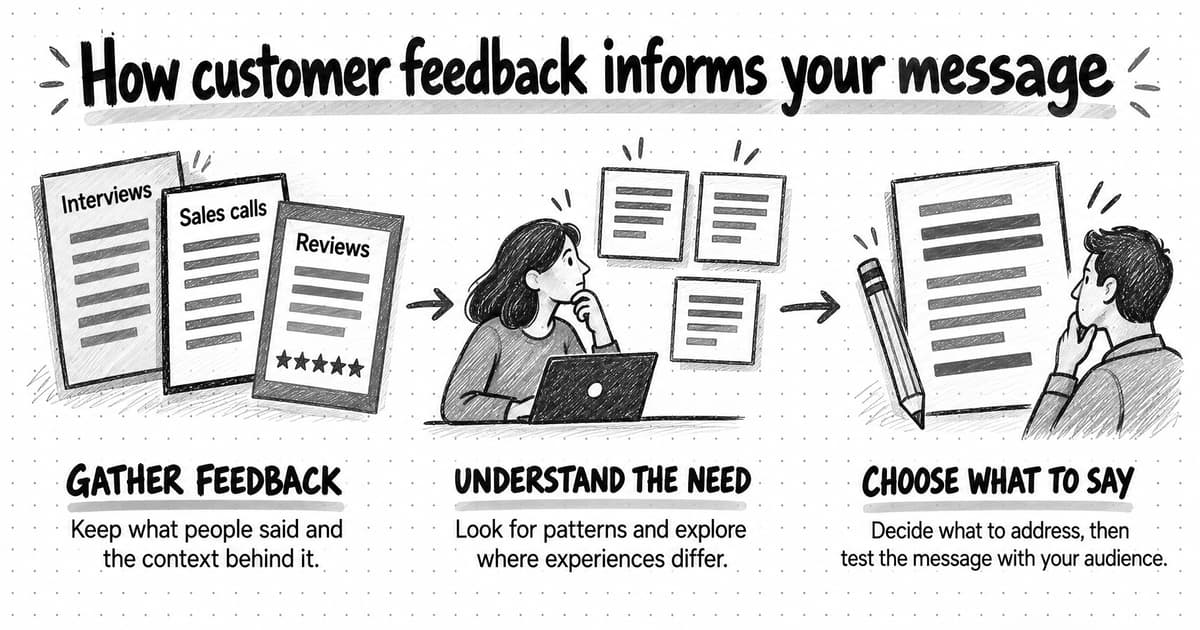
If you're trying to improve a product page or plan a campaign, you may already have plenty of customer feedback to work with. Sales has recordings of recent calls, support has tickets describing problems, and someone has collected reviews with phrases that sound more natural than the copy on your website. Reading that material can give you ideas, but it can also leave you unsure which concern deserves the most attention. One person wants work to happen faster; another wants fewer steps; a third wants to know what happened when something went wrong. You still have to decide what those comments mean for the message you're writing.
That decision gets easier when you look at the circumstances behind each comment. A complaint about a slow process might refer to waiting for another person, searching for missing information, or using software that takes too long to respond. Each calls for a different explanation of how your product helps. It also matters whether the person is deciding what to buy, doing the work every day, or explaining why they left. Keeping that context with the feedback helps you compare people's experiences without assuming they are all describing the same problem.
Voice-of-customer (VoC) research gives you a way to do that work deliberately. In marketing, it means gathering and interpreting people's accounts of their needs, buying decisions, and experience with a product or process. You read for patterns, examine comments that challenge your interpretation, and use the findings to decide what a message should address. The result should give you a reason for choosing a particular message, along with the sources and limitations someone else would need to assess that choice. A phrase may sound right on a homepage and still need testing with the intended audience.
To show how this works, the guide follows RelayBoard, a fictional B2B SaaS company that helps account teams coordinate customer handoffs. Its homepage promises faster work, but some of the feedback points to a more specific concern: knowing who is responsible for the next step. We'll follow that question through the source material, the analysis, and a proposed change to the copy. All RelayBoard excerpts, people, counts, and findings are invented for this worked example. The evidence log and review method are designed for you to adapt to your own research.
Define the decision and research question
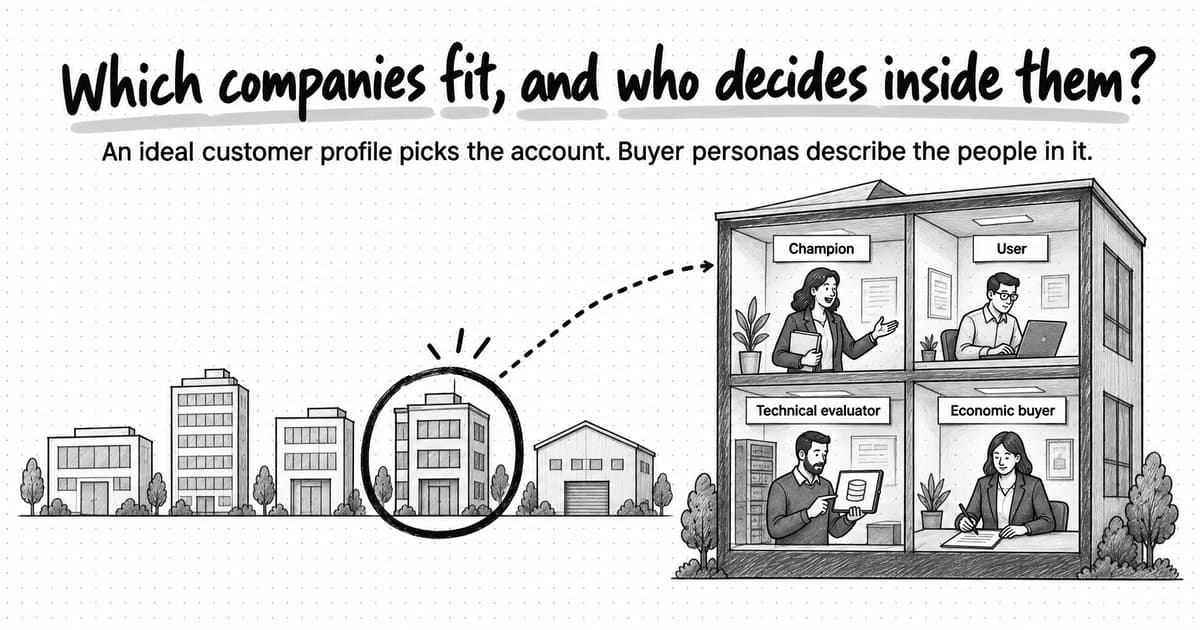
The same collection of feedback could help RelayBoard improve onboarding, investigate a product problem, or change its sales material. For this project, the marketing team has a narrower decision: should the homepage continue to lead with “Move work faster,” or should it emphasize knowing who owns a handoff? The audience is operations leaders who are considering replacing their current process. Naming that audience and decision helps the team choose relevant evidence instead of gathering opinions about every part of the product.
Its research question becomes: When operations leaders at growing B2B software companies consider replacing handoff spreadsheets, what breakdown prompts the search, what outcome do they need, and what proof makes a coordination tool credible? Notice that this asks about the situation that leads to a purchase, not whether people like a headline the team has already written. Daily users and former customers can help explain that situation too, as long as their experience is identified in the analysis.
For your own project, write down the decision, intended audience, and deadline before choosing sources. Include what you would need to learn to change your mind. RelayBoard has a reason to investigate ownership if people describe uncertainty about who should act after a handoff. It should also be willing to keep speed as the lead if buyers place greater importance on processing time. Asking people to describe a recent handoff and what made it difficult leaves room for either answer; asking how unclear ownership slowed them down would introduce the team's preferred explanation.
How other research can help answer the question
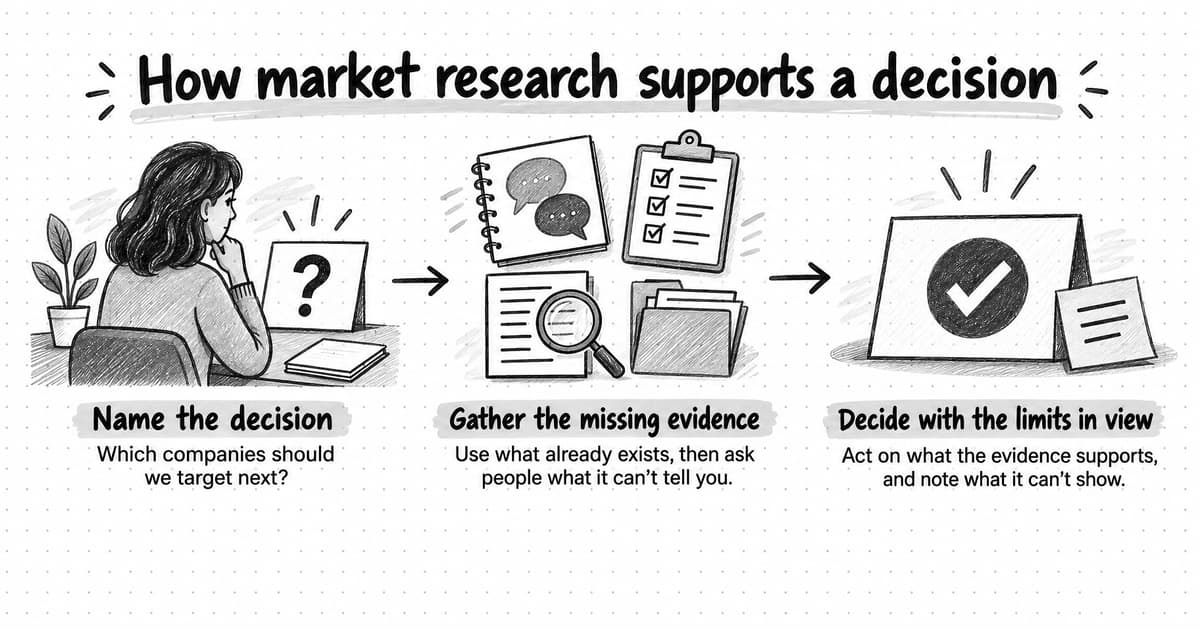
VoC is one part of market research. Customer accounts can explain why a particular problem matters, while other research may be needed to estimate the size of the market, compare competing offers, or study pricing. For RelayBoard, learning that a buyer struggles with handoffs would help the team understand that buyer's situation. It would not establish how many companies have the same problem or whether RelayBoard has an advantage over their alternatives.
Social listening and sentiment analysis can help you find material to examine. Social listening brings relevant public conversations into view, although it only covers people who post in places you can observe. Sentiment analysis can sort comments by tone, but a negative label does not explain what someone was trying to do or what went wrong. You need the underlying passage to make that judgment.
Findings from this work can improve personas, the summaries a team uses to describe an audience's needs and circumstances. Keep those summaries tied to their sources so they can be revised when new evidence appears. Message testing comes into play when you have wording to evaluate: it checks how the intended audience understands the message and whether it is relevant to them. Collecting quotations contributes to the research, but a phrase selected for its appeal has not gone through those checks.
View the source map at full size (opens in a new tab).
Build a source inventory before coding feedback
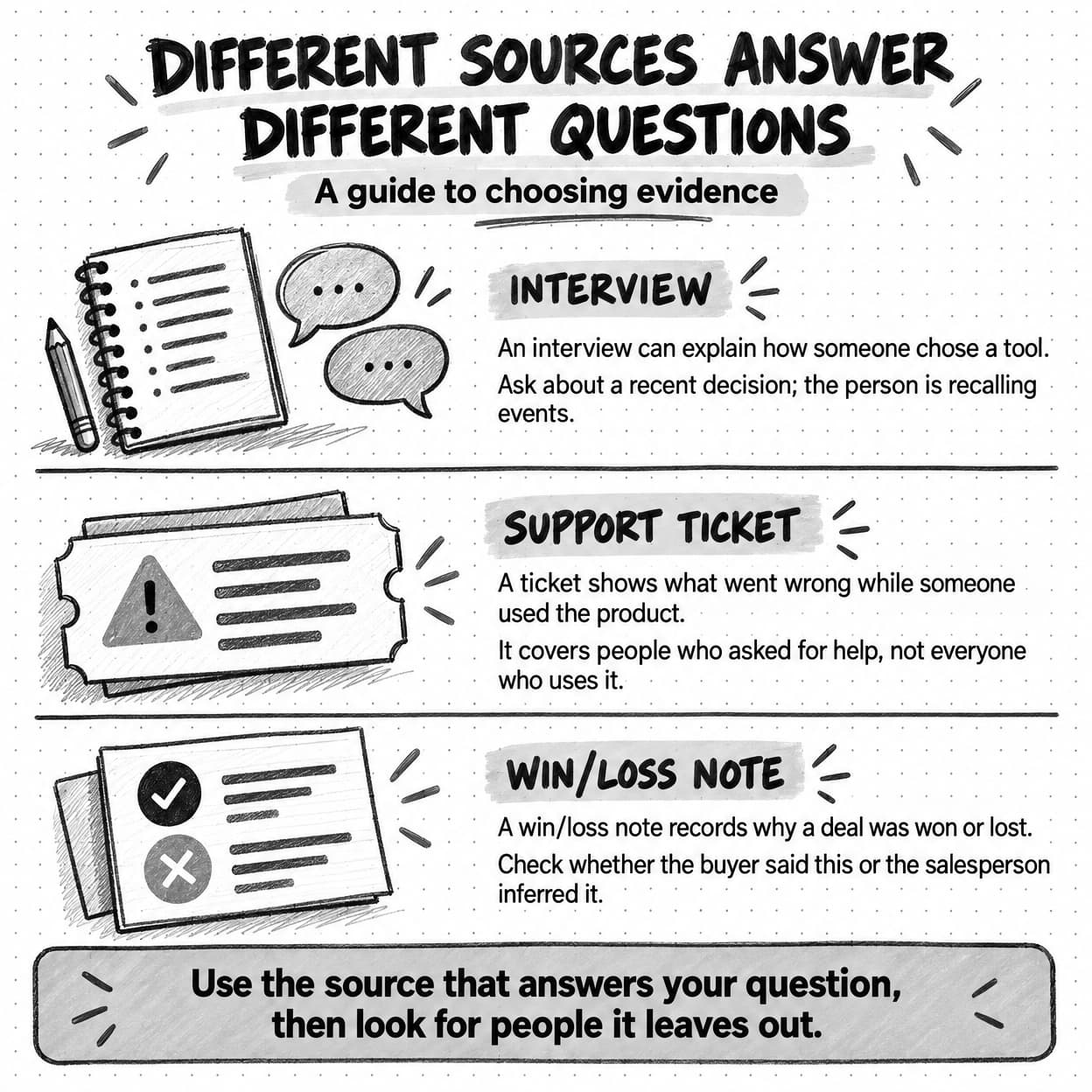
Choose sources according to what you need to learn. An interview can help you reconstruct the events that led someone to look for a new tool, including alternatives they considered and abandoned. A sales call captures questions during evaluation, although the seller may have introduced the language the buyer uses. Both can help explain a purchase decision; a support ticket is more likely to explain what went wrong during use.
Reviews and public discussions can reveal comparisons and vocabulary you would miss in conversations with your own customers. You may have little context about the writer, however, and people who post are self-selected. Surveys let you ask a consistent question across respondents, but short answers often need follow-up. Preserve the question with the answer. In RelayBoard's example, the survey asks “What helps your team most?” The response tells you what that person values; it is not a complete account of what they like and dislike.
Win/loss and churn notes can help explain why someone chose a product, stayed with an alternative, or left after using it. Check who wrote each note and how they arrived at the explanation. A salesperson's summary may be useful, but it is already an interpretation of the buyer's decision. If that explanation becomes central to your messaging, look for a recording or follow-up conversation that lets you examine what the buyer actually said.
RelayBoard's illustrative inventory contains 10 invented records, chosen to demonstrate different perspectives and contradictions. Each record is one excerpt or note; the count does not represent 10 unique customer accounts or support estimates about a market.
| Source in illustrative set | Records | What it can contribute | Important limitation |
|---|---|---|---|
| Buyer and user interviews | 2 | What prompted a search, which alternatives came up, and what the person wanted | People recall events in response to the interviewer's questions |
| Sales call excerpts | 2 | What a prospect questions or needs to evaluate | Covers active deals and may reflect the seller's framing |
| Support ticket | 1 | A problem someone experienced while using the product | Misses people who did not contact support |
| Product review | 1 | What a reviewer values, compares, or would change | The reviewer chose to post and may differ from other users |
| Survey free text | 1 | An answer to a specific question | Meaning depends on the wording and who responded |
| Win/loss note | 1 | The reason recorded for a purchase decision | This note is the salesperson's paraphrase |
| Churn note | 1 | The explanation recorded when a customer left | Timing and relationships within the account may affect what the person reports |
| Public discussion | 1 | How someone describes the problem outside a sales conversation | The poster's role and situation may be unknown |
In your own inventory, record who could have contributed and how you selected the material. A survey sent only to active champions leaves out buyers who declined and users who stopped engaging. Five support tickets from one difficult rollout may describe several problems within a single account. Keep those problems, but do not count the tickets as five independent customer endorsements or objections.
Look for perspectives the inventory misses. A daily user can describe the work, a buyer with budget authority can explain what justified the purchase, and an internal champion can tell you what they needed to persuade colleagues. Lost prospects and churned customers may reveal reasons that satisfied customers have little cause to mention. Being a reviewer or support contact describes how someone contributed feedback; it does not establish which of these roles they held.
Record the segment, use case, lifecycle stage, and date alongside the role. These details can change how you interpret the same complaint. A feature release may have addressed last year's problem, while an enterprise security objection may have little bearing on a self-serve trial. When context is missing, leave it marked as unknown and consider whether it limits the conclusion you want to draw.
Check how the material was collected before copying it into a research folder. Establish who may access it, how long it may be retained, and whether the permitted use covers research, public quotation, or both. Remove unnecessary names, account details, and sensitive content from working excerpts. Before sending confidential material to a transcription or analysis service, check its storage, access, retention, and training terms against your organization's requirements.
A public post still needs care. Quoting it can make a person identifiable through a search, even if you remove their name. Consider whether you need the exact words, whether reuse is permitted, and whether the context makes attribution or further permission necessary. The 2025 ICC/ESOMAR Code addresses transparency, privacy, and responsibility in research and data analytics; the MRS Code sets professional requirements for its members. Resolve permission and data-handling questions before sharing the material with an analyst or a tool.
Keep each excerpt linked to its original context
Keep the original recording, transcript, document, or URL wherever you are authorized to store it. Give each excerpt a source ID and a location someone else can reopen: a timestamp, ticket segment, review URL and access date, or line in a note. This record of where evidence came from is its provenance.
Alongside the excerpt, record the speaker's role, account segment, journey stage, date, and the question or preceding exchange. Label the text verbatim, edited excerpt, or paraphrase so a reader knows whose wording they are looking at. For example, a sales summary saying “buyer wanted an audit trail” might accurately describe the conversation, but the buyer may have used quite different words. You can use the note to guide the research while reserving quotation marks for wording confirmed in the original.
The table below contains the complete illustrative set of 10 invented records. Within this fictional example, quotation marks identify the speaker's exact words. R8 and R9 are the recorder's paraphrases and appear without quotation marks. None is a real testimonial.
| ID and invented source | Role, stage, context | Illustrative excerpt or note | Initial code |
|---|---|---|---|
| R1 · interview | Operations buyer; evaluation; replacing spreadsheet | “When the account changes hands, I need to know who owns the next step.” | ownership gap |
| R2 · interview | Daily user; active account; weekly handoff | “A quick handoff is good, but I still have to find the last decision.” | decision history |
| R3 · sales call | Champion; evaluation; asked about rollout | “Can I show my VP what happened without building a report?” | proof for sponsor |
| R4 · sales call | Economic buyer; evaluation; asked about value | “I care more about cycle time than another dashboard.” | speed criterion |
| R5 · support ticket | Daily user; onboarding; assigned owner changed | “The owner was wrong after the reassignment, so we checked the spreadsheet.” | product failure |
| R6 · review | Active user; retrospective review | “The history is useful; updating it takes more clicks than it should.” | value and friction |
| R7 · survey free text | Champion; active customer; answer to “What helps your team most?” | “Seeing who is waiting on whom.” | visibility |
| R8 · win/loss note | Lost prospect; decision; salesperson summary, paraphrase | Buyer selected incumbent because setup looked simpler. | setup objection |
| R9 · churn note | Former buyer; exit; customer-success summary, paraphrase | Ownership visibility mattered, but adoption stalled across teams. | adoption barrier |
| R10 · public discussion | Unverified poster; category discussion; not about RelayBoard | “Our handoff doc tells us the owner, then nobody updates it.” | stale alternative |
The survey contributes one illustrative free-text response to this 10-record teaching set. There is no invitation or respondent pool from which to calculate a response rate. R10 is also limited: it describes a handoff problem in a public discussion, with no established connection to RelayBoard. It can suggest a question to investigate, but it cannot support a claim about the product's customers.
Move from an excerpt to a defensible theme
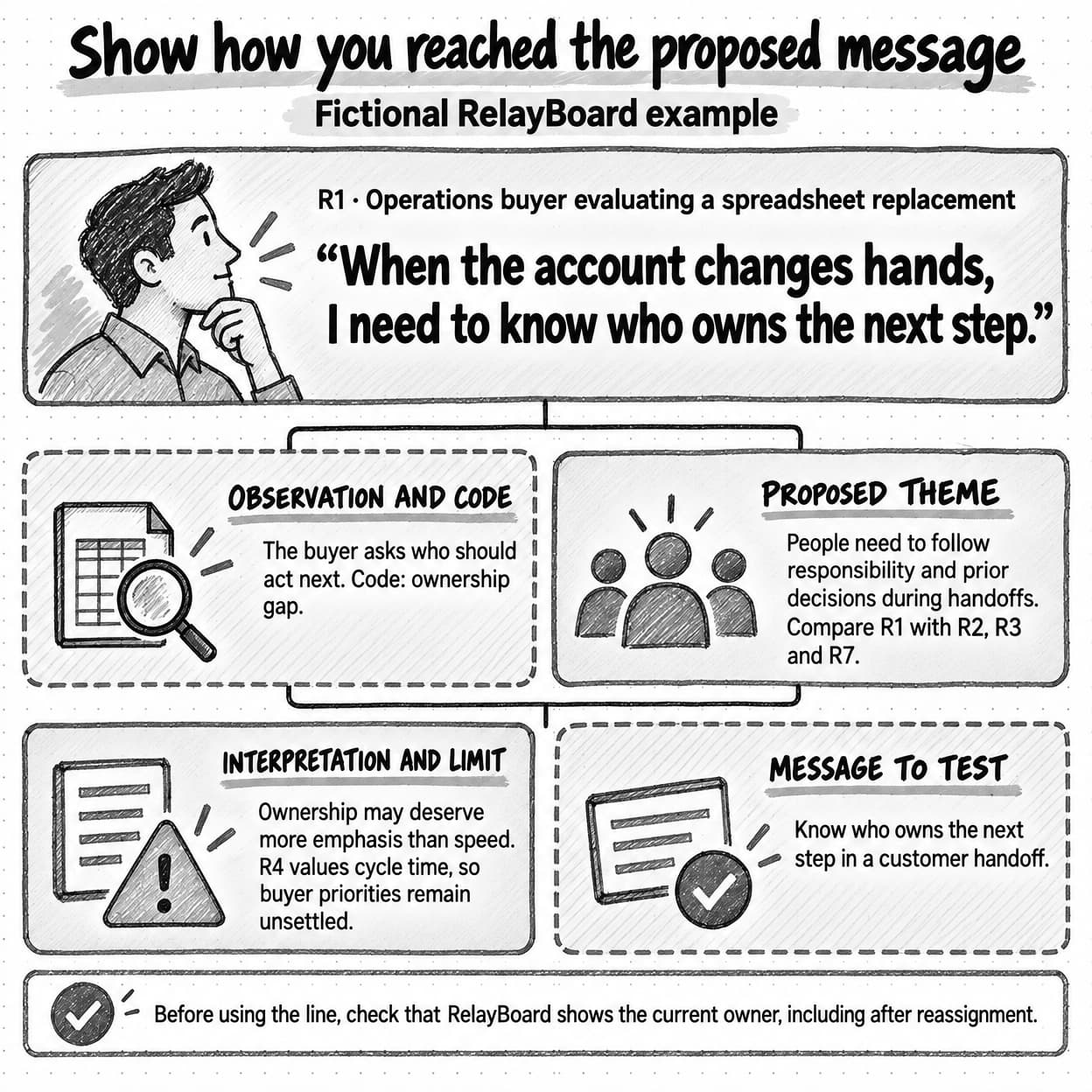
Read the source records in full before pulling out individual phrases. This gives you a chance to understand what each person was discussing and to notice qualifications that a short excerpt could lose. Then describe what a passage tells you. For R1, the observation is that a buyer wants to know who owns the next step after an account changes hands. You might attach the code “ownership gap” to the passage so you can find it again when comparing similar accounts.
A code is a short label for an idea you want to examine. Useful questions include whether a passage describes a problem, desired outcome, trigger, current alternative, objection, evaluation criterion, or proof need. In this example, the spreadsheet is an alternative the buyer already uses; setup effort is an objection; cycle time is R4's evaluation criterion. R3's request to show a VP what happened points to evidence the champion needs to share. A passage can contain more than one of these ideas, so do not force it into a single category just to keep the log tidy.
As you compare passages, ask what the related ideas mean together. R1 asks about responsibility, R2 needs an earlier decision, and R3 wants to show a colleague what happened. A possible theme is that people need to follow responsibility and prior decisions when managing handoffs. You have now proposed a relationship among the accounts, which is why a theme needs an explanation and a check against the sources. Braun and Clarke's thematic-analysis guidance distinguishes this interpretation of shared meaning from a summary that simply collects everything people said about a topic.
A messaging implication explains what the theme might change in the copy. If being able to follow a handoff matters to operations buyers, RelayBoard could make ownership and decision history more prominent on its homepage. That is a proposal based on the analysis. The team still needs to learn whether buyers find it more relevant than the speed message and whether the product behaves as the new copy suggests.
View the evidence chain at full size (opens in a new tab).
The R1 analysis records both the reasoning and the limits on each conclusion:
| Layer | RelayBoard example | What could change it |
|---|---|---|
| Source and context | R1, fictional verbatim interview quote from an operations buyer evaluating a spreadsheet replacement: “When the account changes hands, I need to know who owns the next step.” | Full transcript or interviewer prompt could narrow the meaning. |
| Observation | This buyer asks to identify who is responsible for the next step after a handoff. | It is one person's stated concern. |
| Code and theme | Code: ownership gap. Proposed theme: people need to follow responsibility and prior decisions when managing handoffs. R2, R3, and R7 describe related needs. | The theme joins different roles and may be too broad. |
| Interpretation | Operations leaders may find a message about ownership and history more relevant than a general promise of speed. | R4 explicitly values cycle time; buyer priority is unresolved. |
| Messaging implication | Test “Know who owns the next step in a customer handoff.” | Check that the product shows current ownership reliably and that buyers understand the phrase. |
R1 gives the marketer a reason to address unclear ownership. It provides no evidence that RelayBoard resolves the problem or makes handoffs faster. R5 makes the product check especially important because it describes an incorrect owner after reassignment. The research can still inform an article answering “How do you assign ownership when an account changes hands?” while the team investigates whether it can substantiate a product promise.
Explain contradictory feedback before prioritizing themes
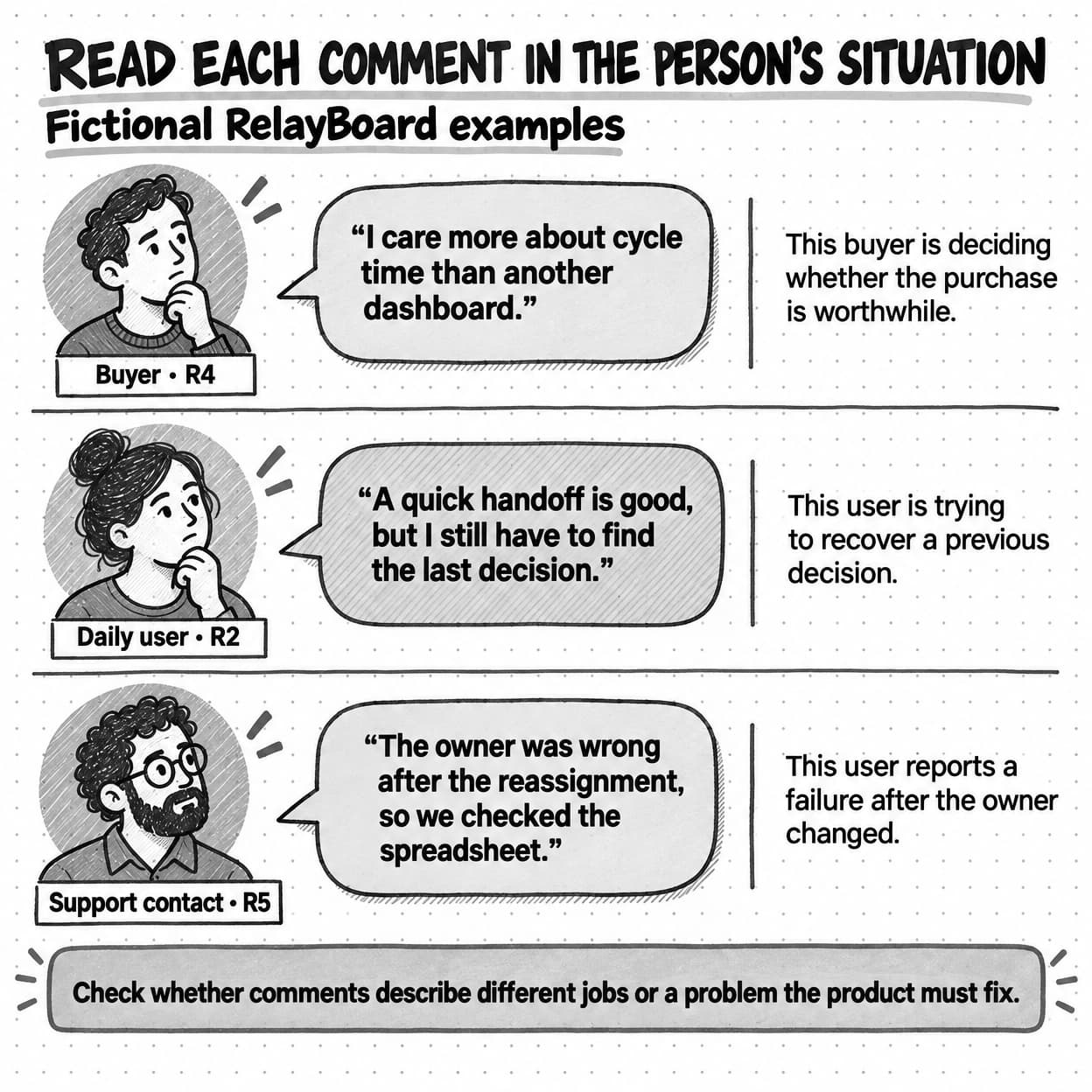
The proposed theme initially draws on four of the 10 illustrative records: R1, R2, R3, and R7. That tells the reader which records support the interpretation; it is not a measure of how common the need is. To judge whether the theme is useful, the team also has to explain the records that complicate it. R4 prioritizes cycle time, while R6 values history but dislikes the work needed to maintain it. R8 and R9 suggest that setup and adoption can matter enough to determine whether someone chooses or keeps the product.
View the contradiction map at full size (opens in a new tab).
Reading this material as a vote for the most frequently mentioned issue would lose some of its value. A buyer might mention a requirement only once and refuse to purchase without it, while several users might repeat a complaint they find irritating but tolerable. Frequency helps you decide what to investigate, but you also need to understand the consequence for the person and the decision. The same applies to a vivid quotation: forceful wording may be worth following up, yet its emotional impact on you does not establish how much weight it should carry in the research.
Some apparent disagreement becomes easier to understand once you compare the situations. The buyer in R4 is evaluating the purchase, whereas the user in R2 is trying to find an earlier decision during the work. Both needs could matter, perhaps at different points in the buying and usage experience. R5 poses a different problem: the product showed the wrong owner. That is evidence the team needs to investigate before making a reliability claim, regardless of how many people asked for clearer ownership.
The next research should address those differences. RelayBoard can ask more buyers how they judge cycle time, observe how users find current ownership, and investigate what happened during reassignment. Keep the date with each finding so that someone revisiting the work after a product change can see which conclusions need to be checked again.
Use AI to organize material, then audit it against originals
When you have more material than you can comfortably review at once, AI can help you find a starting point. Transcription makes recordings searchable, and retrieval can bring back passages relevant to a particular question. Clustering can suggest which passages to read together. These uses are most helpful when the source IDs and timestamps remain attached, because the next step is to read and judge the material the tool has selected.
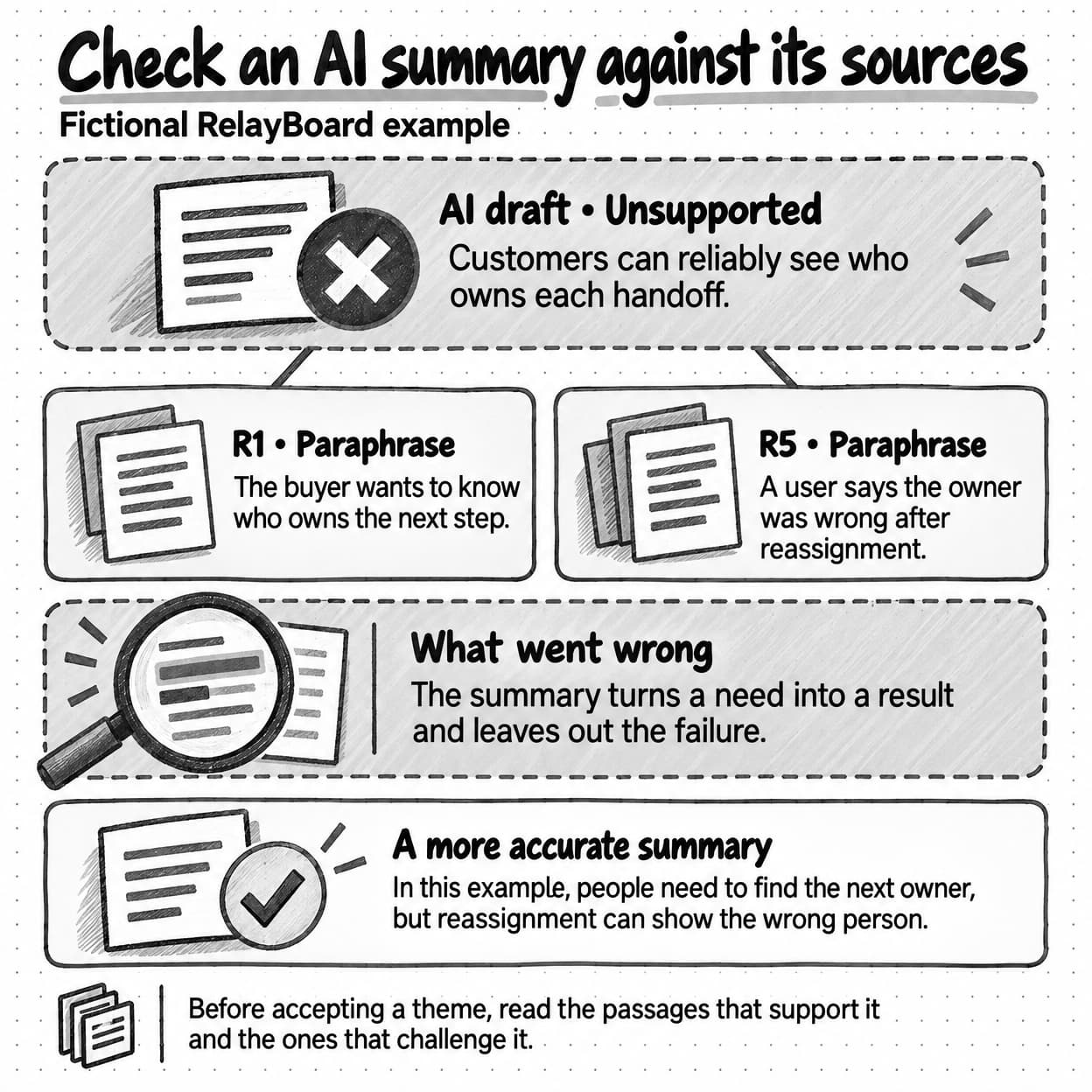
Pay attention to distinctions a summary may have lost. A transcript can mishear a product name or drop a negation; a summary can go further and turn a request into a result. If a model combines R1's wish to know the next owner with R5's complaint about an incorrect owner, it might produce the misleading conclusion that customers can reliably see who owns each handoff. Reading the two passages shows what went wrong: the summary treats the need as satisfied and leaves out the failure. An AI-generated persona or quotation also needs to stay outside the evidence column, however plausible it sounds.
Give the system the research question and permitted material, including source IDs, roles, dates, and source types. Ask it to attach supporting and contradicting passages to each proposed theme, cite exact locations, label paraphrases, and identify questions the material cannot answer. Review its output as follows:
- Reopen at least one original passage for every supporting ID, including the turns before and after it. Verify speaker, wording, and negation against audio where needed.
- Reopen every cited contradiction and look for plausible counterexamples the model omitted. Search the uncoded material for the theme's key concept and its opposite.
- Check that the theme describes a shared meaning, not simply a repeated topic label; identify the role and stage in which it appears.
- Identify repeated contacts from the same person or account. Define whether you are counting passages, people, or accounts, and record the denominator and selection method. Retain distinct experiences even when they come from one account.
- Mark what is still interpretation. Do not paste generated prose into quotation marks or use a composite quote as verbatim speech.
View the AI theme audit at full size (opens in a new tab).
Turn findings into messages you can test
Once the analysis is written down, consider each proposed message on its own terms. The records give RelayBoard a reason to address ownership, but they do not show how much faster a handoff becomes or establish that no handoff will ever be lost. Those differences determine what the team can do next. In the table below, supported as a message to test means the research justifies investigating the wording; the product check and the audience's response still have to follow.
| Candidate | Decision | Reason and next check |
|---|---|---|
| “Know who owns the next step in a customer handoff.” | Supported as a message to test | R1 and R7 express the visibility problem; R2 adds history. Verify current product behavior in the intended use case and test buyer comprehension. |
| “Shorten handoff cycles.” | Requires validation | R4 mentions cycle time, but the set has no measured cycle-time change or evidence that this criterion is common among target buyers. Define a metric and test the claim. |
| “Never lose a handoff again.” | Reject | Absolute outcome is unsupported, and R5 documents an illustrative incorrect-owner failure. Do not turn a problem statement into a performance guarantee. |
The difference is easier to see in the copy itself. The original line, “Move work faster with an intelligent handoff platform,” leaves the reader to work out which part of the work improves. The proposed test variant, “Know who owns the next step in a customer handoff,” names the concern found in the feedback. A supporting sentence could read: “See the current owner and the decisions behind the handoff in one place.” The buyer now has something specific to look for in a demonstration. RelayBoard needs to check that demonstration against the failure in R5 before using the line publicly; softer wording would not make an incorrect owner reliable.
The same findings can help you decide which content to create. Someone asking who should act next might benefit from guidance on assigning a handoff owner. A champion who needs to report to a VP may need a worked example showing how to review an account's history. The setup objection calls for an explanation of what adoption involves. In each case, the source gives you a reason for the content and a question it should answer. When findings show a gap between what customers say and what the category assumes, that gap can become a point of view worth publishing.
Start message testing by asking intended readers to explain what a line promises in their own words. Their answer may reveal an expectation you did not intend to create. Ask what makes the message relevant to their situation and what they would need to see to believe it, rather than simply asking which version they like.
Once product evidence supports the claims, a campaign can compare the ownership and cycle-time messages for the same buyer role, with the offer and channel held constant where possible. Decide which behavior will inform the decision before running the test, and interpret the result within those conditions. A difference in clicks may help you choose between two ads, but it does not demonstrate that the product delivers the promised outcome.
Record validated decisions in a brand messaging framework, along with the intended audience and supporting evidence. Use the brand voice guide when adapting those messages into copy for different channels.
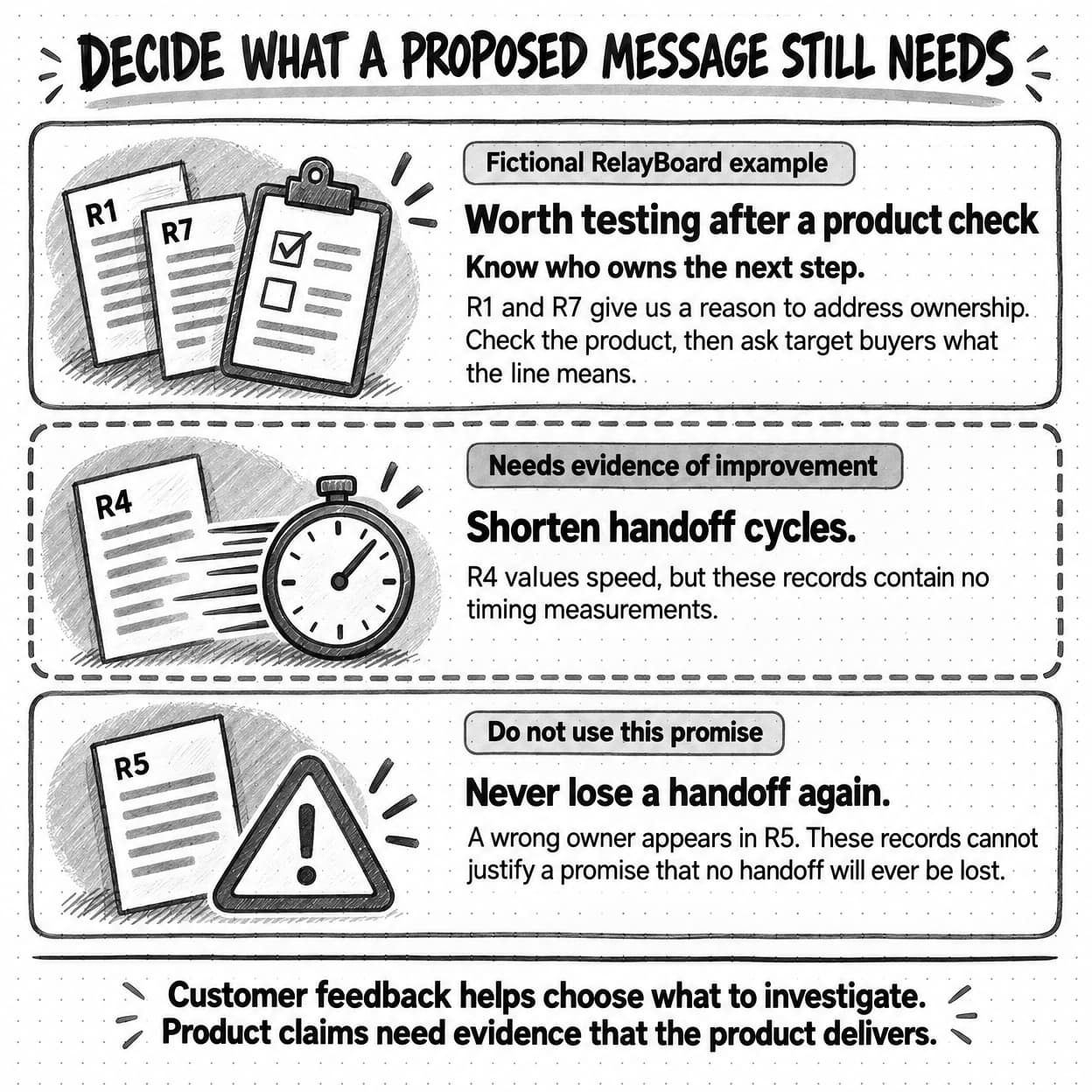
View the claim decisions at full size (opens in a new tab).
Copy this evidence log and analysis template
The template below keeps collection and interpretation together without blending them. Use one row per passage and include a location that lets an authorized reviewer reopen the original. As themes develop, record the supporting and contradicting source IDs in the analysis section. Keep the originals in access-controlled storage and use de-identified IDs when sharing the analysis more widely.
Decision and deadline:
Research question:
Target role, segment, stage, use case, date range:
Source population and selection method:
Missing roles or outcomes:
Access, consent, reuse, retention, and confidentiality rules:

Source ID | Type | Date | Role | Segment | Stage | Use case | Original location | Verbatim / edited / paraphrase | Exact excerpt or note | Preceding context | Code | Contradiction | Permission for public quote

Theme name and central meaning:
Supporting IDs and original locations:
Contradicting IDs and original locations:
Descriptive count and denominator, if useful:
Interpretation and competing explanation:
Coverage gap / product proof needed:
Messaging hypothesis and intended audience:
Test, success measure, owner, and decision date:
If you shorten a long answer, preserve its meaning and mark omissions. Do not join different speakers' words into a single quotation. If you write a composite to illustrate a pattern, label it as a composite rather than verbatim speech. Keep your codes and themes separate from the quoted text so a reviewer can see where your interpretation begins.
A short illustrative research report
Decision. Test whether operations leaders evaluating a handoff tool understand and value a message about ownership more than a general promise of speed. The evidence for this illustrative report is RelayBoard's 10 invented records.
Findings. R1, R2, R3, and R7 describe needs to identify responsibility, find previous decisions, or show what happened. The proposed theme is uncertainty about who should act and what has already been decided. R10 describes a related problem outside a vendor context. Together, these records justify further investigation; they cannot establish how common the problem is among target buyers.
Contradictions. R4 prioritizes cycle time. R5 reports a wrong owner after reassignment, and R6 values history but dislikes the update effort. R8 and R9 point to setup and adoption barriers that could prevent a purchase or renewal even if the buyer values visibility.
Unknowns. The set does not establish how buyers with budget authority rank ownership against cycle time, whether either message is persuasive, or whether the product reliably shows the correct owner across handoff paths. These questions require buyer research and a product check.
Proposed experiments. Check current ownership and decision history after reassigning an account. Interview recent target buyers about a handoff that went wrong and how they evaluated alternatives, without suggesting which problem should matter most. Test whether readers understand the ownership and cycle-time lines, then compare their response in a controlled campaign or page test if product evidence supports both claims.
Next research questions. What makes a buyer seek a replacement? What would convince them that a handoff is reliable? How do champions explain the choice to a VP? When do setup and update effort outweigh the value of visibility? Use the answers to revise the proposed message and its supporting proof in the messaging framework.
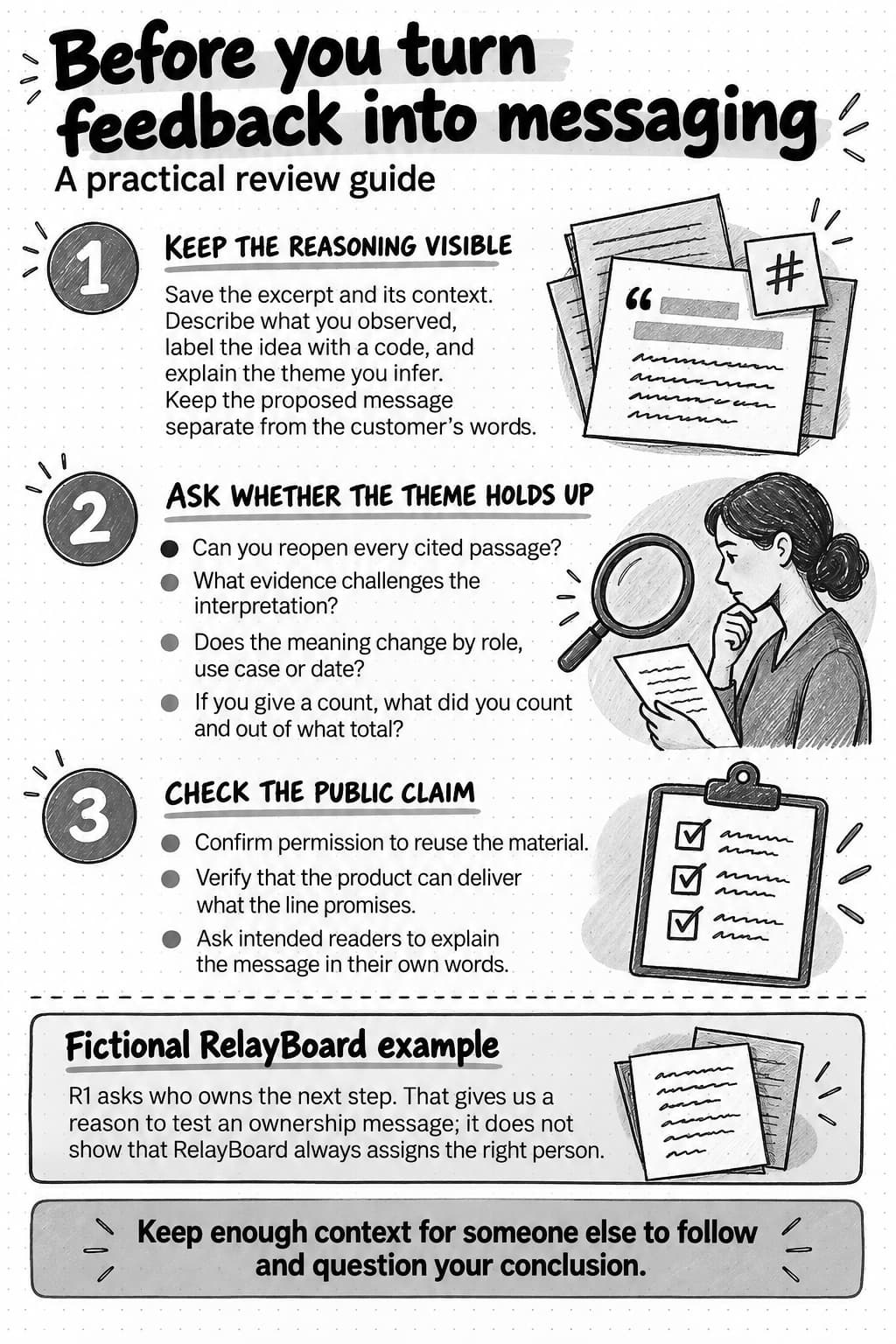
Open and save the VoC analysis reference at full size (opens in a new tab).
Sources and further reading
- Braun and Clarke's thematic-analysis FAQs clarify how codes, themes, and topic summaries differ.
- Pew Research Center's survey-question guide explains wording, order, and response effects when gathering feedback.
- The 2025 ICC/ESOMAR International Code and MRS Code of Conduct inform the privacy, transparency, and research-use boundaries above.
- Google's people-first guidance and guidance for generative AI search features favor useful original analysis over pages built around keyword variants.
- Amplitude's guides to in-app feedback and data preparation show how collection quality and validation affect later decisions.
- OpenAI's file-transcription documentation describes transcription and speaker-label options; check the current capabilities and data controls of whichever approved service handles your recordings.
Frequently Asked Questions
What is voice-of-customer (VoC) research in marketing?
Voice-of-customer (VoC) research in marketing means gathering and interpreting people's accounts of their needs, buying decisions, and experience with a product or process. A team reads that material for patterns, examines the comments that challenge its interpretation, and uses the findings to decide what a message should address. The main purpose is to give the team a reason for choosing a particular message, recorded with the sources and limitations someone else would need to assess that choice.
What is the difference between voice-of-customer research and market research?
Market research is the broader field, and voice-of-customer research is the part that uses people's own accounts to explain why a problem matters to them. Other market research may be needed to estimate the size of a market, compare competing offers, or study pricing. A buyer's description of a problem helps a team understand that buyer's situation, but it cannot show how many companies share the problem or whether one product has an advantage over the alternatives.
What are the most effective voice-of-customer research methods?
No single method is most effective, because each source answers a different question and has its own limitation. Interviews can reconstruct the events that led someone to look for a new product, sales calls capture questions asked during evaluation, and support tickets show what went wrong during use. Reviews and public discussions reveal comparisons and vocabulary from self-selected writers. Surveys ask one consistent question but often need follow-up, and win/loss and churn notes help explain why someone chose, stayed, or left, though a note may already be its writer's interpretation.
What are the best questions to ask in voice-of-customer interviews?
The best questions ask people to describe a recent, real experience of the problem and what made it difficult. From there, ask what prompted them to look for a solution, which alternatives they considered and abandoned, what outcome they needed, and what proof would make a product credible. Keep your own theory out of the wording. Asking how one specific issue slowed someone down plants the team's preferred explanation, while an open account leaves room for a different answer.
How do you identify recurring themes in voice-of-customer research?
To identify recurring themes, read each record in full, write down what a passage tells you, and attach a short code, such as a problem, desired outcome, trigger, current alternative, objection, evaluation criterion, or proof need. Then compare the coded passages and ask what the related ideas mean together. A theme proposes a shared meaning across accounts, which goes further than a topic label that keeps appearing, so check each one against the original passages, including the records that contradict it.
How do you prioritize voice-of-customer insights?
Weigh each voice-of-customer insight by its consequence for the person and the decision, treating frequency as a guide to what to investigate. A count of supporting records shows which material backs a theme, not how common the need is in the market. A buyer may mention a requirement once and refuse to purchase without it, while several users repeat a complaint they find irritating but tolerable. Before ranking a theme, explain the records that complicate it and compare the situations of the people behind them.
What is an example of voice-of-customer research?
One example is a fictional B2B software company deciding whether its homepage should keep promising faster work or emphasize knowing who owns the next step in a customer handoff. Four of the worked example's 10 invented records support a theme about following responsibility and earlier decisions; others favor cycle time, report an incorrect owner, or point to setup and adoption barriers. The analysis supports testing an ownership message, requires a defined metric and validation for a cycle-time claim, and rejects an absolute promise that no handoff will be lost.
What should a voice-of-customer report include?
A voice-of-customer report should state the decision it informs, the findings with their supporting source IDs, the records that contradict them, and the questions the evidence cannot answer. It closes with proposed experiments and the next research questions. A supporting evidence log gives each passage its own row, recording the source, date, speaker role, stage, original location, and whether the text is verbatim, edited, or paraphrased. The guide includes a copyable evidence log and analysis template plus a short illustrative report.
How should you test messaging based on voice-of-customer research?
Test the message for understanding first by asking intended readers to explain in their own words what a line promises; their answer can expose an unintended expectation. Ask what makes it relevant and what they would need to see to believe it. Once product evidence supports the claims, a campaign or page test can compare messages for the same audience, with the offer and channel held constant and the deciding behavior chosen in advance. Clicks can inform a choice between ads without proving the product delivers.
What tools help with voice-of-customer research?
AI transcription, retrieval, and clustering tools help by making recordings searchable, pulling up passages relevant to a question, and suggesting which passages to read together. Social listening finds public conversations and sentiment analysis sorts comments by tone, but judging what went wrong still takes the underlying passage. Keep source IDs and timestamps attached, because every output needs checking against the originals: a transcript can drop a negation, and a summary can turn a request into a result. Check a service's storage, retention, and training terms before sending it confidential material.