Ideal customer profile vs. buyer persona: the difference and how to use both
An ideal customer profile describes the companies where a product fits. A buyer persona describes the people who take part in deciding whether that company buys it. See what each contains, the decisions it guides, and how they work together.
35 min readWritten by Ampere
Short answer
What is the difference between an ideal customer profile and a buyer persona?
An ideal customer profile describes the kind of company where a product fits: the accounts most likely to get value from it, buy it, and stay. A buyer persona describes a person who takes part in the purchase: their responsibility, what they need to understand, and the evidence they trust. Use the profile to choose accounts and personas to decide what each person needs to hear.
Summary
An ideal customer profile and a buyer persona describe different things. The profile describes organizations: the accounts most likely to get value from a product, buy it, and stay. A persona describes a person’s role in the purchase and the reasoning behind it. B2B teams need both, because companies buy through several people who each need a different explanation of the same product.
A useful profile names the conditions that explain success rather than size alone: the use case, the need, the operating conditions the product depends on, and the company’s ability to implement it. Firmographic details such as industry and employee count help find similar companies but do not prove fit, and disqualifying conditions show which attractive-looking accounts to leave alone.
A useful persona describes a part in the decision, not a fictional biography. Champions, users, technical evaluators, economic buyers, and procurement participants each bring a different question and trust different evidence. One person can hold several of these roles in a small company, and the same job title can carry different responsibilities, so titles serve only as a search aid.
The worked example follows Fernbill, a fictional accounts payable software company, through a compact profile, six roles at one matching distributor, a controller who holds four roles at a smaller wholesaler, and a controller with a familiar title at a design agency that does not fit. Each persona match is real; only the profile shows whether the account can succeed.
Company evidence comes mostly from records of what accounts did, including churned and unsuitable accounts, and person evidence from interviews about specific recent purchases. Mark every line of either description as supported or assumed, treat early versions as hypotheses, and revise them when customers, buying groups, the product, or sales objections change. A worksheet at the end turns this into a one-page draft.
Contents
- What an ideal customer profile describes
- What a buyer persona describes
- The difference at a glance
- How ICPs and personas relate to target audiences, segments, and customers
- Buying roles inside one account
- Worked example: Fernbill’s ICP and the people in one account
- How ICPs and personas shape research, content, messaging, channels, and proof
- Evidence that informs an ICP and buyer personas
- Provisional profiles for a new company
- When to revise an ICP or buyer persona
- Exercise: describe one suitable company and the people inside it
- Use both descriptions in every brief
- Sources and further reading
- Frequently Asked Questions
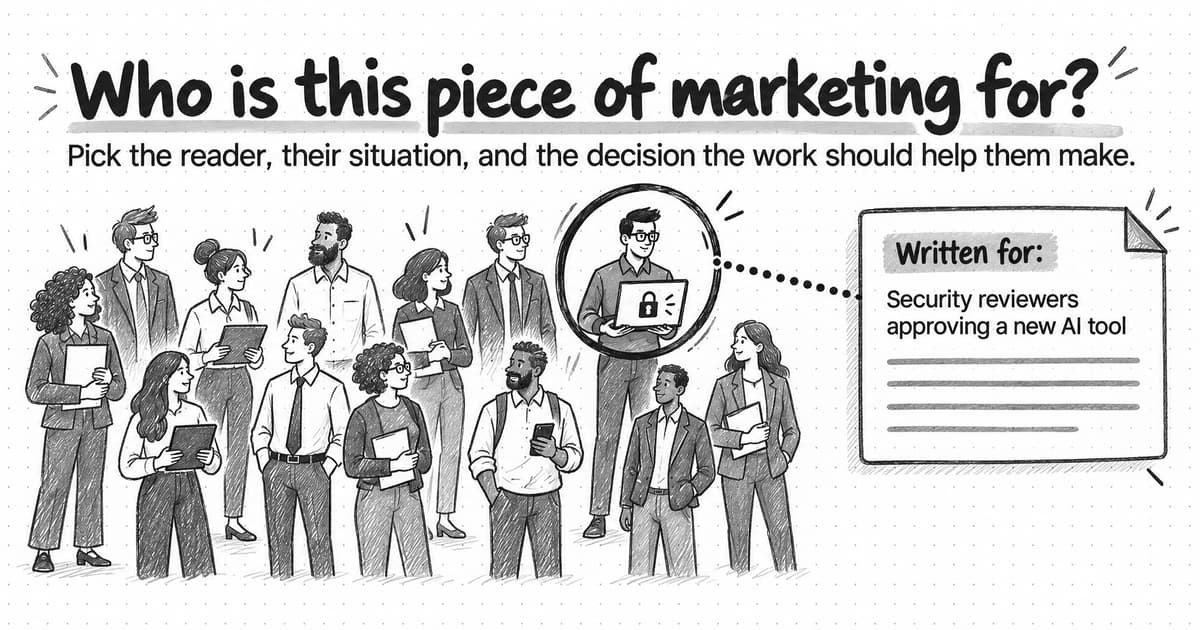
A B2B software team is planning next quarter’s campaign, and someone asks who it is for. One person answers with a kind of company: “mid-sized distributors that pay suppliers against purchase orders.” Another answers with a person: “the controller who dreads month-end.” Both answers are useful. In many teams, both are also written under the same heading, sometimes labeled the ICP and sometimes the persona, and the confusion shows up later in the work. A list of job titles goes to an ad platform with no check that those people work at companies that can use the product. A list of target companies reaches the content team with nothing about the people who will read the content.
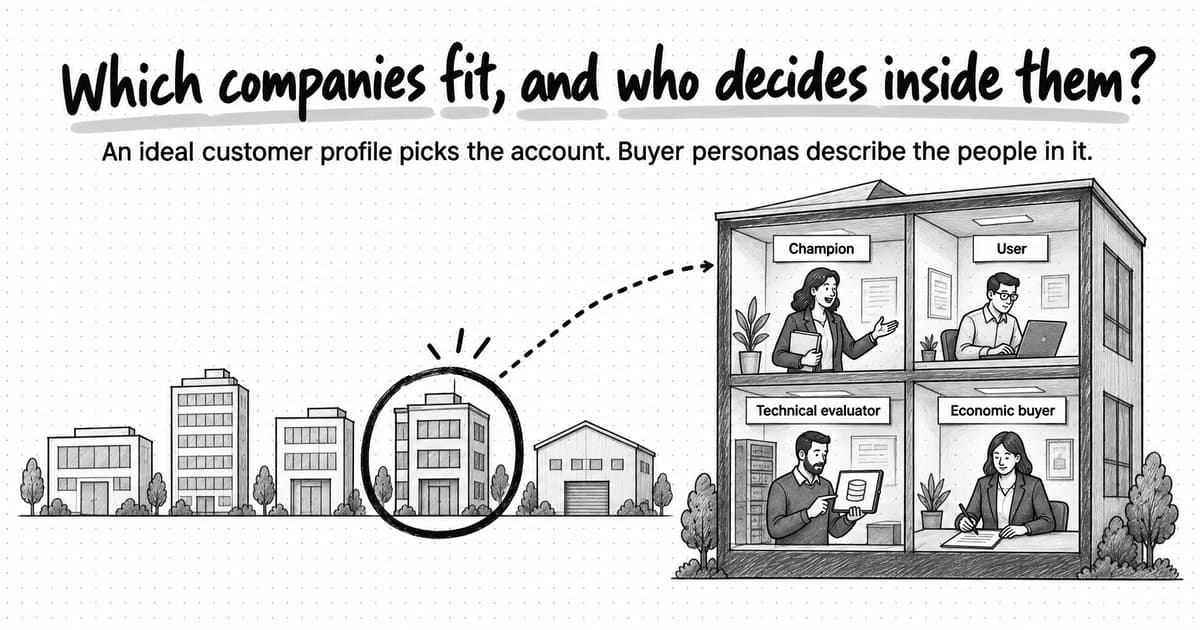
The two answers describe different things. An ideal customer profile (ICP) describes the kind of organization where a product fits well: a company that has the problem, the conditions to solve it with this product, and a good chance of getting enough value to buy, stay, and expand. A buyer persona describes a kind of person who takes part in the purchase: what they are responsible for, what must be true before they will support the decision, what worries them, and which evidence they trust. The ICP tells a team which accounts to pursue. Personas tell it what each person inside those accounts needs to understand.
A B2B purchase needs both views because an organization buys through people. A precise description of the controller is of little use if the controller’s company has nothing for the product to do. A precise list of suitable companies will not tell a writer whether to open with month-end, data security, or price, because different people in the same company care about different things.
This guide explains what each description contains, which decisions each one supports, what evidence each needs, and how to use them together. The examples follow Fernbill, a fictional company that sells AI-assisted accounts payable software to mid-sized businesses. Fernbill, its customers, and its numbers are invented for teaching. Choosing whom one article or campaign should address is a separate decision, covered in our guide to defining a target audience; the ICP and personas described here are the main inputs to that choice.
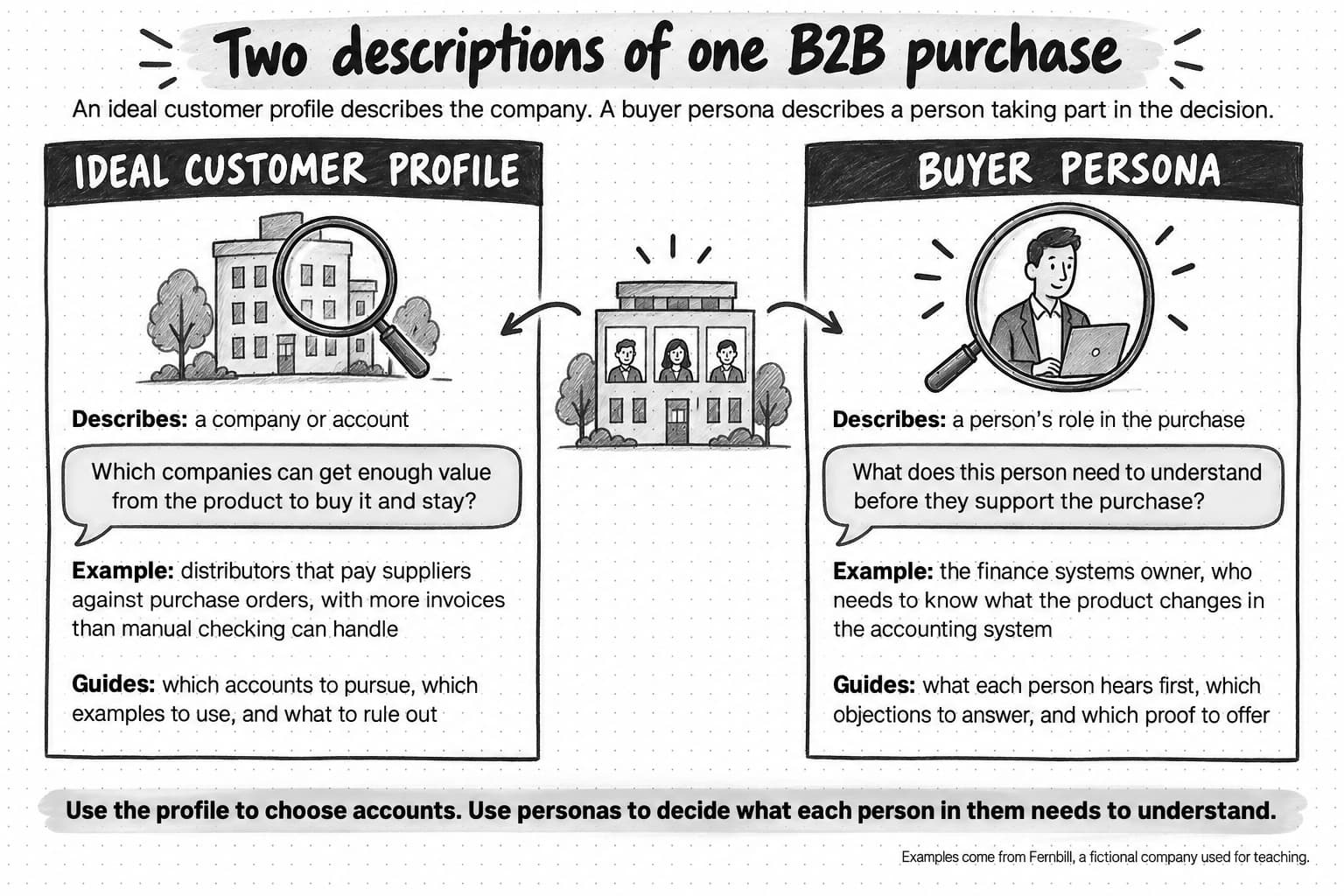
View the comparison of the two descriptions at full size (opens in a new tab).
What an ideal customer profile describes
In B2B marketing, an ideal customer profile describes organizations, not individuals. Its subject is the account: the company that signs the contract, puts the product to work, and later renews or leaves. A good ICP also explains why those accounts succeed where others struggle. In his ideal customer profile framework, Lincoln Murphy says plainly that it is not about persona development but about types of customers, which in B2B generally means companies. He judges fit by a customer’s potential to succeed with the product, which he divides into technical, functional, resource, competence, experience, and cultural fit.
The word “ideal” is easy to misread. It does not mean the largest companies a business could sell to, or the best-known logos. A very large company can be a poor fit if it needs integrations the product does not have, takes a year to approve a purchase, or would use only a small part of what it pays for. A profile built around size alone can send sales and marketing toward deals that are slow to close and unlikely to renew. April Dunford’s positioning method offers a different test from size: it asks which characteristics make a customer care a lot about what the product does differently.
Company characteristics that indicate fit
Firmographic details, such as industry, employee count, revenue, and region, are where most profiles start, because they are easy to find in sales databases and ad platforms. They work best as stand-ins for conditions that matter. Employee count suggests how many invoices a company pays or how formal its purchasing process is, but it does not prove either. A useful ICP names the conditions themselves:
- Use case. Which job would the company use the product for? Fernbill reads supplier invoices and matches each one to its purchase order and to the record of goods received. A company that mainly pays software subscriptions and contractors, with no purchase orders, has little for Fernbill to match.
- Need. What makes that job important enough to pay to solve? For Fernbill, the need appears when invoice volume outgrows manual checking: invoices are paid late or twice, and the month-end close waits on accounts payable.
- Operating conditions. What must already be true inside the company for the product to work? These include the systems it uses (sometimes called technographics), its processes, its data, and any regulation it must follow. Fernbill needs purchase orders raised in an accounting system it connects to, and warehouse staff who record deliveries promptly.
- Ability to obtain value. Can the company implement, adopt, and maintain the product? Someone has to own the finance systems, set approval rules, and keep supplier records clean. A company with the right problem but nobody to run the rollout may buy and then stall.
- Evidence of success. Which accounts like this have adopted the product quickly, renewed, and expanded? This is what makes a profile ideal rather than merely possible.
Each item belongs in the profile because it changes a decision. The use case determines which demonstrations and examples to show. The need determines which problem a campaign leads with. Operating conditions determine which technology partners matter and what to ask before a trial. Ability to obtain value determines what onboarding material a buyer will want to see. Some teams also write down disqualifying conditions, sometimes called a negative ICP: the circumstances under which they should not pursue an account even when it looks attractive on paper.
What a buyer persona describes
A buyer persona describes a type of person who takes part in a purchase and the reasoning that person brings to it. In B2B, its subject is a role in the decision, such as the person who argues for the product, the person who checks whether it will work with existing systems, or the person who approves the money. The most useful personas record what that person is trying to achieve, what brings them into the decision, what success means to them, what makes them hesitate, which criteria they use to compare options, and which sources and evidence they trust. The Buyer Persona Institute defines a buyer persona in similar terms, by what it reveals about buyers’ decisions: the attitudes, concerns, decision criteria, and journey that lead them to choose a product, a competitor, or no change at all.
A persona is not a fictional biography. Many templates start with an invented name, a stock photograph, an age, a family, and a list of hobbies. Those details make a persona feel vivid, but they rarely change what a B2B buyer needs to know, and invented specifics can give a team false confidence that it understands real people. Adele Revella, who founded the Buyer Persona Institute, calls demographics “a dangerous distraction” and reports that teams that start from the buying decision they want to influence end up with about half as many personas. A persona named by its role, such as “the finance systems owner,” is easier to check against evidence. Demographic traits belong only when evidence shows they change the message, the channel, or the offer.
Marketing’s buyer personas are related to, but different from, the user personas that product and design teams create. A user persona describes how someone works with a product so the team can design it. Buyer personas include people who will never use the product at all, such as a finance leader who approves the budget or a security reviewer who approves the vendor.
Why a job title is not a persona
Job titles are useful for finding people, but they are unreliable guides to what those people do in a purchase. The same title can carry different responsibilities in different companies: a controller at a 150-person company may run accounts payable and sign contracts, while a controller at a 3,000-person company may do neither. Describe the persona by its responsibility and its part in the decision, then list the titles that commonly hold it as a search aid.
The difference at a glance
The comparison below sets the two descriptions side by side.
| Ideal customer profile | Buyer persona | |
|---|---|---|
| Unit of analysis | An organization or account | A person’s role in a purchase |
| Question it answers | Which companies are most likely to get value from the product, buy it, and stay? | What does this person need to understand and believe before they support the purchase? |
| Useful information | Use case, need, operating conditions, ability to obtain value, firmographic proxies, and disqualifying conditions | Responsibilities, what brings them into the decision, success criteria, concerns, decision criteria, and the evidence and sources they trust |
| Main sources | Customer records on adoption, retention, and expansion; churned and unsuitable accounts; lost deals by account type | Interviews with recent buyers and users, sales conversations, win/loss interviews, support conversations, and product use by role |
| Marketing decisions it guides | Which accounts and segments to pursue, which examples and case studies to use, which channels and partners reach those companies, and what to rule out | What each person hears first, which objections to answer, which proof and format suit them, and when in the purchase they need it |
How ICPs and personas relate to target audiences, segments, and customers
Organizations use these terms differently. Some consumer businesses use “ideal customer profile” for a description of one person, because the buyer and the customer are the same individual. Qualtrics notes that some teams call the same idea an “ideal buyer profile,” and some marketers call personas “customer avatars.” The B2B sources cited here draw the line in the same place. Product Marketing Alliance, for example, describes an ICP as a profile of a target company and a buyer or user persona as a close look at one individual. This guide follows that convention, in which each term answers a different question:
- A target market is the full set of organizations a business could reasonably serve.
- A market segment is a group within that market whose needs or circumstances differ enough to call for a different approach. A company with several segments may keep a separate ICP for each.
- The ideal customer profile describes the accounts within a market or segment that are most likely to succeed with the product.
- Buyer personas describe the people inside those accounts who take part in the purchase.
- A target audience is the group a particular campaign, article, or offer is meant to reach. It usually combines an ICP with one or two personas in a particular situation, such as controllers at suitable companies who are preparing for a new accounting system.
- Actual customers are the companies and people who have bought. They are the strongest evidence for both descriptions, and they rarely match either one exactly.
The gap between the profile and actual customers is informative. Customers who match the ICP but leave suggest that a condition is missing from it. Customers who fall outside it but succeed suggest that it is too narrow.
Buying roles inside one account
A company that fits the ICP does not make a decision as a single mind. Several people take part, each with a different responsibility, and each may need a different explanation of the same product. The roles below are the ones B2B teams name most often. Their labels come mainly from sales practice, so organizations define them slightly differently.
- Champions want the purchase to happen and argue for it internally. They need to understand the product well enough to explain it, and they need material they can hand to colleagues.
- Users will work with the product. They judge whether it fits the way they work and whether it creates more effort than it saves. Some use it every day; others touch it only occasionally, for example to approve something.
- Technical evaluators check whether the product will work in the company’s environment: integration with existing systems, administration, data handling, and security. They can rarely approve a purchase on their own, but they can often stop one.
- Economic buyers approve the spending and usually control the budget. They weigh value, risk, and cost against other uses of the money and the disruption of a change.
- Procurement participants run the purchasing process. Depending on the company, this can include a procurement team, legal counsel, and vendor-risk or security reviewers who negotiate terms, check contracts, and require questionnaires before signature.
The size and shape of this group vary with the company, the price, and the risk of the purchase. In its 2026 survey of nearly 18,000 business buyers, Forrester found that an average purchase was influenced by 13 people inside the buying company and nine outside it, and that procurement acted as a decision-maker in 53% of buying cycles. Averages hide a wide range: a small team buying an inexpensive tool may involve two people, while a large company buying software that touches financial or customer data may involve many more. Treat any fixed list of roles as a starting checklist rather than a map of every purchase. Our beginner’s guide to B2B SaaS marketing describes the wider buying group, including executive sponsors and outside influences.
One person can hold several roles, especially in smaller companies, where a single finance leader may find the product, use it, approve the budget, and sign the contract. Researchers noticed this early. As the Open University’s OpenLearn course summarizes it, Frederick Webster and Yoram Wind’s 1972 model of organizational buying described users, influencers, buyers, deciders, and gatekeepers, and allowed that one individual may play more than one role and that some roles may not appear at all. The opposite also happens: several people can share one role, and a role can be missing entirely, as when a company has no procurement team. This is why a persona describes a role and not a person. The same individual can need the champion’s material on Monday and the economic buyer’s on Thursday.
Worked example: Fernbill’s ICP and the people in one account
Fernbill’s software reads supplier invoices, matches each one to its purchase order and the record of goods received, sends invoices that do not match to the right person, and posts approved invoices to the company’s accounting system. The example below shows a compact ICP, the people inside one company that fits it, how the same product needs different explanations for them, and what happens when a familiar job title appears at a company that does not fit.
Fernbill’s ideal customer profile
Fernbill has about 40 customers. It built its ICP by comparing the ones that adopted the product quickly and renewed with the ones that stalled or left. Each line records the decision it changes and whether evidence supports it.
| Part | Fernbill’s ICP | Decision it changes | Status |
|---|---|---|---|
| Use case | Matching supplier invoices to purchase orders and goods-received records before payment | Which demonstrations and examples to show | Supported by customer records |
| Need | Roughly 1,500 or more supplier invoices a month, with late or duplicate payments or a close that waits on payables | Which problem campaigns lead with, and which accounts sales contacts first | Partly supported; the 1,500 threshold is an estimate from the 12 customers that shared monthly volumes |
| Operating conditions | Purchase orders raised in an accounting system Fernbill connects to; deliveries recorded within two working days | Which technology partners to work with, and what to ask before a trial | Supported by implementation notes |
| Ability to obtain value | A named owner for finance systems, and a finance lead who can set approval rules | Which onboarding material and implementation proof to offer | Assumed; check in the next five sales calls |
| Firmographic proxies | Distributors and manufacturers with 150 to 1,500 employees | Which lists, ad targeting, and trade events to use to find these companies | Supported as a proxy only |
| Disqualifiers | Mostly invoices without purchase orders; a custom in-house system that would need a bespoke integration | Which accounts to stop pursuing, and when to point a prospect to a simpler tool | Supported by churned accounts and stalled trials |
The firmographic line comes late in the profile on purpose. It helps Fernbill find companies, but the conditions above it explain why those companies succeed. The status column separates what Fernbill has observed from what it still believes without proof, and the threshold estimate shows how a supported line can still rest on a small sample.
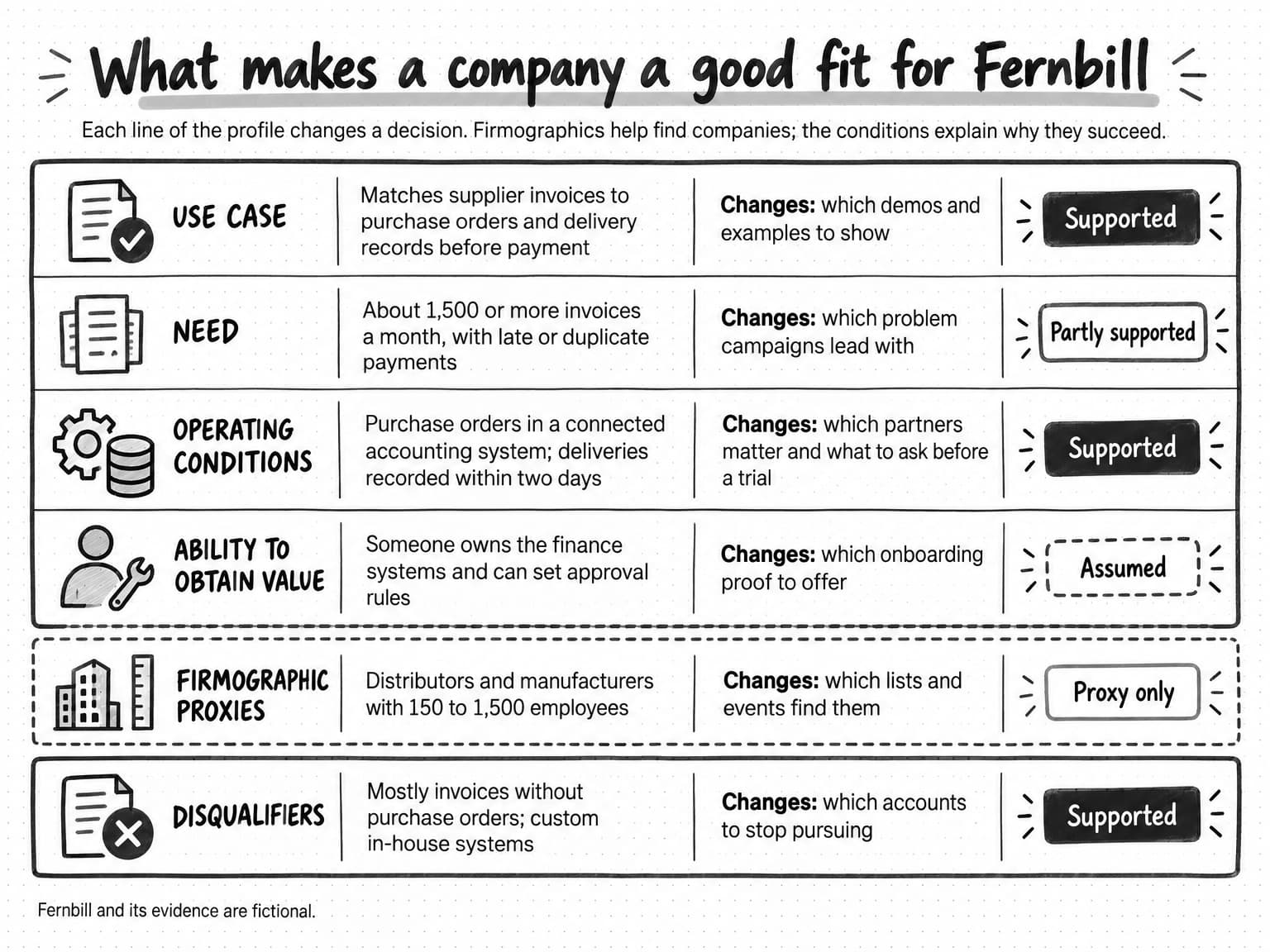
View Fernbill’s ideal customer profile at full size (opens in a new tab).
The people inside one matching account
One company that fits the profile is a building-supplies distributor with about 600 employees, three warehouses, and about 4,000 supplier invoices a month. Its purchase orders are raised in an accounting system Fernbill connects to. Six kinds of people take part in its evaluation:
- The accounts payable manager is the champion. They lead a team of four specialists and spend the last week of every month chasing receipts and approvals. They found Fernbill and want to bring it to the finance leadership.
- The accounts payable specialists are daily users. They key invoice lines today and will spend their time on exceptions if Fernbill is adopted.
- Warehouse and department managers are occasional users. They confirm deliveries and approve invoices that do not match. They will never buy Fernbill, but if they do not record deliveries, matching fails.
- The finance systems administrator is the technical evaluator, working with the company’s IT security lead. They decide whether the integration and permissions are acceptable. Fernbill names this persona “the finance systems owner” rather than by job title, because at other companies the same responsibility sits with a controller or an IT manager.
- The chief financial officer is the economic buyer. They approve the budget and must believe the change is worth the cost and the disruption.
- The procurement manager runs the purchase, with help from legal. They review the contract, data-processing terms, and the vendor-risk questionnaire. Procurement also owns the company’s purchase-order policy, so it cares how Fernbill treats orders.
The same product explained to each person
Fernbill’s capabilities and claims are the same for everyone at the distributor. What changes is the question each person brings, the part of the product that answers it, and the evidence that settles it.
| Person | What they need to understand | How Fernbill explains it | Evidence they trust |
|---|---|---|---|
| Accounts payable manager | Which invoices will still need the team, and how to make the case to the CFO | Invoices that match the order and the delivery within agreed tolerances go to approval; the rest land in one queue that shows why | A trial on 300 of last month’s invoices showing how many matched, and a business-case template |
| Accounts payable specialists | What changes in their working day | They stop keying invoice lines and spend their time resolving the exceptions | A walkthrough of the exception queue using their own invoices |
| Warehouse managers | How much work recording deliveries adds | A delivery is confirmed on a phone when it arrives; the supplier is not paid until it is | A short recording of the confirmation on a phone |
| Finance systems administrator | What Fernbill reads from and writes to the accounting system, and what happens when a sync fails | Documentation of each field exchanged, the permissions required, and the queue where failed syncs wait for review | A connection to the company’s test environment |
| Chief financial officer | Whether faster, more accurate payment justifies the cost and the change | Fewer duplicate and late payments, and a close that no longer waits on payables | A business case built on the company’s own volumes, and a call with a finance leader at a similar distributor |
| Procurement manager and legal | Contract terms, data handling, and controls over supplier bank details | Standard contract and data-processing terms, with a description of who can change bank details and how changes are approved | A completed vendor-risk questionnaire and an independent security audit report |
The table shows why one asset rarely serves everyone. A single brochure that tries would open with a benefit for the CFO, bury the integration details the administrator needs, and say nothing about the warehouse managers whose cooperation the rollout depends on. Some material, such as the business-case template, is written for one person to hand to another. Keeping the claims identical matters, because these people compare notes before they decide.
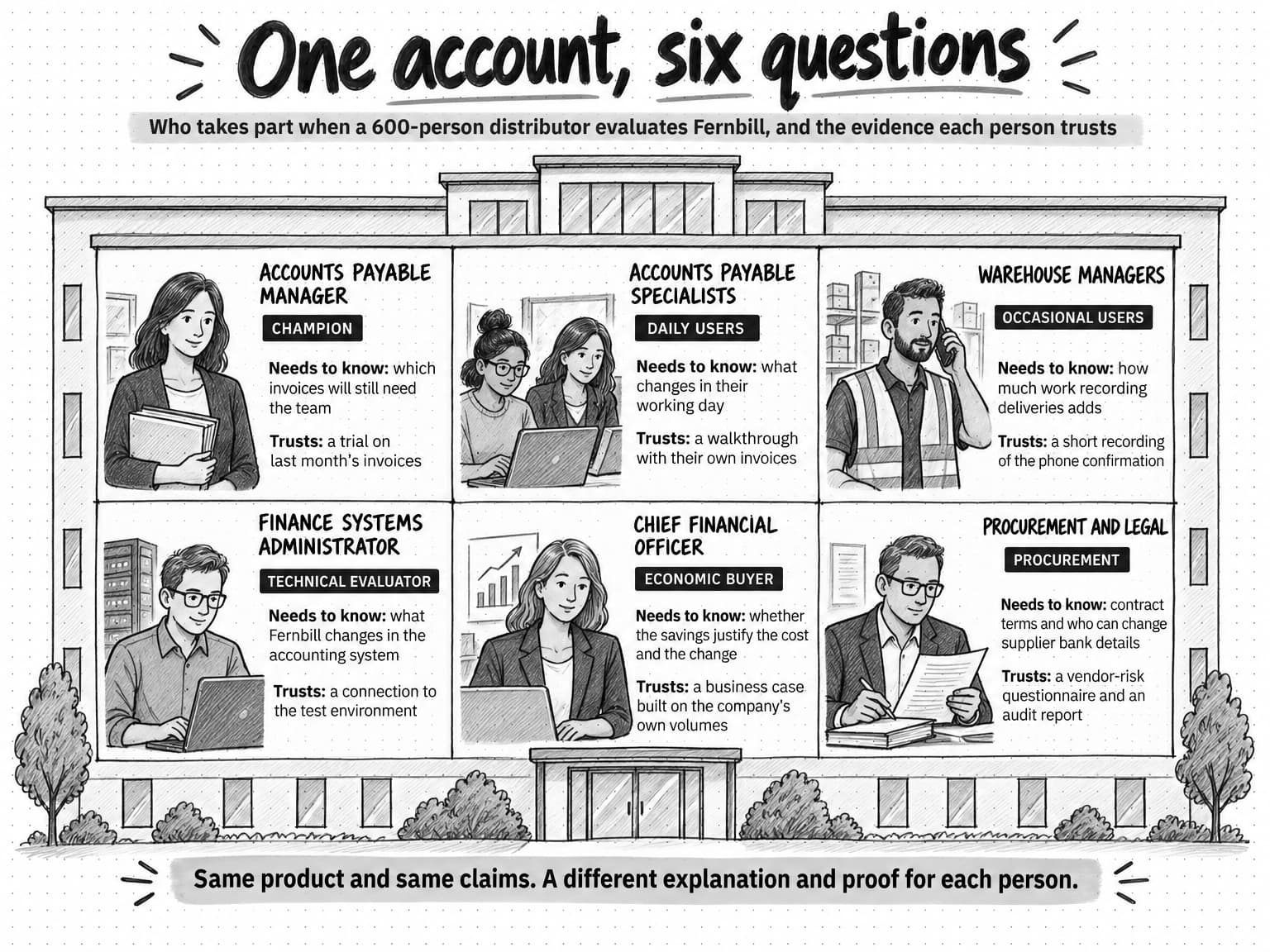
View the six people in the distributor’s purchase at full size (opens in a new tab).
When one person holds several roles
A second company also fits Fernbill’s ICP: a wholesaler with about 180 employees and 1,800 supplier invoices a month. There, the controller found Fernbill, will approve most exceptions, and can sign a contract of this size without the CFO. The company has no procurement team or finance systems staff, so the controller completes the vendor-risk questionnaire, and an outside IT provider checks the integration as the technical evaluator.
One person is champion, user, economic buyer, and procurement participant, and the technical evaluator works for another company. The questions from each role still need answers, but they arrive in a single inbox. A complete evaluation pack that answers the business case, the integration, and the security review together serves this controller better than a sequence of separate assets timed for a committee that does not exist.
A familiar job title at a poor-fit company
Now consider the controller at a 70-person design agency. The title matches Fernbill’s champion at the wholesaler, and the frustration sounds familiar: invoices pile up at month-end. But the agency pays about 150 invoices a month, most of them software subscriptions and freelancers, and it does not use purchase orders. Fernbill would have almost nothing to match, and a simpler bill-payment tool would serve the agency better.
If Fernbill targeted its advertising by job title alone, at controllers and accounts payable managers, this person would see the ad, recognize the problem, and might book a demonstration. Sales would spend weeks on an account that, if it bought, would likely leave at renewal. The persona match shows that the person understands the problem. Only the ICP shows whether the person’s company has the conditions to solve it with this product.
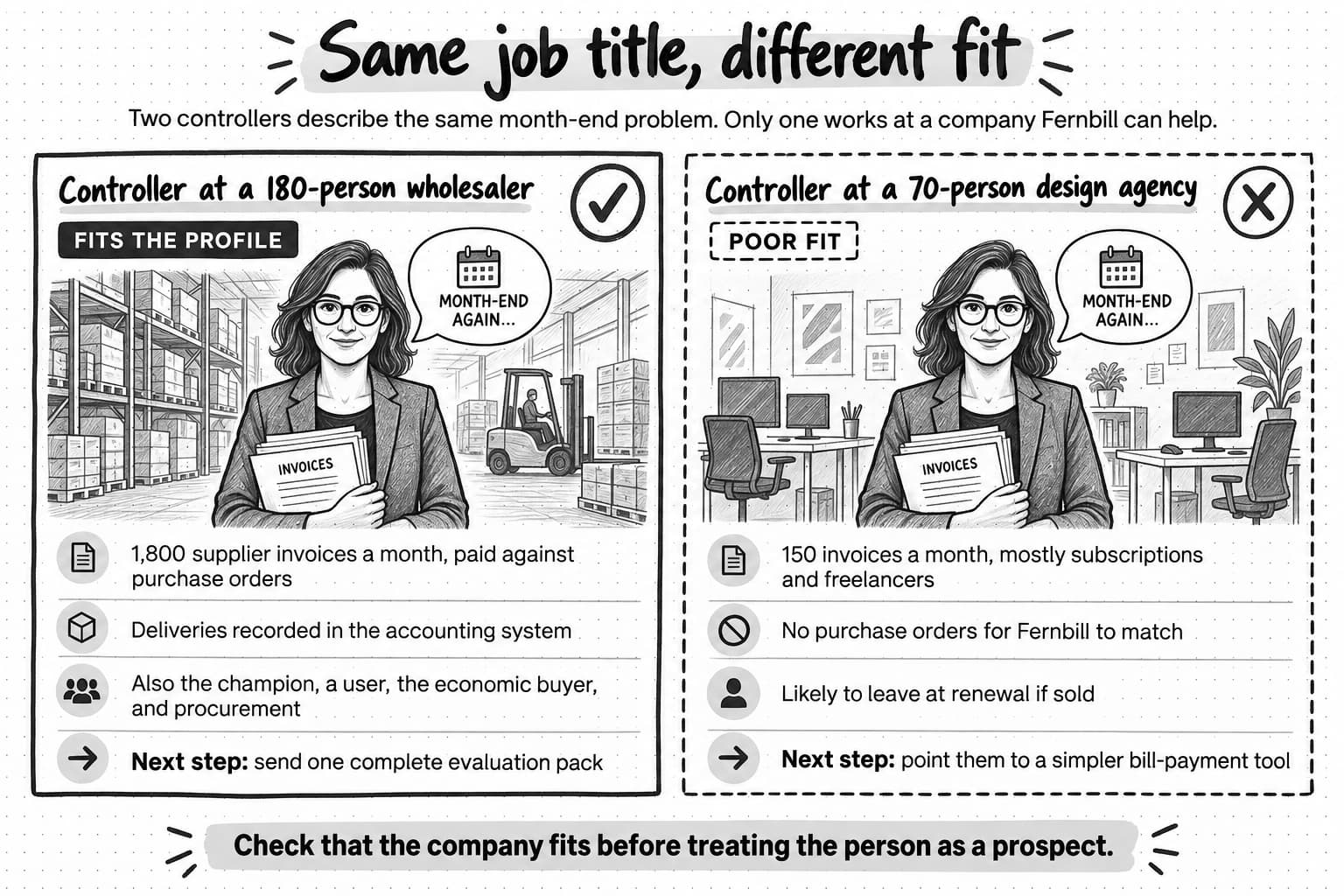
View the two controllers at full size (opens in a new tab).
How ICPs and personas shape research, content, messaging, channels, and proof
For each marketing decision, the two descriptions settle different parts.
| Decision | What the ICP decides | What personas decide |
|---|---|---|
| Research | Which companies, industries, and alternatives to study | Whom to interview, and which questions about triggers, criteria, and objections to ask |
| Content | Which use cases, industries, and operating conditions the examples describe | Which questions each piece answers, at what depth, and in which format |
| Messaging | Which problem the company leads with in its market, and which claims it can support for those accounts | Which part of the message comes first for each person, and which objections each piece must address |
| Channels | Which communities, trade events, technology partners, and lists reach suitable companies | Which publications, peers, and formats each role relies on, and which material arrives through a colleague |
| Proof | Which customers make credible case studies, because they resemble the prospect’s company | Which kind of evidence each person accepts: a trial, documentation, a reference, an audit report, or a business case |
The order matters. Choosing accounts first keeps persona work focused on people who can actually buy. A team that starts with personas alone tends to produce content that speaks to a familiar job title in general, which attracts the design-agency controller as readily as the distributor’s. A team that stops at the ICP tends to produce content that describes the company’s situation well but answers nobody’s particular question.
The two descriptions also feed the documents that come after them. A brand messaging framework records the claims every persona should hear, so the emphasis can change without the substance changing. A content brief carries both into each piece of work. Our guide to B2B content marketing strategy shows how these choices add up to a portfolio that helps each participant make progress.
Evidence that informs an ICP and buyer personas
Both descriptions are claims: that certain companies succeed with the product, and that certain people need certain things before they support a purchase. They need evidence, and the two draw on partly different sources. Company-level evidence comes mostly from records of what accounts did. Person-level evidence comes mostly from conversations about what people did and why.
| Source | What it shows about companies (ICP) | What it shows about people (personas) | What it cannot show on its own |
|---|---|---|---|
| Successful customers | The conditions shared by accounts that adopted quickly, renewed, and expanded | Who championed the purchase and who uses the product | Why those conditions mattered |
| Unsuitable and churned accounts | Disqualifying conditions, and where implementations stalled | Which roles never adopted the product or lost interest | Whether a different approach would have saved them |
| Lost deals and win/loss interviews | Account types the company loses, and to which alternatives | Whose objection stopped the deal, and who joined the decision late | How common each reason is across the market |
| Interviews with recent buyers and users | The operating conditions that made adoption possible | The trigger, criteria, concerns, and evidence each person used | How many others share the experience |
| Sales and support conversations | Which kinds of accounts reach a trial and which struggle after buying | The questions each role asks, in their own words | The view of people who never reached sales or support |
| Product use by account and role | How deeply each kind of account adopts the product | Which roles use which parts, and how often | The reasons behind the behavior |
Start with the customers you already have. Nora Conklin of Forrester warns that an ICP loses its basis in reality when teams focus on the “ideal” rather than the verified, and she recommends existing customers as the first source because they show which accounts get durable value. A won deal is only the start of that evidence: an account that signed and then stalled tells you as much as one that renewed.
Fernbill’s disqualifiers came from exactly those accounts. Six customers left within their first year. Five had few purchase orders to match, and the sixth needed a bespoke integration with an in-house system, the same problem that had stalled three trials. Each failure had a cause the team could name, which made the disqualifiers easier to write than the description of an ideal account.
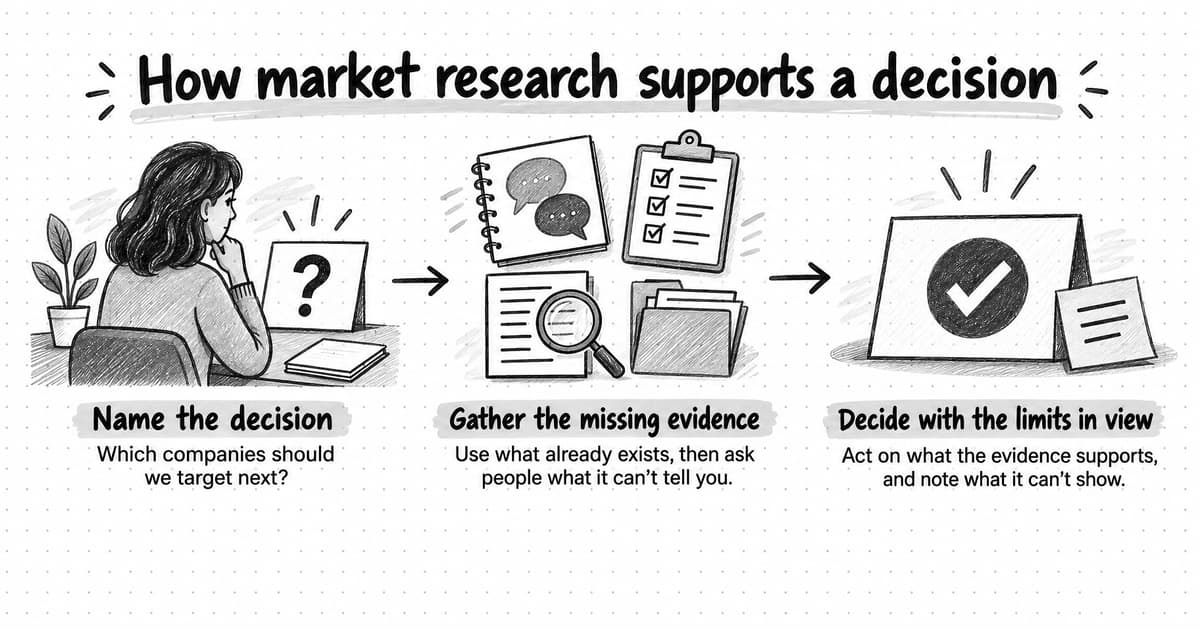
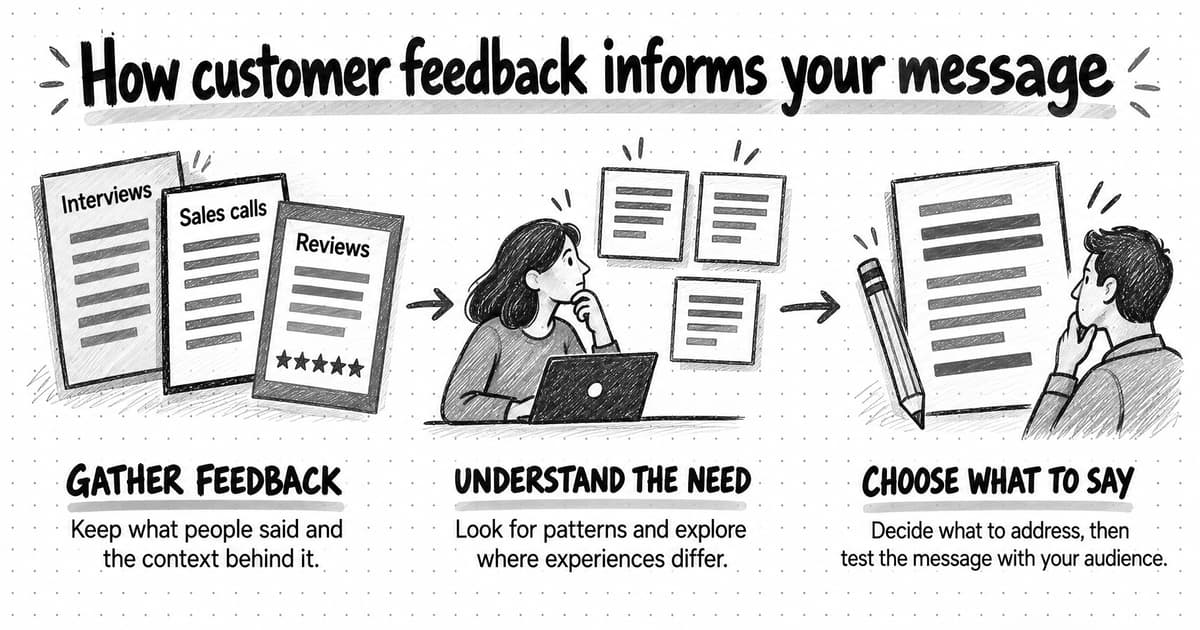
Interviews are most reliable when they reconstruct a particular recent purchase rather than ask people to summarize their usual behavior: who noticed the problem first, who joined the evaluation and when, what nearly stopped it, and which evidence settled each doubt. The Buyer Persona Institute’s guidance is blunt: to understand buying decisions, talk to people who recently made one, because there are no shortcuts. Teresa Torres gives the reason in her work on customer interviews: when people answer general questions, they tend to give inaccurate summaries of their own behavior, so she keeps interviews grounded in specific past instances. Our voice-of-customer research guide explains how to collect and analyze this kind of material, and our introduction to market research explains how to choose a method for a question you cannot answer from your own customers.
Separate research from assumption
A profile based on research and a profile based on what the team believes can look identical on the page. Mark the difference in the document itself. For each line, record whether it is supported, with the source, or assumed, with the check that would confirm it. Fernbill’s ICP table does this in its status column. The marking keeps an early guess from hardening into a fact simply because it has been written down and repeated. It also applies to anything drafted by an AI tool: a generated persona can be a useful list of questions to investigate, but it is not evidence about real buyers.
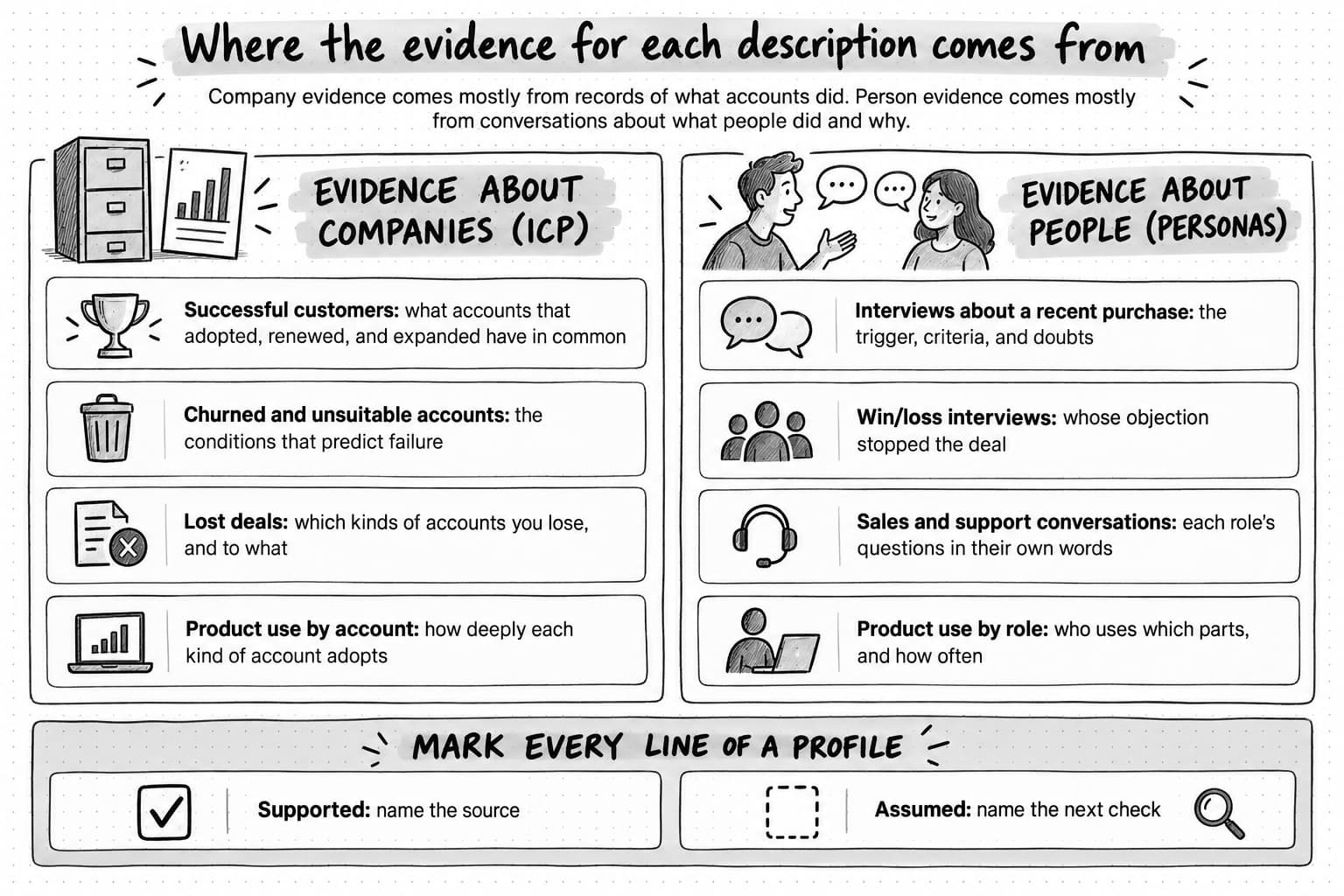
View the evidence sources at full size (opens in a new tab).
Provisional profiles for a new company
A company with few customers still has to decide which accounts to pursue and what to say to the people in them. It can write both descriptions as hypotheses: specific, written guesses that evidence can confirm or correct.
Start the ICP with conditions rather than size. Write down the use case, the need, and the operating conditions the product depends on, with the reason for each. These come from the founders’ experience, early conversations, design partners, and public sources such as job postings that describe the problem, discussions in professional communities, and reviews of alternative products. Keep personas short and practical: the roles the team expects to meet, the question each is likely to ask, and the evidence the team can offer today. Invented detail adds nothing at this stage. Nielsen Norman Group calls personas built from what a team already believes, with no new research, proto-personas. It considers them useful when the team treats them as hypotheses to test, and warns that otherwise they can become an echo chamber for the team’s incorrect assumptions.
The first accounts a new company can win are not always the ones it ultimately wants. Maja Voje suggests starting with an early customer profile, a segment that feels the problem now and can pay to solve it, and working up to the ICP by securing the pilot projects, case studies, and references that the more demanding accounts expect to see. Write both profiles down when they differ, so early wins do not quietly redefine the long-term target.
Then decide what would prove the hypotheses wrong. If Fernbill had been new, it might have written: “If three of our first five pilots stall because deliveries are not recorded, add prompt receipt recording to the ICP.” Each early deal, won or lost, is evidence. Record which account conditions and which roles appeared, and compare them with what the profile predicted. The target-audience guide describes ways to test an audience hypothesis quickly, and the same methods apply here.
When to revise an ICP or buyer persona
Both descriptions age as the product, the market, and the evidence change. Revisit them when:
- customers outside the ICP keep buying and succeeding, or customers inside it keep leaving;
- win rates, sales cycles, or time to first value change noticeably for one kind of account;
- new people join evaluations, such as an AI governance committee or a data-protection reviewer;
- the product or its pricing changes which companies can benefit or who buys, for example through a new use case, integration, or plan;
- the sales approach changes, for example from sales-led contracts to self-serve sign-up, which often merges the user and the buyer;
- regulation, technology, or competitors change who owns the problem or how urgent it is;
- the objections heard in sales conversations change.
Review the ICP during planning, and sooner when one of these changes appears. Personas can change faster, because new roles and objections show up in individual deals. Record what changed and why, so colleagues know which version the current work rests on.
Exercise: describe one suitable company and the people inside it
This exercise produces a first draft of both descriptions for one account. It works best with a recent customer that got value quickly. A new company can use a design partner, or the company it most wants to serve, and mark more lines as assumed.
- Choose the account and describe it with the company section of the template below. Include firmographic details only where they help you find similar companies.
- List the people who took part in its purchase and the role each played. Note anyone who held more than one role, and any role that was missing.
- For each person, write the one thing they most needed to understand and the evidence that convinced them, or would have.
- Check whether your current marketing provides that explanation and evidence. Where it does not, you have found the next piece of content to make.
- Mark each line as supported, naming the source, or assumed, naming the check you will run.
THE COMPANY
Use case: which job would this company use the product for?
Need: what makes that job important enough to pay to solve now?
Operating conditions: which systems, processes, or data must already be in place?
Ability to obtain value: who will implement and maintain it, and is there time and budget?
Proxies: which firmographic details help find similar companies?
Disqualifiers: what would make a similar-looking company a poor fit?

THE PEOPLE
For each person involved:
- Role in the purchase: champion, user, technical evaluator, economic buyer, procurement, or other
- Responsibility: what they are accountable for
- What they need to understand before they support the purchase
- Evidence they trust: trial, documentation, reference, audit report, business case, or other
- Other roles this person also holds

EVIDENCE CHECK
Mark each line above as supported (name the source) or assumed (name the next check).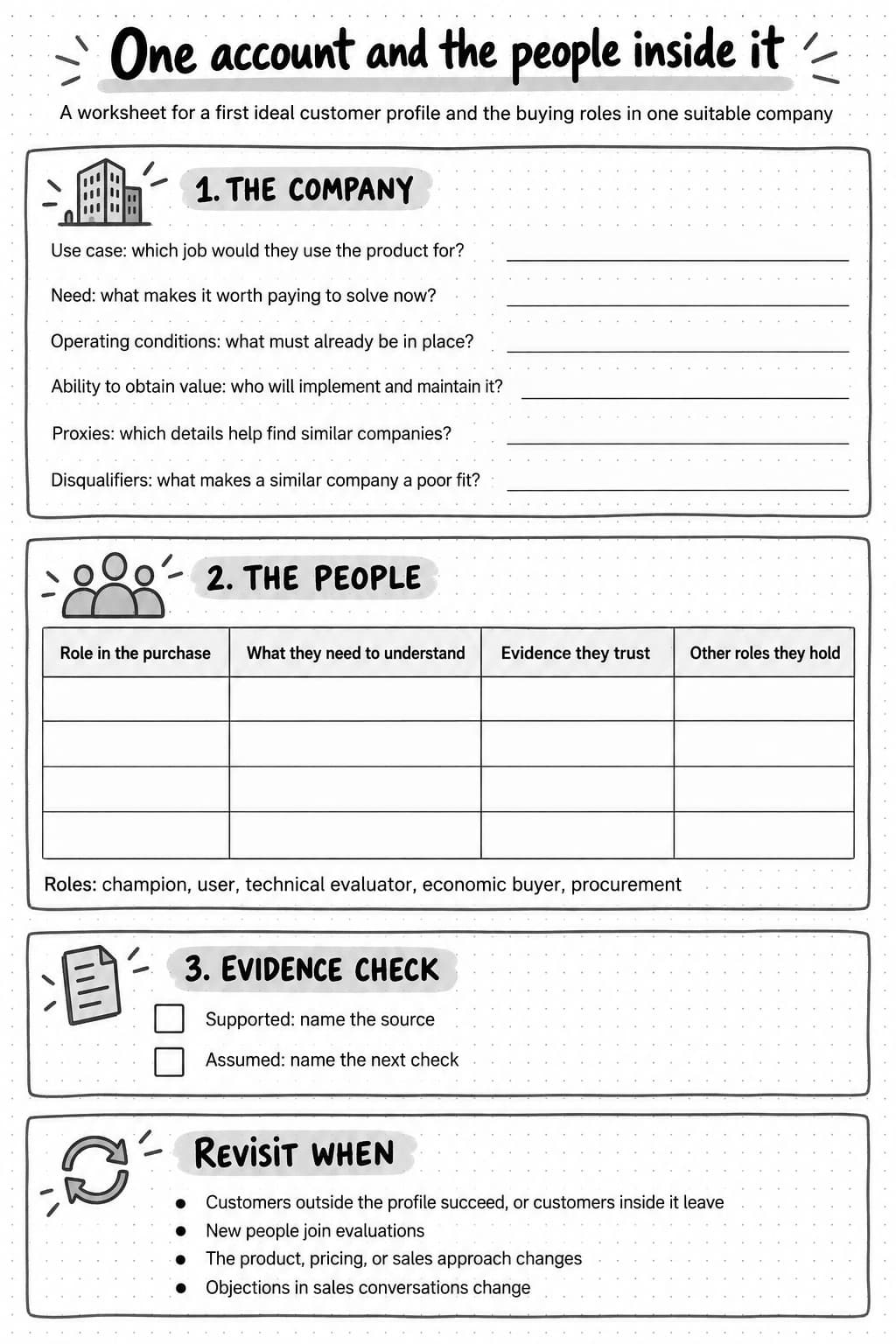
Open the worksheet at full size to save or print it (opens in a new tab).
Keep the result to a page or so: short enough that the team will use it to choose accounts and brief content.
Use both descriptions in every brief
When the ICP and personas live in a strategy document that nobody opens, the work drifts back to job titles and company sizes. Put the relevant parts into each brief instead: the kind of account the piece is for, the person it must help, what that person needs to understand, and the evidence they will accept. A reviewer can then judge the draft by whether it helps that person in that kind of company.
Meet Ampere—your AI marketing agent. Ampere can research public sources about companies in your market and save evidence-backed audience and voice-of-customer reports to Brand memory, where your team can review and edit them. It can also use the interview notes and win/loss summaries you upload to a Project as context. Later briefs and drafts can then start from the same understanding of the accounts you pursue and the people inside them. Your team remains responsible for the customer evidence, its interpretation, and approval.
Sources and further reading
- Lincoln Murphy, Sixteen Ventures: Ideal customer profile framework
- April Dunford: A quickstart guide to positioning
- Buyer Persona Institute: What is a buyer persona?
- Adele Revella, Buyer Persona Institute: Building B2B buyer personas? Focus on the buying decision, then the person
- Qualtrics: Ideal customer profiles (ICPs), a complete guide
- Yael Davidowitz-Neu, Product Marketing Alliance: How to create an ideal customer profile (ICP)
- Forrester: The state of business buying, 2026
- Frederick E. Webster Jr. and Yoram Wind: A general model for understanding organizational buying behavior, Journal of Marketing (1972)
- The Open University, OpenLearn: Understanding your customers, buying-centre roles
- Nora Conklin, Forrester: Start with customer insights to determine your highest-fit opportunities
- Teresa Torres, Product Talk: Story-based customer interviews uncover much-needed context
- Nielsen Norman Group: 3 persona types
- Maja Voje, Growth Unhinged: How to build your GTM strategy from scratch
Frequently Asked Questions
What is the difference between an ideal customer profile and a buyer persona?
An ideal customer profile describes a kind of organization: the accounts most likely to get value from a product, buy it, and stay. A buyer persona describes a kind of person who takes part in the purchase: their responsibility, what they need to understand, their concerns, and the evidence they trust. Teams use the ICP to choose which accounts to pursue and personas to decide what to tell each person inside those accounts.
What does ICP mean in marketing?
ICP stands for ideal customer profile. In B2B marketing, it describes the companies where a product fits best: those with the use case, the need, the operating conditions, and the ability to get value from it. It also lists firmographic details that help find similar companies and conditions that rule an account out. Some consumer businesses use the term for a single person, because there the buyer and the customer are the same individual.
What should an ideal customer profile include?
Include the conditions that explain success, not only company size. A useful ICP names the use case, the need that makes it worth paying to solve, the operating conditions the product depends on, the company’s ability to implement and maintain it, firmographic proxies for finding similar companies, and disqualifying conditions. Mark each line as supported, with its source, or assumed, with the check that would confirm it.
What details should a buyer persona include?
Describe the person’s part in the decision rather than a fictional biography. Record their responsibility, what brings them into the purchase, what success means to them, their concerns, the criteria they use to compare options, and the evidence and sources they trust. List common job titles only as a search aid, and include demographic details only when evidence shows they change the message, channel, or offer.
Should you create an ICP or buyer personas first?
Start with the ICP. Choosing the accounts first keeps persona work focused on people who can actually buy and get value. Personas written without an ICP tend to address a familiar job title in general, which attracts people at poor-fit companies as readily as people at good ones. Then write personas for the roles that take part in purchases at the companies the profile describes.
How is an ideal customer profile different from a target market or target audience?
A target market is every organization a business could reasonably serve. The ICP narrows it to the accounts most likely to succeed with the product. A target audience is the group one campaign, article, or offer is meant to reach, and it usually combines the ICP with one or two personas in a particular situation, such as controllers at suitable companies who are preparing for a new accounting system.
What is the difference between a buyer persona and a user persona?
A user persona, usually created by product and design teams, describes how someone works with a product so the team can design it. A buyer persona, used in marketing and sales, describes how someone takes part in the purchase. The two overlap when users influence the decision, but buyer personas also cover people who never use the product, such as the finance leader who approves the budget or a security reviewer.
What is the difference between a customer and a buyer in B2B?
In B2B, the customer is usually the organization that signs the contract, uses the product, and later renews or leaves. The buyers are the people inside it who take part in the decision: champions, users, technical evaluators, economic buyers, and procurement participants. That is why B2B teams describe customers with an ideal customer profile and the people who buy with buyer personas.
What is a negative ICP or negative buyer persona?
A negative ICP lists the conditions under which a company should not pursue an account, even when it looks attractive on paper. For an invoice-matching product, that might be a company that pays mostly invoices without purchase orders. Churned and unsuitable accounts are the best source for it. A negative persona does the same for people, but in B2B the account often decides fit: one job title can belong to a strong prospect or a poor one.
Can you give an example of an ICP and buyer personas?
This guide’s fictional company, Fernbill, sells software that matches supplier invoices to purchase orders. Its ICP covers companies that pay roughly 1,500 or more supplier invoices a month against purchase orders raised in an accounting system it connects to. Inside one matching distributor, the accounts payable manager is the champion, the specialists are daily users, the finance systems administrator is the technical evaluator, the CFO is the economic buyer, and procurement and legal run the purchase.