What is E-E-A-T? How Google and AI answers judge whether to trust your content
A precise account of E-E-A-T from Google's own guidelines, what it is not, how it carries into AI answers, and how a B2B team shows real experience and expertise on each kind of page, with a checklist and a rewritten example.
44 min readWritten by Ampere
Short answer
What is E-E-A-T?
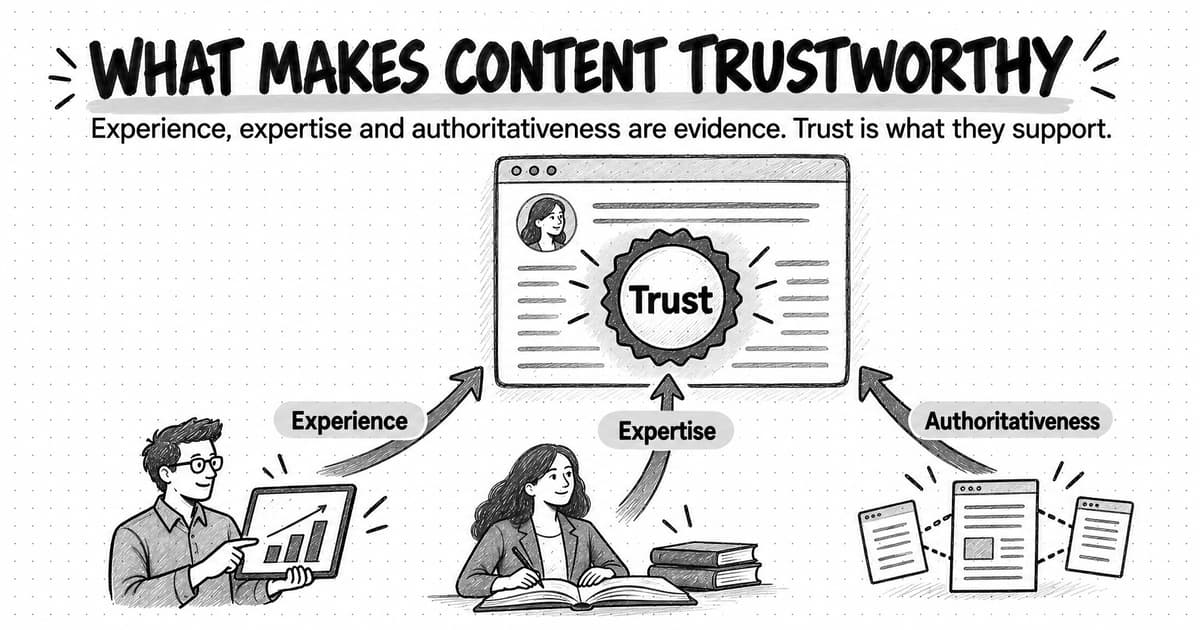
E-E-A-T stands for Experience, Expertise, Authoritativeness, and Trust. It is the framework in Google's Search Quality Rater Guidelines for judging whether content deserves trust. Trust is the most important part, and the other three are kinds of evidence that support it. E-E-A-T is not a single ranking factor or score; Google's systems use many signals to favor content with these qualities.
Summary
E-E-A-T describes what makes content trustworthy, and trust sits at its center. Experience, expertise, and authoritativeness are evidence that supports trust, and a page does not need all three. A page that is inaccurate or deceptive has low E-E-A-T however expert it looks, so accuracy and honesty come before bios and badges.
E-E-A-T comes from Google's Search Quality Rater Guidelines, which about 16,000 raters use to judge sample results. Their ratings help Google check and improve its ranking systems but never move an individual page. Google says E-E-A-T is not a specific ranking factor, so there is no score to raise; its systems use many signals to favor content with these qualities.
Some B2B topics carry a higher standard. Google calls topics that could affect people's health, money, or safety YMYL and expects more accuracy and expertise on them. Most marketing content is not YMYL, but pages about tax, payroll, security, legal compliance, or health data can be, so they need a qualified author or a named reviewer.
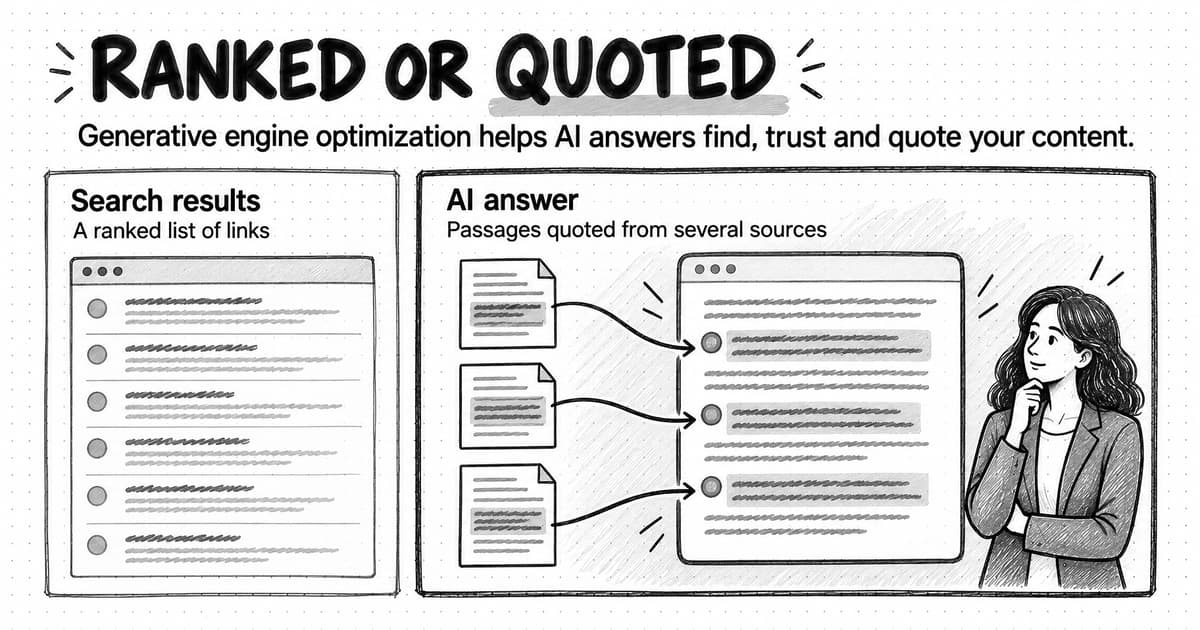
Google judges AI-assisted content by its quality, not its method, but pages of AI text produced with little effort or originality are rated lowest. The same qualities plausibly help with AI answers: Google's AI features use its normal quality systems, and pages with clear claims, named sources, and original information are easier to cite, though nothing guarantees a citation.
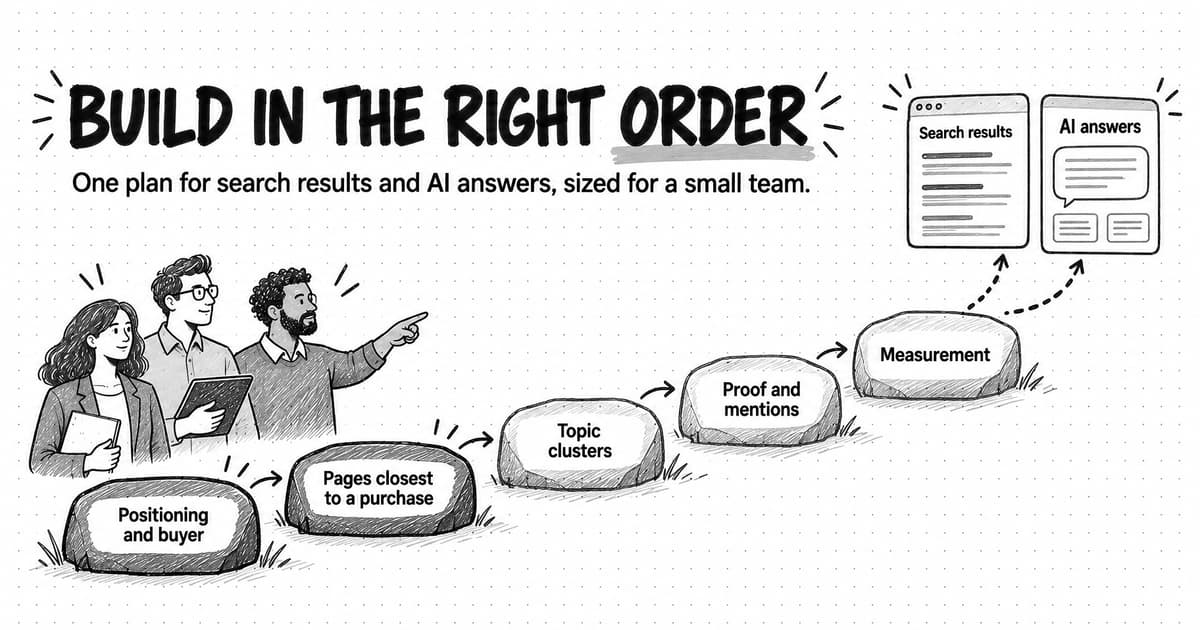
Showing E-E-A-T on a B2B site means putting real evidence on the page: first-hand detail from the people who do the work, primary sources, your own data with its method, named accountable authors, and accurate product pages. A checklist by page type and a fictional rewrite show that most of the work is gathering material, not writing.
Contents
- What E-E-A-T stands for
- Where E-E-A-T comes from: Google's Search Quality Rater Guidelines
- Is E-E-A-T a ranking factor?
- Experience: first-hand knowledge of the topic
- Expertise: the knowledge or skill the topic requires
- Authoritativeness: being a go-to source
- Trust: why it sits at the center
- How raters look for E-E-A-T on a page
- YMYL topics and why some B2B topics count
- E-E-A-T and AI-generated content: what Google says
- How E-E-A-T carries into AI answers
- How to show E-E-A-T on a B2B SaaS site
- E-E-A-T checklist by page type
- Worked example: a generic page rewritten (fictional)
- Common E-E-A-T mistakes
- How E-E-A-T works with Ampere
- Sources and further reading
- Frequently Asked Questions
A team that starts drafting blog posts with AI usually notices the same thing within a few weeks. The drafts are fluent and on topic, and they could have been published by any company in the category. Someone then asks whether Google will treat the pages as low quality, and the conversation turns to E-E-A-T: whether the posts need author bios, whether the site needs an expert reviewer, and whether there is a score to improve.
E-E-A-T stands for Experience, Expertise, Authoritativeness, and Trust. It is the framework Google uses to describe what makes content trustworthy, and its human search quality raters use it to judge whether Google's results are any good. Trust is the center of the framework. The other three qualities are kinds of evidence that support it: someone who has done the thing, someone who knows the subject, and a source people already rely on. A page can show one of them strongly and still be trustworthy, but a page that is inaccurate or deceptive fails no matter how expert it looks.
That definition answers the worried question in a more useful way than an author bio can. E-E-A-T is not a score Google assigns to pages, and Google says it rewards quality however content is produced. Its systems look for many signals associated with content people can trust, and its guidelines describe what that content looks like: who made it is clear, the knowledge in it is real, the claims are accurate and sourced, and it was made to help the reader. AI drafts tend to fall short on the first two, because a model has no first-hand experience of your product or your customers. The fix is to put that experience and expertise into the page and to show it.
This guide explains where E-E-A-T comes from and what Google says about it, defines each element with the examples from Google's own guidelines, and explains why some B2B topics fall under the stricter standard Google calls YMYL. It then covers what Google says about AI-generated content, how the same qualities affect which sources AI answers cite, how to show E-E-A-T on a B2B software site page by page, and a fictional page rewritten from generic to trustworthy.
What E-E-A-T stands for
E-E-A-T has four parts, and Google's guidelines define each one as a question a rater asks about the page in front of them.
Experience asks whether the person who made the content has first-hand or life experience of the topic: have they used the product, done the job, or lived through the situation? Expertise asks whether they have the knowledge or skill the topic requires. Authoritativeness asks whether the creator or the website is known as a go-to source for the topic. Trust asks whether the page is accurate, honest, safe, and reliable.
The order of the letters says nothing about importance. Google's Search Quality Rater Guidelines state that "the most important member at the center of the E-E-A-T family is Trust," and describe experience, expertise, and authoritativeness as concepts "that can support your assessment of Trust." Google's page on creating helpful, reliable, people-first content says the same thing to site owners: "Of these aspects, trust is most important. The others contribute to trust, but content doesn't necessarily have to demonstrate all of them."
That last sentence matters for planning. A customer's account of migrating from a spreadsheet to your product can be valuable because of the experience in it, even though the customer is not a recognized expert. A security engineer's explanation of how single sign-on works can be valuable because of the expertise in it, even if the engineer has never written for your blog before. You do not need to manufacture all four qualities on every page. You need the kind of evidence that would make a reasonable reader trust this page for this purpose.
The guidelines also note that the qualities overlap: someone may develop expertise "due to first-hand Experience accumulated over time." The people who know your product best usually have both kinds of evidence and have simply not been asked to put it on the page.
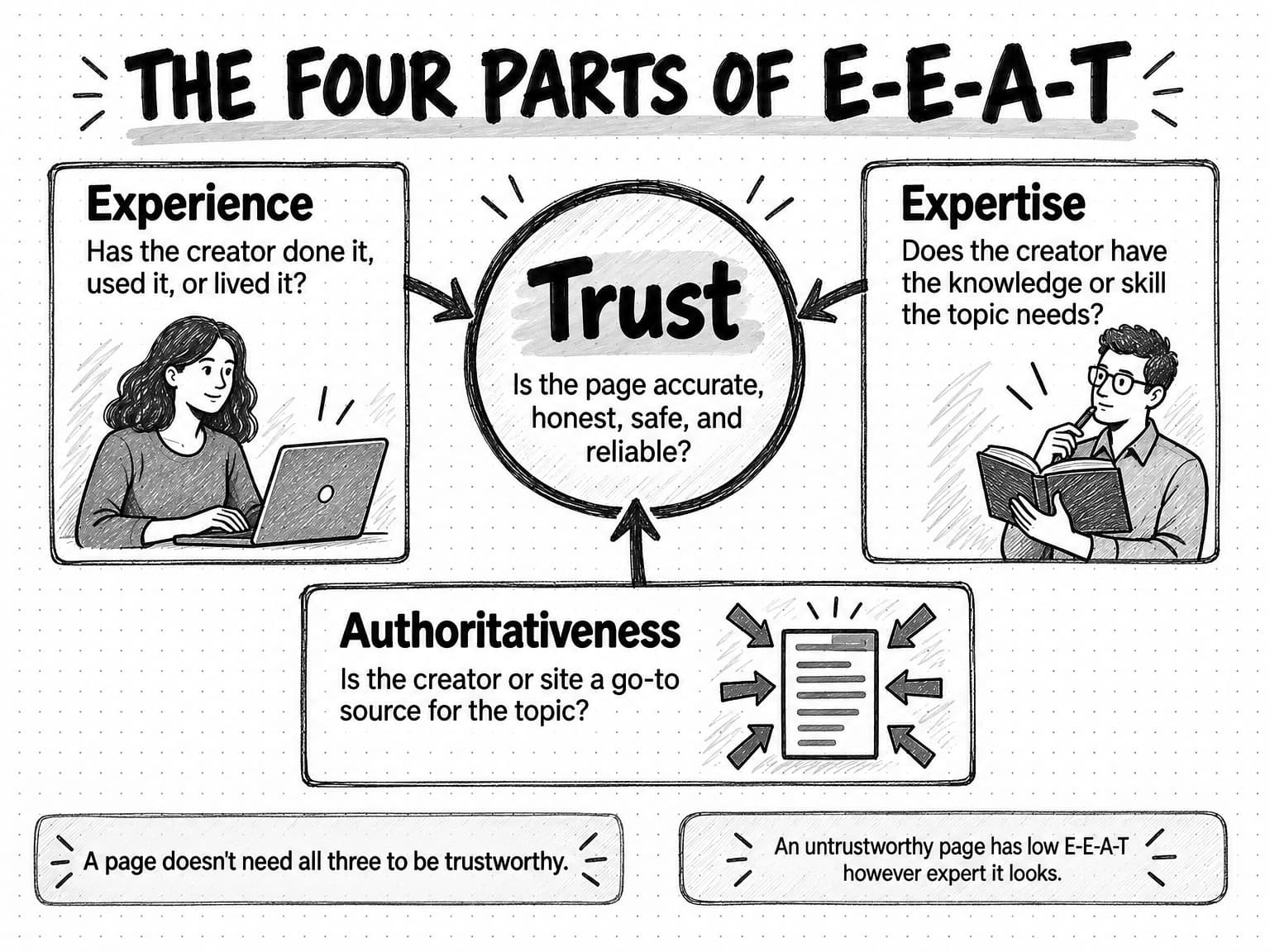
View the E-E-A-T diagram at full size (opens in a new tab).
Where E-E-A-T comes from: Google's Search Quality Rater Guidelines
E-E-A-T is a term from a document most marketers never read: Google's Search Quality Rater Guidelines, a public PDF of about 180 pages. The version current in October 2026 is dated September 11, 2025. It is written for search quality raters, external evaluators who judge the quality of search results. In a 2023 overview of the rating program, Google says it works with about 16,000 external raters around the world.
Raters do two main jobs. In page quality rating, they judge how well a page achieves its purpose, which is where E-E-A-T appears. In needs met rating, they judge how well a result serves the person who searched. Google uses the ratings to measure whether its ranking systems work and to test proposed changes, for example by showing raters results with and without a change and asking which they prefer.
The ratings do not move individual pages. The guidelines state that "no single rating can directly impact how a particular webpage, website, or result appears in Google Search," and explain why: humans "could never individually rate each page on the open web." Google's people-first content page puts it plainly: "Search raters have no control over how pages rank. Rater data is not used directly in our ranking algorithms." Google compares the ratings to feedback cards a restaurant collects from diners. The cards tell the kitchen whether the food is good; they do not cook it.
The framework was E-A-T for years. In a December 2022 post, Google added the first E for experience, asking whether content shows "some degree of experience, such as with actual use of a product, having actually visited a place or communicating what a person experienced." The post gave an example that still explains the idea well: for instructions on filling out a tax return, you want an accountant, but for reviews of tax preparation software, you may want a forum of people who have used it.
A marketer should read it because it is the most detailed public description of what Google means by trustworthy content, and Google recommends it for this use: reading the guidelines "may help you self-assess how your content is doing from an E-E-A-T perspective." Treat it as a written description of the target Google's engineers are aiming at.
Is E-E-A-T a ranking factor?
No, not in the sense of a single measured factor. Google's own wording is precise: "While E-E-A-T itself isn't a specific ranking factor, using a mix of factors that can identify content with good E-E-A-T is useful."
That sentence describes a two-step relationship. Google's ranking systems use many signals, and Google does not publish most of them. Raters, using E-E-A-T, tell Google whether the results those signals produce look trustworthy. When ratings show that results are falling short, engineers change the systems. Over time, the systems come to favor content with the qualities the raters were asked to look for, without any system computing an "E-E-A-T score" for your page.
Google is also explicit that the weight varies by topic: "our systems give even more weight to content that aligns with strong E-E-A-T for topics that could significantly impact the health, financial stability, or safety of people, or the welfare or well-being of society." Those are the YMYL topics covered later in this guide.
Three practical consequences follow for a marketing team.
First, there is nothing to install. Author schema, an "expert reviewed" badge, or a bio box at the bottom of a post does not add E-E-A-T by itself. Google's article structured data documentation recommends marking up authors accurately, including a URL for each author's page, because it helps Google "best understand and represent the author of the content." That is useful, but the markup describes evidence; it does not supply it. If the author page says nothing about what the author has done, there is no evidence to describe.
Second, any SEO tool that gives a page an E-E-A-T score is measuring its own proxies, such as whether a byline or an About page exists. Those checks can be a useful reminder, and they can also be satisfied by a page no reader would trust. Use them as a checklist, not as a measure of quality.
Third, E-E-A-T improvements rarely show up as a ranking change you can attribute to them. You make the content more useful and more credible, and you judge the result over months, across a body of pages. Our guide to how to measure AI search visibility covers a baseline you can track for the AI-answer side.
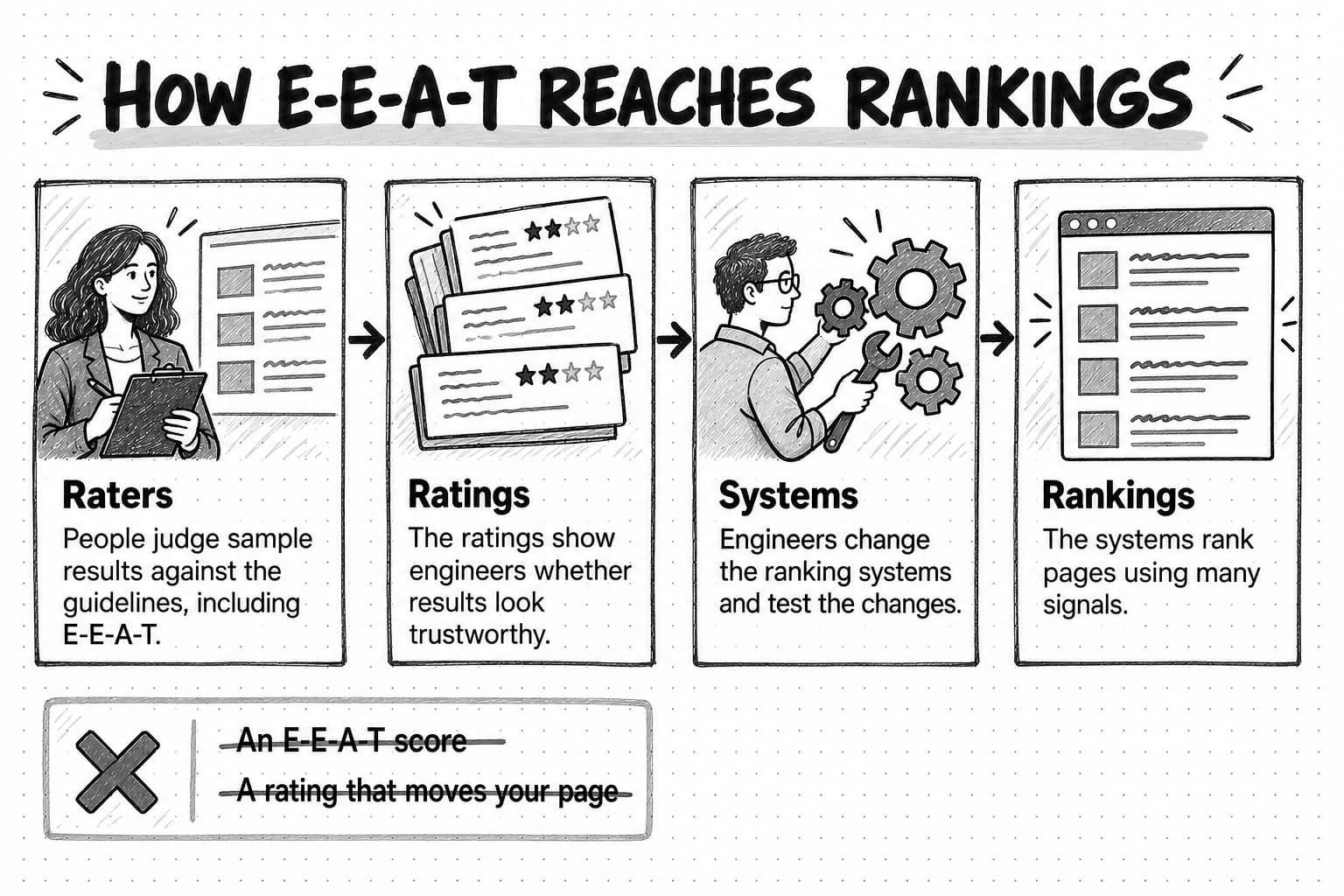
View the diagram of how E-E-A-T relates to ranking at full size (opens in a new tab).
Experience: first-hand knowledge of the topic
The guidelines define experience as "the extent to which the content creator has the necessary first-hand or life experience for the topic," and give a simple test: "which would you trust: a product review from someone who has personally used the product or a 'review' by someone who has not?"
Experience is the quality AI drafts most obviously lack, and it is the one B2B companies have in the greatest supply without realizing it. Your support team has read every confusing error message in your product. Your implementation team knows which integrations take a day and which take a month. Your sales engineers know which objections come up in security reviews. Your customers know what their workflow looked like before and after. None of that is in a model's training data in a form specific to your product, and none of it appears on the page unless someone puts it there.
On a B2B site, experience usually shows up as one of the following:
- A description of doing the work, with details only a practitioner would include: the step that took longest, the mistake made the first time, the setting that changed the outcome.
- Evidence of the work, such as annotated screenshots of a real configuration, a sample export, or a photo from an event. Google's guidance on writing high quality reviews asks reviewers to "provide evidence such as visuals, audio, or other links of your own experience."
- Results from your own testing or your own data, with the method stated. Our guide to original research covers how to produce data that others can check.
- Customer accounts in the customer's own words, attributed and approved.
The test for experience is whether the page contains something the writer could only know by having done the thing. "Integrations can take time to set up" fails that test. "The most common delay we see is waiting for the customer's IT team to approve the OAuth app, so we ask for that approval in the kickoff call" passes it, provided it is true.
Expertise: the knowledge or skill the topic requires
Expertise is "the extent to which the content creator has the necessary knowledge or skill for the topic," and the guidelines note that "different topics require different levels and types of expertise to be trustworthy." Their example: home electrical rewiring advice from a skilled electrician versus from an antique homes enthusiast with no knowledge of wiring.
Expertise is not the same as credentials. The guidelines describe formal reputation evidence for professionals, such as "educational degrees, peer validation, expert co-authors, and citations," and they also say "there are many types of informal expertise that may be visible in the MC itself" (MC is the guidelines' abbreviation for main content). A data engineer with no degree in the subject who explains clearly why a sync job fails on timezone boundaries is showing expertise in the text.
For B2B content, expertise has two visible parts. The first is in the content itself: correct terminology used precisely, explanations that go past the obvious, accurate treatment of edge cases and trade-offs, and claims that match what the field knows. Google's self-assessment questions ask whether the content "provide[s] insightful analysis or interesting information that is beyond the obvious" and whether it has "any easily-verified factual errors." The second is around the content: a byline that leads to an author page explaining what the person does and why they know the subject, and, for higher-stakes topics, a named reviewer with relevant expertise.
The level of expertise needed depends on the claim. A post on how to write a better onboarding email needs someone who has written and tested onboarding emails. A post on what a data processing agreement must contain under GDPR needs someone who understands data protection law, or a reviewer who does. Matching the expert to the claim is part of trust: a confident page on a topic its author does not understand is a liability whatever the byline says.
Authoritativeness: being a go-to source
Authoritativeness is "the extent to which the content creator or the website is known as a go-to source for the topic." The guidelines point out that "most topics do not have one official, Authoritative website or content creator," but when they do, that source is usually among the most reliable. Their examples: the official government page is the authoritative source for passport renewal, and a local business's social profile may be the authoritative source for what is on sale now.
For a software company, authoritativeness has a narrow, solid core. You are the authoritative source on your own product: how it works, what it costs, what it integrates with, what changed in the last release, and what your security practices are. Documentation, pricing pages, changelogs, and trust centers should be the best pages on the web for those questions, and they should be accurate and current, because other sites and AI answers will quote them.
Beyond your own product, authoritativeness is earned slowly and mostly off your site. The guidelines tell raters to look at "what others say about the website or content creators: Look for independent reviews, references, news articles, and other sources of credible information." In B2B, that includes analyst coverage, independent reviews, conference talks, podcast appearances, contributed articles, citations of your research by other publications, and practitioners in your category recommending your guides. You cannot claim authority on your own pages; you can only give others reasons to grant it.
That is why the most durable authority-building work for a small team is usually narrow: become the reference on a few topics where your company has real knowledge, rather than publishing thinly across many. Our guide to what thought leadership is covers how a company develops a point of view others want to cite, and what topical authority is covers how a connected body of content on one subject builds it.
The guidelines also offer reassurance for small sites. Small websites "may have little or no reputation information," and "this is not indicative of high or low quality." When reputation information is missing, raters are told to look harder at the page itself. A young company can still publish trustworthy pages; it just has to carry more of the evidence on the page.
Trust: why it sits at the center
Trust is "the extent to which the page is accurate, honest, safe, and reliable," and the guidelines explain why it outranks the other three with a memorable example: "a financial scam is untrustworthy, even if the content creator is a highly experienced and expert scammer who is considered the go-to on running scams!" In their words, "untrustworthy pages have low E-E-A-T no matter how Experienced, Expert, or Authoritative they may seem," and "if a page is untrustworthy for any reason, it has low E-E-A-T."
The amount of trust a page needs depends on what it is for. The guidelines list examples: online stores need secure payment and reliable customer service; product reviews "should be honest and written to help others make informed purchasing decisions (rather than solely to sell the product)"; informational pages on clear YMYL topics "must be accurate to prevent harm"; and a social post meant to entertain may not need much trust at all.
Three parts of trust come up most often on B2B sites.
Accuracy. Claims are correct, numbers are sourced, and the page is current. An out-of-date pricing table or a feature that was removed two releases ago does more damage than a missing bio, because readers act on it. Google's guidance on using generative AI content adds that generative models "don't retrieve facts, but predict a likely sequence of words," so AI drafts need fact-checking before publication. Our guide to preventing AI hallucinations in marketing covers how to check them.
Honesty about who is speaking. The guidelines warn about conflicts of interest: "reviews" by the product manufacturer ("Our product is great!") or by an influencer paid to promote the product "are not as trustworthy due to the conflict of interest." A software company writing about its own category always has that conflict. You cannot remove it, but you can be open about it: say that the page is written by the company, state your criteria, describe competitors fairly, and admit where your product is a poor fit.
Transparency about the business. Raters look for who is responsible for the website and who created the content. A real About page, contact details, a physical or registered address where appropriate, clear pricing, and accessible terms, privacy, and security information all contribute.
Trust also explains why some tactics backfire. Google's people-first content page says that fabricating creator profiles, "such as by using AI-generated headshots, made-up names, or false credentials," is a form of deception, and that "any form of deception makes a page untrustworthy to both users and our automated quality systems." A fake expert byline is worse than no byline.
How raters look for E-E-A-T on a page
The guidelines tell raters to base their E-E-A-T assessment on "one or more of the following" sources of evidence, and the list doubles as a map of where your own evidence should be.
What the website or content creators say about themselves. Raters start with the About page and the creator's profile page. For a B2B company, that means an About page that says who runs the company and what it does, and author pages that say what each author does, what they have worked on, and where else their work appears.
What others say about the website or content creators. Raters look for "independent reviews, references, news articles, and other sources of credible information," and ask whether there is "independent, reliable evidence" for or against trustworthiness. You influence this through the quality of your product and your work, not through your own pages: earned coverage, independent reviews, and other people citing you.
What is visible on the page. "For some types of pages, the level of experience and expertise may be clear from the MC itself." A detailed walkthrough with real screenshots, a method section, a dataset, or a comment thread where practitioners confirm the advice can show more than any bio.
The three sources check one another. A bio that claims ten years of experience, on a page of generic advice by an author no one else mentions, raises doubt. The pages that hold up are those where all three agree: the author page says this person runs implementations, the article reads as if they do, and their name appears elsewhere talking about implementations.
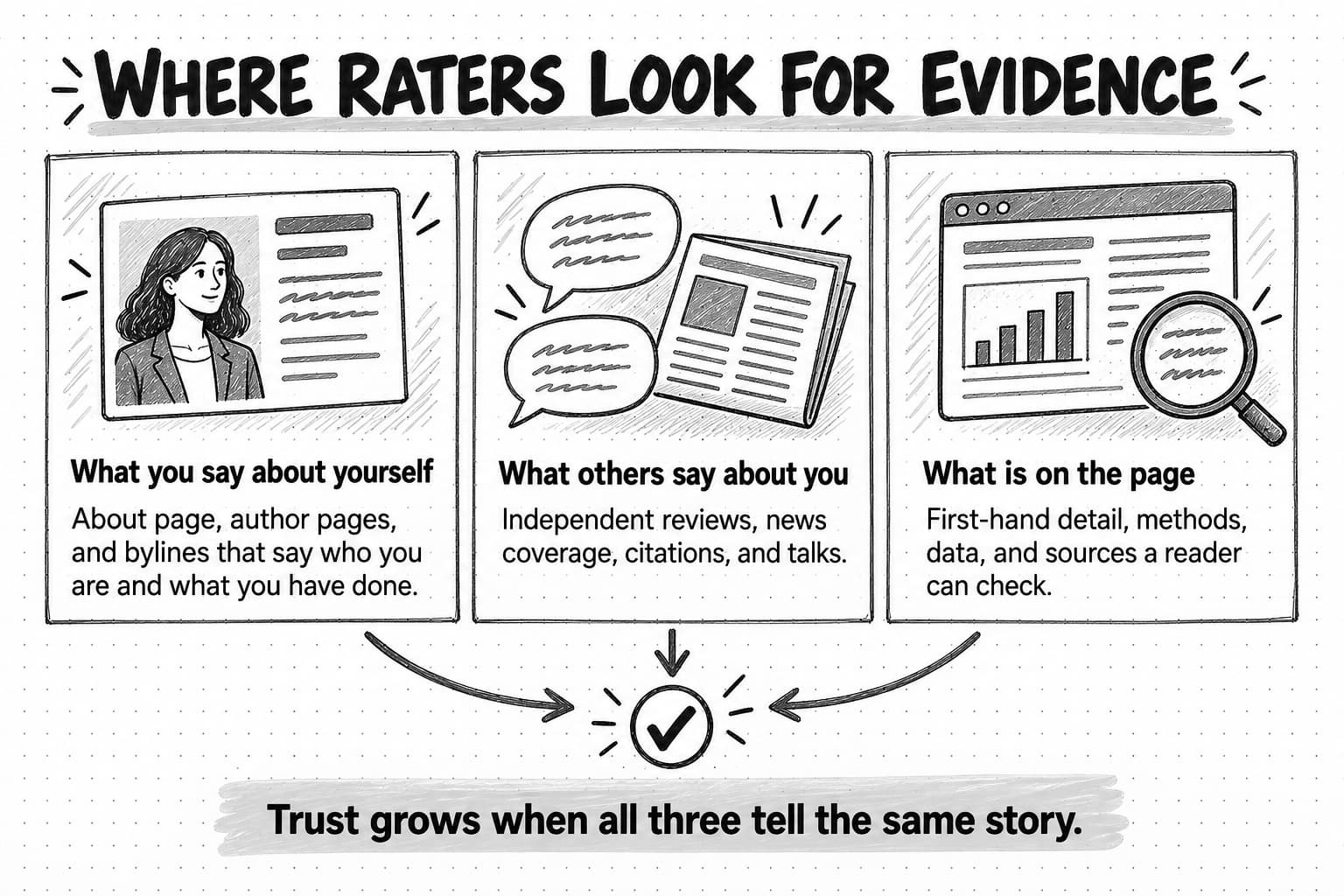
View the three sources of E-E-A-T evidence at full size (opens in a new tab).
YMYL topics and why some B2B topics count
YMYL stands for "Your Money or Your Life." The guidelines define YMYL topics as those that "could significantly impact the health, financial stability, or safety of people, or the welfare or well-being of society," and sort the possible harms into four types: health or safety, financial security, government, civics and society, and other harm to people or society.
Two points in the definition are easy to miss. First, YMYL is a spectrum. The guidelines suggest thinking of topics as "clear YMYL, definitely not YMYL or something in between," and they state that "many or most topics are not YMYL." Second, the stakes come from the topic, not from the website. A page about choosing a project management tool is unlikely to be YMYL wherever it is published; a page about how to fill out a tax form is YMYL even on a hobby blog.
Most B2B marketing content is not YMYL: a slightly wrong post about webinar promotion harms no one. But B2B software companies publish more YMYL-adjacent content than they tend to assume, because many sell into finance, security, health, employment, and legal workflows, where a wrong page can affect someone's money, safety, or job:
| Topic on a B2B site | Where it sits | Why |
|---|---|---|
| How to calculate payroll tax withholding | Clear YMYL (financial security) | A wrong figure can cost an employer or employee money and penalties. |
| What a SOC 2 report covers | May be YMYL (safety online) | Buyers make security decisions on it; an error can mislead a risk assessment. |
| How to set an employee expense policy | May be YMYL (financial security) | Reimbursement and tax treatment rules can affect employees' pay. |
| HIPAA requirements for patient messaging | Clear YMYL (health and legal) | Errors can lead to privacy breaches and penalties. |
| How to write a product launch email | Not YMYL | A weak email wastes a send; it does not harm anyone. |
| Best practices for sprint planning | Not YMYL | Advice is a matter of team preference and is easy to correct. |
The placements in this table are the editorial judgment of this guide, made with the guidelines' definitions and examples; Google does not publish a list of B2B YMYL topics.
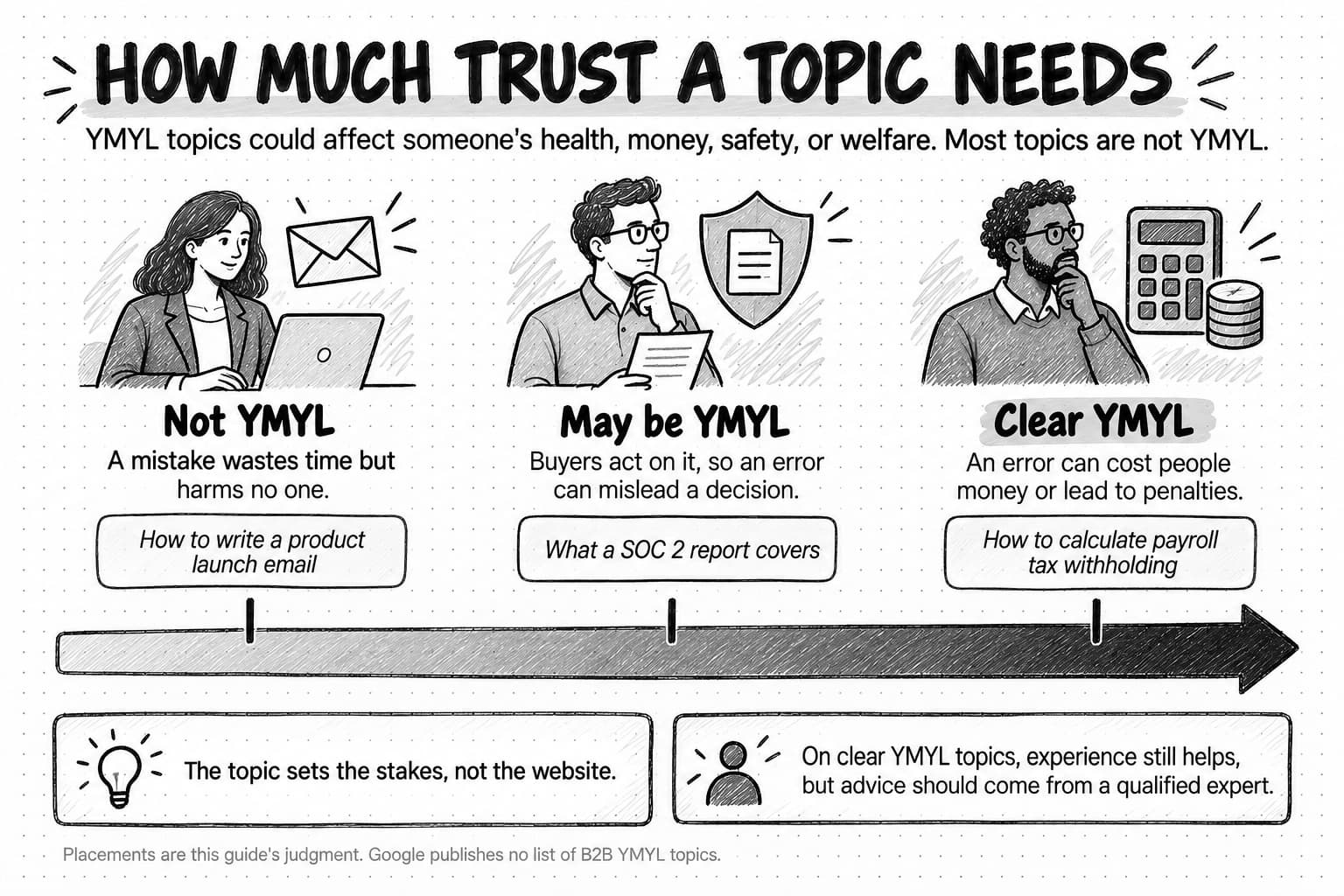
View the YMYL spectrum at full size (opens in a new tab).
For YMYL content, the guidelines draw a useful line between experience and expertise. Section 3.4.1 says that pages sharing "first-hand life experience on clear YMYL topics may be considered to have high E-E-A-T as long as the content is trustworthy, safe, and consistent with well-established expert consensus," but that "some types of YMYL information and advice must come from experts." Their financial examples make the distinction concrete: reviews of retirement saving services by people who used them are valuable experience, while advice on how much to save and what to invest in is "best left to Experts."
For a B2B team, the practical rule follows directly. A customer story about how a finance team cut its month-end close from ten days to six is experience, and it is valuable. A guide that tells readers how to treat a reimbursement for tax purposes is advice that should come from, or be reviewed by, someone qualified, and the page should say who that is and when they reviewed it.
E-E-A-T and AI-generated content: what Google says
Google's position on AI content is consistent across its documentation, and it is framed in E-E-A-T terms. In its February 2023 guidance on AI-generated content, Google said its ranking systems "aim to reward original, high-quality content that demonstrates qualities of what we call E-E-A-T," and that its focus is on "the quality of content, rather than how content is produced." The same post says automation, including AI, used "with the primary purpose of manipulating ranking in search results is a violation of our spam policies," and that "using AI doesn't give content any special gains." Our guide to AI slop covers the policy history in more detail, including the scaled content abuse policy Google introduced in March 2024.
What matters for E-E-A-T is how Google asks site owners to evaluate their own content, whether AI was involved or not. The people-first content page frames it as three questions.
Who created the content? Google asks whether it is "self-evident to your visitors who authored your content," whether pages "carry a byline, where one might be expected," and whether bylines "lead to further information about the author or authors involved." It "strongly encourage[s] adding accurate authorship information." On AI specifically, the February 2023 post says that "giving AI an author byline is probably not the best way" to make AI's role clear to readers. The byline should name the person who is accountable for the content.
How was it created? Google suggests explaining process where readers would value it, for example how many products a review tested and how. For content where automation played a substantial role, it suggests disclosures "where someone might think 'How was this created?'" and "when it would be reasonably expected." For most B2B marketing pages written by a person with AI assistance, readers are not asking that question, and a disclosure is a judgment call rather than a requirement. Where AI produced something readers might rely on, such as a summary of reviews or a generated dataset, explaining the method is part of being honest.
Why was it created? Google calls this "perhaps the most important question." The answer should be "that you're creating content primarily to help people," content "useful to visitors if they come to your site directly." Content made mainly to attract search visits is not aligned with what Google's systems reward, however it was produced.
The guidelines add a sharper standard that applies directly to AI-assisted work: effort. Google's people-first content page lists effort as one of the main-content attributes raters evaluate, and it gives AI as an example of the low end: "using generative AI to produce large amounts of text without manual oversight or curation represents little to no effort." It adds that "attribution or giving credit to other sources doesn't replace the need for original effort." Section 4.6.6 of the guidelines tells raters to give the lowest rating when "all or almost all" of a page's main content is "copied, paraphrased, embedded, auto or AI generated, or reposted from other sources with little to no effort, little to no originality, and little to no added value." The guidelines also make the opposite point: "the use of Generative AI tools alone does not determine the level of effort or Page Quality rating."
Put together, the guidance gives an AI-assisted team a clear standard. AI can research, structure, and draft. The page still needs something that did not exist before: experience from your team or customers, analysis or data of your own, judgment about what applies to your reader, and a person who checked the facts and stands behind the result. Google's generative AI guidance asks for that check explicitly: "It is critical to manually factcheck and review all AI-generated content for accuracy and trustworthiness before publishing," including titles, meta descriptions, structured data, and image alt text.
How E-E-A-T carries into AI answers
E-E-A-T is Google's framework, and AI answer engines do not publish anything equivalent. But the question it answers, whether a source deserves to be trusted, is the same question an AI answer has to settle when it decides what to cite. This section separates what the platforms document from what is reasonable inference.
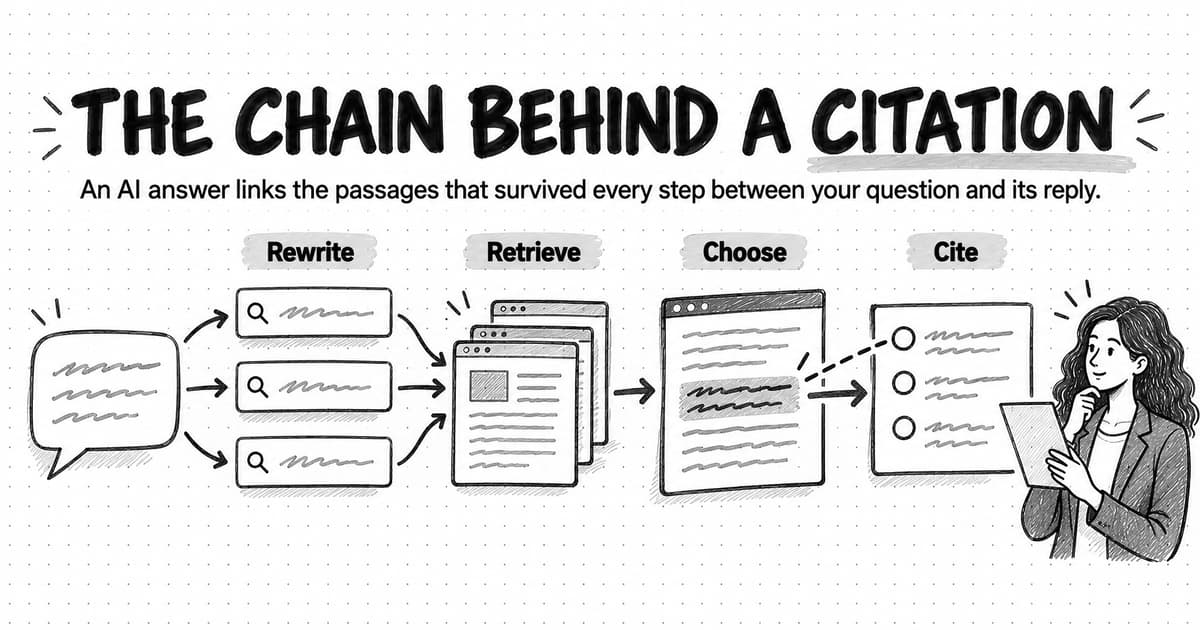
What Google documents for AI Overviews and AI Mode. Google's page on AI features and your website says that "there are no additional requirements to appear in AI Overviews or AI Mode, nor other special optimizations necessary," and that a page must be indexed and eligible to appear in Search with a snippet to be shown as a supporting link. It recommends the same foundations as ordinary search, including "creating helpful, reliable, people-first content," the page E-E-A-T comes from. It also says both features may use "query fan-out," issuing multiple related searches across subtopics to build a response, and that you don't need new machine-readable files, AI text files, or special schema to appear. In other words, Google's AI features draw on the same index and the same quality guidance as ordinary search, so the trust work you do for search applies to them. Our guide to Google AI Overviews and AI Mode explains how those features work in more detail.
What other AI search products document. OpenAI's crawler documentation says OAI-SearchBot "is used to surface websites in search results in ChatGPT's search features," and that sites opted out of it will not be shown in ChatGPT search answers. That is an access requirement: a source has to be reachable before anyone can judge it. OpenAI does not publish how ChatGPT search weighs sources once it can reach them, and neither do most other AI answer products. Our guide to how AI search engines choose sources to cite covers what each platform does document.
What research suggests. A 2024 study of generative engine optimization by researchers from Princeton University and IIT Delhi tested how rewriting a source changed its visibility in AI-generated answers, using a simulated engine built on GPT-3.5 over the top five Google results, and checked some findings on Perplexity. Adding citations to sources, quotations, and statistics produced the largest gains, a 30 to 40 percent relative improvement on the paper's main visibility measure, while keyword stuffing "offer[ed] little to no improvement." The study measured lab conditions and engines that have since changed, so treat it as evidence about a direction, not a formula. Our guide to generative engine optimization covers that field.
The reasoning that connects them. No AI answer product has documented an E-E-A-T equivalent, so what follows is inference, not a published ranking rule. An AI answer that cites a source is putting its own credibility behind it. Pages that state clear claims, show where the numbers come from, name who is responsible, and contain information found nowhere else are easier to quote accurately and safer to cite. A page that only restates what ten other pages say gives an answer engine no reason to choose it over the other ten. So the same habits that make a page trustworthy to a rater, such as specific claims, visible sources, original data, and clear ownership, also make it a better candidate for a citation. None of them guarantees one.
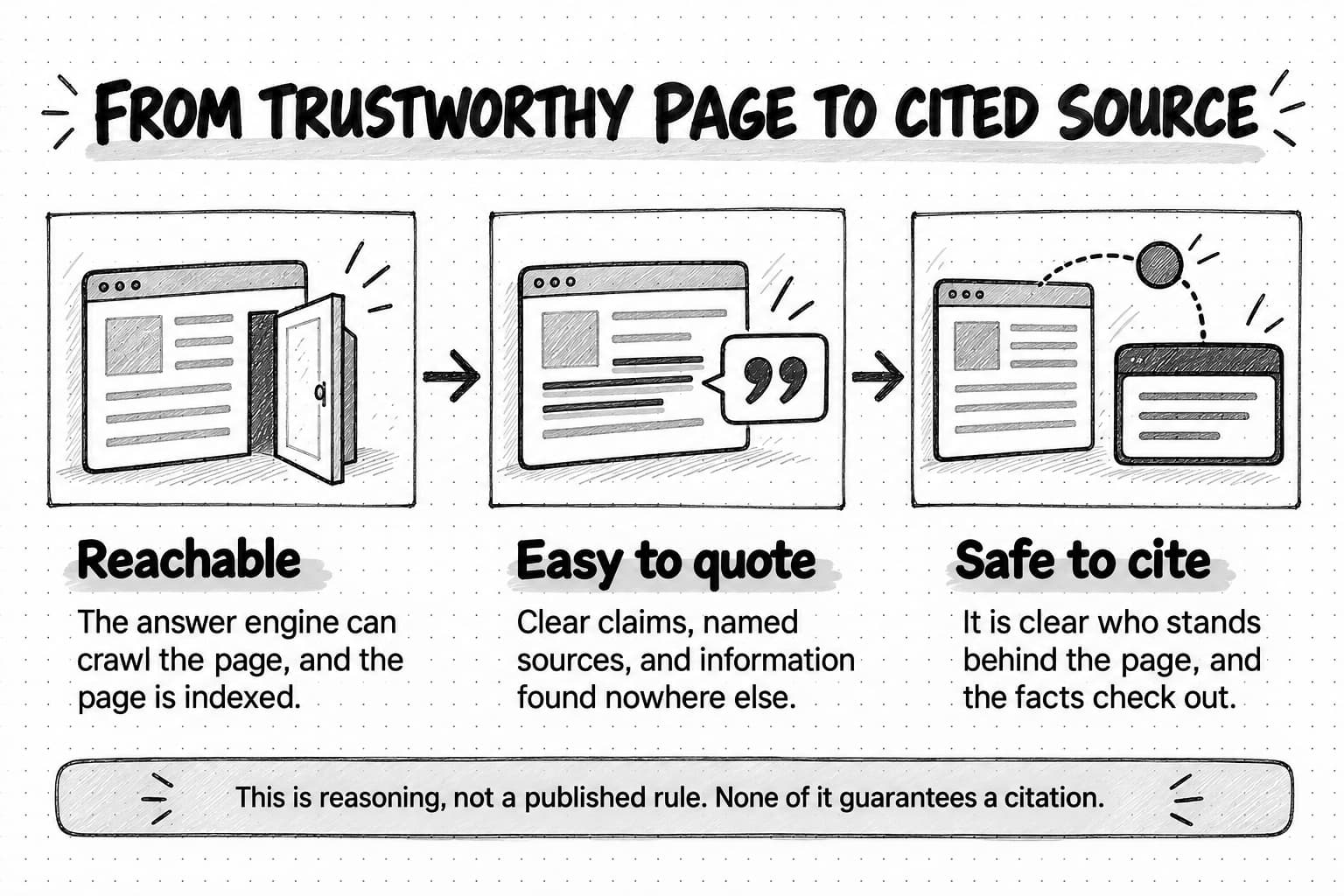
View the diagram of E-E-A-T and AI answers at full size (opens in a new tab).
How to show E-E-A-T on a B2B SaaS site
E-E-A-T work happens at two levels: the site, which tells readers and raters who you are, and the page, which shows what this content is based on. Most teams over-invest in visible page furniture, such as bio boxes and badges, and under-invest in the substance the furniture is supposed to describe.
Site-level signals
- An About page that answers who runs the company. Name the founders or leadership, say what the company does and for whom, and give a way to contact a person. Raters start here.
- Author pages for everyone who writes or reviews. Each should say what the person does, what they have worked on, and where else their work appears, with links to profiles that confirm it. Link bylines to these pages, and mark them up as Google's article structured data documentation recommends, with each author's name and a URL.
- An editorial standards page. Explain how content is researched, who reviews it, how you handle corrections, how you use AI in production, and how you treat competitors. It gives readers and raters one place to understand your process, and writing it forces the team to agree on one.
- Accurate product pages, pricing, documentation, and a trust or security page. These are the topics where you are the authoritative source. Keep them current, and date them.
Page-level signals
- A byline that names the accountable person, linked to their author page. For a high-stakes page, add a named reviewer and the date of review.
- First-hand material: what your team saw, tested, or did, with screenshots, sample outputs, or data, and the method stated.
- Sources for every claim you did not originate, linked to the primary source rather than a summary of it.
- Dates that mean something: a published date, and an updated date only when the content changed substantially. Google's people-first content page lists "changing the date of pages to make them seem fresh when the content has not substantially changed" as a warning sign.
- Honest scope and limits: who the advice is for, when it does not apply, and where your product is not the right choice.
- A clear purpose: the page answers the question in its title fully enough that the reader does not need to search again.
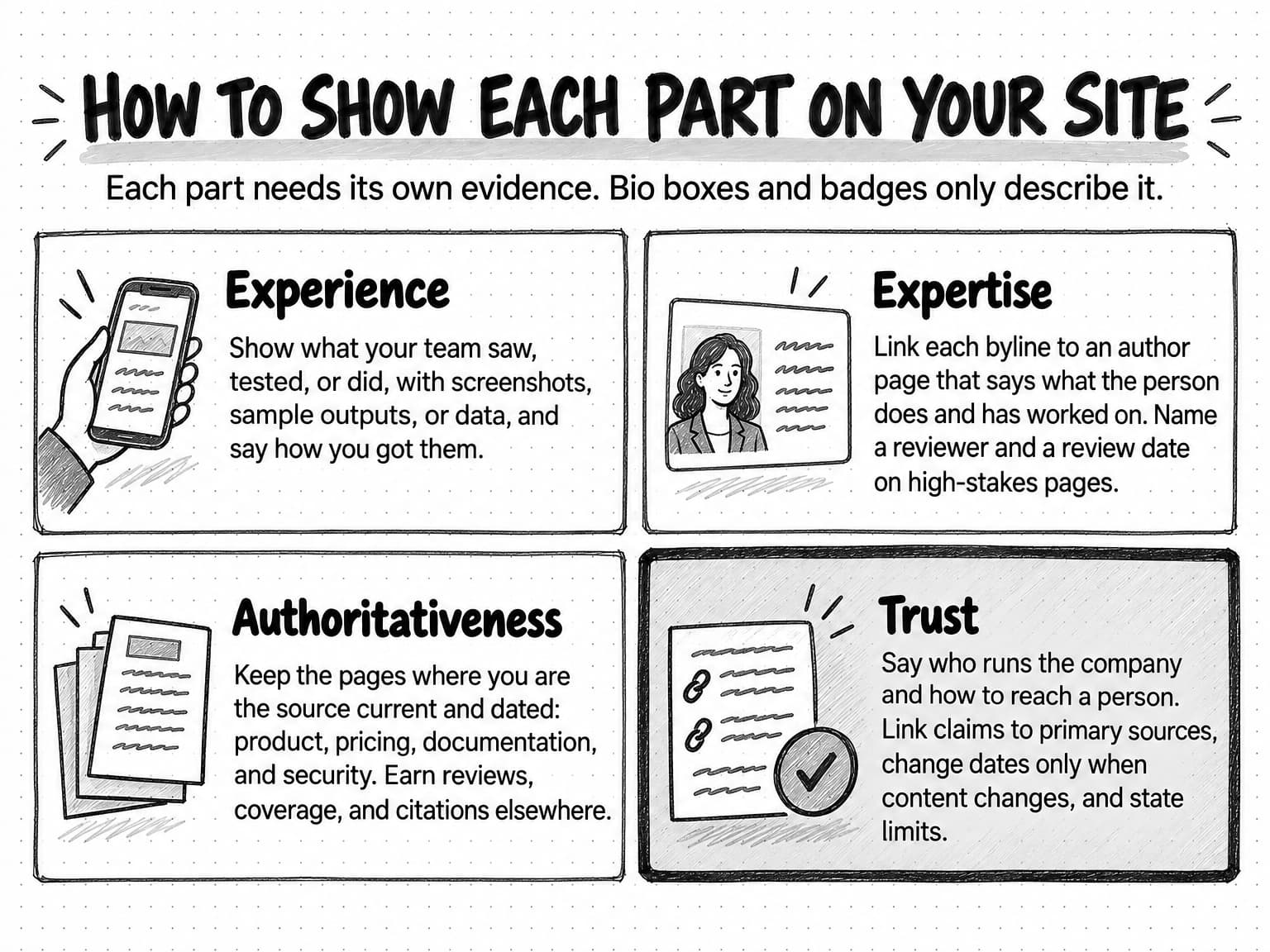
View how to show each part of E-E-A-T at full size (opens in a new tab).
Who supplies what in an AI-assisted workflow
If your team drafts with AI, assign the E-E-A-T work explicitly, because the model cannot supply most of it. A workable split looks like this:
| Stage | Who supplies it | What it adds |
|---|---|---|
| Topic and angle | Marketer with the subject-matter expert | Why this page should exist for your audience |
| Experience and examples | Subject-matter expert, customers, support or sales notes | First-hand detail no other page has |
| Data and evidence | Your product data, research, or tested results | Original information and a stated method |
| Research and structure | AI, checked by the writer | Coverage of what is already known, with sources |
| Draft | AI and writer together | A readable first version built from the material above |
| Fact check | Writer, with a named expert for YMYL topics | Accuracy, which trust depends on |
| Approval and byline | The accountable person | Ownership readers and raters can see |
Our guide to AI content creation walks through that workflow stage by stage, and our guide to writing a content brief covers how to capture the expert's input before drafting starts.
E-E-A-T checklist by page type
Different pages need different evidence, because readers trust them for different things. Use this table to decide what each page type must show; the last column is the most common failure.
| Page type | What readers trust it for | E-E-A-T evidence to show | Common failure |
|---|---|---|---|
| Educational guide or blog post | Correct, useful explanation | Named author with relevant experience, first-hand examples, primary sources, accurate dates | Generic definitions any site could publish |
| Product or feature page | What the product does | Specific, current capabilities, real screenshots, limits stated, links to documentation | Claims broader than the product supports |
| Comparison or alternatives page | A fair decision | Stated criteria, a disclosed point of view, fair treatment of competitors, dated facts | A review by the manufacturer presented as neutral |
| Customer story or case study | Proof it works for someone like me | Named customer with approval, the before and after, how results were measured | Unattributed quotes and unmeasured results |
| Original research or benchmark | New information | Method, sample, dates, limits, and the data behind charts | Headline numbers without a base |
| Documentation or help article | How to do it now | Accurate current steps, version or date, ownership by the product team | Out-of-date steps after a release |
| Pricing page | What it costs | Complete, current prices and terms, what is included, how to contact sales | Hidden conditions or stale plans |
| YMYL guide (tax, security, legal, health) | Advice that will not cause harm | Qualified author or named expert reviewer, review date, primary regulatory sources | Confident advice from someone not qualified to give it |
Our guide to writing a B2B case study covers the case study row in more depth, and the original research guide linked earlier covers the research row. A content audit is the natural place to run this checklist across an existing library.
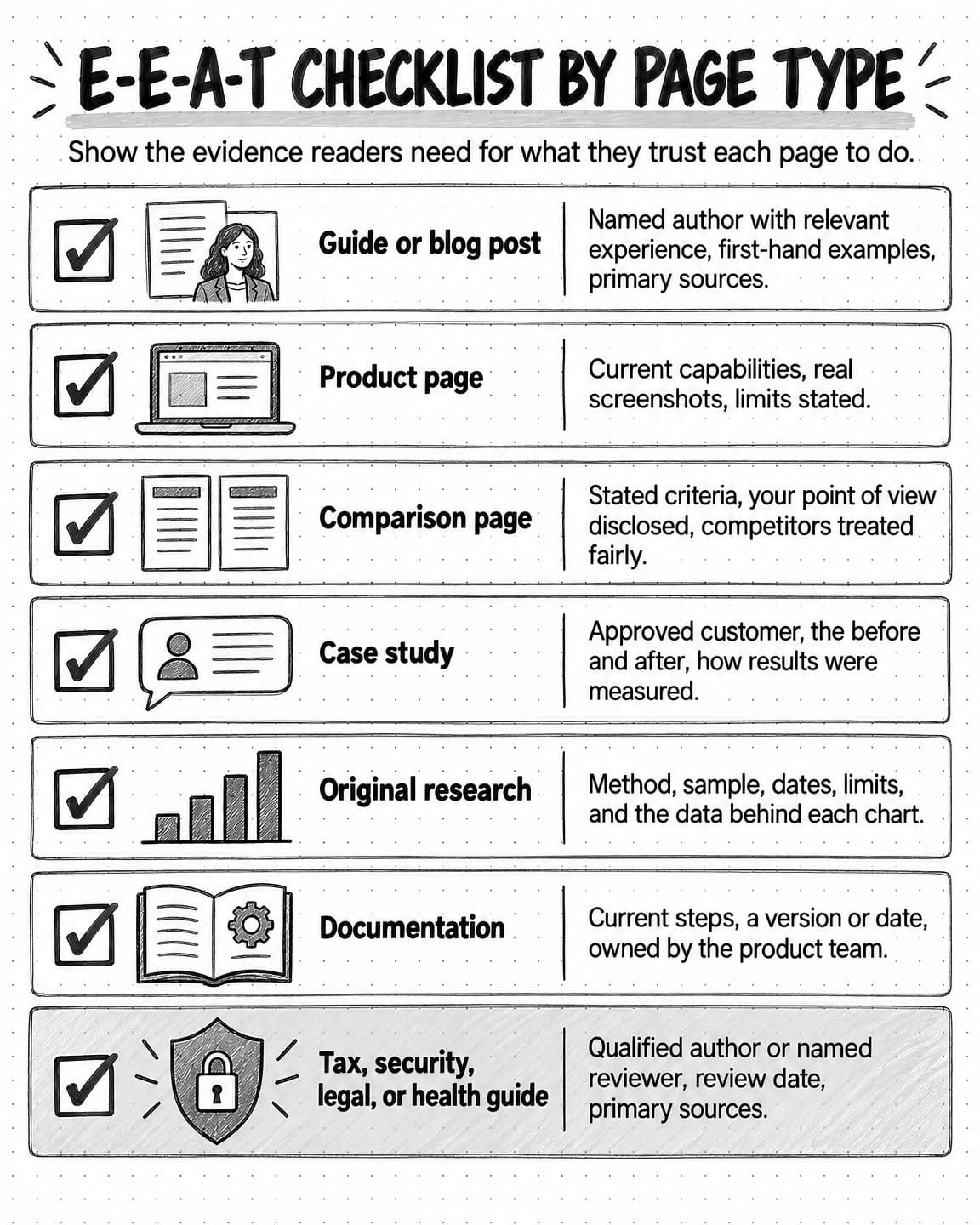
View the E-E-A-T page checklist at full size (opens in a new tab).
How to audit one page against the checklist
Before rewriting a whole library, audit one important page. It shows what material your team will need to gather for the rest.
- Name the page's purpose and stakes. What does a reader rely on this page for, and is the topic YMYL, possibly YMYL, or not? That sets how much trust and expertise the page needs.
- Find the first-hand material. Highlight every sentence that only someone with experience of your product, your customers, or the job could have written. If there are none, that is the main finding.
- Check the claims. List every factual claim and number. Mark each as sourced, sourced to a summary, or unsourced, and check the important ones against the primary source.
- Check who is accountable. Is there a byline? Does it lead to an author page with relevant background? For a YMYL topic, is there a qualified author or a named reviewer with a date?
- Check honesty. Does the page state your conflict of interest where there is one, describe competitors fairly, and admit limits?
- Compare with the results. Search the page's main query and read the top results and any AI answer. What does your page offer that they do not? If the honest answer is nothing, the rewrite should start by gathering something, not by editing sentences.
- Record what you need. Write down the interviews, data, reviewer, and sources the rewrite requires, and who will provide each.
The same steps work as a quarterly check on your most important pages. Our guide to content gap analysis covers step six in more depth.
Worked example: a generic page rewritten (fictional)
This example is fictional. Tallyroute is an invented expense-management software company, and every person, number, and quote in this section is illustrative.
Tallyroute's marketing team publishes a guide called "What is an employee expense policy?" The page was drafted with AI in an afternoon and lightly edited. It ranks on page three for its main query, and the team has never seen it cited in an AI answer. Here is a fair summary of the original:
- Byline: "Tallyroute Team", linking nowhere.
- Opening: "In today's fast-paced business world, a clear expense policy is more important than ever."
- Body: a definition, a list of ten "key elements" (such as "approval workflows" and "receipt requirements"), and the sentence "Experts recommend reviewing your policy regularly."
- Tax treatment: one sentence saying reimbursements "are generally not taxable," with no country, no conditions, and no source.
- Evidence: none. No examples, no data, no screenshots, no sources.
- Ending: a call to action to book a demo.
- Date: updated last month, though only the call to action changed.
Read against the guidelines, the page has three problems. Its main content shows little effort or originality: everything on it appears on dozens of other pages. Nothing on it suggests experience of running an expense process. And it makes a tax claim, which puts it at least partly in YMYL territory, with no qualified source and an unqualified generalization that is wrong in some circumstances.
The team rewrites the page in a week, and most of the time goes into gathering material rather than writing.
Experience. Tallyroute's head of customer finance, who ran expense operations at two companies before joining, is interviewed for 30 minutes. She explains the three policy rules that cause the most rejected claims and why. The support team exports 400 policy-related tickets from the last year (an illustrative figure) and tags them by cause; the top three causes become a section with the share of tickets for each and a note on the method. Two customers agree to be quoted by name about how they changed their policies, and approve their quotes.
Expertise. The tax sentence is replaced by a short section that explains when reimbursements are and are not treated as taxable income in the two countries where most of Tallyroute's customers operate, with links to the tax authorities' own guidance. An outside accountant reviews the section, and the page names her, her qualification, and the review date.
Authoritativeness. The page links to Tallyroute's own documentation for the configuration steps, since Tallyroute is the authoritative source on its product, and to the tax authorities for the rules, since they are the authoritative source on tax.
Trust. The byline names the head of customer finance and links to an author page describing her background. A short note says the page was drafted with AI assistance from her interview and the ticket analysis, and fact-checked by the named reviewer, because the team decided readers relying on tax guidance would reasonably want to know how it was made. The page states that Tallyroute sells expense software and that the policy template works whatever tool the reader uses. The updated date changes because the content changed.
| Element | Before | After |
|---|---|---|
| Byline | "Tallyroute Team", no link | Head of customer finance, linked to an author page |
| Experience | None | Interview insights and a ticket analysis with its method |
| Expertise | Unqualified tax claim | Country-specific section reviewed by a named accountant |
| Evidence | None | Ticket data, two approved customer quotes, primary tax sources |
| Honesty | Demo call to action only | Conflict of interest stated; template usable with any tool |
| Dates | Changed without a content change | Changed because the content changed |
None of these changes guarantees a better ranking or a citation, and Tallyroute should not expect to attribute any later change to one of them. What the team can say is that the page now contains information found nowhere else, says who stands behind it, and gives an AI answer something specific and sourced to quote.
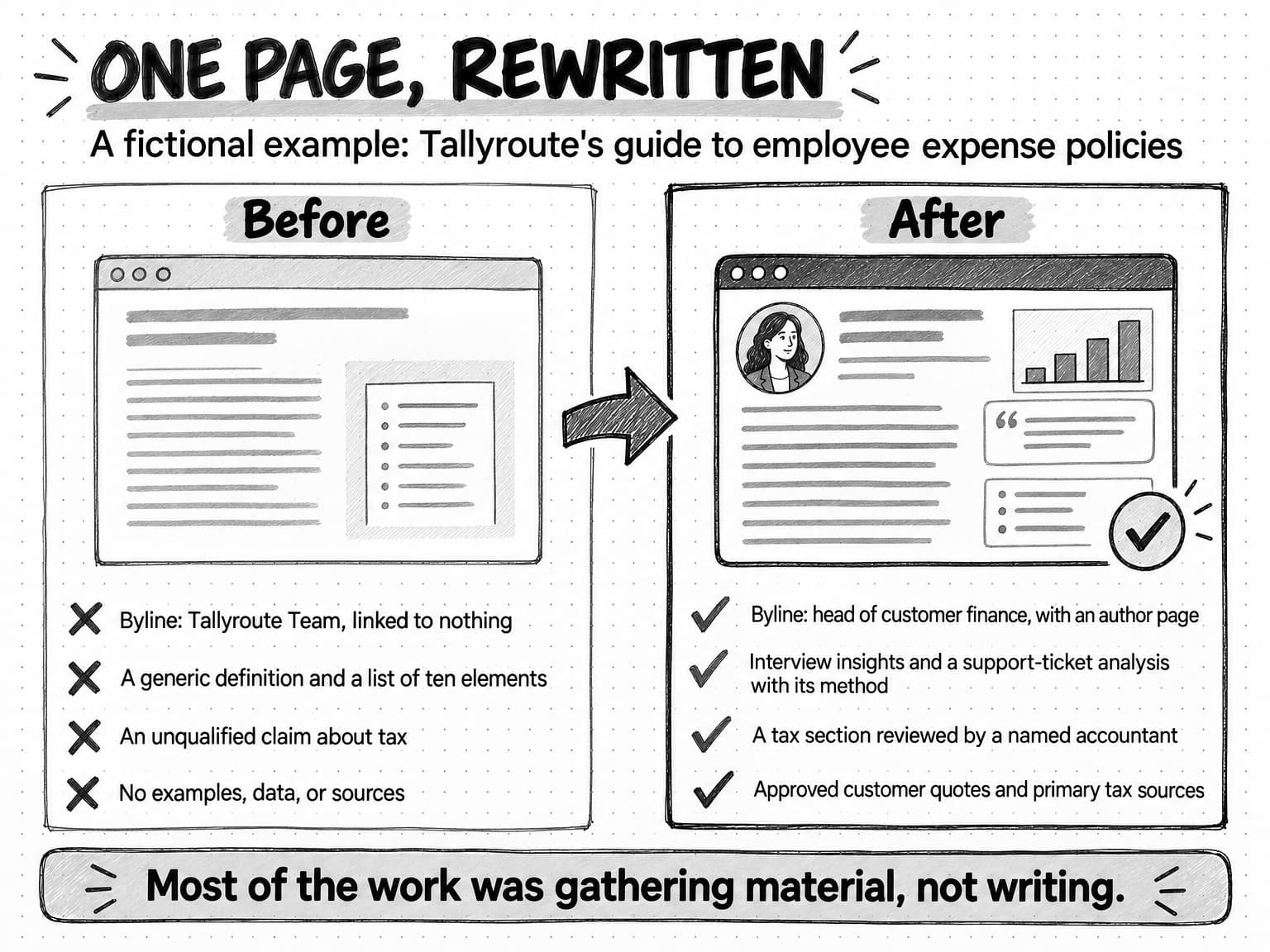
View the before-and-after rewrite at full size (opens in a new tab).
Common E-E-A-T mistakes
Most E-E-A-T mistakes come from treating the framework as a set of signals to display rather than qualities to have.
Bios as decoration. A bio box that says "Jordan is a content marketer passionate about growth" adds nothing a reader can check. A useful bio says what the person does and has done that is relevant to this page, in one or two sentences, and links to evidence.
Borrowed authority. An "expert reviewed" label on pages no expert read, or a famous advisor's name on content they never saw, is deceptive. Use a reviewer only if the review happened, and say what they reviewed.
Generic expertise on specific topics. A brand-level byline on a page about tax treatment or security controls asks the reader to trust the company's marketing team on a subject outside its expertise. Match the named person to the claim.
Freshness theater. Changing the date without changing the content is a warning sign in Google's own list. Update dates when you update substance.
Publishing more pages instead of better ones. A dozen thin pages generated to cover every keyword variation do not build authority. They risk falling under Google's spam policy on scaled content abuse, and they leave you with a library you cannot keep accurate.
Ignoring the pages you are the authority on. Teams spend months on blog bylines while the documentation, pricing, and security pages, where the company is the authoritative source, go stale. Those pages are where accuracy matters most and where AI answers most often quote you about yourself.
How E-E-A-T works with Ampere
Ampere, the AI marketing agent, can do much of the research, drafting, and checking around an E-E-A-T rewrite. The experience and expertise still have to come from your team, your customers, and your data, and a person reviews and publishes the result.
Ampere works from your brand's saved context. Brand memory holds evidence-backed reports about your company, including your products, positioning, voice, voice of customer, social proof, and search landscape, so drafts start from what your company actually offers and says rather than from generic category language. You can correct those reports, and later work uses the corrected version.
For the research side, Ampere can search the web, read and extract published pages, and summarize what the top sources already say on a question, with the sources linked, so you can see what your page needs to add. It can run SEO audits and research gaps in your AI-search visibility. For the drafting side, it can turn interview notes, support-ticket exports, customer quotes you supply, or your own data files into source-grounded article drafts in the session workspace, where you can see the files and sources it used.
Ampere does not have first-hand experience of your product or your customers, and it does not replace a qualified reviewer on a YMYL topic. AI output can be inaccurate or incomplete, and public-web research never covers everything, so a person checks the claims and approves the page. Ampere prepares the work; it does not publish pages or change your website.
Sources and further reading
- Google, Search Quality Rater Guidelines (General Guidelines), September 11, 2025. Section 2.3 (YMYL), section 3.4 (E-E-A-T), section 3.4.1 (experience or expertise on YMYL topics), sections 4.6.5 and 4.6.6 (scaled content abuse and low-effort content).
- Google, Search Quality Rater Guidelines: An Overview, November 2023. How the rating program works and the approximate number of raters.
- Google Search Central, Creating helpful, reliable, people-first content, last updated October 5, 2026. E-E-A-T and ranking, the Who, How, and Why questions, and the main-content attributes raters evaluate.
- Elizabeth Tucker, Our latest update to the quality rater guidelines: E-A-T gets an extra E for Experience, Google Search Central Blog, December 15, 2022.
- Danny Sullivan and Chris Nelson, Google Search's guidance about AI-generated content, Google Search Central Blog, February 8, 2023.
- Google Search Central, Google Search's guidance on using generative AI content on your website, last updated October 1, 2026.
- Google Search Central, Spam policies for Google web search, last updated August 28, 2026. Scaled content abuse.
- Google Search Central Blog, What web creators should know about our March 2024 core update and new spam policies, March 5, 2024.
- Google Search Central, AI features and your website, last updated December 10, 2025. Requirements and best practices for AI Overviews and AI Mode.
- Google Search Central, Article structured data, last updated September 8, 2026. Author markup best practices.
- Google Search Central, Write high quality reviews, last updated December 10, 2025. Evidence of first-hand experience.
- OpenAI, Overview of OpenAI crawlers, read October 14, 2026. OAI-SearchBot and ChatGPT search.
- Pranjal Aggarwal, Vishvak Murahari, Tanmay Rajpurohit, Ashwin Kalyan, Karthik Narasimhan, and Ameet Deshpande, GEO: Generative Engine Optimization, Proceedings of KDD 2024.
Frequently Asked Questions
What does E-E-A-T stand for?
E-E-A-T stands for Experience, Expertise, Authoritativeness, and Trust. Experience is first-hand knowledge of the topic, expertise is the knowledge or skill it requires, and authoritativeness is being a go-to source for it. Trust asks whether the page is accurate, honest, safe, and reliable. Google's rater guidelines call Trust the most important member, and treat the other three as evidence that supports it.
Why is E-E-A-T important for Google?
E-E-A-T matters to Google because it describes the kind of results Google wants to show. Raters use it to judge whether results are trustworthy, and Google uses their ratings to check and improve its ranking systems. Google says E-E-A-T isn't a specific ranking factor, but its systems use a mix of signals to identify content with good E-E-A-T, and give that even more weight on topics affecting health, money, or safety.
What are Google's guidelines for E-E-A-T content?
Google's E-E-A-T guidance is in two places. The Search Quality Rater Guidelines, a public document of about 180 pages, define each element and tell raters how to assess it. Google's page on creating helpful, reliable, people-first content turns the same ideas into self-assessment questions for site owners, including who created the content, how it was made, and why. Reading both shows what Google means by trustworthy content.
Does AI content affect E-E-A-T and SEO?
AI content is not penalized for being AI content. Google says it rewards high-quality content however it is produced, and that using AI gives content no special gains. What hurts is low effort: Google's guidelines rate pages of mostly AI-generated or paraphrased text with little originality or added value as lowest quality. AI-assisted pages meet E-E-A-T when people add real experience, check the facts, and stand behind the result.
What is YMYL in SEO?
YMYL, short for Your Money or Your Life, is Google's term for topics that could significantly affect people's health, financial stability, or safety, or the welfare of society. Google holds YMYL pages to a higher standard of accuracy and expertise. It is a spectrum, and most topics are not YMYL, but B2B content about tax, payroll, security, legal compliance, or health data can be, so it should come from or be reviewed by a qualified person.
How do you improve E-E-A-T on a website?
To improve E-E-A-T, add the evidence readers need rather than badges. Put first-hand experience on the page from the people who do the work, cite primary sources, and publish your own data with its method. Name the accountable author and link to an author page with relevant background. Keep product, pricing, and documentation pages accurate and current, state conflicts of interest, and use qualified reviewers on high-stakes topics.
Is there an E-E-A-T score checker?
No E-E-A-T score exists in Google's systems, so any E-E-A-T score checker measures its own proxies, such as whether a page has a byline, an About page, or author markup. Those checks can be useful reminders, but a page can pass all of them and still be untrustworthy. Use such a tool as a checklist, and judge the page by whether its claims are accurate, sourced, and backed by real experience.
Does E-E-A-T apply to GEO and AI answers?
E-E-A-T is Google's framework, and AI answer products have not published an equivalent. Google says AI Overviews and AI Mode have no extra requirements beyond normal search quality, so the same trust work applies there. For other AI answers, it is reasonable to expect that pages with clear claims, named sources, original information, and clear ownership are easier to cite, though nothing guarantees a citation.