What is thought leadership? And why most content called that isn't
A working definition of B2B thought leadership, a test that separates a point of view from a trend roundup, and a method for finding, evidencing, publishing, and measuring one your buyers will repeat.
43 min readWritten by Ampere
Short answer
What is thought leadership?
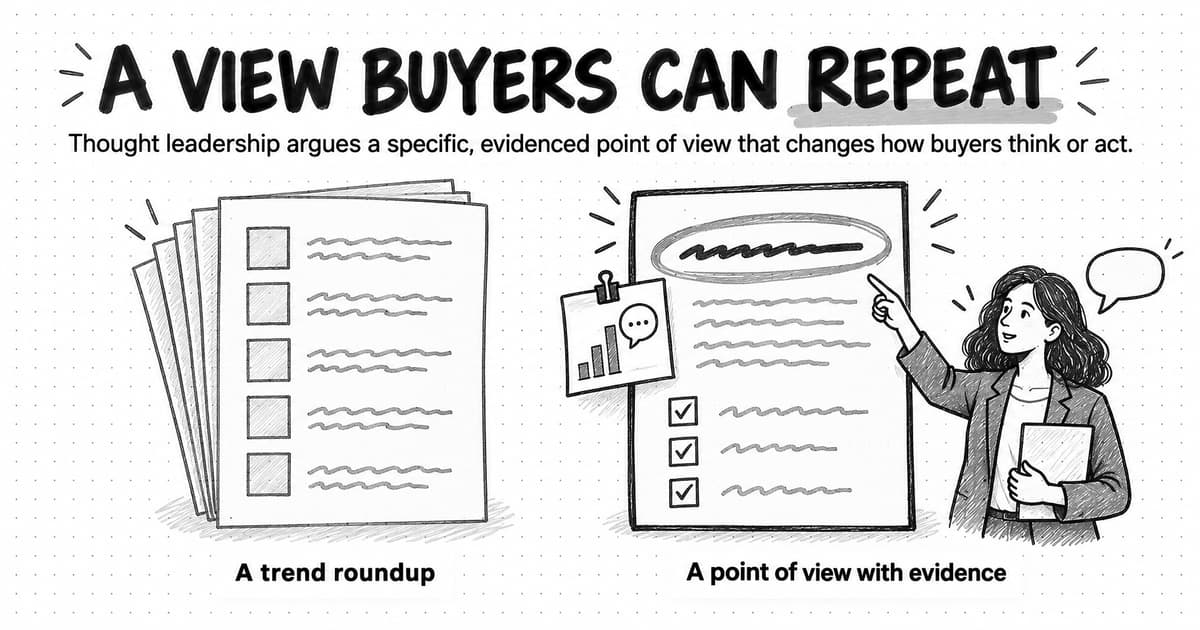
Thought leadership is published work in which a company, or a person in it, argues a specific, evidenced point of view about a problem its buyers face, one that changes how those buyers think or act. The label describes what the work does for the reader, so a trend roundup, a disguised product pitch, or a byline that restates consensus doesn't qualify.
Summary
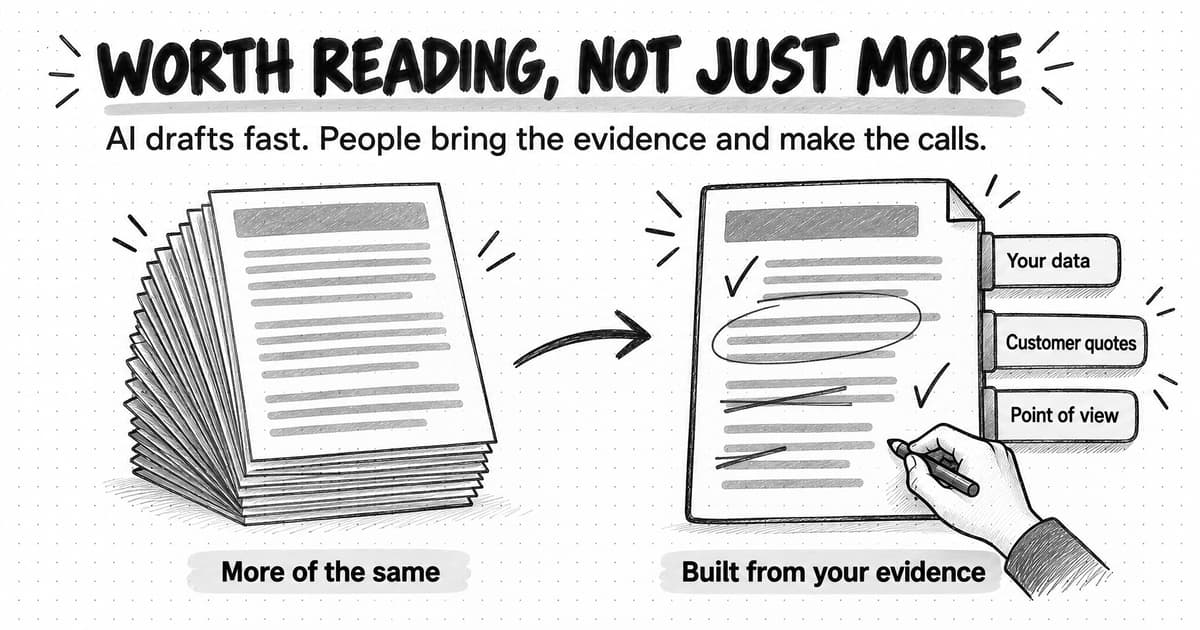
Thought leadership is defined by its effect: published work that argues a specific, evidenced view about a buyer's problem and changes how buyers think or act. Much content filed under the label is trend roundups, disguised product pitches, or senior bylines restating consensus, which is why teams publishing it wait for results that never come.
A five-part test separates a point of view from commentary. Ask whether a claim is specific, contestable, evidenced, useful, and ours, meaning a competitor couldn't publish it under its own logo. Weak claims can usually be repaired by narrowing them, naming the view they oppose, or going back to the evidence.
Points of view come from four sources: your own data, experience repeated across many customers, customer conversations, and a different reading of public market information. Write each candidate as a statement with its conditions and exceptions, argue against it, and test it on customers who might disagree before publishing.
Formats range from a comment to a book, and a claim should earn its way up from cheap tests to expensive formats. Buyers in Edelman and LinkedIn's sponsor-run 2024 survey said they valued original data and preferred subject experts to senior executives, so use expert voices for specific claims and interview-based drafting to help experts publish.
Measure thought leadership in four layers: attention, response quality, adoption of the idea, and commercial influence. Adoption, such as prospects using your framing in calls, best matches the work's purpose. AI can help research, draft from interviews, and challenge an argument, but the point of view and the final judgment belong to people.
Contents
- What thought leadership means
- What buyers say thought leadership does for them
- What thought leadership isn't
- The five-part test for a point of view
- Where a point of view comes from
- How to develop and stress-test a point of view
- The evidence that makes thought leadership credible
- Thought leadership formats, ranked by effort
- Company voice, executive voice, and expert voice
- How to publish and distribute thought leadership
- How to measure thought leadership
- A thought leadership strategy on one page
- Worked example: a fictional accounts-payable software company finds its point of view
- Can AI help with thought leadership?
- Thought leadership with Ampere
- Sources and further reading
- Frequently Asked Questions
Most marketing teams have been asked, at some point, to "do more thought leadership." The request usually turns into a steady stream of trend roundups, predictions for next year, and executive bylines about how fast the industry is changing. The posts go out on schedule and the dashboard fills with impressions, yet when a buyer asks a salesperson what the company believes, the answer sounds like everyone else's.
That gap is the subject of this guide. Thought leadership is published work in which a company, or a person in it, argues a specific, evidenced point of view about a problem its buyers face, one that changes how those buyers think or act. The label describes what the work does for the reader, so a piece earns it by changing someone's mind, and a byline, a format, or a senior author cannot supply that on their own. By that standard, much of what companies file under thought leadership is ordinary content marketing, and some of it is product promotion with an opinion attached.
The guide explains what the term means and what buyers say they want from it, then gives you a five-part test for any claim you are about to publish: is it specific, contestable, evidenced, useful, and ours? It then covers where a point of view comes from, how to test and evidence it, which formats and voices to use, and how to tell whether buyers have adopted the idea, ending with a one-page strategy template and a fictional worked example. It assumes you already have a content strategy; if you don't, start with how to build a content marketing strategy for a B2B company and come back when you are choosing what the company should argue.
What thought leadership means
The Cambridge Dictionary defines thought leadership as "the activity of influencing other people with your ideas and opinions on a particular subject, especially in business," and a thought leader as "an expert on a particular subject whose ideas and opinions influence other people, especially in business." Both definitions put influence at the center. Publishing is how the influence travels, but the measure is whether other people's ideas change.
The phrase took hold in business publishing in the 1990s. Art Kleiner, writing in strategy+business in 2016, credits the magazine's founding editor, Joel Kurtzman, with coining "thought leader" in its first issue. Kurtzman later recalled the magazine's "Thought Leader interviews" with executives, which ran from its early years. The term has since spread far beyond the magazine and loosened as it went. One of the example sentences Cambridge shows, taken from Wikipedia, reads "In the jargon of public relations, they are called thought leaders," which tells you how the word sounds to many readers today.
For a B2B company, a narrower working definition is more useful than the dictionary's. Thought leadership is the part of your content that argues for a way of understanding a problem your buyers have, and backs that argument with evidence your company is unusually well placed to have. It has four parts:
- A problem the buyer cares about. The subject is the buyer's work, not your product. A security vendor writes about how access gets granted and removed, not about its dashboard.
- A point of view. The piece takes a position on that problem that a reasonable person could disagree with.
- Evidence. The position rests on something the reader can inspect: data, documented experience, customer accounts, or a careful reading of public information.
- A change in the reader. After reading, the buyer sees the problem differently, asks a new question, or does something new.
The commercial logic is patient. Peter Weinberg and Jon Lombardo, then heads of research and development at the B2B Institute, LinkedIn's think tank, set out what they called the 95:5 rule in a 2021 Marketing Week column. Drawing on work by Professor John Dawes of the Ehrenberg-Bass Institute, they wrote that only about 5% of B2B buyers are in the market to buy at any given time, and that effective marketing mostly pays off in future buying situations. If that holds for your market, most people who read your thought leadership will not buy this quarter. The work earns its place by shaping how the other 95% understand the problem before they start shopping, so your framing is one they have already met.
Thought leadership vs content marketing
Content marketing is the wider practice of publishing useful material to attract and keep an audience. It includes how-to guides, templates, customer stories, product education, and news. Thought leadership is one kind of content marketing: the kind that argues. A guide to setting up single sign-on is useful content marketing; a piece arguing that most companies should stop treating offboarding as an IT ticket is thought leadership. The content strategy guide calls thought leadership "a substantiated view that changes how an audience understands a consequential problem," and puts it alongside other content types in a portfolio rather than above them.
The distinction matters for planning. A how-to guide succeeds when the reader finishes a task; thought leadership succeeds when the reader thinks about the task differently, which takes longer, is harder to measure, and needs different evidence.
Thought leadership also depends on brand positioning without being the same thing. Positioning decides how you want buyers to understand what you offer compared with the alternatives. Thought leadership argues about the problem itself. The two should point the same way: if your positioning says you are the choice for teams that outgrew spreadsheets, your thought leadership might argue that the spreadsheet stage lasts longer than it should and costs more than teams think.
What buyers say thought leadership does for them
The most cited buyer research on B2B thought leadership comes from an annual survey that Edelman runs with LinkedIn. Two caveats apply before any number. The figures are what respondents say about their own attitudes and behavior, not measurements of what they did, and the sponsors have an interest in the answer: Edelman sells thought leadership services and LinkedIn sells the platform much of it runs on. Read the results as a picture of stated buyer attitudes, not proof of effect.
The 2024 edition, Reaching Beyond the Ready, surveyed nearly 3,500 management-level professionals across seven countries: Australia, Canada, Germany, India, Singapore, the UK, and the US. Edelman reported these findings from that 2024 sample:
- More than three-quarters of respondents said a piece of thought leadership had persuaded them to research a product or service they had not been considering.
- Nearly two-thirds said thought leadership had made them realize their organization was missing significant opportunities.
- Nine in ten said they were more receptive to sales and marketing from companies that consistently produce high-quality thought leadership.
- 70% of C-suite respondents said thought leadership had made them question whether to continue with an existing supplier.
The same report described what buyers count as high quality. Edelman's summary names three attributes: it "cites strong research and data, helps buyers understand their business challenges, and offers concrete guidance." 55% of respondents named strong, original data and research as a key characteristic of the best thought leadership, and 80% said they preferred thought leadership that brings in third-party data and insights. Most respondents also said they preferred analysis of current trends over speculation about the future, and 77% said they would rather hear from deep subject matter experts on specialized topics than from senior executives on high-level issues.
The 2025 edition, Invisible Influence, focused on "hidden buyers": people who shape a purchase without being the visible decision maker. Edelman's report page describes its sample as nearly 2,000 global professionals. The two figures below come from a June 2025 Edelman article by Andrew Mildren, whose methodology note describes the sample differently: 1,934 US business decision makers, surveyed online through LinkedIn in March and April 2025. Edelman's two pages don't reconcile the descriptions, so treat the figures as coming from that US sample. In it, 71% of hidden buyers said they had relatively little interaction with sales. And 91% of hidden buyers said a hallmark of quality thought leadership is that it uncovers challenges or needs the company had not recognized, compared with 81% of more visible decision makers. If those answers reflect how buying works in your market, the people who can block or champion a deal may never meet your sales team, and your published thinking may be the only argument from you they see.
What thought leadership isn't
Edelman's own commentary on the 2024 survey names the problem from the producer's side. Andrew Mildren, writing about those results, put it bluntly: "Thought leadership often becomes a catch all for thinly disguised product marketing or overt company promotion swayed by the views of a few senior executives." Five patterns account for most of the content that carries the label without doing the job.
The trend roundup. "Five trends shaping procurement in 2027" collects observations anyone in the category could make. It may be accurate and well written, but it has no position, so a reader finishes it with nothing to agree or disagree with. A roundup can become thought leadership when it argues that one trend matters more than the others and says why.
The disguised product pitch. The piece describes a problem in exactly the terms that make your feature the answer, then names the feature. The tell is that the argument could not survive without the product; a real point of view would still be worth reading if the reader never bought from you.
The executive byline with nothing to say. A senior leader's name goes on a piece about leadership, culture, or the future of the industry, and the piece says what every other leader in the category has said. Seniority does not create a point of view, and respondents in the 2024 Edelman survey said they would rather hear from subject experts than from senior executives, which suggests readers know it.
Consensus restated. "Customer experience matters." "Security is everyone's responsibility." These statements are true and nobody argues with them, which is the problem. If no reasonable person would disagree, the piece is reminding readers of something they already believe.
Contrarian for show. The opposite failure: "Email is dead" or "Stop doing SEO," written to provoke, with no evidence and no account of when the claim applies. Disagreement is necessary for a point of view but does not make one. Readers who act on a provocative claim and get burned remember who made it.
None of these is useless: a trend summary can be a good newsletter, and product education belongs in your content plan. The trouble is the label. A team that believes it is publishing thought leadership while publishing these waits for an effect that will not come and never builds the argument buyers would remember.
The five-part test for a point of view
Before a claim goes into a post, an article, or a talk, put it through five questions. Each one catches a different failure, and a claim that passes all five is usually worth the effort of publishing well.
1. Is it specific? Could a reader tell which situations the claim covers and which it doesn't? "Onboarding drives retention" covers everything and therefore nothing. "Customers who connect their accounting system in the first week renew at a higher rate than those who don't" names a behavior, a time window, and an outcome. Specificity is what lets a reader apply the idea to their own case. The failure mode is the claim that sounds wise and gives the reader nothing to check against their own experience.
2. Is it contestable? Who would disagree, and what do they believe instead? If you can't name the opposing view, you probably don't have a point of view yet. The opposing view does not have to be foolish; the strongest thought leadership often argues against a sensible default, such as "automate the invoice first," that has stopped fitting the facts. The failure mode is consensus restated.
3. Is it evidenced? What would you show a skeptic? The evidence might be your own data, a pattern across many customer conversations, a documented experiment, or public data read in a new way. It has to be something the reader can inspect or at least understand the source of. The failure mode is the confident claim with nothing behind it, which buyers have learned to discount.
4. Is it useful? What will the reader do differently after reading? A point of view that changes how someone understands a problem should change at least one decision: what they measure, what they ask a vendor, which step they do first. If the honest answer is "nothing, but they'll find it interesting," the piece is commentary. The failure mode is the insight with no consequence.
5. Is it ours? Could a competitor publish the same piece with their logo on it? If so, it isn't your thought leadership, even if it passes the other four tests. "Ours" means the claim comes from something your company knows, has seen, or has done that others in the category have not. This is the test most often skipped, and the one that decides whether thought leadership builds your reputation or the category's.
Use the five questions in a conversation with the person whose view it is. A claim that fails one test can usually be repaired by narrowing it, finding the opposing view, or going back to the evidence. A claim that fails "ours" and can't be repaired should be dropped, however well it reads.
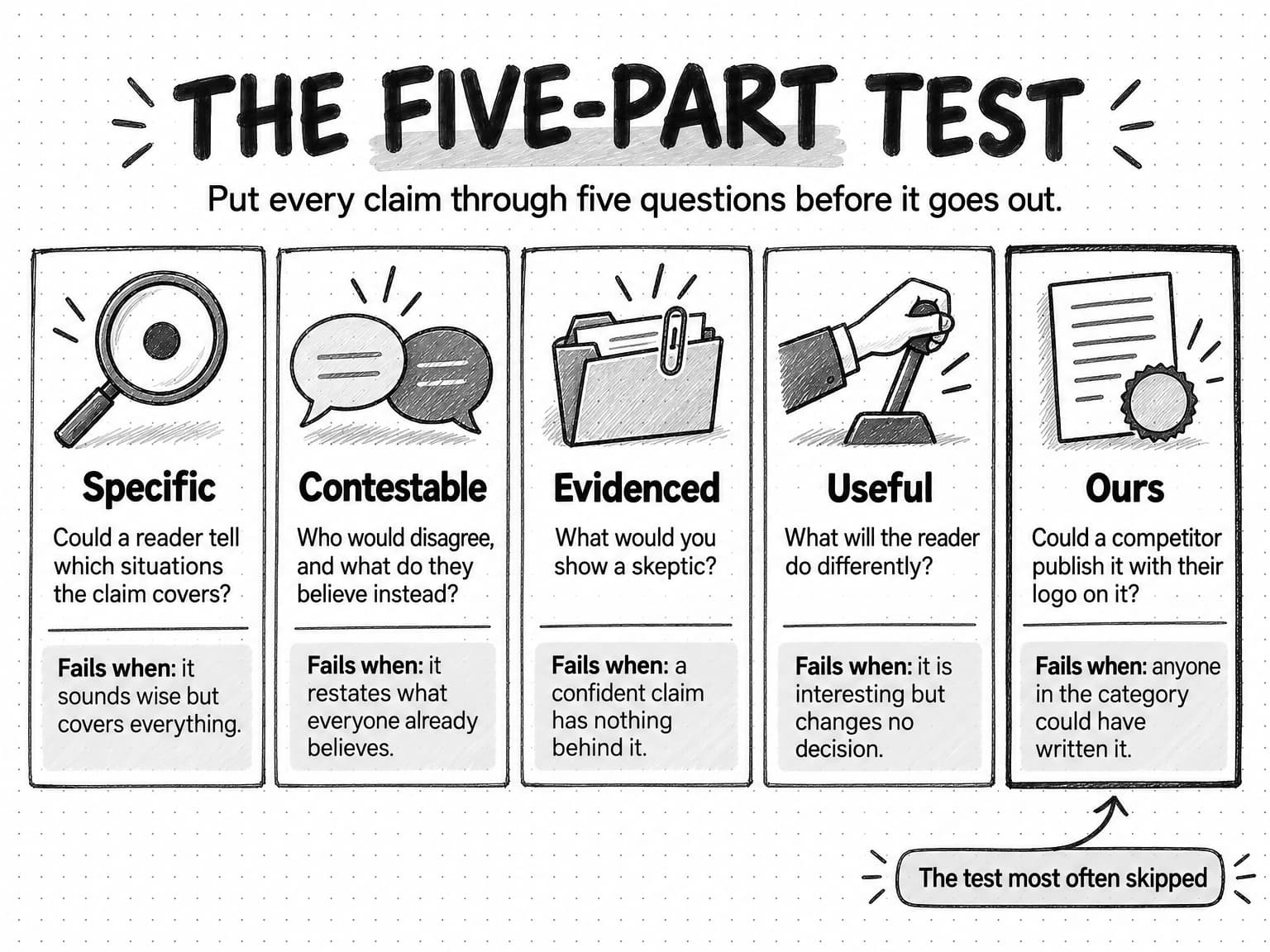
View the five-part test at full size (opens in a new tab).
Before and after: weak claims rewritten
The table shows four illustrative claims of the kind teams often publish, what fails in each, and a rewrite that passes. The rewrites are examples of shape, not findings: the numbers in them are illustrative, and a real version would need the evidence described in the last column.
| Before | What fails | After | What would make it pass |
|---|---|---|---|
| "AI is transforming sales coaching." | Not specific, not contestable, not ours: every vendor could say it. | "Most teams use call recordings to grade reps after the fact; the teams that improve fastest use them to rewrite the discovery questions before the next call." | Patterns from coaching sessions the company has run, with permission, and two customer accounts that show the change. |
| "Security is everyone's responsibility." | Consensus: nobody disagrees, so nobody learns anything. | "Most access risk in mid-sized companies comes from offboarding, not onboarding, because nobody owns the day someone leaves." | Aggregated, anonymized data on stale accounts found during audits, and a clear statement of which company sizes it covers. |
| "Onboarding is the key to retention." | Not specific or useful: it gives the reader no decision to make. | "A shorter onboarding checklist beats a complete one: customers who finish five setup steps in week one stay longer than customers who start fifteen." | Product data on completion and renewal, an honest note on correlation, and the five steps named. |
| "The future of procurement is autonomous." | Contrarian for show and speculative: no evidence, no conditions. | "Procurement teams that automate approvals before they clean up supplier data spend the next year fixing exceptions by hand." | Accounts from implementation teams, a description of the exception types, and the conditions where the claim does not hold. |
In each rewrite the subject moved from the category to a specific decision, an opposing practice appeared, and the claim became something the company would have to back up. The "after" claims can also be wrong, which is what makes them worth reading.
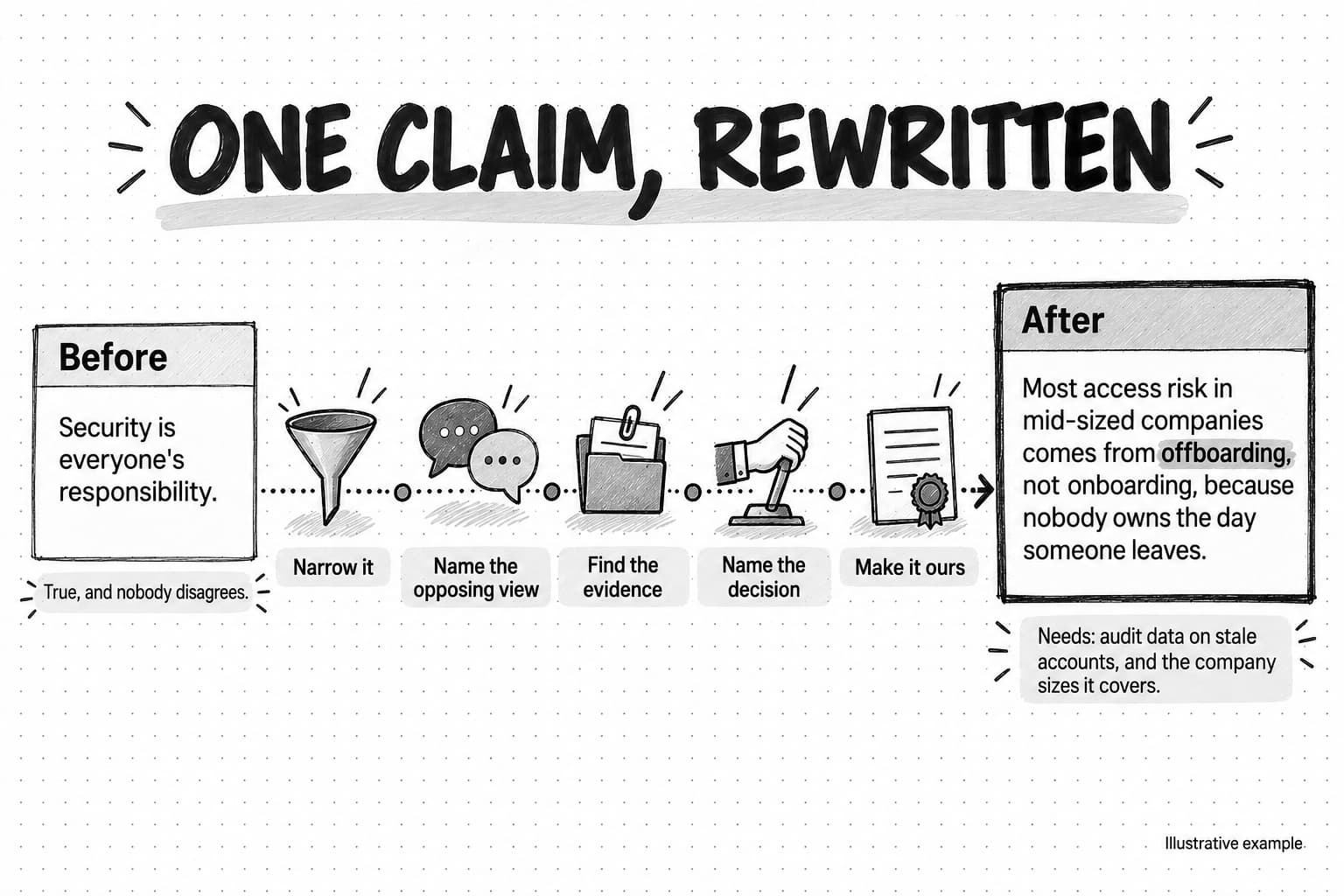
View the claim rewrite at full size (opens in a new tab).
Where a point of view comes from
A point of view does not come from a brainstorm about what to say. It comes from something the company already knows that the market has not absorbed. Four sources produce most good B2B thought leadership, and most strong arguments draw on more than one.
Your data. Product usage, support tickets, implementation records, benchmark data from many customers, or the results of your own experiments. Data is the strongest source because it is hard to copy, and more than half of respondents in the 2024 Edelman survey named strong, original data as a mark of the best thought leadership. It is also the source that needs the most care: you need permission to use customer data, you need to aggregate and anonymize it, and you need to be honest about what it does and doesn't show. A pattern in your customer base may reflect who buys from you rather than how the world works. Running a proper study is a project of its own; the guide to original research content covers how to design, run, and publish one.
Repeated experience. What your team has seen many times across customers, deals, or projects. A head of implementation who has run two hundred rollouts knows which step fails first; a founder who has sold into a category for ten years knows which objection is really about something else. Experience is the most common source of a point of view and the most under-used, because the people who have it rarely write. Your job is to find the pattern they keep describing in meetings and ask whether it holds.
Customer conversations. What buyers say when they describe their problem in their own words: in sales calls, interviews, reviews, support threads, and churn conversations. Voice-of-customer research is the discipline of gathering and interpreting those accounts. For thought leadership, the useful finding is a gap between what customers say and what the category assumes. If the category talks about invoice automation and customers keep describing purchase order problems, there is an argument waiting.
A different reading of the market. Public information that everyone can see but few have read closely: competitor messaging, analyst reports, job postings, regulatory changes, search behavior, public reviews. Market research and competitor analysis can show where the category's shared assumptions are, which tells you where a contrary argument would stand out. This source is the easiest to copy, so it works best combined with one of the other three: a public trend that your own data explains differently.
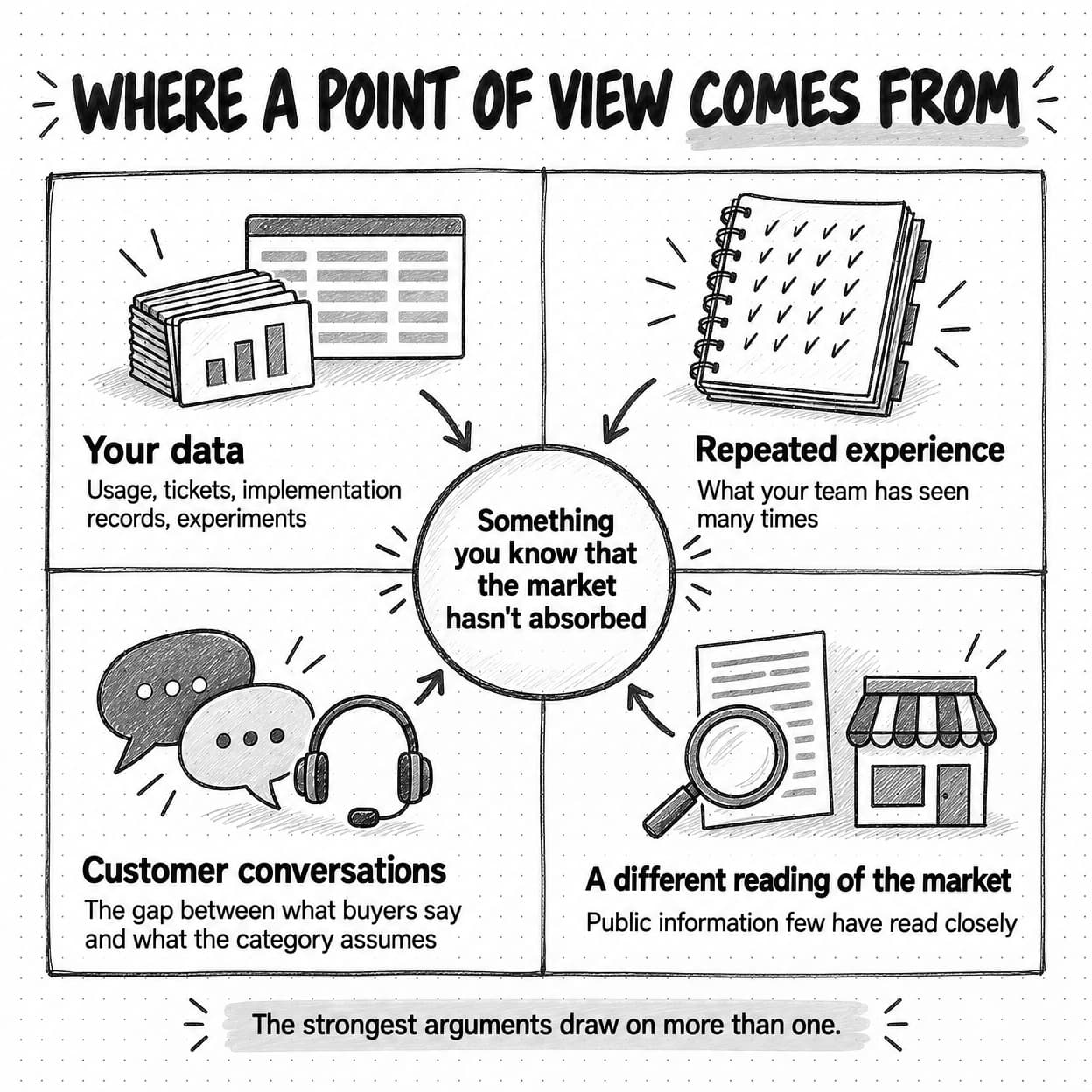
A useful exercise is to ask four people in the company the same question: "What do our customers get wrong about this problem before they work with us?" Ask someone in sales, someone in customer success, a product lead, and the founder. Where their answers overlap, you have a candidate point of view. Where they conflict, you have a question worth investigating before you publish.
How to develop and stress-test a point of view
A candidate point of view is usually a sentence someone said in a meeting. Turning it into something you can publish takes four steps: write it down in a fixed shape, argue against it, test it on people who would disagree, and decide where it stops applying.
Start by writing the view in a statement that forces the parts into the open. The template below is meant to be copied.
If you can't fill a line, that tells you what is missing. An empty "most believe" line means you haven't found the opposing view. An empty "we have seen" line means you have an opinion, not yet a point of view. An empty "does not apply when" line usually means you haven't tested it.
Next, argue against it. Write the strongest version of the opposing view, as its smartest advocate would put it, and list the evidence that would prove your claim wrong. If the opposing view turns out to be stronger, you have avoided a public mistake. If your claim holds only in some situations, you have found your conditions. Readers will raise the objections whether you do or not, so answering them first makes the published version credible.
Then test it on people. Share the statement with three to five customers or practitioners you trust, including at least one you expect to disagree, and ask two questions: "Does this match what you have seen?" and "What would make this wrong for you?" Their answers often supply the best examples for the published piece. If several of them say "that's obvious," the view is not contestable enough. If they all say "that's wrong," look harder at your evidence.
Finally, check it against your positioning and messaging framework. A security company that argues offboarding is the main access risk should sell something that helps with offboarding, or be open that the argument is about the problem rather than its product. When the view and the positioning pull in different directions, the thought leadership starts to look like a disguise.
Expect to end up with fewer points of view than you started with. Most companies can sustain two or three at a time, each argued across many pieces, which buyers remember better than twenty claims argued once each.
The evidence that makes thought leadership credible
The "evidenced" part of the test is where most thought leadership is weakest, partly because teams treat evidence as decoration added at the end. It works better to decide what kind of evidence a claim needs before writing, because the evidence determines what the piece can honestly say. Search engines look for related signals: Google's E-E-A-T guidelines ask its raters to judge a page's experience, expertise, authoritativeness and trust.
| Type of evidence | What it can support | What it can't support |
|---|---|---|
| Your aggregated product or customer data | Patterns in how your customers behave, with the sample described | Claims about the whole market, or about cause without an experiment |
| Original survey | What a defined group says it believes or does, at a point in time | What people actually do, unless the survey measured it |
| Documented experience across many cases | Recurring patterns, failure points, and practical sequences | Precise rates or percentages |
| Customer interviews and accounts | How the problem looks from the inside, in the buyer's words | How common the experience is |
| Public data read in a new way | A different interpretation of facts the reader can check | Anything the source data does not contain |
| Third-party research | Context for your claim, from a source buyers already trust | Your company's distinctive view, on its own |
| A single named example | That the claim can be true in a real case | That it is usually true |
Respondents in the 2024 Edelman survey said they valued both original data and third-party data, and the two do different jobs. Third-party research shows that the problem is real and widely felt; your own evidence shows what you know about it that others don't. A piece with only third-party data is a summary, and a piece with only your data can look self-serving, so use outside research to set the context and your own evidence to make the argument.
Whatever the type, describe it honestly: how many customers, which period, which segment, how you collected it, and what it can't show. Label illustrative numbers as illustrative. A confident percentage with no source looks exactly like a real one until a skeptical reader asks, and AI drafting tools make such numbers easy to produce. The guide to preventing AI hallucinations in marketing covers how to check every figure before it goes out.
Thought leadership formats, ranked by effort
Thought leadership is a quality of the argument, not a format, so the same point of view can appear in a two-line comment or a book. Formats differ in effort, in how much evidence they can carry, and in what they are good for. The table runs from least to most effort.
| Format | Effort | What it needs | Use it to |
|---|---|---|---|
| Comment on someone else's post | Minutes | A specific, informed reaction | Test a view in public and find people who disagree |
| Short social post | An hour or two | One claim and one piece of evidence | Introduce or repeat a point of view; see what resonates |
| Newsletter issue or essay | Half a day to a day | A claim, the reasoning, and two or three examples | Develop an argument at length for people who chose to hear it |
| Framework or method guide | Several days | A repeatable method that follows from the view | Turn the view into something readers use and share |
| Talk, webinar, or podcast | Days of preparation | A clear argument and a speaker who can defend it live | Reach buyers who prefer to listen, and take questions |
| Point-of-view paper or white paper | One to several weeks | A sustained argument with sourced evidence | Give buyers and their colleagues a document to circulate and cite |
| Original research report | One to several months | A study design, data collection, and analysis | Create evidence nobody else has, which others then quote |
| Book | Many months | A body of thinking that holds together at length | Establish a durable position for a person or company |
Start small and move up: a claim that gets no reaction as a post is unlikely to work as a white paper, while a claim that starts arguments in the comments is a candidate for a longer piece.
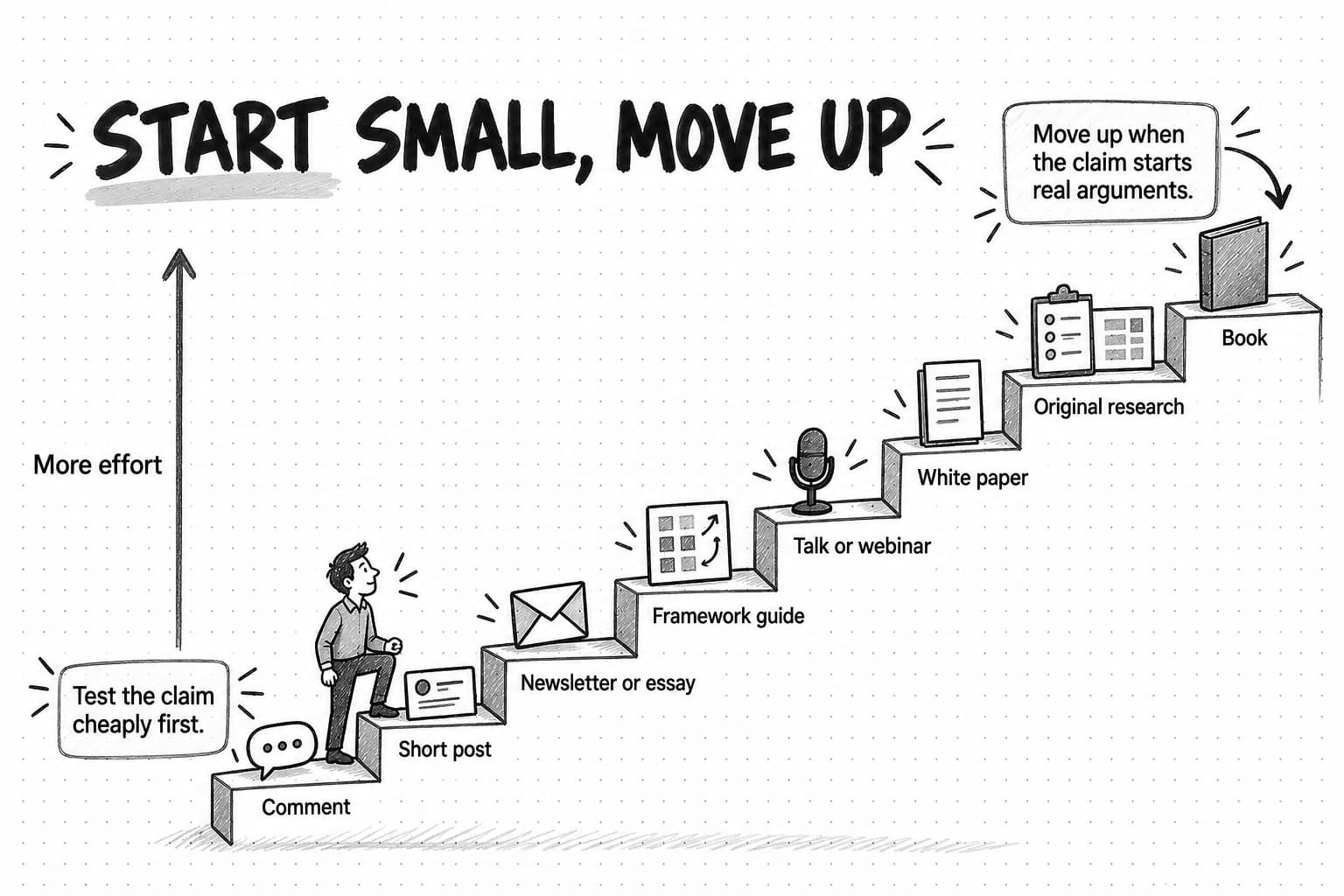
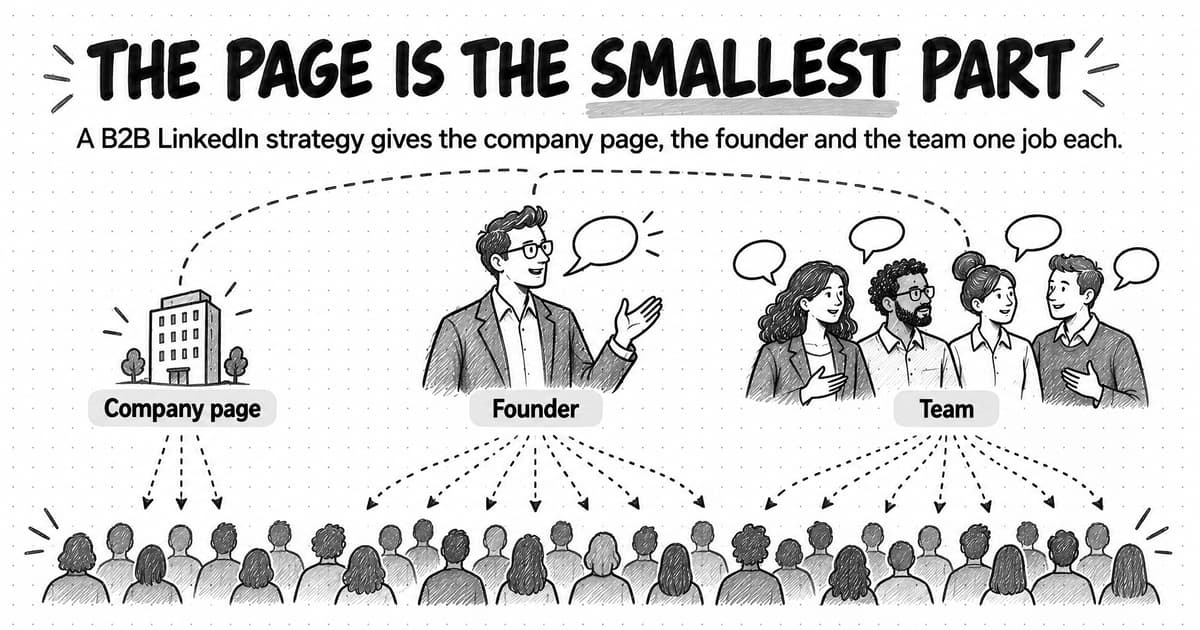
For the long formats, see the sibling guides: what a white paper is and how to write one covers when a white paper is the right format and how to structure one, and the original research guide covers surveys and data studies. For the short formats on the network where most B2B thought leadership circulates, the guide to LinkedIn content strategy for B2B explains how company pages, founders, and team members divide the work.
Company voice, executive voice, and expert voice
Whose name goes on a piece changes how readers receive it. There are three options, and most companies use all three for different jobs.
The company voice publishes under the brand: research reports, white papers, the company blog, the company page. It suits arguments built on company data and claims the whole organization stands behind. It is the most durable voice, because the work stays when people leave, and the least personal. Keep it consistent with your brand voice and resist the hedged committee tone institutional writing slides into.
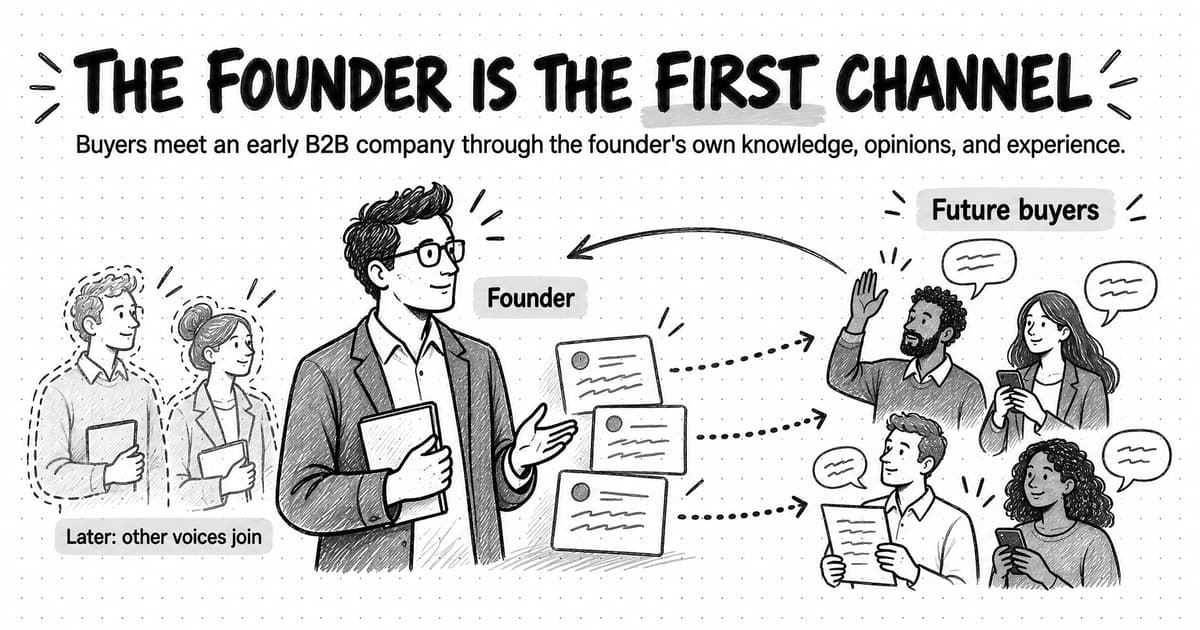
The executive voice publishes under the name of a founder, CEO, or other leader. It suits arguments about the direction of the category, the company's own choices, and lessons from building the business. Readers give an executive's view weight because the executive is accountable for it. The risk is the byline with nothing to say: an executive asked to write about "the future of the industry" will usually produce consensus. It works when the executive argues about something they have decided or seen, in their own words. For founders, the guide to founder-led marketing covers how a founder builds a channel around their own perspective.
The expert voice publishes under the name of the person who knows the subject best: the head of implementation, a security engineer, a senior support lead, a researcher. In Edelman's 2024 survey, 77% of respondents said they would rather hear from deep subject matter experts on specialized topics than from senior executives on high-level issues. That stated preference is a good reason to use this voice more. Experts are often more credible than leaders on specific claims because they are closer to the evidence. The obstacle is time and confidence: most experts don't want to write, and some worry about saying something the company won't stand behind.
Interview-based drafting solves most of that. A writer, or a writer working with an AI tool, interviews the expert for thirty to forty-five minutes using the point-of-view statement as a guide, drafts from the transcript, and sends the draft back for the expert to correct in their own words. The rule that keeps this honest: the person whose name is on the piece must hold the view, must have reviewed and changed the draft, and must be able to defend it in conversation. Ghostwriting that meets that rule is ordinary editorial help; ghostwriting that puts a view in someone's mouth turns a byline into a liability.
A practical split for a smaller company: the company voice carries the research and long documents, the founder carries the category argument, and one or two experts carry the specific claims from their work. All three argue the same two or three points of view, so a buyer hears one consistent argument whichever voice they meet first.
How to publish and distribute thought leadership
Thought leadership that buyers never see changes nothing. Distribution is easier when you treat one argument, not one piece, as the unit of work.
Run one argument across formats. A research finding becomes a report, an article explaining what it means, a set of posts each carrying one finding, a webinar, a slide in the sales deck, and a talk. The content repurposing guide covers how to adapt one source into many formats without diluting it.
Give it to sales and customer success. The people who talk to buyers every day are often the least used distribution channel. Give them the point-of-view statement, the two or three strongest pieces of evidence, and a short version they can say in a conversation. When a salesperson can explain why most companies get a problem wrong, the argument is working where buying decisions happen.
Use paid distribution where it fits. LinkedIn's Thought Leader Ads let a company promote posts from its employees, members, or creators as ads, with the author's permission. As of October 2026, LinkedIn's help documentation says only public text, single-image, video, and article or newsletter posts are eligible; reposts, polls, documents, celebrations, and multi-image posts are not, and the author's profile must show their full name. Promotion can put a strong expert post in front of buyers who don't follow the expert. It cannot make a weak argument strong, so promote the pieces that already started conversations.
Write for search and AI answers too. Buyers also meet arguments in AI-generated answers, not only in feeds. Google's guidance on helpful content asks, among other questions, whether content provides "original information, reporting, research, or analysis" and "insightful analysis or interesting information that is beyond the obvious." Those are the same qualities the five-part test looks for. No one controls whether an AI answer cites a given piece, but you can check. The guide to measuring AI search visibility covers how to check whether AI assistants mention your company and its arguments.
Map pieces to the buying journey. Most thought leadership works early, while buyers define the problem, but a white paper a champion can forward to a skeptical finance lead works late, when a committee compares approaches. The guide to the B2B buyer journey explains the stages; Edelman's 2025 findings add the colleague who never meets sales but reads what the champion shares.
How to measure thought leadership
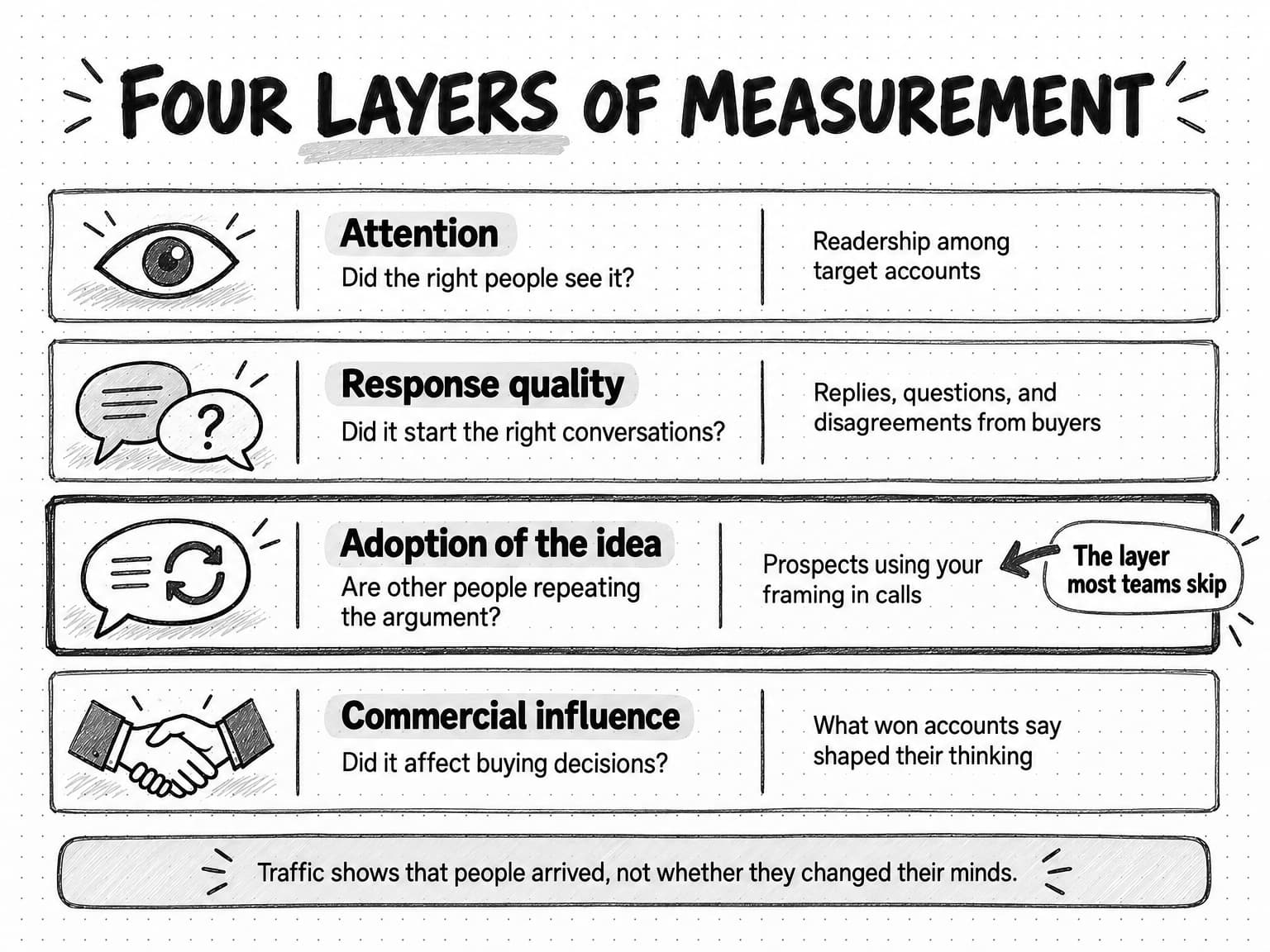
Measurement is where thought leadership programs most often lose their way. In the 2024 Edelman survey, one in five respondents said their company had no process for measuring the effectiveness of its thought leadership, and 42% said their primary measure was increased web and social traffic. Traffic is easy to count, and it tells you that people arrived, not whether they changed their minds.
A more useful approach measures four layers, each answering a different question. No single layer proves the program works; together they give you a reasonable picture.
| Layer | The question | What to look at | What it can't show |
|---|---|---|---|
| Attention | Did the right people see it? | Reach and readership among target accounts and roles, not just totals; time spent; subscriptions | Whether anyone agreed or changed their view |
| Response quality | Did it start the right conversations? | Comments and replies from buyers and practitioners; disagreements; questions; invitations to speak or contribute | How widely the view spread beyond those who responded |
| Adoption of the idea | Are other people repeating the argument? | Prospects using your framing or terms in calls; citations and mentions by others; your argument appearing in AI answers; sales reporting fewer objections on the topic | That the adoption led to revenue |
| Commercial influence | Did it affect buying decisions? | Self-reported attribution ("how did you hear about us?"); content touched by won accounts; deal-stage notes; pipeline from accounts that engaged | Cause, because buyers meet many influences |
The adoption layer is the one most teams skip and the one that best matches what thought leadership is for. If the point of view is that invoice automation fails at the purchase order, the clearest sign of success is a prospect who opens the first call by asking about purchase orders. You can collect that evidence cheaply: add a field to call notes for "framing the prospect used," ask customer success to listen for the argument in renewal conversations, and search the web and AI answers for your terms every quarter.
View the four measurement layers at full size (opens in a new tab).
Measure per argument, not per piece, and give it time: an argument usually needs months of repetition before adoption shows. Ask buyers in onboarding or a win-loss interview which ideas shaped their thinking, and keep a log of notable responses alongside the numbers, because one comment from the right person can tell you more than a month of impressions.
A thought leadership strategy on one page
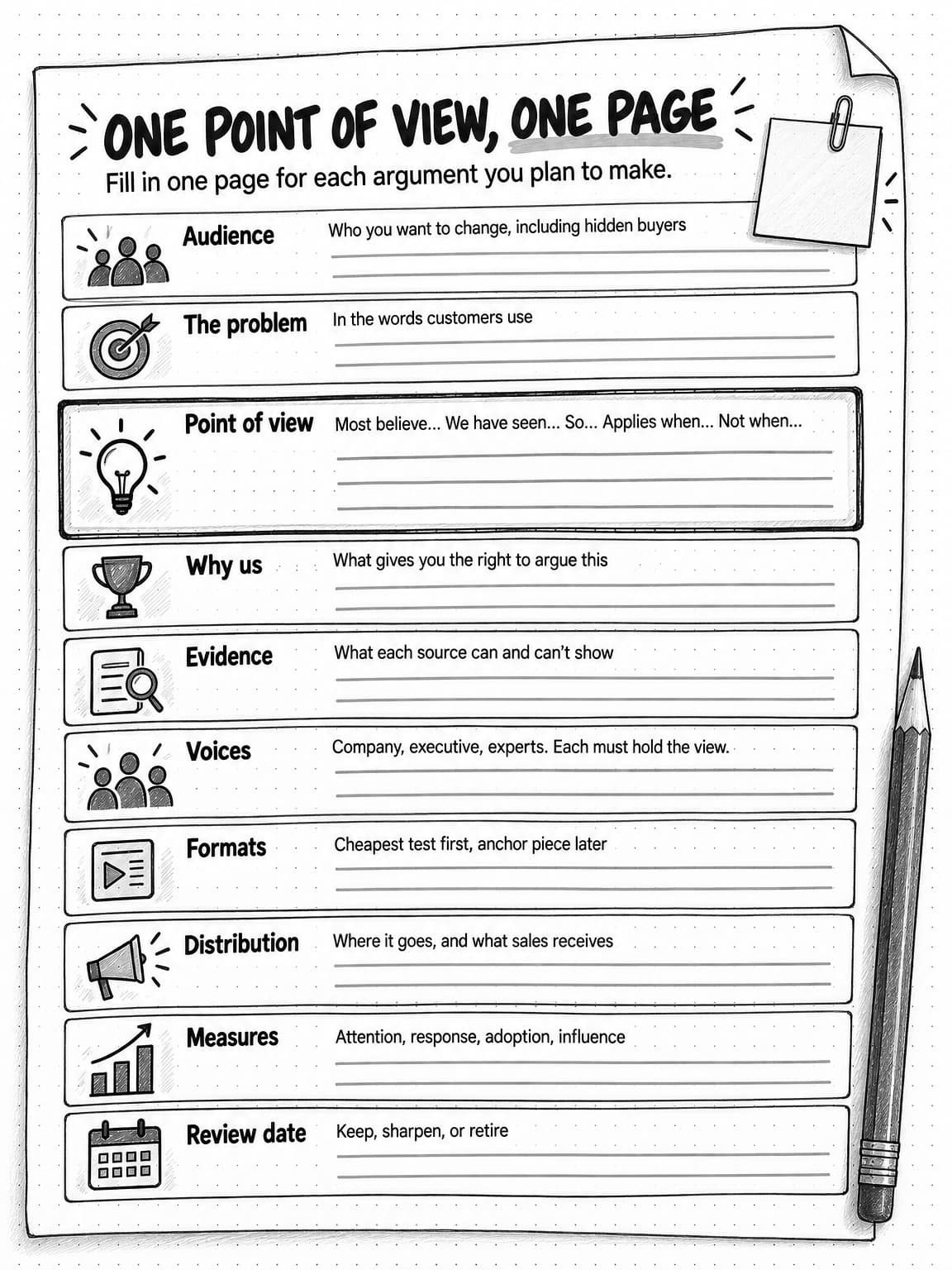
A thought leadership strategy answers a short list of questions: which arguments, for whom, backed by what, in whose voice, in which formats, and judged how. It fits on one page, and keeping it to one page forces the choices that make it work. Copy the template below and fill in each line for each point of view you plan to argue.
| Audience | The buyers and roles you want to change, including the hidden buyers who influence a decision without meeting sales. |
|---|---|
| The problem | The problem in the buyer's work this argument is about, described in the words customers use. |
| Point of view | The full point-of-view statement: what most people believe, what you have seen, what you claim instead, when it applies, and when it does not. |
| Why us | What your company knows, has seen, or has done that gives it the right to make this argument. |
| Evidence | The data, experience, customer accounts, and outside research that support the claim, with what each can and cannot show. |
| Voices | Whose names carry it: the company, which executive, which experts. Each person must hold the view. |
| Formats | The anchor piece and the smaller formats around it, in order, starting with the cheapest test. |
| Distribution | Where each format goes, what sales and customer success receive, and what, if anything, gets paid promotion. |
| Measures | One or two signals for each layer: attention, response quality, adoption of the idea, and commercial influence. |
| Review date | When you will decide whether to keep, sharpen, or retire the argument, usually after one to two quarters. |
Two or three filled-in pages are a complete strategy for most B2B companies. More than that usually means the arguments are too thin or the team will spread itself across too many to repeat any of them enough.
View or save the one-page strategy worksheet at full size (opens in a new tab).
The review date matters because points of view age. The market absorbs a good argument, competitors start repeating it, and what was contestable becomes consensus. That is success, and also the signal to move on: once buyers routinely use your framing, the next argument should build on it.
Worked example: a fictional accounts-payable software company finds its point of view
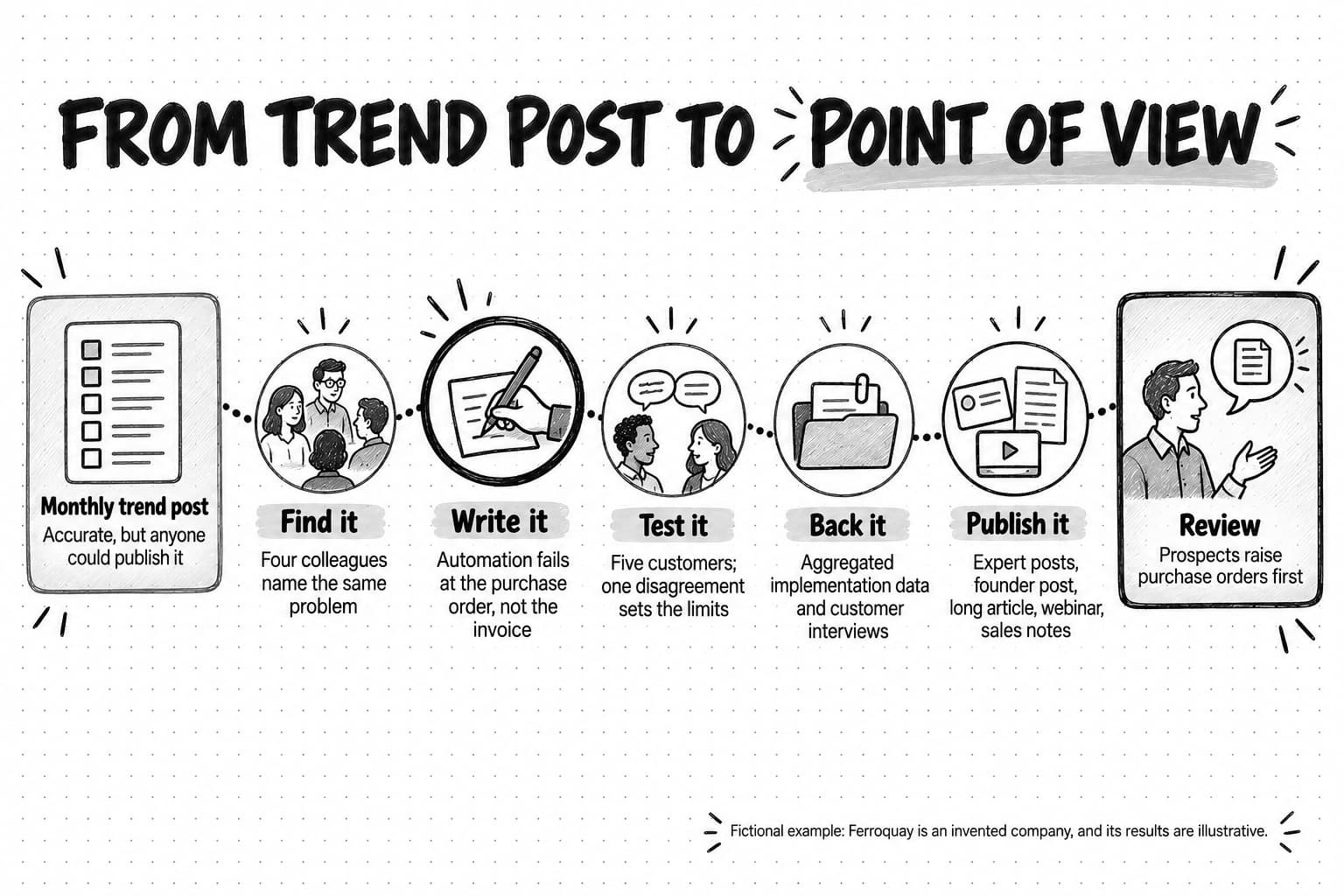
Ferroquay sells accounts-payable software to mid-sized manufacturers. Its marketing team of two had been publishing a monthly post titled along the lines of "5 AP trends for manufacturing finance teams." Each post was accurate, and none was distinctive: three competitors published nearly identical lists, and sales reported that prospects still described Ferroquay as "one of the invoice automation tools."
Finding the point of view. The head of marketing asked four colleagues what customers got wrong before working with Ferroquay. The head of customer operations, who had overseen most implementations, said customers always wanted to start with invoice capture and then spent months fixing invoices that didn't match a purchase order. A sales lead said the same objection came up in late-stage deals: "We tried automation before and it didn't save time." The product lead pointed to support tickets, most of which were about exceptions, not capture. The founder said the category had spent a decade selling faster invoice processing to companies whose real problem was upstream.
The overlap gave the team a candidate claim: invoice automation fails at the purchase order, not at the invoice. They wrote it in the point-of-view statement format.
Testing it. The team argued against the claim: competitors would say capture is the visible bottleneck and that better matching software handles exceptions. They shared the statement with five customers. Three agreed strongly; one said it matched their experience but only after a merger brought in new suppliers; one disagreed, because their business bought mostly without purchase orders. That disagreement became the "does not apply" line.
Gathering evidence. With customer permission, Ferroquay aggregated anonymized implementation data from its customer base and found, in this illustrative case, that invoices without a clean purchase order match accounted for most of the time finance teams spent on exceptions. The team was careful about what the data could show: it described Ferroquay's customers, who skew toward manufacturers already struggling with exceptions, not the whole market. They added twelve customer interviews, used with permission, and one dated outside survey on the cost of invoice exceptions.
Choosing voices and formats. The head of customer operations became the main voice, because the claim came from her work and buyers would trust her on implementation details. The founder carried the broader argument about where the category had gone wrong. The team planned the formats from cheap to expensive:
- Weeks 1–3: the head of customer operations posted three short pieces on LinkedIn, each with one example of a purchase order failure from an implementation, written from interviews with her and edited by her.
- Week 4: the founder posted the category argument and asked finance leaders whether it matched their experience. The replies included two strong disagreements, which became a section of the long article.
- Weeks 5–8: the team published a long article with the full argument, the aggregated data, and a purchase order readiness checklist that finance teams could use before choosing any automation tool, including a competitor's.
- Week 10: a webinar where the head of customer operations and a controller from a customer company walked through a cleanup project.
- Throughout: sales received the point-of-view statement, three evidence points, and a two-sentence version for first calls.
View the worked example path at full size (opens in a new tab).
Measuring it. At the 90-day review, the team looked at the four layers. Attention: readership among target accounts had grown, though total traffic was similar to the trend posts. Response quality: the posts drew detailed replies from controllers and AP managers, including questions the team had not considered. Adoption: in this illustrative case, sales logged several first calls where the prospect raised purchase orders before the rep did, and two prospects mentioned the checklist by name. Commercial influence: too early to judge, but two late-stage deals that had stalled on the "automation didn't save time" objection moved forward after the champion shared the article internally.
The team kept the argument for another two quarters, planned a short research report on exception rates, and retired the monthly trend post, which had taken as long to produce and had never come up in a sales call.
Can AI help with thought leadership?
AI can help with most of the work around thought leadership. It cannot supply the point of view, and the attempts to make it do so produce the patterns this guide started with.
The work AI does well is the research, the drafting, and the stress-testing. It can gather public material on a topic, read competitor messaging and reviews to show the category's shared assumptions, and turn an expert interview transcript into a first draft the expert can correct. It can play the opposing side: given a point-of-view statement, it can write the strongest counterargument, list the evidence that would disprove the claim, and point out where the draft overstates the data. Once the argument exists, it can adapt it into many formats. None of this changes whose view it is.
The work AI does badly is the part that makes thought leadership distinctive. A general-purpose model is trained on what has already been published, so asking it for a point of view about your category tends to return a fluent version of the consensus. A 2024 experiment by Anil Doshi and Oliver Hauser, published in Science Advances, illustrates the effect: writers given AI-generated ideas produced stories that evaluators rated as more creative and better written, especially among less creative writers, but the AI-assisted stories were more similar to one another than stories written without help. For an individual piece, AI can raise the floor. For a category in which every company uses the same tools to generate its opinions, it narrows the range of what gets said.
Google's helpful-content guidance makes a related point from the search side: it describes "using generative AI to produce large amounts of text without manual oversight or curation" as an example of little to no effort. Thought leadership produced that way fails the "ours" test by construction. The guide to AI slop covers how to recognize and avoid low-value AI content more generally, and the guide to AI content creation covers how to set up an AI-assisted content workflow.
The division of labor that works: people own the claim, the evidence, and the final judgment, and AI helps find evidence, draft from what people said, challenge the argument, and adapt it. Check every fact and figure in an AI-assisted draft against its source before it goes out.
Thought leadership with Ampere
Ampere is an AI marketing agent that helps teams with the research and drafting around a point of view. The point of view itself comes from your team; Ampere helps you gather evidence, challenge the argument, and prepare drafts for your review.
For research, Ampere can search and extract from the public web, read public reviews on sites such as G2, Trustpilot, and TrustRadius, pull from ad libraries and social and creator data, and analyze how AI search tools answer questions in your category. That is the material for the "different reading of the market" source: where competitors all make the same claim, what customers complain about in public, and how AI assistants answer the questions buyers put to them. Public sources are never complete, so treat the results as evidence to weigh, not a full picture of the market. Scheduled tasks can rerun that research regularly, and Monitoring can check competitor pages for changes, which can show you when a competitor starts arguing your point.
Brand memory keeps the context an argument needs. Ampere can produce editable positioning, voice, voice-of-customer, competitor, category landscape, search landscape, and trend snapshot reports, each showing its sources, and you correct what it got wrong. Later drafts start from the approved versions, which helps keep a point of view consistent with your positioning.
For drafting, Ampere can prepare research reports and whitepapers, and LinkedIn text post, poll, and newsletter packages with review notes and claim checks, so unsupported figures surface during review. The carousel skill works from source material you share, including video and audio links, which suits turning an expert interview or a webinar recording into posts. YouTube Transcript and Video Analyzer can help you work from recorded talks, such as a public YouTube video, and their output needs review like any other.
Ampere's output can be inaccurate or incomplete. You review every draft, check every claim, and decide what to publish and where; Ampere doesn't publish for you.
Sources and further reading
- Cambridge Dictionary, thought leadership and thought leader.
- Art Kleiner, Remembering Joel Kurtzman, strategy+business (April 10, 2016), on the origin of the term "thought leader."
- Joel Kurtzman, Looking Back With Prescience, strategy+business (November 3, 2015), on the magazine's founding and its Thought Leader interviews.
- Edelman and LinkedIn, 2024 B2B Thought Leadership Impact Report (February 2024), survey of nearly 3,500 management-level professionals in seven countries, and the report one-pager. Sponsor-produced research.
- Andrew Mildren, Misaligned and Misunderstood: Proving the Value of Thought Leadership, Edelman (February 28, 2024).
- Tim Weber, Using buzzwords does not replace thought leadership, Edelman (June 25, 2024).
- David Bersoff, Sailing Your Thought Leader-SHIP Into International Waters, Edelman (March 19, 2024), country-level results from the 2024 survey.
- Edelman and LinkedIn, 2025 B2B Thought Leadership Impact Report (2025), on hidden buyers. Sponsor-produced research.
- Andrew Mildren, The Battle for B2B Influence is Won Before Sales Walks In, Edelman (June 26, 2025), including the methodology note for the 2025 survey of 1,934 US business decision makers.
- Peter Weinberg and Jon Lombardo, The 95:5 rule is the new 60:40 rule, Marketing Week (September 2, 2021).
- Google Search Central, Creating helpful, reliable, people-first content (last updated October 2026).
- Anil R. Doshi and Oliver P. Hauser, Generative AI enhances individual creativity but reduces the collective diversity of novel content, Science Advances (July 2024).
- LinkedIn Help, Thought Leader Ads, checked October 2026.
Frequently Asked Questions
What is a good example of thought leadership?
A good example of thought leadership is a piece that argues a specific claim, names the view it disagrees with, and backs the claim with evidence the company is well placed to have. An accounts-payable vendor arguing that automation fails at the purchase order, not the invoice, and showing aggregated implementation data and a readiness checklist, is thought leadership. A list of five trends in finance technology is not, however well written, because a competitor could publish the same list.
How long should a thought leadership piece be?
A thought leadership piece should be as long as the argument and its evidence need, and no longer. A social post can carry one claim and one example in a few short paragraphs. An article that states a view, answers the strongest objection, and shows the evidence usually runs to a couple of thousand words. White papers and research reports run longer because they carry the method and data. Length never substitutes for a point of view.
What is a thought leadership strategy?
A thought leadership strategy is a short plan for which arguments a company will make, to whom, backed by what evidence, in whose voice, through which formats, and judged by which signals. For most B2B companies it covers two or three points of view, each argued across many pieces over one or two quarters. It fits on one page per argument and includes a date to review whether buyers have adopted the idea.
What is the difference between thought leadership and content marketing?
Thought leadership is one kind of content marketing: the kind that argues. Content marketing covers everything a company publishes to attract and keep an audience, including how-to guides, templates, customer stories, and product education. Thought leadership takes a position on a problem the buyer has and tries to change how the buyer understands it. A setup guide succeeds when the reader finishes a task; thought leadership succeeds when the reader thinks about the task differently.
What is the difference between a thought leader and an influencer?
A thought leader is someone whose ideas change how others in a field understand a problem, usually because of expertise and evidence. An influencer is someone whose audience reach can shape what followers notice or buy. The two can overlap, but reach is not the test for thought leadership: a security engineer with a small following whose argument about offboarding gets repeated across the industry is a thought leader, while a large account that repeats consensus is not.
What is another term for thought leadership?
Thought leadership has no exact synonym, and teams use several overlapping terms. Point-of-view content and expert content describe the same idea from different angles. Executive visibility and executive communications cover the publishing a leader does, whether or not it argues anything. Some public relations teams use the word eminence for a firm's reputation for expertise. Whatever the name, the useful question is whether the work argues a specific, evidenced view.
How does thought leadership work on LinkedIn?
Thought leadership on LinkedIn usually runs through people more than company pages, because posts from named experts and founders read as personal views. A company can argue one point of view through a founder, a few experts, and the company page, each with a different job. LinkedIn also lets companies promote eligible posts from employees and other members as Thought Leader Ads, with the author's permission. Promotion extends a strong argument's reach; it does not make a weak one stronger.
Can AI write thought leadership content?
AI can help write thought leadership content, but it cannot supply the point of view that makes it thought leadership. It is useful for gathering research, drafting from an expert interview, writing the strongest counterargument, and adapting one argument into several formats. Asked for an opinion of its own, a general-purpose model tends to return the category consensus. People should own the claim and the evidence, and check every fact in an AI-assisted draft before it goes out.