What is a white paper? How to write one people finish, with a template
What a B2B white paper is, the three common types, a copyable section-by-section template, and the research, length, gating and promotion decisions that decide whether anyone reads it to the end.
43 min readWritten by Ampere
Short answer
What is a white paper?
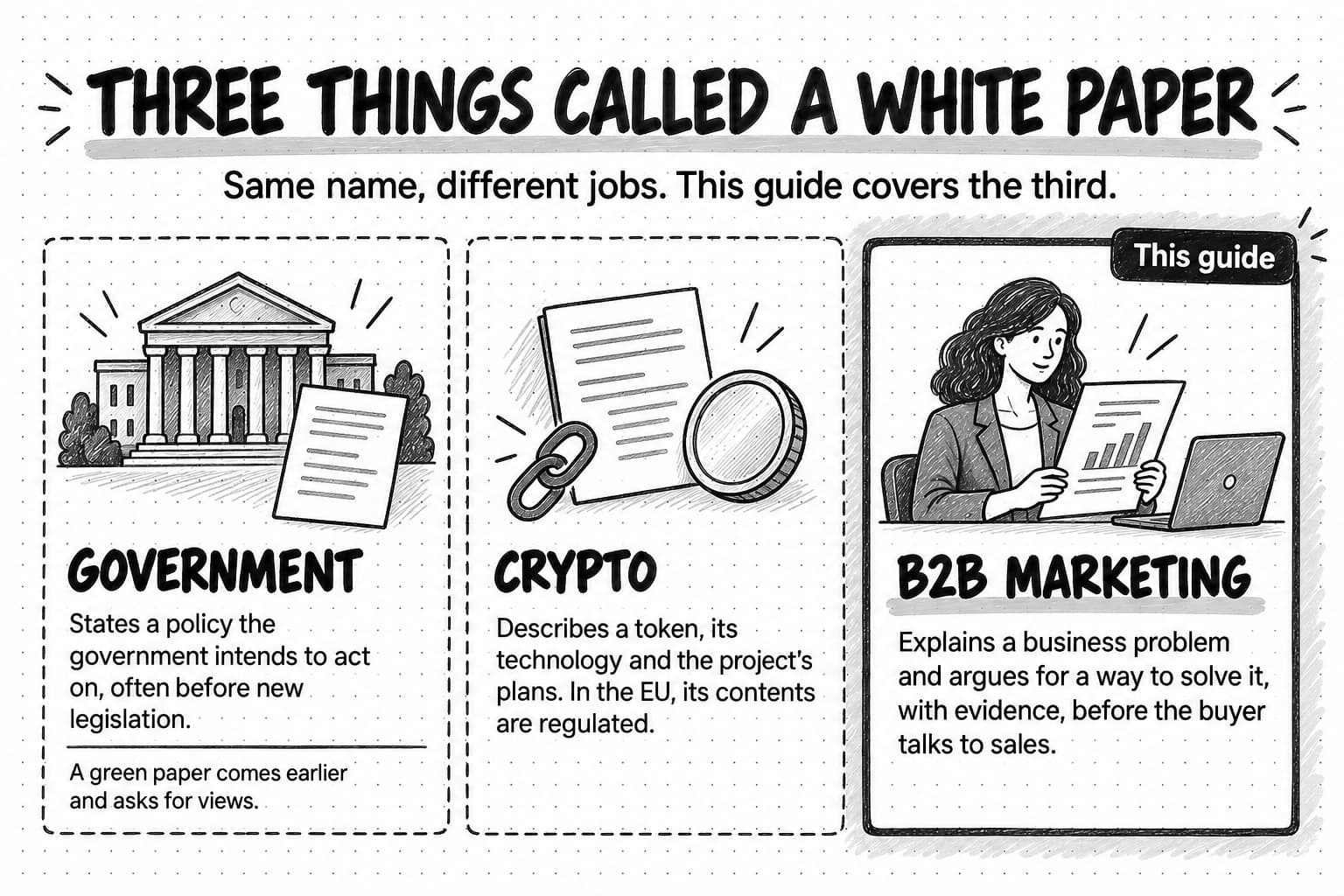
In B2B marketing, a white paper is a long-form, evidence-based document that explains a business problem and argues for a way to solve it, written to help a buyer understand the issue or make a decision before talking to sales. It differs from a government white paper, which states policy, and a crypto white paper, which describes a token and its technology.
Summary
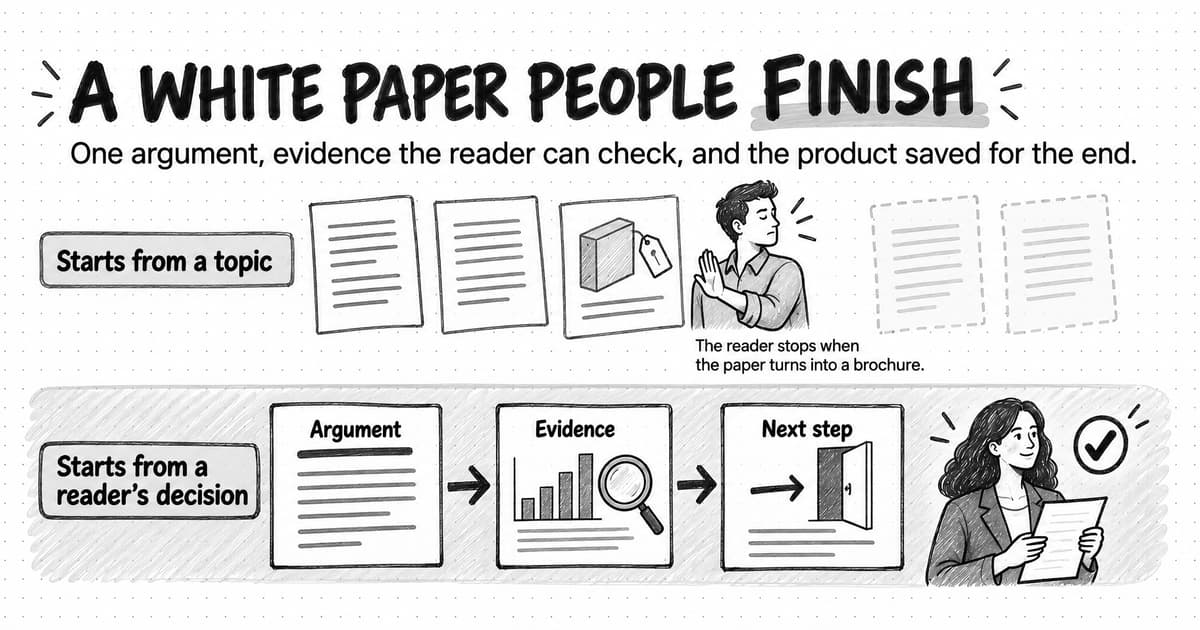
A B2B white paper gets read to the end when it makes one argument a reader could disagree with, backs each claim with evidence the reader can check, and keeps the product to a short section near the end. Weak white papers start from a topic and drift into a brochure; strong ones start from a reader with a decision to make and help with it whether or not the reader buys.
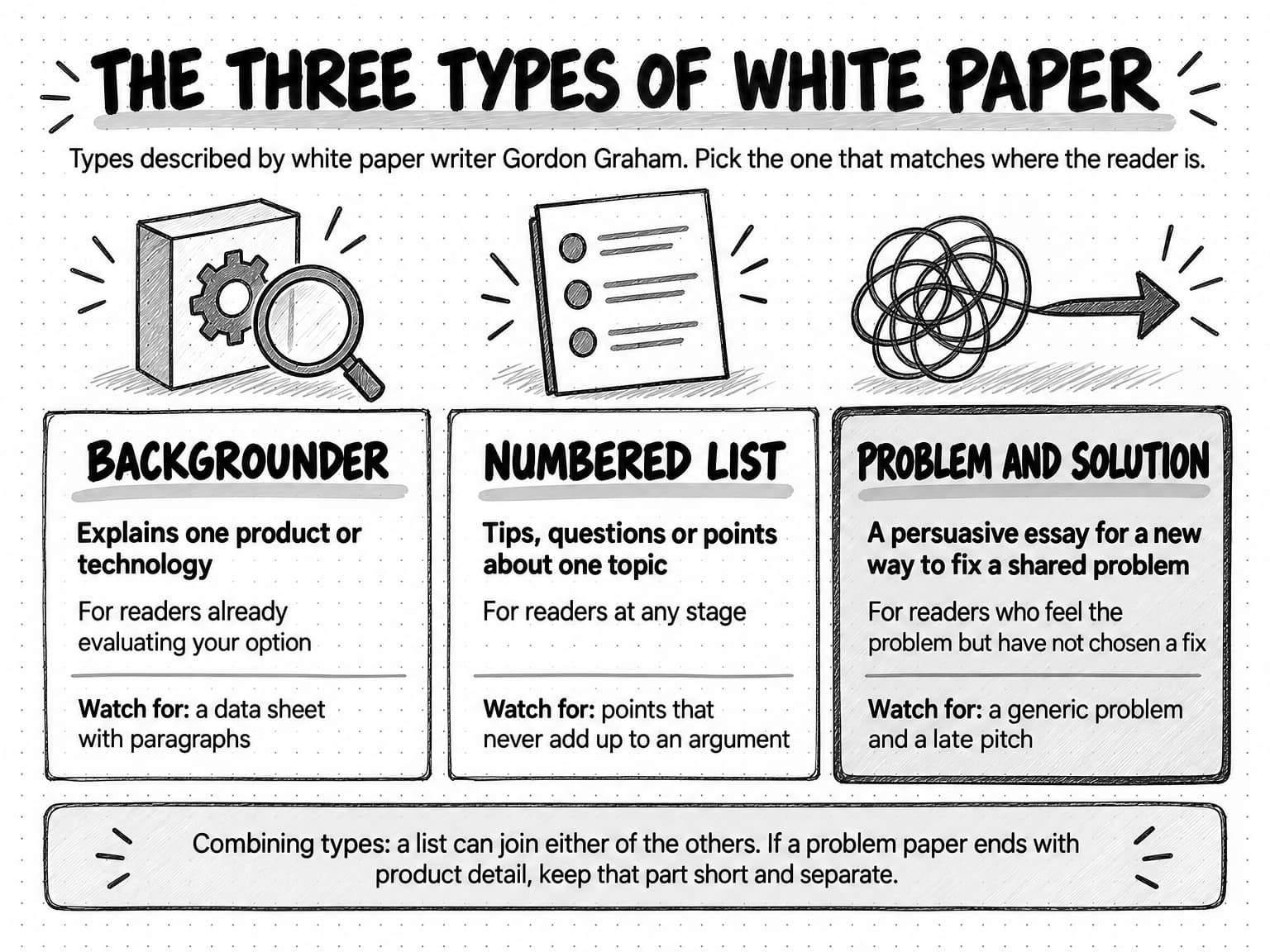
White paper writer Gordon Graham sorts most marketing white papers into three types: the backgrounder, which explains one product to late-stage evaluators; the numbered list, a set of points for any stage; and the problem and solution paper, a persuasive essay for readers who feel a problem but have not chosen a fix. Graham calls the third the toughest to create, because it demands the most proof.
Planning comes before drafting: name the reader, the decision and a one-sentence argument, then list each claim with its evidence, source and checker. A copyable template runs from executive summary through the problem, why it persists, a better approach, evidence and how to apply it, with the company last. A fictional worked example follows one paper from a sales request to launch, including a statistic it dropped because nobody could trace it.
White paper writer Gordon Graham puts most white papers at 6 to 8 pages of main body, about 2,000 to 3,500 words. Publishing the full paper as an ungated web page with a PDF for printing lets search engines and AI answers find and cite it, which matters because Pew Research Center found people clicked results about half as often when Google showed an AI summary. Gating a companion worksheet keeps lead capture where intent is real.
Promotion and measurement belong in the plan from the start. A launch kit of findings, charts, quotations and a sales email feeds a six-week plan across email, posts, partners, a webinar and sales follow-up. Judge the paper by how far people read, whether sales keeps sending it, its influence on deals and whether others cite it, because download counts show interest in a title, not belief in the argument.
Contents
- What a white paper is, and what it isn't
- The three types of white paper
- When a white paper is the right format
- Start with the reader, the decision and the argument
- Plan the research and evidence
- A section-by-section white paper template
- Worked example: one fictional white paper from request to launch
- How to write a white paper people finish
- How long a white paper should be, and how to design and format it
- Should a white paper be gated?
- How to promote a white paper
- How to measure whether a white paper worked
- Common white paper mistakes and how to fix them
- How white papers work in Ampere
- Sources and further reading
- Frequently Asked Questions
Someone asks you for a white paper. Perhaps sales wants something substantial to send after a first call, perhaps the founder wants the company to look serious in a market full of bigger names, or perhaps a competitor has just released one. The request usually comes with a page count and a deadline, and rarely with an answer to the questions that decide whether the paper will be read: who it is for, what it should convince them of, and what evidence the company has that nobody else does.
The word itself does not help, because it means different things in different places. Search for it and you will find government policy documents, cryptocurrency launch documents and marketing PDFs, all called white papers. This guide is about the third kind. In B2B marketing, a white paper is a long-form, evidence-based document that explains a business problem and argues for a way to solve it, written to help a prospective buyer understand an issue or make a decision before they talk to sales. It educates first. The company that publishes it benefits because the reader comes away trusting its view of the problem, and that only works when the argument holds up without the sales pitch.
Many white papers fail on that point. They promise insight in the title, spend three pages on a problem the reader already knows, and turn into a product brochure halfway through. Readers notice and stop reading. A paper people finish does the opposite: it states its argument early, backs each claim with evidence the reader can check, and saves the company's own role for the end, where it reads as a reasonable next step.
This guide separates the marketing white paper from the government and crypto kinds, explains the three common types and when the format fits, and gives an evidence plan, a copyable template, a fictional worked example, and guidance on length, format, gating and promotion.
What a white paper is, and what it isn't
The name started in government. In British usage, a white paper is a published statement of government policy or strategy, often explaining the reasons for planned legislation, while a green paper is an earlier consultation document that sets out options and asks for views. A government white paper announces a position the government intends to act on.
Cryptocurrency borrowed the name for a different job. On October 31, 2008, Satoshi Nakamoto sent a message titled "Bitcoin P2P e-cash paper" to a cryptography mailing list, linking to a nine-page technical paper, "Bitcoin: A Peer-to-Peer Electronic Cash System." It became known as the Bitcoin white paper, and crypto projects now commonly launch with a white paper describing the technology, the token and the plans for it. In the European Union this is now a regulated disclosure: the Markets in Crypto-Assets Regulation (Regulation (EU) 2023/1114) sets out what a crypto-asset white paper must contain and requires that the information be "fair, clear and not misleading." A crypto white paper is closer to a disclosure document than to marketing content.
The B2B marketing white paper took the name, and some of the authority that came with it, from the government sense. It is a persuasive document, but it persuades the way a good analyst does: by defining a problem precisely, showing evidence about its causes and costs, and arguing for an approach. Gordon Graham, a white paper writer who publishes as That White Paper Guy and wrote White Papers For Dummies (Wiley, 2013), lists six standards for one. It is built from narrative text; it runs at least five pages in portrait format; it provides educational, practical and useful content rather than a sales pitch; it relies on well-researched facts, not just opinions; it is used before a sale, not after; and it includes an introduction or executive summary. Those standards are one practitioner's view, not a formal definition, but they describe what readers expect when they open something called a white paper.
View the three meanings of white paper at full size (opens in a new tab).
The term overlaps with several other formats, and each sets different expectations for the reader.
| Format | What it does | How it differs from a white paper |
|---|---|---|
| White paper | Explains a business problem and argues for an approach, with evidence | The benchmark: an argument a buyer can use to understand a problem or make a decision |
| Research report | Presents findings from a study, survey or data analysis | Leads with what was found; a white paper can use research as one piece of evidence for its argument |
| Ebook | Teaches a broad topic in a visual, skimmable layout | Usually lighter on argument and evidence, heavier on design and breadth |
| Case study | Tells one customer's story, with the problem, the work and the result | Proof from one situation; a white paper argues about the problem in general |
| Blog post or guide | Answers one question on a web page | Shorter, narrower and usually open to everyone; a white paper carries a sustained argument across several sections |
| Solution brief or data sheet | Describes a product's features and specifications | Product-first sales material; a white paper that reads like one has become a brochure |
In practice the labels blur: a market report with an argued conclusion can do a white paper's job, and many companies call their ebooks white papers. What matters is the promise. A white paper promises that the argument is grounded in evidence and that the reader will understand the problem better by the end, whether or not they buy. If the main job is to share new findings, a research report is the better label. If you need one customer's proof, see the guide to writing a B2B case study sales will actually send.
The three types of white paper
Gordon Graham describes three main types, which he calls flavors and compares to vanilla, strawberry and chocolate ice cream. He published the scheme on his site in 2012 and developed it in White Papers For Dummies. In the post, he says he used to agree with experts who listed eight or ten types, until working on 323 white papers convinced him there were only three main ones. Other writing on white papers often repeats these three types; credit them to Graham when you use them.
The backgrounder explains the features and benefits of one product, service or technology. In Graham's words, it "details the features and benefits of a specific product or service." He places it at the end of the buyer's journey, when a prospect already knows the problem and is evaluating a specific option, and he notes that it suits product launches, where it sits alongside the other launch material covered in our guide to product marketing. A backgrounder is the easiest type to write, because the subject matter already exists in product documentation, and the least likely to attract new readers, because few people search for a detailed explanation of a product they have not heard of.
The numbered list presents tips, questions, mistakes or points about one topic, such as "Seven questions to ask before you replace your freight audit provider." Graham describes it as "a numbered set of tips, questions, answers, or points about a certain topic" and says it can be used anywhere in the journey. It is quick to read and easy to promote, because each item can become a post. Its weakness is that a list can avoid making an argument: seven loosely related tips do not add up to a reason to change anything.
The problem and solution paper is the classic white paper. Graham defines it as "a persuasive essay that uses facts and logic to present a new solution" to a problem many organizations share. It works at the start of the journey, for readers who feel the problem but have not settled on a way to fix it. Graham calls it the toughest type to create, because it "demands a mountain of proof": a precise problem, real evidence and an honest account of the alternatives. When it works, it gives the reader a case for change they can take to colleagues.
The three types can be combined, with one constraint. Graham originally advised that a numbered list could be added to either of the other two, but that a problem and solution paper should not be merged with a backgrounder, because "it's hard to shift from an industry-wide focus on a nagging problem" to a deep dive into one product. In a 2022 post he conceded that the two can work together in practice. A useful working rule follows from his reasoning: if a paper starts with an industry problem and ends with product detail, make the product part short and clearly separate, or move it into a second document for readers who are further along.
| Type | Reader's situation | Main job | Typical sources | Watch for |
|---|---|---|---|---|
| Backgrounder | Evaluating your product or technology | Explain how it works and what it does for them | Product documentation, technical staff, implementation notes | Reading like a data sheet with paragraphs |
| Numbered list | Interested in the topic, at any stage | Give a quick, practical set of points | Practitioner experience, common objections, buyer questions | A list that never adds up to an argument |
| Problem and solution | Feels the problem, has not chosen an approach | Change how the reader sees the problem and its fix | Research, customer evidence, expert interviews, analysis | Generic problems, vague evidence, a late pitch |
View the three types of white paper at full size (opens in a new tab).
When a white paper is the right format
A white paper is expensive. A good one takes weeks of research, writing, expert review and design, and it asks a busy reader for a long, unbroken stretch of attention. That cost is justified when the purchase is complex enough that buyers need a sustained argument, not a quick answer.
The format suits situations like these:
- The problem is misunderstood. Buyers blame the wrong cause, underestimate the cost, or do not know a better approach exists. Changing that view takes more than a blog post.
- Several people have to agree. In an organizational purchase, the person who found the product has to persuade colleagues in finance, operations, IT or legal. Our guide to the B2B buyer journey explains how buying groups bring different questions to the same decision. A white paper gives the internal champion a document to forward that makes the case in their absence.
- The argument depends on evidence. If the case rests on data, analysis or a method the reader needs to trust, the length of a white paper lets you show the evidence instead of asserting the conclusion.
- The company has earned a view. The paper needs something the company knows from its own work, customers or data. Without it, the paper becomes a summary of what everyone else has published. Our guide to thought leadership covers what it takes for a company's view to be worth reading.
It is the wrong format when the purchase is simple, when buyers mainly want to see the product working, when the topic is news that will date within weeks, or when the company has nothing to say beyond what is already in search results. In those cases a demo, a comparison page, a short guide or a case study will do more for less. A useful test is to write the paper's argument in one sentence. If that sentence is something every competitor would also say, such as "data quality matters," the paper is not ready to be written.
White papers remain a common B2B format. In the Content Marketing Institute's survey of B2B marketers, fielded from June to August 2024 with 980 B2B respondents, mostly in North America, 51% said they had used e-books or white papers in the previous 12 months, and 45% named e-books and white papers among the formats that produced their best results, level with research reports. The survey groups e-books and white papers together and measures marketers' own judgment of results, so treat it as a sign that the format is still in wide use. It does not show that a white paper will work for any particular company. Where a white paper sits in your wider plan is a question for your B2B content marketing strategy, which should decide which buyer questions each format answers.
Start with the reader, the decision and the argument
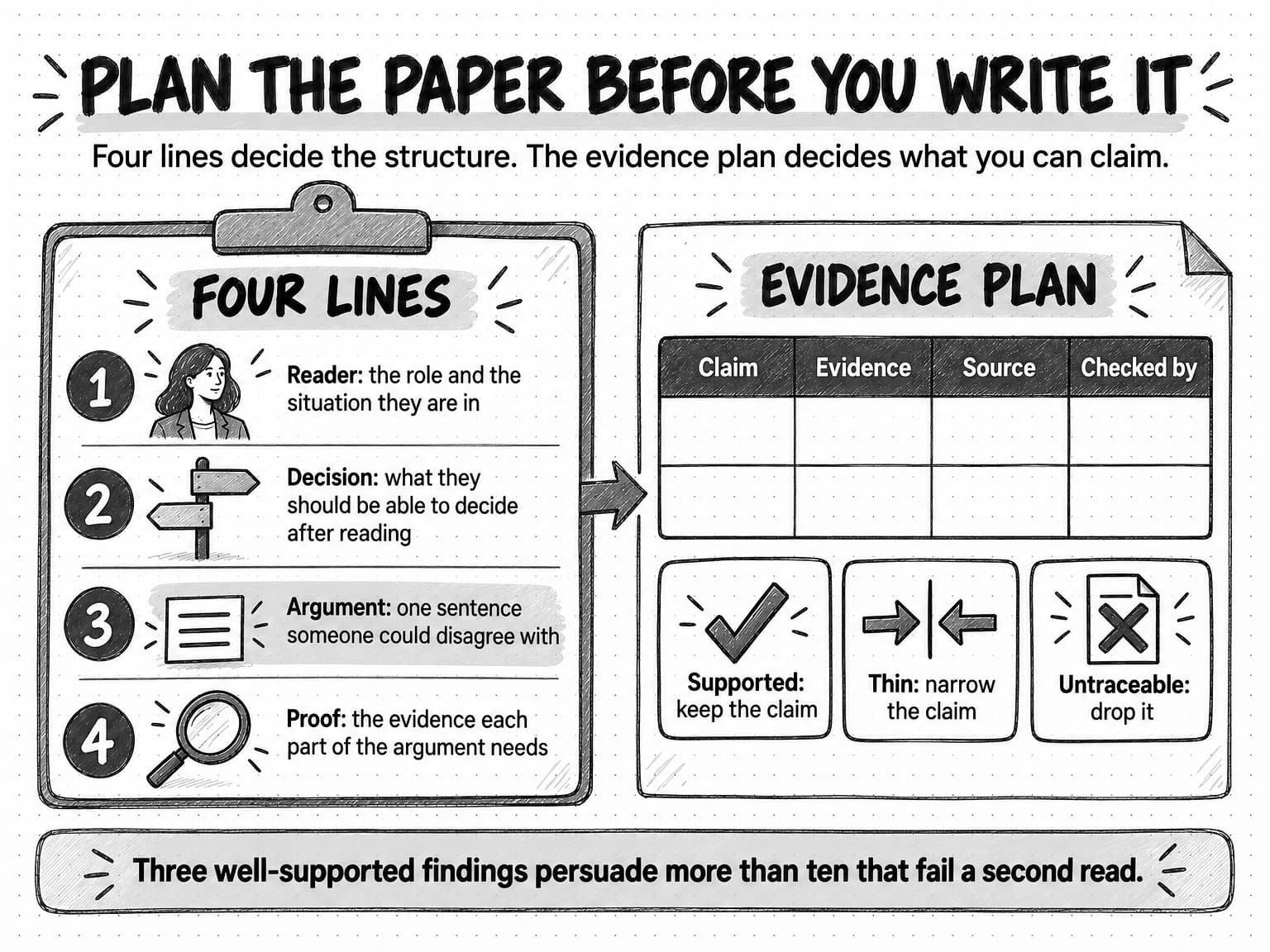
Most weak white papers begin with a topic. Strong ones begin with a reader who has a decision to make. Before outlining anything, write down four things.
The reader. Name the role and the situation, not a demographic. "Operations directors at manufacturers with 200 to 2,000 employees who have just been asked to cut logistics costs" tells the writer which problems to explain and which to skip. A paper for a technical evaluator needs different evidence from one for a finance approver, even on the same subject. If both matter, decide whose question the paper answers first and give the other an appendix or a separate summary.
The decision. State what the reader should be able to decide after reading. It might be whether the problem is worth fixing this year, which approach to take, or what to ask vendors. A paper that helps the reader make a decision gets forwarded, because it is useful inside the buying group whether or not your company wins.
The argument. Write the thesis in one sentence that someone could disagree with. "Most freight overcharges are caught too late to recover, because audits check invoices after payment" is an argument; "Freight audit is important" is a topic. The argument decides the structure: every section either establishes the problem, explains a cause, presents evidence or shows the approach. A section that does none of these is a candidate for cutting.
The proof. List the evidence you have or can get for each part of the argument. This is where many white papers stall, and it is better to find out now than in the third draft. The next section explains how to plan it.
These four lines are also the brief for the writer. Our guide to writing a content brief covers the rest of what a writer needs, including the angle, the sources and what the piece should leave out.
Plan the research and evidence
A white paper's authority comes from its evidence. Readers have learned that a confident tone costs nothing, so they look for numbers they can trace, examples they recognize and reasoning they can follow. Plan the evidence before the writing, claim by claim.
The kinds of evidence a white paper can use
- Your own data. Aggregated, anonymized patterns from your product, service delivery or support work, with the method explained. This is often the strongest evidence a company has, because nobody else can publish it. Check that customers' agreements allow the use and that no single customer can be identified.
- Customer evidence. Interviews, quotations and examples, used with permission and enough context for the reader to judge whether they apply. A quotation that says something specific about the problem is worth more than praise for the product.
- Original research. A survey, benchmark or experiment run for the paper. It takes longer but gives the paper findings nobody else has. Our guide to original research content covers how to design and publish a study; in a white paper, the findings serve as evidence for the argument, and the argument stays the point.
- Third-party research. Studies, official statistics and analyst reports. Use the original source, give its date, sample and method, and say what the number measures. Our guide to market research sets out the questions for judging whether a source is useful and credible.
- Expert input. Interviews with your own specialists, customers' practitioners or outside experts. Experts supply the explanation of why something happens, which data alone rarely provides.
- Worked examples and calculations. A step-by-step example lets the reader test the argument against their own situation. Label hypothetical figures as illustrative, and show the arithmetic.
Build an evidence plan before you draft
List each claim the argument needs, the evidence that would support it, where that evidence will come from, and who will check it. The plan shows you early which claims you can make, which you can make only in a narrower form, and which you will have to drop.
| Claim the argument needs | Evidence that would support it | Source | Status | Checked by |
|---|---|---|---|---|
| The problem is common in this segment | Survey share or aggregated data with sample size | Own data or third-party study | Have / need / not available | Analyst |
| The problem costs more than readers assume | A calculation from typical figures, shown step by step | Customer interviews plus own data | Finance reviewer | |
| The usual fix does not work, and why | Expert explanation and two examples | Interviews | Subject expert | |
| The approach works | Before-and-after results with conditions stated | Customer evidence, with permission | Customer marketing | |
| What it takes to adopt | Steps, time and roles from real projects | Implementation team | Implementation lead |
When the evidence for a claim is thin, narrow the claim instead of inflating the evidence. "In the 40 accounts we reviewed" is a narrower statement than "across the industry," and a reader can trust it. A paper with three well-supported findings is more persuasive than one with ten that do not survive a second read.
View the white paper evidence plan at full size (opens in a new tab).
Use AI for research, and check what it finds
AI research tools can gather published studies, statistics and competitor material quickly, which is useful for the background sections of a white paper. They can also misquote figures, cite pages that do not contain the claim, or present an old number as current. Our guide to how deep research agents work explains a five-step source check, and our guide to preventing AI hallucinations in marketing covers fact-checking a draft. For a white paper, trace every number to its original source and open the page before the number goes into the draft. Desk research also has a ceiling: it can tell you what has been published, but it cannot tell you what your customers experience, so the evidence that makes a paper distinctive usually comes from your own data and conversations.
A section-by-section white paper template
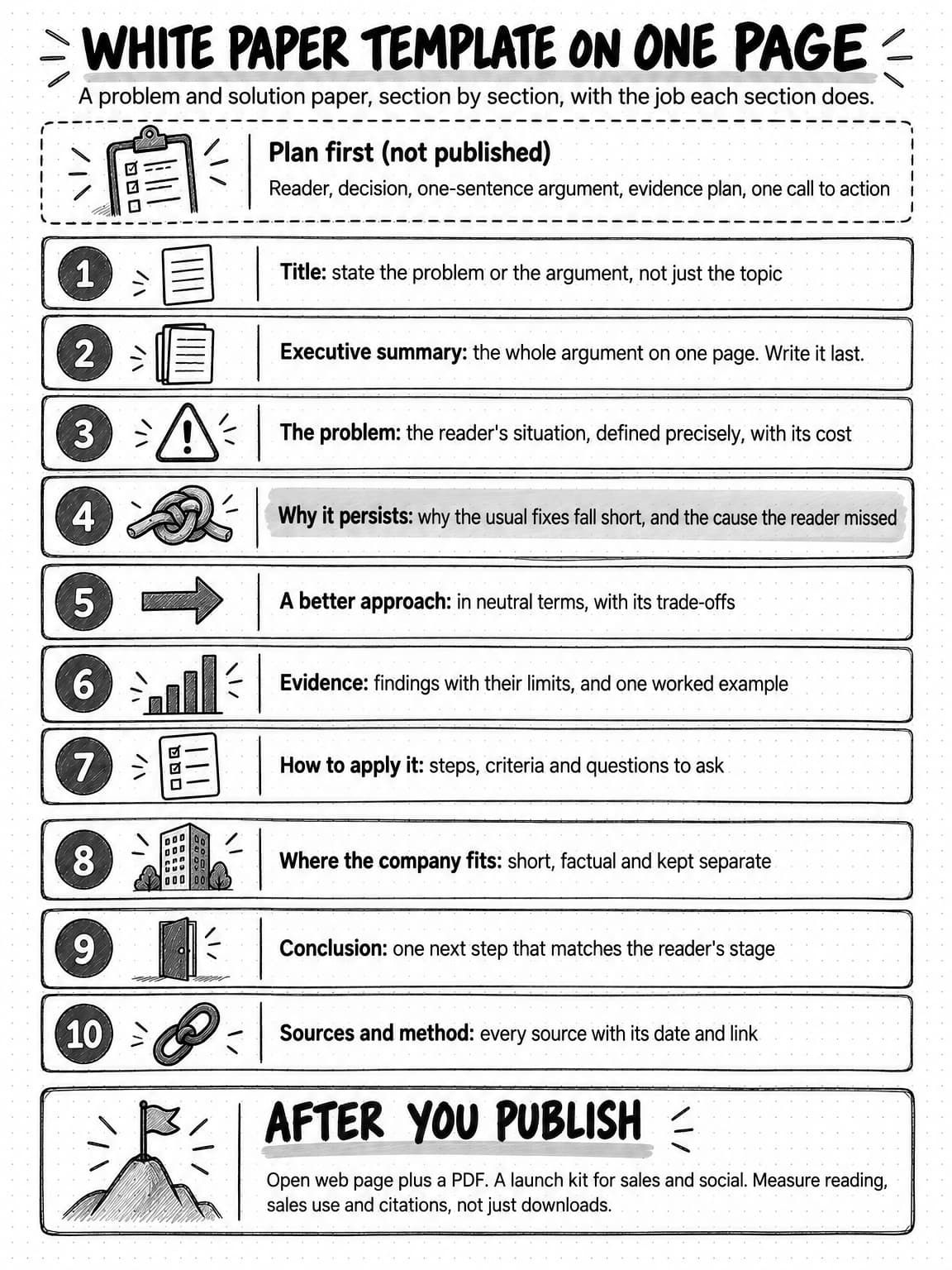
The template below fits a problem and solution paper of about 3,000 to 3,500 words in the main body, the type to choose when readers have not yet settled on how to fix a problem. The word counts are a starting budget for planning, not a rule; the subsection after the template shows how to adapt the template for a backgrounder or a numbered list. Copy it into your document and replace each prompt with your own content.
WHITE PAPER TEMPLATE: PROBLEM AND SOLUTION

0. PLANNING BLOCK (not published)
   Reader: [role + situation]
   Decision the paper helps them make: [...]
   Argument in one sentence: [a claim someone could disagree with]
   Evidence plan: [claim -> evidence -> source -> checked by]
   Call to action: [the one next step for a reader who agrees]

1. TITLE AND SUBTITLE
   Title: state the problem or the argument, not just the topic.
   Subtitle: who it is for and what they will be able to do.

2. EXECUTIVE SUMMARY (200-300 words, one page)
   - The problem in two sentences, with its cost or consequence.
   - Why the usual approach falls short.
   - The approach the paper argues for.
   - The two or three findings that support it.
   - What the reader should do next.
   Write it last. A reader who stops here should know the argument.

3. THE PROBLEM (400-600 words)
   - Describe the situation the reader recognizes, in their words.
   - Define the problem precisely: who has it, when, and how often.
   - Show the cost: money, time, risk or missed opportunity.
   - One piece of evidence the reader can check.

4. WHY THE PROBLEM PERSISTS (400-600 words)
   - The usual explanations and fixes, stated fairly.
   - Why they fall short, with evidence or examples.
   - The cause the reader has missed. This is often the paper's
     most valuable section.

5. A BETTER APPROACH (600-900 words)
   - The approach or principle, stated in vendor-neutral terms.
   - How it addresses the cause from section 4.
   - What it requires: data, people, process, tools, time.
   - Trade-offs and situations where it is not the right choice.

6. EVIDENCE THAT THE APPROACH WORKS (400-600 words)
   - Findings from data, research or customer results,
     each with its conditions and limits.
   - One worked example or calculation, labeled if illustrative.
   - Quotations from practitioners, with permission.

7. HOW TO APPLY IT (400-600 words)
   - Steps, checklist or evaluation criteria the reader can use.
   - Questions to ask internally and of vendors.
   - What a realistic first step looks like.

8. WHERE [COMPANY] FITS (150-300 words)
   - How your product or service delivers the approach.
   - Kept short, factual and clearly separated from the argument.

9. CONCLUSION AND NEXT STEP (100-200 words)
   - The argument restated in light of the evidence.
   - One call to action that matches the reader's stage.

10. SOURCES AND METHOD
    - Every source cited, with date and link.
    - How any original data was collected, the sample and limits.

11. ABOUT [COMPANY]
    - Two or three sentences and a contact route.
A few notes on using it. The planning block stays in your working document and never appears in the published paper, but it is the part reviewers should approve first, because a change of reader or argument later means rewriting everything. The executive summary is written last and read first; many readers will read only that page and the headings, so it must state the argument and its support, not promise that the paper will. Section 4 is where a problem and solution paper earns its reader's attention: if the reader already knew why the problem persists, the paper has told them nothing new. Section 8 is the only place where the company's product appears in detail. Keeping it short and late is what lets the rest of the paper read as advice.
View the white paper template on one page at full size (opens in a new tab).
How the template changes for the other two types
For a backgrounder, replace sections 3 to 7 with: the problem the product addresses, briefly; how the product or technology works; the main capabilities, each tied to a benefit for the reader's situation; implementation, integration and requirements; and evidence from customers or tests. The executive summary and sources stay. A backgrounder can name the product from the start, because the reader has asked to understand it.
For a numbered list, keep the title, executive summary, a short introduction that explains why the list matters now, and then the numbered items, each with a heading that states the point, two or three paragraphs of explanation, and an example or piece of evidence. End with a short section that pulls the items together into what the reader should do, which is where a list becomes an argument. There is no set number of items; fewer, better-explained items beat a long list of thin ones.
Worked example: one fictional white paper from request to launch
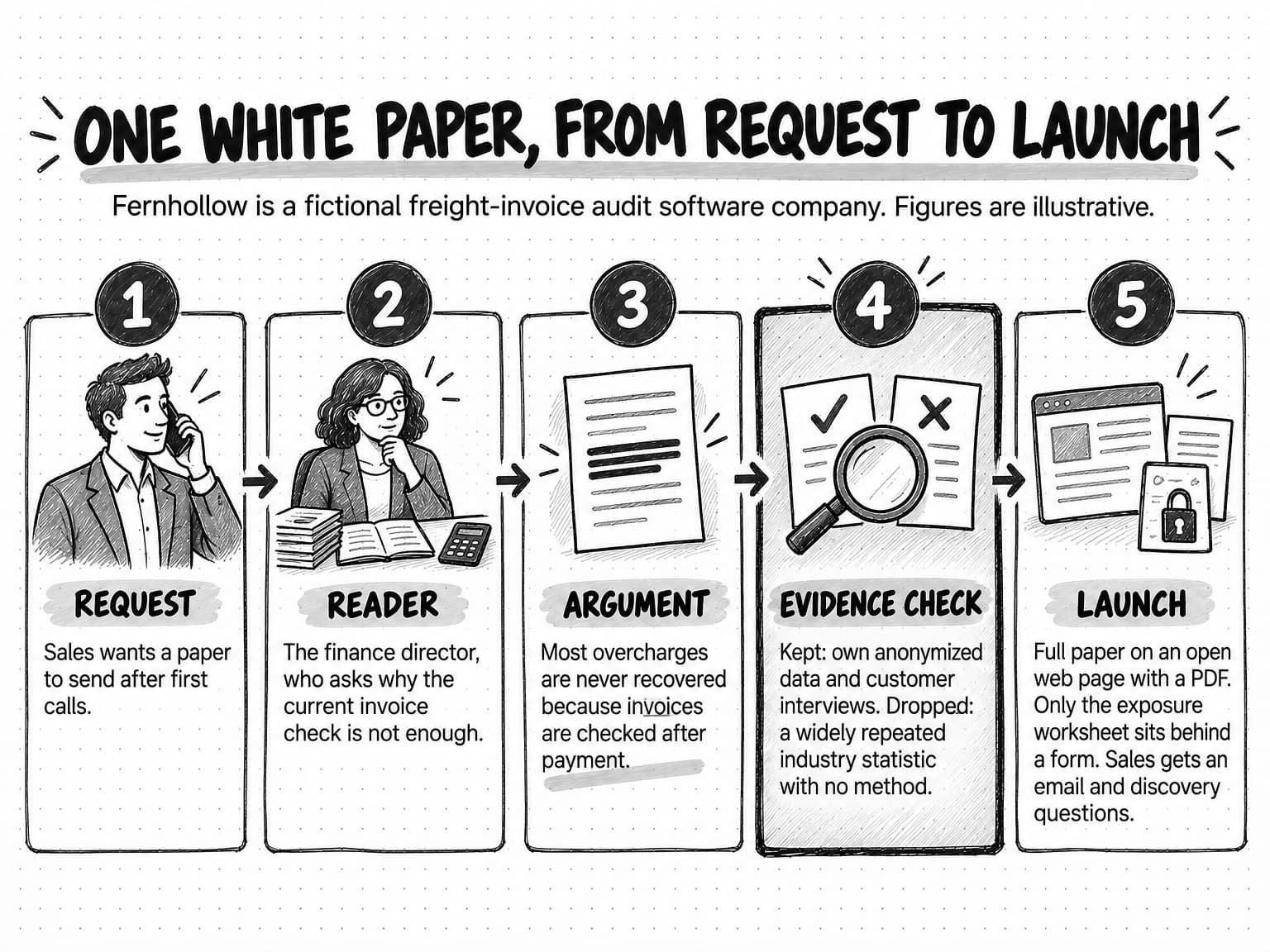
This example is fictional: Fernhollow is an invented company, and every figure below is illustrative, chosen to show the method.
Fernhollow sells freight-invoice audit software to mid-sized manufacturers. Its sales team asks marketing for "a white paper we can send after first calls." The head of marketing has six weeks and one writer.
Reader and decision. Sales calls show that the people who first contact Fernhollow are logistics managers, but deals stall when the finance director asks why the company should pay for software when its freight carrier already provides invoices and the accounts team checks them. The marketing lead chooses the finance director as the main reader. The decision the paper should support is whether checking freight invoices before payment is worth changing the accounts-payable process for.
Type and argument. The finance director does not yet accept that the problem is worth fixing, so a problem and solution paper fits better than a backgrounder. The first draft of the argument, "Freight audit saves money," fails the one-sentence test, because every competitor says it. After three conversations with Fernhollow's implementation team, the writer sharpens it: "Most freight overcharges are never recovered because invoices are checked after payment, when the cost of disputing a small error is higher than the error itself."
Evidence plan. The writer lists the claims that argument needs and what supports each one:
| Claim | Evidence | Source | Result of the check |
|---|---|---|---|
| Overcharges are common | Share of invoices with a billing error in aggregated, anonymized customer data, with sample size and period | Fernhollow data team | Usable; customers' contracts allow anonymized aggregate use |
| Errors found after payment are rarely recovered | Recovery rates for errors found before and after payment | Fernhollow data, plus four customer interviews | Usable for the 38 accounts with two years of data; claim narrowed to "among the customers we studied" |
| The usual check misses them | How accounts teams check invoices today | Interviews with three finance teams | Usable as qualitative evidence, not as a share |
| Checking before payment works | Illustrative before-and-after calculation for a typical company | Built from the data above, labeled illustrative | Usable, with the arithmetic shown |
| Industry-wide error rate | A frequently repeated statistic | Traced to a 2014 vendor blog post with no method | Dropped |
The last row matters as much as the others. The most quoted number in the category could not be traced to a study, so the paper does not use it, and the argument rests on evidence Fernhollow can explain.
Outline and budget. Using the template, the writer budgets about 3,250 words for the main body: a 250-word executive summary; 500 words on the problem, opening with a month-end scene the finance director will recognize; 600 words on why it persists, explaining that disputing a small error after payment costs staff time that often exceeds the amount recovered; 800 words on checking before payment; 500 words of evidence; 400 words of steps and questions to ask; and 200 words on where Fernhollow fits.
A passage before and after editing. The first draft of the problem section opened like this:
In today's complex supply chain landscape, freight costs represent a significant and growing challenge for manufacturers of all sizes, and finance leaders are increasingly seeking innovative solutions to optimize spend.
The edited version opens with the reader's situation and a specific claim:
At month end, the accounts team approves the freight carrier's invoices against purchase orders and pays them. The invoices match the orders, so they look correct. What the check does not see is whether the carrier billed the agreed rate, the right weight class or a fuel surcharge the contract caps. Among the 38 Fernhollow customers we studied, most billing errors were found only after payment, and errors found after payment were recovered far less often than errors found before it.
The second version is longer, but every sentence gives the finance director something: a process they recognize, the gap in it, and a finding with its scope stated.
Gating and promotion decisions. The full paper is published as an ungated web page, with a designed PDF available for anyone who wants to print or forward it. A one-page spreadsheet for estimating a company's own exposure sits behind a short form, because readers who want it are signaling a real interest. Sales gets the PDF, a one-paragraph email to send after first calls, and three of the paper's findings phrased as questions to ask in discovery. The launch plan is described in the promotion section below.
Review. Before publication, the data team checks every figure against its query, the implementation lead checks the steps, a finance reviewer reads the paper as the intended reader would, and the legal team confirms that no customer can be identified from the aggregated data.
View the fictional white paper example at full size (opens in a new tab).
How to write a white paper people finish
Readers abandon white papers when the opening wastes their time, the argument is hard to find, the evidence feels thin, or the paper turns into a pitch. These habits address each of those.
Put the argument up front. State the problem and the paper's view of it in the first page, and give the main findings in the executive summary. Research by the Nielsen Norman Group on how people read web content found that readers often scan in an F-shaped pattern when there are no strong cues, reading the opening lines and the start of headings and skimming the rest. Its recommendations for writers include leading with the most important points, using headings that stand out, and starting headings with the most informative words. Apply the same habits to the PDF version: the research looked at web pages, but a busy reader on a screen has the same reasons to skim a long document.
Write headings that state findings. "Market overview" tells the reader nothing. "Most overcharges are found after payment" tells them the section's point, and a reader who reads only the headings gets the argument. Test this by reading the headings alone, in order. If they read like a table of contents for any paper on the subject, rewrite them.
Open sections with the reader's situation. Describe a scene, a process or a decision the reader knows from their own work before explaining it. Recognition earns attention. A paragraph that starts with "In today's landscape" earns none, and so does one that piles up abstract nouns such as "optimization," "transformation" and "solutions."
Explain every number. Give each statistic its source, date, sample and what it measures, and then say what it means for the reader. "Among the 38 customers we studied" is more credible than an unattributed percentage, and a sentence that explains why the number matters stops the reader from having to work it out.
Keep paragraphs developed and short. A white paper paragraph should make one point and explain it: the claim, the reason, and an example or consequence. Very short paragraphs make an argument feel like a list of assertions; very long ones hide the point. Use bullets for genuine lists, such as steps or criteria, and connected prose for reasoning.
Hold the pitch until the end. Use neutral terms for the approach in the body, and describe the company's product only in its own section. Readers forgive a clearly separated product page. They stop trusting a paper that names the product in every section.
Sound like the company's experts. A white paper is a chance to show how the company thinks, so let the voice of the people who know the subject come through: their examples, their vocabulary, their honest caveats. If AI helps with the draft, edit for the generic phrasing it tends to produce; our guide to AI slop describes the signs. A paper that could have come from any company in the category does little for yours.
State limits once, where they apply. Say what the evidence does not show, for example that results come from customers in one region. One clear statement at the right point builds trust. Hedging every sentence drains the argument.
How long a white paper should be, and how to design and format it
There is no official length. The most specific practitioner guidance comes from Gordon Graham, who says that most white papers today have 6 to 8 pages of main body, about 2,000 to 3,500 words, plus five or more pages of front and back matter such as the cover, contents, executive summary, conclusion, sources and company information, for 12 to 16 pages in total. He treats a draft of 25 pages or more as probably too long for business readers, notes that some technical audiences will read 30 or 40 pages, and says a one-page piece is not enough to develop a strong argument. His industry standards set a minimum of five pages. These figures are one experienced writer's observations of common practice, not a measured norm.
Use the range as a check, not a target. A problem and solution paper usually needs the full range, because it has to establish the problem, explain the cause and present the evidence. A numbered list or a backgrounder can be shorter. If a draft runs long, a common cause is a problem section that explains what the reader already knows or an evidence section that includes every finding instead of the ones that carry the argument. Cut those before cutting the explanation.
Design that helps reading
Design should make the argument easier to follow, not decorate it.
- Use a portrait page with readable type. Body text should be comfortable to read on a laptop screen and in print, with generous line spacing and margins. Two narrow columns make someone reading on a screen scroll down one column and back up for the next; a single column avoids that.
- Make the structure visible. A contents page for longer papers, clear heading levels, and page numbers help readers who jump to the section they care about.
- Turn key evidence into charts and tables. A chart should show one point, with a title that states it and a source line beneath it. Tables suit comparisons and criteria. Label illustrative figures as illustrative.
- Keep the brand present but quiet. The company's colors and typefaces belong on the cover and in the design system. Logos on every page and product screenshots in the problem section signal a brochure.
- Make it accessible. Use real text rather than images of text, add alternative text to charts, and check color contrast, so readers using screen readers or reading in poor light can follow the paper.
PDF, web page or both
The white paper grew up as a PDF, and readers still expect one they can download, print and forward. But a PDF is a poor format for reading on a screen. Guidance from the Nielsen Norman Group, set out by Jakob Nielsen and Anna Kaley in 2020, is that PDFs should be reserved for documents people need to print and that content meant to be read on screen belongs on web pages, ideally with an HTML page that summarizes a PDF's key points.
For most B2B white papers, the practical answer is both: publish the full paper as a well-structured web page, with headings, charts and a table of contents, and offer a designed PDF of the same content for printing and sharing inside a buying group. The web page can be read on a phone, linked to a specific section and found by search engines and AI answers. The PDF serves the reader who wants to annotate it or attach it to an internal email. Keep the two versions identical in substance, and update both when a fact changes.
Should a white paper be gated?
A gated white paper sits behind a form: the reader gives a name, email address and company before downloading it. Gating made white papers a standard lead magnet, and many teams still judge a paper by its form fills. Two changes have made that trade harder to justify for every paper.
The first is that people click less when search results include an AI-written summary. Pew Research Center tracked the Google searches of 900 U.S. adults in March 2025. When a results page included an AI summary, users clicked a traditional search result in 8% of visits, compared with 15% of visits to pages without one, and they clicked a link inside the summary itself in only 1% of visits. When a buyer researching a problem gets an answer without clicking, the sources that shaped that answer did their work without receiving a visit.
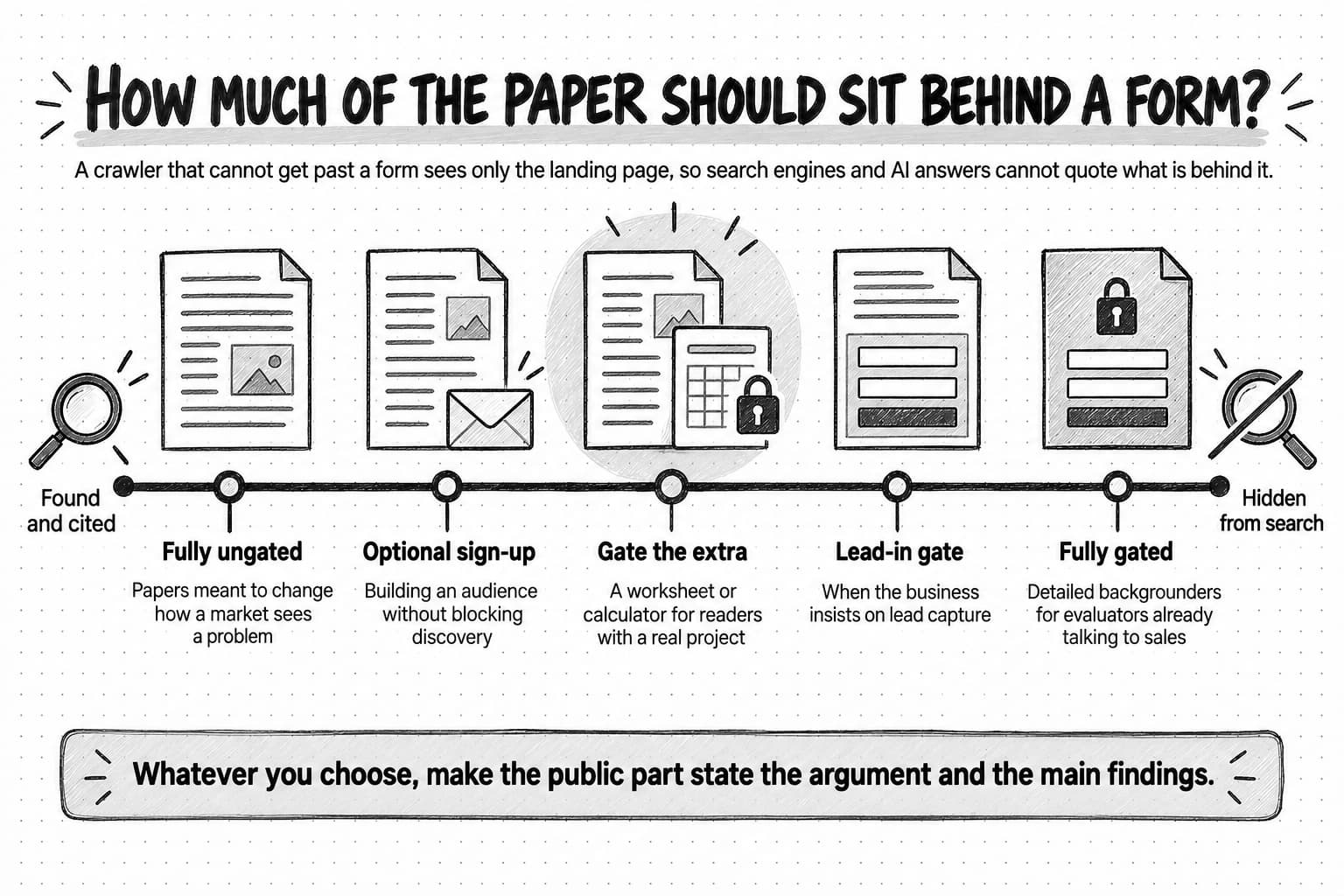
The second is that gated content cannot shape those answers. Google says a page must be indexed and eligible to appear with a snippet to be shown as a supporting link in its AI features. A crawler that cannot get past a form sees only the landing page, so the paper's argument and evidence cannot be found, quoted or cited by search engines or AI answers, however good they are. Google's guidance on paywalled content treats registration barriers the same way as subscription paywalls, and it describes ways to show part of the content, such as a lead-in, while marking the rest so it is not mistaken for cloaking. For a white paper meant to change how a market thinks about a problem, invisibility is a real cost. Our guide to zero-click content distribution covers how to reach buyers who get their answers without clicking.
Gating still has a place. It makes sense when the reader who completes the form is signaling real intent, when the paper is specific enough that the people who want it are likely buyers, and when sales will follow up in a way the reader finds useful. It makes little sense for a paper whose job is to reach people who do not know the company yet, or when the form fills mostly produce contacts nobody follows up.
Between fully gated and fully open, several options are available:
| Option | How it works | When it fits |
|---|---|---|
| Fully ungated | The full paper is a web page, with a PDF download and no form | Problem and solution papers meant to change how a market sees a problem; papers you want quoted and cited |
| Ungated with an optional sign-up | Everything is open; readers can choose to get updates or the next paper | Building an audience without blocking discovery |
| Gate the extra, not the paper | The paper is open; a related worksheet, calculator, dataset or benchmark sits behind a short form | When a companion asset is useful only to readers with a real project |
| Lead-in gate | The executive summary and first sections are open; the rest needs a form | Compromise when the business insists on lead capture; mark the gated part correctly for search |
| Fully gated | Only a landing page is public | Detailed backgrounders for late-stage evaluators already talking to sales |
View the white paper gating options at full size (opens in a new tab).
Whatever you choose, make the public part substantial. A landing page with three vague bullets gives searchers, AI answers and potential readers nothing to judge the paper by. A summary that states the argument and the main findings serves the readers who will never fill in the form and persuades the ones who might.
How to promote a white paper
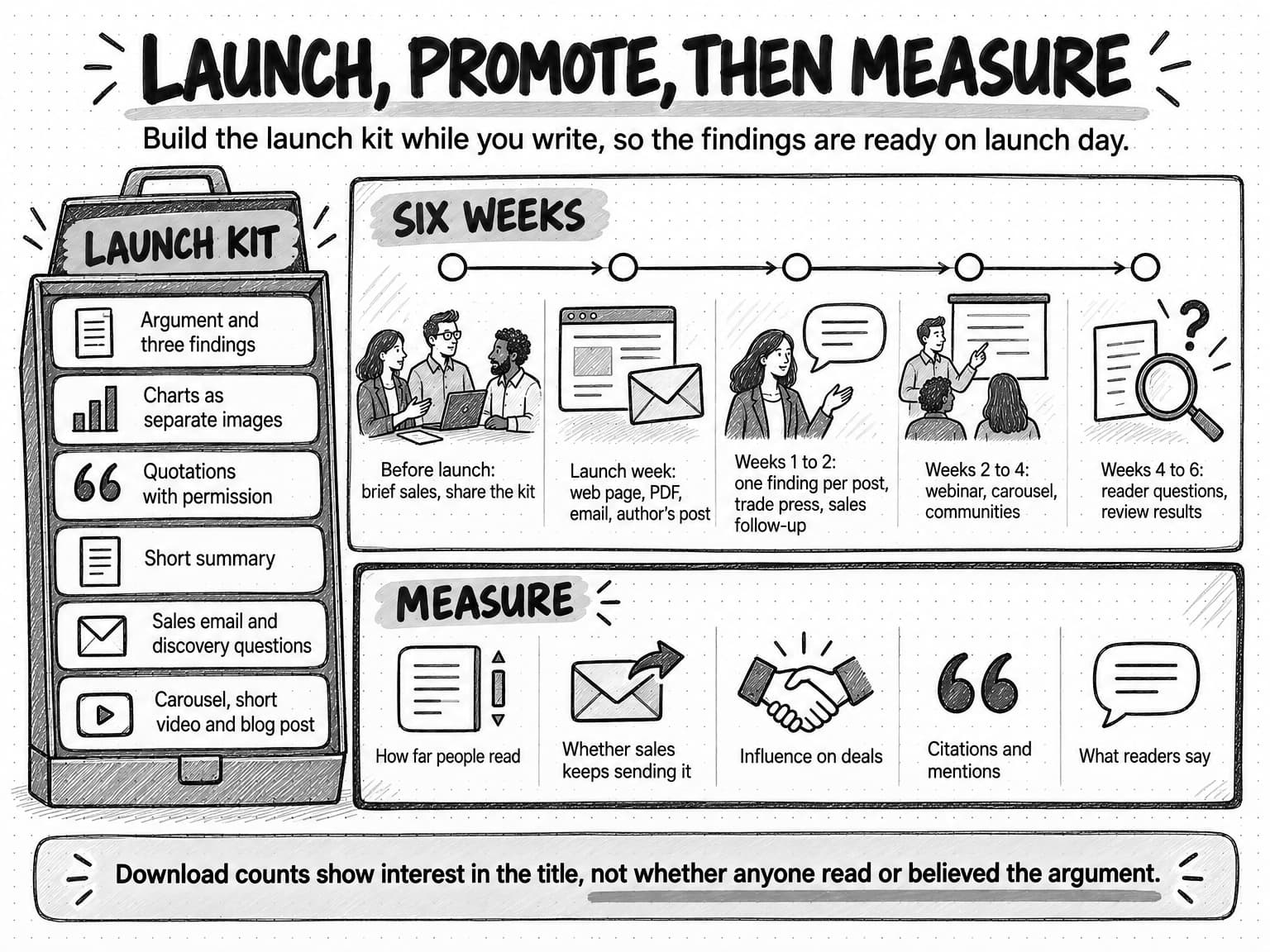
A white paper is not finished when it is published. Many readers will meet it through something else: a post that quotes a finding, an email from a colleague, a salesperson's follow-up, a webinar, or an AI answer that cites it. Plan promotion while the paper is being written, so the findings, charts and quotations are ready to use on launch day.
Build a launch kit from the paper
Before launch, pull out the pieces each channel needs:
- The argument and three findings, each written as a sentence that stands alone with its source, ready for posts, emails and sales notes.
- Charts as separate images, each with a title that states its point and a source line.
- Two or three quotations from the experts or customers in the paper, with permission to use them separately.
- A short summary of 150 to 300 words for the landing page, newsletters and partner sites.
- A sales kit: the PDF, a short email to send after a first call, and two or three findings phrased as discovery questions.
- Repurposed formats: a LinkedIn carousel of the main argument, a short video of an author explaining one finding, a blog post that answers a question the paper covers. Our guide to repurposing content across channels explains how to adapt a source without losing its point.
A six-week promotion plan
| When | Activity | Owner |
|---|---|---|
| Two weeks before launch | Brief sales and customer-facing teams on the argument and findings; share the sales kit; ask the experts and customers quoted in the paper whether they will share it at launch | Marketing lead |
| Launch week | Publish the web page and PDF; send to the email list with the main finding in the subject line; publish the author's post and the company post; send to partners and the people quoted | Marketing |
| Weeks 1 to 2 | Post one finding per post, each linking to the relevant section; offer an article or interview to one or two trade publications or newsletters; sales sends the paper after relevant calls | Marketing and sales |
| Weeks 2 to 4 | Run a webinar or live discussion with the author and one practitioner; publish the carousel and short video; answer questions in communities where the reader's peers already talk | Marketing and subject experts |
| Weeks 4 to 6 | Publish a follow-up post on reader questions; review results; give sales any new objections or questions the paper raised | Marketing |
| Ongoing | Link to the paper from related guides and product pages; update facts when they change; use findings in sales decks and proposals | Content owner |
The author and the experts quoted in the paper have their own networks and credibility with the reader's peers, so involve them in promotion. Give them sentences they can use and a link to the relevant section.
How to measure whether a white paper worked
Download counts measure interest in the title and the form. They do not tell you whether anyone read the paper, believed it or acted on it. Measure against the decision the paper was meant to support.
- Reading. For the web version, track how far readers scroll and how long they stay on the page, and which sections they jump to. A paper that most readers leave in the problem section has a problem section that does not earn its length.
- Use by sales. Count how often salespeople send the paper and ask them whether it moves conversations forward. A paper sales stops sending after two weeks has failed one of its main audiences, whatever the download numbers say.
- Influence on deals. Look at whether opportunities where buyers read the paper progress differently from others, while remembering that buyers who read white papers may already be more serious. Treat the comparison as a signal, not proof of cause.
- Citations and mentions. Note links from other sites, quotations in trade press, and whether AI answers cite the paper for the questions it covers. These are signs that the argument is reaching people who never visit.
- What readers say. Ask a few readers, customers and salespeople what they took from it and what was missing.
Set the measures before launch, with a review at four and twelve weeks. If the paper is read but sales does not use it, the argument may not match the questions buyers ask in calls. If sales uses it but few people find it, look at distribution or gating before rewriting the content.
View the white paper launch and measurement plan at full size (opens in a new tab).
Common white paper mistakes and how to fix them
| Mistake | What the reader experiences | Fix |
|---|---|---|
| Starting from a topic | A survey of the subject with no point | Write the one-sentence argument before the outline |
| Explaining what the reader already knows | Pages of familiar problem description before anything new | Cut the problem section to what is needed to set up the cause |
| Weak or untraceable evidence | Statistics without sources, dates or samples | Trace every number to its original, narrow claims to what the evidence supports |
| A pitch in every section | The paper reads as a brochure | Use neutral terms in the body; keep the product to one late section |
| A PDF only, behind a form | The paper is invisible to search and AI answers | Publish an ungated web version and gate a companion asset if needed |
| No promotion plan | A launch email and then silence | Build the launch kit while writing and run a six-week plan |
| Never updated | Old figures circulate under the company's name | Name an owner and review the facts at least once a year |
How white papers work in Ampere
Ampere, the AI marketing agent, can draft research reports, white papers and source-backed infographics, and you can brief it with the planning block and evidence plan from this guide.
In a session, Ampere can research the topic by searching the web, extracting page content and crawling sites, and it can pull public company, review, social and ad data for market research. It works from the context you give it: a brief with the reader, the argument and the evidence plan, uploaded files such as interview notes or exported data, and saved Brand memory about your company, audience, products, competitors and voice, so the draft starts from what your team already knows. The work happens in a session workspace, where you can see the files and browser pages Ampere is working in. Ampere can produce the paper as a document, a PDF or a self-contained HTML report, and it can prepare the launch kit from the finished paper, such as a LinkedIn carousel, social posts and a newsletter edition.
The checks in this guide still apply. Public web and data sources can be partial or out of date, and AI output can be inaccurate or incomplete, so trace every figure to its source and have your experts review the argument before anything is published. Ampere drafts and prepares; your team decides what goes out and publishes it.
Sources and further reading
- Gordon Graham, How to pick the perfect flavor for your next white paper, That White Paper Guy, first published 2012, updated September 2025. The backgrounder, numbered list and problem and solution types.
- Gordon Graham, This just in: a new metaphor for white paper mashups, That White Paper Guy, May 2022, updated November 2022. Combining the types.
- Gordon Graham, Industry standards for white papers, from White Papers For Dummies (Wiley, 2013), Dummies.com.
- Gordon Graham, Fix a draft that's too short or too long, That White Paper Guy. Typical length in pages and words.
- University of Southampton Library, White papers and green papers, official publications guide. The government meaning.
- Satoshi Nakamoto, Bitcoin P2P e-cash paper, Cryptography Mailing List, October 31, 2008, and the paper Bitcoin: A Peer-to-Peer Electronic Cash System.
- European Securities and Markets Authority, MiCA Article 6: Content and form of the crypto-asset white paper, Interactive Single Rulebook, Regulation (EU) 2023/1114.
- Stephanie Stahl, B2B Content Marketing Benchmarks, Budgets, and Trends: Outlook for 2025, Content Marketing Institute, October 9, 2024. Survey fielded June 25 to August 16, 2024; 980 B2B respondents.
- Athena Chapekis and Anna Lieb, Google users are less likely to click on links when an AI summary appears in the results, Pew Research Center, July 22, 2025. Browsing data from 900 U.S. adults, March 2025.
- Google Search Central, AI features and your website. Requirements for appearing as a supporting link.
- Google Search Central, Flexible Sampling general guidance. Registration walls, lead-ins and structured data for paywalled content.
- Kara Pernice, F-Shaped Pattern of Reading on the Web: Misunderstood, But Still Relevant (Even on Mobile), Nielsen Norman Group, November 12, 2017.
- Jakob Nielsen and Anna Kaley, Avoid PDF for On-Screen Reading, Nielsen Norman Group, June 28, 2020.
Frequently Asked Questions
How do you write a white paper?
Write a white paper by starting with the reader and the decision the paper should help them make, then stating the argument in one sentence someone could disagree with. Plan the evidence for each claim before drafting, follow a structure that moves from the problem through its cause to a better approach and its proof, and keep the product to one short late section. Write the executive summary last and have experts check every figure.
What is the purpose of a white paper?
The purpose of a B2B white paper is to help a prospective buyer understand a business problem and decide how to solve it, before they talk to sales. It persuades through evidence and reasoning rather than a pitch. The publishing company benefits when the reader trusts its view of the problem, and when an internal champion can forward the paper to colleagues who have to agree on the purchase.
How long should a white paper be?
Most B2B white papers have 6 to 8 pages of main body, about 2,000 to 3,500 words, plus front and back matter such as the cover, executive summary, sources and company information, for 12 to 16 pages in total, according to white paper writer Gordon Graham. He treats five pages as the minimum and 25 or more as probably too long for business readers, though technical readers will read longer papers.
How should a white paper be structured?
A problem and solution white paper usually runs in this order: title, executive summary, the problem, why it persists, a better approach, evidence that the approach works, how to apply it, where the company fits, a conclusion with one next step, and sources. A backgrounder replaces the middle sections with how a product works and what it does, and a numbered list replaces them with explained points.
What is an example of a white paper?
The best-known example is the Bitcoin white paper, a nine-page technical paper Satoshi Nakamoto shared in 2008. Governments also publish white papers setting out policy. In B2B marketing, a typical example is a problem and solution paper from a software company explaining why a costly business problem persists and what approach fixes it, backed by its own data, customer interviews and a worked calculation.
What is the difference between a white paper and a report?
A report presents findings, such as the results of a survey or data analysis, and leads with what was found. A white paper makes an argument about a business problem and how to solve it, and it can use a report's findings as one piece of its evidence. Some documents do both, such as a market report that ends with an argued recommendation.
What is the difference between a white paper and a research paper?
A research paper reports a study for an academic or scientific audience, follows a set structure of methods and results, and is often peer reviewed. A B2B white paper is written for business readers, argues for an approach to a practical problem, and is published by a company that benefits if the reader trusts its view. A white paper can draw on research but answers a business decision.
What is the difference between a white paper and a green paper?
In government, a green paper is a consultation document that sets out policy options and asks for views, while a white paper is a published statement of policy or strategy, often explaining planned legislation. A green paper belongs earlier in the process, while options are still open, and a white paper sets out the position the government has settled on. The B2B marketing white paper borrowed the name but has no green paper stage.
How should a white paper be formatted?
Format a white paper in portrait pages with readable body type, clear headings, a contents page for longer papers, and charts that each make one point with a source line. Publish the full paper as a web page, which can be read on a phone and found by search engines and AI answers, and offer a designed PDF of the same content for printing and forwarding inside a buying group.