How to create a brand messaging framework (with template)
Turn scattered website, sales, and campaign copy into one usable source for your audience, value, differentiation, message pillars, and proof.
21 min readWritten by Ampere

Contents
- What a brand messaging framework is
- Gather evidence before you write the message
- Build the framework around six decisions
- The completed Loopline messaging framework
- Copyable brand messaging framework template
- Turn the framework into channel-specific copy
- Improve a vague message without changing the facts
- Test comprehension, relevance, credibility, and difference
- Keep the framework useful in everyday marketing
Your homepage says you help teams “work smarter.” The sales deck describes an analytics platform. An outreach email leads with automated reporting, while a recent social post calls the product a collaboration tool. None of those descriptions is necessarily false. Together, though, they make the buyer assemble the story.
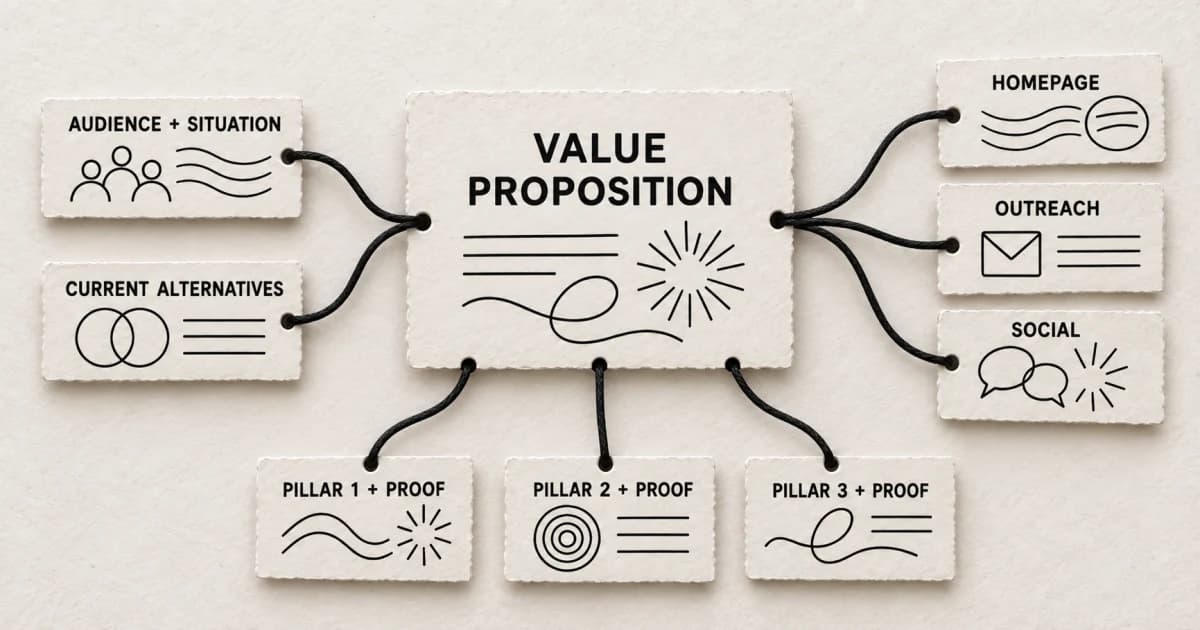
A brand messaging framework gives the team one place to decide that story before anyone writes the next page, deck, email, or ad. It records who the message is for, what those people are trying to accomplish, what they use today, what useful outcome the offer creates, why they should believe it, and which parts of the story deserve emphasis in a particular situation.
The framework is not the finished copy. It is the set of decisions that keeps the finished copy coherent. A homepage can be concise, a sales conversation can handle objections, and a social post can focus on one idea without turning the business into three different companies.
This guide uses one fictional software business from first notes to finished examples. It also includes a blank template you can copy directly. The structure is intentionally small. Practitioners use different names and diagrams—message houses, message maps, value propositions, brand pillars—but a small team needs a usable first version more than it needs a universal taxonomy.
What a brand messaging framework is
A brand messaging framework is an internal reference for what a business should communicate, to whom, and on what evidence. A useful one usually contains:
- A defined audience and the situation that makes the offer relevant
- The progress that audience is trying to make
- Current alternatives, including doing nothing
- A value proposition connecting the offer to a useful outcome
- Meaningful differentiation from those alternatives
- A small set of message pillars, each supported by proof
- Guidance for changing emphasis by audience, buying situation, or familiarity
This is a practical synthesis, not the only valid arrangement. Strategyzer’s Value Proposition Canvas, for example, maps customer jobs, pains, and gains against an offer’s products, pain relievers, and gain creators. Positioning consultant April Dunford starts with competitive alternatives, differentiated value, best-fit customers, and market category; she also makes the useful distinction that positioning is not the same as messaging. Both approaches supply decisions a messaging framework can turn into a working communication guide.
The adjacent terms are easy to blur because teams often store them in the same document. Their jobs are different.
| Term | The decision it captures | Typical output |
|---|---|---|
| Positioning | The market context in which the offer has the strongest value for the best-fit customer | Chosen audience, alternatives, differentiated value, category |
| Messaging framework | What the business should communicate about that position and why people should believe it | Core message, pillars, proof, adaptation guidance |
| Brand voice | How the business sounds while communicating | Voice traits, writing principles, examples, boundaries |
| Tagline | A short, memorable expression associated with the brand or a campaign | One line |
| Copy | The words written for one audience, channel, and moment | Homepage, email, ad, deck, post, script |
A positioning statement may appear in your framework, but the framework should not become a second positioning project. If the team has not decided which customers matter most, what those customers compare, or where the offer is meaningfully different, record those as open positioning questions. Smoother wording cannot settle them.
Voice enters after the message is clear. It can make the same idea sound candid, warm, technical, playful, or restrained. It cannot decide which idea the business should lead with or turn a generic claim into a defensible one. If several people or AI systems create marketing for the same company, both layers matter: the messaging framework tells them what must remain true, and the voice guidance shapes how they express it. Our article on brand consistency in AI-generated marketing explains why that shared context has to persist beyond a single draft.
Gather evidence before you write the message
The fastest way to produce a generic framework is to begin with an empty worksheet and fill it from memory. Internal knowledge matters, but every team develops shorthand that customers may not understand and convictions they have not yet tested.
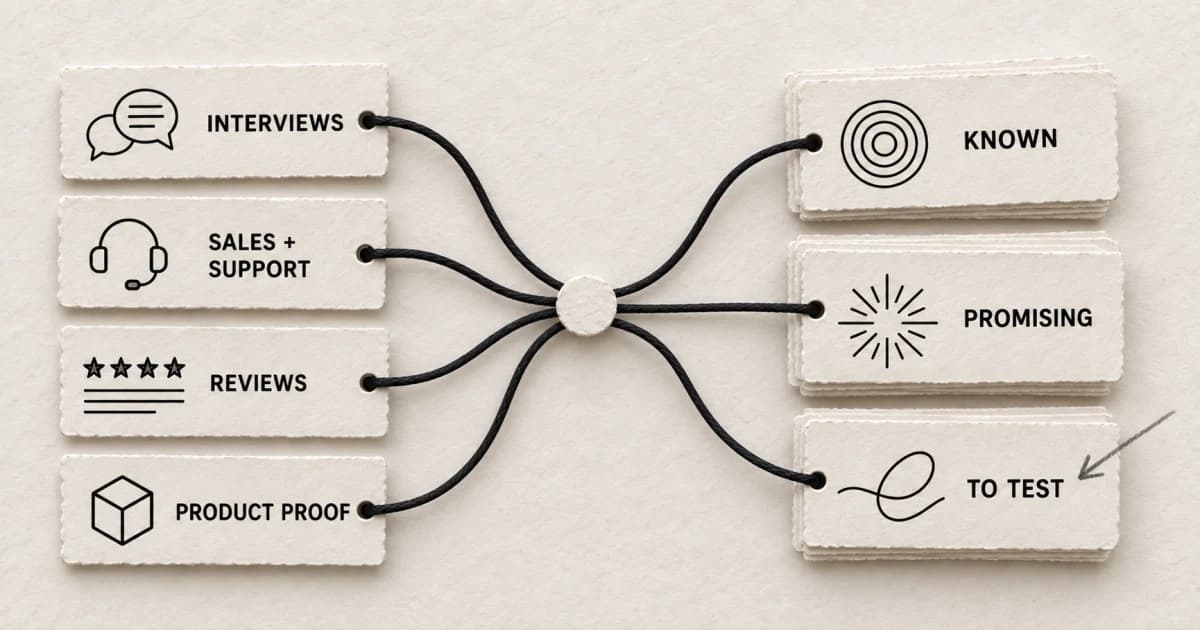
Begin with a modest evidence pack. You do not need a six-month research project. You need enough material to separate what the team knows, what customers have said or done, and what remains an assumption.
Customer and market inputs
Talk to recent buyers, active customers, lost prospects, or people who fit the intended audience. Ask about a recent situation rather than requesting a review of your pitch. Useful prompts include:
- What were you trying to get done when you started looking for a different approach?
- What had changed or become difficult?
- How were you handling it before?
- What else did you consider, including keeping the current process?
- What made one option feel credible or risky?
- Which result mattered enough to justify changing?
The questions are meant to uncover circumstances, behavior, alternatives, and decision criteria. They are not an invitation to steer the interviewee toward your preferred promise. Strategyzer similarly treats “fit” as something to test against evidence, not something a completed canvas proves.
Sales calls add repeated objections and the language prospects use before they have learned your internal vocabulary. Support conversations show where the delivered experience does not match the promise. Reviews—your own and competitors’—can reveal valued outcomes, switching triggers, and recurring disappointments. Treat a striking comment as a lead, then look for a pattern or verify it in conversation before elevating it into the central message.
Business and product inputs
Review current product behavior, service delivery, pricing, onboarding, policies, case evidence, and any claims the team is allowed to make. This is where attractive ideas meet reality.
Create a simple proof inventory:
| Possible claim | Evidence available now | Status |
|---|---|---|
| Customers can trace a summary to its source | Current product behavior and demo | Usable product proof |
| Teams make decisions twice as fast | No measured study | Do not use |
| Setup takes less than an hour | A few informal observations with inconsistent timing | Hypothesis to test |
| Customers value traceability most | Two interviews mention it | Promising, not established |
Existing marketing belongs in the evidence pack, but as an artifact to inspect—not an authority to obey. Mark repeated claims, contradictions, unsupported superlatives, and useful phrases that already match customer language. A polished page can still be wrong.
What an early-stage business can use
A new business may have no customer base, no win-loss archive, and no reliable performance data. It can still create a first framework, provided the document distinguishes facts from hypotheses.
Use founder interviews, problem interviews with people in the intended market, competitor reviews, sales notes, wait-list conversations, pilot observations, and direct product evidence. Record the source and confidence beside every important conclusion. “Five interviewees described copying support excerpts into planning documents” is evidence from a small sample. “Product teams need one source of truth” is an interpretation. “This is the main reason the market will buy” is a hypothesis.
The early framework should become more specific as evidence arrives. It should not become more certain simply because the team has repeated it.
Build the framework around six decisions
To show how the pieces connect, the rest of the guide uses Loopline, a fictional customer-research product. All interviews, product details, research notes, and proof attributed to Loopline are invented for teaching. They illustrate how to reason from inputs; they are not real customer evidence or claims about an existing company.
Loopline has a three-person founding team and six design partners. The product imports interview notes, call transcripts, and support-ticket exports. It groups related feedback into themes, and every generated summary links back to the exact source excerpt and date. The team does not yet have reliable evidence that the product saves a particular amount of time, improves retention, or leads to better roadmaps.
That limitation is part of the example. A useful framework has to work with the proof the business actually has.
1. Choose an audience and a relevant situation
“B2B software companies” describes a market. It does not give a writer enough context to choose a message.
Define one primary audience in relation to the problem. Then name what those people are trying to accomplish and the circumstances that make the offer worth noticing. The situation is often more useful than a demographic profile because the same person can care about different things at different moments.
Loopline initially considered founders, product managers, researchers, support leaders, and sales teams. The product can help all of them contribute or find customer evidence. Leading with everyone, however, would produce a catalogue of features rather than a clear reason to care.
The team chooses this primary audience for the first framework:
Product leads at B2B software companies with small product teams. They are preparing roadmap or prioritization decisions, but customer evidence is scattered across interview notes, support exports, and sales conversations. They need to explain why a proposed priority deserves attention without turning every planning cycle into a manual research project.
This definition contains a role, a goal, a recurring situation, and a problem. It does not claim that every product lead works this way. In Loopline’s fictional evidence log, it remains a hypothesis supported by four design-partner interviews and several observed planning documents.
2. Map the alternatives and the reason to change
Every offer competes with the way people handle the job now. That may be a named competitor, but it may also be a spreadsheet, a shared document, an employee’s memory, a collection of specialist tools, or no action at all.
List the real alternatives. Then write why each remains attractive and where it breaks down in the situation you chose. This prevents the framework from caricaturing the status quo. People keep a messy process because it is familiar, flexible, already paid for, or adequate most of the time.
Loopline’s working alternative map looks like this:
| Current approach | Why teams keep it | What creates pressure to change |
|---|---|---|
| Notes in documents and spreadsheets | Flexible, familiar, no new software | Hard to search across studies; evidence loses context when copied |
| Search support and call tools separately | Source material stays in existing systems | Slow to compare patterns across sources |
| Ask sales, support, or a founder what customers are saying | Fast and socially easy | Loud or recent anecdotes can outweigh documented evidence |
| Do no formal synthesis | Avoids setup and maintenance | Planning discussions revisit the same unresolved questions |
The reason to change is not “the old way is broken.” The team may tolerate it until a trigger raises the cost: a planning cycle, a churn review, a new product lead, disagreement about priorities, or a growing volume of feedback. Those triggers become useful contexts for outreach, content, and campaigns.
3. Write the value proposition as a useful outcome
A value proposition connects three things: what the business offers, the useful outcome it enables, and why that outcome matters to the chosen audience.
A practical draft formula is:
For [audience in a relevant situation], [offer] helps [useful outcome] by [how it creates that value].
The formula is scaffolding, not final copy. Loopline’s internal value proposition becomes:
For product leads preparing roadmap decisions, Loopline turns scattered customer conversations into traceable product evidence by bringing research, call, and support inputs into one reviewable view where every theme links back to its source.
“Traceable product evidence” matters because the audience has to make and defend a decision. The statement also names how the product creates the outcome. It does not claim that Loopline makes the decision, guarantees the right roadmap, or delivers an unmeasured business result.
4. Find differentiation you can support
Differentiation answers a comparative question: why choose this approach instead of the alternatives the audience seriously considers?
“Innovative,” “high quality,” “easy to use,” and “customer-focused” rarely answer it. They describe desirable qualities almost any business would claim. A useful differentiator is relevant to the chosen audience, meaningfully distinct in the comparison, and supported by product or market evidence.
For Loopline, “centralizes customer feedback” is relevant but not distinctive. Several alternatives can collect information. The team’s sharper, supportable difference is the evidence trail: summaries and themes retain links to the original excerpt, source type, and date. That matters when a product lead needs to check whether a theme reflects repeated evidence or one unusually forceful comment.
The team does not claim that no competitor offers traceability. It has not completed that research. Its working statement is narrower:
Lead with traceable synthesis rather than generic AI summarization. Show the path from each theme back to the underlying customer evidence.
If no meaningful difference survives scrutiny, stop polishing. The next task may be customer research, a clearer focus on one segment or use case, a change to the offer, or stronger proof. A messaging exercise cannot manufacture customer value. Dunford makes the same point plainly in her discussion of products with no apparent differentiation: positioning cannot solve the problem by inventing value.
5. Create a few pillars and attach proof
Messaging pillars are the small set of supporting ideas that make the central value proposition believable and useful. Three is often enough for a first framework. Five may be reasonable for a complex offer. More than that becomes difficult for writers to prioritize and for customers to remember.
Each pillar needs four parts:
- A short theme the team can remember
- A customer-relevant claim
- The implication for that audience
- Evidence the business can show now
Loopline’s pillars are deliberately uneven. The first is the strongest differentiator. The others help a buyer understand the complete value without pretending every benefit is unique.
| Pillar | Supporting message | Why it matters | Evidence available now |
|---|---|---|---|
| Trace every theme to its source | Each summary links to the original excerpt, source, and date | Product leads can inspect the evidence before using it in a decision | Working product and reviewable demo |
| Review feedback together | Interview notes, call transcripts, and support exports can be examined in one view | Patterns are easier to compare across teams and research methods | Current import types and product view |
| Carry evidence into planning | Teams can filter themes and export an evidence brief for a planning discussion | Research is easier to use at the moment a decision is made | Current filters and export |
Notice what is absent: “save hours,” “eliminate bias,” and “build better products.” Those outcomes may be desirable, but the fictional team does not yet have evidence for them. The framework leaves room to add stronger proof later without weakening its first version with wishful claims.
6. Decide what stays fixed and what can change
Consistency does not require repeating the same sentence in every channel. It requires preserving the same underlying value, differentiation, and evidence while selecting the part most relevant to the person and moment.
For each important audience or buying situation, record:
- What they already know
- What they care about now
- Which pillar should lead
- Which proof will feel credible
- Which objection or risk needs an answer
- What action is reasonable next
Loopline adapts its message in three ways:
| Context | Lead with | Keep in support | Do not change |
|---|---|---|---|
| Product lead entering quarterly planning | Evidence that can be checked and carried into the meeting | Cross-source review and export | The product organizes evidence; it does not make the priority decision |
| Founder hearing about the category for the first time | A clearer view of what customers are saying across the company | Traceability as the reason to trust the synthesis | No unsupported promise of eliminating bias or improving retention |
| Existing design partner considering wider team use | Shared review across product, support, and sales inputs | Filters, exports, and source links | Same central value and current product boundaries |
You may need a separate framework when two audiences value the offer for fundamentally different reasons. You do not need one merely because a founder and a product lead use different words. Start by adapting emphasis. Split the framework only when the core job, alternatives, value, or evidence changes.
The completed Loopline messaging framework
Here is the example assembled in one place. Again, Loopline and every research input or proof point below are fictional and illustrative.
| Primary audience | Product leads at small B2B software teams preparing roadmap or prioritization decisions |
|---|---|
| Situation and job | Customer evidence is scattered, but the lead needs to form and explain a defensible view of what deserves attention |
| Current alternatives | Documents and spreadsheets; separate searches across call and support tools; asking customer-facing teammates; no formal synthesis |
| Change triggers | Planning cycles, churn reviews, leadership disagreement, a new product lead, or growing feedback volume |
| Offer | A customer-research product that imports interview notes, call transcripts, and support-ticket exports |
| Useful outcome | Traceable product evidence that can be reviewed and carried into planning |
| Central value proposition | For product leads preparing roadmap decisions, Loopline turns scattered customer conversations into traceable product evidence by bringing research, call, and support inputs into one reviewable view where every theme links back to its source |
| Meaningful difference | Lead with the visible evidence trail from each theme to the underlying excerpt, source, and date—not generic AI summarization |
| Pillar 1 | Trace every theme to its source. Proof: current source-linking behavior and demo |
| Pillar 2 | Review feedback together. Proof: current supported import types and combined review view |
| Pillar 3 | Carry evidence into planning. Proof: current filters and evidence-brief export |
| Claim boundaries | Do not claim quantified time savings, bias removal, retention gains, better roadmaps, or uniqueness across the entire market without new evidence |
| Evidence gaps | How buyers rank traceability against other criteria; adoption effort; measured effect on planning; complete competitor comparison |
The document is specific enough to guide writing and honest enough to show where the team still has work to do. That combination is more useful than a polished framework in which every field sounds finished.
Copyable brand messaging framework template
The essential fields are enough for a small team to create a usable first version. Add the optional refinements when they solve a real coordination problem.
# Brand messaging framework

## Essential fields

### 1. Primary audience

Name one audience in relation to the problem. Avoid “everyone” or a demographic profile that does not change the message.

[Write the primary audience]

### 2. Situation and customer job

What are they trying to accomplish? What event, problem, or circumstance makes the offer relevant now?

[Write the job and situation]

### 3. Current alternatives

What do they use or do today, including a manual process or doing nothing? Why is each option still attractive?

- [Alternative and why it persists]
- [Alternative and why it persists]

### 4. Reason to change

What creates enough pressure to reconsider the current approach? Do not exaggerate a mild inconvenience into a crisis.

[Write the trigger, cost, or unmet need]

### 5. Offer and useful outcome

What do you provide? What can this audience accomplish or improve with it? Why does that outcome matter in their situation?

[Write the offer, outcome, and relevance]

### 6. Meaningful differentiation

Why choose this approach over the real alternatives? Use a specific, relevant difference you can support. If none exists yet, record the gap.

[Write the differentiator or open question]

### 7. Central value proposition

For [audience in a situation], [offer] helps [useful outcome] by [how it creates value].

[Write the internal value proposition]

### 8. Messaging pillars and proof

Use two to four pillars. For each one, connect the claim to its audience relevance and current evidence.

#### Pillar 1: [memorable theme]

- Supporting message: [what is true]
- Why it matters: [audience consequence]
- Evidence: [product behavior, data, demonstration, customer evidence, or a visible gap]

#### Pillar 2: [memorable theme]

- Supporting message:
- Why it matters:
- Evidence:

#### Pillar 3: [memorable theme]

- Supporting message:
- Why it matters:
- Evidence:

### 9. Adaptation guidance

For each priority audience, buying situation, or familiarity level, state what should lead and what must remain unchanged.

| Context   | Lead with        | Supporting proof | Objection or risk | Next step |
| --------- | ---------------- | ---------------- | ----------------- | --------- |
| [Context] | [Pillar/outcome] | [Evidence]       | [Concern]         | [Action]  |

### 10. Claim boundaries and evidence gaps

List what the team must not claim yet, assumptions still being tested, and proof that needs to be collected.

- Do not claim:
- Hypothesis to test:
- Evidence to collect:

## Optional refinements

### Positioning inputs

- Best-fit customer:
- Competitive alternatives:
- Differentiated value:
- Market category or context:

### Objections

Record recurring objections and the factual answer to each one.

### Approved short descriptions

Write useful 10-, 25-, and 50-word descriptions only after the framework is stable.

### Relationship to brand voice

Link to the separate voice guidance that governs how these messages should sound.

### Ownership and review

- Owner:
- Last reviewed:
- Next review trigger:
- Sources used:
Do not complete optional fields merely to make the document look comprehensive. A ten-page framework that nobody consults has less value than a two-page reference the team uses in every brief.
Turn the framework into channel-specific copy
The framework earns its place when it helps someone make a real writing decision. These examples use the same Loopline facts, but each one meets a different reader with a different level of attention and intent.
Homepage opening
Turn scattered customer conversations into product evidence you can trace.
Loopline brings interview notes, call transcripts, and support exports into one reviewable view. Every theme links back to the source, so your next planning discussion can start with evidence instead of competing recollections.
The homepage introduces the category through the problem rather than assuming the visitor knows what a customer-research repository is. It leads with the strongest differentiator—traceability—then explains the product and the planning consequence. The second sentence uses only capabilities in the fictional proof inventory.
Outreach email opening
Hi Maya—when roadmap planning starts, does your team still pull evidence from research notes, support tickets, and whichever calls people remember? Loopline brings those inputs into one reviewable view and keeps every theme linked to the original excerpt. I’m reaching out because product leads at small B2B teams are the group we’re designing it with.
The outreach version begins with a recognizable situation and current alternatives. It is more conversational and narrower than the homepage. It does not announce the entire value proposition or list all three pillars. The traceability claim and small-team focus remain consistent.
Because Loopline is early stage, the final sentence describes who the fictional team is designing with. It does not imply a large customer base or proven result.
Social post or advertisement
Your roadmap meeting should not depend on who remembers the loudest customer call.
Bring interview notes, call transcripts, and support exports into one view. Loopline keeps every theme connected to its source, so the team can inspect the evidence before it debates the priority.
The social version uses the tension between recollection and evidence. It makes one point quickly and leaves the broader workflow for the landing page. The underlying message is still the same: scattered inputs become traceable evidence for a decision. The wording changes because the reader has not asked for a product explanation and may give the post only a few seconds.
Across the three examples, the audience, value, differentiation, and proof do not change. The entry point, detail, tone, and next step do.

Improve a vague message without changing the facts
Suppose the Loopline team has approved only these facts:
- The product imports interview notes, call transcripts, and support-ticket exports
- It uses AI to group related feedback into themes
- Every theme links to an original excerpt, source, and date
- Users can filter themes and export an evidence brief
- The product is being developed with six design partners
Here is the vague version:
Loopline is an innovative, AI-powered customer-insights platform that centralizes feedback and helps product teams make better decisions faster.
And here is a framework-led improvement:
Turn scattered customer conversations into evidence your product team can inspect. Loopline groups interview notes, call transcripts, and support exports into themes that link back to the original excerpt, source, and date. Filter the evidence and carry a focused brief into your next planning discussion.
The revision does not add a result, testimonial, or capability. It makes five decisions differently:
- It replaces category fog with a concrete job. “Customer-insights platform” may be a useful category label later, but it does not tell a new reader what happens.
- It names the inputs. Interviews, calls, and support exports make “centralizes feedback” tangible.
- It leads with the supportable difference. The evidence trail explains why the themes can be inspected.
- It connects the product to a real situation. The planning discussion is the moment when the evidence becomes useful.
- It removes unsupported outcomes. The original claims “better decisions faster,” but the fictional team has measured neither decision quality nor speed. The improved version stays inside the known facts.
The result is longer than a slogan and shorter than a product tour. A different channel may compress it, but the claim boundary should remain.
Test comprehension, relevance, credibility, and difference
The team that wrote the framework already knows what every sentence is supposed to mean. Validation needs people who do not share that context.
Recruit a small number of people who resemble the primary audience. Show them realistic copy in context: a homepage opening, outreach email, sales slide, or ad. Do not begin by explaining the product, and do not ask “Which headline do you like?” Preference can be useful for taste decisions, but it does not tell you whether the message works.
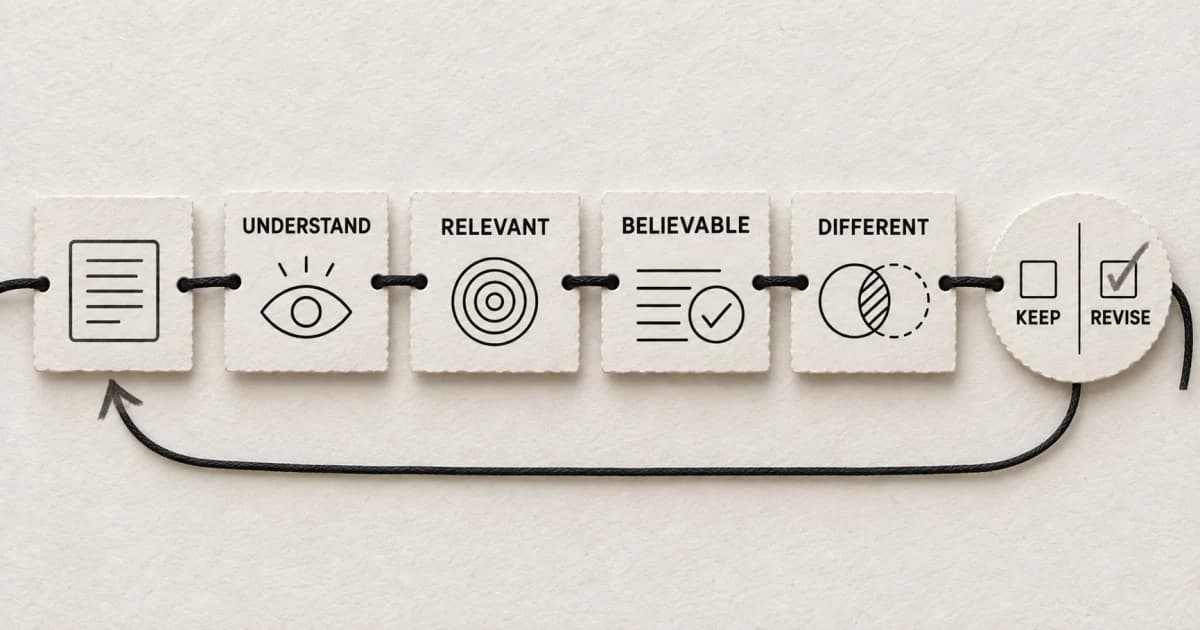
Test four questions:
- Comprehension: What do you think this company offers? Who is it for? What could you do with it?
- Relevance: In what situation, if any, would this matter to you? What feels important or unimportant?
- Credibility: Which claims do you believe? Which need explanation or evidence? What makes you hesitate?
- Differentiation: How does this seem different from what you do now or from other options you would consider?
Ask participants to explain in their own words. If they reread and quote the headline back, follow with “What would that mean in your work?” Nielsen Norman Group’s guidance on testing content with users recommends recruiting the right audience, using realistic tasks, and checking whether people can explain the content without simply reading it back. Wynter’s practitioner framework evaluates B2B messages across closely related dimensions: clarity, relevance, value, differentiation, and brand.
Record where several participants misunderstand the same idea, dismiss the relevance, question the proof, or describe the message as interchangeable with alternatives. Those patterns are more useful than votes on favorite wording.
Small qualitative tests diagnose problems; they do not establish market-wide preference, demand, or conversion lift. Five conversations can expose a confusing category or an unbelievable claim. They cannot prove that a new headline will increase revenue. Use larger experiments or behavioral data when you need a comparative performance conclusion, and avoid changing the audience, offer, headline, and page structure at once if you want to learn which decision mattered.
After revising, test again. The framework itself is not the stimulus customers buy; the copy and experience derived from it are.
Keep the framework useful in everyday marketing
Store the framework where writers, founders, salespeople, agencies, and product marketers can find it. Give one person responsibility for resolving contradictions and recording updates. Link claims to their evidence instead of letting proof become folklore.
Use the framework at three moments:
- Before a brief: choose the audience, situation, pillar, and proof that fit the task
- During review: check whether the copy preserves the central value and claim boundaries
- After learning: update the framework when interviews, product changes, sales patterns, or new evidence alter a decision
Review on a trigger, not only on an arbitrary calendar. A new product, a shift in the best-fit customer, a repeated objection, a competitor change, a repositioning decision, or a claim that no longer matches the product should reopen the relevant section. Do not rewrite the whole document because one campaign needs a fresh creative angle.
A human writer can use the framework as a decision brief: which truth deserves the lead, what evidence belongs nearby, and what must not be implied. An AI marketing agent can use the same material, provided the brief names the target audience and channel, includes current evidence, and preserves approval boundaries. Our guide to briefing an AI marketing agent shows how to turn that context into a specific assignment.
Neither a person nor an agent should treat the framework as permission to assemble claims mechanically. The audience context still requires judgment. Evidence can expire. A campaign may need to depart from the usual emphasis. The framework makes those choices visible, so the team can adapt deliberately instead of rediscovering the brand in every draft.
Start with the essential fields, apply them to one real page or email, and put the message in front of people who match the audience. The first useful version is not the one with every box filled. It is the one that helps the team write the next piece more clearly—and shows them which assumptions still need evidence.