What is market research? Types, methods, and B2B examples
An introduction for B2B founders and marketers: what market research can help you decide, how the main methods differ, and how to plan a small first investigation.
40 min readWritten by Ampere
Short answer
What is market research?
Market research gathers and interprets evidence about buyers, alternatives, and markets to improve a decision. Start with the decision and missing information, then choose credible methods and sources that can answer the question. Keep observations, interpretations, and recommendations distinct, and explain the limits of the evidence before acting on it.
Summary
Market research helps with decisions that depend on facts about people and markets outside your team, and a useful project's scope follows from the decision it serves. Research reduces uncertainty but rarely removes it, so a team deciding whether to test a new segment needs only enough evidence to justify the test and a clear idea of what would stop it.
The four commonly listed types of market research are really two separate distinctions. Primary and secondary describe where evidence comes from; qualitative and quantitative describe its form, words that explain how and why or numbers that show how many. Each supports only certain claims: a theme counted across eight chosen interviews can't show how common it is.
Choose the method from the question a decision leaves open. Exploratory questions suit qualitative methods, while how-many questions need a defined group measured consistently. Explore first, because a survey written before anyone has spoken to buyers offers only answers the team already imagined. In B2B, record each participant's role and report counts beside percentages.
Read evidence in light of who took part, who could never have appeared, and how questions were worded. In the worked example, five of eight prospects who paused after a fictional company's demo cite IT or security approval, though three came from deals already tagged with that obstacle. A count across 52 stalled deals finds a security or IT review mentioned in 19, enough to justify a small test of a security review pack.
Keep each finding tied to its evidence and label what is still a hypothesis. AI tools can speed up reading and drafting, but AI-generated respondents only approximate what someone might say, so their answers aren't evidence. Keep research separate from selling, reuse only the personal data you need, and start with the included template for a two- or three-week project.
Contents
- What market research can help you decide
- Market research and related terms
- The main types of market research
- Common market research methods
- Exploratory questions and questions about how many
- What's different about B2B market research
- How to choose a research method
- How to judge whether a source is useful and credible
- What affects how you interpret evidence
- From observation to decision: a worked example
- How research findings shape marketing work
- What AI can and can't do in market research
- Ethics and privacy in market research
- Plan your first market research project
- Where to go next
- Sources and further reading
- Frequently Asked Questions
Suppose prospects keep going quiet after your product demo. Sales thinks the price is the problem. The product lead suspects a missing integration. The founder believes buyers don't yet understand why the category matters. Each explanation leads to different work: a new pricing page, a change to the roadmap, or a series of educational articles. If the team picks one because it sounds most convincing, it could spend a quarter on the wrong fix and never find out why nothing improved.
Market research is the systematic gathering and interpretation of evidence about buyers, competitors, and markets, so that a decision like this rests on more than the most persuasive opinion in the room. A project can be as small as reading last quarter's lost-deal notes and interviewing six prospects, or as large as a commissioned industry survey. What makes either one research is the approach: you start from a question that matters to a decision, choose evidence that can answer it, and interpret what you find with its limits in view.
Ledgerlark, an invented AI tool that helps finance teams reconcile their accounts at month-end, is in this position. Its team wants to know why prospects pause after a demo, whether accounting and bookkeeping firms are worth testing as a segment, and how buyers describe the problem in their own words. The company, its prospects, and its findings are fictional. This guide uses those three questions to show how the types and methods of market research differ, how to choose a method, how to judge what the evidence can support, and how to plan a modest first project. When your question narrows to rival products or to customer language, the competitor analysis guide and the voice-of-customer guide take you further.
What market research can help you decide
Market research helps with decisions that depend on facts about people and markets outside your own team: who has a problem, how they deal with it today, what else they consider, what would make them act, and how many of them there are. For a B2B company, those facts feed choices about which segment to pursue, what to emphasize in positioning, which topics deserve content, where to run a campaign, and what new users need explained.
| Choose a segment | Which companies have the problem, can be reached, and have someone able to buy? |
|---|---|
| Position the product | What do buyers use today, what else do they consider, and what matters when they choose? |
| Plan content | What questions do buyers ask, and what words do they use for the problem? |
| Plan a campaign | Where does the audience look for information, and what prompts the next step? |
| Improve product education | Where do new users get stuck, and what do they misunderstand? |
| Set prices | How do buyers budget for this work, and what do their alternatives cost? |
Research reduces uncertainty; it rarely removes it. That is why the scope of a useful project follows from the decision it serves. If Ledgerlark only needs to decide whether to test accounting and bookkeeping firms as a segment next quarter, it doesn't need a census of the accounting industry. It needs enough evidence to believe the test is worth running and a clear idea of which result would stop it. Starting from the decision also gives the work an end point. "Learn about the market" can go on indefinitely, while "decide within three weeks whether to test this segment next quarter" tells you when you've learned enough.
Market research and related terms
Customer research, competitor analysis, market intelligence, and product analytics all overlap with market research, and teams use the terms loosely. A practical way to tell them apart is by the question each one answers and the evidence it usually relies on. Market research is the broadest. It covers buyers, competitors, and the market as a whole, and it can draw on every method in this guide. The other four are narrower parts or close neighbors.
| Term | Main question | Typical evidence | What it can't tell you on its own |
|---|---|---|---|
| Customer research | What do buyers and users need, and how do they decide? | Interviews, surveys, feedback, call recordings | Whether the people studied represent the wider market |
| Competitor analysis | What do alternatives offer, claim, and charge? | Competitor websites, pricing pages, ads, reviews | Why buyers choose one alternative over another |
| Market intelligence | What is changing in the market right now? | Ongoing monitoring of launches, prices, hiring, news, and search | Whether a change matters to your buyers |
| Product analytics | What do users do inside our product? | Product events, funnels, retention | Why users act as they do, or anything about people who never signed up |
Product analytics is often the richest data a software company has, which makes it tempting to treat as market research. But it only sees people who reached your product. Prospects who never started a trial, deals lost before a demo, and buyers who chose a competitor are invisible to it, and market research has to look there.
The main types of market research
Many lists of market research types name four: primary, secondary, qualitative, and quantitative. These are two separate distinctions, each answering its own question about a piece of evidence: where it came from, and what form it takes.
Primary and secondary research
The first distinction concerns where the evidence comes from. Primary research collects new evidence for your question: you interview prospects, send a survey, or watch people use a product. Secondary research uses evidence that already exists and was gathered for another purpose, such as an industry report, government statistics, a competitor's pricing page, public reviews, or your own sales and support records.
By that definition, your company's own records usually count as secondary evidence. Ledgerlark's CRM notes were written to manage deals, and its call recordings were made during sales conversations. They are close to the buyers Ledgerlark cares about, cheap to access, and often the best place to begin. They also reflect the purpose they were created for. A lost-deal reason picked from a dropdown by a busy sales rep records the rep's quick summary, not the buyer's full reasoning.
The US Small Business Administration's guidance describes the trade-off plainly: existing sources save time but may not be specific to your audience, while asking people yourself gives a more detailed understanding and costs more time and money. The usual sequence follows from that. Begin with what already exists to learn what is known and sharpen the question, then collect new evidence for the part existing sources can't answer.
Qualitative and quantitative research
The second distinction concerns the form of the evidence and the kind of question it can answer. Qualitative research produces words, images, and observations: what someone said in an interview, how they described a problem in a review, what they did when setup went wrong. It suits questions about how and why. Quantitative research produces numbers: how many deals stalled, what share of survey respondents chose each answer, how many businesses operate in an industry. It suits questions about how many, how much, and how often.
Neither is more rigorous in general. Interviews with eight carefully chosen prospects can be excellent qualitative research, and a survey with thousands of responses can be poor quantitative research if the wrong people answered or the questions pushed them toward an answer.
The two often appear together. A survey can include an open question whose answers are qualitative, and interview notes can be tagged by theme (researchers call this coding) and counted. Counting doesn't change what the evidence represents, though. If five of eight interviewees mention the same obstacle, you have learned that the obstacle is real for some buyers and worth investigating. You haven't learned that about 60% of buyers face it, because eight people chosen for interviews were never selected in a way that could estimate a share of the market.
One question, four kinds of evidence
Put the two distinctions together and you get four kinds of evidence. Ledgerlark's first question shows why that is useful: the team wants to know why prospects pause after a demo, and it can look for an answer in all four places:
- Existing words (secondary and qualitative): recordings of recent demo calls, lost-deal notes, and emails from prospects who went quiet.
- Existing numbers (secondary and quantitative): how many deals stalled at each stage last quarter, and how many trials connected a bank account.
- New words (primary and qualitative): interviews with prospects who paused in the past three months.
- New numbers (primary and quantitative): a short survey sent to everyone who saw a demo in the past six months, asking which of several obstacles applied to them.
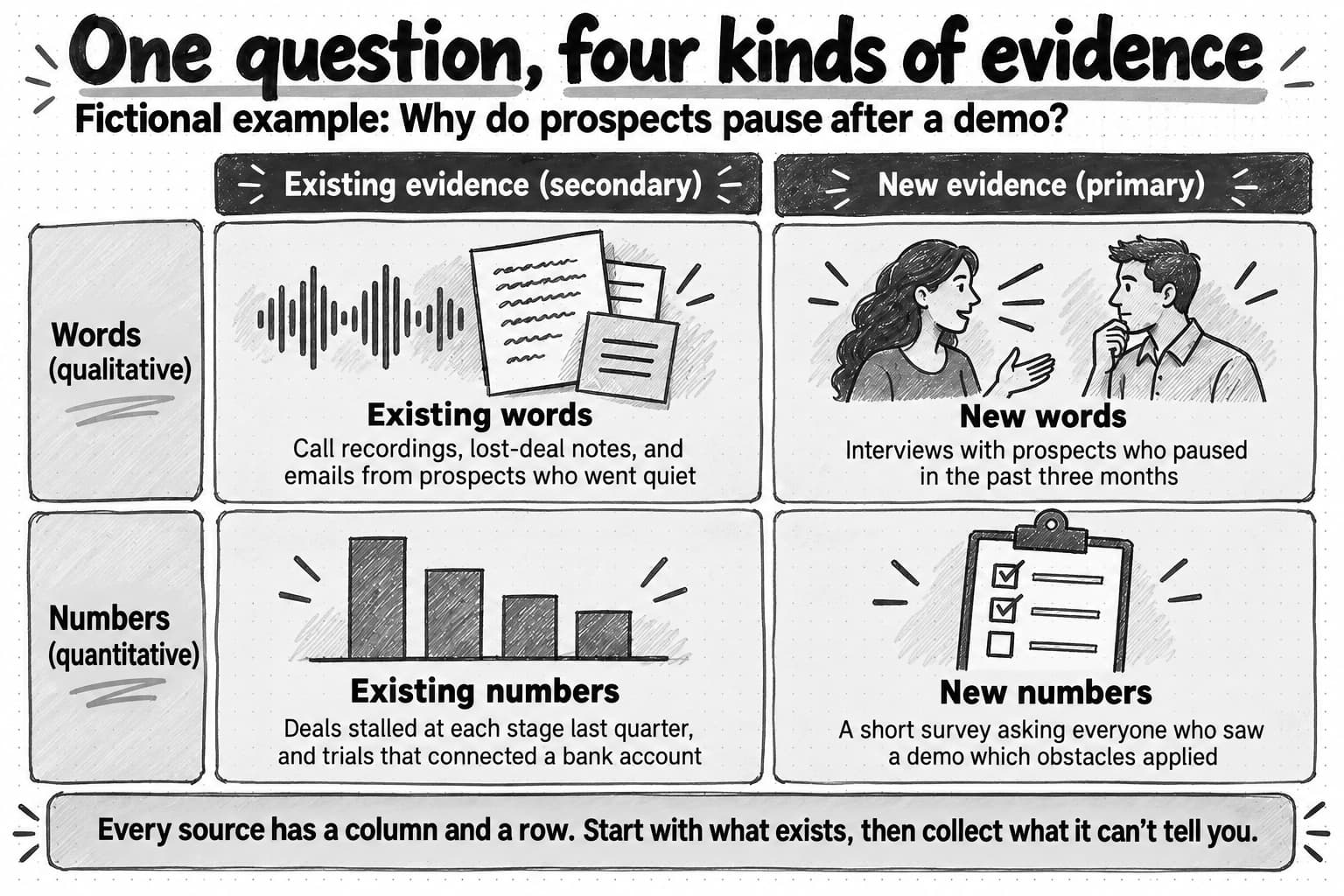
Open the four-kinds-of-evidence grid at full size (opens in a new tab).
Call recordings might reveal that prospects keep asking who else must approve the purchase, and the CRM might show that deals stall between the demo and the trial rather than at the pricing stage. Interviews can then explore that gap from the prospect's side. If they point to a few distinct obstacles, the survey can measure how often each one applies among recent evaluators. Each source answers a different part of the question, and together they make a stronger case than any one of them alone.
Other labels you'll see
Some researchers add a third distinction: what people say versus what they do. Nielsen Norman Group treats it as a separate dimension because the two often disagree: a prospect may say price was the problem, while trial data shows they never connected a bank account and so never saw the product work.
Research types are also named by purpose, such as segmentation, pricing, brand, concept testing, customer satisfaction, and competitor analysis. These names describe the question being asked, and each can draw on several of the methods below. Pricing research might combine competitors' published prices (secondary), interviews about how buyers budget (primary and qualitative), and a willingness-to-pay survey (primary and quantitative).
Common market research methods
Methods are the practical ways of getting evidence. The seven below cover most of what a B2B team uses in its first projects. For each, the useful questions are what it can show, what it can't, and what to watch for.
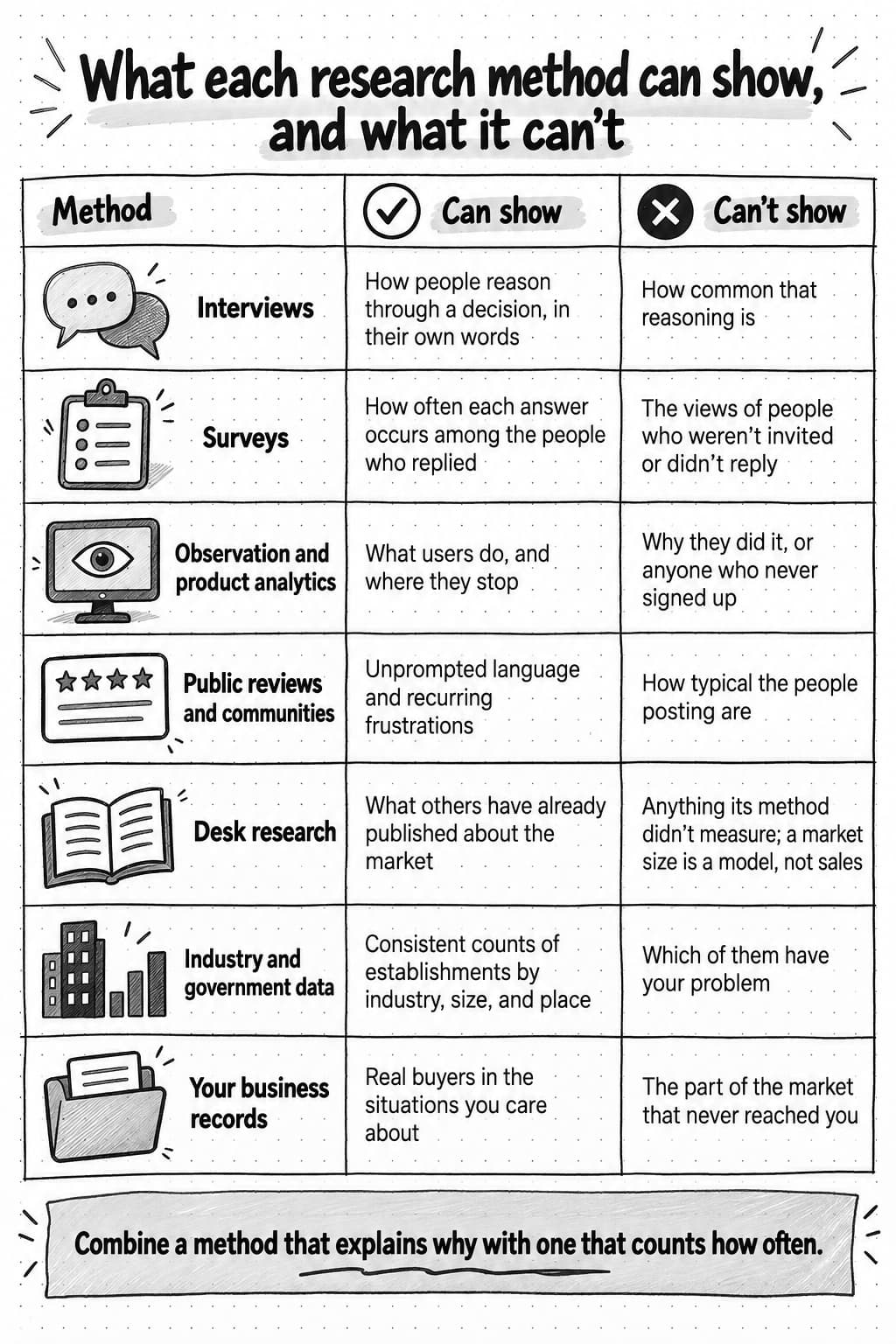
Open the research-methods comparison at full size (opens in a new tab).
Interviews
An interview is a conversation with one person, guided by open questions about a recent experience. It is the best way to learn how someone reasons: what started their search, who else was involved, which alternatives they considered, and what almost made them stop. Interviews also capture the words buyers use for their problem.
Because you speak with a few people you chose, interviews can explain reasoning without showing how common it is. Ask about specific past events, such as "Walk me through your last month-end close," rather than hypothetical futures, such as "Would you use a tool that matched transactions automatically?" What someone did last month is more reliable than a forecast of what they might do, and people tend to be polite about an idea when its creator is the one asking. Recruit people who recently made the decision you're studying, including some who decided not to buy, and stop when new interviews stop adding reasons you haven't already heard.
Surveys
A survey asks many people the same questions, usually with fixed answer options, so the answers can be counted. It is the practical way to estimate how often something applies across a defined group, such as how many recent evaluators needed security approval.
A survey result describes the people who answered it, as the questions were worded. Whether it describes anyone else depends on who was invited and who responded, and a large number of responses doesn't settle that. Pew Research Center found that 12% of adults under 30 in one online opt-in sample claimed to be licensed to operate a nuclear submarine, a qualification almost no Americans hold. Opt-in samples recruit people through ads and websites rather than selecting them at random, and some respondents rush through surveys for rewards.
A survey sent to your own list avoids anonymous panels but has its own skew: the answers come from people who know you and chose to reply. That can still be useful if you report the result as what it is, for example "27 of the 61 evaluators who replied (out of 140 invited) said a security review delayed their trial," rather than as a finding about the whole market.
Observation and product analytics
Observation records what people do. In a usability session, you watch someone attempt a task, such as connecting a bank account, and note where they hesitate. Product analytics records similar behavior at scale through events inside your product, and session recordings sit somewhere between the two.
Observation is valuable because behavior can't be misremembered or exaggerated the way a description of it can. Its limit is that it shows what happened without explaining why. If Ledgerlark's trial data shows that most trials that didn't convert never connected a bank account, the data locates the problem without explaining it: those users might have been confused, interrupted, or waiting for a colleague's permission. Observation also covers only the people you can watch, usually your own users, so it says nothing about the buyers who never arrived.
Public reviews and online communities
Review sites, forums, community groups, and social posts contain buyers describing problems and products in their own words, without being prompted by you. For Ledgerlark, reviews of existing reconciliation and month-end close tools, along with threads in accounting communities, can show which frustrations recur and what practitioners call them.
These sources are self-selected. People who write reviews or posts tend to have strong experiences or particular reasons to post, and each platform attracts its own audience. Some reviews are incentivized or fake. Use public posts as a source of language and hypotheses, check who the writers appear to be, and don't treat the volume of complaints as a measure of how common a problem is.
Desk research
Desk research means reading what others have already published: industry and analyst reports, trade publications, competitor websites, job postings, conference talks, and company announcements. It is the fastest way to get oriented in an unfamiliar market and to find the questions worth asking.
Its value depends on the source, so apply the credibility questions later in this guide before relying on a report. Market-size figures need particular care. A market estimate is a model built on assumptions about how many potential buyers exist and what they might spend; it is not a record of sales that anyone observed. Two reputable firms can publish very different estimates for the same market because they define it differently, so read the method before quoting the number.
When you need a size estimate for your own decision, you can build one from the bottom up: count the organizations that match your definition, estimate what each might spend in a year, and multiply. Bill Aulet's Disciplined Entrepreneurship framework prefers this approach and describes a top-down analysis built from market reports as "much less compelling on its own." A bottom-up estimate is still a model, but its assumptions are yours, and colleagues can check each one.
Industry and government data
Official statistics are collected with published methods and consistent definitions, which makes them useful for sizing and comparing markets. For the segment question, the US Census Bureau's County Business Patterns reports the number of establishments, employees, and payroll for each industry by location and employment size. Accounting, tax preparation, bookkeeping, and payroll services form industry 5412 in the North American Industry Classification System (NAICS).
Official data measures exactly what it says, and that is often not quite what a marketer wants to know. County Business Patterns counts establishments, meaning physical locations with paid employees. A firm with three offices appears three times, while a bookkeeper who works alone doesn't appear at all; the Census Bureau covers businesses without employees in a separate series. The count also can't tell you which firms reconcile accounts for clients, which already use software for it, or who would buy. It describes how large the pool could be, not how many buyers have your problem. Official releases also describe a past reference year, so check the period before using the figures.
Existing business records
Your CRM, call recordings, support tickets, win-loss notes, and billing data describe real buyers and customers in the situations you care about most. For many B2B questions, reading 30 or 40 recent records carefully is the quickest useful research a team can do.
Two cautions apply. Records include only people who reached you, such as prospects who booked a demo or customers who contacted support, so they say little about the part of the market that never found you or dismissed you early. They also reflect how they were recorded. Dropdown reasons, rep summaries, and support categories were designed for day-to-day operations, not for research, so read the underlying notes where you can. Reusing records for research has privacy implications too, which are covered later in this guide.
Exploratory questions and questions about how many
Research questions come in two broad kinds, and the difference determines which methods can help. An exploratory question asks what is going on when you don't yet know the possible answers. What happens between a demo and a decision? How do accounting and bookkeeping firms organize month-end work for their clients? What do buyers call this problem? Qualitative methods fit these questions because they leave room for answers you didn't anticipate.
A question about prevalence, size, or behavior asks how many, how much, or how often. What share of stalled deals mention a security review? How many accounting and bookkeeping firms with 10 to 49 employees operate in our target states? What share of trials connect a bank account in the first week? These questions need a defined group and a consistent measurement across it, which usually means counting records, sending a survey, or using published statistics.
The two kinds work best in sequence. Explore first, so you learn which answers are possible and how people describe them. Then measure, so you learn how common each answer is. Skipping the exploration is a common mistake: a survey written before anyone has spoken to buyers can offer only the answer options the team already imagined, so it measures the team's assumptions. Skipping the measurement is the opposite mistake. A vivid interview becomes the basis for a strategy without anyone checking whether it's typical.
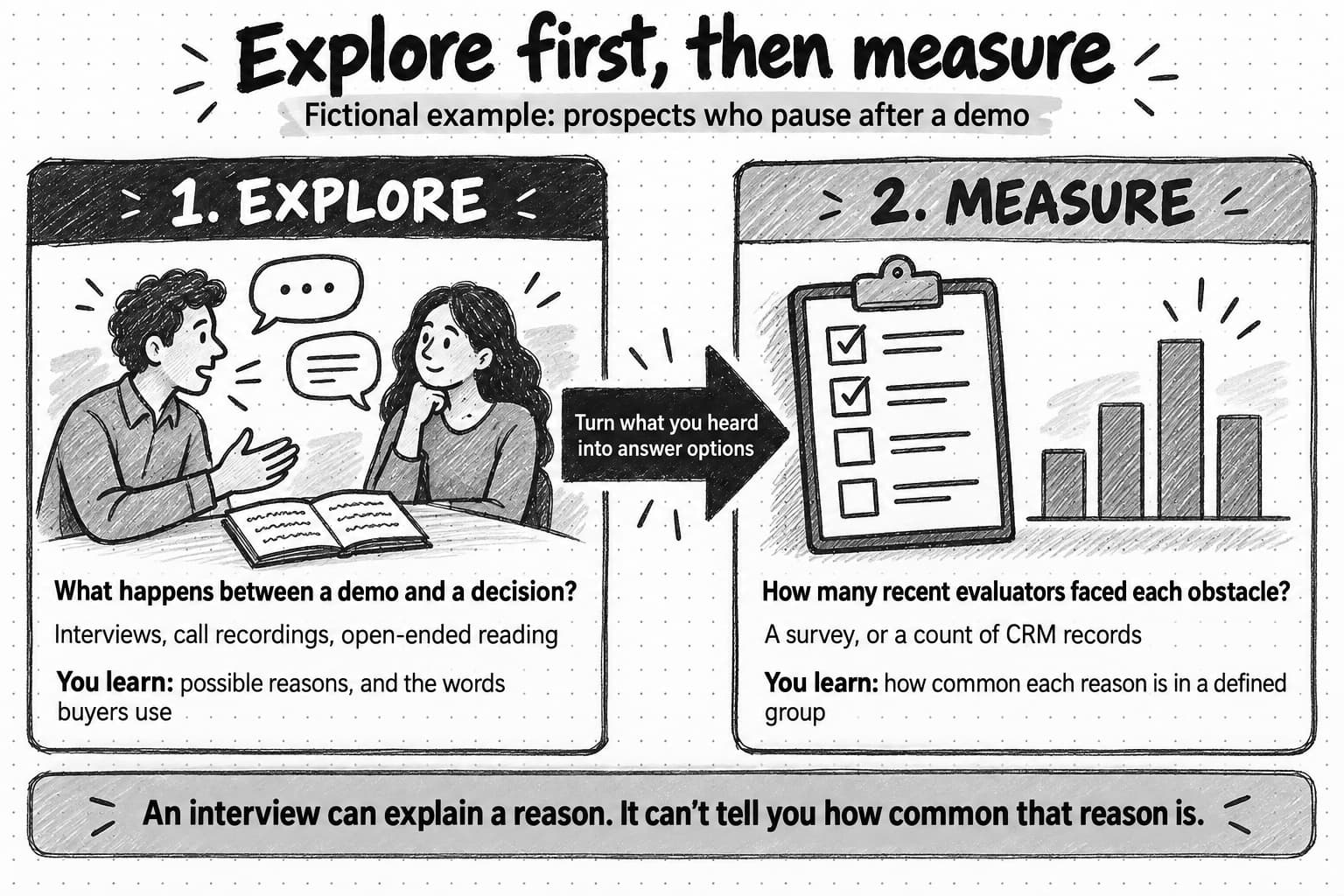
Open the explore-then-measure diagram at full size (opens in a new tab).
A third kind of question asks about cause. Will a security review pack help more trials start? Does a new headline increase demo requests? Neither interviews nor counts can answer these reliably, because other things change at the same time. They need a controlled comparison, such as an A/B test, which is beyond the scope of this introduction.
What's different about B2B market research
Many introductions to market research assume consumer markets, where populations are large and one person usually makes each purchase. B2B research differs in three ways that affect which methods work.
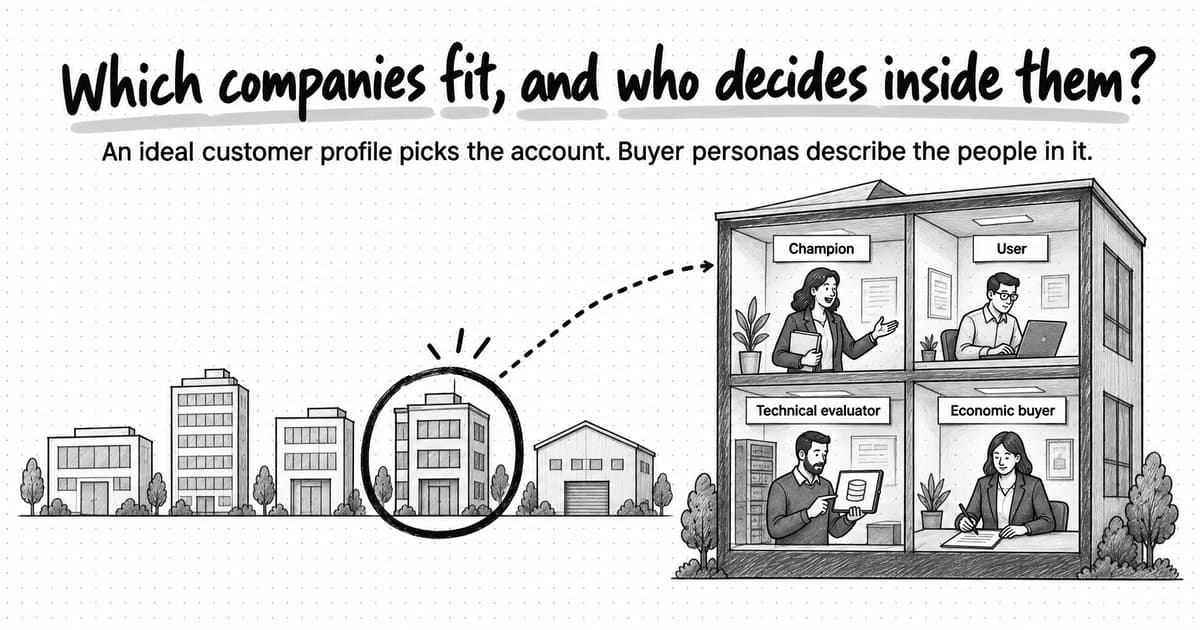
Several people share the decision. A purchase like Ledgerlark's may involve a controller who does the month-end work, a finance leader who owns the budget, and an IT or security reviewer who can block any tool that touches bank data. Each sees a different part of the decision. Interview each group separately and record every participant's role, so you can tell whose view a finding represents. A question about why a deal stalled may need evidence from more than one person at the same company.
Markets are small. A B2B team may have a few thousand potential customer accounts and a few hundred prospects in its CRM. You can often reach everyone in a defined group, such as every prospect who saw a demo last quarter, which makes your records and a short survey of a known list more useful than they would be in a consumer market. Small numbers also mean a percentage can rest on a handful of answers, so report counts alongside shares.
The right people are hard to reach and hard to verify. Senior finance and security staff are busy and receive many requests. Paid survey panels can screen by job title, but respondents describe their own jobs, and anyone willing to claim a submarine license, as some opt-in respondents did in Pew's study, can also claim to be a finance director. Recruit through your customers, prospects, and professional communities where you can confirm who people are, and record how each participant was found.
How to choose a research method
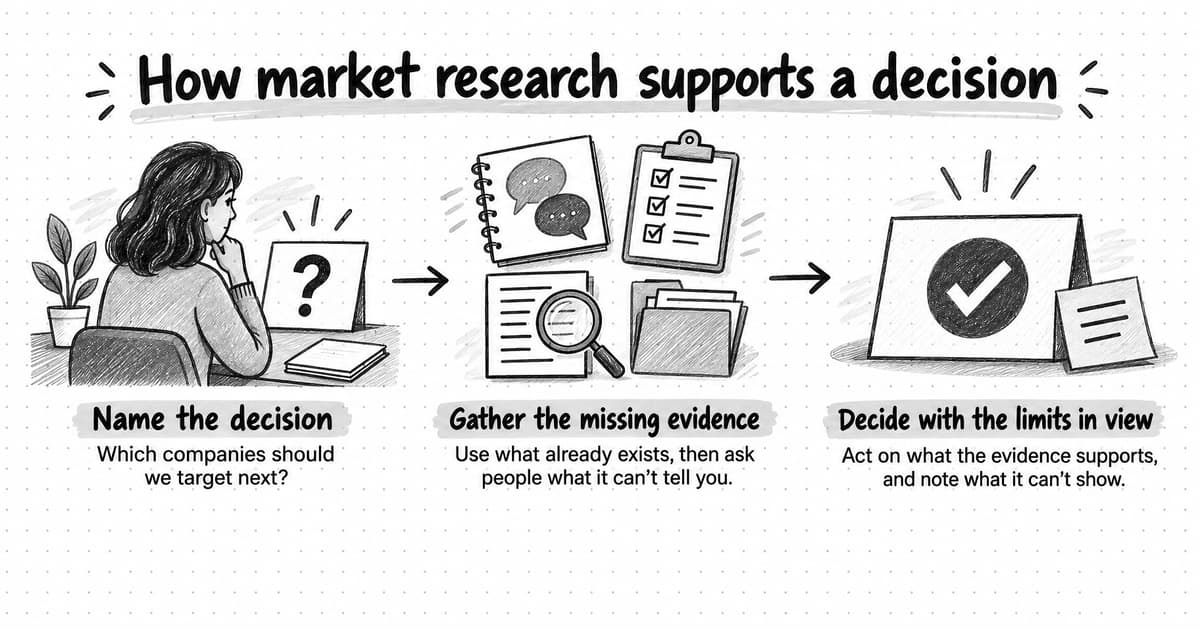
Choose a method by working backward from the decision. Ask which evidence is missing, then find the cheapest credible way to get it. The seven steps below follow the same order as the planning template at the end of this guide.
- Name the decision, its deadline, its options, and what you'd need to believe to choose each one. For example: decide within three weeks whether to target accounting and bookkeeping firms next quarter or keep focusing on in-house finance teams. Choosing the firms would mean believing that they reconcile many client accounts, have someone who can buy software, and can be reached.
- Check what you already know and how you know it. Existing records, public sources, and colleagues' experience often answer part of the question.
- Identify what is missing. It might be an explanation, a count, a record of behavior, or a fact about the outside market.
- Choose the smallest source or method that fills that gap. Eight interviews, a careful review of 40 records, or an afternoon with official statistics is often enough for a first decision.
- Decide who or what to include. Write down how you will choose people, records, or sources, because that choice limits whom the result can describe.
- Decide in advance which result would change your mind. Writing this down before you collect evidence makes it harder to read every result as confirmation.
- Note the limits. Record what the evidence won't be able to tell you, so nobody stretches the findings later.
Here is how that works for Ledgerlark's three questions.
Why prospects pause after a demo
The missing evidence is the prospects' own reasoning, so the team follows the sequence described earlier: recordings and CRM data first, then interviews, then a count across deal notes or a survey if it needs to know how common each obstacle is before investing in a fix.
Whether accounting and bookkeeping firms are worth testing as a segment
The team needs to know whether the segment is large enough to matter, whether firms have the problem Ledgerlark solves, and whether they can buy. County Business Patterns gives a rough ceiling for the first part by counting accounting and bookkeeping establishments in each state and size band. The CRM shows whether any firms have already shown interest, though only among firms that found Ledgerlark on their own. Interviews with six to eight owners or operations leads can explain how client reconciliations are organized, who chooses software, and whether handling many clients' bank data adds approval steps.
How buyers describe the problem
For messaging and content, Ledgerlark wants the words buyers use. Call transcripts and interviews capture that language in context. Reviews of existing reconciliation tools and posts in accounting communities add unprompted phrases from a wider group of practitioners. Keyword tools can show which phrasings people type into search engines, but a search estimate describes searches, not buyers. Google's Keyword Planner reports rounded average monthly searches for a keyword and its close variants, and Google Trends shows a term's popularity relative to all searches, scaled from 0 to 100, rather than a count of searches. Neither tells you how many of those searchers need reconciliation software, let alone would buy it.
The table below summarizes common B2B research questions, a suitable method for each, and the limitation to keep in mind when you interpret the result.
| Question | Suitable method | Evidence it yields | Important limitation |
|---|---|---|---|
| Why do prospects pause after a demo? | Interviews with recent prospects; call recordings | Reasons, sequence of events, other people involved | Explains reasoning; doesn't show how common each reason is |
| How often do stalled deals mention security review? | Coding CRM notes and transcripts from a set period | A count across recorded deals | Covers only deals that reached sales, as reps recorded them |
| How many evaluators face each obstacle? | Survey of everyone who saw a demo in a set period | Share of respondents choosing each answer | Reflects who replied and how the options were worded |
| How many accounting and bookkeeping firms could we reach? | Official business statistics | Establishment counts by industry, size, and location | Counts locations with employees, not buyers with the problem |
| What words do buyers use for the problem? | Interviews, transcripts, reviews, communities | Phrases in context | Public posts over-represent strong views; phrases need testing |
| How much search interest is there in a topic? | Keyword tools, Google Trends | Rounded estimates or relative interest | Measures searches, not buyers or demand |
| Where do new users get stuck? | Usability sessions, product analytics | What users do and where they stop | Shows behavior without reasons; covers only people who signed up |
How to judge whether a source is useful and credible
A source is useful when it answers your question for the people you care about. It is credible when you can see how it was produced. Before relying on a statistic or report, ask:
- Who produced it, and why? A vendor's survey may be designed to show that the problem its product solves is urgent.
- How was the evidence collected? Look for the method, the sample, and the questions that were asked.
- Whom does it cover? Compare its population, geography, company sizes, and industries with your market.
- When was it collected? Markets involving AI change quickly, and official data describes a period that ended before publication.
- What exactly does the number measure? Establishments aren't companies, searches aren't buyers, and respondents aren't a whole population.
- Can you trace it to the original? Statistics repeated from article to article often lose their definitions and dates along the way.
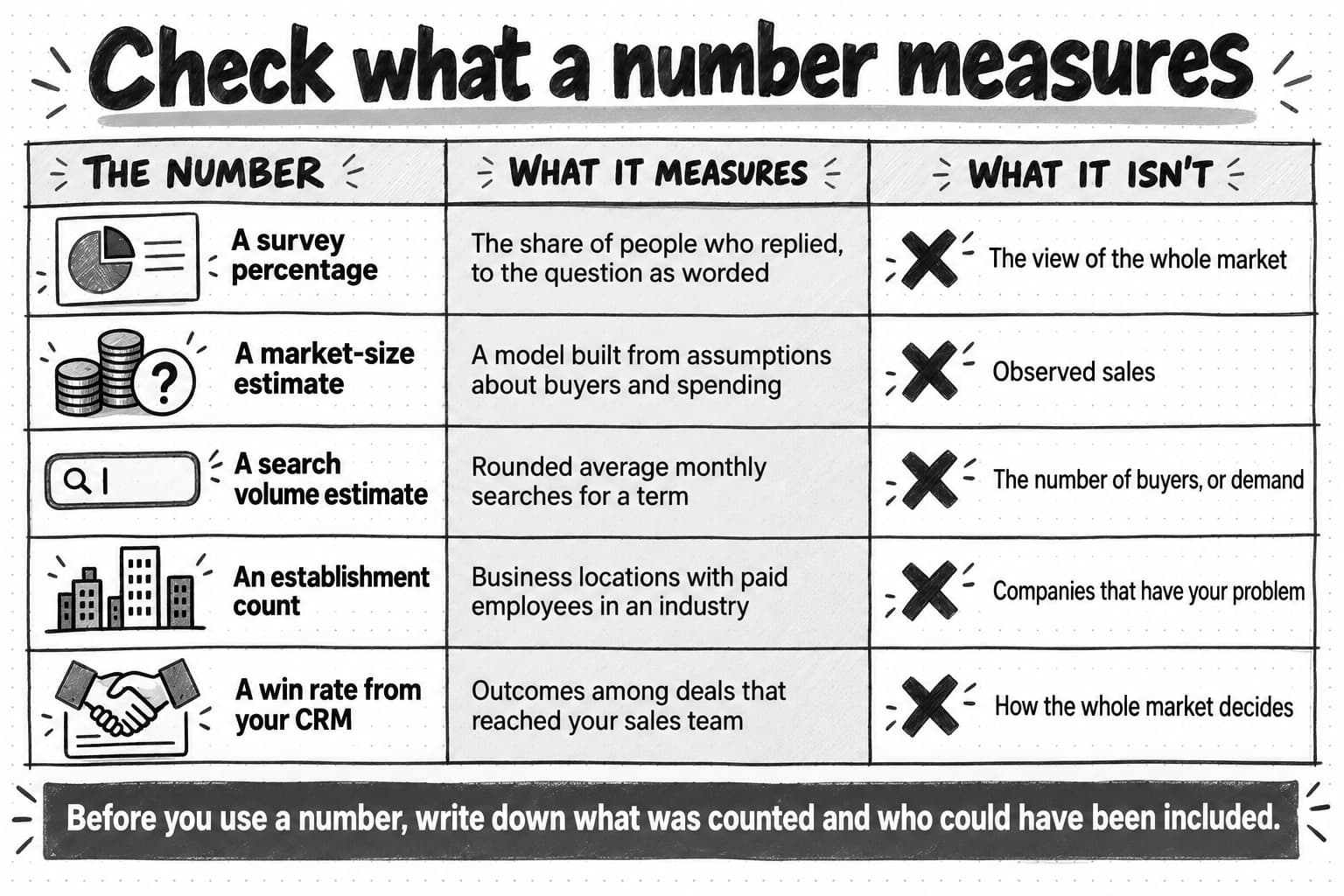
Open the number check at full size (opens in a new tab).
Reputable research makes these questions easy to answer. The ICC/ESOMAR International Code, the international code of conduct for market and social research, requires researchers and their clients who publish findings to give the public enough information about the data source, sampling, and method to assess the conclusions. A report that won't tell you how it was produced deserves less weight in your decision, however polished its charts are.
What affects how you interpret evidence
Even credible evidence needs to be read in light of how it was gathered. Five factors come up again and again.
Who took part
The people you study shape the answers you get. If Ledgerlark interviews customers suggested by its account managers, it will probably hear mostly from satisfied ones. A survey promoted in your newsletter reaches people who already know you. Write down how participants were selected, and whose views that approach leaves out.
Who could not appear in the data
Coverage concerns the people who had no chance of being included. Ledgerlark's CRM can't show why some firms never booked a demo, and a survey of its customers can't show why other buyers chose a competitor. When coverage is limited, keep the conclusion to the group you actually observed rather than extending it to the whole market.
How the questions were asked
Wording, answer options, and question order all influence responses. Pew Research Center's survey guidance describes a poll after the 2008 US presidential election that asked which issue mattered most to people's vote. When the economy was offered as an answer option, 58% chose it; when the question was open-ended, only 35% named it. Interviews have the same risk. A question like "How much time does manual matching waste?" supplies both the problem and how to see it. Ask about recent events and let people name the problem themselves.
When the evidence was collected
Evidence ages. A report on how finance teams used AI a few years ago describes a different market from today's, and a review written before a competitor's major release may describe a product that has since changed. Note the date of every source, and prefer recent evidence when the question involves a fast-moving market.
The situation in which people responded
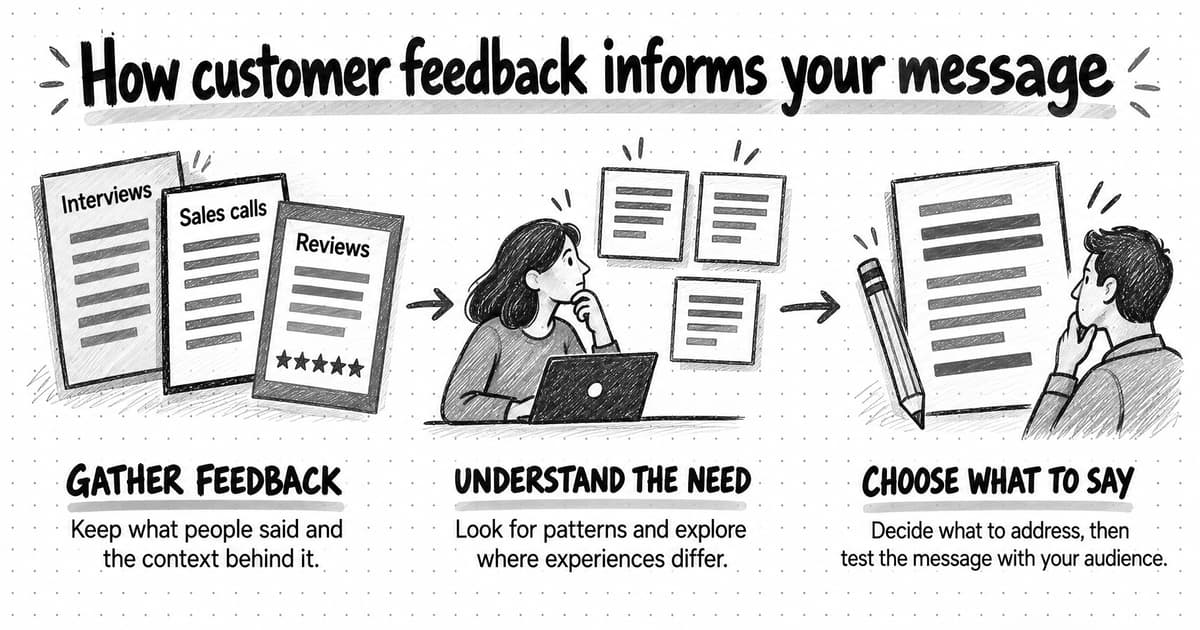
Context changes what people say. A prospect who mentions price during a negotiation may be bargaining rather than describing a budget limit. A review written minutes after a failed import captures frustration at that moment. A survey sent at the end of a support chat reaches people who just needed help. Keep the situation attached to each piece of evidence, as the voice-of-customer guide explains in more detail.
From observation to decision: a worked example
Evidence becomes useful when it changes a decision, but getting from one to the other involves distinct steps. The ICC/ESOMAR Code asks researchers to keep findings, their interpretation of those findings, and their recommendations clearly separate. Doing the same in your own work shows colleagues where the evidence ends and judgment begins.
Observation. Ledgerlark's team interviews eight prospects who paused after a demo last quarter, three of them recruited from deals tagged "stalled at security." Five say their IT or security team must approve any tool that connects to bank data. Two of those five say the review hasn't started because nobody has sent the security team the information it needs.
Interpretation. Security approval may be delaying trials, and some of the delay may be avoidable. Before accepting that explanation, the team lists others the evidence allows. Because three interviewees came from deals already tagged that way, the sample may overrepresent this obstacle. "We need IT approval" can also be a polite way to decline. The pattern might apply only to companies above a certain size.
Check. To learn whether the pattern is common, the team reads the notes on every deal that stalled after a demo in the past two quarters and counts those that mention a security or IT review. The notes on 19 of the 52 deals do: often enough to justify a small test, though a mention doesn't prove the review is what stalled the deal. The count still covers only deals that reached sales, as reps recorded them.
Decision. The response is proportionate to the evidence. The team prepares a security review pack that explains how Ledgerlark handles bank data, sends it after a randomly chosen half of demos for the next six weeks, and compares how quickly trials begin with and without it. Chance, not the sales rep, decides which prospects get the pack, so neither group is stacked with the most promising deals. Before the test starts, the team agrees how much faster trials must begin for the pack to become standard. It doesn't rewrite the homepage around security, because nothing yet shows that security concerns stop buyers from considering Ledgerlark in the first place. That would be a separate question, requiring evidence from people who never booked a demo.
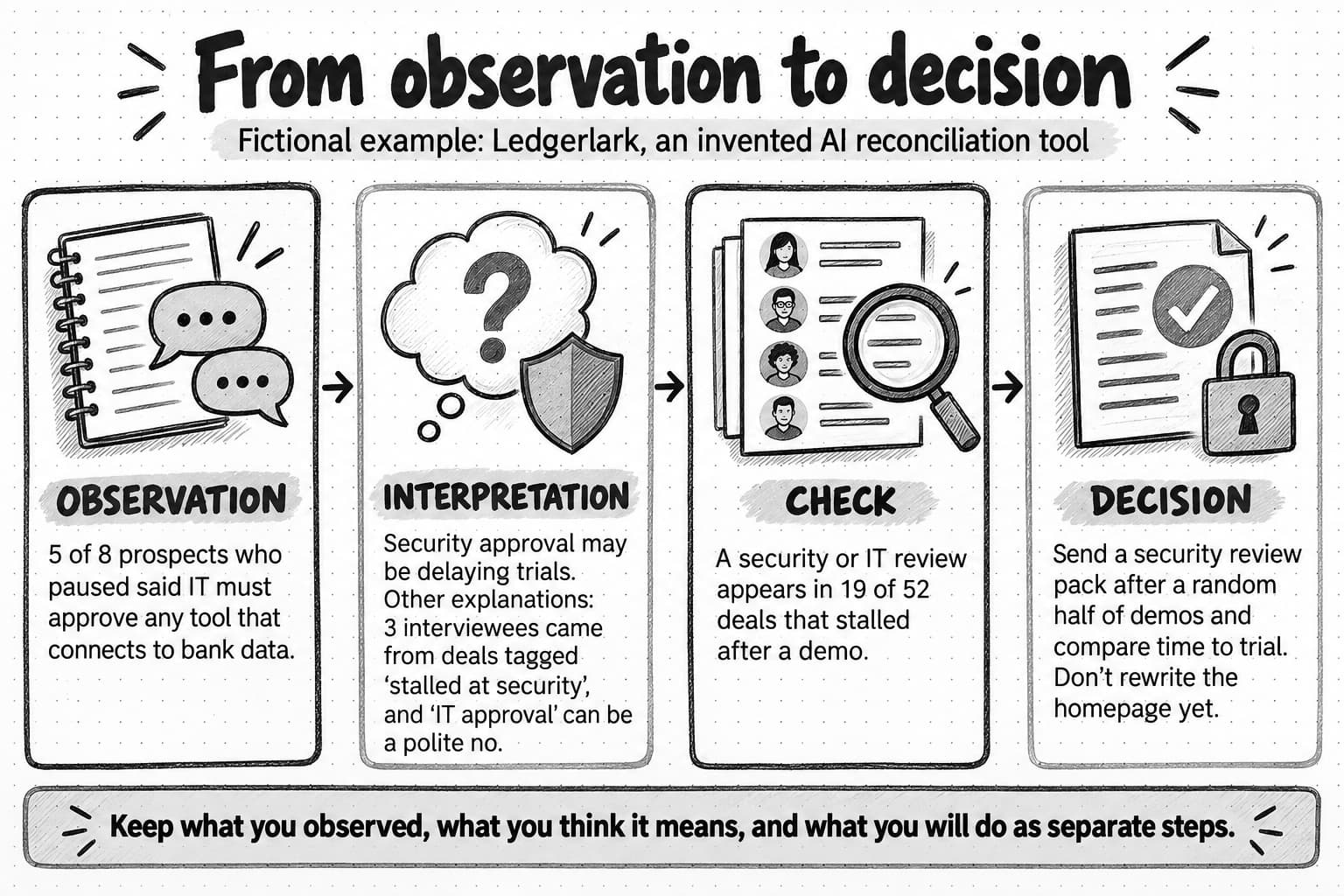
Open the worked example at full size (opens in a new tab).
How research findings shape marketing work
Findings are worth the effort when they change what the team does next. For B2B marketers, they usually inform five kinds of work.
- Audience selection. If interviews show that accounting and bookkeeping firms reconcile many client accounts every month and have an owner who can buy, Ledgerlark has a reason to test that segment with a focused campaign.
- Positioning. Knowing the alternatives buyers consider, such as spreadsheets, the reconciliation features built into accounting software, or outsourced bookkeeping, defines what Ledgerlark has to be better than. The brand positioning guide explains why those alternatives shape a position, and the messaging framework guide shows how to turn it into messages and proof points.
- Content. Buyers' questions and words suggest topics and headlines, and the security finding points to a new reader: the IT reviewer. A content brief can record the evidence behind each piece, and findings worth publishing can become original research content.
- Campaigns. Knowing where buyers look for information and what prompts them to act narrows the channels, offers, and messages worth testing. A campaign run as a test, with a comparison group, can then answer a question about cause.
- Product education. Observed setup problems, such as trials that never connect a bank account, and recurring support questions show what onboarding emails, help articles, and demos need to explain.
Keep each finding linked to its evidence and label what is still a hypothesis. A content plan built on "buyers worry about security" should say whether that came from five interviews or from a survey of every recent evaluator, because the two support different levels of investment.
What AI can and can't do in market research
AI tools are useful throughout a research project, mostly for speeding up the reading, organizing, and drafting around the evidence. They can find and collect public sources, summarize long reports, draft an interview guide or survey for you to review, transcribe and organize interviews, suggest codes for open-ended answers, and compare large sets of public reviews or web pages. Check each of those outputs against the original material; our guide to how deep research agents work sets out a source-by-source check for AI research reports. A summary can merge two different complaints, drop a qualification, or attribute a view to the wrong source.
What AI can't do is create evidence about your market. That evidence has to come from the people, sources, and behavior you are studying: what your buyers did, how common an obstacle is, what an official statistic counts, and whether a message works.
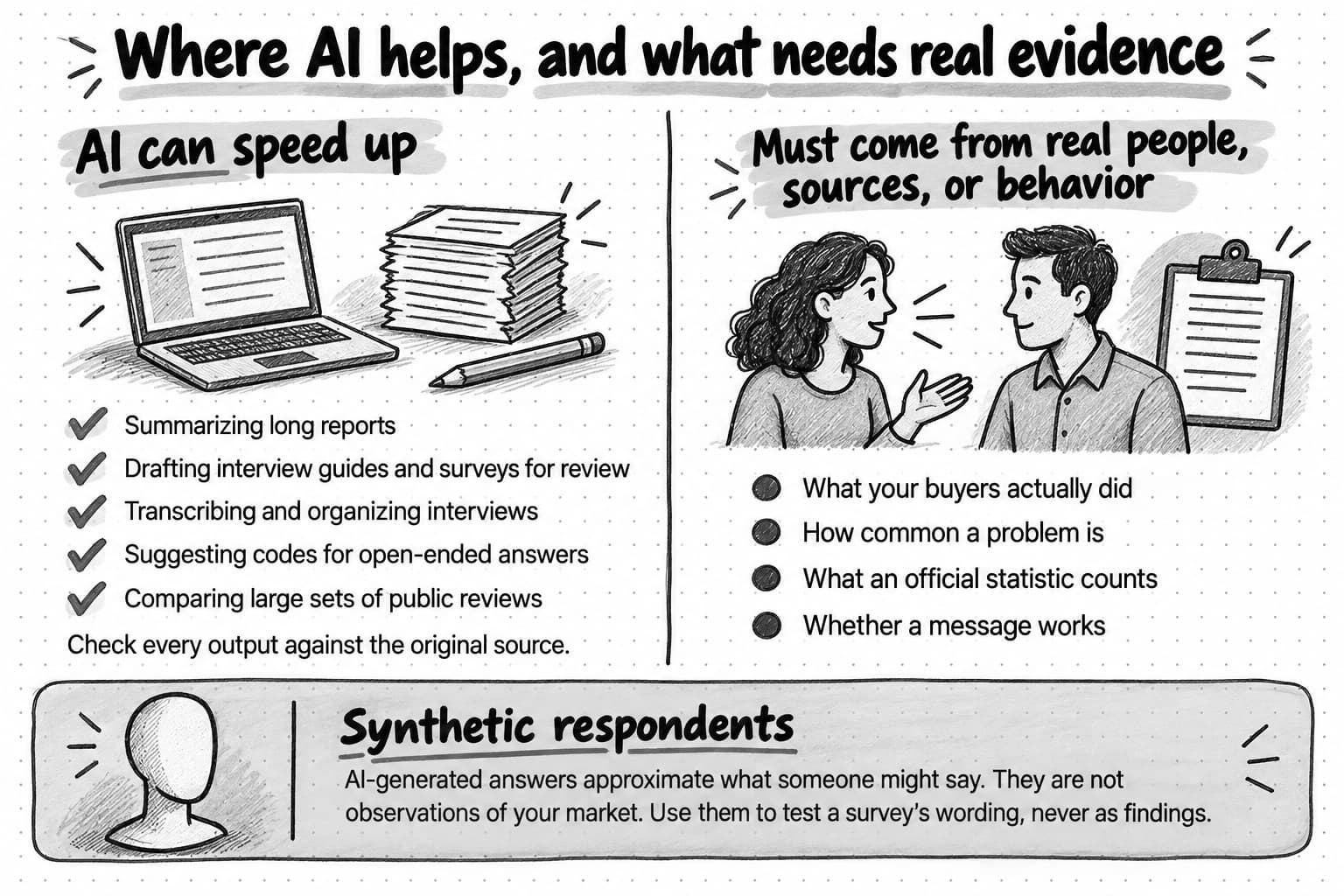
Open the AI and evidence comparison at full size (opens in a new tab).
The distinction matters most with synthetic respondents, AI-generated personas or panels that answer interview and survey questions in place of real people. A 2026 task force report from the American Association for Public Opinion Research (AAPOR) describes a synthetic answer as a model-based approximation of what a person might say, not an observation of anyone. Synthetic answers can sometimes match how answers to a single question are spread, the report notes, but they frequently miss the variety among real respondents and can make results look more representative than they are. A 2024 study it cites found that ChatGPT's answers came close to a real survey's averages but varied less than real people's answers and changed with small edits to the prompt. The report adds that the risk rises when synthetic respondents stand in for groups that are sparse in real data, and specialized B2B roles, such as owners of small bookkeeping firms, are likely to be among them.
Nielsen Norman Group reached a similar conclusion when it compared synthetic users with real research participants: the synthetic answers were often favorable and vague, treated every need as important, and couldn't provide behavioral data. Professional bodies now address the practice directly. The AAPOR report warns of particularly serious risks when synthetic responses go beyond clearly labeled pretesting, pilot work, or other exploratory checks, and the 2025 revision of the ICC/ESOMAR Code requires researchers to tell clients when AI, synthetic data, or synthetic personas are used, along with the extent of human oversight. A synthetic panel can help you rehearse an interview guide or catch confusing survey wording before real buyers see it. Its answers aren't findings, and they shouldn't be counted as evidence.
Ethics and privacy in market research
Research depends on people trusting what happens to the information they share. Professional research codes translate that trust into three practical habits for a B2B team running its own research.
- Keep research separate from selling. An interview with a prospect is not a sales call. The UK Market Research Society's Code of Conduct names selling under the guise of research, known as "sugging," as a practice its members must never undertake. The ICC/ESOMAR Code requires a clear distinction between research and other activities: if sales or promotional follow-up is planned, participants must be told before data collection begins and asked for separate consent.
- Tell participants what will happen. Explain the purpose of the research, how long you will keep the data, and that taking part is voluntary. Ask before recording a conversation.
- Collect and reuse only what you need. Limit personal data to what is relevant to the question. Before reusing call recordings or support tickets for research, check that the new use fits what people were told when the data was collected, and remove names and account details you don't need.
Privacy law also applies, and it varies by country. In the EU and UK, for example, the GDPR and UK GDPR govern how personal data from interviews and business records may be used. If you're unsure, check with whoever handles privacy at your company before recording conversations or reusing personal data.
Plan your first market research project
A first project should be small enough to finish in two or three weeks and specific enough to change a decision. Use the template below. Each field matches one of the seven steps above.
Decision:
What will we decide, by when, and what are the options?
What would we need to believe to choose each one?

What we know:
What evidence do we already have, and where did it come from?

What's missing:
Which explanation, count, behavior, or outside fact would help most?

Source or method:
What is the smallest credible way to get that evidence?

Who or what to include:
Which people, records, or sources, and how will we choose them?

What would change our mind:
Which result would make us choose differently?

Limits:
What will this evidence not be able to tell us?
Here is the plan Ledgerlark might write for its segment question:
Decision:
Within three weeks, decide whether to spend next quarter's test budget
on accounting and bookkeeping firms or keep focusing on in-house
finance teams. Choosing the firms means believing they reconcile many
client accounts, have someone who can buy software, and can be reached.

What we know:
Four firms in the segment booked demos this year without outreach (CRM).
We haven't checked how many firms operate in our five target states.

What's missing:
How firms organize client reconciliations, who chooses software, and
whether client bank data adds approval steps. A rough pool size.

Source or method:
County Business Patterns for NAICS 5412 in our five target states
(one afternoon). Interviews with 6-8 owners or operations leads at
firms with 10-49 employees (two weeks).

Who or what to include:
Recruit from CRM contacts and one accounting community, not only from
firms that already know us. Record each person's role and how we
found them.

What would change our mind:
We lean toward testing the segment. We'll postpone it if most
interviewees say reconciliation happens inside each client's own
software, if owners can't approve new tools, or if client agreements
prevent connecting bank data.

Limits:
Interviews show how some firms work, not how many share the problem.
Establishment counts include firms that do no reconciliation work and
leave out bookkeepers who work alone.
The plan is deliberately modest. It doesn't try to size the entire market or prove that the segment will succeed. It gathers enough evidence to decide whether a test is worth running, and it names the result that would stop the team. That is the right scale for most first projects.
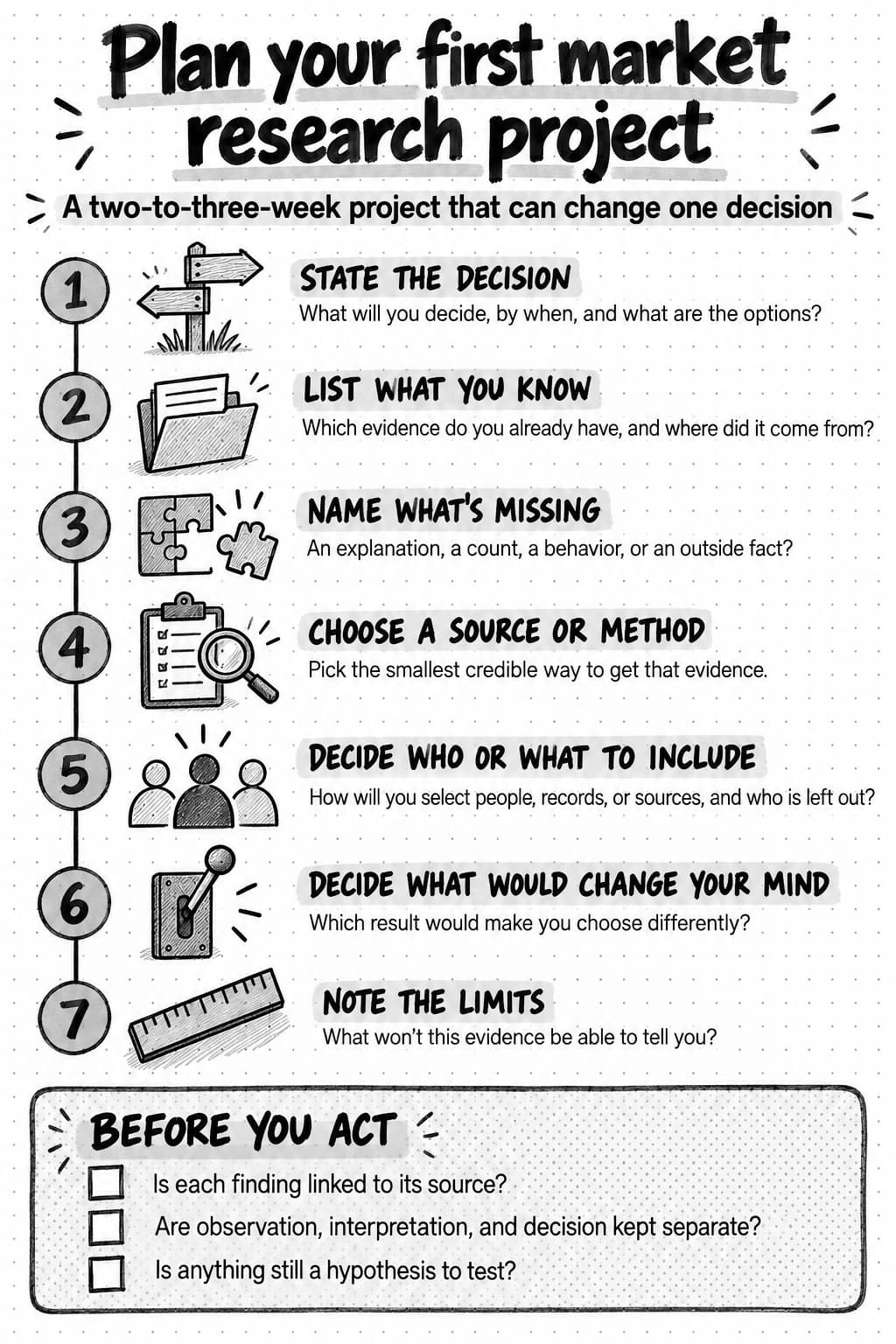
Open the first-project planning reference at full size (opens in a new tab).
Where to go next
Once you can match a decision to the missing evidence and read each source with its limits in view, the more specialized kinds of research become easier to use. If your question is about rival products and their claims, the competitor analysis guide covers choosing competitors, collecting public evidence, and turning comparisons into positioning decisions. If it is about what customers need and how they describe it, the voice-of-customer guide shows how to analyze interviews, reviews, and support conversations and turn them into messages you can test.
Meet Ampere—your AI marketing agent. Ampere can help with the public-source research described here: it can search the web, read and extract pages, and pull public review, social, ads, and company data into structured summaries with their sources. It can also save evidence-backed reports, such as audience, voice-of-customer, category landscape, and search landscape reports, to Brand memory, so later content and campaign work starts from the same evidence. Public sources can be partial, and the interviews, surveys, and final decisions stay with your team.
Sources and further reading
- The 2025 ICC/ESOMAR International Code sets the publishing, consent, data minimization, AI-disclosure, and research-versus-selling rules summarized above, and defines primary and secondary data.
- The UK Market Research Society's Code of Conduct lists selling under the guise of research among the practices its members must never undertake.
- Nielsen Norman Group's guide to choosing research methods explains the qualitative-quantitative and attitudinal-behavioral dimensions.
- Nielsen Norman Group's review of synthetic users compares AI-generated research participants with real ones.
- AAPOR's 2026 task force report, Responsible AI Integration in Survey Research, explains why synthetic responses are approximations rather than observations and where their use carries the most risk.
- Bisbee and colleagues' study of synthetic survey data, published in Political Analysis in 2024, compares ChatGPT's answers with a national election survey.
- Pew Research Center's guide to writing survey questions documents wording, order, and answer-option effects.
- Pew Research Center's analysis of online opt-in polls describes the bogus-respondent problem in opt-in samples.
- The US Small Business Administration's market research guidance compares existing sources with direct research.
- Bill Aulet's guide to sizing a beachhead market, from the Disciplined Entrepreneurship framework, compares bottom-up and top-down market sizing.
- The US Census Bureau's County Business Patterns overview describes what its establishment counts include and exclude; its Nonemployer Statistics cover businesses without paid employees.
- Google Ads Help's Keyword Planner forecast documentation defines average monthly searches and notes that volumes are rounded.
- Google Trends Help's data FAQ explains how Trends normalizes search interest on a 0 to 100 scale.
Frequently Asked Questions
What is market research used for?
Market research is used to inform decisions that depend on facts about people and markets outside your own team. For a B2B company, those decisions include which segment to pursue, what to emphasize in positioning, which topics deserve content, where to run a campaign, what new users need explained, and how to set prices. Research reduces uncertainty but rarely removes it, so a useful project gathers enough evidence to make the decision and names in advance the result that would change it.
What are the main types of market research?
The main types of market research are usually listed as primary, secondary, qualitative, and quantitative, but these are two separate distinctions. Primary and secondary describe where evidence comes from: newly collected for your question, or already gathered for another purpose. Qualitative and quantitative describe its form: words and observations that explain how and why, or numbers that show how many, how much, and how often. Research is also named by purpose, such as pricing, segmentation, or brand research, and each purpose can draw on several methods.
What is the difference between primary and secondary market research?
Primary market research collects new evidence for your question through interviews, surveys, or watching people use a product. Secondary market research uses evidence that already exists and was gathered for another purpose, such as industry reports, government statistics, public reviews, and your own sales and support records. Existing sources save time but may not be specific to your audience, while asking people yourself gives more detail at a higher cost. So start with what exists, then collect new evidence for the part it can't answer.
What are common market research methods?
Common market research methods include interviews, surveys, observation and product analytics, public reviews and online communities, desk research, industry and government data, and a company's existing business records. Interviews explain how people reason without showing how common that reasoning is; surveys estimate how often something applies across a defined group, but a result describes the people who answered, as the questions were worded; product analytics shows what users do without explaining why. When a method's limit matters to your decision, check that point with another source.
How do you conduct market research step by step?
To conduct market research step by step, work backward from a decision. Name the decision, its deadline, its options, and what you'd need to believe to choose each one; check what you already know and how you know it; identify the missing evidence; choose the smallest source or method that fills that gap; decide who or what to include; decide in advance which result would change your mind; and note what the evidence won't be able to tell you. The guide's planning template follows the same seven steps.
What is an example of market research?
One example is a software company investigating why prospects go quiet after a product demo. In the guide's fictional worked example, five of eight interviewed prospects who paused cite IT or security approval, although three of the eight came from deals already tagged with that obstacle. A count across 52 stalled deals then finds a security or IT review mentioned in 19. That is enough to justify a small test, sending a security review pack after a randomly chosen half of demos, though not to rewrite the homepage around security.
Where can you get market research data?
You can get market research data from sources that already exist and from people you ask yourself. Existing sources include your CRM, call recordings, and support tickets; official statistics such as the US Census Bureau's County Business Patterns; industry and analyst reports; competitor websites; public reviews and online communities; and keyword tools such as Google Trends. Interviews and surveys cover what those sources can't. Each source still needs checking: who produced it and why, how and when the evidence was collected, whom it covers, and what its numbers measure.
Can ChatGPT do market research?
ChatGPT can do part of the work around market research, but it can't produce evidence about your market. It can summarize reports, draft an interview guide or survey for you to review, organize interview notes, and suggest codes for open-ended answers, and each output needs checking against the original material. When it answers as a synthetic respondent, it approximates what someone might say. A 2024 study found ChatGPT's answers came close to a real survey's averages but varied less than real people's and changed with small edits to the prompt.
What are the best market research methods for small businesses?
For a small business, the best market research method is the smallest credible one that fills the gap a specific decision leaves open. In B2B, that often means reading 30 or 40 recent CRM notes, call recordings, or support tickets, then interviewing six to eight people who recently made the decision you're studying, including some who chose not to buy. B2B markets are small, so you can often survey everyone in a defined group, such as every prospect who saw a demo last quarter, and should report counts beside percentages.
What is the difference between market research and marketing research?
Market research and marketing research overlap, and the terms are often used interchangeably. Writers who distinguish them say market research studies a market and the people in it, while marketing research also covers a company's own marketing, such as how well an ad or a price performs. The guide uses market research throughout.