How to define the brand voice for your company (with examples)
Turn a handful of vague adjectives into writing guidance a teammate, freelancer, or AI marketing agent can follow.
19 min readWritten by Ampere

Contents
- Where brand voice fits
- Find the voice you already have
- Define a voice when the company is new
- Turn adjectives into instructions
- A completed brand voice guide for a fictional business
- Keep one voice while the tone changes
- Copy this brand voice guide template
- Apply the guide across channels
- Give AI the guide, examples, and the actual job
- Review new writing against the guide
- Maintain the guide without freezing the brand
- Sources and further reading
You can usually recognize an undocumented brand voice by the edits people keep making.
The founder removes the same inflated phrases from every landing page. The marketer shortens introductions that take too long to get to the point. A support lead replaces cheerful jokes when a customer is stuck. Nobody has written down the pattern, but a pattern is there.
A useful brand voice guide captures that judgment. It explains the consistent personality behind the writing, then translates that personality into choices another person can see and repeat: which words fit, how sentences move, how much the writer assumes, when humor is welcome, and what changes when the reader needs reassurance rather than excitement.
By the end of this guide, you will have enough to write a credible first version, test it on real copy, and tell someone exactly why a draft does or does not sound like your company.
Where brand voice fits
Brand voice is the recognizable personality a company expresses through language. It appears in vocabulary, rhythm, formality, point of view, humor, level of detail, and the relationship the writing creates with the reader.
If a company is calm, candid, and practical, those qualities should be perceptible in a homepage, an onboarding email, and a late-payment reminder. The messages will differ, yet the word choices should still feel as though they came from the same company.
Voice sits beside several other parts of a brand that are easy to blur together:
| Part of the brand | The question it answers | Example |
|---|---|---|
| Positioning | Why should this audience choose us instead of an alternative? | Bookkeeping for small creative studios that want useful explanations, not a pile of reports |
| Messaging | What ideas and claims do we repeat? | Know what came in, what is due, and what needs attention |
| Brand voice | How do we sound when we express those ideas? | Calm, plainspoken, exact, and free of scolding |
| Tone | How does that voice adjust to this reader and moment? | Brighter for a launch; restrained and direct when a deadline slips |
| Visual identity | How do we look? | Type, color, imagery, layout, and logo use |
Each part answers a different question. Positioning tells a writer which benefit to lead with. Voice determines whether to write “Get a clear view of your cash” or “Unlock real-time financial visibility,” while product evidence determines which claim is true. Visual identity can make either sentence look like your brand. The wording decides whether it sounds like your brand.
Voice and tone are especially easy to confuse. Mailchimp’s public content guide describes its voice as relatively stable while its tone changes with the reader’s situation. Shopify’s guidance makes a similar distinction and recommends responding to the specifics of the situation rather than presuming how a reader feels. That is a useful operating rule: keep the company’s character; adjust the volume, warmth, urgency, and amount of explanation.
Find the voice you already have
For an established business, defining a voice is usually an act of selection before it is an act of invention. Your company has already written things that feel right, things that feel wrong, and things that contain one good sentence buried under five forgettable ones.
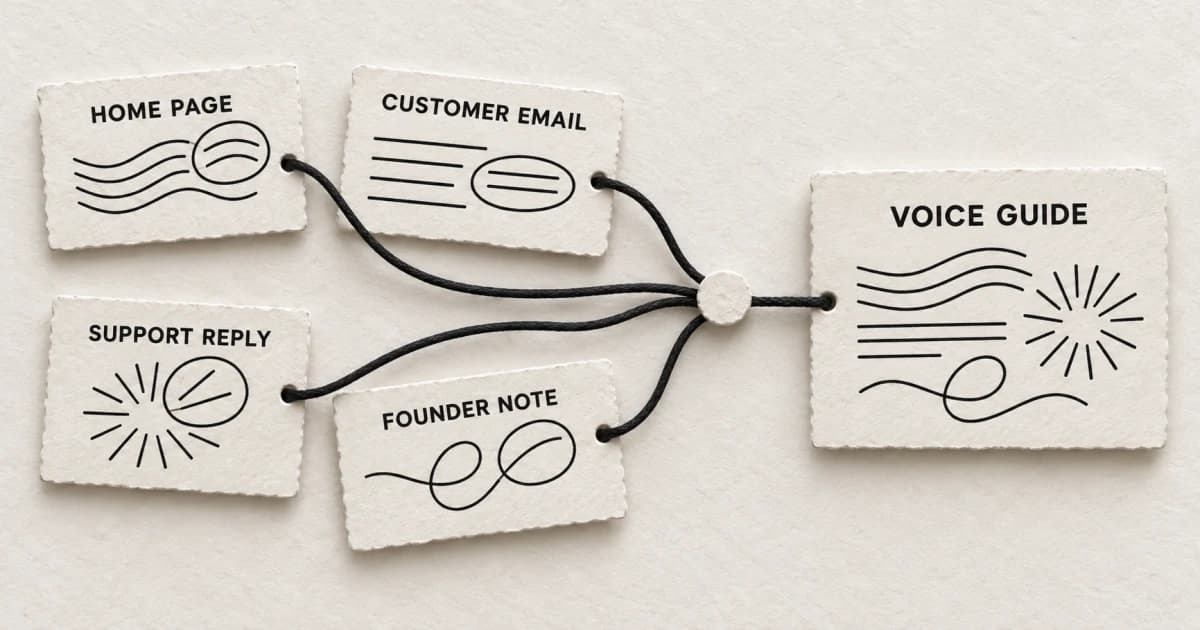
Start with a small sample from different contexts:
- The homepage or sales page that best explains the business
- Two emails people regularly reply to
- A sales proposal, onboarding note, or support response
- Three social posts that still feel representative
- A founder note, interview, presentation, or recorded call in which the company’s point of view comes through naturally
Do not assume the most polished asset has the strongest voice. A carefully produced homepage may have passed through so many reviewers that it sounds like nobody. A founder’s unscripted explanation may contain the better raw material: a vivid comparison, a firm opinion, or a refreshingly simple way to explain the product.
Mark passages that sound distinctly like the company, then name what the writing is doing. “Friendly” is an impression. “Uses contractions, addresses the reader as ‘you,’ and explains unfamiliar terms without announcing that they are simple” is evidence.
Look for patterns in six places:
- Vocabulary. Everyday words or specialist terms? Concrete nouns or abstract business language? Any phrases people naturally repeat?
- Sentence structure. Short and clipped, flowing and explanatory, or a deliberate mix? Does the main point arrive in the first line or after context?
- Formality. Contractions, first person, fragments, slang, honorifics, emoji, and punctuation all move the writing along a formal-to-casual range.
- Relationship to the reader. Does the brand teach, challenge, reassure, entertain, or advise? Does it sound like a peer, a specialist, a host, or a coach?
- Evidence and detail. Does it make broad claims, show its workings, cite sources, define technical terms, or assume prior knowledge?
- Boundaries. Which phrases trigger an immediate rewrite? What kinds of jokes, claims, or emotional language feel false?
The boundary examples are often the fastest route to clarity. Many teams struggle to explain what “confident” means, but can immediately agree that “We’re revolutionizing the future of work” is not it.
Listen to customers without impersonating them
Customer language helps you understand which words are familiar, which problems feel urgent, and which explanations land. Review sales calls, support questions, survey responses, reviews, and search queries for repeated language. Preserve the meaning and emotional weight, then filter the wording through your own voice.
If customers say they want to “know what I can safely spend,” that phrase may be more useful than the company’s “real-time cash-flow intelligence.” It tells you how the problem is experienced. Copying every abbreviation, complaint, or bit of industry slang would erase the company’s own perspective. Your voice should meet the audience in language they understand while still sounding like your company.
Separate the founder’s perspective from their speech habits
In a young company, the founder often carries the clearest sense of what the business believes. Capture the distinctions they insist on, the claims they refuse to make, the examples they use, and the assumptions they challenge.
A transcript is source material for the founder’s perspective. Speech is full of repetition, unfinished sentences, and private shorthand, so look beneath those habits for the principles worth preserving. A founder who repeatedly says “we show the working, not just the answer” has given you a voice principle. Saying “you know” four times a minute is simply a speech habit.
Define a voice when the company is new
A new company may have little published material and no stable pattern to audit. You can still define a starting voice. Treat it as a hypothesis, then test whether it holds up in real writing.
Begin with three inputs:
- The company’s position. A premium specialist, a friendly guide, and a category challenger should not sound interchangeable.
- The audience’s expectations. A buyer choosing payroll software needs a different balance of warmth and precision from someone browsing a novelty gift shop.
- The company’s credible character. Choose qualities the people and product can sustain. “Irreverent” will fail quickly if every joke needs three rounds of approval.
Then collect reference passages from outside the company. Choose examples for a specific reason: one brand handles technical explanation well; another has the right degree of formality; a third demonstrates how to be warm without becoming effusive. Record the feature you want to learn from. “Sound like this brand” is too broad to guide a writer, and imitating surface quirks rarely imports the strategy that made them work.
Write two or three test passages early: a homepage introduction, a routine email, and a difficult message. A voice that only works in launch copy needs more range. The difficult message will show you where the guidance breaks down.
Turn adjectives into instructions
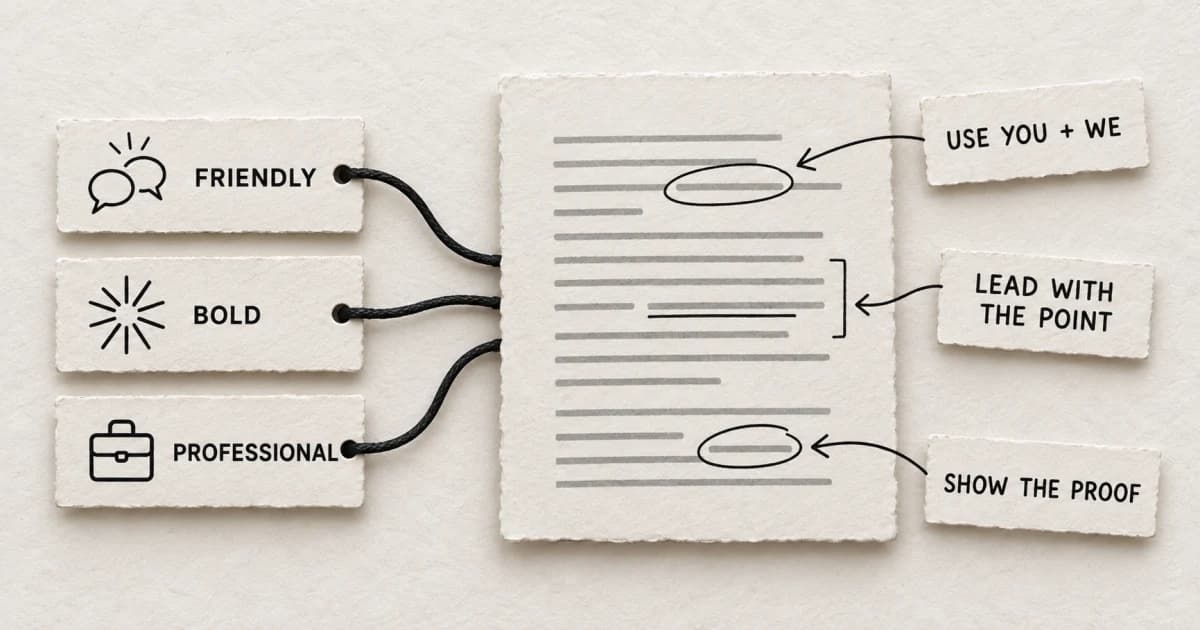
Three or four voice traits are usually enough for a first guide. The number matters less than the work each trait does. “Friendly, bold, professional, authentic, innovative, and human” sounds comprehensive, but every company could claim it and two writers could interpret it in opposite ways.
For each trait, write four things:
- What the trait means for this company
- What it does not mean
- The observable choices it produces
- A short before-and-after example
Here is what that translation looks like:
| Vague trait | Observable guidance |
|---|---|
| Friendly | Use “you” and “we,” contractions, and ordinary words. Acknowledge the reader’s goal. Do not add exclamation marks, pet names, or forced enthusiasm. |
| Bold | State the conclusion early. Prefer specific claims you can support. Do not use swagger, absolutes, or provocation merely to attract attention. |
| Professional | Be prepared, accurate, and respectful. Explain the consequence and next step. Do not become stiff, distant, or heavy with jargon. |
Slack’s published brand guidelines use paired boundaries such as confident without becoming cocky and witty without becoming silly. The value lies in the edge each pair identifies. Microsoft’s style guide goes further by connecting its principles to short everyday words, contractions, sentence-style capitalization, and getting to the point quickly. A writer can act on those choices.
A completed brand voice guide for a fictional business
The example below uses Northline Books, a fictional bookkeeping studio for small creative businesses. Its made-up service details stay fixed throughout the examples: clients receive a monthly financial summary by the fifth business day, covering cash balance, taxes set aside, and overdue invoices.
Voice in one paragraph
Northline Books sounds like a calm specialist sitting beside the reader, making the numbers usable without making the reader feel judged. We lead with the practical answer, explain enough to support a decision, and name uncertainty plainly. Warmth comes through in useful help, confidence through exact answers. Bubbly language and absolutes stay out. We use bookkeeping terms when they help, and define them when we do.
Voice traits
| Trait | What it means | What it does not mean |
|---|---|---|
| Steady | Calm pacing, no manufactured urgency, clear next steps | Cold, passive, or vague |
| Plainspoken | Familiar words and concrete explanations | Oversimplified or imprecise |
| Exact | Dates, amounts, owners, and consequences are named when known | Dense with detail or falsely certain |
| Nonjudgmental | Describe the situation and help the reader act | Euphemistic, overly apologetic, or afraid to be direct |
Writing choices
- Vocabulary: Prefer “money in,” “money out,” “taxes set aside,” “invoice,” and “what needs attention.” Use “cash flow” when it is the accurate term, then explain it in context. Avoid “financial wellness,” “unlock,” “crush your goals,” “effortless,” and fear-based language about mistakes.
- Sentence structure: Put the answer or status in the first sentence. Use mostly short and medium sentences, with a longer sentence when the explanation needs it. Keep one main idea per paragraph.
- Formality: Use contractions and address the reader as “you.” Write as “we” when Northline is taking responsibility. No emoji in service messages. Exclamation marks are rare and reserved for genuine congratulations.
- Humor: Light observational humor is acceptable in educational content. Do not joke about debt, taxes, missed payroll, overdue invoices, or a reader’s confusion.
- Technical detail: Use the correct bookkeeping term when it helps the reader make a decision. Define it in ordinary language on first use. Show the calculation or source when a number could affect an action.
- Avoid: Scolding, cute euphemisms, breathless optimism, unsupported guarantees, and language that implies the reader should already understand the numbers.
Before and after: a routine monthly update
Before
Great news! Your May financial wellness snapshot is officially ready to unlock. Dive in to discover your current cash position, tax readiness, and outstanding receivables. These are the three areas to review this week so you can make empowered decisions with confidence!
After
Your May summary is ready. It shows your current cash balance, the amount set aside for taxes, and the invoices that are overdue. Those are the three areas to review this week.
The underlying message is the same: the monthly summary is ready and contains three specific areas. The revision changes the editorial choices:
- “Your May summary is ready” gives the status immediately instead of surrounding it with celebration.
- The three contents are named in the same language Northline uses in its guide. “Tax readiness” and “outstanding receivables” are technically accurate; here, they add distance without adding precision.
- The final sentence keeps the action concrete by naming what to review and dropping the abstract promise to “empower” the reader.
- The exclamation mark and promotional verbs disappear to match a routine service moment.
Before and after: an overdue invoice notice
Before
Don’t worry. We all get busy! Three invoices totaling $4,200 are now more than 30 days overdue, but a quick nudge can get your financial wellness back on track. Northline has not counted the $4,200 as available cash. The summary lists each invoice and a draft follow-up you can send today.
After
Three invoices are more than 30 days overdue. Together, they account for $4,200 that Northline has not counted as available cash. The summary lists each invoice and a draft follow-up you can send today.
Both versions contain the same facts and next step. The first wraps them in reassurance the reader did not ask for and vague phrases such as “financial wellness” and “back on track.” “We all get busy” also hints that the reader neglected the invoices, though the facts do not establish why they are overdue. The revision names the condition, consequence, and action without judging the reader.
Keep one voice while the tone changes
Tone responds to the reader’s situation. A launch can carry more energy. A routine update should stay out of the way. A delay requires candor, restraint, and a clear recovery plan. The voice underneath can remain steady, plainspoken, exact, and nonjudgmental.
The following three messages communicate one core fact: Northline’s monthly summary covers cash balance, taxes set aside, and overdue invoices, and is normally delivered by the fifth business day.

Launch announcement
A clearer monthly summary arrives on the fifth business day. You’ll see your cash balance, taxes set aside, and overdue invoices first, followed by the notes behind the numbers.
The tone is positive and forward-looking. “A clearer monthly summary” gives the change some energy, while the rest stays concrete. The energy remains measured even though the news is good.
Routine client message
Your monthly summary is ready. It covers your cash balance, taxes set aside, and overdue invoices. Reply if you want to walk through any of the notes together.
The tone is neutral and helpful. The message is shorter because the reader already knows the service. The invitation adds warmth without turning a routine delivery into an event.
Delay notice
Your monthly summary will arrive on the seventh business day, two days later than planned. We’re still checking the cash balance, taxes set aside, and overdue invoices. We’ll send the completed summary by 3 p.m. Thursday and let you know sooner if that changes.
The tone becomes more direct and accountable. It names the delay, the unfinished work, the new time, and the next update. The underlying voice is still recognizably Northline: calm, exact, and free of blame.
This is why a useful guide defines both the constant and the range. “Always sound upbeat” will fail the moment the company has disappointing news. “Sound like a steady specialist, then match the energy to the situation” gives a writer room to respond appropriately.
Copy this brand voice guide template
Keep the first version short enough that someone will use it while drafting. One or two pages with real examples will outperform a long deck that describes the brand beautifully but never settles a sentence.
BRAND VOICE GUIDE

Company:
Audience:
Position in one sentence:

VOICE IN ONE PARAGRAPH
Describe who the company sounds like, its relationship to the reader,
and the qualities that should remain recognizable in every situation.

VOICE TRAITS

1. [Trait]
What it means:
What it does not mean:
Observable choices:
Before:
After:

2. [Trait]
What it means:
What it does not mean:
Observable choices:
Before:
After:

3. [Trait]
What it means:
What it does not mean:
Observable choices:
Before:
After:

WRITING CHOICES

Vocabulary we prefer:
Vocabulary we avoid:
Sentence length and rhythm:
Level of formality:
Point of view (we, I, the company name):
Humor:
Technical detail and definitions:
Claims and evidence:
Language or topics that need extra care:

TONE BY SITUATION

Good news or launch:
Routine information:
Confusion or support:
Delay, error, or disappointment:

REFERENCE EXAMPLES

Three examples that sound like us:
Three examples that do not sound like us, with reasons:

OWNER AND MAINTENANCE

Guide owner:
Approved by:
Last reviewed:
Review again when:
The template deliberately asks for examples that do not sound right. Positive examples show the destination; rejected examples reveal the boundaries. Keep the reason beside each rejection so a future writer does not copy the sentence and miss the lesson.
Apply the guide across channels
A channel changes the shape of the writing more often than it changes the voice. A social post may be shorter and more topical than a guide. A product message has less room and a more immediate job. A sales page can make a fuller argument. Those constraints affect length, structure, and emphasis while the company’s personality stays recognizable.
Add channel notes only when the channel creates a recurring decision. For example:
- On social, does the brand use emoji, respond in first person, or join cultural conversations?
- In product messages, does the action come before the explanation? How does the brand handle errors and irreversible actions?
- In long-form content, how much background does the audience need? How are sources shown?
- In sales material, which claims require evidence, and which phrases overstate the offer?
Do not fill the guide with theoretical rules. Add a channel rule after you have seen the decision recur.
Give AI the guide, examples, and the actual job
An AI marketing agent can apply a voice guide more reliably when the guide contains observable choices and examples. “Sound warm and professional” leaves the model to supply its own version of warmth and professionalism. A short guide with preferred vocabulary, sentence patterns, boundaries, and approved passages narrows the interpretation.
If you want help producing that first version, Ampere can study a company’s public material, create an editable Brand voice report, and save it to Brand memory. Ampere can then reuse the same guidance in later tasks and Projects instead of starting from a fresh description each time. Watch the Brand voice demo to see a replay of the real Ampere run that created this guidance for Notion.com.
For each assignment, provide the voice guide alongside the facts, audience, purpose, format, and source material. The guide governs how the message is expressed. Source material and product information supply what the message can truthfully say. Our guide to briefing an AI marketing agent covers the rest of that handoff.
Let AI draft and flag possible mismatches, then have a person make the final call. Ask it to point to the rule behind each suggested edit. If it cannot explain the edit in terms of vocabulary, structure, tone, evidence, or another documented choice, the feedback may be generic preference rather than brand guidance.
Examples also need maintenance. An old passage can be beautifully written and no longer represent the company’s position. Keep dates or source links with important examples, and remove them when the facts, offer, or audience changes.
Review new writing against the guide
A practical review separates facts, voice, and tone. If those are mixed into a single question such as “Does this feel on-brand?”, feedback becomes subjective and hard to resolve.
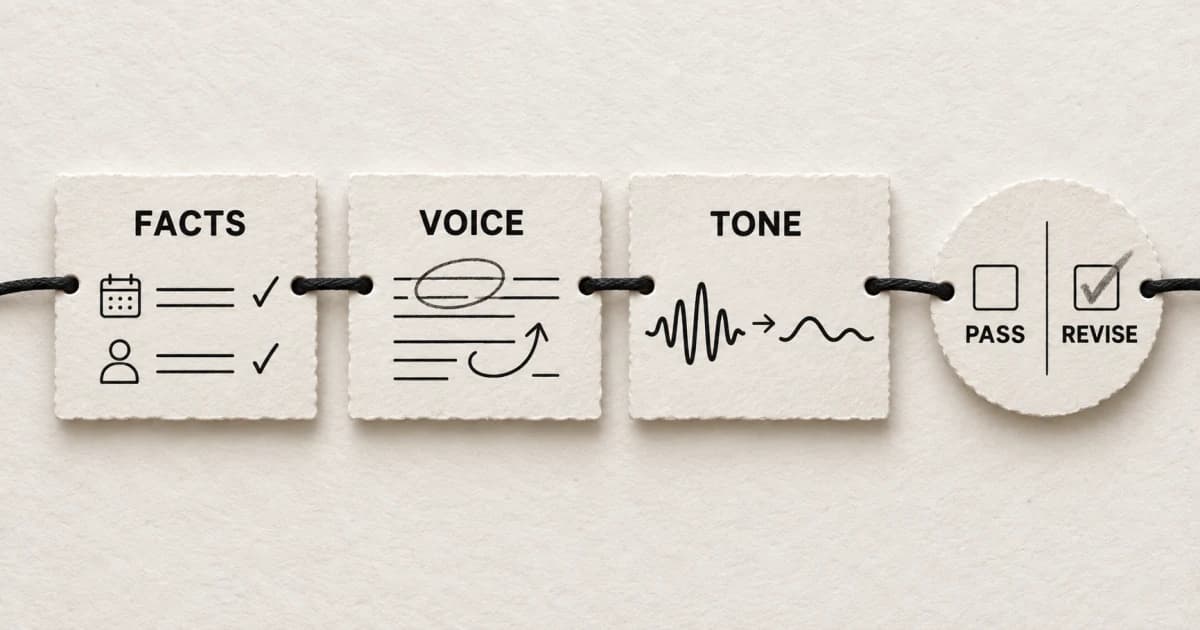
First, check the message itself:
- Are the facts, claims, dates, and names correct?
- Does the piece communicate the intended message and next action?
- Is the level of detail right for what the reader needs to decide or do?
Then run a voice pass:
- Can you point to at least two observable choices that reflect the voice traits?
- Does the vocabulary follow the preferred and avoided language guidance?
- Do sentence length, structure, and formality match the guide?
- Is humor used only where the guide and situation allow it?
- Are technical terms explained at the right level?
- Does the writing respect the guide’s boundaries around claims, judgment, and language to avoid?
Finally, run a tone pass:
- What situation is the reader in?
- Is the energy appropriate to that situation?
- Does the message acknowledge the consequence without guessing how the reader feels?
- Has the tone moved while the underlying voice remains recognizable?
Mark each question pass, revise, or not applicable, then attach one sentence of evidence. “Revise: ‘unlock your financial potential’ conflicts with the preference for concrete bookkeeping language” is actionable. “Doesn’t sound like us” gives the writer nothing to act on.
A voice guide is finished enough when two people can use it to make the same edit for the same reason.
When reviewers disagree, return to the rule and the reader’s situation. If the guide does not resolve the disagreement, record the decision and improve the guide. Those recorded decisions gradually turn the first version into a dependable shared reference.
Maintain the guide without freezing the brand
Assign one owner, but let examples come from across the company. The owner should collect repeated edits, keep the preferred language current, and retire examples that no longer reflect the business. Review the guide after a repositioning, a meaningful audience change, a new product category, or several instances of the same unresolved feedback. A routine six- or twelve-month check can catch smaller drift.
One campaign that deliberately stretches the voice does not require a guide update. Record successful experiments and decide whether they reveal a broader change or a useful exception. Consistency comes from recognizable judgment applied across different work; the outputs themselves can vary.
If your team is already producing more material with AI, the guide becomes more important because every unclear instruction can be repeated at speed. The deeper issue is shared brand context, which we explore in our discussion of why polished AI marketing can still feel off-brand. This guide gives you the practical starting document that discussion assumes.
Write the one-paragraph voice description, define three traits with boundaries, complete one before-and-after example, and test the result on a routine message and a difficult one. That is enough for a useful first version. The next round of real edits will tell you what the guide still needs.
Sources and further reading
- Mailchimp Content Style Guide, Voice and Tone and Writing Goals and Principles.
- Shopify, Voice and tone.
- Slack, Brand Guidelines, especially the documented voice-and-tone section.
- Microsoft Style Guide, Microsoft’s brand voice: Above all, simple and human.
- Buffer, What Voice and Tone Sounds Like in Practice, a first-party account of its company-wide content style guide.
- Google Search Central, Creating helpful, reliable, people-first content and AI features and your website.