What is a target audience? B2B examples and how to define yours
Decide whom a message, article, campaign, or offer should address, describe those people in terms that change the work, and see which parts of the description still need evidence.
33 min readWritten by Ampere
Short answer
What is a target audience, and how do you define yours?
A target audience is the group a particular article, campaign, offer, or message is intended to reach. A useful B2B description names their need, situation, role, and the decision they face, not just their industry or job title. Use that description to choose the message, evidence, channel, and next action, and refine it with customer evidence.
Summary
A target audience is chosen for each piece of work, so one company has several at once. A target market guides long-term product and pricing choices, an ideal customer profile names the organizations most likely to benefit, buy, and stay, and a buyer persona shows how one participant approaches a purchase. The profile and persona inform an audience without replacing it.
A useful audience description records only details that change the work: what people are trying to get done, the task they would use the product for, the event that makes the problem pressing, their role in the decision, and company traits that change what they need to hear. A detail that changes none of those does not belong.
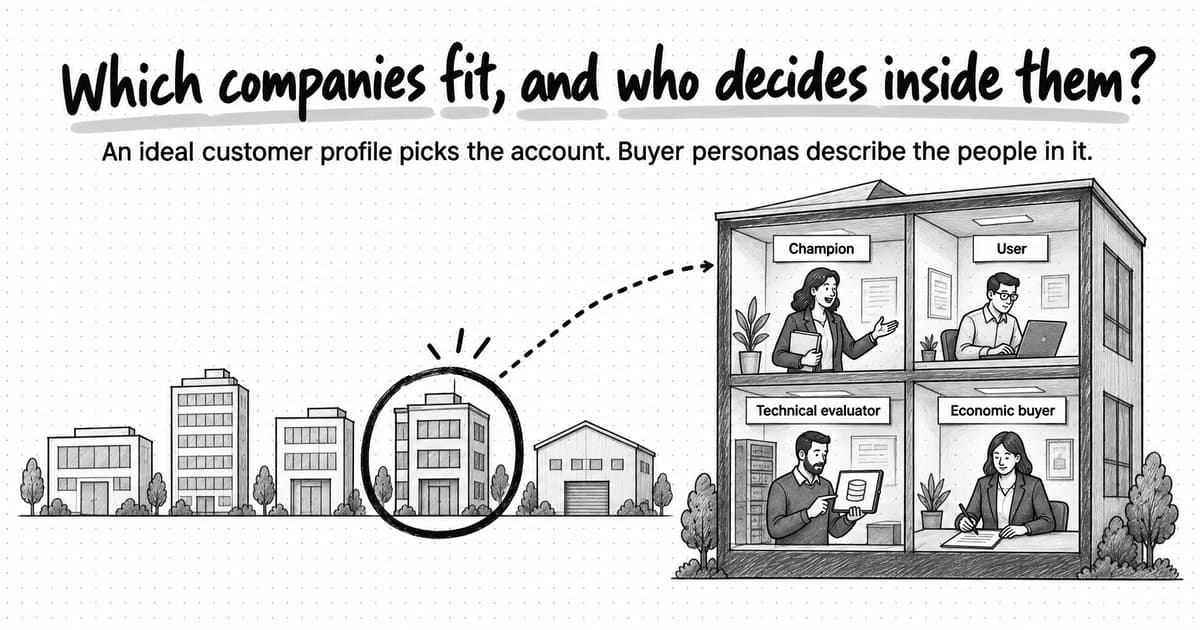
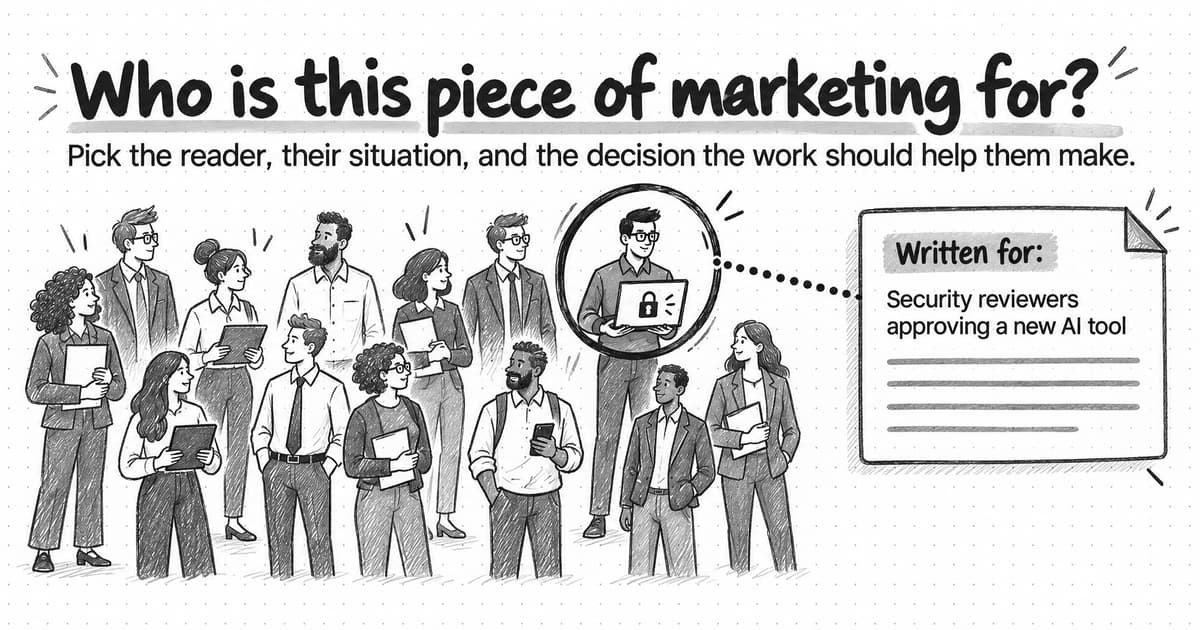
In a B2B purchase, the person a piece must help is often not the one who signs. Users, champions, budget holders, and approvers such as security reviewers may need different answers, so each piece should serve one named participant. Explained to a head of legal and a VP of sales, one product gets a different opening and proof but the same claims.
An audience description is a set of claims about people, and the strongest evidence comes from those who bought, used, stayed with, or rejected the product or an alternative. Ad segments and website visitors show only who can be reached, so they suit testing a finished description. One based on little evidence, or drafted by an AI tool, is a hypothesis.
A description that fits competitors’ customers is probably too broad, and one that leaves out a participant who can block the purchase is probably too narrow. The guide ends with an audience statement template, a completed example, and a worksheet that marks each part supported, assumed, or decided, so the riskiest assumption is checked first.
Contents
- How a target audience differs from a target market, ICP, and persona
- Why one company needs several audience descriptions
- Describe the audience by need, situation, and role
- The person who signs is not always the audience
- How the audience changes the message, examples, proof, channel, and next action
- Evidence that establishes or refines an audience
- What to do when you have little customer evidence
- Signs an audience definition is too broad or too narrow
- When to revisit an audience definition
- Write an audience statement for your next piece of work
- Keep the audience statement with the work
- Sources and further reading
- Frequently Asked Questions
Before a B2B team publishes an article, launches a campaign, or announces an offer, someone usually asks who it is for. The first answer is often a category: “mid-market SaaS companies,” “marketing leaders,” or “anyone evaluating AI tools.” Each answer names a real group, yet it leaves the people doing the work to guess which problem to open with, which example will feel familiar, what proof the reader will accept, and what to ask them to do next.
A target audience is the group of people a particular marketing effort is meant to reach and help. Naming the group is the easy part. The work depends on describing it in terms that change what you make: the need or situation that makes the message relevant now, the part these people play in a purchase or project, and the company context that affects what they need to hear. Industry, company size, and job title belong in that description when they change a decision about the work.
Because the definition is tied to a particular effort, one company has several target audiences at once. Its wider target market might include every organization that could reasonably buy the product. A campaign might address a smaller group facing a particular problem this quarter. A single article in that campaign might be written for one participant in the purchase, such as the security reviewer who must approve a new tool but will never use it or pay for it.
This guide explains how a target audience differs from related terms, how to describe one so the description improves marketing decisions, which evidence supports it, and how to draft one for your next piece of work. The examples follow Clauseway, a fictional company that sells AI contract review to in-house legal teams. Clauseway, its customers, and its numbers are invented for teaching.
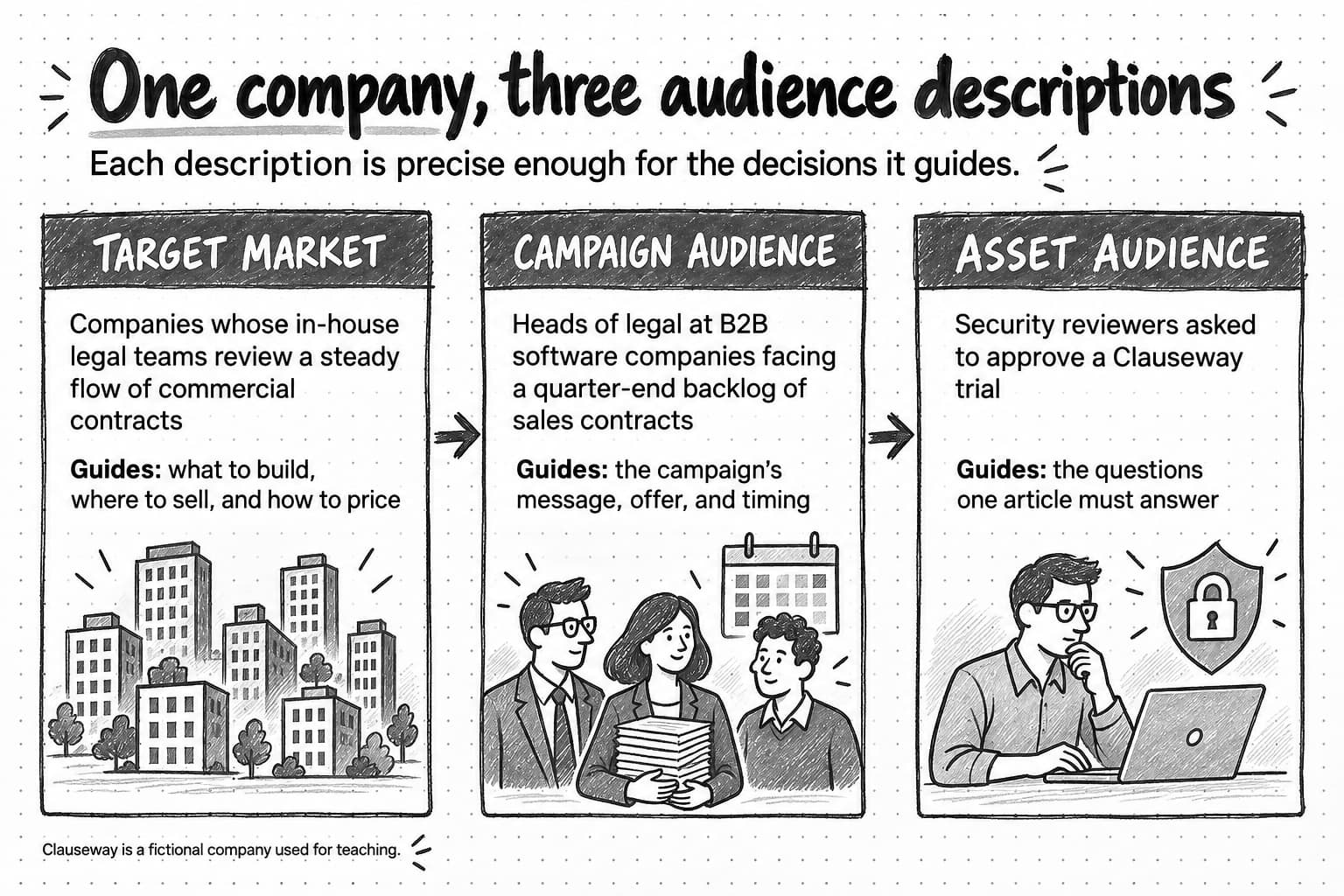
View Clauseway’s three audience descriptions at full size (opens in a new tab).
How a target audience differs from a target market, ICP, and persona
Marketing references do not use these terms consistently. An American Marketing Association article describes the target audience as a narrower group inside the target market: dog owners of a certain age within the wider market of pet owners. The Cambridge Business English Dictionary ties the term to the thing being promoted, defining it as the group an advertisement, product, website, or programme is directed at. OpenStax’s open textbook Principles of Marketing draws the line elsewhere: a toy’s target market can be the children who play with it, while its target audience is the parents who buy it.
For B2B work, it helps to give each term a different job. This guide uses the following distinctions:
| Term | The question it answers | Clauseway example |
|---|---|---|
| Target market | Which organizations and people is the business built to serve? | Companies whose in-house legal teams review a steady flow of commercial contracts |
| Market segment | Which groups within that market differ enough in needs or circumstances to need a different approach? | Software companies reviewing sales agreements; hospitals reviewing vendor contracts that involve patient data |
| Ideal customer profile (ICP) | Which organizations are most likely to benefit, buy, and stay? | B2B software companies with 200 to 2,000 employees, a legal team of one to five people, and a written contract playbook |
| Buyer persona | How does one kind of participant approach the purchase? | A head of legal who wants faster reviews without losing control of risky terms |
| Target audience | Whom must this campaign, article, message, or offer reach and help? | For a quarter-end campaign: heads of legal whose teams become a bottleneck for sales contracts |
| Advertising audience | Whom can an ad platform show this ad to? | LinkedIn members whose profiles indicate in-house legal roles at software companies |
The ICP and the buyer persona describe different things: the ICP describes organizations, while a persona describes a person taking part in a purchase. Our guide to ideal customer profiles and buyer personas explains what goes into each. Both inform the choice of a target audience without replacing it. The target audience is chosen for each effort. For a brand campaign it can be almost as broad as the target market; for a single article it can be one participant in one buying situation.
An advertising audience describes who can be shown an ad
Advertising platforms use the word audience for their targeting settings. Google describes its audience segments as groups of people with particular interests, intents, and demographic information, “as estimated by Google.” LinkedIn combines what members enter on their profiles with some inferred and estimated attributes; company size and revenue, for example, are estimates. Several platforms can also deliver ads beyond the segments an advertiser selects: Google’s optimized targeting, LinkedIn’s audience expansion, and Meta’s Advantage+ audience can each reach people similar to the chosen segments or people the platform expects to respond, and some of these features are on by default for certain campaign types. Meta separates audience controls, which limit who can see an ad, from audience suggestions, which do not always limit delivery.
These settings answer a practical question: which people will the platform show this ad to? They do not establish that those people have the problem your product solves or are in a position to buy it. Define the target audience first, translate it into the closest available settings, and check which settings the platform treats as limits and which as suggestions. Then judge fit by what happens after the click: whether the people who respond match the description, and whether they take the next step.
Why one company needs several audience descriptions
A company’s target market guides long-term choices: what to build, which industries to sell into, how to price, and which partners to pursue. That description can stay fairly broad because many decisions draw on it. Individual products and plans can have narrower audiences within it: a company that serves both designers and developers, or both small teams and large enterprises, may describe a different audience for each product line or plan.
Campaigns and individual assets need narrower descriptions still, because they make narrower decisions. A campaign has to choose a problem, a period, a set of channels, and an offer. An article has to choose an opening, examples, evidence, and a next step for someone reading it at a particular moment.
Clauseway at three levels
Clauseway reviews commercial contracts against a legal team’s playbook: the written list of positions the company prefers and the fallback terms it will accept. The software flags clauses that fall outside the playbook and suggests edits for a lawyer to approve.
Target market. Companies whose in-house legal teams review a steady volume of commercial contracts, such as sales agreements, vendor contracts, and nondisclosure agreements. This description guides product and business decisions: which contract types to support, which integrations to build, and which industries to enter first.
Campaign audience. For a campaign that runs in the weeks before each quarter ends, Clauseway addresses heads of legal at B2B software companies whose small legal teams review every sales contract. At quarter end, sales leaders press for faster turnaround, and the legal team must either delay deals or accept terms outside its playbook. This description guides the campaign’s message, offer, and timing.
Asset audience. One article in that campaign is written for the security reviewer. When a head of legal asks to trial Clauseway, the company’s security team must approve a tool that will process confidential customer contracts. The reviewer will not use Clauseway and does not control the budget, but can delay or stop the trial. The article’s audience is therefore security and IT reviewers who need to know where contract data is stored, who can access it, how long it is kept, and whether it is used to train AI models.
Each description is precise enough for its job. The market description would be no help in writing the security article, and the security article’s audience would be far too narrow to guide Clauseway’s product strategy.
Public B2B pages written for different participants
Established B2B software companies often address different participants on different pages. Three examples, observed in September 2026:
- Figma has a Dev Mode page for developers who need to turn approved designs into working code. It describes inspecting components, connecting design components to code, and giving AI coding tools design context, and it links to developer documentation. Figma’s main design page speaks to the designers who create and prototype those interfaces.
- Stripe has an enterprise page for large companies evaluating payments infrastructure. It features customer stories, reliability figures, and analyst recognition, offers a guide to running a request for proposal, and asks visitors to contact sales. Stripe’s documentation is written for the developers who will build the integration, with runnable examples, test data, and a path to create an account.
- Trust centers, such as those published by Notion and Anthropic, serve security and compliance reviewers. They collect certifications, security documentation, lists of subprocessors, and answers about how customer data is used, and they let reviewers request access to detailed reports.
These pages do not tell us how the companies define their audiences internally. They do show the same product explained differently when the reader’s job, questions, and next step differ.
Describe the audience by need, situation, and role
A useful audience description settles the questions a writer, designer, or campaign manager faces before starting. Five kinds of information usually do that work.
The need. What are these people trying to get done, and what makes it hard? In a 2016 Harvard Business Review article, Clayton Christensen and his coauthors argued that the progress a customer is trying to make in a particular circumstance explains a purchase better than the customer’s characteristics do. For Clauseway’s campaign audience, the need is to clear routine sales contracts quickly without weakening the company’s legal position.
The use case. Which task would they use the product for? Reviewing sales agreements involves different clauses, risks, and colleagues from reviewing supplier contracts or employment agreements, so it calls for different examples.
The buying situation. What has happened, or is about to happen, that makes the problem pressing now? Common triggers include a new regulation, a failed audit, rapid hiring, a new funding round, a leadership mandate, a renewal date, or a quarter-end rush. At any given moment, most potential buyers are not in that situation. John Dawes of the Ehrenberg-Bass Institute, writing for LinkedIn’s B2B Institute, estimated that up to 95% of business buyers in many categories are not in the market at any one time, and called the figure a heuristic rather than a precise rule. A campaign for people who are choosing a product now needs a different offer from content meant to be remembered when the need arrives.
The role in the decision. Will they use the product, argue for it, approve it, pay for it, or check it for risk? The section on buying participants below explains why the person who signs is not always the right audience.
The company context. Which company characteristics change what is true or what these people need to hear? Size affects how many people take part in a purchase and how formal procurement is. Industry affects regulation and the types of contracts involved. The tools a company already uses determine which integrations matter. The maturity of its process matters too: Clauseway is easier to evaluate for a legal team that already has a written playbook.
When demographic and firmographic details help
Firmographics are company characteristics such as industry, size, revenue, location, and ownership. They help when they change the work: a regulated industry needs different proof, a region raises different data-residency questions, and a company’s size changes who joins the purchase. They are also practical for finding and reaching people, because sales databases and ad platforms are organized around them.
They become a problem when they are the whole description. “SaaS companies with 200 to 2,000 employees” includes many companies with no current need, no budget for a solution, and no reason to read your article this month. Personal demographics, such as age and gender, rarely change what a B2B buyer needs to know. Include them only when evidence shows they change the message, the channel, or the offer.
Before and after: adding detail that changes the work
Here is Clauseway’s campaign audience described first as a category, then as a situation.
| Before | In-house legal teams at mid-market companies. |
|---|---|
| After | Heads of legal at B2B software companies with 200 to 2,000 employees, where a legal team of one to five people reviews every sales contract. In the last weeks of each quarter, sales leaders press for faster turnaround, and the team must either delay deals or accept terms outside its playbook. They are open to AI-assisted review but will not start a trial until they see it apply their own fallback positions and their security team approves it. |
The fuller description changes several decisions the team has to make:
| Decision | What “in-house legal teams” leaves open | What the fuller description settles |
|---|---|---|
| Message | Any benefit of AI contract review | Clear routine sales contracts at quarter end without accepting riskier terms |
| Examples | Nondisclosure agreements, litigation, employment contracts | Sales agreements with non-standard liability caps and payment terms |
| Proof | A general claim about saving time | A test on the reader’s own playbook, with every suggested edit waiting for a lawyer’s approval |
| Channel and timing | Any legal audience, at any time | In-house legal communities, plus the sales leaders who feel the delay, several weeks before quarter end |
| Next action | “Book a demo” | Test Clauseway on five recent sales contracts, and share the security overview with the colleague who must approve the trial |
| Who is left out | Unclear | Law firms, litigation teams, and companies whose contracts rarely vary |
The “after” version is longer, and every added detail changes something the team will make.
If removing a detail would change nothing about the message, examples, proof, channel, or next step, it does not belong in the description.
The fuller description also contains claims the team has not yet proven: that quarter-end pressure is common, that these legal teams have written playbooks, and that security approval comes before a trial. The exercise at the end of this guide shows how to mark which parts are supported and which still need checking.
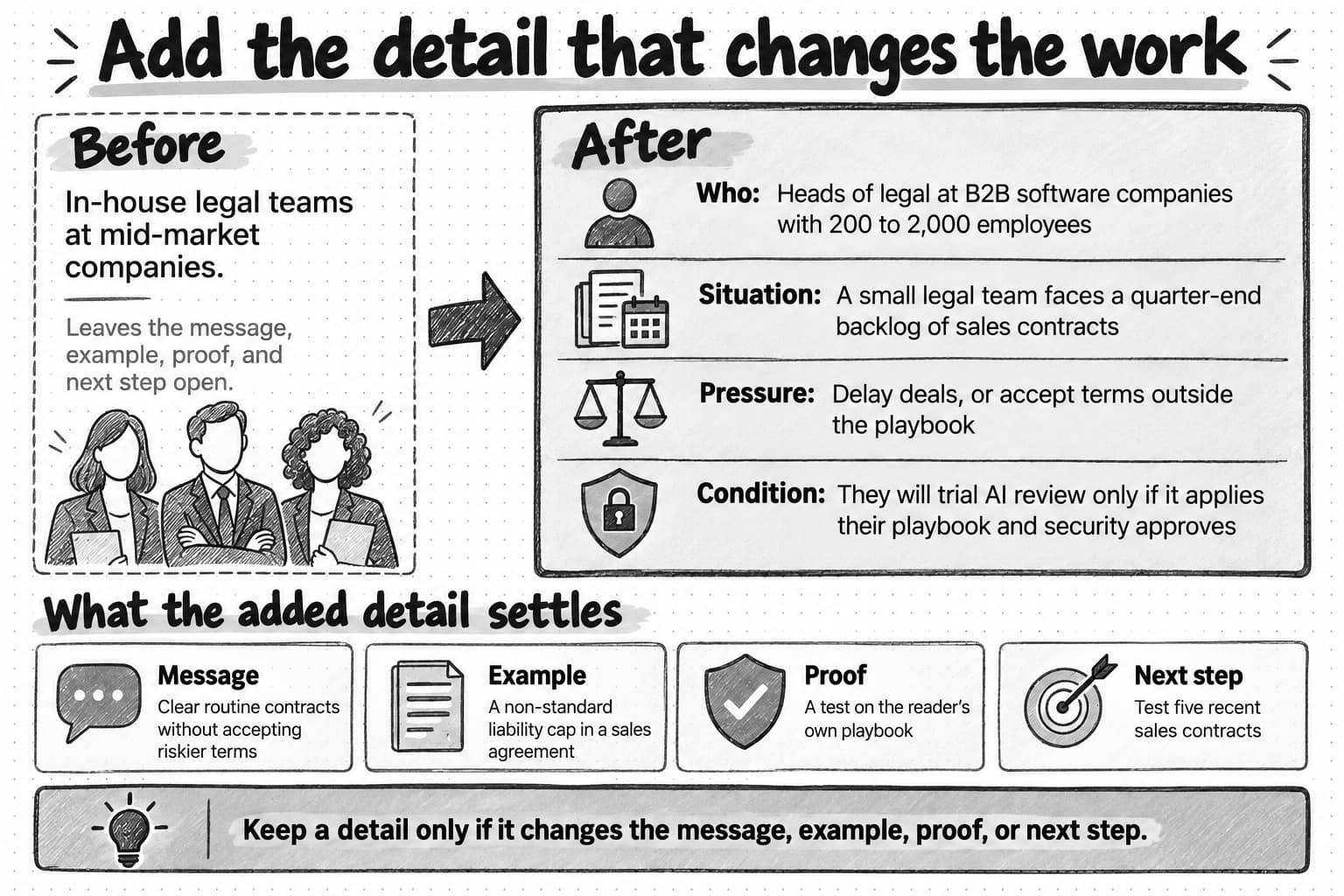
View the before-and-after audience description at full size (opens in a new tab).
The person who signs is not always the audience
B2B purchases involve several people with different responsibilities, and AI products tend to involve more of them. In its 2026 survey of business buyers, Forrester found that buying groups for purchases including generative AI features were twice the size of those for purchases without them: 14 members compared with seven. Each additional member can advance or stop the purchase and may need different answers.
In a 1972 model of organizational buying, Frederick Webster and Yoram Wind described the people involved by their roles: users, influencers, deciders, buyers, and gatekeepers. Sales teams also talk about the champion, a role that model does not name. One person can hold several roles, and several people can share one.
- Users work with the product. They judge whether it fits their daily work and whether it will create more effort than it saves.
- Champions want the purchase to happen and argue for it inside their organization. They need material they can use to persuade colleagues.
- Deciders approve the purchase and often control the budget. They weigh value, risk, and cost against other uses of the money.
- Buyers, often a procurement team, run the purchasing process: comparing vendors, negotiating terms, and completing onboarding.
- Influencers shape the decision without making it. Technical evaluators, security reviewers, legal counsel, finance, and experienced users can all play this role. Some also act as approvers whose sign-off is required, which lets them stop a purchase on their own.
- Gatekeepers control the flow of information and access, such as a procurement portal or an assistant who manages a leader’s calendar.
These roles matter because each piece of marketing should serve a particular participant. At a software company trialing Clauseway, the head of legal is the champion and often holds the budget. The contract managers who will use the product need to see how it fits their review process. The VP of sales influences the decision because slow reviews delay revenue. Procurement negotiates the terms, and the security reviewer is an approver who can stop the trial. If Clauseway wrote its security article for the budget holder, the reviewer’s questions about data storage and model training would be buried under benefits the reviewer is not evaluating.
A champion will often forward material to colleagues, so an article written for a security reviewer should also work when it arrives with no introduction. It should say what it covers, answer the reviewer’s questions directly, and name the next step.
GitLab’s public marketing handbook makes a similar distinction. It separates buyer personas, the main buyers and internal champions who drive a purchase, from user personas, the people who use GitLab. Users may or may not have the authority and budget to buy it, but the handbook describes them as heavy influencers in the buying process. It also notes that different channels and pages tend to reach each group, with feature pages serving users and solution pages serving buyers.
Mapping every role for a product is buyer persona work. For choosing a target audience, the essential step is narrower: name the participant a particular piece of work must help.
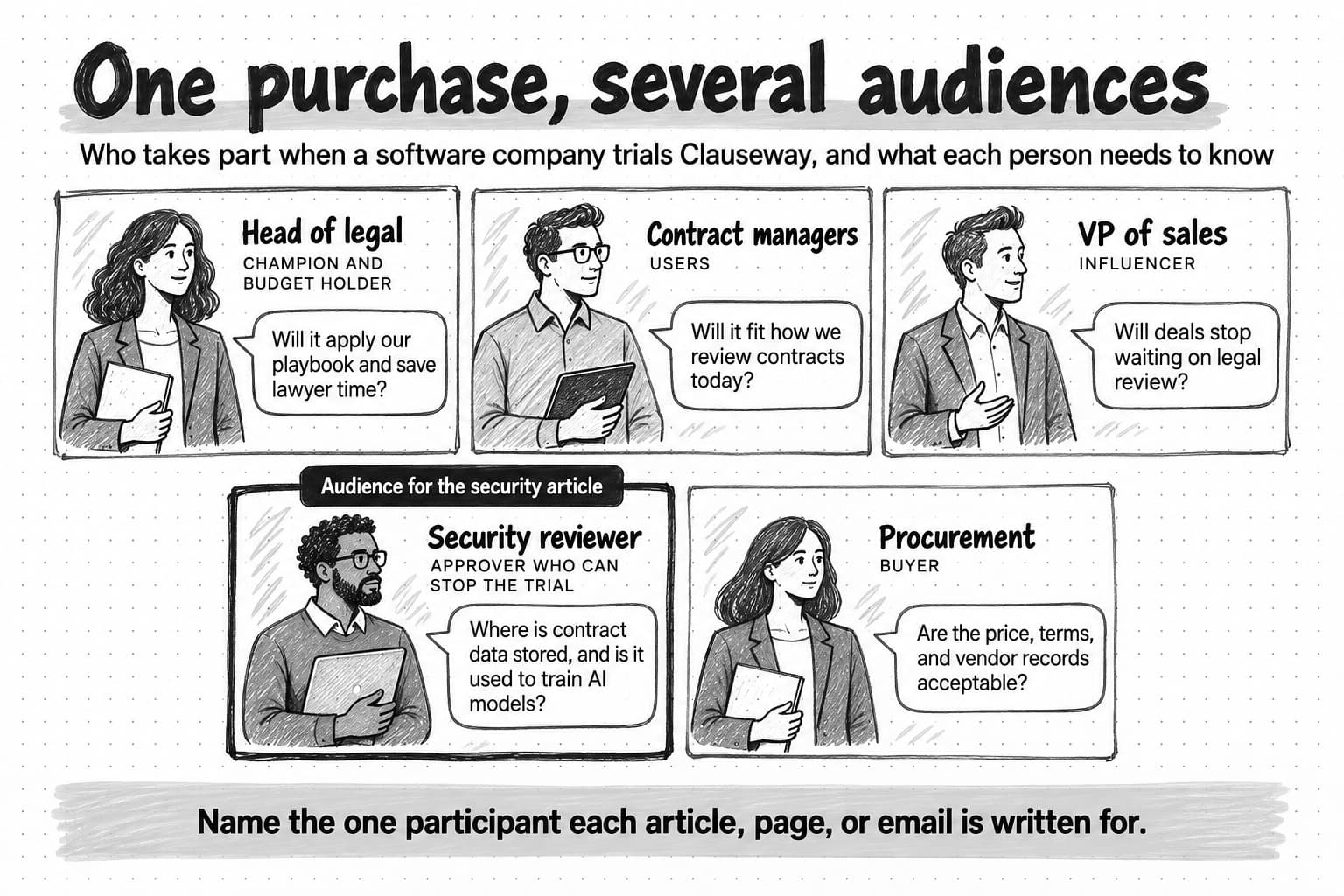
View the buying participants and their questions at full size (opens in a new tab).
How the audience changes the message, examples, proof, channel, and next action
Once the audience is clear, it should change the problem you lead with, the examples you choose, the proof you offer, the channels you use, and the next step you ask for. The comparison below shows the same product explained to two people involved in the same purchase.
The same product explained to two audiences
| Head of legal | VP of sales | |
|---|---|---|
| What they want | Clear the quarter-end queue without accepting terms outside the playbook | Close signed deals this quarter instead of watching them slip into the next one |
| Opening message | Apply your playbook to routine clauses so your lawyers can concentrate on the exceptions | Get routine contract edits back sooner, and see where each contract stands |
| Example | A customer proposes an uncapped liability clause; Clauseway flags it and suggests the approved fallback for a lawyer to accept | A deal that waited three days in legal review for a standard change to payment terms |
| Proof they trust | A test on the team’s own recent contracts, showing each flag and the approval step | Review times before and during a pilot, and the account of a peer sales leader |
| Likely objection | “Will it let risky language through without us noticing?” | “Will my team have to learn another tool?” |
| Channel | In-house legal communities, legal operations newsletters, and a peer-led webinar | Sales leadership and revenue operations channels, or a summary forwarded by legal |
| Next action | Test Clauseway on five recent sales contracts | Share a one-page summary with the head of legal |
The product, its capabilities, and its claims stay the same in both columns. What changes is the entry point: which problem appears first, which example makes it concrete, what evidence settles the reader’s doubts, and what they are asked to do next. Keep the claims consistent, because the legal team and the sales team will compare notes. A brand messaging framework helps here: it records the claims every audience should hear, so the emphasis can change without the substance changing.
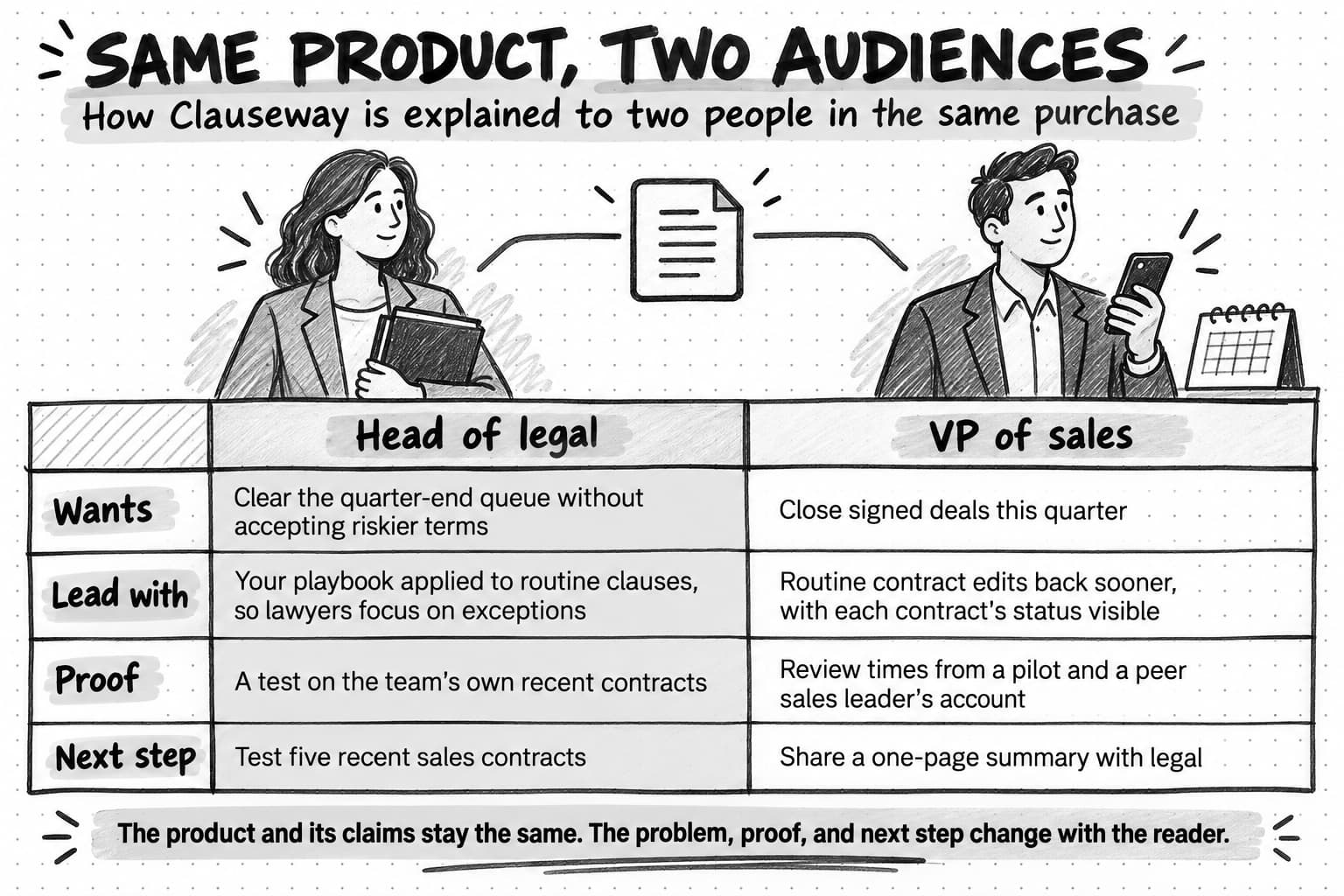
View the two-audience comparison at full size (opens in a new tab).
Evidence that establishes or refines an audience
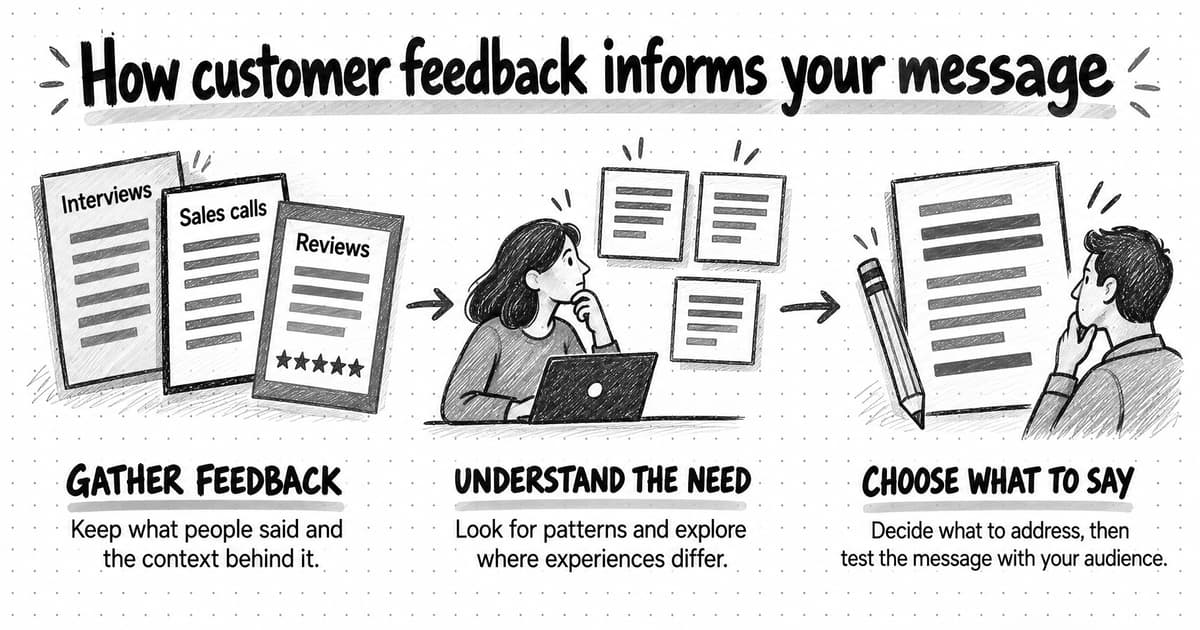
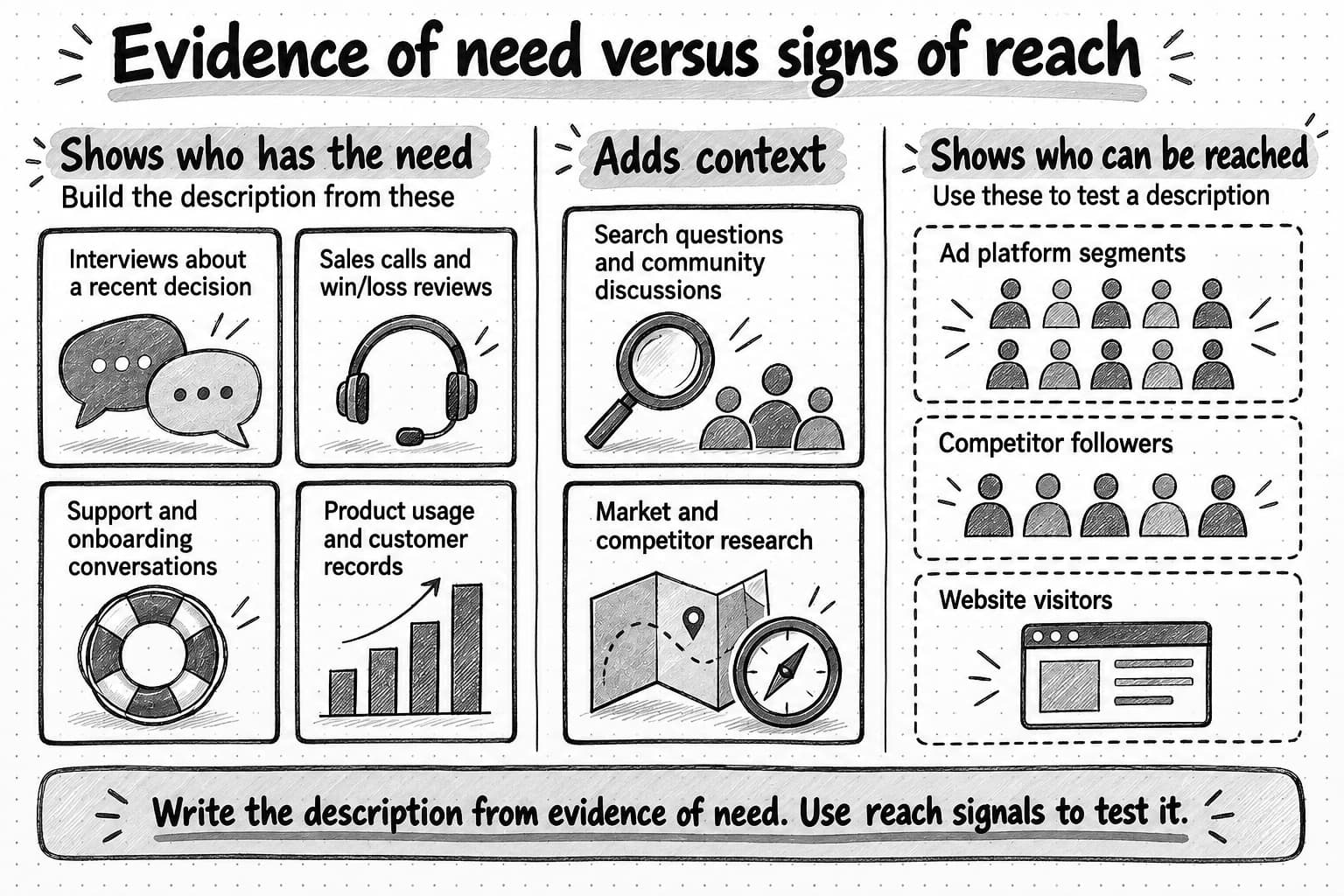
An audience description is a set of claims about people: that they have a need, that something makes it urgent, that they play a certain role, and that particular proof will persuade them. The strongest evidence comes from people who have faced the situation: those who bought, used, stayed with, or rejected the product or one of its alternatives.
| Source | What it can show | What it cannot show on its own |
|---|---|---|
| Interviews with recent customers and prospects | What triggered the search, who took part, what nearly stopped the purchase, and the words people use | How common the pattern is |
| Sales calls and win/loss reviews | Who joins evaluations, which objections stall deals, and why deals were lost | The needs of people who never reached sales |
| Support and onboarding conversations | Who uses the product and where they struggle | Why others chose an alternative |
| Product usage and customer records | Which kinds of accounts and roles adopt, expand, or leave | The reasons behind that behavior |
| Search data and community discussions | The questions and language people use in public | Who is asking, or how many |
| Market and competitor research | Alternatives, regulations, category norms, and unmet needs | How your own audience behaves |
Interviews are most reliable when they reconstruct a specific recent event. Teresa Torres, a product discovery coach, recommends asking people to tell the story of a particular recent occasion rather than to summarize their usual behavior, because summaries invite quick, biased answers. Our voice-of-customer research guide explains how to collect and analyze this kind of evidence, and the competitor analysis guide shows how to identify the alternatives your audience actually considers.
Evidence from existing users can also narrow an audience. Superhuman’s founder, Rahul Vohra, described surveying users about how disappointed they would be if they could no longer use the product. He grouped the answers by type of user and focused the company on the groups most likely to say they would be very disappointed: founders, managers, executives, and business development professionals. The account is his own, and Superhuman is email software for professionals rather than a complex team purchase. The method can still help many B2B companies: find the people who value the product most, then study what they have in common.
Ad segments, followers, and visitors show reach
Some readily available data describes who can be reached or who has noticed you. It is useful for distribution and testing, but it does not define the audience you should serve.
- Ad platform segments show whom a platform can show an ad to, based on its estimates. Reaching a segment does not show that its members have the problem your product solves.
- Competitor followers include customers, but also employees, job seekers, investors, partners, other vendors, and people curious about the category. Following a company signals interest, not need, and the group reflects the competitor’s positioning rather than yours.
- Website visitors reflect what you have already published and where you promoted it. If an old article attracted students, letting visitor data define the audience would steer future work toward whoever that article happened to reach.
Use these signals to test a description after you write it. Did the people you intended to reach arrive? Did they take the next step? Did sales conversations with them go further than conversations with others?
View the evidence and reach comparison at full size (opens in a new tab).
What to do when you have little customer evidence
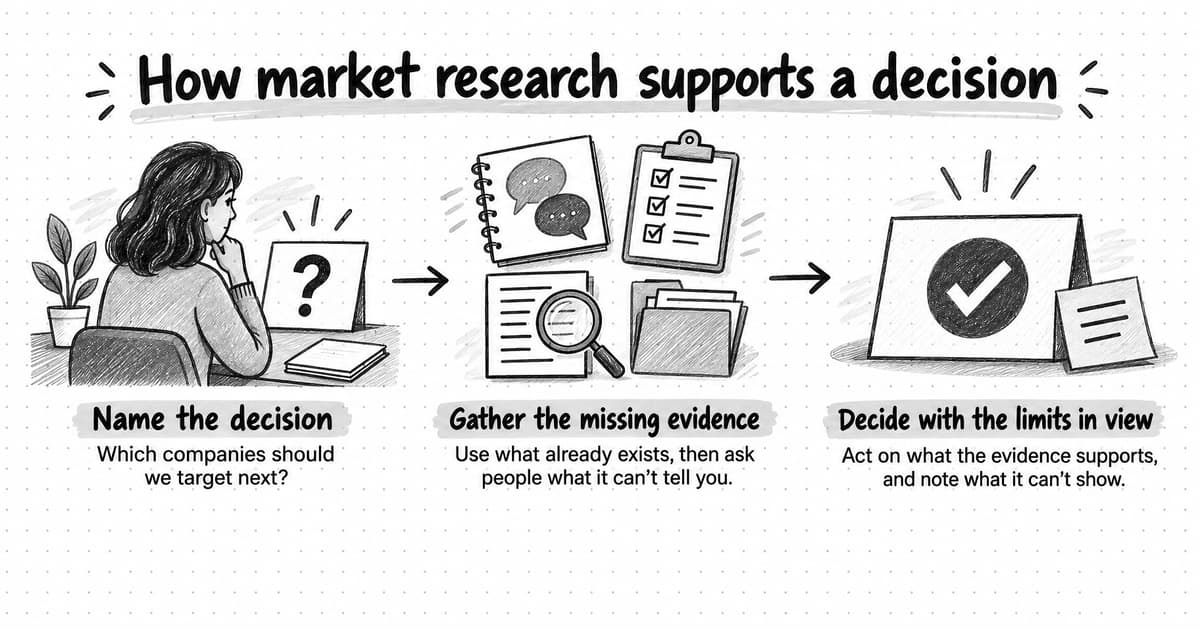
Early-stage companies often have to choose an audience before they have many customers. That is reasonable, as long as the team treats the description as a hypothesis: a specific, written guess that evidence can confirm or correct.
Start with what the team knows from experience, early conversations, and public sources, and write down the reason behind each claim. Nielsen Norman Group calls personas built from a team’s existing knowledge, without new research, lightweight or proto-personas. It considers them useful for exposing a team’s assumptions and agreeing on them, and as hypotheses for later research, while warning that they are often inaccurate and can reinforce mistaken beliefs.
Then look for the quickest evidence that could prove the hypothesis wrong:
- Talk to a handful of people who match the description about the last time they faced the problem.
- Record who attends early demos and pilot discussions, including people you did not expect.
- Read public evidence about the situation: job postings that mention the problem, community discussions, reviews of alternatives, and new regulations.
- Run a small test, such as one article or a narrow campaign with a specific offer, and look at who responds and whether they have the problem.
Decide in advance what result would change the description. If Clauseway’s security article is rarely requested and security reviewers seldom appear in pilot discussions, the team should question whether security approval is the obstacle it assumed.
Our introduction to market research explains how to choose a method for a question like this and plan a small first investigation.
AI tools can draft a plausible audience description or persona in seconds, but plausibility is not evidence. Treat a generated description like any other hypothesis and mark which parts come from sources you can check.
Signs an audience definition is too broad or too narrow
Breadth depends on the job. A target market can be broad because it guides long-term choices, and an article’s audience can be very narrow because it answers one group’s questions. Judge a description against the work it has to guide.
A description is probably too broad when:
- it would fit your competitors’ customers and many companies that will never buy;
- you cannot choose an opening example, because any example would suit only part of the group;
- the only proof that fits everyone is generic, such as “trusted by teams worldwide”;
- the next action is “learn more,” because no specific step suits everyone;
- results are hard to interpret, because responses come from so many different kinds of people.
It is probably too narrow when:
- the group is too small for the goal (a campaign meant to create new sales opportunities needs enough reachable organizations in the buying situation);
- it contains details that change nothing, such as a city or a favorite podcast, which shrink the group without improving the work;
- it leaves out a participant who can block the purchase;
- it rests on one customer’s story or one founder’s assumption;
- people outside the description keep buying and succeeding, and the description ignores them.
To broaden a description, remove details that do not change the work. To narrow it, add the situation or need that separates people who have the problem now from people who might have it someday.
When to revisit an audience definition
Audience descriptions age as the product, the market, and the evidence change. Revisit a description when:
- the people who respond, buy, or stay differ from the description;
- new participants appear in evaluations, such as a procurement team or an AI governance committee;
- the product adds a use case, integration, or plan that changes who can buy or use it;
- the sales motion changes, for example from self-serve sign-up to sales-led contracts;
- regulation, technology, or competitors change who owns the problem or how urgent it is;
- the company enters a new region, industry, or company size.
Check campaign and asset descriptions each time you write a brief, since they are quick to update. Review the market-level description during planning, or sooner when one of the changes above appears. Record what changed and why, so colleagues know which version the current work is based on.
Write an audience statement for your next piece of work
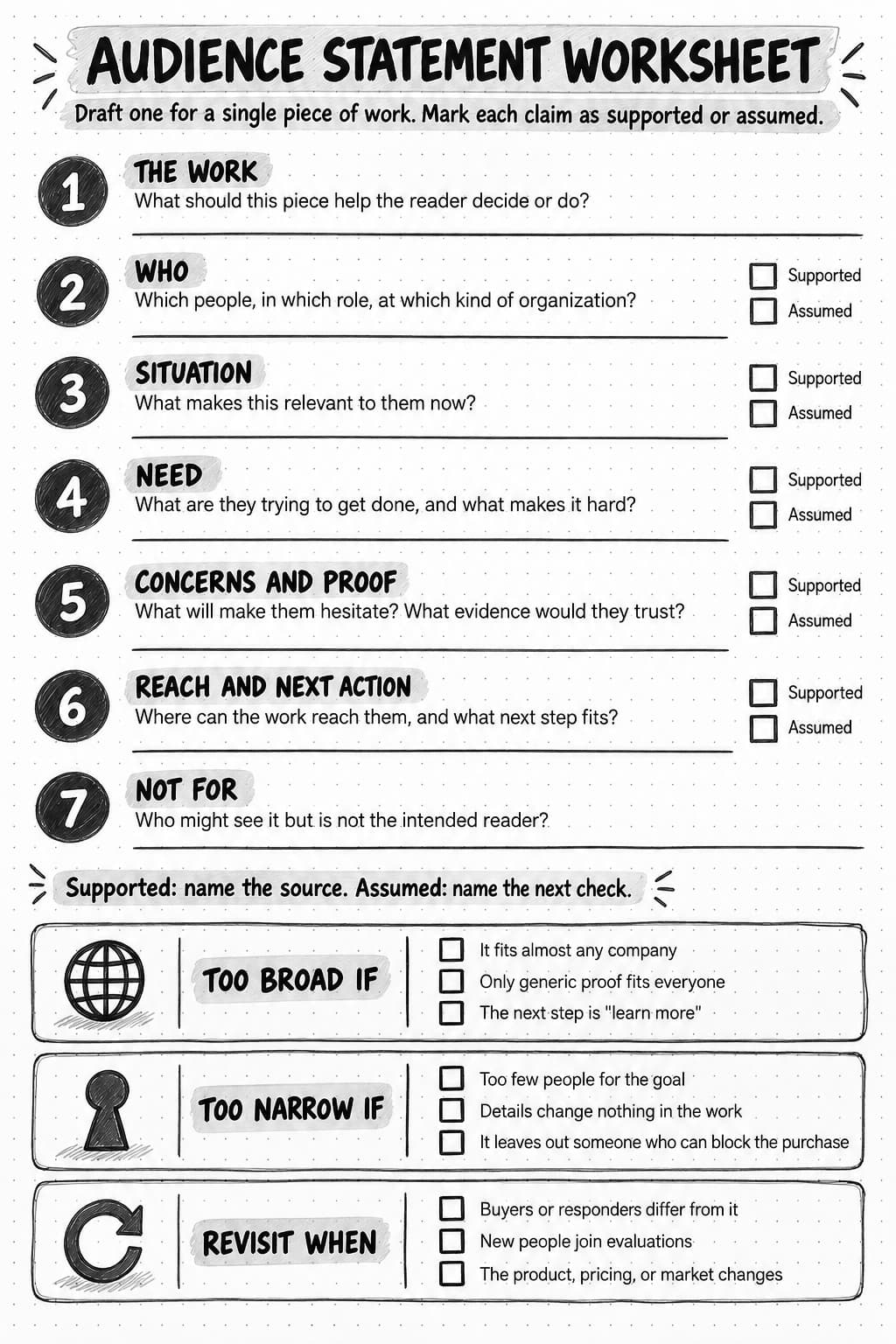
Choose one article, campaign, offer, or message you are about to start, then:
- Write down what the work should help the reader decide or do.
- Fill in the template below in plain language. Write what you believe, even where you are unsure.
- Mark each claim as supported, naming the source, or assumed, naming the check you will run. Parts that are choices rather than claims about people, such as the work itself, can be marked as decided.
- Choose the assumption that would change the work most if it were wrong, and check it first.
- Put the finished statement at the top of the brief, so everyone working on the piece starts from the same description.
THE WORK
Which article, campaign, offer, or message is this for? What should it help the reader decide or do?

WHO
Which people, in which role, at which kind of organization? Include company details only if they change the work.

SITUATION
What has happened, or is about to happen, that makes this relevant now?

NEED
What are they trying to get done or decide? What makes it hard today?

CONCERNS AND PROOF
What will make them hesitate? What evidence would they trust?

REACH AND NEXT ACTION
Where can this work reach them? What is a sensible next step for someone in their situation?

NOT FOR
Who might see this work but is not the intended reader, and why?

EVIDENCE CHECK
Mark each part above as supported (name the source) or assumed (name the next check).
Clauseway’s statement for the security article
Clauseway’s evidence below is fictional, like the company.
| Part | Clauseway’s draft | Status | Evidence or next check |
|---|---|---|---|
| The work | An article explaining how Clauseway handles contract data, so a reviewer can decide whether to approve a trial | Decided | Campaign plan |
| Who | Security and IT reviewers at B2B software companies whose legal teams want to trial Clauseway | Supported | Security review was required in six of the last eight trial requests, according to sales notes |
| Situation | They have been asked to approve a new AI tool that will process confidential customer contracts | Supported | Trial request emails and the security questionnaires received |
| Need | Decide whether the tool meets their data-handling requirements without weeks of back-and-forth | Partly supported | The questions come from questionnaires. The time pressure is assumed: ask two reviewers how long their last AI vendor review took |
| Concerns and proof | Whether contracts are used to train AI models, where data is stored, and who at Clauseway can access it; they trust documentation and specific answers over marketing claims | Supported | The most frequent questionnaire items |
| Reach and next action | Reached through the head of legal, who forwards the article; next step is to request Clauseway’s security documentation | Assumed | Check whether reviewers find the article themselves or receive it, by asking in the next three trial kickoffs |
| Not for | Heads of legal judging the product’s value, who need the playbook guide instead | Decided | Campaign plan |
The riskiest assumption is how the article reaches reviewers. If reviewers rarely find it on their own, Clauseway should attach it to every trial request rather than promote it through search or social posts.
Our guides to writing a content brief and a creative brief for a campaign show how the audience section connects to the rest of the plan.
Open the full-size audience statement worksheet to save a copy (opens in a new tab).
Keep the audience statement with the work
Keep the statement in the brief through drafting and review. The writer can use it to choose the opening and examples, the designer to decide what the visuals should show, and the reviewer to judge the draft by whether it helps the intended reader rather than by personal preference.
Meet Ampere—your AI marketing agent. Ampere can research public sources about a market, synthesize the customer evidence you supply, and save an evidence-backed audience report to Brand memory, where your team can review and edit it. Later briefs, drafts, and campaigns can then start from the same audience context. You can watch a replay of Ampere mapping Notion’s target audience from public sources. Your team remains responsible for the customer evidence, its interpretation, and approval.
Sources and further reading
- American Marketing Association: How to find your target audience
- Cambridge Business English Dictionary: target audience
- OpenStax, Principles of Marketing: Selecting target markets
- Google Ads Help: About audience segments
- Google Ads Help: About optimized targeting
- LinkedIn Marketing Solutions Help: Targeting options for LinkedIn Ads
- LinkedIn Marketing Solutions Help: Use audience expansion in your ad set
- Meta Business Help Center: Audience controls and audience suggestions in Advantage+ audience
- Meta Business Help Center: About estimated audience size
- Figma: Dev Mode
- Stripe: Enterprise and Stripe documentation
- Notion Trust Center and Anthropic Trust Center
- Harvard Business Review: Know your customers’ “jobs to be done”
- John Dawes, The B2B Institute: Advertising effectiveness and the 95-5 rule (PDF)
- Forrester: The state of business buying, 2026
- Frederick E. Webster Jr. and Yoram Wind: A general model for understanding organizational buying behavior, Journal of Marketing (1972)
- GitLab Handbook: Roles and personas
- Product Talk: Story-based customer interviews uncover much-needed context
- First Round Review: How Superhuman built an engine to find product-market fit
- Nielsen Norman Group: 3 persona types
Frequently Asked Questions
What is the difference between a target audience and a target market?
Definitions vary, but in B2B marketing a target market is the set of organizations and people a business is built to serve, while a target audience is the group a particular article, campaign, offer, or message must reach and help. The market guides long-term choices such as what to build, which industries to sell into, and how to price, so it can stay fairly broad. Because each piece of work has its own audience, one company has several target audiences at once.
What is the difference between a target audience and a buyer persona?
A buyer persona shows how one kind of participant approaches a purchase, and a target audience is the group a specific campaign, article, or message must reach and help. A persona for a contract review product might be a head of legal who wants faster reviews without losing control of risky terms. Personas inform the choice of audience without replacing it. Mapping every role in a purchase is persona work; choosing an audience means naming the participant one piece of work has to help.
What is an example of a target audience?
One example is heads of legal at B2B software companies with 200 to 2,000 employees, where a legal team of one to five people reviews every sales contract and sales leaders press for faster turnaround as each quarter ends. The guide builds this campaign audience for a fictional AI contract review company. A vaguer description of the same campaign audience, “in-house legal teams at mid-market companies,” names a real group but leaves the message, examples, proof, and next step undecided.
What research methods can you use to identify a target audience?
The most reliable methods study people who bought, used, stayed with, or rejected the product or an alternative: interviews with recent customers and prospects, sales calls and win/loss reviews, support and onboarding conversations, and product usage and customer records. Search data, community discussions, and market and competitor research add the questions people ask and the alternatives available to them. Interviews work best when they reconstruct a specific recent event. Ad segments and website visitors show only who can be reached, so they suit testing a finished description.
What is a target audience in advertising?
In advertising, a target audience usually means the people an ad platform will show an ad to, chosen through targeting settings built partly on the platform’s own estimates about people and companies. Reaching those people does not show that they have the problem your product solves. Define the target audience first, translate it into the closest available settings, and check which settings act as limits, because features such as audience expansion can deliver ads beyond the segments you chose.
What should a target audience profile include?
A target audience profile should name the work it serves, the people and their role, the situation that makes the work relevant now, their need, their concerns and the proof they trust, where to reach them, the next step, and who the work is not for. The guide’s audience statement template also marks each part as supported, with a source, or assumed, with the next check to run. Leave out any detail that would not change the message, examples, proof, channel, or next step.
How do you segment a target audience?
Segment a target audience into groups whose needs or circumstances differ enough to need a different approach. The differences that usually matter are what people are trying to get done, the task they would use the product for, the event that makes the problem pressing, their role in the decision, and company traits such as industry or size when those change what they need to hear. Personal demographics such as age and gender rarely change what a B2B buyer needs to know.
What is the difference between a target audience and an ideal customer profile?
An ideal customer profile names organizations, the companies most likely to benefit from a product, buy it, and stay, whereas a target audience names the people a particular campaign, article, or message must reach. The profile tells a team which companies to pursue, and the audience tells each piece of work whom to address inside them, such as the head of legal who champions a contract review tool or the security reviewer who must approve a trial.
How do you define a target audience for a new business?
A new business should treat its first target audience as a hypothesis: a specific, written guess that evidence can confirm or correct. Build it from the team’s experience, early conversations, and public sources, noting the reason behind each claim. Then seek the quickest evidence that could prove it wrong, such as a few interviews about the last time people faced the problem or one small campaign, and decide in advance which result would change the description.
How often should you reassess a target audience?
Reassess a campaign or asset audience every time you write a brief, since it is quick to update, and review the market-level description during planning. Revisit any description sooner if the people who respond, buy, or stay differ from it, new participants such as a procurement team join evaluations, the product adds a use case or plan, or the company enters a new region, industry, or company size. Record what changed and why.