Write effective prompts
Learn what to include in a Joule prompt so Joule can start with the right goal, context, and review step.
Last verified about 1 month ago
Joule works best when your prompt describes the marketing outcome you want, the context it should use, and how you want to review the work. You do not need a perfect prompt. You just need enough direction for Joule to start in the right place.
Use this article when you are staring at the composer and want a practical way to ask Joule for useful work.
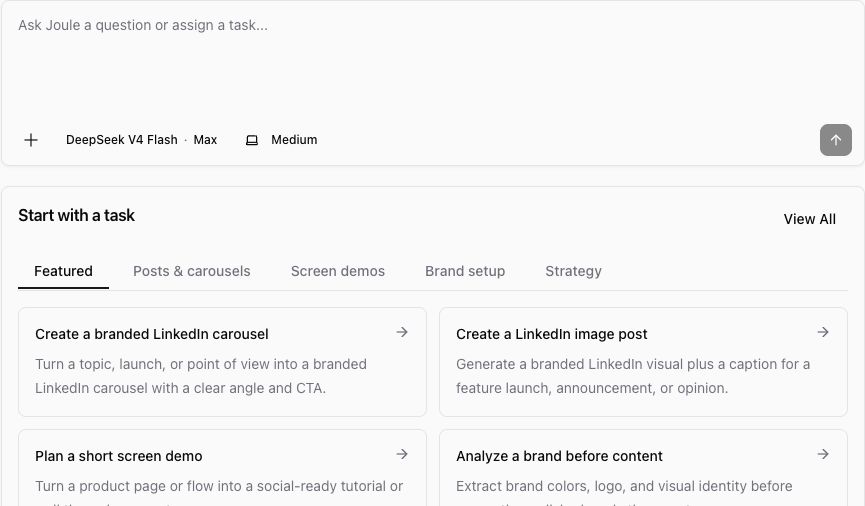
Start with the outcome
Begin with the thing you want Joule to help you create or decide. Make the output concrete.
Weak prompts usually name a broad topic:
- "Help with LinkedIn."
- "Make some ads."
- "Write about our product."
Stronger prompts name the deliverable:
- "Create a 7-slide LinkedIn carousel outline."
- "Draft three Meta ad concepts for this product photo."
- "Turn this launch note into a founder-led LinkedIn post."
- "Research competitors and summarize the strongest positioning angles."
If you are not sure which format you need, say that too. Joule can help narrow the plan before creating files or assets.
Add the audience and context
Tell Joule who the work is for and what it should use as source material.
Useful context can include:
- Your audience or buyer.
- The product, feature, offer, or campaign.
- A project, brief, website, uploaded file, or attachment you want Joule to use.
- The channel or format, such as LinkedIn, an article, a deck, a short demo, or an ad concept.
- Any brand voice, tone, or visual direction that matters.
You can keep this simple. For example: "Use our selected project brief and brand voice" is better than leaving Joule to guess.
Give constraints that matter
Constraints help Joule avoid work you already know you will reject. Include only the ones that change the result.
Helpful constraints include:
- Length: "Keep it under 150 words" or "Make this a 7-slide outline."
- Tone: "Practical and direct" or "Founder-led, not corporate."
- Format: "Return a table first" or "Give me the outline before making visuals."
- Source of truth: "Use the uploaded brief" or "Use the selected project."
- Review step: "Ask me before generating images" or "Show me the angle first."
Avoid packing every preference into the first message. Start with the constraints that would be expensive or annoying to fix later.

Ask for a checkpoint when you want control
For bigger tasks, ask Joule to show a plan, outline, angle, or first draft before it creates final assets. This keeps you in the loop without forcing you to manage every step.
Good checkpoint requests sound like:
- "Show me the outline before making visuals."
- "Give me three angles and recommend one."
- "Ask what I want to change before you generate the final deck."
- "Start with the research summary, then wait for my direction."
Use checkpoints when the direction matters, the output will take credits, or you want to review the strategy before Joule produces files.
Use starter tasks when you do not want to start from scratch
Starter tasks are useful when one matches the job you want. They give you a product-shaped starting point for common marketing work, such as creating a branded LinkedIn carousel, a LinkedIn image post, a short screen demo, or brand analysis before content.
You can still edit the prompt after choosing a starter task. Add the topic, source material, audience, tone, or review checkpoint that makes it specific to your work.
Revise in the same session
Your first prompt does not have to carry the whole job. After Joule responds, keep the conversation going in the same session.
Useful follow-ups include:
- "Make the tone sharper and less formal."
- "Use the uploaded launch brief as the source of truth."
- "Cut this to five slides."
- "Give me two more hook options."
- "Turn this into an article outline instead."
Staying in the same session helps Joule keep the context from the previous messages and generated work.
Was this article helpful?
Related articles
Learn how to start a first Joule session, what to include in your prompt, and what to review next.
Learn how Ampere, Joule, and the AI Tools catalog work together to help you ship marketing work.
Learn what the main areas of the Joule workspace are for before you start reviewing sessions and files.