Content pillars: how to choose the themes your content calendar runs on
A method for choosing content pillars from buyer questions, demand, point of view and proof, then sizing a content calendar to the hours your team really has, with a scoring table, a copyable template and a fictional worked example.
42 min readWritten by Ampere
Short answer
What are content pillars?
Content pillars are the few recurring subjects a company publishes about, each one a problem its buyers have and the company can say something useful and credible about. Every planned piece belongs to one pillar. A pillar is broader than a single topic and narrower than an industry, and it should be chosen from evidence: buyer questions, search and AI demand, the company's point of view, and proof it can show.
Summary
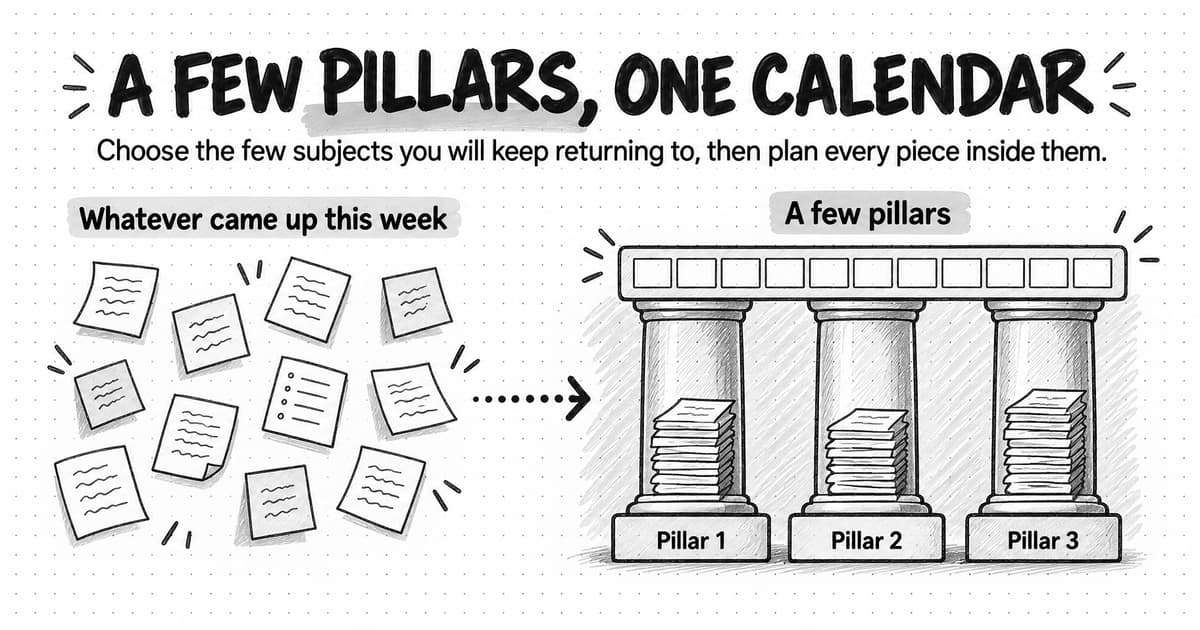
Content pillars turn scattered publishing into work that adds up. When a small team writes about whatever came up that week, it ends with many pieces on many subjects and nothing a buyer can learn from in depth. A few pillars, each naming a buyer problem rather than a product feature, give every planning session a short list of places to look for the next topic.
Content pillars differ from messaging pillars, topics and SEO pillar pages. Messaging pillars are claims about the company's offer; content pillars are subjects about the buyer's problem, and a calendar built from messaging pillars becomes a stream of ads. A topic is one piece's subject within a pillar, and a pillar page is a website structure that a pillar may use as its anchor.
Choose pillars by scoring candidates 0 to 2 on four inputs: buyer questions, search and AI demand, the company's point of view, and proof it can show. A candidate no buyers ask about is rejected however popular it is, and one without proof goes on a watch list for test pieces. A fictional billing-software company shows the scoring, and a one-page template defines each pillar and its backlog of buyer questions.
Size the content calendar to the hours the team really has, measured from the last month rather than an ideal one, and, as this guide's working rule rather than a measured standard, plan to about three quarters of them. Estimate each format from start to finish, put anchor pieces on first, and build derived pieces around them. The guide includes illustrative format hours, a copyable calendar template and a worked first quarter.
A calendar keeps running through a 30-minute weekly review: what slipped and why, whether the next two weeks are briefed and owned, new buyer questions for the backlog, and pillar balance. A piece that slips twice is shrunk or cut. Change a pillar for evidence, such as dried-up questions or a business change, not because one post did badly or the team is bored.
Contents
- What content pillars are
- Content pillars, messaging pillars, topics and pillar pages
- Choose content pillars from four kinds of evidence
- Score candidate pillars with a simple table
- How many content pillars a small team can run
- Content pillar examples for B2B SaaS companies
- Write each pillar on one page and fill its backlog
- Size the calendar to what your team can produce
- Content mix and cadence
- A content calendar template you can copy
- Worked example: a fictional company's first quarter
- Run the calendar with a weekly review
- When to change your content pillars
- Why content calendars stall, and how to keep yours going for six months
- How Ampere helps plan content pillars and calendars
- Sources and further reading
- Frequently Asked Questions
Many small marketing teams plan content the same way. Someone has an hour on Thursday, looks at what came up that week, and writes about it: a product update, a reaction to an industry report, a post about a customer call. Each piece is reasonable on its own. Three months later the blog and the company page can hold forty pieces on thirty subjects, no subject has more than two pieces, and nobody can say what the company is known for. Planning the next month means starting from a blank page again.
The fix is to decide, before choosing any single topic, which few subjects the company will keep returning to. Content pillars are the few recurring subjects a company publishes about, each one a problem its buyers have and the company can say something useful and credible about. Every planned piece belongs to one of them. A pillar is broader than a topic and narrower than "our industry": "pricing a usage-based product" is a pillar, "how to set a usage tier threshold" is a topic within it, and "SaaS" is neither.
Pillars help in two ways. They make each planning session shorter, because the question changes from "what should we write about?" to "which question in this pillar is next?" And they let the work add up: ten pieces on one problem build a library a buyer can learn from, where ten pieces on ten problems leave ten fragments. The content calendar, the schedule of who publishes what and when, then has something stable to run on.
This guide covers both halves of that work. The first half chooses the pillars from evidence, with a scoring table and examples from B2B software. The second half builds a calendar sized to the hours your team actually has, with a copyable template, a weekly review that keeps it running, and signs that a pillar needs changing. A fictional software company, Ostrand, works through the whole method.
What content pillars are
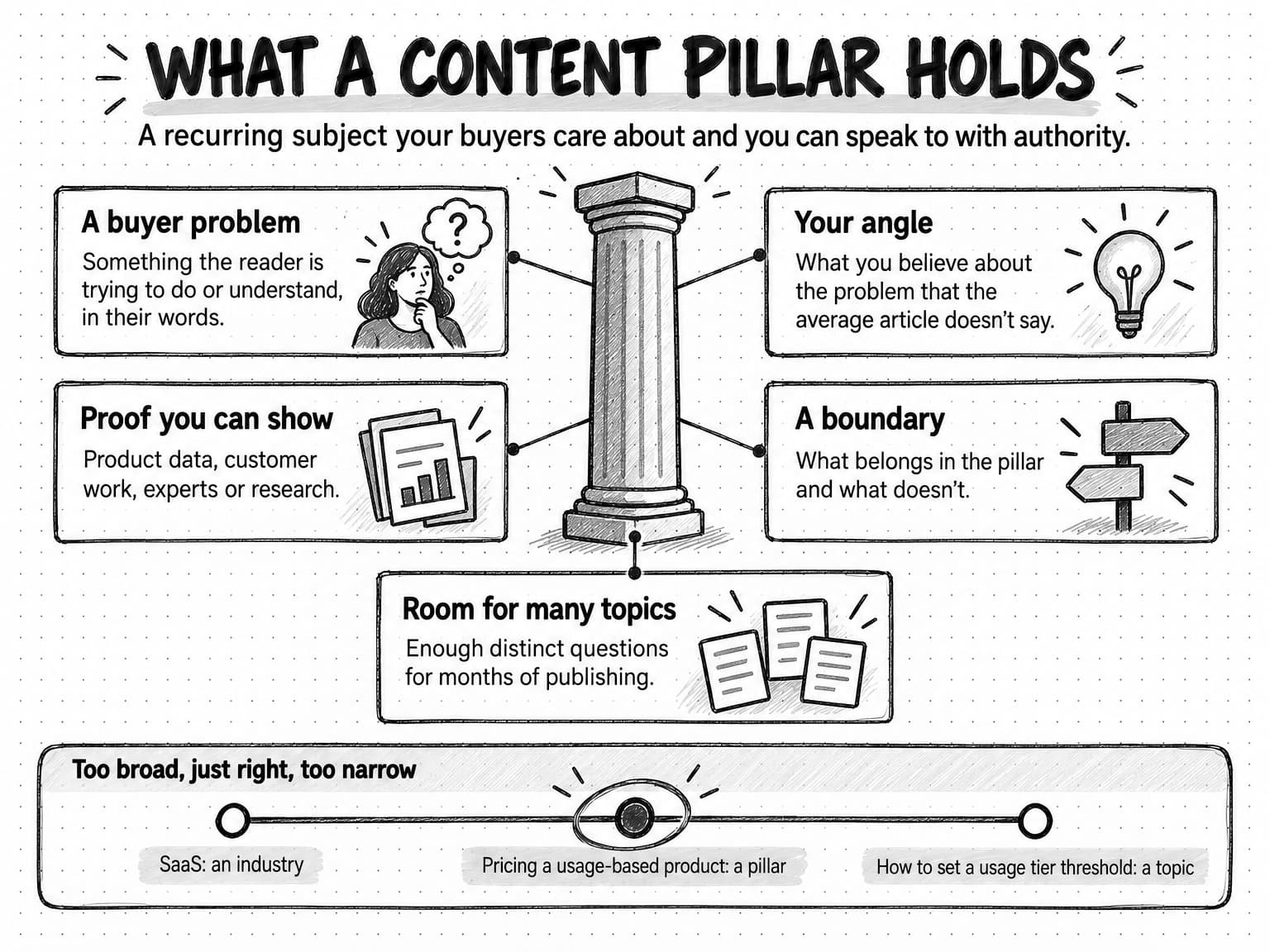
A content pillar is a planning decision: for the next few quarters, this is one of the subjects we will publish about repeatedly, in several formats, until a buyer who follows us has learned something substantial about it. A category tag describes what was published; a pillar decides what gets published.
A useful pillar has five parts, and the one-page template later in this guide asks for each:
- A buyer problem. The pillar names something the audience is trying to do or understand, in their terms. "Getting through a first security audit" is a buyer problem; "our compliance features" is a product description.
- The company's angle. What the company believes about that problem, or the way it approaches it, that a reader would not get from the average article. Without an angle, the pillar produces summaries of what is already published.
- Proof the company can show. Product data, customer work, expert practitioners, or research that lets the company say more than an outsider could.
- A boundary. What the pillar includes and what it leaves out, so a topic can be placed without a debate.
- Room for many topics. Enough distinct questions to fill months of publishing without repeating itself.
View the parts of a content pillar at full size (opens in a new tab).
A pillar is not a format ("videos"), a channel ("LinkedIn"), or a content type ("customer stories" or "product news"). Those cut across pillars: a customer story can belong to any pillar whose problem the customer solved, and a product update earns a place when it changes how buyers can handle a pillar's problem. A "company news" pillar tends to fill the calendar with announcements nobody outside the company was waiting for.
Content pillars sit inside the content strategy. A B2B content marketing strategy decides the business objective, the buying situations to serve, and the point of view the company has earned, and names a handful of strategic themes. Pillars turn those themes into something a calendar can use: defined, bounded, and stocked with topics. Without a written strategy, choosing pillars from evidence still works, and often shows which strategic decisions come next.
Content pillars, messaging pillars, topics and pillar pages
Four terms with overlapping names cause most of the confusion here, often when a messaging workshop produces three "pillars" and someone tries to build the content calendar from them.
Messaging pillars are the supporting claims that make a company's value proposition believable: "every theme links to its source," "review feedback in one place." They are claims about the offer, each backed by proof, and they guide how the company describes itself on its homepage, in sales decks and in ads. Our guide to building a brand messaging framework explains how to write them.
Content pillars are subjects the audience cares about, where the company has something to teach. They are about the buyer's problem, and most content within them should be useful to a reader who never buys. A messaging pillar might be "usage pricing your finance team can audit." The related content pillar is "running billing for a usage-based product," which covers invoicing, disputes, revenue recognition and forecasting whether or not the reader uses the product.
The two connect. Content in a pillar is where a messaging claim becomes believable over time, because a reader who has learned from ten useful pieces about billing operations will take the company's claim about auditable billing more seriously. But if you build a calendar from messaging pillars, every piece argues for the product, and the calendar turns into a stream of ads.
Some teams say content themes or content buckets instead of content pillars; the terms usually mean the same thing.
Topics are the individual subjects of single pieces: one question, one answer. "What to do when a customer disputes a usage charge" is a topic in the billing-operations pillar. A pillar holds dozens of topics; a topic belongs to one pillar.
Pillar pages are an SEO structure. In the topic cluster model HubSpot popularized, a pillar page "covers a broad subject at a high level" and links to cluster pages that go deeper on subtopics, which link back to it. A content pillar often has a pillar page as its anchor on the website, but the content pillar is the larger idea: it also covers newsletters, social posts, webinars and sales material that never touch the cluster.
| Term | What it is | Who it's about | Example | Where it's used |
|---|---|---|---|---|
| Messaging pillar | A supporting claim behind the value proposition, with proof | The company and its offer | "Usage pricing your finance team can audit" | Website, sales, ads, positioning |
| Content pillar | A recurring subject the company publishes about | The buyer and their problem | "Running billing for a usage-based product" | Content calendar, all channels |
| Topic | The subject of one piece of content | One buyer question | "What to do when a customer disputes a usage charge" | A single brief and piece |
| Pillar page | A broad page that links a cluster of related pages | Search visitors to one subject | A complete guide to usage-based billing | Website structure and SEO |
Choose content pillars from four kinds of evidence
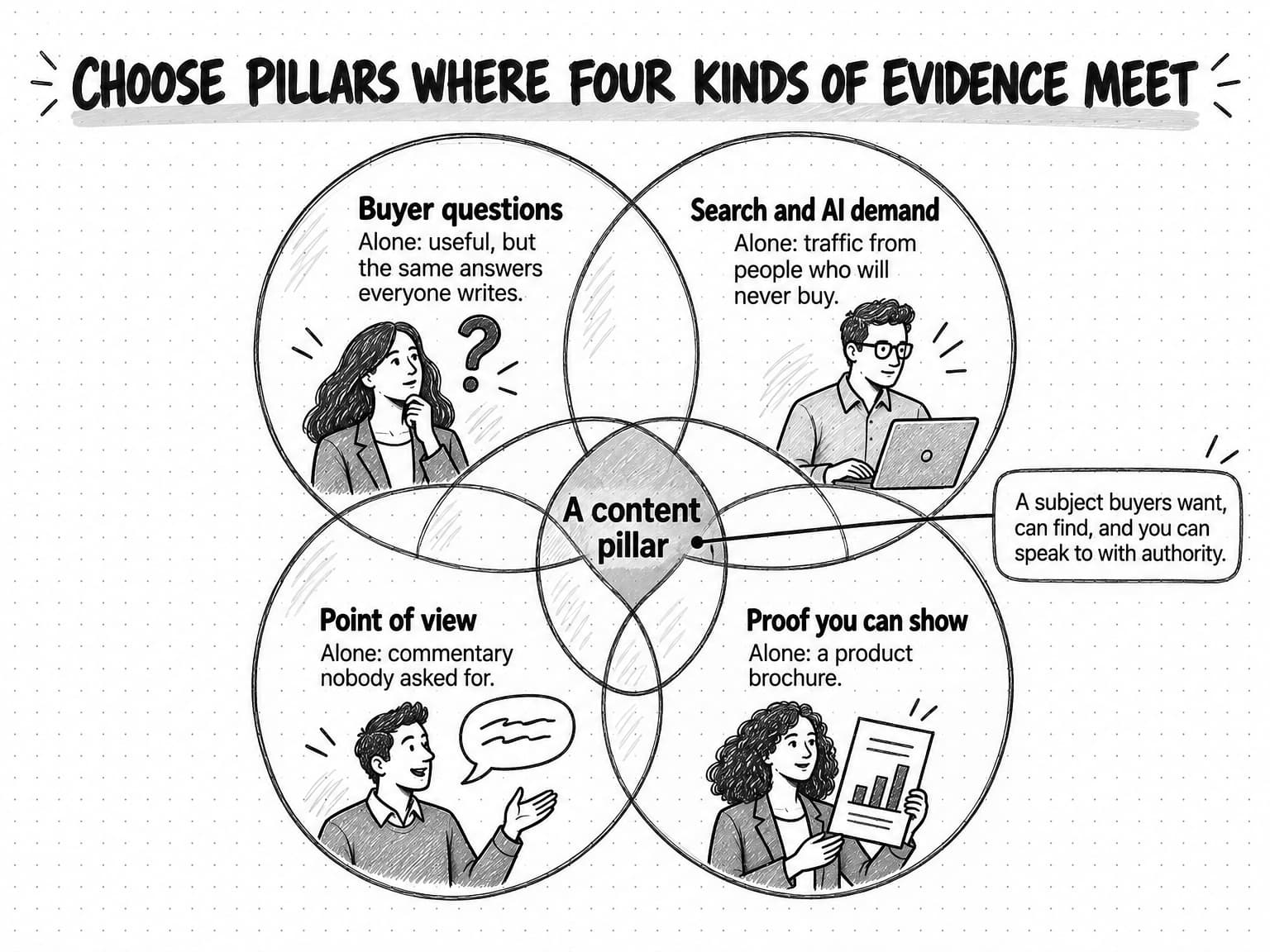
Most teams choose pillars by brainstorming a list of things the company knows about, which usually comes out too broad and too close to the product. A stronger method checks each candidate against four kinds of evidence, because each one corrects a mistake the others allow.
| Buyer questions | Do real buyers repeatedly ask about this problem, in their own words? |
|---|---|
| Search and AI demand | Do people look for answers about it in search engines and AI assistants? |
| Point of view | Does the company have a reasoned position on the problem that a reader would not get elsewhere? |
| Proof | Can the company show evidence, from its product, customers, experts or research, that supports what it will say? |
A pillar chosen from buyer questions alone tends to be useful but generic: every company in the category hears the same questions and can write the same answers. A pillar chosen from search demand alone can bring traffic from people who will never buy. Google's own guidance on helpful content asks publishers whether they are "producing lots of content on many different topics in hopes that some of it might perform well in search results," and lists it among the signs of search-engine-first content. A pillar chosen from the company's opinions alone produces commentary nobody asked for. A pillar chosen from proof alone becomes a product brochure. Where all four meet, the company has a subject buyers want, can be found for, and can speak about with authority.
View the four kinds of evidence diagram at full size (opens in a new tab).
Buyer questions
Start with the questions buyers ask before, during and after they buy, recorded in their own words. The best sources are the ones where buyers speak freely: sales call notes and recordings, support tickets, onboarding calls, questions from webinars, lost-deal notes, and conversations in the communities where your audience asks peers for help. Our guide to voice-of-customer research explains how to collect and code that material without losing the original context.
Collect the questions in a simple log: the question, who asked it (role and situation, not name), where it came from, and the date. After thirty or forty entries, group them by the underlying problem. Groups that recur across different sources and different buyer roles are pillar candidates. A question that only one enthusiastic customer asked is a topic idea at most.
Keep the audience precise while you do this. A question asked by a finance lead evaluating billing software and the same question asked by a student researching SaaS are different signals. Our guide to defining a target audience covers describing the reader by need, situation and role.
Search and AI demand
Next, check whether people look for answers to those problems. Four sources are practical for a small team:
- Search Console shows the search queries for which your own pages already appeared in Google results, with impressions and clicks. It is the most reliable demand evidence you have, but it only covers subjects you have already published about.
- Keyword research tools estimate search volume and difficulty for queries you have not covered. Treat the numbers as directional estimates from that tool's dataset, and record the tool, market and date beside each one.
- Autocomplete, People Also Ask and related searches show the phrasing searchers use and the follow-up questions a search engine associates with a query.
- AI assistants. Ask the buyer questions from your log in two or three AI assistants and note what they answer and which sources they cite. Google says its AI Overviews and AI Mode may use a "query fan-out" technique, "issuing multiple related searches across subtopics and data sources" to build a response, so an answer to one broad question can draw on pages that cover its subtopics well. Our guide to measuring AI search visibility sets out a repeatable way to run these checks.
Demand helps you prefer one candidate over another, but it shouldn't choose a subject on its own. A pillar with modest search demand and strong buyer questions can be the right choice, especially when buyers learn mostly through sales conversations and peers. High demand with no buyer questions usually signals an audience mismatch.
The company's point of view
A point of view is what the company believes about the problem and why, stated firmly enough that a reasonable person could disagree. "Most usage-pricing projects fail because finance is brought in after the price is set" is a point of view. "Usage pricing has pros and cons" is not. Our guide to thought leadership covers where a point of view comes from and how to test it.
For pillar selection, the question is narrower: does the company have at least one position on this problem that would shape what it publishes? If every piece in the pillar would read the same as a competitor's, the pillar will struggle to earn attention.
Proof the company can show
Last, check what evidence the company can bring. Proof can be product data (aggregated and permitted), customer stories with permission, experienced practitioners inside the company, implementation patterns the team has seen many times, or original research. It decides what the company can claim without borrowing someone else's authority.
Proof also decides how long the pillar can last. A pillar backed only by general knowledge runs out of distinctive material after a few pieces; one backed by a support team that resolves the same problem every week has a steady supply of examples.
Score candidate pillars with a simple table
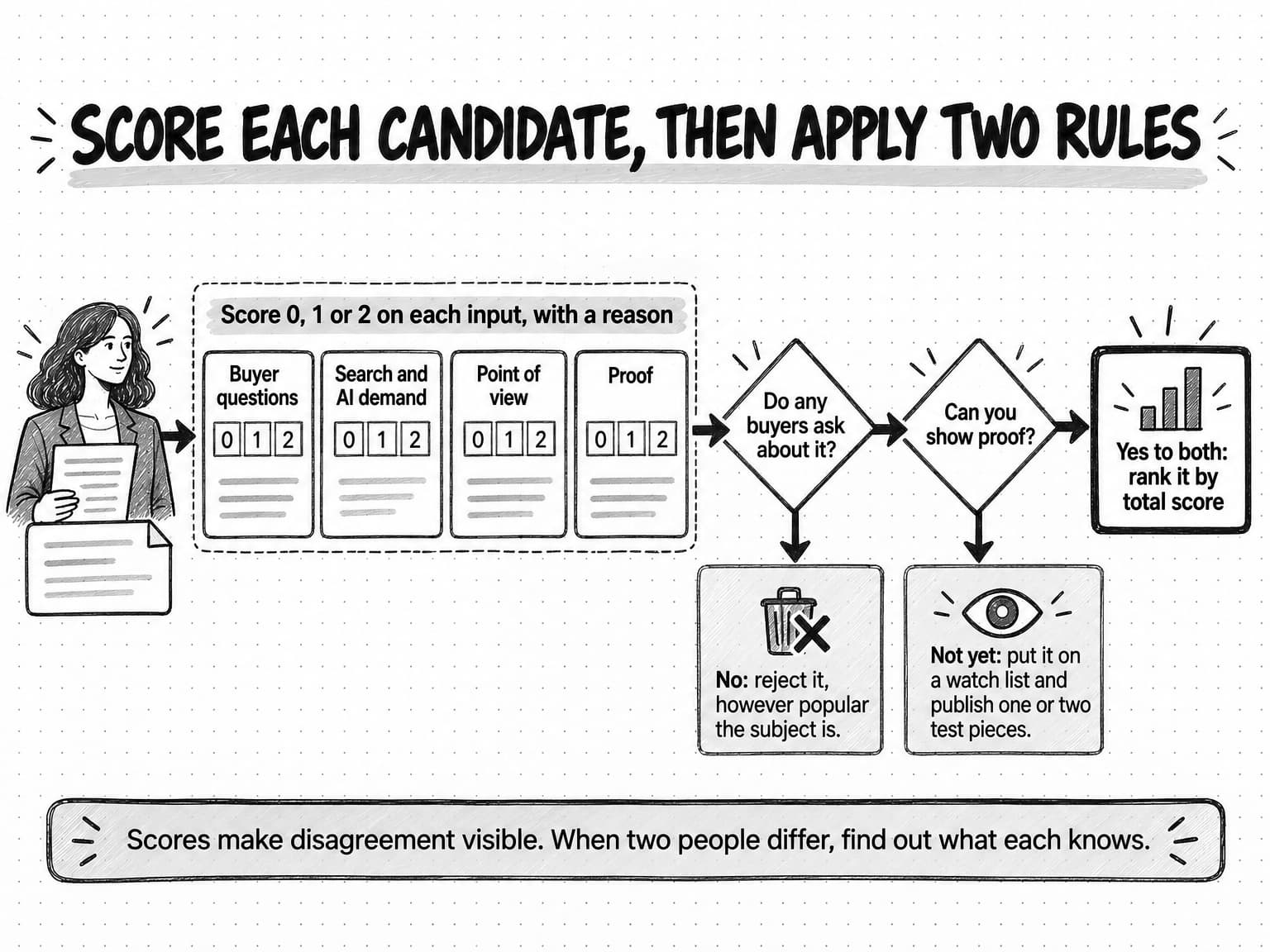
Once you have six to ten candidates, score each one on the four inputs. A three-level scale is enough, and it forces a decision where a ten-point scale invites false precision. Write a one-line reason beside every score, because the reasons are what you will argue about, and what you will check when you review the pillars later.
| Input | 0: weak | 1: some evidence | 2: strong |
|---|---|---|---|
| Buyer questions | Rarely asked, or asked by people outside the audience | Asked in one or two sources, or by one buyer role | Recurs across several sources and buyer roles |
| Search and AI demand | Little evidence people look for answers | Some queries or AI answers on the subject, mostly broad | Clear queries and follow-up questions, including specific ones |
| Point of view | Nothing to say that competitors don't | A view on part of the problem | A clear position that shapes what the company publishes |
| Proof | Only general knowledge | Some expert or customer material | Product data, customer work or practitioners the company can draw on regularly |
Add the scores, then apply two rules before ranking. First, a candidate scoring 0 on buyer questions is not a pillar, however high its other scores, because there is no audience problem to serve. Second, a candidate scoring 0 on proof goes on a watch list instead of the calendar: publish one or two pieces to test it while the company builds the evidence, and promote it when the proof exists.
View the scoring rules diagram at full size (opens in a new tab).
Here is how the fictional company Ostrand scored its candidates. Ostrand is invented for this guide: a B2B software company of about forty people that sells usage-based billing software to finance teams at software companies. Its marketing team is one marketing lead, with the founder writing occasionally and a freelance designer a few hours a week. All of its details and scores are illustrative.
| Candidate | Buyer questions | Search and AI demand | Point of view | Proof | Total | Decision |
|---|---|---|---|---|---|---|
| Moving from seat pricing to usage pricing | 2: asked in most sales calls by founders and finance leads | 2: many specific queries and AI follow-ups | 2: finance should help set the price, not inherit it | 1: customer migrations, few with permission yet | 7 | Pillar |
| Running billing operations for usage revenue | 2: support tickets and onboarding calls weekly | 1: queries exist but are scattered | 2: billing errors start in the contract, not the invoice | 2: support team sees disputes every week | 7 | Pillar |
| Revenue recognition and close for usage revenue | 2: asked by controllers in evaluations | 2: specific questions with clear demand | 1: a view on forecasting, less on accounting | 1: one in-house accounting expert | 6 | Pillar |
| Pricing AI features with credits | 1: asked by a few newer customers | 2: rising questions in search and AI answers | 1: early opinions | 0: no customer work yet | 4 | Watch list: two test pieces |
| General SaaS growth advice | 0: buyers don't ask Ostrand about this | 2: very broad demand | 0: nothing distinctive | 0: none | 2 | Reject |
| Company and product news | Not scored | Not scored | Not scored | Not scored | A content type, not a pillar |
The table did two useful things beyond ranking. It kept "general SaaS growth advice," the subject the founder enjoyed writing about most, off the calendar, with a reason anyone could check. And it turned "pricing AI features," a subject the team was excited about but could not yet support, into a test with a clear promotion rule instead of a pillar that would run dry after three posts.
How many content pillars a small team can run
We know of no study that measures the right number of content pillars. Our judgment for most small B2B teams is three or four, but the reasoning matters more than the number: each pillar needs enough attention to build something.
Work backward from capacity. To build a library a buyer can learn from, a pillar needs an anchor piece at least once a quarter and something new most weeks between anchors. A team that can produce one substantial piece a month can keep three pillars moving by rotating the anchor among them. A team that manages one every two months is better served by two pillars than by four that each get an anchor twice a year.
Three signs suggest you have too many. Some pillars go a month or more without a planned piece. The weekly review keeps choosing between pillars instead of between topics. And when you describe the company's content to a new hire, you can't name what it is known for in one sentence. One sign suggests too few: the backlog in one pillar keeps running out and the team starts repeating itself.
A founder publishing alone can usually sustain two or three pillars, and they should overlap with the company's rather than add new ones.
Content pillar examples for B2B SaaS companies
The examples below are illustrative: they show the shape of good pillars for different kinds of B2B software company, not recommendations for any real one. Your evidence should decide yours.
| Company type | Content pillars | Proof the company could bring |
|---|---|---|
| Security compliance software for startups | Passing a first security audit; answering enterprise security questionnaires; running a compliance program without a dedicated team | Patterns from many completed audits; common questionnaire sections; in-house former auditors |
| Product analytics | Instrumenting a product without drowning in events; diagnosing activation and retention; making roadmap decisions with usage data | Aggregated, permitted usage patterns; analytics practitioners; customer analyses shared with permission |
| API monitoring for developers | Responding to incidents; designing reliable APIs; on-call that engineers can sustain | Incident data across customers; engineers who run on-call themselves |
| Employee onboarding software | A new hire's first ninety days; preparing managers to onboard; HR operations as headcount grows | Program data from many companies; HR practitioners; onboarding templates customers use |
| AI customer support | Evaluating AI answers before rollout; keeping support knowledge accurate; designing a support team that works with AI | Evaluation methods; failure patterns seen in pilots; support leaders on staff |
| Sales engagement software | Outbound that earns replies; ramping new sellers; running useful pipeline reviews | Aggregated reply-rate patterns; sales leaders; customer playbooks with permission |
Three patterns run through the table. Each company has a pillar close to where its product helps (the audit, the instrumentation, the incident) and at least one pillar a step away from the product (the compliance program, the roadmap decision, sustainable on-call), which gives the company something to say to buyers who are not yet evaluating tools. None of the pillars is a feature. And each one holds dozens of questions: "passing a first security audit" covers choosing an auditor, scoping, evidence collection, common findings, timelines and what to do after a failed control.
If your list looks like your product's navigation menu, start over from the buyer questions.
Write each pillar on one page and fill its backlog
A pillar that exists only as a name drifts. Six weeks in, someone files a post about hiring under "billing operations" because it mentions invoices. A one-page definition prevents that and gives anyone who drafts for the pillar, including an AI marketing agent, the same starting point.
PILLAR NAME
A short name the team will use in the calendar.

BUYER PROBLEM
What is the reader trying to do or understand? Write it in the buyer's words.

WHO IT'S FOR
The roles and situations this pillar serves first.

OUR ANGLE
What we believe about this problem, and why. One or two sentences someone could disagree with.

IN SCOPE / OUT OF SCOPE
Subjects that belong here, and nearby subjects that belong to another pillar or to none.

PROOF WE CAN USE
Product data, customer stories (with permission status), in-house experts, research. Note what still needs approval.

CLAIMS TO AVOID
Anything the evidence does not yet support.

ANCHOR PIECE
The substantial piece that will hold the pillar together, such as a complete guide or a pillar page.

FORMATS AND CHANNELS
Where this pillar's audience learns, and which formats suit it.

OWNER
The person who keeps the pillar's backlog stocked and its pieces accurate.

TOPIC BACKLOG
A link to the list of questions waiting to be briefed.
The topic backlog is the list of questions waiting to become pieces, kept per pillar. It turns the pillar from a subject into a supply. Fill it from the buyer question log first, then from search and AI research, then from the team's own ideas, in that order of trust.
Write each backlog entry as the buyer question it answers, not as a headline: "How do we explain a usage charge a customer doesn't recognize?" rather than "Usage dispute best practices." A question tells the writer what the reader needs; a headline only tells them what to call the piece. Beside each entry, note where the question came from, the buyer role, how often it came up, and whether the proof to answer it exists yet.
A healthy backlog holds at least two months of topics per pillar, so the weekly review chooses between good options instead of scrambling for one. When an entry reaches the calendar, it gets a content brief: the reader, the question, the evidence and the outcome. Our guide to writing a content brief covers that step, which is where most of the quality of a piece is decided.
Size the calendar to what your team can produce
Most content calendars fail on capacity. The plan assumes the hours the team would have in a good week, and then launches, events, sales requests and sick days take them. In the Content Marketing Institute's survey of 1,015 B2B marketers, fielded in mid-2025, 39% put resource constraints (time, people and budget) among their top three content challenges, and 28% named creating enough quality content for their organization's needs.
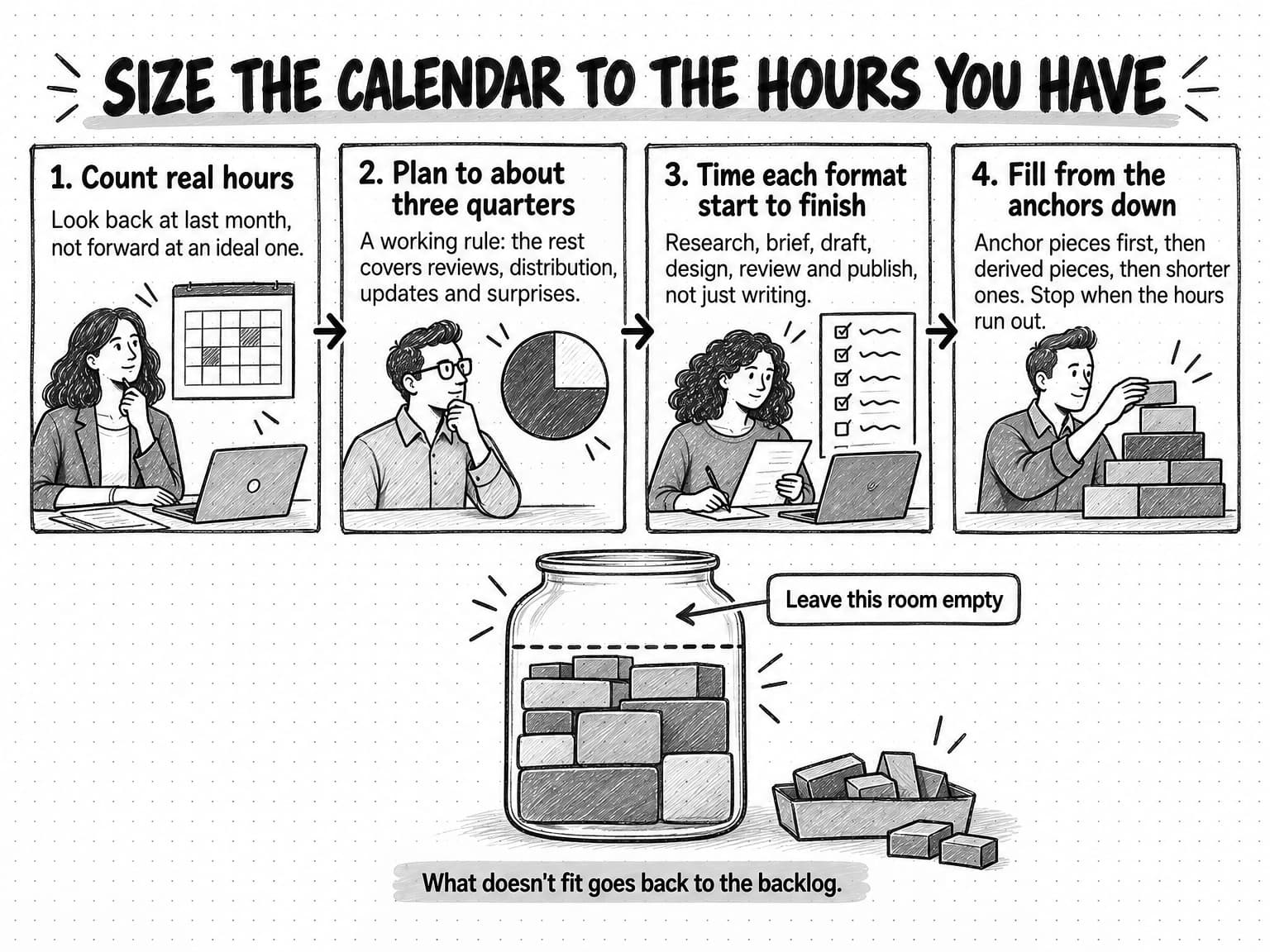
Size the calendar in four steps.
1. Count the hours you really have. For each person who works on content, estimate the hours per week they can give it in a normal week, after meetings and other responsibilities. Look back at the last month rather than forward at an ideal one. Researchers who study the planning fallacy, the tendency to underestimate how long our own tasks will take, find that people make that error even when they know their past projects ran late. Roger Buehler, one of the authors of the original 1994 studies, describes the cause as an "inside view": focusing on the specifics of the new task instead of one's track record. Your track record is the better guide.
2. Plan to about three quarters of that number. This is our working rule, not a measured standard. The remaining quarter covers what calendars forget: reviews, distribution, replying to comments, updating older pieces, and the request that arrives on Tuesday. If you finish every week with time to spare, raise the plan later.
3. Estimate the hours each format takes from start to finish. Count research, briefing, drafting, design, review, revisions and publishing, not just writing. Orbit Media's 2026 survey of 1,042 content marketers found the average blog post takes 3 hours and 20 minutes to write, for an average post of about 1,300 words. That is writing time alone, self-reported, for a typical post; a researched guide with an expert interview and a review step takes several times as long. Time your own work for a month and replace the illustrative numbers below with yours.
| Format | Illustrative hours, start to finish | What drives the time |
|---|---|---|
| Substantial guide or pillar page (2,000+ words) | 12–16 | Research, an expert interview, review by a subject expert |
| Shorter article answering one question | 5–7 | Brief, draft, one review |
| Newsletter edition | 2–4 | Mostly curation and editing when it draws on existing pieces |
| Carousel or visual explainer | 3–5 | Design time and a second review for accuracy |
| Social post adapted from an existing piece | 0.5–1 | Choosing the one idea that fits the channel |
| Original social post from a founder or expert | 1–2 | Interviewing or editing the person, plus their review |
| Refreshing an existing piece | 2–4 | Checking claims, updating examples and links |
4. Fill the plan from the most valuable work down. Put the substantial pieces on the calendar first, because they anchor the pillars and take the longest. Then add the pieces derived from them, then the original shorter pieces, and stop when the hours run out. Whatever does not fit goes back into the backlog to wait for capacity.
View the calendar sizing steps at full size (opens in a new tab).
AI drafting tools cut the drafting and adaptation hours in step 3 much more than the review hours, because a person still checks every claim. Our guide to AI content creation covers where AI saves time and where it adds checking work. Recalculate your format hours after a month of real use instead of assuming the savings in advance.
Content mix and cadence
With hours and formats known, decide two things: which kinds of content the calendar will hold, and how often each channel gets something new.
Mix: anchors, derivatives and the jobs content does
A calendar that runs on pillars works best with an anchor and derivatives pattern. Each pillar periodically gets one substantial anchor piece, such as a guide, a research report, a webinar or a pillar page. The weeks around it carry pieces derived from it: posts that each take one idea from the anchor, a newsletter section, a carousel of its method, a short video of the expert explaining one step. One round of research then feeds a month of publishing, and each derived piece leads readers back to the full answer. Our guide to repurposing content across channels explains how to adapt one source without losing its point.
Within each pillar, also balance the jobs content does. Most pieces should teach, because teaching is what earns a buyer's attention before they need the product. Some should state the company's point of view, some should show proof, and a small share should be about the company and product. For LinkedIn, our B2B LinkedIn content strategy guide gives rough shares for each post type and explains why self-promotion should stay a small minority.
Rotate pillars so none goes quiet. A simple pattern for three pillars is one anchor per pillar per quarter, staggered by month, with derived and shorter pieces from all three pillars running every week. Each pillar then gets a month in the spotlight and steady attention in between.
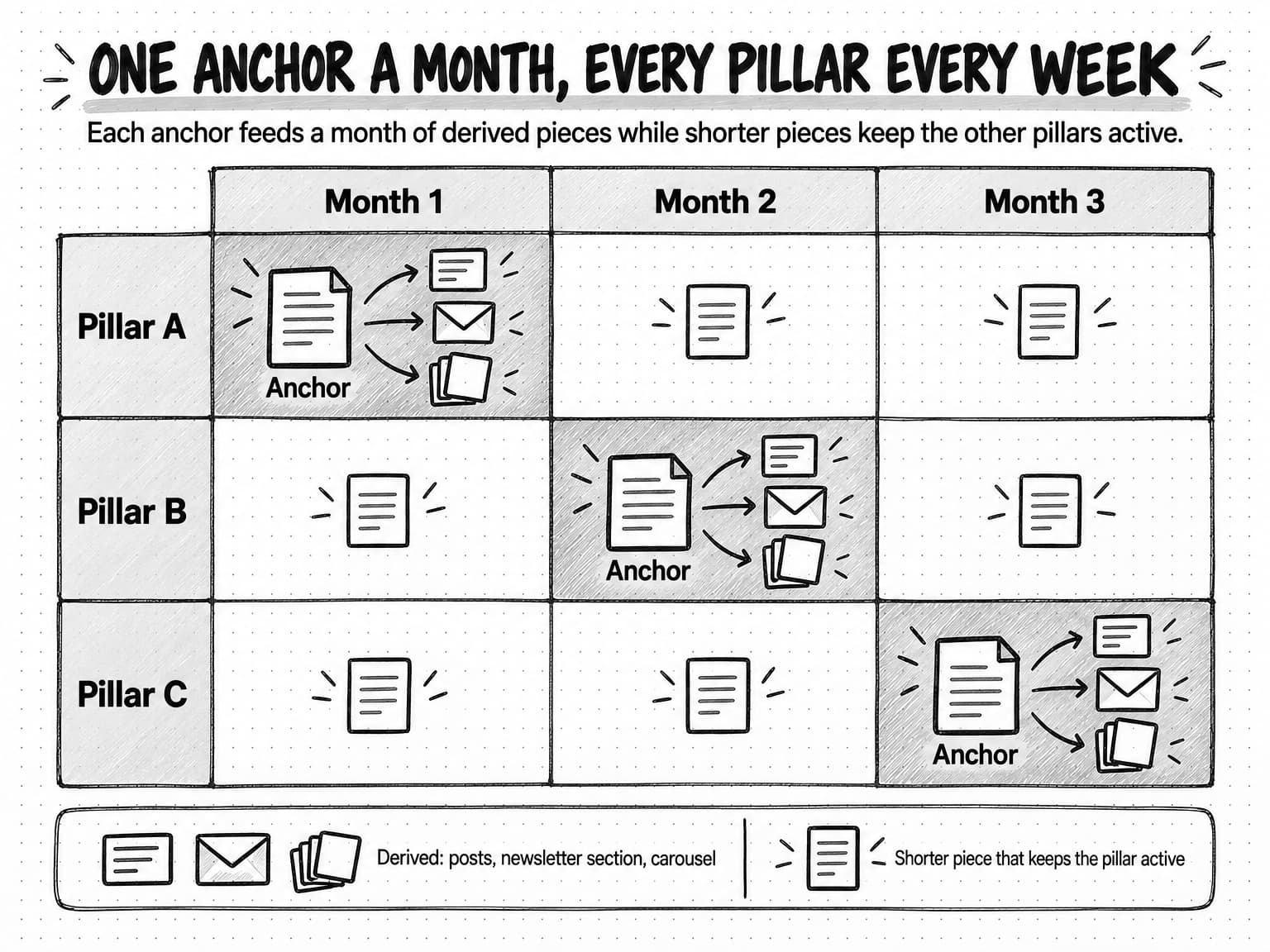
View the anchor rotation at full size (opens in a new tab).
Cadence: what you can sustain for a quarter
Choose a publishing rate for each channel that the team can keep for at least a quarter, then hold it. Consistency matters more than volume for a small team, for a practical reason: an audience can only form a habit around a schedule it can predict, and a team can only learn from results when the output is steady enough to compare one month with the next.
Evidence on frequency differs by channel and comes with limits; the LinkedIn strategy guide reviews what the LinkedIn studies can and cannot show. For a blog or resource library, a predictable rhythm of substantial pieces usually does more than a high rate of thin ones. Treat any cadence as a starting point to adjust from your own results.
How far ahead should you plan? A rolling horizon works for most small teams, and it is the one this guide's template assumes: pillars set for at least a quarter or two, a firm calendar for the next two to four weeks with every piece briefed and owned, a pencilled plan for the month after, and the backlog beyond that. Planning every slot six months out wastes effort, because launches, news and new buyer questions will change the later months anyway.
A content calendar template you can copy
A content calendar is the schedule that turns pillars and the backlog into dated work: each planned piece, its pillar, owner, status and channels. Some teams use editorial calendar for the same thing. Where the terms are distinguished, an editorial calendar usually covers publishing on owned channels, such as articles, guides and newsletters, with its editorial stages, while a content calendar also includes social posts and other channels. The difference matters less than including the fields below.
Copy these columns into a spreadsheet, a shared document or a project management tool; a spreadsheet is enough for most small teams.
Publish date,Pillar,Working title,Buyer question it answers,Format,Channels,Anchor or derived from,Owner,Reviewer,Status,Brief due,Draft due,Proof or sources,NotesMost columns explain themselves. Four do more work than they appear to:
| Buyer question it answers | Keeps every piece tied to a real question. It is the most important column. |
|---|---|
| Anchor or derived from | Links derived pieces to their source, so a correction to the anchor reaches all of them. |
| Reviewer | The subject expert or editor who checks claims, named before drafting starts. |
| Status | Idea, briefed, drafting, in review, ready, published. The weekly review reads this column first. |
Here are four rows from Ostrand's first month, to show the level of detail that helps without becoming a burden:
| Publish date | Pillar | Working title | Buyer question | Format | Owner | Reviewer | Status |
|---|---|---|---|---|---|---|---|
| Week 2, Tue | Seat to usage pricing | The finance checklist for a usage pricing change | What should finance check before we switch to usage pricing? | Guide (anchor) | Marketing lead | Founder | Drafting |
| Week 2, Thu | Seat to usage pricing | Three checks finance teams skip | Same, one idea from the anchor | LinkedIn post (derived) | Marketing lead | Founder | Briefed |
| Week 3, Wed | Billing operations | Explaining a usage charge a customer doesn't recognize | How do we explain a usage charge a customer disputes? | Article | Marketing lead | Support lead | Briefed |
| Week 4, Tue | Revenue recognition | Monthly newsletter: closing the books on usage revenue | What changes at month-end with usage revenue? | Newsletter | Marketing lead | Controller | Idea |
Keep backlog items in the same sheet without dates, so moving a topic onto the calendar is a single edit. And never put a row on the calendar without an owner and a buyer question; a row without either is a wish.
Worked example: a fictional company's first quarter
This example continues with Ostrand, the fictional billing-software company from the scoring section. Its people, hours and outcomes are invented to show the method, not to serve as benchmarks.
The hours. The marketing lead looked back at the previous month and counted about 12 hours a week actually spent on content, after events, website work and sales requests. The founder could give about 2 hours a week, mostly reviewing and recording short explanations. The freelance designer had 4 hours a week. That made 18 hours a week, or 72 in a four-week month. Planning to about three quarters gave 54 hours a month.
The pillars. From the scoring table: moving from seat pricing to usage pricing, running billing operations for usage revenue, and revenue recognition and close for usage revenue. Pricing AI features went on the watch list with two test pieces in the quarter. Each pillar got a one-page definition and a backlog of 20 to 30 buyer questions from three months of sales notes, support tickets and onboarding calls.
The monthly plan. Using its own format estimates, which matched the illustrative table closely, Ostrand filled a typical month like this:
| Work | Pieces per month | Hours each | Hours |
|---|---|---|---|
| Anchor guide (one pillar per month, rotating) | 1 | 14 | 14 |
| Shorter articles from the other two pillars | 2 | 6 | 12 |
| Newsletter | 1 | 3 | 3 |
| Carousel from the month's anchor | 1 | 4 | 4 |
| Company page posts, derived | 8 | 0.75 | 6 |
| Founder posts, drafted from short interviews | 4 | 1 | 4 |
| Refresh of one older page | 1 | 3 | 3 |
| Total | 46 |
That left 8 of the 54 planned hours, and 26 of the 72 real hours, unassigned; the two watch-list test pieces came out of that slack. The marketing lead was tempted to add a second anchor guide. She didn't, and the decision proved right in week five, when a pricing-page redesign took two days of her time and the calendar absorbed it without dropping a piece.
The rotation. Month one's anchor was the finance checklist for a usage pricing change; month two's, a guide to handling usage disputes; month three's, a month-end close guide for usage revenue. Each month's derived posts, carousel and newsletter section drew on its anchor, while the shorter articles kept the other two pillars active.
What the weekly review changed. In week six, the review noticed that three questions in a row from new sales calls were about credits for AI features, the watch-list subject. The first test piece on it had drawn more replies from finance leads than any post that quarter. The team did not promote it to a pillar on that basis: the proof score was still 0, because Ostrand had no customer work on credits yet. Instead, it moved the second test piece forward and asked the support team to flag any customer setting up credit-based pricing, so the company could build the proof it would need.
What changed at the quarter review. The billing operations pillar had produced the most useful pieces, judged by sales use and replies from the right roles, but its search demand stayed scattered. The team kept it, because sales was sending the dispute guide to prospects in nearly every late-stage deal. Revenue recognition had strong search demand but drew many readers from accounting firms rather than software companies; the team narrowed its in-scope list to questions finance leads at software companies ask during evaluations. No pillar was replaced; both changes were to scope.
Run the calendar with a weekly review
A calendar stays alive through a short, regular meeting. For a small team, 30 minutes a week is usually enough; a solo marketer can do it alone in 20, with the founder joining once a month.
Use the same agenda every week:
- Last week: planned versus published. For each piece that slipped, note why in one line: capacity, missing proof, a late review, a changed priority. The reasons tell you what to fix.
- The next two weeks: ready to go? Every piece due in the next fourteen days should have a brief, an owner, a named reviewer and its proof in hand. Anything missing one of those gets fixed now or moved.
- New signals into the backlog. Spend five minutes on what came in: questions from sales and support calls, comments and replies, new search queries in Search Console, a customer who agreed to be quoted. Add each to the right pillar's backlog with its source.
- Pillar balance. Count the last four weeks of published pieces by pillar. If one pillar has gone quiet, the next open slot goes to it.
- Cut or shrink. If the next two weeks hold more work than the hours allow, decide now what moves out, rather than missing it on Friday.
One rule makes the review work: when a piece slips twice, shrink it or cut it. A guide that has moved twice becomes a shorter article or goes back to the backlog with a note on what blocked it. Letting slipped pieces stack up in front of new ones is how a calendar falls weeks behind without anyone deciding it should.
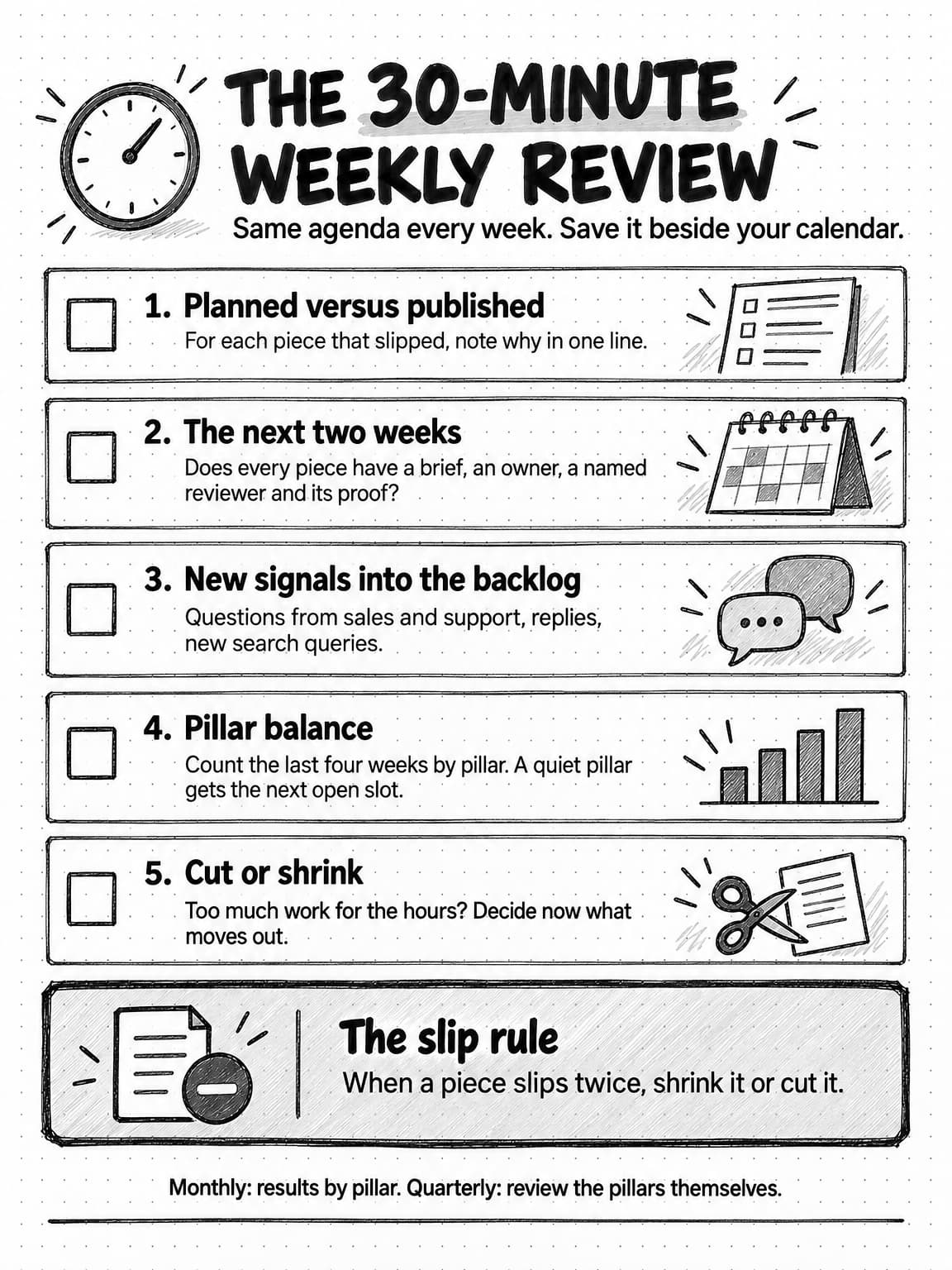
View the weekly review agenda at full size (opens in a new tab).
Once a month, add ten minutes to look at results by pillar rather than by piece, and once a quarter, review the pillars themselves. Judge a pillar over a quarter, not by a single post. Search clicks and impressions show whether people find the work; replies from the right roles, sales use and newsletter sign-ups show whether it reaches buyers. The content strategy guide linked earlier explains which question each metric can answer and why content's contribution to revenue is rarely simple to attribute.
When to change your content pillars
Pillars should be stable enough that the work accumulates, which in our judgment usually means a year or more. Change them for evidence, not boredom. The team usually tires of a pillar long before its audience does, because the team sees every piece and most readers see a few.
Good reasons to change a pillar:
- The buyer questions have dried up. The backlog can no longer fill a month with distinct questions, and new sales and support calls aren't adding any.
- The business has changed. The company now serves a different segment, has a new product line, or has stopped serving a situation the pillar was built around.
- The proof has run out or no longer holds. A product change or a market shift means the company can no longer support what the pillar argues.
- The pillar reaches the wrong audience. After a full quarter of consistent publishing, the people it attracts are mostly outside the buyer profile, and narrowing its scope hasn't fixed that.
- A watch-list candidate has earned its place. The test pieces drew the right readers, and the proof now exists.
Weak reasons: one piece performed badly, a competitor launched content on another subject, or someone senior has a new enthusiasm. Each of those may justify a single piece or a test, but none on its own justifies changing what the calendar runs on.
When you retire a pillar, do it gradually. Stop adding anchor pieces, let the remaining backlog finish over a month or two, and move any questions that still matter into another pillar if they fit. Don't abandon the pieces already published: they keep answering buyers' questions, and they still need refreshing when their facts change. Our guide to running a content audit covers deciding which existing pieces to keep, fix, merge or cut.
When you add a pillar, score it, write its one-pager, build a backlog, and give it an anchor piece early.
Why content calendars stall, and how to keep yours going for six months
A calendar the team is still following in six months is mostly the result of decisions made in its first week. The failures below are common, and each has a fix this guide has already covered.
| Why calendars stall | What it looks like | The fix |
|---|---|---|
| Planned to ideal capacity | Every week is full; one interruption pushes everything back | Plan to about three quarters of real hours (our working rule) |
| Topics without briefs | Pieces stall at the draft because nobody knows what they should say | Brief every piece before it reaches the next two weeks |
| One person reviews everything | Drafts wait days for the founder | Name a reviewer per pillar; limit each review to the claims that person owns |
| Formats instead of questions | The calendar says "blog post Tuesday," not what it answers | Require a buyer question on every row |
| No pillars, or too many | Planning starts from a blank page each month | A few pillars (our judgment: three or four), each with a backlog |
| No room for launches and news | Product launches displace the plan entirely | Leave unassigned hours; let launches borrow from them |
| Slipped pieces pile up | The team is always three weeks behind | When a piece slips twice, shrink it or cut it |
| No review ritual | The calendar is accurate for two weeks, then ignored | The same 30-minute agenda every week |
| Distribution dropped | Pieces publish and nobody sees them | Plan derived pieces and channels in the same row as the piece |
Underneath all of them is a calendar written as a wish list of output instead of a plan for the hours the team has. A calendar built on a few evidence-backed pillars, real capacity, briefs and a weekly review can absorb a bad month and still be in use in month six.
How Ampere helps plan content pillars and calendars
Ampere, the AI marketing agent, can do much of the research and drafting in this method, while you choose the pillars, the questions and what is ready to publish. Ampere prepares the work; people at your company publish it.
The evidence stage can start from what you already publish. Ampere can audit one LinkedIn company page from up to about 70 of its recent public posts, covering posting cadence, format mix, copy, topics, audience coverage and engagement against LinkedIn best practice for the company's industry. It delivers an executive HTML report of opportunities grouped by priority, with a recommended topic list. Treat that list as one input to score alongside your buyer questions, not as the pillars themselves: the audit covers that one page only, does not compare competitors, and its engagement figures are public counts that can be partial.
For the other inputs, Ampere researches your brand into Brand memory, saved and reviewable knowledge about your brand, audience, market, products, competitors and voice. Its reports include audience, voice-of-customer, content inventory, search landscape and positioning reports, which map onto the buyer-question, demand, point-of-view and existing-content evidence this guide asks for. The reports are editable, so you can correct them before later work relies on them. From that context and your own notes, Ampere can draft the pillar one-pagers, topic backlogs and a calendar as a document or spreadsheet in the session workspace, for you to review and change.
For production, Ampere drafts the pieces themselves: blog article packages, newsletters, LinkedIn text posts and carousels, with review notes and claim checks alongside the LinkedIn text post and newsletter drafts, so the reviewer starts from the claims that need checking. On paid plans, a scheduled task can prepare recurring drafts, such as next week's derived posts or the monthly newsletter, and return each result for review; our guide to automating marketing with AI agents explains where recurring work like this fits. Nothing publishes on its own. AI drafts can be inaccurate or incomplete, so the reviewer named in your calendar still checks every claim.
Ampere has a Free Plan for eligible Organizations whose owner has never had a paid plan. Ampere sets up Brand memory, then completes up to four Free tasks for the brand, with no card required: LinkedIn content audit, LinkedIn image post, LinkedIn carousel, and LinkedIn text post. Your own prompts and follow-up questions, 200+ AI tools & skills, Scheduled Tasks, and Monitoring come with paid plans.
Sources and further reading
- Google Search Central, Creating helpful, reliable, people-first content, last updated October 5, 2026. The self-assessment questions, including the warning about producing content on many topics in hopes some performs well in search.
- Google Search Central, AI features and your website, last updated December 10, 2025. How AI Overviews and AI Mode use query fan-out, and why no special optimization is required.
- Google Search Console Help, Performance report (Search results). Definitions of queries, impressions and clicks.
- Mimi An, Topic clusters: the next evolution of SEO, HubSpot, updated June 2026. The pillar page and topic cluster model.
- Robert Rose, 9 takeaways and insights from the 2026 B2B Content and Marketing Trends report, Content Marketing Institute, October 8, 2025. Survey of 1,015 B2B marketers with MarketingProfs, fielded June 24 to August 14, 2025; content challenges, including resource constraints.
- Andy Crestodina, Blogging statistics 2026, Orbit Media, September 8, 2026. Annual survey of 1,042 content marketers; self-reported time to write a blog post and average length.
- Roger Buehler, The planning fallacy: an inside view, Society for Personality and Social Psychology, May 30, 2019. Why people underestimate their own task times, and the value of looking at past performance.
- Roger Buehler, Dale Griffin and Michael Ross, "Exploring the planning fallacy: Why people underestimate their task completion times," Journal of Personality and Social Psychology 67, no. 3 (1994): 366–381. The original studies.
Frequently Asked Questions
How do you choose content pillars?
Choose content pillars by checking candidate subjects against four kinds of evidence: questions real buyers repeatedly ask, search and AI demand for answers, a point of view the company holds on the problem, and proof the company can show. Score each candidate 0 to 2 on each input with a written reason. Drop any candidate with no buyer questions, and put any candidate without proof on a watch list until the evidence exists.
How many content pillars should you have?
No study measures a right number of content pillars. Our judgment is that most small B2B teams do well with three or four, and the real limit is capacity. Each pillar needs an anchor piece at least once a quarter and something new most weeks to build a library a buyer can learn from. A team producing one substantial piece a month can rotate it among three pillars; a team producing one every two months is better served by two.
What are some examples of content pillars?
Examples of content pillars for B2B software companies include passing a first security audit for a compliance product, diagnosing activation and retention for a product analytics company, and responding to incidents for an API monitoring tool. Good content pillars name a buyer problem rather than a feature, hold dozens of distinct questions, and draw on proof the company has, such as product data, customer work or in-house practitioners.
What is the difference between content pillars and messaging pillars?
Messaging pillars are the supporting claims behind a company's value proposition, each backed by proof, and they guide how the company describes its offer on the website and in sales. Content pillars are the recurring subjects the company publishes about, framed around the buyer's problem, and most of their content should help readers who never buy. Content pillars make messaging claims more believable over time, but a calendar built from messaging pillars becomes a stream of ads.
What is the difference between content pillars and topic clusters?
Content pillars are the recurring subjects a company plans all its content around, across every channel. A topic cluster is an SEO structure in which a broad pillar page links to pages that cover subtopics in depth, and those pages link back. A content pillar often has a pillar page and a topic cluster on the website, but it also includes newsletters, social posts, webinars and other content that sits outside the cluster.
What is the difference between content pillars and content themes?
Content pillars and content themes usually mean the same thing: the few recurring subjects a company publishes about. Some teams also call them content buckets. What matters more than the name is the definition behind it: a pillar names a buyer problem, the company's angle on it, the proof it can draw on, and what is in and out of scope. A topic is narrower, the subject of one piece within a pillar.
How do you create a content calendar?
Create a content calendar by choosing your content pillars, building a backlog of buyer questions for each, and counting the hours your team really has for content. As a working rule, plan to about three quarters of those hours, estimate how long each format takes from start to finish, and fill the calendar with anchor pieces first, then derived and shorter pieces. Give every row an owner and a buyer question, and review the calendar weekly.
What should a content calendar include?
A content calendar should include, for each planned piece, the publish date, its content pillar, a working title, the buyer question it answers, the format and channels, the anchor piece it derives from if any, an owner, a named reviewer, its status, internal brief and draft deadlines, and the proof or sources it draws on. The buyer question and the owner are the two fields a row should never lack.
What is the difference between a content calendar and an editorial calendar?
A content calendar and an editorial calendar are often the same thing: a dated schedule of planned content with owners and status. When teams distinguish them, an editorial calendar usually covers publishing on owned channels, such as articles, guides and newsletters, with their editorial stages, while a content calendar also includes social posts and other channels. Either works if it records the pillar, buyer question, owner and reviewer for each piece.