What is marketing operations? Responsibilities and how a lean team runs it
A practical guide for founders and first marketing hires at B2B SaaS and AI companies: what marketing ops owns, how it changes from one marketer to twenty, the minimum stack and data model, a 90-day plan, and how AI agents add new work to govern.
41 min readWritten by Ampere
Short answer
What is marketing operations?
Marketing operations is the function that designs and runs the processes, systems, data and measurement a marketing team depends on. It covers the tech stack and integrations, data quality, lead routing, reporting definitions, tool budgets, consent and now AI governance. A small team can run it with one named part-time owner before it needs a dedicated hire.
Summary
Every company that markets already does marketing operations; the question is whether anyone owns it. Marketing ops decides how work moves rather than what marketing says, so when nobody owns it, numbers disagree, leads wait for follow-up, and tools pile up without a clear purpose.
Marketing operations has eight core responsibilities: process design, the tech stack and integrations, data quality, lead management and routing, measurement, budget and vendors, compliance and consent, and AI governance. It overlaps with RevOps, sales ops and marketing automation but is not the same job, and demand generation is its main internal customer.
The work changes with team size. One marketer needs a clean CRM, one lead definition and a trusted weekly number; five marketers need a named owner, routing agreements and fixed report definitions; twenty need governance and usually a dedicated role. A minimum viable stack gives each kind of record one source of truth.
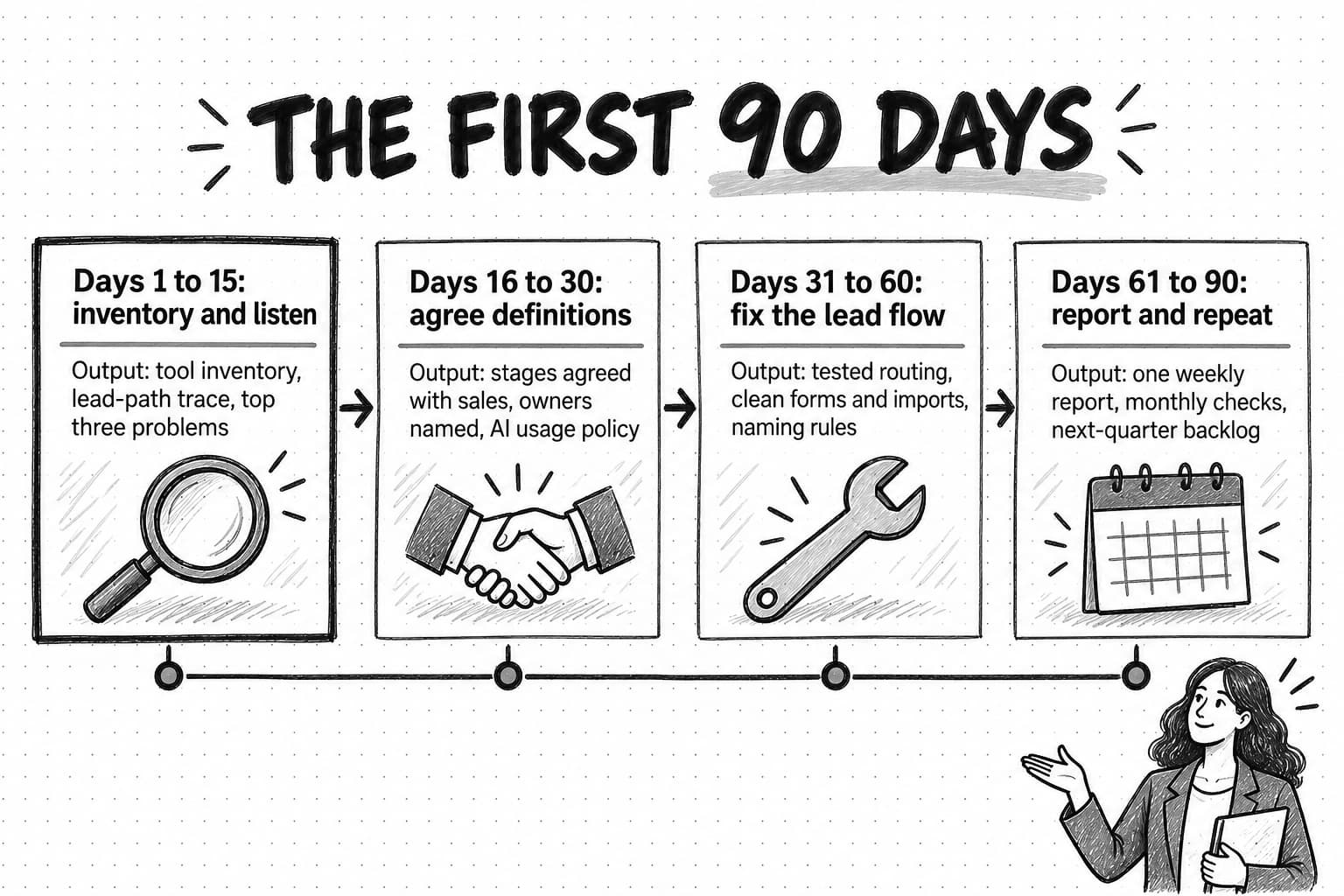
A 90-day plan for one part-time owner runs inventory and a lead-path trace first, then agreed definitions and an AI usage policy, then fixes to routing and data entry points, then one weekly report and recurring checks. A fictional worked example and a copyable responsibilities checklist show the method in practice.
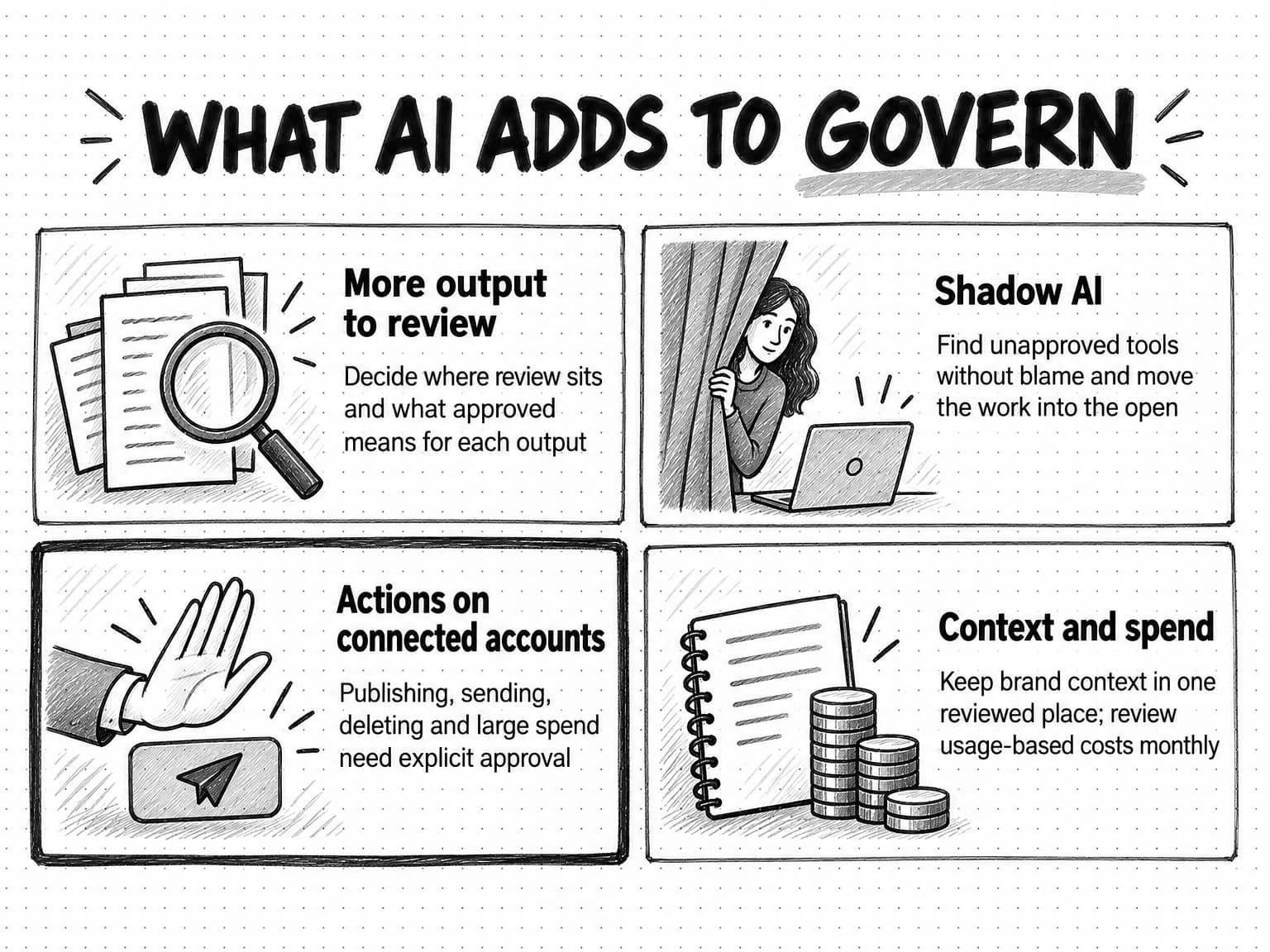
AI agents add work for marketing operations to govern: more output to review, shadow AI tools, agents that can act on connected accounts, and usage-based spend. The fix is to inventory AI tools, require approval for publishing, sending and deleting, keep brand context in one reviewed place, and track health metrics such as lead response time.
Contents
- What is marketing operations?
- Marketing operations vs RevOps, sales ops, marketing automation and growth
- The eight core responsibilities of marketing operations
- Does a small team need marketing operations?
- What marketing operations looks like at 1, 5 and 20 marketers
- A marketing operations maturity model
- The minimum viable marketing ops stack and data model
- The first 90 days of marketing operations for a small team
- Worked example: a fictional two-person team runs its first 90 days
- How AI agents change marketing operations
- Marketing operations metrics
- What does a marketing operations manager do?
- Marketing operations skills and hiring signals
- Common marketing operations failure modes
- A marketing operations responsibilities checklist
- How Ampere fits into a lean marketing operations setup
- Sources and further reading
- Frequently Asked Questions
A founder at a forty-person software company asks a simple question in the Monday meeting: how many qualified leads did marketing produce last month? The first marketing hire opens the CRM and finds three fields that could mean "source," a lifecycle stage that half the records skip, and a webinar list that was uploaded twice. The marketing automation tool reports one number, the CRM another, and the spreadsheet the founder built last year a third. Nobody is wrong, exactly. The company simply never decided what a lead is, where the record of it lives, or who keeps that record honest.
That gap is what marketing operations exists to close. Most early teams do not notice it while they are small, because one person can hold the whole picture in their head: which form feeds which list, why a field is called lead_source_2, which tool sends the onboarding emails. The picture breaks when a second marketer arrives, when sales starts asking why a demo request sat untouched for two days, or when the board wants pipeline numbers it can trust. It breaks faster now that marketers also use AI tools that draft, research and sometimes act on connected accounts, because each new tool is another place where data, permissions and spending can drift.
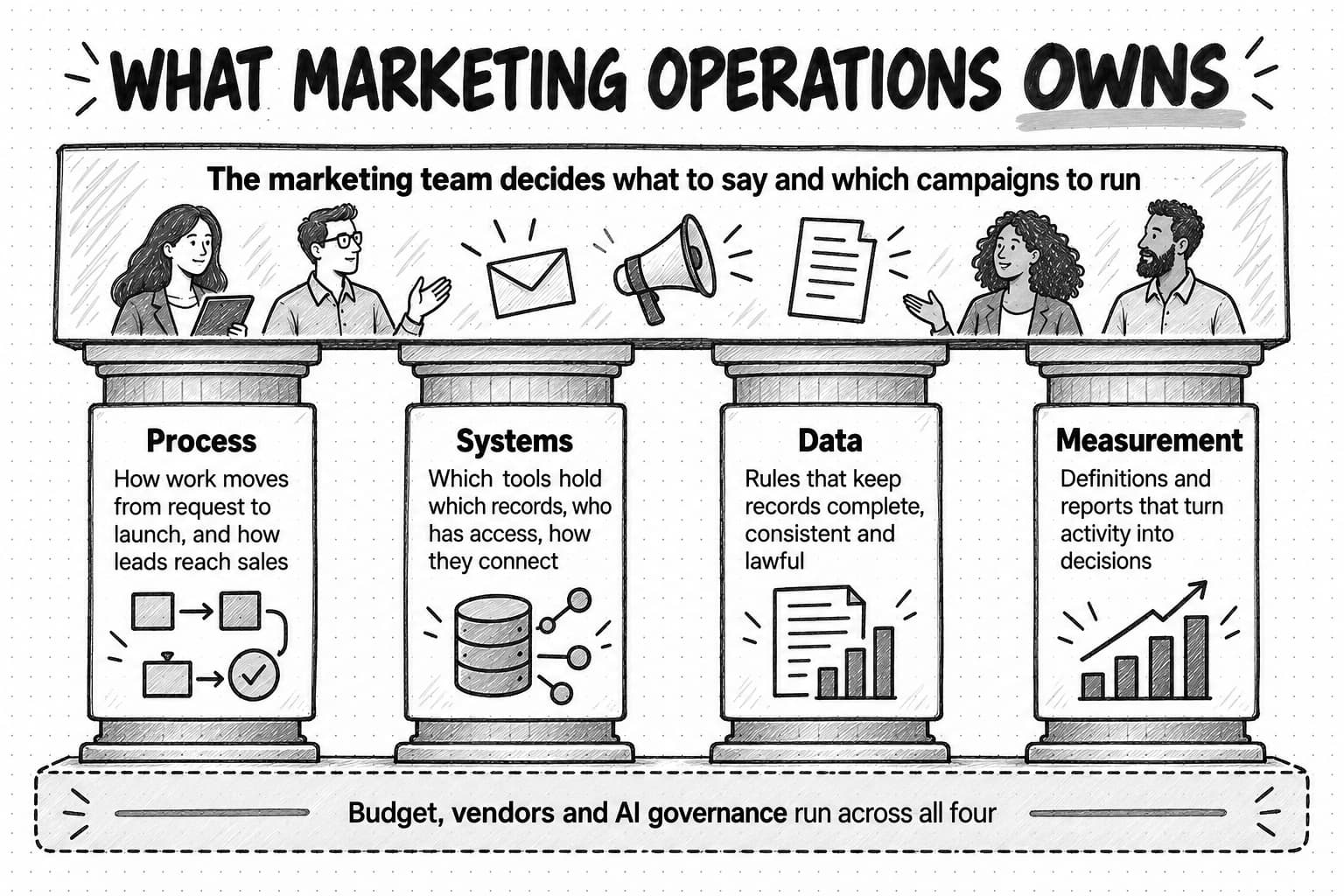
Marketing operations is the function that designs and runs the processes, systems, data and measurement a marketing team depends on, so campaigns can be planned, launched, followed up and judged consistently. It does not decide what the company says or which campaigns to run. It decides how the work moves: how a lead is captured, scored and routed, which tools hold which records and how they connect, what each metric means and where it comes from, how money is spent on software and vendors, how consent is recorded, and now, which AI tools and agents are allowed to do what.
This guide is for a founder or first marketing hire at a B2B SaaS or AI company deciding whether the company needs "marketing ops," what it would cover, and how to run it before there is a dedicated person to own it. It separates the function from revenue operations, sales operations, marketing automation and growth, walks through the eight core responsibilities, and shows how the work changes from one marketer to twenty. Then it gives a maturity model, a minimum viable stack and data model, a 90-day plan, and a worked example, followed by how AI agents change the job, metrics, hiring, failure modes and a copyable responsibilities checklist.
What is marketing operations?
Marketing operations, often shortened to MOps or marketing ops, is the operating layer underneath a marketing team. If the marketers are the people who write the campaign, build the audience and make the creative, marketing operations is the set of decisions and systems that let that work reach the right people, be recorded correctly, and show up accurately in a report afterward.
GitLab publishes its marketing operations charter in its public handbook, which makes it a useful primary example of how a real team describes the job. The charter, last modified in August 2026, says the team "supports the marketing organization to streamline processes and manage related tools" and works across teams so that "information between systems is seamless, data is as accurate as possible, and terminology is consistent." It lists the team's primary functions as project management of the marketing technology stack, standardizing processes related to tools, data cleanliness and accuracy, best practices and strategy on marketing technology, continuous improvement of systems, evaluating new technology, and supporting its procurement. The list belongs to a large company, but a company of thirty has the same concerns, handled by whoever happens to be closest.
Most marketing ops tasks fall into one of four areas. The first is process: how marketing work moves from request to finished, reviewed and launched. That includes campaign intake, briefs, approvals, launch checklists and the handoff of leads to sales. The second is systems: the marketing technology stack, how each tool is configured, who has access, and how the tools pass data to each other. The third is data: the records the systems hold about people, companies and their activity, and the rules that keep those records complete, consistent and lawful. The fourth is measurement: the definitions, attribution rules and reports that turn activity into numbers the company can make decisions on.
Budget and vendor management sit across all four, since you pay for systems, data and the people or agencies who run processes. This guide treats budget as one of the eight responsibilities described later.
Marketing operations vs RevOps, sales ops, marketing automation and growth
These terms are used inconsistently because companies draw the boundaries differently. The distinctions below are the common ones in B2B software companies. Small companies often merge them, but it helps to know which job you are describing before you hire for it.
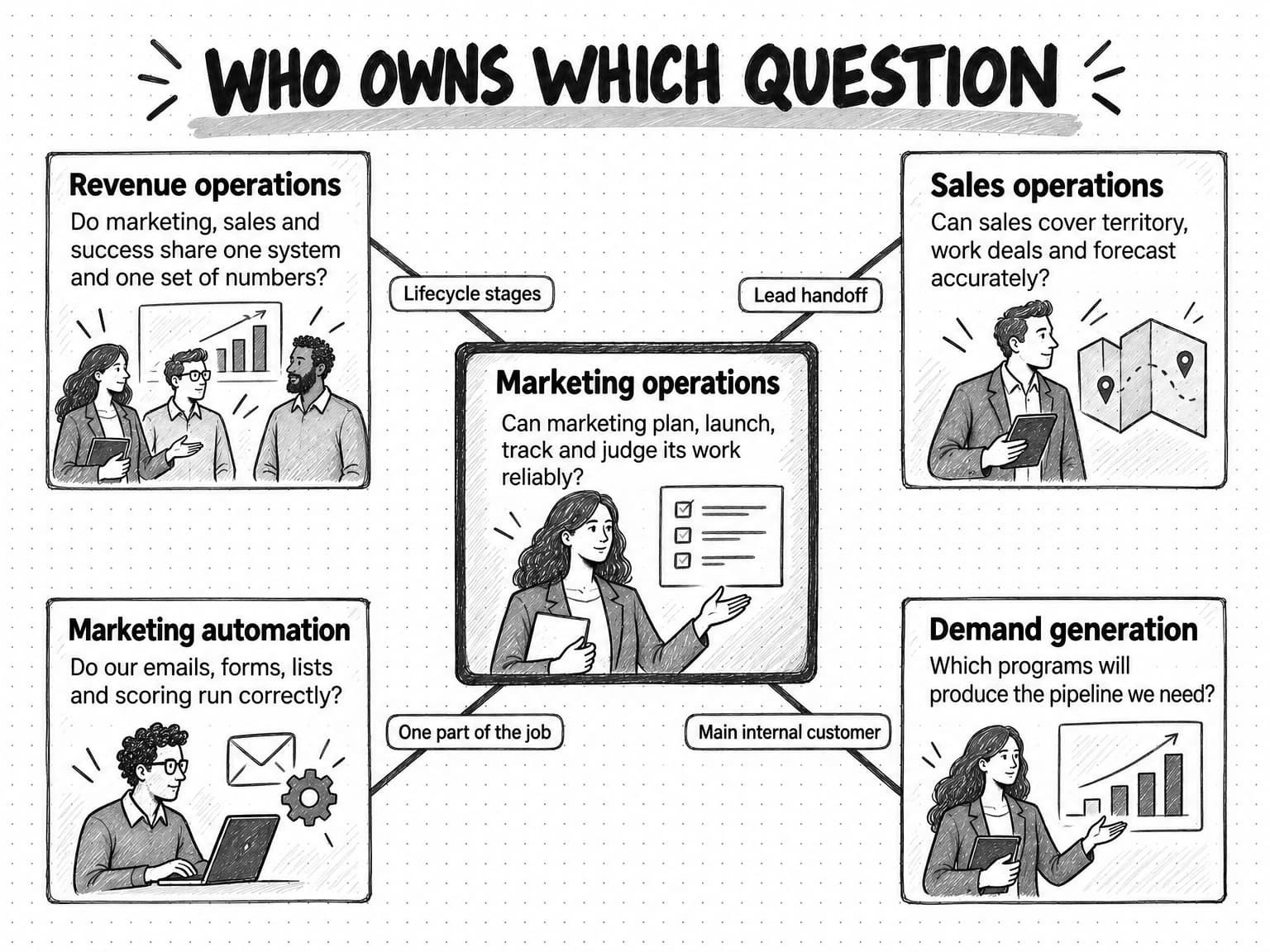
Revenue operations (RevOps) is the operating function for the whole revenue team, usually marketing, sales and customer success together. It owns the systems and definitions that span the customer lifecycle: the CRM as a single record, pipeline stages, forecasting, and reporting that connects a first touch to renewal. When a company has RevOps, marketing operations often sits inside it. Marketing ops owns the marketing tools and the part of the lifecycle before sales accepts a lead; RevOps owns the shared spine and what comes after.
Sales operations does for sales what marketing operations does for marketing: territories, quotas, sales tools, deal processes and forecasting. It meets marketing operations at the handoff, which is why the two most often argue about lead routing and response times.
A marketing automation specialist configures and runs the marketing automation platform: emails, nurture programs, forms, lists and scoring rules. That is one important part of marketing operations. A team with an automation specialist and nobody responsible for definitions, data quality and measurement has a well-tuned engine without a map. Our guide to what marketing automation is and how it works covers the automation side.
Growth or demand generation owns pipeline targets and decides which programs to run. Marketing operations makes sure those programs can be launched, tracked and attributed without rebuilding the plumbing each time. Large companies sometimes also split out martech management for tool architecture; at small companies it is part of marketing operations.
| Function | Main question it answers | Typical owner of | Where it overlaps with marketing ops |
|---|---|---|---|
| Marketing operations | "Can marketing plan, launch, track and judge its work reliably?" | Marketing processes, marketing tools, marketing data rules, marketing reporting | It is the reference point |
| Revenue operations | "Do marketing, sales and success run on one system and one set of numbers?" | CRM as shared record, lifecycle stages, forecasting, cross-team reporting | Lifecycle definitions, attribution, CRM fields marketing writes to |
| Sales operations | "Can sales cover territory, work deals and forecast accurately?" | Territories, quotas, sales tools, deal processes | Lead routing, handoff rules, response-time agreements |
| Marketing automation specialist | "Do our emails, forms, lists and scoring run correctly?" | The marketing automation platform | Automation is a subset of marketing ops |
| Growth or demand generation | "Which programs will produce the pipeline we need?" | Campaign plans, channel budgets, pipeline targets | They are marketing ops' main internal customer |
When the boundaries blur, ask who gets called when something breaks. A form that stops writing to the CRM is marketing ops. A rep who cannot see a lead's history is probably RevOps or sales ops. An underperforming campaign is demand generation, though marketing ops should be able to show the numbers.
The eight core responsibilities of marketing operations
The responsibilities below are the ones most marketing operations job descriptions and team charters share, listed roughly in the order a small team tends to need them. Each is described in terms of what owning it means: the decisions to make, the artifacts to keep, and the routine checks that keep it working.
1. Process and workflow design
Marketing repeats a lot of work: webinars, launches, newsletters, paid campaigns, event follow-ups. Each has the same skeleton of request, brief, draft, review, launch and follow-up. Marketing operations designs that skeleton once, so each new campaign starts from a known path rather than from memory. Owning it means keeping an intake template, a launch checklist per campaign type, a clear statement of who approves what, and a visible status of work in progress. It also means deciding what does not need a process: a three-person team that writes a twelve-step approval flow for social posts will route around it within a month. Our guides to marketing workflows, marketing SOPs and content approval workflows cover this work in depth.
2. Tech stack and integrations
Marketing software is a crowded market. The 2025 Marketing Technology Landscape published by Scott Brinker at chiefmartec in May 2025 counted 15,384 solutions, up 9% from 14,106 the year before. A small team needs a tiny fraction of that, but it needs a deliberate answer to three questions about every tool it pays for: what job does it do, what data does it read and write, and who owns it.
Owning the stack means keeping an inventory with an owner, cost, renewal date and purpose for each tool; naming the source of truth for each kind of record; documenting integrations, including which direction data flows and which fields map to which; and controlling admin access. The MO Pros community's summary of its State of the Marketing Ops Professional research, on a page dated September 2025, reports that 96% of teams use a marketing automation platform, that only a third of respondents are fully satisfied with their tech stack, and that 81% ranked integration as their top priority when evaluating martech. The page gives no sample size, so treat those as practitioner survey figures, but they point the same way most teams' experience does: the problem is rarely a missing tool and usually tools that do not connect cleanly. Our guide to building an AI marketing stack has a worksheet for deciding what to keep, consolidate or cut.
3. Data quality and governance
Every report, segment and routing rule depends on the records underneath it. Duplicate contacts split a buyer's history in two. A missing company size sends a large account to the wrong rep. A field that three people interpret differently produces three different reports. Owning data means keeping a short data dictionary (each important field with its definition, allowed values, source and owner), controlling the entry points where bad data arrives (forms, list uploads, enrichment and integrations), and running a regular hygiene routine of merging duplicates, normalizing values and retiring dead fields. GitLab's job description for an associate marketing operations manager includes "merging like records" and "cleansing, enriching and uploading prospect lists from various events," a fair picture of how routine much of this work is.
4. Lead management and routing
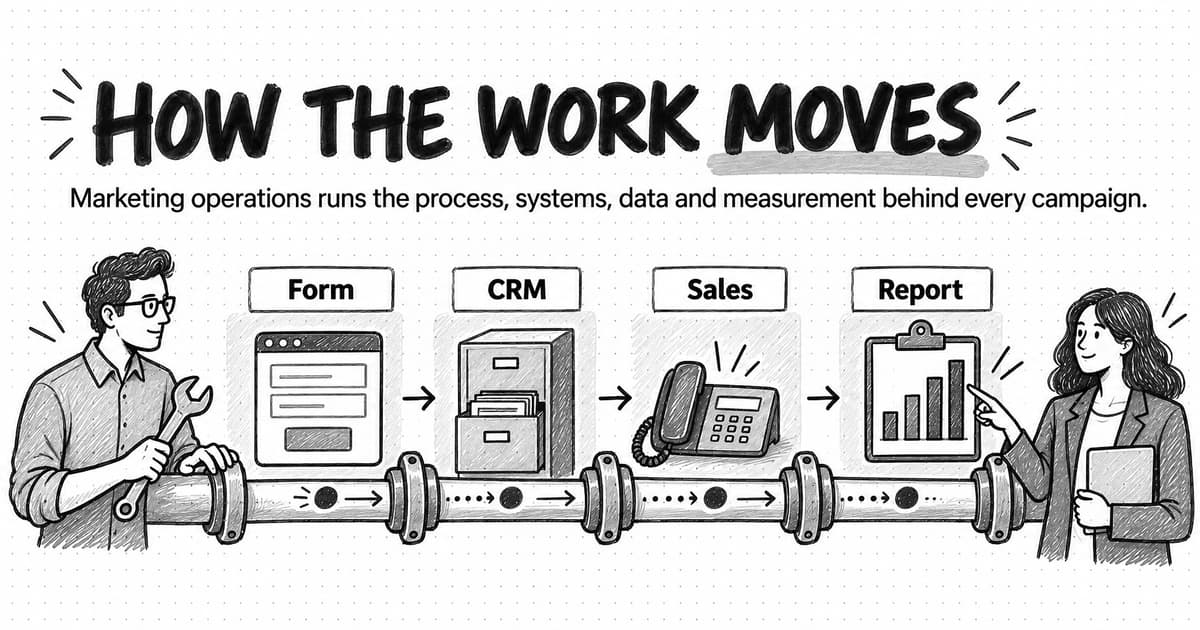
Lead management is the set of rules that decide what happens to a person after they show interest: how they are recorded, how they are qualified, when they become a lead sales should work, who gets them, and how fast. In B2B companies this is where marketing and sales most often lose trust in each other, so it needs explicit agreements. Owning it means defining lifecycle stages (for example subscriber, lead, marketing-qualified lead, sales-accepted lead, opportunity, customer) with written criteria for each transition, deciding how leads are assigned, agreeing a response-time expectation with sales, and building a path back to nurture for leads sales rejects, with a reason code. It also means testing the path by submitting a form as a fake buyer and watching what happens.
5. Measurement and reporting
The job here is less about building dashboards than about making sure everyone means the same thing by the same word. If "marketing-sourced pipeline" counts any opportunity with a marketing touch in one report and only first-touch opportunities in another, the dashboard causes arguments instead of decisions. Owning measurement means writing definitions for each reported metric, choosing an attribution approach and stating its limits, setting campaign naming and UTM conventions, and producing a regular report people read. Our guides to automating marketing reporting and content marketing ROI go further.
6. Budget and vendor management
Marketing operations is often the team that knows what every tool costs, when it renews and whether anyone uses it. Owning this means keeping spend and renewal dates in the stack inventory, reviewing usage before each renewal, managing seat counts and contracts, and watching usage-based costs. Many AI tools and agents are priced by tokens, credits or runs rather than seats, so the bill moves with activity and needs its own review. Our explainer on AI tokens and credits covers how that pricing works.
7. Compliance and consent
Marketing systems hold personal data and send commercial messages, so marketing operations carries part of the legal and deliverability risk even when counsel owns the policy. The EU's General Data Protection Regulation says in Article 7 that where processing is based on consent, the controller "shall be able to demonstrate" that the person consented, and that consent must be "as easy to withdraw as to give." The U.S. Federal Trade Commission's CAN-SPAM compliance guide says commercial email must include a valid physical postal address, that opt-outs must be honored within 10 business days, and that a company "can't contract away" its responsibility by hiring someone else to send. Google's email sender guidelines say that since February 1, 2024, senders of more than 5,000 messages a day to personal Gmail accounts must set up SPF, DKIM and DMARC authentication, support one-click unsubscribe for marketing messages, and keep the spam rate reported in Postmaster Tools below 0.30%.
The operational job is to make the systems able to record and honor those requirements: store consent with its source and timestamp, make unsubscribes flow to every sending system, keep email authentication correct, and know which fields hold personal data. Marketing operations does not give legal advice; when in doubt, it asks counsel and records the answer.
8. AI governance
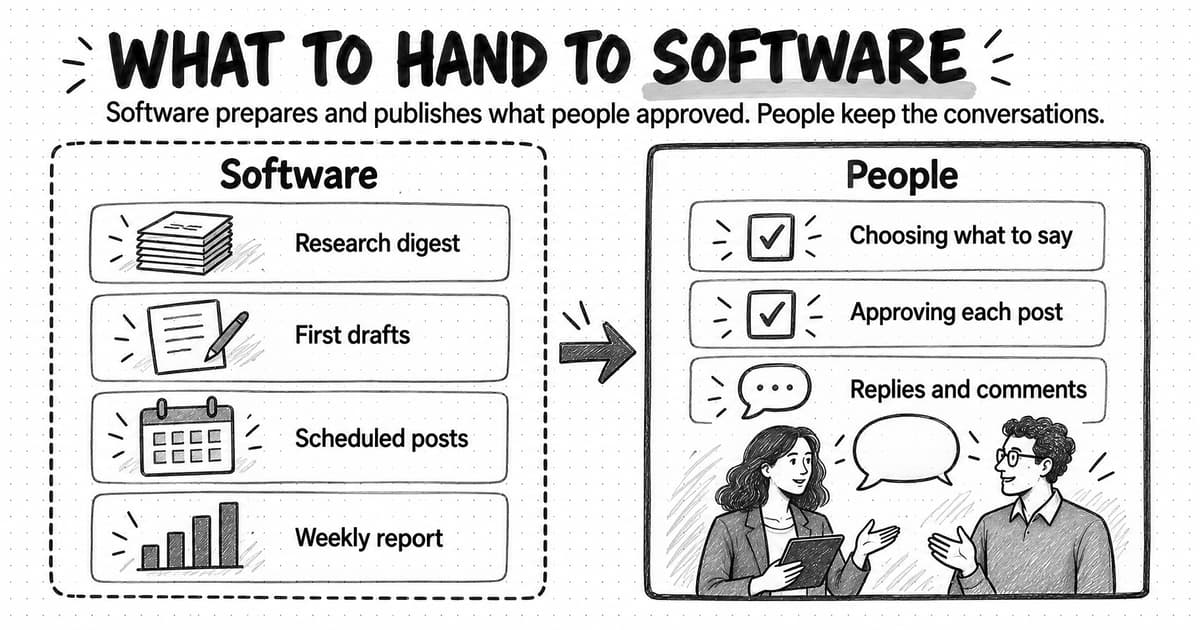
This is the newest responsibility. Marketers now use AI tools to draft copy, research competitors and make creative, and AI agents that can browse, use files and sometimes act on connected accounts. Each tool touches data, produces content that carries the brand, and costs money. Owning AI governance means keeping AI tools in the stack inventory, writing a short usage policy, listing the actions that always need human approval (publishing, sending, deleting, spending above a limit), keeping shared brand context in one reviewed place, and watching usage and spend. The section on how AI agents change marketing operations covers this in detail.
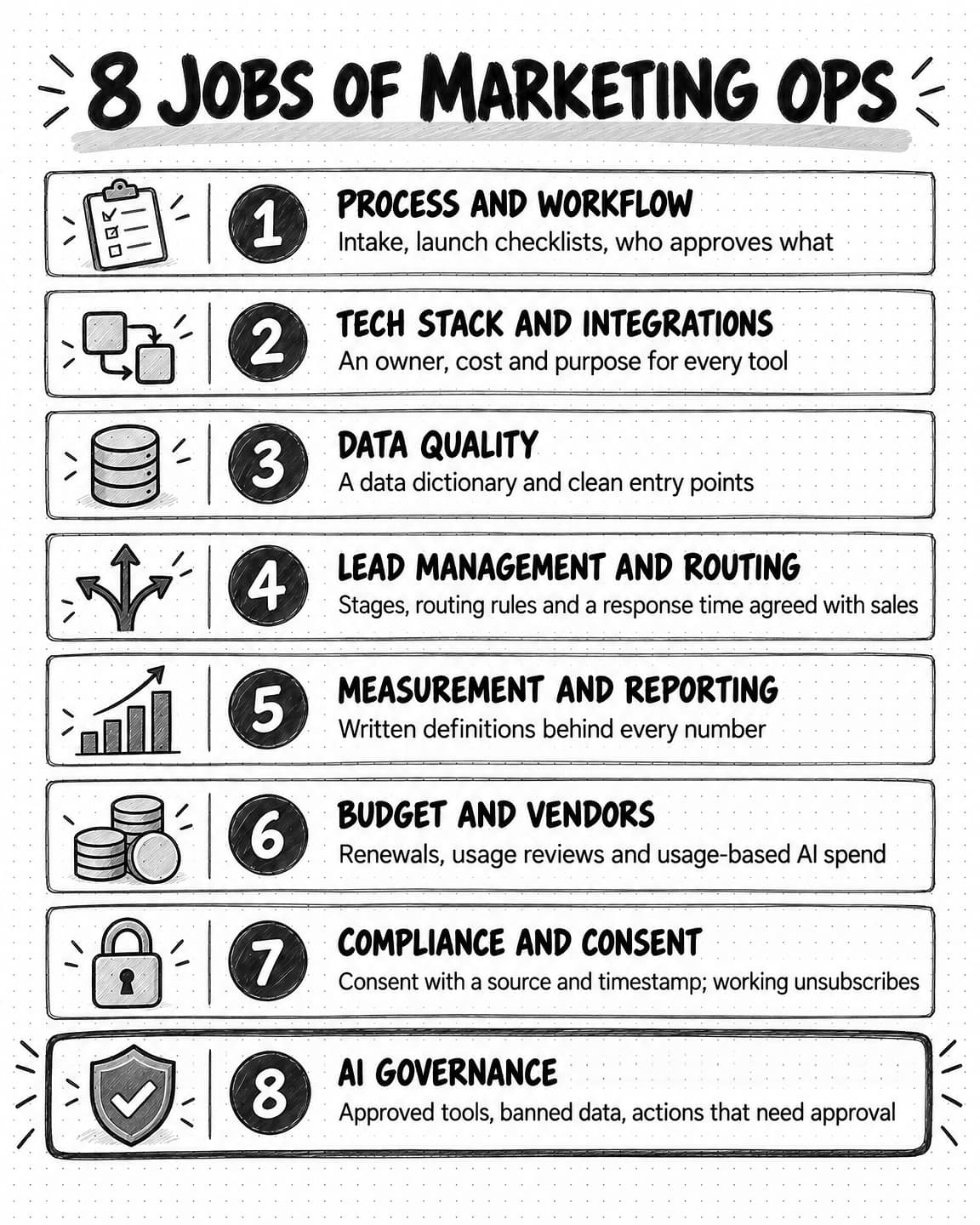
View the eight responsibilities at full size (opens in a new tab).
Does a small team need marketing operations?
Every company that markets already has marketing operations. The question is whether anyone owns it. In a company of twenty, it is usually the founder or the first marketer, done in between other work and mostly in their head. That arrangement works until one of a few signals appears.
The clearest signals: leaders ask a simple numbers question and get several different answers. Sales complains that leads arrive late, incomplete or not at all. A campaign launch slips because someone has to rebuild the same form, list and email sequence from scratch. A new marketer needs weeks to learn which tool does what. The company pays for tools nobody can explain. Someone discovers that a teammate has been pasting customer data into an AI tool nobody approved. Any one means marketing operations is happening by accident.
A small team does not need a full-time marketing operations manager to respond. It needs one named owner, a few protected hours a week, and a short list of decisions written down. The rest of this guide assumes exactly that: marketing ops as a part-time responsibility first, and a dedicated role later.
What marketing operations looks like at 1, 5 and 20 marketers
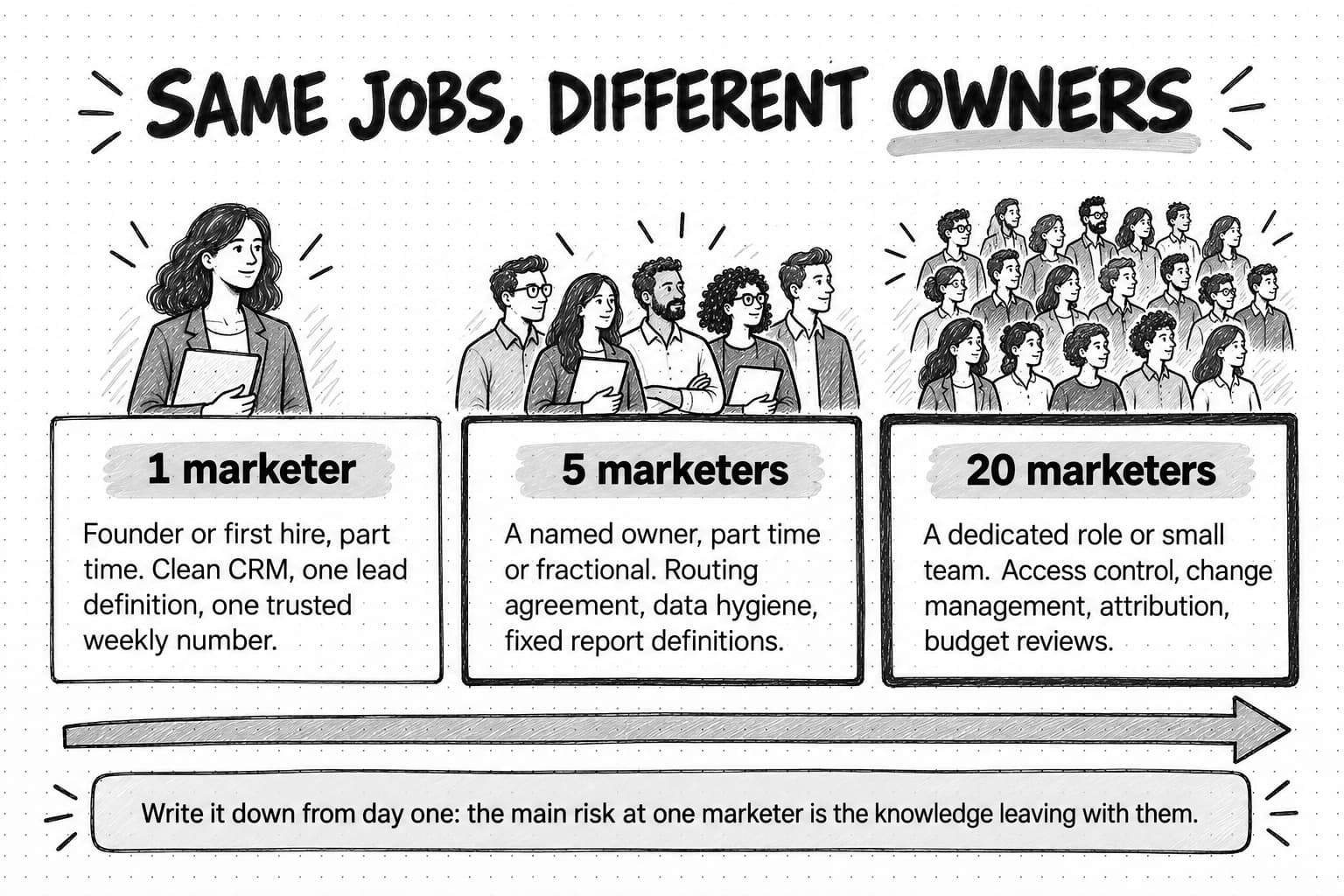
The same eight responsibilities exist at every size. What changes is who does them, how formal they need to be, and which become urgent first. These snapshots are illustrations, not benchmarks; real teams vary with their sales motion, deal size and how much pipeline marketing produces.
With one marketer, often the founder or first hire, marketing operations is a few hours a week of the same person's time. The urgent work is whatever prevents lasting damage: a clean CRM structure, one definition of a lead and how it reaches sales, consent captured at every form, and one weekly number the founder trusts. Process can stay informal, but anything painful to reconstruct, such as integrations, field meanings and admin logins, should be written down from the start, because the main risk at this size is the first marketer leaving with the operating knowledge.
With five marketers, people specialize in content, demand generation, product marketing or events, and they launch work in parallel. Process starts to matter, more people have admin access, and data slips as more people upload lists and create fields. This is the point where a named marketing operations owner becomes important, even if it is a demand generation manager spending a third of their time on it or a fractional specialist a few days a month. Lead routing needs a formal agreement with sales, and reports need fixed definitions because more people read them.
With twenty marketers, marketing operations is usually a dedicated role or small team, often inside revenue operations. The work shifts toward governance and capacity: architecture for a larger stack, access control, change management for shared systems, budget reviews, attribution, and training. GitLab's handbook, for example, describes tracking major changes in a marketing changelog so other teams know when shared systems change. AI governance at this size is an owned policy with periodic reviews.
| 1 marketer | 5 marketers | 20 marketers | |
|---|---|---|---|
| Who owns marketing ops | Founder or first marketer, part time | A named owner part time, or a fractional specialist | A dedicated role or small team, often within RevOps |
| Most urgent work | CRM structure, lead definition and handoff, consent, one trusted weekly number | Process for parallel work, data hygiene, routing agreement, fixed report definitions | Architecture, access control, change management, attribution, budget reviews |
| Documentation | A short operating document and field list | Data dictionary, launch checklists, routing rules, AI usage policy | Runbooks, changelog, training material, governance reviews |
| AI governance | A list of approved tools and one rule on customer data | A usage policy with approval rules and shared brand context | An owned policy, access reviews, usage and spend reporting |
A marketing operations maturity model
A maturity model is a way to describe where you are now and what the next step looks like, so you can sequence the work instead of trying to fix everything at once. The five levels below are a simplified model for small and mid-sized B2B teams. They are not a scoring standard, and a team can sit at different levels for different responsibilities: a company might have mature lead routing and ad hoc AI governance.
| Level | What it looks like | Typical symptom | Next step |
|---|---|---|---|
| 1. Accidental | Operations happen as side effects of campaigns; knowledge lives in one person's head | Numbers disagree; nobody knows why a field exists | Name an owner and write down the stack, fields and lead path |
| 2. Documented | The stack, key fields and lead path are written down; basic definitions agreed | Documents exist but are not always followed | Turn the most repeated work into checklists and templates |
| 3. Standardized | Recurring campaigns use templates; lead routing and SLAs are agreed; a weekly report uses fixed definitions | Changes to shared systems still break things | Add change control, data hygiene routines and access reviews |
| 4. Managed | Changes are reviewed; data quality is measured; budget and vendor reviews happen on a cadence; AI tools are governed | Reporting is trusted but slow to adapt | Automate routine checks and reporting; review metrics quarterly |
| 5. Improving | Operations are measured and improved deliberately; automation and AI agents run routine work under clear review | The risk is complacency and unreviewed automation | Keep reviewing what automation does; retire what no longer earns its place |
Most early-stage companies sit at level one or two, and that is normal. The goal for a small team is usually level three for the responsibilities that touch revenue directly (lead management, data and measurement) and level two for the rest. Moving everything to level five at a forty-person company would cost more time than it saves.
The minimum viable marketing ops stack and data model
A small team does not need many tools to run marketing operations well. It needs a few tools with clear jobs, one source of truth for each kind of record, and a data model simple enough that everyone uses it the same way.
The minimum viable stack
The table lists the jobs a small B2B stack has to cover, not specific products. Many tools cover several jobs.
| Job | Source of truth for | Note for a small team |
|---|---|---|
| CRM | People, companies, deals, lifecycle stage | Decide early whether the CRM or the marketing tool owns lifecycle stage; only one should |
| Email and marketing automation | Email engagement, subscriptions, consent | Make sure unsubscribes and consent sync to the CRM |
| Website forms | Form submissions | Keep fields short and mapped to defined fields |
| Analytics | Web sessions and campaign tracking | Agree UTM conventions before the second campaign, not after the tenth |
| Reporting | Nothing; it reads from other systems | A spreadsheet or the CRM's own reports are fine at first |
| Enrichment (optional) | Company size, industry and other firmographics | Decide which fields enrichment may overwrite |
| AI tools and agents | Should not own customer records | Govern access, data inputs, approvals and usage |
| Documentation | Definitions and rules | One shared place, linked from every tool's admin settings |
The rule that saves the most trouble is one source of truth per kind of record. When two systems both think they own lifecycle stage or consent, they overwrite each other and the reports disagree in ways that take days to untangle.
The minimum viable data model
The data model is the set of objects and fields the systems use to describe buyers and their journey. Most small B2B teams need five things:
- People and companies as separate, linked records, because several people at one company often take part in a purchase, so reporting by company matters as much as by person.
- One lifecycle stage field with written criteria, owned by one system, with a short list of values and a rule for each transition.
- An original source field that is set once and never overwritten, plus a separate latest source field. Overwriting original source is one of the most common reasons attribution stops making sense.
- Consent fields with timestamp and source, flowing to every system that sends.
- A campaign naming convention, so a lead can be traced to a campaign and a campaign to its cost.
A data dictionary for these fields can be short. Rename fields to match your tools.
FIELD: lifecycle_stage
  Definition: Where this person is in the buying journey.
  Values: subscriber, lead, mql, sql, opportunity, customer, disqualified
  Owned by: CRM (marketing automation reads only)
  Rules: transition criteria in the operating document, section "Lifecycle"

FIELD: original_source
  Definition: How this person first reached us. Set once, never overwritten.
  Values: organic_search, paid_search, paid_social, referral, event, partner, direct, outbound, other
  Owned by: marketing automation (writes on record creation)

FIELD: email_consent
  Definition: Whether this person agreed to receive marketing email.
  Values: opted_in, opted_out, unknown
  Also record: consent_timestamp, consent_source (form or import name)
  Owned by: marketing automation; syncs to CRM and every sending tool

FIELD: campaign
  Format: YYYY-MM_channel_short-name (for example 2026-10_webinar_pricing-teardown)
  Owned by: campaign record in the CRM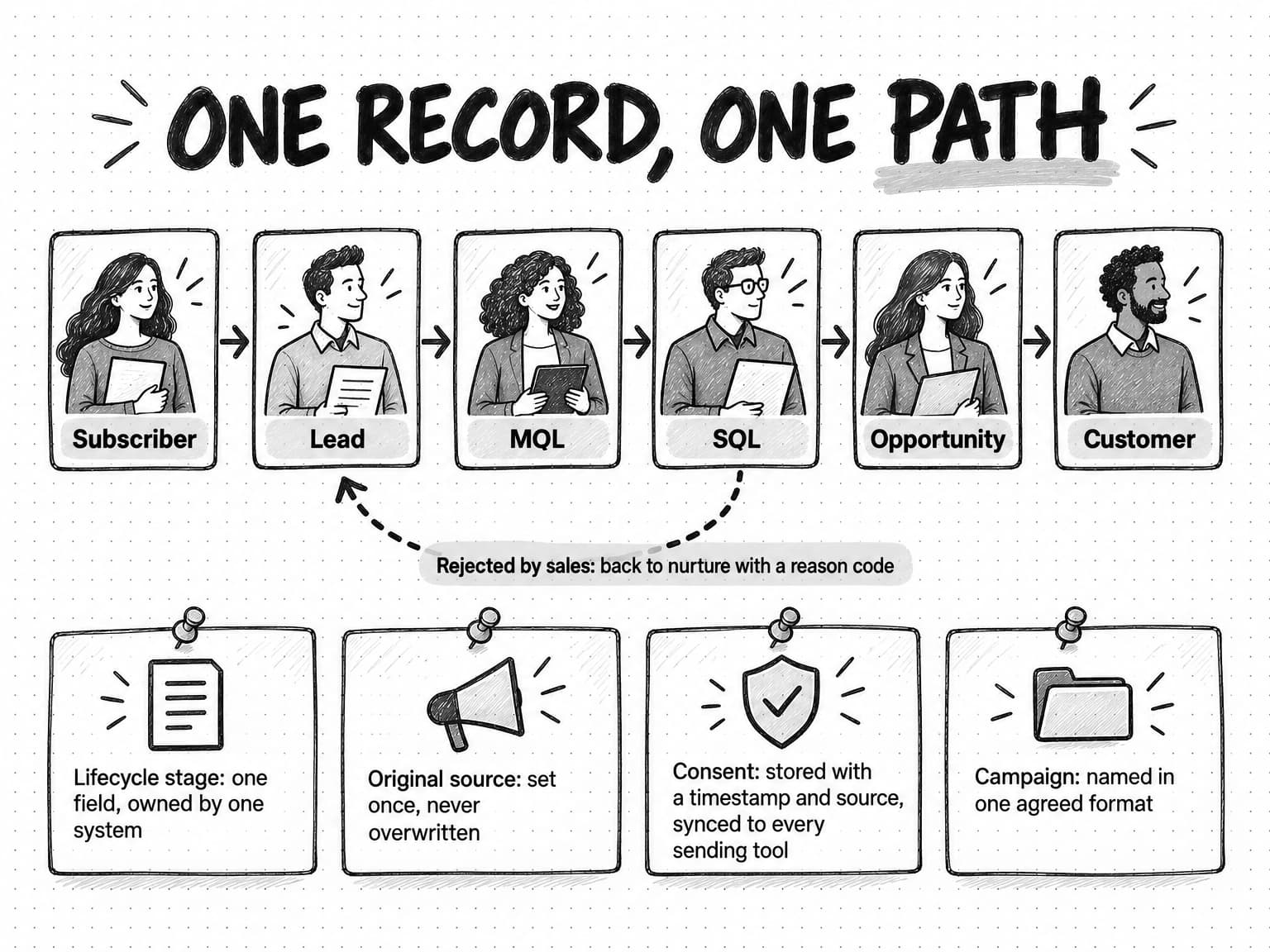
The first 90 days of marketing operations for a small team
The plan assumes one owner with about a day a week for marketing operations, a CRM and an email tool already in place, and some untidy data. It puts the work that protects revenue and trust first, and each phase produces something useful even if the next one slips. Adjust the pace to the hours you actually have.
Days 1 to 15: inventory and listen
- List every tool marketing uses or pays for, including AI tools individuals signed up for, with owner, cost, renewal date, admins, data held and connections. Our guide to shadow AI has a blame-free way to find tools people adopted on their own.
- Trace the lead path end to end by submitting each main form as a fake buyer and following the record: where it lands, which fields fill, what stage it gets, who is notified and how long it takes to reach a person.
- Ask the founder, sales lead and finance contact which numbers they use, which they distrust, and what decision each number should inform.
Output: a one-page inventory, a lead-path diagram with gaps marked, and the three problems that cost the company most.
Days 16 to 30: agree definitions and owners
- Agree lifecycle stages, transition rules, a response-time expectation and a rejection path with sales, in a meeting rather than by document review alone.
- Name the source of truth for each kind of record, especially lifecycle stage and consent.
- Write a short AI usage policy: approved tools, data that must never go in, and actions that always need approval. The AI guardrails guide has a template.
- Start the operating document, one shared page linking the inventory, definitions, data dictionary and policies.
Output: agreed definitions, an owner for every tool and record type, and a first operating document.
Days 31 to 60: fix the lead flow and data entry points
- Fix routing gaps found in the trace, starting with any lead that can be lost or delayed.
- Clean up forms and list imports so each field maps to a defined field and consent is captured.
- Deduplicate and normalize the fields that drive routing and reporting, and stop anything that overwrites original source.
- Set campaign naming and UTM conventions for all new campaigns, and check email authentication and unsubscribe handling with whoever manages your domain.
Output: a tested lead path, cleaner entry points, and conventions that stop new mess.
Days 61 to 90: reporting, routines and next quarter
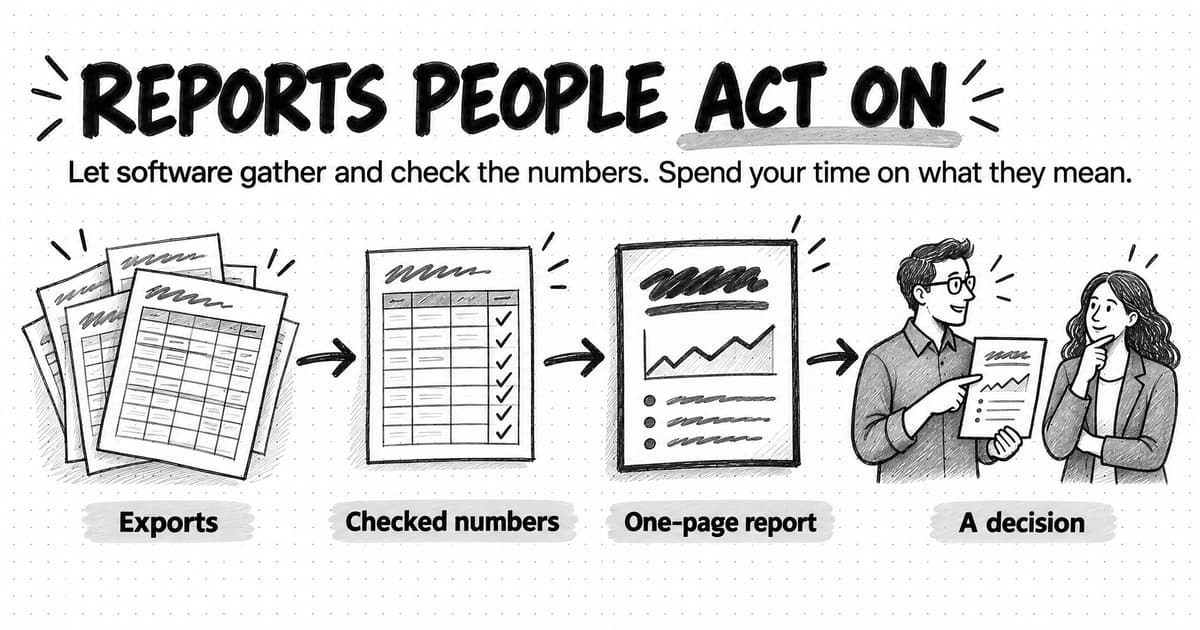
- Build one weekly report on the agreed definitions: new leads by source, conversion between stages, response time and marketing pipeline, readable in five minutes.
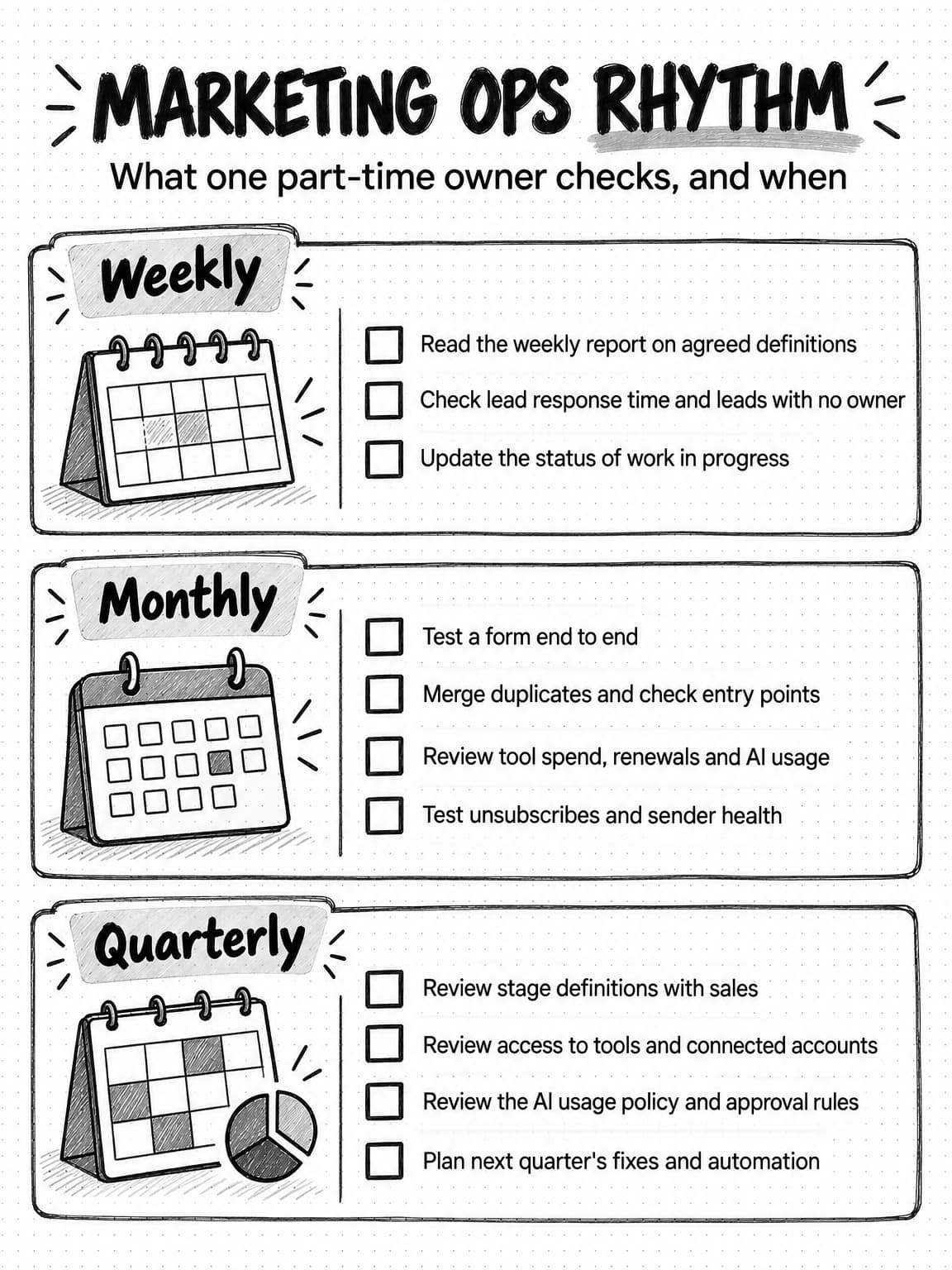
- Set recurring routines: a weekly report review, a monthly data hygiene check and spend review, and a quarterly review of definitions, tools and AI usage.
- Turn the two most repeated campaign types into checklists or templates.
- Write the next-quarter plan, including which routines to automate first and whether the volume of work justifies more dedicated time or a hire.
Output: a weekly number leaders trust, a running cadence of checks, and a prioritized backlog.
Worked example: a fictional two-person team runs its first 90 days
This example describes a made-up company, not a customer. Fieldline is a fictional forty-five-person company selling inventory software to mid-sized distributors. Marketing is a head of marketing and one content marketer. The company has a CRM that sales owns, an email tool marketing set up two years ago, website forms, web analytics, and four AI tools that different people pay for on their own cards. The founder's complaint is the one from the opening of this guide: three different lead numbers every month.
The head of marketing takes the marketing operations role and blocks Thursday mornings for it. In the first two weeks she lists eleven tools, including two nobody uses and an AI writing tool a former contractor can still administer. Her lead-path trace finds that demo requests from the pricing page create a CRM record with no owner, because the routing rule only covers the contact form. Those leads wait until someone spots them in a weekly export, which explains much of the sales team's complaint about slow follow-up.
In weeks three and four she and the sales lead agree five lifecycle stages, a rule that demo requests go straight to the account owner or a round robin, and a same-business-day response expectation. The CRM will own lifecycle stage and the email tool will own consent. Her one-page AI policy approves two AI tools, bans customer data and unreleased financials from all of them, and allows no AI tool to publish or send without a person's approval.
In weeks five to eight she fixes the pricing-page routing, removes four unused form fields, stops the email tool overwriting original source, and merges the duplicates created by a webinar list uploaded twice. By week twelve the founder reads a one-page weekly report on Monday. The three numbers have become one, with a note explaining that the email tool counts subscribers and the report counts leads. The two unused tools are cancelled at renewal, and the backlog for next quarter has three items: a lead score, a quarterly attribution review, and a launch template. None of the work required a new tool.
How AI agents change marketing operations
Earlier marketing automation followed rules people wrote: if a person fills this form, add them to this list and send this email. AI tools and agents change the job in two ways. They produce much more work, much of it content and research that carries the brand, and some of them can take actions, such as publishing a post or changing a record, from instructions rather than fixed rules. Both changes land on marketing operations, because both touch process, systems, data and measurement.
More automation to govern
When an agent can draft a newsletter, research competitors weekly and prepare social posts, output grows faster than anyone's ability to review it. Marketing operations has to decide where review sits, who does it, and what "approved" means for each kind of output; our guide to human-in-the-loop AI explains the review points that matter. Recurring AI work also needs what any automation needs: an owner, a clear schedule or trigger, a place where results land, and a way to notice failed or wrong runs. How to automate marketing with AI agents covers scheduled and event-triggered AI work.
Shadow AI
Marketers adopt AI tools fast, often on personal accounts, because they are cheap and useful. The result is shadow AI: AI used for work without the organization's knowledge or approval. For marketing operations that means customer data in unreviewed tools, brand context scattered across private chat histories, spending missing from the stack inventory, and content nobody can trace. The fix is the same as for any shadow tool: find it without blame, decide what to approve, and move the work into a shared system with access control.
Permissions and approval workflows
An agent that can act on connected accounts deserves the same thinking as a new hire with admin access. Which accounts can it reach? Which actions can it take alone, and which need approval first? What happens on a scheduled run when nobody is watching? A sensible default is that drafting and research run freely, while publishing, sending, deleting and spending above a set limit always need explicit approval of the exact action. AI guardrails for marketing teams sets out five layers of control: access, actions, spend, content and data. Put the approval rules in the operating document beside the routing rules, since both decide what may happen automatically.
Shared context and spend
AI output is only as good as the context it starts from: positioning, audience, products, competitors and voice. When each marketer keeps that context in private prompts, outputs drift and nobody can review what the AI was told. Marketing operations can treat brand context like the data dictionary, as one maintained source with an owner and a review date; our guide to AI agent memory explains how saved brand context works. Usage-based pricing also changes budget work. A seat licence costs the same whether used or not, while an agent priced by credits costs more on a busy week and can jump when someone schedules a heavy job every hour. Know where AI usage is visible, who approves larger spend, and how recurring jobs pause when they fail, and review AI spend in the monthly stack review.
Marketing operations metrics
Marketing operations tracks two kinds of metrics. Outcome metrics show whether marketing produces results; marketing ops owns their accuracy, not the outcomes. Health metrics show whether the operating layer itself works, and marketing ops owns those directly.
| Metric | Type | What it tells you | How to read it |
|---|---|---|---|
| Lead response time | Health | How long a lead waits before a person in sales contacts it | Track the median and the slowest cases; long waits usually mean a routing gap |
| Leads with no owner | Health | Records that should be routed but are not | Should be close to zero; any count is a process bug to fix |
| Duplicate rate | Health | Share of new records that match an existing person | Rising rates point to a bad entry point, such as a list import |
| Required field completeness | Health | Share of records with the fields routing and reporting depend on | Check per entry point to find which form or import is leaking |
| Stack cost and utilization | Health | Spend per tool and whether it is used | Review before every renewal |
| AI usage and spend | Health | Usage-based AI costs and which jobs drive them | Look for recurring jobs that cost more than their output is worth |
| Stage conversion rates | Outcome | Share of leads moving from one lifecycle stage to the next | Only meaningful once stage definitions are stable |
| Marketing-sourced and influenced pipeline | Outcome | Pipeline value linked to marketing by the agreed rules | Always state which attribution rule produced the number |
Start with four or five, because a twenty-metric dashboard rarely gets read. Lead response time and leads with no owner are the best first two: both expose revenue lost to process gaps, and both are cheap to measure.
What does a marketing operations manager do?
A marketing operations manager owns the operating layer this guide describes. The title covers a wide range of jobs, so it helps to look at what fills the week. At a small or mid-sized B2B company, a marketing operations manager might fix a form that stopped writing to the CRM, build lists and tracking for next week's webinar, explain a change in the weekly report, answer a sales rep's question about why a lead went to someone else, refuse a request for a duplicate tool, merge duplicates from an event upload, and update a launch checklist after a campaign went wrong. Over a quarter, the same person reviews definitions with sales, renews or cancels tools, runs an access review and plans the next improvements.
GitLab's public job descriptions show how the role grows. At the associate level the work is mostly data stewardship and system support: provisioning licences, cleaning and uploading prospect lists, building segmented lists. At the intermediate level it is "maintaining, optimizing, and integrating" the marketing tech stack, training the team on tools, auditing configurations and maintaining database quality, including GDPR and CASL compliance. Senior roles add cross-functional initiatives, analysis and project management.
What separates a strong marketing operations manager from a capable tool administrator is habit more than tool knowledge. They ask what a field means before they change it, they test end to end instead of trusting that an integration works, and they write things down so the operating knowledge survives when people change jobs.
Marketing operations skills and hiring signals
The skills that matter for a first marketing operations owner, hired or grown internally, are CRM and marketing automation administration; confident spreadsheet and data work, including deduplication and basic reporting; process design and documentation; measurement literacy, meaning funnels, attribution and their limits; integration basics, such as recognizing a sync conflict; enough compliance awareness to know when to involve counsel; and judgment about AI tools' data handling, permissions and cost. Many first owners grow into the role from a marketing, sales operations or data job by taking over a system nobody else owned, such as the CRM or the weekly report. Underneath the skills sits a temperament: people who like knowing how a record moves through four tools and who can get sales and marketing to agree on a definition without a fight.
A full-time hire usually makes sense when the operating work regularly takes more than two days a week of someone else's time, when several marketers launch work in parallel, or when marketing produces enough pipeline that unreliable numbers become a leadership problem. Before that, the common options are a part-time owner inside the team, a fractional specialist for a few days a month, or a short agency project to fix the foundations. Choose by whether the problem is ongoing capacity or a one-time cleanup, and whichever you choose, keep the operating document and definitions with someone inside the company, or the knowledge leaves when the contract ends.
Five interview questions reveal real experience quickly:
- Walk me through how a lead moved from a form to a sales conversation at your last company. Where did it break?
- Tell me about a time two reports disagreed. How did you find out why?
- How would you decide which system owns lifecycle stage?
- What would you do in your first month here?
- How would you decide whether an AI tool may connect to our CRM?
Strong answers are specific about records, fields and people. Weak answers stay at the level of tool names.
Common marketing operations failure modes
Most of these patterns come from treating marketing operations as tooling rather than as decisions.
- Buying a tool to fix a definition problem. No attribution or dashboard tool resolves a disagreement about what counts as a qualified lead. Agree the definition first, then report it.
- Two sources of truth. When the CRM and the automation tool both write lifecycle stage or consent, they overwrite each other. Give each field one owner and make other systems read it.
- Overwriting original source. Many tools update source on every conversion, so after a few months every lead seems to come from email or direct traffic, and channel budgets are set on false data.
- Processes nobody follows. Heavy approval flows on a small team get bypassed within weeks. Remove steps that do not change outcomes.
- Undocumented integrations and access that never expires. A former contractor's sync silently writes to a field nobody understands, and departed staff keep admin access to tools holding customer data, including AI tools. Inventory every integration and review access quarterly and when anyone leaves.
- Unreviewed automation. A scheduled job or AI agent runs every week and nobody has checked its output since the first month. Recurring automation needs an owner and a periodic review.
- AI context in private chats. Each marketer keeps a personal version of positioning and voice in prompts, so outputs diverge and nobody can review what the AI was told.
A marketing operations responsibilities checklist
Copy this checklist into your operating document and fill in an owner and cadence for each line. A blank owner is itself a useful finding.
MARKETING OPERATIONS RESPONSIBILITIES CHECKLIST
Company: ________  Marketing ops owner: ________  Last reviewed: ________
For each line, record: Owner / Cadence / Where the evidence lives

1. PROCESS AND WORKFLOW
[ ] Intake template for campaign requests
[ ] Launch checklist per repeated campaign type
[ ] Approval rules: who approves what
[ ] Visible status of work in progress

2. TECH STACK AND INTEGRATIONS
[ ] Tool inventory: owner, cost, renewal date, purpose, admins
[ ] Source of truth named for each record type
[ ] Integration map: direction, fields, owner
[ ] Change log for shared systems

3. DATA QUALITY AND GOVERNANCE
[ ] Data dictionary for key fields
[ ] Entry points checked: forms, imports, enrichment
[ ] Monthly deduplication and normalization pass
[ ] Unused fields retired

4. LEAD MANAGEMENT AND ROUTING
[ ] Lifecycle stages and transition rules agreed with sales
[ ] Routing rules documented and tested end to end
[ ] Response-time expectation agreed and tracked
[ ] Rejection path back to nurture, with reason codes

5. MEASUREMENT AND REPORTING
[ ] Written definition for each reported metric
[ ] Campaign naming and UTM conventions
[ ] Attribution approach and its limits written down
[ ] One weekly report leaders read

6. BUDGET AND VENDORS
[ ] Spend and renewal dates per tool and vendor
[ ] Usage reviewed before each renewal
[ ] Usage-based AI spend reviewed monthly

7. COMPLIANCE AND CONSENT
[ ] Consent stored with source and timestamp
[ ] Unsubscribes reach every sending system (test monthly)
[ ] Email authentication and sender health checked after any change
[ ] Policy questions confirmed with counsel

8. AI GOVERNANCE
[ ] AI tools in the stack inventory, with owners
[ ] AI usage policy: approved tools, banned data
[ ] Actions that always need human approval listed
[ ] Shared brand context maintained in one place
[ ] Access to connected accounts reviewed quarterly and on departures
The checklist says what to own; the rhythm says when to look. Each week, read the report and check lead response time and unowned leads. Each month, test a form end to end, clean duplicates, test unsubscribes and sender health, and review tool and AI spend. Each quarter, review definitions with sales, access to tools and connected accounts, and the AI usage policy, then plan the next fixes.
View and save the marketing ops rhythm at full size (opens in a new tab).
How Ampere fits into a lean marketing operations setup
Ampere is an AI marketing agent, not a marketing operations platform. It is not a CRM, it does not send marketing email or route leads, and it is not a general marketing automation platform; your CRM, email tool and forms stay the systems that hold buyer records and send messages. Ampere helps a lean team with the marketing work around those systems, and with several of the habits this guide recommends for AI work.
Recurring work with a place to land. Scheduled tasks run supported recurring work, such as a weekly competitor research summary or a monthly content audit, hourly, daily, weekly, monthly or on demand. Each run returns its result to a Project for review, and a task can email run updates to chosen Organization members. Scheduled runs check credits before they start and can pause after repeated failures or when credits run out. Our guide to automating competitor monitoring shows how such a job fits into a team's week.
Monitoring that files evidence. Monitoring checks supported public sources, such as competitor pages, reviews or search results, hourly, daily or weekly, and files in-app alerts with evidence excerpts and source links when something changes. A monitor can also prepare follow-up work for review. Coverage depends on available sources and is never exhaustive, so treat alerts as prompts to look.
Approval before actions on connected accounts. When Connectors are enabled, Ampere can work with approved third-party accounts, and an action that needs approval shows an approval checkpoint in the session before anything happens, which matches the rule this guide recommends for publishing.
Roles, Projects and shared context. Organizations have owner, admin, member and viewer roles, with billing access handled separately. Projects keep briefs, files, reusable assets and related sessions together. Brand memory holds saved, reviewable knowledge about your brand, audience, products, competitors and voice that Ampere reuses in later work, giving the team one maintained source of brand context; like any shared data, it still needs an owner and a review date.
Visible usage. Each Organization has one shared credit pool, and the app's credit control shows usable credits, usage in the current cycle, and recent 24-hour and 7-day usage, so AI spend can join the monthly stack review.
Ampere drafts, researches and prepares work for review. Your team keeps the decisions about what to publish, what to send and which definitions to use, and checks the output, which can be wrong or incomplete.
Sources and further reading
- GitLab Handbook, Marketing Operations, last modified August 28, 2026. Team charter and primary functions.
- GitLab Handbook, Marketing Operations Roles, last modified March 12, 2026. Responsibilities by level from associate to senior.
- Scott Brinker, 2025 Marketing Technology Landscape Supergraphic, chiefmartec, May 6, 2025. 15,384 solutions, up 9% from 14,106.
- MarketingOps.com, What's Happening in Marketing Ops: 6 Trends from our State of the Marketing Operations Pro Study, page dated September 3, 2025. Practitioner survey summary; sample size not stated.
- MarketingOps.com, State of the Marketing Ops Professional, 2025 Edition. Report landing page.
- Regulation (EU) 2016/679, Article 7 GDPR: Conditions for consent.
- U.S. Federal Trade Commission, CAN-SPAM Act: A Compliance Guide for Business.
- Google Workspace Admin Help, Email sender guidelines. Requirements for senders of more than 5,000 messages a day.
- National Institute of Standards and Technology, AI Risk Management Framework. AI RMF 1.0 (January 2023) and Generative AI Profile (July 2024).
Frequently Asked Questions
What does a marketing operations team do?
A marketing operations team designs and runs the processes, systems, data and measurement that marketing depends on. In practice that means managing the marketing tech stack and its integrations, keeping CRM and marketing data clean, defining and routing leads to sales, setting reporting definitions, tracking tool spend, making sure consent and unsubscribes are recorded and honored, and, increasingly, governing which AI tools may be used and how.
What is the difference between marketing ops and RevOps?
Marketing operations runs the processes, tools and data for the marketing team, mostly up to the point where sales accepts a lead. Revenue operations, or RevOps, runs the shared systems and definitions across marketing, sales and customer success, such as the CRM as a single record, lifecycle stages, forecasting and cross-team reporting. In companies with both, marketing operations often sits inside or reports into RevOps.
What is the difference between marketing operations and marketing automation?
Marketing automation is software, and the skill of running it, that sends emails, runs nurture programs, hosts forms and scores leads by rules. Marketing operations is the broader function that decides how marketing works as a system, including which tools to use, how data is defined and kept clean, how leads are routed, and how results are measured. Running the automation platform is one part of marketing operations.
What is a marketing operations manager?
A marketing operations manager is the person responsible for marketing's processes, technology and data. Day to day, a marketing operations manager administers the CRM and marketing automation tools, maintains data quality, builds and tests lead routing, sets up campaign tracking, produces reporting, trains the team on tools and evaluates new technology. Senior marketing operations managers add cross-team projects, budget responsibility and governance for the wider stack.
When does a startup need marketing operations?
A startup needs someone to own marketing operations as soon as marketing data affects decisions, which is usually from the first marketing hire. A dedicated role makes sense later, when the operating work regularly takes more than two days a week, several marketers launch work in parallel, or unreliable pipeline numbers become a leadership problem. Before that, a part-time owner or fractional specialist is common.
How do you get into marketing operations?
Most people get into marketing operations from a hands-on marketing, sales operations or data role by taking over a system nobody owns, such as the CRM, the email tool or reporting. Useful early skills are CRM and automation administration, confident spreadsheet and data work, process documentation, and measurement basics. Fixing a real lead routing or reporting problem is strong evidence for a first marketing operations role.
What is the difference between marketing operations and demand generation?
Demand generation owns pipeline targets and decides which campaigns and channels will produce them. Marketing operations makes those campaigns possible to launch, track and attribute reliably, by running the tools, data, lead routing and reporting underneath them. Demand generation is marketing operations' main internal customer, and at small companies one person often does both jobs.
How are AI agents changing marketing operations?
AI agents add a new layer of work for marketing operations to govern. They produce more drafts and research to review, some can act on connected accounts, and they are often priced by usage. Marketing operations now has to list AI tools in the stack inventory, set a usage policy, require approval for publishing, sending and deleting, keep shared brand context in one place, and review AI spend.