Marketing SOPs: how to write procedures people and AI agents can follow
A practical guide for founders and small marketing teams: when a task deserves a standard operating procedure, what a good one contains, how to make it usable by a new teammate or an AI agent, five complete examples, and a template you can copy.
41 min readWritten by Ampere
Short answer
What is a marketing SOP?
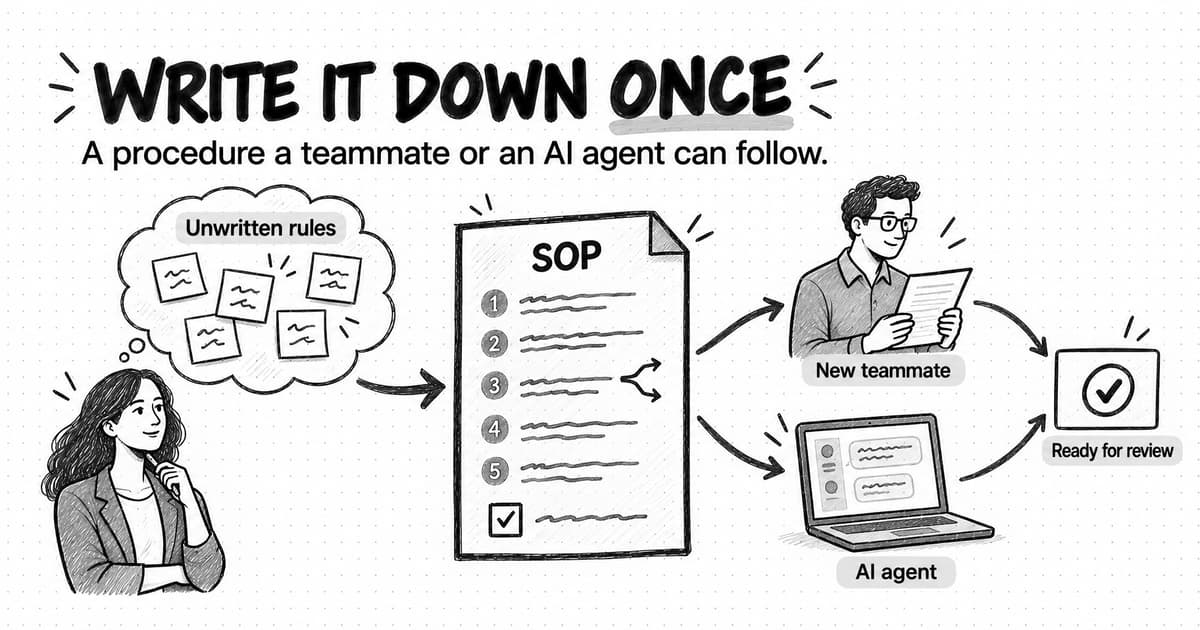
A marketing SOP is a written procedure for one recurring marketing task: what starts it, which inputs and sources to use, the steps in order, the decisions along the way, and the standard the finished work must meet. It lets a new teammate, a freelancer, or an AI agent do the task the way your team does without guessing.
Summary
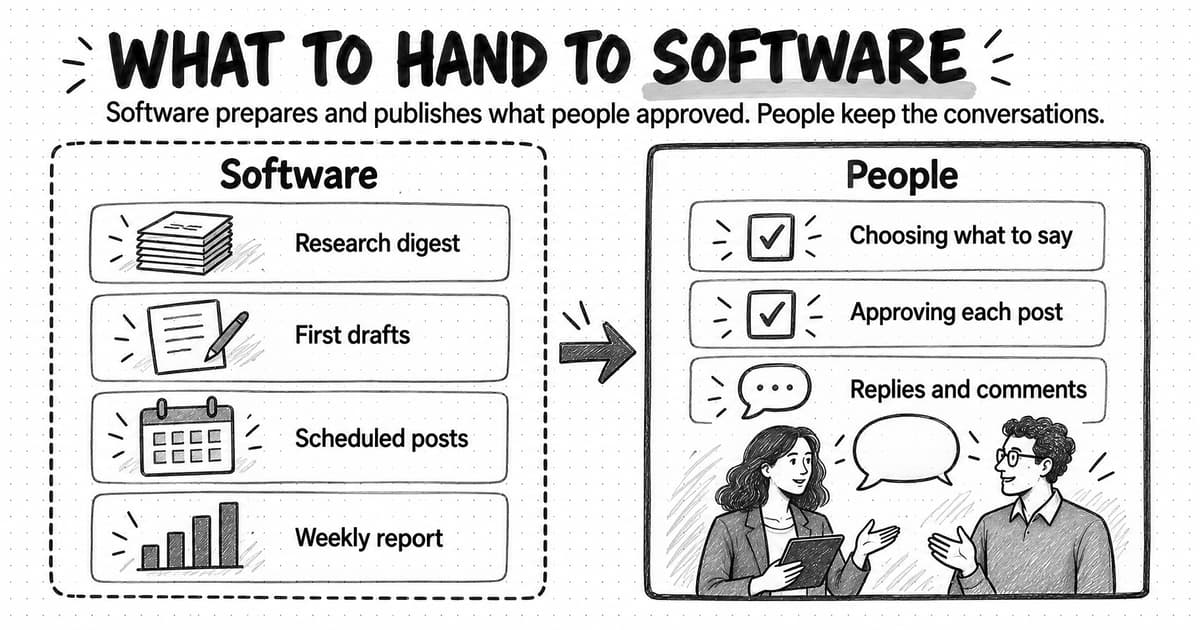
Write an SOP when a marketing task recurs, has a known right way, and costs something when done wrong, such as an unapproved customer name, an outdated claim, or a missed approval. A good SOP captures the rules that live in one person's head so anyone, including an AI agent, can follow them.
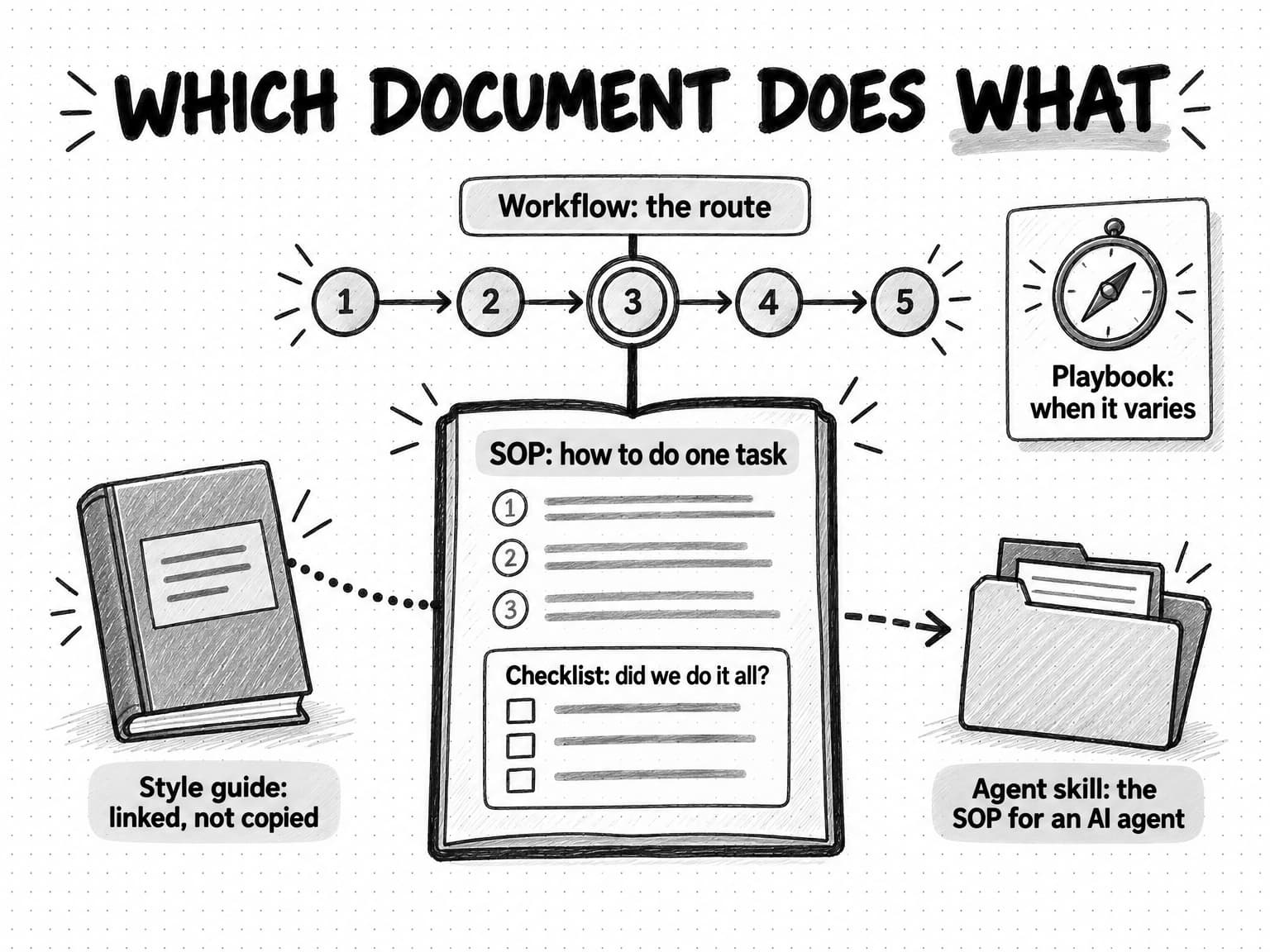
Keep the document types apart. A workflow maps the route between steps, an SOP explains how to do one task, a checklist confirms nothing was missed, a playbook guides judgment, and a style guide sets standards. Mixing them produces long documents that do none of these jobs well.
A complete SOP names a purpose, scope, trigger, roles, inputs, numbered steps, decision points, a definition of done, examples, exceptions, and a change log. Write each step as one imperative action with an observable result, and test the draft with someone who has never done the task.
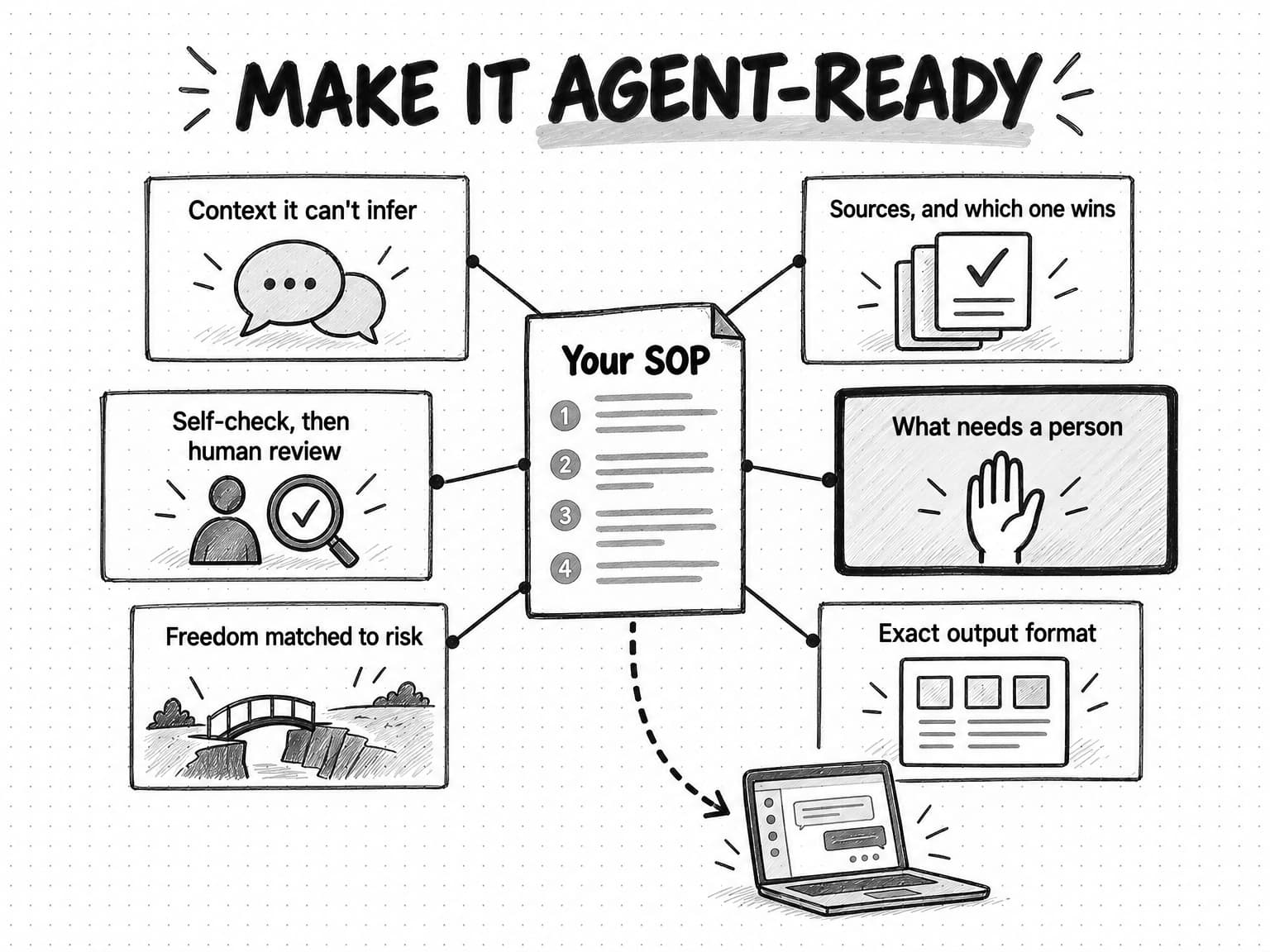
To make an SOP agent-ready, add the context an agent can't infer, the sources it may use and which one wins, the actions that need a person, an exact output format, and a self-check before human review. Publishing, sending, and spending should stay with people.
Treat SOPs as living documents. Give each one an owner and a review date, update it whenever a tool, rule, or reviewer changes or a mistake gets through, and measure both adherence and the outcome the SOP was written to improve, such as revision rounds, errors after publishing, or cycle time.
Contents
- What is a marketing SOP, and why write one?
- SOP vs workflow, checklist, playbook, style guide, and agent skill
- When a marketing task deserves an SOP
- The anatomy of a marketing SOP
- How to write a marketing SOP, step by step
- How to write SOP steps people actually follow
- How to make an SOP an AI agent can follow
- From SOP to saved prompt, brand context, or agent skill
- Five example marketing SOPs
- A copyable marketing SOP template
- How to keep marketing SOPs current
- How to measure whether an SOP works
- Common marketing SOP mistakes
- Running marketing SOPs with Ampere
- Sources and further reading
- Frequently Asked Questions
Every Monday, someone on a small marketing team writes the week's LinkedIn post for the company page. For a year it was the founder, who knew which customer stories were approved for public use, which product claims legal had softened, what length worked, and that nothing went out without a link to the source. Then the founder hands the job to a new marketer, or to a contractor, or to an AI agent. The first post comes back on time and reads well. It also quotes a customer who never agreed to be named, rounds a beta result up into a promise, and has no link.
Nobody did anything careless. The person doing the work was missing the rules that lived in the founder's head, and nothing on paper told them those rules existed. That gap is what a standard operating procedure closes.
A marketing SOP (standard operating procedure) is a written set of instructions for doing one recurring marketing task the same way each time: what triggers it, what inputs to use, the steps in order, the decisions along the way, and the standard the finished work must meet. It turns "how we do it here" into something a new teammate, a freelancer, or an AI agent can follow without guessing, and something the team can improve on purpose instead of by accident.
The AI agent in that story is a new kind of reader. Marketing teams now hand recurring work to agents that research, draft, and assemble deliverables, and an agent has even less tacit context than a new hire on day one. A procedure written for a person who can lean over and ask a question often fails an agent that can't. This guide explains what a complete SOP contains, how to write steps people follow, and what to add so an AI agent can follow them too, then gives five complete marketing SOPs and a copyable template.
What is a marketing SOP, and why write one?
The term comes from fields where doing a routine job differently each time causes real damage: laboratories, factories, hospitals, and flight decks. The U.S. Environmental Protection Agency's guidance on preparing SOPs defines one as "a set of written instructions that document a routine or repetitive activity followed by an organization," and says the point is consistency "in the quality and integrity of a product or end-result," including when people change. That transfers to marketing almost unchanged: a blog article or a webinar invitation is a routine end-result whose quality should not depend on who produces it this week.
Marketing teams often resist SOPs because procedures feel like the opposite of creativity. That mixes up two kinds of work inside every marketing task. The angle of a post and the hook of an ad call for judgment. The checks around them are routine: confirming that a customer approved their quote, adding tracking parameters, getting sign-off for a pricing claim, filing the final version where sales can find it. Many visible mistakes happen in the routine part, because it is what people skip when they are busy. An SOP fixes the routine so the creative part gets the attention.
Checklists help even highly trained experts. In a study published in the New England Journal of Medicine in January 2009, eight hospitals in eight cities introduced a one-page surgical safety checklist. According to Harvard's report on the study, across 7,688 patients the rate of major complications fell from 11% to 7% and inpatient deaths fell from 1.5% to 0.8% after the checklist was introduced. It was a before-and-after comparison rather than a randomized trial, and marketing mistakes are not surgical complications, but the mechanism is the same one an SOP relies on: skilled people still forget steps under pressure, and a short written standard catches the omissions.
A good marketing SOP makes quality repeatable, so the tenth article meets the standard of the first. It makes handoffs safe, so work can move between people, or to an AI agent, without the unwritten rules getting lost. It shortens onboarding. And it makes improvement possible, because until a process is written down, each person runs their own version and nobody can tell which change helped.
The EPA guidance adds a warning: "the best written SOPs will fail if they are not followed." An SOP is a tool for doing the work, not a record that the work could in theory be done well, so the rest of this guide is about writing procedures people actually use.
SOP vs workflow, checklist, playbook, style guide, and agent skill
Several marketing documents look like SOPs, and mixing them up produces documents that do none of their jobs well. The table separates them by the question each one answers.
| Document | Question it answers | Typical form | Marketing example |
|---|---|---|---|
| Workflow | What happens, in what order, and who hands what to whom? | A map or board of steps, owners, and handoffs | Blog article from approved topic to promoted post |
| SOP | How exactly is this one task done, to what standard? | Numbered steps with inputs, decisions, and a definition of done | How to prepare and publish an article in the CMS |
| Work instruction | How is one small step inside an SOP done? | A short how-to, often with screenshots | How to add tracking parameters to a link |
| Checklist | Did we do every required thing? | A list of items to tick | The pre-publish checklist inside the SOP |
| Playbook | How do we approach a situation that varies each time? | Principles, options, and examples | How we respond when a competitor launches a rival feature |
| Style guide or brand guidelines | How should our work look and sound? | Rules and examples for voice, terminology, and visuals | Voice, banned phrases, logo use |
| Agent skill | How should an AI agent handle this kind of task? | Instructions, examples, and resources an agent loads when relevant | A skill for drafting LinkedIn carousels |
A workflow is the map, and an SOP is the instruction for one stop on it or for the whole short route. Our guide to marketing workflows explains how to map the route first, which is usually the right order.
A checklist is part of an SOP, not a replacement for it. The EPA guidance says so directly: "the checklist is not the SOP, but a part of the SOP." A checklist confirms that steps happened but doesn't explain how to do them or what to do when something is missing.
A playbook covers situations that differ every time, such as crisis response or competitive moves, where the right move depends on judgment. If most steps of a draft SOP say "it depends," you are writing a playbook; call it one so readers know how much discretion they have.
A style guide or set of brand guidelines holds rules that apply across many tasks. An SOP should link to them rather than copy them, because copied rules drift apart within months.
An agent skill is a packaged set of instructions, examples, and reference material that an AI agent loads when a task matches it. It plays the role for an agent that an SOP plays for a person; our guide to AI agent skills explains how they work.
When a marketing task deserves an SOP
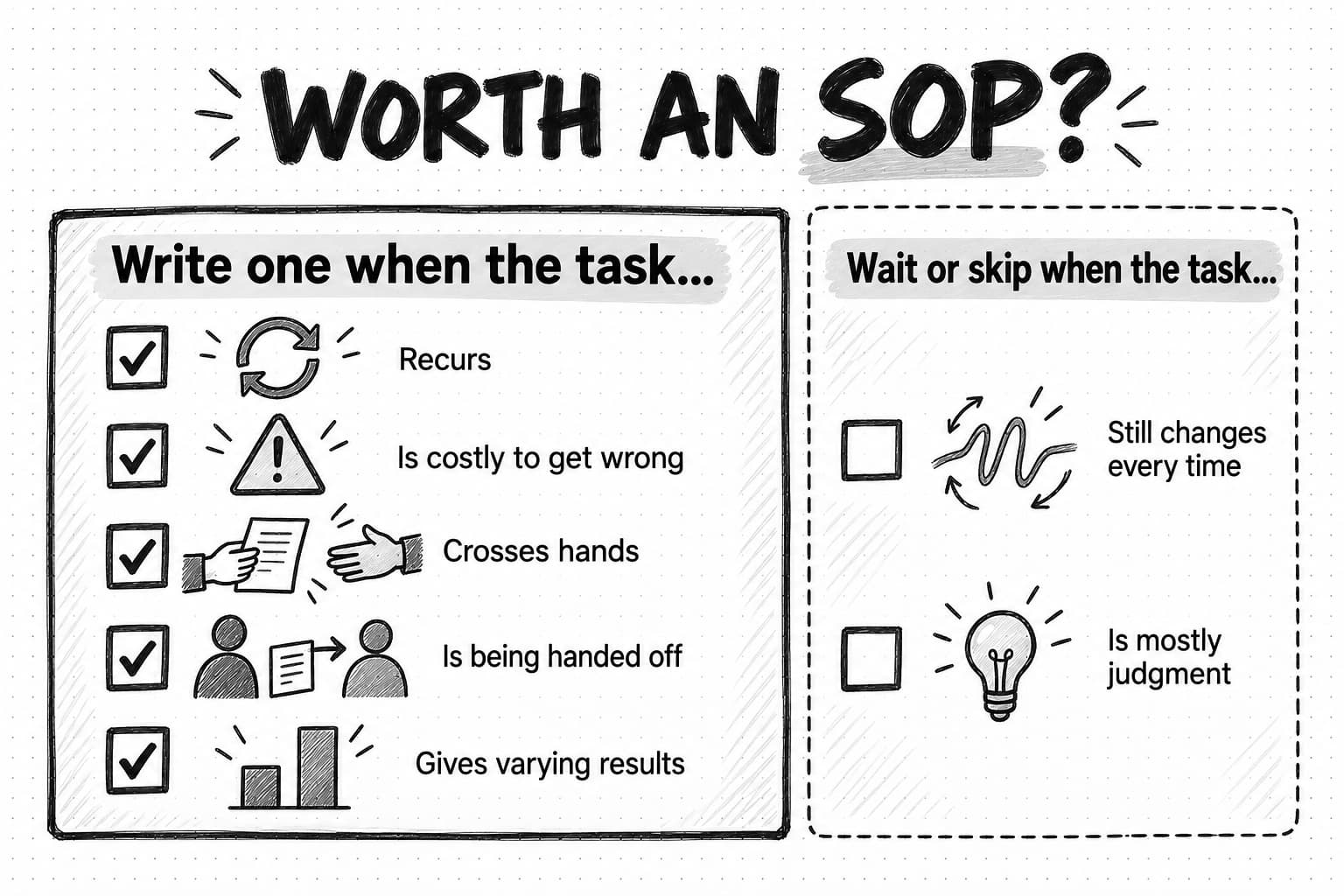
Not every task needs a procedure, and documents nobody needs make the useful ones harder to find. Five signals suggest a task is worth documenting:
- It recurs. A weekly or monthly task repays the writing quickly. A complicated annual task deserves one too, because nobody remembers the details a year later.
- Mistakes are costly or public. Anything that publishes, sends, spends money, or makes a claim about the product or a customer.
- It crosses hands. Work that moves between people, between teams, or to an outside contractor loses its unwritten rules at each handoff.
- You want someone else to do it. Handing a task to a new hire, a freelancer, or an AI agent is when the knowledge in your head has to become a document anyway.
- The results vary and you don't know why. If two people produce different quality from the same request, the difference is usually an undocumented step one of them does and the other doesn't.
Two signals point the other way. Skip the SOP when the task still changes every time you do it; write it once the shape settles. And skip it when the task is mostly judgment with little routine around it. A procedure for "come up with a campaign concept" adds nothing; a procedure for "brief, review, and approve a campaign concept" can add a lot.
A quick way to decide is to score each candidate task from 0 to 2 on the five signals and write procedures for the highest totals first. The scores aren't a formula; they make the team say out loud why a task matters.
| Candidate task | Recurs | Cost of a mistake | Crosses hands | Delegating soon | Results vary | Total |
|---|---|---|---|---|---|---|
| Weekly company LinkedIn post | 2 | 2 | 1 | 2 | 2 | 9 |
| Publishing a blog article | 2 | 2 | 2 | 1 | 1 | 8 |
| Monthly competitor brief | 2 | 1 | 1 | 2 | 2 | 8 |
| Annual brand refresh | 0 | 2 | 2 | 0 | 0 | 4 |
| Brainstorming campaign themes | 1 | 0 | 0 | 0 | 1 | 2 |
The table is an illustrative scoring for a fictional five-person team, not a benchmark. Your scores will differ.
The anatomy of a marketing SOP
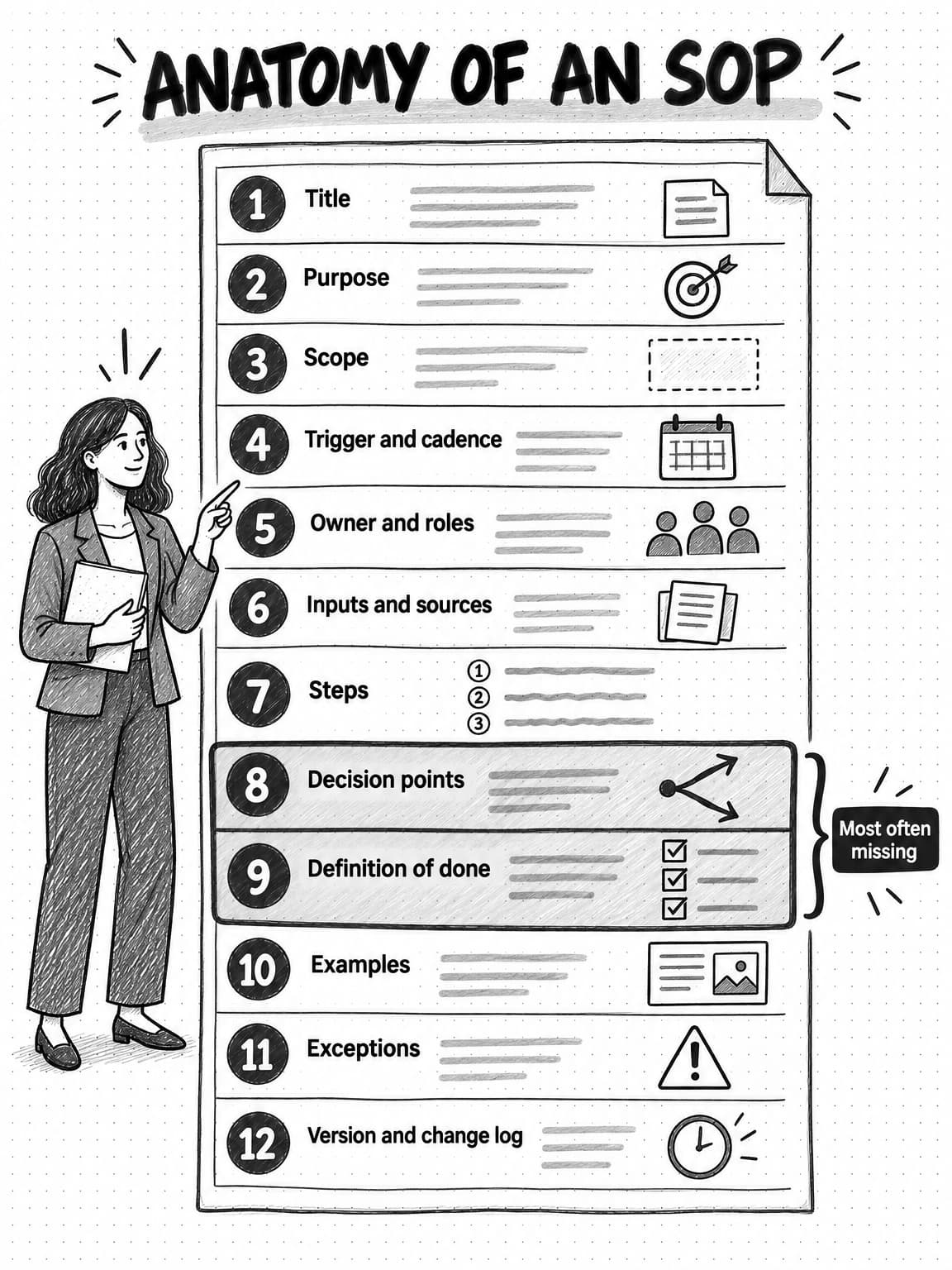
The EPA guidance says there is no single correct format, and that the level of detail should depend on how critical the process is, how often it runs, and how many people use it. Still, workable SOPs tend to contain the same twelve parts, in roughly this order. Short tasks can merge several parts into a line each, as long as none is missing by accident.
- Title and identifier. A title that names the task as the reader would search for it ("Publish a blog article," not "Content SOP 3"), plus a short ID if you keep many.
- Purpose. One or two sentences on why the task exists and what good looks like for the business. Purpose lets someone make a sensible call when the steps don't cover a situation.
- Scope. What the SOP covers and what it doesn't. "Covers the company LinkedIn page. Does not cover founder posts or paid ads."
- Trigger and cadence. What starts the task: a date ("every Monday by 11:00"), an event ("when a feature ships"), or a request ("when sales asks for a battlecard").
- Owner and roles. Who does the work, who reviews it, who approves it, and who owns the document itself. Name roles, not people, so the SOP survives a reorganization.
- Inputs and sources. What the doer needs before starting, such as the brief, approved claims, brand guidelines, and templates. Say where each lives and which source wins when two disagree.
- Steps. Numbered, in order, one action each.
- Decision points. The places where the path splits, written as explicit conditions: "If the post mentions a customer by name, confirm written approval in the customer tracker. If there is none, remove the name."
- Quality criteria and definition of done. The checks the finished work must pass and the exact state that counts as finished ("scheduled in the publishing tool, link logged in the content tracker, reviewer notified").
- Examples. At least one example of good output, and ideally one that looks fine but fails a criterion, annotated to show why.
- Exceptions and escalation. What to do when an input is missing, a deadline can't be met, or something looks wrong. Who to tell, and whether to pause.
- Version, review date, and change log. The version, last and next review dates, and a one-line note for each change.
Two parts do the most work and are the ones most often missing. Decision points are where real tasks differ from the tidy version in someone's head; without them, an SOP produces confident work that is wrong in exactly the situations that matter. The definition of done lets a reviewer, or the doer, check the work without arguing about taste. "A good post" is a matter of opinion. "Under 1,300 characters, one claim, a link to the source, the customer's approval on file" can be checked.
View the anatomy of an SOP at full size (opens in a new tab).
How to write a marketing SOP, step by step
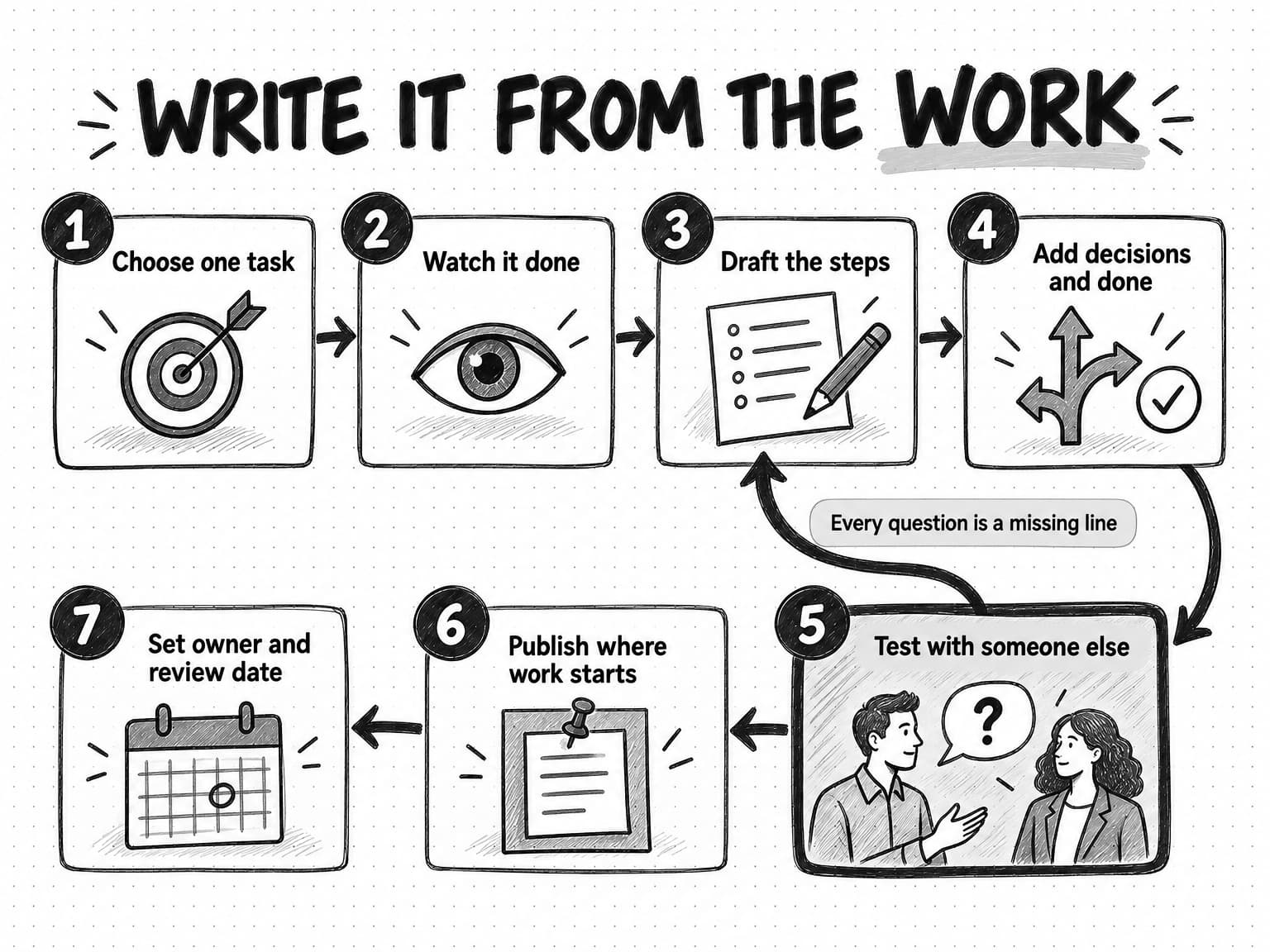
The fastest way to a bad SOP is to write it from memory. People describe how they believe they do a task and leave out the small checks they do without thinking, which are often the reason their work is good. The method below starts from the work itself.
- Choose one task and name its boundaries. Write down where the task starts and ends. "Weekly LinkedIn post" starts when the topic is chosen and ends when the post is scheduled and logged, not when the draft is written.
- Watch it done, or record yourself doing it. Have the person who does it best work through it once while narrating, or record your own screen. Note every source opened, every check made, and every hesitation; hesitations mark decision points.
- Draft the steps from the notes. Write numbered steps, one action each, in the order they happened. Leave out what anyone in the role would know, and keep what a capable newcomer would miss.
- Add the decisions, the definition of done, and an example. At each step, ask what could be different this time and what the doer should do then. Then write the finishing standard and attach one real example.
- Test it with someone who didn't write it. This step matters most. The EPA guidance says it is "especially helpful if draft SOPs are actually tested by individuals other than the original writer." Ask a colleague, a contractor, or an AI agent to do the task using only the document. Every question they ask is a missing line.
- Publish it where the work happens. Link the SOP from the task template, project board, or saved prompt that starts the work, so the doer meets it when they need it.
- Set an owner and a review date. Put both at the top. A stale SOP is worse than none, because people trust it.
How to write SOP steps people actually follow
Steps fail by being vague, long, or written in a voice that hides who does what. The U.S. Federal Aviation Administration's advisory circular on standard operating procedures, written for airline flight crews, is one of the clearest public guides to writing steps. Its advice translates directly to marketing: plain language, short sentences, active verbs ("Do X" rather than "X should be done"), steps written as imperatives, few negatives because a missed "not" reverses the meaning, and one word for one thing throughout.
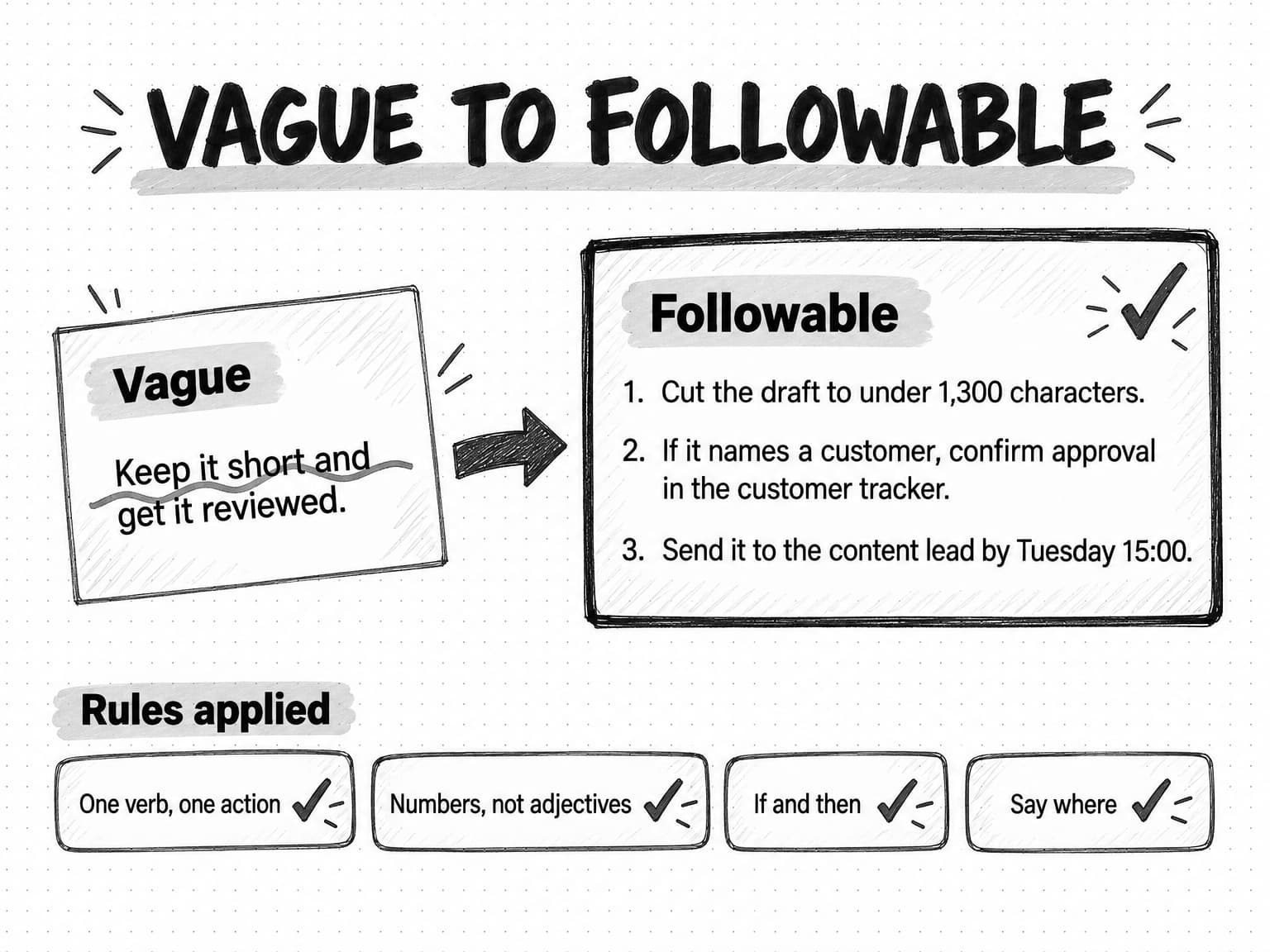
Start each step with a verb, and give it one action. "Check the claim against the approved-claims sheet" is a step. "Make sure everything is accurate and on brand before review" is several steps in one sentence, and a reader will do the one they remember.
Make decisions explicit with "if" and "then." "Use judgment on customer names" leaves the reader to reconstruct a rule. "If the post names a customer, confirm approval in the customer tracker. If approval is missing, replace the name with the customer's industry" leaves nothing to reconstruct.
Use numbers instead of adjectives. "Keep it short" means different things to different people. "Under 1,300 characters" means one thing.
Use the same term for the same thing. If the document says "content tracker" in step 3, don't call it "the publishing log" in step 9. A careful reader, and especially an AI agent, may reasonably conclude these are two different documents.
Explain why a step exists when the reason isn't obvious. The FAA lists "crewmembers understand the reasons for the procedure" as a condition for an SOP to work, but keeps the rationale in a separate training document so the steps stay uncluttered. A marketing SOP can do the same with a short "why" note after a step. The reason lets the doer handle cases the step didn't anticipate: someone who knows the link rule exists so readers can check claims will link a quote, too, without being told.
The table shows the rules applied to real steps.
| Vague step | Followable step |
|---|---|
| Make sure the post is on brand. | Check the draft against the voice section of the brand guidelines. Replace any phrase on the banned list. |
| Get it reviewed. | Send the draft to the content lead in the review channel by Tuesday 15:00 with the source links. |
| Use good images. | Use an image from the approved image folder at the size in the brand guidelines, or request one from design by Monday. |
| Don't post unapproved stuff. | If the post quotes a customer, confirm approval in the customer tracker before scheduling. |
| Track the results. | The following Monday, log impressions, comments, and clicks for the post in the content tracker. |
How to make an SOP an AI agent can follow
An AI agent reads an SOP differently from a person in three ways, and each one changes what the document needs.
First, the agent has no tacit context. A new hire picks up which customers are sensitive by sitting near the team. An agent starts each task with only what it is given, plus whatever the product it runs in saves between tasks. Anthropic's prompting guidance for Claude says to think of the model as "a brilliant but new employee who lacks context on your norms and workflows." Its test works for SOPs too: if a colleague with minimal context would be confused by the instructions, the model will be too.
Second, the agent fills gaps instead of stopping. A person who hits an unclear step usually asks. An agent that isn't set up to ask makes a reasonable-looking choice and carries on, and the result reads just as confidently either way. Decision points and missing-input rules matter even more for an agent.
Third, the agent can't read your organization. It can't tell that the old pricing deck in the shared folder is out of date, or that the founder's opinion outranks the style guide on a particular point, unless the SOP says which source wins.
A well-written SOP is most of the way to good agent instructions already. OpenAI's practical guide to building agents advises teams to "use existing operating procedures, support scripts, or policy documents" when writing instructions for agents, to break dense resources into smaller and clearer steps, to make every step correspond to a specific action or output, and to capture edge cases with conditional steps, such as what to do when a required piece of information is missing. An agent-ready SOP keeps those qualities and adds six things.
- Context the agent can't infer. The audience, the business goal, and the facts a newcomer would pick up by osmosis. Link to them where they already live, such as brand guidelines or saved brand context, so there is one current copy. Our guide to context engineering covers how to choose what to include.
- Sources, and which one wins. List the sources the agent should use, the ones it must not use, and the order of precedence when they disagree. "Approved claims sheet over website copy over old decks" prevents the most common failure: confident use of an outdated fact.
- Boundaries on actions. Say what the agent may do on its own and what needs a person. Publishing, sending, spending, deleting, and contacting anyone outside the company should need explicit approval. Our guide to AI guardrails for marketing teams covers which actions to gate.
- An output format. Describe exactly what to hand back: the file type, the sections, the length, where source links go, and what to include for the reviewer, such as a list of claims to check.
- The right degree of freedom for each step. Anthropic's guidance on writing agent skills recommends matching specificity to how fragile and variable a step is. Where many approaches are valid, give direction; where a mistake is costly or the sequence is fixed, give exact instructions. In its image of a narrow bridge versus an open field, the angle of a post is an open field; the customer-approval check is a bridge.
- A review step and a self-check. End the procedure with a check the agent runs on its own work against the definition of done, and then a handoff to the named human reviewer. Our guide to human-in-the-loop AI covers how deep each review should go.
Worked example: making one SOP agent-ready (fictional)
Fernway is a fictional twelve-person software company. Its marketing lead wrote an SOP for the weekly company LinkedIn post. The steps were sound, but when she gave it to an AI agent, the draft cited a feature by its old name, used a customer logo from a deck, and arrived as a chat message with no source links.
She made five changes. She added a context line naming the audience (operations managers at mid-sized logistics firms) and the goal. She added a source order, product changelog over website over the shared drive, and a rule that customer names and logos come only from the approved-customers list. She marked publishing as a human step: the agent drafts and stops. She specified the output: the post text, a character count, a source link for every claim, and a list of points for the reviewer to check. And she added a self-check against the definition of done.
The second run used the current feature name, mentioned no customer, and arrived in the review folder with sources attached. Most of the changes weren't about the agent at all. They were rules the original SOP had relied on people already knowing.
View the agent-ready additions at full size (opens in a new tab).
From SOP to saved prompt, brand context, or agent skill
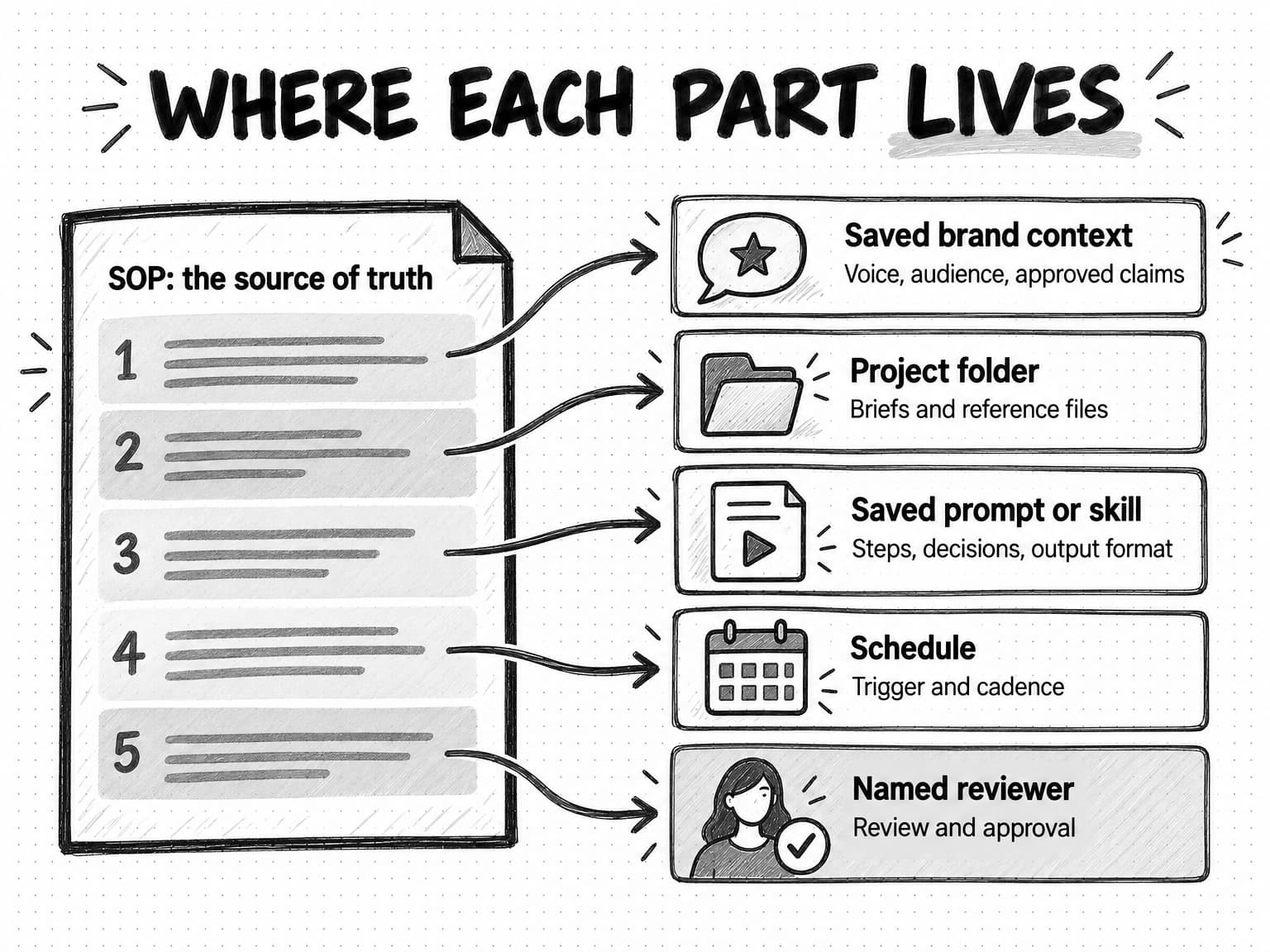
Once an SOP works, the next question is where its parts should live so the agent, or the person, meets them at the right moment. Pasting the entire SOP, brand guidelines included, into every prompt is a common mistake: the copied rules drift from the official versions, and the instructions get lost among the background.
A cleaner split puts each part where it changes least often and is easiest to keep current:
| SOP part | Where it usually lives for an AI agent | Why there |
|---|---|---|
| Brand voice, audience, products, approved claims | Saved brand context or brand guidelines the agent can read | Shared by many tasks; one copy to update |
| Project facts, briefs, reference files | A project folder or project brief attached to the work | Specific to one campaign or client; changes per project |
| Purpose, inputs, steps, decisions, output format | A saved prompt, task instructions, or an agent skill | The procedure itself; changes when the method changes |
| Trigger and cadence | A schedule or an event rule in the tool that runs the work | Mechanical; should not depend on someone remembering |
| Review and approval | The human review step and the tool's approval controls | Accountability stays with a named person |
This is also how SOPs and agent skills relate. In Anthropic's format, an agent skill is a folder with a SKILL.md file: a short name and description that tell the agent when the skill applies, a body of instructions, and optional reference files, templates, and scripts that the agent reads only when needed. That is an SOP's structure translated for an agent: the description is the trigger and scope, the body is the steps and decisions, and the reference files are the inputs and examples. A tested SOP is most of a skill, because the hard part of both is knowing what the procedure is.
Whether an SOP becomes a skill, a saved prompt, or task instructions depends on the tool: some agent products let you write your own skills, while others maintain their own and let you save prompts, attachments, and context for recurring work. Either way, the SOP stays the human-readable source of truth. When the procedure changes, change the SOP first and update the agent-facing version from it. Our guide to briefing an AI marketing agent covers how to write the prompt part well.
Five example marketing SOPs
The five SOPs below use the anatomy above, with short parts merged. Replace the roles and tools with your own. They show structure, not channel strategy: the cadence, lengths, and timing suit a fictional small B2B team and should change to fit yours.
SOP 1: Weekly company LinkedIn post
Purpose. Publish one post a week on the company page that helps our buyers with a real problem. Our guide to LinkedIn content strategy for B2B covers the strategy this SOP serves.
Scope. The company page only. Not founder posts, not paid ads, not comment replies.
Trigger. Every Monday. Draft by Tuesday 12:00, scheduled by Wednesday 17:00 for Thursday morning.
Roles. Doer: content marketer or AI agent. Reviewer: content lead. Approver for any product claim: product marketing. SOP owner: content lead.
Inputs. The content calendar row for the week; brand voice guidelines; the approved-claims sheet; the approved-customers list; the product changelog; last month's post performance in the content tracker.
Steps.
- Open the calendar row and confirm the topic and the one idea the post should leave readers with.
- Collect evidence for that idea from the approved sources, with a link for every fact.
- Draft the post: a first line that states the idea or the problem, two to five short paragraphs that explain it, and one question or next step at the end.
- If the post names a customer, check the approved-customers list. If the customer isn't on it, describe them by industry and size instead.
- If the post makes a product claim, check it against the approved-claims sheet. If the claim isn't there, flag it for product marketing and don't schedule until it's approved.
- Check the draft against the voice guidelines and replace any phrase on the banned list.
- Choose an image from the approved image folder at the size in the brand guidelines, or request one from design.
- Send the draft, the image, and the source links to the reviewer in the review channel.
- After approval, schedule the post and log it in the content tracker.
- The following Monday, log the post's impressions, comments, and clicks in the content tracker.
Definition of done. Under 1,300 characters; one central idea; every fact traceable to a logged source; no unapproved customer or claim; reviewer approval recorded; post scheduled and logged.
Exceptions. If no topic is ready by Monday 12:00, use the next backlog topic and tell the content lead. If the reviewer hasn't responded by Wednesday 12:00, message them directly; don't publish without review.
SOP 2: Publishing a blog article
Purpose. Turn an approved article into a published page that is accurate, findable, and ready for sales and social to use.
Scope. From final edited draft to published and announced. Writing starts from a brief; see our guide to writing a content brief.
Trigger. The editor marks the article "ready to publish" on the content board.
Roles. Doer: content marketer. Reviewer: editor. SOP owner: content lead.
Inputs. Final draft; the brief with the target query and reader; images from design; the content management system; the internal-linking list; the tracking-link template.
Steps.
- Confirm the board shows editor approval and, for any article that makes a product, pricing, or customer claim, product marketing approval.
- Paste the article into the CMS using the article template, then check headings, lists, and tables.
- Write the title tag and meta description, with the target query in both, and set a short lowercase URL slug.
- Add every image with descriptive alt text, compressed to the size limit in the brand guidelines.
- Add three to five internal links to related pages, and two links to the new article from existing pages on the internal-linking list.
- Preview on desktop and mobile and click every link.
- Publish, check the live page in a private browser window, and request indexing in Google Search Console.
- Create tracked links for each promotion channel and add the article to the content tracker with its publish date and owner.
- Post the link and a two-sentence summary in the sales channel.
Definition of done. Live page renders correctly on mobile and desktop; all links work; title tag, description, and alt text complete; internal links in both directions; content tracker updated; sales notified.
Exceptions. If an approval is missing, keep the article in "ready to publish" and tell the approver. If the page breaks after publishing, unpublish it, fix it, and record what happened in the change log.
SOP 3: Monthly competitor brief
Purpose. Give leadership and sales a short, sourced summary of what changed at our main competitors this month and what, if anything, to do about it. Our guide to competitor analysis covers the deeper analysis this brief draws on.
Scope. Up to five named competitors. Public sources only: websites, pricing pages, changelogs, public ads, reviews, and social posts.
Trigger. The first working day of each month.
Roles. Doer: product marketer or AI agent. Reviewer: head of marketing. SOP owner: product marketer.
Inputs. The competitor list; last month's brief; our positioning document; access to the public sources above.
Steps.
- Open last month's brief and list what it said each competitor was doing.
- For each competitor, check its pricing page, changelog or release notes, homepage messaging, and public ads for changes since last month. Record a link and the date checked for every change.
- Check review sites for new reviews that mention a competitor's strengths or weaknesses on a topic we care about.
- Mark each change as new, continuing, or reversed compared with last month.
- For each change, write one sentence on what it means for us. If the meaning is unclear, say so rather than guessing.
- Write a three-sentence summary at the top: the most important change, what it means, and one recommended action or "no action needed."
- Add a sources list with every link and check date.
- Send the brief to the reviewer.
Definition of done. Every change has a link and a check date; every interpretation is labeled as interpretation; the summary fits on one screen; sales has a copy.
Exceptions. If a source is unavailable, note it in the brief rather than leaving the competitor out silently. If a change looks urgent, such as a price cut aimed at our customers, tell the head of marketing the same day instead of waiting for the brief.
SOP 4: Webinar promotion
Purpose. Fill a webinar with the right attendees and make the recording useful afterward.
Scope. Promotion and follow-up for one webinar. Content and speaker preparation are out of scope.
Trigger. The webinar date and title are confirmed, at least four weeks ahead.
Roles. Doer: marketing manager. Reviewers: the speaker for copy that quotes them, the content lead for everything else. SOP owner: marketing manager.
Inputs. Webinar title, description, speaker bios and photos; the registration page; the email tool; the social calendar; the tracking-link template.
Steps.
- Four weeks before: publish the registration page, create tracked links, and draft the invitation email, two social posts, and a short message for the speaker to share. Send the drafts for review.
- Three weeks before: send the invitation to the chosen segment and publish the first social post.
- Two weeks before: publish the second post and ask the speaker to share their message.
- One week before: send a reminder to people in the segment who opened the invitation but didn't register. Send registrants reminders one day and one hour before.
- Within two working days after: send the recording to attendees, and a version with a short apology for missing them to registrants who didn't attend.
- Within one week after: turn the recording into at least one article or post series, following our guide to repurposing content across channels.
- Log registrations, attendance, and follow-up clicks by channel in the campaign tracker.
Definition of done. Every asset reviewed before it went out; every link tracked; follow-ups sent within two working days; results logged by channel.
Exceptions. If registrations are below half the target two weeks out, tell the marketing lead and agree on extra promotion or a smaller room. If the speaker cancels, follow the event cancellation SOP and email registrants the same day.
SOP 5: Product launch checklist
A launch suits an SOP built around a checklist: it happens rarely enough that people forget the steps, and touches enough teams that a missed step shows. The checklist sits inside a short procedure rather than replacing it.
Purpose. Announce a new product or major feature so the right customers and prospects understand it and know what to do next, with every team ready on the day.
Scope. Launches the product team classifies as major. Smaller updates follow the release-notes SOP.
Trigger. The product team confirms a launch date, ideally six weeks ahead.
Roles. Doer and SOP owner: product marketer. Reviewers: product lead for accuracy, head of marketing for messaging, legal for claims about competitors, security, or results.
Inputs. The product brief; the positioning and messaging document; screenshots or a demo build; the customer list for any beta participants willing to be quoted.
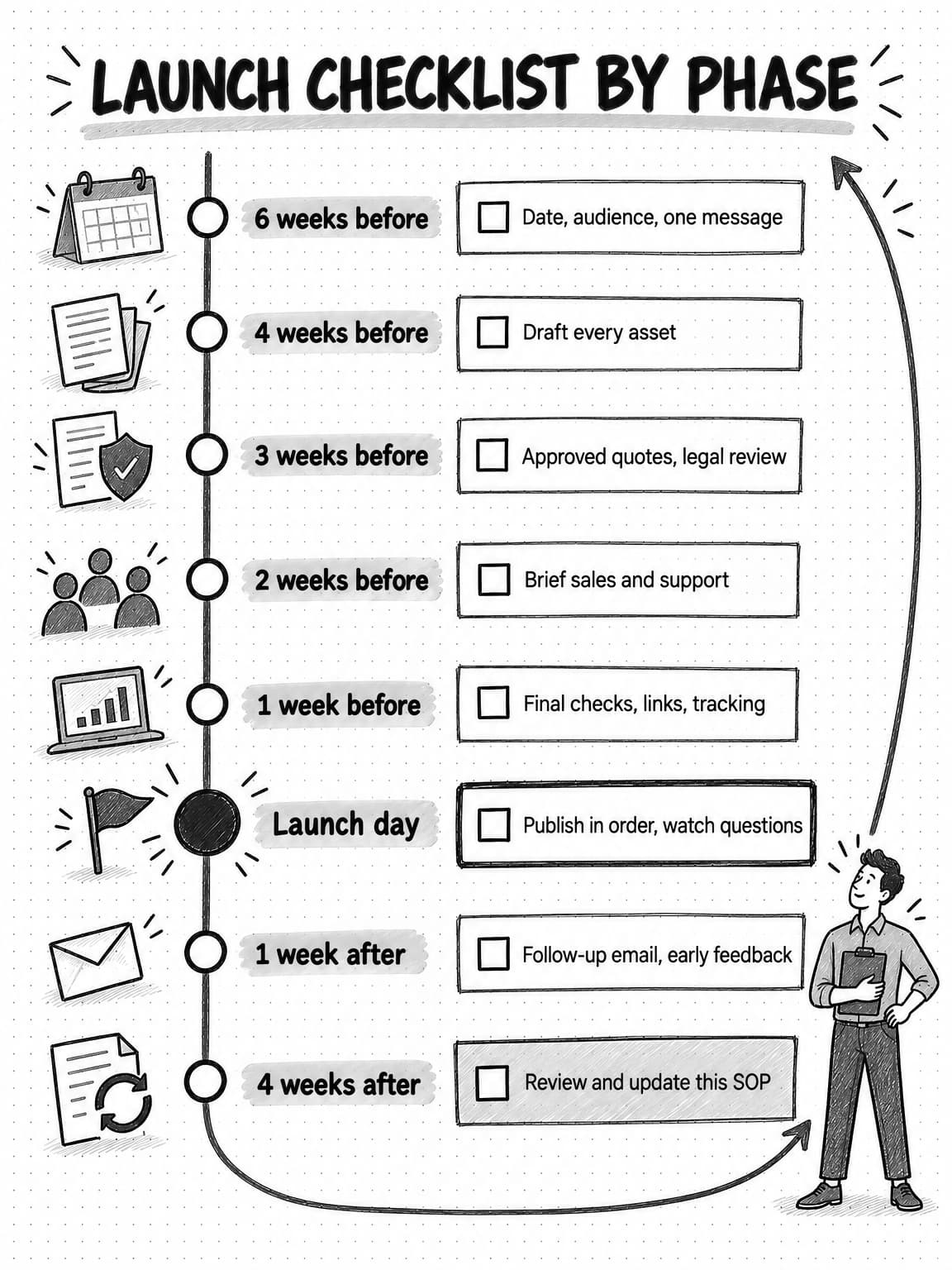
Checklist by phase.
- Six weeks before: confirm the launch date, the audience, and the one message the launch must land; agree who approves what.
- Four weeks before: draft the announcement post, landing page or pricing-page changes, launch email, sales one-pager, and help documentation; request visuals and a short demo video.
- Three weeks before: collect any customer quotes with written approval; get legal review for regulated or comparative claims.
- Two weeks before: brief sales and support with the one-pager and an FAQ; prepare social posts for the company page and founder.
- One week before: finalize every asset; check every link; set up tracking; schedule what can be scheduled.
- Launch day: publish in the agreed order; post in the sales and support channels; watch for questions and broken links; reply to comments.
- One week after: send the follow-up email; collect early feedback from sales and support; log results against the launch goals.
- Four weeks after: hold a short review of what worked and update this SOP.
Definition of done. Every asset approved by its named reviewer; sales and support briefed before launch day; results logged; review held and the SOP updated.
Exceptions. If the launch date slips, move every phase by the same amount and tell all reviewers. If a claim can't get approval in time, cut the claim rather than delaying the launch, unless the product lead says otherwise.
View the launch checklist by phase at full size (opens in a new tab).
A copyable marketing SOP template
Copy the template into your wiki, docs tool, or project template. The bracketed text explains what goes in each part. The agent-ready section at the end is optional, but filling it in often improves the human version too, because it makes you write down sources and boundaries.
# [Task name, as someone would search for it]

ID: [short ID]   Version: [1.0]   Owner: [role]
Last reviewed: [date]   Next review: [date]

## Purpose
[Why this task exists and what good looks like for the business, in one or two sentences.]

## Scope
Covers: [what is included]
Does not cover: [related tasks handled elsewhere, with links]

## Trigger and cadence
[What starts the task: a date, an event, or a request. Deadlines for each stage.]

## Roles
- Doer: [role]
- Reviewer: [role]
- Approver: [role, and for which kinds of claims or actions]
- Current people in these roles: [names, kept up to date]

## Inputs and sources
- [Input]: [where it lives]
- [Input]: [where it lives]
Source order when sources disagree: [most trusted] > [next] > [least trusted]
Do not use: [sources that look useful but are out of date or not approved]

## Steps
1. [Verb + one action + where or with what.]
2. [Verb + one action.]
3. If [condition], then [action]. Otherwise, [action].
4. [Verb + one action.] Why: [short reason, if it is not obvious]

## Definition of done
- [Checkable criterion, with a number where possible]
- [Checkable criterion]
- [The exact state that counts as finished, such as "scheduled and logged"]

## Examples
- Good example: [link], with a note on what makes it good
- Near miss: [link], with a note on which criterion it fails

## Exceptions and escalation
- If [input is missing], then [action] and tell [role].
- If [deadline cannot be met], then [action] and tell [role].
- If something looks wrong, [pause or continue], and tell [role].

## For AI agents (optional)
Context: [audience, goal, and facts a newcomer would not know, or links to them]
May do without asking: [for example, research, draft, format]
Must ask a person before: [for example, publish, send, spend, contact anyone outside the company]
Output to hand back: [format, sections, length, where source links go, what the reviewer should check]
Self-check before handoff: [check the work against the definition of done and list anything that fails]

## Change log
- [Version] [date] [who]: [what changed and why]
How to keep marketing SOPs current
Marketing changes faster than the fields that invented SOPs. A few habits keep a small library honest without turning it into a part-time job.
Give every SOP one owner. The owner doesn't have to do the task; they keep the document true and are the person to tell when it isn't.
Set a review date and keep it short. The EPA guidance suggests a periodic review "every 1-2 years" for its procedures. Marketing procedures usually need a shorter cycle; quarterly suits SOPs that touch channels or tools, and every six months suits slower ones. Put the next review date at the top, where a reader will notice when it has passed.
Update on change, not only on schedule. A new tool, a channel rule change, a product rename, a new reviewer, or a mistake that got through should each trigger an update. So should a doer saying "the SOP says X, but we actually do Y." Write Y down that day.
Version the document and keep a change log. A version number and a one-line log entry for each change show which version a piece of work followed and whether a change helped. The EPA guidance also recommends a master list of all SOPs with versions, dates, owners, and status; for a small team, one table in the wiki is enough.
Retire old versions explicitly. When a procedure changes, remove or clearly mark the old one, and update every template, saved prompt, or agent instruction derived from it. Two live versions are worse than one stale one, because people follow whichever they find first.
How to measure whether an SOP works
Counting documents says nothing about whether the work got better. Measure two things: whether people follow the procedure, and whether following it improves the work.
Adherence shows whether the SOP is in use. Useful signals are the share of tasks where the definition of done was completed, a monthly spot check of a few finished pieces, and the questions doers ask that the SOP should have answered. Low adherence is information, not a discipline problem: it usually means the SOP is hard to find, too long, or out of date.
Outcomes show whether the SOP helps. Pick the outcome the SOP was written to improve and track it before and after. Useful measures for marketing SOPs include:
- Revision rounds per piece: how many times work goes back to the doer before approval.
- Errors caught at review versus after publishing: the second number should fall as the SOP catches problems earlier.
- Cycle time: how long the task takes from trigger to done.
- Time to independent work: how long a new teammate or contractor takes to do the task without help.
- First-pass acceptance for AI agents: the share of agent outputs the reviewer approves with only light edits.
Read the two together. If adherence is high but outcomes haven't moved, the steps probably miss the real cause of the problems. If outcomes improved but adherence is patchy, find out what the people who skip the SOP do instead; sometimes it's a better way that belongs in the next version.
SOPs also make KPIs, such as article traffic or post engagement, easier to read: with consistent inputs, a change in the KPI can be traced to a change in the work rather than to someone doing the task differently that week.
Common marketing SOP mistakes
Writing the novel. A forty-page procedure that covers every case gets opened once. Keep each SOP to one task, move background and rationale to a notes section, and link to shared rules instead of copying them.
Leaving out the decisions. A list of steps with no "if" in it describes the easy version of the task. Real work branches, and the branches are where mistakes happen.
Copying shared rules into every SOP. Voice rules, approved claims, and product facts belong in one place each. Copied into ten documents, they start disagreeing within a quarter.
Skipping the test run. The writer can't see what's missing, because they know it. A test by someone else, or by an AI agent, finds the gaps quickly.
No owner and no review date. The SOP goes stale, people notice it's wrong, and they stop trusting the whole library.
Treating an agent-ready SOP as permission to stop reviewing. A good procedure makes an AI agent's work more consistent; it doesn't make it correct every time. Keep the human review step, and keep approvals for anything that publishes, sends, or spends.
Running marketing SOPs with Ampere
Ampere is an AI marketing agent that can carry out the research, drafting, and assembly steps of many marketing SOPs and return finished work for your team to review. You describe the work in plain English, and Ampere does it in its own session workspace. Here is how the parts of an SOP map onto it.
The brand rules your SOPs link to. Brand memory holds saved, reviewable knowledge about your brand, products, audience, competitors, voice, and visual identity, which Ampere uses in later work, so the context an SOP links to can live in one place. Projects keep briefs, uploaded files, reusable assets, and related sessions together, so the inputs for one campaign or client stay with that work.
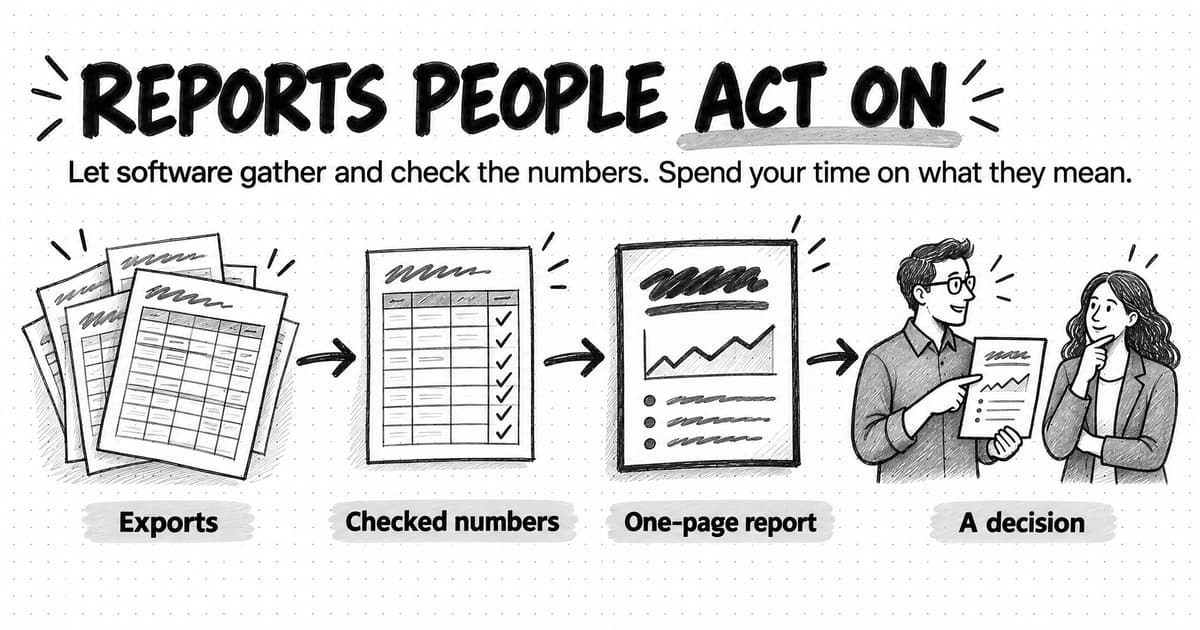
The procedure itself. For a recurring SOP, a scheduled task can hold it. Saved prompt tasks give Ampere a saved prompt, can be bound to a Project, can include saved attachments such as your template or an example of good output, and run manually or on an hourly, daily, weekly, or monthly cadence. Each result goes back to the Project for review, and the task can email a run update to the Organization members you choose. Ampere can also propose one from a conversation as a reviewable card that you edit and accept. Ampere also brings marketing skills of its own, which Ampere maintains, for jobs such as LinkedIn carousels and a weekly competitor-moves brief; your saved prompt adds your team's specific procedure on top of them.
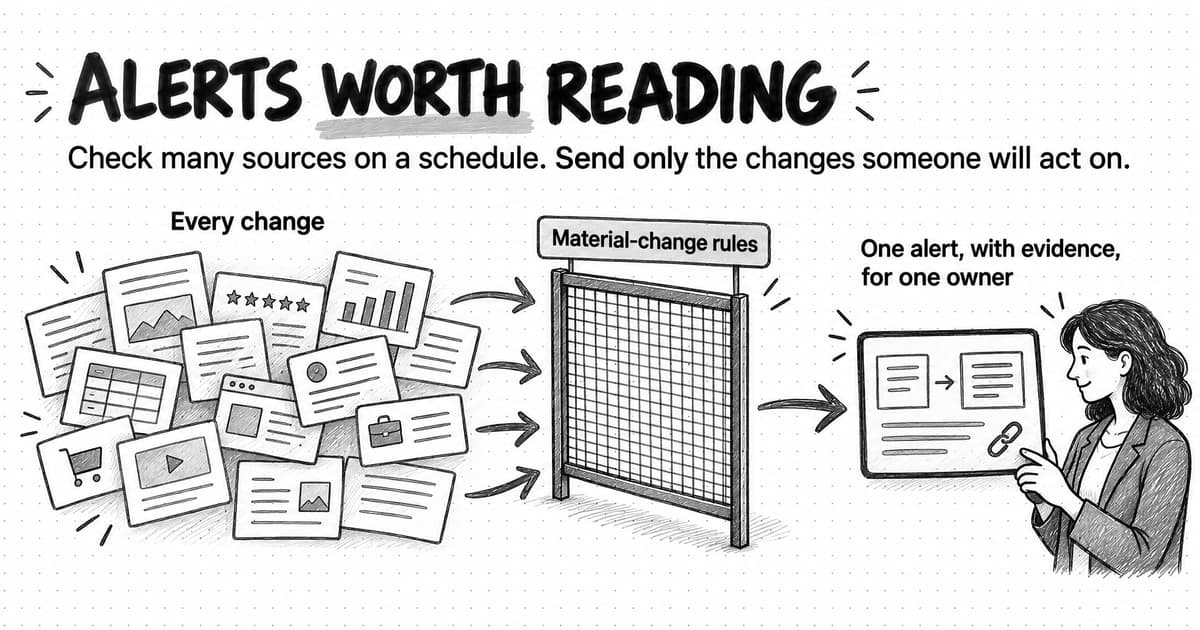
Event-driven steps. Some SOPs start when something changes, such as a competitor's pricing page or new reviews. Monitoring checks supported public sources hourly, daily, or weekly and files in-app alerts with evidence, and a monitor with a follow-up action can have Ampere prepare follow-up work for your review. Coverage can be partial.
The review step. Ampere drafts, researches, and packages; it doesn't publish to your website, schedule social posts, or send marketing email. Your team reviews each result against the definition of done and decides what goes out, and where Connectors to third-party accounts are enabled, actions in those accounts go through approval checkpoints. AI output can still be inaccurate, so your SOP's review step stays.
Sources and further reading
- U.S. Environmental Protection Agency, Guidance for Preparing Standard Operating Procedures (SOPs), EPA QA/G-6, April 2007. Definition, writing style, testing by someone other than the writer, review cycles, checklists, and document control.
- U.S. Federal Aviation Administration, Advisory Circular 120-71B: Standard Operating Procedures and Pilot Monitoring Duties for Flight Deck Crewmembers, January 10, 2017. Conditions for effective SOPs and guidance on writing steps.
- Harvard Gazette, Surgical safety checklist drops deaths and complications by more than one third, January 14, 2009. Report on the eight-hospital study published in the New England Journal of Medicine.
- OpenAI, A practical guide to building agents. Best practices for agent instructions, including using existing operating procedures.
- Anthropic, Prompting best practices, Claude documentation. Clear and direct instructions and the colleague test.
- Anthropic, Agent Skills overview and Skill authoring best practices, Claude documentation. Skill structure, progressive loading, and degrees of freedom.
Frequently Asked Questions
What are the main components of a marketing SOP?
The main components of a marketing SOP are a title, purpose, scope, trigger, roles, inputs and sources, numbered steps, decision points, a definition of done, examples, exceptions, and a version with a review date. The decision points and the definition of done matter most, because they let someone handle real variations and check the finished work.
What is the format of an SOP?
An SOP has no single required format, but most follow a header with the title, owner, version, and review date, then purpose and scope, then inputs, then numbered steps in order, then a definition of done, examples, and exceptions. Tasks with many branches can add a flowchart or a checklist inside the procedure.
How do I start writing a marketing SOP?
Start writing a marketing SOP by choosing one recurring task where mistakes are costly or work changes hands, then watching it done or recording yourself doing it. Turn your notes into numbered steps, one action each, add the decisions and a definition of done, and test the draft with someone who didn't write it. Their questions show what is missing.
Can ChatGPT or other AI tools write marketing SOPs?
ChatGPT and other AI tools can draft a marketing SOP from your notes, a recording transcript, or an existing document, and can turn a dense document into clear numbered steps. They can't know your unwritten rules, approved claims, or which sources are current unless you tell them. Treat the AI draft as a first version, then test it with a person or an agent doing the real task.
What is the difference between an SOP and a workflow?
A workflow maps the whole path of a piece of recurring work: the steps, who owns each one, and the handoffs between them. An SOP gives detailed instructions for doing one task or step on that path the same way each time, with inputs, decisions, and a finishing standard. Map the workflow first, then write SOPs for the steps where consistency matters.
What is the difference between an SOP and a playbook?
An SOP describes a routine task that should be done the same way each time, with fixed steps and a checkable standard. A playbook guides situations that differ each time, such as responding to a competitor launch, with principles, options, and examples rather than fixed steps. If most steps in a draft SOP say "it depends," the document is probably a playbook.
How do SOPs and KPIs relate in marketing?
SOPs and KPIs work together in marketing: a KPI measures a result, such as traffic or engagement, and an SOP keeps the work that produces it consistent. With a procedure in place, a change in a KPI is more likely to reflect a deliberate change in the work rather than someone doing the task differently.
What is an example of a marketing SOP?
An example of a marketing SOP is a weekly company LinkedIn post procedure. It names the trigger (every Monday), the roles, and the inputs, such as brand guidelines and an approved-claims sheet, then lists steps from choosing the idea to logging results. It includes decisions, such as removing a customer's name without approval, and a definition of done with a character limit and a source link for every fact.