Content approval workflows: how to review and sign off content without slowing marketing down
Why content waits days for sign-off, how to match each review to what could actually go wrong, who should approve what, and how to approve AI drafts and the actions AI agents take. Includes an approval matrix and reviewer checklists you can copy.
40 min readWritten by Ampere
Short answer
How do you set up a content approval workflow?
Set up a content approval workflow by sorting content into risk tiers, then giving each tier only the reviews its risks need. Name one final approver per piece, give each reviewer a short checklist for their own area, run independent reviews in parallel, set response deadlines with an escalation path, and keep one versioned source of truth. Measure cycle time and revision rounds.
Summary
A content approval workflow is the agreed path a piece of content takes from finished draft to permission to publish: who reviews it, what each person checks, in what order, by when, and who makes the final call. Most approvals are slow not because people review carefully but because work waits in queues, criteria are unclear, and specialist reviewers arrive at the end.
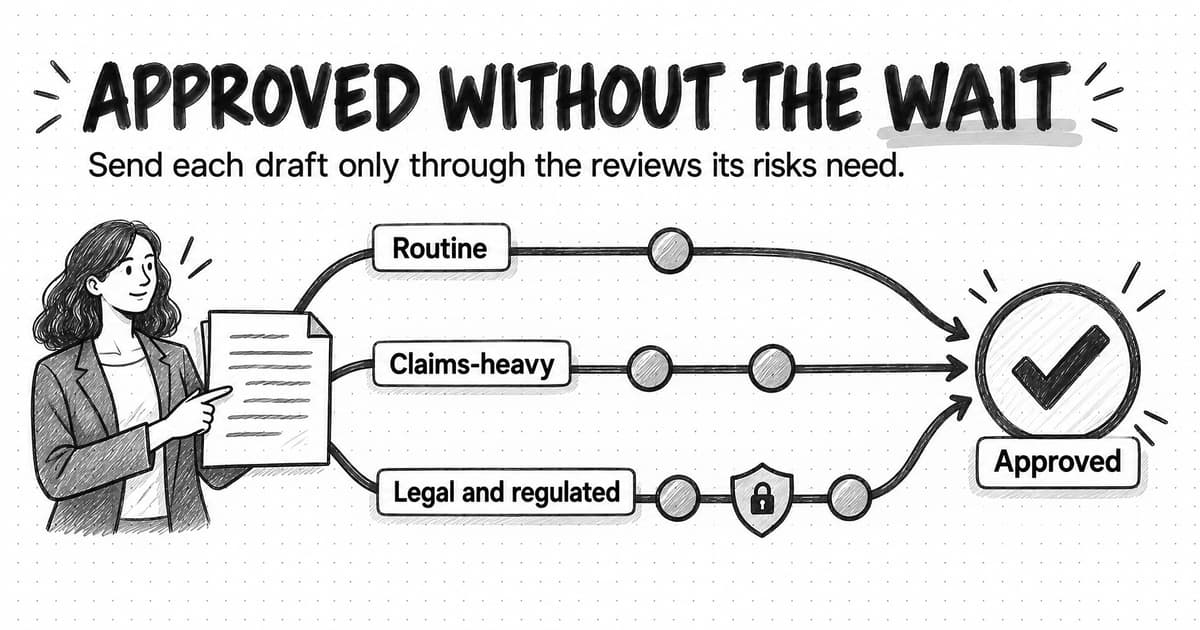
Risk tiers fix the biggest source of delay. Routine content such as a social post from approved messaging needs one editor; claims-heavy content such as a comparison page adds a fact and product check; legal, regulated, or high-exposure content adds compliance review and a recorded approval. Each tier gets the reviews its risks need and nothing more.
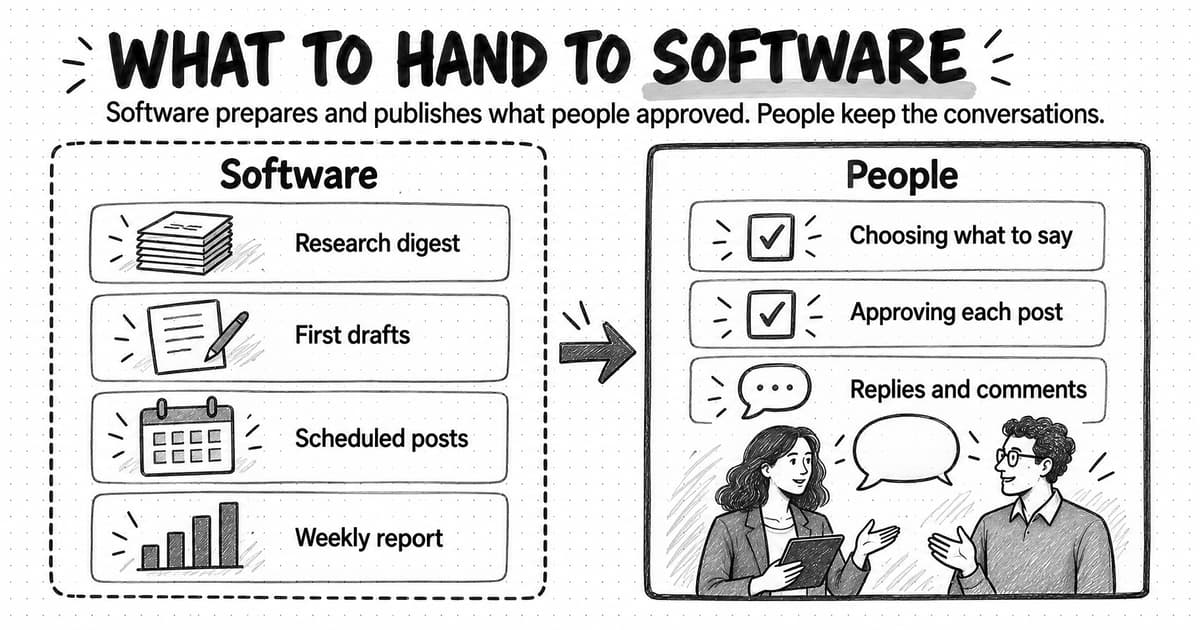
Each reviewer should check one area against a short checklist, such as brand and voice, factual claims, product accuracy, legal and disclosure, or accessibility, and leave the rest alone. One accountable approver resolves conflicting feedback. Reviews that do not depend on each other can run at the same time, and every review gets a response deadline and an escalation path.
AI changes two things. AI-drafted content needs the same approval as any other content, plus a source for every claim, because models can produce confident errors. AI agents that can publish, send, or delete need a second kind of approval: a person approves the exact action before it happens, and destructive actions get fresh approval every time.
A worked example follows one fictional software company through three tiers, from a routine LinkedIn post to a customer case study, and the guide ends with a copyable approval matrix and reviewer checklists. Measure approval cycle time, revision rounds, and first-pass approval rate, and start by tiering the content you publish most often.
Contents
- What is a content approval workflow?
- Why content approvals slow marketing down
- Risk-tiered approval: match the review to what could go wrong
- Roles in a content approval workflow: requester, author, reviewer, approver, and informed
- Review criteria: what each reviewer checks, and what they leave alone
- Sequential vs. parallel review
- How to set up a content approval workflow, step by step
- SLAs, deadlines, and escalation
- Version control and a single source of truth
- Approving AI-generated content
- Approving AI agent actions: publishing, sending, and deleting
- Disclosure and compliance checks: endorsements, AI labels, and regulated content
- Tools for content approval workflows
- How to measure a content approval workflow
- Worked example: one team, three tiers
- Templates: approval matrix and reviewer checklists
- Common content approval mistakes
- How Ampere fits a content approval workflow
- Sources and further reading
- Frequently Asked Questions
A product marketer finishes a LinkedIn post announcing a new integration on Monday morning. It needs a quick look from the founder, who is travelling. The product manager wants to confirm the feature name. Someone suggests legal should see it because it mentions a partner. By Thursday the post has three sets of comments in two places, the founder has rewritten the opening, the product manager has changed it back, and the partner has already announced the integration on its own. Nobody did anything wrong. The post simply had no defined path to "approved."
The same team also has content where a slow, careful review is right: a pricing page, a customer case study with revenue figures, a security claim a buyer's procurement team will hold the company to. The trouble is that most teams run every piece of content through one informal process, so the post gets the caution meant for the pricing page, and the pricing page sometimes gets the casual glance meant for the post.
A content approval workflow is the agreed sequence of reviews a piece of content goes through before it can be published, with named reviewers, the criteria each one checks, the order and deadlines for their reviews, and one person with authority to give final sign-off. Written down, it answers questions the team otherwise argues about on every piece: does this need legal, who decides when the founder and the product manager disagree, how long is a reasonable wait, and which version is the approved one.
AI has made the question more pressing. Teams now review drafts an AI system produced in minutes, often in larger volumes than before, and some use AI agents that can publish a post, send an email, or delete a file on a connected account. Those drafts need a review that checks claims against sources, and those actions need a different kind of approval altogether.
This guide explains why approvals slow marketing down, then builds a workflow piece by piece, from risk tiers and roles to approvals for AI drafts and agent actions. It ends with measurement, a worked example across three tiers, and copyable templates.
What is a content approval workflow?
A content approval workflow covers the stretch of content production between "the draft is done" and "this can go live." It does not cover how topics get chosen or how drafts get written. Those belong to the broader marketing workflow and to content operations. The approval workflow is narrower: it decides what happens to a finished draft.
Every approval workflow, formal or not, has the same parts:
- A submission point. The moment and place an author says a draft is ready, so reviewers don't comment on half-finished work.
- Review stages. The checks the content goes through, such as an editorial read, a fact check, or a legal review.
- Criteria for each stage. What each reviewer looks for. A reviewer without criteria reviews everything, which is how a legal reviewer ends up rewriting headlines.
- An order and a deadline. Which reviews happen first, which run at the same time, and how long each reviewer has.
- Decision states. Approved, approved with minor edits, changes required, or rejected, so "looks fine, but maybe tweak the intro?" can't be read as either a yes or a no.
- A final approver. The one person who can say the content is ready and who settles disagreements.
- A record. The approved version, who approved it, and when. For most content that is a comment and a timestamp; for regulated content it may be a legal requirement.
Three words get used loosely and are worth separating. Review is checking content against a standard and giving feedback. Approval is the decision that the content meets the standard for its purpose. Sign-off usually means the final approval, given by the person accountable for the content going out. Many people can review a piece; only one should sign it off.
An approval workflow is also different from the approval feature in a content management system or social media tool. The feature enforces a step; it does not decide who approves, what they check, or which content needs them. The workflow makes those decisions and the tool setting carries them out.
Why content approvals slow marketing down
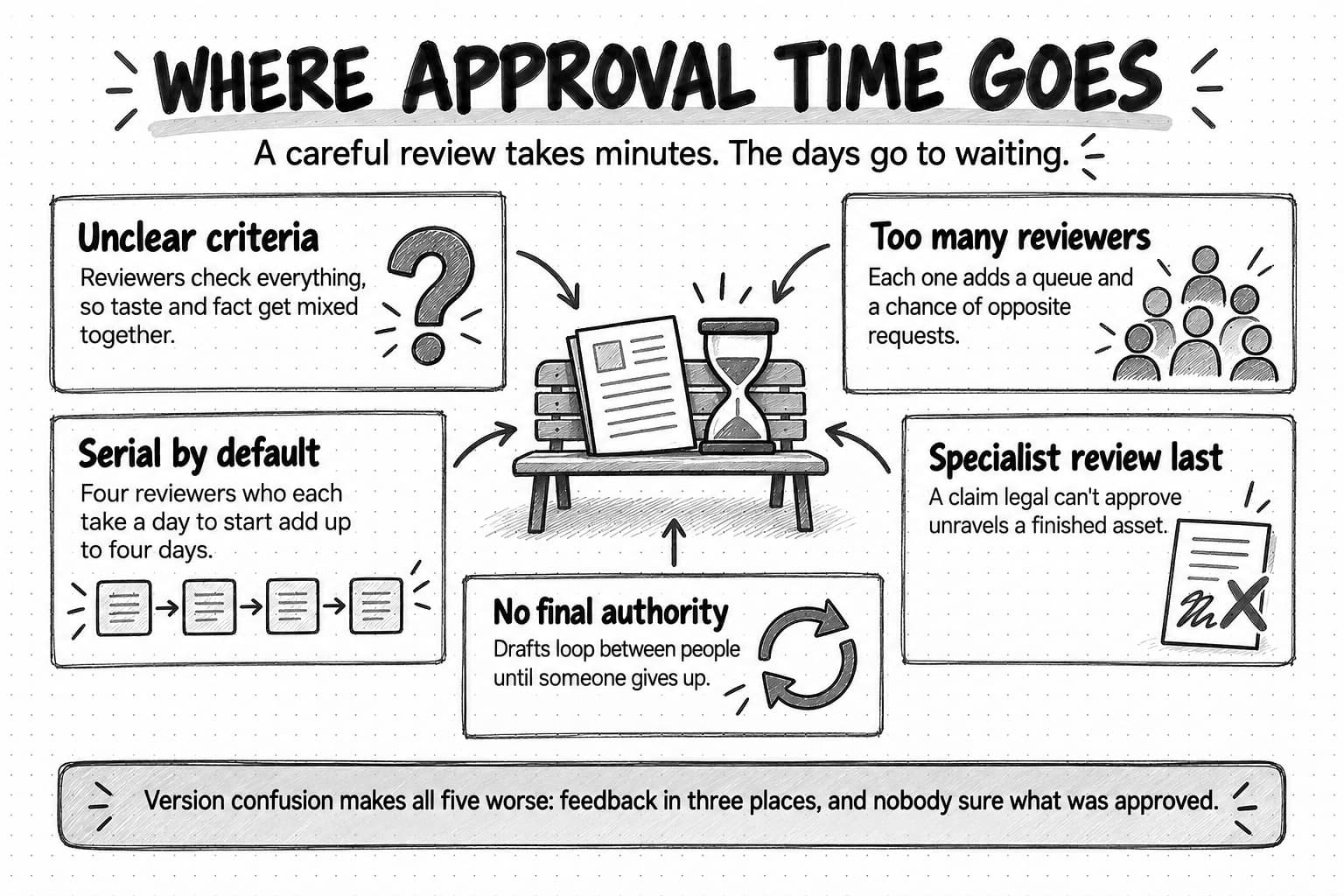
Slow approvals are rarely slow because reviewers read carefully; a careful read of a 600-word post takes minutes. The days go to waiting: for a reviewer to open the document, for the next reviewer to start after the previous one finishes, for someone to reconcile comments that contradict each other. Five patterns cause most of that waiting.
Unclear criteria. A reviewer who doesn't know what to check checks everything, and their feedback mixes taste with fact. The author can't tell requirements from preferences, addresses all of them, and the next reviewer starts from a rewritten draft.
Too many reviewers. Each extra reviewer adds a queue, more comments to reconcile, and a chance that two people want opposite things. Reviewers are often added for reassurance ("loop in sales, just in case"). Someone who would never block the content can be informed instead.
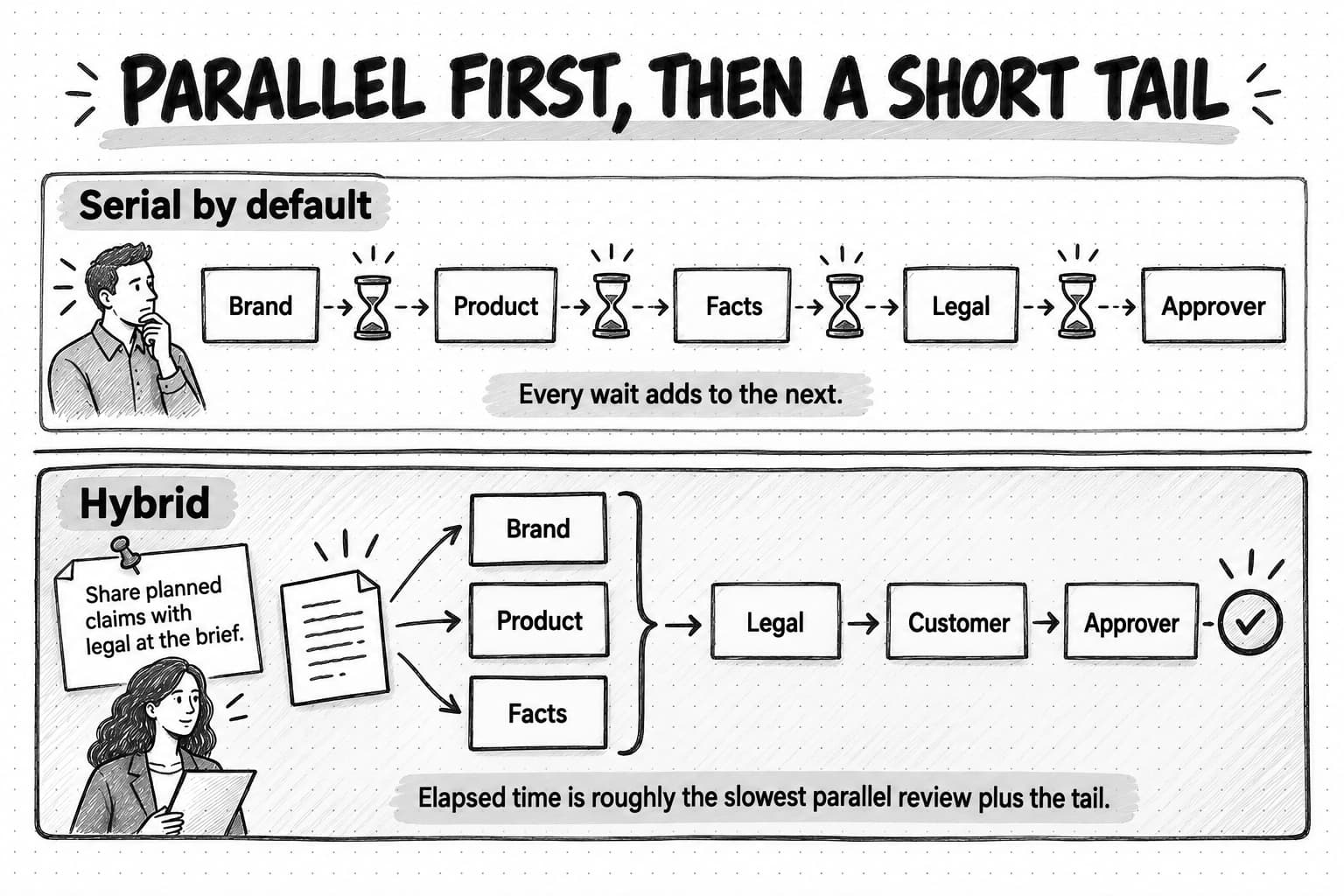
Serial reviews by default. Many teams pass a draft from one reviewer to the next because that is how email forwarding works, not because the second review depends on the first. If each of four reviewers takes a day to get to the draft, a serial chain takes four days even when every review takes a few minutes. A brand review and a product-accuracy review rarely depend on each other and can run at the same time.
Specialist review at the end. Legal, compliance, or a subject expert often sees the content last. If they find a claim the company cannot support, the fix can unravel the headline, the structure, and the design, so a problem that was cheap to fix in the brief becomes expensive in a finished asset.
No one with final authority. When the founder, the product lead, and the head of marketing all comment and nobody has the last word, the author becomes a negotiator. Drafts loop between people until someone gives up. One named approver per piece, with authority to settle disagreements, ends the loop.
A sixth problem makes the other five worse: version confusion. When feedback arrives in a document, an email thread, and a chat message, people comment on different versions, approved changes get lost, and nobody is sure what was approved.
Software teams studied a similar problem. DORA, the research program behind the State of DevOps reports, examined heavyweight change approval, where an external board must sign off each change before it ships. Its 2019 findings, summarized on DORA's page on streamlining change approval, were that these processes slowed delivery and that there was no evidence a more formal external review led to fewer failed changes. DORA recommends peer review close to the work, backed by automated testing. Marketing content is not software, so the findings don't transfer as numbers, but the principle does: review that is far from the work and applied to everything slows teams down without necessarily catching more problems.
Risk-tiered approval: match the review to what could go wrong
The most effective change most teams can make is to stop running every piece of content through the same reviews. Sort content into risk tiers and give each tier the reviews its risks need: a routine post needs no specialist, a claims-heavy page needs a fact check, and a regulated communication needs compliance review because the law requires it.
Risk here means the cost of getting it wrong, not how important the content feels. Six questions are enough to tier most content:
- Does it make factual claims beyond approved messaging? A new statistic, a competitor comparison, or a customer result raises the tier; restating approved positioning does not.
- Could a statement create legal exposure? Competitor claims, guarantees, pricing, security, privacy, health or financial outcomes, endorsements, and anything a regulator governs.
- Who is speaking, and to how many people? A company page post, a press release, a paid ad, and a partner's newsletter carry different weight.
- How reversible is it? A social post can be edited within minutes, though screenshots last; a sent email or a press release cannot be recalled.
- Does it involve another party? A customer, partner, named employee, or paid creator usually needs to approve how they are represented, and a paid relationship may need a disclosure.
- Is it new? A first post in a new format or a first use of AI-generated imagery deserves more attention than the hundredth weekly update.
Most B2B marketing teams can work with three tiers.
| Tier | Typical content | What could go wrong | Reviews needed | Final approver |
|---|---|---|---|---|
| 1. Routine | Social posts from approved messaging, event reminders, internal recaps, newsletter items repeating published content, small fixes to existing pages | Off-voice wording, a typo, a broken link | One editorial review against the brand checklist | Content lead or an experienced editor |
| 2. Claims-heavy | Comparison and alternative pages, product launch posts, pricing and landing pages, data-led articles, ads, sales one-pagers | A wrong or unsupported claim, an outdated product detail, an unfair competitor comparison | Editorial review plus fact and claims check plus product accuracy check | Head of marketing or the owner of that page |
| 3. Legal, regulated, or high-exposure | Customer case studies with results, security and compliance statements, partner co-marketing, paid creator and employee advocacy campaigns, press releases, anything in a regulated industry | Legal or regulatory breach, a damaged customer or partner relationship, a public correction | Tier 2 reviews plus legal or compliance review, third-party approval, and a recorded approval | The executive accountable for the content, with legal sign-off where required |
These tiers are a starting point, not a standard. A financial services or health company may treat much of its content as tier 3, while a five-person startup might keep tier 3 only for customer stories and security claims. What matters is that the tiers are written down and that authors know how to place content in one.
Two rules keep tiering honest. First, the highest-risk element sets the tier: a routine post that quotes a customer's revenue result is tier 3, because the quote is. Second, the author proposes the tier and the approver can raise it, which makes authors think about risk while writing.
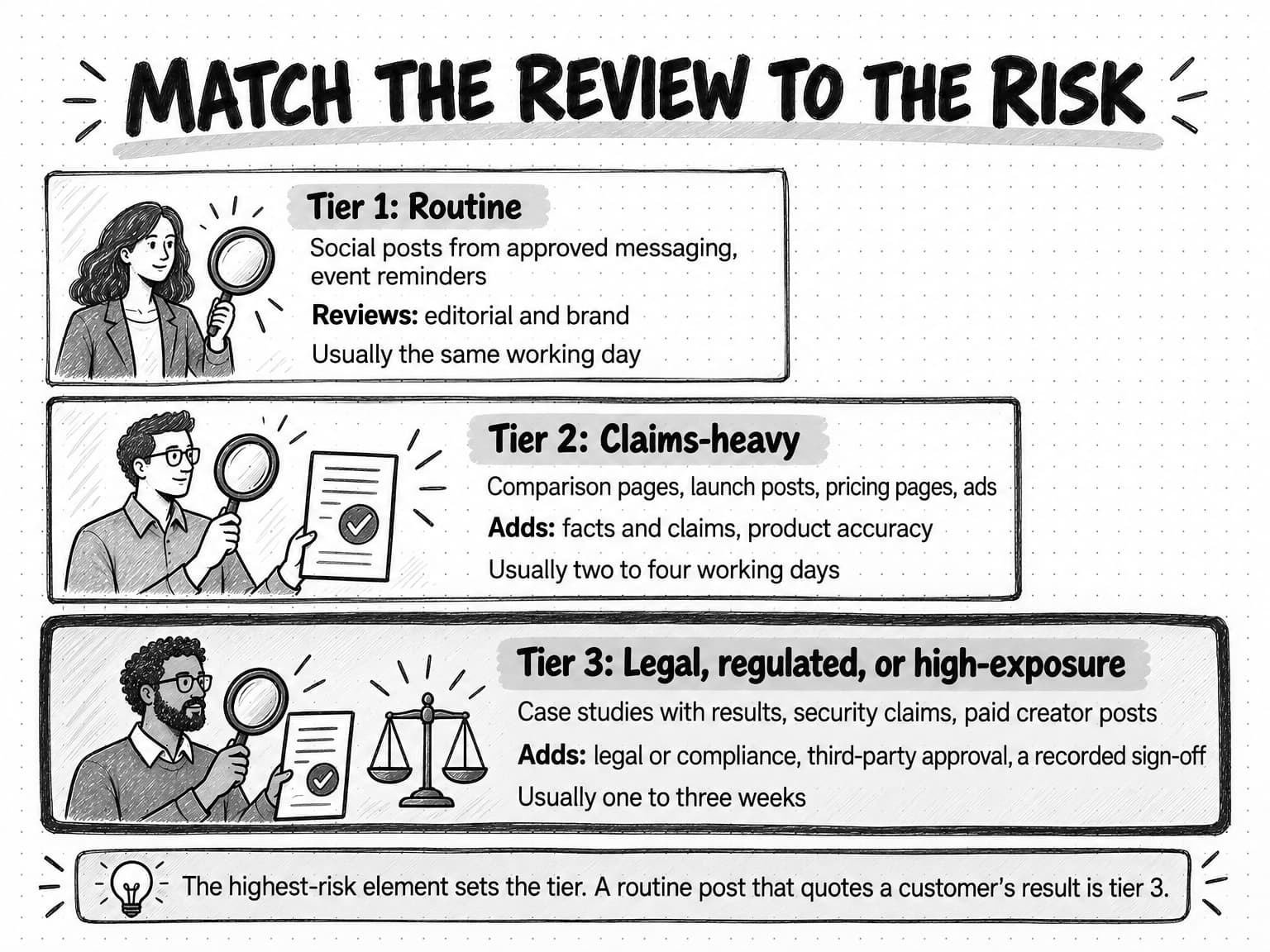
View the three risk tiers at full size (opens in a new tab).
Roles in a content approval workflow: requester, author, reviewer, approver, and informed
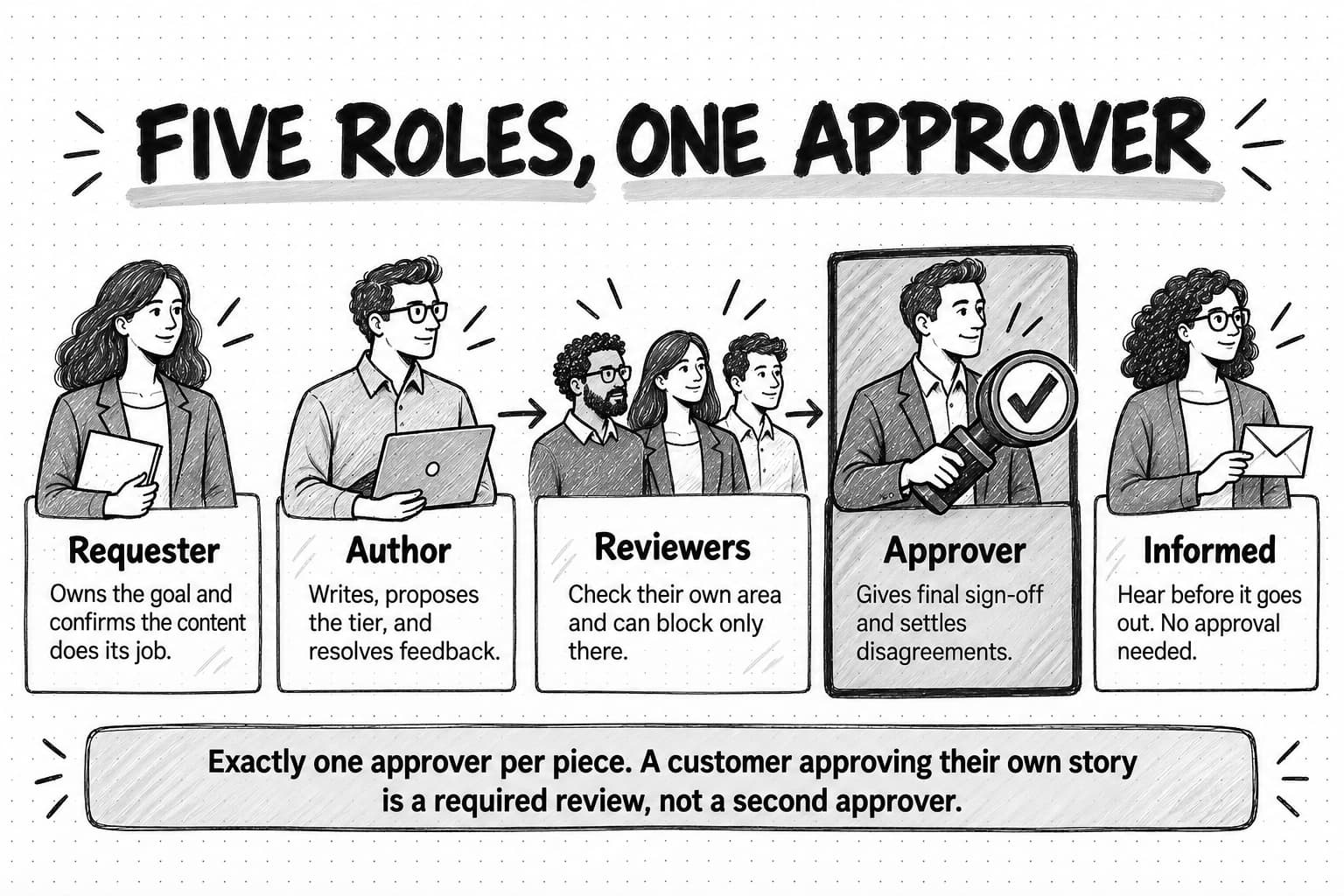
Approval problems are often role problems: people comment because they were copied, and nobody knows who can say no. Naming five roles clears most of this up.
Requester. The person who asked for the content and owns its goal, such as a sales lead asking for a one-pager. The requester confirms the content does its job but is not automatically the approver.
Author. The person who writes or assembles the content, proposes the tier, resolves feedback, and makes sure the published version matches what was approved. When AI drafts the content, the person who directed and edited it is the author; the AI does not take this role.
Reviewer. A person who checks the content against the criteria for their area, such as a product manager checking feature names or a lawyer checking a competitor claim. A reviewer can block content on matters inside their area and only suggest changes outside it.
Approver. The single person who gives final sign-off, reads the reviewers' decisions, and settles conflicts. There should be exactly one per piece. A customer approving their own case study is a required review with veto power over its own part, not a second approver.
Informed. People who need to know the content is going out but do not approve it, such as the sales team before a launch post. Telling them avoids surprises without adding a queue.
These roles map onto a RACI chart, a common project-management grid that marks who is Responsible for the work, the one person Accountable for the outcome, who is Consulted, and who is Informed. The author is responsible, the approver accountable, and the reviewers consulted. The rule that matters most is one accountable person per task.
| Task | Requester | Author | Reviewers | Approver | Informed |
|---|---|---|---|---|---|
| Set goal, audience, and deadline | Accountable | Consulted | |||
| Propose the risk tier | Consulted | Responsible | Accountable | ||
| Draft and revise | Consulted | Responsible | Accountable | ||
| Review against own criteria | Informed | Responsible | Accountable | ||
| Resolve conflicting feedback | Consulted | Responsible | Consulted | Accountable | |
| Give final sign-off | Informed | Accountable | Informed | ||
| Publish and confirm it went live | Informed | Responsible | Accountable | Informed |
The founder problem
At startups, the founder often reviews everything. Early on that is useful, because the founder's review teaches the team what good looks like. As output grows, founder review becomes the queue everything waits in, competing with travel, sales calls, and fundraising.
The fix is to move the founder's judgment into the workflow instead of keeping the founder in it. The founder approves the reusable building blocks once (messaging, claims, voice examples) and then only tier 3 content and new kinds of content. A content lead approves the rest against those blocks, and the founder can be informed when it goes out and spot-check a sample each week. Our guide to founder-led marketing covers the related question of which content should stay in the founder's own voice.
Review criteria: what each reviewer checks, and what they leave alone
A reviewer with a short list of criteria reviews faster and gives feedback the author can act on. The list should also say what the reviewer does not check: a product manager who knows voice is not their call will leave the headline alone.
Brand and voice review checks terminology, tone for the channel, formatting, and visual standards against the brand guidelines. It does not check facts, and it should separate rule violations from personal taste. Our guides to brand guidelines and brand voice explain how to write rules a reviewer can apply consistently.
Fact and claims review checks every factual statement against a source: statistics, dates, quotations, customer results, comparisons, and anything presented as true. The reviewer should be able to trace each claim to a document, a dataset, or an approved list. Under the FTC's policy statement on advertising substantiation, US advertisers need a reasonable basis for objective claims before they disseminate them, and a claim that implies a level of support, such as "studies show," needs that support. A fact checker does not judge voice or structure.
Product accuracy review, usually by a product manager or product marketer, checks that features, names, availability, limits, integrations, and pricing match the current product. It catches outdated screenshots, renamed features, and promises of features still in development.
Legal and compliance review checks competitor claims, guarantees, privacy and security statements, endorsement and testimonial rules, required disclosures, trademarks, and industry rules. Legal reviewers work fastest when the claims and sources arrive listed and they know which parts were already approved.
Accessibility review checks that people can perceive and use the content: alt text for meaningful images, captions or transcripts for video, link text that makes sense out of context, sufficient color contrast, heading structure, and plain language. The W3C's Web Content Accessibility Guidelines, whose current version is WCAG 2.2, are the reference standard. Many of these checks can sit in the editorial checklist rather than in a separate review stage.
Channel and format review, usually part of the editorial review, checks that the piece fits where it is going: character limits, image sizes, links, tracking parameters, and the call to action.
Some reviews apply only at certain tiers, so each reviewer's checklist should mark the tier for each check. The templates section near the end of this guide has a copyable version.
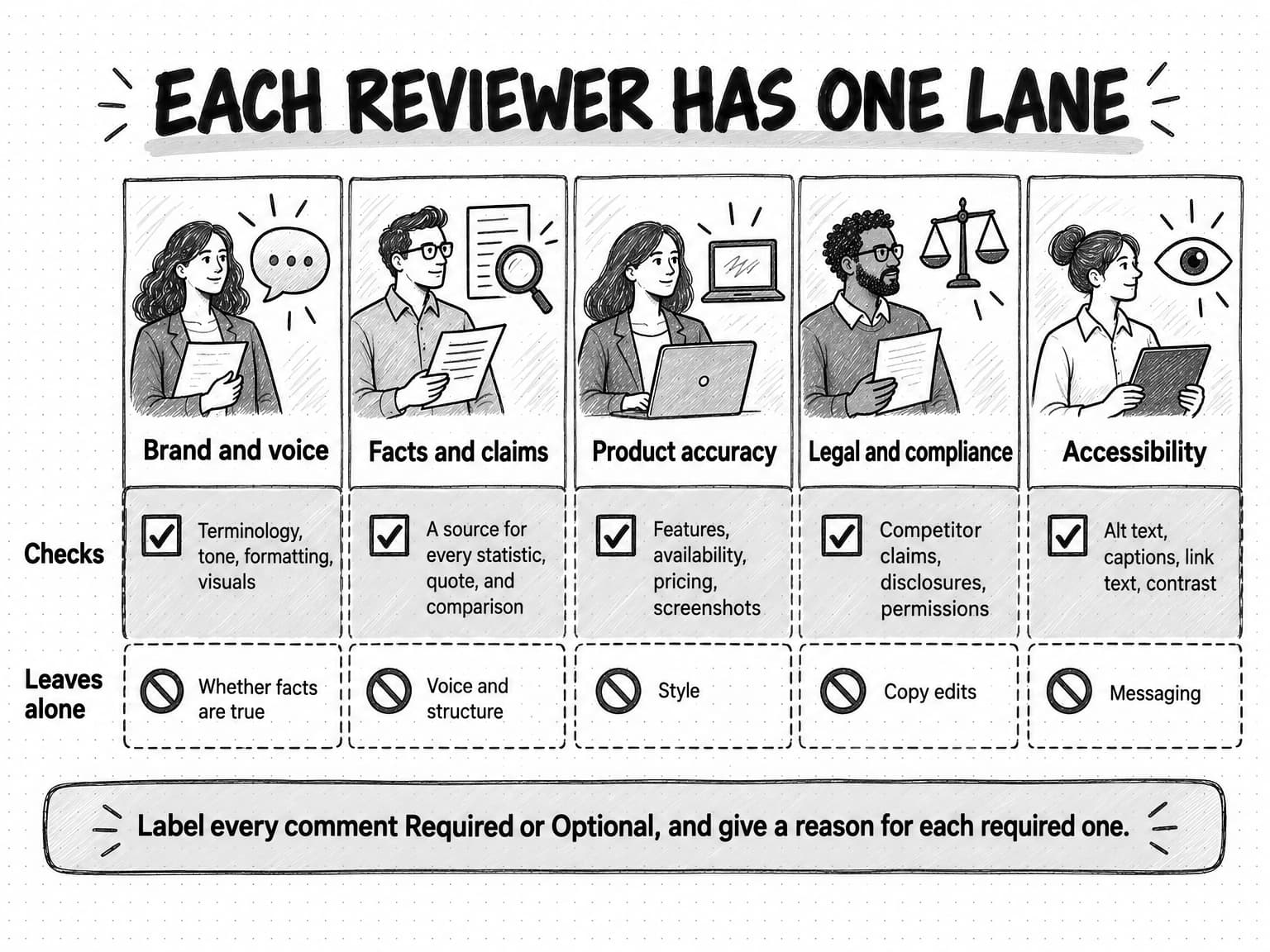
View the reviewer lanes at full size (opens in a new tab).
Sequential vs. parallel review
In a sequential review, the content goes to one reviewer, then the next, then the next. In a parallel review, it goes to several reviewers at the same time, and the author consolidates their feedback. Each has a place.
Use parallel review when one reviewer's changes are unlikely to affect what another checks, as with brand, product accuracy, and accessibility. It cuts elapsed time to roughly the slowest reviewer instead of the sum of all of them, at the cost of feedback the author must reconcile, which is why the approver settles disagreements.
Use sequential review when a later review depends on an earlier one. Legal review should see the content after the claims are settled, because a fact-check change can raise a new legal question, and a customer should see a near-final case study once rather than several drafts.
Most effective workflows are hybrid: a parallel round, then a short sequential tail for legal, the customer, and the approver. Two changes shorten the tail.
Bring specialists in at the brief. For tier 3 content, share the brief and the planned claims with legal or compliance before drafting starts. A five-minute "can we say this?" early prevents a rewrite at the end. Our guide to writing a content brief shows where claims and sources belong in a brief.
Give the last reviewer a smaller job. If legal receives a list of the claims, their sources, and the parts already approved, they review the risk instead of reading the whole piece cold. The same applies to the final approver, who should see the reviewers' decisions alongside the draft.
How to set up a content approval workflow, step by step
The parts above come together in a sequence most teams can complete in a week or two, starting with the content they publish most often.
- List your content types. Everything the team publishes in a typical quarter, with how often each appears and who asks for it.
- Assign each type a default tier. Use the six risk questions, and note the elements that push a piece up a tier.
- Name the roles for each tier. The approver and the required reviewers, by name or job title, not "the team."
- Write a checklist for each reviewer. Five to ten checks, each marked with its tiers, plus what that reviewer does not check.
- Decide the order. Default to parallel unless one review depends on another.
- Set response deadlines and an escalation path for each tier.
- Choose one place for drafts and decisions, and move feedback that arrives elsewhere into it.
- Define the decision states and what each means for the author's next step.
- Run a pilot for two to four weeks on real content, tracking waits and rounds.
- Adjust and publish the workflow. Remove reviews that never change anything, add checks for problems that slipped through, and share it where authors and reviewers will see it.
A workflow document of one or two pages is enough for most teams; longer usually means it describes exceptions instead of defaults. Our guide to marketing SOPs covers how to write procedures people follow.
SLAs, deadlines, and escalation
A review deadline, often called a service-level agreement or SLA, is the time a reviewer has to respond. Without one, reviews lose to anything on the reviewer's list that has its own deadline. The windows below are illustrative starting points, not industry benchmarks; adjust them to your team's capacity.
| Tier | Response window per reviewer | Typical total cycle | What happens at the deadline |
|---|---|---|---|
| 1. Routine | Same working day, or 4 working hours | One day | The editor's approval stands; others are informed |
| 2. Claims-heavy | One to two working days | Two to four working days | Author pings once, then escalates to the approver |
| 3. Legal, regulated, or high-exposure | Two to five working days, agreed at the brief | One to three weeks, including third-party approvals | Escalate to the approver and the reviewer's manager; never publish without the required review |
Silence rules need care. Some teams adopt "no response by the deadline counts as approval." That can work for optional reviewers at tier 1, where the cost of a missed comment is small. It must never apply to required reviews at tier 2 or 3, and it must never apply to legal, compliance, or a third party's approval of how they are represented. For those, a missed deadline triggers escalation, not publication.
Escalation should be boring. Write down the steps when a deadline passes: a reminder to the reviewer, then the approver, who can chase the reviewer, assign a substitute, or decide the review isn't needed for this piece. Name a backup approver for each tier, because founders travel and counsel take holidays.
Work backward from launch dates. Set the approval deadline first and schedule drafting to meet it. A press release that needs legal review and a partner's sign-off should reach legal a week or more before launch.
Version control and a single source of truth
Most approval confusion comes down to a simple question with no clear answer: which version was approved? Four practices settle it.
Keep one working copy. Reviewers comment in one document or tool, and the author pastes in any feedback that arrives elsewhere.
Freeze the approved version. Mark it approved with the date and approver's name, and treat it as locked. "Approved, Priya, 14 October" is enough for most content.
Define what reopens review. Small edits after approval are inevitable: a typo, a broken link, a date. Agree which changes the author can make without new approval (spelling, formatting, links that point to the same destination) and which send the piece back (any change to a claim, a figure, a quote, a price, a legal statement, or the call to action). Without this rule, approved content drifts.
Keep the record proportional to the risk. For tier 1, the approval comment is enough. For tier 3, keep the approved version, the reviewers' decisions, the sources behind each claim, and any third-party approvals. In the US securities industry, for example, FINRA Rule 2210 requires, with some exceptions, that an appropriately qualified registered principal approve each retail communication before it is used or filed, and requires firms to keep the communication with the name of the principal who approved it and the date of approval. Most marketing teams are not subject to rules like this, but it models a complete record: what was approved, by whom, and when.
Approving AI-generated content
Content drafted with AI needs the same approval as content drafted by a person. The tier depends on what the content says and where it is going, not on who or what drafted it: an AI-drafted post from approved messaging is still tier 1.
What changes is the emphasis within the review. AI models can produce fluent text that contains invented statistics, misattributed quotes, outdated product details, or customers and studies that do not exist, and the fluency makes errors easier to miss. Google's guidance on using generative AI content, last updated October 1, 2026, says publishers should fact-check and review all AI-generated content for accuracy before publishing, including metadata such as titles, descriptions, and image alt text. Four adjustments help.
Require sources with the draft. Ask whoever directs the AI to deliver each factual claim with the source it came from, or to mark it as unsourced. A reviewer who can see the claims and their sources side by side checks faster than one who has to find them. Our guide to preventing AI hallucinations in marketing sets out a four-step claim check you can use as the fact-check criteria.
Check what AI tends to get wrong. Add a few AI-specific checks to the editorial checklist: claims that sound plausible but appear in no source, generic phrasing that could describe any company, confident statements about the product that nobody gave the AI, and quotes or examples presented as real. Our guide to AI slop describes the generic patterns to look for.
Give the AI the same standards the reviewers use. If the AI drafts from the approved messaging, claims list, and voice examples your reviewers check against, more of its output passes the first review.
Watch for rubber-stamping. When an AI produces many drafts that are usually fine, reviewers can start approving without reading, a tendency known as automation bias. Spot-checks, ticking off each claim, and a realistic review volume per person help. Our guide to human-in-the-loop AI covers where review points belong in AI marketing work and how to keep them meaningful.
In some markets there is also a regulatory reason to keep a person accountable. The European Commission's guidance on Article 50 of the EU AI Act, which has applied since August 2, 2026, says AI-generated text published to inform the public on matters of public interest must be labeled unless it has gone through human review or editorial control and a person holds editorial responsibility for it. Most product marketing is not public-interest information, but a documented review with a named approver is the kind of editorial control that exception describes.
Approving AI agent actions: publishing, sending, and deleting
An AI agent that can publish a LinkedIn post, send an email, update a web page, or delete a file on a connected account is no longer only producing content for review. It is proposing an action with consequences.
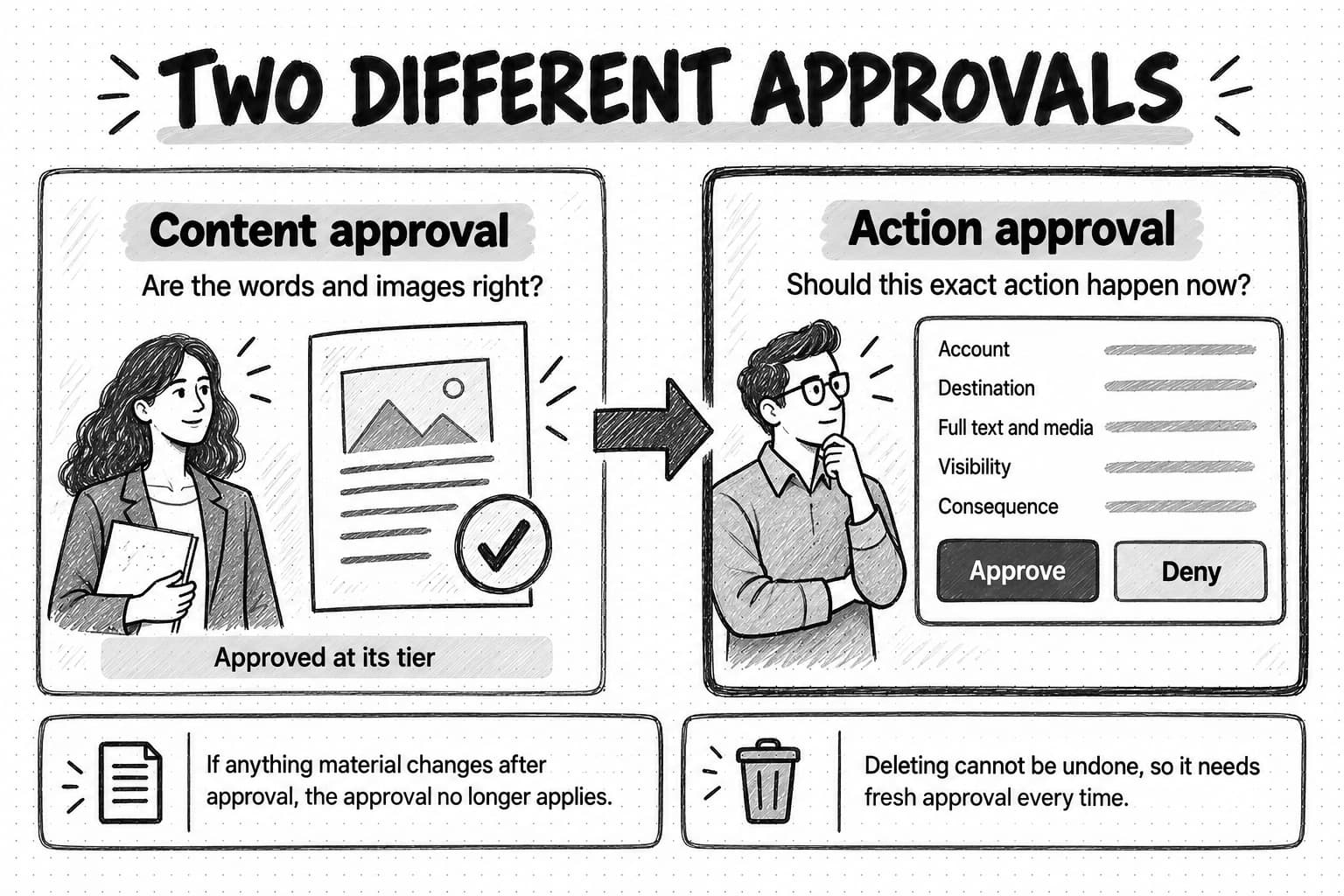
Approving content and approving an action are different decisions. Content approval asks whether the words and images are right. Action approval asks whether this exact thing should happen now: this post, on this account, with this visibility; this email, to this list; this file, deleted permanently. A post approved in a document on Tuesday can still be published to the wrong account on Thursday, and the second approval guards against that.
Good action approval has five properties.
- The approver sees the exact action. Not "publish the post," but the account, destination, full text, media, visibility, and consequence.
- The approval is tied to that exact action. If the text, account, or audience changes after approval, the approval no longer applies and the action does not go ahead. Systems that fail closed this way stop an approved post from being swapped for a different one.
- Denying is as easy as approving. A reviewer who cannot easily say no will tend to say yes.
- Destructive actions get fresh approval every time. Deleting a post or unpublishing a page cannot be undone, so standing permission to delete is rarely worth the risk.
- Recurring actions have scoped consent. If a weekly job may act under standing consent, scope it to one task, one account, and one kind of action, and require new consent when the task changes materially. Without valid consent, the agent should finish the draft and wait.
Reading data, drafting, and saving files to a working folder are usually safe to allow; publishing, sending, spending, changing settings, and deleting usually need approval. Our guide to AI guardrails for marketing teams sets out these action categories, and the guide to autonomous AI agents explains how much autonomy a given job should get.
The two approvals should connect. The person approving an agent's proposal to publish a tier 2 page should be able to see that the content was approved, by whom, and that nothing changed since. An action approval should never stand in for a missing content approval.
Disclosure and compliance checks: endorsements, AI labels, and regulated content
Some approval criteria come from law rather than preference. This section summarizes a few US and EU rules marketing teams commonly meet, as of October 2026. It is not legal advice, and rules differ by country and industry, so confirm what applies to you with counsel.
Endorsements and material connections. The FTC's Endorsement Guides, revised in 2023, require disclosing a connection between an endorser and a brand that many consumers would not expect, such as payment, free products, employment, or a family relationship. The FTC's guidance page, FTC's Endorsement Guides: What People Are Asking, says the disclosure should be placed where it is "difficult to miss," not buried in comments or at the end of a long post. Three consequences for an approval workflow:
- Paid creator and influencer content is tier 3. The FTC's guidance says advertisers need reasonable programs to train and monitor the people who promote them, and advises reviewing posts before they go up rather than searching for them afterward.
- Employee advocacy needs a disclosure check. Employees who post about their company's products should disclose the relationship, and the guidance says listing the employer on a profile is not enough. If your team drafts posts for employees, the disclosure belongs in the reviewed draft.
- Testimonials need a source. The FTC's rule on consumer reviews and testimonials, in force since October 2024, prohibits fake reviews and testimonials, including ones attributed to people who do not exist. Every quote in a case study or ad should trace to a real person who agreed to it.
AI labels. The EU AI Act's Article 50 also requires labels on deepfakes, realistic AI-generated or manipulated images, audio, or video. If your campaigns use realistic AI-generated people, add a disclosure check for that content.
Regulated industries. Financial services, health care, pharmaceuticals, alcohol, gambling, and others have their own advertising rules, and some require pre-approval by a qualified person, as FINRA does for broker-dealer retail communications. In these industries compliance review is part of the default workflow, and its record-keeping requirements shape the tool choice. Our AI guardrails guide covers claims, copyright, and disclosure rules for AI-assisted marketing in more depth.
Tools for content approval workflows
A content approval workflow can run on almost any tool, and many teams start with the documents they already use. What a tool adds is enforcement (content cannot go live without approval), visibility (where each piece is waiting), and a record.
| Tool category | What it does well | Where it falls short | Fits |
|---|---|---|---|
| Shared documents with comments and version history | Fast to start, familiar, comments in place, version history | No enforced stages, approvals are informal comments, hard to see queues across many pieces | Small teams, tier 1 and 2 written content |
| Project management boards | Status columns, owners, due dates, visible queues | Content and approval live in different places; approval is a status anyone can change | Teams with many pieces in flight |
| Proofing and review tools | Comments pinned to images, video, and PDFs; side-by-side versions; reviewer decision buttons | Another tool to adopt; less useful for plain text | Design, video, and ad creative |
| CMS editorial workflows | Approval enforced before a page can publish; roles and permissions; publish records | Covers only content published through that CMS | Website pages and blog posts |
| Social media management tools with approvals | Approval required before a scheduled post goes out; per-account permissions | Covers only social posts in that tool | High-volume social publishing |
| AI agents with approval checkpoints | Drafting and research with sources; the agent pauses for approval before consequential actions | Approval scope depends on what the product enforces; content approval may still happen elsewhere | Teams using AI for drafting and recurring work |
Whatever the tools, check three things. Can you see every piece waiting for review and for how long? Can you tell which version was approved and by whom? And can content reach the public without the approvals its tier requires? If the answer to the last question is yes, the workflow is a suggestion.
How to measure a content approval workflow
A handful of measures show whether the workflow is fast enough and careful enough, and most can be tracked from timestamps in a board or a spreadsheet.
| Approval cycle time | Time from submission to final sign-off, by tier. The headline speed measure. |
|---|---|
| Wait time vs. review time | How much of the cycle is spent waiting for a reviewer to start, compared with time spent reviewing. Long waits point to queues, not slow reviewers. |
| Revision rounds | How many times a piece goes back to the author before approval. Many rounds point to unclear briefs or criteria. |
| First-pass approval rate | Share of pieces approved on their first review, by tier. A useful sign that briefs, building blocks, and checklists are working. |
| Late-stage rejections | Pieces sent back for substantive changes at the legal, customer, or final approval stage. These are the most expensive rewrites. |
| Missed deadlines and escalations | How often a review passes its deadline and how often escalation is needed, by reviewer and tier. |
| Post-publication corrections | Published content that had to be corrected or withdrawn, and which review should have caught the problem. The quality check on a fast workflow. |
Read the measures together. Faster cycle times with rising post-publication corrections mean the workflow got faster by getting careless. A high first-pass approval rate with long cycle times means reviewers agree but are slow to start, which is a queue and deadline problem, not a quality problem. Many revision rounds at tier 1 usually mean the brief or the approved building blocks are missing something, because routine content should rarely need more than one round.
Measure for a month before changing anything, then review monthly. The goal is a cycle time the team can plan around, with corrections rare enough that nobody wants more reviews.
Worked example: one team, three tiers
This example is fictional. Quillmark is a made-up company selling invoicing software to accounting firms, with a five-person marketing team: a head of marketing, a content lead, a product marketer, a designer, and a demand generation manager. The founder used to review everything, and pieces regularly waited a week, so the team adopted the three-tier workflow in this guide.
Tier 1: a LinkedIn post announcing a webinar
The demand generation manager drafts a company page post promoting next month's webinar on month-end closing. The post uses the approved webinar description, the speaker's approved bio, and the registration link. It makes no new claims. She marks it tier 1 and submits it in the shared content document.
The content lead reviews it against the brand checklist the same afternoon: voice, length, link, tracking parameters, alt text on the speaker image. She changes one phrase that the brand guidelines flag ("game-changing") and approves it with minor edits. The founder and the sales team are informed in the weekly content digest. Total cycle: four working hours, one round.
Tier 2: a comparison page against a competitor
The product marketer drafts a page comparing Quillmark with a well-known competitor, aimed at accounting firms searching for alternatives. It makes a dozen factual claims about features, integrations, pricing models, and support hours. She marks it tier 2 and submits it with a claims table listing each claim, its source, and the date she checked it.
Three reviews run in parallel. The content lead does the editorial and brand review. The product manager checks every claim about Quillmark and finds one problem: a bank-reconciliation feature described as available is still in beta for some regions. The head of marketing, acting as fact checker for the competitor claims, finds that one competitor pricing claim came from an old version of the competitor's pricing page and asks for a current source. Both fixes are required changes; the remaining comments are optional.
The product marketer makes the changes and resubmits. The head of marketing, as approver, confirms the required changes were made, checks that nothing else changed, and signs off with a review date three months out, because comparison pages go stale. Total cycle: three working days, two rounds.
Tier 3: a customer case study with results
The content lead drafts a case study about an accounting firm that adopted Quillmark. It includes the customer's name and logo, a quote from the firm's managing partner, and a result: the firm says it cut the time to send month-end invoices from three days to one. Because it names a customer and reports a result, it is tier 3 from the brief.
At the brief stage, the content lead shares the planned claims with Quillmark's outside counsel and with the customer's contact, so both know what is coming. After drafting, the editorial, product, and fact reviews run in parallel. The fact check confirms the result against the customer interview recording and asks for the customer's wording to be used exactly, since the result is the customer's own estimate rather than a measured study. The page now says the firm "estimates" the change.
Then the sequential tail: counsel reviews the near-final version, the customer's managing partner approves the quote and the result in writing, and the head of marketing signs off. The approval record keeps the final version, the reviewers' decisions, the interview recording reference, and the customer's written approval. Total cycle: eleven working days, most of it waiting for the customer, which the team planned for.
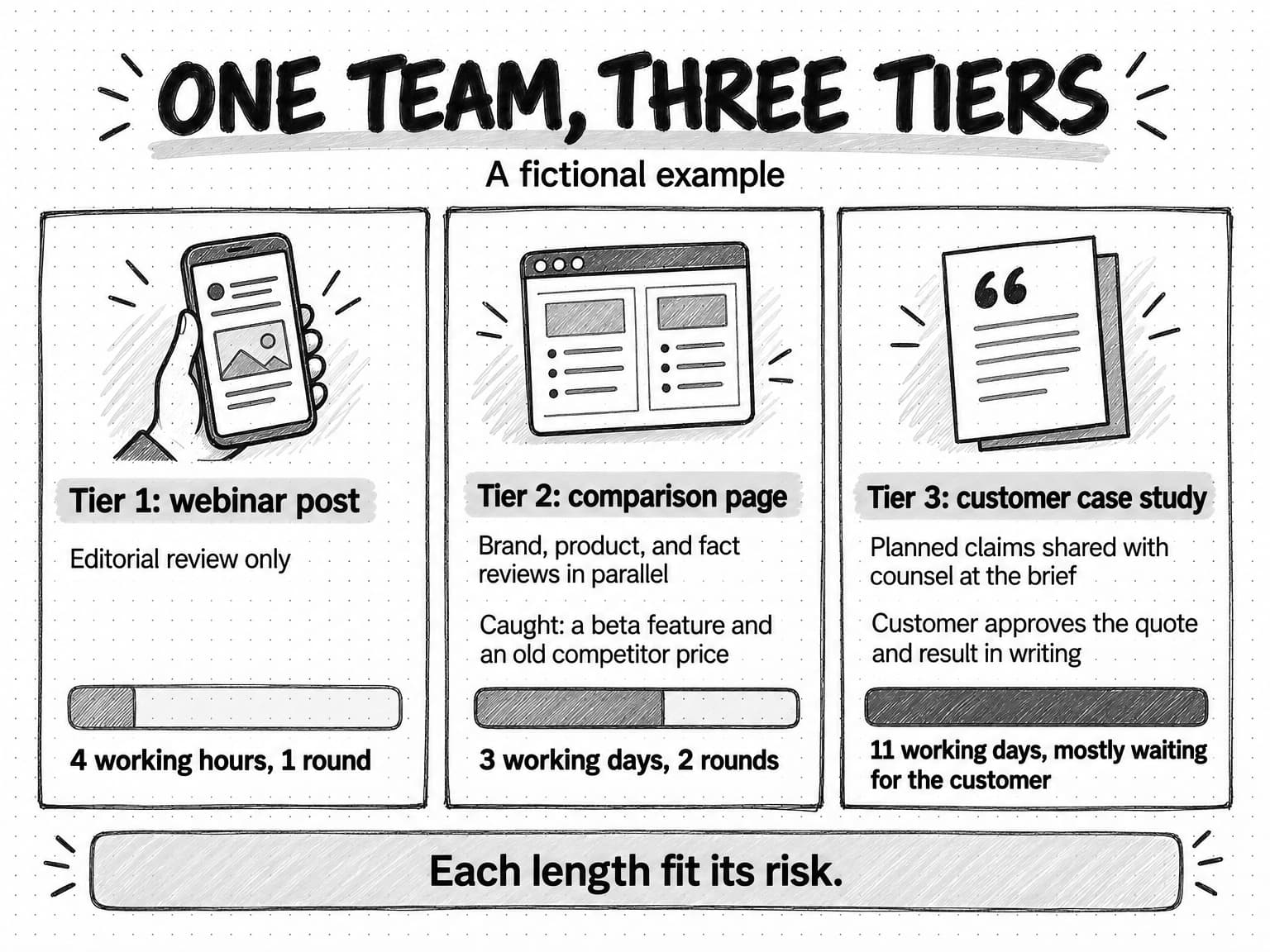
The three pieces took four hours, three days, and eleven days, and each length fit its risk. Under the old process all three would have waited for the founder, and the case study might have gone out without the customer's written approval of the result.
Templates: approval matrix and reviewer checklists
Copy these templates, replace the example roles with names or job titles, and remove checks that don't apply to your content.
Content approval matrix
CONTENT APPROVAL MATRIX
Owner of this document: [name]          Last reviewed: [date]

HOW TO TIER A PIECE
The highest-risk element sets the tier. The author proposes; the approver can raise it.
Raise the tier for: claims not on the approved list, named competitors, customers or
results, paid or gifted posts, security/privacy/pricing/legal claims, irreversible releases.

TIER 1 - ROUTINE
  Reviews:      editorial and brand (checklist A)
  Approver:     content lead           Backup: head of marketing
  Deadline:     same working day
  If late:      editor's approval stands; others informed
  Record:       approval comment with name and date

TIER 2 - CLAIMS-HEAVY
  Reviews:      editorial and brand (A) + facts and claims (B) + product accuracy (C), in parallel
  Approver:     head of marketing      Backup: [name]
  Deadline:     2 working days per reviewer
  If late:      remind once, then escalate to the approver
  Record:       approved version, claims table with sources, approver and date

TIER 3 - LEGAL, REGULATED, OR HIGH-EXPOSURE
  Reviews:      tier 2 reviews in parallel, then legal or compliance (D), then third-party approval
  Approver:     [accountable executive]; legal sign-off where required
  Deadline:     agreed at the brief; share planned claims with legal before drafting
  If late:      escalate to approver and reviewer's manager; never publish without required reviews
  Record:       approved version, all reviewer decisions, sources, third-party written approval

CHANGES AFTER APPROVAL
  No new approval:  spelling, formatting, a link to the same destination
  Back to review:   any change to a claim, figure, quote, price, legal statement, audience, or CTA

AI-DRAFTED CONTENT
  Same tier and reviews as any content. Draft must arrive with a source for each factual claim.

AI AGENT ACTIONS (publish, send, delete, spend)
  A person approves the exact action. Content must already be approved at its tier.
  Deletion and other irreversible actions need fresh approval every time.
Reviewer checklists
A. EDITORIAL AND BRAND  (all tiers)
  [ ] Brand voice, terminology, formatting, and visuals follow the guidelines
  [ ] The point is clear in the first lines; no generic filler
  [ ] Fits the channel: length, image size, links, tracking, call to action
  [ ] Accessibility: alt text, captions, descriptive link text, heading order
  Not checked here: whether facts are true (B), whether the product works this way (C)

B. FACTS AND CLAIMS  (tier 2 and 3)
  [ ] Every statistic, date, and figure traces to a named source
  [ ] Every quote traces to a real person who agreed to it, in their exact words
  [ ] Competitor claims are current as of today and fairly stated
  [ ] Implied claims ("studies show", "leading") have the support they imply
  [ ] AI-drafted claims checked against sources, not against the draft's own wording
  Not checked here: voice and style (A)

C. PRODUCT ACCURACY  (tier 2 and 3)
  [ ] Features, availability, limits, integrations, and pricing match the product
  [ ] Nothing promised that is not yet released to the stated audience
  [ ] Screenshots and demos show the current interface
  Not checked here: voice and style (A)

D. LEGAL AND COMPLIANCE  (tier 3, and tier 2 when flagged)
  [ ] Comparative, security, privacy, and guarantee claims are supportable
  [ ] Endorsement and material-connection disclosures are present and hard to miss
  [ ] Customer, partner, and employee permissions are in writing
  [ ] Industry and regional rules are met; AI labels added where required
  Not checked here: copy edits, unless they change legal meaning

DECISION (circle one): Approved / Approved with minor edits / Changes required / Rejected
Mark each comment REQUIRED or OPTIONAL. Give a reason for every REQUIRED comment.
Reviewer: ________   Date: ________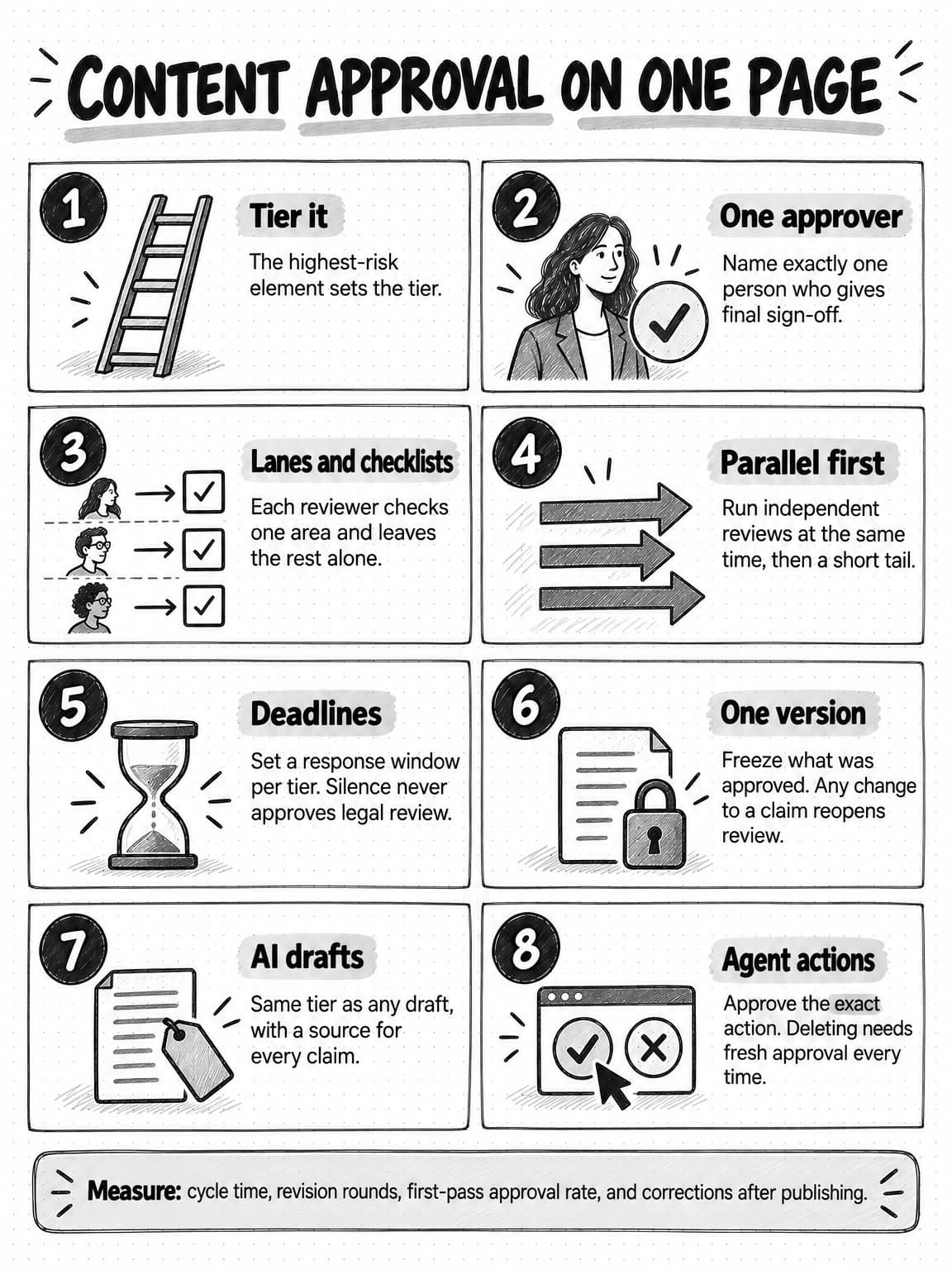
Open the one-page content approval reference at full size (opens in a new tab).
Common content approval mistakes
Adding reviewers instead of fixing criteria. When something slips through, the reflex is to add a reviewer. Usually the better fix is a new check on an existing reviewer's list or a line on the approved claims list, because every added reviewer slows every piece at that tier.
Using one process for everything. Without tiers, routine content waits as long as legal content, people learn to work around the process for routine pieces, and soon they work around it for the rest too.
Letting approval mean "nobody objected." An approval should be an active decision by a named person. Silence-means-yes is acceptable for optional reviewers on routine content and dangerous anywhere else.
Treating AI drafts as pre-checked, or approving agent actions from a summary. A fluent AI draft can contain invented facts, and approving "publish the post" without seeing the exact post, account, and audience defeats the purpose of the approval.
Never revisiting the workflow. Review it every quarter: remove checks that never catch anything, and add the ones that would have caught last quarter's corrections.
How Ampere fits a content approval workflow
Ampere, your AI marketing agent, researches and drafts marketing work and returns it for your review. Your team decides what is approved and what goes out, so Ampere fits as the first stage of an approval workflow, not a replacement for one.
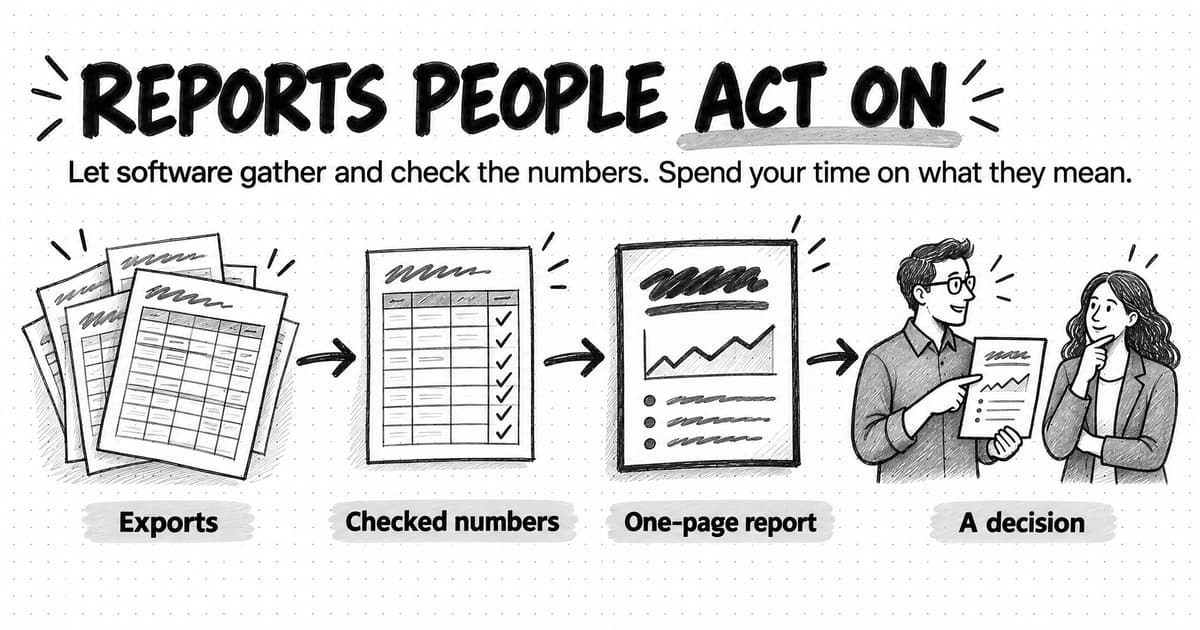
Drafts that arrive ready to review. Ampere drafts channel-specific content packages, including LinkedIn, X, Instagram, TikTok, and YouTube posts, newsletters, lifecycle email sequences, blog article packages, landing-page copy, reports, decks, images, and short video. For LinkedIn text posts, polls, and newsletters, its packages include review notes and claim checks alongside the drafts, so a fact reviewer can start from the claims that need checking.
The same standards each time. Brand memory keeps saved, reviewable knowledge about your brand, products, competitors, audience, and voice, which you can view and edit. When your reviewers' standards live there, Ampere drafts from the same approved positioning and voice they check against, and corrections you make to Brand memory carry into later work.
Review where the work happened. Each session has a session workspace with the browser, files, and sources behind the work, and sessions can be shared with view, edit, or owner access, so a product or legal reviewer can inspect a draft without changing it. The owner can get an email when Ampere needs input or has work ready to review.
Approval before consequential actions. Where Connectors are enabled for your Organization and a Connector action needs approval, Ampere shows an approval checkpoint that opens a full review before you approve and keeps denial available, and the approval does not go ahead if it cannot be tied to the exact action captured for review. For scheduled tasks, saved tasks are created and changed through confirmation cards, scheduled Connector actions can use task-scoped standing consent or one-off approval where the action allows it, destructive scheduled actions always need fresh approval, and without valid consent a run finishes its draft work and waits for you.
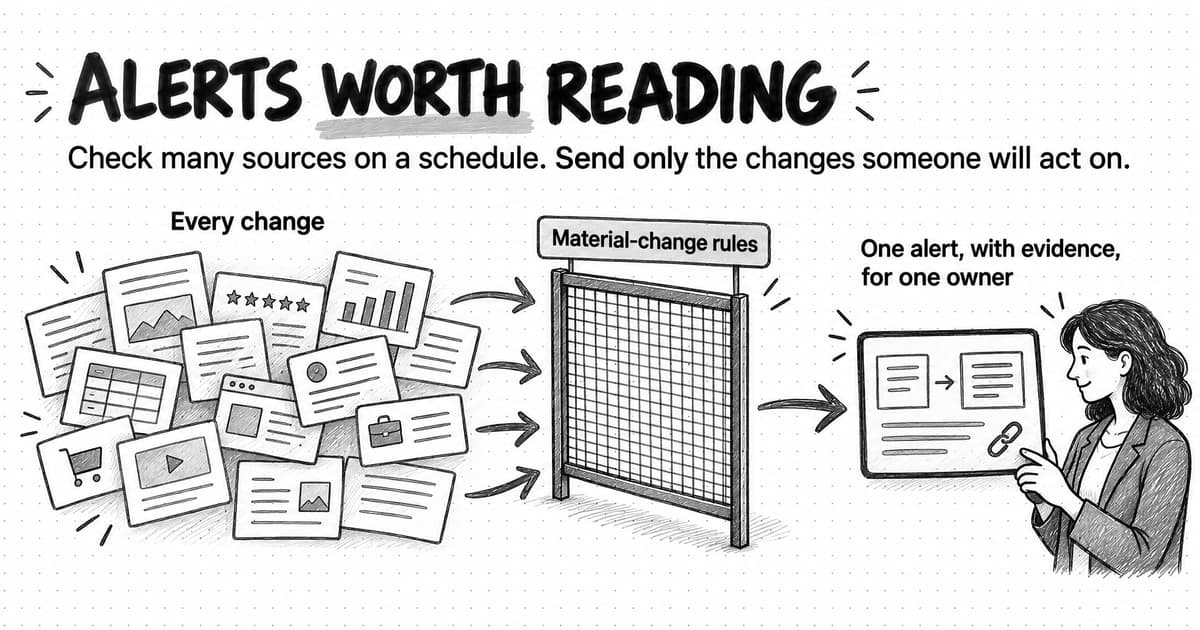
Recurring work comes back for review. Scheduled tasks run saved prompt tasks and AI Tool runs hourly, daily, weekly, or monthly, and return each result to a Project for review, with optional run-update emails to chosen Organization members. Monitoring files in-app alerts with evidence when something you track changes, and can prepare follow-up drafts for review.
Ampere does not publish to your website, and it is not a social scheduler or an email sending platform. AI output can be inaccurate or incomplete, so drafts go through your approval workflow like any other content.
Sources and further reading
- DORA, Capabilities: Streamlining change approval. Findings from the 2019 State of DevOps Report on heavyweight change approval and peer review.
- Federal Trade Commission, FTC's Endorsement Guides: What People Are Asking. Material connections, clear and conspicuous disclosure, employee posts, and monitoring programs, reflecting the 2023 revision.
- Federal Trade Commission, FTC Policy Statement Regarding Advertising Substantiation, November 23, 1984. The reasonable-basis standard for objective claims.
- Federal Trade Commission, Federal Trade Commission announces final rule banning fake reviews and testimonials, press release, August 14, 2024.
- FINRA, Rule 2210: Communications with the Public. Principal approval and record-keeping for retail communications.
- European Commission, Transparency obligations under Article 50 of the AI Act, last updated July 24, 2026. Labeling rules and the human review exception for AI-generated public-interest text.
- Google Search Central, Google Search's guidance on using generative AI content on your website, last updated October 1, 2026.
- W3C Web Accessibility Initiative, WCAG 2 overview, last updated September 17, 2026. WCAG 2.2 was published in October 2023 and updated in December 2024.
Frequently Asked Questions
What is an approval workflow process?
An approval workflow process is the defined path a piece of work follows from submission to a final decision: who reviews it, what each reviewer checks, in what order, by when, and who gives final approval. In marketing, a content approval workflow applies this to drafts before publication, with extra reviews for content that makes claims or carries legal risk.
What are the stages of a content approval workflow?
The stages of a content approval workflow are submission, review, revision, final approval, and publication with a record of what was approved. Review can include editorial and brand, facts and claims, product accuracy, legal and compliance, and accessibility checks. Routine content usually needs only an editorial review, while claims-heavy and regulated content adds the specialist stages.
Who should approve marketing content?
One named approver should give final sign-off on each piece of marketing content, and the right person depends on the risk tier. A content lead can approve routine posts, the head of marketing or the page owner can approve claims-heavy content, and the accountable executive approves legal or high-exposure content, with legal or compliance sign-off where the content requires it.
How long should a content approval process take?
A content approval process should take as long as the content's risk needs, and no longer. As an illustrative starting point, routine posts can be approved within a working day, claims-heavy pages in two to four working days, and legal or customer-facing content such as case studies in one to three weeks, mainly because third parties must approve. Set response deadlines for each tier and measure actual cycle times.
What is the difference between a content workflow and a content approval workflow?
A content workflow covers the whole path of a piece of content, from idea and brief through drafting, review, publishing, and distribution. A content approval workflow is the part of it between a finished draft and permission to publish: the reviews, their criteria and order, the deadlines, and the final sign-off. A team can improve its approval workflow without redesigning everything else.
Should content reviews be sequential or parallel?
Content reviews should run in parallel when they are independent and sequentially when one depends on another. Brand, product accuracy, and accessibility reviews can usually happen at the same time, which cuts the wait to roughly the slowest reviewer. Legal review and customer approval usually come after claims are settled, because fact-check changes can raise new legal questions.
How do you approve AI-generated marketing content?
AI-generated marketing content should go through the same approval tier as any other content with the same claims and audience. The difference is emphasis: require a source for every factual claim, check for invented statistics, quotes, or product details, and keep reviewers from approving without reading. When an AI agent can publish or send content, a person should also approve the exact action.
What should a content approval checklist include?
A content approval checklist should include a short list of checks per reviewer and a line saying what each reviewer does not check. Editorial checks cover voice, format, links, and accessibility; fact checks cover sources for statistics, quotes, and competitor claims; product checks cover features and availability; legal checks cover disclosures, permissions, and regulated claims. The template in this guide is a starting point.