How to write a B2B case study sales will actually send
Build each case study around a deal sales is trying to win, from choosing the customer and getting a yes to honest results and the formats sellers send, with a copyable template and a worked example.
43 min readWritten by Ampere
Short answer
How do you write a B2B case study?
Write a B2B case study by starting from a deal pattern sales keeps losing, choosing a customer who resembles those prospects, and agreeing the scope and approvers before the interview. Then tell the story in six parts (before, trigger, choice, rollout, results, proof), report each result with its baseline, period and source, and get every quote and number approved before cutting the formats sales sends.
Summary
A B2B case study gets sent when it answers the question a specific deal is stuck on, in the words of a customer the buyer sees as a peer. Many case studies are written to celebrate a customer instead, so sellers skip them. Start from a proof-gap table built with sales: the prospects you want, where their deals stall, the proof you have, and the gap the next story must fill.
Choose the customer for fit with those prospects, not for the biggest logo, and ask through the person who owns the relationship, right after a success. Say exactly what is involved and what the customer will approve. Agree the formats, naming, numbers and approvers in writing before the interview, and send a one-page story summary before the draft, so legal and PR objections surface early.
Interview the champion and a daily user with questions that follow a six-part arc: before, trigger, choice, rollout, results and proof. The choice and rollout parts matter most to buyers, because they show which alternatives the customer rejected, what almost stopped them, and what implementation really took. Asking what almost stopped them produces the objection-handling material that helps close deals.
Results stay believable when each one has a baseline, a time frame, a named source and an honest account of what else changed in the same period. US guidance from the Federal Trade Commission expects endorsements to reflect honest experience, to avoid distorted quotes, and to avoid implying that one customer's result is typical. When a customer won't share figures, use relative changes, ranges or operational measures instead of estimates.
One interview can produce a quote bank, a one-pager, a long-form story, a slide, video clips and a reference offer, each suited to a different moment in a deal. A tagged library and a short send note make them findable and useful. A copyable template and a fictional worked example, about a distributor whose dock staff doubted new software, show the method from stalled deal to finished assets.
Contents
- What sales needs from a B2B case study
- Start with the deals sales is trying to win
- How to choose the right customer for a case study
- How to ask a customer for a case study and get a yes
- An approval process customers will agree to
- Case study interview questions that get specifics
- The B2B case study story arc: before, trigger, choice, rollout, results, proof
- How to write case study results without inflating them
- How to write the case study draft
- Case study formats and how sales uses each one
- How sales teams use case studies in a deal
- Copyable B2B case study template
- Worked example: one fictional case study from stalled deal to finished assets
- Common B2B case study mistakes and how to fix them
- How case studies work in Ampere
- Sources and further reading
- Frequently Asked Questions
A seller is preparing for a call with a regional distributor that runs four warehouses. The prospect has already said what worries them: their drivers and dock staff have ignored new software before, and they don't want to pay for another tool nobody uses. The seller opens the shared folder of case studies and finds a three-year-old PDF about a software company, a quote from a customer that has since left, and a page saying a client "increased efficiency by 40%" without saying what was measured, against what, or over how long. The seller closes the folder and describes a happy customer from memory instead.
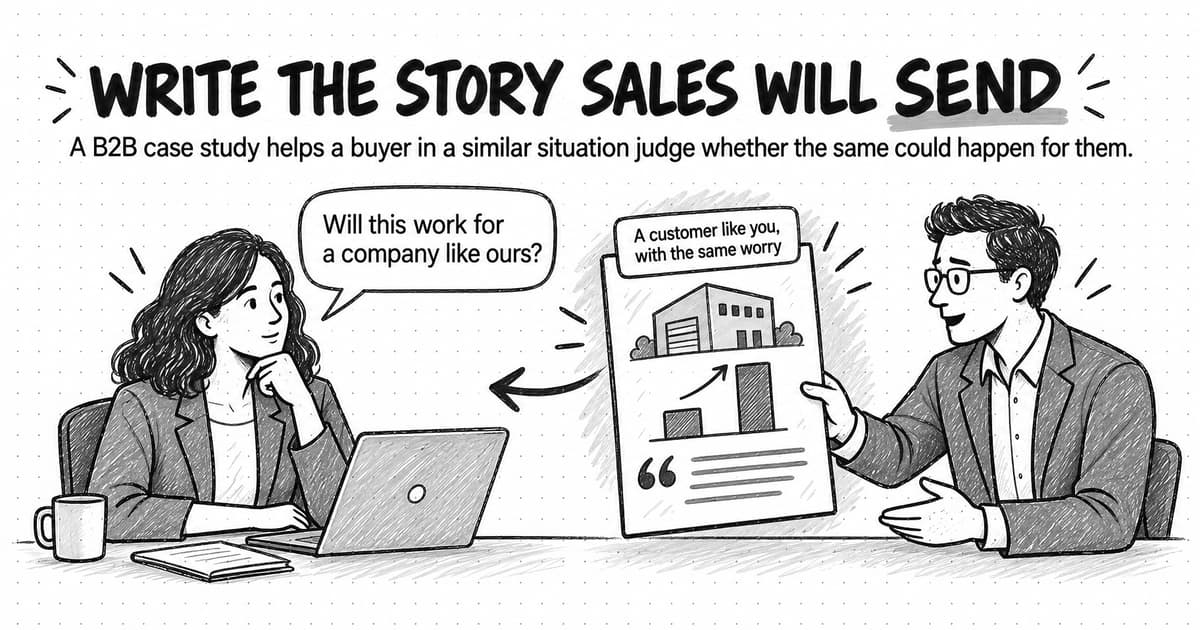
Many case studies end up like this. They exist, and nobody sends them, because they were written to celebrate a customer rather than to answer the question a buyer is stuck on. A B2B case study is a customer-approved account of how one business chose and used a product or service to change a specific part of its work, with evidence of the change, written so a buyer in a similar situation can judge whether the same could happen for them. The last part of that definition decides whether sales uses it. The distributor's buyers don't need proof that the vendor has satisfied customers. They need to see a company like theirs, with the same worry, getting its drivers to use the software, told in enough detail to believe.
This guide works backward from that moment. It starts with the deals sales is trying to win and the questions those deals stall on, then covers choosing the customer whose story answers them, asking for a yes, and agreeing an approval process before anyone is interviewed. It then gives an interview question bank, a six-part story arc (before, trigger, choice, rollout, results, proof), a method for writing results without inflating them, the formats sellers send, a copyable template, and a fictional worked example that follows one case study from a stalled deal to finished assets.
What sales needs from a B2B case study
Sellers send a case study when it helps a particular buyer take the next step in a particular deal. Most of the time that step is a judgment about fit: will this work for a company like ours, with our setup and our people? A Gartner survey of 632 B2B buyers, conducted in August and September 2024 and published in June 2025, found that 61% preferred an overall rep-free buying experience, but that for tasks needing context, such as deciding whether a product fits their company's needs, buyers preferred a seller's input. The survey didn't ask about case studies. Our reading is that a good one serves both preferences: a buyer can read it alone, and a seller can send it at the moment the fit question comes up.
Marketers rate the format highly. In the Content Marketing Institute's 2025 B2B benchmarks report, based on 980 B2B marketers surveyed between June and August 2024, mostly in North America, 75% had used case studies or customer stories in the previous 12 months, and 53% rated them among the most effective content types, second only to videos at 58%. The previous year's survey had ranked them first. These are marketers judging their own content, not measurements of what buyers did.
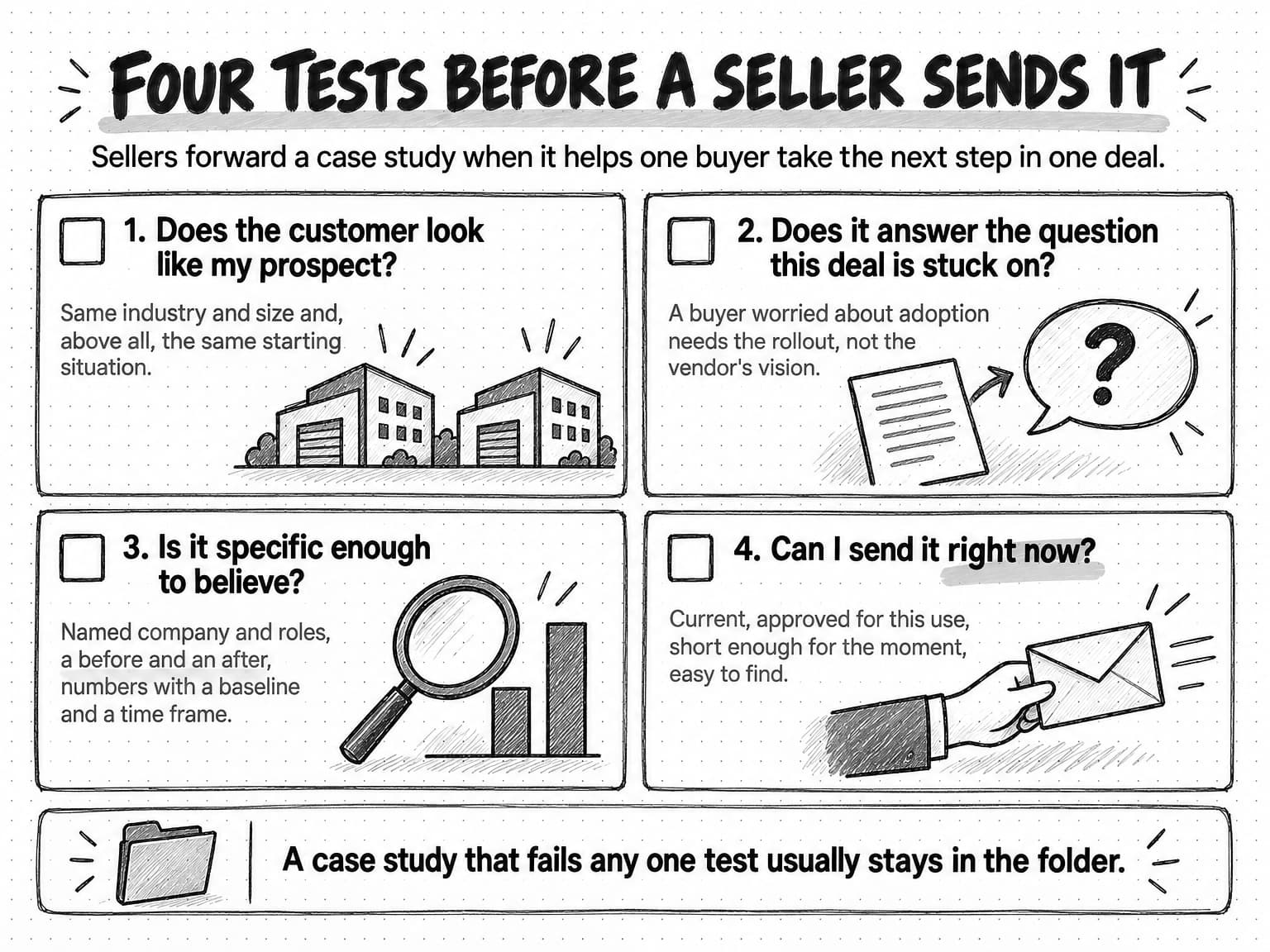
Before a seller forwards a case study, they run four quick tests, usually without naming them:
- Does the customer look like my prospect? Industry, size, region, and above all the situation. A company replacing spreadsheets has a different story from one replacing a competitor.
- Does it answer the question this deal is stuck on? A buyer worried about adoption needs the rollout, not a paragraph about the vendor's vision.
- Is it specific enough to believe? A named company, named roles, a before and an after, and numbers with a baseline and a time frame.
- Can I send it right now? It is current, approved for the use the seller has in mind, short enough for the moment, and easy to find.
The rest of this guide is a way to pass those tests on purpose. In a buying group, each evaluator may need a different part of the answer, as our guide to the B2B buyer journey explains, so the formats section shows how one interview can serve several of them.
View the four tests at full size (opens in a new tab).
Case study, testimonial, reference, and customer story
Teams use these terms loosely, but each asks something different of the customer and does a different job in a deal.
| Asset | What it is | What it asks of the customer | Where sales uses it |
|---|---|---|---|
| Testimonial | A short, attributed statement of opinion, one to three sentences | Approval of one quote, with name and title | Web pages, proposals, slides |
| Case study | A structured account of one customer's situation, choice, rollout, and results, with evidence | An interview, a draft review, and approval of quotes, numbers, and naming | Follow-ups, evaluations, proposals, the website |
| Customer story | Often a synonym for case study; some teams mean a more narrative or video version | The same, plus filming for video | Website, social posts, events |
| Reference | A live conversation between a prospect and a current customer | Time on a call, usually late in a deal | Final evaluation |
A testimonial tells a buyer that someone was pleased. A case study shows why, in enough detail for the buyer to compare the situation with their own.
Start with the deals sales is trying to win
It is tempting to start a case-study program with a list of happy customers. Start instead with a list of deals: which buying situations keep stalling, and what proof would move them?
Spend an hour with three to five sellers and a customer success manager, and ask four questions. Which kinds of prospect do you most want more of next quarter? Where do those deals stall, and what does the buyer say when they do? When you won one, what convinced the buyer? Which case study have you actually sent in the last month, and why that one? Listen for objections in the buyer's own words: "our team won't change how they work," "we tried a tool like this and it took a year," "finance won't sign off without a number." Those sentences are the brief for your next case study.
Put what you hear into a proof-gap table. The rows below are illustrative, for a fictional company that sells scheduling software to distribution businesses.
| Prospect situation | Where deals stall | Proof we have | Gap |
|---|---|---|---|
| Multi-site food distributor, 200 to 500 staff | "Will drivers and dock staff actually use it?" | A single-site story from a parts supplier | A multi-site rollout with adoption detail |
| Company replacing spreadsheets and phone calls | "How long until it pays back?" | A quote calling the tool "a game changer" | A measured before and after with a time frame |
| Company replacing a competitor | "What does switching involve?" | Nothing published | A switching story, even an anonymized one |
The gap column tells you which customer to look for and what the story must contain. The first row needs a customer for whom adoption was a real risk and who can describe how they handled it. A well-written story about a single-site customer with no adoption problems wouldn't move those deals, however happy that customer is. Our B2B content marketing strategy guide makes the same point at the level of a whole content plan: when buyers stall in evaluation, a proof-rich customer story can do more than another broad explainer.
How to choose the right customer for a case study
The best customer for a case study is rarely the biggest logo or the friendliest contact. It is the one whose situation matches the prospects in your gap row, who has a clear before and after, and who can approve a specific story. Judge candidates on these criteria, roughly in order:
- Fit with the prospects you want. Similar industry, size, setup, and starting problem. Our guide to ideal customer profiles and buyer personas explains why buyers find a case study more credible when the company in it resembles theirs. A mid-sized customer that matches the profile will usually help more deals than a famous one that doesn't.
- A clear before. Someone can describe how the work used to happen and what it cost. If nobody remembers the old process, the story has no starting point.
- A change you can show. Measured, with a baseline and a period, or at least observable: a step that moved from days to hours, a task nobody does by hand anymore.
- A storyteller. A champion who chose and rolled out the product and will speak plainly, ideally with a second voice, such as a daily user or an executive sponsor.
- A realistic approval path. Some companies, especially large or regulated ones, don't let vendors name them. Ask the account team early whether the customer has a publicity policy.
- Good timing and a healthy account. Usually three to twelve months after rollout, when results exist and people still remember the before. Avoid accounts in a renewal dispute, an escalation, or a reorganization.
Customer success usually knows the candidates first, from business reviews where results came up, renewals, and thank-you messages. Sellers know who already takes reference calls. A short list of five or six is enough, because you'll lose some to approval, timing, or a champion who changes jobs.
How to ask a customer for a case study and get a yes
"Would you be open to a case study?" sounds like an unknown amount of work and an unknown amount of exposure. A request that says exactly what you'll ask for, how long it will take, what the customer will approve, and what's in it for them is far easier to agree to.
Who asks and when. The person with the relationship, usually the customer success manager or account executive, makes the first approach, and marketing follows with the details. Ask right after a moment of success, such as a go-live, a business review where the customer saw their results, or a renewal, while the story is fresh and the goodwill is real.
What to ask for. A 45-minute recorded interview with one or two people, one review of the draft, approval of every quote, number, and use of their name and logo, and a list of the formats you plan to make. Give the whole timeline, for example four to six weeks.
What's in it for them. The champion gets public credit for a project they led. The company gets its story told well, sometimes with a link to its site. You can also offer a speaking slot at your event, a co-written post the champion shares on their own profile, or early access to a feature.
Incentives need care. In the US, the Federal Trade Commission's Guides Concerning the Use of Endorsements and Testimonials in Advertising say that a connection between an endorser and the seller that the audience wouldn't expect, and that could affect how much weight they give the endorsement, must be disclosed clearly and conspicuously; payments, free or discounted products and other benefits are among the examples. The FTC's FAQ on the Endorsement Guides adds that a business can't make an incentive, such as a discount, conditional on a review being positive. If a customer receives a discount or another benefit for taking part, decide with your legal team how to disclose it, and never tie the benefit to what they say. This guide isn't legal advice; rules differ by country.
A publicity clause in the contract is permission to ask, not approval of a specific story. A customer who finds their logo and a number they never approved on your website is unlikely to agree to anything else.
Here is a request the account owner can adapt:
Subject: Would you share how [Customer] handled [the problem]?
Hi [Name], the way your team [specific result] keeps coming up when we talk to other [industry] companies with the same problem. Would you be willing to tell that story in a short case study? It would take one 45-minute call with you and, if possible, [second person], then one review of the draft. Nothing is published until you, and anyone else at [Customer] who needs to see it, have approved every quote, number, and use of your name and logo. We'd like to make a web page, a one-page summary, and a few quotes for presentations. If that works, I'll introduce you to [marketer], who runs the process.
An approval process customers will agree to
Case studies often stall in approval. The draft sits with the customer's communications team for six weeks, comes back with every number removed, or never comes back because the champion's manager was never asked. You can prevent most of this by agreeing the scope and the approvers before the interview.
Start with a short scope agreement, usually an email the champion confirms. It says what will be published and where, whether the customer will be named and their logo used, which kinds of numbers you hope to include, who on their side approves, how many review rounds there will be, and how long each should take. It also says the customer can withdraw before publication and ask you to take the story down later.
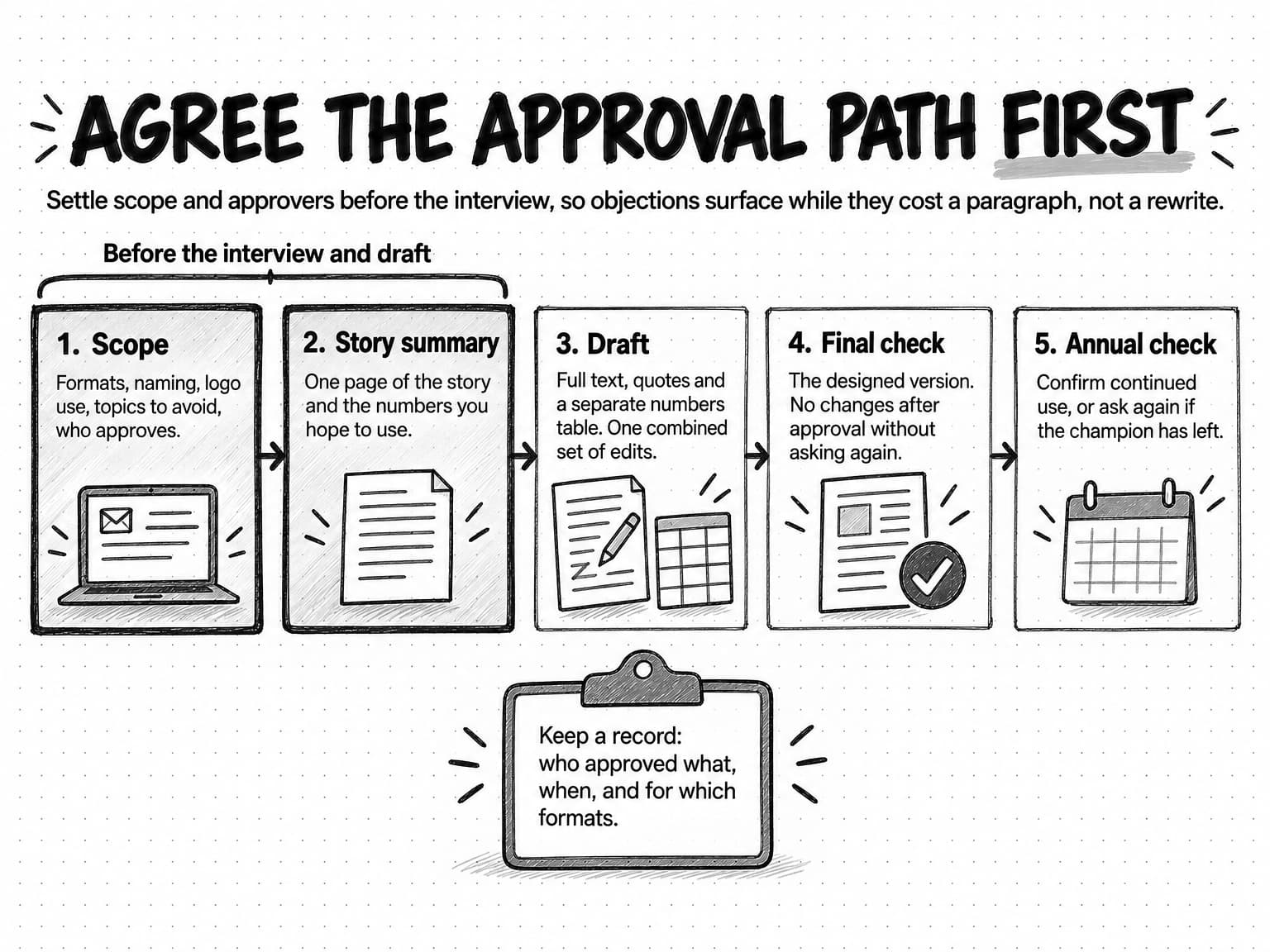
Then follow a sequence like this one. The timings are for you and the customer to agree, not standards.
| Stage | What the customer approves | Who on their side | Common cause of delay |
|---|---|---|---|
| Scope | Formats, naming, logo use, topics to avoid, approvers | Champion, sometimes their manager | Nobody asked whether the company allows vendor publicity |
| Story summary | A one-page outline of the story and the numbers you hope to use | Champion | Learning late that a number or a partner's name can't be published |
| Draft | Full text, quotes, and a separate numbers table | Champion, then communications or PR, sometimes legal | Several reviewers editing separate copies |
| Final check | The designed version and any changes since the draft | Champion | Edits made after approval without asking |
| Video release | Use of each person's image and voice | Each person filmed | Release forms sent after filming |
| Annual check | Continued use | Champion or their successor | The champion has left |
Four habits make this work. Send the one-page story summary before writing the draft, because that is where you learn the customer can't name the competitor they replaced or share labor costs, at the cost of a paragraph rather than a rewrite. Put the numbers in their own table, each with its source and period, so a reviewer approves each one explicitly. Ask the champion to gather colleagues' comments into one set of edits, and offer a short call with their communications team. And never change approved wording without asking again, including a quote cut down for a slide.
View the approval path at full size (opens in a new tab).
Keep a record of who approved what, when, and for which formats. It answers the seller who asks whether a quote can go in a proposal, and it tells you when a story needs re-approval.
Case study interview questions that get specifics
Prepare before the call
Read what your company already knows about the account before the call, so the interview confirms and deepens it instead of starting from nothing. The deal record shows why they bought, which alternatives they considered, and which objections the seller handled. Onboarding notes and support history show what was hard. Business review slides may already hold the results. Anything you plan to publish from your own data still needs the customer's approval.
Interview two people if you can. The champion explains the decision and the rollout. A daily user describes what changed in the work itself, which is often where the most convincing details are. Ask permission to record, and take every quote from the transcript.
Send the topics a few days ahead, with the number questions written out in full, so the customer can look the figures up rather than guess on the call. Most people can answer "What was your average wait time before, and how did you measure it?" accurately with a day's notice and inaccurately on the spot.
The general skills of a customer interview apply: ask about real events rather than opinions, keep your theory out of the wording, and keep each excerpt tied to who said it and in what context. Our guide to voice-of-customer research covers that technique. A case-study interview is narrower, because you already know roughly what happened and are collecting the details, numbers, and sentences that will let a stranger believe it.
Questions for each part of the story
The questions below follow the six-part arc explained in the next section. Pick the ones your proof gap needs, ask them in roughly this order, and follow each answer with a request for an example, a number, or a person: "Can you walk me through the last time that happened?", "What did that cost you?", "How do you know?"
Before: the situation and its cost
- Walk me through how [the process] worked before, step by step, on a normal day.
- What went wrong most often? Tell me about a recent time it went badly.
- What did that cost in time, money, customers, or staff? How did you know?
Trigger: why now
- What happened that made this a priority instead of something you lived with?
- What would have happened if you had done nothing for another year?
- Who decided it had to be fixed?
Choice: the alternatives and the doubts
- What else did you consider, including doing nothing, hiring, or building something yourselves?
- What did the solution have to do? Which of those mattered most?
- What almost stopped you from choosing us? What did you have to convince your manager, finance, or IT of?
Rollout: what it took
- How long from signing to the first real use? What took longest?
- Who had to change how they worked, and how did they react?
- What was harder than you expected, and what would you do differently?
Results: what changed and how you know
- What is different now? Describe a week compared with before.
- Which numbers changed? What were they before, what are they now, and over what period? Who tracks them?
- What else changed in the same period, such as new staff, new sites, or a busy season?
- What hasn't improved?
Proof: what we can show
- Which numbers can we publish? Would a percentage or a range work if the exact figure can't?
- Is there a report or dashboard we could cite or show, with your approval?
- Would you speak to a prospect considering the same change?
- If a peer at another company asked whether to do this, what would you tell them?
Two questions do more work than they appear to. "What almost stopped you from choosing us?" produces the material that helps close deals, because the customer describes the next buyer's worry, and how it was resolved, in their own words. "What else changed in the same period?" keeps you from publishing a result the customer's own team knows had another cause.
When sales tells you the exact objection a deal is stuck on, ask about it directly and early: "Many companies we talk to worry that [objection]. Did you, and what happened?" Then ask for the moment the worry went away. That moment, told by a customer the prospect sees as a peer, is often the most persuasive paragraph in the case study.
The B2B case study story arc: before, trigger, choice, rollout, results, proof
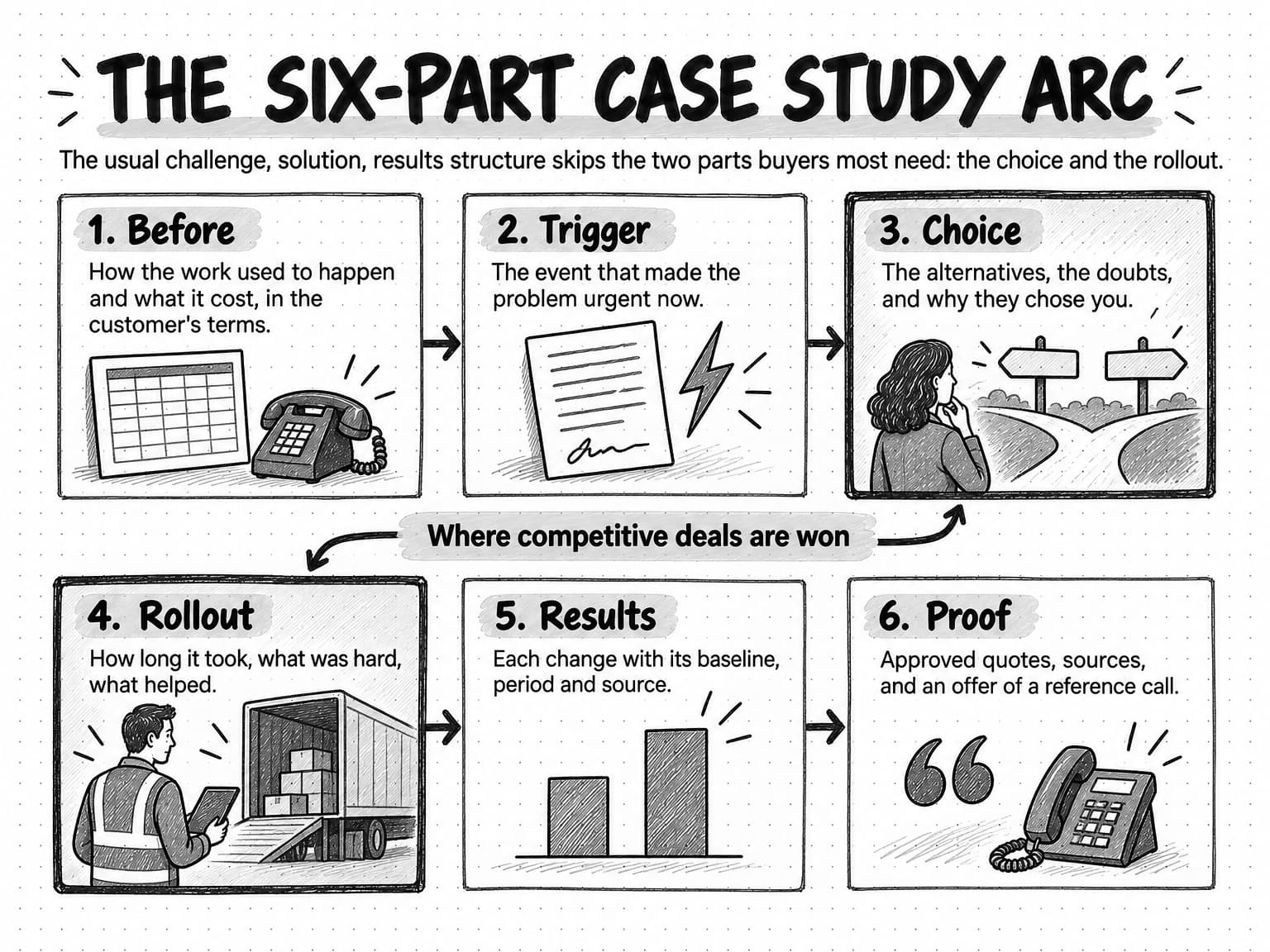
The familiar structure is challenge, solution, results. It skips the two parts a B2B buyer most needs: why the customer chose this option over the alternatives, and what it took to make it work. A six-part arc fills those gaps.
1. Before. The customer's situation in their terms: who they are, how the work used to happen, and what it cost. Use details a buyer can compare with their own, such as four warehouses, 120 trucks a day, and appointments booked by phone into a spreadsheet, and name the cost in the customer's units, not your product's features.
2. Trigger. What made the problem urgent now. Often it is an event: a new contract, a lost customer, an audit, a new leader, growth that broke the old process. Buyers recognize their own moment in it. A prospect who has just signed a large contract reads "after a supermarket contract that would double inbound deliveries" and thinks: that's us.
3. Choice. The alternatives considered, what the customer needed, and the doubts they resolved before choosing you. Many case studies skip it, yet it does the most work in a competitive evaluation. If the customer considered hiring or building their own tool, say so and say why they didn't. Don't name or criticize competitors unless the customer and your legal team are comfortable with it.
4. Rollout. How long it took, who was involved, what was hard, and what helped. Honest difficulty makes the story more credible. A buyer worried about adoption believes "two of our longest-serving dock leads refused to use it for the first month" far more than "the rollout was seamless," especially when the next sentence explains what changed their minds.
5. Results. What changed, with baselines, time frames, and an honest account of what else contributed. The next section covers this in detail.
6. Proof. The evidence a buyer can check or act on: approved quotes, the source of each number, a report the customer allowed you to show, an offer of a reference call, and what the customer would tell a peer.
Not every format gives the six parts equal weight. A one-pager might give the before and trigger a sentence each and spend most of its space on results, while a long-form story written for a stalled evaluation might spend most of its words on the choice and rollout. The arc lists what the story must account for; the proof gap decides where the words go.
View the six-part case study arc at full size (opens in a new tab).
A case study sales will send answers the question the next buyer is stuck on, in the words of a customer that buyer sees as a peer.
How to write case study results without inflating them
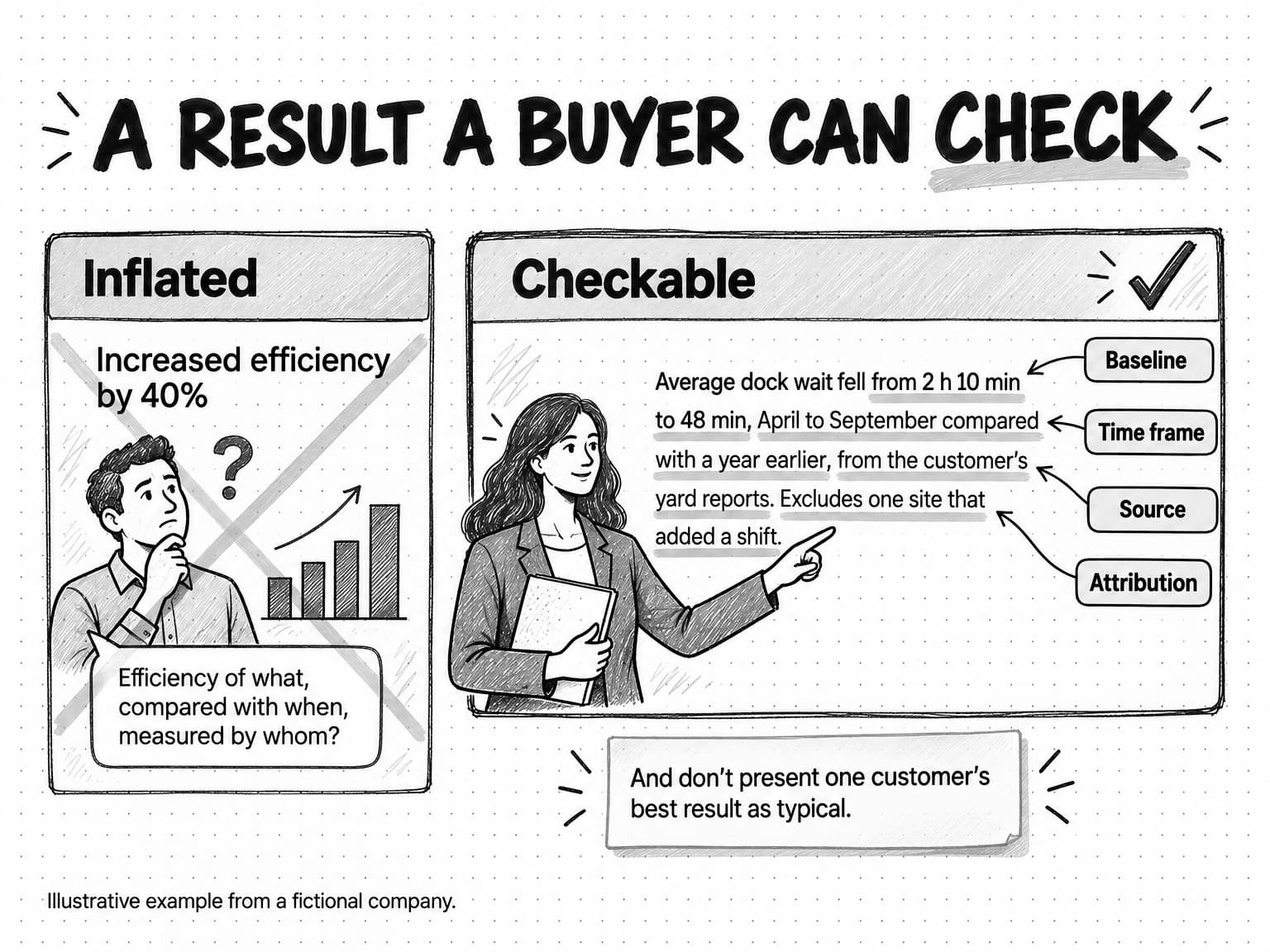
A buyer who has been burned before reads "cut costs by 60%" and asks: 60% of what, compared with when, measured by whom, and how much of it was the product? If the case study doesn't say, the number reads as marketing, and a finance reviewer in the buying group may discount the whole story. Five rules keep results honest and believable.
State the baseline. "Average dock wait fell from 2 hours 10 minutes to 48 minutes" can be checked and compared. "Wait times fell 63%" invites "from what?", and a percentage of a small number can sound larger than it is.
State the time frame. Say when the before and the after were measured and over how long. "April to September, compared with the same months a year earlier" also handles seasonality.
Say how it was measured and by whom. "From the customer's yard reports" tells the reader the number came from somewhere real. If it came from your product's data, say so.
Be honest about attribution. Businesses change several things at once. If the customer also hired staff or opened a site in the same period, say so, and either exclude what you can or describe the result as something the product contributed to. A sentence such as "the figure excludes the Fairview site, which added a second shift that quarter" makes every other number more believable.
Don't present the best result as the usual one. The FTC's Endorsement Guides, at 16 CFR 255.2, say an ad featuring a customer's experience with a key attribute of a product is likely to be read as showing what people generally achieve, so the advertiser should have support for that or clearly disclose the results people can generally expect. The Guides discuss consumer endorsements; for B2B stories, the practical lesson is the same: don't imply that one customer's result is typical without evidence, and say what drove an unusually good result.
View the checkable result example at full size (opens in a new tab).
The table shows common inflated phrasings and honest rewrites. The numbers are illustrative.
| Inflated | Why a buyer doubts it | Honest version |
|---|---|---|
| "Increased efficiency by 40%" | Efficiency of what, measured how? | "Cut the time to book a delivery from about 11 minutes of phone calls to under 2 minutes, based on the customer's call logs for March and September" |
| "Saved $500,000 a year" | Usually an estimate built on hidden assumptions | "Reduced carrier waiting charges by about a third over six months; the customer estimates the annual saving at $180,000 to $220,000" |
| "Up to 10x faster" | "Up to" describes the best case | "At the busiest site, on-time unloading rose from 58% to 90%; the other sites improved less, from about 70% to 85%" |
| "Seamless rollout" | Most rollouts have some friction | "Live at all four sites in nine weeks; the first took five weeks because of a dispute over who owned the schedule" |
Check the arithmetic too: keep units the same before and after, round consistently, don't add savings that overlap, and if you convert hours into money, say what hourly cost you used and that the result is an estimate.
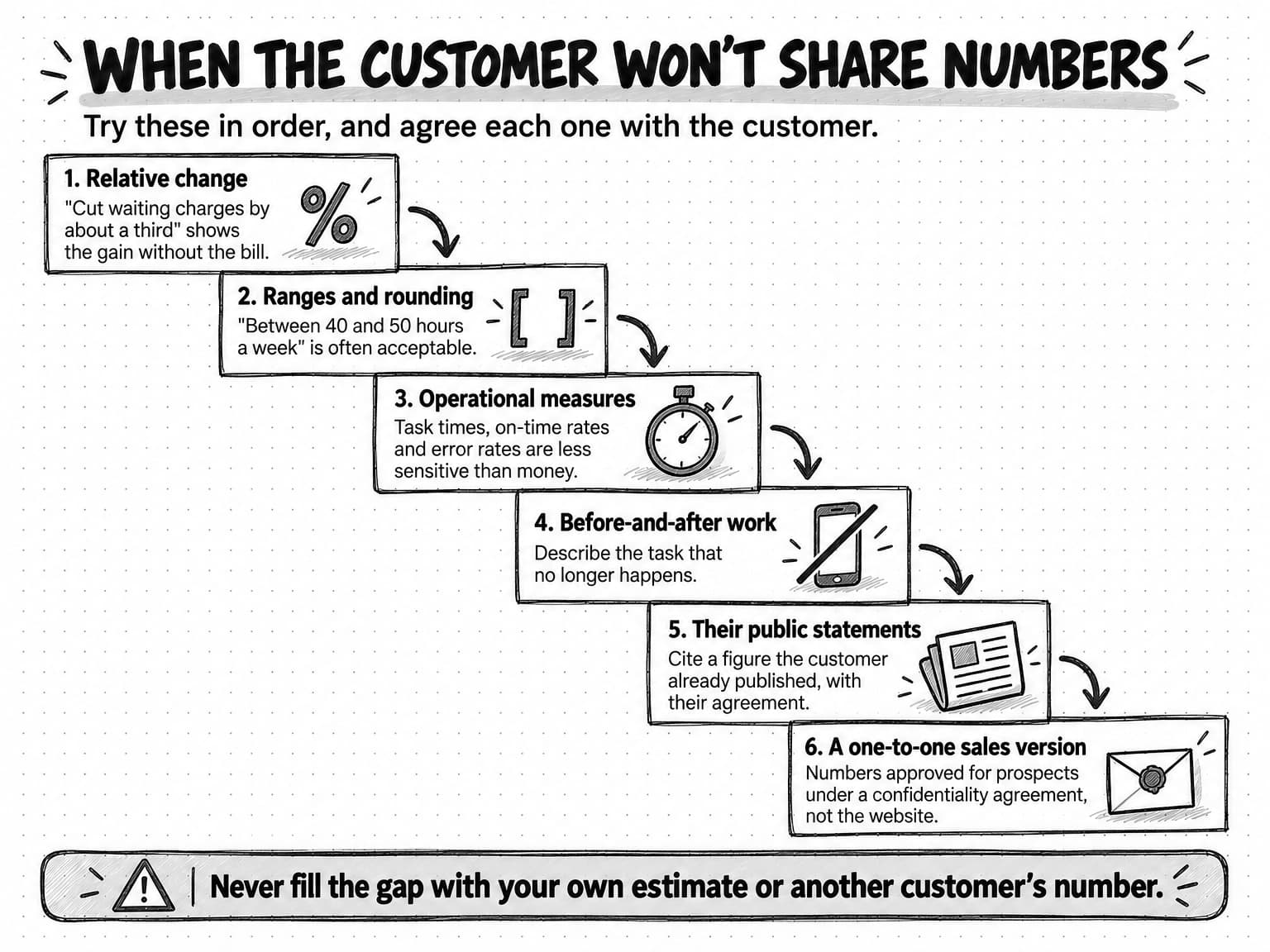
What to do when the customer won't share numbers
Many customers won't let you publish revenue, costs, or volumes, and some won't share any figures. Plan around it rather than dropping the story. Try these options in order, agreeing each with the customer:
- Relative change instead of absolute values. "Cut carrier waiting charges by about a third" shows the improvement without the bill.
- Ranges and rounded figures. "Between 40 and 50 hours a week" is often acceptable where an exact figure isn't.
- Operational measures instead of financial ones. Task times, on-time rates, error rates, and steps removed are usually less sensitive than money, and they convince the people who will use the product.
- Before-and-after descriptions of the work. "The planner no longer spends Monday morning rebuilding the week's schedule by phone" is a result a buyer can picture.
- The customer's own public statements. A figure the customer has already published, such as in an executive's post, can be cited with their agreement.
- A version for one-to-one sales use. Some customers approve specific numbers for prospects under a confidentiality agreement but not for the website. Label that version and record who may receive it.
If none of these works, publish without numbers and make the qualitative evidence specific: named roles, concrete before-and-after detail, quotes about what changed. Never fill the gap with an estimate the customer didn't make, another customer's number, or a figure a reader could mistake for a measurement.
View the options for missing numbers at full size (opens in a new tab).
How to write the case study draft
With the transcript, the story summary, and the approved scope in hand, the draft goes quickly. A few choices separate a story people read from one they skim past.
Write the headline as a result for a recognizable company. "How a four-warehouse food distributor cut dock wait times by almost two-thirds" tells a prospect at once whether the story is about a company like theirs.
Open with a summary box. Busy readers read the top and stop. A short block with the customer, industry, size, problem, solution, and two or three headline results lets them decide whether to read on, and gives sellers something to quote.
Make the customer the subject of the sentences. "The planners stopped rebuilding the schedule by phone" is about the customer. "The intelligent scheduling engine eliminated manual work" is about the vendor. Describe the product only as far as the reader needs to understand what changed.
Use quotes for judgment and prose for facts. A customer's words convince most when they say what the change meant, what they worried about, or what they'd tell a peer. Put figures in your own sentences, with source and period. Edit quotes only for length and clarity, and get each approved as it will appear. Never write a quote the customer didn't say, even one you think they'd agree with: the FTC's Endorsement Guides, at 16 CFR 255.1, say an endorsement must reflect the endorser's honest opinions or experience and may not be presented out of context or reworded in a way that distorts it.
Write for every role in the buying group. An operations lead, a finance reviewer, and someone from IT may all read the long-form version. A few sentences on cost, setup, and the daily work serve all three; our guide to writing a value proposition explains why one capability matters differently to each.
Make it as long as the job needs. About 800 to 1,500 words covers the six parts for most web case studies, and a one-pager has room for about 250 to 400. These are working ranges, not research findings.
Before the draft goes for approval, check it against the transcript: every quote matches what was said, every number matches its source, and the prose claims no more than the customer did. If an AI tool helped draft it, this check matters more, because a model can produce a fluent quote or figure that nobody gave. In the US, the FTC's 2024 rule on fake reviews and testimonials covers reviews and testimonials that misrepresent that they are by someone who doesn't exist, including AI-generated ones. Our guide to preventing AI hallucinations in marketing shows how to trace each claim to its source.
Case study formats and how sales uses each one
One interview can produce several assets, each sized for a moment in a deal. List the formats in the scope agreement so the customer approves them together instead of being asked again every time sales wants a new version.
| Format | Typical size | When in the deal | How sales uses it |
|---|---|---|---|
| Quote bank | 10 to 30 approved quotes, tagged by topic, role, and objection | Any time | Drops the right quote into an email, proposal, or slide |
| Quote or result card | One quote or one result, with name, title, and company | Early, and in proposals | A slide, a web section, a social post |
| One-pager | One page: summary, before, results, one or two quotes | After a first call | Sent as a follow-up and forwarded by the champion to colleagues |
| Long-form web case study | About 800 to 1,500 words, the full arc | Evaluation, and buyers researching alone | Linked in follow-ups; found through search and AI answers |
| Video | 60 to 120 seconds for a highlight, 3 to 5 minutes for the story | Early interest and late reassurance | Shared before meetings, played in presentations, clipped for social |
| Slide | One slide: situation, result, quote, logo | Discovery and proposal meetings | Added to the deck for the prospect's industry or objection |
| Reference call | A 20- to 30-minute conversation | Late evaluation | Offered close to a decision, sparingly |
The quote bank is the easiest format to overlook. It is a spreadsheet of every approved quote, with columns for the customer, the speaker's role, the topic, the objection it answers, the formats it is approved for, and the approval date. A seller facing "will people use it?" can find three relevant quotes in a minute instead of hunting through PDFs.
The one-pager does most of the forwarding. Buyers pass it around inside their company without the seller present, so it must stand alone. Write it last, from the approved long-form text, so it can't contain anything the customer didn't approve.
Video shows most clearly that a real person stands behind the story, and costs the most to make and approve. A recorded video call with good audio, edited to a few minutes, is often enough. Get a signed release from everyone on camera before filming.
When you adapt the story for other channels, check that each version keeps what the long-form version established and stays within what the customer approved. Our guide to repurposing content across channels explains how to keep the point intact when the format changes, and notes that a customer story may come with limited reuse rights.
How sales teams use case studies in a deal
A case study helps a deal only if the seller can find the right one and knows how to use it, so the library and the send note matter as much as the writing.
Build a library sellers can search. Keep every case study and its formats where sellers already work, tagged by industry, company size, region, problem, product, objection, roles quoted, approval scope, and re-check date. A seller looking for "multi-site distributor, adoption worry" should find it in one search.
Send it with a note. The note connects the story to the buyer and tells them where to look: "You mentioned your dock leads have ignored new tools before. This distributor had the same problem; the second section explains how they won over their longest-serving leads in the first month." A buyer who knows why they are reading something reads it.
Equip the champion. The person you talk to usually has to convince others when you aren't in the room. Give them the one-pager and the quotes that answer their colleagues' questions about cost and setup.
Ration reference calls. Each call costs the customer time. Track who has taken one recently, offer references late, and thank the customer every time.
Find out what gets used. Ask sellers each quarter which case studies they sent, which they skipped, and what they wished they had. Where your tools allow it, track which assets were shared in which deals, and treat the result as directional. Retire stories that have gone stale.
Case studies also travel beyond sales. A post written with the champion and shared from their own profile reaches peers a company page won't; our guide to LinkedIn content strategy for B2B covers where proof posts fit and the boundaries for sharing customer details. And because an AI-generated answer can summarize a page for a buyer who never visits it, put each story's key facts (the customer, the problem, the measured result, the period) in plain text on the page, where search engines and AI answers can find and cite them. Our guide to reaching buyers who never click covers that kind of distribution.
Copyable B2B case study template
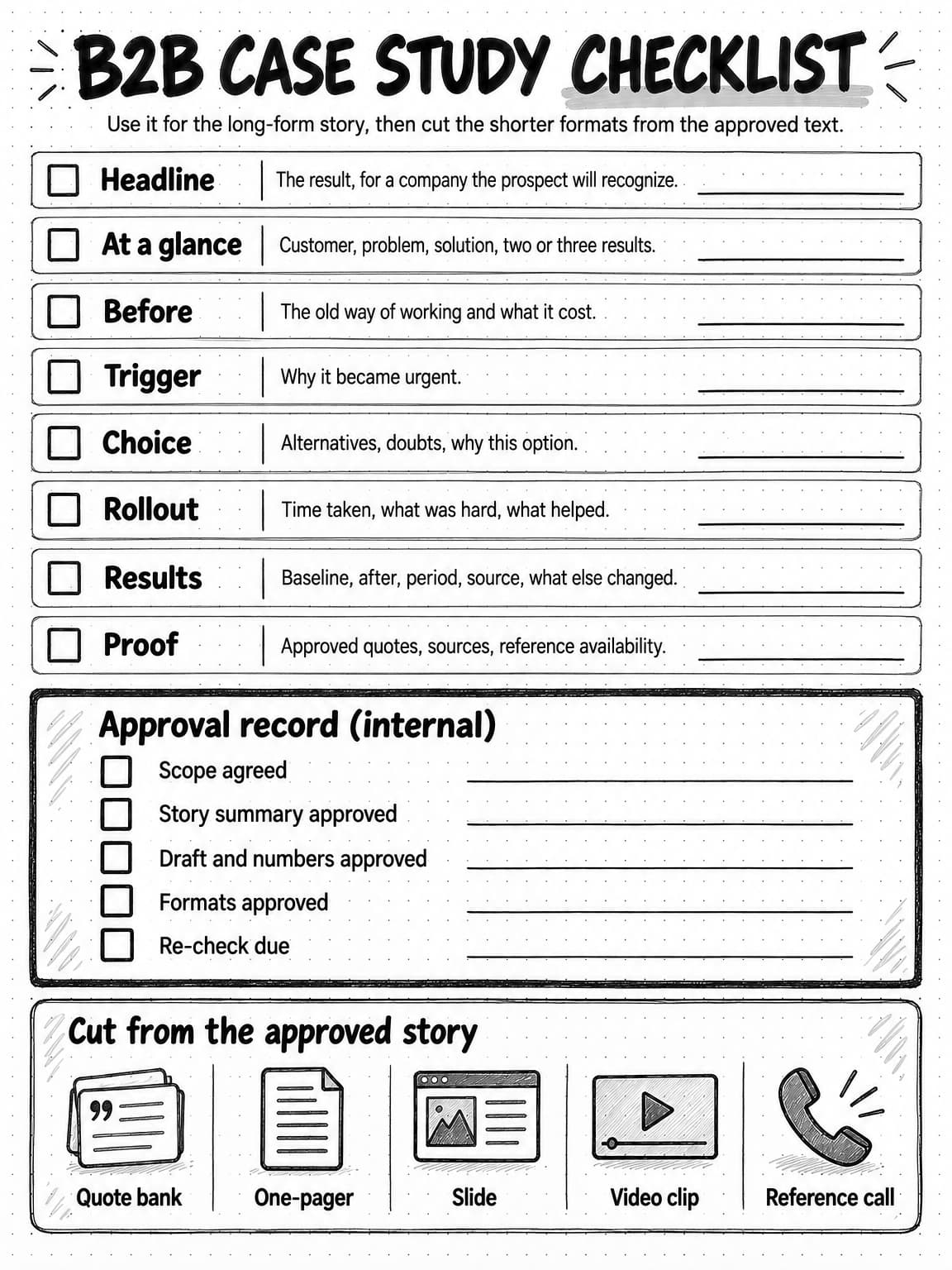
Use this template for the long-form version, then cut the shorter formats from the approved text. Square brackets mark what to fill in; the notes in parentheses say what each part must do.
# [Result] for a [recognizable description of the customer]
(Shape: How a [size] [industry] company [measured change] in [period])

## At a glance
- Customer: [name], [industry], [size], [region]
- Problem: [one sentence in the customer's terms]
- Solution: [what they used, in one sentence]
- Results: [two or three, each with baseline, period, and source]

## Before
[How the work used to happen, who was involved, what went wrong,
and what it cost in the customer's units.]

## Trigger
[The event that made it urgent, and who decided to act.]

## Choice
[Alternatives considered, including doing nothing. What the customer
needed. The doubts they resolved. Why they chose this option.]

## Rollout
[How long it took, who was involved, what was hard, what helped,
what they would do differently.]

## Results
[Each change with its baseline, period, and source. What else changed
in the same period. What hasn't improved.]

| Measure | Before | After | Period | Source |
| --- | --- | --- | --- | --- |
| [measure] | [value] | [value] | [dates] | [report or system] |

## Proof
[One or two approved quotes about what the change meant. What the
customer would tell a peer. Approved reports. Reference availability.]

## About [customer]
[Two sentences, approved by the customer.]

---
Approval record (internal, not published):
- Scope agreed: [date, name, role]
- Story summary approved: [date]
- Draft and numbers approved: [date, names, roles]
- Formats approved: [list]
- Re-check due: [date]
Keep the transcript, the proof-gap row the story was made for, and the numbers table with each figure's source alongside it. The approval record isn't published, but no format should be used without it.
View the B2B case study checklist at full size (opens in a new tab).
Worked example: one fictional case study from stalled deal to finished assets
This example is fictional. Berthline and Calloway & Pike are invented companies, the people are invented, and every number and quote is illustrative, chosen to show the method. None of it describes a real customer.
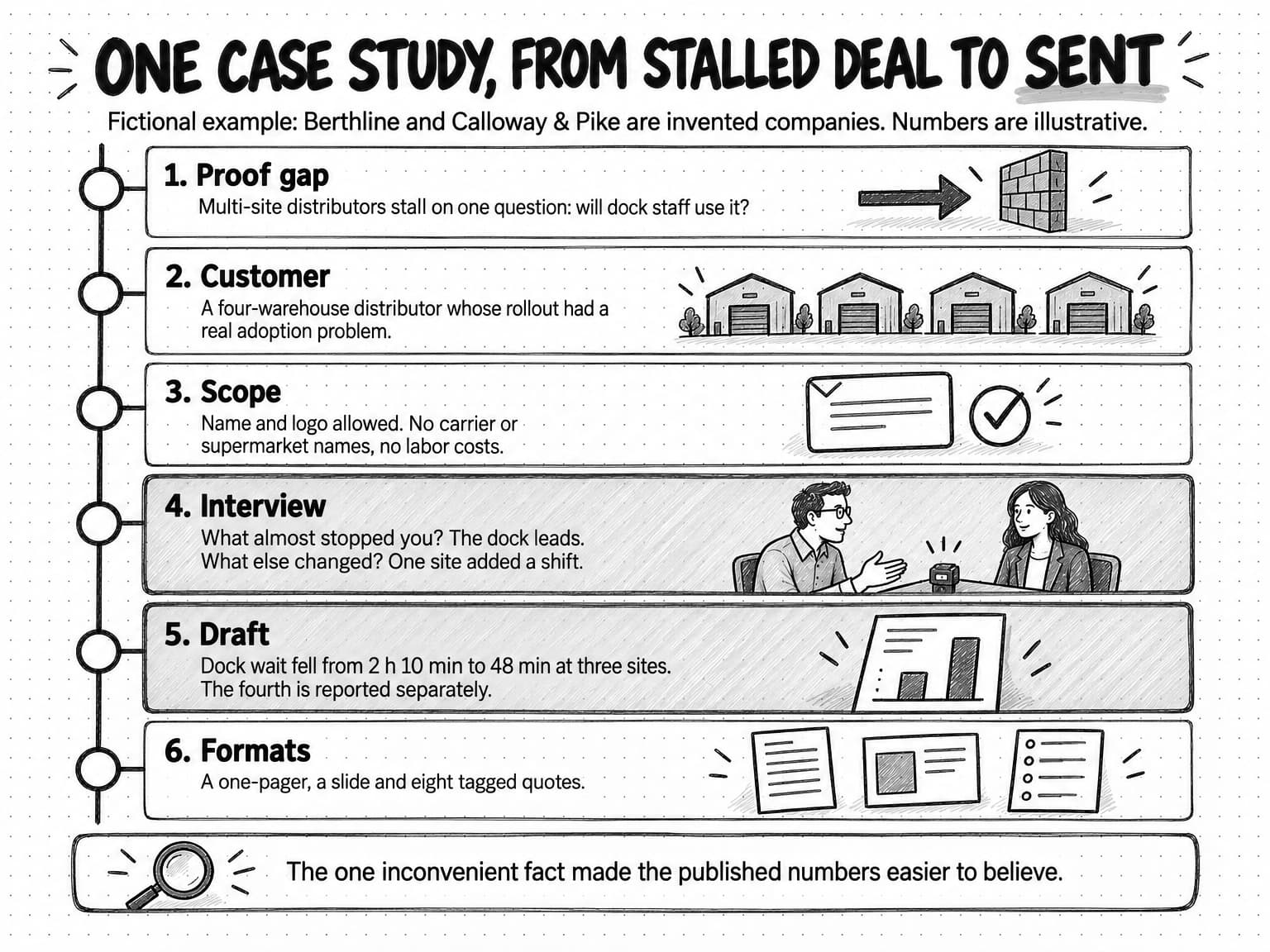
The proof gap. Berthline sells dock-appointment scheduling software to distribution companies. Its deals with multi-site food distributors keep stalling at the same point: the operations director likes the product, then asks whether drivers and dock staff will use it. Berthline's only case study is about a single-site parts supplier with no adoption problems, so the marketing lead adds the first row of the proof-gap table shown earlier.
The customer. Customer success suggests three candidates. Calloway & Pike, a regional food distributor with four warehouses and about 340 staff, fits best: its rollout had a real adoption problem that the operations manager, Priya Nair, solved, and its six-month business review showed measured results. The account manager confirms the company allows vendor case studies if its communications team approves.
The ask and the scope. The account manager asks Priya the week after the business review. Priya agrees and names two approvers, her director and the communications manager. The scope email lists a web case study, a one-pager, a slide, and quote-bank entries; allows the name and logo; rules out carrier and supermarket names and labor costs; and allows dock wait times and on-time unloading rates. Each review gets ten working days.
The interview. Marketing reads the deal notes, which show Calloway & Pike also considered hiring a second scheduling coordinator, and sends the number questions three days ahead. The 45-minute interview is with Priya and a dock lead, Tom Adeyemi. Asked what almost stopped them, Priya says the director's main doubt was the dock leads, who had ignored the last two systems. Tom says he refused to use the new one for three weeks, until the schedule started showing which trucks were actually on their way. Asked what else changed in the same period, Priya mentions that the Fairview warehouse added a second shift that quarter.
The story summary. The summary flags the Fairview shift, and Priya and marketing agree to report results for the other three sites and mention Fairview separately. Communications removes the supermarket's name; the story says "a new supermarket contract."
| Before | About 120 trucks a day across four warehouses, booked by phone into a shared spreadsheet; drivers often waited more than two hours to unload |
|---|---|
| Trigger | A new supermarket contract that would double inbound deliveries within a year |
| Choice | Considered hiring a second coordinator or extending the spreadsheet, and chose software because the problem would grow with every contract; the operations director doubted that dock leads would use it |
| Rollout | Live at all four sites in nine weeks; one dock lead refused it for three weeks, until the schedule showed which trucks were on their way |
| Results | At three sites, average dock wait fell from 2 h 10 min to 48 min and on-time unloading rose from 64% to 89%, comparing April to September with the same months a year earlier, from Calloway and Pike yard reports |
| Proof | Approved quotes from Priya and Tom, the source of each number, and Priya available for two reference calls a quarter |
The draft. The headline reads "How a four-warehouse food distributor cut dock wait times by almost two-thirds." One paragraph in the results section gives the baseline, period, source, and the Fairview exclusion. Tom's approved quote sits in the rollout section, where it answers the adoption objection directly: "I'd ignored two systems before this one. I started using it when it told me which trucks were actually coming, and now I'm the one who complains when it's down." Priya's sits in the proof section: "If you're worried your dock team won't use it, ask them what they'd want to know an hour earlier. That's what got ours on board."
The approval. Priya gathers her director's and the communications manager's comments into one set of edits. They remove a sentence about a carrier complaint and approve the rest. Marketing records the approvals and the formats, and sets a re-check date a year out.
The formats. From the approved text, marketing makes a one-pager, a slide with the headline result and Tom's quote for the distribution deck, and eight tagged quote-bank entries, three of which answer the adoption objection. Sellers get a short note with a suggested send message. The next time an operations director asks whether drivers will use the software, the seller sends the one-pager and points to the rollout section.
View the worked example at full size (opens in a new tab).
The lesson is in the order. A stalled deal pattern chose the customer, the objection steered the interview, the approval path was agreed before the draft, and the one inconvenient fact, the Fairview shift, made the published numbers more believable.
Common B2B case study mistakes and how to fix them
- Written for the vendor, not the buyer. The story is about features and partnership. Make the customer the subject and spend the words on the situation, the choice, and the rollout.
- Results without baselines or periods. "Increased productivity by 35%" tells a careful reader nothing. Apply the five results rules.
- A customer chosen for their logo. A famous name in the wrong industry rarely helps the deals you need. Choose from the proof-gap table.
- Approval left until the end. Agree the scope before the interview and send a story summary before the draft.
- One long PDF and nothing else. Plan the quote bank, one-pager, and slide in the scope, so they are approved together.
- A rollout with no friction. Buyers who have lived through hard implementations tend to doubt a seamless one. Include the hard part and what resolved it.
- Invented or composite quotes. Take every quote from the transcript and get it approved as it will appear.
- Never updated. Set a re-check date in the approval record and review the library once a year.
How case studies work in Ampere
Ampere, the AI marketing agent, can do much of the drafting and adapting around a case study, while your team keeps the customer relationship, the interview, and every approval.
You can share the interview transcript, your notes, the story summary, and the approved scope with Ampere in a session, along with files such as a business review deck or an export of the numbers. If you have a recording instead of a transcript, Ampere's speech-to-text tools can produce one with speaker labels, which you should check against the recording before quoting anyone. From those materials, Ampere can draft the long-form case study in the six-part arc, a one-pager, a slide or short presentation, and quote-bank entries, working in a session workspace where you can see the files it uses and creates. It also uses your saved Brand memory, such as your products and voice, so drafts start from what your team has already approved about the company.
Ampere can save a social proof report to Brand memory: the public proof it can find about your company, such as published customer stories, review ratings, and press mentions, with caveats and the gaps it found. Public data is never complete, so treat the report as a starting list of what buyers can already see, not a full inventory.
Once a case study is approved, Ampere can turn it into LinkedIn text posts or a carousel for the company page or the champion's own profile, drafted from the approved text so the posts stay within what the customer signed off.
Ampere can't supply the customer, run the interview, or approve anything for them, and it doesn't publish. AI output can be inaccurate or incomplete, so check every quote against the transcript and every number against its source before the draft goes to the customer.
Sources and further reading
- Gartner, Gartner Sales Survey Finds 61% of B2B Buyers Prefer a Rep-Free Buying Experience, press release, June 25, 2025. Survey of 632 B2B buyers, August to September 2024.
- Content Marketing Institute and MarketingProfs, B2B Content Marketing Benchmarks, Budgets, and Trends: Outlook for 2025, 2024. Survey of 980 B2B marketers, June 25 to August 16, 2024; content types used and rated effective.
- US Federal Trade Commission, Guides Concerning the Use of Endorsements and Testimonials in Advertising, 16 CFR Part 255, as revised in 2023 (text via the Legal Information Institute). Sections 255.1 (honest opinions and context), 255.2 (consumer endorsements and generally expected results), and 255.5 (material connections).
- US Federal Trade Commission, Federal Trade Commission Announces Updated Advertising Guides to Combat Deceptive Reviews and Endorsements, June 29, 2023.
- US Federal Trade Commission, FTC's Endorsement Guides: What People Are Asking. Answers on incentives, disclosures, and generally expected results.
- US Federal Trade Commission, Federal Trade Commission Announces Final Rule Banning Fake Reviews and Testimonials, August 14, 2024. Covers testimonials attributed to people who don't exist, including AI-generated ones, and undisclosed insider testimonials.
Frequently Asked Questions
What is a case study in marketing?
A case study in marketing is a customer-approved account of how one customer chose and used a product or service to change a specific part of their work, with evidence of the change. In B2B, its main job is to help a buyer in a similar situation judge whether the same could happen for them, which is why the customer chosen, the detail of the rollout, and honest results matter more than praise for the vendor.
What are the five parts of a case study?
A common five-part structure for a marketing case study is the customer's background, the challenge, the solution, the results, and a quote or call to action. For B2B, a six-part arc works better: before, trigger, choice, rollout, results, and proof. It adds why the customer chose this option over the alternatives and what implementation took, which are the parts buyers in a competitive evaluation most want to see.
What should a B2B case study template include?
A B2B case study template should include a results-led headline, an at-a-glance box with the customer, problem, solution, and headline results, and sections for the before, the trigger, the choice, the rollout, the results, and the proof. The results section needs a table with each measure's baseline, after value, period, and source. Keep an internal approval record with the template, showing who approved the scope, the draft, the numbers, and each format.
What questions should you ask in a case study interview?
Ask about each stage of the story: how the work used to happen and what it cost, what made the problem urgent, which alternatives the customer considered, what almost stopped them from choosing you, what was hard in the rollout, and which numbers changed over what period. Follow every answer with a request for an example or a number, and ask what else changed in the same period so you don't credit the product with someone else's result.
How long should a B2B case study be?
A B2B case study should be as long as its job needs. A long-form web version of about 800 to 1,500 words covers the full story for most customers, while a one-page summary has room for about 250 to 400 words. These are working ranges, not rules. Shorter formats, such as a single quote, a slide, or a short video clip, should be cut from the approved long-form version.
What is the difference between a case study and a testimonial?
A testimonial is a short, attributed statement of a customer's opinion, usually one to three sentences. A case study is a structured account of one customer's situation, choice, rollout, and results, with evidence. A testimonial tells a buyer that someone was pleased, while a case study shows why, in enough detail for the buyer to compare the situation with their own. A good case study usually produces several approved testimonials as a by-product.
How do you get customers to agree to a case study?
Customers agree to a case study when the request is specific. Have the person who owns the relationship ask soon after a success, such as a go-live or a strong business review, and say exactly what is involved: one 45-minute interview, one draft review, and approval of every quote, number, and use of their name before anything is published. Offer something that helps the champion, such as public credit for their project, and disclose any incentive.
How do sales teams use case studies?
Sales teams use case studies to answer a buyer's question about fit at the point a deal stalls. A seller searches a tagged library for a customer that resembles the prospect and faced the same objection, then sends the right format with a note pointing to the relevant section: a quote early in the deal, a one-pager after discovery, the long-form story during evaluation, and a reference call near the decision.
Can AI write a B2B case study?
AI can draft a B2B case study from an interview transcript, notes, and approved figures, and it can cut the approved story into a one-pager, slides, and posts. It can't supply the customer, the interview, or the approval. Check every quote against the transcript and every number against its source, because a model can produce a fluent quote or figure nobody gave, and the US Federal Trade Commission's 2024 rule bans fake testimonials, including AI-generated ones.