What is product marketing? Responsibilities, deliverables, and examples
How product marketing turns customer understanding into positioning, launches, sales material, and product education, with a worked example of one customer finding that changed a launch.
44 min readWritten by Ampere
Short answer
What is product marketing?
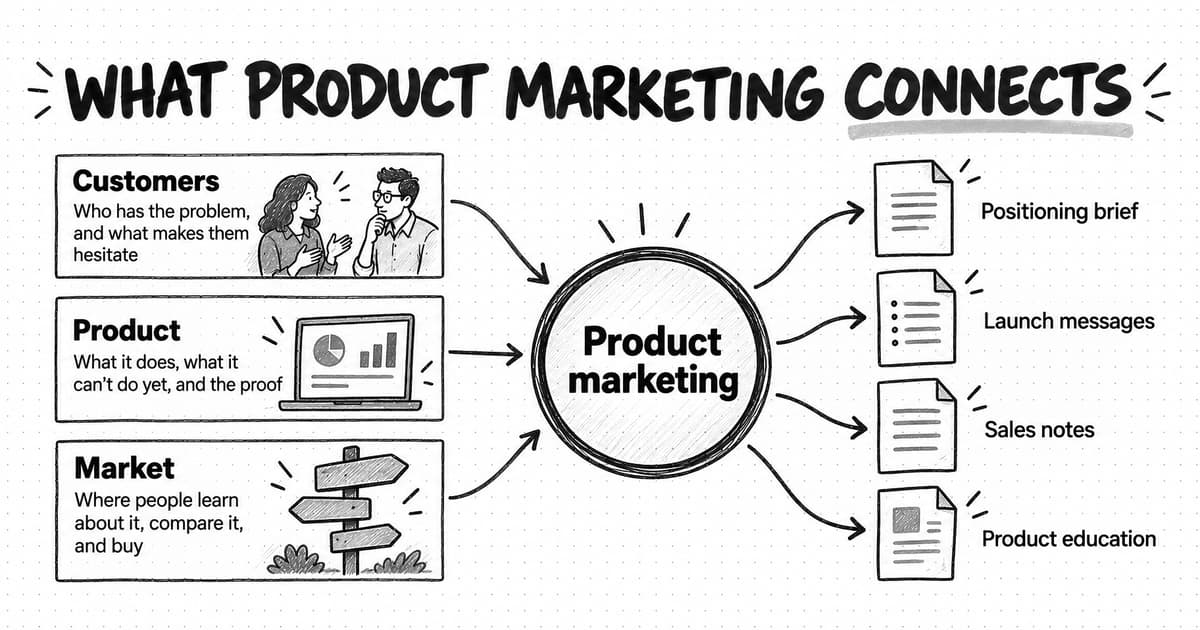
Product marketing is the work of connecting what a company knows about its customers, its product, and its market, and turning that into decisions about who the product is for, how it is positioned and explained, and how it is introduced. Those decisions become positioning briefs, launch plans, sales material, and product education that other teams use.
Summary
Product marketing shapes how people understand a product: who it is for, what it is compared with, why it is different, and how it is introduced. Most of its work reaches customers through other teams, such as sales, support, and campaigns, so it contributes to revenue, adoption, and retention without controlling any of them alone.
The common responsibilities connect: research and competitive understanding inform positioning, positioning shapes messaging, and launches, sales enablement, and product education carry the messages to people at different moments. Ownership of pricing, competitive intelligence, customer stories, and the website varies between companies. Product management decides what to build; product marketing decides how it is introduced and explained, and the two share customer research.
The deliverables are mostly internal tools for other teams: positioning briefs, messaging frameworks, battlecards, launch plans, demonstration scripts, comparison guides, product explanations, and onboarding material. In the guide's fictional example, beta interviews showed that data leads cared more about consistent numbers than speed, which changed the main message, the launch order, the demonstration, and the sales notes, while product management decided to change the product.
Launch planning separates decisions from assets. The strategy decides who hears first, what will persuade them, how much effort the change deserves, and what counts as success; the announcement assets express those decisions. Most launch work happens before the announcement, adoption happens after it, and the material needs review whenever the product, pricing, or competition changes.
Self-serve products explain themselves through the product and website, while sales-led products depend on material salespeople use. AI products need their capability demonstrated, and the evidence should match the risk: a reviewed writing suggestion needs examples and a trial, while an agent acting on customer records needs testing results, controls, and security documentation.
Evaluate product marketing with three kinds of evidence: whether the intended people understand the product, whether other teams use the positioning and material, and whether shared outcomes such as feature adoption or win rate move against a baseline. Agree on the measures before the work starts, and read revenue as a result many teams share.
Contents
- What product marketing is
- The responsibilities that usually sit with product marketing
- How product marketing works with other teams
- The deliverables product marketing produces
- Worked example: how one customer finding changed a launch
- Four deliverables from the Tallybrook launch
- Before, during, and after a launch
- How product marketing supports adoption and change
- Self-serve and sales-led products need different material
- What an AI product needs explained and demonstrated
- How to evaluate product marketing's contribution
- Try it: one product, one uncertainty, one deliverable
- Sources and further reading
- Frequently Asked Questions
Suppose your company is a few weeks from releasing a feature that lets people ask questions of their business data in plain English. The engineers can explain how it works. The harder questions are about the people who will meet it. Who should hear about it first? What will make them hesitate? Which evidence would answer that hesitation, and what should the website, the sales team, the support team, and the in-product announcement each say? Someone also has to plan for the weeks after the announcement, when most customers still have not tried the feature.
Product marketing is the work of answering those questions. It combines an understanding of customers and the market with an accurate understanding of the product, and turns the two into decisions about whom a product is for, how it is positioned and explained, and how it is introduced. Those decisions then become material that other teams use, such as a positioning brief, launch messages, notes for salespeople, comparison pages, and product education.
Most of that material reaches customers through other people's work. A salesperson uses the comparison in a call, a support article explains the feature, and a campaign carries the message to new audiences. Product marketing therefore contributes to revenue, adoption, and retention without controlling any of them on its own, and the clearest way to understand it is through the decisions it informs and the work it produces.
This guide follows a feature like that through a fictional analytics company, Tallybrook, from the first customer interviews to the review after launch, and uses public examples from software companies to show the same work elsewhere. It ends with a short exercise to try on your own product.
What product marketing is
Product marketing connects three kinds of knowledge that usually sit in different parts of a company. The first is an understanding of customers and the market: who has the problem, how they describe it, what they use today, and what makes them hesitate. The second is an accurate understanding of the product: what it does, what it does not do yet, and what evidence shows that it works. The third is knowledge of how the product reaches the market: the channels, teams, and moments where people learn about it, evaluate it, buy it, and start using it. Product marketing works where the three meet.
Practitioners describe the job with different emphases. Product Marketing Alliance, a professional community for product marketers, describes it as bringing a product to market and overseeing its ongoing success. Martina Lauchengco, a partner at Silicon Valley Product Group and the author of Loved, a book about product marketing, wrote in 2012 that explaining why people should care about a product takes far more skill than most people realize, because it depends on understanding both the customer and the product in depth. GitLab's public handbook describes its product marketing team's mission as developing insights, positioning, and messaging. All three treat product marketing as shaping how a product is understood, not only announcing it. In practice that work takes the form of decisions, and each decision ends up in material other teams use, from a positioning brief that keeps the website, the sales pitch, and the campaigns consistent to a launch plan that tells several teams what to do and when.
Who does this work depends on the company's size. At an early-stage startup, the founder usually does it, often without calling it product marketing, while explaining the product to the first customers and investors. Product Marketing Alliance's 2025 report found that 44.3% of product marketing teams have one or two people. In larger companies, product marketers are often organized by product line, customer segment, or region. Intercom, for example, has described pairing each product marketer with two or three product managers who work in the same area. Parts of the work, such as competitive intelligence or sales enablement, may also become separate teams.
Product marketing is sometimes confused with the marketing mix, the framework of product, price, place, and promotion that E. Jerome McCarthy popularized in 1960. Product marketing contributes to all four Ps, especially to how a product is presented and promoted, but price and distribution are usually decided together with product, finance, sales, and leadership.
The responsibilities that usually sit with product marketing
Product Marketing Alliance's 2025 survey gives a sense of which responsibilities are most common. Positioning and messaging was the most widely reported, at 91% of the product marketers who responded, followed by launches (80.9%), sales enablement (78.7%), customer and market research (69.7%), and competitive intelligence and the company website (65.2% each). Fewer reported content marketing (48.3%), customer onboarding (37.5%), or roadmap planning (28.1%). The survey's public summary does not give a sample size, and the figures describe the product marketers who took part rather than every company, but the same core list appears in the published descriptions of the job at GitLab and Intercom.
The responsibilities are easiest to understand as connected work rather than a list of tasks. Research tells the team who the customers are and what they compare the product with. Positioning uses that understanding to decide how the product should be seen. Messaging turns the position into words, and launches, sales enablement, and product education carry those words to the people who need them at different moments. What customers then say and do feeds back into the research.
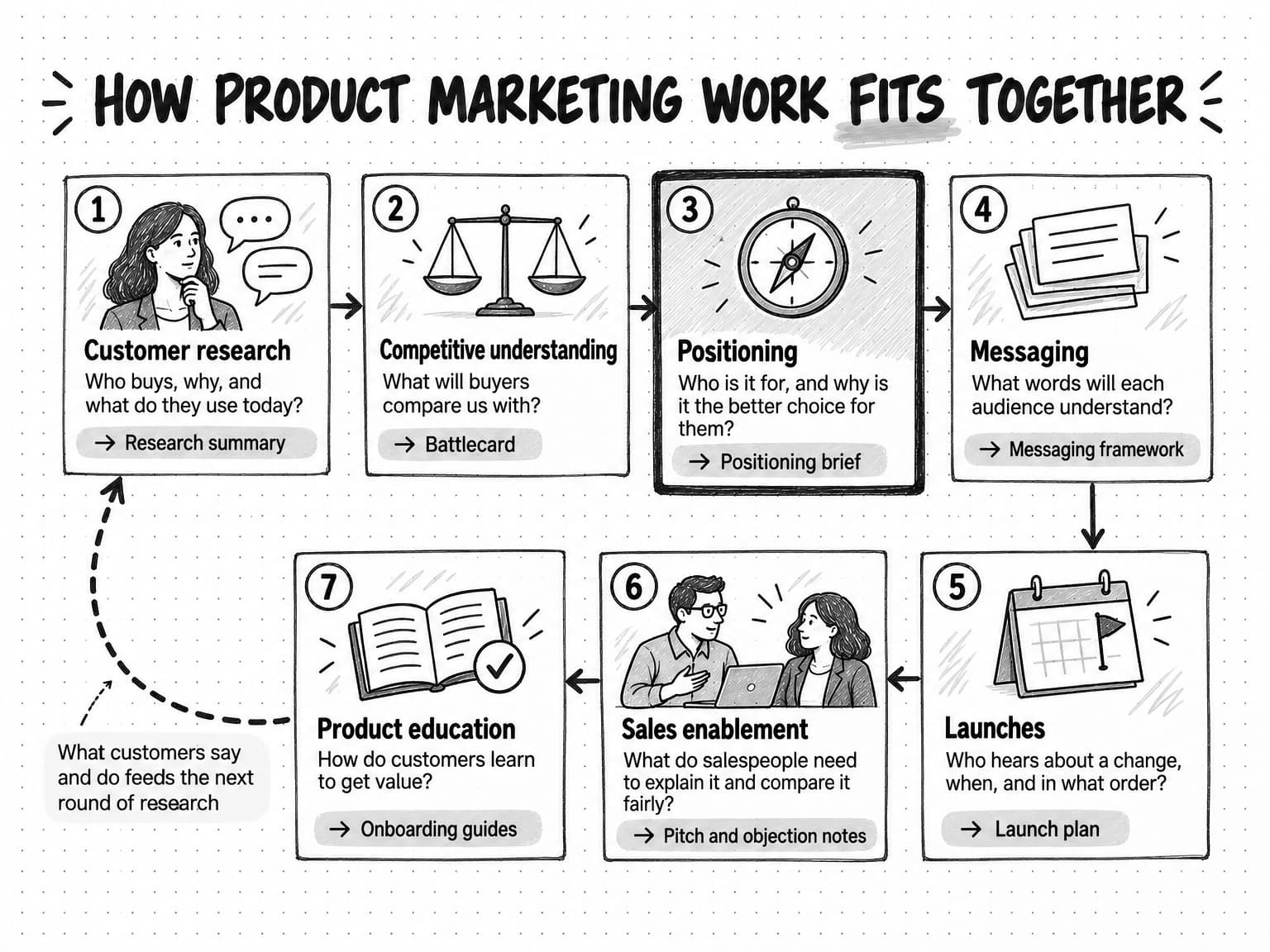
Open the product marketing responsibilities diagram at full size (opens in a new tab).
Customer research
Product marketing needs a current, specific picture of the people who buy and use the product: the situation that sends them looking, the words they use for the problem, what they use today, and what makes them hesitate. The sources include customer and prospect interviews, win and loss interviews after a deal closes, reviews of recorded sales calls, support tickets, public reviews, and product usage data shared by product and analytics teams. Product management researches many of the same people with a different question in mind, so the two teams often share interviews and findings. The market research guide covers the main methods, and the voice-of-customer research guide explains how to turn what customers say into messaging evidence.
Competitive understanding
Buyers rarely evaluate a product alone. They compare it with competitors, with an older tool, with a spreadsheet, with hiring someone, and with doing nothing. Product marketing works out which of those alternatives buyers actually consider, how the product compares on the criteria buyers care about, and what that means for positioning and sales conversations. The competitor analysis guide covers the research method.
Positioning
Positioning decides who the product is for, what it should be compared with, what is different about it, why that difference matters to those buyers, and what evidence supports it. Most other product-marketing work depends on these decisions, which is why many practitioners treat positioning as the center of the job. April Dunford, who advises software companies on positioning, separates it from messaging: positioning defines how a product is different from and better than the alternatives for a particular set of customers, and messaging expresses that position in words. The brand positioning guide explains the parts of a position and how product positioning relates to the company's brand.
Messaging
Messaging turns the position into words that particular audiences will understand: the main message, the supporting points and the proof for each, and the way the message changes for a buyer, a user, or a technical reviewer. The messaging framework guide and the value proposition guide cover this step in detail.
Launches
Product marketing usually coordinates the launch plan and writes or reviews the announcement, while product, engineering, sales, support, and other marketing teams carry out their parts. The launch section follows the work in order.
Sales enablement
Sales enablement prepares salespeople and other customer-facing teams to explain the product, compare it fairly, answer objections, and recognize which prospects it suits. Product marketing often supplies the content: pitch narratives, demonstration scripts, comparison guides, objection notes, and customer evidence. Some companies have a separate enablement team that runs training and tools.
Product education
After someone buys, they still have to learn to use the product well. Product marketing contributes explanations of what a capability is for and when to use it, which become onboarding emails, guides, and in-product messages. The adoption section covers this work in more detail.
Work whose ownership varies most
Some responsibilities sit with product marketing at one company and elsewhere at another. Pricing is the clearest case. GitLab's handbook gives the chief executive final authority over pricing tiers and makes product managers responsible for placing features in the right tier, while product marketers research pricing and packaging and lead how changes are communicated. Competitive intelligence varies too: in a 2025 survey by Crayon, a vendor of competitive intelligence software, 47% of respondents said marketing owned the function, 20% said strategy or the executive team, 17% product, and 16% sales. Customer stories, analyst relations, the website, and partner marketing also move between teams as companies grow.
How product marketing works with other teams
Product marketing shares borders with several functions, and the borders move from company to company. The table describes a common division of work at a B2B software company. Read it as a starting point for a conversation about ownership, not as a rule.
| Function | The main question it answers | Typical work | Where it meets product marketing |
|---|---|---|---|
| Product management | What should we build, for whom, and why? | Discovery, roadmap, requirements, release decisions | Shares customer research; product marketing brings market and buyer evidence to roadmap discussions and turns releases into positioning and launch plans |
| Brand marketing | What should people think of the company as a whole? | Brand positioning, identity, voice, company-level campaigns | Product messages fit inside the brand; product positioning gives the brand concrete proof |
| Content marketing | What will our audience find useful enough to read, watch, or share? | Articles, guides, newsletters, videos, research | Product marketing supplies the subject expertise, positioning, and claim boundaries; content reaches people before they look for a product |
| Demand generation | How do we create and capture interest from the right buyers? | Campaigns, paid media, events, lead programs | Campaigns carry product marketing's messages and audience decisions; campaign results show which messages work |
| Sales and sales enablement | How do we help this buyer decide and buy? | Discovery calls, demonstrations, proposals, training | Product marketing provides pitch narratives, comparisons, and objection handling; sales reports what buyers ask and why deals are won or lost |
| Customer success | How do we help customers get value, renew, and expand? | Onboarding, adoption programs, renewals, account reviews | Product marketing provides education and release material; customer success reports where customers get stuck and what they value |
In a small company, one person may cover several of these rows, and the founder often does most of the product marketing until the company hires for it. Whatever the organization chart looks like, each question in the second column needs someone who answers it.
Content marketing and product marketing are easy to confuse because both publish material. A content marketing strategy decides which audiences, questions, and topics the company will publish about, often for people who are not yet looking for a product. Product marketing decides how one product is positioned and explained, and its research and positioning give content writers accurate claims to work from.
Product marketing and product management
The boundary between product management and product marketing causes the most confusion, partly because the titles are similar and partly because both teams work from customer research. Silicon Valley Product Group describes the two as partners. In Marty Cagan's foreword to Lauchengco's Loved, the product manager focuses mainly on the product side, finding a product that is valuable and usable, while the product marketer focuses mainly on the market side, including the go-to-market strategy. Lauchengco adds that the two kinds of discovery happen in parallel: a product marketer working alongside product discovery can notice which customers are likely to recommend the product to others, or that buyers may be swayed more by what they read on comparison sites and forums than by a trial.
GitLab's handbook shows one way to make the division concrete. Its product managers are measured on usage of their product area and its product marketers on annual recurring revenue for their solutions. Product marketers there give input on the roadmap, draft the headline and introduction of each release announcement, and listen to sales calls to test messages, while product managers pass along what they hear about buyers on their own customer calls.
The deliverables product marketing produces
Product marketing's decisions become concrete in deliverables. Most of them are used by other people, such as salespeople, writers, designers, and support agents, rather than read directly by customers, which is one reason the work can be hard to see from outside. The table groups common deliverables by the people who use them. Few teams produce all of them, the names vary from company to company, and some may be owned by another team.
| Deliverable | Main users | What it is for |
|---|---|---|
| Customer research summary or win and loss report | Product, sales, and marketing leaders | Shares what buyers need, how they decide, and why deals are won or lost |
| Positioning brief | Everyone who writes or talks about the product | Records the target customer, the alternatives, what is different, why it matters, and the supporting evidence |
| Messaging framework | Writers, designers, campaign teams, and sales | Turns the position into a main message, supporting points with proof, and versions for each audience |
| Competitive overview or battlecard | Sales and customer success | Explains how the product compares with each alternative and how to respond to common claims |
| Launch plan | The cross-functional launch team | Sets the audiences, order, owners, dates, assets, and measures for a release |
| Announcement assets | Customers and prospects | The blog post, email, release notes, in-product message, video, and social posts for a release |
| Product and pricing pages | Prospects | Explain what the product does, who each plan suits, and what to do next |
| Pitch narrative and demonstration script | Sales and solutions engineers | Give salespeople a consistent story and a demonstration that proves the main claims |
| Comparison page or guide | Prospects and sales | Help someone choose between the product and the alternatives they are considering |
| Product explanation or solution brief | Buyers, technical reviewers, and administrators | Explain how a capability works, its limits, and what it requires |
| Onboarding and education material | New and existing customers | Help people get value from what they bought |
The first three rows are internal documents, and they shape most of what follows. A team that skips the positioning brief and the messaging framework can still produce a website and a pitch deck, but each piece will make its own decisions about who the product is for and what to emphasize, and the pieces will drift apart.
Product marketing work you can see in public
Companies publish many of these deliverables, so you can study real ones. What you can see is the finished asset. Who made it and what decisions came before it are usually inferences, because a public page rarely says which team wrote it. The examples below separate the two.
A coordinated launch. For its Ship conference in June 2025, Vercel, a cloud platform for web applications, published a recap post linking to more than ten announcements, most of them with their own changelog entry or blog post. Several changelog entries state the release stage in their titles, such as limited beta or generally available. A change to compute pricing got a separate explanatory post with a worked cost example. The new pricing was switched on by default for most plans, while existing Enterprise customers were told that availability depended on their plan and to contact their account representative. What is observed is a set of assets that agree with one another on names, stages, and availability. What can be inferred is that someone decided those names, the stage labels, and the separate route for existing Enterprise customers before anything was published.
Two comparison pages for the same decision. Notion publishes a page comparing itself with Atlassian's Confluence, and Atlassian publishes one comparing Confluence with Notion. Notion argues that Confluence leaves a team's knowledge fragmented and presents its own product as one connected workspace. Atlassian's page grants that Notion suits teams wanting a simple, lightweight workspace, then argues that Confluence is built for scale, with evidence such as an uptime figure and analyst recognition. Each company chose the evidence that supports its own positioning, which shows how a positioning decision shapes the comparison that buyers eventually read.
Material for a customer's internal champion. Linear, a project-management tool for software teams, publishes a guide for employees who want their company to switch to Linear. It prepares them for three objections Linear expects them to hear, including the argument that the current tool works well enough, and a separate guide explains how to run a pilot with baseline and follow-up surveys. These are sales-enablement deliverables written for a customer's employee rather than for a salesperson. They suggest that Linear expects many purchases to begin with one enthusiastic person who has to persuade colleagues, though that is an inference from the material rather than something the company states.
Worked example: how one customer finding changed a launch
Tallybrook is a fictional company invented for this guide. Its product, customers, research, and plans are assumptions made for the example, not observations of a real business.
Tallybrook sells analytics software to B2B software companies with roughly 100 to 1,000 employees. At each customer, the data team defines the company's approved metrics in Tallybrook, such as how it counts an active customer or calculates revenue retention, and builds the dashboards that sales, marketing, finance, and customer success managers read. Smaller data teams buy the Team plan online. Larger companies buy the Enterprise plan through Tallybrook's sales team, which adds single sign-on, audit logs, and a security review.
The product team is about to release Ask, an AI feature that lets anyone with access type a business question in plain English, such as “How many mid-market accounts expanded last quarter?”, and get a chart in return. Each answer records which metric definition and filters it used, behind a “How was this calculated?” link. If a question depends on a term the data team has not defined, Ask says so and suggests the closest approved metrics instead of guessing.
Six weeks before release, the plan reflected what the team found most impressive about Ask: its speed. The draft headline read “Ask your data anything in plain English. Get answers in seconds.” Every user would see an in-product announcement on launch day, and the launch video would show a sales manager getting an answer in a few seconds.
What the beta interviews found
Before finishing the launch plan, Tallybrook's product marketer joined the product manager's calls with beta customers and added interviews of their own, speaking with data leads and business users at eight of the accounts testing Ask. They also read the beta feedback channel and the questions support had received.
Two findings changed the plan. The data leads, who decide whether Ask is switched on, cared less about speed than about consistency. Their dashboards had taken years to earn trust inside their companies, and an AI answer that produced a slightly different revenue figure in a meeting could undo that work. Several said they would keep Ask turned off unless each answer made its definition obvious. The business users, meanwhile, repeated an answer in a meeting only when they could show where the number came from. They liked the speed, but it was not what they talked about.
The interviews also changed the team's picture of the competition. The product team had expected buyers to compare Ask with features in other analytics tools. Business users described different alternatives: messaging an analyst and waiting a few days, or exporting a spreadsheet and working the answer out themselves, sometimes with a general-purpose AI chat assistant.
Eight accounts is a small sample, and interviews show what people say rather than how many customers share a view. The product marketer still treated the findings as strong enough to change the plan, because they came from the people who control whether Ask is enabled, and planned to check them against usage after release.
How the finding changed the message and the launch
| Decision | Working plan | Revised plan | Owner of the final call |
|---|---|---|---|
| Who hears first | Every user, on launch day | Data leads, two weeks earlier, with an admin preview and a guide to checking which metrics are ready | Product marketing, agreed with product and customer success |
| Main message | “Ask your data anything in plain English. Get answers in seconds.” | “Ask questions in plain English. Get answers built on the metrics your data team already approved.” | Product marketing |
| Demonstration | A fast answer | An answer with its definition visible, followed by a question Ask declines because a term is undefined | Product marketing, with product |
| Product behavior | Definition behind a link | Definition shown on every answer | Product management |
| Sales and support material | A feature overview | A note on answering “Will this give different numbers from our dashboards?” and a comparison with the alternatives customers described | Product marketing, reviewed by sales and support |
| Enterprise accounts | The same announcement as everyone else | A data-handling note for security reviewers and a call with the account's customer success manager before Ask is turned on | Customer success, using product marketing's material |
Speed did not disappear from the launch. Business users see Ask only after their data lead has turned it on, so their message leads with an example question and how quickly the answer arrives, while the definition beside every chart gives them what they need to repeat the number in a meeting.
The product decision in the table belonged to product management. Product marketing contributed evidence: the product manager heard the same concern in the interviews and decided to show the definition by default. Product marketing often learns something about customers that affects the product, and the people responsible for the product decide what to do with it.
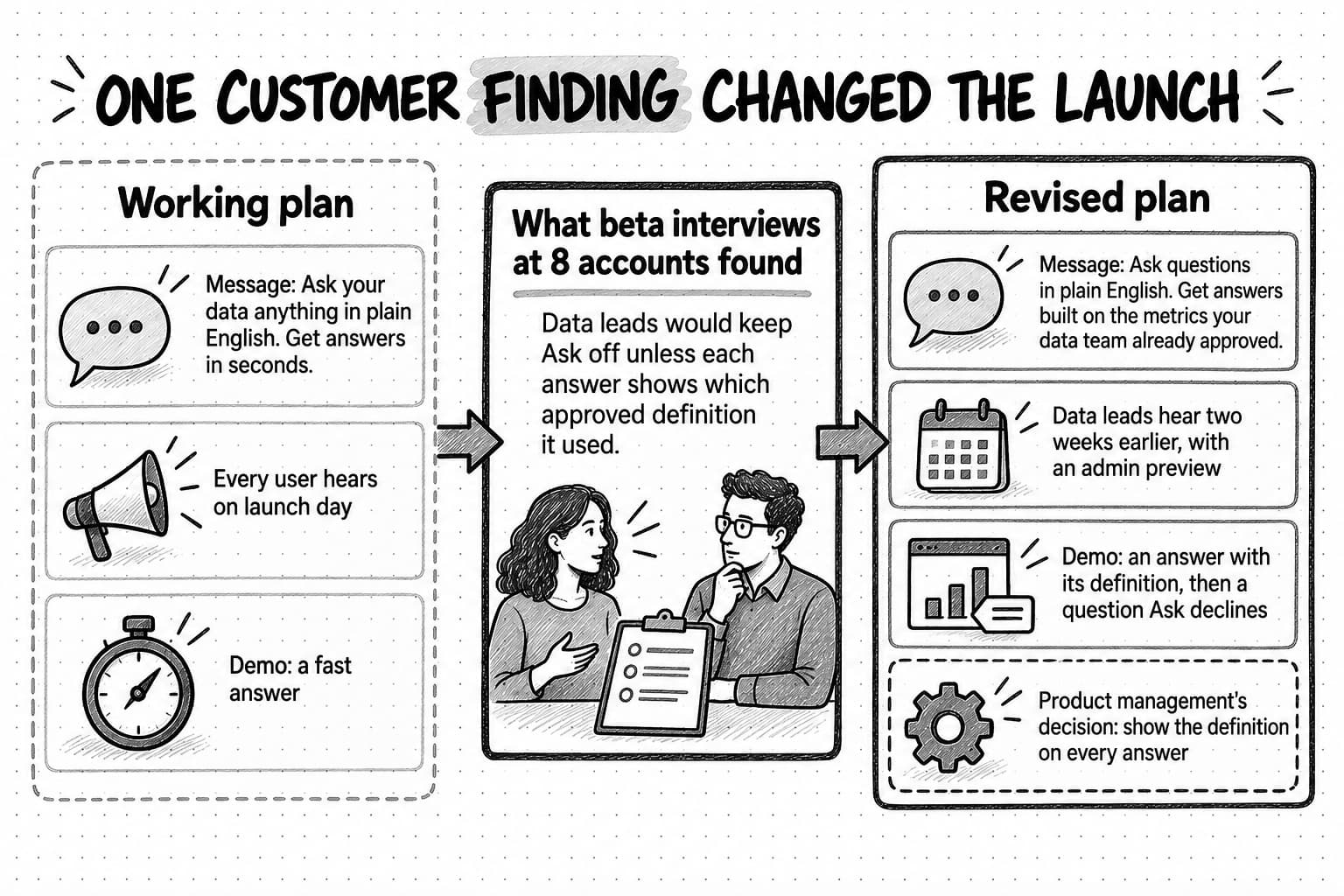
Four deliverables from the Tallybrook launch
The decisions above had to become material that other people could use. The excerpts below show four common product-marketing deliverables from the fictional launch. Each one serves a different reader, and each would be longer in practice.
A positioning brief
A positioning brief records the decisions that the rest of the launch depends on: who the release is for, what they use today, what is different, and what evidence supports the claims. It is an internal document. Customers never see it, but the website, the announcement, the sales note, and the comparison page all draw on it, which keeps them consistent.
| Release | Ask, an AI feature in Tallybrook that answers plain-English business questions with a chart |
|---|---|
| First audience | Data leads at B2B software companies who maintain approved metrics and decide whether Ask is turned on |
| Second audience | Managers in sales, marketing, finance, and customer success who read those dashboards and need answers between updates |
| Situation | Business questions arrive faster than the data team can answer them, so people wait or work around the queue with spreadsheets |
| Current alternatives | Messaging an analyst and waiting; exporting a spreadsheet; pasting an export into a general-purpose AI chat assistant |
| What is different | Answers use the definitions the data team already approved and show which one they used; an undefined term prompts a question instead of a guess |
| Evidence at launch | Interviews at eight beta accounts; the product behavior shown in the demonstration; an internal test on questions collected from beta accounts, with known weak spots documented |
| Claims to avoid | Always accurate; replaces your analysts; any time-saving figure until it has been measured across customers |
The “Claims to avoid” row tells everyone writing about Ask what the evidence does not support yet, so a salesperson or a campaign does not promise more than the product can show.
A launch message
The launch message turns the brief into words customers will read. This version is the opening of the announcement sent to data leads two weeks before everyone else:
Ask: plain-English questions, answered with your approved metrics
Your colleagues will soon be able to type questions such as “How many mid-market accounts expanded last quarter?” and get a chart in Tallybrook. Every answer shows the metric definition and filters it used, so the number matches the dashboards your team already maintains. If a question depends on a term you haven't defined, Ask says so and suggests the closest approved metrics instead of guessing.
Ask stays off until an admin turns it on. Start with the readiness guide to see which of your metrics are ready.
The message leads with the reader's concern and answers it with a specific behavior the reader can check. It ends with an action only a data lead can take. The version for business users, sent after Ask is enabled, puts the example question and the speed first.
A comparison asset
A comparison asset helps someone choose between their current approach and the product. Tallybrook's version compares Ask with the alternatives customers described in interviews rather than with a competitor's feature list:
| Approach | Works well when | Watch for |
|---|---|---|
| Ask an analyst | The question is new, complicated, or needs judgment about which data to use | Waiting time, and analysts spending their week on routine questions |
| Export a spreadsheet, alone or with a general-purpose AI chat assistant | Someone needs a one-off exploration and is comfortable checking the method | Definitions that differ from the dashboards, and company data copied outside the systems the data team manages |
| Ask in Tallybrook | The question uses metrics the data team has already defined | Questions that need a metric no one has defined yet; Ask will say it cannot answer them |
The comparison says where each alternative works well. That makes the rest of the page easier to believe, and it tells sales when Ask is not the right answer for a prospect's question.
A sales-enablement note
A sales-enablement note prepares salespeople and customer-facing colleagues for real conversations. A short note that someone reads before a call is often more useful than a long training deck.
- Talk to first: the data lead or head of analytics, before business users.
- Ask: Which metrics does your team maintain definitions for? How do managers get answers between dashboard updates? What happened the last time two reports disagreed?
- The objection you will hear: “Won't this give different numbers from our dashboards?”
- How to answer: Show an answer with its definition, then a question Ask declines because a term is undefined. Explain that Ask uses only the definitions the team has approved.
- Do not say: that Ask is always accurate, that it replaces analysts, or any time-saving figure.
- Bring in: the security team for data-handling questions, and a solutions engineer when a prospect needs help preparing its metric definitions.
Before, during, and after a launch
A launch is the planned introduction of a new product, feature, plan, or significant change to the people who need to know about it. It is the most visible part of product marketing, and the easiest to mistake for the whole job.
It helps to separate the launch strategy from the announcement. The strategy is a set of decisions: who needs to know, in what order, what they should understand, what evidence will persuade them, how much effort the change deserves, and what would count as success. The announcement assets, such as the blog post, the email, the in-product message, the video, and the social posts, express those decisions. A team that starts with the assets can end up with a confident announcement that answers no particular reader's question. The decisions usually reach writers and designers as a brief; our guide to a creative brief for a marketing campaign shows how to carry the audience, message, and evidence into the assets.
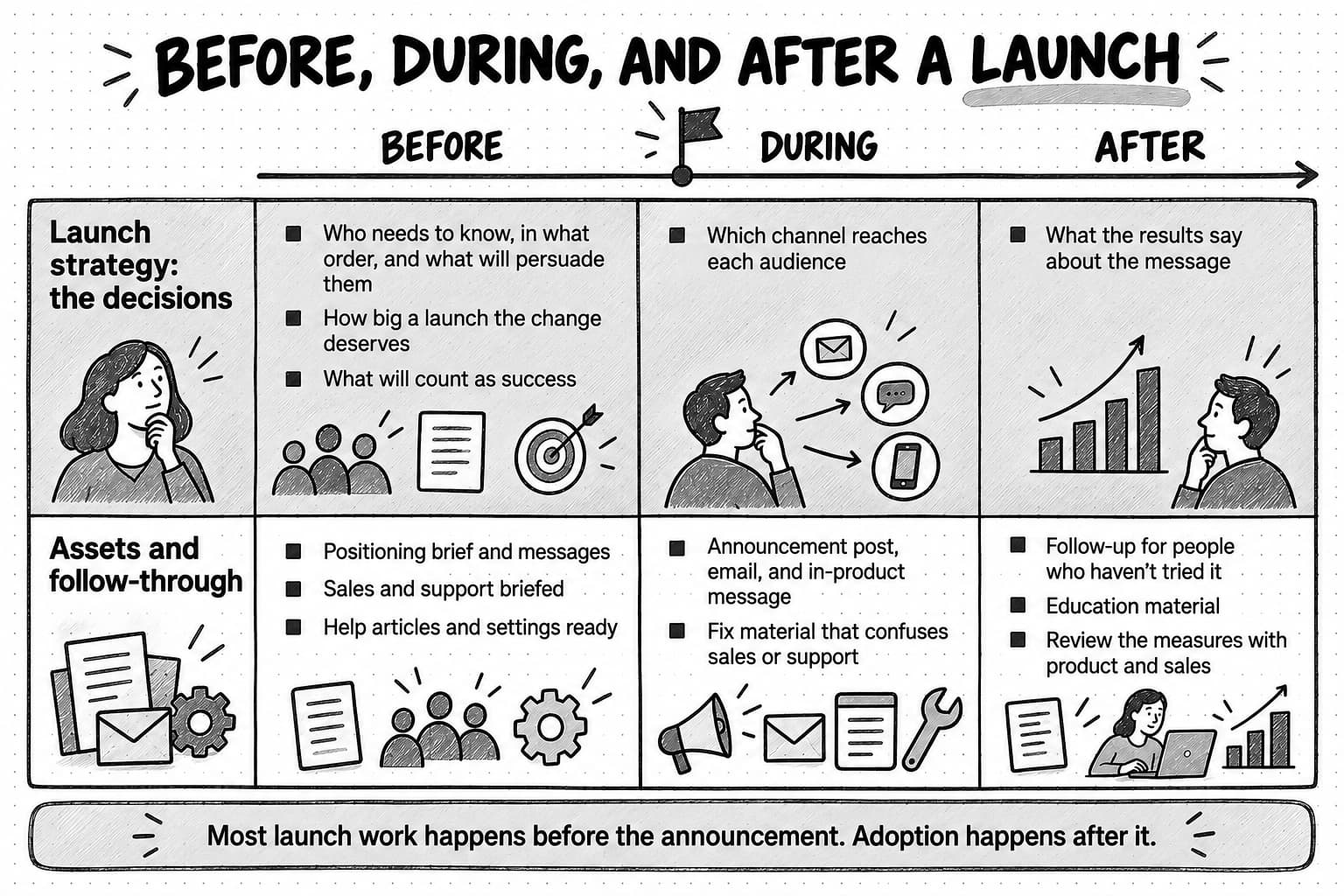
Open the launch diagram at full size (opens in a new tab).
Size the launch to the change
Not every release deserves the same effort, and many teams sort releases into tiers before planning them. Intercom has described a four-level system in which each launch gets a score from questions about revenue, engagement, differentiation, and the size of the audience affected; P1 covers the biggest launches and P4 small updates. Ashley Faus, a marketer at Atlassian, has described a similar range. A top-tier launch reaches all customers, matters to the company's revenue, and gets press, an event keynote, several demonstrations, paid promotion, and in-product notifications. A fourth-tier launch affects a small group of users and gets a community post and limited promotion. Both systems score a release by its importance to customers and the business.
In the fictional example, Ask was a top-tier launch for Tallybrook because it changed how business users could get answers and gave sales a new reason to talk to data leaders. A change to how dashboards export to spreadsheets, released the same month, got a release note and a line in the customer newsletter.
Before the announcement
Most launch work happens before anyone outside the company hears about the release:
- Confirm with product management what the release does, what it does not do, and when it will be ready.
- Decide the audiences, the order in which they hear, and the main uncertainty each one has.
- Write the positioning brief and the messages, and agree on the claims the evidence supports.
- Prepare the people who will talk about the release: sales, support, customer success, and sometimes partners. Many companies brief these teams before the public announcement so customers do not hear about a change before the people answering their questions.
- Check that customers can act on the announcement: help articles, pricing and plan changes, settings, and the product explanation are ready.
- Agree on what success looks like and record a starting point for each measure.
During the announcement
The announcement itself coordinates the channels so each audience hears a consistent message in the form that suits it. Existing customers may see an in-product message and an email, prospects a blog post and social posts, and the sales team a short briefing they can forward. During the first days, product marketing watches the questions coming into sales and support and corrects material that is causing confusion.
After the announcement
The announcement is the start of adoption, not the end of the launch. Many customers will not read it, and many who do will not try the release until they need it. The weeks afterward are when product marketing follows up with people who have not tried the release, works with customer success and product on education, collects the questions and objections that keep coming up, and updates the material to answer them. It is also when the team compares the results with the measures it chose and reports what it learned to product management.
| When | What Tallybrook did (fictional) |
|---|---|
| Six weeks before | Beta interviews; positioning brief drafted and reviewed with product management |
| Four weeks before | Messages, demonstration script, and product explanation approved; launch measures agreed |
| Two weeks before | Sales and support briefed; data leads invited to the admin preview with the readiness guide |
| Launch day | Announcement post and email; in-product message for business users in accounts where Ask was on |
| Two weeks after | Follow-up to data leads who had not turned Ask on, with answers to the questions support had received |
| Sixty days after | Review of the launch measures with product, sales, and customer success; material updated |
How product marketing supports adoption and change
Much of product marketing happens between launches. Two kinds of work continue after the announcement: helping existing customers adopt what they already pay for, and keeping the company's explanations accurate as the product and the market change.
Product education and adoption
In a subscription business, a customer who never uses a feature has less reason to renew, and an existing customer is often the best audience for a new release. Product education gives people the knowledge to get value: getting-started guides, templates, short videos, webinars, in-product tips, and onboarding emails. Customer success, support, and product teams usually own parts of this work. Product marketing contributes the explanation of why a capability matters and to whom, so education is organized around customer goals rather than around menus and settings.
For the fictional Tallybrook, adoption meant two different problems. Data leads had to trust Ask enough to turn it on, which the readiness guide addressed. Business users then had to remember Ask existed when a question came up, which called for different material: example questions for each team, a short video in the weekly digest email, and a prompt beside dashboards inviting a follow-up question.
Usage data shows where education is needed. If many accounts turn a feature on but few people use it after the first week, the explanation may have attracted interest the feature did not satisfy, or people may not know when it applies. Product marketing reads that data with product and analytics colleagues, and asks customers before deciding which it is.
When the product or the market changes
Product marketing material goes out of date quietly. Features are renamed, plans and prices change, a competitor launches something similar, buyers start using a new term for the category, or the company moves into a new segment with different concerns. Each change can make a page, a comparison, or a sales note inaccurate, and inaccurate material does more harm than missing material, because people rely on it.
Keeping the material current is part of the work: an owner for each important asset, a review when the product or pricing changes, and a quick check of competitive claims when a competitor moves.
Suppose that a few months after Ask's launch, a competitor releases plain-English questions that also use approved metric definitions. Tallybrook's comparison asset and the “What is different” row of the positioning brief need review, because the difference they describe is now smaller. If Ask later improves at comparing metrics measured over different time periods, the “What we tested” section of the product explanation changes too. Those are updates to material. If buyers start choosing between the two products on something else entirely, such as how many data sources each one connects to, the team may need to reconsider who Ask is for and what it is compared with, which is a positioning decision. The brand positioning guide describes the signs that a position needs to change.
Self-serve and sales-led products need different material
The underlying decisions are the same whether customers buy online or through a salesperson: who the product is for, what they compare it with, what is different, and what evidence supports the claim. What changes is where the explanation happens and who delivers it.
In a self-serve product, the product, the website, and onboarding do most of the explaining, and the moment that matters most is usually the first time someone gets a useful result. In a sales-led product, salespeople do much of the explaining with material product marketing prepares, and several people review the purchase, so the material has to work for readers who never see a demonstration.
| Aspect | Self-serve | Sales-led |
|---|---|---|
| Who explains the product | The product, website, and onboarding | Salespeople, solutions engineers, and the material they share |
| Typical deliverables | Plan and pricing pages, onboarding emails, in-product guidance, templates, tutorials | Pitch narrative, demonstration script, comparison guides, business-case templates, security documentation |
| What a launch emphasizes | In-product announcements and getting existing users to try the release | Briefing the sales team and preparing material for each reviewer |
| Where feedback comes from | Product usage, sign-up and upgrade data, support questions | Call reviews, win and loss interviews, sales feedback |
Many companies use both, as the fictional Tallybrook does. Its Team plan customers learned about Ask from an in-product preview and the readiness guide, while Enterprise accounts heard about it from their customer success manager, with a data-handling note ready for their security reviewers. The B2B SaaS marketing guide describes these buying approaches, including the sales-assisted path between them, in more detail.
What an AI product needs explained and demonstrated
An AI product goes through the same product-marketing decisions as any other product, but buyers usually have more to work out before they trust it, from how often the output is wrong to what happens to their data. The B2B SaaS marketing guide lists the questions buyers commonly ask about AI products and the material that answers each one.
Product marketing's part is to decide which of those questions a particular audience will ask first, and to answer them with evidence the buyer can check: an example to inspect, a description of how quality was tested, and a chance to try the product on the buyer's own material.
Make the capability demonstrable
For the fictional Tallybrook, the most useful AI deliverable was a short product explanation that a data lead could read before turning Ask on:
How Ask answers a question
- Ask matches the words in a question to your approved metric definitions and filters.
- It builds the query from those definitions, not from its own interpretation of the raw tables.
- It returns a chart with the definition and filters shown beside it.
- If no approved metric matches, it says so and suggests the closest ones instead of guessing.
What we tested: Before release, we ran Ask on questions collected from beta customers and reviewed every answer against the matching dashboard. It handles questions about a single metric well. It is weaker when a question compares metrics measured over different time periods, and it tells you when it cannot answer.
The explanation does three things a feature announcement does not. It describes the mechanism in terms the reader cares about, it reports how quality was checked, and it names a weakness. Naming the weakness costs little, because a data lead would find it during the preview anyway, and it makes the rest of the explanation more believable.
Match the evidence to the buyer and the risk
Not every AI product needs the same material. A writing assistant inside a self-serve tool, where a person reviews every suggestion before using it, may need little more than clear examples, a way to try it, and a plain statement about data use. An AI agent that acts on customer records for a regulated company may need security documentation, administrator controls, audit trails, testing results, and a pilot before anyone signs. Most products sit somewhere between.
The difference comes from what happens if the output is wrong and who has to approve the purchase. When a mistake is cheap and the user sees it immediately, a demonstration and a trial carry most of the weight. When a mistake is expensive or invisible until later, buyers need evidence about testing, controls, and accountability, and that evidence often has to satisfy reviewers who will never use the product.
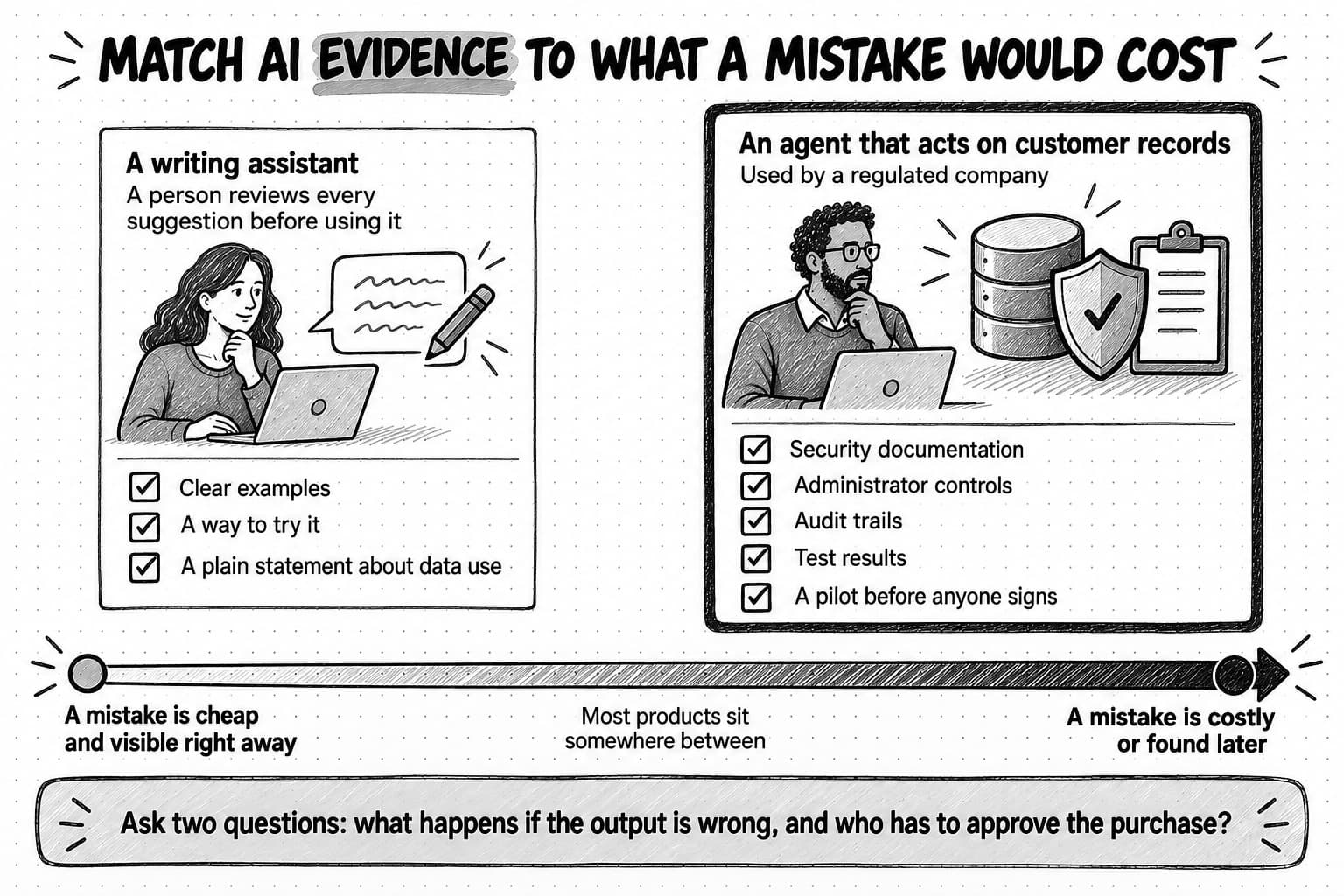
Public examples show how one company can need both kinds of material. Gamma, an AI presentation tool, answers the data question for individual users in a short help article: content from individual plans may be used to train its AI features unless the user opts out in a settings tab, while business and enterprise workspaces are excluded. A separate trust center with security reports serves the procurement teams that buy for organizations. Granola, an AI meeting-notes app, documents a similar split, with enterprise accounts opted out of training by default.
Testing evidence is most useful when it says exactly what was tested. When GitHub published research on its AI coding assistant, Copilot, in 2022, it described the test precisely: 95 professional developers, split randomly into two groups and timed while writing an HTTP server in JavaScript. The group using Copilot was more likely to finish (78% against 70%) and took 1 hour and 11 minutes on average, against 2 hours and 41 minutes for the other group, and GitHub reported a confidence interval of 21% to 89% for the speed gain. The widely repeated claim that developers worked 55% faster comes from that single task, which is why the description of the test matters as much as the headline figure.
How to evaluate product marketing's contribution
Product marketing is hard to measure because most of its work reaches customers through other teams. A win rate depends on the product, the price, the salesperson, and the competition as well as the positioning. Feature adoption depends on how useful the feature is. Giving product marketing sole credit for those numbers overstates its role, and ignoring them leaves the work judged by how many documents it produced, which says nothing about whether anyone was helped.
A more useful evaluation looks at three kinds of evidence together and agrees on them before the work starts.
| What to look at | Questions to ask | Examples of evidence |
|---|---|---|
| Understanding | Do the intended people understand what the product does, who it is for, and how it differs? | Message tests with prospects, the questions asked in sales calls and trials, how customers describe the product in interviews and reviews |
| Use | Do other teams use the decisions and material in their own work? | Whether sales uses the pitch and comparison, how often support links to the product explanation, whether campaigns follow the messages |
| Shared outcomes | Did the outcomes the work was meant to influence move, compared with a plan or baseline? | Adoption of a launched feature by its intended audience, win rate against a named alternative, trial-to-paid conversion, sales cycle length |
Companies do hold product marketing to revenue and adoption measures. In Product Marketing Alliance's 2026 survey of product marketing leaders, 53.91% named new revenue among their measures, 38.28% named win rate, 32.03% retention, and 13.28% said they had no defined measures; leaders named 16 different metrics in all. As with the 2025 survey, the public summary does not give a sample size. GitLab, which measures its product marketers on annual recurring revenue, states plainly that they do not control everything that drives it. Revenue can be a reasonable shared goal, as long as the company reads it as a shared result and looks at the evidence underneath it.
The most useful habit is deciding before a launch what would count as success, who influences each measure, and what would change the plan. In the fictional example, Tallybrook's team chose three measures for Ask: the share of eligible data teams that turned it on within 60 days, the number of people asking questions each week in accounts where it was on, and the number of support tickets about answers that did not match a dashboard. None of them belongs to product marketing alone. Together they show whether the message persuaded the people who controlled the switch, whether the feature was useful once on, and whether the promise about consistency held.
Qualitative evidence belongs in the review too. If salespeople stop hearing “Won't this give different numbers?” because prospects already know the answer, that is a sign the message is reaching them, even before it shows up in a win rate.
Try it: one product, one uncertainty, one deliverable
You can practice the core of product marketing without a launch or a team. The exercise takes about half an hour and needs only what you already know about a product and the people who consider it.
- Choose one product, feature, or plan. Narrow is better: “the Enterprise plan” or “our new reporting feature” works better than “our platform.”
- Name one audience in a specific situation. Describe who they are and what they are trying to get done when they meet the product, such as “a data lead deciding whether to let managers query data directly.”
- Write their main uncertainty in their own words. Use the question you have heard in calls, tickets, or reviews, such as “Will this give different numbers from our dashboards?” If you have not heard one, that is a research task before it is a writing task.
- List the information that would resolve it. Include the evidence, not only the claim: a demonstration, a test, a document, a customer example, or a fair comparison. Note anything you cannot support yet.
- Choose one deliverable that would carry that information at the right moment. Decide who will use it, such as a salesperson before a call or a new user on their first day, and where they will meet it.
Product, feature, or plan:
Audience and situation:
Their main uncertainty, in their words:
Where that uncertainty came from:
Information and evidence that would resolve it:
What we cannot support yet:
Deliverable:
Who uses it, and when:
How we will know it helped:
Here is the worksheet filled in for the fictional Tallybrook launch:
| Product, feature, or plan | Ask |
|---|---|
| Audience and situation | A data lead deciding whether to turn Ask on |
| Their main uncertainty, in their words | “Will this give different numbers from our dashboards?” |
| Where that uncertainty came from | Beta interviews at eight accounts |
| Information and evidence that would resolve it | An answer with its definition visible, and a question Ask declines |
| What we cannot support yet | Any time-saving figure |
| Deliverable | The readiness guide |
| Who uses it, and when | Data leads, during the admin preview |
| How we will know it helped | The share of eligible data teams that turn Ask on |
Fill in the last line before you create anything. Deciding in advance how you will know the deliverable helped turns a piece of content into a test of whether you understood the audience.
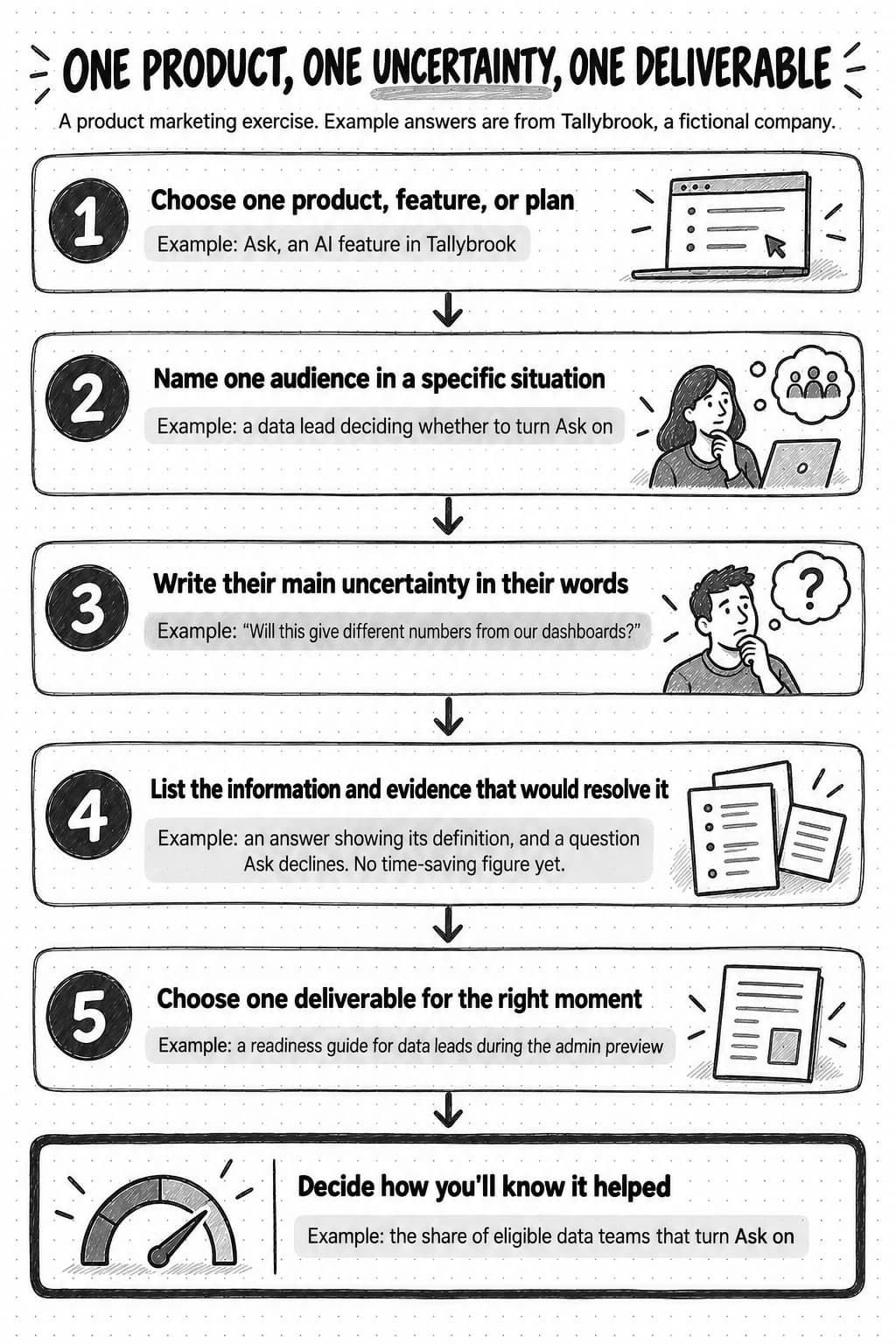
Open the product marketing worksheet at full size (opens in a new tab).
Sources and further reading
- Product Marketing Alliance: What is product marketing? (2026)
- Product Marketing Alliance: State of Product Marketing Report 2025
- Product Marketing Alliance: How PMM leaders get measured (2026)
- Martina Lauchengco: Product marketing contribution, Silicon Valley Product Group (2012)
- Martina Lauchengco: The market side of product/market fit, Silicon Valley Product Group (2022)
- Marty Cagan: Foreword to Loved, Silicon Valley Product Group (2022) and the book's page
- April Dunford: A quickstart guide to positioning, Lenny's Newsletter (2021)
- GitLab handbook: Product and solution marketing, Product marketing team, and Product marketing manager job description
- GitLab handbook: Tiering strategy and guidance for product managers
- Intercom: Keeping the market in mind, product marketing at Intercom (2021)
- Intercom: How to evolve product launches as you grow (2019, updated 2024)
- Ashley Faus: How do you prioritize your product launches? Atlassian Community (2024)
- Crayon: 2025 State of Competitive Intelligence report (PDF)
- Vercel: Vercel Ship 2025 recap and Introducing Active CPU pricing for Fluid compute (2025)
- Notion: Notion vs. Confluence and Atlassian: Confluence vs. Notion
- Linear: Pitching Linear and Running a pilot
- Gamma: Does Gamma use my content to train its AI features? and Gamma Trust Center
- Granola: Models and training
- GitHub: Research quantifying GitHub Copilot's impact on developer productivity and happiness (2022)
- E. Jerome McCarthy: Basic Marketing: A Managerial Approach (Richard D. Irwin, 1960)
- Company pages above were read on October 6, 2026; public pages change, so check the current version before relying on a detail.
Frequently Asked Questions
What are the responsibilities of a product marketer?
A product marketer's usual responsibilities are customer and market research, competitive understanding, positioning, messaging, launches, sales enablement, and contributing to product education and adoption. In Product Marketing Alliance's 2025 survey, positioning and messaging was the most common responsibility, reported by 91% of respondents, followed by launches and sales enablement. Pricing, customer stories, analyst relations, and the website sit with product marketing at some companies and with other teams at others.
What is the difference between product marketing and product management?
Product management decides what to build, for whom, and why, working with engineering and design to make the product valuable and usable. Product marketing decides how the product is presented to the market: who it is for, what it is compared with, how it is described, and how it is introduced. The two share customer research and work together on releases, and ownership of pricing varies. At a small company, one person may do both.
How is product marketing different from other types of marketing?
Product marketing focuses on how a specific product is positioned, explained, launched, and adopted. Brand marketing shapes how people see the company as a whole, content marketing produces material people find useful before they look for a product, and demand generation creates and captures interest through campaigns. Product marketing supplies those teams with positioning, messages, and the limits on what can be claimed, and their results show which messages work. Ownership varies, and small companies often combine these roles.
What is an example of product marketing?
A typical example of product marketing is preparing a feature launch. In this guide's fictional example, interviews showed that data leads cared less about speed than about AI answers matching their approved dashboards. Product marketing changed the main message, told data leads two weeks before other users, built a demonstration showing each answer's definition, and gave sales a note on the objection. Public examples include Vercel's coordinated launch posts and the comparison pages that Notion and Atlassian publish about each other.
What are the main product marketing deliverables?
Common product marketing deliverables include a positioning brief, a messaging framework, research and win and loss summaries, competitive battlecards, launch plans, announcement assets, product and pricing pages, pitch narratives and demonstration scripts, comparison guides, product explanations, and onboarding material. Many are internal and used by other teams. The positioning brief and messaging framework shape most of the rest, because the website, sales material, and campaigns all draw on them.
What is a product marketing strategy?
A product marketing strategy is the set of decisions about which customers a product is for, what they compare it with, what is different and why it matters, how to describe it to each audience, and how to bring it to market and help customers adopt it. It usually starts with customer and competitive research, is recorded in positioning and messaging, and is carried out through launches, sales enablement, and product education.
How do you measure product marketing success?
Measure product marketing with three kinds of evidence: whether the intended audience understands the product, whether other teams use the positioning and material, and whether shared outcomes such as feature adoption, win rate, or trial conversion move against a baseline. In Product Marketing Alliance's 2026 survey of product marketing leaders, 53.91% named new revenue as a measure. Agree on measures before a launch, and read revenue as a shared result.
What are the four Ps of product marketing?
The four Ps are the marketing mix: product, price, place, and promotion, a framework popularized by E. Jerome McCarthy in 1960. Some writers add a fifth P, and which one varies. The mix lists the decisions involved in marketing any product. Product marketing contributes to all four, especially to how the product is presented and promoted, but price and distribution are usually decided together with product, finance, sales, and leadership.
How is product marketing different for AI products?
Product marketing for an AI product involves the same decisions, but buyers need more evidence before they trust the output. They want to know what the AI does and what people still review, how quality was tested and where it fails, what happens to their data, and what changes when the model is updated. Product marketing decides which questions each audience asks first and answers them with examples, test descriptions, trials, and documentation suited to the risk.