What is an AI-native marketing team? Five stages from first pilot to daily practice
A five-stage model with a readiness self-assessment, the six reasons AI pilots stall and the fix for each, and an operating model that names who owns context, review, recurring work, and quality.
44 min readWritten by Ampere
Short answer
What does AI-native mean?
AI-native describes something designed with AI as part of how it works from the start, rather than AI added to a process that already existed. For a marketing team, it means the AI works from shared context the team keeps current, recurring jobs run on a schedule and come back for review, and named people decide what goes out.
Summary
Many marketing teams use AI inside a process designed before it: each person gets faster, but briefs, review, and corrections stay as they were, and pilots fade. A team becomes AI-native by redesigning that work around the AI, not by adding tools, and the gain is more capacity and sharper focus for the people it already has.
Published rates of AI projects that stall or fail range from about half to 95%, because studies count different things, from projects reaching production to profit impact six months after a pilot. Where the studies agree, the obstacles are mostly people and process. Six causes recur in marketing pilots, each with a fix, from testing a tool instead of a recurring job to having no measure of whether the work helped.
The five stages run from ad hoc experiments through assisted, systematic, and delegated work to AI-native practice, and teams move up one stage at a time because each stage builds what the next one needs. A twelve-statement readiness self-assessment, scored 0 to 2, places a team: its stage is the last one where every statement scores 2, and the first statement below 2 is the next piece of work.
The operating model answers four questions: who owns the shared context, who reviews each class of work, which jobs become scheduled tasks, and how quality is checked over time. Five named responsibilities and three monthly routines (a context review, a quality sample, and a retro) keep it running, and simple measures such as outputs used after light edits and repeat corrections show whether the practice is improving.
A worked example follows the four-person marketing team of a fictional software company from stage 2 to stage 4 in four months: its tools barely changed, but the decisions around them did. A sensible first job recurs, is easy to check, and is reviewed before anything goes out, and leaders support the change by saying what the freed time is for and working from the shared context themselves.
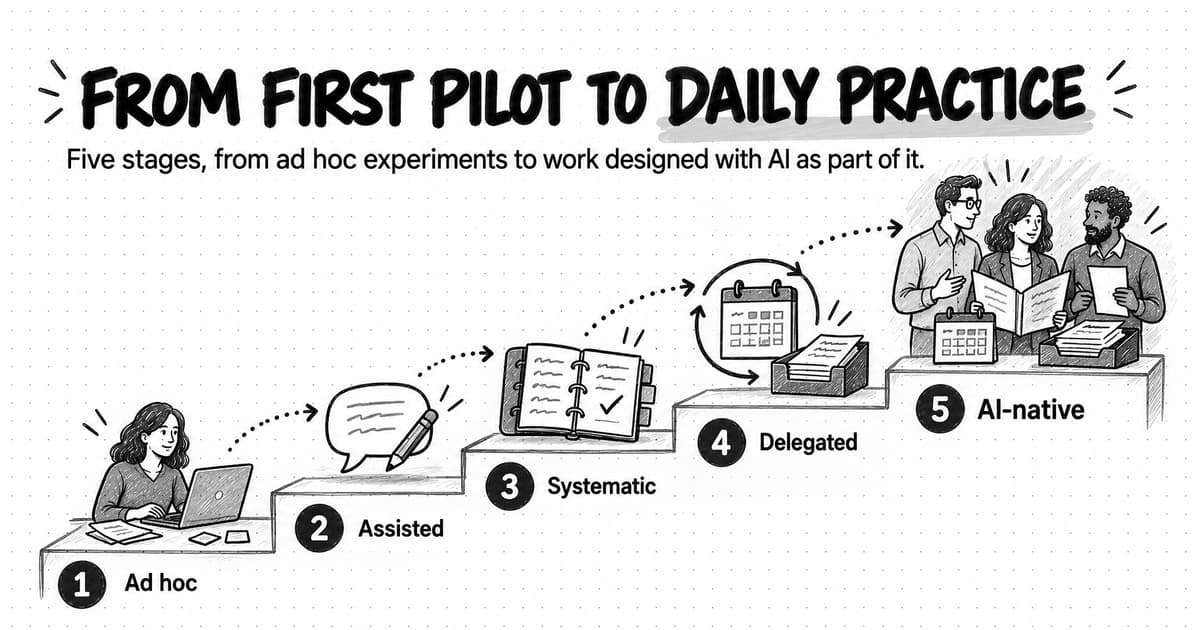
Contents
- What does AI-native mean for a marketing team?
- Why most AI pilots stall: what the evidence shows
- Six reasons AI marketing pilots stall, and the fix for each
- The five stages from first pilot to daily practice
- Readiness self-assessment: which stage is your team at?
- The AI-native operating model in four questions
- Roles and routines in an AI-native marketing team
- What to hand over to AI first
- How to bring your marketing team along
- How to measure progress toward AI-native work
- Worked example: one fictional team's AI-native week
- How an AI-native marketing team works in Ampere
- Sources and further reading
- Frequently Asked Questions
Many marketing teams have run an AI pilot by now. A few people bought chat subscriptions, someone tested a writing tool, and perhaps the team tried an AI agent on a real campaign. The early results were often good: a competitor summary in minutes, a first draft that needed only light edits. Then use thinned out. Each person was still pasting the product description into a fresh chat, reviewers kept correcting the same outdated claim, and nobody could say whether the pilot had improved the team's marketing or only produced more drafts.
Getting past that point takes a change in how the work is organized around the AI. An AI-native marketing team is a team whose everyday work is designed with AI as part of it: the AI works from shared context the team keeps current, recurring jobs run on a schedule and come back for review, and named people own the decisions about what goes out. People on such a team still research, write, and approve. What changes is that routine preparation, such as gathering sources, summarizing, and drafting first versions, is planned around the AI, and people spend more of their time on the judgment the AI can't supply: what to say, to whom, and whether it's true.
Few teams make that change in one step, and the surveys covered below suggest most organizations haven't made it yet. This guide gives you a five-stage model, from ad hoc experiments to daily practice, with a self-assessment that places your team on it. It explains the six reasons AI pilots usually stall and the fix for each, then sets out an operating model: who owns the context, who reviews what, which work becomes a scheduled task, and how quality is checked. A worked example follows one fictional team from stage 2 to stage 4 and through a week of its new routine. Throughout, the aim is added capacity and sharper focus for the team you already have.
What does AI-native mean for a marketing team?
Ericsson's 2023 white paper on AI-native telecom networks gives the term a precise meaning: a system in which AI is "a natural part of the functionality, in terms of design, deployment, operation, and maintenance." The paper adds that using AI to replace or add functions in existing components does not, by itself, make a system AI-native. The test is whether AI was part of the design or was attached to a design that already existed.
The same test separates two marketing teams that both use AI every day. On an AI-assisted team, people use AI tools inside a process designed before those tools existed. The work gets faster for each person, but the briefs, the review habits, and everything else around the work stay as they were, and nothing one person learns is saved for the next. On an AI-native team, the process assumes the AI from the start, and the difference shows up in six places.
| What differs | AI-assisted team | AI-native team |
|---|---|---|
| Where context lives | In people's heads and old documents, pasted into each chat | In one shared place the AI works from, with a named owner |
| How work starts | Someone remembers to open a chat | Recurring jobs run on a schedule, and new work starts from a standing brief |
| Who reviews, and against what | Whoever has time, against their own taste | Named reviewers at set points, against a written standard |
| What happens to corrections | Fixed in the draft, then repeated next time | Sent back to the context or brief the mistake came from |
| How the team knows it works | Impressions and estimates of hours saved | Whether the output gets used, how much editing it needs, and what it achieved |
| Where freed time goes | Absorbed by the next urgent request | Planned in advance: customer conversations, strategy, creative judgment |
The phrase is also used for companies founded around AI, whose products and operations assumed it from the first day. You don't have to work at one of those to run an AI-native marketing team. The change described here is in the team's working practice, and a five-person team at an established company can make it as fully as a startup can.
Being AI-native says nothing about how much of the output AI writes or how many people the team has. Positioning, customer interviews, and creative direction may involve AI only at the edges, and anything that publishes, sends, or spends money still waits for a person. What the team gains is capacity and focus, and it decides on purpose where the freed time goes. The AI doing the work is usually an AI marketing agent, which can research, draft, and use tools across a multistep job, but the same changes apply with simpler tools. Choosing those tools without paying twice for the same job is the subject of our guide to building an AI marketing stack.
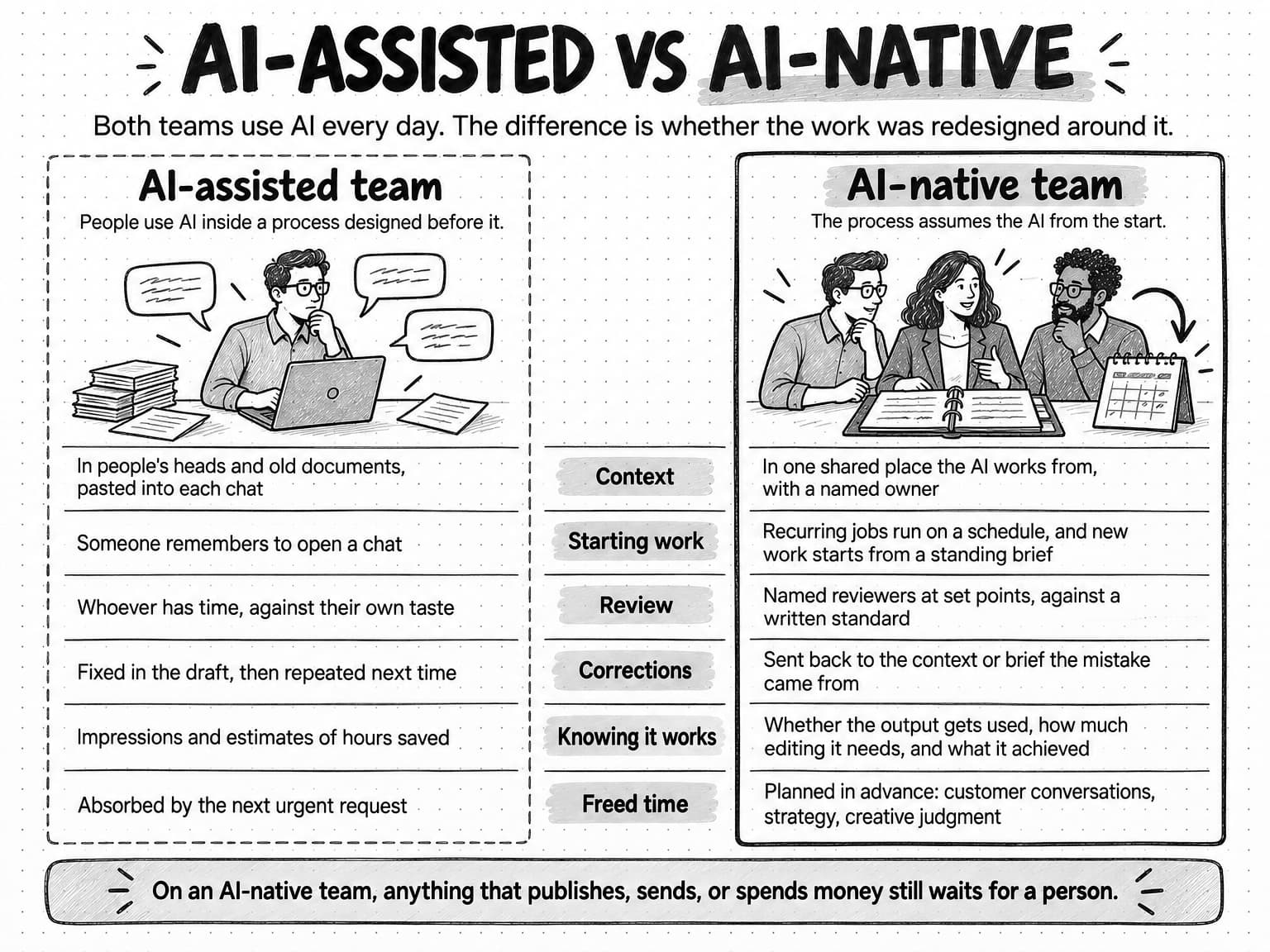
View the AI-assisted vs AI-native comparison at full size (opens in a new tab).
Why most AI pilots stall: what the evidence shows
Published figures on AI projects that stall or fail run from about half to 95%. They disagree because they count different things, ask different people, and were collected at different times. The table sets six of these sources side by side with what each one measured.
| Source and date | Who was asked or studied | What was counted | Finding |
|---|---|---|---|
| Gartner survey, published May 2024 | 644 respondents at organizations in the US, Germany, and the UK, surveyed in late 2023 | AI projects that reach production | On average, 48% of AI projects made it into production, and moving from prototype to production took eight months |
| BCG survey, published October 2024 | 1,000 senior executives in 59 countries | Companies showing tangible value from AI | 74% had yet to show tangible value, and 26% had the capabilities to move beyond proofs of concept |
| Gartner survey of marketing leaders, published February 2025 | 418 marketing leaders, July to September 2024 | Use of generative AI in marketing campaigns | 27% reported limited or no adoption |
| Marketing AI Institute report, 2025 | 1,882 respondents, recruited mainly through the institute's own channels, February to April 2025 | The stage marketers say their team is at | 40% understanding, 46% piloting, and 14% scaling (1,865 answered this question) |
| MIT NANDA report, July 2025 (labeled preliminary findings) | Interviews with people at 52 organizations, a survey of 153 senior leaders at four industry conferences, and a review of more than 300 public AI initiatives, January to June 2025 | Enterprise AI tools that reached production with a lasting effect on productivity or profit, as interviewees described it, judged about six months after a pilot | 95% of organizations were getting zero return; 60% had evaluated enterprise AI tools, 20% had reached a pilot, and 5% had reached production |
| McKinsey survey, published November 2025 | 1,993 participants, June to July 2025 | Organizations scaling AI across the enterprise | 88% used AI regularly in at least one function, and nearly two-thirds had not begun scaling it |
Two Gartner forecasts often appear next to these figures: that at least 30% of generative AI projects would be abandoned after proof of concept by the end of 2025, published in July 2024, and that more than 40% of agentic AI projects will be canceled by the end of 2027, published in June 2025. Both are predictions, not measurements. Another number that circulates, that 85% of AI projects fail, matches a February 2018 Gartner prediction that through 2022, 85% of AI projects would "deliver erroneous outcomes due to bias in data, algorithms or the teams responsible for managing them." That prediction was about wrong outputs; it didn't count failed projects.
RAND's 2024 study, based on interviews with 65 experienced data scientists and engineers, repeats an estimate from 2022 press coverage that more than 80% of AI projects fail. Its more useful finding is the most common root cause the interviewees described, in RAND's words "misunderstandings and miscommunications about the intent and purpose of the project." RAND's interviewees built AI systems, a different job from a marketer using an AI product, but the purpose problem shows up in marketing pilots too.
Treat every number in the table as a rough indication. Only two of the sources ask about marketing, and the larger of the two surveyed its own audience, which the publisher notes may show more understanding and adoption of AI than the broader industry. MIT NANDA's 95% needs the most care. Its authors call the figures "directionally accurate based on individual interviews rather than official company reporting," note that organizations define success differently, and warn that six months may be too short to judge longer projects, which could make success look rarer than it is. None of the sources measures what happens to a small marketing team's pilot.
Where the sources agree is more useful than any single rate: the obstacles they describe are mostly about people and process rather than the AI model. BCG's 2024 survey attributed about 70% of AI implementation challenges to people and process, 20% to technology, and 10% to the algorithms. McKinsey found that its high performers, the organizations attributing more than 5% of their earnings before interest and taxes to AI, were nearly three times as likely as others to have fundamentally redesigned their workflows, 55% against 20%, and that redesigning workflows had one of the strongest links to business impact of all the factors it tested. The six stall reasons below translate that pattern into the forms it takes on a marketing team.
Six reasons AI marketing pilots stall, and the fix for each
Each reason below is something a team can observe in its own pilot, and each fix becomes part of the operating model later in this guide.
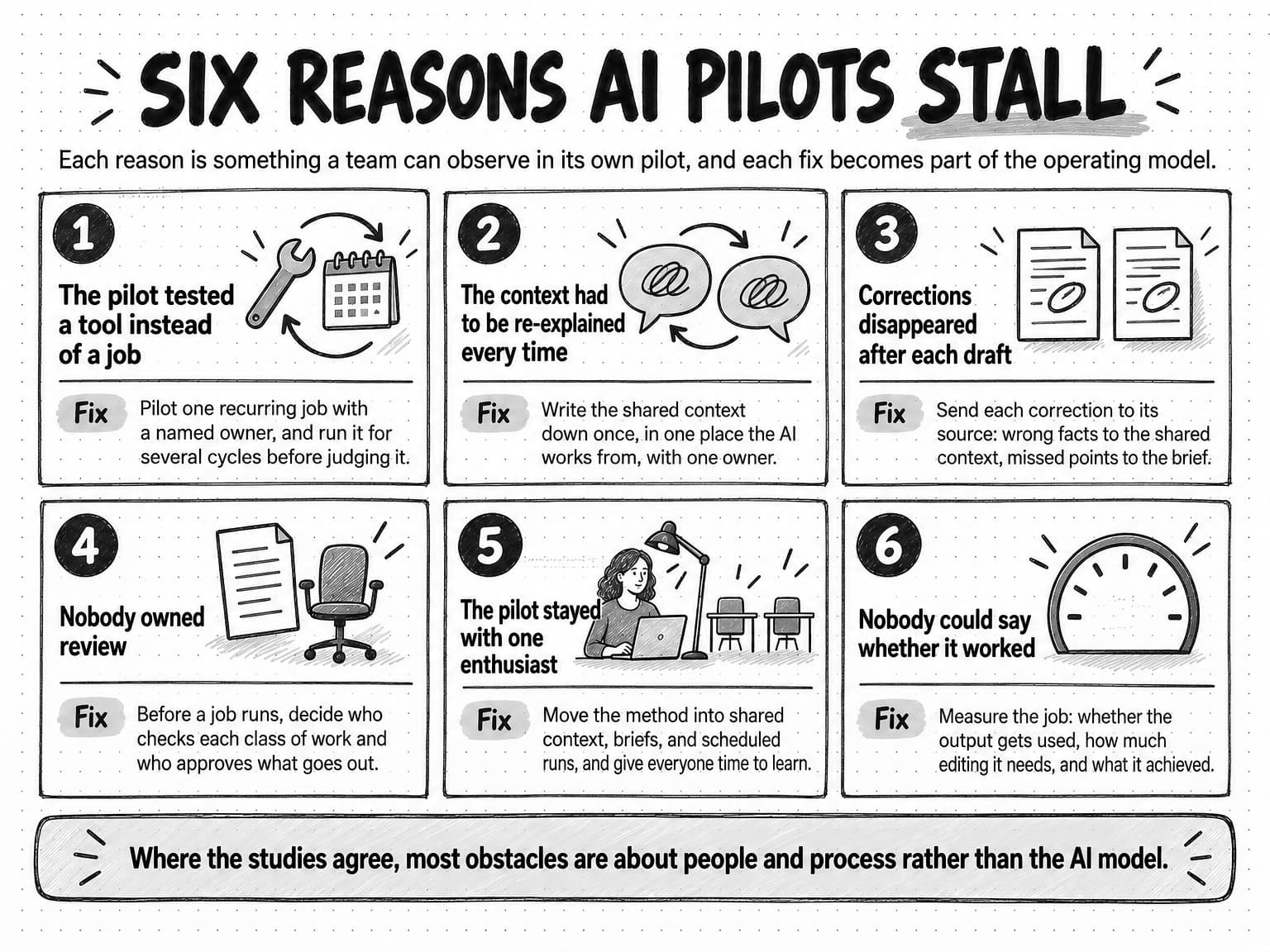
View the six stall reasons and their fixes at full size (opens in a new tab).
1. The pilot tested a tool instead of a job
Many pilots begin with a product and an open question: what can this do for us? The team tries it on a blog post, some ad headlines, a competitor scan, and a campaign plan, once each. Every result is interesting and none becomes routine, because no job was repeated often enough for the team to learn how to brief it, review it, and fit it into the week. This is the marketing version of the purpose problem RAND describes, and it fits a finding in BCG's 2024 survey: the companies furthest ahead with AI pursued about half as many AI opportunities as their less advanced peers.
The fix is to pilot a job. Choose a recurring job the team already does, such as the weekly competitor summary, name the person who owns it, and write down what a finished version looks like. Then run it every time it comes due, for several cycles, before judging it. Choosing between products is a separate, earlier test, covered in our guide to evaluating an AI marketing agent with your own work.
2. The context had to be re-explained every time
In most pilots the product details, audiences, voice, and proof points live in people's heads and scattered documents. Each person pastes in what they remember, so two people asking for the same thing get different answers, and drafts read as generic because the AI never learned what makes the company specific. One of the barriers users cited in the MIT NANDA report puts the cost plainly: "Too much manual context required each time."
The fix is to write the shared context down once, in one place the AI works from, and give it one owner who keeps it current and dates each change. Our guide to AI agent memory explains what that saved knowledge should hold and the routine that keeps it accurate.
3. Corrections disappeared after each draft
Reviewers in a pilot fix the draft in front of them: the wrong price, an outdated feature name, a phrase the brand never uses. The next week the same mistakes return, because the fix lived in that one document, and after a few rounds reviewers decide the AI can't learn. Another barrier listed in the same report says it in almost those words: "It doesn't learn from our feedback."
The fix is a rule the whole team follows: a correction goes to its source. A wrong fact gets fixed in the shared context, and a draft that missed the point gets a better brief. A correction that comes up twice means the problem is in the context or the brief. A short correction log for each recurring job, with the date, the change, and where it was fixed, makes repeats visible.
4. Nobody owned review
When nobody is named to review AI work, two failures appear, often on the same team. Some drafts wait for the founder or head of marketing, who becomes the bottleneck the AI was meant to remove. Others go out after a quick skim, because everyone assumed someone else had checked the claims. Slow work looks like no gain, and one published error makes everyone cautious.
The fix is to decide review by class of work before a job runs: who checks internal working material, who checks anything customers will read, and who approves anything that publishes, sends, or spends money. The operating model below sets this out.
5. The pilot stayed with one enthusiast
Many pilots work well for one person. The marketer who enjoys the tool builds good prompts, gets good results, and keeps both in a private chat history. Nobody else learns the method, so when that person gets busy or leaves, the practice stops. BCG's 2025 AI at Work survey of more than 10,600 people found that regular use among frontline employees had stalled at 51%, and that regular use was sharply higher among employees who had at least five hours of training and access to in-person training and coaching. In the Marketing AI Institute's 2025 survey, the barrier to AI adoption in marketing that respondents named most often was lack of education and training, chosen by 62%.
The fix is to move the method out of one person's chat history and into assets the team shares, such as the context, the briefs, and a scheduled run everyone can see, and to protect time for everyone to learn the approved tools.
6. Nobody could say whether it worked
A pilot that ends with "people liked it" or an estimate of hours saved rarely earns a second budget or a permanent place in the week. In Gartner's 2024 survey, the obstacle to AI adoption named most often, by 49% of participants, was the difficulty of estimating and demonstrating the value of AI projects. Hours saved is a weak answer, because the time is rarely traced to anything the business values.
The fix is to measure the job itself: whether the output gets used, how much editing it needs, how long the job takes from brief to approval, and whether it served its purpose, such as a sales conversation, a published article, or a decision. Our guide to measuring the ROI of AI in marketing covers the business case; the progress measures later in this guide track the practice.
The five stages from first pilot to daily practice
The five stages describe how a marketing team's practice changes between first experiments and work designed around AI. Each stage is defined by what the team does, so you can recognize it from the inside whatever tools you use.
| Stage | What it looks like | Where it usually stalls | What moves the team on |
|---|---|---|---|
| 1. Ad hoc | Individuals try AI tools on their own for occasional tasks. There's no shared context or rule, and results depend on who asked. | Nobody knows which tools are in use, what data goes into them, or whether any of it helps. | Approve a small set of tools with a short usage rule, and choose one recurring job to try together. |
| 2. Assisted | The team has approved tools, and most people use AI each week for drafts, research, and summaries. Each person prompts from scratch and pastes in their own context. | Results vary by person, the same corrections repeat, and use fades once the novelty wears off. | Write down the shared context and the brief for the first recurring job, and name a context owner. |
| 3. Systematic | Shared context, written briefs, and a review standard make results repeatable from one person to the next. | Every job still starts by hand, so it runs only when someone remembers and has time. | Put the proven jobs on a schedule with set review points, and start a regular quality sample. |
| 4. Delegated | Recurring jobs run on a schedule or trigger and come back for review. Named people review at set points, approve anything that goes out, and track how much editing each job needs. | The rest of the team's week hasn't changed, so the time the jobs free up drains into other requests. | Plan roles and the week around the system, and decide each month what to hand over, change, or stop. |
| 5. AI-native | New work starts with a decision about which parts the AI does and which need a person. Context, review, and quality routines are on the calendar, and people spend more time on work only they can do. | Jobs keep running after they stop being useful, or quality drifts after a model or tool change and nobody notices. | Keep the monthly review and the quality samples, and retire jobs that no longer earn their review time. |
Apply the stages job by job. A team can run its weekly competitor summary at stage 4 while its launch messaging stays at stage 2, and that can be the right call: some work is too infrequent, too consequential, or too dependent on fresh judgment to systematize. The team's overall stage is a rough summary of where most of its recurring work sits.
Teams move up one stage at a time because each stage builds what the next one needs. Scheduling a job before its context and brief are written down automates the inconsistency of stage 2: the job runs on time and produces a different mistake each week. BCG's 2025 study of more than 1,250 companies makes a similar point at company scale, reporting that companies that try to jump straight to reshaping their work, without first building the capabilities it needs, typically fail.
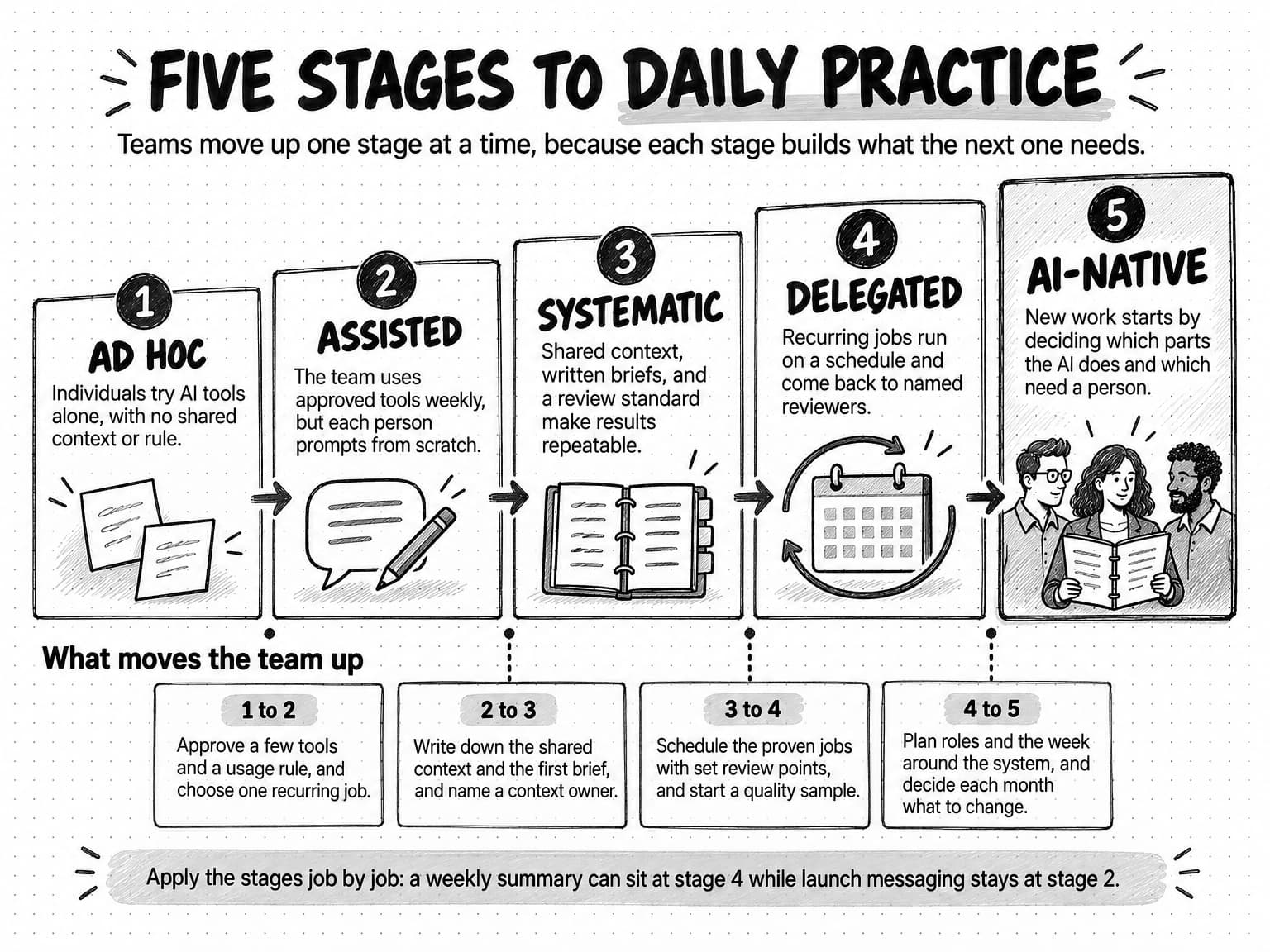
View the five stages diagram at full size (opens in a new tab).
Other maturity models work at a broader scale. Gartner's AI maturity toolkit assesses an organization across seven areas: strategy, product, governance, engineering, data, operating models, and culture. Microsoft's 2025 Work Trend Index, based on a survey of 31,000 workers in 31 markets, describes three phases, from AI as an assistant to people directing agents that run whole processes. The five stages here are narrower: they describe one marketing team's practice in terms the team can see and change.
Readiness self-assessment: which stage is your team at?
Score each statement for your team as it works today: 2 if it's true, 1 if it's partly true or true for some jobs, and 0 if it isn't true. Score what the team does now; plans don't count. The assessment works best when two or three people score it separately and then compare answers, because the disagreements show where practice differs from what the team believes about itself.
| # | Stage | Statement | Score |
|---|---|---|---|
| 1 | Assisted | The team has approved AI tools and a short written rule about what may and may not go into them. | 0 / 1 / 2 |
| 2 | Assisted | Most people on the team use AI for real work every week. | 0 / 1 / 2 |
| 3 | Assisted | Everyone has had time set aside to learn the approved tools, not only the people who volunteered. | 0 / 1 / 2 |
| 4 | Systematic | The brand, products, audiences, and approved claims are written down in one place the AI works from, and one named person keeps it current. | 0 / 1 / 2 |
| 5 | Systematic | Each recurring job the AI helps with has a written brief and a description of what finished looks like, and everyone uses the same ones. | 0 / 1 / 2 |
| 6 | Systematic | Reviewers check work against a written standard, and corrections go back into the shared context or the brief, not only into the draft. | 0 / 1 / 2 |
| 7 | Delegated | At least one recurring job runs on a schedule or trigger, and its results come back to a named reviewer. | 0 / 1 / 2 |
| 8 | Delegated | Anything that publishes, sends, spends money, or makes a claim about customers or results waits for a named person's approval. | 0 / 1 / 2 |
| 9 | Delegated | For each delegated job, the team tracks whether the output is used and how much editing it needs. | 0 / 1 / 2 |
| 10 | AI-native | A sample of AI work is scored against a written rubric on a fixed schedule, and low scores lead to changes in briefs, context, or tools. | 0 / 1 / 2 |
| 11 | AI-native | When new work comes in, the team first decides which parts the AI will do and which need a person, and plans the week around that. | 0 / 1 / 2 |
| 12 | AI-native | Once a month, the team reviews which job to hand over next, what to change, and what to stop. | 0 / 1 / 2 |
Start with the three Assisted statements. If all three score 2, move to the Systematic statements, and continue up the table. Your stage is the last one where every statement scored 2; if any Assisted statement scored below 2, the team is at stage 1, ad hoc. The first statement that scored below 2 is your next piece of work.
The order matters. A team that runs a scheduled job (statement 7) without shared context (statement 4) is at stage 2 by this reading, and that's deliberate: the scheduled job runs on the same inconsistent inputs as everyone's private chats. The total, out of 24, matters less than the stage, but it's useful for tracking progress. Rescore every quarter: the total rises with each improvement, while the stage changes only when every statement at the next level scores 2.
The AI-native operating model in four questions
The operating model is the set of decisions that turns individual use into team practice. Its four questions address all six stall reasons between them, and a small team can answer them on one page. They build on the conditions that our guide to agentic marketing says a team needs before agents take on more of the work.
Who owns the context the AI works from?
Shared context is the written knowledge every AI job draws on: positioning and messaging, audiences and their problems, products, pricing and plans, voice and style rules, approved claims with the source for each, competitors, and the things the company never says. One person owns it, often the product marketer on a larger team, because positioning and claims already sit with that role.
Owning the context doesn't mean writing all of it. Other people may keep their own parts current, but the owner decides what goes in, accepts or rejects proposed changes, and makes sure each change lands in the same week as the event behind it, such as a price change, a launch, or a new competitor. Everyone sends corrections through the owner instead of editing their own copies, because copied context drifts. Our guide to context engineering explains where context should live and who keeps it current, layer by layer.
Who reviews what?
Review works best when it's assigned by class of work before a job runs. Four classes cover most marketing work:
| Class of work | Examples | Who reviews | What they check |
|---|---|---|---|
| Internal working material | Research summaries, competitor notes, outlines, and briefs | The person who will use it | The facts they'll rely on, and that each one has a source |
| Customer-facing drafts | Posts, articles, emails, ads, and sales material | The job owner, plus the owner of any claim the draft makes | The audience and angle, the claims and their sources, and the voice |
| Anything that goes out | Publishing, sending, spending, deleting, or changing a live page | A named approver | The exact final version, its destination, and its timing |
| Results of recurring runs | Each run of a scheduled job | The job owner | That the run meets the job's standard, and whether quality is drifting |
Two rules keep review honest. The approver for anything that goes out is a named person, never "the team", and approving means reading the final version rather than a summary of it. And review time is part of the job's cost: if a job's output needs heavy editing every time, the job needs a better brief or better context. Our guide to human-in-the-loop AI covers the five points where review belongs in AI marketing work and how deep each check should go.
Which work becomes a scheduled task?
A scheduled task is a saved job that runs on a cadence and returns its result for review. Not every recurring job should be one. Before you schedule a job, check five things:
- It recurs. The same job comes due at a predictable cadence: weekly, monthly, or after a known event.
- Its inputs are stable. The sources and context it needs are available each time without someone gathering them by hand.
- Finished is defined. The brief says what a good result contains, so a reviewer can judge it in minutes.
- A reviewer has time at that cadence. A weekly job needs a weekly slot on someone's calendar.
- It has already run well by hand. The team has run it interactively several times, and the recent results needed only light edits.
If any answer is no, keep the job interactive and fix the missing piece first. Scheduling a job that hasn't run well by hand only makes its problems arrive on time. Work that needs fresh judgment about what to say each time stays interactive, however often it comes up. The step-by-step version, from writing the acceptance test and making the first interactive run to production, is in our guide to automating marketing with AI agents.
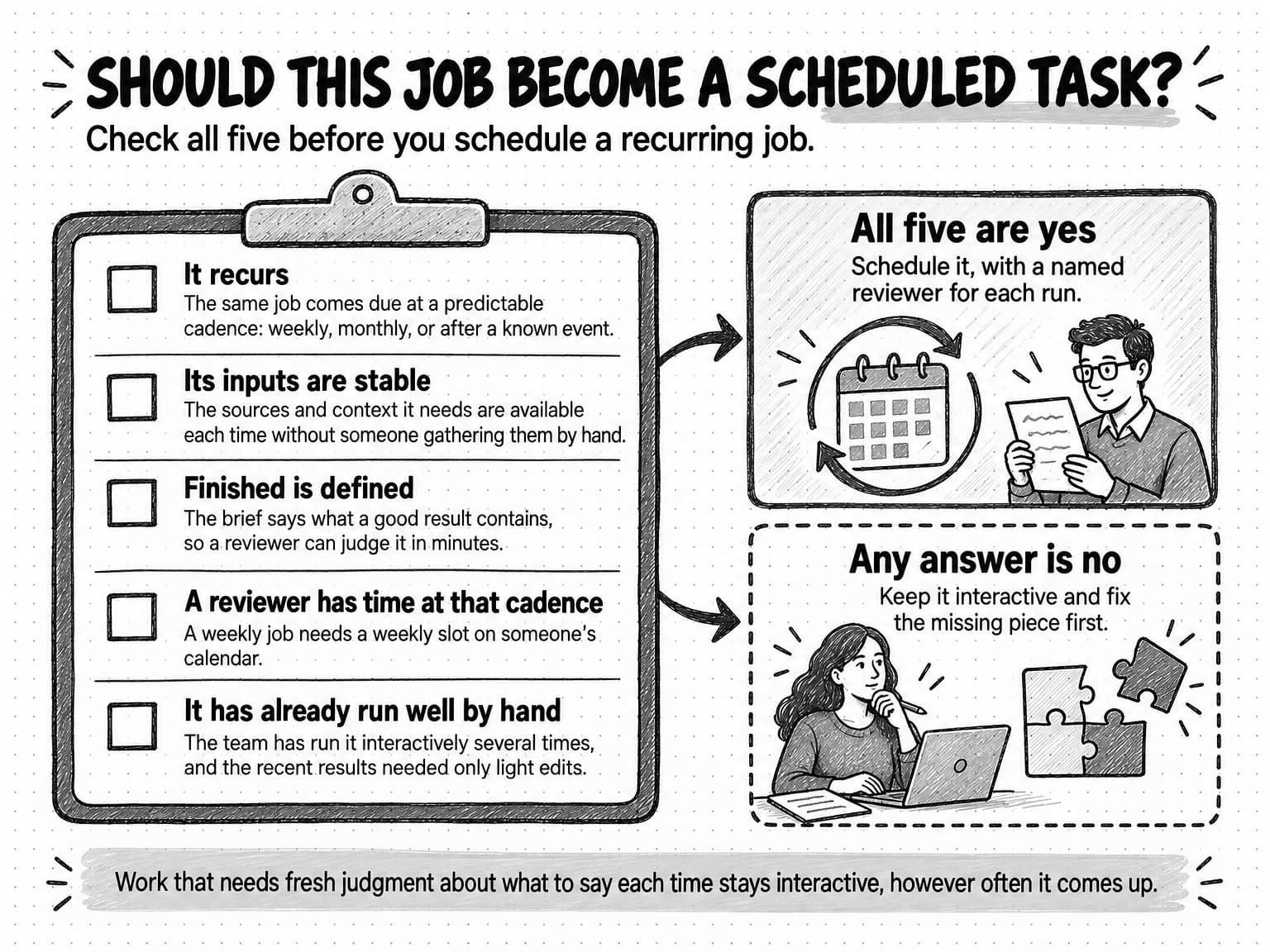
View the scheduled task checklist at full size (opens in a new tab).
How is quality checked?
Review catches the mistakes in one output. A quality check asks whether a job is getting better or worse over time, which no single review can show. The simplest version takes an hour a month:
- Write a short rubric for each job. Start with pass or fail gates for the faults that make an output unusable, such as an unsupported claim or a missing required part. Then add four or five criteria, each scored from 1 to 4, such as accurate, on-brand, specific, useful, and ready to ship.
- Each month, score up to five recent outputs from each recurring job against the rubric. Check the gates first, and never average a failed gate into a score. Decide in advance which runs go in the sample, so it isn't only the ones that looked odd, and when possible have someone other than the job owner score them.
- Record the scores next to the job's correction log, and compare them with the previous month's.
- When a score falls, trace it to a cause before changing anything: stale context, a weak brief, a changed source, or a change in the AI model or tool.
- After any material change, such as a new model, a new tool, or a rewritten brief, score the next few outputs straight away.
That routine samples live work. A full AI eval adds a golden set: a fixed set of past briefs with their sources, rerun after any change to the model, brief, or tool, so every change is measured against the same tasks. Our guide to AI evals covers both, with a rubric, a scoring sheet, and an AI judge prompt you can copy.
Roles and routines in an AI-native marketing team
An AI-native team doesn't need new job titles. It needs five responsibilities, each with a named holder. On a small team one person holds several; what matters is that nobody has to guess who decides.
| Responsibility | What it covers | On a team of three | On a team of ten |
|---|---|---|---|
| Sponsor | Chooses which jobs come next, protects learning time, and uses the shared context and briefs in their own work | Founder or head of marketing | Head of marketing |
| Context owner | Keeps the shared context current and decides on proposed changes | Head of marketing | Product marketer |
| Job owner | Writes the brief for one recurring job, reviews its runs, and keeps its correction log | Whoever does that job today | The specialist for that channel or job |
| Approver | Signs off anything that publishes, sends, or spends money | Head of marketing | The channel lead, with the head of marketing for anything high-stakes |
| Quality reviewer | Runs the monthly sample and reports the scores | The other two team members, taking turns | Rotates monthly |
Three routines keep the model working. Each is short, and each goes on the calendar so it doesn't depend on someone remembering.
| Routine | Cadence | Owner | Time | What it produces |
|---|---|---|---|---|
| Context review | Monthly, and in the week of any launch, price change, or repositioning | Context owner | About an hour | A dated list of changes to the shared context |
| Quality sample | Monthly | Quality reviewer | About an hour | Scores for each recurring job, compared with the previous month |
| Retro | Monthly | Sponsor, with the whole team | 30 to 45 minutes | Decisions on what to hand over next, what to change, and what to stop |
The retro is where the operating model improves. A short agenda keeps it to decisions:
| 1. What ran | For each recurring job: how many runs, how many outputs were used, and the latest quality score |
|---|---|
| 2. What repeated | Corrections that came up more than once, and whether each was fixed at its source |
| 3. What changed | Any change to a model, tool, source, or the shared context since the last retro, and its effect |
| 4. What to hand over next | One job to move up a stage, with its owner and a start date |
| 5. What to stop | Any job whose output isn't used or doesn't earn the time it takes to review |
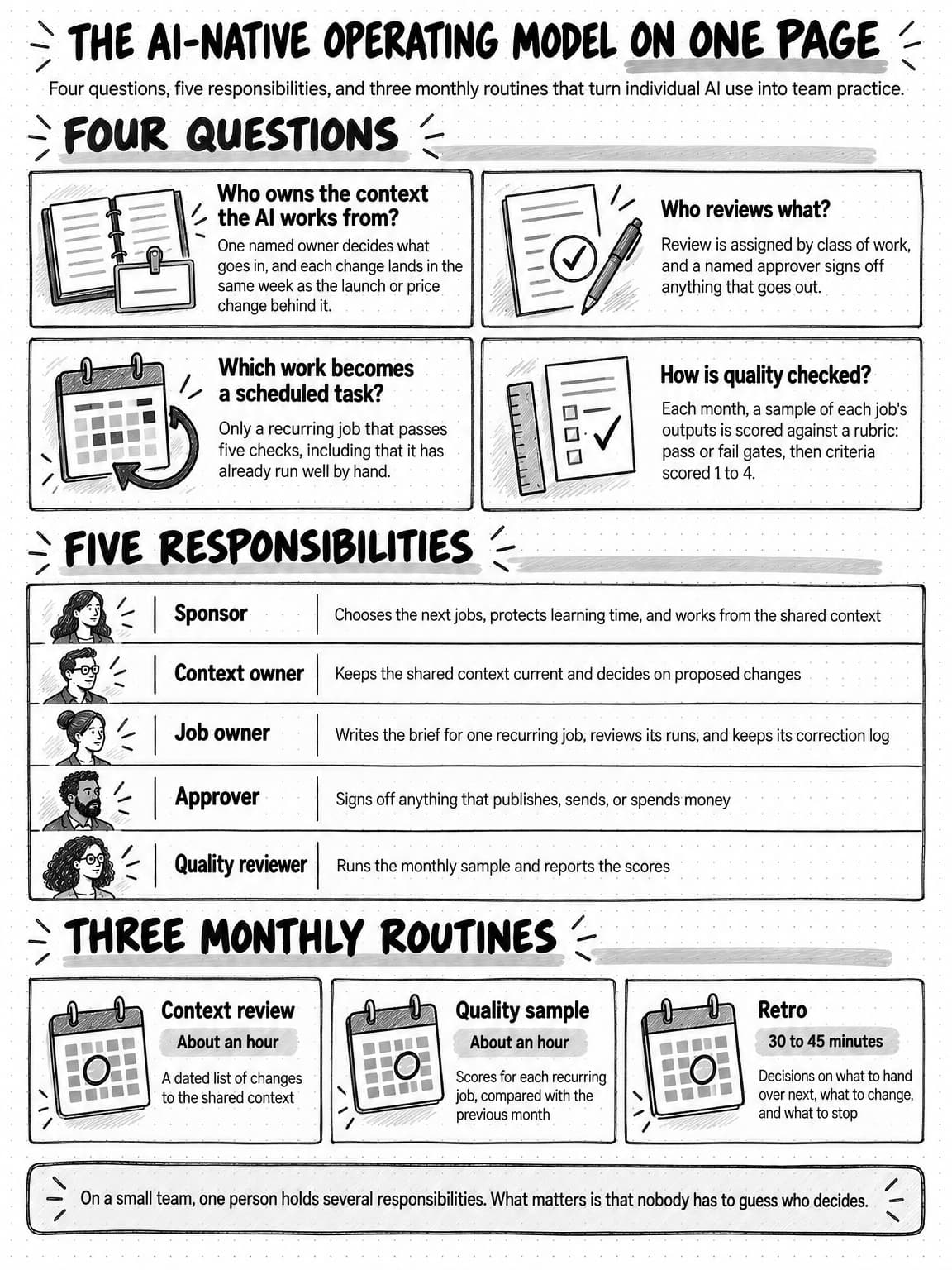
View the one-page operating model reference at full size (opens in a new tab).
What to hand over to AI first
The first jobs set the team's expectations, so choose them for what the team will learn rather than for how impressive the result looks. Good first jobs come up often, are already well understood by the team, can be checked quickly, and carry little risk because a person reviews them before anything goes out. They also have an owner who wants the time back.
| First job | Why it's a good start | Who reviews |
|---|---|---|
| Weekly competitor and market summary | Frequent, easy to check against its sources, and useful to sales | The product marketer or head of marketing |
| Monthly performance report draft | A fixed structure, figures that can be checked, and slow to do by hand | Whoever reports to leadership |
| Social post drafts from approved source material | Clear inputs and quick to review, and voice problems show up fast | The content owner, with an approver before anything is posted |
| Research brief before a campaign | Speeds up the slowest part of planning, and the review stays internal | The campaign owner |
| Synthesis of customer interviews or feedback | Turns raw notes into themes the team can check against those notes | The person who ran the interviews |
Leave for later the jobs where a weak first result is costly or hard to spot: positioning, pricing pages, launch messaging, responses to complaints, and anything legal or regulated. Those can still use AI for research and options, but they stay at the assisted stage until the rest of the model is in place. Whatever the first job is, its brief decides much of the result, and our guide to briefing an AI marketing agent gives a reusable template.
How to bring your marketing team along
A change in how work is organized raises an obvious question for everyone on the team: what does this mean for my job? BCG's 2025 AI at Work survey found more of that worry where the change went further: 46% of employees at organizations undergoing comprehensive AI-driven redesign worried about job security, against 34% at less advanced companies. Say plainly what the change is for: more capacity for the work the team rarely gets to, such as customer interviews, sharper positioning, stronger creative, and better follow-through on campaigns.
Decide what the freed time is for before the first job starts. Otherwise it fills with whatever is urgent.
In the same survey, the share of employees who felt positive about generative AI rose from 15% to 55% with strong leadership support, yet only about a quarter of frontline employees said they received that support, and only a third of employees said they had been properly trained. On a small marketing team, support is concrete: the sponsor works from the shared context and briefs, reviews on time, and keeps learning time on the calendar.
Clear rules help people try things with confidence, because they know where the edges are. A short AI usage policy says which tools are approved, what data must never go into them, and which actions need a person's approval; our guide to AI guardrails for marketing teams includes a template. Some people will already be using tools the team never approved. Treat that as information about what the approved tools lack, and move the useful work onto approved tools; our guide to shadow AI covers how to do that without blame.
Involve the people who do the work in choosing what to hand over. They know which tasks are tedious, which are risky, and where a good draft would save the most time, and a job someone chose is a job they'll review with care.
How to measure progress toward AI-native work
Hours saved is usually estimated rather than measured, and it says nothing about whether the work got better. Five measures that a small team can collect by hand say more about the practice.
| Measure | What it tells you | How to collect it |
|---|---|---|
| Jobs at each stage | Whether recurring work is moving up the stages | List the recurring jobs and their stage at each quarterly self-assessment |
| Outputs used with light edits | Whether the output is good enough to use | For each job, the share of outputs used after only line edits |
| Repeat corrections | Whether fixes reach their source | Count the corrections in each job's log that had appeared before |
| Time from brief to approval | Whether the whole job is faster, review included | The date of the brief and the date of approval for each output |
| Quality score | Whether quality holds over time and after changes | Gate failures and the average criterion score in each job's monthly sample |
Add one measure of outcome for each job, chosen from what the job is for: the competitor summary is useful if sales uses it, the report if leadership makes decisions from it, and the post drafts if the posts perform as well as the team's best work without AI. BCG's 2025 study found that more than 60% of the companies it rated most advanced in AI rigorously tracked its value, against 17% of the companies it classed as stagnating. Turning these measures into a financial return is a separate calculation, which the ROI guide linked earlier covers.
Worked example: one fictional team's AI-native week
Kiteleaf is a fictional company invented for this guide. It sells inventory software to independent restaurant groups, and its marketing team has four people: a head of marketing, a product marketer, a content lead, and a marketing generalist. Every score, count, and time in this example is illustrative.
At the start of the year, Kiteleaf had already run two AI pilots: chat assistants for drafting, which everyone still used, and a six-week pilot of an AI agent that produced a strong first round of competitor summaries before use faded. When the team took the self-assessment, it scored 8 out of 24. The three Assisted statements scored 2, which put the team at stage 2, but the Systematic statements scored 0, 1, and 0, and statement 8, on approvals, scored 1. The product description lived in four people's heads, and reviewers had corrected the same wrong claim about Kiteleaf's integrations in five separate drafts.
Over the next four months, the team made four changes:
- The product marketer became the context owner and wrote the shared context in two weeks: positioning, three audiences (owner-operators, operations managers at multi-site groups, and finance leads), products and plans, voice rules, and twelve approved claims, each with its source.
- The team chose three recurring jobs, each with an owner and a written brief: a weekly competitor and market summary, LinkedIn post drafts from the monthly customer webinar, and a draft of the monthly performance report.
- Each job ran interactively for a month. The competitor summary and the monthly report then moved to a schedule. The webinar posts stayed interactive, because each month's recording needs the content lead's judgment about the angle.
- From the first month, each job owner kept a correction log, and the content lead and the product marketer scored a monthly sample of outputs against a short rubric, each scoring the jobs they don't own. By month four, review was assigned by class of work, and the team had held its first retro.
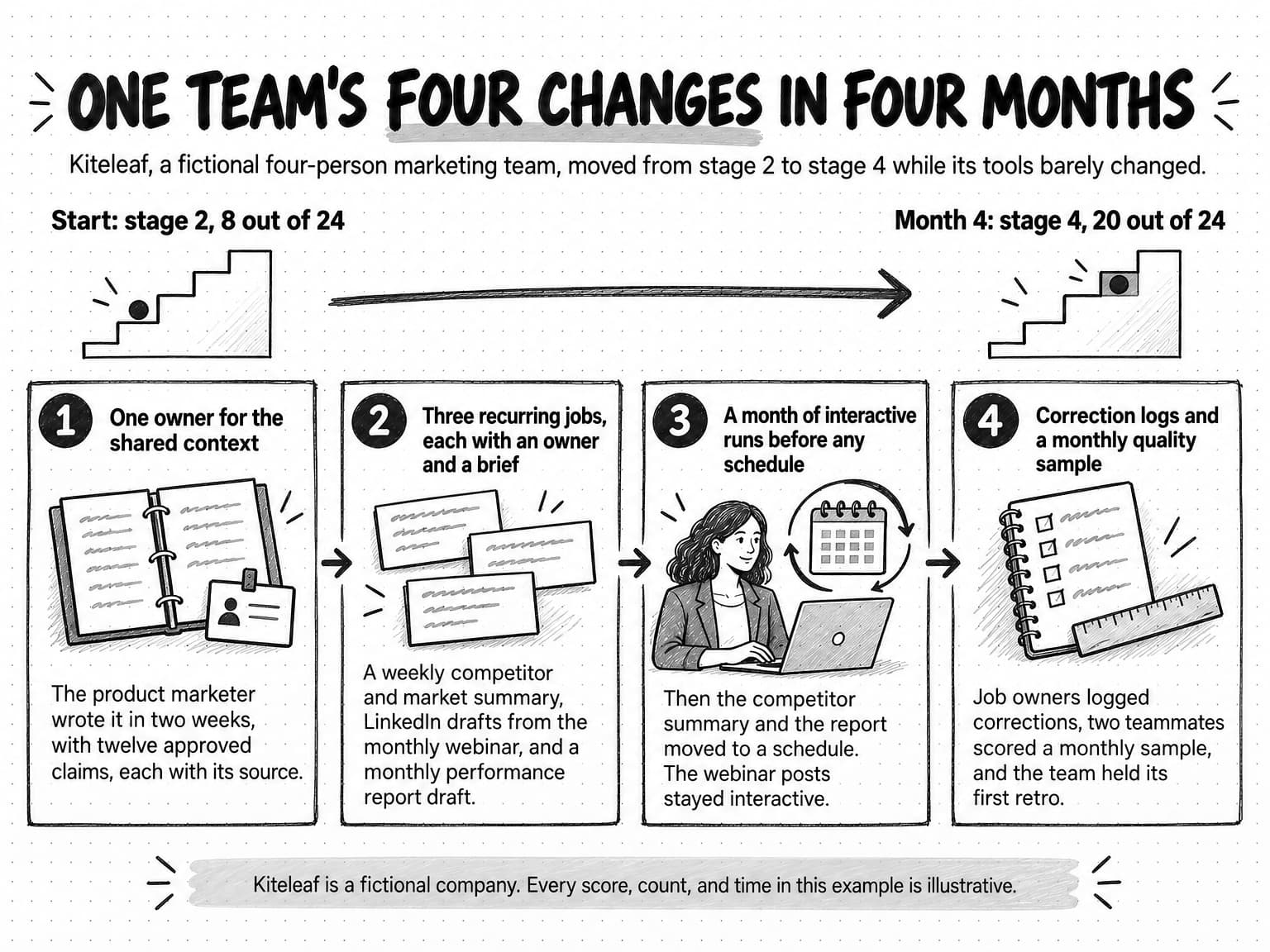
View Kiteleaf's four changes at full size (opens in a new tab).
When the team rescored itself after four months, it reached stage 4 with 20 out of 24. The gaps were at stage 5: the quality scores hadn't yet led to a change in any brief, new work was still planned the old way, and the team had held only one retro. This is the team's week at the start of month five.
| Day | What the AI prepared | Who reviewed it | What happened next |
|---|---|---|---|
| Monday | The weekly competitor and market summary, from its scheduled task | The product marketer, in 15 minutes, checking two pricing claims against their sources | One competitor's new pricing went to sales. A line about Kiteleaf's own reporting feature, out of date since the previous week's release, was corrected in the shared context, not only in the summary. |
| Tuesday | Five LinkedIn post drafts from last week's customer webinar, prepared in an interactive session | The content lead, in 40 minutes: cut two drafts, rewrote one opening, and checked the customer's quote against the recording | The head of marketing approved three posts, and the content lead published them over the following week. |
| Wednesday | A research brief for a new campaign aimed at restaurant finance leads | The head of marketing and the product marketer, in 30 minutes | They changed the campaign's angle after reading the evidence on how finance leads compare inventory software. |
| Thursday | The draft of the monthly performance report, from its scheduled task | The marketing generalist, in 25 minutes, checking every figure against the analytics source | The head of marketing added the interpretation and sent the report to the CEO. |
| Friday | Nothing new: the team ran its monthly routines | The content lead scored the month's four competitor summaries and its report draft, and the product marketer scored the five LinkedIn drafts: ten outputs in about an hour between them | At the retro, the team chose first drafts of case studies as the next job, added two industry sources to the competitor summary, and stopped a weekly trend-ideas prompt, left over from the earlier pilots, that nobody had used in a month. |
Across the week, reviewing and scoring AI work took a little over three hours of the team's time, plus a 45-minute retro. The time the scheduled jobs freed went to work that had been slipping: two interviews with restaurant finance leads, planning a partner webinar, and rewriting the pricing page with the evidence from Wednesday's brief.
| Measure | Month 1 | Month 4 |
|---|---|---|
| Competitor summaries used in the weekly sales meeting | 2 of 4 | 4 of 4 |
| LinkedIn drafts used after only line edits | 1 of 5 | 3 of 5 |
| Repeat corrections in the logs | 6 | 1 |
| Average quality score, out of 4 | 2.6 | 3.3 |
The tools Kiteleaf used barely changed between the stalled pilots and this week. What changed were the decisions around them: one owner for the context, an owner and a brief for each job, review assigned by class of work, two jobs on a schedule, and a monthly hour to decide what to change next.
How an AI-native marketing team works in Ampere
Several parts of Ampere, the AI marketing agent, line up with the operating model in this guide.
Context. Ampere keeps an Organization's shared context in Brand memory. During setup, it researches the brand from its website or a short business brief and saves its products, competitors, colors, logo, and visual identity. Its 22 Brand memory skills can research and save further reports, such as positioning, voice, audiences, and pricing. People can view and edit each report, and each has a default refresh cadence: 12 months for most briefs, 30 days for trend snapshots, and 14 days for recent news. Projects keep briefs, files, reusable assets, and related sessions together, so new work in a Project starts with context.
Roles. Organization roles are owner, admin, member, and viewer, and billing access is granted separately. Sessions can be shared with view, edit, or owner access, so a reviewer can open the work a teammate ran.
Recurring work. A scheduled task can save a prompt for Ampere, be bound to a Project with saved attachments, and run hourly, daily, weekly, monthly, or when someone starts it. Ampere can propose a scheduled task in chat, and the proposal becomes a saved task only when someone accepts it. Each run's result is kept in the task's run history for review, run-update emails can go to the Organization members the team chooses, and the Scheduled Tasks dashboard names the tasks that need attention and shows the success rate of runs for a chosen period. Monitoring checks supported public sources every hour, day, or week, files the available evidence and source excerpts when something changes, and starts follow-up work only if the team has set one up. Monitoring can miss a change or return only partial evidence, so it supplements the team's own watch on the market.
Review and method. Ampere pauses with a question when work can't continue without a fact nobody has supplied, and the person who owns a session can get an email when Ampere needs their input or when work is ready to review. Ampere drafts and prepares, and people approve and publish. Its outputs can be inaccurate or incomplete, so the review rules above still apply. It works from Ampere-maintained marketing skills, evaluated against defined task, tool, and output expectations, so the team doesn't have to write the method for common marketing jobs from scratch.
A first result for teams at the early stages. Eligible accounts in supported regions that have never had a paid plan can start on the Free Plan with no payment or card. Ampere sets up Brand memory, then completes up to four Free tasks for the brand: a LinkedIn content audit, a LinkedIn image post, a LinkedIn carousel, and a LinkedIn text post. Up to five people, counting the owner and pending invitations, share the Organization's one Free allowance and its Brand memory. Your own prompts and follow-up questions, 200+ AI tools & skills, Scheduled Tasks, and Monitoring come with paid plans, so running recurring jobs in Ampere needs a paid plan.
Sources and further reading
- Ericsson, “Defining AI native: A key enabler for advanced intelligent telecom networks”, white paper, February 2023.
- Gartner, “Gartner Says Nearly Half of CIOs Are Planning to Deploy Artificial Intelligence”, press release, February 13, 2018. The source of the 85% prediction.
- Gartner, “Gartner Survey Finds Generative AI Is Now the Most Frequently Deployed AI Solution in Organizations”, press release, May 7, 2024.
- Gartner, “Gartner Predicts 30% of Generative AI Projects Will Be Abandoned After Proof of Concept By End of 2025”, press release, July 29, 2024.
- Gartner, “Gartner Survey Reveals Over a Quarter of Marketing Organizations Have Limited or No Adoption of GenAI for Marketing Campaigns”, press release, February 18, 2025.
- Gartner, “Gartner Predicts Over 40% of Agentic AI Projects Will Be Canceled by End of 2027”, press release, June 25, 2025.
- Gartner, AI Maturity Model and AI Roadmap Toolkit, research page.
- James Ryseff, Brandon De Bruhl, and Sydne J. Newberry, “The Root Causes of Failure for Artificial Intelligence Projects and How They Can Succeed: Avoiding the Anti-Patterns of AI”, RAND Corporation, August 13, 2024.
- Boston Consulting Group, “AI Adoption in 2024: 74% of Companies Struggle to Achieve and Scale Value”, press release, October 24, 2024.
- Vinciane Beauchene and colleagues, “AI at Work: Momentum Builds, but Gaps Remain”, Boston Consulting Group, June 26, 2025.
- Jessica Apotheker and colleagues, “The Widening AI Value Gap: Build for the Future 2025”, Boston Consulting Group, September 2025.
- Alex Singla and colleagues, “The state of AI in 2025: Agents, innovation, and transformation”, McKinsey & Company, November 2025.
- Aditya Challapally and colleagues, “The GenAI Divide: State of AI in Business 2025”, MIT NANDA, July 2025. Labeled preliminary findings; linked as the Internet Archive’s August 18, 2025 capture of the PDF that MIT hosted at publication.
- Marketing AI Institute and SmarterX, 2025 State of Marketing AI Report, 2025.
- Microsoft, “2025: The year the Frontier Firm is born”, Work Trend Index, April 23, 2025.
Frequently Asked Questions
What is the difference between AI-native and AI-enabled?
AI-enabled, sometimes called AI-assisted, describes AI added to a product or process that was designed without it. AI-native describes one designed with AI as part of it from the start. On a marketing team, an AI-enabled team pastes context into private chats and reviews whatever comes back, while an AI-native team keeps shared context with an owner, runs recurring jobs on a schedule, and reviews against a written standard.
What is an AI-native company?
An AI-native company is usually one founded around AI, whose products and operations assumed it from the first day instead of adding it later. A marketing team doesn't have to work at one to be AI-native, because the change that matters is in the team's working practice: shared context, standing briefs, scheduled recurring jobs, and named reviewers.
Why do AI projects fail?
Studies of AI adoption mostly point to people and process rather than the AI model. BCG's 2024 survey of 1,000 executives attributed about 70% of AI implementation challenges to people and process, and RAND's 2024 interviews found misunderstanding about a project's purpose to be the most common root cause. Marketing pilots usually stall when nobody owns the context, the review, or the measure of success.
Do 85% of AI projects fail?
Not as a measured fact. The 85% figure matches a February 2018 Gartner prediction that through 2022, 85% of AI projects would deliver erroneous outcomes because of bias in data, algorithms, or the teams managing them. That was a forecast about wrong outputs, not a count of failed projects. Measured rates depend on what is counted: a 2024 Gartner survey found that 48% of AI projects reached production.
Is it true that 95% of AI pilots fail?
Not in the way the number is usually repeated. It comes from MIT NANDA's July 2025 report, labeled preliminary, which found 95% of organizations getting zero return from generative AI, judging success by a lasting effect on productivity or profit about six months after a pilot. The study drew on interviews at 52 organizations, a survey of 153 senior leaders, and a review of more than 300 public AI initiatives, and its authors say the figures are directionally accurate, drawn from interviews rather than company reporting.
What is an AI maturity model?
An AI maturity model is a staged description of how an organization's use of AI develops, used to judge where it stands and what to build next. Gartner's toolkit assesses seven areas, including strategy, governance, data, and culture, while Microsoft's 2025 Work Trend Index describes three phases. For a single marketing team, a narrower model built on observable practice is easier to act on.
What are the stages of AI maturity for a marketing team?
One practical model has five stages. At the ad hoc stage, individuals experiment alone. Assisted teams have approved tools and use them weekly, but each person prompts from scratch. Systematic teams work from shared context, written briefs, and a review standard. Delegated teams run recurring jobs on a schedule and review the results. AI-native teams start new work by deciding which parts the AI does and which need a person.
How do you assess a marketing team's AI maturity?
Score twelve statements about how the team works today, from 0 to 2, with three statements for each of the assisted, systematic, delegated, and AI-native stages. The team's stage is the last one where every statement scores 2, and the first statement below 2 is the next piece of work. Have two or three people score separately and compare their answers, then rescore every quarter.
How do you get a marketing team to adopt AI?
Get a marketing team to adopt AI by explaining what the change is for, such as more time for customer interviews, and by showing support from the top: in BCG's 2025 survey, the share of employees positive about generative AI rose from 15% to 55% with strong leadership support. Then give everyone time to learn the approved tools, set clear rules, and let the people who do the work choose what to hand over first.


