AI outputs may be inaccurate
Understand why Ampere outputs can need review, what to check before using them, and how to improve the next run.
Last reviewed August 2026
Ampere can help you create drafts, images, research summaries, analysis, project assets, and other marketing work faster. AI-generated work still needs human review before you rely on it, publish it, send it to customers, or use it for business decisions.
Use this article when an output looks wrong, incomplete, duplicated, off-brand, or not ready to use.
Why review is still required
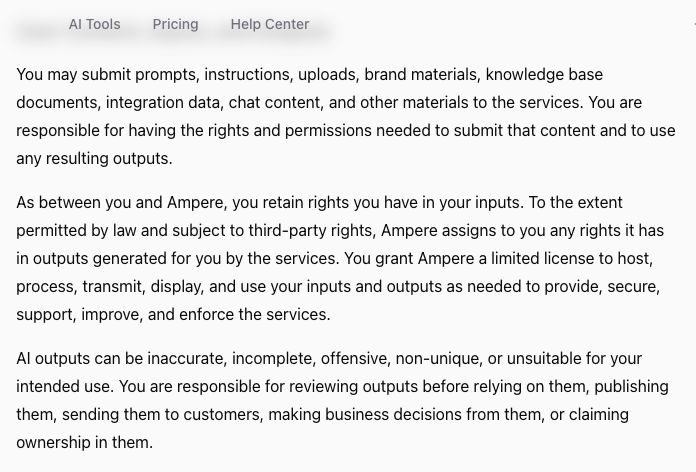
AI outputs can be inaccurate, incomplete, non-unique, or unsuitable for your intended use. Some tools also depend on public web, social, ads, review, or provider-backed data that can be partial, unavailable, rate-limited, noisy, or out of date.
That means Ampere should be treated as a creative and research agent, not as the final approver for your team. Review the output against your source material, brand standards, legal requirements, campaign goals, and any channel rules before you use it outside Ampere.
What to check first
Before you use an output, check the parts that matter most for the job:
- Facts, dates, names, statistics, claims, links, citations, and quoted material.
- Brand voice, tone, offer details, audience fit, and campaign objective.
- Rights, approvals, disclosures, and whether the output is safe to publish in the channel you plan to use.
- Completeness, formatting, file quality, and whether any sections, slides, images, rows, or assets are missing.
- Public-data caveats, especially when an AI Tool depends on external sources that may return partial or noisy data.
For customer-facing work, use your normal review process. Ampere can speed up the draft, but your team decides what is accurate, approved, and ready to ship.
If an output is wrong or incomplete
If the work is close, edit the output directly where the product allows editing, or ask Ampere to revise it with specific instructions. Point to what is wrong, what should change, and any source material that should guide the revision.
If the work is not usable, rerun the task with clearer context. Include the goal, audience, brand guidance, required inputs, examples to follow, facts to preserve, and constraints to avoid. For research or public-data work, narrow the source, company, competitor, time range, or topic so the tool has a clearer target.
If the output appears based on missing or unreliable public data, do not force a confident conclusion. Use the available parts, note what could not be verified, or run a more focused tool that gathers the missing source material.
When to stop and verify outside Ampere
Pause before using an output when it affects legal, compliance, financial, health, safety, employment, customer promises, or high-value business decisions. Verify those details with the original source or the right reviewer on your team.
Also stop if the output references private information you did not intend to use, includes credentials or sensitive data, or makes a claim you cannot prove. Remove the sensitive material from the output and rerun the task only with information you are authorized to process.
Where to go next
For the official output responsibility language, read the Terms of Service. For data-handling basics, read Privacy and data handling basics. For Ampere-created files and artifacts, read Review and edit outputs. For public-data caveats, read How public-data AI Tools work and their limits.
Was this article helpful?
Related articles
Learn what public-data AI Tools can return, why results vary, and how to review caveats before you act.
Learn review and edit outputs in Ampere with product-grounded steps, current limits, and where to go next.
Understand what kinds of data Ampere handles, how AI processing works, and which controls to use before sharing sensitive work.