How to write a creative brief for a marketing campaign
Give your creative team, agency, freelancer, or AI marketing agent clear direction on the audience, message, and proof, with room to decide how the campaign should look and sound.
26 min readWritten by Ampere
Short answer
What goes into a creative brief for a marketing campaign?
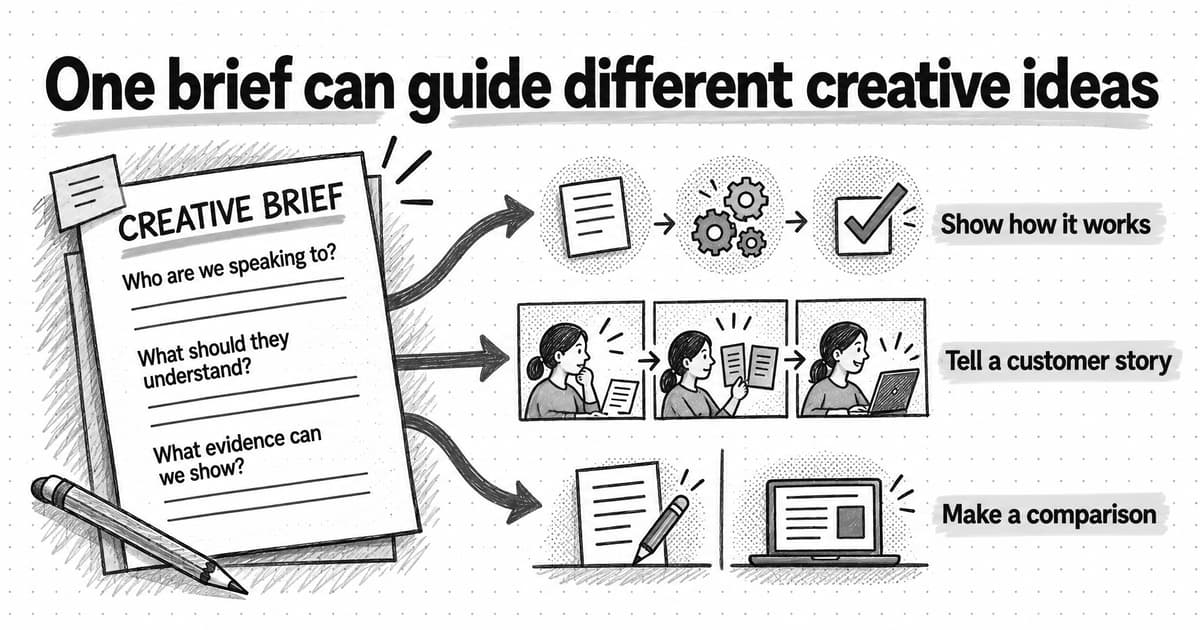
A creative brief turns campaign strategy into a clear communication task: who the message is for, what they should understand or do, the central proposition, and the evidence that supports it. Include practical constraints, deliverables, and review responsibilities. Use the brief to compare concepts before adapting the chosen idea into individual executions.
Summary
A creative brief supplies the direction a list of deliverables leaves out. A request for three ads, a landing page, and a video sets the workload without saying why anyone should pay attention. Drawing on the campaign brief's goal, audience, offer, and channels, the creative brief defines what the campaign must communicate.
Keep the business objective apart from what the audience should understand, the response invited, and the channel metrics. Decide before launch how each measure will be used, since numbers such as clicks show what to investigate without explaining the cause.
Build the direction from audience evidence and claim no more than it supports. Describe the situation that makes someone care, and keep what a source shows apart from your interpretation; one interview can raise a question without proving every buyer shares it. The central proposition needs current proof and its limits beside it, while the headline and visual approach stay open.
The worked example takes a fictional company selling software for evaluating AI support answers from research notes to a completed brief, which records which claims, such as an accuracy rate, lack support. Three untested concepts answer it differently. A new headline or format is usually a variation; a new concept changes how the work explains the proposition.
Review every concept against the brief with the same questions about strategic fit, clarity, distinction, credibility, channel fit, and feasibility. A polished concept implying every AI answer is correct fails, because nothing supports perfect accuracy. When concepts expose a flaw in the brief, revise it and record why. The guide's copyable template is the place to start.
Contents
When you're commissioning a marketing campaign, you may already know quite a lot about the work. There is a product or offer to promote, an audience you want to reach, and a date when the campaign needs to run. You might also have a list of assets ready for an agency, freelancer, internal team, or AI marketing agent. The harder part is explaining what you want those assets to help the audience understand. A request for a launch video or a set of ads gives someone a job to do, but leaves a great deal for them to decide about the message.
That gap becomes clearer when the first ideas arrive. One proposal might focus on how quickly a product works, while another spends more time showing how someone can check its results. Choosing between them means going back to the customer: what are they trying to do, what is stopping them, and which parts of the product can address that concern? If the team hasn't discussed those questions, a review of headlines and layouts can turn into a late debate about what the campaign was supposed to say.
A creative brief gives you a place to work through those decisions before asking for ideas. It explains who the campaign is for, what you want them to understand, and what evidence the creative team can use to make the message believable. It also records the practical requirements that affect the work, such as placements, budget, timing, and approvals. Someone reading it should understand both the purpose of the campaign and the choices they have room to make.
Leaving that room matters. You might ask the team to show how a customer can examine an AI answer before relying on it, because that is a concern supported by your research. A writer and designer could answer that brief in several ways. They could show people reviewing an answer together, follow it back to a source, or build a story around a test conversation. The brief helps you judge whether each idea does the required job without deciding the headline or drawing the ad in advance.
This guide works through that process using SignalDesk, a fictional B2B company selling software for evaluating AI support answers. You'll see how the research and product information lead to a completed brief, how three concepts answer it differently, and how to review variations of a chosen idea. SignalDesk's research notes, product capabilities, and campaign copy are invented for the example; they do not describe actual customer findings or campaign results.
Where the creative brief fits
You don't need to rebuild the marketing strategy every time you commission creative work. The marketing plan should already explain the priorities for the period. The campaign brief brings those priorities into a particular campaign by defining its business goal, audience, offer, channels, budget, and measurement approach. The creative brief draws on that work and explains the communication task in enough detail for someone to start proposing ideas.
Other documents help the team deliver the campaign. A media plan specifies where and when placements will run and who should see them. A content brief guides an individual article, video, or other piece. Production specifications cover requirements such as file formats and dimensions, while a deliverables list records the assets, owners, and due dates. Teams sometimes combine these documents, but each answers a different set of questions.
For example, “three ads, a landing page, and a video” tells the team how much work to plan for. It doesn't explain why someone should pay attention to any of it. The creative brief supplies that direction. At the same time, the team needs to know about production limits while it is developing ideas: a concept that depends on filming customers will be difficult to deliver if no customers have agreed to appear and the campaign launches next week.
The Design Council's Double Diamond describes the process of understanding and defining a problem before developing possible solutions. The IPA's BetterBriefs research documents disagreements between marketers and agencies about briefs, which is a reason to discuss the document together before starting creative work. For examples of how an organization frames a challenge, browse the D&AD New Blood briefs. D&AD identifies the organizations setting these educational competition briefs. They illustrate briefing practice, but do not establish how a campaign performed.
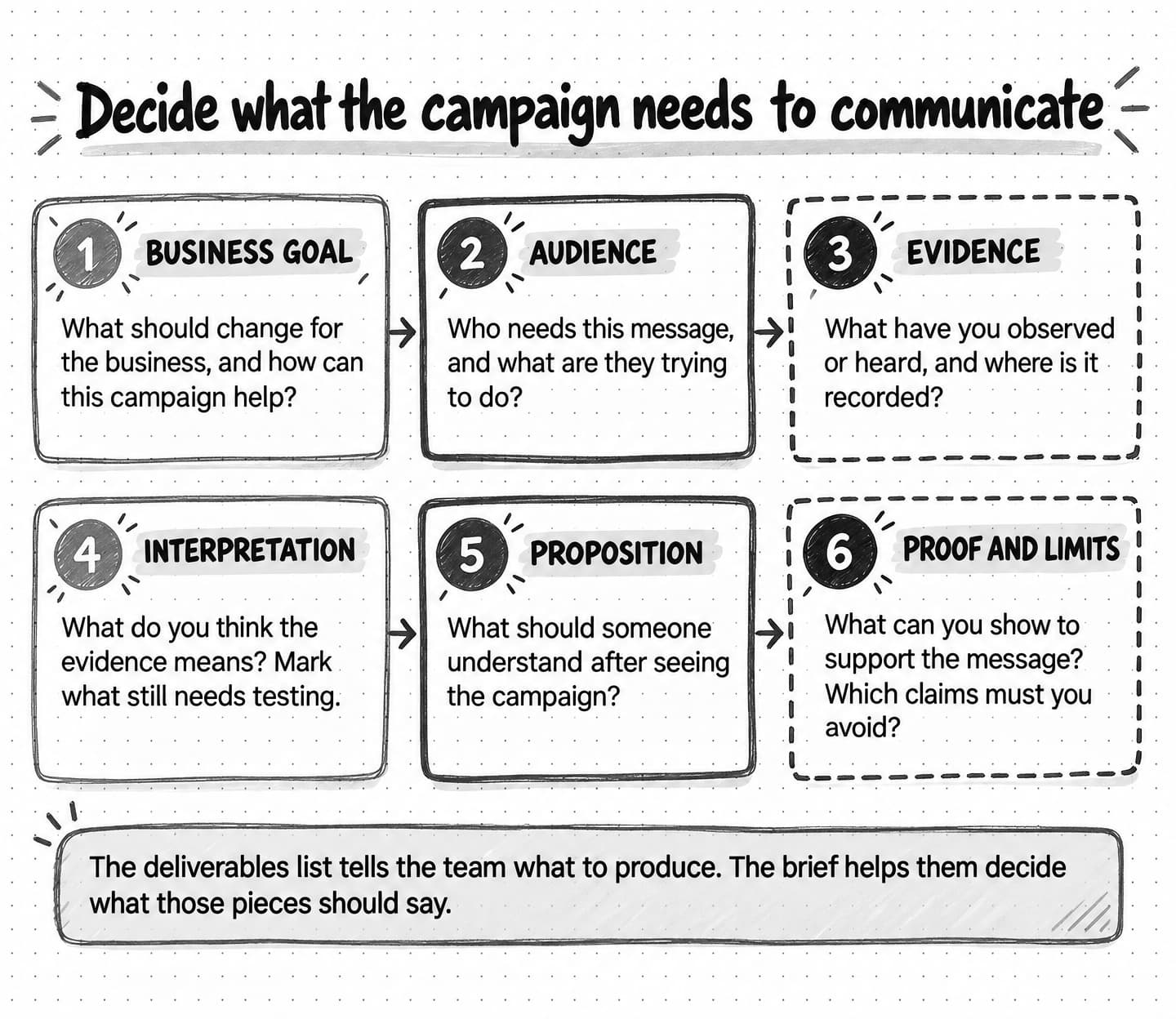
View the brief decisions at full size (opens in a new tab).
Separate objectives, audience responses, and metrics
A business objective names the commercial change the campaign should help create, such as more qualified evaluation starts. The communication objective describes what the audience should understand, believe, or feel able to do after seeing the work. For SignalDesk, that could mean helping a support leader understand how to examine test answers before agreeing to an AI pilot.
The audience response is the action you invite after communicating that idea. SignalDesk might ask someone to open an evaluation guide or request a product walkthrough. Channel metrics, such as reach, video completion, clicks, and landing-page actions, help you observe what happens along the way. They are useful for different reasons. A click shows that someone followed the ad, while a request from a relevant prospect tells you more about whether the campaign reached a potential buyer.
Write down how you will use those measures before the campaign runs. If an ad earns attention and clicks but few qualified evaluation starts, there are several possible explanations: the promise may have attracted the wrong people, the next step may be unclear, or the landing page may not support the ad's message. The numbers give you something to investigate; they don't explain the cause on their own. If the objective concerns brand understanding, you also need a way to ask people what they understood. For pipeline reporting, agree on which opportunities count, how you attribute them, and the time window.
The Amplitude campaign analytics guide explains how to connect early interactions to later customer actions, and its experimentation guide covers controlled comparisons between versions. Those are later stages of learning about the campaign. Completing the brief and agreeing on a concept give the team a reason to proceed, but audience response still has to be measured.
Build direction from audience evidence
An audience description becomes useful when it explains the situation in which someone might care about the message. A job title alone leaves the creative team guessing. A support leader preparing an AI pilot, for example, may need to understand how the team will examine answers before customers see them. A procurement reviewer at the same company may be comparing contract terms. They are involved in the same purchase, but the same ad is unlikely to answer both people's immediate questions.
Use your source material to describe what has made the problem relevant now, what the person already knows, which alternatives they use, and who else is involved. You are looking for enough context to make a communication choice. If you cannot explain why a particular concern deserves the campaign's attention, keep it as a research question rather than filling the space with an assumed motivation.
Next, separate three layers in your notes:
| Layer | What belongs here | Example from the fictional campaign |
|---|---|---|
| Observation | What a source actually says or shows | In the invented research pack, two evaluation notes ask how answer errors can be inspected before release. |
| Interpretation | What you think the observations mean | Showing how to review test answers may help the campaign address a buyer concern. |
| Creative hypothesis | A possible way to express that interpretation | Show an answer moving through a review before it reaches a customer. |
Keep the interpretation proportionate to the evidence. One interview can reveal a question worth investigating without establishing that all buyers share it. Likewise, seeing a competitor's ad tells you what they ran, not how well it performed. Where research is thin, name the assumption and decide how to check it. Our guides to competitor analysis and content strategy explain how to record sources and use findings in planning.
Make the proposition defensible
Once you have chosen the audience concern to address, write the central proposition: the main thought you want someone to take away from the campaign. This is a sentence for the creative team to work from, so it can be more straightforward and explanatory than an advertising headline. For SignalDesk, it will be the idea that a team can examine test answers before deciding whether to start an AI support pilot.
The proposition needs support. If a campaign says people can inspect an answer, the team needs a current demonstration of what they can inspect and how. Put that evidence beside the proposition, along with any limits on the claim. For an AI product, an example of one successful answer would not support a promise about overall accuracy or reliability. The same care applies to claims about autonomy, data handling, and features that are still planned rather than available.
The company's existing brand guidance should help the team make these choices. Positioning and messaging explain which alternatives buyers compare and which benefits deserve emphasis. Brand voice guides the wording, while visual identity guides type, color, imagery, and logo use. Where these decisions are written down as brand guidelines, link to the relevant parts and explain where they affect this campaign. For example, a measured voice would give a writer a reason to avoid alarmist language about AI errors, while still addressing the buyer's concern clearly.
Consider this weak instruction: “Make it exciting and premium.” Different people could follow it and produce work with little in common.
A useful revision gives them decisions they can act on: “Show support leaders how they can review test answers before an AI pilot. Use the approved product capture to make that process clear. Keep the language direct, and avoid promises of error-free automation. The creative team should propose how to tell that story.” This specifies the audience, message, and available proof while leaving the headline, visual approach, and sequence open.
Completed creative brief: SignalDesk pilot campaign
This completed brief is a fictional teaching example. Its research notes and product checklist are assumptions supplied for the exercise, not material collected from a real company.
SignalDesk helps teams evaluate AI-generated support answers. For this example, assume its product checklist confirms that it can import approved knowledge, run test conversations, group failure patterns, and link a result to its test case and source. The checklist supplies no evidence for an accuracy rate, a reduction in support cost, or autonomous release approval.
The campaign aims to encourage support operations leaders at software companies to start a structured evaluation. The hypothetical source pack consists of interview notes from evaluation conversations, product walkthrough recordings, and the capability checklist. The interview notes raise two questions: how to inspect answer errors and how to involve knowledge owners before a pilot. The review features assumed in this scenario give the campaign a way to address those questions by showing how a team examines answers before deciding whether to proceed.
That interpretation still needs testing. The notes do not establish how common these concerns are, whether this message will attract qualified buyers, or how long their buying process takes. Keep those unknowns in the brief so the team can distinguish the product capabilities it may describe from the campaign response it hopes to achieve.
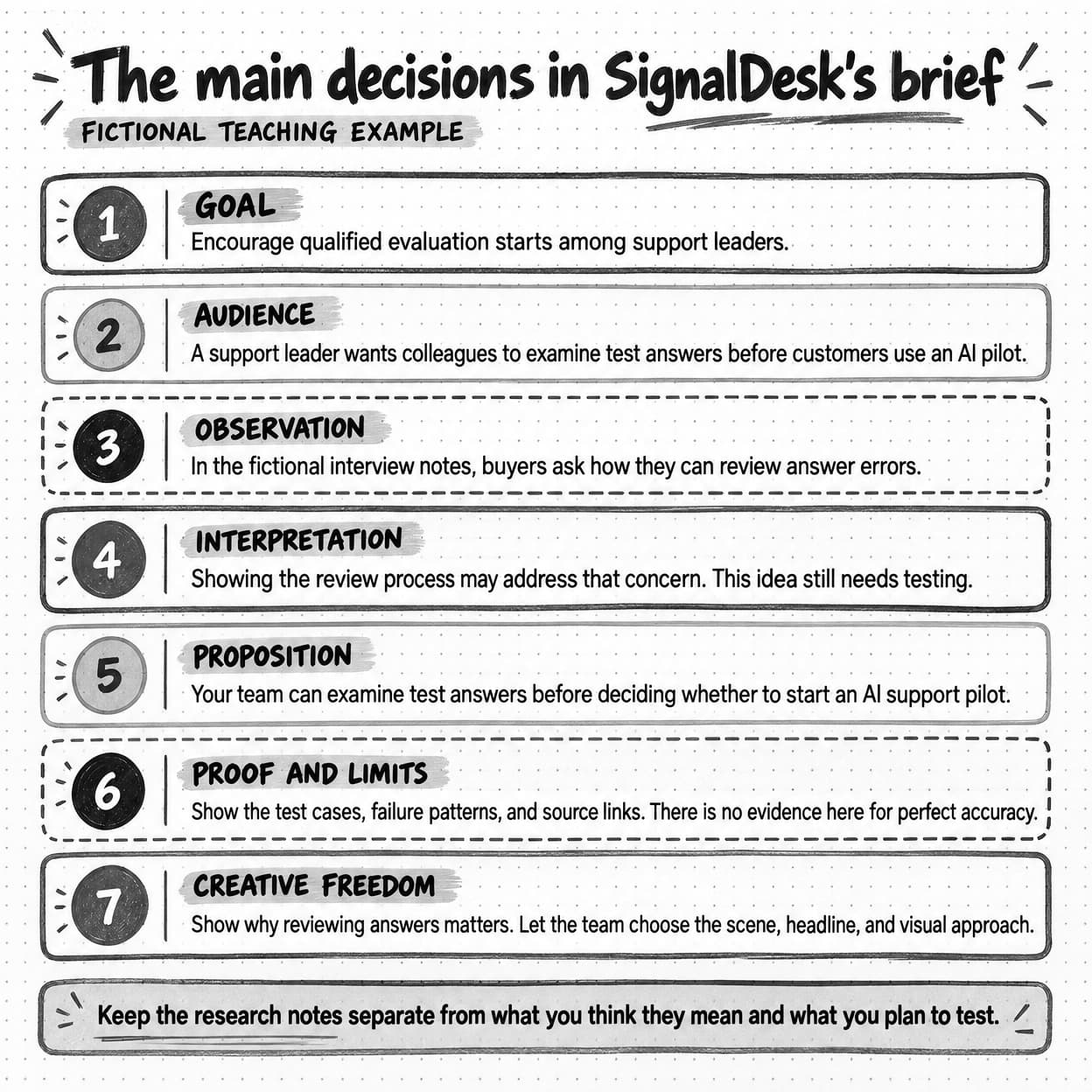
View the annotated SignalDesk brief at full size (opens in a new tab).
The brief
| Field | SignalDesk campaign decision |
|---|---|
| Business context and objective | Reach support operations leaders who are considering AI pilots and encourage qualified evaluation starts. Track these separately from reach and clicks. |
| Audience situation | A support leader needs to involve knowledge owners and other reviewers in examining a pilot before customers use it. They need to inspect failure cases as well as successful demos. |
| Evidence and interpretation | The fictional evaluation notes ask how to inspect answer errors before release. The product walkthroughs show test cases and source links. Interpretation to test: showing this review process may help buyers decide whether to start an evaluation. |
| Communication objective and response | Help the audience see that they can examine test answers and failure patterns before deciding on a pilot. Invite them to open an evaluation guide and request a walkthrough if relevant. |
| Central proposition | Your team can examine test answers before deciding whether to start an AI support pilot. The creative team should find a way to express this idea; the sentence itself is not a required headline. |
| Proof and claim boundary | Show current test-conversation review, grouped failure patterns, and links to sources and cases. Do not claim perfect answers, a quantified improvement, autonomous approval, or a customer result. |
| Brand guidance | Follow the current positioning, messaging, and visual identity guidance. Explain what a reviewer can do in direct language; avoid alarmist “AI disaster” language. |
| Open creative question | How can the campaign show the value of reviewing answers before a pilot? The team can propose the headline, visual approach, and story. |
| Deliverables and channels | Develop a campaign concept that can work on a landing page, in an introductory email, and in LinkedIn single image ads. Adapt the chosen concept to each placement. |
| Production and approval | Use only approved product captures or clearly fictional illustration. Provide descriptive alt text and readable type; check contrast, captions for any later video, rights, privacy, and mobile legibility. Marketing owns strategic fit, product verifies capabilities, legal reviews claims, and design signs off on identity. Budget, launch date, media spend, landing-page analytics, and final approvers must be confirmed before production. |
| Learning plan | Ask relevant prospects what they understand from the concepts. After launch, track engagement, clicks, guide opens, qualified walkthrough requests, brand understanding, and pipeline as separate measures. Agree on definitions and attribution before reporting. |
Keep the technical specifications with the production handoff. At the September 25, 2026 research check, LinkedIn's official single image ad specifications recommended 1200 × 1200 pixels for a square image and 1200 × 628 for a landscape image, with different ranges and display behavior by format. Check the live requirements again before submitting ads. The brief should identify the intended placements early enough to influence the ideas, while the production specification records the current technical requirements. The examples below still need production work before they could run as ads.
Three concepts that answer the same brief
A concept is the idea that holds a campaign together across its ads, pages, films, or emails. An execution is one finished piece of that work. An adaptation carries the concept into another placement, while a variation changes part of an execution, such as its headline or crop. The underlying idea can remain the same through all of those changes.
The three concepts below all answer SignalDesk's brief. One puts the audience in a group review, another follows an answer back to its evidence, and the third stages a test conversation as a rehearsal. Each offers a different way to explain why inspecting answers matters. None has been tested with an audience.
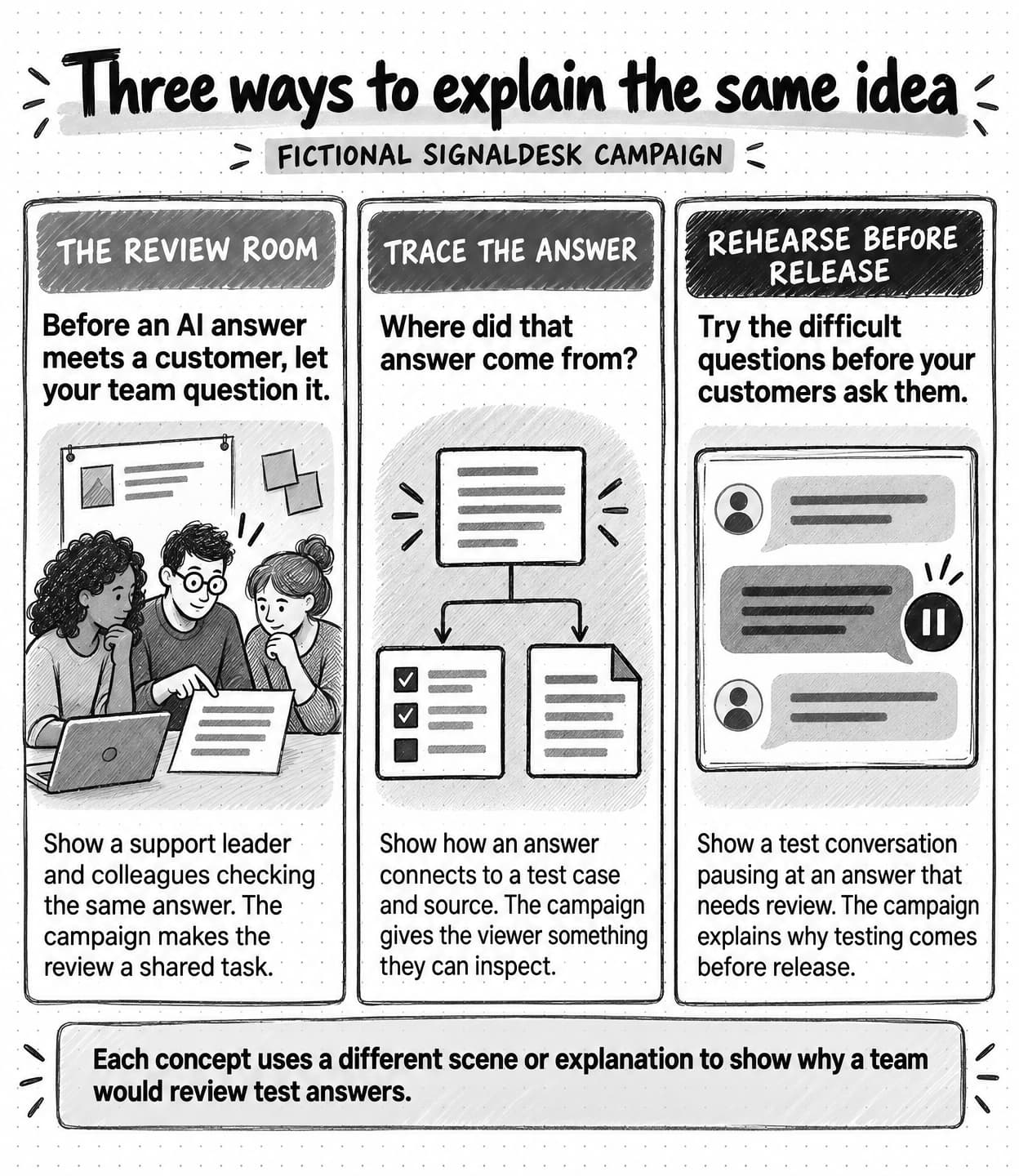
View the three concepts at full size (opens in a new tab).
Concept 1: The review room
The review room takes its cue from the notes about involving knowledge owners. It presents evaluation as something a support leader can work through with colleagues: examine one answer, compare it with the source, and decide what needs further testing.
The visual centers on one test answer annotated by reviewers. Their notes point to a source, flag a weak response, and identify something to investigate.
Before an AI answer meets a customer, let your team question it.
The product's test cases give the campaign something concrete to show. An ad could introduce the annotated answer, an email could invite the reader to review it, and the landing page could walk through the comments. Before producing those pieces, the team must decide which reviewer roles to show and check that the scene does not imply a built-in approval workflow. It also needs a version of the visual that readers can understand in a feed.
Concept 2: Trace the answer
Trace the answer addresses a specific part of the review: understanding where a response came from. An answer may sound plausible when it is read on its own, so the campaign gives the viewer a reason to look further. It follows one response back to its test case and approved source, showing the material a reviewer would use to judge it.
An ad could show the answer beside a linked test case and source excerpt. On a landing page, readers could follow the same sequence in more detail.
Where did that answer come from?
This concept uses the source and test-case links specified in the example's product checklist. It addresses the support leader's need to examine an answer by showing the evidence behind it; the review room emphasizes the people discussing it. The team still needs to choose a screen that demonstrates the links clearly, check that the wording does not overstate how consistently the product provides them, and make the sequence legible in a small ad.
Concept 3: Rehearse before release
Rehearse before release focuses on the decision to test before customers use the system. A simulated conversation unfolds, pauses at a questionable answer, and gives the reviewer a chance to investigate it. The rehearsal suggests a process the team can repeat as it learns what to test.
Try the difficult questions before your customers ask them.
SignalDesk's test-conversation workflow supports this idea. It gives the buyer a way to examine possible problems before deciding on a pilot, without promising that testing will catch every error. The production team needs to choose scenarios that resemble questions the intended audience deals with and that it has permission to use. Any fictional transcript should be labeled, so viewers understand what they are seeing and don't mistake an illustration for a customer result.
Variations stay inside one concept
Suppose the team chooses The review room. A LinkedIn single image ad might show one annotated answer with the line “Before an AI answer meets a customer, let your team question it.” A second version could ask, “What would your team question in this answer?” and crop closer to the review notes. An email could open with “Let's review one AI answer together” before linking to an evaluation guide. On the landing page, readers could walk through the answer, its source, and the reviewers' comments in sequence.
All four pieces retain the shared review of one answer. A different color, closer crop, shorter hook, or new format changes the execution while keeping that idea. To judge whether a proposal is a new concept, ask what has changed in the way it explains the proposition. Following an answer back to its source and rehearsing a conversation each give the audience a different way to understand evaluation. If the scene, reasoning, and use of proof stay the same, the team is probably comparing variations.
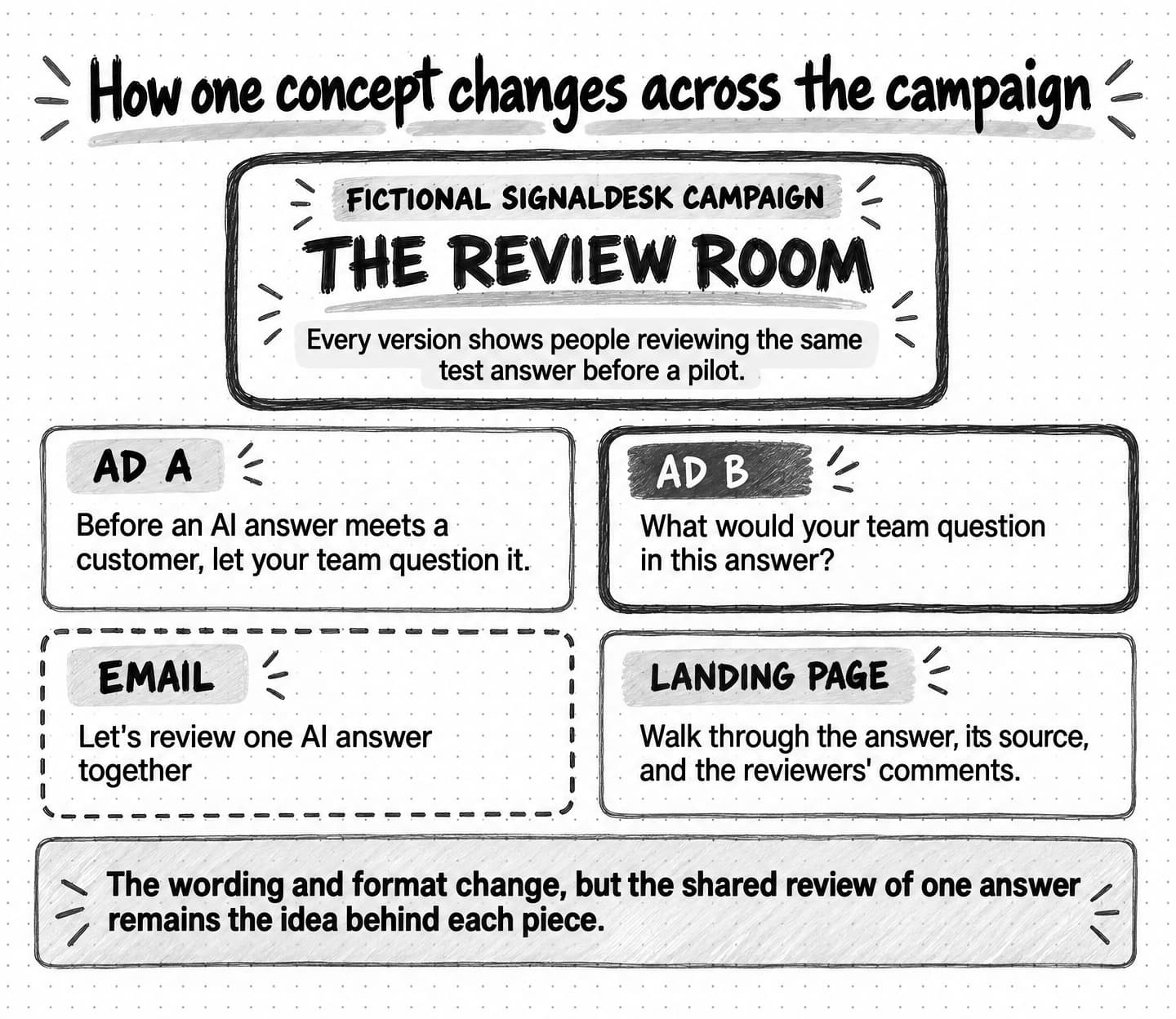
View the concept and variation example at full size (opens in a new tab).
Review concepts against the brief
Ask the creative team to explain how each concept answers the brief and which evidence supports it. Then use the same questions for every proposal:
- Strategic fit: Does the idea address the audience's problem and the communication objective?
- Clarity: What would someone understand after a quick look? What context are you assuming they already have?
- Distinction: How does the idea differ from the other proposals? Is it a new concept or a variation?
- Credibility: Can you support what the words and images imply, as well as what they state explicitly?
- Channel fit: Can the idea work in the intended placements, with the available space and attention?
- Feasibility: Can you produce it within the budget and time, with the necessary rights and approvals?
When you give feedback, explain what you noticed and how it affects the brief. “The source label disappears at feed size” gives the designer a specific problem to solve. “This headline promises an accuracy rate we haven't measured” identifies a claim to change. It is much harder to act on “this doesn't feel right,” because the team has to guess whether you mean the idea, the wording, or the design. If the disagreement is about the audience or objective, return to that part of the brief before asking for another version.
Consider a polished concept called Zero errors, zero worries. A carefully composed interface shows every AI answer turning green, under the headline “Every answer right, every time.” The layout is clear and could adapt easily across the planned placements.
This concept should be rejected because SignalDesk has no evidence for perfect accuracy, and both the headline and the all-green display imply it. The campaign is supposed to help buyers understand how to inspect answers and find problems. Promising that every answer will be correct removes the reason for doing that work. The team would need to reconsider the idea itself; changes to typography or pacing would leave the unsupported promise intact.
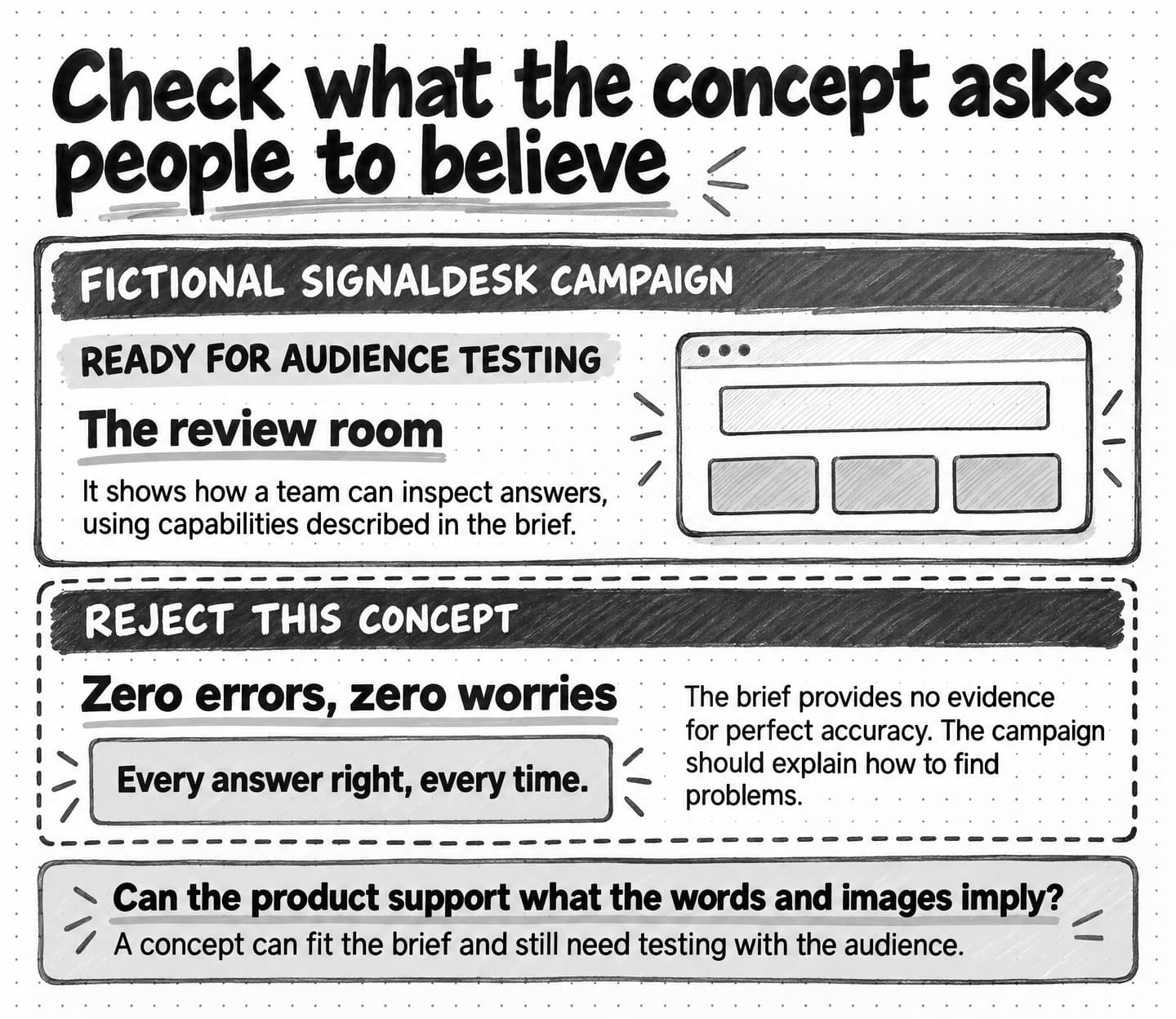
View the concept review at full size (opens in a new tab).
Sometimes the concepts reveal a problem in the brief itself. If every promising idea depends on a claim nobody can support, reconsider the proposition. If the creative team finds evidence of a more pressing audience problem, examine that evidence together. Ask which part of the brief should change, why, and how the change affects work already underway. Record the decision so everyone works from the revised brief.
An AI marketing agent can help explore ideas, but the request needs to make clear what kind of exploration you want. If you give it an existing ad and ask for more options, it may be useful to receive new headlines or layouts for that ad. When you want new concepts, ask it to work from the brief and propose different ways to explain the central idea. Have it describe the audience concern each proposal addresses, the evidence it would show, and how the proposal differs from the others.
You can review that explanation before asking for finished assets. For SignalDesk, three proposals that all show colleagues annotating one answer would still be exploring the review room, even if their headlines sounded different. The source trace and rehearsal concepts change what the viewer is invited to examine. Asking the agent to explain that difference gives you something more useful to assess than a count of ten headlines.
You can also ask the agent to summarize evidence and flag unsupported claims, then check its work against the original sources. A person still needs to verify product capabilities, brand fit, rights, and production limits. Our guide to briefing an AI marketing agent covers the task instructions and approval boundaries that belong alongside the creative brief.
Copyable creative brief template
Fill in the decisions relevant to your campaign and link to the source material behind them. A short brief may fit on one page, with detailed specifications attached. For an unanswered field, record what needs to be checked and who will check it before the team commits to production.
Campaign and owner:
Business context and objective:
Audience situation and current alternative:
Observed evidence (source, date, what it shows):
Interpretation to test:
Communication objective and action you want the audience to take:
Central proposition (the main thought to communicate):
Supporting product/customer proof and approved source links:
Claims or implications the work must avoid:
Positioning, messaging, voice, and visual identity sources:
Creative question and decisions left open to the team:
Deliverables and intended placements:
Mandatory elements, accessibility, rights, and production constraints:
Budget, timing, dependencies, and approvers:
What is unknown and who will resolve it:
Concept review criteria:
Learning plan: engagement, qualified actions, brand outcomes, pipeline: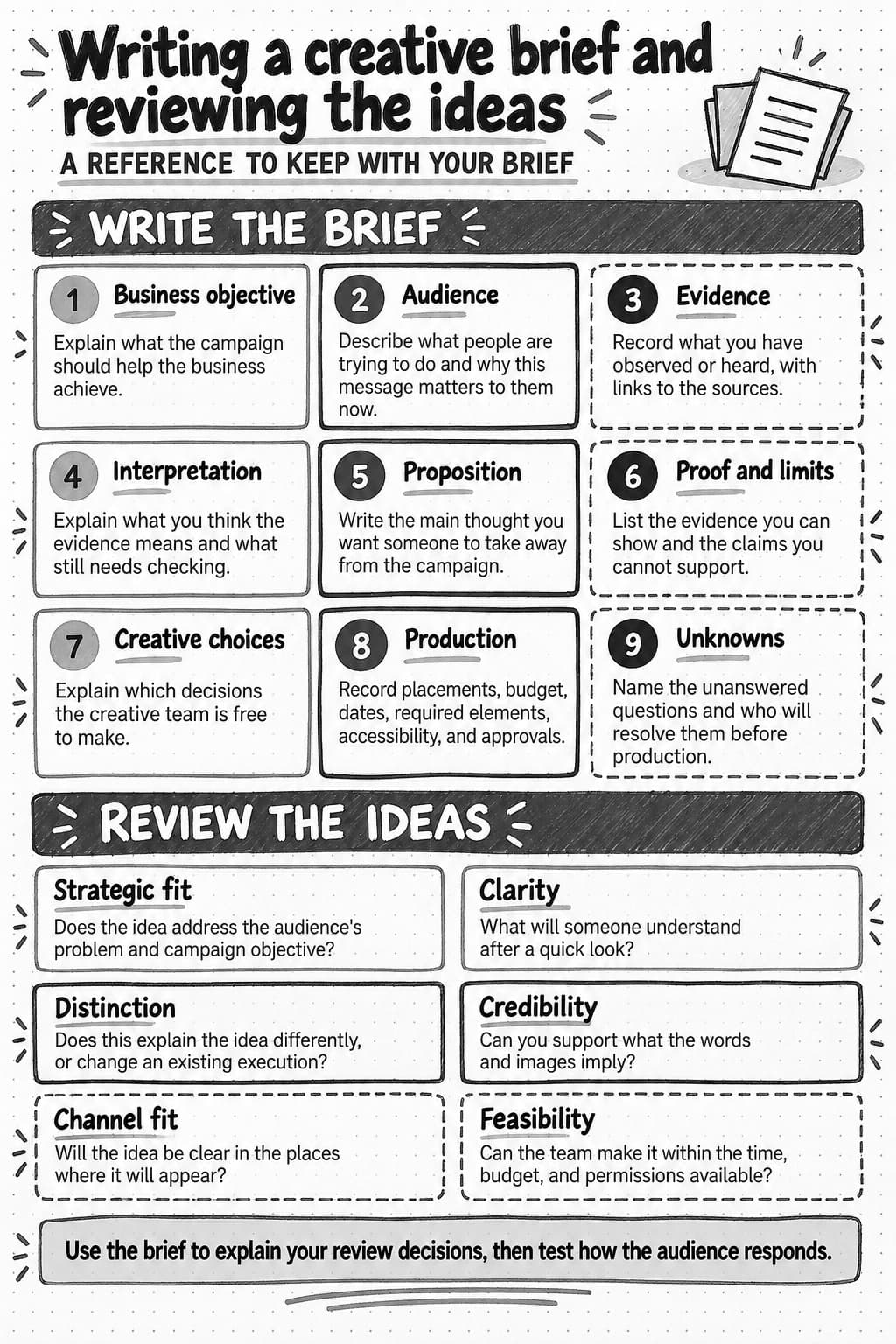
Open and save the creative brief and review reference at full size (opens in a new tab).
Once you have filled in the brief, talk it through with the people creating the campaign. Give them time to question the audience description, examine the evidence, and point out requirements that may be difficult to meet. Their questions can reveal where you have relied on context that never made it into the document. Resolve those gaps together, and use the agreed brief when you return to review the first ideas.
Frequently Asked Questions
What is a creative brief in marketing?
A creative brief in marketing is the document that tells the people making a campaign what the work must communicate, to whom, and with what evidence, before they propose ideas. It sits between the campaign brief, which sets the goal, audience, offer, and channels, and the creative work itself. A request for three ads, a landing page, and a video sets the workload; the creative brief explains why anyone should pay attention, and it leaves the team room to decide how the campaign looks and sounds.
How do you write a creative brief?
Write a creative brief by working through the communication decisions before asking for ideas. Start from the campaign brief, then separate the business objective from what the audience should understand and the response you invite. Describe the audience's situation from evidence, keeping what a source shows apart from your interpretation. Draft the central proposition with current proof and claim limits beside it, add brand guidance, deliverables, placements, constraints, and approvers, then talk the brief through with the people creating the work.
What makes a good creative brief?
A good creative brief gives the creative team decisions it can act on and leaves the expression open. An instruction such as “Make it exciting and premium” could produce work with little in common. A useful instruction names the audience, the message, and the available proof, then lets the team propose the headline, visual approach, and sequence. A good brief also keeps its interpretation proportionate to the evidence and names any assumption it has not yet checked.
What does a creative brief template look like?
A creative brief template is a list of fields to fill in with the campaign's decisions and links to the source material behind them. The guide's copyable plain-text template starts with the campaign owner and business objective, moves through the audience situation, evidence, interpretation, proposition, proof, and claims to avoid, and ends with deliverables, constraints, approvers, review criteria, and a learning plan. For any field you cannot answer yet, record what needs to be checked and who will check it.
What is an example of a creative brief?
The guide's worked example is a fictional creative brief for a B2B company that sells software for evaluating AI support answers. It targets support operations leaders considering AI pilots, with the proposition that a team can examine test answers before deciding whether to start a pilot. The brief lists test-conversation review, grouped failure patterns, and source links as proof, and rules out claims of perfect answers, a quantified improvement, autonomous approval, or a customer result. Three untested concepts then answer the same brief in different ways.
What is the difference between a creative brief and a marketing brief?
A marketing brief, or campaign brief, defines the business side of a campaign: its goal, audience, offer, channels, budget, and measurement approach. A creative brief draws on those choices to set the communication task, explaining what the audience should understand, the central proposition, the proof the work can use, and which choices the creative team is free to make. Both sit below the marketing plan, which sets the priorities for the period.
What is the difference between a creative brief and a design brief?
A design brief guides a specific design project, such as a logo, website, or piece of packaging, and sets out what must be designed and the requirements it has to meet. A campaign creative brief defines the communication task every execution must serve: the audience situation, the central proposition, and the proof behind it. Some teams use the two names interchangeably. In a campaign, file formats, dimensions, and similar requirements go in separate production specifications.
How long should a creative brief be?
One page can be enough for a short creative brief, with detailed specifications attached. The brief itself holds the communication decisions, while technical requirements such as file formats and dimensions belong with the production handoff. Whatever the length, someone reading the brief should understand the campaign's purpose and the choices they have room to make.
How do you write campaign objectives and key messages for a creative brief?
Treat campaign objectives as separate layers and the key message as one central proposition. The business objective names the commercial change, such as more qualified evaluation starts; the communication objective says what the audience should understand; the audience response is the action you invite; channel metrics such as clicks track what happens along the way. Decide before launch how you will use each measure. The proposition is a plain sentence for the creative team, backed by current proof, and it need not become the headline.
Can AI write a creative brief?
AI can help prepare a creative brief, though a person still has to verify the result. An AI marketing agent can summarize evidence and flag claims the sources do not support. Compare its work with the original sources, and confirm product capabilities, brand fit, rights, and production limits yourself. Once the brief is agreed, the agent can work from it to propose different ways of explaining the central idea, describing the audience concern and evidence behind each proposal.