What is a value proposition? Examples for B2B SaaS and AI products
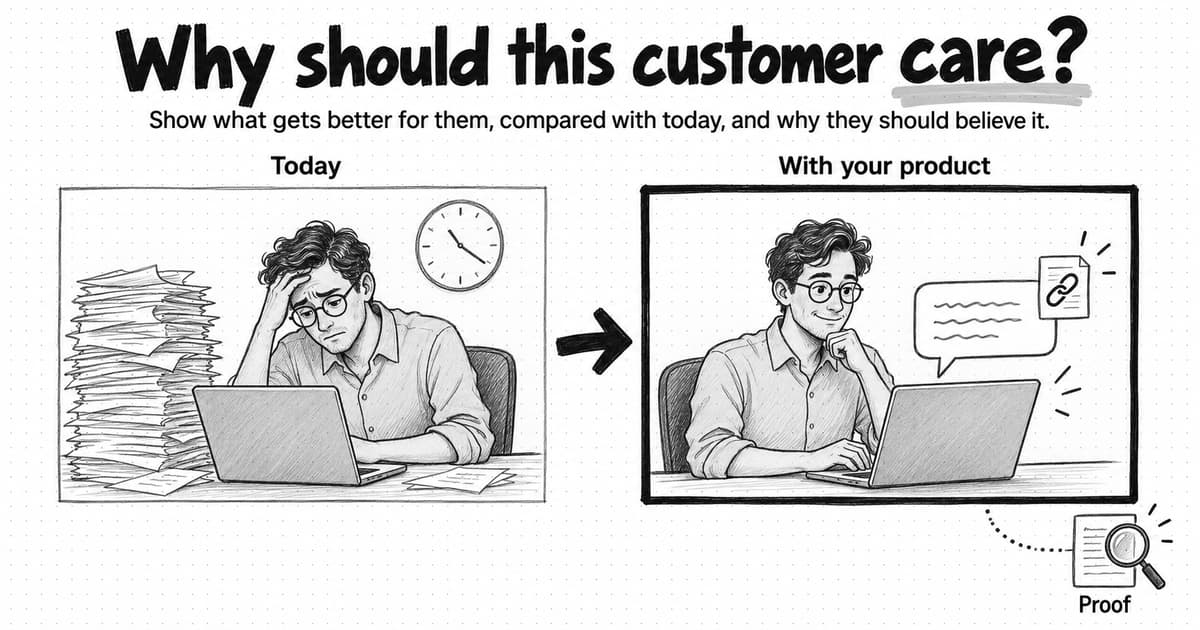
Explain what your product helps a particular customer achieve, compared with what they do today, and why they should believe it.
45 min readWritten by Ampere
Short answer
What is a value proposition?
A value proposition explains what a particular customer can achieve or avoid with a product, in a situation they recognize, compared with how they handle it today, and why they should believe it. It is not a tagline or a feature list. A useful one names the customer, the outcome, the alternative, and the evidence, and separates what the product is designed to do from what customers have measured.
Summary
A value proposition explains what a particular customer can achieve or avoid with a product, compared with how they handle the problem today, and why they should believe it. It answers four questions buyers ask without saying them: is this for someone like me, what will be better, better than what, and why should I believe it? Cost, in money, setup effort, and risk, sits behind all four.
It differs from the terms it is often confused with. Positioning decides the market context in which a product's value is clearest, a tagline is a line to remember, a mission statement describes a company's long-term aim, and a feature list says what the product does. A messaging framework organizes the wider message system, usually with the value proposition at its center.
Features, benefits, outcomes, and evidence form a chain, and each link needs its own support: a demonstration proves a capability, customer experience supports a benefit, and only measurement supports an outcome. Describe what the product is designed to do, and report measured results with their scope. One pilot's figure, measured at one company, is not a promise to the next customer.
The same capability offers different value to different audiences and against different alternatives. An IT manager and a head of HR operations want different outcomes and trust different proof, and an analyst-staffed help channel, an intranet, a general AI assistant, or doing nothing each changes what “better” means. Basic usefulness matters most to readers new to a category; differentiation matters most on a shortlist.
Phrases such as “AI-powered,” “all-in-one,” and “easy to use” need the task, the components, or the comparison behind them. Check a proposition in order, testing comprehension, relevance, and credibility in conversations and commercial response through behavior once there is enough volume. The guide ends with a five-question worksheet covering the customer, situation, useful outcome, relevant alternative, and available proof.
Contents
- What a value proposition tells a prospective customer
- How a value proposition differs from positioning, taglines, mission statements, and features
- Value proposition examples from SaaS and AI companies
- How features, benefits, outcomes, and evidence fit together
- Why the same capability has different value for different audiences
- How the customer's current alternative shapes the proposition
- When differentiation matters and when basic usefulness matters more
- Why “AI-powered,” “all-in-one,” and “easy to use” need context
- What makes a value proposition specific and credible
- Company-level and product-level value propositions
- Using the value proposition on a homepage, product page, email, and sales call
- How to check whether people understand and believe it
- Draft a value proposition for your product
- Keep the value proposition current
- Sources and further reading
- Frequently Asked Questions
Sooner or later, everyone who markets a software product has to answer the same question in a sentence or two: why should this person care? It comes up when a founder rewrites the homepage, when a product marketer prepares a launch, and when a seller opens a first call with someone who has never heard of the company. First attempts often describe the product (“an AI-powered platform for employee support”) or praise it (“easy to use,” “all-in-one”). Both kinds of sentence can be accurate. Neither tells the reader what will be different for them.
A value proposition is the explanation that answers the question. It states what a particular customer can achieve or avoid with the product, in a situation they recognize, compared with the way they handle that situation now, and why they should believe the claim. A homepage headline, a product page, an email, and a sales conversation each express part of it, in different words and at different lengths. The value proposition is the idea they share.
That idea is simple to state and harder to write well, because it depends on information that marketing copy often skips: who the customer is, what they use today, what actually changes when they switch, and what evidence supports the change. Without that information, a team falls back on the product's features, or on adjectives that every competitor also uses.
This guide explains what a value proposition communicates, how it differs from positioning, a tagline, a mission statement, and a feature list, and how to connect a product's capabilities to customer outcomes and proof. It follows Helmline, a fictional company, through a worked example, and looks at how several software companies state their value today. Helmline sells an AI agent that answers employees' IT and HR questions in Slack and Microsoft Teams. The company, its customers, and its pilot results are invented for teaching.
What a value proposition tells a prospective customer
The term began in strategy consulting. Michael Lanning and Edward Michaels used it in a 1988 McKinsey staff paper, “A Business Is a Value Delivery System,” to describe a deliberate choice: which benefits a business will provide, at what price, to which customers. Every part of the company then had to deliver that value and communicate it. Today the phrase usually refers to the explanation customers see, but the original idea still applies. An explanation of value is only as strong as the product, price, and evidence behind it.
A prospective customer reading or hearing a value proposition is trying to answer four questions, usually without stating them.
Is this for someone like me, in a situation like mine? The proposition names the customer and the circumstances that make the problem matter, so the right reader recognizes themselves and the wrong reader can move on. “IT teams at growing companies” is a start. “IT teams whose help channel fills with the same questions every Monday” is a situation a reader can recognize.
What will be better, and how? The proposition states the useful outcome, in words the customer would use, and says enough about how the product produces it that the outcome sounds plausible. An outcome with no mechanism reads like a slogan; a mechanism with no outcome reads like a specification sheet.
Better than what? Every customer already handles the problem somehow: with another product, a spreadsheet, a colleague, an outside contractor, or by living with it. Value is judged against that alternative, whether or not the copy names it.
Why should I believe it? The proposition rests on evidence the customer can check: a demonstration, a trial, customer results, reviews, or documentation. Claims with no visible support are discounted, and the more a claim promises, the more support it needs.
There is a fifth question behind these four: what will this cost me? Price is part of it, and so are the time to set the product up, the effort of changing how people work, and the risk that it will not work as described. A homepage headline rarely mentions cost, but pricing pages and sales conversations cannot avoid it, and a proposition that ignores it is incomplete.
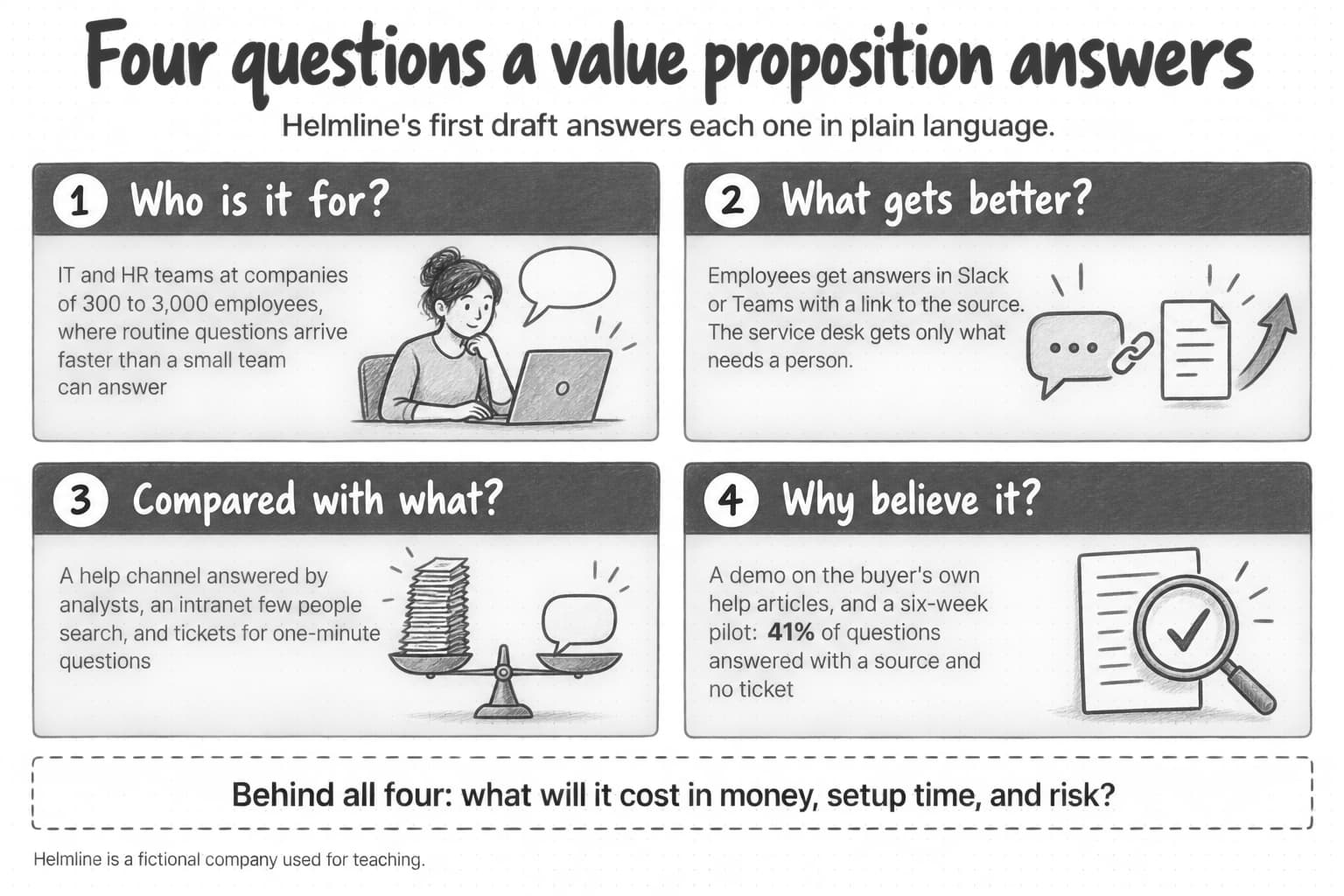
View the four questions and Helmline's answers at full size (opens in a new tab).
In full, Helmline's answers to the four questions make a first draft of its value proposition:
| Who it is for | IT and HR teams at companies of 300 to 3,000 employees, where routine questions about passwords, laptops, expenses, and leave arrive faster than a small team can answer them |
|---|---|
| What gets better | Employees get answers in Slack or Teams with a link to the approved help article or policy, and the service desk receives only the questions Helmline cannot answer from a source |
| Compared with what | A help channel answered by analysts, an intranet that employees rarely search, and tickets for questions that take a minute to answer |
| Why believe it | A demonstration on the buyer's own help articles, and a six-week pilot in which Helmline answered 41% of employee questions with a linked source and no ticket |
The draft is not a headline. It is the material that headlines, product pages, emails, and sales talk tracks are written from, and it is written for the team before it is written for customers.
How a value proposition differs from positioning, taglines, mission statements, and features
Teams often keep these items in the same document, so the terms blur. Each answers a different question, and confusing them produces predictable problems: a tagline asked to do the work of a value proposition, or a feature list presented as one.
| Term | The question it answers | Helmline example |
|---|---|---|
| Value proposition | What will a particular customer get from the product, compared with their alternative, and why believe it? | IT teams get routine questions answered in Slack with a linked source, and analysts receive only the questions that need a person |
| Positioning | In which market context is the product's value clearest: for which customers, against which alternatives, in which category? | An AI help desk agent for companies of 300 to 3,000 employees, compared with analyst-staffed help channels and general AI assistants |
| Messaging framework | Which core message, supporting points, and proof should every channel draw on? | A core message, three supporting points, and the evidence for each |
| Tagline or slogan | What short line should people remember? | “Answers where work happens” |
| Mission statement | What is the company trying to achieve beyond any one product or customer? | “Help every employee get unstuck at work” |
| Feature list | What does the product do or include? | Slack and Teams apps, source links, ticket handoff, routing rules for sensitive topics, a weekly topic report |
| Unique selling proposition (USP) | Which specific benefit can this product claim that competitors do not offer? | None yet: Helmline has not compared itself with the other AI help desk agents a buyer might shortlist |
Positioning and the value proposition overlap the most. April Dunford, a positioning consultant and the author of Obviously Awesome, describes positioning as defining how a product leads at delivering something a well-defined group of customers cares a lot about. Her method starts with the alternatives customers would otherwise use and works through the product's differences, the value they create, the customers who care most, and the market category. A value proposition uses the same ingredients to answer a narrower question. Positioning decides the context in which the product is understood; the value proposition explains the value that context makes clear. Dunford is explicit that positioning is neither messaging nor a tagline: it is the strategy those are written from. The guide to brand positioning works through those choices with B2B examples.
A brand messaging framework organizes the wider message system: the core message, the supporting points, the evidence behind each, and the way emphasis changes by audience and channel. The value proposition is usually its central statement, and the framework keeps the rest of the company's copy consistent with it.
A tagline or slogan is a short line meant to be remembered. It can express part of the value proposition, but it rarely carries all of it, and it does not need to. A line can be memorable without explaining any value, which is fine for a tagline and a failure for a value proposition. Many lists of “value proposition examples” quote company taglines for this reason, and the two are worth keeping apart.
A mission statement describes what a company is trying to achieve over the long term, usually in terms of an industry or society as a whole, with no particular customer in view. Stripe's About page, for example, describes the company as focused on improving the conditions for economic growth and prosperity. That aim explains why the company exists, but it does not tell a finance team why it should move subscription billing to Stripe. A mission can shape a value proposition; it cannot stand in for one.
A feature list says what the product does. The value proposition says why those features matter to a particular customer. A page that lists features without explaining their value asks the reader to do the translation, and most readers will not.
A unique selling proposition is an older advertising idea. Rosser Reeves, an advertising executive, described it in his 1961 book Reality in Advertising as a specific benefit that the competition does not or cannot offer. Many teams use “unique value proposition” in a similar sense. Uniqueness is valuable when buyers are comparing options, but a value proposition does not have to be unique to be useful. The section on differentiation below explains when it matters.
Value proposition examples from SaaS and AI companies
A company's homepage is the most visible statement of its value proposition, though never the whole of it. The three examples below come from homepages read on October 4, 2026. Homepages change often, and some companies rotate or test their headlines, so the copy you see may differ. Each example is read against the four questions above, and each shows a different decision.
Fin: an AI agent with a measured outcome
Fin is Intercom's AI customer service agent. Its homepage headline is broad: “Perfect customer experiences made possible with Fin.” The section that follows is much more specific. It names the task Fin performs, resolving customers' questions, and the measure it asks to be judged by, its resolution rate. It then gives a figure with qualifiers: Fin averages a 76% resolution rate across more than 12,000 customers, “with many seeing over 85%.”
The figure is persuasive because it is an average across a stated number of customers rather than one customer's best result. Where the page claims improvements to the model behind Fin, a footnote names the model it was compared with. A careful buyer would still ask how Fin defines a resolution and over what period the average was measured, because the page does not say. The figure is reported by the company, which is normal for a homepage; a buyer's next step is to check what a resolution would mean in their own support queue.
Granola: naming the alternative
Granola's headline describes the product and the situation it is for: “The AI notepad for back-to-back meetings.” The subheadline lists what the user gets (“Notes, actions and memory”) and then contrasts the product with the alternative most readers already know: “Without a meeting bot.” Many AI note-takers join a call as a visible participant. The first section explains how that is possible: Granola uses the computer's audio, so it does not invite a bot.
The page shows customer logos but no measured results, and its main call to action is a free download, so the proposition asks readers to try the product rather than take a number on trust. The example also shows that a difference may not last. Otter, a longer-established note-taker, now promotes a desktop app “for bot-free meetings.” Once competitors match a difference, it stops being a reason to choose one product, although it may remain something buyers expect.
Calendly: explaining a broader job
Calendly is widely known for scheduling. Its homepage now proposes a broader job, “All the work around meetings, handled,” and the subheadline explains what that includes: “From AI-powered scheduling to automated meeting recaps and follow-ups, get the busywork done with fewer tools and less effort.” When a well-known product widens its scope, the copy has to explain basic usefulness again, because readers' existing picture of the product is narrower than the new proposition.
The phrase “AI-powered” is immediately followed by the tasks the AI handles, which gives it context. The evidence is mixed. The page calls Calendly “the world's #1 scheduling tool” without saying who measured what. Lower down, results such as an 80% reduction in booking-related emails sit next to quotations from named customers. These are individual customers' reports, not averages, and they illustrate what is possible; they are not a result a new customer should expect.
Read against the four questions, the three pages answer roughly as follows. The table is our summary, not the companies' wording.
| Question | Fin | Granola | Calendly |
|---|---|---|---|
| Who is it for? | Companies with customer service teams | People with back-to-back meetings | Professionals who book and run meetings |
| What gets better? | Customer questions resolved by the AI agent | Notes, actions, and memory from each meeting | Scheduling, recaps, and follow-ups handled with less effort |
| Compared with what? | Other AI agents, and building one in-house | Note-takers that join meetings as a bot | Several tools and manual follow-up |
| Why believe it? | An average resolution rate across a stated customer base | Customer logos and a free trial | Named customers' results and an unsourced ranking |
None of the three pages answers every question in the headline. They distribute the answers across the headline, the subheadline, the first section, and the proof, which is how most good homepages work.
How features, benefits, outcomes, and evidence fit together
A product's features are where its value proposition starts, but they are rarely where the reader's interest starts. Four terms help separate the layers.
- A feature or capability is what the product does or includes. Helmline answers employee questions in Slack and Teams from a company's approved documents and links the source.
- A benefit is what that capability lets a particular person do, avoid, or stop doing. Employees get routine answers without filing a ticket, and analysts stop retyping the same instructions.
- An outcome is the change in the customer's work or business that the benefit can lead to, described in terms the customer could observe or measure. Fewer routine tickets reach the service desk, and analysts have more time for problems that need a person.
- Evidence is what makes each layer believable. A demonstration supports a capability, customer experience supports a benefit, and measurement supports an outcome.
Sales training often adds a step between feature and benefit, called the advantage: what the feature does better than the way the customer works now. The step is worth keeping in mind, because a benefit exists only in comparison with something. Answering questions in Slack is a benefit to employees who currently wait for a ticket to be picked up. It is no benefit to employees who already get quick answers from an analyst in the same channel; for them, the value is that analysts get their time back.
A worked progression from capability to evidence
Here is Helmline's main capability followed through to the outcome an IT service desk manager cares about, with the evidence available at each step.
| Layer | Helmline, for an IT service desk | Evidence available now |
|---|---|---|
| Capability | Answers employee questions in Slack and Teams using only the company's approved help articles, links the article it used, and opens a ticket with the conversation attached when it cannot find a sourced answer | A live demonstration using the buyer's own help articles |
| Benefit | Routine questions, such as setting up the VPN or requesting a new laptop, are answered without an analyst, and the questions that do reach the queue arrive with the employee's request and what they already tried | Conversation logs from the pilot |
| Outcome | A lighter queue of routine tickets, and more analyst time for problems that need a person | In a six-week pilot at one 800-person company, 41% of questions were answered with a linked source and no ticket. Ticket volume and analyst time were not measured |
| What Helmline says | Helmline answers routine IT questions with a link to your approved article and sends the rest to your service desk. In a six-week pilot at one 800-person company, it answered 41% of questions without a ticket | The demonstration and the pilot, with the pilot's scope stated |
The evidence thins as the claims move toward the business result. Anyone can watch the capability in a demonstration. The benefit is supported by what happened in one pilot. The outcome the IT manager cares about most, a lighter queue and more time for difficult problems, is plausible, but nobody has measured it.
That distinction shapes what Helmline can say. It can describe what the product is designed to do: answer routine questions from approved sources and pass the rest to a person. It can report what was measured, with the context that makes the number meaningful. It cannot promise a new customer “41% fewer tickets,” because the pilot measured something else (questions answered without a ticket, which is not the same as tickets avoided), at one company, over six weeks. The share at another company will depend on how complete and current its help articles are, which questions its employees ask, and how many of them use Helmline instead of the old channel.
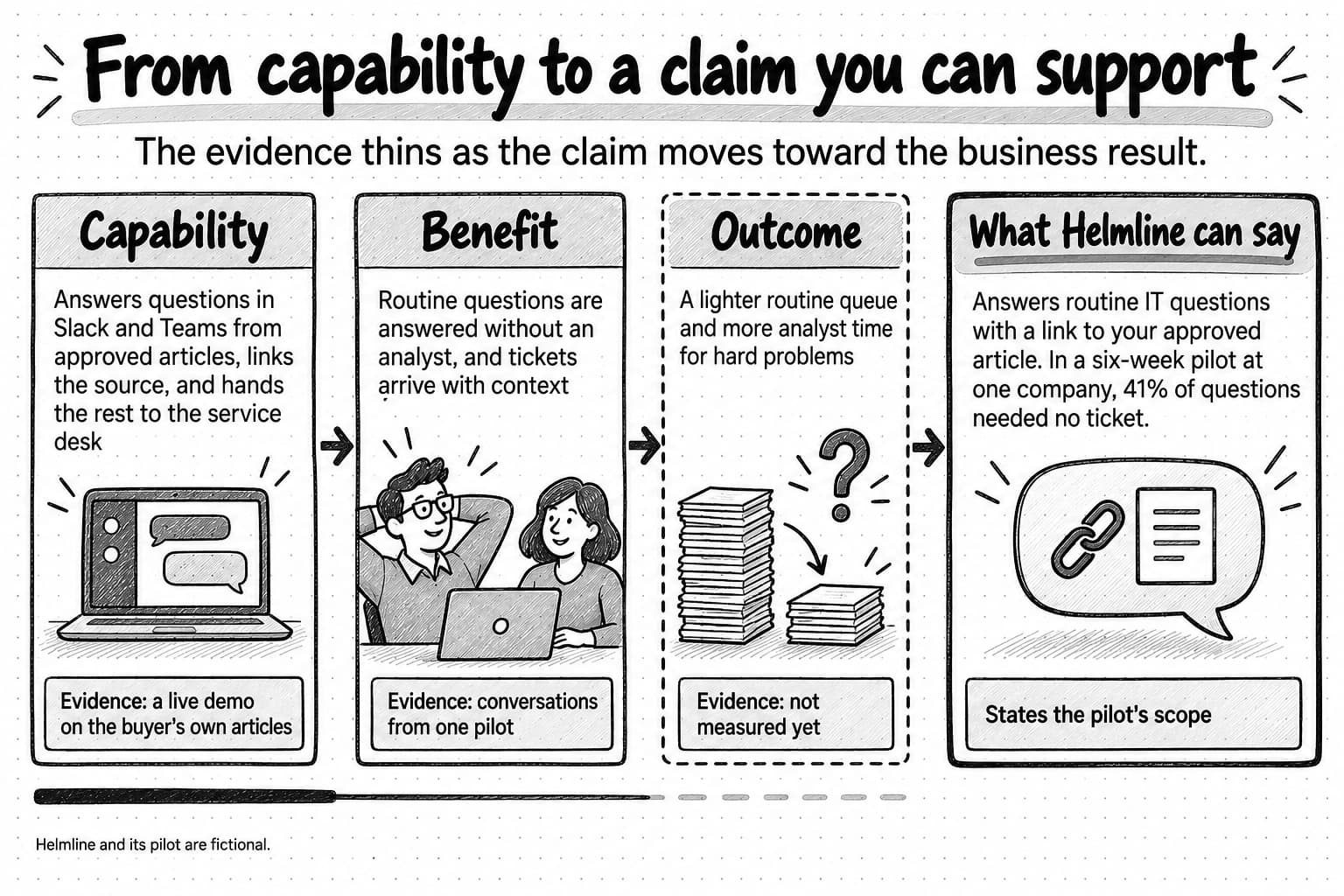
View the capability-to-claim progression at full size (opens in a new tab).
Describe what the product is designed to do. Report what customers measured, with the context that makes the number mean something.
Why the same capability has different value for different audiences
Helmline usually sells to two teams at once. The IT service desk manager owns the help channel and the ticket queue. The head of HR operations owns the policies employees ask about most often: expenses, leave, benefits, and onboarding. Both see the same capability, and each finds a different value in it.
| IT service desk manager | Head of HR operations | |
|---|---|---|
| Responsible for | Keeping the queue moving and fixing problems that stop people working | Clear, consistent policy answers and a fair experience for every employee |
| Current alternative | A help channel answered by analysts, plus tickets for anything longer | An HR inbox, and managers who each explain the policy slightly differently |
| What Helmline changes | Analysts stop answering the same how-to questions, and tickets arrive with context | Every answer quotes the current policy and links to it, and sensitive topics go straight to a person |
| Outcome they want | Fewer routine tickets and faster help with difficult ones | Consistent answers, and early warning when a policy confuses people |
| Proof they trust | A demonstration on their own help articles, and the pilot figure with its method | Answers that quote the current policy, and the weekly report of the most-asked topics |
| Likely concern | “Will wrong answers create more tickets than they save?” | “Will it answer a sensitive question that should go to a person?” |
| Sensible next step | Run Helmline against last month's help-channel questions | Review how Helmline handles leave and benefits questions, including which ones it routes to HR |
The product and its claims are the same in both columns. What changes is the problem it addresses first, the outcome that matters, and the evidence each reader needs. The two teams will compare notes before they buy, so the claims should stay consistent even as the emphasis moves. Our guide to defining a target audience explains how to choose the reader a particular page, email, or campaign is meant for.
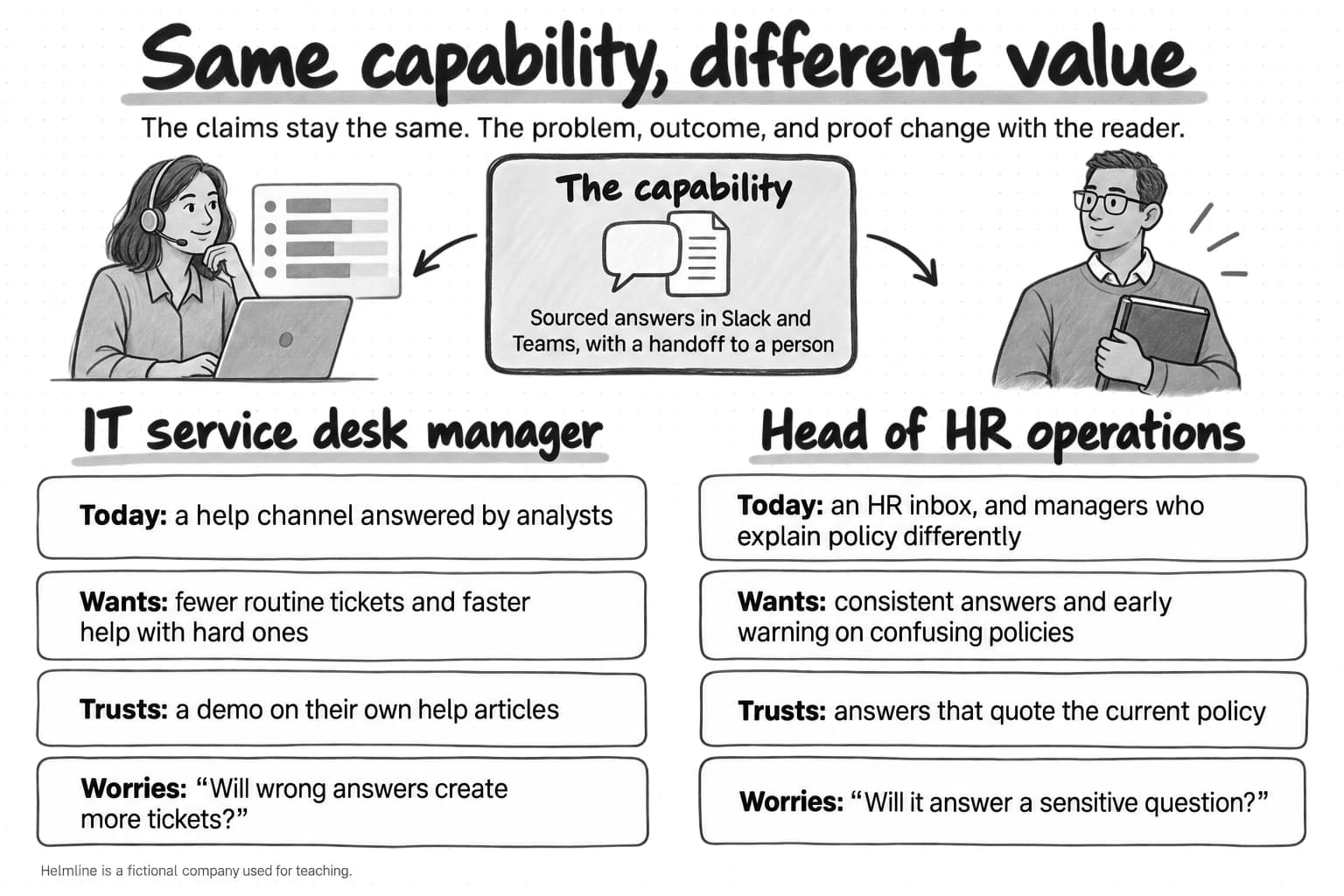
View the two-audience comparison at full size (opens in a new tab).
How the customer's current alternative shapes the proposition
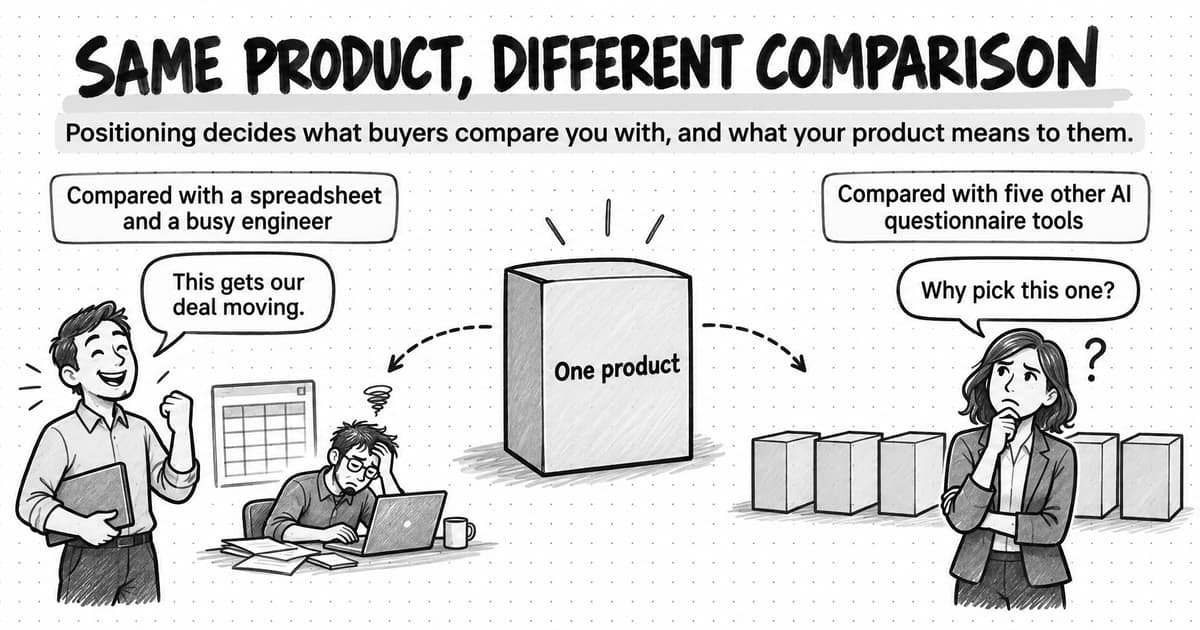
A customer judges a product against what they would otherwise do, and that is often not a competing product. It can be a manual process, a spreadsheet, a colleague who knows the answer, an agency, a general-purpose tool the company already pays for, or doing nothing and living with the problem. James Anderson, James Narus, and Wouter van Rossum called this the customer's next best alternative in a 2006 Harvard Business Review article on business-to-business value propositions, and measured a product's advantages and disadvantages against it. The alternative can be a different way of solving the problem, not only a rival supplier. Dunford's positioning method starts in the same place, by asking what customers would use if the product did not exist. The positioning guide describes the four alternatives B2B buyers most often keep and how to find out which one a buyer has.
The alternative changes the proposition because it changes what “better” means. Helmline's alternative varies from one prospective customer to the next:
- Against a help channel answered by analysts, the value is time. Routine answers no longer need a person, employees get them outside office hours, and analysts keep the questions that need judgment.
- Against an intranet that employees rarely search, the value is reach. People ask in their own words, in a tool they already have open, and get one answer with its source instead of a list of pages.
- Against a general-purpose AI assistant that employees already use, the value is accuracy about this company. Helmline answers from the company's approved documents rather than general knowledge, and it passes a question to a person when it has no sourced answer.
- Against doing nothing, the value has to outweigh a cost the team has learned to tolerate. Here the proposition depends on a reason to act now: a hiring wave, a new office, a policy change, or an analyst who has left.
Each comparison leads to a different first sentence, a different proof point, and a different objection to answer. A proposition written without a particular alternative in mind tends to drift toward claims that are true of every option, such as “save time” or “work smarter,” which give the reader no reason to change.
For AI products, the alternative often includes a general-purpose assistant the buyer already pays for. Leaving that comparison out of the proposition leaves the most common objection unanswered: why not use the assistant we already have? Helmline's answer, approved sources and a handoff to a person, is the part of its proposition that a general assistant cannot easily claim.
When differentiation matters and when basic usefulness matters more
A value proposition does not have to be unique in every part. Anderson, Narus, and van Rossum separated points of parity, where a product is about as good as the next best alternative, from points of difference, where it is better or worse. They found two common mistakes: listing every benefit the product offers, including ones the customer does not care about, and assuming that every difference from a competitor is an advantage. Their recommendation was a resonating focus, meaning the one or two points of difference that matter most to the customer, plus any point of parity the customer needs to hear.
Some value has to be present before a buyer will consider a product at all. Bain & Company's B2B Elements of Value research, published in Harvard Business Review in 2018, places “table stakes” at the base of its pyramid: meeting specifications, an acceptable price, regulatory compliance, and ethical standards. The authors leave them out of their analysis of what sets suppliers apart, because every supplier has to meet them. In software, security reviews, integrations with tools the customer already uses, and reliable support often work the same way. A buyer will not choose Helmline because it passes a security review, but will rule it out if it cannot.
Explaining basic usefulness matters more when the reader does not yet know the category, or does not believe the problem can be solved. An IT team that has always answered routine questions by hand first needs to understand that software can answer them from approved articles and pass the rest to an analyst. A comparison with three other AI help desk agents means little to that reader. Calendly's homepage, discussed above, leads with the job it handles and lists what that includes before it ranks itself against other scheduling tools.
Differentiation matters more when the reader is already comparing options: a shortlist, a formal request for proposals, or a crowded category where every vendor's basic promise sounds alike. For that reader, Helmline's answer to “why this one?” carries more weight than another explanation of what an AI help desk agent does. Its answer would be the parts a buyer can test: answers only from approved sources, a handoff with the conversation attached, and routing rules that HR controls.
Most propositions need both, in a deliberate order. A homepage for readers new to the category leads with usefulness and supports it with difference; a comparison page for a buyer with a shortlist does the reverse. In both cases, a difference counts only if the customer values it. A unique feature nobody asked for is a point of difference with no value.
Why “AI-powered,” “all-in-one,” and “easy to use” need context
Three phrases appear on a large share of software websites because each points at something buyers want: capable technology, fewer tools, and less effort. On their own they say little, because they leave the reader to supply the meaning, and every competitor can use them too.
“AI-powered” describes how a product works, not what it does for the customer. Pavel Samsonov of Nielsen Norman Group argues that the phrase can mean almost anything, so people are left to work out the benefit for themselves. He cites a 2024 study by Cicek, Gursoy, and Lu in which mentioning AI in product descriptions lowered consumers' intention to buy. That study concerned consumer products and services, not business software, but it is a reason not to rely on the label. A useful version names the task the AI performs, the inputs it works from, how the customer can check its output, and what a person still decides. “AI-powered employee support” becomes “answers employee questions from your approved help articles and links the source.”
The specific version is also easier to defend. In the United States, the Federal Trade Commission expects advertisers to have a reasonable basis for objective claims before making them, and in 2024 it announced a set of enforcement actions against companies whose claims about AI products were deceptive or unsupported. A claim about what the AI does, which the buyer can watch in a demonstration, carries less risk than a claim about how much better it is.
“All-in-one” claims consolidation. It communicates value only when the reader learns what is combined and why having it together helps them: fewer tools to pay for, fewer handoffs between teams, or one place to find information that is now scattered. Without that context the reader cannot tell whether “all” includes what they need, and some will assume that a product doing everything does each thing less well than a specialist. HubSpot's homepage shows how to give the claim context. Its headline promises to “build demand, win deals, and delight customers — all on one platform,” and the subheadline says what is combined and why: marketing, sales, and service work from the same customer data. A later section names the problem the consolidation solves, which is disconnected tools and data.
“Easy to use” is a comparison with an unstated other side. Easy compared with what, for whom, and to do which task? The claim helps when the alternative is noticeably hard and the copy says how this is easier: no new application to learn, setup in an afternoon by the person who will use it, or nothing to install for the people who ask the questions. Buyers also tend to expect usability, so on its own it rarely distinguishes one product from another.
A vague proposition, revised
Here is a first draft of Helmline's homepage description that uses all three phrases:
Helmline is the AI-powered, all-in-one employee support platform that's easy to use and transforms the employee experience.
And here is a revision built from the same facts:
Helmline answers your employees' IT and HR questions in Slack and Microsoft Teams, using only your approved help articles and policies, and links the source for every answer. Anything it cannot answer from a source goes to your service desk as a ticket, with the conversation attached.
The revision adds no new capability or result. It makes five editorial decisions:
- It replaces “AI-powered” with what the AI does and what it works from. The reader learns the task (answering questions), the inputs (approved articles and policies), and how to check an answer (the linked source).
- It replaces “all-in-one” with the two kinds of question it covers and where people ask them. IT and HR, in Slack and Teams, is specific enough for a buyer to judge whether it matches their own help requests.
- It drops “easy to use” and keeps the reason for it. Employees ask in a chat tool they already use; nobody has to learn a new portal. The reader can infer ease from that fact without being told.
- It removes “transforms the employee experience.” The phrase claims a large, unmeasured result. Helmline has no evidence for it, and buyers discount it because every vendor says something similar.
- It states what happens when Helmline does not know the answer. That boundary answers the IT manager's first objection, and it makes the rest of the description more believable, because it shows the company has thought about the failure case.
The revision is longer and less impressive-sounding than the original. It is also something a buyer can verify in a demonstration. A homepage headline would compress it further, and the claim boundary should survive the compression.
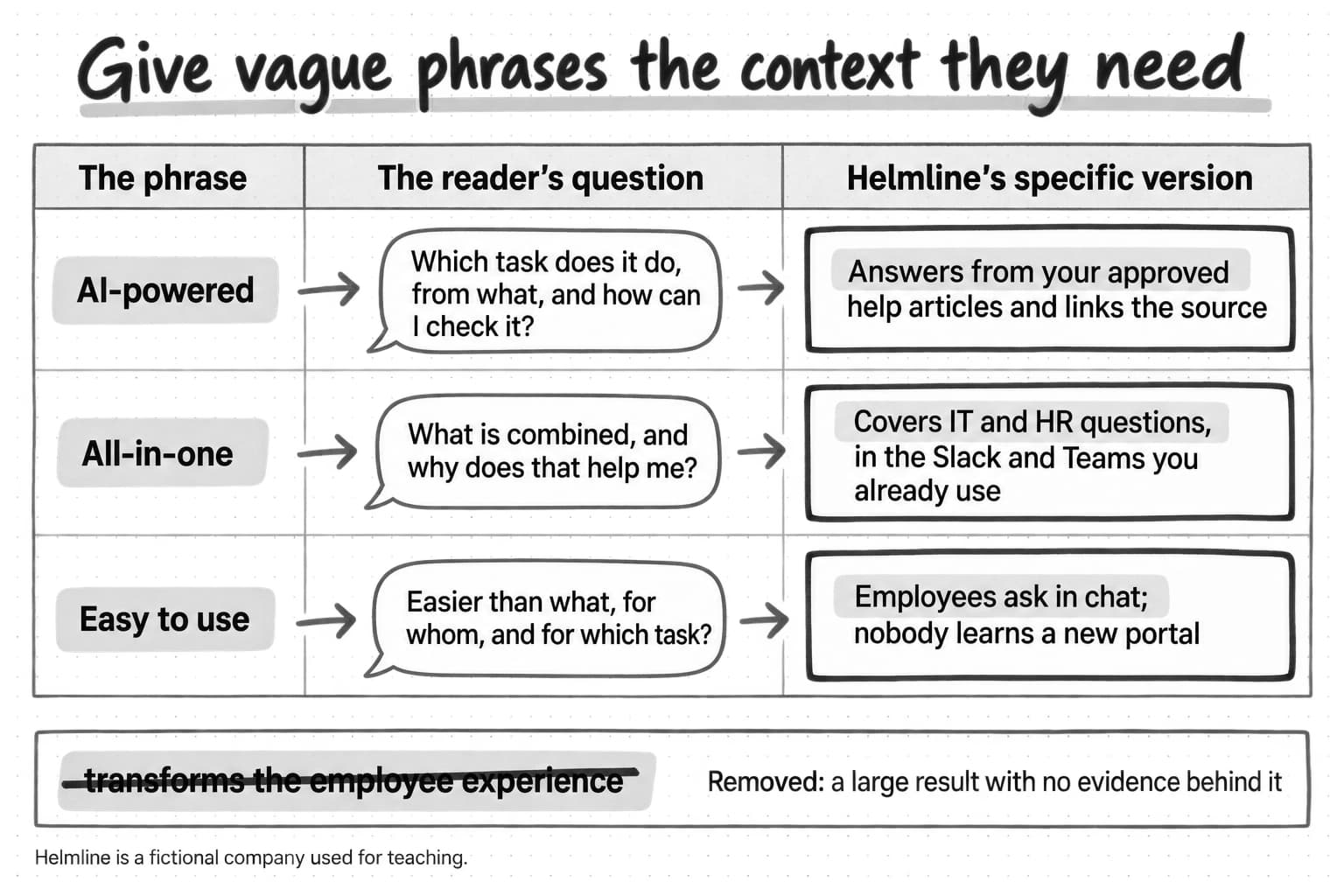
View the vague-phrase revisions at full size (opens in a new tab).
What makes a value proposition specific and credible
Specific and credible are separate qualities. A specific proposition is easy to understand and easy to test; a credible one gives the reader a reason to believe it. A sentence can be specific and still unbelievable, such as an exact percentage with no source, or believable and vague, such as “we help teams work better.”
Signs a proposition is specific
A specific proposition:
- names the customer by role and situation, so the intended reader recognizes themselves and others can tell it is not for them;
- states an outcome the customer could notice in their own work, described in the words they would use;
- implies or names the alternative it improves on;
- says enough about how the product works that the outcome sounds plausible;
- marks a boundary, such as what the product does not do or when it hands work to a person.
A quick test is substitution. If a competitor could put its own name into your sentence and the sentence would still be true, it describes the category rather than your product. That can be acceptable when the reader is new to the category and needs to understand basic usefulness. It is not enough on its own for a reader who is comparing options. Jakob Nielsen suggested a version of this test for website taglines in 2001, together with a second question: would any company ever claim the opposite? Nobody advertises a product as hard to use, which is why “easy to use” tells the reader so little.
Match the evidence to the claim
Each kind of claim needs its own kind of support, and each piece of support needs enough context for the reader to judge it.
| Claim | Helmline example | Evidence that supports it | Context the reader needs |
|---|---|---|---|
| Capability | Links the source for every answer | A demonstration, product documentation, or a trial | Which chat tools and document types are supported |
| Benefit | Employees get routine answers without filing a ticket | Pilot logs, customer interviews, or reviews | Which customers, and which kinds of question |
| Measured outcome | 41% of questions answered with a linked source and no ticket | A measurement with its period, sample, and method | Who measured it, where, over what period, and what it does not include |
| Comparison | Answers from approved documents rather than general knowledge | A side-by-side test against the named alternative | What was compared, when, and on which questions |
| Outside validation | A security certification or a rating on a review site | The certificate, the audit report, or the published rating | The date, the scope, and who issued it |
A number reported by the company about its best customer is still useful evidence, but readers weigh it differently from an independent measurement across many customers. Say which kind it is. Early companies with few customers can use demonstrations, documentation, and design-partner results honestly labeled as such. The brand messaging framework guide shows how to keep a proof inventory that records which claims have evidence and which do not.
Company-level and product-level value propositions
A company with one product usually has one value proposition. A company with several products, or one product sold to several kinds of customer, needs propositions at two levels, and they should fit together.
Stripe shows the levels clearly. Its mission, on the About page, concerns economic growth. Its homepage states a company-level proposition: “Financial infrastructure to grow your revenue,” followed by a list of what that covers, from accepting payments to custom revenue models, “from your first transaction to your billionth.” The page for Stripe Billing, one of its products, narrows the same promise to particular jobs: “Monetize faster with Stripe Billing. Manage pricing, reduce churn, and grow revenue—on one platform.” The evidence narrows with it. The homepage cites the total payment volume Stripe processed in 2025; the Billing page cites the value of failed payments its customers recovered in the same year.
The company-level proposition has to be true of every product, so it is usually broader, and it is supported by evidence about the company: its scale, its reliability, and the customers who already trust it. A product-level proposition names a narrower customer, situation, and alternative, and needs evidence about that product. The two connect when each product proposition reads as a specific case of the company's promise. If a product's proposition cannot be connected to the company's, either the product is aimed somewhere new or the company proposition is out of date.
Helmline works the same way on a smaller scale. At the company level, it helps employees get accurate answers to work questions without waiting for a person, and keeps people involved where they are needed. For IT, the product proposition is about routine questions answered from approved articles and a service desk that handles only what needs an analyst. For HR, it is about consistent answers from the current policy and sensitive topics routed to the team. If Helmline later added a feature that drafts answers for analysts to send, it would usually strengthen the IT proposition and would not need one of its own. A separate proposition makes sense when a feature serves a different customer, replaces a different alternative, or is bought separately.
Using the value proposition on a homepage, product page, email, and sales call
A value proposition is not a sentence to paste into every channel. It is the reasoning each channel draws on, and each channel uses a different part of it, depending on what the reader already knows and how much attention they are giving.
| Where | The reader's situation | What the proposition supplies | Helmline example |
|---|---|---|---|
| Homepage | Arrived from a search, an ad, or a referral; may not know the category; decides quickly whether to keep reading | The customer and outcome in the headline, how it works and what it replaces in the subheading, proof close by | Headline: “Answer employees' IT and HR questions in Slack, with the source attached.” The subheading explains the handoff to the service desk |
| Product page | Knows roughly what the product is; checking whether it fits their team, tools, and requirements | Capabilities tied to the benefits for one audience, the evidence for each, and the limits | A page for IT teams covering supported tools, how handoff works, and the pilot result with its scope |
| Did not ask to hear from you and will give it a few seconds | One situation, one benefit, one piece of proof, and a small next step | To an HR operations lead after a policy change: an offer to show how Helmline would answer questions about the new policy | |
| Sales conversation | Evaluating with colleagues, raising objections, and gathering material to persuade others | The whole proposition, including cost, risk, and evidence for each claim | Ask how routine questions are handled today, demonstrate on the prospect's own help articles, and walk through the pilot's method |
Across the four, the claims stay the same. What changes is how much of the proposition appears, which part leads, and what the reader is asked to do next.
The sales conversation also runs in the opposite direction from a web page. A page has to state the value and hope the reader recognizes their situation. A seller can first ask how the prospect handles the problem today, what it costs them, and what they have already tried, and then state only the parts of the proposition that apply. If the answers show that the prospect's alternative works well, the honest conclusion may be that the product is not a fit yet. The brand messaging framework guide shows complete homepage, outreach, and social examples for one product.
How to check whether people understand and believe it
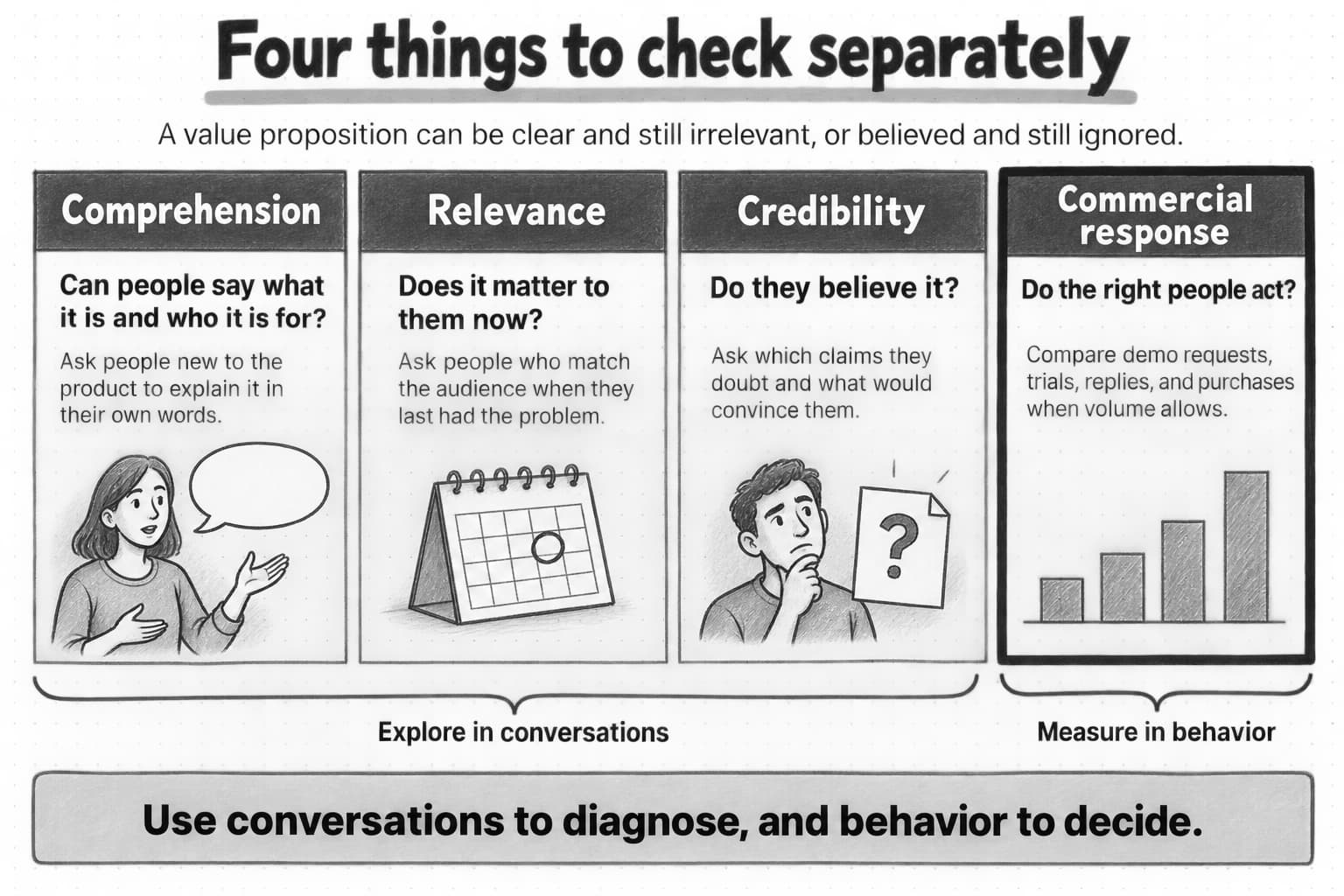
A value proposition can fail in four different ways, and each failure needs a different check. People may not understand what the product does. They may understand it and decide it does not apply to them. They may find it relevant and doubt the claims. Or they may believe all of it and still not act, because the price, the timing, or the effort of switching is wrong. Treat comprehension, relevance, credibility, and commercial response as separate questions, and check them roughly in that order. A buyer cannot judge whether something is relevant or believable until they understand it. Wynter, a company that sells B2B message testing, uses a similar sequence of clarity, relevance, value, and differentiation, and recommends fixing the first layer that fails before rewriting anything else.
Comprehension: can people say what it is? Show the page or the copy to people who do not know the product, then ask them to describe what it does and who it is for in their own words. Give them enough time to read it. Nielsen Norman Group describes the popular five-second test as a measure of first visual impressions, which is too short for anyone to read and understand a paragraph of copy. If they repeat the headline back, ask what it would mean in their work. Misreadings show which words carry the team's internal meaning but not the reader's.
Relevance: does it matter to them now? Relevance belongs to a particular audience and situation, so check it with people who match the audience description. Ask when they last faced the problem, how they handled it, and what it cost them. Helmline's copy might be perfectly clear to an HR operations lead and still irrelevant if that company's employees rarely ask HR anything.
Credibility: do they believe it? Ask readers which claims they doubt and what would convince them. Doubt is useful information: it shows which claims need evidence placed next to them, which need narrowing, and which should go.
Commercial response: do the right people act? Comprehension, relevance, and credibility can be explored in a handful of conversations. Commercial response is behavior: demo requests, trial starts, replies to outreach, sales opportunities that progress, and purchases. Compare versions only when there is enough volume for the difference to mean something, and look at who responded as well as how many. A headline that doubles clicks from people who will never buy has made the funnel worse.
View the four checks at full size (opens in a new tab).
The four checks catch different problems. A page can be understood and irrelevant to most visitors. A claim can be believed and produce no demand because the offer asks for too much commitment too soon. Commercial response is the only one of the four that measures behavior, but on its own it cannot explain why a version did better or worse. Use conversations to diagnose, and behavior to decide.
Small conversation-based tests can expose a confusing phrase or an unbelievable claim; they cannot prove that a new proposition will increase revenue. The brand messaging framework guide describes a simple message test with people outside the team.
Draft a value proposition for your product
Choose one product and one audience. If the product serves several audiences, start with the one you are writing for next. Answer five questions in plain language, writing what you believe even where you are unsure.
- Customer. Who is this for? Name a role and the kind of organization, and include only details that change the value.
- Situation. When does the problem become pressing? What has happened, or is about to happen, that makes it worth solving now?
- Useful outcome. What will be better for them, in words they would use? Separate what the product is designed to do from what customers have measured.
- Relevant alternative. What would they do instead, including nothing? Why does that alternative persist?
- Available proof. What can you show today for each claim? Write down the gaps as well.
Then combine the answers into two or three sentences, and check them with someone who fits the customer description before anyone turns them into copy.
CUSTOMER
Who is this for? Role and kind of organization, with only the details that change the value.

SITUATION
What has happened, or is about to happen, that makes the problem worth solving now?

USEFUL OUTCOME
What will be better for them, in their words?
Designed to do:
Measured by customers (with source and context):

RELEVANT ALTERNATIVE
What do they do today, including nothing? Why does it persist?

AVAILABLE PROOF
For each claim: what can you show now? What is missing?

DRAFT
For [customer] who [situation], [product] [useful outcome] by [how it works], unlike [alternative]. [Strongest available proof, with its context.]

CHECK
Can someone who fits the customer description explain it back, say whether it applies to them, and name what they would need to believe it?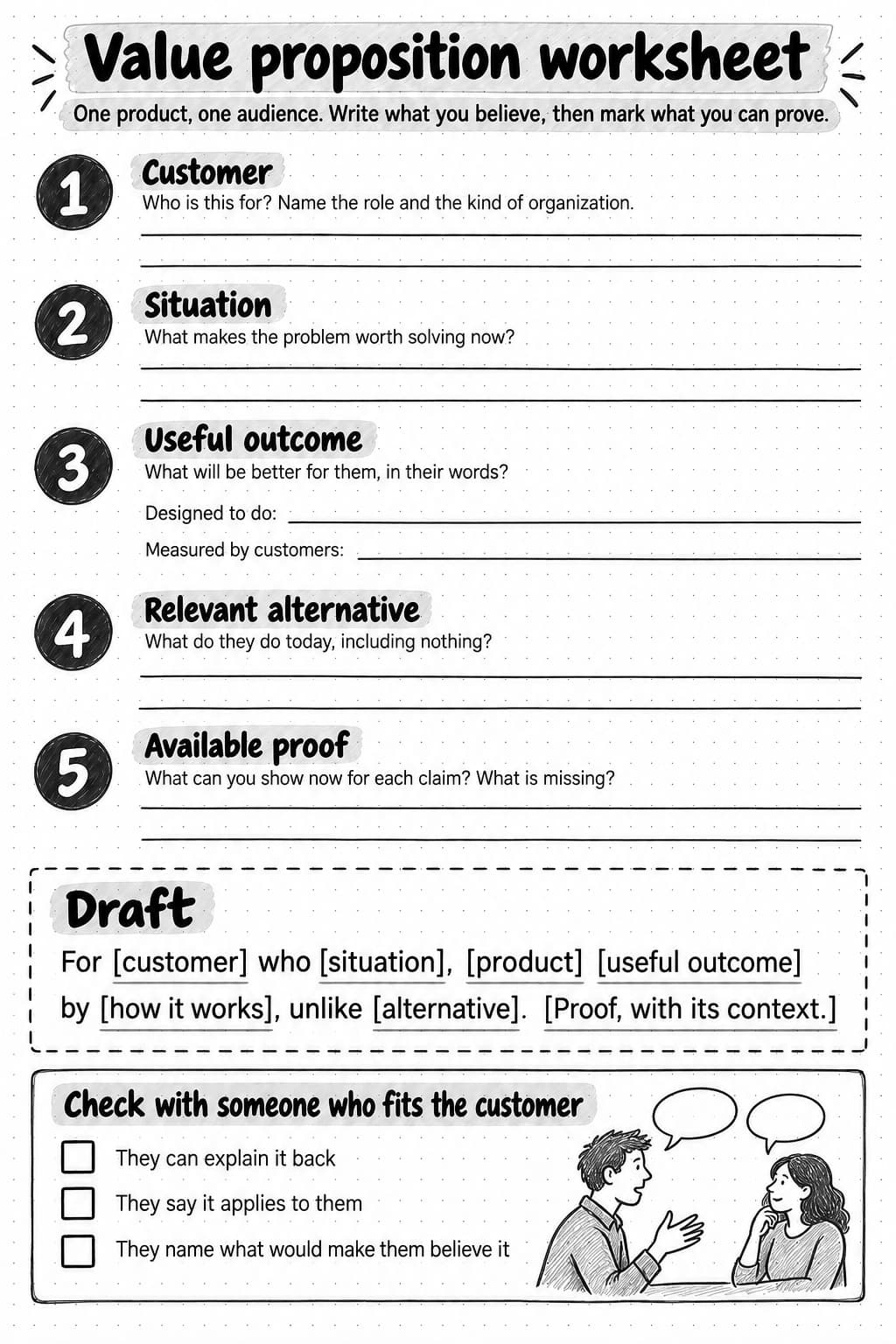
Open the full-size value proposition worksheet to save a copy (opens in a new tab).
The draft sentence resembles the positioning statement template Geoffrey Moore popularized in Crossing the Chasm. Treat it as scaffolding for an internal statement. The finished copy will rarely keep this shape.
Teams that want more structure often use Strategyzer's Value Proposition Canvas, which maps a customer's jobs, pains, and gains against the products and services, pain relievers, and gain creators meant to address them. It goes into more detail than this worksheet and is useful when a team is designing a new product or offer together. For most marketing work the five questions above are enough. They also ask directly about something the canvas does not show on its face: the alternative the customer would otherwise use.
Helmline's worksheet for the HR audience
Helmline's evidence below is fictional, like the company.
| Part | Helmline's answer | Status and evidence |
|---|---|---|
| Customer | Heads of HR operations at companies of 300 to 3,000 employees | Supported: four of six design partners involved HR in the purchase |
| Situation | A policy has changed, or the company is hiring quickly, and the HR inbox fills with questions managers answer inconsistently | Partly supported: two design partners described this; the hiring trigger is assumed |
| Useful outcome | Employees get the same answer from the current policy, with a link, and HR sees which policies confuse people | Designed and demonstrated. Not yet measured: whether inconsistent answers decreased |
| Relevant alternative | The HR inbox, managers explaining policy, and a policy library on the intranet | Supported: described in all six design-partner interviews |
| Available proof | Demonstration on the buyer's own policies; sensitive topics routed to a person; weekly most-asked report from the pilot | Gap: no customer has yet measured a change in HR inbox volume |
From those answers, Helmline drafts:
For HR operations teams whose inboxes fill with policy questions after every change, Helmline answers employees in Slack and Teams from your current policies and links the policy it used, unlike a policy library that employees rarely search. Sensitive topics go straight to your team, and a weekly report shows which policies generate the most questions.
The draft leaves out the pilot's 41% figure, because that result came from IT questions and says little about HR. The riskiest assumption is the hiring trigger. If design partners rarely mention it, the HR proposition should lead with policy changes alone.
Keep the value proposition current
A value proposition is useful as long as people consult it. Keep it in the place where briefs are written, next to the evidence for each claim, and give one person responsibility for updating it. Revisit it when the product changes what it can do, when customers start comparing it with a different alternative, when new evidence supports a stronger claim, or when a claim stops being true.
Meet Ampere—your AI marketing agent. Ampere can research how your company describes itself across its website and public pages and save an evidence-backed positioning brief to Brand memory, covering your category, promise, differentiation, and audience-specific messaging. Your team can review and edit the brief, and later drafts of pages, emails, and campaigns can start from it. You can watch a replay of Ampere naming Notion's positioning from public sources. Your team remains responsible for the customer evidence, the claims you approve, and what ships.
Sources and further reading
- Michael J. Lanning and Edward G. Michaels: A business is a value delivery system, McKinsey Staff Paper No. 41 (1988, PDF)
- James C. Anderson, James A. Narus, and Wouter van Rossum: Customer value propositions in business markets, Harvard Business Review (2006)
- Eric Almquist, Jamie Cleghorn, and Lori Sherer: The B2B elements of value, Harvard Business Review (2018)
- April Dunford: A quickstart guide to positioning (2021)
- Strategyzer: The Value Proposition Canvas
- Pavel Samsonov, Nielsen Norman Group: “Powered by AI” is not a value proposition (2025)
- Jakob Nielsen, Nielsen Norman Group: Tagline blues: what's the site about? (2001)
- Megan Chan, Nielsen Norman Group: Testing visual design (2024)
- Wynter: The B2B message layers framework
- Federal Trade Commission: Policy statement regarding advertising substantiation
- Federal Trade Commission: FTC announces crackdown on deceptive AI claims and schemes (2024)
- Stripe: About
- Product pages read on October 4, 2026: Fin, Granola, Otter, Calendly, HubSpot, Stripe, and Stripe Billing
Frequently Asked Questions
What should a value proposition include?
A value proposition should answer four questions: who the product is for and in what situation, what will be better for them and how, what it is better than, and why they should believe it. It also has to account for cost, including price, setup time, the effort of changing how people work, and risk. Supporting evidence should match each claim, from a demonstration for a capability to a stated measurement for an outcome.
What is the difference between a value proposition and positioning?
Positioning decides the market context in which a product's value is clearest: the customers it is best for, the alternatives it is compared with, and the category it belongs to. A value proposition explains the value itself, in terms a customer can understand and check. The two use the same ingredients, and positioning usually comes first, because the context determines which value is easiest to see and which alternative the proposition should be compared with.
What is the difference between a value proposition and a unique selling proposition?
A unique selling proposition, a term from the advertising executive Rosser Reeves, is a specific benefit that competitors do not or cannot offer. A value proposition explains the value a product gives a particular customer compared with their alternative, which may be another product, a manual process, or doing nothing. A value proposition does not have to be unique to be useful. Uniqueness matters most when buyers are comparing a shortlist of similar products.
What is the difference between a value proposition and a tagline or mission statement?
A tagline is a short, memorable line, and a mission statement describes what a company is trying to achieve over the long term. Neither has to explain value to a particular customer, which is the job of a value proposition. A tagline can express part of the proposition, and a mission can shape it, but many lists of value proposition examples quote taglines that tell the reader little about what will change for them.
What is the difference between features and benefits in a value proposition?
A feature is what the product does or includes; a benefit is what that feature lets a particular person do, avoid, or stop doing. A value proposition connects them and goes one step further, to an outcome the customer could observe or measure, with evidence for each step. A benefit exists only in comparison with something, so the same feature can be a strong benefit for one customer and none at all for another.
What are examples of a value proposition for a SaaS business?
Fin, Intercom's AI customer service agent, names its task and supports it with an average resolution rate across a stated number of customers. Granola describes itself as an AI notepad for back-to-back meetings and contrasts itself with note-takers that join calls as a bot. Calendly explains a broader job, all the work around meetings, by listing what that includes. Each answers the four questions across its headline, first section, and proof.
How do you write a value proposition for an AI product?
Name the task the AI performs, the inputs it works from, how the customer can check its output, and what a person still decides. “AI-powered” alone describes how a product works and says little about what it does for the customer. Compare the product with the general-purpose AI assistant the buyer may already use, and support claims with demonstrations or measured results that state their context, because accuracy is the first thing buyers of AI products doubt.
How is a value proposition used in sales?
In a sales conversation, the value proposition works in the opposite direction from a web page. Instead of stating the value and hoping the buyer recognizes their situation, a seller first asks how the prospect handles the problem today, what it costs them, and what they have tried, then presents only the parts of the proposition that apply, with evidence for each claim. If the current alternative works well, the honest conclusion may be that the product is not a fit yet.
How can I test whether my value proposition works?
Check four things separately. Comprehension: can people who do not know the product say what it is and who it is for? Relevance: does it matter to people who match the audience? Credibility: which claims do they doubt? Commercial response: do the right people request demos, start trials, or buy? Conversations can diagnose the first three; only behavior, measured with enough volume, shows whether a new version performs better.
What is a Value Proposition Canvas?
The Value Proposition Canvas, from Strategyzer, is a design tool that maps a customer's jobs, pains, and gains against the products and services, pain relievers, and gain creators meant to address them. It is useful when a team is designing a new product or offer together. For most marketing work, a simpler set of questions is enough, provided it covers the customer's situation, the useful outcome, the alternative they use today, and the available proof.