What is user-generated content (UGC)? How B2B brands use it, and where AI-made UGC fits
A guide for B2B marketers who keep hearing about UGC: what the term means now, which kinds of customer content help software buyers, how to ask for it and get the rights to use it, the disclosure rules for paid creators, and where AI avatar video fits without misleading anyone.
41 min readWritten by Ampere
Short answer
What is user-generated content?
User-generated content (UGC) is content about a brand that customers, users, employees, or others outside its marketing team create and publish, such as reviews, social posts, community answers, and shared templates. The term now also covers paid creator and AI avatar videos made to look like customer posts; those are advertising, not customer evidence, and need clear disclosure.
Summary
User-generated content now names two different things. Organic UGC is content customers choose to make, such as reviews, posts, and community answers, and it works as evidence. Paid creator UGC and AI avatar video are brand content in a native-looking format, useful as advertising but never proof of what customers think.
B2B user-generated content comes in eight main types, from reviews on software review sites, which the brand cannot edit, to testimonials, employee posts, and creator partnerships, which it shapes or pays for. Buyer surveys show most software buyers consult customer reviews, so customer words carry weight brand claims do not.
Sourcing UGC ethically means asking every customer for reviews at a fixed point in the lifecycle, offering any incentive for honest reviews of either kind, and saving personal requests for quotes, posts, and video for moments of success. The creator owns what they make, so ask for the specific use, from resharing to running an ad, and record each yes in writing; a permission request template is included.
Once a brand gives value or pays for content, endorsement rules apply. The FTC's Endorsement Guides and its 2024 rule ban fake and AI-generated reviews, sentiment-based incentives, undisclosed insider reviews, and suppression of criticism, and require disclosure inside the content in plain words. Platforms add their own paid-partnership and AI labels.
AI avatar video fits B2B marketing as clearly labeled brand content, such as product explainers, announcements, and ads, and becomes deceptive when it suggests a real customer is speaking. A 13-week plan, a fictional worked example, and a video brief template show how a small team can build a UGC program and measure it through review volume, request yes rates, and self-reported attribution.
Contents
- What is user-generated content?
- The two meanings of UGC: organic customer content and paid creator content
- Types of user-generated content in B2B
- Why user-generated content works for B2B buyers
- UGC vs. influencer marketing, employee content, and brand content
- How to source user-generated content ethically
- Permissions, usage rights, and attribution
- The rules for reviews, testimonials, and paid creator content
- AI-generated UGC and avatar video: what is acceptable and what is deceptive
- How to repurpose user-generated content across channels
- How to measure user-generated content
- A UGC program plan for a small team
- Worked example: a five-person team builds a UGC program (fictional)
- A brief template for creator and AI avatar videos
- Common mistakes with user-generated content
- How Ampere helps with user-generated content work
- Sources and further reading
- Frequently Asked Questions
A buyer is three tools into a shortlist for accounts-payable software. She has read each vendor's website, and they all say roughly the same thing. What moves her is somewhere else: a two-year-old review on a software review site from a controller at a company her size, a LinkedIn post where a customer shared the approval workflow they built, a community thread where someone asked whether the product handles multi-entity approvals and another customer answered with a screenshot. None of that was written by the vendor. All of it shaped the decision.
That material has a name. User-generated content (UGC) is content about a product or brand that customers, users, employees, or other people outside the brand's own marketing team create and publish, such as reviews, social posts, community answers, shared templates, and testimonials. Its value comes from who made it. A buyer reads a customer's account of a product differently from the vendor's description of the same product, because the customer has nothing to sell.
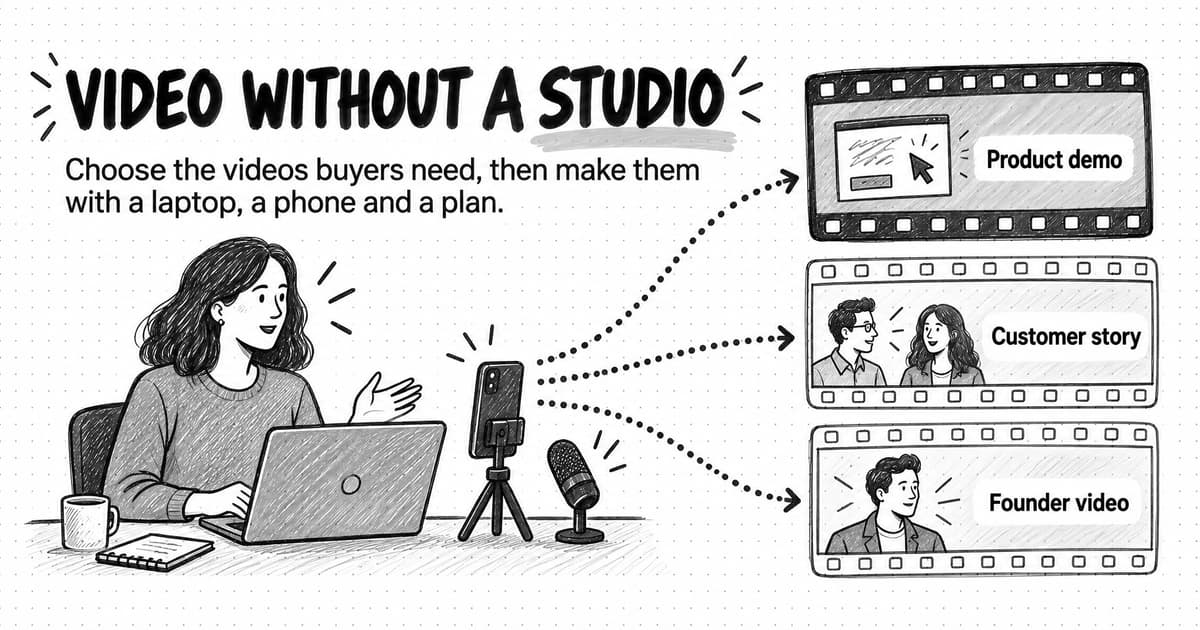
The term has picked up a second meaning, which causes most of the confusion. Consumer brands now pay "UGC creators" to make videos that look like casual customer posts, and AI tools generate those videos with synthetic presenters. So a B2B marketer searching for UGC finds unboxing videos, creator rates, and AI avatar generators mixed with advice about reviews, all under one label.
This guide separates the two meanings and explains what each is good for in B2B: which types of user-generated content matter to business buyers, why they carry weight, how to ask for them, and how to get the rights to reuse them. It then sets out the rules that apply once money or a brand relationship is involved, including the FTC's Endorsement Guides, its 2024 rule against fake reviews, and platform labels for paid and AI-generated content. It ends with where AI-made, UGC-style video is acceptable, a program plan for a small team, a fictional worked example, and two templates.
What is user-generated content?
The most careful early definition comes from the OECD, which studied what it called user-created content in 2007. Its report Participative Web and User-Created Content noted that there was no widely accepted definition and proposed three characteristics: content "made publicly available over the Internet," which "reflects a certain amount of creative effort," and which is "created outside of professional routines and practices."
Those three tests still sort most cases well. A customer's review on a software review site passes all three. An email a customer sends your support team is not published, so it is feedback, not UGC, until the customer agrees to share it. A post that only copies your marketing copy adds no creative effort. A video your agency produced is professional content, even if it features a customer.
The third test does not mean amateur. A finance director who reviews your product is a professional, but writing the review is not her job, and nobody paid her to reach a conclusion. That independence is the point, and it is why the definition strains once a brand pays someone to create content in a customer's voice.
In B2B, "user" usually means a customer. It can also mean a free-tier user, a partner, a community member, an employee, or a practitioner who writes about the category. What they share is that the brand did not author the content, even if it asked for it.
Two neighboring terms help. Brand-generated content is what your own team makes: your website, blog, ads, and product videos. Customer content or customer marketing is the broader practice of building marketing around customers, including case studies and reference calls that your team writes or produces with the customer's help. A case study is not strictly user-generated, because your team writes it, but it is built from customer words, and the same permission and honesty rules apply to it.
The two meanings of UGC: organic customer content and paid creator content
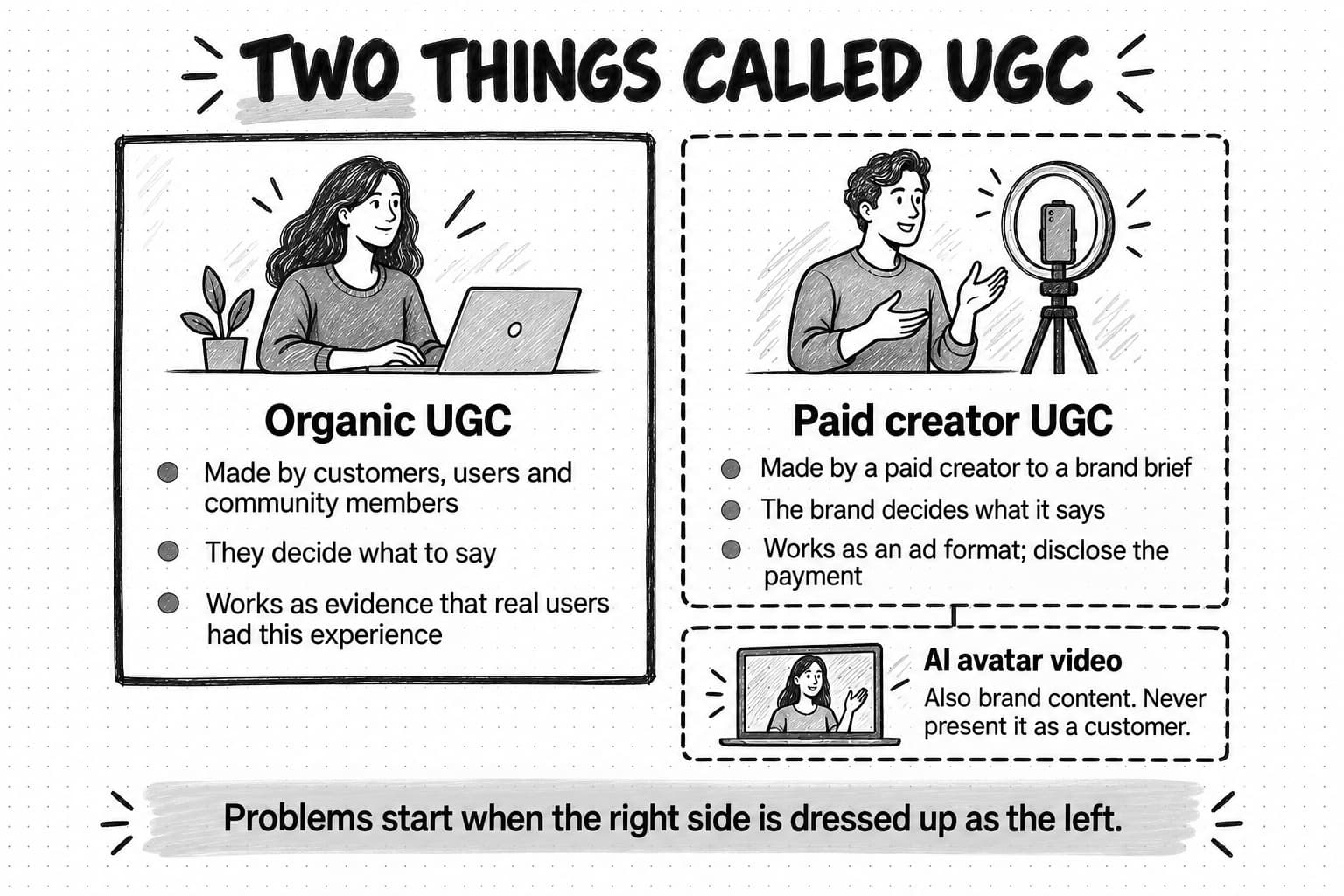
Two different things now share the name. The first is organic UGC: content customers and users create because they want to, such as a review, a post about a result, a community answer, or a shared template. The brand may have asked for it or offered a modest incentive, but the customer decided what to say. This is the original meaning, and the one the OECD definition describes.
The second is paid UGC, sometimes called creator UGC or UGC ads. A brand pays a creator, often someone who has never used the product before the brief arrives, to make content in the style of an ordinary customer post: a person talking to a phone camera, a casual demo, a "here's what I use" format. The brand runs the result as an ad or posts it on its own channels. It is not user-generated in the OECD sense at all; it is brand content made to look native to social feeds.
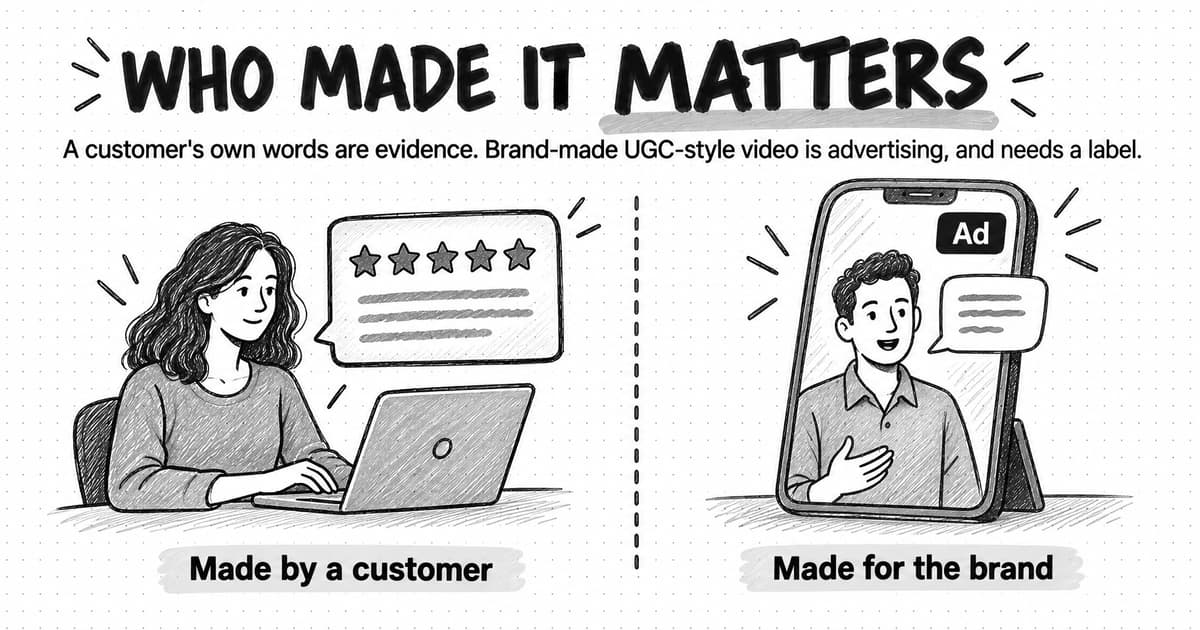
The two do different jobs. Organic UGC is evidence: it carries weight because a real customer chose to say it. Paid UGC is a format: it can make an ad more watchable, but the person on screen speaks for the brand. Treating the second as the first is where marketing slides into deception.
| Organic UGC | Paid creator UGC | |
|---|---|---|
| Who makes it | Customers, users, community members, employees | A paid creator or actor working to a brand brief |
| Who decides what it says | The person who made it | The brand, through the brief and approval |
| What it proves | That a real user had this experience and chose to share it | Nothing about customer experience; it is a production style |
| Main B2B uses | Reviews, social proof, community, case-study raw material, sales enablement | Paid social ads, product explainers, top-of-funnel video |
| Disclosure | Needed when the brand gave something of value or has a relationship | Always a material connection; label it as paid or sponsored |
| Rights | The creator owns it; ask permission before reuse | Set by contract; agree usage scope and duration up front |
A third category builds on the second: AI-generated UGC-style content, in which an AI avatar delivers a brand script in the casual style of a creator video. It belongs with paid UGC, and adds questions about likeness, consent, and labeling that a later section works through.
Types of user-generated content in B2B
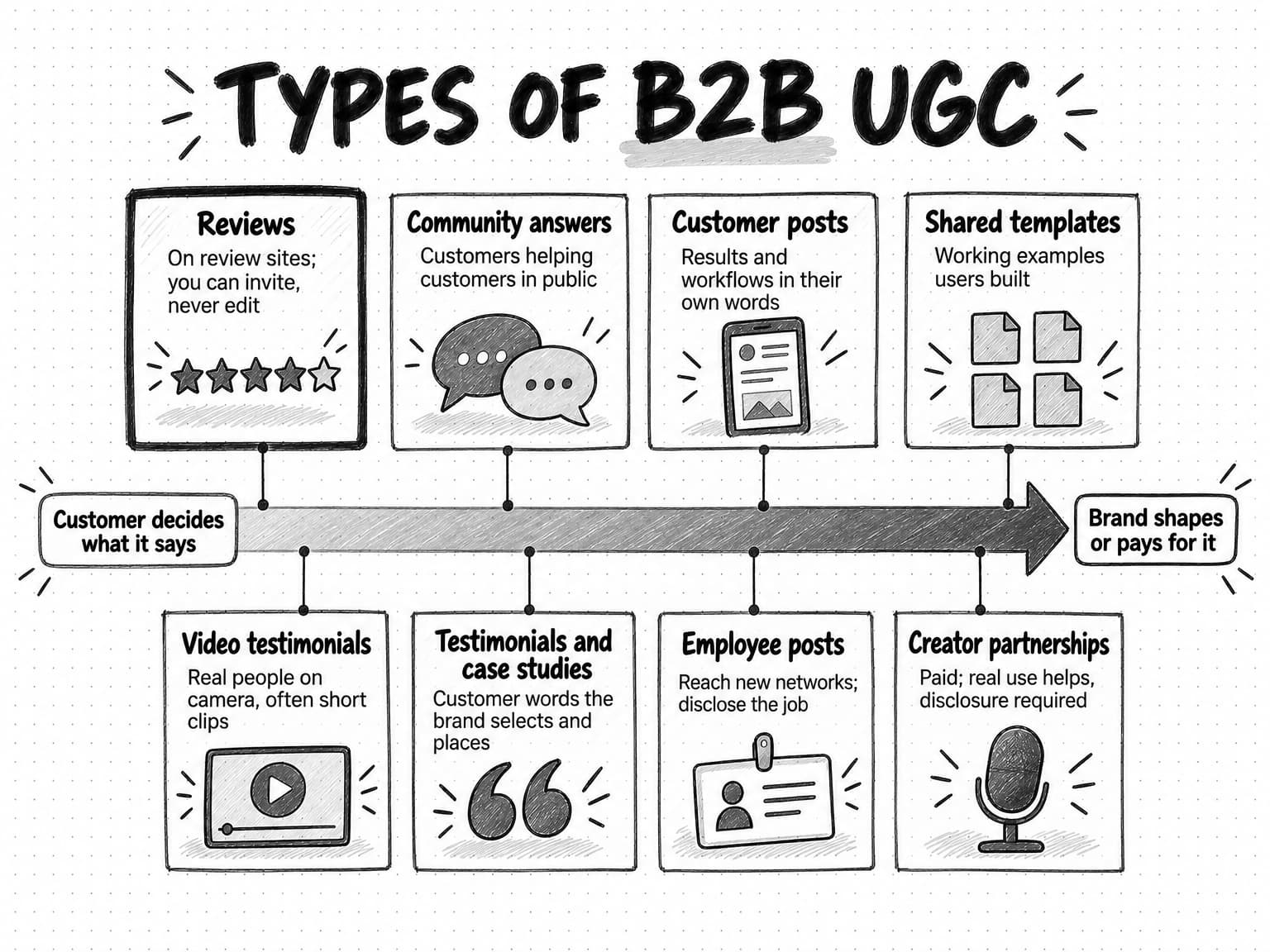
Consumer UGC is dominated by photos and short videos of products in use. B2B UGC looks different, because the product is often software used at work and buyers evaluate it with colleagues.
Reviews on third-party review sites
Reviews on software and business review sites are the most influential B2B UGC for most companies. Buyers read them while comparing tools, AI answers draw on them, and the larger sites validate reviewer identity, which makes them hard to fake at scale. Reviews differ from almost every other type in one respect: the brand does not control them. You can invite reviews, but you cannot edit or remove the ones you dislike, and trying to is now explicitly covered by FTC rules.
Customer social posts
A customer posting on LinkedIn about a result, a workflow, or a problem the product solved is the B2B equivalent of a consumer product photo. These posts carry the customer's own network and credibility, and they contain the specific detail marketing copy lacks: "we cut month-end close from nine days to six" lands differently from "faster close." A passing mention inside a post about the person's work is often more persuasive than dedicated praise, because the product appears as a tool someone actually uses.
Community answers and discussions
When customers answer each other's questions in your forum, a Slack group, a subreddit, or a practitioner community, they create a public record of how the product works in real situations. A prospect searching "can [product] handle X" may find a customer's answer before any page you wrote. Community threads also show you which questions keep coming up.
Templates, workflows, and other things users build
Products that let users build things, such as automations, dashboards, templates, or reports, produce a strong form of UGC: working examples. A gallery of customer-built workflows shows what the product can do more concretely than a feature list, and gives new users a starting point.
Testimonials and case-study quotes
Testimonials are customer statements the brand collects and publishes, usually short quotes with a name, title, and company. Case studies are longer stories the brand writes with a customer's cooperation. Both start as customer words and become brand content once your team selects and places them. Sales teams use them heavily because they can be matched to a prospect's industry, size, or problem. Our guide to writing a B2B case study covers how to build one that sales will send.
Video testimonials
A customer speaking on camera is a persuasive testimonial format and the hardest to get, because it asks for time, a willingness to be on camera, and often approval from the customer's own company. Short clips recorded on a video call or at an event often work better than studio productions, because they look like what they are: a real person speaking for themselves.
Employee-generated content
Employees posting about their work and their company's product reach networks the company page never will. Their posts are not independent in the way a customer's post is, though: the FTC's guidance says employees should disclose the relationship when they promote their employer's products, and that listing the employer on a profile page is not enough.
Creator and practitioner partnerships
B2B creator programs sponsor practitioners with an audience, such as a well-known finance operator or a newsletter writer. When the creator genuinely uses the product and says what they think, the result sits between organic UGC and advertising: real experience under a paid relationship that must be disclosed. When they follow a script about a product they barely know, it is paid UGC.
Why user-generated content works for B2B buyers
People discount what a seller says about itself and give more weight to people like them. The evidence for B2B buyers points the same way, with caveats.
TrustRadius, a B2B software review site owned by HG Insights, surveys technology buyers each year. Its 2026 B2B Buying Disconnect report, drawn from 1,862 buyers and 444 vendors and summarized on July 15, 2026, found that 74% of buyers consulted customer reviews during their purchase, that use of review sites rose from 58% in 2025 to 63% in 2026, and that 53% spoke to a peer, all of whom found it at least somewhat helpful. Vendor marketing collateral ranked last among the resources buyers consulted, and 47% of buyers said they trusted online resources less than a year earlier. A review company has an interest in findings like these, so read them as one survey's direction: buyers check vendor claims against other people's experience.
The same report found that 94% of buyers who used AI in their purchase fact-checked its output at least some of the time. AI answers often summarize what customers say about a product, so a buyer may read a summary of your reviews and then go to the review site to check it.
Evidence on how reviews change behavior comes mostly from consumer ecommerce. Northwestern University's Spiegel Research Center analyzed product page data and reported in 2017 that a product with five reviews was 270% more likely to be purchased than one with none, that the effect of displaying reviews was larger for higher-priced products (a 380% conversion increase, against 190% for lower-priced items), and that purchase likelihood typically peaked at average ratings between 4.0 and 4.7 stars, not at a perfect 5.0. Those numbers describe retail shoppers, not buying committees, so do not put them in a B2B forecast. Two lessons travel well: the first handful of reviews does most of the work, and a few honest criticisms make the praise more believable.
User-generated content does three jobs that brand content struggles with:
- Proof. It shows that real customers get the result the brand claims.
- Context. It shows how the product fits real situations, such as a team or workflow like the buyer's, which helps them judge fit.
- Reach. A customer's post reaches colleagues and peers your company page does not, with an implicit recommendation attached.
UGC works best as evidence inside a content strategy that already explains who the product is for and why. Our guide to building a content marketing strategy for B2B SaaS and AI companies covers that structure.
A customer's specific number, in their own words, is evidence. The same number on your homepage is a claim.
UGC vs. influencer marketing, employee content, and brand content
The vocabulary around UGC overlaps. These are the definitions this guide uses.
| User-generated content (UGC) | Content about a brand that people outside its marketing team create and publish because they chose to, such as reviews, posts, community answers, and shared templates. |
|---|---|
| Paid UGC or creator UGC | Content a brand pays a creator to make in the style of an ordinary customer post. It is brand content in a native-looking format, and the payment is a material connection to disclose. |
| AI UGC or AI avatar video | UGC-style video in which a synthetic presenter delivers a brand-written script. It is brand content; it must never be presented as a real customer. |
| Influencer marketing | Paying or sponsoring people with an established audience to talk about a product to that audience. The value is the creator’s reach and credibility, not only the production style. |
| Employee-generated content | Posts and other content employees create about their work or their employer. It is not independent; employees should disclose the relationship when they promote the product. |
| Brand-generated content | Content the brand’s own team or agencies create, such as the website, blog, ads, and product videos. |
| Testimonial | A customer statement the brand collects and publishes, usually a short quote with a name and role. It starts as customer words and becomes brand content once selected and placed. |
| Social proof | Any signal that other people use and value a product: reviews, ratings, customer logos, testimonials, usage counts. UGC is one important source of it. |
The distinction that matters most is between content a person chose to make and content you commissioned in their voice. Both are legitimate; problems start when the second is dressed up as the first.
How to source user-generated content ethically
Most B2B companies have more potential UGC than they realize, scattered through support tickets, sales calls, community threads, and customer posts nobody saved. The work is to ask at the right moments, make it easy, and stay inside the rules that keep the content believable.
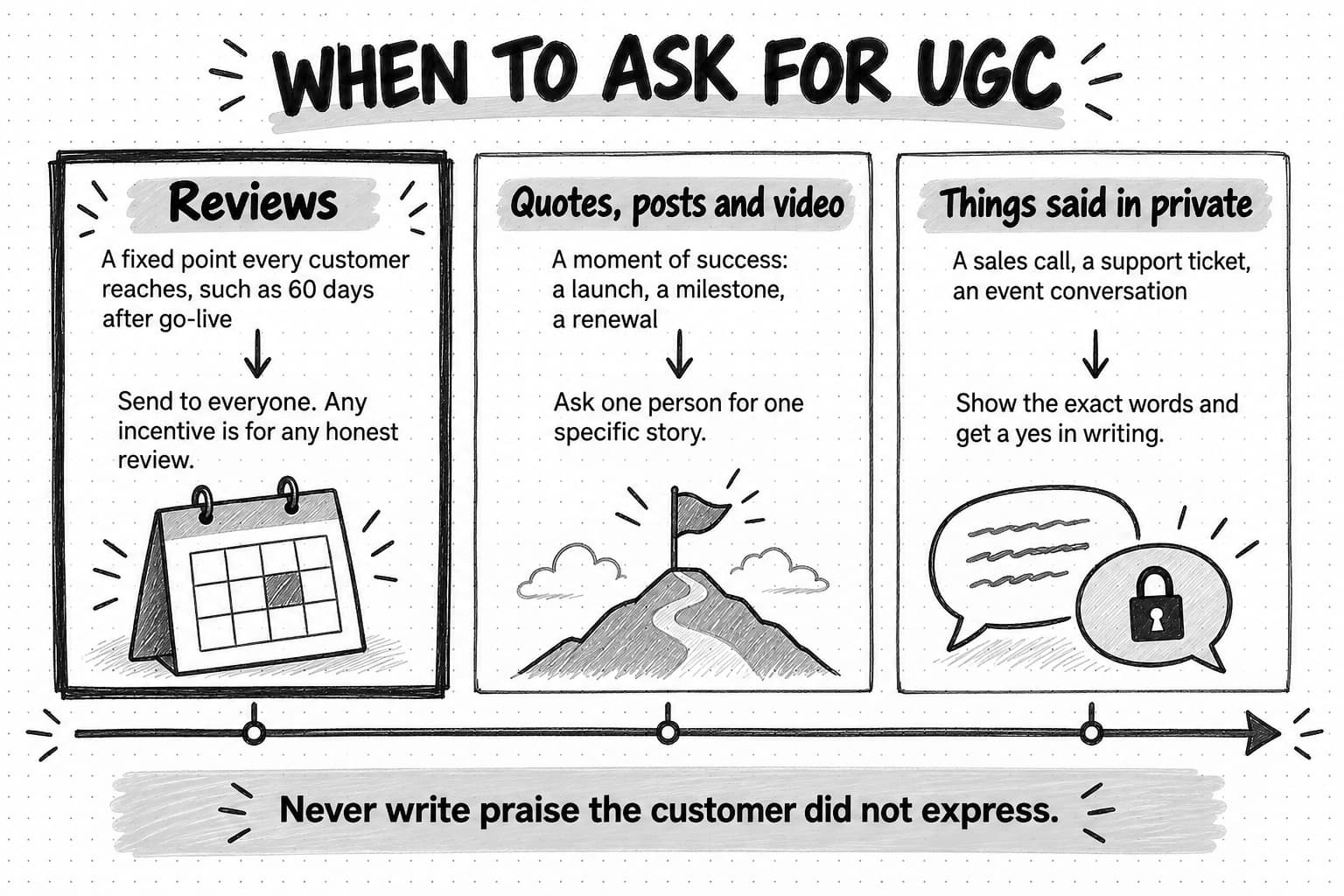
Ask at moments of success
The best time to ask for a quote or a post is right after a customer has experienced the value: a successful launch, a first month-end close in the new system, a support ticket resolved quickly, a renewal. The customer remembers the result and feels goodwill.
Reviews are different. The FTC's guidance on the Endorsement Guides, What People Are Asking, says it is fine to "invite all of your customers to post honest reviews, positive or negative," and warns that asking only customers you expect to be happy would be misleading if it skews the picture. So trigger review requests from an event every customer reaches, such as a set time after go-live, and send them to everyone who reaches it. Save moments of success for the personal asks, where you invite someone to share a specific story.
Run a review program, not a review campaign
A one-off push produces a burst of ratings from the same month and then nothing, which looks odd to buyers and to review sites. A steady program works better: a standing request at a defined point in the customer lifecycle, one reminder, and a thank-you.
If you offer an incentive, keep it modest, offer it for any honest review, and disclose it. G2's page About G2's Reviews, Data, and Rankings says vendors "may not condition an incentive on a positive review," must disclose any incentive to G2, and are capped at $100 per review across incentive types. Confirmed incentivized reviews carry a label and are weighted less in its satisfaction scoring. Read the current guidelines of each review site you use, because the site's rules and the FTC's both apply.
Build places where users want to share
Community content grows where users get something back: answers, recognition, access to the product team, or a better way to do their job. A forum, a customer Slack group, or a template gallery gives people a place to contribute. Seed it with your team's own answers, recognize contributors publicly, and pull the best contributions into your channels with permission.
Use events, calls, and support conversations
Conferences, webinars, and user groups produce talks and quotes that can become content. So do sales calls and support tickets: when a customer explains in their own words what the product changed, that sentence is raw material for a testimonial. The customer said it privately, so treat it as a lead for a request. Ask whether you can quote them, show them the exact wording, and get a yes in writing.
Make the ask small and specific
A specific request with the hard part done gets more yeses than a vague one: "Would you share the approval workflow you built for your regional teams? Here is a link to the template gallery, and we'll credit you by name." For a quote, offer a draft based on what they said and invite changes. For a post, suggest the angle but never the opinion.
Permissions, usage rights, and attribution
Finding a great customer post is not the same as being allowed to use it. Rights are the part of UGC programs most teams skip.
The creator owns what they make
In the United States, the Copyright Office explains that a work "is under copyright protection the moment it is created and fixed in a tangible form," and that registration is generally voluntary. A customer's post, photo, video, or written review belongs to the customer, or sometimes to their employer, from the moment they make it. Platform terms usually let the platform display it, and may let you share it within the platform, such as reposting on LinkedIn. They do not give you a license to put it in an ad, on your website, or in a sales deck.
Ask for exactly the use you need
Permission comes in levels, and each step up is a bigger request:
- Engage on the platform. Reshare with the platform's own share feature, which keeps the original and its credit. This generally needs no extra permission.
- Feature it on owned channels. Quote or embed it on your website or in a newsletter, with credit. Ask first.
- Use it in sales materials. Decks, one-pagers, case studies. Ask, and say where it will appear.
- Edit it. Trim a video or shorten a quote. Ask, and show the edited version.
- Run it as paid advertising. Ask specifically, because the words will travel far beyond the customer's network and the ad may need disclosure.
Ask for the use you need, not blanket rights forever. A narrow request is more likely to get a yes.
Get it in writing and record it
A comment reply such as "sure, go ahead" is better than nothing, but a short written confirmation by email or form is much easier to rely on six months later. Record who agreed, what they agreed to, the date, any conditions such as "not in ads," and a review date. Keep that record next to the asset, so whoever reuses it can check what is allowed.
Two complications are common in B2B. Many companies restrict employees from endorsing vendors publicly, so your champion may need approval from their own communications or legal team; ask, and give them time. And people change jobs, so a quote that names a former employer can become inaccurate. Review testimonials on a schedule and retire the ones that no longer reflect reality. Credit people the way they want: the name, title, and company they approve, a link to the original, or anonymity if they prefer.
Here is a permission request you can adapt. Keep it short and send it from a real person.
Subject: Could we feature your [post / review / template]?

Hi [first name],

Thank you for sharing [your post about cutting month-end close]. It is one of the clearest explanations we have seen of [what it shows].

We would like to feature it in these places:
- [Use 1: our website's customer stories page]
- [Use 2: our monthly newsletter]
- [Use 3, only if needed: a paid LinkedIn ad, for up to 6 months]

We would credit it as: [Name, Title, Company] and link to your original post.
We would [use it as-is / trim it to the section below / add captions]:
[Paste the exact excerpt or describe the edit.]

There is no obligation, and you can say yes to some uses and not others.
If your company needs to approve this, we are happy to wait.
You can ask us to stop at any time, and we will remove it from future materials within [timeframe].

A quick reply saying which uses you agree to is all we need.

Thanks again,
[Your name, role]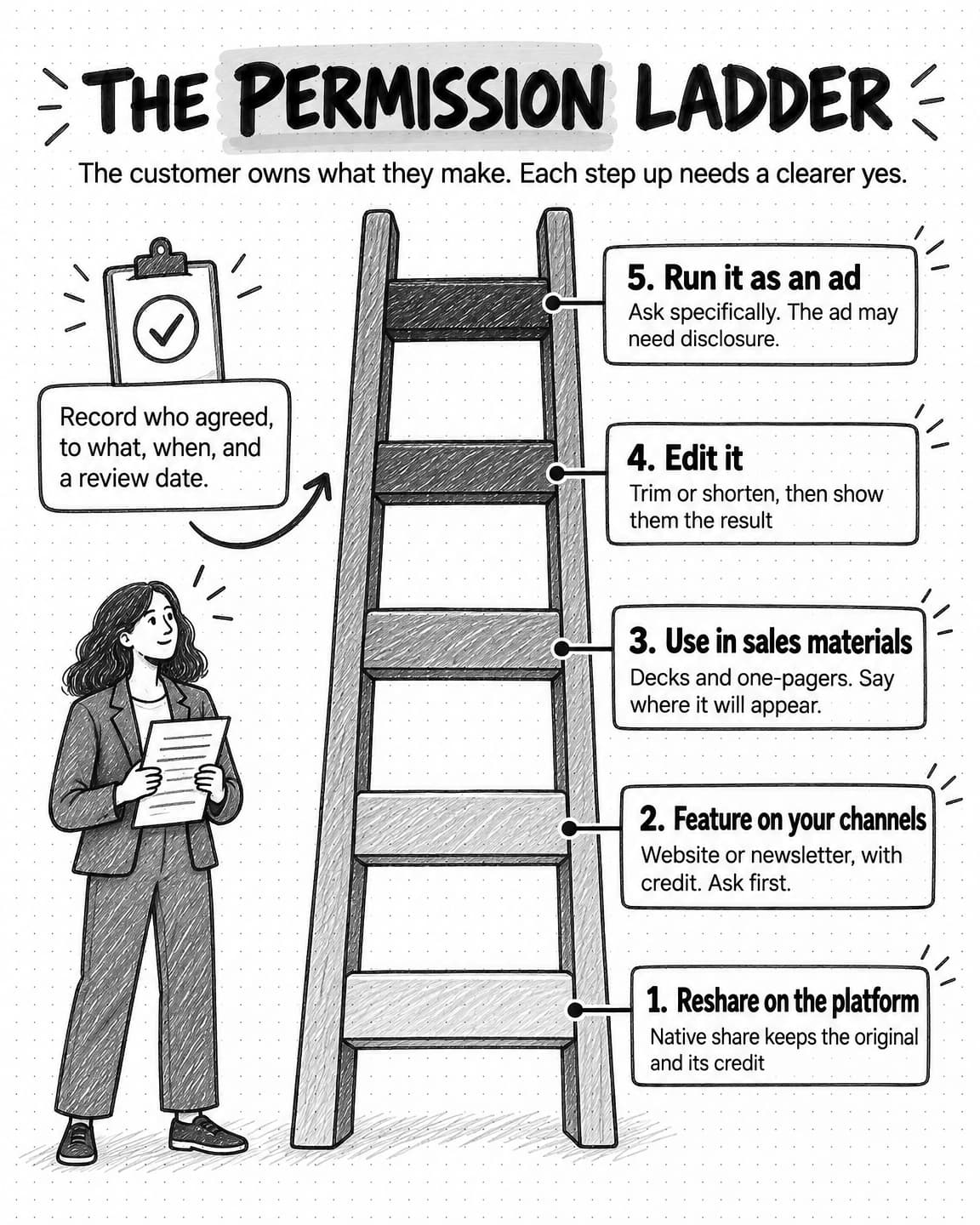
Open the full-size permission ladder (opens in a new tab).
The rules for reviews, testimonials, and paid creator content
Once a brand gives something of value, asks for content, or pays someone to make it, user-generated content becomes an endorsement, and endorsement rules apply. In the United States, the main sources are the FTC's Endorsement Guides and its 2024 rule on consumer reviews and testimonials. Platforms add their own labeling requirements on top.
The FTC Endorsement Guides
The FTC announced revised Endorsement Guides on June 29, 2023. The revision extended the definition of an endorsement to cover "fake reviews, virtual influencers, and tags in social media," defined "clear and conspicuous," addressed the manipulation of consumer reviews, and warned that a platform's "built-in disclosure tool might not be an adequate disclosure."
The FTC's question-and-answer guidance on the Guides, What People Are Asking, turns that into practical rules. The ones most relevant to a B2B UGC program:
- Endorsements must be honest. They must reflect the endorser's real opinion and experience, and they cannot make claims the advertiser could not make itself.
- Disclose material connections. Payment, free products, discounts, commissions, employment, and personal or business relationships generally need disclosure when people would not expect them and they could affect how much weight the endorsement gets.
- Do not make incentives depend on sentiment. "You can't condition an incentive – for example, a discount – on a review being positive."
- Do not suppress or cherry-pick. Selectively delaying or hiding negative reviews, or asking reviewers to change or delete them, can mislead.
- Employees must disclose. The guidance says that "listing your employer on your profile page isn't enough."
- Disclose in the content itself. Disclosures in a comment, behind a link, or only on a profile or home page are generally not enough. For video, the guidance says a disclosure "has the best chance of being clear and conspicuous if it's included in the video itself," and endorsements made visually should be disclosed at least visually.
- Use clear words. "#ad," "Ad:" at the start of a post, "Paid post by [brand]," and plain statements of what was given work. Vague terms such as "partner," "ambassador," or "collab" alone do not.
- Advertisers are responsible. Brands should train and monitor the creators they work with, and the FTC suggests reviewing paid posts before they go live.
The FTC's plain-language guide Disclosures 101 for Social Media Influencers (November 2019) adds that video disclosures are more likely to be noticed when made both aloud and on screen, since some people watch without sound.
The 2024 rule on fake reviews and testimonials
On August 14, 2024, the FTC announced a final rule banning fake reviews and testimonials. The rule, the Trade Regulation Rule on the Use of Consumer Reviews and Testimonials at 16 CFR Part 465, was published in the Federal Register on August 22, 2024 and took effect on October 21, 2024. Unlike the Guides, which explain how existing law applies, a trade regulation rule lets the FTC seek civil penalties for violations. It prohibits:
- Creating, selling, buying, or disseminating reviews or testimonials that misrepresent who wrote them or their experience, including reviews by "someone who does not exist, such as AI-generated fake reviews," when the business knew or should have known.
- Offering compensation conditioned on a review expressing a particular sentiment, positive or negative.
- Reviews and testimonials by company insiders, such as officers and managers, that do not "clearly and conspicuously disclose the giver's material connection to the business."
- Company-controlled websites that claim to offer independent reviews.
- Suppressing negative reviews through "unfounded or groundless legal threats, physical threats, intimidation," or misrepresenting that the reviews shown are all or most of the reviews.
- Buying or selling fake indicators of social media influence, such as bot followers or views, for commercial purposes.
For a UGC program, the practical effect is simple. Every review and testimonial you publish or promote should come from a real person describing their real experience, any relationship or incentive should be disclosed, and negative reviews should be left alone.
Platform labels for paid and branded content
Platforms require their own labels for paid partnerships, and those labels supplement legal disclosure rather than replacing it.
- LinkedIn. LinkedIn's help page Label post as brand partnership says that "if you share content in an exchange for value," including "monetary payment, endorsements, free products or services, or other benefit," you must label the post as a brand partnership using the toggle when posting. It also reminds members to check the disclosure laws where they are.
- Instagram and Facebook. Meta's Branded Content Policies require creators to tag the business partner in branded content, content made in exchange for something of value, using the paid partnership tool.
- YouTube. Its help page Paid product placements, sponsorships and endorsements says creators must tell YouTube when a video features branded content, sponsorships, or endorsements by selecting the paid promotion option, which adds a disclosure label at the start of the video, and that creators and their partners remain responsible for complying with the law.
- TikTok has its own setting for marking branded content. Check its current help pages before a creator campaign. TikTok's and YouTube's AI-content labels are covered in the next section.
A good rule for paid creator work: use the platform's label and also say it in the content, in words and on screen, near the start.
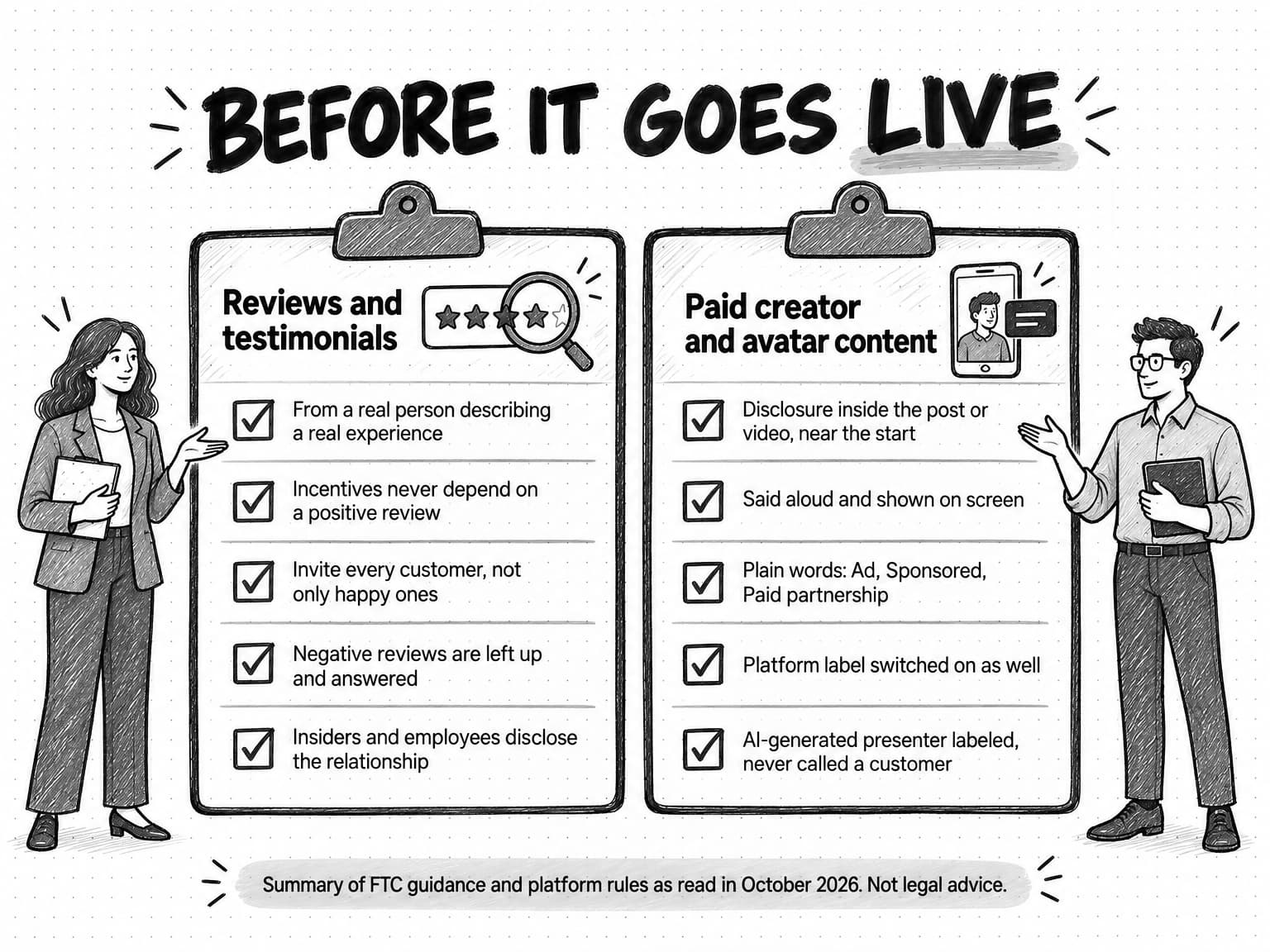
Open the full-size disclosure checklist (opens in a new tab).
AI-generated UGC and avatar video: what is acceptable and what is deceptive
Search for "AI UGC" and the results are almost all tools that generate videos of synthetic people talking to a phone camera. The appeal for a small B2B team is obvious: an explainer or a set of ad variants without booking a presenter or a studio, easy to update when the product changes.
AI UGC is video or other content in the casual, creator-made style of user-generated content, produced with AI, usually with a synthetic presenter called an AI avatar reading a script the brand wrote. The brand wrote every word and no customer is involved, which puts AI UGC on the advertising side of the line drawn earlier. It can be useful advertising. It is never evidence of what customers think.
Where AI avatar video is acceptable
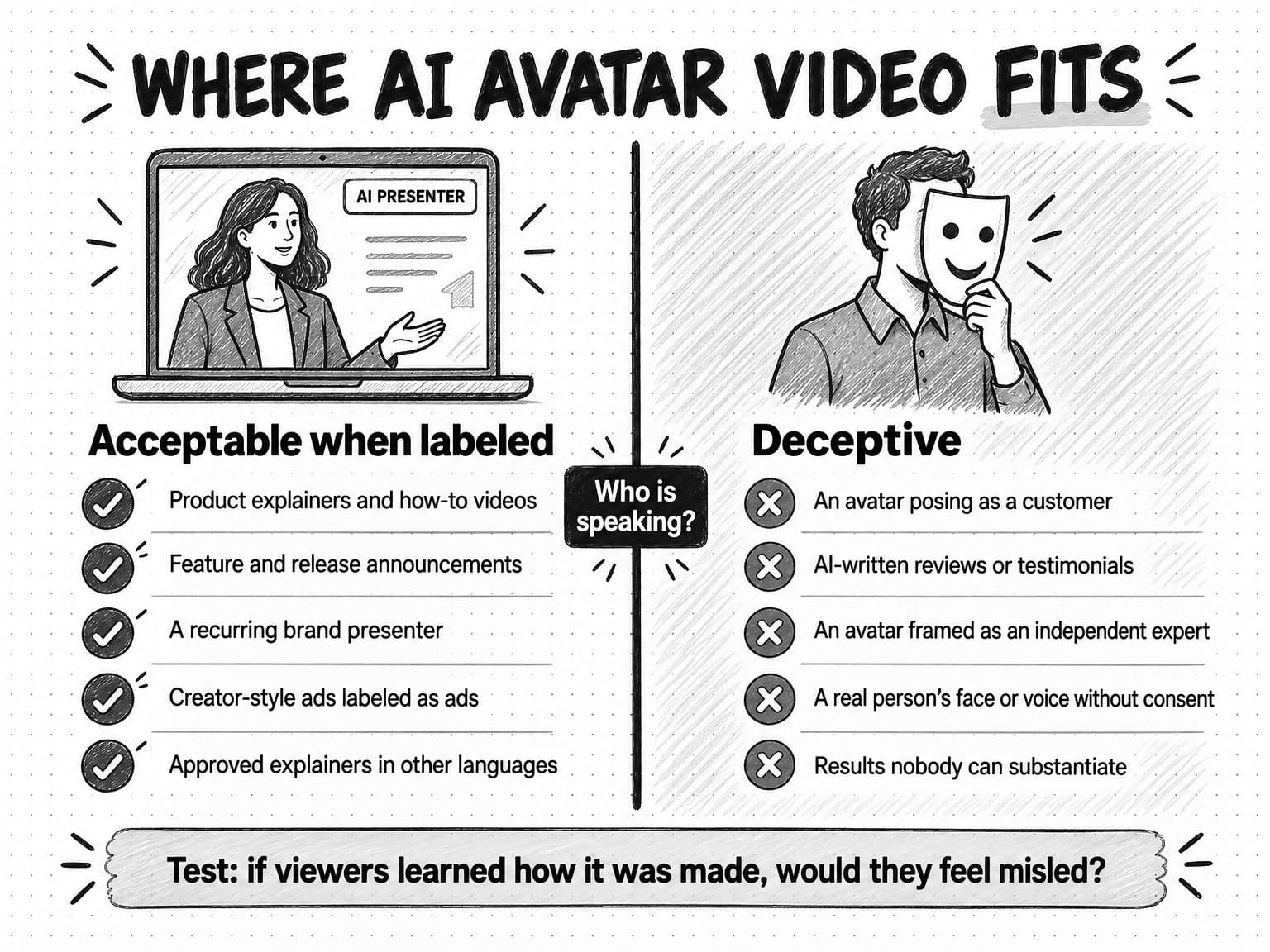
AI avatar video is a reasonable choice when the presenter is clearly speaking for the brand and the content would be honest if an employee or a hired actor delivered it. That covers product explainers and how-to videos, feature and release announcements, a recurring brand presenter for tutorials, the same approved explainer localized into several languages, and creator-style ads that are labeled as ads, make only claims the brand can substantiate, and never present the speaker as a customer.
Where it becomes deceptive
The line is crossed when the content suggests that a real customer, user, or independent person is speaking from their own experience. An avatar saying "I switched to this tool last quarter and our team loves it" is a fabricated testimonial, and the FTC's 2024 rule covers testimonials that misrepresent who gave them or their experience, naming AI-generated fake reviews specifically. The same applies to framing an avatar as an independent creator or analyst, to generating a real person's face or voice saying things they never said without their written permission, and to claims such as "teams save ten hours a week" that nobody can substantiate, whoever delivers them.
A useful test is to imagine the viewer learning how the video was made. If they would feel misled about who was speaking or whether the experience was real, the content is deceptive, whatever the label says.
| Use of AI avatar video | Verdict | What makes the difference |
|---|---|---|
| Avatar explains how a feature works, labeled as the brand's video | Acceptable | The brand is openly speaking; the content is factual |
| Labeled ad in a casual creator style, presenter not described as a customer | Acceptable with care | Ad label, substantiated claims, no implied experience |
| Avatar says "I've used this for a year and it saved my team hours" | Deceptive | Presents invented personal experience as real |
| AI-generated written or video reviews posted as customer feedback | Prohibited | Fake reviews from people who do not exist |
| Customer's own testimonial, re-voiced by an avatar in another language with the customer's written consent and a disclosure | Possible with care | Real experience, consent, and a clear disclosure of the method |
| Video of a real person saying things they never said, without consent | Not acceptable | Likeness and voice used without permission |
Consent, likeness, and voice
Avatar tools usually offer stock avatars, built from actors who licensed their likeness to the provider, and custom avatars, built from a real person's photo, video, and voice. If your avatar is based on a real person, such as a founder, an employee, or a hired actor, get informed, written consent that covers the specific uses: which channels, ads or organic, how long, whether their voice will be cloned, and what happens if they leave or withdraw. An employee who agrees to front the product tutorials has not agreed to appear in ads after they leave.
The law here is moving. Right-of-publicity laws in many US states already protect a person's name and likeness from unauthorized commercial use, and some newer laws address AI directly. Tennessee's ELVIS Act, for example, took effect on July 1, 2024 and added voice to the personal rights the state protects. Other jurisdictions differ, which is one more reason to keep a written consent record and get legal review before using anyone's likeness.
Platform AI labels and regulation
Platforms also require labels for realistic synthetic media:
- YouTube. Its help page Disclosing use of altered or synthetic content requires creators to disclose realistic content that, among other things, "makes a real person appear to say or do something they didn't do" or generates a realistic scene that did not happen. It exempts clearly unrealistic content, minor edits, AI help with scripts, and cloning your own voice for voice-overs. A photorealistic avatar talking to camera is the kind of content to label when in doubt.
- TikTok. TikTok announced on September 19, 2023 that its synthetic media policy requires people to label AI-generated content "that contains realistic images, audio or video," and introduced a label creators can apply to content "completely generated or significantly edited by AI."
- Meta. In Expanding GenAI Transparency for Meta's Ads Products, first published February 3, 2025, Meta said ads in which its generative AI tools produced "an AI-generated photorealistic human" would carry an AI label next to the Sponsored label. A June 2026 update to the same post describes "AI info" labels in the ad's "About this ad" section. Check Meta's current advertiser guidance before a campaign, because the details have changed more than once.
- The European Union. Article 50 of the EU AI Act, which applies from August 2, 2026, requires deployers of AI systems that generate or manipulate deep fakes to "disclose that the content has been artificially generated or manipulated." The Act defines a deep fake as AI-generated or manipulated content that "resembles existing persons, objects, places, entities or events and would falsely appear to a person to be authentic or truthful."
The safe default for AI avatar video is to label it in the content and with the platform's AI label, never to present the presenter as a customer, and to keep a record of the consent behind any avatar based on a real person.
How to repurpose user-generated content across channels
A single good piece of UGC can work in many places, provided the permissions cover each use. A customer's LinkedIn post about cutting their close time might become a quote on your pricing page, a slide in the sales deck for that industry, a newsletter feature, and the seed of a case study.
Keep the customer's words intact and change the frame around them: pull the strongest sentence, add context about who they are, and link to the original. Never stitch fragments from different customers together, or trim a quote so it says more than the person meant. Our guide to repurposing content across channels covers how to adapt one source for several formats without losing its point.
Match the type of UGC to the place it does the most work:
| Where | UGC that works | Notes |
|---|---|---|
| Product and pricing pages | Short attributed quotes, review-site ratings with a link, template examples | Put proof next to the claim it supports |
| Comparison and use-case pages | Reviews and quotes from customers in that segment or switching from that competitor | Keep dates; refresh when the product changes |
| Sales decks and one-pagers | Testimonials and case-study quotes matched to industry and size | Check permission covers sales use |
| Newsletters and social | Customer posts, community answers, shared templates, with credit | Reshare natively where possible |
| Paid ads | Customer content with explicit ad permission, or clearly labeled creator or avatar ads | Disclose any relationship; label AI |
A shared library of approved UGC, where each item carries its permission record, source link, and review date, lets anyone on the team reuse it correctly. Our guide to content operations covers how a small team runs that kind of shared system.
How to measure user-generated content
Buyers see UGC over months, in channels you cannot track. So measure three things: whether you are getting more UGC, whether people see it, and whether it shows up in buying decisions.
| Volume and freshness | New reviews per month, recency of the latest reviews, number of customers who have posted or shared, community answers by users rather than staff. |
|---|---|
| Quality and balance | Average rating and its spread, share of reviews that mention specific outcomes, themes in critical reviews, and whether reviews come from your target segments. |
| Request conversion | Share of review, quote, and permission requests that get a yes. A falling rate often means you are asking at the wrong moment or asking for too much. |
| Reach and engagement | Views and engagement on customer posts you reshare, visits to review-site profiles and template galleries, and how often UGC assets are opened in sales tools. |
| Influence on deals | How often prospects mention reviews, peers, or community in self-reported attribution and sales notes, and win rates where a matched testimonial was used. |
| AI answer presence | Whether AI assistants describe your product in terms that match your reviews, and which review and community pages they cite. |
The most useful single signal for many B2B teams is self-reported attribution: a free-text "How did you hear about us?" field on demo forms, plus the same question on sales calls. When prospects write "reviews" or "saw a customer's post," the program is working. Our guide to measuring content marketing ROI explains how to combine these signals with what attribution reports can see.
Read critical reviews as closely as the praise. A specific, non-defensive reply often does more for a prospect's confidence than another five-star rating.
A UGC program plan for a small team
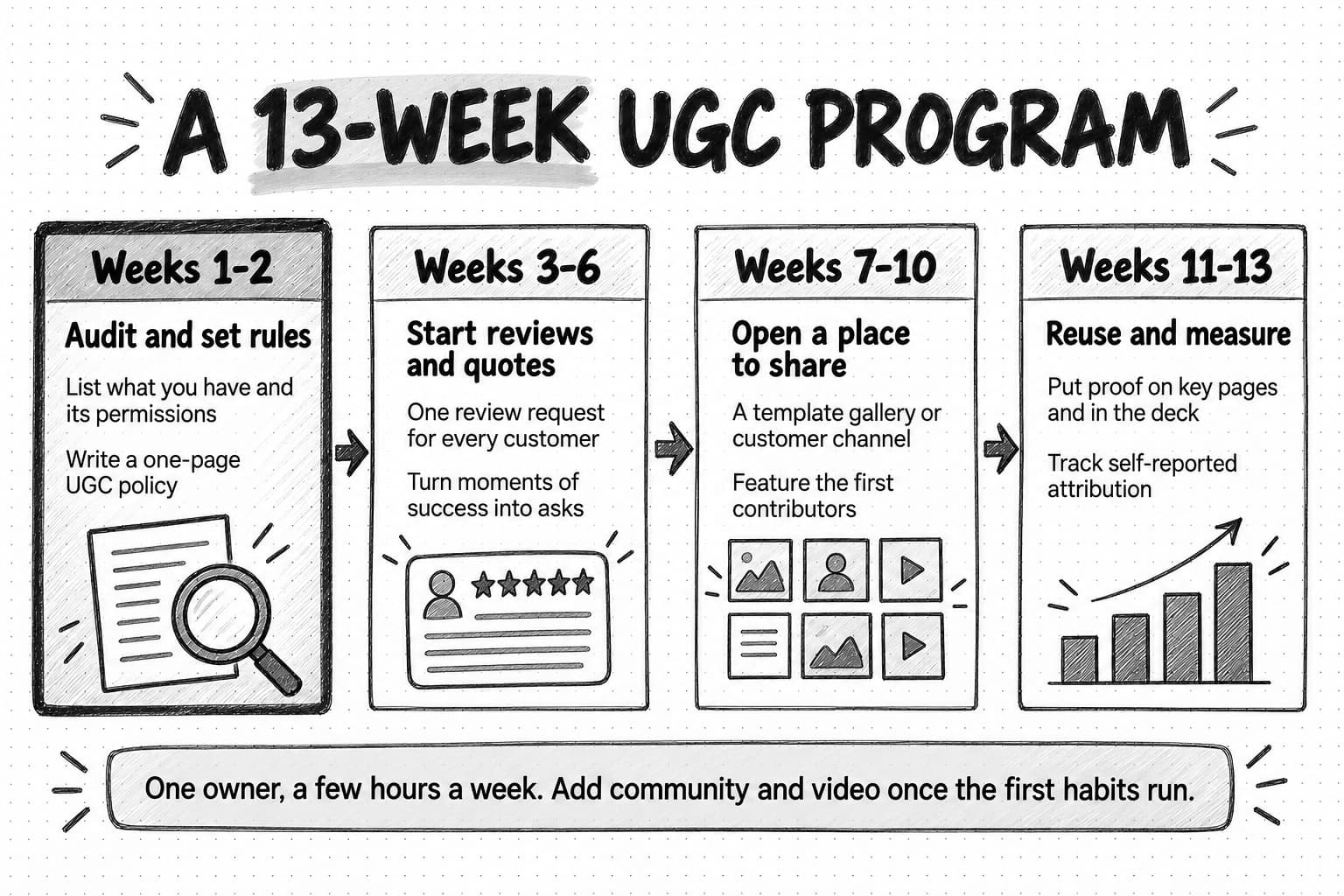
A UGC program needs a few standing habits and one owner who keeps them going, not a dedicated hire. This plan assumes a marketing team of one to five people and at least a few dozen active customers.
Weeks 1 to 2: audit and set rules. List the UGC you already have: review-site profiles, customer posts that mention you, community threads, testimonials in decks, and where each came from. Note which items have written permission and which do not. Write a one-page policy covering when you ask for reviews, what incentives (if any) you offer, how you disclose relationships, how you handle negative reviews, and how you label AI-generated video. Share it with sales and customer success.
Weeks 3 to 6: start the review and quote engine. Pick one or two review sites your buyers use and add a review request at a fixed lifecycle point for every customer. Ask customer success to flag moments of success and turn each into a specific request. Start a library with each approved item, its permission record, and a review date.
Weeks 7 to 10: open a place to share. Launch one place where users can contribute, such as a template gallery or a customer channel. Seed it with your own examples, feature the first contributors, and ask two or three customers for a short clip recorded on a video call.
Weeks 11 to 13: reuse and measure. Put the best UGC on product, pricing, and comparison pages and in the sales deck. If you run paid social, test an ad built from customer content with ad permission against a labeled avatar explainer. Review the measures above and adjust what you ask for and when.
Worked example: a five-person team builds a UGC program (fictional)
This example is fictional. Ledgerline is an invented company that sells accounts-payable automation to mid-sized finance teams. Its marketing team has five people, and its review profile on one major software review site has eleven reviews, the newest from fourteen months ago. The head of marketing wants more proof for buyers and has heard that AI UGC ads are cheap to make.
The audit. The team finds forty-odd customer LinkedIn posts mentioning Ledgerline, strong quotes in sales call notes, a community thread where customers compared approval workflows, and three deck testimonials with no record of permission. One of those came from a customer who has since churned. The team retires it and asks the other two customers to confirm their quotes in writing; both agree.
The rules. Review requests go to every customer sixty days after go-live, with a small gift card for any honest review, disclosed to the review site. Customer success flags milestones, and marketing follows up with specific requests for quotes. Negative reviews get a reply from the head of customer success within a week. AI avatar video is labeled and never presented as a customer.
The first quarter. The lifecycle request produces a steady trickle of reviews, including two critical ones about the mobile approval app; the public replies explain what is changing. Four customers agree to have their LinkedIn posts featured on the website and in the newsletter, and one agrees to ad use for six months. A customer who built an approval workflow for subsidiaries shares it as the first entry in a new template gallery, credited by name.
The AI video decision. The team makes two kinds of video. The first is a set of short explainers presented by a stock AI avatar, labeled as Ledgerline's own videos, each covering one feature with claims the product team has checked. The second is one ad built from a real customer's recorded clip, with written ad permission and a disclosure, because the customer received a conference pass. The team rejects a script one writer drafted in which the avatar says "As a controller, I was drowning in invoices until Ledgerline." That line invents a customer, and the policy forbids it.
What changed. By the end of the quarter, the review profile has fresh reviews from the target segment, the deck's testimonials have permission records, and reps hear prospects mention reviews and the template gallery on calls. The team does not try to attribute revenue to any single piece. It tracks self-reported attribution and the share of requests that get a yes.
A brief template for creator and AI avatar videos
When you commission creator-style content from a paid creator or an AI avatar, the brief is where honesty gets decided: who the presenter is, what they may claim, and how the content is disclosed. Copy this one and adapt it.
UGC-STYLE VIDEO BRIEF

Product and feature: [what the video covers]
Audience: [role, company size, situation]
Objective: [what the viewer should understand or do next]
Channel and placement: [LinkedIn feed ad / YouTube tutorial / website]
Length: [e.g. 30–45 seconds]

Presenter: [paid creator name / stock AI avatar / custom avatar of (name)]
Presenter role on screen: brand presenter, NOT a customer
Consent record (custom avatar or real person): [link to signed consent; uses covered; expiry]

Claims allowed (each with its source):
- [Claim 1] — source: [product doc / data]
- [Claim 2] — source: [...]
Claims not allowed: no personal experience ("I used...", "my team..."),
no results we cannot substantiate, no comparisons we have not checked.

Customer content used (if any): [quote or clip] — permission: [link; covers ad use?]

Disclosure:
- Spoken, near the start: [e.g. "This is a Ledgerline video."]
- On screen, in captions: [e.g. "Ad" / "Paid partnership with ..." / "Made with an AI avatar"]
- Platform labels: [paid partnership toggle / AI-generated label]

Call to action: [what to do next]
Review before publishing: [who checks claims, disclosure, and rights]
Common mistakes with user-generated content
Treating paid UGC as social proof. A creator video or avatar ad is a production style, not evidence. Putting it on a "what our customers say" page or quoting it in sales as customer feedback misleads buyers.
Reusing content without permission. A public post is not a license. Featuring it without asking can damage the relationship. When you do quote it, keep their voice: a quote rewritten into marketing language loses what made it believable.
Cherry-picking or fighting reviews. Asking only happy customers can mislead under FTC guidance, suppression is covered by an FTC rule, and buyers notice when every review is perfect. Ask everyone, reply to criticism specifically, and fix what you can.
Letting testimonials go stale. A testimonial from a former customer about a feature you removed misleads. Put a review date on each item in your library.
Using AI to fill gaps in evidence. AI-generated testimonials presented as real are prohibited, not a fix for thin proof. Earn and ask for real proof, and use AI where it is honest: clearly labeled explainers and ads.
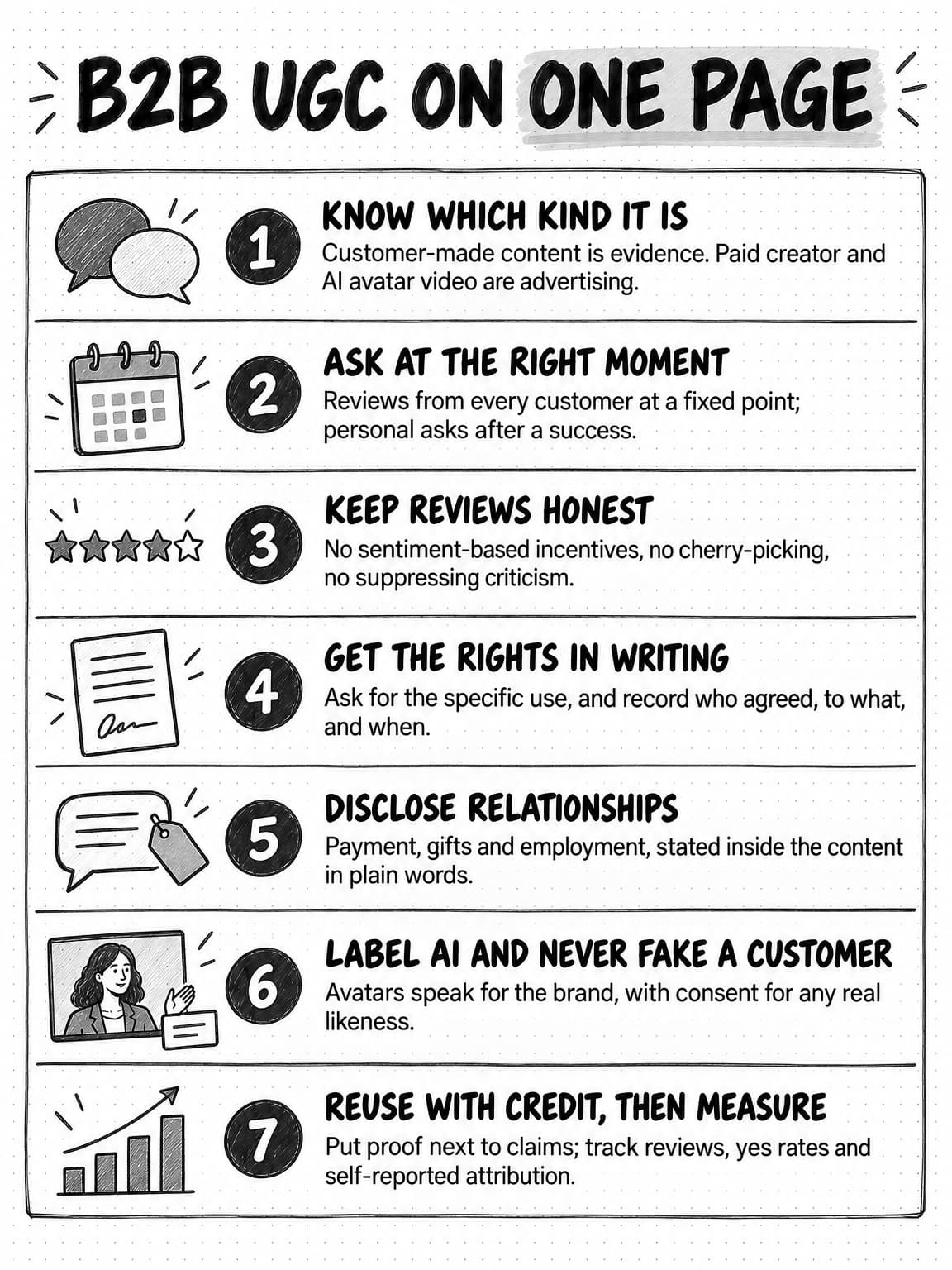
Open the full-size UGC reference to save or print it (opens in a new tab).
How Ampere helps with user-generated content work
Ampere is an AI marketing agent that can handle much of the research, drafting, and production in a UGC program, while your team keeps the customer relationships and publishing decisions. Ampere can pull public review, social, and creator data into structured summaries, and save voice-of-customer and social proof reports to Brand memory, so later work starts from what customers say about you and your competitors. Monitoring can check supported public sources, including reviews, on a cadence and file in-app alerts with evidence when something changes, and scheduled tasks can rerun a review or social research brief and return the results to a Project for review. Public data coverage is never complete, so treat these as a starting point to check.
For production, Ampere can draft channel-specific social packages, newsletters, and image posts that feature approved customer content, and marketing video script packages for product demos and UGC-style ads. It can create reusable AI avatars, talking-avatar videos, and UGC-style avatar videos for explainers and labeled ads, and save AI avatars and custom voices for reuse. Use those avatars as brand presenters: an AI avatar must never be presented as a real customer, and you remain responsible for consent, claims, and disclosure labels.
Ampere drafts and produces; it does not publish posts, run ads, or contact customers for you. Your team reviews every draft, checks every claim, confirms the permissions behind any customer content, and decides what goes live.
Sources and further reading
- OECD, Participative Web and User-Created Content: Web 2.0, Wikis and Social Networking, October 2007.
- Federal Trade Commission, FTC announces updated advertising guides to combat deceptive reviews and endorsements, June 29, 2023.
- Federal Trade Commission, FTC's Endorsement Guides: What People Are Asking.
- Federal Trade Commission, Disclosures 101 for Social Media Influencers, November 2019.
- Federal Trade Commission, Federal Trade Commission announces final rule banning fake reviews and testimonials, August 14, 2024.
- Federal Register, Trade Regulation Rule on the Use of Consumer Reviews and Testimonials, 89 FR 68034, August 22, 2024; effective October 21, 2024.
- U.S. Copyright Office, Frequently Asked Questions: Copyright in General.
- LinkedIn Help, Label post as brand partnership.
- Meta Business Help Centre, Branded Content Policies.
- Meta, Expanding GenAI Transparency for Meta's Ads Products, February 3, 2025, updated June 1, 2026.
- TikTok Newsroom, New labels for disclosing AI-generated content, September 19, 2023.
- YouTube Help, Paid product placements, sponsorships and endorsements.
- YouTube Help, Disclosing use of altered or synthetic content.
- EU AI Act, Article 50: Transparency obligations for providers and deployers of certain AI systems. Applies from August 2, 2026.
- Tennessee General Assembly, HB 2091 (ELVIS Act), effective July 1, 2024.
- G2, About G2's Reviews, Data, and Rankings.
- HG Insights, Trust more, verify everything: what the 2026 B2B Buying Disconnect report says, July 15, 2026.
- Spiegel Research Center, Northwestern University, How online reviews influence sales, 2017.
Frequently Asked Questions
What is an example of user-generated content?
An example of user-generated content is a customer's review of a software product on a review site, written in their own words about their own experience. Other B2B examples include a customer's LinkedIn post about a result the product helped them reach, an answer one user gives another in a community forum, a workflow template a customer built and shared, and a short video testimonial recorded on a call.
How do B2B companies use user-generated content?
B2B companies use user-generated content as evidence buyers trust more than vendor claims. They invite reviews on software review sites, feature customer posts and quotes on product, pricing, and comparison pages, put matched testimonials in sales decks, build template galleries and communities where users share their work, and turn customer stories into case studies, always with the customer's permission for each use.
What is the difference between user-generated content and influencer marketing?
User-generated content is content anyone outside the brand's marketing team creates, usually customers, while influencer marketing pays or sponsors people with an established audience to talk about a product. Organic UGC is valued as independent evidence; influencer content is valued for the creator's reach and credibility and is a paid relationship that must be disclosed. Paid creator UGC sits between them: a native-looking format with no audience requirement.
How do I get user-generated content for my brand?
Get user-generated content by asking at the right moments and making it easy. Send review requests to every customer at a fixed point, such as 60 days after go-live, and ask individual customers for a quote, post, or short video right after a success. Build a place where users can share templates or answers, and ask permission before reusing anything they post.
Do brands need permission to use user-generated content in campaigns?
Brands need permission to use user-generated content beyond the platform's own share features. The creator owns the copyright from the moment they make it, and platform terms do not license a brand to put it on its website, in sales materials, or in ads. Ask for the specific uses you need, get the answer in writing, and record any conditions and a review date.
What are the benefits of user-generated content for B2B marketing?
User-generated content gives B2B marketing proof, context, and reach. It shows that real customers get the results the brand claims, shows buyers how the product fits situations like theirs, and carries recommendations into customers' own networks. Buyer surveys from review companies report that most software buyers consult customer reviews and that vendor collateral ranks last among sources, though those surveys come from firms with an interest in reviews.
What is AI UGC?
AI UGC is video or other content in the casual style of user-generated content, produced with AI, usually with a synthetic presenter called an AI avatar reading a script the brand wrote. Because the brand writes every word and no customer is involved, AI UGC is advertising, not customer evidence. It suits labeled product explainers, announcements, and ads, and must never be presented as a real customer.
Is AI UGC legal?
AI UGC is generally legal when it is honest about who is speaking and follows disclosure and likeness rules. It becomes unlawful when it fakes customers or reviews: the FTC's 2024 rule bans fake reviews and testimonials, including AI-generated ones. Using a real person's face or voice needs their written consent, and platforms such as YouTube and TikTok require labels on realistic AI-generated content. This is not legal advice.